Peter M. Ball's Blog, page 27
September 3, 2019
Building Pyramids and Focus
I knew Father’s Day would be rough for me this year, so i didn’t push myself to do too much writing last week while the advertising was in full swing. Instead, I gave the week over to all sorts of catch-up projects and a bunch of forward planning in an effort to make good use of the anxiety-driven energy that set in.
One of those projects involved sitting down and implementing the Pyramid Technique for figuring out where my writing-and-publishing priorities are currently sitting.
This technique is borrowed from Dan Blank’s Be The Gateway, where he uses it to help clarify life priorities. This feels like a good time to do this, as I’m heading into the second half of the year with the distinct feeling that I’ve got a lot of planes in the air and nothing is really landing.
PHASE ONE: THE INITIAL PYRAMID
The process I’m using ran something like this:
Grab a bunch of index cardsEvery writing and publishing project that has my attention gets a card, regardless of what stage it’s at, or where the results will be published. All that matters is that it’s on my mind mind, and getting a fraction of my attention or work time–and both publishing tasks (like creating Short Fiction Lab bundle) and writing tasks (like drafting a story, a novel, or a series bible) are taking up mental space.Scribble in deadlines for any projects that have them.Sit down at the table and start arranging the projects in a pyramid–the most important goes at the top, the least important at the bottom. Each row can only be one card larger than the row before it. The results will end up looking something like this.
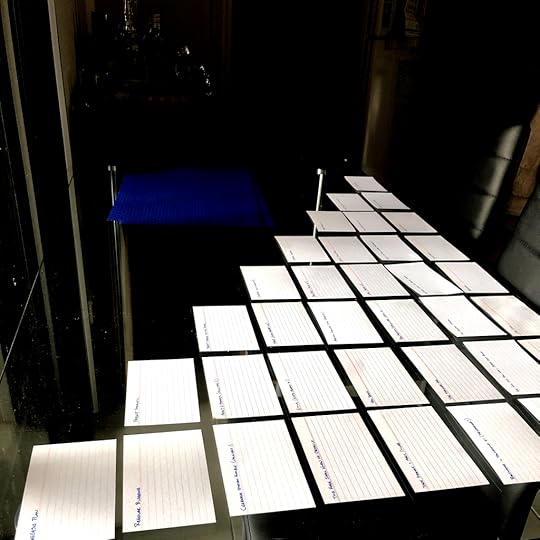
That’s thirty-six projects that got dumped out of my head on the first past–writing stuff that I’m actively thinking about and jotting notes about in my journal. A mix of thesis projects, non-fiction drafts, stories, novellas, and novels, along with a spot for writing regular blog posts, which rated surprisingly high on my priority list.
PHASE TWO: WHAT’S IMPACTING N THOSE PRIORTIES?
After it was done, I sat down with my original pyramid and started making notes on the card. Little things like which genre/subgenre a project belonged to, or how it fit into my broader plans as a writer and publisher. This made it really clear how many of these projects were SF or fantasy, how many were related to building up a platform as an author, and how many were just stray ideas that didn’t really fit anywhere.
One trend that quickly emerged as I did this: Short Fiction Lab projects occupy fifteen of the initial pyramid (and there’s a small horde of less developed short stories that didn’t make it on because they’re in my inactive projects folder). One of those projects was way up at the top of the list, but the others made up the bottom row because they don’t become a priority until current Short Fiction Lab project is done.
In reality, these stories are all one project–create an ongoing Short Fiction Lab line. In my head, it behaves a lot more like a blog than a discrete writing project. As a result, I grouped all those projects into a stack that could be arranged into its own mini-pyramid of projects within the broader scheme.
Interestingly, the thing that feels like the highest priority on that Short Fiction Lab pyramid isn’t drafting a new story, but rather doing the production and design for a bundle and the associated changes to the back-matter of earlier books. I’ve been slowing on my current story draft ever since this idea came into view, and I started planning things and while I won’t swear that this is the reason, I’m tempted to try and clear that top project card and see if that changes my projects.
PHASE THREE: WHAT HAVE I MISSED?
Useful as that first braindump was, it’s also unreliable. Once you’re at thirty-six projects, it’s highly probable there’s stuff that’s slipped your mind. It’s even more likely that you’re spawning half-finished projects at a rate of knots, simply because unfinished projects beget more unfinished projects as subconscious looks for ways to complete the open loops.
So I walked away for twenty minutes, flicked through my various notebook projects, and came back to see what I’d missed.
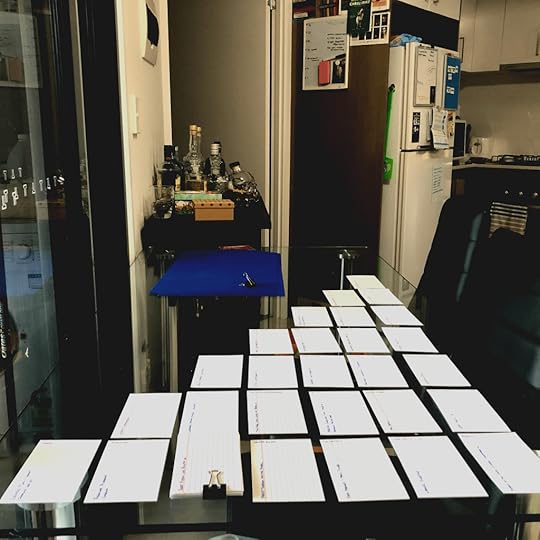
Turns out, I was six projects short. Some of these were stuff ticking away in the background, like my write-one-page-a-day novel experiment that fell by the wayside last week. Some where projects I simply didn’t regard as writing, even if they really are–stuff like my newsletter, which didn’t make the list, even if blogging did.
So I wrote those things up and added them to the pyramid, rejigging the priority to include them in the spaces they currently occupy. The results looked something like this:
PHASE FOUR: WHERE ARE THE UNSOLVED PROBLEMS OR MISALIGNED PRIORITIES?
This process resulted in some surprising things. The biggest is that the top three spots on my priority pyramid aren’t occupied by fiction. The very top of the pyramid is my thesis draft right now–and it’s likely to stay that way until said draft is done, given the deadlines and the complexity of the work I’m doing there. That said, the second row was occupied by my author platform activities–writing regular blog content and producing the weekly newsletter.
This gives me something to ponder, right from the outset: are these really more important than getting new work written? Or publishing new projects that these platform activities are supposed to be supporting? I don’t have answers to this yet, but it’s a fair reflection of my process at the moment–the first half the week tends to be dominated by ticking platform activities off my whiteboard, even at the expense of other writing.
I get a lot of satisfaction from doing both of these projects, and they feed into some of my larger priorities as a person, but they may be taking up more time than I want them too at the moment.
The other useful datapoint came way down in the pyramid, in the section I start to think of as the Urban Fantasy Doldrums. I’m going to throw up another image here, as it makes things a little easier to explain:
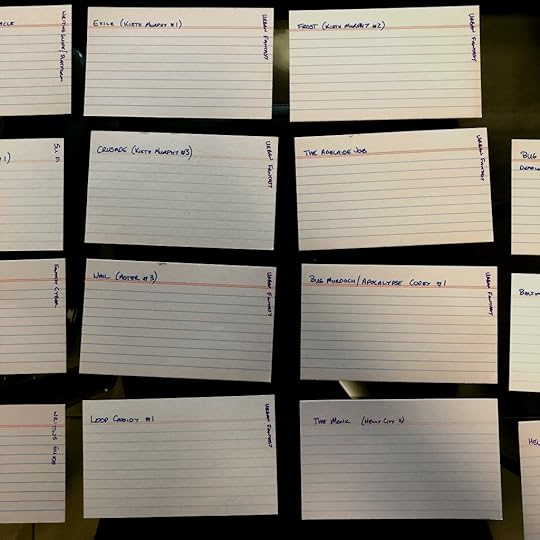
That there, spread across four different priority lines, is a knot of four seperate Urban Fantasy projects with one or more novellas or novels in them. All of them are in seperate universes, unrelated to one another, all using Brisbane or South East Queensland as a default setting, and all having at least 70% of a draft and/or future stories partially drafted if I start digging into my files.
And all four were intended as open-ended series, rather than discrete blocks of narrative, even if the realities of process and publishing stopped that from happening.
As a writer, I’ve got no problem with this–they’re all interesting characters and interesting worlds. There’s stuff there that interests me on the writing front. I fret a little about the possibility of repeating myself, but that’s something I can hopefully work around.
As a publisher, running multiple unfinished series in the same sub-genre, from the same author, this makes for a considerably bigger headache. There’s enough similarity there that they’ll bleed into one-another’s branding, especially if they’re all gearing up and trying to get traction with readers at the same time.
The usual points of differentiation in this situation are usually works coming out from different publishers (if you’re an author), works in similar genres coming from out from multiple authors (if you’re a publisher). Both those options disappear if you’re an indie publisher, unless you’re taking on pen names (something I’ve considered) or working in clearly packaged narrative units like a trilogy or “season.”
Laying the cards out like this actually helps shape some decisions for me, because it pulls attention towards these kinds of issues I need to navigate. There’s a lot of Kieth Murphy books in the pyramid, courtesy of the rights reversion a few months back, but its possible my ambitions and future plans are slightly misplaced. Sure, I could be doing a lot more with the character and the series, but do I want to do that more than I want to kick off some of the books that I’m holding back–subconsciously or otherwise–in order to make that happen?
NEXT STEPS
The current pyramids are really a reflection of what is–the priorities tend to match the things that get the bulk of my attention now.
As anyone whose read You Don’t Want To Be Published knows, I’m a big advocate of knowing what you want from writing. The challenge is that we often want all sorts of different things, and the weighting we give those desires is subject to shifts over time.
Fortunately, part of the pyramid’s charm is that it’s easy to adjust in response to those shifts….and the same tool that helped me prioritise writing projects can also be used to clarify the weighting I give to my various writing and publishing goals.
All I need is a stack of index and a little time to sort them.


September 2, 2019
Black Swan Thinking
Many years ago, I worked a shift at dayjob where shit well-and-truly hit the fan. We were preparing for one of our busiest periods of the year–lots of incoming calls from lots of panicked writers looking to double-check a big opportunity deadline, while simultaneously trying to prep for other big projects that were coming up.
Big opportunity deadline days weren’t fun days at the best of time, but within the first hour of this one kicking off shit started going wrong. One staff member’s flight home had been delayed by twenty-four hours. Another staff member called in sick (from memory, they were heading to hospital). Our then-CEO was incomunicado for the day (for reasons I don’t recall), and the two other staff members on deck were both relatively new to the organisation. On top of that, i was relatively new to the role I was working and the projects I was working on. It was a time of transition, new staff coming in and old staff taking on new positions, everyone trying to find their feet in the new landscape.
All other tasks on the docket went by the wayside as two of us downed tools and answered phone calls for the next seven hours. An unrelenting stream of phone calls, constantly asking the same handful of questions. The third staff member present–who, from memory, wasn’t actually meant to be there and had come in to get ahead on the big opportunity deadline project–pitched in and did some of the sorting so we could focus on the customer service.
The day ended, as submission days tended to do, with a manic burst of activity and panicked writers trying to double-check just how close to the wire they could cut things. Five o’clock came and we downed tools, sorted things, and celebrated with that nervous, relieved laughter that only arrives when the day has been crazy, yet you’ve handled it well and finished without succumbing to the madness.
#
The next week, parts of our management team went into evaluate mode trying to figure out what procedures we could implement in order to prevent such a thing from happening again. We already had guidelines around how many people needed to be in the office in order to stay open to the public (a minimum of two), and when people could take leave, but the reaction to a big, manic day of hell was legislate all the ways it wouldn’t happen again.
We’d stumbled into the phenomena that economic theorist Nassim Nicholas Taleb has dubbed a Black Swan Event, used to describe a moment in crises that both a) involve a very high level of rare, hard-to-predict events that are beyond the scope expectations set by experience and current understandings of the state of play, and b) hold considerable sway on future thinking because we’re psychologically blind to the role uncertainty and chance played in setting up the event.
Or, the short version, an unpredictable event that’s a massive outlier occurs, and we waste all sorts of energy trying to prevent it happening again.
There was a lot of low-probability chance of this particular day being the focal point of so many people being out of the office, and even then it was only a problem because it coincided with the one day in a whole 365 day year that was the final day to submit to a big opportunity that got our base all riled up.
In the six years I worked at QWC, it was the sole time someone missed their flight home after taking leave, and the sole time we were without a CEO and an acting CEO in the office when we weren’t expecting it. It wasn’t the sole time a staff member got sick, but in 99% of cases someone taking sick leave wasn’t a big deal because it wasn’t a high pressure day with lots of queries from panicking writers.
So we talked about what we could do to prevent it from happening again, and the suggestion was basically: do nothing. We couldn’t predict a day like that happening again, and there weren’t any reasonable precautions against it. Rationalising that we could have was applying hindsight to an unpredictable event.
There were, frankly, better uses for our time.
#
Thinking about this a lot right now, because I wrote very little on the fiction and thesis front last week. There were a confluence of factors that influenced this, among them:
I had a stack of marking to grade, which always escalates my tendency towards anxiety The lead-in to Father’s Day was rough, both via advertising and the subtle uptick of movies with relationships-with-your-dad themes on various streaming platforms.I was prepping Short Fiction Lab #4 for launch, but noticing that it was headed for the weakest sales of the series thus far.I was prepping some other projects for launch later in the year, which sucked up a little time.I’d hit a transition point in my thesis draft, and needed to revisit some notes I’d made two years ago. Because we’d reorganised the flat, those notebooks weren’t where i remembered.I’d hit a complex point in my fiction draft, and got a little stuck.
Now, these weren’t entirely unpredictable, but some of them did catch me off-guard. You can’t predict when your subconscious is going to latch onto a problem in your manuscript that you haven’t consciously noticed yet, and this was my first time trying to manage the grief over losing a parent as the major milestones came up.
Obviously, I knew it would be rough, but had no idea how rough or what was going to trigger it (Netflix was a killer, with its seasonal algorithms kicking dad movies into the recommended viewing queue). Even with all that, my suspicion that a good chunk of how rough it was actually stemmed from marking anxiety.
Similarly, i knew my writing tended to dip during release weeks, and also while marking, but there is a big difference between ‘dipping’ and ‘stalling out entirely.’
Despite this, I’d hit a confluence of events that mixed together into a potent disruption, and I immediately started looking for things that would prevent it from ever happening again. I started rewriting business plans and rethinking how i was going to monetise writing projects on the docket. I pulled new ideas out of my arse because they were shiny, figuring they’d be an obvious next choice.
I succumbed, in short, to black swan thinking on the micro level, and started trying to figure out how to manage unpredictability out of existence.
It wasn’t until Sunday, when the marking was done and I’d had a morning to brainstorm the issues with the story I was writing, that I finally caught my breathe and realised what I was doing.
Now, there was some use to the black swan induced mania last week, but those usages largely came because it opened up new avenues of thought rather than gave me useful solutions. It wasn’t until things calmed down that I started to see how those solutions could be implemented much later and much better, compared to slapping something together on the fly to try and solve the unsolvable problem.
I’ve flagged them for further thinking and planning, rather than immediate action.
And yesterday, I fired up my thesis file and my current draft and got back to work, trusting in the process and the business plan that’s gotten me this far into the year. The sole change I’ve made to my process is slapping a honking great eight-hour Freedom session on the writing computer Monday to Friday, rather than just the first three hours of the work day.
‘Cause my process may not be 100% right, but it’s done me right enough thus far, and writing is a better use of my time than any other solution I might come up with.
September 1, 2019
OUT NOW: One Last First Date Before The End Of The World
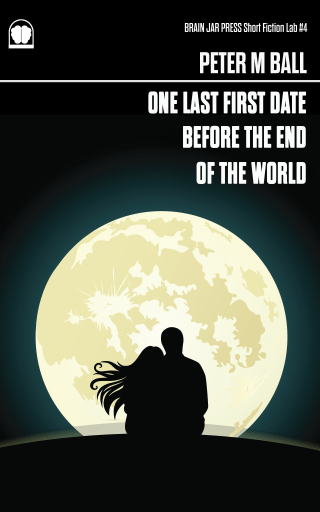
What do you do when your date tells you Ragnarök starts next Tuesday?
Logan expected his date with Stina Lorne to be a disaster, quickly ending after dinner when they acknowledged she was out of his league. Instead they went for a long drive, then a walk along a familiar beach. In fact, everything seems to be going better than Logan could have imagined when he asked her out last week.
Sure, his date is convinced she’s the descendant of Fenrir, demon wolf of Asgard. And yeah, she’s talking about the apocalypse kicking off in the near future. Logan’s not sure that matters, yeah? After all, nobody’s perfect, and even the best relationships take work.
One Last First Date Before The End Of The World is the fourth release in the Short Fiction Lab series from Brain Jar Press. This experiment has been filed under: mythic fantasy, first dates, the day before the apocalypse, and slipstream romance stories.
Available now in Kindle (Aus | UK | USA), Kobo, and other great bookstores.
This release is on sale for the remainder of the week, giving you the opportunity to pick it up for 99 cents US. Come Sunday, it’ll be joining the rest of the Short Fiction Lab line at $2.99.
And with that, I’m off to drink coffee and write new words.
August 31, 2019
The Sunday Circle: What Are You Working On This Week?

The Sunday Circle is the weekly check-in where I ask the creative-types who follow this blog to weigh in about their goals, inspirations, and challenges for the coming week. The logic behind it can be found here. Want to be involved? It’s easy – just answer three questions in the comments or on your own blog (with a link in the comments here, so that everyone can find them).
After that, throw some thoughts around about other people’s projects, ask questions if you’re so inclined. Be supportive above all.
Then show up again next Sunday when the circle updates next, letting us know how you did on your weekly project and what you’ve got coming down the pipe in the coming week (if you’d like to part of the circle, without subscribing to the rest of the blog, you can sign-up for reminders via email here).
MY CHECK-IN
What am I working on this week?
Writing is top of the agenda this week, after the bulk of last week was taken up by grading papers. A good chunk of my between-marking downtime was spent working my way through issues on the Project Stairwell draft, creating a to-do list of things to hit when I started drafting again.
The story is an interesting challenge because it’s really four seperate mini-stories, three of which have their own micro-story nested within them. Getting it right means keeping the reader interested in each part, and seamlessly transitioning from one to the other. I haven’t quite cracked that yet, but I’ll get there.
With luck and focus, the coming week will also see me finish a chapter in my thesis.
What’s inspiring me this week?
I read two Mary Robinette Kowal novels this week–her first, Shades of Milk and Honey, and her recent Hugo winner, The Calculating Stars. Both were the kinds of books I stayed up until 2:00 AM to finish, and both me sent me over tot he internet to revisit some of the truly outstanding and mind-blowing advice Kowal has posted over the years (hint: start with the what puppetry taught me about writing episode of writing excuses).
What action do I need to take?
I need to sit down and do a new Quarterly and Monthly checkpoint this week–they were on the list for last week, but got eclipsed by some of the short-term deadlines. This is a state that could well continue, and I’m hitting the part of the year where lots of different things feel urgent. Outsourcing my thinking to to a more detailed plan that tells me what actually is urgent will help keep me on track.
Status Post: 31st August, 2019
BIG NEWS THIS WEEK: One Last First Date Before the End Of the World was released today.
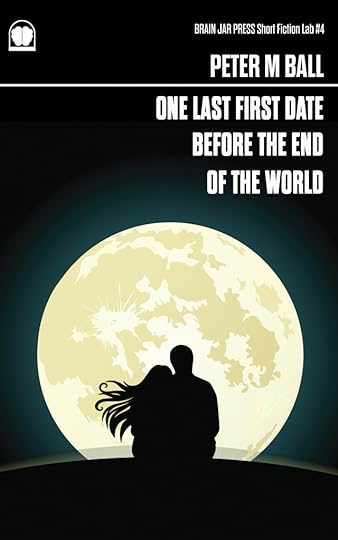
What do you do when your date tells you Ragnarök starts next Tuesday?
Logan expected his date with Stina Lorne to be a disaster, quickly ending after dinner when they acknowledged she was out of his league. Instead they went for a long drive, then a walk along a familiar beach. In fact, everything seems to be going better than Logan could have imagined when he asked her out last week.
Sure, his date is convinced she’s the descendant of Fenrir, demon wolf of Asgard. And yeah, she’s talking about the apocalypse kicking off in the near future. Logan’s not sure that matters, yeah? After all, nobody’s perfect, and even the best relationships take work.
One Last First Date Before The End Of The World is the fourth release in the Short Fiction Lab series from Brain Jar Press—home to stand-alone short story experiments in fantasy, science fiction, horror, and fabulist literature. This experiment has been filed under: mythic fantasy, first dates, the day before the apocalypse, and slipstream romance stories.
AVAILABLE NOW AT ALL GOOD EBOOK STORES
BIG ACHIEVEMENTS THIS WEEK: I marked a stack of assignments in a relatively efficient manner, rather than giving into procrastination and leaving everything until the last minute. I also did a metric buttload of reading this week, polishing off a bunch of books that I’ve been meaning to finish for a while.
Which means it was essentially a holiday from writing, with everything else going on. Some words were done, because I’m bad at holidays, but I’m actually taking a weekend off to regroup and plan ahead.
CURRENT EARWORM: Spice Up Your Life by the Spice Girls.
CURRENT READING: My current print reading is Catherynne Valente’s Radiance, and incredible sci-fi novels about alternate universes where the golden age of Hollywood took place in space. Not a description that does the book justice, but I’ll likely do a larger write-up when I’m done.
I’m also half-way through The Meg: Origins, the free novella tucked into the back of Steven Altern’s giant shark novel, The Meg. I was a big fan of the movie adaptation, but it’s really interesting to see how he’s spun the original story off into a whole universe of sequels.
BEST SCREEN MEDIA OF THE WEEK: A Stupid and Futile Gesture, a biopic about Doug Kenney and the creation of the National Lampoon, which is a far smarter and more entertaining film than you’d expect when you hear the words National Lampoon. Incredibly well done, borrowing a narrative style from its subject and playing with conventions with unabashed glee.
INBOX STATUS: 20 emails and probably growing as I type this. I’ve barely looked at my inbox this week, and really need to go clear it out.
WHAT I’M LOOKING FORWARD TO RIGHT NOW: Monday morning, which represents both the period where the emotional turmoil of Father’s Day is over and I can get back to writing fiction drafts.
August 29, 2019
Vintage Links 005: Literary Fame, Publishing Crashes, Breathing, & Research

It’s Friday, September 30, and so I launch into the fifth instalment of my Vintage Links series. It’s been an interesting week clearing the To-Read folder, as i’ve had my first run of posts/articles that were either a) no longer online, or b) now taken over by godawful spam sites that have camped on the former name.
The Bizarre, Complicated Formula for Literary Fame (Joshua Rothman for the New Yorker, 2015)
Read it at the New Yorker’s Website
When you work in a writers centre, you tend to accumulate articles about how various writers get famous or made a giant splash. They’re almost always talking about outliers, because the kinds of folks who get the big coverage are exceptions to the rule, but they’re also the source of information for how publishing works for many new writers. They assume every successful writer’s career trajectory mirrors Stephen Kings, or Dan Browns, or JK Rowlings, or…well, you get the idea.
This…isn’t one of those articles. Rather, it’s a look at what makes Romantic poets like William Wordsworth more famous and remembered than their contemporaries, via an academic study by HJ Jackson at the University of Toronto. The answers are surprising, involving writing different types of works, creating work that is easily illustratable, and work that is highly adaptable.
I’m intrigued by how well this seems to marry up with the insights on creativity from David Epstein’s book, Range, which argues for the power of being a generalist rather than a specialist and the power of writing in different styles and genres.
The Easiest Way To Get Started Running: Mind Your Breath, Not Time (Lifehacker, 2015)
It’s notable that 2015 was the year that I learned I had chronic sleep apnea, and one of the contributing factors was my weight. I started accumulating posts about diet, budgeting (’cause treating sleep apnea costs, yo), and exercise as they rolled through my feed.
This one caught my attention because it was all about committing time to the act of running, but tailored the process to your current condition. It was such a useful approach that I flagged it as a metaphor for learning to write in classes.
Business Musings: The Hard Part (Kristine Kathryn Rusch’s Blog, 2015)
Read the post at KrisWrites.com
Rusch has been posting about the state of indie publishing for years, and always comes at the strategies with the mindset of a career-long writer and editor who has seen the status quo of publishing shift more than one. This post talks about the shift away from the tactics that worked in the early days of Kindle, and the problem with binding your approach to a single tactic and retailer that you don’t control.
It’s also a post on the steps you take when your tactics crash into a trough, which is one of those things that’s going to happen more than once in any writer’s career. Some really useful insight:
Every single successful freelance writer I’ve ever met bounced on and off day jobs early on in her career. Every single one—except those who have a spouse, significant other, or family member who was willing to bankroll the ups and downs of a writing career.
Using the day job to relieve financial stress is a time-honored freelancer tradition.
Indie writers have never faced this before. Most of them believed that the gold rush would last forever. Some burned bridges horribly with their day jobs, so there’s no returning.
But there are other day jobs. Most freelancers get lower-level service jobs to tide them over—not career jobs. Things like retail or waiting tables or temp work. Those will often pay the bills until it’s time to freelance again.
Never look at one trough—no matter how deep—as the end of your career. It’s only the end of your career if you end your career.
How To Research Like A Journalist When The Internet Doesn’t Deliver (LifeHacker, 2015)
Exactly what it says on the tin. A remarkably good primer on how to research if you’re a writer, digging into things well beyond what you can find with a Google search. I may have sent this out to more than a few people who called into the Writers Centre looking for advice about researching their projects, but it’s lingered in my to-read file despite this.
August 28, 2019
RECENT READING: Do Anything by Warren Ellis

Warren Ellis takes a look at the history of comics using the metaphor of Jack Kirby’s Robot Head as the central metaphor and anchor for his free-associating path through the topic.
That doesn’t do the book justice, though. I don’t think any description ever will. Because one of the things that unifies Ellis’ disparate project tends to be his interesting in breaking down a form to its components and rebuilding it into something new.
Ten years, when this book was just a column on Bleeding Cool, he took that approach to a weekly essay on comics books. The days, you can see him deploy the same approach over on his website, courtesy of the way he’s thinking out loud about comic book publishing and developing his vision for a weekly newsletter in an ongoing web series.
I discovered this book by a circuitous route. I’d been a fan of Ellis for years, courtesy of his work on Transmetropolitan and his Authority comics for Image, and gradually followed him into fiction writing (go read Normal) and writing for screen (Go watch Castelvania on Netflix). Mostly, though, I became a fan of watching Ellis think out loud on his blog and in his newsletter, watching him interrogate ideas and chart his interests for readers who may be curious.
Do Anything was an old project by the time I latched onto his social media, but it would occasionally get referenced because it was written in a very particular way: an ongoing serial essay that was drafted in a reporters notebook, one long essay with the breaks inserted later, during the second draft as Ellis went back and coaxed a little more out of the seeds he planted.
I’m a sucker for anything notebook related, especially when it’s based upon changing up a process, so I went and sought the book out. It’s not available online, but the book is slim and cheap–essentially, it’s a 48-page comic format that just happens to be full of words instead of pictures.
There are books that leave their fingerprints on you, when you read them as a writer. Books that break open the way you’d thought about something and showed you whole possibilities you hadn’t seen. This is definitely one of them.
DO ANYTHING: THOUGHTS ON COMICS AND THINGS, WARREN ELLIS: Amazon (AUS | UK | USA)
August 27, 2019
Movable Objects
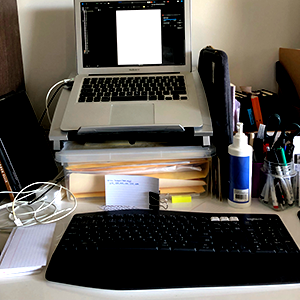
Over the last few weeks my laptop has taken on an increasingly stationary role. I’ve pulled it away from the current set-up exactly twice–once for Write Club and an afternoon at the university, and once when it was necessary to write away from the desk due to other things going on in the flat. the rest of the time it’s sat in the same spot, with the same peripherals plugged in or attached to the bluetooth. Surrounded by the same tools, the same books, the same project notes.
After two or three years of migrating around the flat two or three times every work day, the steady routine of being able to just sit and write is surprising.
Of course, give that it’s Wednesday as this post goes live, I’m probably engaging in my once-weekly ritual of carting the computer across town to get work done.
On the downside, I’ve been in a stretch of letting my phones get smarter again. More notifications, more access to distracting stuff. Just as making the laptop less movable has had some surprising benefits, it may be time to dumb down the tools that get used for jobs that aren’t writing.
August 26, 2019
Movies That Surprised Me: Office Christmas Party

I remember when Office Christmas Party hit cinemas, and I’d planned to go see it. The film looked awful, a little slice of seasonal narrative that was going to be equal parts debauchery and twee, but every time the trailer’s played I kept noticing actors whose work I dug in the supporting cast: Kate McKinnon, Olivia Munn, Courtney B. Vance, Randall Park, Jennifer Aniston.
“It will be terrible,” I told myself, “but it could have some great moments.”
Then life got busy, ’cause it was the holidays, and it’s time in cinemas was incredibly short. There was always a movie slightly more appeal playing at the same time, and I went to see that instead.
Fast forward to last week, when my partner and I settled in for a trashy movie night and scrolled through the new releases on Netflix. Office Christmas Party flashed up, and the graphics were basically Kate McKinnon in a terrible holiday sweater, and my partner was sold on that basis.
“This will be terrible,” she said, “but Holtzman will be great.”
So we loaded up on junk food and put the movie on, and lo….it was almost entirely the movie you expected it to be after watching the trailer.
But–and I’m going to stress this–it’s only almost entirely the film you’re expecting: Yes, it’s about a bunch of plucky office misfits trying to save their company with a massive party; Yes, it’s reliant on familiar jokes about sex, drugs, alcohol, and inappropriate behaviour; and, yes, it’s a film about the evil, soulless corporations being measurably worse than the small, this-is-a-family firm. It’s an underdog-misfit story that has been played out constantly, and problematically, since Porkys and Revenge of the Nerds.
Which is why the film would occasionally catch us off-guard when it would throw in references like the white-straight-male-trust-fund-kid-CEO being aware enough to recognise that he’s basically easing through life on the lowest possible difficulty setting, or pulling off a moment of insight around consent, or race, as they progressed through the usual beats you associate with this kind of film.
These insights weren’t nuanced–in some cases, they were largely hanging a lampshade on things before going for the problematic joke regardless–but it’s interesting to see the way in which conversations around equality are filtering down from high-end think films to the cheap-and-easy holiday filler.
And it also meant that when the film pulled off a really nice bait-and-switch at the midpoint, delivering the climax we expected at the end and veering off in a new direction, we were inclined to follow along with it. By the time Jennifer Aniston’s cold, corporate antagonist busted out some sweet Krav Maga, we were largely onboard with this film being one of the best usages of Aniston in years.
For a film we largely picked to watch Kate McKinnon being cooky and weird between the dross, it caught us off-guard enough to beat our expectations.
At the same time, it delivered exactly the right among of McKinnon being cooky and weird to satisfy.
August 25, 2019
RECENT READING: Clementine, Cherie Priest

I started describing this book to my partner as I was approaching the midpoint, running through the key details: steampunk western; Escaped slaves turned dirigible pirates; a female spy forced to become a Pinkerton because she’s too famous for the South to want her anymore; MAD SCIENCE SUPER-WEAPONS!
My partner basically asked me to stop and put it on her to-read pile before I’d finished the list.
Clementine is part of Priest’s Clockwork Century series, which started with 2009’s Steampunk Zombie Western Boneshaker and rolled through another 5 novels and two novellas. This is one of the latter, originally released as a special edition by Subterranean press and now out in paperback for everyone who wants to catch up.
As a novella, it’s not going to be for everyone. It’s definitely a long novella–I’d estimate that it runs close to 40,000 words–but it packs a lot of story, action beats, and two POV characters into that count. The result is a story that rattles along at an incredible pace, but it’s definitely one for the people who like moving fast and know the world from the prior novels.
It is, in fact, the kind of book that makes for a really interesting case study for my PhD, although I’m not entirely sure that I have the time to do it justice before the thesis is due.
Anyway, I loved this book. I’ll be going back to it and studying its techniques closer, to get a feel for how it moves at the pace it moves at, and it’s served as a good reminder of why I loved the series. It turns out that I’d completely missed the last two books in the sequence as well, so I’ve got some more to look forward to.
CLEMENTINE, CHERIE PRIEST: Amazon (AUS | UK | USA) | BOOKTOPIA