Peter M. Ball's Blog, page 25
October 8, 2019
Cat Mojo vs. Peter Mojo
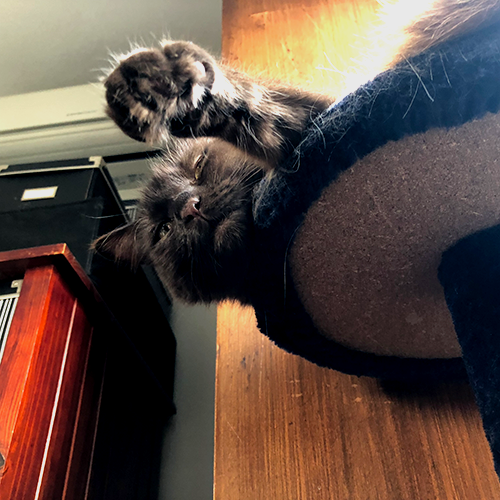
Today I return to the internet the same way I left it a week ago: by posting a picture of my cat doing cat-like things.
There’s a lot of gathering-up-the-threads going on today, trying to figure out where I’m at in a whole bunch of projects. First cab off the rank is calling the shelter we adopted the Admiral from last month, letting them know that our thirty-day trail is going well and that our cat is very definitely going to be our cat. We like her and want to keep her.
Second cab off the rank is taking a look at my daily routine and hacking it a little, trying to figure out where the kitty fits in. The admiral is an inside cat, and our apartment is kinda small. That means she needs a lot of exercise of the hunting-and-pouncing kind, or the thing that she hunts and pounces will inevitably be our feet.
This means there needs to be two or three sessions of play fit into the daily routine, giving her a half-hour or more of chasing a mouse on a string around the flat. It’s a genuinely gleeful experience for cat and owner, but it’s also disruptive. A new daily behaviour with no strong indicators about when it needs to happen, or what occurs after it.
This isn’t necessarily a bad thing in and of itself, but we picked up the need for this much play after watching Jackson Galaxy’s show (and reading his book, Total Cat Mojo) right about the time my grandmother passed away. Not having my usual routines in place made it easier to let some of the necessary self-care lapse and get distracted by the complex knot of feelings I’m trying to process.
Which, in turn, wore me down because that rarely led me to the work desk on a given day, and so a neat little anxiety/shame spiral started picking up momentum.
It’s been a good week for the kitty mojo, but a tough one on my own.
Fortunately, it’s not like that mojo is out of my control. So, today, I’m taking a page from some other recent reading, James Clear’s Atomic Habits, and mapping out my morning routine to start building in the new additions and creating a flowchart I can follow that will deliver me back to the desk.


October 1, 2019
Placeholder Cat Holds The Fort
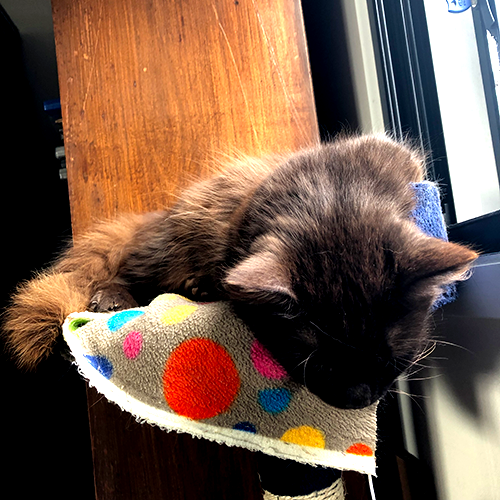
Offline today, on account of heading to my Grandmother’s funeral, so I’m posting this picture of the Admiral engaged in one of her weirder sleeping habits. You don’t get to hear the tiny snores that kick in when she falls asleep with her head like this, but trust me, they’re adorable.
September 30, 2019
Publishing in the Age of the Apphole
Craig Mod’s latest Roden Explorer newsletter features excerpts from a long speech he delivered about dopamine, smart phones appholes, and the social contracts of entertainment. You can check it out via his newsletter archive, and I’d suggest it’s as required reading if you’re an author trying to forge a living in a social media world.
Part of what interests me about the speech is the way he charts the progression of certain media outlets into dopaminergenic publications–a frequent problem with legacy media outlets transitioning into an online space, forcing them to at least partially shift their business model to capturing your attention and keeping your eyeballs on their sites in order to reap sweet advertising bucks.
When these incumbent newspapers were print only, there was only one way to “enter” the content: Through the front page. The front page was all you could see on the news stand. Once you bought the thing, you were converted to a paying participant. Make note: Design and contract parameters go hand in hand. When the front page is the only entry point, only a single page of the publication requires hyperbole to convert passers-by to readers. Online, every article becomes a potential entry point. And so there is an incentive for pervasive hyperbole in order to “convert” eyeballs in service to ads and the consumption of more attention.
Media Accounting 101: Appholes and Contracts, Craig Mod
This, in turn, changes the contract between reader and publication, and not always for the better.
Where my interest really picked up was when his attention turned towards TV business model, starting off with the reminder that once upon a time television broadcasts ended for the evening. Compare that to the present, as Mod explores it:
Netflix is a $134,000,000,000 market capped company with 6,000+ employees. Competition is rapidly rising: Disney+, Amazon Prime, HBO Go / Now, Apple TV+. Netflix is a public company. The mandate is they must continue to grow. Netflix can’t lose us as subscribers, but they also can’t charge much more. And so, one imagines an internal mandate decrying: Netflix must become a downtime habit humans cannot live without. The service must become a teat, an irreplaceable and inexhaustible binge conveyance. Unsubscribe? Unthinkable! Their current strategy in achieving this is to produce an endless profusion of well-funded shows. Some of which are superb.
…
Browsing Netflix is an endless sensation of falling forward into ever more content. Previews auto-play. As soon as one episode in a series ends, the next begins before credits finish rolling. If there’s no other episodes in the series, random trailers begin to play. The very design of Netflix itself is constructed to reduce your ability to a) think about what you want to do, and b) step away from the service. It’s designed to be a boundless slurry of content poured directly into your eyeballs. In a way, it’s training us to never step back or even consider, say, reading a book or going for a walk. The binge is dopaminergic to the max, satisfying some odd completionist instinct.
That, Mod argues, is a truly complex social contact for us to navigate compared to way subscriptions used to work.
What’s interesting about this speech is the way it contrasts with publishing strategies in the indie space. A terrain where ideas like “Rapid Release” and “Capturing Whale Readers” dominates the rhetoric and strategic vision of most writers, because they’re actively trying to replicate the capture-a-reader-once-and-never-let-them-go ideology behind most dopamine driven entertainment (and because Amazon has built the platform for it, and grown hungry for content).
Mod isn’t blind to the advantages of that approach–he openly acknowledges that the Netflix model can result in great TV and a diversity of voices getting chances that wouldn’t be there in the traditional television model–but he’s interested in the goals that publishing can embrace in the current environment.
To recap: The adversary of books is anything that eats attention — appholes. The way to fight appholes is by helping potential readers habituate the very act of reading.
Habits are tied to identities. So the goal should be to convert the identities of wanna-be readers into full-fledged bag-o-books readers. Our goal is not to get someone to read a single book, but become a reader.
And traces some of the appeal of being a reader, particularly of hardcopy books:
…a physical book provides the simplest contract of most media today. Simpler contracts often (but not always) mean that the object or app or piece of media has our best interests in mind (that’s why the contract is simple; the befuddling nature of complex contracts is a feature for the company defining the contract, not a bug), simpler contracts make it easier for us to do “action” as opposed to “motion.”
I’m going to stop here, less I end up reposting a truly large chunk of a 4,000 word essay/speech that really is worth giving a read. These quotes are just the bits that resonated with me in the first half.
Even if you disagree with Mod, you can’t argue with the depth of his thinking. He’s always a fascinating commentator on the issues of publishing and tech, but this is one of the best things he’s done in recent years.
September 29, 2019
Anchor, Orient, Reduce, Contrast
Where do ideas come from? It’s the question that you’re not meant to ask writers and other creative people, because the mythology of creativity is so fucking bizarre that providing a real answer is seen as a diminishment of the art produced. Or it’s disregarded because people assume the idea is the important part, rather than the work to flesh it out and build it into something.
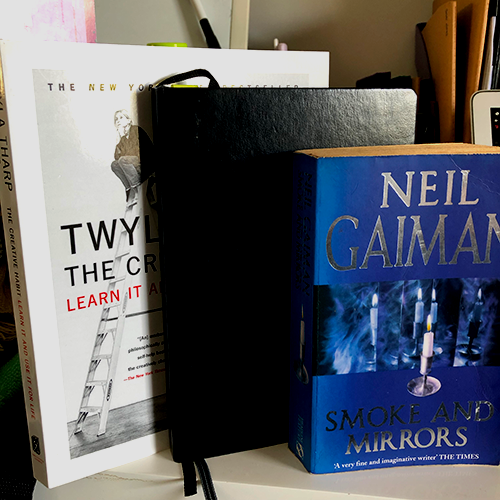 Tools on the work bench this morning
One of the best answers I’ve ever seen to the question actually comes from the perennially underrated Neil Gaiman novellette The Goldfish Pool & Other Stories, available in his first short story collection Smoke & Mirrors. In it, Gaiman’s novelist-turned-screenwriter protagonist reaches for an answer as he grapples with art and storytelling and the weirdness of Hollywood:
People talk about books that write themselves, and it’s a lie. Books don’t write themselves. It takes thought and research and backache and notes and more time and more works than you’d believe.
Except for Sons of Man, and that one pretty much wrote itself.
The irritating question they ask — us being writers — is: ‘where do you get your ideas?’
And the answer is: Confluence. Things come together. The right ingredients and suddenly: Abracadabra!
Smoke and Mirrors, Neil Gaiman, pg 87
(An aside for those who’ve never read Smoke and Mirrors: it’s worth it for this one story. It’s like the early seeds of an approach to narrative that eventually bloomed into Gaiman’s acclaimed novel, The Ocean at the End of the Lane, but its infinitely stranger and touched with a stronger sense of the uncanny).
That particular quote about ideas has been living in the back of my brain forever, and it always bubbles up to the fore when I find myself stuck on something. Case in point: one of my tasks last week was producing a scene for a short story.
The scene involved a weary, long-retired swordsman returning to an arena where he’d been forced to fight as gladiator for an alien ruling class in the city where he lived, ostensibly as a favour to his old mentor as the next great gladiator refused. My goals for the scene were ambitious, because there were a lot of moving pieces in play:
I wanted to render a familiar space and the strangeness that had seeped in now that he encountered in a new contextI wanted to give the reader a sense of how far the protagonist is from the crowd of people around him, and the realisation that he’d once been complicit in the thing that horrifies himAt the same time, I wanted a sense of nostalgia for the fighter he used to be, as well as a sense of envy as he sees the new generation take his spot.I wanted to use the scene to mark a sense of transition–the protagonist has spent the first few scenes in cramped tunnels beneath the arena, dealing with people one-on-one. This scene marks the point where he’s moved to a passive role, after seeking people out, and stepping from the darkness of the tunnels into the bright, open space of the arena he once dominated. In effect, he goes from being a big presence to a single figure in the crowd. And, finally, he has his first encounter with an alien noble since the story began, which becomes the major catalyst that drives the narrative going forward. This means I’m both establishing the big conflict, but also giving the reader context for the nobility’s inhuman goals and trying to instil an uneasiness into the encounter.
It’s a lot to do, and not easy, which is why I kept getting stuck on it. Trying to figure out the techniques to use, and how I want to move the reader’s attention around through the various narrative beats. If I get it right, it becomes the beating heart of the story–a little focal point for the mood I’ve been building up in the previous scenes. A gear change that alerts the reader that we’re heading into the real shit now.
Today, two things came together for me that may actually get me through the scene (albeit with a good deal of work).
The first was a lecture I sat through last week for the class I’m teaching, where a lot of the focus was on thinking about Setting and Context. Two of the things we advised students to look for were the ways a reader is anchored and oriented–what do we ask them to latch onto? How do they know where they are?
These are habits it’s easy to forget about when you’ve been writing for a while, particularly if you’re a panster. They are tools/techniques that become subconscious habit, rather than tools you can turn to while drafting when things are going wrong. Slipping into a point of view and establishing a need (the anchor) becomes second nature, as does seizing upon the details that will give the reader context for what’s to come.
There’s very few writers I know who tend to think in terms of naming techniques like this, but it’s surprising how useful they can be. They give you a next step, when you’re stuck on something, and if you can’t complete that next step then you’ve got a tool for analysing what work still needs to be done.
If I can’t anchor the reader, it’s probably a sign I don’t yet know what’s coming in the scene and where the real conflict lies. If I can’t orient the reader, it’s because I don’t yet know what’s going to become meaningful details as the scene progresses. Both things may come if you start writing, but it can useful to sit down and list potential details rather than pelt words at the page.
Useful as those two words may be, they weren’t enough to solve this particular conundrum on their own. Fortunately, they were fresh in my mind as I started reading Twyla Tharp’s The Creative Habit, and in particular her chapter on scratching for ideas when you’re stuck or starting on something.
Part of what Tharp talks about here are the difference between big ideas and little ideas–the stuff that are self-contained and self-defining. The big projects that are marked by their ambition and ulterior motives, and fire you up with their inherent energy.
The scene I’m stuck on is a big idea. And, like most big ideas, it both takes up a lot of mental space and involves an incredible number of small steps in order to bring them to the fore. And the small steps are not big ideas, but a steady accumulations of smaller ideas that are deployed in succession.
“This is why you scratch for little ideas,” Tharp suggests. “Without the little ideas, there are no big ideas.”
Or, as she puts it later in the chapter:
Scratching is what you do when you can’t wait for the thunderbolt to hit you. As Frued said, “when inspiration does not come to me, I go halfway to meet it.”
…Remember this when you’re struggling for a big idea. You’re much better off scratching for a small one.
The Creative Habit, pg 98
Incidentally, people had been recommending Tharp’s book to me for years, and I’d been slow to pick it up because it was only available in hardcopy (for the curious: Amazon AUS | UK | USA and via Booktopia). It’s part analysis of Tharp’s own creative process, part meditation on what’s really going on when we create, and I’ve been pulling little details out of every chapter I come across.
The example she goes on to give draws from Robert Pirsig’s Zen and the Art of Motorcycle Maintenance, talking about scaling the ambition of a project down until your subject is a brick rather than an entire country.
And, the moment I read that, I knew where I was going wrong. Because the scene I was stuck on didn’t just need anchor and orientation, it needed the focus to be narrowed in on very specific things. I’d been thinking of the scene in cinematic terms–all the detail and grandeur that could be achieved if you pointed a camera at something and let it wash over the viewer.
I don’t have that option as a writer, because readers will only pick up details once sentence at a time. Smaller things need to stand in for larger things, and single details need to suggest a broader field of details begin.
Which meant I didn’t need to start with the crowd or the grandeur, but something personal. The give I was looking for was a slow accumulation of details and reactions, not the sweeping reveal of a cinematic scene as the characters stepped onstage.
In this instance, I can filter a whole lot of what I’m trying to do with the scene into the act of preparing–pulling on an old uniform element, contrasting the protagonists feeling for wearing it once more against the way everyone else responds to him wearing the house colours. That gives me a hook and a very specific, focused metaphor that I can hang the rest of the scene on, as everything builds out of that particular moment and emotion.
And for the first time, I can see the scene as part of a book instead of a big feast of visual details. I’m playing to the strengths of the medium, rather than being beholden to a genre beat that the medium isn’t great at replicating.
Neither Tharp’s book or the lecture would have got me started on their own, but the confluence of those ideas coming together got me thinking about things in a new way: anchor, orient, reduce the focus, find the contrasts.
It’s a neat little list to fall back on when I’m stuck on a particular scene.
September 28, 2019
The Sunday Circle: What Are You Working On This Week?

The Sunday Circle is the weekly check-in where I ask the creative-types who follow this blog to weigh in about their goals, inspirations, and challenges for the coming week. The logic behind it can be found here. Want to be involved? It’s easy – just answer three questions in the comments or on your own blog (with a link in the comments here, so that everyone can find them).
After that, throw some thoughts around about other people’s projects, ask questions if you’re so inclined. Be supportive above all.
Then show up again next Sunday when the circle updates next, letting us know how you did on your weekly project and what you’ve got coming down the pipe in the coming week (if you’d like to part of the circle, without subscribing to the rest of the blog, you can sign-up for reminders via email here).
MY CHECK-IN
What am I working on this week?
My twin goals for this week are:
Writing something on my PhD exegisis every day–I’ve fallen off the wagon with the events of the last two weeks, but this week I get to reaffirm my commitment to the project and get it moving once more.
Work on the Exile (Keith Murphy 1) re-release and clear at least three chapters.
It’s the first time in a while that I haven’t set myself any first draft goals, but it’s going to be a complex week for getting stuff done. There’s a funeral to go to, a packed weekend next weekend, and I’m in the phase where habits get to be reset and re-affirmed rather than being tools to rely upon.
What’s inspiring me this week?
The biggest bang-for-my back inspiration this week has been Craig Mod’s latest Roden Explorer newsletter, in which he devotes approximately 4,000 words to the idea of publishing, appholes, and dopamine-driven entertainments. It’s the kind of topic that’s deep inside my wheelhouse to start with, but it came loaded with enough links to other resources that have got my brain sparking that it’s a highly inspiration-rich ground zero document.
What action do I need to take?
Less an action I need to take, and more an action I need to maintain: keeping my desk clear. I let a whole lot of clutter rise up in my workspace over the last few months, which culminated in the classic I’ve-spilled-coffee-on-my-laptop moment that tends to arrive when there’s nowhere to put the cup.
This was a prompt to get the desk cleared last week, but it will be ridiculously easy to fall back into the clutter mode, so I’m challenging myself to develop two habits: starting each day with a desk clear, and ending each work session by returning the tools (books referenced, notebooks worked in) back to their default state.
Ideally, I’d like to be hitting next Sunday with the desk in much the same state as it is now–a clean, ready-to-use surface where work can spread across as necessary, ready to adapt when I switch between computers and notebooks in order to get work done.
September 27, 2019
Status Post: 28 September 2019
Picking up the weekly Status Post thread this week, if only so I remind myself that I’m the kind of person who does this (I’ve been reading Atomic Habits this morning, and it’s affecting the way I think about things).
Sneaking this in quickly before we head South to visit family for the rest of the day, but adding in a new category for those who enjoy kitten-based hi-jinx on the internet.
CURRENT FEELINGS ABOUT THE CAT: Positive.
Admiral Coco Marshmallow Flerkin-Wittingstall has been part of our household for nearly three weeks now, which is about the point that the shelter we adopted her from is willing to concede she’s become part of the family. I continue to be enchanted by some of the bizarre poses she adopts as she lazes around the flat.
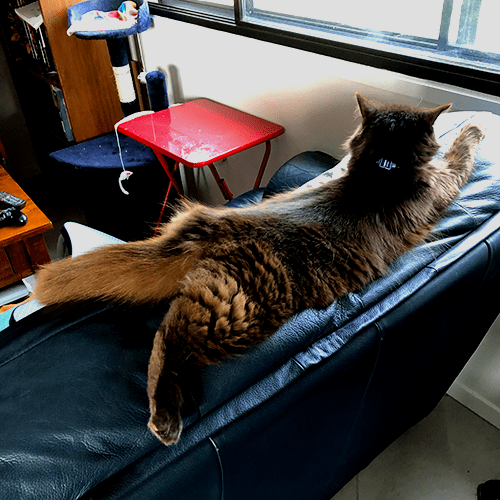
On the other hand, she has just spent the morning hunting everything. Her felt mousey. The doorstop. My hands. My feet. My leg. The blanket. My phone. Goblins from beyond space and time.
CURRENT WRITING STATUS: Regrouping. Deaths in the family after an anxiety week mean my process has gone out the window, but I’ve been spending a good chunk of my time setting myself up to return to regular progress now that things are calming down.
CURRENT EARWORM: Helmet’s Milquetoast has been stuck in my head for the better part of a week, and I’ve routinely found myself putting the entire Betty album on for a spin as a result.
CURRENT READING: Neil Gaiman in the 21st Century: Essays on Novels, Children’s Books, Online Writings, Comics, and Other Works–a collection of academic papers on various aspects of Gaiman’s work. The early run-through of essays about American Gods has been fascinating, but it’s really picking up as I move into the essays about Gaiman’s kid’s books.
BEST SCREEN MEDIA OF THE WEEK: My partner and I have started picking up specific movies to watch on a Friday night, rather than cruising Netflix to see what’s there. It means there’s a bit more intent behind the films we’re watching, and we can catch up on stuff that we really wanted to see.
That said, this week we flicked through the films on sale and spotted Seventh Son–a film that scripted like it’s straight out of the heyday of 80s B-Movie fantasies, but embraces digital effects. It’s an odd film: weirdly paced with a fifteen minute prologue before introducing it’s actual protagonist; plagued by an all-too-short appearance by Kit Harrington, who is largely used poorly; Jeff Bridges playing a pompous demon-hunting knight, adopting a truly bizarre accent but committing to it 100%.
I’m obviously taking a very loose definition of “best screen media” this week, but Seventh Son is straight-up cheese blended with a D&D rules manual and a handful of great actors really committing to their scenery chewing. It’s not going to be everyone’s taste, but when we’re in the mood to make goofy D&D jokes the entire way through the film, it’s the perfect Friday night film for the Brain Jar Compound.
INBOX STATUS: 10 Emails. I had it down to one before I closed up shop yesterday, but everything came in overnight.
WHAT I’M LOOKING FORWARD TO RIGHT NOW: There’s some jerk chicken in our fridge, waiting to become dinner later this week. I’m totally there for that.
September 26, 2019
27 September 2019
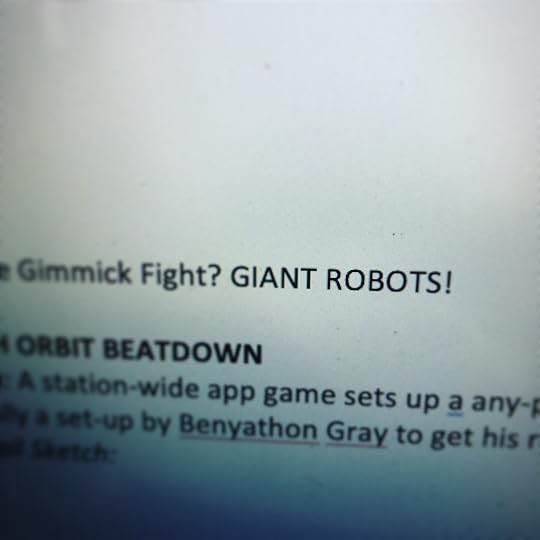
I’m largely offline today, so here’s a glimpse at the planning document for a future Brain Jar series. This is poking at a story idea that sits about halfway through an 8-book run.
My grandmother passed away yesterday morning, and today I’m running on too little sleep and a fresh hit of grief in a year that’s already been heavy on grieving. I’m going to be paring back expectations on the writing front for a stretch, trying to winnow down process to the bare minimum of things that need doing right now.
September 25, 2019
Snoots and Roundabouts
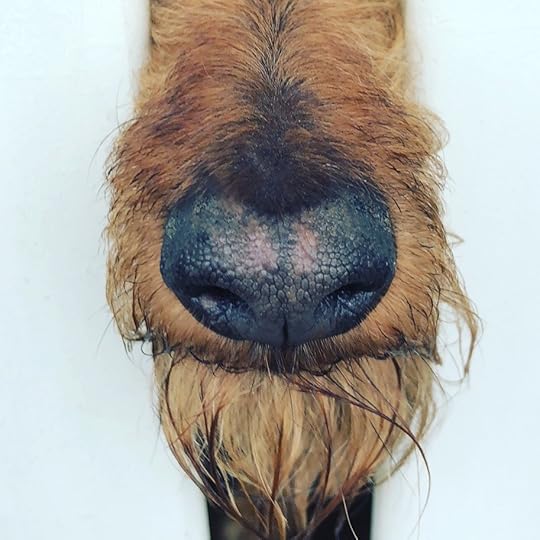
I snapped this photograph while waiting at the door before Write Club yesterday. The snoot is donate by Lulu, a regular feature on the inimitable Angela Slatter’s Instagram.
Today I’m off to the sunshine coast, where my grandmother is in hospital. She’s in her nineties and hasn’t been in great shape the last few times we caught up. She went into palliative care for a bit, but rallied later in the day and moved back into regular care.
Regular blogging will resume at some point, but it’s fairly clear at this point that 2019 is not a year where regular anything is possible.
On the plus side, it’s also a year that’s taught me the value of appreciating dog snoots, toe beans, good friends, and the rare moments when everything has been running smoothly and you’re free to put your focus on a single project.
September 24, 2019
Writing as a great and terrible steampunk juggernaut
There are weeks when my writing process feels like a great and terrible steampunk juggernaut, powered by a creaky engine and beholden to its own momentum. When everything is running correctly, I get an extraordinary amount of work done and quickly stack up pages.
When things go wrong, momentum will carry me for a while even though the engine is blowing pistons and and leaking fluids. Then the momentum will falter and the fires of the engine will go dark, and the act of getting the whole thing moving once more feels impossible.
Sometimes, the thing that goes wrong is needing to turn and head in a new direction. Or stop for a while, to focus on something else, then restart after a short break. Sometimes the thing that goes wrong is a problem in the engine itself–a loose screw nobody noticed that gradually rattles free.
Either way, once the momentum is gone, it feels like getting the engine started again is a near-impossible task.
It’s not. What I need to do to get started again is generate words: one word, then the next. Easiest thing in the world to do. They don’t even have to be good words, just words that exist. Even a handful will do it.
The engine feeds on words. Everything after that is navigation, and you do that once the whole machine is up and running again.
September 21, 2019
The Sunday Circle: What Are You Working On This Week?
The Sunday Circle is the weekly check-in where I ask the creative-types who follow this blog to weigh in about their goals, inspirations, and challenges for the coming week. The logic behind it can be found here. Want to be involved? It’s easy – just answer three questions in the comments or on your own blog (with a link in the comments here, so that everyone can find them).
After that, throw some thoughts around about other people’s projects, ask questions if you’re so inclined. Be supportive above all.
Then show up again next Sunday when the circle updates next, letting us know how you did on your weekly project and what you’ve got coming down the pipe in the coming week (if you’d like to part of the circle, without subscribing to the rest of the blog, you can sign-up for reminders via email here).
MY CHECK-IN
What am I working on this week?
I got distracted last week and ended up working on books-that-were-not-scheduled-to-be-worked-on-yet , so this week I’m making a really specific to-do list. First cab off the rank is nailing the duel-on-the-bridge scene of the short story I’m trying to write, followed by nailing a confrontation-with-an-alien-nobleman-who-holds-life-and-death-in-his hands scene. I’m still working out the rest of the list for the week, but I’m trying to get it as specific as that all the way through, to the order of one scene a day.
What’s inspiring me this week?
I don’t really know how to describe Rose Lerner’s A Little Among Thorns, so I’m just going to quote the tweet that convinced me to read it:
My first review for @SmartBitches is live! I had a lot of feelings about Rose Lerner’s A Lily Among Thorns, like “I am incredibly here for a sex worker turned crime boss turned inn owner who is going to protect her people no matter what.” https://t.co/R648fChQSH
— Susan (@Spindilly) September 19, 2019
It’s one of those books where my own review would start with “It feels a little like Heyer,” except that it’s not much like Heyer at all beyond a general feeling of incredibly-smart-black-sheep-with-specialised-interests-being-dumb-about-their-feelings and the regency setting.
And that fascinates me, because it brings home that there is something going on in a lot of Heyer novels that I really like and isolates it in a way I can lift and apply to other genres/settings.
What action do I need to take?
I am working without a plan at the moment, and that’s not the best state for me. It makes it too easy to get stuck into work that isn’t essential, and too hard to fix priorities in my mind. Little things slip through the cracks, but they’re little things that have the potential to throw off timelines.
I need to devote a half day or so to rebuilding to-do lists and upcoming commitments, plus establishing the broad areas of focus that govern my writing time and waypoints that keep things on track.