Peter M. Ball's Blog, page 24
October 19, 2019
The Sunday Circle: What Are You Working On This Week?

The Sunday Circle is the weekly check-in where I ask the creative-types who follow this blog to weigh in about their goals, inspirations, and challenges for the coming week. You can find a more detailed post and how and why it’s a useful thing to do here. Want to get involved? It’s easy—just answer three questions in the comments or on your own blog (with a link in the comments here, so that everyone can find them).
After that, throw some thoughts around about other people’s projects, ask questions if you’re so inclined. Be supportive above all.
Then show up again next Sunday when the circle updates next, letting us know how you did on your weekly project and what you’ve got coming down the pipe in the coming week (if you’d like to part of the circle, without subscribing to the rest of the blog, you can sign-up for reminders via email here).
MY CHECK-IN
What am I working on this week?
The project sitting top of mind as I sit down to do my weekly plan is a lecture I’m delivering Wednesday, but that’s a small amount of my weekly work in terms of raw writing time.
The larger focus is going to my PhD exegesis. At time of writing I’m about 4,000 words off minimum viable length for a submission—not the same thing as being done at all, but the point where the pressure is off a little because I know that worst-case scenario there is something I can pull together. With the deadline looming next year, I’m really pushing to hit that milestone as soon as I can and giving the theory the bulk of my writing time.
It’s a short-term hit to fiction productivity, but it will come with long-term gains. The less time spent with the exegesis making me nervous, the more of my focus I can give to fiction down the line.
I do, however, have the line level of a short-story collection on my plate at the moment, which is giving me some interesting creative challenges on the fiction front.
What’s inspiring me this week?
John Milton Edwards The Fiction Factory, which is essentially a “how to make a career as a professional writer” guide written by a pulp writer who went full-time in 1893 and covers a period into the 1920s.
It’s an utterly fascinating read given the conversations I’ve been having about productivity and the push to do more as writers—one of the recurring motifs Edwards builds around is yearly income reports about his career, what he wrote and how much it earned him. He doesn’t use the factory term lightly–a yearly listing will frequently group together 20 or 30 blocks of novella-length work put together for a nickel or dime novel series, then list everything else produced over the course of the year. At his height, he claims to maintain a pace of two “novelettes” a week, although most contemporary writers would regard these as closer to novellas.
I took a stack of notes for this one and spent a lot of time thinking about what I’d like to take away from it. While Edward’s style may be a little formal, it’s also beguiling in its arguments—to the point where I needed to think real hard about why I found myself tempted to take something onboard as a tactic.
What action do I need to take?
Make sure I write a newsletter this week. I have sent nothing out since my grandmother died, which is ticking into three weeks of radio silence. Part of the hold-up is a mental block around announcements that have been delayed, but the other part is just a general stall of processes that set in.


October 18, 2019
Hello, Caturday
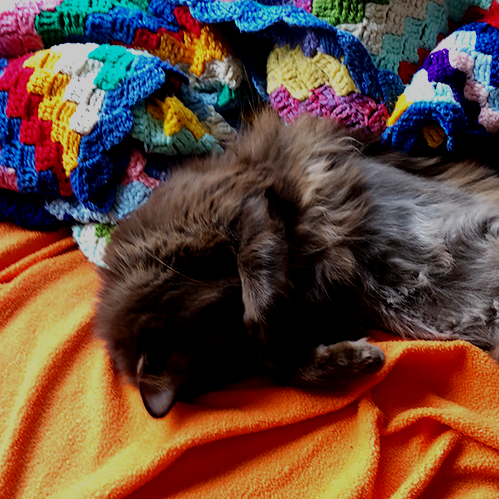
Because I have blog stats and know what you folks are showing up for, here’s a picture of Admiral Coco Marshmallow Flerkin-Wittingstall for your general perusal and admiration.
It’s astonishing how much colour she managed to find in our flat, given our general decorating preferences.
Astonishing, also, how much of her belly fur is still growing back after she had some surgery prior to coming to live with us.
October 17, 2019
Serendipity
I found myself falling through a blog hole over at Kristine Katheryn Rusch’s blog yesterday, going back and reading earlier posts she kept referencing. Along the way, I discovered a three-paragraph section that was immediately snagged for my thesis:
Then there were the series that I had to abandon because of the changes in publishing. In the 1980s and early 1990s, book publishers loved series. More than that, they loved poaching series from another publisher. Publisher A couldn’t make your series work? Publisher B was happy to snatch up the next book—mid-series—and prove to Publisher A how stupid their marketing department was.
But with the collapse of the distribution system in the late 1990s, the consolidation of publishing houses, and the layoff of countless employees, suddenly this poaching practice stopped. A series wasn’t doing as well as it could for Publisher A? Well, then no other publisher would touch it. A series was doing passably well for Publisher A? Then no other publisher would want it mid-book, because they’d have to grow the series—and that wasn’t a guaranteed bestseller.
I had one series die in that mess, but I saw the warning signs on the wall, so I wrapped up as quickly as I could. I sold three other series in that time period, and they continued for years—into the new century, when a new problem struck with two of those series: they weren’t growing fast enough.
The Business Rusch: Popcorn Kittens. Kristine Kathryn Rusch (2011)
There’s a lot writing about the shift towards series as a publishing strategy in light of technological change, but this is the first that’s really shown the movement back-and-forth.
The interesting thing here is not necessarily what I’ve discovered, but how I discovered it: I stumbled over this section through a process that was at least partly procrastination rather than productive work. Which is something that I’ve been thinking about ever since I put up the post about bookstores on Monday–the internet is great at delivering things we want, but not so good at the serendipitous find.
There is a great pleasure in browsing bookstores, just as there used to be great pleasure in browsing DVD racks and music stores. You don’t always find the thing you’re looking for, but you’ll occasionally trip over something unexpected at exactly the right time.
October 16, 2019
Notebooks, Erle Stanley Gardner, and Accidental Creative
I’ve been re-reading Secrets of the World’s Best-Selling Writer: The Storytelling Techniques of Erle Stanley Gardner this week, tracking down a quote I wanted to use for my thesis.
It’s an incredibly intriguing book–Gardner is, after all, best known for creating Perry Mason, but was also known as the king of the pulps for a time, including a year-long stint where he maintained 13 different series characters.
What’s really intriguing is that Secrets isn’t actually written by Gardner–instead, it’s an assemblage put together by two other authors using the vast archives of his notebooks, correspondence, and other resources archived at a university library. This means there’s less “this is how you do it” advice, and more glimpses into the ongoing development of the writer for whom writing did’t come naturally. Gardner taught himself to write using a lot of diligent study and stress-testing of ideas, and recorded a lot of it in his dairies and notebooks.
One of the quotes that has stuck with me, courtesy of his notes from a correspondence course on playwriting:
To have the plot instinct is a great blessing for the writer. Lacking this, however, the most valuable asset he can possess is the note book habit. Carry one with you constantly. Jot down everything that may be of help in framing and developing a plot, as well as in creating a dramatic scene for a story…
The rule of jotting down your thought on the instant does not apply merely to ideas that come as inspirations, or thoughts suggested by what you read or see, but it applies especially to ideas that come to you at the tie you give yourself up to concentrated thinking on play-production.
Secrets of the World’s Best-Selling Writer: The Storytelling Techniques of Erle Stanley Gardner
This is, going by the details that follow in the book, exactly what Gardner did.
What’s intriguing about this is the way it syncs up with a lot of the advice in Todd Henry’s Accidental Creative, which doesn’t necessarily advocate for carrying a notebook constantly, but does advocate for engaging in active reading that involves copious note-taking and setting aside dedicated time to ponder a particular problem or idea.
What’s really intriguing about Henry is the way he puts a frame around these activities. For example, when reading, he suggests a short series of questions to ask yourself and take notes about:
Are there any patterns in what you’re reading that are similar to something else you’re working on? (My friend Kathleen Jennings, upon reading Accidental Creative, took this a step further by forcing herself to draw connections and patterns to current projects, just to see what emerged)What do you find surprising about what you’re experiencing?What do you like about what you’re experiencing and why?What do you dislike about what you’re experiencing?
I’m relatively bad at remembering to do this (despite the fact that the first step largely what I’m going here), although I do tend to set aside some dedicated study time where I actively take notes. Reading about Gardner’s approach has convinced me it may be worth taking things a step further–I’ve taken to packaging a small pocket notebook alongside my phone (aka my primary reading device, especially for non-fiction), in addition to incorporating any online reading into the bullet journal beside my computer.
It’s stepped up my notetaking game considerably–particularly when it comes to online content, which now involves a lot more thought about what I’m reading rather than just flicking through and bookmarking stuff that may seem useful.
October 15, 2019
Recent Reading: Sharks and more Sharks
One of the projects I’d like to work one, somewhere down the line, is essentially a deranged giant monster horror/thriller that should not exist. Since I’m primarily a fan of these in film form, rather than fiction, I set myself the task of reading a bunch of books that serve as an introduction to the form in a literary sense.
The result was Shark Week.

I kicked off with Steve Alten’s The Meg because a) I’d really enjoyed the recent film in all it’s goofy glory, and b) it had a surprising number of sequels, which immediately caught my eye as a researcher interested in series.
The Meg in book form is a very different beast to the film. There are still giant sharks, of course, and plenty of people who get eaten along the way, but the character traits wrapped around the default archetypes are different enough to mean something. Our protagonist, Jonas Taylor, isn’t just a retired navy deep sea specialist, but now has a PhD in Sharks and a not-so-whackadoodle theory that megaladons are still alive after his experiences in hte navy. His ex-wife isn’t a fellow sub specialist, but a highly-ambitious journalist whose life has been destroyed by protagonist Jonas Taylor’s obsessions and isn’t quite an ex yet. Everyone else is similarly a few steps sideways from the film adaptation, giving us a decent spread of POV’s and a whole lot of internal dramas to play out.
The Meg isn’t a subtle book, but its a hell of a lot of fun and a really great example of a how to handle a few aspects of genre (for example: give the antagonist a POV, give the reader a basic education in the “science!” of your setting; big motivations leading to dumb, stupid decisions). Plus, it does that thing I live as a reader: take an absurd concept, then play it absolutely straight.
Here’s what’s interesting, though: the cinematic version of The Meg is undoubtably a tighter story. It’s had to winnow down the details and streamline things, tie it together with a unity and underlying action that makes a good film work. And it’s a hell of an enjoyable film, if you dig a goofy monster film (although my partner, who does enjoy a goofy monster film, was not as big a fan).
At the same time, I’m not sure that the film is as outright enjoyable as the book. Despite it’s sprawling plot and increasingly goofy motivations, with folks swearing vengeance against the Meg and setting out to hunt it every couple of chapters, the fiction version couples a sense of outright glee with the feeling that you’re getting a glimpse into secret worlds and learning details.
And that can be just as powerful as a tightly woven story. More so, if you’re a certain kind of reader.
I’m curious to read the sequels to see what they replicate, what the escalate, and what they allow to fall by the wayside.
THE MEG, BY STEVE ALTERN: AMAZON (AUS | UK | USA); KOBO: BOOKTOPIA


The other half of informal Shark Week reading was Peter Benchley’s Jaws, the New York Times bestseller that went on to be adapted into the Stephen Spielberg film and launch one of the most iconic soundtrack riffs fo all time.
I raved about this book a few times while reading it, and I’m probably going to do so here: it’s worth a read. Like a lot of 80s films that seemed to spin off endless sequels, Jaws is one of those stories whose original qualities got burried under the absurdity of trying to reiterate a simple story. Going back to the source is interesting, because it shows just how smart the book is: the broad metaphors of class, the conflicts between intellect-driven decisions and Sheriff Brody’s insticts, the way that the conflict of stopping the shark is routinely tied to really personal goals in the protagaonists.
It’s even more interesting to read this back-to-back with The Meg, because you can both see the influences on Altern’s approach, but also the genre traits worth replicating. Once again, there’s the POV given to the animal as a means of escalating tension; the minor characters who get a few moments in the sun before getting eaten; the big, not-at-all-related-to-this motivations that both tie into and get subsumed by the marauding shark; the exploration of the science of sharks, even as we’re hunting it down.
It’s definitely the stronger of the two novels, although I suspect that The Meg may be a little more fun if you’re the kind of reader who likes their giant monster stories to be a little goofy and cheesy.
JAWS, by PETER BENCHLEY: AMAZON (AUS | UK | USA); KOBO; BOOKTOPIA
October 14, 2019
Action vs Results
There’s a really good post about process, goals, and identity over on LitReactor at the moment. It’s worth taking a gander at the entire thing, but I’ve grabbed the key take-away here:
You can never take the process away, but once you attach your identity to goals and results you can’t control, it’s a recipe for disaster.
Dying on the Mountain: How Goals Will Kill You and How to Focus on the Process, Fred Venturini @ LitReactor
Or, to phrase it as one of my writing mentors did: you have no control over whether you get published or read. You do have control over how much you write and how much you submit.
I keep circling around that particular idea, because it’s so similar to the key takeaway when I was seeing my psychiatrist about anxiety: don’t focus on what you think or feel, focus on what you do.
So much of my anxiety is predicated on what Ellen Hendrickson has dubbed The Reveal — the fear that we’ll be judged, and that those judgements are right. It’s a fear that a thing that is fundamental to who we are will be taken away, because we don’t truly believe that we are that person.
It’s a measuring of success against results, rather than action.
(For more, you can check out my original post about Hendrickson’s book and the lessons it taught me about writing).
One of my recent reads was James Clear’s Atomic Habits, which comes at this from a different direction. In among his advocacy of small, iterative changes and being 1% better at something every day is a kernel that acknowledges the importance of identity and focusing on systems rather than results.
Changing habits, he argues, is a lot like voting for a new identity:
Each habit is like a suggestion: “Hey, maybe this is who I am.” If you finish a book, then perhaps you are the type of person who likes reading. If you go to the gym, then perhaps you are the type of person who likes exercise. If you practice playing the guitar, perhaps you are the type of person who likes music.
Every action you take is a vote for the type of person you wish to become. No single instance will transform your beliefs, but as the votes build up, so does the evidence of your new identity.
Atomic Habits (p. 38), James Clear
Part of taking a regrouping week last week was giving myself space to figure out what habits I needed to re-set. Part of it was looking for the stuff that delivers value I’m somewhat blind to–for instance, while I don’t think of myself as a blogger, one of the recurring themes when I look for things that make me happy revolves around the application of research and knowledge.
Similarly, I dig sharing things with people–books I’ve loved, films I’ve enjoyed, ideas that lit me up with their usefulness–especially when there’s a chance to illuminate things that might be overlooked.
And so the blogging begins again, along with the habits that support it, trying to get back into a routine. I spend my morning diary time sketching out rough timelines to strive for as I figure out what falls in where.
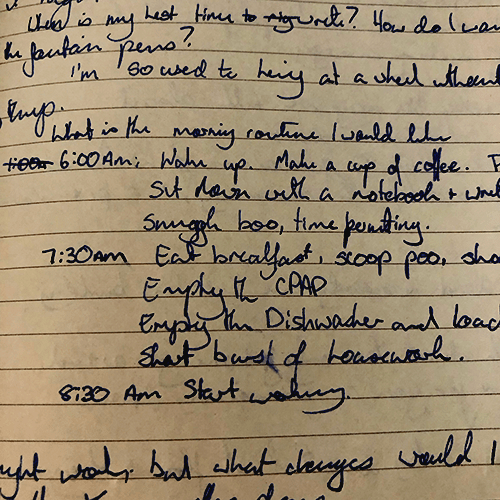
(It’s only now, here at the end of this post, that I realise how many of these details may be misconstrued if you don’t recognise that we have a very exuberant cat who tends to start the morning with very full litter tray)
October 13, 2019
Books are perfect for online shopping
Mike Shazkin’s recent post about the 7 Ways Book Publishing will change is a great read (albeit one that’s influenced by his relationship with the distributor Ingram). I wanted to pull one entry out for here because it’s a really useful way to look at the the shifts in book retail:
Books have a ton of characteristics that make them perfect for online shopping. You want to shop from a full selection no store has. It is very seldom when you must have a book right now. And books are heavy, so you don’t really want to carry them around if you can avoid it. The view from here is that it will continue to be very challenging to make physical book locations commercially viable.
As a bookish person who has a bunch of friends who work in book retail, many of whom are doing it tough right now, that’s the kind of idea that’s not going to entirely welcome as a thing posted here on the blog. Especially since Shazkin suggests the people who are going to compete with the big river will largely be other big retail outlets who are moving into the online space (Walmart and Costco in the USA – god knows who our local equivalents will be here in Australia).
Of course, I’m not in book retail directly, so there’s a bit of upside/downside there. For one thing, the move away from limited-shelf-space stores is actually a net plus for writers who have a deep backlist, and it’s noteworthy that Shazkin sees a growing attention on backlist in traditional publishing as one of the coming changes. I’ve mentioned this one before, looking at the ways in which the tactics of series shift when prior books are easily accessible, and it’s a big thing to wrap your head around if you’re looking to make money from writing in the next couple of decades.
On the flip side, the loss of bespoke stores also means writers are losing advocates who know their local consumers and tastemakers in the form of booksellers who knew their shit. When everything is available all at once, rather than a curated collection, it becomes trickier for potential readers to find their work.
I’m intrigued by how this will affect the way writers operate online. While this shift has been underway for years, I suspect we’re hitting a period where writers actually have to think about how they’re going to find new readers as part of their ongoing business model. The indie side of things is already hip-deep in it, figuring out the online advertising platforms and how to make them work, utilising search and SEO to make their books stand out.
The really smart ones (well, Joanna Penn) are already looking towards the changes in search that are comming, such as the gradual uptick of voice-activated search tools that don’t require us to type things into a google bar.
In short, conversations about author platform that used to revolve around how do I speak to my existing readers and make them hardcore fans will need to start incorporating the acquisition of new audience as well.
October 12, 2019
The Sunday Circle: What Are You Working On This Week?
The Sunday Circle is the weekly check-in where I ask the creative-types who follow this blog to weigh in about their goals, inspirations, and challenges for the coming week. The logic behind it can be found here. Want to be involved? It’s easy – just answer three questions in the comments or on your own blog (with a link in the comments here, so that everyone can find them).
After that, throw some thoughts around about other people’s projects, ask questions if you’re so inclined. Be supportive above all.
Then show up again next Sunday when the circle updates next, letting us know how you did on your weekly project and what you’ve got coming down the pipe in the coming week (if you’d like to part of the circle, without subscribing to the rest of the blog, you can sign-up for reminders via email here).
MY CHECK-IN
What am I working on this week?
I’m having one of those weeks where I’m largely following my nose on the writing front, but I suspect the next five days will be spent drafting a new short story (Project Hook) and trying to get my attention back on the thesis after nearly three weeks away from the project.
What’s inspiring me this week?
I read Shastra Deo’s debut poetry collection, The Agonist, earlier this week and immediately started taking notes about things to pay attention too in the work. There’s a precision to the language that really lifts of the page, but it’s the deeper entwining of themes that really carry thing–Deo’s got an interest in the body that’s exacting and anatomical, but her interests are filtered through a pop-cultural obsession that lends the work a real speculative undercurrent that frequently breaks the surface. In another timeline, published by a publisher that wasn’t a university press with literary sensibilities, I could have seen The Agonist making a run at spec fic awards like the Rhysling.
Basically, at it’s best, The Agonist reminded me a lot of one of my favourite short story writers, Caitlin Kiernan. The two writers share a similar interest in rendering the body strange and using language to evoke the uncanny, and I suspect that anyone’s whose a fan of Kiernan will likely dig Deo’s work.
What action do I need to take?
Getting back into the habit of turning off the internet. As ever, it’s crept back into my daily routine over the last few weeks–right there as I start the day, the first thing I see when I load the computer (because I forgot to shut down the browser before logging off). I’m not necessarily wasting time on it–mostly, I’m clearing email or writing blog posts or doing other secondary-business-tasks–but they are secondary business tasks. I need to remove it from the first half of my day for a stretch, and get my focus back onto writing prose and getting books ready.
October 10, 2019
Stacking Notebooks
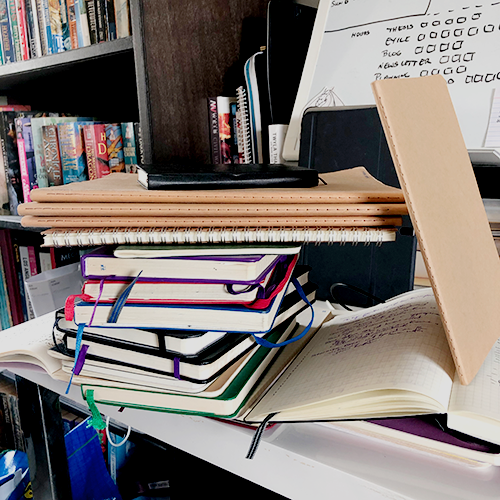
This week has been all about regrouping after the latest life-roll to disrupt my year (the third, and hopefully, the last). My brain is heavily scattered at the moment, and my anxiety gets to drive a lot more than I’d like, so I wanted to create a space where I could just sit down and get my priorities in order.
Part of that meant dragging out all the work spaces on my desk and taking a close look at them. Which, inevitably, means dragging out a veritable mountain of notebooks and taking a look at everything that’s in progress, then looking at the current unfinished projects on the digital front.
I had assumed I was in a notebook-lite workflow just prior to doing this. It would appear…not so much.
That said, it looks worse than it is, as not every notebook represents an active work project. There are two finished Bullet Journals in there, left in place so I can reference details and notes from last year. There’s two full-length notebooks containing a novel draft that I really need to get around to typing up. There’s two of the smaller notebooks which are filled with notes for the Keith Murphy series and the various fixes and new works I might choose to do (and, at this stage, may not). Two notebooks for my superhero RPG campaign (you can see the rulebooks poking over the top of the pile on the left), and one for a campaign that I’m planning when SMAX wraps up in a couple of weeks. Two research notebooks–one for PhD research, one for another project I’ve poking at. One notebook that is just for the morning brain dump.
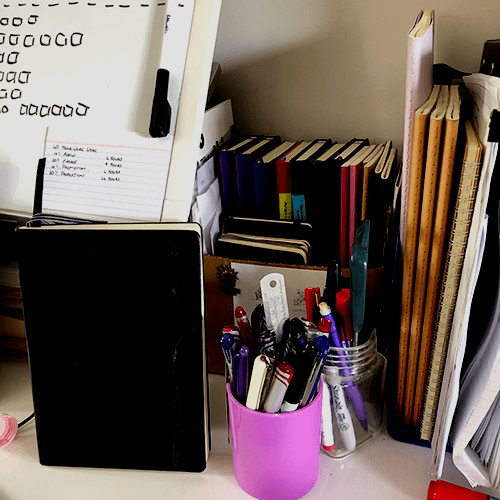
What’s really surprising is the way my tastes are shifting as I work at dekss more often. After years of working in hardcover notebooks, I’m starting to really use a lot of the softcover Moleskine Cahiers which tend to come in three-packs. My preference for RPG planning is the grid-ruled Cahier in the beige colouring–the smaller sized, 80-page notebooks for general notes, and a larger sized, 120-page notebooks for broad worldbuilding details.
Writing is increasingly taking place in blank notebooks of various sizes, depending on the project (I’m increasingly fond of the green ones, which makes for easier colour-coding of writing and gaming work).
Either way, a good day of sorting and figuring out what’s still useful has allowed for a more organised approach to storage.
October 9, 2019
Panettone Season
One of the most useful guidelines for blogging is sitting down every morning and asking yourself: “what is the most useful thing I can put out into the world right night?”
Some days that will be a deep thought. Some days, it will be much simpler. Like this:
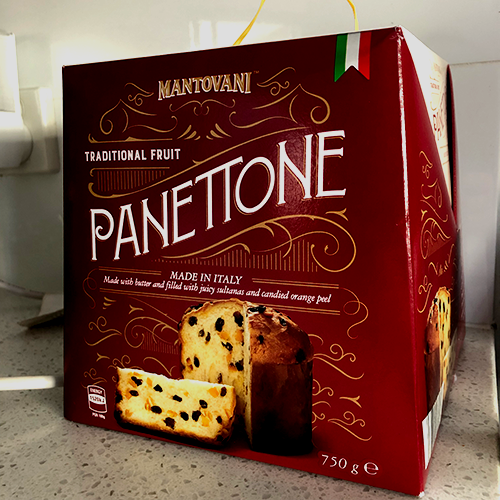
There are plenty of reasons to be irritated by the Christmas season starting in October, but I’ll admit that the easy availability of panettone for three months of the year almost makes up for it.
My partner sold me on these a few years back, when she described it as “delicious Italian bread cake,” and it lived up to the hype. Remarkably soft to bite down on, and lighter than most cakes I’ve picked up in my life, but also filled with fruity awesomeness.
Interestingly, there’s an attempt underway to try and designate authentic Panettone as a product of a specific region, much like certain wines, but it hasn’t yet reached fruition. I suspect ours wasn’t authentic, but it’s still damned delicious.
So. Panettone. It’s worth picking one up if you’ve never tried it before. Great fresh. Even better when you toast the last few slices and put a little butter on it, which may not be the traditional method of eating it, but so it goes in these, the late stages of capitalism.