Peter M. Ball's Blog, page 19
February 6, 2020
Personalised Chapbook Offer: The Seventeen Executions of Signore Don Vashta
Print copies of The Seventeen Executions of Signore Don Vashta landed in my mailbox today, and they’ve come up rather beautifully for a thirty-page chapbook.
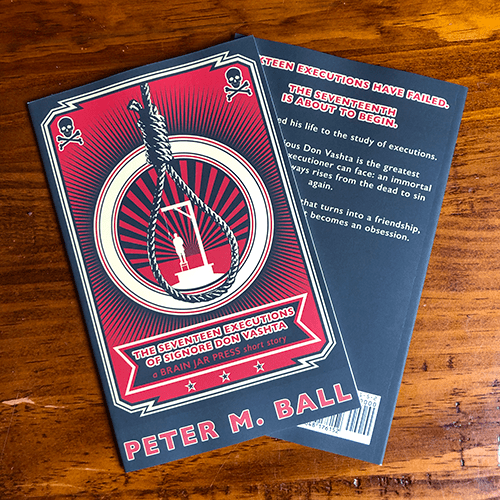
About half the very short print run are already spoken for, heading off to various friends and authors I’m courting for future projects who wanted to see how the chapbooks turned out. The other half are reserved for the handful of folks who might want a personalised print copy, and are willing to order direct from me.
I’m not particularly high-tech about these things (at least, not yet). , so the process is as follows. To grab one, paypal me at PeterMBall@gmail.com.
Amounts to paypal as follows:
One signed copy, on a “give it to me next time we see each other” delivery model: $7.50One signed copy, posted anywhere in Australia: $9.50 One signed copy, posted overseas: $15
Australian folks can order multiple copies by adding an additional $7.50 to the prices above.
Overseas folks…drop me an email on the same address. Sending packages overseas from Australia is like trying to post things to Narnia, so it’ll likely be hideously expensive, but I’ll work out options (or alternatives) as best I can if you are really interested.
Use the notes function in Paypal to give me any additional details—who you’d like it signed to, any specific messages—and make sure your delivery address is correct.
(and I’m blatantly copying this approach from Alan Baxter, who is doing something similar with his novella The Roo–it’s totally worth checking out)


Reasons to follow newsletters
Comics writer Kieron Gillen sent out his latest newsletter yesterday, which featured a line-up of his top music tracks of 2019. Gillen’s got a background as a DJ, and writes some pretty awesome music-inspired works, and his newsletter has introduced me to a bunch of music I would have overlooked.
He introduced The Comet Is Coming thusly:
People occasionally ask me about whether there’s going to be a Doctor Aphra show or not (answer: no idea) but no-one’s actually asked what I’d like to see in a Doctor Aphra show. My answer: I would like to see them back a cart of money up to The Comet Is Coming and get them to record the complete score. Listen to this. You want to watch the show this is the theme tune for. This is an explosion, a promise, all propulsion and sex. I walk, it soars, the world is better.
Newsletter 144: momentarily Manichean, Kieron Gillen
I loved his Doctor Aphra run, so…yeah. Sold. Just on the description. But then I went and tracked them down on youtube, and seriously, OH. MY. GOD.
I may have ordered CDs already. Because I am terrifyingly behind the times in that regard.
You should subscribe to Gillen’s newsletter, BTW. Even if you’re not a comics fan. I followed him this way for a year or so, before I started engaging with his work, and he’s invariably introduced me to interesting things every week.
This has been your Friday Morning community service announcement.
February 5, 2020
Today I'm feeling 20%
In the early days of my newsletter I posted a link to Maggie Steifvater’s journaling approach, designed to manage uneven energy levels after she contracted a long-term illness that kept her from writing. The original post is gone now—along with the rest of Steifvater’s Tumblr—but the lesson from it has lived with me on-and-off in four bullet journals now.
The basic theory is this: before you plan the day, imagine the idealised version of you that’s operating at 100%. The perfect, focused, utterly ready to do all the things version of yourself.
Then check in with how you’re feeling right now, and rate your current state as a percentage of that ideal. Or, to put it another way, acknowledge your limits and work with the energy you’ve got, not the energy you wish you had.
It’s really easy to resent work when things are off-kilter with your health, whether its physical or mental. Resentment quickly leads to procrastination, which only compounds the problem. It’s so easy to hate yourself for being less than 100% that a 20% day can result in no work at all, instead of the 20% you might have been capable of if you’d framed your to-do list in those terms.
Today is a total 20% day for me at the moment. My anxiety and stress are high at the moment for various reasons, mostly PhD related, and we’re heading into the period where I’d be preparing to celebrate my dad’s birthday if he hadn’t passed away last year. The moment we get through that, we celebrate my birthday in March…which is the day before dad actually died.
On top of that, my partner is home sick and will need me to drive to the GP later. My morning routine is disrupted as hell, so I need to think about what I need to do next instead of letting habit carry me. And I’ve only had three hours sleep, due to poor dietary decisions last night and a cat whose decided 5:00 AM is the perfect time to attack my legs.
In short, I’m a complex mess of feelings—almost invariably leading back to holy shit I feel sad and burnt out—and setting aside that sadness to get stuff done for the sake of other people’s priorities is hard.
I thought about none of that when I first sat down to write today’s to-do list, which meant it set expectations at what I could achieve if I felt 100%: writing 4,000 words of rough draft in addition to editing, setting up and testing webinar options, catching up on email, and doing the line edits on the next Keith Murphy book.
Unsurprisingly, when I sat down to start work, I procrastinated like hell. Focusing on what should be, if my physical and mental health was in peak condition, created a metric butt-ton of resistance because my 20%-of-peak-Peter toolkits weren’t going to get all of that done. Failure to meet expectations would give my anxiety another tool to use when beating me up, and if I was already going to feel bad about doing less, it was easier to do nothing.
Which is where the advantage of Stiefvater’s system really shows itself, because setting expectations at 20% of peak Peter opens me up to positive reinforcement rather than negative resistance. I’m sure as shit not going to get to 4,000 words, but I can probably make 800…and everything after that will be gravy, pulling my mood up instead of weighing me down.
I may not manage all my email and business decisions, but I can clear 6 from the inbox (20% of the total) and try to answer the most urgent. I can’t do a full test of the webinar software, but I can write a list of next steps and do one of the things on the to-do list.
And here’s the thing: building on rather than fighting against tends to increase capacity as the day goes on. I started this post feeling 20% and stuck, but I’m finishing it feeling 30% because my focus has shifted.
In her outstanding book on focus and attention, Rapt, Winnifred Gallagher does a really interesting breakdown of bottom-up attention versus top-down attention.
Bottom-Up attention is involuntary and passive, the survival response that causes you to zoom in on threats and resources for survival. It’s highly attuned to risk-and-reward, and connects you to the world, but it comes with a major drawback: lots of distraction, and an immense vulnerability to new stimuli.
I wrote my first to-list for the day in a bottom-up mode, which only added to my anxiety. The moment I assessed my energy and came up with the 20% number, I shifted into a top-down approach where choices were made against the context.
Putting your brain in a top-down mode makes it easier to disregard distractions and focus on a particular task. By its nature, it suppresses our focus on irrelevant data. As Gallagher puts it:
The top-down sort has advanced our species, particularly by enabling us to choose to pursue difficult goals, such as nurturing the young for extended periods or building and operating cities. Where the individual is concerned, this deliberate process is the key to designing your daily experience, because it lets you decide what to focus on and what to suppress.
Winifred Gallagher, Rapt: Attention and the Focused Life (p. 17).
Or, to put it another way, simply by acknowledging I feel 20% and pondering how that changes my day, I’m setting aside some of the anxieties and fears contributing to that number and freeing my attention up to focus on how today can bring me closer to the goals that matter to me.
It makes me feel a little less sad, and a whole lot more in control, even before the first thing on my new to-do list is attempted and checked off.
February 4, 2020
In Another Universe
I’m reading Dreamsongs at the moment, George R.R. Martin’s big retrospective collection of short stories, and the introductions where Martin gets salty are among my favourite things.
Particularly this one, from Doing the Wild Card Shuffle, where he talks about a failed attempt to get a job at Marvel and how his love of comics led to Wild Cards:
I have no doubt that in some alternate universe Marvel Comics did hire me when I applied in 1971, and right now in that world I am sitting at home muttering and gnawing at my wrists as I watch blockbuster movies based on my characters and stories rake in hundreds of millions of dollars while I receive exactly nothing.
In this world I was spared that fate. In this world I wrote short stories and novellas and novels instead of funny books, and later on screenplays and teleplays as well.
Martin, George R.R.. Dreamsongs: A RRetrospective (p. 229).
A useful reminder that sometimes the opportunities that don’t pan out wouldn’t necessarily have led you to a more successful life.
February 3, 2020
Oh, Riverdale.
We finished watching the third season of Riverdale last night, and my mouth dropped at the sheer and wondrous audacity of a twist in the penultimate episode where a secret was revealed. It was a moment that delivered what I’d loved in Riverdale’s first season–a well-honed twist that changed the direction of a story, and showed you a big, whopping clue that had been there all season and became sinister by the addition of new information.
It renewed my love for the franchise in the space of two episodes, and got me interested in really sitting down and investigating the craft of each season.
On the other hand, there was a looooong gap between the point where we started the season and the point we ended it. At one point, well into the heart of the season, we simply stopped watching for about twelve months because we didn’t have the energy.
After a relatively sublime first season, it’s a show that’s struggled to maintain its footing, but I continue to admire its energy. Whether it succeeds or fails on any given episode–Riverdale goes big.
February 2, 2020
Long Term Influences
It’s been twenty-five years since I first saw Hackers, and not a week goes by where I don’t find myself tempted to start an email with “Ola, Boys and Girls,” in an attempt to find my people.
Filmmakers really should have done more with Matthew Lillard.
February 1, 2020
Externalised Memory
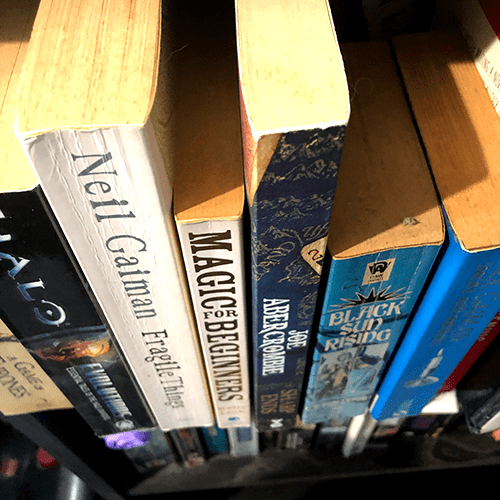
I often joke about treating my phone and bullet journal as externalised parts of my memory, treating it like a new phenomenon. Truth is, it’s been a habit ever since I first got bookshelves, where there’s always a short chunk of shelf space given over to references for projects I’m working on.
Case in point, a short stretch of books that have inspired sections of the thesis or upcoming blog posts:
January Release Roundup
I just did the Brain Jar Press newsletter and realised I’d put together four new releases across January: Exile, a new short story collection, a new chapbook in the Short Fiction Lab line, and the chapbook edition of The Seventeen Executions of Signore Don Vashta.
Amid the chaos of January, some of these didn’t even get announced here on the blog, let alone get talked up on social media. Exile captured the lion’s share of my promotional energy, so I’m going to use this post to catch you all up on what’s being going on.
THE LATEST: SHEDDING SKINS (Short Fiction Lab Chapbooks #5)

A Brain Jar Press Short Fiction Lab chapbook story, Peter M. Ball’s Shedding Skin is a dark fantasy about snakes, old wounds, and isolation in the heat of the Queensland outback.
Things haven’t been right with Mariah ever since the car accident, but Harley knows the problems were seeded long before they drove off the road. Things come to a head when they retreat to an old house in the outback to spend time together, far away from the bustle and watching eyes of worried friends and family.
But things watch from the shadows beneath the house too, and Harley’s own reservations come to a head when they discover a snake in their midst…
This one snuck out under the wire, launching on January 31st while I diligently focused everyone’s attention on Exile. Like all Short Fiction Lab releases, it started with an experiment—in this case, running an old, unpublished story through one of the AI-powered proofing and line-editing tools (Grammarly, ProWritingAid, et al) that get advertised to writers every time they go on the internet.
I didn’t expect much, going in. The online advertising made these sound like a souped up version of spellcheck, and spellcheck is only marginally useful. By the time I ran this story through their reports, I laid down a couple of hundred bucks for a lifetime subscription to the software.
For all that it looks like spellcheck, what sold me was the algorithm’s ability to pick up on stuff I struggle to see when editing works: hidden verbs, repeated phrases that might jar the reader, and overly complex sentences lacking concrete details. It’s the stuff you tend to get picked up in a good line edit, and while the suggestions for fixing the issues aren’t great, I’ve been through the editing process enough times to cover a lot of ground myself if things are flagged for me.
I go into this in a lot more detail in the Author’s Note, as I’m want to do in Short Fiction Lab releases. For those who are really curious, there’s a bonus link in the end of this release where you can download the pre-AI edit story and compare how big a difference the software (and around 14 years of writing fiction) made on my writing.
Grab it in EBOOK or PRINT
THE BIG RELEASE: EXILE (Keith Murphy Urban Fantasy Thrillers #1)
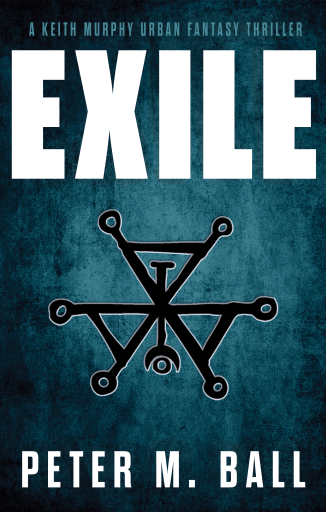
Keith Murphy’s coming home to a city full of demons. What’s following on his heels is much worse.
Ever since he left the Gold Coast, Keith Murphy’s been the triggerman for the sorcerer-assassin Danny Roark. Then they screwed up a job and all hell broke loose, unleashing a vengeful cult of necromancers eager to take down the hit man who gunned down their leader and reclaim their master’s soul from the bullet around Keith’s neck. Roark was already running when Keith made it the rendezvous, and the old man left Keith three simple instructions: go home, lie low, and wait for me to call.Easier said than done.
If you ever wanted to see Lee Child’s Jack Reacher or Max Allen Collins’ Quarry taking on demons, sorcerers, and magic, you won’t be able to put down the Keith Murphy series.
Released on Wednesday and already the biggest launch Brian Jar Press has ever had, courtesy of some strong pre-orders. If you scroll back through a week of posts you’ll find a whole lot of me talking about it, so I won’t belabour the point here, but it’s book one of a trilogy that will be rolling out across the next two months (and if it continues to sell well, there could be more a little later this year).
It breaks tradition with a lot of Brain Jar Press releases by launching into Kindle Unlimited, giving folks subscribed to the program a chance to download it for free. It’s a data-gathering mission for the PhD, testing some of the ideas I’m talking about with regards to access, release schedules, and seriality. But it’s also a damed good book, thoroughly scrubbed down and tightened up before it was relaunched into the world.
Grab the ebook exclusively from Amazon (US|UK|AUS) or in print at your favourite bookstore.
THE POORLY TIMED RELEASE: THESE STRANGE & MAGIC THINGS:
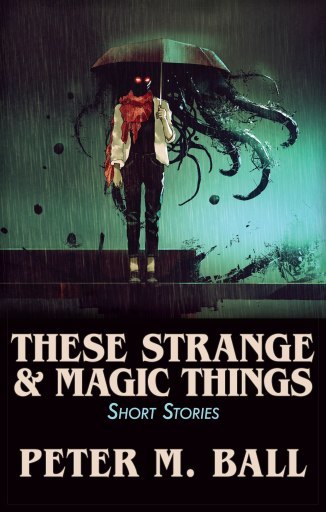
For fans of the weird and enchanting, Peter M Ball returns for a third collection of speculative fiction stories that dance along the borders between horror, fantasy, and science fiction. These Strange and Magic Things brings together fifteen tales that showcase why he’s among the finest writers of the strange and fantastic working in Australia right now.
With fifteen stories to enchant and thrill you, These Strange and Magic Things spins magic, horror, and pop culture together into an unforgettable collection of tales featuring rogue jinn, uncanny rock bands, magic bees, flying crocodiles, laundromat ghosts, haunted coins, cyberpunk gangs, and lost loves.
This collection came out in the early stages of January, when the bulk of my attention (along with the rest of Australia) was focused on the devastating bushfires annihilating large chunks of the country. The period where I’d normally talk it up online was given over to the Authors for Fireys auction and my attention shifted to Exile right after, so it’s largely one of those books folks don’t find unless they stumble across it.
It happens like that sometimes. Your book comes out while major things are going on in the world, and it doesn’t do quite so well as anyone expected.
Available in EBOOK or PRINT
THE EXPERIMENT: THE SEVENTEEN EXECUTIONS OF SIGNORE DON VASHTA (Short Chaps)
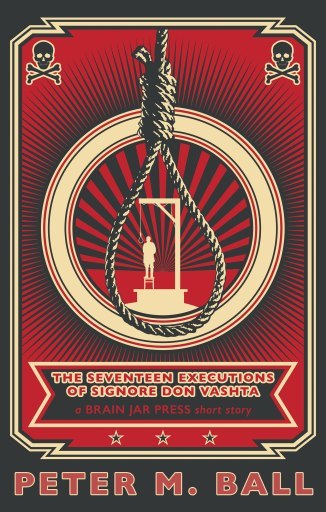
Sixteen executions have failed. The seventeenth is about to begin.
Beal devoted his life to the study of eliminating convicted felons, but the notorious Don Vashta is the greatest challenge any executioner can face: an immortal criminal who always rises from the dead to sin again.
A short story chapbook about a job that turns into a friendship, and a friendship that becomes an obsession.
A few weeks back, I put together a short story chapbook for my partner based on a release she was rather fond of. It turned out to be a really beautiful object in and of itself–a thirty-page booklet that reminded me of buying single-issue comic books.
It got me thinking about possibilities, and different approaches to publishing. Ebooks have large demolished the idea that a “book” needs to be 100,000 words to be worthy of release, but is there the potential to do the same with Print on Demand technology.
Doing the first chapbook gave me a taste for the format, and this is my first attempt at doing a release withs some intent behind it. While I normally limit short stories to Amazon’s print-on-demand catalogue, this one has been released through Ingram’s distribution, which means it’ll show up in bookstore search engines (and sites like Book Depository, which sell it at a tidy discount).
Available in EBOOK or in PRINT from all good bookstores
January 30, 2020
Do not fall for her innocent looks…
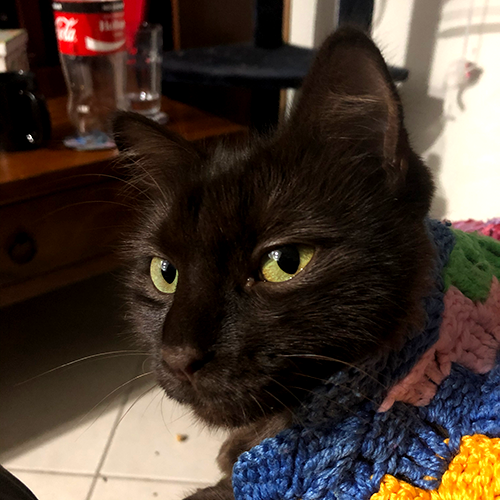
I woke at sunrise this morning, courtesy of the cat attacking my feet and then ruthlessly demanding attention for twenty minutes. She spent a good chunk of last night stalking a gecko, and I suspect she failed to capture it going by this morning’s behaviour.
I would be mad at her, but there’s 40 emails in my inbox and things that need editing, so it’s not like getting up early is a bad thing…
January 29, 2020
New Board, Who Dis?
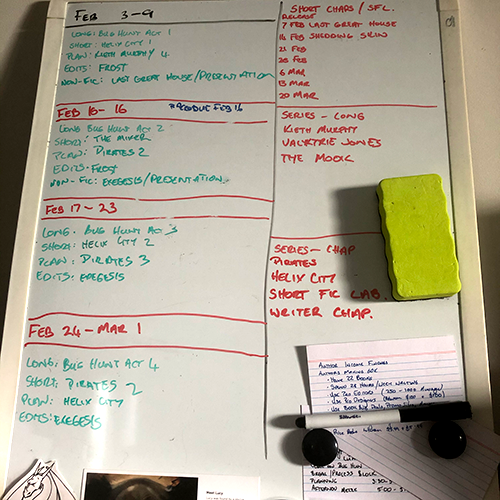
I wrote a rough plan for February, because January has been one of those months where I’ve been reacting to deadlines and my brain is doing a very bad job of figuring where my focus needs to be.
I love a good whiteboard that takes that decision away from me and says, “Here. Your focus needs to be here.”