Shutta Crum's Blog, page 4
June 3, 2023
Wordless/Nearly Wordless Books with Marsha Diane Arnold and Shutta Crum: Notes
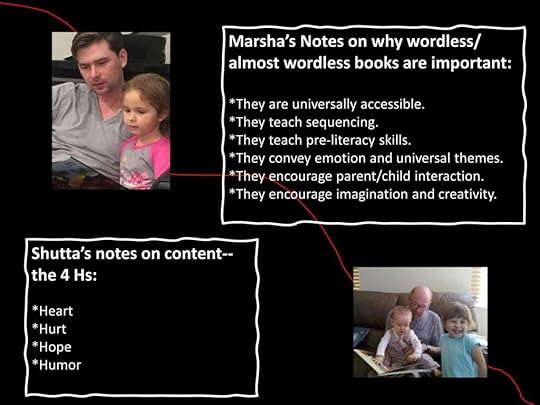
A big thank you to all who attended the recent webinar on wordless or nearly wordless books with Marsha Diane ARnold and Shutta Crum. Hosted by the MD/DE/WV chapter of SCBWI. Below is the slide with Marsha’s notes and mine, as well as another slide with our contact info. If yo get a moment tell us what you thought of the program. (It’s so hard doing a webinar and not being able to see the audience!) Thank you for all the thoughtful questions. And do let other writer groups/SCBWI chapters know about it. We put a good deal of work into the webinar and would love to do it again!
Please feel free to reach out to us at:
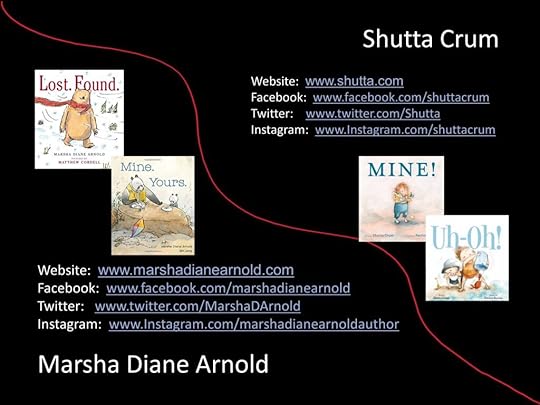
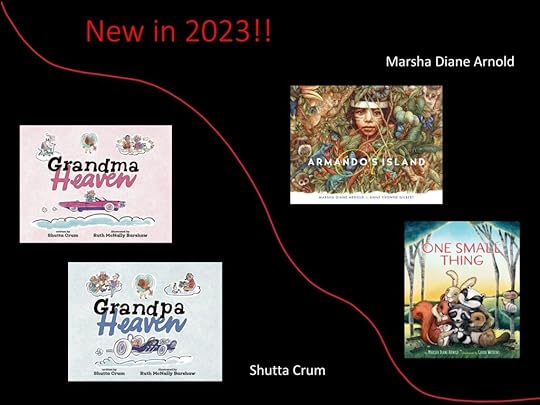
Our newest books:
 The post Wordless/Nearly Wordless Books with Marsha Diane Arnold and Shutta Crum: Notes first appeared on Shutta Crum.


May 14, 2023
A Poem for Mother’s Day: My Mother Taught Me to Quilt by Shutta Crum
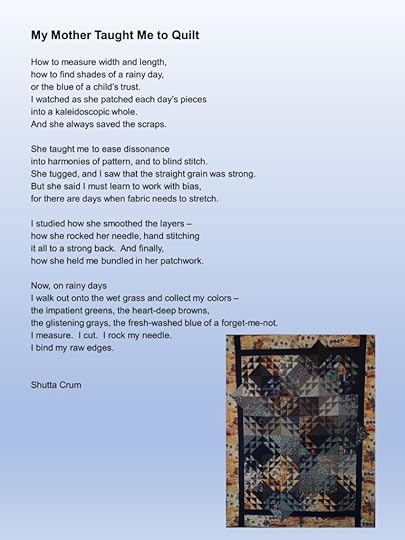
Enjoy this poem I wrote a number of years ago: My Mother Taught Me to Quilt.
 The post A Poem for Mother’s Day: My Mother Taught Me to Quilt by Shutta Crum first appeared on Shutta Crum.
May 4, 2023
Grandma Heaven & Grandpa Heaven: Two New Books by Shutta Crum
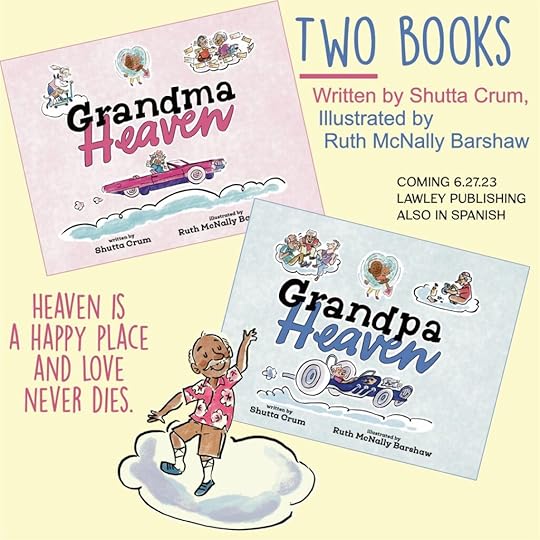
Two new books: Grandma Heaven and Grandpa Heaven by Shutta will be making their joint debuts June 27, 2023! They are illustrated by good friend and talented artist Ruth McNally Barshaw. Just look at that grandpa–what bliss! These multicultural books reassure young worriers that Heaven is a fun place for grandparents that have left us, and that love never dies. Paperback versions are coming in Sept. 2023 and Spanish translations in January 2024. Yahoo!
The post Grandma Heaven & Grandpa Heaven: Two New Books by Shutta Crum first appeared on Shutta Crum.April 10, 2023
Nocturnes and Aubades: a reading list
For those of you who’ve taken my workshop on nocturnes and aubades, or who simply enjoy the form–here’s a list of poems for further study/enjoyment. Dive in!

AUBADES:
Aubade with Cutlery and Crickets by Aimee Nezhukumatathil
Three Friends by Mark Van Doren
Another Trashy Aubade by Evan Zimroth
Aubade for West African History by Honoree Fanonne Jeffers
Aubade Beginning in Handcuffs by Torrin A. Greathouse
Under Two Windows (1. Aubade 2. Nocturne) by Schuyler Van Rensselaer
NOCTURNES
A Clear Midnight by Walt Whitman
The Body Electric by James Crews
The Night in Isla Negra by Pablo Neruda
The Fury of Sunsets by Anne Sexton
Stone Canyon Nocturne by Charles Wright
The post Nocturnes and Aubades: a reading list first appeared on Shutta Crum.April 1, 2023
Of Rhyme & Elephants by Shutta Crum
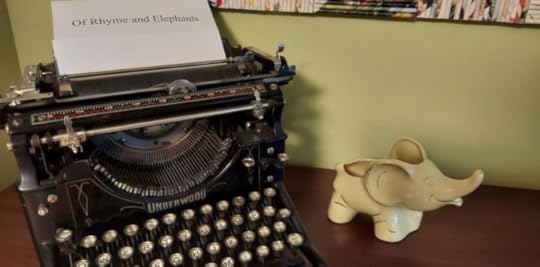
Let’s take a little time and talk about rhyme. So, if I were to take that first line and divide it into two end-stopped lines of poetry: Let’s take a little time/and talk about rhyme I’d have the classic end-stopped exact rhyme we were introduced to as children. Rhyme can be that simple—and that ho-hum. However, if used in a more complex way rhyme can heighten the musicality of your writing. There is a great deal one can say about rhyme.
But first, we need to address the elephantine question that’s lurking in the room—must a poem rhyme to be considered a poem?
Dear Elephant: We love you. However, things change with time. Western poetry is no longer defined only as lines that must be end rhymed exactly. Most poems published today do not. We’re sorry. That’s just the way it is. The enjoyment of wide-ranging free verse put an end to that. However, this is not to say that rhyming has died out. Oh, no! It’s simply become more versatile—even a bit subversive. Let’s take a look at some rhyme variations and what we can do with them.
Alliterative rhymes (assonance and consonance): Alliteration is the repetition of sounds within words. Alliteration is most often defined as repeated initial sounds (head rhymes), but its subdivisions include assonance and consonance. Assonance: repeated vowel sounds. Consonance: repeated consonant sounds. Use of assonance and conso- nance can give your words rhythm. And when continued into the next line, it can link the lines in a lyrical way. Look at these examples:
Alliteration:
“…and the trade winds soft through the sighing trees…”
This is a line from Caged Bird by Maya Angelou. Why did she insert the word soft? The line would make perfect sense without it. It’s because it completes a musical phrase, soft through the sighing, that separates the two T words trade and trees. It also anchors the line by hugging those two internal T words through and the between two S words, soft and sighing. That’s four T sounds in one line (two TR sounds and two TH sounds). And counting the final S in winds and trees, we have four S sounds! It’s a master class on the technique in a single line. (And we could go on about her use of meter in this line—but meter is a whole other discussion!)
Assonance:
When I forget to weep
I hear the peeping tree toads creeping . . .
These lines are by Ruth Stone from a poem titled Mantra. Here the long double EE plays throughout the poem without any regularity and seldom at the ends of lines. This repetition helps the poem hang together and creates aural pleasure.
Consonance:
I didn’t as
what kinds of things
hide behind black trees . . .
These lines by Jane Yolen, from her Caldecott winning book in verse Owl Moon, repeat the hard stopped letter “K.” This is appropriate as it is a bit of a scary scene for a young child going owling with her father in the middle of the night. This kind of subtle use of consonance adds atmosphere. For even more atmosphere using various forms of alliteration, all you have to do is read some of Edgar Allan Poe’s The Raven.
Deep into that darkness peering, long I stood there wondering, fearing,
Doubting, dreaming dreams no mortal ever dared to dream before.
Internal rhymes: These are rhymes in the midst of a line rather than at the end. Such as these by Rowena Bennett in the poem The Witch of Willowby Wood. (Notice the alliteration.)
There once was a witch of Willowby Wood, and a weird wild witch was she,
with hair that was snarled and hands that were gnarled, and a kickety, rickety knee . . .
Many poetic forms actually require an internal rhyme or two. For example, the Vietnamese Lục Bát (Check out the article on Lục Bát in the Sept./Oct. 2021 OPAP.), or several of the Welsh or Cornish englynion.
Penultimate rhymes: Words that rhyme on the second to last syllable, such as roaster and toasting are called penultimate rhymes. Listen closely and you’ll find this in many song lyr- ics. This allows for a great deal of leeway as to that final syllable. If sung, or read aloud, the last syllable can be extended/chopped/enjambed (slid into the next line), and the rhyme will still jump out to the listener. Here’s an example rom Bob Dylan’s I’ll Be Your Baby Tonight.
We’re gonna forget it.
That big, fat moon is gonna shine like a spoon,
But we’re gonna let it,
You won’t regret it.
In Robert Creeley’s The Conspiracy the penultimate end rhyme makes use of assonance.
Things tend to awaken
even through random communication.”
Dactylic rhymes: Dactylic rhymes are rhyming words that have a dactylic beat (hard-soft- soft). Such as terrible and wearable. Look below at the wonderful dactylic rhymes from Nonstop in the play Hamilton. (Note that the penultimate syllables rhyme exactly in two of the words, and pretty dang close in the third!)
Now for a strong central democracy
If not, then I’ll be Socrates
Throwing verbal rocks at these mediocrities…
Slight/slant/sprung rhymes: Slant rhymes are syllables/words that almost rhyme. Songs often bring two words that don’t rhyme closer to each other by the vocalization of the singer. These rhymes are handy for poets who can still solidify the piece but forego an exact rhyme—knowing that our ears will almost hear it as a rhyme. For example, the two slant rhymes girl and world in Prince’s song Kiss:
You don’t have to be rich to be my girl
You don’t have to be cool to rule my world.
Also, slant rhymes can be used where disruption, surprise, or an unsettled feeling is want- ed. (It’s that subversive ability of rhyme I mentioned earlier.) Here’s an example by W. B. Yeats rhyming young with song.
That is no country for old men. The young
In one another’s arms, birds in the trees
– Those dying generations – at their song . . .
Subversive use of rhyme: Slant rhymes can be used to shake us up a bit. In addition, there are poetic forms that might throw an English speaker/reader for a loop. Some traditional forms require the first syllable of each line to rhyme, not the final syllable. Also, there is a form called the wrenched rhyme which is rhyming a stressed syllable with an unstressed one—such as, caring and wing. And I haven’t even mentioned sight/eye rhymes such as good and food. All these techniques, and more, that slightly jostle us off our feet can be used to produce surprise, humor, or disruption.
So, Dear Elephant: Although most American poetry today is not defined by exact end rhyme, it is still fun to jump in and play with other rhyming techniques. Wanna join me?
[NOTE: This article first appeared in Of Poets & Poetry, published by the Florida State Poets Association. Nov./Dec. 2022]
Some poetry/songwriting links to further your practice: https://www.izotope.com/en/learn/5-types-of-rhymes-you-can-use-in-your-song.html https://oxfordsongwriting.com/stephen... https://www.masterclass.com/articles/how-to-write-in-rhyme#10-different-rhyme-schemes And see Shutta’s handout “Poetry 101,” at https://shutta.com/resources/
The post Of Rhyme & Elephants by Shutta Crum first appeared on Shutta Crum.March 27, 2023
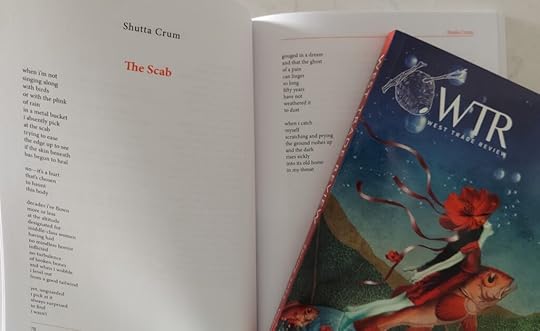
The Scab, a poem, by Shutta Crum published in the West Trade Review
My poem The Scab has just appeared in the spring issue of the West Trade Review. And what a lovely publication it is! Big trim, easy to read, color, lovely cover. I do hope you buy one today–it’s a classy anthology of short stories, poems and art. Thank you to editor Ken Harmon and the WTR staff. Kudos!
 The post The Scab, a poem, by Shutta Crum published in the West Trade Review first appeared on Shutta Crum.
March 23, 2023
Lesser Jewels Poem by Shutta Crum Appears on Autumn Sky Site
Excited that the Autumn Sky daily poetry site chose my poem Lesser Jewels to highlight on March 21. The link is here. Leave a comment or a like if you have time–they like that!
 Lesser Jewels poem by Shutta CrumThe post Lesser Jewels Poem by Shutta Crum Appears on Autumn Sky Site first appeared on Shutta Crum.
March 9, 2023
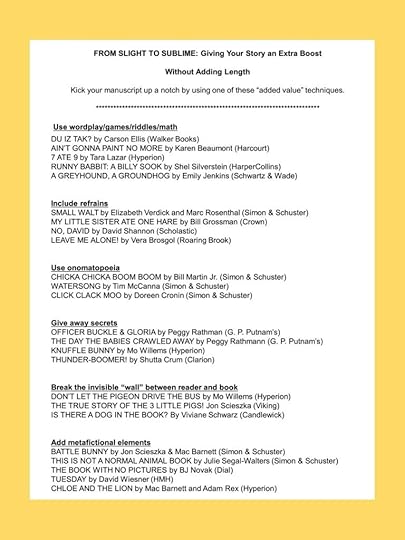
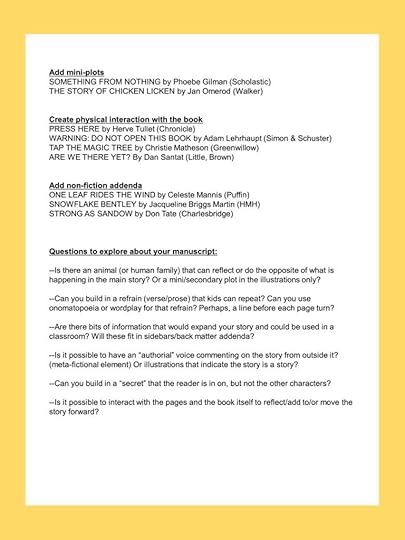
From Slight to Sublime: What to add to your picture book without adding length,
Here’s a handout that I used in a workshop I taught with Sylvie Frank at the Fl-SCBWI conference a few years ago. It’s a list of good books that illustrate what can be added to a picture book without adding length. Enjoy some of these titles!
 The post From Slight to Sublime: What to add to your picture book without adding length, first appeared on Shutta Crum.
February 6, 2023
Entwined Poem by Shutta Crum
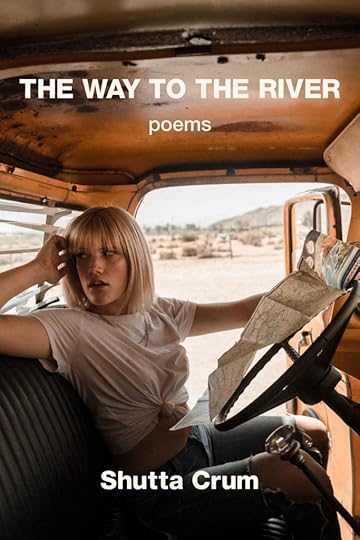
I recently read this poem at the Unitarian Universalist Church in Jacksonville, so I thought I’d post it here for everyone. It’s in my book THE WAY TO THE RIVER. Enjoy!
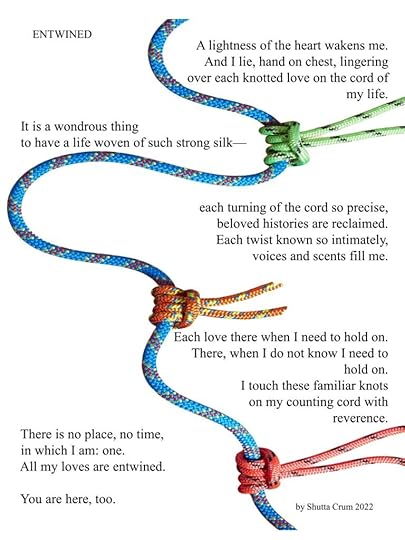 “Entwined” poem by Shutta Crum
 The Way to the River by Shutta CrumThe post Entwined Poem by Shutta Crum first appeared on Shutta Crum.
February 4, 2023
Poem by Shutta Crum: Baptized at the Creek now up on the Silver Birch site
Silver Birch site has published my “Baptized at the Creek” poem as part of their One Good Memory series. Thank you! You can read it at their site, or below. Enjoy!
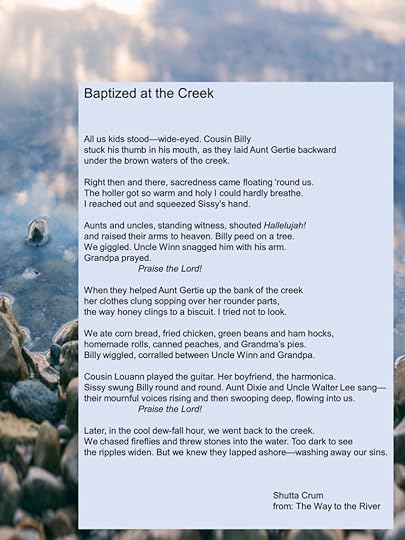
“Baptized at the Creek” is from my book THE WAY TO THE RIVER. Available at Kelsay Books or on amazon.
 The post Poem by Shutta Crum: Baptized at the Creek now up on the Silver Birch site first appeared on Shutta Crum.