Shutta Crum's Blog, page 23
September 22, 2011
BUMBLE-ARDY: The "Fresh Air" Interview with Maurice Sendak.
 In case you missed it: here is the link to the NPR "Fresh Air" interview with Maurice Sendak. "This Pig Wants to Party." Very moving!
(Interview with Maurice Sendak.)
Enjoy!
Shutta


September 21, 2011
Authors Who Broke the Rules: NY Times article
 Here's an enjoyable article about the 3 big "S's" in children's lit.: Seuss, Sendak, and Silverstein—all of whom have new books coming out.
Link is here: N Y Times article 9/18/2011.
Enjoy!
Shutta
September 20, 2011
Kelly's "A Sign of the Times"
![316163_283584381652609_100000031472857_1226134_1352214613_n[1]](http://blog.shutta.com/wp-content/uploads/2011/09/316163_283584381652609_100000031472857_1226134_1352214613_n1.jpg) My friend, author Kelly DiPucchio, posted this picture she took in Ferndale, MI to her FB wall recently. I do own a Kindle, but there's nothing like the smell and feel of a book. I wonder if anyone is working on scratch-and-sniff links for ebooks? Or little widgets that pop up and let you feel the texture of paper? Just asking . . .
My friend, author Kelly DiPucchio, posted this picture she took in Ferndale, MI to her FB wall recently. I do own a Kindle, but there's nothing like the smell and feel of a book. I wonder if anyone is working on scratch-and-sniff links for ebooks? Or little widgets that pop up and let you feel the texture of paper? Just asking . . .
Shutta
September 17, 2011
Literary Rambles: Agent Spotlight on Kathleen Rushall
Literary Rambles: Agent Spotlight: Kathleen Rushall.

Another great interview! This time with Kathleen Rushall of Marsal Lyon Literary Agency. Literary Rambles does weekly interviews with agents and is VERY detailed in its listings of background information, collected interviews, etc. For all writers—especially if you are looking for an agent—this is a good site to bookmark!
Enjoy!
Shutta
September 12, 2011
Clues for the Clueless about the Writing Life
(I'm re-posting this bit of info here to the new website. I hope it informs.)
1. There is no substitute for good writing (Having "connections' in the publishing world won't help if the writing is not good.) The most useful thing you can do to push your publishing career forward is to hone your craft. That means practice writing—and yes, despite what you might have heard—grammar, syntax and punctuation are important.
2. You need to be a reader in the area in which you wish to write. Read! Compare readings, take notes, and read like a writer. Could you do brain surgery if you did not study the body? ('Nuff said.)
3. No one can do your homework for you. You need to research children's publishing and current award winners. You need to know what is already out there so you won't waste your time, and so it will inform your writing. You'll be building a base of knowledge about your craft. That knowledge cannot reside in the mind of someone else. And remember, these are "current" books you will be studying because you will be writing for the millennial (today's) child, not the child you were fifty years ago.
4. No author will refer you to his/her agent or editor without falling in love with your manuscript. Relationships of this type are built on trust. No author would do damage to his or her agent/editor relationship without first reading and loving your manuscript. (Agents and editors are already inundated by thousands of manuscripts.) See # 5 for more info on this point.
5. Few authors have the time to mentor/read your manuscripts. (Thus they will have no time to fall in love with your writing.) This is because they are squeezing every second they can out of the day to work on their own books, and still retain a bit of a family life, and sanity. And don't forget, many authors must write in the middle of the night, or early in the morning, because they hold down day jobs. (See #9 for how much writing pays.) Teachers/instructors and contest judges will, generally, read your whole manuscript. A few authors offer manuscript critiques for a fee. Also, you can hire an independent editor or book doctor. (Do NOT use a book doctor referred to you by an agent that you are not completely sure is on the up-and-up. There could be kick-backs involved.)
6. Everyone gets rejected. This applies to well-known authors, who may have just gotten a rejection from the same agent/editor to whom you are seeking an introduction. There are many reasons for rejections. Get used to it. A lot of authors had hundreds of rejections before an acceptance. (I did!)
7. No one is interested in your memoir unless you are in the public light already, or did something amazing that few know about. The only exception to this is your immediate family.
8. No one is interested in the family tales your grandchildren love. (The exception to this is #7.) That is, unless you have crafted elegant stories from these through the hard work of plotting and revising. Remember, just because something really happened a certain way is no indication that the story should be written to follow the facts. Unless you're writing non-fiction, most good children's books require shaping through plotting. (See #1.)
9. The majority of authors make very little money. Surprised? Do the math. The basic contract for a novel is 10%. That's $1.50 for a $15 novel. Generally, first or second print runs are only few thousand copies. For picture books, it's worse! 10% must be shared with the illustrator. (No one magically comes up with another 10% for the illustrator.) Thus, 5% of a $16 hard-cover picture book is only 80¢! So event organizers: most authors will not travel long distances for "the opportunity" to sell a few copies of their books—the price of gas would eat up any royalties made on sales. (Exceptions to this are bookstore signings/conferences when networking is of more importance than selling.)
10. Authors are rewarded in many other ways, however. The best things that happen to authors are often NOT quantifiable. Children write letters to us. These are fun! And sometimes moving. One child collected over $500 to donate to the Blind Babies Foundation in San Francisco after reading my novel, SPITTING IMAGE. And you never know the places you'll go because of your books. I've been invited to the White House and to do a month-long tour of Japan. Wow! And of course, there is always the reward of a job well-done and recognition from people you admire. What more could anyone want from life?
I hope this list has given you some insight into a writer's life. It's not all rosy, but it is rewarding.
Write if you have a passion for it.
Write it you love how vision and thought combine to shape words on a page.
Write if you want your words to march forth and change the world in big, or small, ways.
Write if the artist within you says, "I am here. I make a difference."

Be true to your talent . . .
Honor it by giving attention to it . . .
Ciao!
Shutta
September 9, 2011
4th Random Act of Publicity: 2011
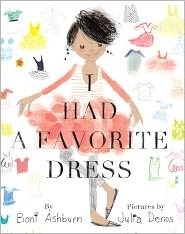
As my 4th random act of publicity this week I am shouting out about Michigan author Boni Ashburn's I HAD A FAVORITE DRESS. (Illustrated by Julia Denos. Published by Abrams Books.) What a fun and beautiful book for any little girl!
This is a fresh retelling of the old Jewish tale of "The Tailor," in which a favorite article of clothing (or a blanket) wears out. It keeps getting remade into something smaller that is loved until that, in turn, wears out. And WHAT a GREAT reworking of that pattern this is! Most little girls have a favorite dress, something in which they feel special. Mine was a green and white checked dress that I could twirl around in as it spun out about me.
Boni's book is perfectly matched by the airy washes and whimsical sketches of Julia Denos. A wonderful pairing—a beautiful book. Go out and buy it—especially if you have a young daughter!
Enjoy!
Shutta
September 8, 2011
3rd Random Act of Publicity: 2011
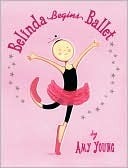
I just reread her book: BELINDA BEGINS BALLET. It's a sure-fire hit for any little girl who's feeling a bit "different." In the story, Belinda is tagged to be
a clown for the school talent show, due to her overly large feet. Instead, she amazes them all when she lets her natural grace shine through. Check it out!
(And while you're at it . . . there are three other Belinda books.) For all little ballerinas everywhere!
Dance!
Shutta
September 7, 2011
2nd Random Act of Publicity: 2011
For my 2nd random act of PR this week, I want to plug a new book called THE GOOD FIRE HELMET written by Tim Hoppey and beautifully illustrated by my good buddy Lori McElrath-Eslick. (See the cover below, and you'll understand why I said "beautifully illustrated!")
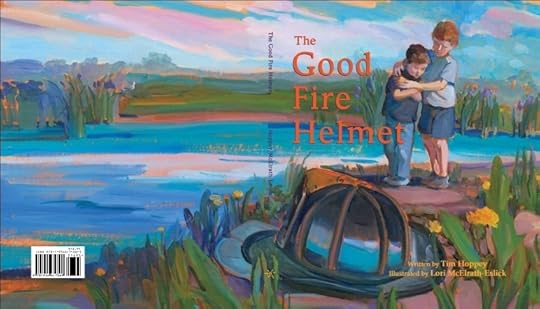
This book is particularly timely as Tim Hoppey is a firefighter and was a first-responder at the World Trade Center disaster.
The story makes a great read-aloud for students in 1st through 4th grade. The plot is about two brothers and how one finds the inner strength to save the other. Enjoy it this week as we approach the anniversary of 9/11.
Shutta
September 6, 2011
1st Random Act of Publicity: 2011
To start off this year's random acts of publicity week, I'd like to give a loud shout-out about my friend Deb Diesen's book, THE POUT-POUT FISH IN THE BIG-BIG DARK. (Illustrated by the talented Dan Hanna. Published by Farrar, Straus and Giroux.)
If you enjoyed the first book about the Pout-Pout Fish, you'll love this one, too in which Fish must conquer his fears to help his friend Ms Clam recover her "yawn-gone pearl."
And if you get a chance be sure to check out the hilarious book trailer made by Dan for the book. (See below.)
What's it about?
It's all about joy!
Shutta
August 28, 2011
Bradbury: Zen in the Art of Writing
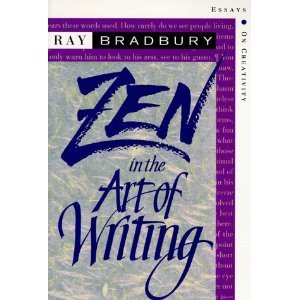
In honor of Ray Bradbury's 91st birthday (!) last week, I have to recommend his excellent book, ZEN IN THE ART OF WRITING: Essays on Creativity. I know it's an oldie, but I just got around to reading it. It was fun, and motivating. Very interesting to hear about how so many "classic" stories of his became 'classic" books like, The Martian Chronicles, Dandelion Wine, The Illustrated Man, Fahrenheit 451, and Something Wicked This Way Comes. (And "Wicked" has been in the news lately for a new graphic novel version that is coming out.)
Happy Birthday, Ray! (And do read ZEN…it's wonderful!)
Shutta