Maggi Andersen's Blog, page 77
December 21, 2011
Excerpt from my young adult novel: WAVING AT THE MOON
 WAVING AT THE MOON
Author: Maggi AndersenBuy Link: http://www.amazon.com/Waving-At-Moon-Maggi-Andersen/dp/1615721967/ref=tmm_pap_title_0?ie=UTF8&qid=1324504726&sr=1-1
Genre: Teen, Sci-Fi / Fantasy, Post-Apocalyptic Reviewed by: ReaderGirl - Night Owl Reviews
Evie French and her cousin Marcus Peters, live together at her parents' bed-and breakfast in Australia after most of the country has been destroyed. No one knows for sure what has really happened. Joel and his dog find their way to the bed and breakfast the three of them head towards a spot of green in a sea of gray. It's a long way down the coast. They find their way to Paradise, a city made up of survivors, led by Abe. Evie, Marcus, and Joel don't agree with all of his rules, but they must abide by them for the moment. But as time goes on, the three start to feel worse about what is going on in Paradise. Escape plans are made, but after Marcus falls for Evie's roommate Jasmine, who becomes pregnant, the plans must be moved up. Will they be able to escape Paradise and make it back home? I couldn't stop reading "Waving at the Moon" by Maggi Andersen until I had finished it all. I enjoyed reading about their journey, their struggles in Paradise, and their dilemma about what to do. This would easily be the first book in a great series. I will be anxiously awaiting Maggi Andersen's book. Those who enjoy post-apocalyptic fiction, and those who just enjoy a good action book will want to pick up "Waving at the Moon." Book Blurb In a post-apocalyptic world, Evie French has just turned seventeen. She and her cousin, Marcus Peters, sixteen, struggle to survive after being left alone in their parent's bed and breakfast hotel in outback Australia. An endless drought has killed Evie's father's avocado trees and all the surrounding habitation. Nothing grows in the fetid soil. Hope comes in the form of a nineteen year old boy, Joel Pitt. He arrives on his motorbike with his dog, Rasputin, bringing supplies. He climbs the tallest tree on the crest of the hill, and locates an area of green down along the coast, hundreds of miles away. The three pile onto the bike, with Marcus and Rasputin in the sidecar, and embark on a trip that will take them over mountainous terrain with a limited supply of food and water. What might they find if they reach the coast? Will other people have survived the devastation? And who bombed their country? No one seems to know. PG Excerpt
When Evie and the boys crawled sleepily out from their blanket, the sky was a hazy duck-egg blue and the sun a glowing egg yolk, rising over the horizon. Seagulls swooped to gather, in noisy conversation, around the bones of last night's meal.
She yawned and thought about the day ahead. The end of their journey was in sight.
"Let's have a swim," she called to the boys. "It will freshen us up."
"No sense in arriving at our new home all smelly." Marcus pulled off his shirt as he ran down the beach. He dived into the ocean with a whoop.
Evie waded in, wearing her T-shirt and shorts. The water was cold and soupy with seaweed. It caught up in her hair as she floated about.
"You look just like a mermaid," Joel said, swimming around her.
She splashed out at him as he dived down, coming up close.
Grabbing her by her waist, he pulled her under. She emerged spluttering.
"Beast!" she cried as he laughingly swam out of reach. The briny water had gone up her nose and she was mad as a hornet. She swam after him, not quite sure what she would do if she reached him. But he avoided her easily with a few strokes of his long arms, and trod water, grinning. It made her even madder.
They didn't see the wave that hit them from behind and tossed them both into shallower water. When he stood up to wipe his eyes, she waded up behind him and shoved him hard, pushing him over. He came up spitting out water. "Oh, I'll get you," he said, moving towards her.
"No, you won't," she said, thrilled and a little afraid at the prospect.
Losing her nerve, she raced out of the water before he could reach her.
He shook his head at her and swam away.
Evie watched the boys while picking bits of leathery weed out of her hair. Marcus caught a wave and it deposited him in a heap of legs and arms on the sand at her feet.
"Damn it," he said, standing up and peering into his shorts.
"Now I've got sand in embarrassing places."
"That could be nasty if it chafes." Joel ran from the water, sweeping his dark hair out of his eyes with a careless hand.
Evie thought how graceful and deft he was. He never seemed to make an awkward movement.
Marcus ran back and dived under a wave.
They ate their last can of beans for breakfast, then stripped the bike down to essentials.
"Darn beans. Almost glad we've finished them." Marcus grabbed the toilet roll and disappeared over a sand dune.
They had pared the bike down to essentials. Evie knelt to examine the pile of discarded stuff they planned to leave behind.
She glanced at Joel. "What do you think we'll find over there?"
His lips thinned. "People."
"Isn't that good? Don't you like people?"
He shrugged. "I like you, and Marcus…when he isn't being a pest."
"I've always found them to be good."
"You're lucky." He looked in the direction of the white buildings.
"I'll get you and Marcus to that place, but I don't know if I'll stay there, Evie."
Evie swallowed, feeling stricken. "Maybe you'll like it there."
"Maybe." Joel began fiddling with the bike engine, which seemed a waste of time seeing as there wasn't any gas. The tense set of his shoulders warned her not to ask any more questions. He was not going to tell her what happened before they met. But one day she hoped he would.
http://www.maggiandersenauthor.com [image error]


December 18, 2011
HAVE YOURSELF A MISTLETOE CHRISTMAS!

The Plant : The mistletoe that is commonly used as a Christmas decoration (Phoradendron flavescens) is native to North America and grows as a parasite on trees from New Jersey to Florida. The other type of mistletoe, Viscum album, is of European origin. The European mistletoe is a green shrub with small, yellow flowers and white, sticky berries which are considered poisonous. It commonly seen on apple but only rarely on oak trees. The rarer oak mistletoe was greatly venerated by the ancient Celts and Germans and used as a ceremonial plant by early Europeans. The Greeks and earlier peoples thought that it had mystical powers and down through the centuries it became associated with many folklore customs.
The Mistletoe Magic : From the earliest times mistletoe has been one of the most magical, mysterious, and sacred plants of European folklore. It was considered to bestow life and fertility; a protection against poison; and an aphrodisiac. The mistletoe of the sacred oak was especially sacred to the ancient Celtic Druids. On the sixth night of the moon white-robed Druid priests would cut the oak mistletoe with a golden sickle. Two white bulls would be sacrificed amid prayers that the recipients of the mistletoe would prosper. Later, the ritual of cutting the mistletoe from the oak came to symbolize the emasculation of the old King by his successor. Mistletoe was long regarded as both a sexual symbol and the "soul" of the oak. It was gathered at both mid-summer and winter solstices, and the custom of using mistletoe to decorate houses at Christmas is a survival of the Druid and other pre-Christian traditions. The Greeks also thought that it had mystical powers and down through the centuries it became associated with many folklore customs. In the Middle Ages and later, branches of mistletoe were hung from ceilings to ward off evil spirits. In Europe they were placed over house and stable doors to prevent the entrance of witches. It was also believed that the oak mistletoe could extinguish fire. This was associated with an earlier belief that the mistletoe itself could come to the tree during a flash of lightning. The traditions which began with the European mistletoe were transferred to the similar American plant with the process of immigration and settlement.
Kissing under the mistletoe : Kissing under the mistletoe is first found associated with the Greek festival of Saturnalia and later with primitive marriage rites. They probably originated from two beliefs. One belief was that it has power to bestow fertility. It was also believed that the dung from which the mistletoe would also possess "life-giving" power. In Scandinavia, mistletoe was considered a plant of peace, under which enemies could declare a truce or warring spouses kiss and make-up. Later, the eighteenth-century English credited with a certain magical appeal called a kissing ball. At Christmas time a young lady standing under a ball of mistletoe, brightly trimmed with evergreens, ribbons, and ornaments, cannot refuse to be kissed. Such a kiss could mean deep romance or lasting friendship and goodwill. If the girl remained unkissed, she cannot expect not to marry the following year. In some parts of England the Christmas mistletoe is burned on the twelfth night lest all the boys and girls who have kissed under it never marry. Whether we believe it or not, it always makes for fun and frolic at Christmas celebrations. Even if the pagan significance has been long forgotten, the custom of exchanging a kiss under the mistletoe can still be found in many European countries as well as in Canada. Thus if a couple in love exchanges a kiss under the mistletoe, it is interpreted as a promise to marry, as well as a prediction of happiness and long life. In France, the custom linked to mistletoe was reserved for New Year's Day: "Au gui l'An neuf" (Mistletoe for the New Year). Today, kisses can be exchanged under the mistletoe any time during the holiday season.
The Legend : For its supposedly mystical power mistletoe has long been at the center of many folklore. One is associated with the Goddess Frigga. The story goes that Mistletoe was the sacred plant of Frigga, goddess of love and the mother of Balder, the god of the summer sun. Balder had a dream of death which greatly alarmed his mother, for should he die, all life on earth would end. In an attempt to keep this from happening, Frigga went at once to air, fire, water, earth, and every animal and plant seeking a promise that no harm would come to her son. Balder now could not be hurt by anything on earth or under the earth. But Balder had one enemy, Loki, god of evil and he knew of one plant that Frigga had overlooked in her quest to keep her son safe. It grew neither on the earth nor under the earth, but on apple and oak trees. It was lowly mistletoe. So Loki made an arrow tip of the mistletoe, gave to the blind god of winter, Hoder, who shot it , striking Balder dead. The sky paled and all things in earth and heaven wept for the sun god. For three days each element tried to bring Balder back to life. He was finally restored by Frigga, the goddess and his mother. It is said the tears she shed for her son turned into the pearly white berries on the mistletoe plant and in her joy Frigga kissed everyone who passed beneath the tree on which it grew. The story ends with a decree that who should ever stand under the humble mistletoe, no harm should befall them, only a kiss, a token of love. What could be more natural than to translate the spirit of this old myth into a Christian way of thinking and accept the mistletoe as the emblem of that Love which conquers Death? Its medicinal properties, whether real or imaginary, make it a just emblematic of that Tree of Life, the leaves of which are for the healing of the nations thus paralleling it to the Virgin Birth of Christ.The Holiday Spot.
 [image error]
December 14, 2011
December 12, 2011
A bit more on the history of fans

When parties and balls became fashionable in England in the Elizabethan period, the fan became de rigueur. The heavy, hot atmosphere of unwashed overdressed people jammed into a candlelit room made them a necessity to keep one's makeup from running. At first paddle-shaped or made from feathers, they were fairly uninspiring until the arrival of the Huguenots.
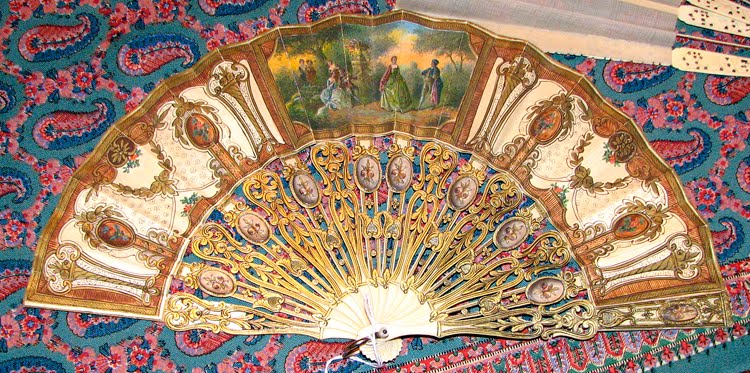 The French excelled at the creation of beautiful fans. A Watteau style fan.
When Jacob Chassereau settled in London fans became a work of art, enlivened by the Chinese export market.
Fans were then constructed uniformly, and no bigger than twelve and a half inches long. The decoration was chosen by the lady. The sticks were made of wood, ivory, mother-of-pearl, gold and the leaves made either paper or lamb's/kid's skin.
Painters specialized in decorating fans. In England the shepherds and nymphs of Watteau and later Boucher were popular. (Watteau himself painted fans, including the bridal fan of Adelaide of Savoy in 1709.)
 In 1711, the craze for expensive fans reached such proportions that Joseph Addison felt the need to mock it roundly in his coffee house publication, The Spectator. His excellent article, 'advertising' his Academy for the Instruction of the Use of the Fan explains how he drills young ladies in fan etiquette in a military fashion.
 The Fluttering of the Fan is the last, and indeed the master-piece of the whole Exercise; but if a lady does not misspend her time, she may make herself mistress of it in three months...There is the angry flutter, the modest flutter, the timorous flutter, the confused flutter, the merry fluttter, and the amorous flutter...I have seen a fan so very angry, that it would have been dangerous for the absent lover who provoked it to have come within the wind of it...I need not add, that a fan is either a prude of coquet according to the nature of the person who bears it.
p.s. I teach young gentlemen the whole art of gallanting a fan.
Spectator, no. 102
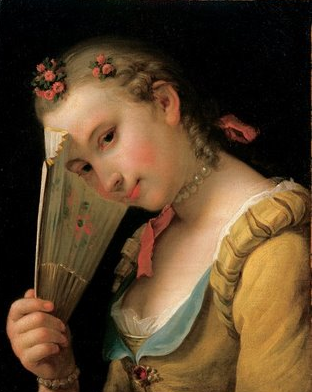 He mocked the 'Language of the Fan'. The Rotari portrait of circa 1750 of the girl with the butcher's hands seems to indicate there was some kind of message to be imparted by particular postures. Whether such a language was ever used by young ladies at fashionable parties was possibly only a romantic notion: Common themes:
Fan closed, tip to lips: we are overheardDitto, tip to right cheek: yesDitto, tip to left cheek: noDitto, tip to forehead: you are out of your mindChin on tip: you annoy meDitto, tip to heart: I love youLower open fan until pointing at the ground: I hate you
The fan disappeared from fashion until 1829 The Duchesse de Bern's ball began the renaissance of the fan at the Tuileries in Paris. Madame la Duchesse de Berri had undertaken to get up a Louis XV quadrille, and was seeking everywhere for fans of that period. Some old fans were found at a perfumer named Vanier, who lived in the Rue Caumartin. Vanier collected them. His fans were taken to the palace; in the quadrille they created a furor, and were all purchased.
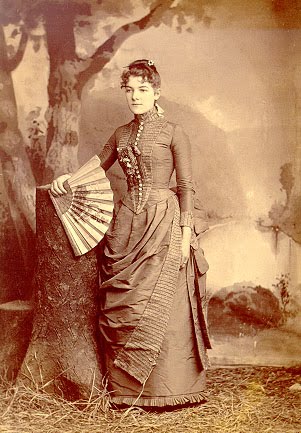 Victorian lady with fan Source: Georgian London by Lucy Inglis Georgian London the book will be available in hardback in the summer of 2012, published by Penguin Books. http://www.georgianlondon.com
Images: The Alice T. Miner Museum
Victoriana.com [image error]
A Victorian Christmas
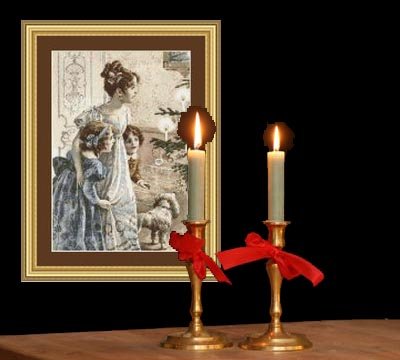
Santa Claus first made an appearance in British society during Queen Victoria's reign when the wealthy middle class generated by the industrial revolution changed the face of Christmas forever. Father Christmas was originally part of an old English midwinter festival, normally dressed in green, a sign of the returning spring. The stories of St. Nicholas (Sinter Klaas in Holland) came via Dutch settlers to America in the 17th Century. From the 1870's Sinter Klass became known in Britain as Santa Claus with his bag full of gifts and toys distributed by reindeer and sleigh.
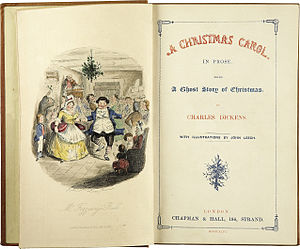
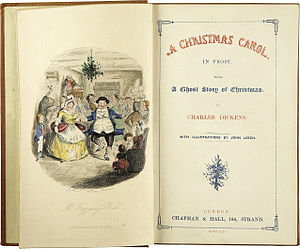
Inspired by Charles Dickens Christmas Carol published in 1843, the wealthy gave money and gifts to the poor at Christmas. Christmas Day and Boxing Day became holidays. Boxing Day was so named because the poor opened the boxes containing gifts and money from their wealthy benefactors. The railways allowed those now living and working in the cities to return to the country for Christmas. With factories came mass production, which produced less expensive games, dolls, books and clockwork toys than the handmade variety. Children of poorer families might have found an apple, orange and a few nuts in their Christmas stocking, which became popular from around 1870.
Turkeys originated from America and had been in Britain for hundreds of years before the Victorian era but along with chicken, they were too expensive at the beginning of Queen Victoria's reign. Roast beef was traditional fare in northern England and in the south goose was eaten. Queen Victoria and family in 1840 enjoyed both beef and a royal roast swan or two. By the end of the century most people feasted on turkey for their Christmas dinner.
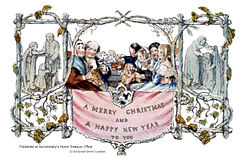
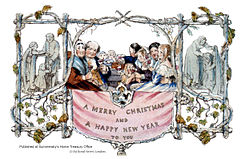
The "Penny Post" was first introduced in Britain in 1840 by Rowland Hill. The idea was simple, a penny stamp paid for the postage of a letter or card to anywhere in Britain. This simple idea paved the way for the sending of the first Christmas cards. Sir Henry Cole tested the water in 1843 by printing a thousand cards for sale in his art shop in London at one shilling each.
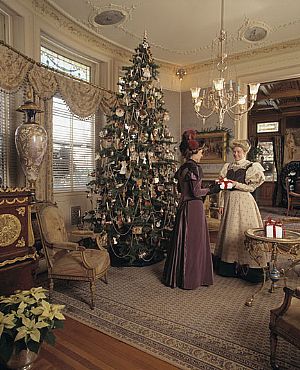
Queen Victoria's German husband Prince Albert helped to make the Christmas tree as popular in Britain as they were in his native Germany, when he brought one to Windsor Castle in the 1840's.
 Tom Smith, a London sweet maker in 1846 invented crackers. The original idea was to wrap his sweets in a twist of fancy colored paper, but this developed and sold much better when he added love notes (motto's), paper hats, small toys and made them go BANG! Carol Singers and Musicians "The Waits" visited houses singing and playing the new popular carols; 1843 - O Come all ye Faithful 1848 - Once in Royal David's City 1851 - See Amid the Winters Snow 1868 - O Little Town of Bethlehem 1883 - Away in a Manger

http://www.historic-uk.com/HistoryUK/... from Wikipedia
SURRENDER TO DESTINY is set in the late 19th Century
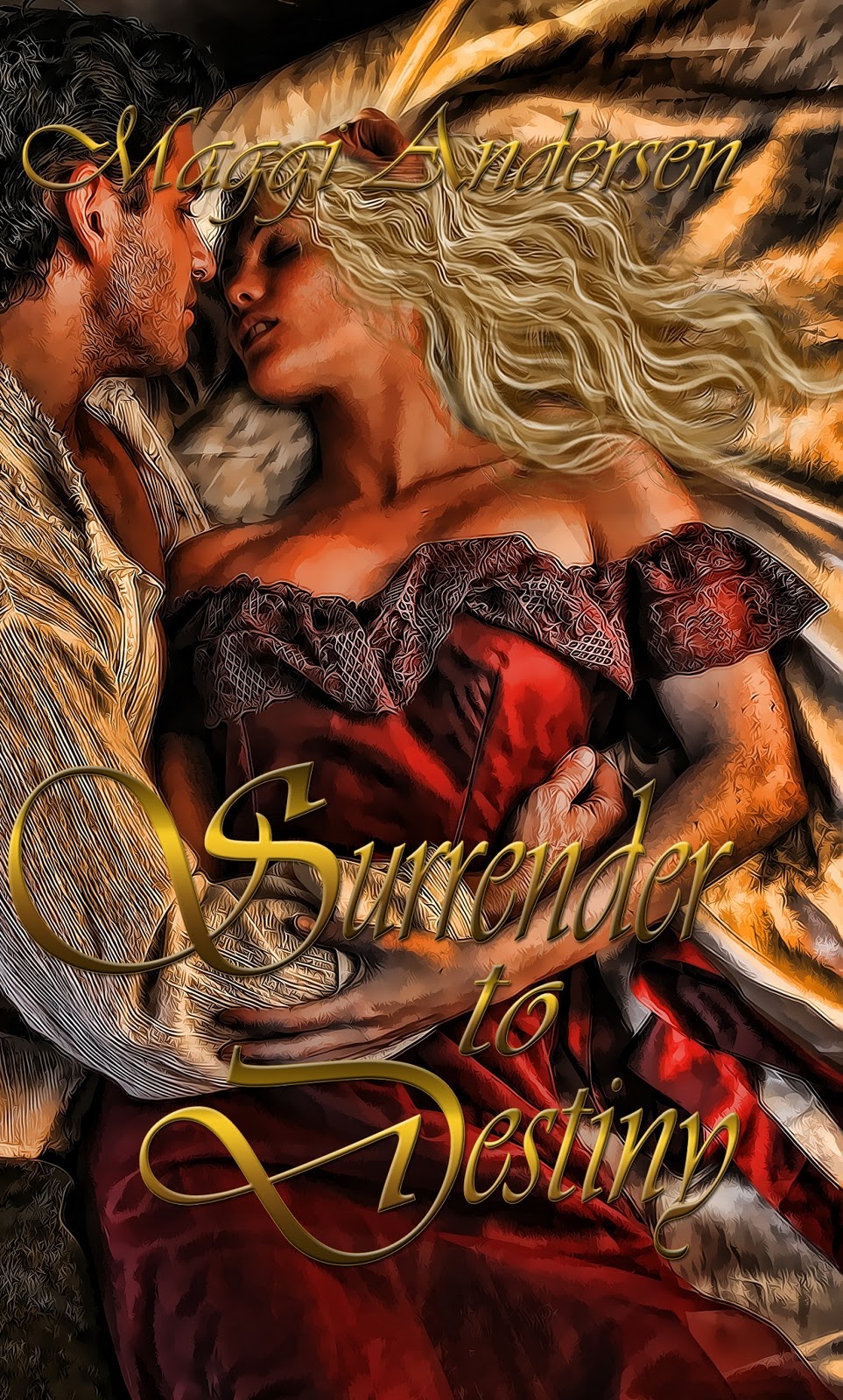
Buy link: http://www.amazon.com/Surrender-Destiny-Maggi-Andersen/dp/146362641X/ref=tag_stp_s2f_edpp_victor17ce
Blurb: In Victorian London, Giovanna Russo finds herself penniless on the streets, fighting for independence in a city where a woman's choices are few. London with its smoggy, dark alleyways is a dangerous place for a girl to be, but now it's got more personal, someone wants her dead. When Blair Dunleavy, a wealthy, Irish gentleman sees Gina Russo in her stepfather's painting, he includes her in his plans for the perfect life. A wife in Ireland and a mistress in London. But the best laid plans … PG Excerpt: LONDON 1890Gina Russo looked up at the attic window where driving rain had caused a leak to form. It dripped down onto the floorboards, forming a pool at her stepfather's feet. He seemed completely unaware of it, but then, when he was painting, the building could burn down around him."You must move your easel, Milo," she ordered him, placing her hands on her hips. "Your trousers will get wet and in this miserable, moldy climate, you'll catch your death."He looked up blankly, paintbrush poised above the canvas where he painted a still life. "But, the light, Gina!""I do not intend to be orphaned in this cold-hearted city. What would I do without you?"He laughed and wiped his brush on a cloth, then threw it down onto a table piled with brushes and half-squeezed tubes of paint. "You have made a good point. You're not just pretty, my girl, you've got something up here," he tapped his forehead.She helped him move his things away then ran to place a bowl under the drip. "When will you pose for me again, Gina? I have great hopes for the last painting I did.""When you have sold another painting and we can afford some coal," she said firmly. "I am not stripping off in this cold. And we need decent food.""Aah. I can taste a tender turkey breast stuffed with sweet Italian sausage and chestnuts. That would be most welcome." "We shall be eating your Still Life with Apples, Milo, long before that." Gina watched as he settled at his easel once more, and pick up his brush. There would be no more conversation for the afternoon. She grabbed the broom and began to sweep the floor at the far end of the room. She worked to warm herself. She'd swept the floor that morning, but no matter how many times she cleaned it, it always looked dirty. Work also helped to clear her head. She was constantly thinking up schemes to leave horrid, foggy London. She had been thirteen years old when her mother brought her to England, old enough to remember the sunny days and green hills of Tuscany. She turned to study the bowl of wizened fruit and vase of wilting flowers she had purchased from the market that morning for Milo to paint. Surely, the sun-ripened fruit of her homeland was sweeter. Her mother had been like a delicate flower, she had not thrived in an English winter. She hated the cold and fog. She was fond of saying that Italians knew how to live and the men knew how to love. It was certainly true that the Englishmen who pursued Gina had money where their hearts should be. They knew nothing of a love that took hold of you, mind, body, and soul. To them she would be an acquisition, someone they could flaunt in front of their friends and boast about in their clubs. She would have none of it. She had promised her mother.When her mother had married Milo and came to England, she had become a much sought after artist's model. Even after her death, Gina and Milo remained loyal to their friends of the demi-world, the shadow world of fellow artists, models, writers, thespians, courtesans and musicians, through which the upper classes wandered, paying for anything they desired. It could be an exciting world, but had a dark side of despair, poverty, ruin and untimely death.Her mother had died of inflammation of the lungs at thirty-six. She was already ailing when she married Milo, fifteen years her elder. She knew he would take care of Gina after she was gone. Even when her health was failing, she would drag Gina to church every Sunday. Her final words still echoed in Gina's ears. "We have a saying in Italy, sweet child. You never forget your first love. I loved your father and if only he'd lived.... No matter how hard life gets, don't ever be tempted to sell your body, for that will destroy your soul. Remember you are a good Christian girl. Promise me!"Gina touched the hair-bracelet on her wrist, made with her mother's lovely golden hair. When she had asked her mother about her father, she would always turn away. "Better that you don't know." Her standard reply left Gina wondering what made her so sad and reluctant to reveal the past. Had her mother and father been married? "Bah," Gina said, swatting at some imaginary speck of dirt. She was sick of being grindingly poor. The struggle to live tore the heart out of you and dragged you down. She hated London, its miles of rat infested, filthy cobblestone alleys and shabby brick and stucco houses, the noise and the smells and the dirt. She hated feeling desperately sad for the tatty, barefoot children. She hated her cheap dresses, and longed to have something store-bought and pretty. She hated their ugly, leaky attic rooms that no amount of cleaning could turn into a home, most of all. A block away, the street prostitutes trolled between the gin shop and the pawnshop, younger than she, some of them. Green from the country, they quickly become addicted to the drink and their gentle eyes turned hard. Lying in bed at night, she'd listen to them out there under the gaslights. Dancing, drinking, and singing into the small hours. The sounds of their hollow laughter made her want to weep and pull a pillow over her head. As she put away the broom, Gina's thoughts turned to Milo. How did he produce such beauty in his paintings, in a place like this? She put her hand to her mouth. How could she be so ungrateful?"Did you say something, mio caro?" Milo asked, adding a highlight to a painted apple. The apple had become his signature and appeared in most of his paintings. His painted apple was so much fresher and redder than the one in the bowl. Perhaps that was his secret, he saw life through rose-colored glasses."No, Milo," she said, going to stir the minestrone soup that with bread and cheese, would have to do them until the end of the week. "You're a good daughter, Gina," he said absently.
Maggi
[image error]
December 11, 2011


December 8, 2011
New Contracts
I've just signed two new contracts with Knox Robinson Publishing. A Baron in Her Bed (Regency-set historical) and The Folly At Falconbridge Hall (late Victorian mystery) Coming next year!
December 4, 2011
Review: THE ACCIDENT by Linwood Barclay
 In Connecticut, building contractor Glen is suffering a downturn in the building trade by the housing crisis, and his wife, Sheila, is taking a business course at night to increase her chances of landing a good-paying job.
When she doesn't return home from her course, Glen's life is changed forever. While their eight-year-old daughter sleeps soundly, Glen discovers the horrible truth, Sheila has been killed in a horrible car accident, which has killed two other people. Fingers are pointed when it's found she was driving drunk, and blame aimed at Glen for allowing her to do it.
Glen knows it's impossible. Sheila wasn't an alcoholic. She was a law abiding citizen. Wasn't she? Glen begins to uncover layers of disturbing criminal activity beneath the placid surface of their suburb. Was Sheila involved?
I like Linwood Barclay's style. He describes it as a suburban suspense and it essentially is, because he paints society warts and all, fractured by desperate people suffering the effects of the global financial crisis. I'd place more emphasis on thriller. He keeps it moving along at a breathless pace and I truly didn't know who the killer was until very close to the end. I'm usually good at picking whodunnits too. There's social comment, which could be a warning to the unwary, and a moral to this book as well, that I liked.