
Maggi Andersen's Blog, page 75
February 25, 2012



February 20, 2012
Four Star Review from RT Book Reviews for The Reluctant Marquess!
THE RELUCTANT MARQUESS
by Maggi Andersen
Released: 8th March 2012
Pre-order on Amazon: http://www.amazon.com/Reluctant-Marquess-Maggi-Andersen/dp/1908483091/ref=sr_1_1?ie=UTF8&qid=1329782037&sr=8-1
Genre: Regency Period, Historical Romance,England, print, E-book.
Setting: Regency England
RT Rating
Readers will love the delightful tale of love in an arranged marriage. As troubles buffet the new couple and their love is tested, readers will be rooting for them to make it through.
Orphan Charity Barlow has no idea who she will be meeting when she travels to the home of her godfather, the Marquess of St. Malin. Robert St. Malin is the new Marquess St. Malin, having inherited the title and the lands from his uncle on the condition that he wed Miss Charity Barlow.
Charity's circumstances change from orphan to marquess in less then a week. She and her new husband are opposites; Charity is headstrong, determined to make their relationship work, while the bitter and angry Robert is determined to use her to prove to the ton that he was not upset when his marriage proposal was turned down. Charity and Robert will have to learn to put aside their pride in order to make their relationship work.

by Maggi Andersen
Released: 8th March 2012
Pre-order on Amazon: http://www.amazon.com/Reluctant-Marquess-Maggi-Andersen/dp/1908483091/ref=sr_1_1?ie=UTF8&qid=1329782037&sr=8-1
Genre: Regency Period, Historical Romance,England, print, E-book.
Setting: Regency England
RT Rating
Readers will love the delightful tale of love in an arranged marriage. As troubles buffet the new couple and their love is tested, readers will be rooting for them to make it through.
Orphan Charity Barlow has no idea who she will be meeting when she travels to the home of her godfather, the Marquess of St. Malin. Robert St. Malin is the new Marquess St. Malin, having inherited the title and the lands from his uncle on the condition that he wed Miss Charity Barlow.
Charity's circumstances change from orphan to marquess in less then a week. She and her new husband are opposites; Charity is headstrong, determined to make their relationship work, while the bitter and angry Robert is determined to use her to prove to the ton that he was not upset when his marriage proposal was turned down. Charity and Robert will have to learn to put aside their pride in order to make their relationship work.

February 18, 2012
New Cover for The Folly at Falconbridge Hall - coming in December
 Vanessa Ashley felt herself qualified for a position as governess, until offered the position at Falconbridge Hall.
Left penniless after the deaths of her artist father and suffragette mother, Vanessa Ashley draws on her knowledge of art, politics and history to gain employment as a governess. She discovers that Julian, Lord Falconbridge, requires a governess for his ten-year-old daughter Blyth at Falconbridge Hall, a huge rambling mansion in the countryside outside London.
Lord Falconbridge is a scientist and dedicated lepidopterist who is about to embark on an extended expedition to the Amazon in search of exotic butterflies. An enigmatic man, he takes a keen interest in his daughter's education, but Vanessa feels that he may disapprove of her modern methods.
As she prepares her young charge to enter into the modern world, Vanessa finds the girl detached and aloof. As Vanessa learns more about Falconbridge Hall, more questions arise. Why doesn't Blythe feel safe in her own home? Why is the death of her mother, once famed society beauty Clara, never spoken of? And why did the former governess leave so suddenly without giving notice?
Pre-Order in print http://www.knoxrobinsonpublishing.com/product_info.php?products_id=123
AMAZON: http://www.amazon.com/Folly-at-Falcon...

February 14, 2012
St Valentine's Day!

A previous post on the history of Saint Valentine's Day.
Saint Valentine's Day, commonly shortened to Valentine's Day held on February 14. The day is named after one or more early Christian martyrs named Valentine and was established by Pope Gelasius I in 500 AD. It was deleted from the Roman calendar of saints in 1969 by Pope Paul VI, but its religious observance is still permitted. It is traditionally a day on which lovers express their love for each other by presenting flowers, chocolates, and sending greeting cards (known as "valentines").
The day first became associated with romantic love in the circle of Geoffrey Chaucer in the High Middle Ages, when the tradition of courtly love flourished.
The first recorded association of Valentine's Day with romantic love is in Parlement of Foules (1382) by Geoffrey Chaucer[18] Chaucer wrote:
For this was on seynt Volantynys day
Whan euery bryd comyth there to chese his make.
["For this was Saint Valentine's Day, when every bird cometh there to choose his mate."]
This poem was written to honor the first anniversary of the engagement of King Richard II of England to Anne of Bohemia.[19] A treaty providing for a marriage was signed on May 2, 1381.[20] (When they were married eight months later, they were each only 15 years old).
Ten words that represent Valentine's Day
#1: Romantic
Definition:
Marked by expressions of love or affection; conducive to or suitable for lovemaking; a person of romantic temperament or disposition (noun)
About the word:
We associate this word with sweetness and love, but it emerged from the conquering powers of the Roman Empire.
The expansion of ancient Rome created various dialects of Latin called "romans." (These evolved into Italian, French, Spanish, and others – the Romance languages.)
"Romans" were used to write popular stories involving chivalric or courtly love, and such tales became known as romances.
If we describe Rome today as a "romantic" city, we're using a word that has travelled a long way to come home.
#2: Valentine
Definition:
A sweetheart chosen or complimented on Valentine's Day; a gift or greeting sent on this day
About the word:
Christianity has more than one martyr named Valentine, and the one, true Valentine is uncertain.
Romantics favor the tale of the third-century Roman physician and priest Valentine. Supposedly, Valentine had fallen in love with his jailer's daughter, and shortly before his death sent a letter to her "from your Valentine."
#3: Amour
Definition:
A usually illicit love affair
About the word:
In 2010, a poll of linguists rated amour – the French word for "love," simple and sweet – the most romantic word in the world. In English, the word gains drama and loses innocence.
#4: Adonis
Definition:
A very handsome young man
About the word:
In Greek mythology, the beautiful young Adonis was beloved by both Persephone and Aphrodite, so Zeus decreed the young man should divide his time and attention between the two goddesses.
He was later killed by a wild boar – an attack that may have been arranged to avenge another of Adonis' romantic intrigues.
#5: Aphrodisiac
Definition:
Something that excites; an agent that arouses or is held to arouse sexual desire
About the word:
Aphrodite, Greek goddess of love (who was infatuated with Adonis) gave the Greeks the words 'aphrodisia' (heterosexual pleasure) and 'aphrodisiakos' (a gem with aphrodisiac powers).
#6: Infatuation
Definition:
Foolish or extravagant love or admiration
About the word:
An infatuation, by definition, is an emotion that shouldn't be taken too seriously. The word's etymology makes the same point. It traces back to the Latin for "foolish" or "silly," as does another insulting term: fatuous.
#7: Casanova
Definition:
Lover, especially a man who is a promiscuous and unscrupulous lover
About the word:
In the 1700s, Giacomo Girolamo Casanova was a spy, a clergyman, a gambler, and apparently a man of charm. He was also a writer. His autobiographical musings about his more than 100 lovers made his name a byword for a man who loves too much.
#8: Unrequited
Definition:
Not reciprocated or returned in kind
About the word:
Where there's unrequited, there's requited. So what does requite mean? To requite (a somewhat quaint term) is to give or do something in return for something that another person has given or done.
So 'unrequited love' suggests an imbalance: too much love paid out and too little paid back.
#9: Saccharine
Definition:
Overly sentimental; mawkish; unpleasantly sweet
About the word:
Boxes of candy covered with cupids and hearts might, for some people, have a saccharine quality – both in sentiment and taste.
For others, romantic and sugary excess is essential to Valentine's Day.
Either way, saccharine comes from saccharum, Latin for "sugar." The word dates back to the 1600s. The calorie-free sweetener saccharin (without an e) arrived a couple hundred years later.
#10: Sweetheart
Definition:
Darling; one who is loved
About the word:
The Greeks and Egyptians believed the heart was the center of the emotions. English speakers borrowed the idea, and sweet + heart has been a term of endearment – particularly for romantic love – since the Middle Ages.

February 11, 2012
Two great reviews for Murder in Devon coming 25th February

MURDER IN DEVON
Blurb:
She wants the truth, but it may cost her more than she thinks...
An ex-patriot-American living in England, magazine reporter Casey Rowan wakes to find one best friend murdered and another seriously injured. Casey is determined to find the killer, despite running afoul of the detective in charge of the case—a blue-eyed Scot named Rod Carlisle, who considers her a prime suspect. As Casey gets closer to the truth, losing her heart to the sexy cop isn't the only thing she risks. Now her life is danger, too.
He wants her, but he may have to choose between love and duty...
Rod has no patience with civilians who interfere in police matters, even hot little numbers like Casey. Though he tries to keep things professional, Casey's beauty and spunk are hard to resist. He warns her that what she's doing is dangerous, but he only succeeds in alienating her. She refuses to listen and goes off on her own with disastrous results. Now Rod's in a race to find the killer before the woman he loves becomes the next victim.
TAYLOR JONES SAYS: Murder in Devon by Maggi Andersen is more than a standard murder mystery. Sure, there is all the suspense you'd expect when Casey Rowan, an American ex-patriot and reporter wakes in the country home of old college friends to find one murdered and the other barely alive. What's more, Casey finds herself "a person of interest"—in more ways than one—of Detective Inspector Rod Carlisle, a man from whom any red-blooded woman would be more than happy to raise their arms and receive a personal pat down.
Determined to find her friend's killer, Casey ignores warnings from the police and embarks on a mission that drags her into the shadowy and secret world of Nazi art theft, modern-day fascist politics and interviewing possible suspects including wife-beaters and criminals seeking revenge beyond the jail's walls—all of this at no small threat to her safety. Of course, tracking her killer isn't the only danger lurking for Casey. There is also the threat that once she allows a certain detective to breach her emotional defense's, he won't stop until he's cuffed her to him good and proper. Yep, I enjoyed observing as Casey and Rod fought and scratched against each other, moved closer, then scratched again.
Andersen has crafted a sharp, twisting plot. Murder in Devon does not hand over its secrets easily, but drags you along and keeps you riveted until the last page. Her characters are real, filled with humor and pathos and you want so much for Casey to find the killer but also for her to achieve a sense of peace at the tragic loss of her friend. Maggie Anderson has a new fan and I can't wait to read another of her novels. My rating: A standout 5 stars.
REGAN MURPHY SAYS: Murder in Devon by Maggi Andersen is a murder mystery as chilling as the wintry English countryside it is set in. When American ex-patriot, Casey Rowan wakes to find her best friend murdered and his wife barely clinging to life, she knows her life will never be the same. But she doesn't know that soon her own life will be in danger. The sexy hunk of a detective, Rod Carlisle tries to warn her—once he stops thinking of her as his prime suspect—but Casey isn't big on listening. She wants to know who murdered one friend and seriously wounded another while Casey slept upstairs. When the police don't move fast enough to suit her, she decides to take matters into her own hands.
A reporter/editor working for a woman's magazine in England, Casey is determined to find the killer, and her investigation leads her into the world of modern-day Neo-Nazis and the black market sale of art stolen by their predecessors during Hitler's Third Reich. But killers and kidnappers aren't the only thing Casey has to be careful of. Her growing attraction to Rod threatens to destroy the carefully constructed walls she has built around her heart.
Murder in Devon is a fast-paced, riveting tale of greed, politics, murder, and two people trying to find room for love while remaining on opposite sides of a police investigation. He has to operate within the law, and she is willing to break the law to get to the truth. This suspense-filled page-turner deprived me of sleep, supper, and my usual email-and-chat fix in the evenings. I simply couldn't put it down. You'll want to visit this one over and over again. I'm giving it 4.6 stars.

February 9, 2012
New Cover for A BARON IN HER BED The Spies of Mayfair Series

I'm mighty pleased with this one.

February 8, 2012
Free Story: Caroline and the Captain - A Regency romance

George, Earl of Haworth, has died in a riding accident and left Haworth Park in disorder.
Captain Nicholas Bonham of Wellington's Peninsular Regiment, the 52nd Light Infantry, returns from fighting the Napoleonic wars to see his brother laid to rest. A skilled rider, George's death remains a mystery, as does the parlous state of his finances. Haworth Park must be sold unless Nicholas can find a swift solution.
When his neighbor, Sir Marcus Mirrington offers Nicholas an answer to his problems, Nicholas accepts his daughter's hand in marriage. But Miss Caroline Mirrington harbors a dangerous secret of her own.
KNOX ROBINSON PUBLISHING: http://www.knoxrobinsonpublishing.com...

February 3, 2012

January 28, 2012
Interesting words and vignettes from the book of ' Forgotten English'
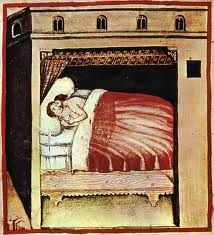 I recently purchased Forgotten English by Jeffrey Kacirk. It's filled with fascinating vignettes.
For example: Amober – Medieval Welsh legal term for a "maiden fee" imposed by the lord of a manor as compensation for forfeiting his right of primae noctis, literally the "first night." Under this custom, know as cuillage in medieval Scotland, he was entitled to the right of "first refusal" with any woman in his employment on her wedding night. If her husband wished to avoid this outrageous insult, he was often forced to pay an amober.
Hazlitt wrote that during the late thirteenth-century reign of Edward I, to add insult to injury, "in Cornwall it was then a manorial custom ...that she should find surety to the lord o the said manor to return to it after the death of her husband, if he predeceased her." Another annoyance face by newlyweds was a delay imposed by the Church during medieval times until their bed was "properly blessed." The new married couples were made to wait till midnight after the marriage day, before they would pronounce a benediction, unless handsomely paid for it, and they durst not undress without it, on pain of excommunication.


