Stephanie Morrill's Blog, page 6
May 11, 2018
Teacher Appreciation Week
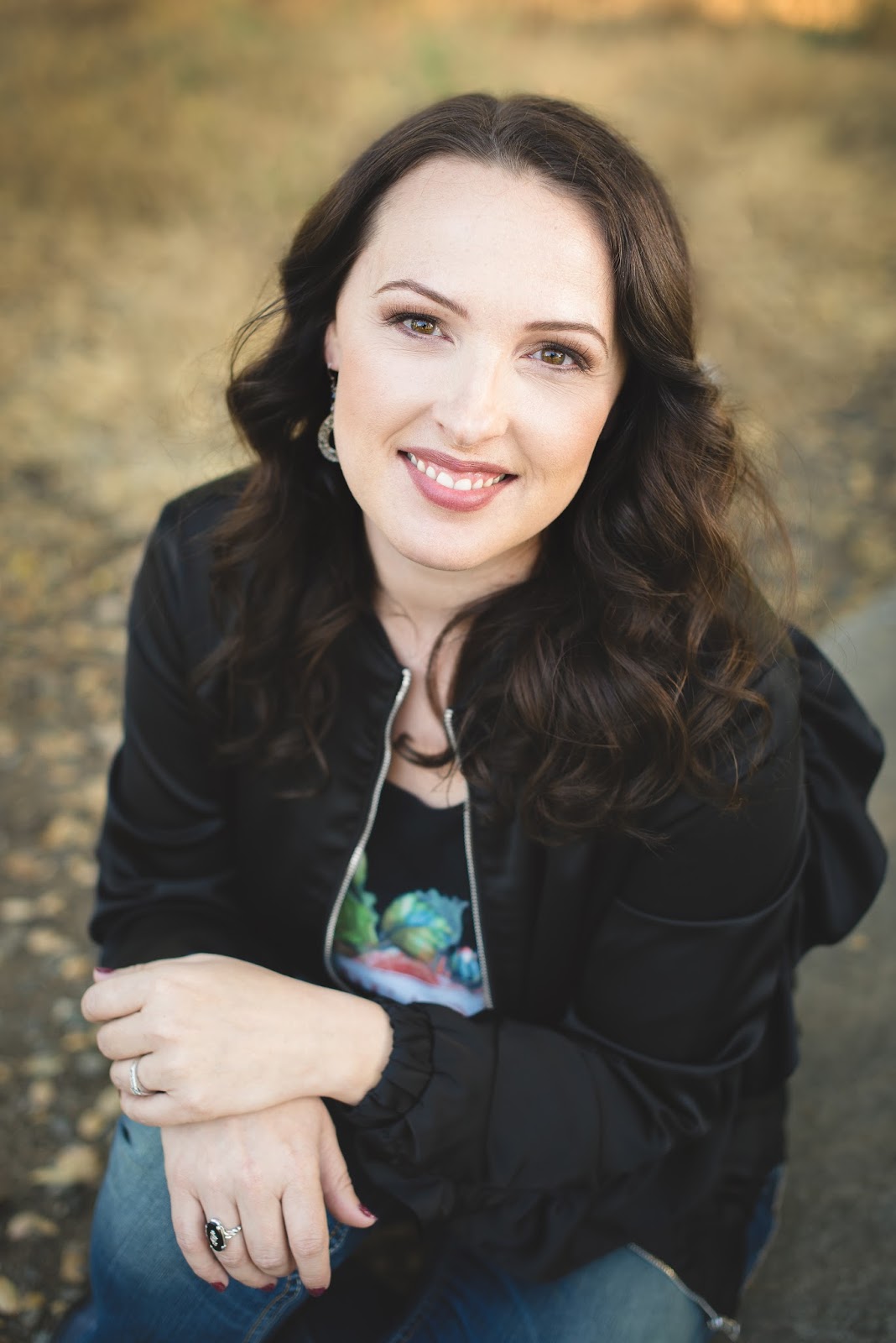 Shannon Dittemore is the author of the Angel Eyes novels. She has an overactive imagination and a passion for truth. Her lifelong journey to combine the two is responsible for a stint at Portland Bible College, performances with local theater companies, and an affinity for mentoring teen writers. Since 2013, Shannon has taught mentoring tracks at a local school where she provides junior high and high school students with an introduction to writing and the publishing industry. For more about Shan, check out her website, Facebook, Twitter, Instagram and Pinterest.
Did you know that the United States of America has designated the first full week of May as Teacher Appreciation Week? It's true! Cross my heart.

After spending three days at outdoor school with my fourth grader, after watching the creativity and sacrifices made by teachers--in the classroom and outside it--I can't help but consider all the ways teachers helped me get where I am today.
When I was in first grade, I desperately wanted to be an astronaut. Tragically, you need to have some sort of mathematical inclination to succeed in outer space, so that was never going to work out. But! It was in first grade that I won my very first writing competition--for a story about a parakeet who escaped its cage only to be found by the hero feasting on a bag of birdseed.
My fifth grade teacher, Mrs. Schroeder, set us a haunted house prompt on Halloween and she liked my story so much--featuring a terrified skeleton who joked about having no guts--she recommended I enter another writing competition. I cooked up a story about a uni-kitty and I never did hear how that one went over.
At the end of my sixth grade year, my two teachers, Ms. Stephen and Miss Yund, awarded me the Silver Pen which signified something about promise and skill. It is, by far, the best award I've ever been gifted. It's a bummer I sent it through the washer and dryer with my old jeans. Bummer for the jeans too.
Fun fact: Miss Yund was the very first person in line at the launch of my third book, Dark Halo. I can't even tell you how humbling that moment was.

During my sophomore and senior years, I had the ever-brilliant Mr. Cimino for English and Lit respectively. He introduced me to Hamlet--my favorite tragedy--and he taught me to think critically about the world and about what I read. If he awarded me anything, it pales in comparison to the way he taught and what he required of me. His class was reward enough.
When I left high school, I didn't intend to pursue writing. I wanted to be a missionary overseas. I wanted to perform onstage. I wanted so many things. But when my world tilted and I stumbled back toward writing, it was only ever there for me because of the teachers and the mentors who encouraged me all those years ago.
And so today, I want to thank them.
To the teachers I've mentioned and to the countless others who poured into me through the years, you'll never ever know what it meant that I had the privilege to sit under you. I know I had a lot of questions. I raised my hand far too much. I spoke when I should have listened. But your words were seeds planted in fertile ground, and now, those seeds are growing into books. Thank you for helping me be the writer I am trying every day to be.
How about you, writers? Are there teachers or mentors in your lives who encouraged you on? Maybe someone who introduced you to a new way of viewing the world? If you could thank them today, what would you say? And hey, maybe you can. Maybe tracking them down and saying THANK YOU would mean a ton to that hardworking teacher. Maybe, right?


May 9, 2018
Writing a Book Proposal
 Jill Williamson is a chocolate loving, daydreaming, creator of kingdoms. She writes weird books in lots of weird genres like fantasy (Blood of Kings and Kinsman Chronicles), science fiction (Replication), and dystopian (The Safe Lands trilogy). She has a podcast/vlog at www.StoryworldFirst.com. You can also find Jill on Instagram, Facebook, Twitter, Pinterest, or on her author website. Tagboth (Tag for short) is a goldhorn dragon from Belfaylinn, a hidden fantasy realm on the western end of the Sargasso Sea. Jill is working on the first book of this tale for this year's Grow an Author series.
Today I'm back on track with Onyx Eyes, and at this stage, if I was planning to submit this book/series to publishers, I would create a book proposal.
Book proposals are strange things. When I first started going to conferences, I was told I needed to learn to write one, and I did write several. Years later Shannon Dittemore told me that no one asks for book proposals in the general market unless they're writing nonfiction. Shannon has a general market agent, and my agent works primarily within the Christian specialty market, so that's when I realized how each market has rules of its own.
Back when I started out, I had no idea there were different markets. I had simply looked up the publishers of some comparative titles (books that were similar to the book I was writing), then I tried to find conferences where I could meet editors from those publishing houses. Unbeknownst to me, this led me into the Christian specialty market. I didn't necessarily want my books sold only in Christian bookstores, but like I said, back then, I didn't understand the publishing industry and how it all worked.
All that to say, whether or not you need to learn about book proposals depends on where you want to be published. Start by making a list of publishers you are interested in. That usually starts by looking at the books on your shelves, choosing those that are most similar to your book, then looking up the publishing house to learn how to submit your book to them.
I actually plan to self-publish this series, but for the sake of this post, I'll pretend I'm going to have my agent pitch it to publishers. In that case, I would usually put together a book proposal that she could edit. Writing a book proposal can be helpful for other reasons. I once wrote a blog post on Go Teen Writers that shared 10 Reasons to Write a Fiction Book Proposal Before Your Write Your Book. Click here if you'd like to read that post.
As to how to go about writing a book proposal, Stephanie has already written a wonderful blog post on that subject, and while not everyone creates a book proposal in the same way, most of them have the same information. Your book proposal does not have to look exactly like mine. Here is a list of pages/elements that I would put into a book proposal for Onyx Eyes.
Title Page: All I would put on this page is the title of my book, my name, and my agent's contact information. If I didn't have an agent, I would put my own contact information.The Manuscript: This is a title heading on the first actual page of the proposal. Content: This is where I put my logline, or one-sentence description of the story. For Onyx Eyes, this is what I've come up with: When a fairy princess is kidnapped, the captain of her guard must find her to prove his own innocence and stop a war from breaking out, but when he falls under the control of a human girl, his mistake may have doomed not only the princess, but his entire race.Category: This is where I would list my targeted age group and genre. For Onyx Eyes, I would say: Young Adult FantasyAudience: Teens, ages 12-17.Length: 80,000Back Cover Copy: Here is mine:
Would you break the law to save a life?
When Princess AyannaRynn goes missing, the Grounder king gives Captain Alston FoyleDrake until the next moon to find her. Convinced the Aerials have taken her, Drake uses onyx to cast a forbidden bonding spell with a dragon so he can grow wings. This is the only way he can impersonate an Aerial and find out where they took the princess.
Drake’s search leads him and his dragon to a place called Idaho in the human realm. There he finds a changeling slave, who had been impersonating a teenage boy. Drake takes the changeling’s place. The bonding spell is starting to cause him pain, and he is so preoccupied with his search that Kaitlyn, the human boy’s sister, overhears the dragon use Drake’s true name. She commands Drake to take her back to his realm and help her find her brother.
Drake doesn’t have time for human games, but the girl controls him now. The sooner he finds the girl’s brother, the sooner he can find the princess, save his own neck, and stop the impending war. Unless Kaitlyn chooses to enslave him forever.
If you like adventure, romance, and fantasy worlds filled with magic and dragons, then you’ll love Onyx Eyes, the first book in a new YA fantasy series from award-winning author Jill Williamson.
Theme: The theme of the first book, Onyx Eyes, is sin. Drake knows it’s wrong to use onyx to cast bonding spells, but he does it anyway because he believes it's the only way to find the princess. At first, his bond with the dragon, though painful, is almost fun. Drake grows his own wings, learns to fly, and becomes good friends with the dragon. But as time goes on, Drake and the dragon become symbiotic, and eventually, they become parasites to one another. This is an allegory for how sin can sometimes seem innocent and fun, but that it often entrenches a person to the point of death.Additional Titles: Here is where I list some alternate titles. This isn't mandatory, but it can be helpful to an editor if the title instantly puts them off for some reason. For Onyx Eyes, I might suggest the following alternate titles: Onyx, The Colors of Belfaylinn, Belfaylinn, The Bonding Spell.Issues of Unique Interest: Fairy lore, Light vs. Darkness, sin, sacrifice, forgiveness Marketing: This is a new title heading. I also give a little pitch for why I think this idea is a good fit for the current market. Here is what I might say for Onyx Eyes: Fantasy is a genre that is growing in popularity. With the success of books to screen like George R. R. Martin's Game of Thrones and Terry Brooks's Shannara Chronicles, readers are hungry for fantasy stories with deep characters and fantastical storyworlds. Onyx Eyes is brings readers into such a world hidden within their own, a world in danger that needs saving, a world in which an ordinary girl can choose to be a hero.Comparative Fiction: This is where I would list at least three titles for the publisher to compare my book to. I include the title, author, year, publisher, and my reasoning how each book is similar or different to mine. For Onyx Eyes, some comparative titles might be: Graceling by Kristin Cashore (Harcourt, 2008) Comparison: Graceling and Onyx Eyes are both fantasy novels filled with magic and political intrigue. Onyx Eyes is not a traditional fairy story, but a medieval fantasy with a surprising twist on fairy lore. The Iron King by Julie Kagawa (Harlequin, 2010) Comparison: The Iron King is primarily a romance story, while in Onyx Eyes, the romance is a series-long subplot. Also in The Iron King, fairies do not have souls, but in Onyx Eyes, fairies who believe in the Creator have souls that glow.Unblemished by Sara Ella (Thomas Nelson, 2016) Comparison: In Unblemished, characters travel to different reflections of the same world, while the fantasy world in Onyx Eyes is a hidden group of islands in the Sargasso Sea.
A few more things that might appear on a book proposal would be:
Promotions: This is the next heading, under which I would list out all the ways I plan to promote this series should a publisher be interested. Endorsements: I would either list endorsements I already had, or I would say something like "The following people are possibilities for endorsements" then list authors I plan to ask.The Author: Here I would give my bio.Sales History: Here I would write out a list of other books I've published and the sales numbers for each.Select Speaking Engagements: Here I would list some recent speaking engagements.Professional Membership: Here I would list what professional organizations I'm a member of.Awards: I would list any awards I've received.A Note From the Author: Here I would give the inspiration behind this series.Synopsis: On the next 1-2 pages, I would put my story synopsis.Series Potential: Here I would share my plans for a series.
If you'd like to see a sample book proposal, click here to see the one I wrote for my book Captives.
Whether or not you ever write a book proposal, you will likely still need to know what books would make good comparative titles to yours. List one or two comparative titles for your work-in-progress in the comments section below.
May 7, 2018
I'm not here today!
Stephanie here! Or "not-here" would perhaps be a bit more accurate for this post.
I'm on a retreat with Roseanna White in a cute little house near Annapolis, Maryland. We're having a great time, eating chocolate, writing, and brainstorming miserable fates for our characters.
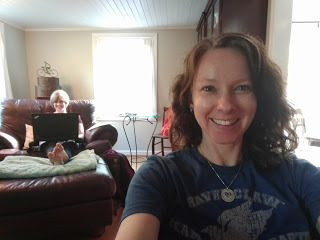 Happy to have big, comfy leather furniture at this house!
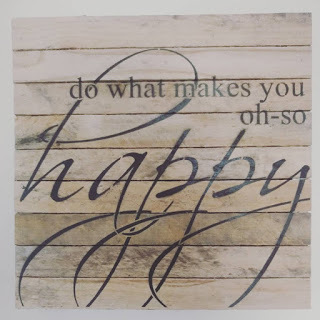 That's what our retreat is all about!
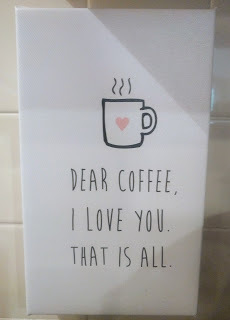 The decor here is very on point for us.
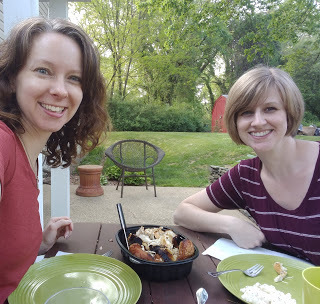 Nice enough weather to eat outside most meals!
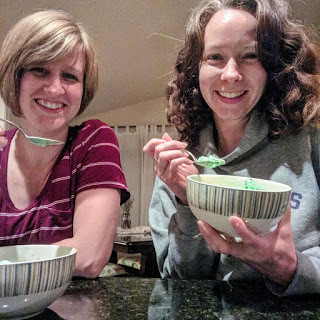 We celebrate hitting our daily word goal with ice cream. Except for when we don't
make our daily word goal. Then we cheer ourselves up with ice cream.
Next week, author and community member Lydia Howe will be our guest! We'll be getting ready to kick off the 100 for 100 writing challenge, and Lydia has been doing this challenge for years. I'm stoked for the chance to learn from her, and I know you will be too!
Happy writing, friends!
I'm on a retreat with Roseanna White in a cute little house near Annapolis, Maryland. We're having a great time, eating chocolate, writing, and brainstorming miserable fates for our characters.
 Happy to have big, comfy leather furniture at this house!
 That's what our retreat is all about!
 The decor here is very on point for us.
 Nice enough weather to eat outside most meals!
 We celebrate hitting our daily word goal with ice cream. Except for when we don't
 make our daily word goal. Then we cheer ourselves up with ice cream.
Next week, author and community member Lydia Howe will be our guest! We'll be getting ready to kick off the 100 for 100 writing challenge, and Lydia has been doing this challenge for years. I'm stoked for the chance to learn from her, and I know you will be too!
Happy writing, friends!
May 4, 2018
Five Promises You Make to the Reader
Shannon Dittemore is the author of the Angel Eyes novels. She has an overactive imagination and a passion for truth. Her lifelong journey to combine the two is responsible for a stint at Portland Bible College, performances with local theater companies, and an affinity for mentoring teen writers. Since 2013, Shannon has taught mentoring tracks at a local school where she provides junior high and high school students with an introduction to writing and the publishing industry. For more about Shan, check out her website, Facebook, Twitter, Instagram and Pinterest.When a reader's eyes travel your book's first page, they are not only reading a story, but one promise after another. Each promise crafted carefully by you, the author.
Wait, what?
You didn't realize you were making promises?
Oh, but you are.
Story beginnings are stuffed full of promises writers make to readers and, today, we're going to talk about five of them.
As the author of your story, you promise:

An exciting adventureThe very fact that a book is sitting on a shelf is a promise. The strategically designed cover and the care that went into packaging and placing this story under the proper category, tells every patron who strolls by, "Pick me! Pick me! I'm going to take you places worth going!"
We read for many reasons: to learn, to expand our horizons, to be inspired, to empathize, to pass the time. But, primarily, we read to be entertained. And it's imperative that you, the author, keep this in mind when you set out to write a novel. Your readers expect to be regaled with a tale worth their time and money. It must satisfy the adventure seeker living inside their chest. The very existence of your book is a promise that you've created just such a story.
A protagonist worth cheering forMore often than not, story plots are built around the forward momentum of a protagonist. Sometimes this protagonist is the hero of the story, sometimes he's got very little of the hero in him. But what this lead character must have is the ability to convince readers to follow him. This might be your biggest task as an author. If, after a few pages, readers find themselves unwilling or disinterested in the character who moves your story forward, you've broken a promise. And it's not a promise that readers forgive lightly. More often than not, they simply close the book and move on to another.
A consistent and compelling toneWe talk often about the importance of your story's opening line. There's a reason for this. Among other things, that first sentence sets the tone of your story. As authors we work hard to craft a compelling opening, but if your tone slips after those first words, if it abruptly changes, if it drifts out of focus, you're now giving the reader something other than what was promised.
So many things help establish tone. Your voice as an author, your audience, the content, the genre, the scene. You must work hard to keep all of these in mind as you move through the story. Doing this will keep the attitude of the book consistent and will ensure that those readers you worked so hard to hook with that opening line, will stay with you until the very end.
A problem to be solved If you don't have a problem, you don't have a story. If you haven't established a story problem in the early chapters of your book, your readers will certainly feel the absence of it. They will wonder what the point is of continuing on. Beautifully crafted storyworlds and compelling heroes and mysterious tones cannot disguise for long the fact that you haven't given your main character a reason to move forward. Readers need that. When they open your book, you promise to present them with a problem to be solved. Do that early on.
A satisfying conclusionIf you've done a good job of presenting a problem to the reader, you've inherently promised a satisfying conclusion. You've said, "I know this problem looks big and hairy. I know I'm putting these characters through trial after trial. But stick with me. In the end, it will all be worth it."
Your ending doesn't have to be happy (unless it's a traditional romance), but it should satisfy the reader. It should fit within the general conventions of the genre and it should have the feel of a well thought out, well constructed tale leading inevitably to this conclusion. Maybe it's surprising--surprising is good. But your ending should feel like the RIGHT ending. Part of making that happen is in the set-up. It's in how the problem is presented to the reader. The solution should be hard earned throughout the course of the novel. Don't give the readers an ending that you haven't worked to carefully construct. It's dishonest after promising them so much.
Tell me, do you write your stories with these promises in mind? Can you think of some other promises writers make to readers?
May 2, 2018
What Do You Do When You're Stuck After Writing a Few Chapters?
Jill Williamson is a chocolate loving, daydreaming, creator of kingdoms. She writes weird books in lots of weird genres like fantasy (Blood of Kings and Kinsman Chronicles), science fiction (Replication), and dystopian (The Safe Lands trilogy). She has a podcast/vlog at www.StoryworldFirst.com. You can also find Jill on Instagram, Facebook, Twitter, Pinterest, or on her author website. Tagboth (Tag for short) is a goldhorn dragon from Belfaylinn, a hidden fantasy realm on the western end of the Sargasso Sea. Jill is working on the first book of this tale for this year's Grow an Author series.There is one question I have been hearing a lot lately either in emails or in person, and it's some variation of "What do I do when I'm stuck after only a few chapters?"
That's a hard question to answer without knowing more about your story, so here is a list of ideas to help. This summary comes from this week's Storyworld Shorts video, which you can watch by clicking here.
1. If you've never written a novel, you might try to complete shorter stories first. Once you get good at shorter stories, you could work on writing some longer ones.
2. Ask yourself some questions:
-"Who is my main character?" Make sure you have a clear main character that the reader can root for.
-"What does my main character (my hero) want?" You need to know what your main character wants in the story to be able to know how he will behave in each scene.
-"What is the story question (story goal)?" Your main character needs to have a goal that will last until the story is done. Frodo making the decision to hold onto the One Ring isn't "story goal" enough. It's when he decides to carry the ring all the way to Mount Doom to destroy it that we have a strong story goal. It's important to define the story goal early on so your readers know what to root for as they read.
-"What are the stakes?" What happens if your hero fails to achieve the story goal? It needs to be something worse than getting a failing grade in a class. You don't have to put the fate of the world at risk, but do keep in mind that the higher the stakes, the more invested your reader becomes.
3. Examine (and strengthen) your plot structure. If could be that taking a look at your plot structure will help you see where you have plot holes.
4. Get to know your character better. You can't write much about a person you don't know very well. Dig deeper into your hero's backstory. Create parents, siblings, friends, a boss, habits, likes and dislikes, lies he believes . . . make sure you come up with all the ingredients you need to create a character who feels read to your reader.
5. Spend more time building your storyworld. If you're writing fantasy or science fiction, sometimes you can get stuck when you don't know enough about your world. Depending on your plot, you might need to spend some more time brainstorming a certain storyworld element, like: government, history, weapons, magic, culture, creatures, etc.
6. Use Try/Fail cycles to keep things moving. Try/Fail cycles can help you get un-stuck by answering a simple question in one of two ways. First, define what your character wants. Then ask whether or not he will succeed? The answer is one of these two: "Yes, but . . ." or "No, and . . ."
For example: My character wakes up late. Will he make it to school in time?
Yes, but he misses the bus and has to walk.OR
No, and he locked himself out of the house, so now he's stuck outside.You can continue this cycle by again asking what he wants, then answering the question of will he succeed with the "Yes, but . . ." or "No, and . . ." replies.
7. Try Stephanie's index card trick in which you make three stacks of cards, one with character names, one with settings, and one with plot situations. Then shuffle and draw one of each until the combination sparks an idea for a new scene.
I hope these ideas help you find a way past where you're stuck and get you back into the story.
Did I miss anything? What do you do when you're stuck? Share in the comments.
April 30, 2018
How To Make Sure Every Character Counts In Your Story

Stephanie Morrill is the creator of GoTeenWriters.com and the author of several young adult novels, including the 1920s mystery, The Lost Girl of Astor Street (Blink/HarperCollins). Despite loving cloche hats and drop-waist dresses, Stephanie would have been a terrible flapper because she can’t do the Charleston and looks awful with bobbed hair. She and her near-constant ponytail live in Kansas City with her husband and three kids. You can connect with her on Facebook, Twitter, Pinterest, Instagram, and sign up for free books on her author website.
I have a tendency to create large casts of characters. I never intend to do this, it just seems to be the way my stories come out.

Within These Lines is actually the first book I've written where I didn't have to cut a character or scale back someone's role dramatically. I hope this means I'm getting better at identifying which characters need to exist and which do not.
If you want to write a story that reads smoothly, it is critical that every character serves a purpose. In well-crafted stories, there is no space for characters who are cuttable.
How do you make sure you accomplish that?
My first suggestion for creating purposeful characters, is to give consideration ahead of time—or in edits, if that ship has already sailed—about what motivates each character during the story.
Here are the primary motivators I listed for several key characters in Within These Lines:

(This is part of my story workbook that I create for each book I write. If you want to get a free tutorial about how to make one for yourself, all you have to do is subscribe to Go Teen Writers Notes.)
When you know the different primary motivators for each character, not only does it naturally cause each character to play a different role in the story, but a source for conflict is built in.
There is also a way to make sure you are accomplishing purposeful character choices within each scene. Think about each scene as though you are planning a heist. (Not that I have ever planned a heist, but I've watched Ocean's 11 several times, and I love Ally Carter's Heist Society series. So I'm totally qualified to rock this analogy.)
When planning a heist, everybody has a specific role to play. One is the decoy, another takes care of the technology, another does the actual sneaking in and stealing, and so forth. Unless there is a very specific need to double up, you never see two people filling the same role in a heist. We don't need two characters dropping in from the ceiling to snatch whatever it was that Tom Cruise was stealing in Mission Impossible.
The same idea applies to individual scenes in your book. You don't need five characters to disagree with your main character, you just need one. Maybe two or three can be justified in certain circumstances, but only if they bring different reasons for disagreeing to the table. We don't need different characters saying the same thing.
An easy ways to figure out if you are already doing this is to ask, How would this scene be impacted if I cut this character? If you could cut the character and keep the scene mostly intact, then that character is not serving a strong enough purpose to be there. You should either look for ways to give them purpose or remove them completely.
Just for fun, pick five of the most important characters of your story. In a phrase or sentence, tell me what their primary motivation is in the story.
April 27, 2018
A Day to Rest
 Hey friends. Shannon here. I hate to bug out when it's my turn to blog, but I'm struggling with some chronic issues today and sitting at the desk is a little too much to ask of my body. I hope you understand and I look forward to chatting with you all next week.
Talk soon, friends. Take care of you.
-SD
April 25, 2018
How to Write a Back Cover Copy for Your Book
Jill Williamson is a chocolate loving, daydreaming, creator of kingdoms. She writes weird books in lots of weird genres like fantasy (Blood of Kings and Kinsman Chronicles), science fiction (Replication), and dystopian (The Safe Lands trilogy). She has a podcast/vlog at www.StoryworldFirst.com. You can also find Jill on Instagram, Facebook, Twitter, Pinterest, or on her author website. Tagboth (Tag for short) is a goldhorn dragon from Belfaylinn, a hidden fantasy realm on the western end of the Sargasso Sea. Jill is working on the first book of this tale for this year's Grow an Author series.Whether I'm going to put together a pitch for a publisher or self-publish, I will need to write some back cover copy for my book. If I'm going to create a pitch, the back cover copy is part of that, and if I'm going to self-publish, I'm going to need the back cover copy when I put the book up for pre-order—maybe even sooner, like when I'd do a cover reveal.
Stephanie wrote a great post on writing back cover copy a few years back. Click here to read it.
I have a nifty method of coming up with back cover copy for a novel. I have no idea who to credit for inventing this three-part formula. I've seen it many times over the years both online and taught at conferences. So while I did not come up with this brilliance, I have no idea who to officially credit. Thank you, o wise one, whoever you are.
Here is how it works:
You need to create at least three paragraphs. One for the hook. One for a book summary (and this part could be two or three paragraphs, if necessary). And one for the sales pitch. Let's take a closer look at each.
Part One: Create a hook sentence, statement, or header that grabs the reader's attention. Think: newspaper or magazine headline.
This hook statement should show the main conflict in your story—or at least the first conflict that pulls your character into the plot. It should also be something the reader can identify with. I recommend writing out as many of them as you can, then edit them and/or combine them until you find one you love. You might even narrow it down to your top three, then poll your critique group or reader group. Here is a long list of potential hooks I wrote for Onyx Eyes.
●For centuries, fairies have enslaved humans and imprisoned criminal fairy changelings in human homes. No one outside this system has ever discovered it—until now.
●Would you risk your life to save another?
●Would you break the law to save a life?
●Sixteen-year-old Kaitlyn has a secret. Her brother is a fairy changeling.
●What would it take to make you leave earth and enter another world?
●What if you discovered your brother was a fairy changeling?
●There's a fairy in the house.
●One missing teenage boy. One missing fairy princess. One epic problem.
●Kaitlyn thinks her brother has gone crazy. Until she learns that he is not her brother at all, but a fairy changeling.
●Kaitlyn’s brother isn’t crazy. He’s missing. Taken by fairies and replaced with a changeling replica.
●Kaitlyn just learned that her brother has been replaced by a fairy changeling, so where is her real brother?
●Kaitlyn wants to find her brother, who was taken captive by fairies, but the fairy warrior she has found to take her into the fae world has a mission of his own.
●Could you abandon your life, your friends, your family, to find your missing brother?
●Kaitlyn has a problem. Her brother has been replaced with a fairy changeling.
I narrowed these down to four:
●Would you break the law to save a life?
●Kaitlyn’s brother isn’t crazy. He’s missing. Taken by fairies and replaced with a changeling replica.●Sixteen-year-old Kaitlyn has a secret. Her brother is a fairy changeling.●One missing teenage boy. One missing fairy princess. One epic problem.
I felt like since Drake is the main character for the first part of them book, the tagline should be his, rather than Kaitlyn's. For now, I'm going with this one (though I might change my mind later on):
●Would you break the law to save a life?
Part Two: Write a short summary of the story. Try to include the following information in your summary. You don't have to keep these things in this order, nor must you use all of these. It's important to at least introduce us to your character, show what they want, what they're up against, how it's going to get worse, and mention the stakes. Also, if you need two-three paragraphs for this part, that's okay.
●What is your main character's name? Jason, Piper, Brielle, Levi, Miri . . .
●What is your main character's role in the story? - Give the reader an identifier like a profession or role: knight, journalist, teacher, high school volleyball player, princess, engineer, dragon, etc. And if the book is about a kid, you might also give their age.
Here is an example from my book Captives: "When eighteen-year-old Levi returned from . . . "
●Where is your main character? - It's often good to mention a location, whether that's a city and/or state or the name of your fantasy world. Readers want to know where the story is going to take place. For example:
From Shannon Hale's Princess Academy: "High on the slopes of Mount Eskel."
From Stephanie Morrill's Lost Girl of Astor Street: ". . . in the dark underbelly of 1924 Chicago."
From Shannon Dittemore's Angel Eyes: ". . . shabby little Stratus, Oregon."
Rick Riordan's Lost Hero: ". . . the Wilderness School, a boarding school for 'bad kids.'"
●What is your main character choosing or being forced to achieve? - Share the story goal or your character's goal. Tell the reader why your character is on this journey. Here are some examples:
From Shannon Hale's Princess Academy: "Then word comes from the lowlands: the king's priests have divined that the prince's bride-to-be—the next princess—will come from Mount Eskel. The prince himself will travel to the village to choose his bride, but first all eligible girls must attend a makeshift academy to prepare for royal lowlander life."
From R. J. Anderson's Faery Rebels: "Deep inside the great Oak lies a dying faery realm, bursting with secrets instead of magic. Long ago the faeries mysteriously lost their magic. Robbed of their powers, they have become selfish and dull-witted. Now their numbers are dwindling and their very survival is at stake. Only one young faery—Knife—is determined to find out where her people's magic has gone and try to get it back."
●What is standing in your main character's way? - This is the conflict in your story. Who or what is trying to stop your hero from achieving his or her goal?
From Stephanie Morrill's Lost Girl of Astor Street: "When Piper discovers those answers might stem from the corruption strangling the city—and quite possibly lead back to the doors of her affluent neighborhood—she must decide how deep she is willing to dig, how much she should reveal . . . "
From Shannon Hale's Princess Academy: "At the school, Miri finds herself confronting both bitter competition among the girls and her own conceited desires to be chosen."
●What will happen if your main character fails? - What are the stakes?
Continued from Stephanie Morrill's Lost Girl of Astor Street: ". . . and if she's willing to risk her life of privilege for the sake of truth."
From Andrew Klavan's Last Thing I Remember: "And more to the point . . . how is he going to get out of this room alive?"
●Use conjunctions to show a change in the action. - Words like: but, however, yet, when, otherwise, as a result, still, on the other hand, instead, finally, meanwhile, etc.
From R. J. Anderson's Faery Rebels: "But when Knife disobeys the Faery Queen and befriends a human named Paul, her quest becomes more dangerous than she realizes."
From Shannon Hale's Princess Academy: "Yet when danger comes to the academy, it is Miri . . . who must find a way to save her classmates."
From Jerry Spinelli's Stargirl: "Then they turn on her. Stargirl is suddenly shunned for everything that makes her different."
●End with another hook, one that leaves the reader wondering what will happen. - Give us a cliffhanger.
From R. J. Anderson's Faery Rebels: "Can Knife trust Paul to help, or has she brought the faeries even closer to the brink of destruction?"
From my book Captives: "Will Mason uncover the truth hidden behind the Safe Lands' facade before it is too late?
From Jeanne DuPrau's City of Ember: "For as long as anyone can remember, the great lights of Ember have kept the endless darkness at bay. But now the lights are beginning to flicker . . ."
Part Three: Sell it! This is where you put on your marketing hat and pretend you work for the author. This is where you write things that might feel a bit pretentious. But you need your product to sound intriguing. You want the reader to want to read it. Right now. This final paragraph can include several of the following, but the first one is essential:
●Tell them why they will want to read (and will like) this book. This can be done in many ways.
1. You could give the facts: "Onyx Eyes is the first book in a new YA fantasy series from award-winning author Jill Williamson." If readers like YA fantasy and/or books by me, then they'll be interested.
2. You could hint at the genre like in this example from Eleanor & Park by Rainbow Rowell: "Set over the course of one school year, this is the story of two star-crossed sixteen-year-olds—smart enough to know that first love almost never lasts, but brave enough to try." This tells us we're going to read a teen romance, and if the reader likes teen romance, she's in.
3. You could use genre words like in this example from Rick Riordan's Lost Hero: "Best-selling author Rick Riordan has pumped up the action, humor, suspense, and mystery in an epic adventure that will leave readers panting for the next installment."
4. Use the "If you liked THIS BOOK, then you'll love THAT BOOK.
If you liked R. J. Anderson's Faery Rebels, then you'll love Onyx Eyes.
This can also be done using genre words: "If you like dangerous quests, a little romance, and fantasy worlds filled with dragons, then you’ll love Jill Williamson’s fantastic new adventure."
"Blending romance, family drama, and fascinating historical detail, The Apothecary's Daughter is a novel to savor and share."
5. Use a combination of facts and genres. For example:
"New York Times bestselling author Melanie Dickerson beautifully re-imagines The Goose Girl by the Brothers Grimm into a medieval tale of adventure, loss, and love."
"Set in a beautifully eclectic world of suspicion, super abilities, and monsters, Storm Siren is a story of power. And whoever controls that power will win."
●Use figures of speech (hyperbole) to get the reader excited. Just don't lie and say your book is epic or funny if it's really not. And don't overdo the hyperbole. A little goes a long way. Here is a list of phrases to give you an idea:
-If you like non-stop action . . .
-BOOK TITLE is a heart-pounding thrill ride . . .
-A powerful retelling . . .
-Time is running out.
-You'll get lost in the action.
-. . . of epic proportions.
-As the nightmare increases . . .
-A first-rate adventure.
-Even as danger mounts . . .
-In this poignant romance . . .
-. . . the shocking truth is revealed
-This breathtaking . . .
-Join old and new friends from in this . . .
-The thrilling conclusion to . . .
-The long-awaited final book in the . . .
●Here are a few other tips.
-Read back cover copies in your genre to see how they do it. This will inspire you with ideas.
-Don't tell the reader everything. Be careful not to spoil your story by writing too much on the back cover. You shouldn't give us more than the first 25% of the story.
-Use the right voice for your story and audience. If your book is funny, so should your back cover copy be. If your book is horror, scare us. If you're writing for teens, use language that will interest teens. If you're writing romance, tell us about the guy and the girl.
-Read your back cover copy out loud to check for sentence flow and word choice.
-If you're self-publishing, you might also want to add a fourth paragraph with a call to action, urging the reader to buy the book. For example: "Buy Onyx Eyes by Jill Williamson and join the adventure today."
So here is the rough draft of my back cover copy for Onyx Eyes. Once I have the book finished, I will likely need to change some things, but this will work for now.
Would you break the law to save a life?
When Princess AyannaRynn goes missing, the Grounder king gives Captain Alston FoyleDrake until the next moon to find her. Convinced the Aerials have taken her, Drake uses onyx to cast a forbidden bonding spell with a dragon so he can grow wings. This is the only way he can impersonate an Aerial and find out where they took the princess.
Drake’s search leads him and his dragon to a place called Idaho in the human realm. There he finds a changeling slave, who had been impersonating a teenage boy. Drake takes the changeling’s place. The bonding spell is starting to cause him pain, and he is so preoccupied with his search that Kaitlyn, the human boy’s sister, overhears the dragon use Drake’s true name. She commands Drake to take her back to his realm and help her find her brother.
Drake doesn’t have time for human games, but the girl controls him now. The sooner he finds the girl’s brother, the sooner he can find the princess. Unless Kaitlyn chooses to enslave him forever.
If you like adventure, romance, and fantasy worlds filled with magic and dragons, then you’ll love Onyx Eyes, the first book in a new YA fantasy series from award-winning author Jill Williamson.
Your turn! See if you can cobble together a three-paragraph back cover copy for your story and share it in the comments.
April 23, 2018
How To Craft High Impact Scenes For Your Stories (Part Two)
Stephanie Morrill is the creator of GoTeenWriters.com and the author of several young adult novels, including the 1920s mystery, The Lost Girl of Astor Street (Blink/HarperCollins). Despite loving cloche hats and drop-waist dresses, Stephanie would have been a terrible flapper because she can’t do the Charleston and looks awful with bobbed hair. She and her near-constant ponytail live in Kansas City with her husband and three kids. You can connect with her on Facebook, Twitter, Pinterest, Instagram, and sign up for free books on her author website.
Looking for Part One? Click here!
Last week, I talked about crafting high impact scenes and how as writers we tend to ask, "What is going to happen in this next scene?" when the better questions are:
Because of what happened in the previous scene, what will my character choose to do now?What is this character's plan or goal coming into this scene?What obstacle stands in my character's way? How is their expectation foiled?What decision does my character make as a result?What is the outcome of my character's decision?
But we don’t want our stories to be action, action, action. Even if your genre is thriller or adventure, you still need to build in moments where your character has time to react to what is happening around them.
You may have heard this taught, as I have, as writing in “Scenes and Sequels,” with scenes being the action part and sequels being the slow-down-and-react part. I’ve always found this teaching very confusing.
What does work for my brain is to think about providing opportunities for my character to process the decision they just made. Usually, the amount of processing time corresponds with how big the obstacle or decision was in the last scene.
The next question going on our list is, “Does my character need time to process what has just happened?”
Going back to my example from Within These Lines, Evalina made a gutsy decision by deciding to go uninvited to Taichi’s hometown. Neither of their families know about the true nature of their relationship. Evalina has never been to his home, nor has she ever called him, for fear that they would be found out.
This is a very big decision that she made, and I chose for some of her processing to happen offstage. It’s implied in the opening of her next scene that she spent the ferry ride over thinking through what to do now.
I could have chosen to show that, but one thing about these kinds of reaction/processing scenes is that a little goes a long way. Hanging out with Evalina while she’s sitting on a ferry and contemplating the possible ripple effects her decision might have can get boring fast, so I chose to show none of it.
 In Donald Maass’s Writing The Breakout Novel, and in all the workshops he teaches, he rails against “In the kitchen drinking tea” scenes, which is what these kinds of processing moments can too often turn into. He says:
“They are a pause, a marking of time, if not a waste of time. They do not do anything. They do not take us anywhere. They do not raise questions or make us tense or worried. No wonder they do not hold my attention.”There are many ways we can have our characters “sit around and drink tea,” and it felt to me like to have a scene where Evalina sits on a ferry and stresses out would be one of them. So instead I have her on the phone with a friend:
“Evalina, you have flipped your wig.” But Gia sounds admiring, not admonishing. “I knew when you finally fell for a boy, you would fall hard, but you seriously took a ferry to Alameda?”
“What else was I supposed to do? He wasn’t at the market this morning, plus these articles in the paper …” I swallow. “I thought maybe his family had been taken.”
“You are so dramatic sometimes. They’re not going to be taken. It’s all voluntary.”
“I don’t think so, Gia.” I twist the cord of the pay phone around my finger. “I think they’ll all be made to go.”
“I still can’t believe you took a ferry to Alameda. What are you going to tell your parents?”
“Hopefully they’ll never know. You’ll cover for me if they call or stop by, right?”
“Of course. I’m meeting Lorenzo for lunch, but I’ll just say you were with us.”
Imaginary lunches with Gia’s on-again off-again boyfriend are the only kind I can tolerate. “Thank you, Gia. I’ll let you know when I’m home.”
In this moment, readers are able to see what kind of thought Evalina has put into this decision. Even though there's movement in the season—Evalina is on the phone, as opposed to just sitting and thinking—it still feels like a beat of rest for the audience.
There is a great example of this in the movie Tangled. After Rapunzel has sung with the thugs that she has a dream, and the palace guards have come for Flynn, Rapunzel and Flynn escape into the tunnel underneath the Snuggly Duckling. While they are in a tunnel, we have about a minute in which they process what happened.
This slowing down from the action gives us a moment to breathe, and it gives them a moment to bond. To process what happened until learn a bit more about the other. (A few years ago, I wrote a post about How To Build A Romance Thread In Your Story, Tangled Style, if that's something you're interested in.)
So you’ve given your character a moment—whether it’s a paragraph or pages—to process what has happened, survey all their choices and various consequences, and feel all the feels.
The next question is basically, What now? What decision is born out of the reaction time?
Sometimes it’s a deepening in the relationships, like Evalina. She chooses to trust Gia with what she’s really doing, partly because she needs a cover story.
In Tangled, during the processing scene, after seeing how Rapunzel held her ground in the Snuggly Duckling, Flynn has a greater respect for her and has become interested in who she is. He chooses to ask her questions.
Sometimes reaction moments take up an entire scene, particularly in heist novels or movies. A heist will go awry, and then we’ll have a scene where the whole crew is sitting in a room debating the various choices and consequences.
Regardless of how long your reaction sequence is, this is a great opportunity for you to show your reader what your character is motivated by, and why they are making this particular decision.
This also leads beautifully into the next plan of action or scene goal, because after the reflection, they’ll be making a new decision.
So here is a compiled list of all the questions:
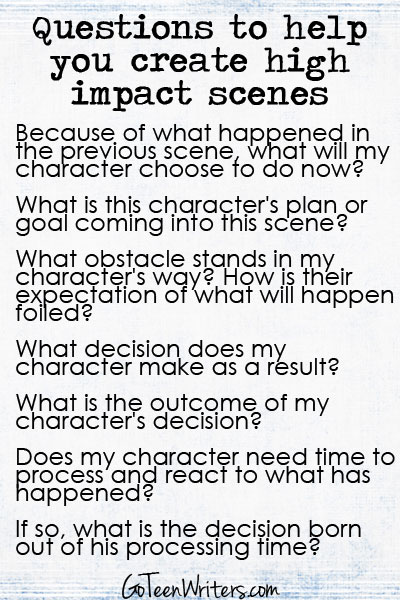
Because of what happened in the previous scene, what will my character choose to do now?What is this character's plan or goal coming into this scene?What obstacle stands in my character's way? How is their expectation of what will happen foiled?What decision does my character make as a result?What is the outcome of my character's decision?Does my character need time to process and react to what has happened?If so, what is the decision born out of his processing time?
What’s really fun is that once you understand these natural pattern, then you are able to mix and match how you put together your scenes.
Scene one could be your character setting out to achieve a goal, and it might end with their expectation being foiled.
Scene two could show the decision they make and the outcome of that decision.
Scene three could be processing, making a decision, and pursuing a new scene goal.
Scene four could be pursuing the new scene goal, having their expectations foiled, and then trying to process this new obstacle.
See how it's all happening in order, just being split in different ways? Arranging the structure of your scenes is like arranging your individual sentences. If you use the exact same sentence structure every time, your prose becomes very boring. Beautiful writing comes from sentences being arranged in all different kinds of ways, and the same is true for building your scenes. If every scene begins with the character having a plan, the plan getting spoiled, and them making a resulting decision, your story will quickly take on a mechanical feel.
What is your favorite scene in your manuscript? Tell us about it!
April 20, 2018
How to Identify and Correct Info Dumps
Shannon Dittemore is the author of the Angel Eyes novels. She has an overactive imagination and a passion for truth. Her lifelong journey to combine the two is responsible for a stint at Portland Bible College, performances with local theater companies, and an affinity for mentoring teen writers. Since 2013, Shannon has taught mentoring tracks at a local school where she provides junior high and high school students with an introduction to writing and the publishing industry. For more about Shan, check out her website, Facebook, Twitter, Instagram and Pinterest.For a writer, beginning a new story is magical. You have all these ideas assaulting your imagination. Ideas about the storyworld and this fantastic new magic system you're designing. Ideas about your characters, their personalities, and the events that happened long ago that have shaped who they are now.
At the beginning of the process, your energy is high and the information you have to share with your reader is plentiful. These are good things, but be careful.
Readers want a story that will whisk them away to another time and place. A story that will challenge them and entertain. Characters who will inspire and enrage. Readers are trusting you to be a skilled conductor, introducing new melodies at the appropriate time and weaving in depth and history and context with restraint. Readers do not want a bunch of information dumped onto their laps.
So, let's talk about it.

An info dump is a hefty dose of information presented to the reader all at once. Info dumps can show up in both narration and dialogue and are super easy to spot. Here, I'll show you:
Narration
Maxwell isn't an ordinary boy. He's seven feet tall and instead of the standard buck teeth most children his age have, he has a pair of neon green fangs. His favorite movie is the Goonies, which would be perfectly normal if he didn't prefer to watch it in reverse order. He cuts the toes off the front of his boots so his toes have room to breathe. It's a trick he learned from his father who is just an inch or two taller than Max but has red hair and gray eyes.
Dialogue
"This is Maxwell," Dad said, tousling his red hair as his gray eyes sparkled. "He likes the Goonies too, but it's the darndest thing. He likes to watch the movie in reverse order. And watch out for his feet. He wouldn't thank you for stepping on those bare toes of his. He has to cut the toes off his shoes to give his little piggies room to breathe."
Now, in certain contexts this information might be entertaining. It might even work in a middle grade novel where younger readers need a bit more telling to set the scene, but as a way to share information with a reader, it falls into the category of DUMPY.
Info dumps aren't entirely bad and they can be a handy tool in your tool box if you use them sparingly. But most of the time, they signify lazy writing. In the example above, wouldn't it be much more interesting to show the reader a scene with Maxwell cutting the toes off his new shoes? Maybe bumping his head on a doorway as he goes in search of the movie Goonies? Wouldn't it accomplish more to paint a picture of Maxwell as a scene moves the story forward?
Of course it would!
Here are some tips for weaving important information into your story:

1. Less is more. If you're looking to slip a little info to your reader, stick with just a sentence or two. Any more and you're venturing close to dumpy. Any more and you risk boring your reader.
2. Voice matters. Certain voices can get away with info dumps, especially if the info dump serves more than one purpose. If it reveals traits about your character that the reader desperately wants, you might have some leeway, but so much comes down to the voice of your narrator. Consider the nasally voice of Ben Stein. It's hilarious in small doses, but if we had to listen to him explain the politics of a storyworld, we might just fall asleep. That is NOT what we want readers to be doing when they open our books.
3. Spread things out. Just because you, the author, came up with all this information at the beginning of the writing process, does not mean your reader needs all of it at the beginning of his reading experience. Info dumps are particularly dangerous early on in your story. The reader is not invested in the characters or the adventure. You risk losing them before they get to the fun stuff if you're not careful.
4. Consider relevance. Ask yourself, "Does this bit of info matter?" And then ask yourself, "Does it matter right now?" We have a tendency to dump everything about a certain topic into one big paragraph or section. Instead, give the reader only what they need in order to make sense of the action. Information should almost always be learned as a scene plays itself out.
5. Embrace your art. Your goal shouldn't be to simply inform the reader. You are creating a piece of art. So, do it well. Work at your craft. Important details should be woven into scenes, one thread at a time. Don't just chuck the ball of yarn at your readers. They won't have a clue which threads are important or how they fit together. YOU ARE THIS STORY'S CREATOR. If there are important details that the reader must know, take the time to sculpt a scene to show off those vital facets of your world or character. Do the work of a committed artist.
TIP: Oftentimes when I'm participating in word sprints or simply writing to discover what my story's about, I end up with some sizeable info dumps. When I return to these sections, if I like the concepts presented, I use these very TELLING paragraphs as writing prompts. In early drafts, certainly in your first draft of a novel, info dumps are perfectly acceptable ways to tell yourself the story. But, upon reflection, you must find a way to integrate the ideas you've developed into scenes that move the story forward. That's what a reader will expect.
Tell me, do you struggle with info dumps? What kind of information to you have a tendency to dump on the reader? Have you come up with any fixes for this problem? Share them with us!