Stephanie Morrill's Blog, page 15
October 4, 2017
What To Do When You Are In Over Your Head
 Jill Williamson is a chocolate loving, daydreaming, creator of kingdoms. She writes weird books in lots of weird genres like fantasy (Blood of Kings and Kinsman Chronicles), science fiction (Replication), and dystopian (The Safe Lands trilogy). Find Jill on Facebook, Instagram, Twitter, Pinterest, on her author website, or on her writing website StoryworldFirst.com. You can also try two of her fantasy novels for free here and here.
Ever taken on a project only to discover it was WAY HARDER than you expected? Either you're feeling insecure that you are qualified or skilled enough to lead, or you're feeling overwhelmed because you said yes to too many things, or you thought you could do it but the learning curve was a little beyond your skill set.
Me too.
I do this to myself often, actually. You'd think I would learn . . .
I've always been both an idea factory and a people pleaser. This ties in to the "lie I believe" deep down, which tells me my worth in this world is a direct result of my actions. (Not true!!) But changing such habits and deeply woven beliefs in real life is a bit harder than it is to write such a change for your character in a novel.
All that to say, I confess that I have bitten off a wee bit more than I can chew with my latest project. For years I've been wanting to do writing craft videos on YouTube. I did some a few years back and really enjoyed it, and people seemed to find them valuable. So this little dream percolated in my head for years as I waited to have time to try.
There's never enough time to do all the things, is there?
But I finished my EPIC REWRITE and decided the time was now. But (because I'm Jill) I didn't just start making new YouTube videos. No . . . I decided to make a website that would list the episodes in a clear way. Then I also decided to make a podcast version, because I thought I could just make an audio version of the videos and put the information on two platforms.
See how my ideas snowball?
Still, I thought, "I can do this. It's a simple website. I've done a podcast before. Videos are easy to record. I've edited them before. And the rest is a blog and linking everything together. How hard can it be?"
I've said those words before, and they always cause me trouble. Let's go over my troubles one at a time, but first, a little bit about my new project, Storyworld Shorts , which I created, in part, for you.
WEBSITE: I've been making Wordpress websites for years. I know how to do them fairly well. But four years have gone by since I last created a new Wordpress website. So, of course, things have changed some, template-wise. The template I chose had a child theme over it, which is meant to protect the site from people who don't know what they're doing so that they don't accidentally break things. Well, it drove me nuts because I couldn't just go into the dashboard and copy and paste code. I wasted hours trying to figure out how to navigate all of that. And the theme I chose is relatively new and glitches sometimes. I'll hit "save changes," and then there are no changes saved on the page. It took me several times before I stared copying and pasting my content into Word just in case the website glitched so I wouldn't have to retype everything. This helped, but I didn't always remember to do it.
PODCAST SETUP: This had changed too. Thankfully, my husband (pen name Casey Oswald) had started his Corner of Hollywood & Broadway podcast this past summer, so he was able to help me a little. But this took me most of a day to install the plugin, configure everything, then apply to iTunes.
VIDEO RECORDING: I decided that I would record five videos at a time. My dream goal was that I would take one day a month to record and edit all the videos I needed for that month, then I could schedule them out. I recorded the videos on my iPhone. I got the lighting right and the sound too--both of which I'd messed up in the past, so I thought I was doing good. It took me about three hours to set up, record them, do wardrobe changes, and clean up.
I edited the videos with Windows Live Movie Maker, knowing I'd have to upload them to my son's computer eventually to add images over the video in places, since Windows Live Movie Maker doesn't have that option. But I thought it would save time to edit down the files beforehand. First problem? Windows Live crashes on me all the time. Second? Video clips randomly get corrupted, to no logical understanding. Third? These files wouldn't open in Adobe Premiere. I had to download a video converter. And when I finally got them on my son's computer, they were tiny, with a huge black border around them. Enlarging the video made it blurry. My son helped me, but we couldn't figure out how to fix it short of me starting over by opening my original video files in Premiere. Thankfully, we figured out that the video converter had a setting that changed the video size. Once we fixed that, all was well. Whew! But, like, another whole day lost to technology.
VIDEO EDITING: I don't know how to use Premiere. It's not terribly difficult, but when I got stuck, I had to Google the answers or wait for my son to come home from school. I was making good time, then I remembered the whole reason I was using Premiere--slides. Slides I had yet to create. Oops. So I had to make a list of all the slides I wanted to appear in my video, then go back to my computer and make those images in Photoshop. Easy, peasy, but fairly time consuming. Time I hadn't factored into my deadline. Another three hours or so here.
PODCAST EDITING: Once I finished the first video (on like, day three), I discovered I couldn't import a video into Audacity (my audio editing program). So I had to export the audio from the video--something else to learn. Not difficult, but time-consuming. When I finally did open the file in Audacity and I had to add an intro and an ending. I ended up doing the first one three times. Any change I made to the video, I had to make to the podcast.
LINKING EVERYTHING: I already had a YouTube channel, so I only needed to create a new header. I had to set up my email newsletter and subscribe page and the automatic email that sends out my freebie for subscribing. Time, time, more time. ;-) I managed to set up my social media icons and the blog subscription, but I still don't know why iTunes isn't showing up on my podcast subscription area. I am simply clueless at this point.
BLOG POSTS: I had to write a blog post in order to post the video and blog post on my new website.
SOCIAL MEDIA: On launch day, I had to create memes to share and write posts for my author blog and social media and post in all those places.
TIME SPENT: What I hoped would take me a day or two, actually took me eight days, so far. (I predict two more days are needed.) I did manage to launch my first video on time, and while I have videos two, four, and five done, I don't have the audio versions made yet, and video three is ten minutes long (when I promised five minutes or less)!
I'm exhausted. And I'm now wallowing in the "What was I thinking!?" phase. I know it will be easier next time around. My website is done. Everything is set up and working. I learned better ways to record and edit the videos--streamlined my process. I'll get better on screen over time--less rambling that needs edited out. Still . . . I now know I need to allocate two or three days a month to do this, not one.
All that to say, I learned a lot this past week. I now have a better idea of what I've created and the time it's going to take me to continue with the project. If you've ever found yourself in a situation like this, here are some tips to help you.
1. Stop and breathe
I noticed several times last week that my adrenaline was pumping hard! Yes, I was excited about my endeavor, but it was the swiftly approaching deadline that had kicked my body into high gear. I should have stopped to rest the moment I felt that. Instead, I kept going. And when I crashed, I crashed hard.
If you feel hyper, take a break. Get a snack and go sit in a corner of your house or out in the yard. Somewhere to quiet your mind and remember that this thing you're working on is only a thing. Sure, it might be important, but in the scheme of life, things like this will come and go. Once you're calm, you can get back to work, but in my experience, working while frantic is a great way to make mistakes. It's far better to conserve your energy so your brain has the best chance to help you.
2. Get organized, prioritize, and let some things go.
You might have planned ahead and think you are organized, but once you feel yourself being drowned by a project it's time to press pause and regroup. Clean your desk. Make a list of all you have to do, then prioritize that list. If your deadline is closing in, you might have to let go of a few things. It could be that you could do those things later, or there might be some that you let go for good. You are only human--one human--and while you are mighty, you can't do everything. You just can't. And that's okay. So choose the items that are necessary and leave the rest behind to pick up later or forever abandon.
3. Admit the truth to yourself and others, if need be, and ask for help.
At this point, you have a really good idea if you're going to succeed or fail. It might be that you simply need more time than you had originally anticipated. This happens. The first thing you must do is admit this to yourself. (It might help to return to your quiet spot as you contemplate this.) Remind yourself that you are only one person and can only do so much. Then, depending on the situation, you might have to have an honest conversation with someone. It could be your boss, a parent, a friend, or a client who hired you to do a job.
Be honest. Tell them the project turned out to be much more complicated than you thought. Tell them the facts and ask how you should proceed. It could be that you can ask for help. You might need another employee to help you get the job done. Or you might need to hire out part of the project to someone more qualified. Whatever it is, know your own limitations as to skill and time, and do what you need to do. There is no shame in this. In fact, the opposite is true, despite how others might treat you. It's always the right choice to stand up for yourself. You help no one by pressing on to do something you aren't qualified for (you won't turn in a quality project). And you only hurt yourself when you get over-stressed and work overtime. (Respect yourself. You deserve to treat yourself better.)
4. Know when to quit.
Sometimes you need to give up. Now, I'm a firm believer in never giving up on your dreams, so this particular point is a difficult one for someone like me. At this time, I have no intention at all of quitting Storyworld Shorts. I do realize that I might not be able to keep up. I just so happen to be between edits at the moment. But once I'm busy on a book again, I might not have three workdays a month to spare on this project. So I might need to skip a week or perhaps scale back to posting videos every two weeks. And if I can't streamline my process, there may come a point when I have to go to one video a month or scrap the project altogether. I hope not. But I do know that not all ideas work out.
The only thing I need to strive at in life is keeping a good balance between work and everything else. I'm the kind of person who could work 18-hour days. That doesn't mean I should. So I have to fight for my off time. I need to "check out" and the end of each day. I need to know when to say, "That's enough for today" or "I can't do this anymore." It's one of the hardest things for me to do, but it is so important. My health, my family, my sanity are at risk if I don't choose wisely how to spend my time.
Have you ever been in over your head? It could be a special project or a season in life that is dealing you a major blow.When this happens, what do you do? How do you handle the situation? Share your tips below. I still have lots to learn!


October 2, 2017
A "Sometimes Life Happens" Day
Stephanie here.
Sometimes we get busier than planned, and we still need to be disciplined with our creative pursuits, like blogging or writing. Other times, life hits you like a truck, and you have to walk away from them for a season.
Last week, I had the "hit like a truck" kind of experience, and putting together a blog post for today just didn't happen. Thank you for being the kind of community who would notice that I hadn't posted today, and who would wonder if something was wrong.
Jill and Shan will be here on Wednesday and Friday like normal, and I hope to be back next Monday.
Sometimes we get busier than planned, and we still need to be disciplined with our creative pursuits, like blogging or writing. Other times, life hits you like a truck, and you have to walk away from them for a season.
Last week, I had the "hit like a truck" kind of experience, and putting together a blog post for today just didn't happen. Thank you for being the kind of community who would notice that I hadn't posted today, and who would wonder if something was wrong.
Jill and Shan will be here on Wednesday and Friday like normal, and I hope to be back next Monday.
September 29, 2017
October '17 Instagram Challenge
 Shannon Dittemore is the author of the Angel Eyes novels. She has an overactive imagination and a passion for truth. Her lifelong journey to combine the two is responsible for a stint at Portland Bible College, performances with local theater companies, and an affinity for mentoring teen writers. Since 2013, Shannon has taught mentoring tracks at a local school where she provides junior high and high school students with an introduction to writing and the publishing industry. For more about Shan, check out her website, Facebook, Twitter, Instagram and Pinterest.
 We are getting ready to kick off our second Instagram challenge, you guys, and we'd love you to participate.
First! The graphic! Post it on your Instagram and help us spread the fun.

Second! The details. As you can see, each day of October has been given a prompt. Your job is to snap a picture that somehow addresses the prompt and maybe works in books and/or writing.
For example, on October 9th, you've been given the word, Fangs. You might choose to post a picture of your favorite vampire novel. OR! Perhaps you decide to snap a picture of you working on your next literary masterpiece while wearing a set of plastic fangs.
Get creative. Have fun. And don't feel like you have to be super literal. Use the prompt as a jumping off point, and share with the rest of us. Instagram challenges are a great way to use our creativity in ways other than writing.
Once you've snapped your picture for the day, post it on Instagram (and any other social media you choose) and use the challenge's hashtag (#GTWOctober17) in your caption. Throughout the challenge, we'll monitor the hashtag and share some of our favorite pictures on our own Instagram account (@goteenwriters).
If you have questions, please feel free to ask them in the comments section below and we'll do our best to get to them before the challenge kicks off on Sunday, October 1st!
Let's do this, friends! Come find us on Instagram!
ALSO, if you do not have an Instagram account, please don't feel left out. You are welcome to participate in any way that works for you. An alternative way to use the challenge would be to look at the daily prompts as writing prompts as opposed to photo prompts. In this way you have 31 days of writing practice laid out for you. Set a timer for fifteen minutes, use the day's word to get you started, and just write. Practice makes every single one of us better!
September 27, 2017
Using an Opening Narration to Pinpoint Your Story Problem
Jill Williamson is a chocolate loving, daydreaming, creator of kingdoms. She writes weird books in lots of weird genres like fantasy (Blood of Kings and Kinsman Chronicles), science fiction (Replication), and dystopian (The Safe Lands trilogy). Find Jill on Facebook, Twitter, Pinterest, or on her author website. You can also try two of her fantasy novels for free here and here.Anyone watch the BBC show Merlin? If so, you might recognize this:
“In a land of myth and a time of magic the destiny of a great kingdom rests on the shoulders of a young boy, his name: Merlin.”
In the television industry, that is what's known as an opening narration. You can find opening narrations in lots of TV shows and in some movies too. Sometimes they are voiced by an omniscient narrator. Other times they are first person from the lead character's voice. Below is a list of quotes from several TV shows or movies. Some of these are super old. Still, see how many you can guess. (Answers below.)
1. “In a time of myth and legend, when ancient gods plagued man with suffering—only one man dared to challenge their power.”
2. “In the criminal justice system, the people are represented by two separate yet equally important groups: the police, who investigate crime, and the district attorneys, who prosecute the offenders. These are their stories.”
3. “Now the story of a wealthy family who lost everything and the one son who had no choice but to keep them all together . . .”
4. “A long time ago, in a galaxy far, far way . . .”
5. “You know the kind of guy who does nothing but bad things, and then wonders why his life sucks? Well . . . that was me. Every time something good happened to me, something bad was always waiting around the corner. Karma. That’s when I realized I had to change. So, I made a list of everything bad I’ve ever done and, one by one I'm going to make up for all my mistakes. I’m just trying to be a better person. My __________.”
6. “In 1972, a crack commando unit was sent to prison by a military court for a crime they didn't commit. These men promptly escaped from a maximum security stockade to the Los Angeles underground. Today, still wanted by the government they survive as soldiers of fortune. If you have a problem, if no one else can help, and if you can find them....maybe you can hire __________. ”
7. “Doctor David Banner, physician, scientist, searching for a way to tap into the hidden strengths that all humans have. Then, an accidental overdose of gamma radiation alters his body chemistry. And now, when David Banner grows angry or outraged, a startling metamorphosis occurs. The creature is driven by rage and pursued by an investigative reporter. The creature is wanted for a murder he didn't commit. David Banner is believed to be dead, and he must let the world think that he is dead, until he can find a way to control the raging spirit that dwells within him.”
8. “You unlock this door with the key of imagination. Beyond it is another dimension - a dimension of sound, a dimension of sight, a dimension of mind. You're moving into a land of both shadow and substance, of things and ideas. You've just crossed over into the ____________.”
9. “Space, the final frontier. These are the voyages of the starship Enterprise. Its five-year mission: to explore strange new worlds, to seek out new life and new civilizations, to boldly go where no man has gone before.”
10. “___________ here, your one and only source into the scandalous lives of Manhattan's elite. And who am I? That's one secret I'll never tell. You know you love me. XOXO, ___________.”
11. “A fiery horse with the speed of light, a cloud of dust and a hearty Hi-Yo Silver, away!”
12. “There is nothing wrong with your television set. Do not attempt to adjust the picture. We are controlling transmission. If we wish to make it louder, we will bring up the volume. If we wish to make it softer, we will tune it to a whisper. We will control the horizontal. We will control the vertical. We can roll the image, make it flutter. We can change the focus to a soft blur or sharpen it to crystal clarity. For the next hour, sit quietly and we will control all that you see and hear. We repeat: there is nothing wrong with your television set. You are about to participate in a great adventure. You are about to experience the awe and mystery which reaches from the inner mind to . . . __________.”
13. “It all started when a time travel experiment I was conducting went... a little ka-ka. In the blink of a cosmic clock I went from quantum physicist to air force test pilot. Which could have been fun... if I knew how to fly. Fortunately, I had help. An observer from the project named Al. Unfortunately, Al's a hologram, so all he can lend is moral support. Anyway, here I am. Bouncing around in time, putting things right which once went wrong. A sort of time traveling Lone Ranger, with Al as my Tonto. And I don't even need a mask. Oh boy.”
14. “Ladies and gentlemen: the story you are about to hear is true. Only the names have been changed to protect the innocent.”
15. “_________, a shadowy flight into the dangerous world of a man who does not exist. Michael Knight, a young loner on a crusade to champion the cause of the innocent, the helpless, the powerless, in a world of criminals who operate above the law.”
Something like this would be a lot of fun for a series and a great way of pinpointing your story problem at the start of every book.
I decided to write one for Spencer and The Mission League books. Here it is:
“I used to think my visions and showed me in inevitable events, that they predicted my future or someone else’s. Now I know they’re possibilities. I can embrace them or run. Considering that most of my visions or warnings, running is usually my best option. Problem is, I’m not a coward. And I don’t like people messing with me. But when you’re living in the witness protection program, calling attention to yourself is just plain stupid. Too late now, though. They’re after me. Unless I can catch them first.”
Your turn!WRITING PROMPT: Write an opening narrative for your book or series and post it in the comments below.
Answer key:1. Hercules2. Law & Order3. Arrested Development4. Star Wars5. My name is Earl6. The A-Team7. The Incredible Hulk8. The Twilight Zone (Season 4 & 5)9. Star Trek (original series)10. Gossip Girl11. The Lone Ranger12. The Outer Limits13. Quantum Leap14. Dragnet15. Knight Rider
Also, I'm having a book sale! Last week I found out that King's Folly is a finalist for the 2017 Christy Awards. I'm so excited and honored.

I had no intention of going. My husband has to work, and the introvert in me hates going to such things without someone I know really well. But then my friend said she'd come with. So I changed my mind!To celebrate, I'm having a sale in my author bookstore. Everything is 30% off with the discount code "CHRISTY"—while supplies last. More info on my author blog.

September 25, 2017
How to Build Systems so You Can Reach Your Writing Goals

Stephanie Morrill is the creator of GoTeenWriters.com and the author of several young adult novels, including the historical mystery, The Lost Girl of Astor Street (Blink/HarperCollins). Despite loving cloche hats and drop-waist dresses, Stephanie would have been a terrible flapper because she can’t do the Charleston and looks awful with bobbed hair. She and her near-constant ponytail live in Kansas City with her husband and three kids. You can connect with her on Facebook, Twitter, Pinterest, Instagram, and sign up for free books on her author website.
This post is the third in a series about goals. In case you missed it, we talked two weeks ago about stating our writing goals. Even those big ones that we can't control 100%. Then last week, I talked about recognizing and documenting our personal writing rules.
Today we get less dreamy and more boots-on-the-ground. We're going to examine each goal, identify what we do now to action on achieving it, and building systems so that we make sure those actions happen. Working on these steps feels like constructing a ladder so we can more easily climb to where we want to be.

To make this post super accessible, let's use a goal that many of you have mentioned to me, that you would like to be traditionally published by the time you graduate high school. (Those of you who are interested in self-publishing, we're going to talk about that too.)
First, let's start brainstorming actionable items:
If you want to take action on your goal, the place to start is assessing what you have control of. To get traditionally published, you'll need a few things in place:
1. A stellar manuscript
2. An agent (probably) and an editor (definitely)
3. A platform (likely)
This is an overly simplistic list, but it'll serve our purposes for today.
Let's take these one-by-one. If you don't yet have a stellar manuscript, that's the first thing you need. (It's basically impossible to get a book published if you don't have the book written, right?) There are lots and lots of actionable items that I could list on this one alone, but for time's sake, I'll include a few. Assuming you've already written the book, your actionable items might be:
Do at least two rounds of edits. If you're feeling overwhelmed by edits, the Go Teen Writers book was written to be a helpful guide through that process.Ask several friends to read the manuscript and give you feedback. Ideally these are friends who know a thing or two about story structure, grammar, and writing. But before I had writing friends, I received several very thoughtful critiques from friends who simply enjoyed reading, so receiving their feedback can still be helpful. (I also received some very bad, damaging feedback along the way, which is the nature of opening yourself up for critique.)Continue to study the craft of fiction by reading books, listening to podcasts, taking courses, or reading blog posts.Obviously, this isn't an exhaustive list of everything you need to do to write a fabulous, shelf-worthy book. We have several fairly detailed series on the blog about writing novels from beginning to end, so maybe start with the Looking for Something Specific tab if you're wanting a more extensive list of posts on that subject.
Onto agents and editors. There are lots of different ways to look for these seemingly illusive people. Most of the time you need an agent before you can gain access to editors, but not always. Writing conferences are the easiest place to get direct access to agents and editors, but if you live somewhere rural or can't afford to travel, that may not be an option. Here are some ways you can take action on finding an agent or editor from home:Lots of agents have blogs or are active on social media. This is a great way to learn about their personalities, tastes, and what they're looking for. You'll need to know how to explain your book in an interesting sentence or two, so you can work on that. You should also have an idea of where your book fits in the market. What other books are like it? What established authors do you have a similar style to?You could take part in (or stalk) an online event like #pitmad Again, these are just a few ideas to get you started.
Lastly, if you want to be published traditionally, you need to have some kind of internet presence. No publishing house will expect you to have a ridiculous number of followers, but like editor Jillian Manning said when she was with us back in May, it's concerning when she searches for a writer online and finds nothing. If you haven't yet, at least reserve your website name, which should be yourname.com. If you can't get that, you can add "books" or "author" to it, but it's best if you can get your name.If you haven't already, and if your parents say it's okay, pick a social platform and focus on growing it and learning how to use it well. Don't put pressure on yourself to be everywhere, but be somewhere.Start your email list. This is a metric publishers care more and more about. If you want to see what kinds of things authors talk about in their emails, start by signing up for a few lists. Like maybe mine, Jill's, and Shan's. *Wink, wink*These suggestions are all items that will help you move closer to your goal of being a published author, whether that ends up being in high school or after.
Maybe your goal is self-publishing. While many of the suggestions above still apply, here are some other ideas that are unique to indie publishing:The indie author community is a generous one. Find the experts. Read their books, listen to their podcasts, and take their tutorials.Follow indie authors on social media. When you find authors you really like, buy their books and see if there are ways you can help them out. Like being on a launch team or writing consumer reviews.Look for Facebook groups or blogs dedicated to indie publishing. Not only can you connect with and learn from other authors, but this will also be a good way to find freelance editors and designers.Work on growing your platform, same as if you were trying to be traditionally published. You will need ways to tell people about your books!Once you've brainstormed a list of ideas for taking action on achieving your goal, you can start to find space for those tasks on your calendar. The easiest way I've found to do that is to build systems:
Create systems:Meeting a big goal always involves making regular space in your schedule to chip away at the tasks. You can't spend a day building a social media presence and then mark it off your list forever, right? Instead, it's better to come up with ways that you can make a little progress on a regular basis.
Using social media as an example, the system you build could be something like, "In the five minutes that I wait for my bus to arrive, I'm going to look up an author I like and follow them on Twitter." That's a system (or the start of a system) you're putting in place to build your following. Donald Miller refers to this as "adding something to the plot" of achieving your dream or goal.
Or if you have a personal writing rule that involves learning more about the craft, maybe instead of listening to music while you clean your room, you instead listen to the Helping Writers Become Authors podcast. We're just looking for little habits we can change that will help us chip away at our goals.
Even though new systems can feel stiff and difficult at first, it doesn't take long for them to start making your life easier. My system for getting books written is that when my baby naps and my kids are at school, I write. I never think about turning on the TV instead of writing during my designated time, unless I'm really sick. That hasn't always been true for me, but because I've been working my system for almost ten years now, writing is a habit and watching Gilmore Girls reruns isn't.
What are some ways you can take action on your goal? Do you need to develop a system to help?
September 22, 2017
Writing Exercise #15: Quick answers
Shannon Dittemore is the author of the Angel Eyes novels. She has an overactive imagination and a passion for truth. Her lifelong journey to combine the two is responsible for a stint at Portland Bible College, performances with local theater companies, and an affinity for mentoring teen writers. Since 2013, Shannon has taught mentoring tracks at a local school where she provides junior high and high school students with an introduction to writing and the publishing industry. For more about Shan, check out her website, Facebook, Twitter, Instagram and Pinterest. We've talked before about the importance of writing practice and as I ease my way into a new project, I'm reminded again just how important it is to keep my imagination in shape. Even a few minutes of free writing a day can keep our minds in a posture that is ready to receive and create new ideas. Practice keeps us thinking like writers.
The trick to any writing exercise, is to simply get going. There is something magical about those first thoughts you have when sitting down to write. In her book, Writing Down the Bones, Natalie Goldberg talks a lot about first thoughts. Here's one of my favorite quotes:
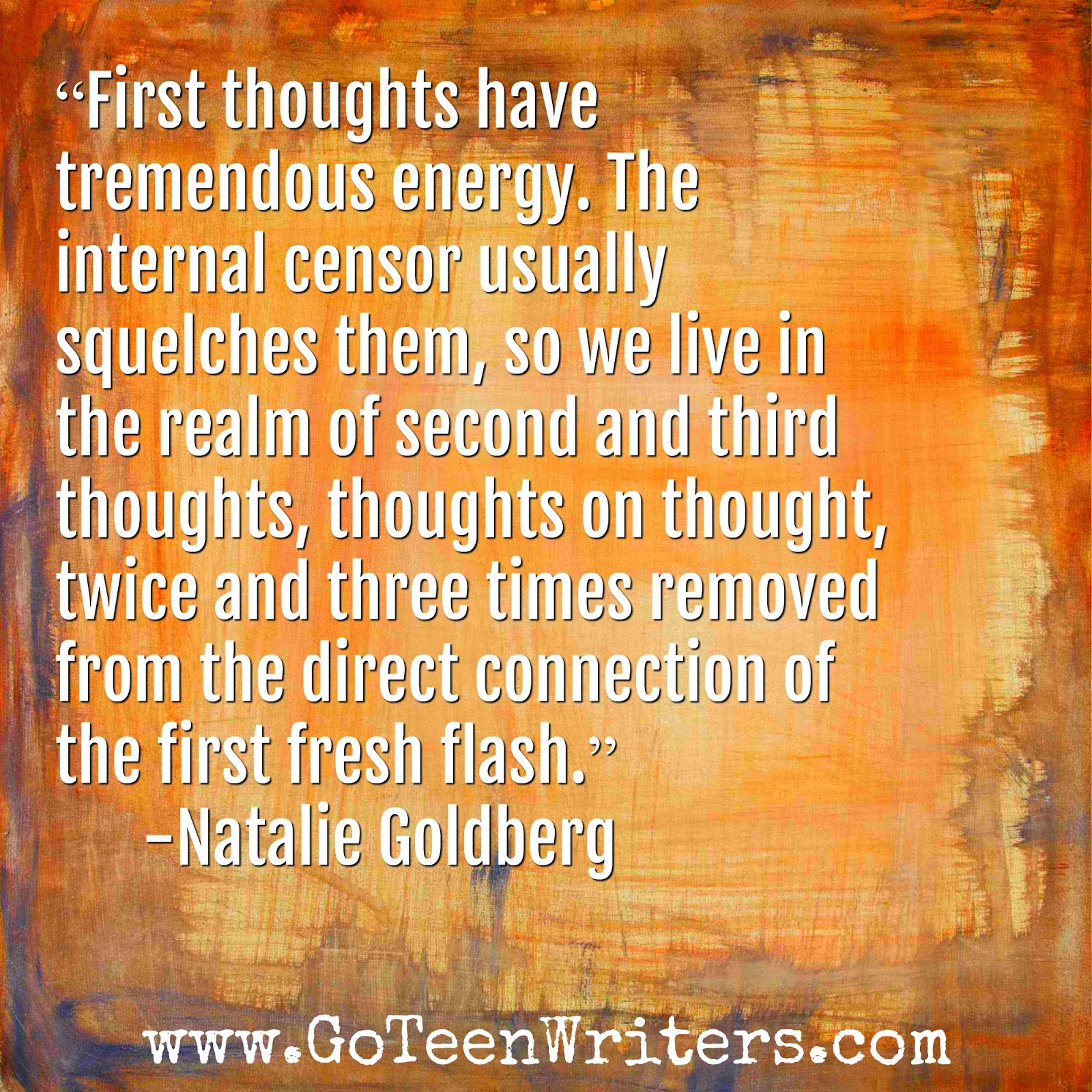
With Goldberg's thoughts in mind, let's practice writing a bit, okay? And today we're going to kick off our exercise session by simply, and quickly, answering a single question.
Here's how it will work:
I'm going to ask you a question you may or may not have an answer to. It doesn't matter either way. You're a storyteller. Make something up and leave your answer in the comments section.
And then just keep writing.
For a total of three minutes (set a timer, friends!), I want you to continue writing. Don't stop. Just let your fingers run with whatever narrative your mind is wanting to tell.
When three minutes are up, you're welcome to check for typos, but don't stop to edit your writing as you go. And don't worry if it makes little sense when you read it back to yourself. We're just practicing here: the art of writing down our first thoughts. It's supposed to be messy.
Also, please be a team player and delete anything that might be inappropriate for younger readers. We like to keep it fairly clean around here.
Be sure to come back throughout the weekend to encourage your friends as they practice. Remember, we're all learning the craft of writing. Not one of us are experts. Anytime you bravely share your work, we're grateful.
Okay! Everybody ready? Here's that question:
Are you going to the football game on Friday?
And, remember! When you participate in our writing exercises you can enter to win an opportunity to ask Jill, Steph and me a question for one of our upcoming writing panels. Once you leave your response to the writing prompt in the comments section, use the Rafflecopter below to enter. Next week, Rafflecopter will select one winner and we'll contact you for your question via email. Happy writing, friends!
a Rafflecopter giveaway
September 20, 2017
How I Cut 33K Words (Twenty Percent) From My Epic Fantasy Novel
Jill Williamson is a chocolate loving, daydreaming, creator of kingdoms. She writes weird books in lots of weird genres like fantasy (Blood of Kings and Kinsman Chronicles), science fiction (Replication), and dystopian (The Safe Lands trilogy). Find Jill on Facebook, Twitter, Pinterest, or on her author website. You can also try two of her fantasy novels for free here and here.Many of you know what I’ve been doing the past few months. If not, let me recap. I received the content edits on King’s War (Kinsman Chronicles, book three). This is the last book in the trilogy. There was a lot to tie up, and I knew the book was long. Too long. The full book came in at about 265K. So I wasn’t surprised when my editor asked me to cut some words.
He asked me to cut 40,000-50,000 words.
I failed.
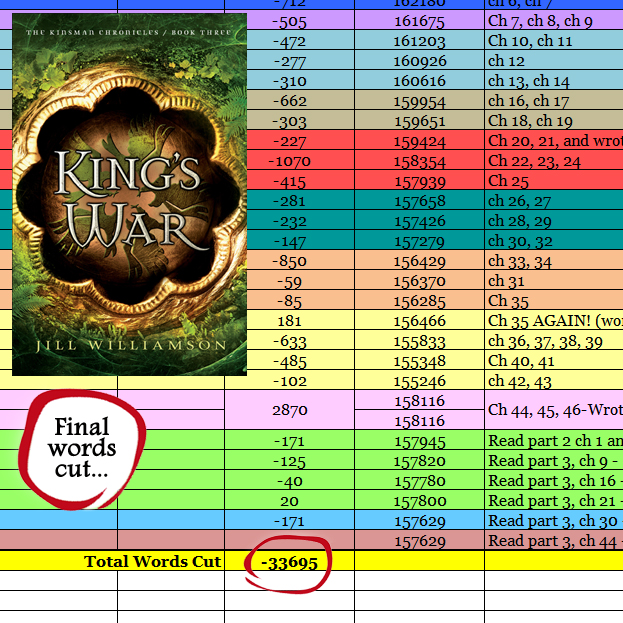
But I came close! This was partly because I had to add some new content, which took up some space. In the end, I managed to get my word count down to 33,695 words, which made me dance and sing. There is an unwritten rule that says when you rewrite your novel, you should trim at least ten percent. This has never been the case with me. I write sparse rough drafts, and my final drafts always grow. Which was why when I first heard how much I needed to cut, it knocked the wind out of my sails.
If I was going to do this, I had to have a plan.
I like plans. I work best when I have a plan. So I knew I’d need a good plan if I was going to come anywhere close to cutting so many words. I thought you all might like to see how I tackled this daunting project.
1. I “saved as.”If I was going to cut that many words, it wasn’t going to happen bit by bit. This book was going to undergo major surgery. I was going to have to hack into the thing with a machete. And I wasn’t going to do that without saving what I had someplace safe. Because I was pretty sure I would cut some things that later I would wish I had again. By saving a copy, I could always go back and find those things if I needed them.
2. I made a list of scenes.Lists of scenes help me be able to see my whole book at a glance. In the past, I simply make a long list. This time, I wanted something a little easier to see. So I used Excel to create a page with twelve empty boxes. Then I scrolled through my book and put the chapter number, point of view character, and title at the top of each box. I wrote down how many pages that chapter was. Then I listed the gist of each scene in the chapter. That gave me a really nice way of looking at my book as a whole.

3. I cut twenty percent—in theory.Math has never been my favorite, but it wasn’t too difficult to go through and subtract twenty percent from each chapter’s page count. If a chapter had ten pages, I was going to try and make that chapter have only eight pages in my rewrite. I went through my list of scenes and wrote my target page count at the bottom in a circle. Now, instead of a somewhat horrifying goal of cutting 50K from my story, I had close to one hundred tiny goals of cutting a few pages here and there. This was much easier to handle. And I could take it one chapter at a time.
4. I made a "To Do" list and added it to my manuscript.I had my notes from my editor on things he wanted changed. I also had a pile of notes from myself of things I wanted to make sure were added to the story or got tied up in the end. I went through all of this, one item at a time. If it was something I wanted to fix or add, I scrolled to the right place in my manuscript and left a comment. “Add description of castle here” or “plant bad guy subplot.” With more complex matters like the latter, I would scroll through the manuscript and add comments in several key places. These acted as reminders for me. And if there were things in my To Do stack that I no longer wanted to add, I threw away those Post-Its or scraps of paper, which was a very liberating feeling. “Almost there, Jill,” I kept telling myself. “Almost to the end!”
5. I cut twenty percent—for real.Then I started at chapter one and worked my way through the story. I cut everything I could. I especially looked for conversations that added nothing to the story or places where characters were being too wordy. I trimmed and trimmed. And if a chapter ended with five or fewer lines of text on the page, I went back through that chapter again, searching for paragraphs that ended with a few words of dialogue on the last line, then I cut and cut until I managed to pull those paragraphs, and eventually that chapter up until it ended one page earlier. This is a tedious process, but it really creates a tight manuscript. And it cuts words!
6. I added when I needed to.When I needed to tweak or add things, I did. And there was a lot to add. I kept a spreadsheet in which I kept track of my word count each day, and it was always painful to have to log a positive number instead of a negative one. Still, overall I did pretty well. I had to add two new chapters at the very end, so that hurt my word count, but it also made the story better.
So that’s how I tackled the beastly rewrite of King’s War. I’ve turned it in, so it will be interesting to see if my editor finds more to cut. I will get the story back for line edits, then again later on for a proofread, so I’m not quite done yet. I’m close, though. I’m very close.
What do you think of my process?Have you ever had to cut a lot of words?If so, how did you go about it?
September 18, 2017
What Are Your Personal Writing Rules?
Stephanie Morrill is the creator of GoTeenWriters.com and the author of several young adult novels, including the historical mystery, The Lost Girl of Astor Street (Blink/HarperCollins). Despite loving cloche hats and drop-waist dresses, Stephanie would have been a terrible flapper because she can’t do the Charleston and looks awful with bobbed hair. She and her near-constant ponytail live in Kansas City with her husband and three kids. You can connect with her on Facebook, Twitter, Pinterest, Instagram, and sign up for free books on her author website.
What are personal writing rules?
We all have them, even if we haven’t officially listed them anywhere. I first came across the idea of making a list of my personal writing rules in the June 2017 issue of the Romance Writers Report in an article by Katharine Ashe. Her article was specific to the rules she’s developed for herself as a romance writer, but the concept applies to anyone who has been writing for a bit.
"Personal writing rules" refers to the truths you've learned about you as a writer, the stories you like to tell, and your methodology for making the magic happen. If the word "rule" skeeves you out, think of them as guidelines or truths.
A quick example is something like, "I'm a plotter." When writers make that statement, it's a short way of saying something like, "I have learned that plotting my stories is important to me and the quality of my work."
For many of us, we begin with a rule like, "Writing matters to me. I make time for it." If you're early in your journey, this might be a rule that you repeat to yourself regularly. It might be the only rule you have so far, and that's okay! Depending on your upbringing and current environment, this might be one of the biggest hurdles you ever cross as a writer.
Here are some other examples of writing rules you might have:
"I write every day." This is one that Lydia Howe can claim. That's a practice that has brought her joy and discipline over the years. For other writers, that kind of rule feels like a noose.
"I edit as I write." Many writers, like me, prefer to plow as quickly as they can through the first draft and then spend more time in edits. That doesn't work for Roseanna M. White, however. She learned that she works better if she edits as she goes, regardless of the frequently repeated advice about how valuable bad first drafts are.
"Pretty writing matters to me." Beautiful prose is something that brings joy to Shannon Dittemore, and it influences her writing voice. If she focused just on being efficient with her words, she would lose a lot of what she loves about storytelling.
"My first drafts are private." This is really important to me, and it gives me the freedom to get the story on the page. It's a rule I had to develop so that I could be messy without fear. Nobody sees my manuscripts until I've edited them at least once.
Why bother?
I see several valuable reasons for writing down your rules, and I'm sure there are others.
1. Writing them down creates a good reminder. Same as writing down your goals instead of just storing them in your head. Sometimes we need reminders of what's important to us and who we are. So when you come across a blog post by a know-it-all writing teacher who says the very best way to write a book is to write a bad first draft (which I probably said in the early Go Teen Writers days when I was much more fond of the words "always" and "never") you can shrug it off and say, "Yeah, that's not what I've learned about myself. I've learned I edit as I write, and that's okay."
2. You can see how they serve or contradict your writing goals. When you put your rules side-by-side with your vision of where you want to go with writing, they can provide some great clarity.
Like if one of your goals is to publish your novel next fall, then a rule like, "I write every day" serves that well. If, however, one of your writing rules is, "I write when I feel like writing," you'll see how those contradict each other. Writing when you feel like it is great for joy, but not so great for deadlines.
3. You'll be able to watch yourself evolve. One of my personal writing rules in high school was that I didn't plot. I had tried several times and it just didn't work for me. I was a pantser.
In my early twenties, I took a class from Angela Hunt, a bestselling author who had been a professional for twenty years at that point. She said, "I like to try one new thing with each book I write." I loved her teachable spirit, and I embraced the rule for myself.
That new rule invited me to give plotting another try. With my deeper understanding of story structure, I found that I understood how to plot much better than I had in high school, and that there were some methods that worked for me.
Personal writing rules are meant to be tools to empower us, not chains that keep us from growing or trying new things.
Want to play along? What are some of your personal writing rules?
Next Monday we'll look at our writing goals and rules, and we'll brainstorm ways we can take action on them. I love making lists and dreaming, but if we don't get some actionable items on our calendar, then these exercises aren't very useful!
September 15, 2017
Writing Exercise #14: Endings As Beginnings
Shannon Dittemore is the author of the Angel Eyes novels. She has an overactive imagination and a passion for truth. Her lifelong journey to combine the two is responsible for a stint at Portland Bible College, performances with local theater companies, and an affinity for mentoring teen writers. Since 2013, Shannon has taught mentoring tracks at a local school where she provides junior high and high school students with an introduction to writing and the publishing industry. For more about Shan, check out her website, Facebook, Twitter, Instagram and Pinterest. Every writer goes through dry seasons. Seasons of time where the words just won't do their thing. They're either stuck in your head or hiding from you entirely. If you're lucky enough to get them out of your pen and onto the page, the sentences are ugly and you find yourself wondering if you've forgotten how to write stories.
It happens to us all. It really does. The only way to claw out of a dry season like that is to {wait for it} write your way through it.
I know. I know. It's rough. It is. And I'm a huge advocate of taking time off when you need time off, but at some point, you're going to have to sit back down in that chair and knock the rust off. One of the best ways to do that is to just write.
"WRITE ABOUT WHAT?" you ask.
My answer is a simple one. Write about anything. Write about nothing. Just write.
The internet is full of writing prompts--and you should totally avail yourselves of those--but sometimes cyberspace can be like all those rabbit holes little girls fall into. There are so many options to choose from. So many shiny ideas. You just keep falling and falling and never getting any writing done.
So, today, instead of trolling Pinterest for writing prompts, I want you to grab the nearest book (puh-lease keep in PG, alright?). Flip to the very last page and put your finger on the very last sentence.
That, my friends, is your beginning. That's right. The last line of the book in your hand is the first line of your shiny new paragraph.
I want you to write me that paragraph and leave it in the comments section below. And then be sure to come back throughout the weekend to see what you're friends are coming up with. We all need a little encouragement now and then.
A couple things:
1. We frown on spoilers here, so please do not tell us the name of the book and if there are recognizable names in the final sentence (like Katniss or Hermione), do us a favor and change them.
2. Your goal is not to continue the book your holding. Use this sentence as a jumping off point. Start something new. Something that's all yours.
3. And, remember! When you participate in our writing exercises you can enter to win an opportunity to ask Jill, Steph and me a question for one of our upcoming writing panels. Once you leave your response to the writing prompt in the comments section, use the Rafflecopter below to enter. Next week, Rafflecopter will select one winner and we'll contact you for your question via email. Happy writing, friends!
a Rafflecopter giveaway
September 13, 2017
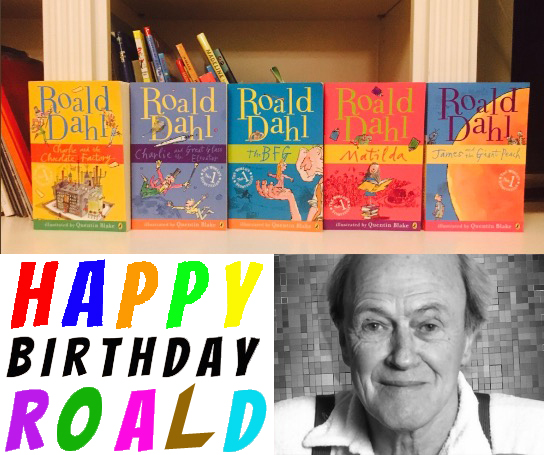
Seven Writing Tips From Roald Dahl To Celebrate His Birthday
Jill Williamson is a chocolate loving, daydreaming, creator of kingdoms. She writes weird books in lots of weird genres like fantasy (Blood of Kings and Kinsman Chronicles), science fiction (Replication), and dystopian (The Safe Lands trilogy). Find Jill on Facebook, Twitter, Pinterest, or on her author website. You can also try two of her fantasy novels for free here and here.Three days left to finish my rewrite. And since it's September 13, and September 13 was Roald Dahl's birthday and is now Roald Dahl Day, I'm celebrating the literary legend.
Roald Dalh grew up in England. He moved to Africa at the age of eighteen to work for Shell Oil Company. After that he was a fighter pilot in World War II. As if all that wasn't adventure enough, when he was twenty-six he moved to America and began to write. (This is especially sweet to me, because I also started writing later in life. I started at the age of twenty-eight.)
Roald was twenty-seven when he published his first book, The Gremlins, which was about little creatures from the Royal Air Force. Walt Disney started making a film based on the book, but it never got made. Click here to see a cool picture (that I was afraid to use, because Disney) of a very young Roald and Walt with some stuffed Gremlins. (It's the second picture in the post, so you have to scroll down a bit.) Random Factoid #1: The 1984 Spielberg movie Gremlins was loosely inspired by Roald's mischievous little creatures. Random Factoid #2: You can see the original gremlins in the Epic Mickey video games. My kids were super excited to discover this. (Google "Epic Mickey Gremlins." They're cute.)
 Photo by Carl Van Vechten, 20 April 1954
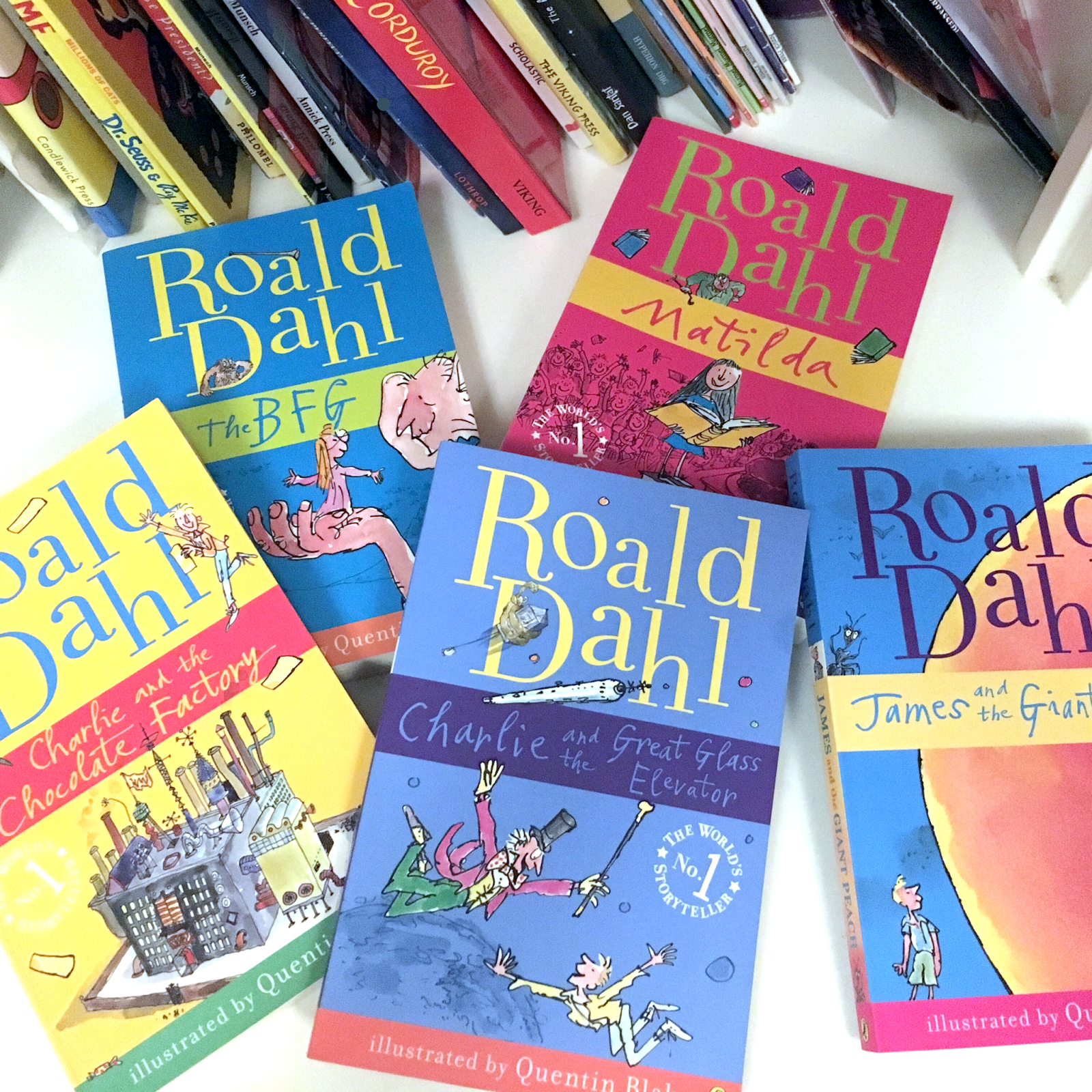
Roald went on to write short stories about his war experiences for The Saturday Evening Post, and for years he wrote for adults. It wasn't until 1960, when he was living in England again, that he started publishing children's books again, beginning with James and the Giant Peach in 1961. Some of my favorite Dahl books are The BFG, Matilda, Charlie and the Chocolate Factory, and Charlie and the Great Glass Elevator.
Roald also wrote two screenplays. One for the James Bond movie You Only Live Twice (which is the one where Sean Connery has to fight the Japanese ninjas) and the other for the musical Chitty Chitty Bang Bang (about a fine, four-fendered flying car), both based on books by Ian Fleming. Roald also wrote for television.
Talk about an amazing and inspiring career. You can learn more about Roald Dahl on his website.
Seven Writing Tips From Roald Dahl
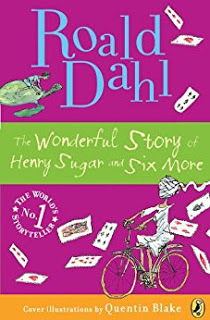
I found these tips as part of an extra in the back of the book The Wonderful Story of Henry Sugar and Six More, where Roald talks about how he became a writer.
1"You should have a lively imagination."
2
"You should be able to write well. By that I mean you should be able to make a scene come alive in the reader's mind. Not everybody has this ability. It is a gift, and you either have it or you don't."
3
"You must have stamina. In other words, you must be able to stick to what you are doing and never give up, for hour after hour, day after day, week after week, and month after month."
4
"You must be a perfectionist. That means you must never be satisfied with what you have written until you have rewritten it again and again, making it as good as you possibly can."
5
"You must have strong self-discipline. You are working alone. No one is employing you. No one is around to give you the sack if you don't turn up for work, or to tick you off if you start slacking."
6
"It helps a lot if you have a keen sense of humor. This is not essential when writing for grown-ups, but for children, it's vital."
7
"You must have a degree of humility. The writer who thinks that his work is marvelous is heading for trouble."
What's your favorite Roald Dahl book? Share in the comments. Mine is Charlie and the Chocolate Factory .
[FYI, my sources are: Roald Dah's bio in the back of The BFG , the extra section in the back of the book The Wonderful Story of Henry Sugar and Six More, and Roald Dahl's Wikipedia page.]