Kristen Orser's Blog, page 6
July 12, 2012
Moonrise Kingdom
A friend tweeted about Wes Anderson’s new movie: “It really brings back that childhood nostalgia.” I wanted to reply, “Are you insane?”
I took a breath and realized I have to play nice–Sure, camp and running away from home; I guess that’s playing on memories. But really, that’s what you took from that whole movie?
If people walk out of that film and feel all “awww” and “that was cute” I’m kind of hoping it’s because they were doped up on Junior Mints. I’m saying this not because I didn’t like it, but because there’s a lot packed into what Wes Anderson’s films have been doing and how they’ve been developing (and repeating) themes/lines/characters.
I know people have a love/hate relationship with him; overall I’m in the love: I give him credit for developing films based on critique. To my mind, his flat characters are intentionally flat because they live in a society that’s empty and boring. Their inner world is more full than the outer world. The outer world is lame, it’s so chock full of objects: record players, fur coats, sweat bands, bells and whistles. It’s aesthetically stunning to see the detail, and it’s heartbreaking to see that the details, the objects, don’t (can’t) ground characters (storytelling 101 would lead us to believe otherwise). Objects seem to bury characters in easy-to-read-characterizations-of-oddities. It’s frustrating. It’s smart.
The storytelling relies on the characters being “just a little bit off” and the audience identifying with that square peg feeling and wanting MORE. He tells us about characters. He tells us about “stuff” and how characters develop personality through objects, through a string of associations, and through storytelling that relies on some basics. I dig that.
And, I know I’m learning to live outside of teaching and outside of academia, I’m kind of concerned that we don’t talk about Wes Anderson more.
Mostly, because of where my mind (and body) is positioned, how he treats female characters.
Even in Moonrise Kingdom, which has a female lead, she’s still an affectless little doll. She makes her decision to run away because of a boy and he, of course, comes up with the plan and has the “know how”. Otherwise, without him, she’s in an “ivory tower” reading books where female leads are so fantastical they are living on other planets and completely unreal.
She is a cute, she is fashionable, and her purpose in life comes from being misunderstood until a boy seems to understand her.
We should look at this through a Feminist lens because Anderson is making challenging works. He leaves us with a main character who is still in a patriarch: a boy visits her, is brought by another man, and she’s still in the ivory and isolated tower.
Wes Anderson’s view of all women is strange. To be frank, it’s not the “pretty” of the main characters that sits with me or the “cute” of their precociousness; it’s not even the inwardness, lack of words, or “difficulty.” Instead, it’s that the women are invariably lead by men. This is a nice way to sum up the difficulty of adoring Wes Anderson and recognizing that it’s not entirely great for women. It’s not about not liking him, not about not thinking what he’s doing is great, it’s just recognizing that there’s a trend.
I kind of think the difficulty he presents MAKES HIM A GOOD FEMINIST (at least makes him aware). In the beginning of Moonrise Kingdom, when we meet our female lead, she’s just punched a mirror. Of course! Way to set the tone Anderson, to ask your audience to see how this is a critique of the woman as object, the woman being watched and the woman (girl) who is learning to watch her watchers (through binoculars even).She’s acting to the system of peeping.
And when she looks straight on at the camera, the passive role gets active and we have to face it all too. We have to realize that she kisses her “husband’s” hand because she’s being watched by a group of boys and by all of us. At the end even, when the boy is painting, we think he’s painting her (admit it, the whole scene is set up to make you think that and he did–before–draw her). He’s painting a landscape, one that they shared. Nice tactic Anderson. You got us, you caught us all thinking that she was the object again. It’s us, not you, who put her in that position. It’s us, not you, who felt uncomfortable when she danced in her underwear. You’re really hit the nail on the head and caught us. Huzzah.
It’s smart. It’s a clever nugget of a film and it’s worth a little more discussion (like all of his films). So yeah, nostalgia comment you are weak and I really want to have a round of beers with you and talk about what movie you were watching.


July 8, 2012
California is…

All the lakes I’ve lived on: Erie, Chautauqua, Ontario, Michigan, Cayuga, Dzban, and all the rivers I’ve known. The ocean is a stranger thing. The Pacific, stranger.
A few days ago, a woman on the beach said this was like Cape Cod and I wanted to turn to her and say, “it’s nothing like that,” but it was true that it was a bit chilly that day and there might have been something of New England to how the wind moved.
We’re planning on learning to paddle surf–is that what it’s called?
In the meantime, we make cherry cocktails with tarragon and they are lovely to sit with.



July 2, 2012
A Weekend Full of Berries
We didn’t make cherry pie. We didn’t make blueberry buckle. We did make everything else berry-licious.

From left to right: cherry syrup, boysenberry galette, and spiced strawberries.
Berry picking is my absolute favorite part of California and it lets me, for a second, remember apple picking upstate, grape harvesting in Chautauqua, and finding blueberries in Maine. More importantly, it gives Jesse and me a chance to not think about what isn’t working here and focus on what we can make out of what already grows here.
The cherry syrup turned out a little more “candy” than I dreamed, but I still think it’s going to be excellent in the next batch of truffles. What a great filling!



July 1, 2012
California is…
In keeping up with people on the East Coast and in the Midwest, it feels totally adequate to let them know that California is “cool.” I’m ascribing this term mostly to the sweet rides everyone has.
Note: a boy at the beat mentioned that my car needs to be washed. It was totally embarrassing.

Also, if you wanted to be cooler than Californian cars, get yourself a muddle and make a cocktail. I’ve got a little bit of Fourth of July advice about muddling that you can read here.



June 29, 2012
Pinch of Pinch
As if he wasn’t cool enough already, Ryan W. Bradley is making me feel like my work (now kind of stale and old for what’s out there) might have mattered a little bit.
Meaning, there’s new work and here’s a little preview:
Pinch of Pinch (read by Ryan himself)
In other newness, the newest batch of truffles are cardamom infused and rolled in nibs instead of powder. They are perfect. Chocolate is perfect and nibs might be one step better than perfection.
Looking into tea infusions for chocolate ganache and, maybe, a workshop around town to make the aesthetic a bit cleaner.


June 26, 2012
New Work
When Quarter After asked me what this work is, I called it a poetic essay. It’s not lyric, I wish it was.
Read Notes from the Dining and Sitting Rooms here and let me know what you think about this try to write with reading (or read with writing).
The rest of the issue is chock full of reading…a lot of work gathered and it’s only their second issue. Nice work Quarter After!

new work that might be like a summer egg



June 24, 2012
California is…
My favorite friend, Sheena Gilbert, sent me a text from upstate NY: “California is…?”
It’s taken me awhile to know how to answer her because California is not what my east coast and midwest thoughts imagined. At lest, not mostly. And, like I always told my students, it’s easier to focus on (and write about) negations and what something is “not” but it’s harder to find out what something “is.”
That whole “essence” idea is pretty far to reach towards, but we try. We try and describe what something is and, even, to discover and uncover what something is (granted, it usually ends up becoming something else, shifting, and changing).
I’ll start trying to tell Shenna what California is so I can, likewise, tell myself what this place is all about. Last weekend, Jesse and I went hiking and California was, for a second a little East Coast feeling–meaning it was woodsy, filled with rivers, and smelling of pine. And the differences were the redwoods, the size, and feeling a bit less like I was fighting daylight.




June 22, 2012
Follow Friends, that you haven’t even met
Ryan W. Bradley gets it.
He gets reading, seeing reading as a community activity, seeing it all as part of working toward connectivity.

He gets this whole building communities thing the digital world promises. He gets that poetic communities are small and, in order to be sustainable, they can’t be exclusive or uppity (that doesn’t mean they don’t have standards, aren’t thinking and attending to standards). He gets the possibility of being a conduit as a reader, writer, thinker, and publisher.
He gets that writing is material, immaterial, and whatever other argument you want to make (and he probably wants to talk to you about it too, probably has some things that will help you see it another way or more clearly the way you already see it…I mean, he’s pretty smart).
He reads poems and records them, makes movies out of them, and understands that they are sonic/visual/emotive/thoughts. The way he thinks about writing takes up space.

It’s tough to find, and I’ve talked about it before, ideal readers (alright, any reader). I don’t care how trite or overdramatic it sounds, I gave up on writing. And I’m glad Ryan W. Bradley was there to kick me in the face and remind me that all the poetry-biz stuff bringing me down and the academic hullabaloo of the recession aren’t good enough reasons to not pursue a point of being able to say something…maybe something beautiful.
It’s easy to negate and give up. It’s way harder to just keep trying to open up.
“To articulate” also means, “to connect” and Bradley connects.
Only connect! That was the whole of her sermon.
Only connect the prose and the passion, and both will be exalted,
And human love will be seen at its height.
Live in fragments no longer.
Only connect…
–E.M. Forster, Howards End
Follow this dude. He’s legit too, with a stunning amount of work including three poetry chapbooks, AQUARIUM (Thunderclap Press, 2010), MILE ZERO (Maverick Duck Press, 2011), and CRUSHING ON A GHOST (Maverick Duck Press, 2012), a short story collection, PRIZE WINNERS (ADP, 2011), and a novel, CODE FOR FAILURE (Black Coffee Press, 2012). There’s more coming too. He’s also the editor/publisher of Artistically Declined Press and a freelance graphic designer specializing in book covers.
Oh, and he doesn’t seem exhausted from all that.
More importantly, he’s a funny, decent, and an instantly love-able homeboy that I’ve never met. I’m totally fascinated by my ability to adore him across distances. Follow this dude on his twitter, his facebook, and then read all his work (that’s what Google’s for).
Yes, I have used both Pound and Forster to talk about this guy…gushing?


June 20, 2012
summer beer (from French farms to the Crousehold)
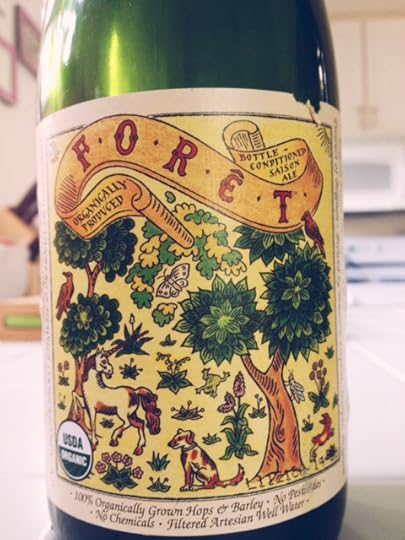
a summer favorite and a little ditty about why Jesse and I love it so much (click image to read).



starting to manifest a manifesto
Always handmade with pure ingredients. Always delicious. à la main is focused on pursuing taste – from the sweet to the salty, the mild to the robust. This is about curiosity.
Cocoa, as an agricultural product, has significant socio-economic consequences. Cocoa, as a cooking ingredient and sensory treat, can support sustainable economics and conscious consumerism.

I’m always putting together what I think about my small business, but I never really know what it is that makes me, as a thinker and buyer, gravitate to one business over another. I think the product matters the most and, that product, seems to rest on quality ingredients/components. Does that make the ethos secondary or primary? Do people read manifestoes, missions, etc.?
When I do the small brand consulting I do, it matters to me that this part of the business be thought out, short, and clear. But I do wonder what happens to it outside of the mind of the business.