David Gessner's Blog, page 24
December 16, 2014


December 15, 2014
Drawing Kate
Friend of Bill and Dave’s Kate Miles is still roaring around on her supertour (I think). But when she dropped by Wilmington she asked, no pleaded, that I draw her a cartoon head in Bill and Dave’s fashion. Be careful what you plead for, Kate. Just found these, scribbled during your talk here at UNCW….
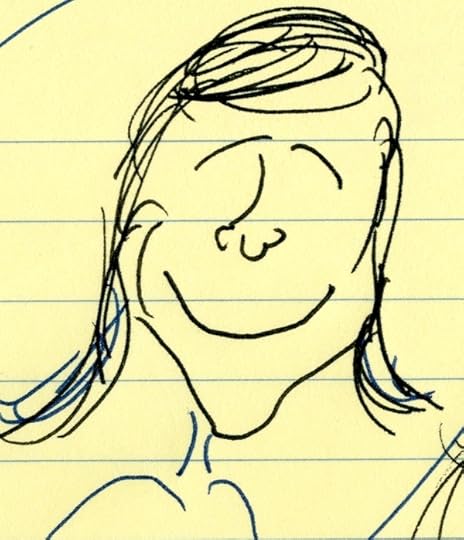
Rough drafts…
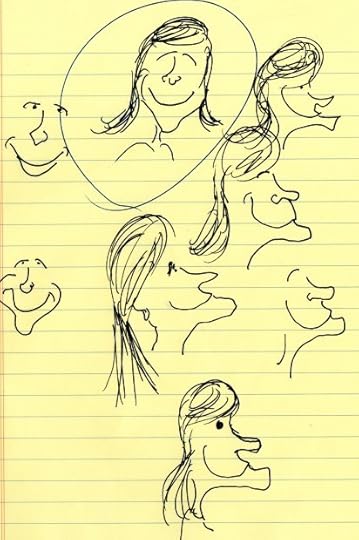
The real Kate….

December 13, 2014
December 11, 2014
Bad Advice Wednesday: The Memory Game, Redux
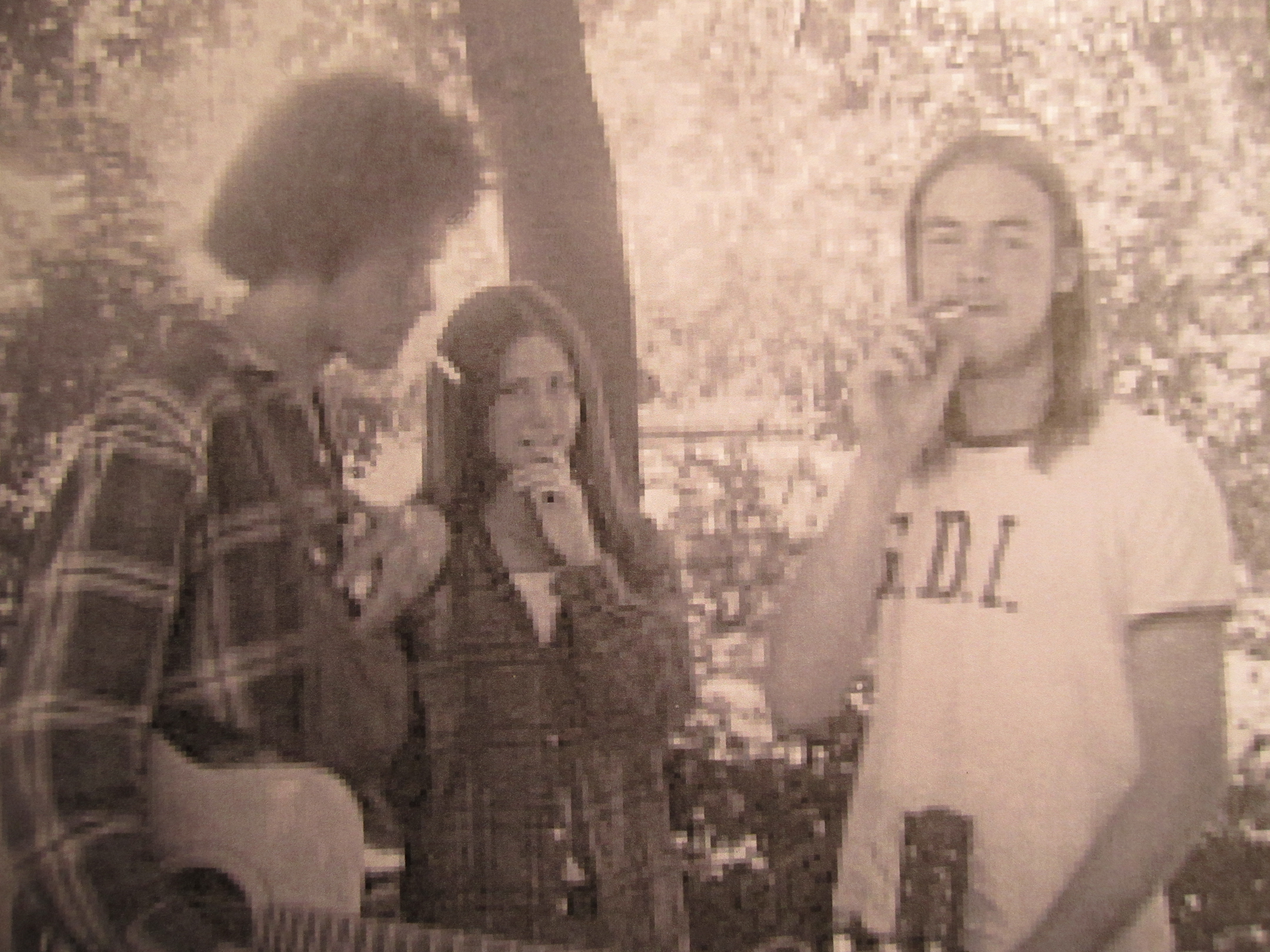
Bill and friends, August, 1972#
One of the many curious things about the act of writing is the way it can give access to the unconscious mind. And in the hidden parts of consciousness lie not only hobgoblins and neurotic glimmers, but lots of regular stuff, the everyday stuff of memory. The invisible face of your grade school bully is in there, somewhere, and the exact smell of the flowers on vines in your grandma’s backyard, along with most everything else, perhaps including borrowed memories, even false ones. Some memories are going to be painful, but some pleasurable, too. An awful lot is just informational, the stuff of lost days.
And—I’m just realizing this—memory is what people are made of. After skin and bone, I mean. And if memory is what people are made of, then people are made of loss. No wonder we value our possessions so much. And no wonder we crave firm answers, formulae, facts and figures. All are attempts (however feeble in the end) to preserve what’s gone. The present is all that’s genuinely available to anyone, and the present is fleeting, always turning instantly to the past. Even facts distort: what’s remembered, recorded, is never the event itself, no matter how precise the measurement (a baseball score is not the game). Memoir is never a re-creation—that’s impossible. At best what we can do is listen to memory and watch memory (the other senses are involved, as well), and translate for those we want to reach, our readers.
If you’ve written fiction at all, you know that detail is required to make a vivid scene. What’s in the room? What sort of day is it? Who exactly is in the scene, and what exactly do they look like? All well and good writing fiction: you make it up. But writing nonfiction, the challenge is different: how to remember. For, of course, if we’re going to call it a true story, the details better be true, right? Then again, we all know memory is faulty. Don’t forget Tobias Wolff: “[M]emory has its own story to tell.”
My sister Carol likes to tell the story of the time our younger brother, Doug, sucked on a hollow toy bolt till it suctioned onto his lips. He was maybe four. She and Mom and Doug were at Roton Point, our run-down beach club in Connecticut, end of the day, marching to the car carrying blankets and towels and pails and toys. Doug was a stocky little kid (we sibs meanly called him The Bullet till he shot up into a slim young man), and he looked cute as hell stumbling along carrying the Scotch cooler with this big blue bolt suctioned onto his lips. In the car he still wore it, all the way to the guard booth, where he liked to say good-bye to the genial old guard who watched the beach gate. Carol tells the story at Thanksgiving and Christmas about every year. And I believe she told it at Doug’s wedding: rehearsal dinner. Anyway, at the gate, Bullet Boy tried to pull the bolt off to say hi to the guard, but it wouldn’t come. He’d sucked on it so long and so hard he couldn’t unstick it. So Carol grabbed hold of the threaded end of the thing, wrestled with it a little till pop it came loose.
And Carol looked at Doug and Doug looked at Carol and then Carol said, “My God!” and so Mom turned and said it, too: “My God!” Doug’s lips—poor Doug!—were ballooned up like some character’s in a cartoon, so big even he could see them. Doug freaked! Carol freaked! Mom freaked! Doug cried and cried, even though it didn’t hurt, but before they could even get near the doctor’s, the swelling had disappeared.
That’s it. Cute little family story. But the trouble is, Carol wasn’t there! I was there. And the bolt wasn’t blue, it was yellow. And that guard was a nasty old guy. I can still see him, all crabbed in his cheap uniform. And Mom didn’t freak; she laughed. She laughed despite herself, because poor little Doug looked so comical, and because—this is important—she knew he’d be all right. And I laughed and laughed, “Bwaa-ha-ha!” because I was a big brother, and big brothers laughed at the misfortunes of younger, at least they did in 1963.
I let Carol tell the story at meals, only occasionally challenging her, and now that’s part of the family story, how we both claim the memory. I know she’s wrong. She knows I’m wrong. Whom do you believe? Does it matter? Maybe we’re both wrong. Is something more important than swollen lips at stake here?
Memory is faulty. That’s one of the tenets of memoir. And the reader comes to memoir understanding that memory is faulty, that the writer is going to challenge the limits of memory, which is quite different from lying. One needn’t apologize. The reader also comes expecting that the writer is operating in good faith, that is, doing her best to get the facts right.
Listen to Darrel Mansell, a teacher of writing, in his article on nonfiction in the old Associated Writing Programs Chronicle.
“You just can’t tell the truth, the whole truth and nothing but the truth about that amorphous blob primary substance—language with its severely limited and totally unrealistic rules and regulations won’t permit it. Furthermore the aesthetic and rhetorical demands of writing won’t quite permit it either. The best you can do is to be scrupulous about facts and conscientious about what you and only you know to be the essential truth of your subject. That way you have a shot at telling one modest aspect of what really happened—something true, up to a point.”
[From Writing Life Stories]
December 6, 2014

December 5, 2014
DFW on CNF: Deconstructing David Foster Wallace
“. .. personal essays and memoirs, profiles, nature and travel writing, narrative essays, observational or descriptive essays, general-interest technical writing, argumentative or idea-based essays, general-interest criticism, literary journalism, and so on.” —David Foster Wallace’s syllabus definition of creative nonfiction.
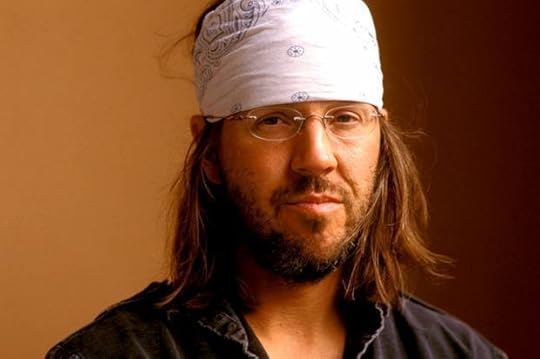
As a teacher and writer of nonfiction, I devoured the late David Foster Wallace’s recently released creative nonfiction syllabus. Salon, which published it, called the document “mind-blowing,” evidently referring to its tough-love language. In this blueprint for a night class he taught at Pomona College once a week in Spring 2008—so roughly six months before his death, presumably when he was already suffering from deep depression—Wallace prosecutes a rigorous, distilled aesthetic. He builds toward it in his opening “Description of Class,” which notes that “nonfiction” means it corresponds to real affairs but that creative “signifies that some goal(s) other than sheer truthfulness motivates the writer and informs her work.”
This purpose may be “to interest readers, or to instruct them, or to entertain them, to move or persuade, to edify, to redeem, to amuse, to get readers to look more closely at or think more deeply about something that’s worth their attention. . . or some combination(s) of these.’’ He continues, going deeper:
 Creative
also suggests that this kind of nonfiction tends to bear traces of its own artificing; the essay’s author usually wants us to see and understand her as the text’s maker. This does not, however, mean that an essayist’s main goal is simply to “share” or “express herself” or whatever feel-good term you might have got taught in high school. In the grown-up world, creative nonfiction is not expressive writing but rather communicative writing. And an axiom of communicative writing is that the reader does not automatically care about you (the writer), nor does she find you fascinating as a person, nor does she feel a deep natural interest in the same things that interest you. The reader, in fact, will feel about you, your subject, and your essay only what your written words themselves induce her to feel.
Creative
also suggests that this kind of nonfiction tends to bear traces of its own artificing; the essay’s author usually wants us to see and understand her as the text’s maker. This does not, however, mean that an essayist’s main goal is simply to “share” or “express herself” or whatever feel-good term you might have got taught in high school. In the grown-up world, creative nonfiction is not expressive writing but rather communicative writing. And an axiom of communicative writing is that the reader does not automatically care about you (the writer), nor does she find you fascinating as a person, nor does she feel a deep natural interest in the same things that interest you. The reader, in fact, will feel about you, your subject, and your essay only what your written words themselves induce her to feel.
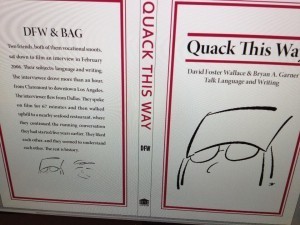
The apparent acid that Salon responded to in “whatever feel-good term you might have got taught in high school,” I read, instead, as an attempt to emphasize his own hard-won understanding. It’s not just that along the line Wallace got his ears bored off by some undergraduates’ essays, though there’s a whiff of that. In the recent Quack This Way: David Foster Wallace and Bryan A. Garner Talk Language and Writing, Wallace discusses how in college he “snapped to it perhaps late,” thanks to his teachers, that the world “doesn’t care about you. You want it to? Make it. Make it care” (33-34).
Also he’s trying to woo his students by inviting them into his world’s inner sanctum. We will learn what only the pros know. His brief for art over experience is a key aesthetic principle of literary nonfiction. Since such prose is often initially motivated by deeply personal experiences and feelings, which often it also does express, it can be a revelation to writers to learn that that’s not enough.
As I read it, Wallace is not forbidding heartfelt personal writing but simply saying that the fact that the experience was personal or cathartic for the writer isn’t sufficient. High levels of craft, which themselves bespeak authorial distance and shaping, must be brought to bear. Attention must be paid … to the reader.
As he explains:
Part of the grades you receive on written work in this course will depend on each document’s presentation. Presentation here means evidence of care, of facility in written English, and of empathy for your readers. The essays you submit for group discussion need to be carefully proofread and edited for typos, misspellings, garbled constructions, and basic errors in usage and/or punctuation. “Creative” or not, E183D is an upper-division writing class, and work that appears sloppy or semiliterate will not be accepted for credit: you’ll have to redo the piece and turn it back in, and there will be a grade penalty — a really severe one if it happens more than once.
David Foster Wallace’s list of essays for student reading
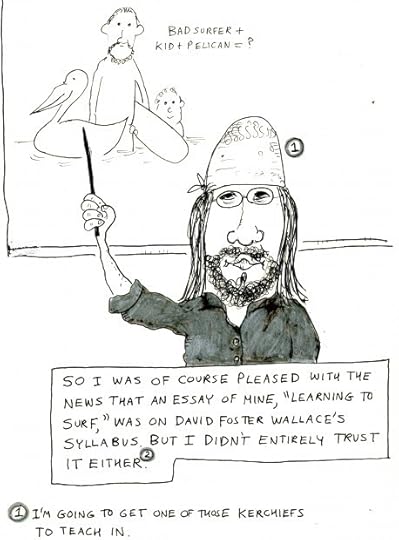
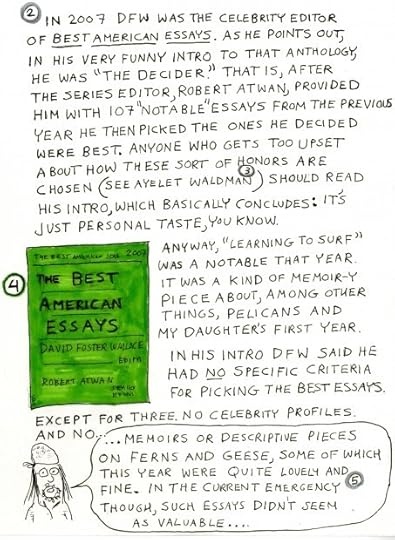
For a class session early in the semester his students were to read Jo Ann Beard’s “Werner,” Stephen Elliott’s “Where I Slept,” George Orwell’s “Politics and the English Language,” and Donna Steiner’s “Cold.” For the next class they were to read David Gessner’s “Learning to Surf,” Kathryn Harrison’s “The Forest of Memory,” Hester Kaplan’s “The Private Life of Skin,” and George Saunders’s “The Braindead Megaphone.”
If this seems light reading for a semester’s writing class, recall that, because his English 183 class is small, he’s running it as one big workshop group. Each student must read, edit, and write about several classmate essays per workshop session. As far as I can tell, after the introductory class and two on these readings—so after about three weeks to get the students writing—the class’s three-hour weekly sessions were spent discussing student work.
By having them read these essays at the start, he was both giving his students sophisticated models and filling in until their essays came rolling in. In the same way that he asked them to respond to their classmates later, he gave his students this assignment for each group of essays:
Pick one of these essays, pretend that it’s been written and distributed by an E183D colleague, and write a practice letter of response to it, being as specific and helpful as possible in detailing your impressions and reactions and suggestions for how the essay might be improved.
I asked David Gessner how he felt about Wallace teaching his “Learning to Surf,” which was published by Orion. The essay braids Gessner’s learning to surf with his experience of being a father to a young daughter and with his increasing interest in the mute, prehistoric-looking pelicans that ride the ocean breezes past the middle-aged Gessner and his fellow teenybopper surfers as they try to catch waves. I think Wallace used “Learning to Surf” because it’s well-written, interestingly structured, and something students might relate to or try to emulate (surfing, writing about multiple subjects, noticing nature and especially birds). However, Wallace’s friend Jonathan Franzen, an avid birdwatcher, has written about Wallace’s antipathy to that passion. Which raises a question about Wallace’s feelings about the whole nature-writing genre.
“I was surprised that DFW taught my essay in his class,” David responded. “I had assumed he was not too crazy about it, as it was a finalist that he did not pick for the Best American Essays the year he chose them. In the intro to that collection, he said he had few definite criteria for choosing the essays, except for ‘no essays about geese and things,’ which I assumed included pelicans, the subject of my essay. So it was a pleasant surprise that he even noticed the essay.”
The genius writer as yeoman teacher
Wallace’s syllabus also interested me for how it reveals the brilliant novelist and essayist as a beleaguered teacher of undergraduates. This class was limited to—praise the Lord!—twelve students. At most institutions, I imagine, the cap would be 16. As writing classes edge above 16 and reach 20 or more students, things get much less personal for everyone. Some students feel they can hide. Instructors simply cannot give each writer as much attention.
So, in prepping his artisanal class, it is amusing to see Wallace practicing the jiu-jitsu common to all teachers who author syllabi. It’s a loss of innocence, what you learn you must include. But it’s also good and necessary housekeeping. Here’s his statement on attendance:
For obvious reasons, you’re required to attend every class. An absence will be excused only under extraordinary circumstances. Having more than one excused absence, and any unexcused ones at all, will result in a lowered final grade. After the first two weeks, chronic or flagrant tardiness will count as an unexcused absence.
That Wallace had to write the next line is rather heartbreaking but it proves he did teach undergraduates:
All assigned work needs to be totally completed by the time class starts.
I can’t remember students in my day using broken typewriter ribbons as excuses, though surely some did; I vaguely recall faded type from frayed ribbons. Now the technological aspect of writing is vast. Especially if work is shared electronically, but there’s also more formatting—the old typesetter’s job—even for hard copies. For both student and teacher, much more knowledge and tools are required. I spend a huge amount of time teaching things like proper formatting in Microsoft Word, including telling students repeatedly to notice and override Word’s annoying default of putting extra space between paragraphs. (Fine for the web, but . . . )
Students have many more real and convenient excuses for late work, including trying to use a web-browsing device as their workhorse computer, lacking compatible software, or composing essays on thumb drives. Periodically I’m asked by students to email them essays because they can’t find drafts in their computers, have a broken hard drive, or have lost the thumb drives they trusted them to. And always, real but foreseeable (to an adult) printer pitfalls—including dry ink cartridges and empty paper trays—crossbreed with immaturity and procrastination. Technology both permits sharing and provides excuses that drive teachers half mad.
Here is Wallace’s valiant, doomed effort to head off the latter:
There are no “extensions” in workshop-type classes; your deadlines are obligations to [12] other adults. Finish editing and revising far enough ahead of time that you can accommodate computer or printer snafus.
Each of his students was allotted three workshops. Except some, he knew, would want one fewer or need one more. Here he tries to engage students in the logistical aspects of workshopping—as if they’ll remember or care that he’ll have to juggle like a demon to accommodate custom experiences:
This is not impossible, but it makes for tricky scheduling — you need to confer with me individually (and soon) if you wish to submit something other than the normal three pieces.
Although a teacher labors to plug the holes and scare the hardened criminals, he learns repeatedly that he’s fair game. And that even good students don’t know the impact of their messy lives on a teacher with dozens of other students to tend and hundreds of pages to grade. Sometimes he imagines good students puzzling over syllabus invective spurred by the sins of their unknown miscreant forebears. As Dave says, it’s tricky.
One of the ways Wallace handles these paradoxes of the teacher’s role is with humor. He’s spoofing his authority even as he establishes it. It’s clear he’s no ogre. Telling his students “you’re insane” if you don’t own a good dictionary and a usage dictionary makes the serious ones feel special—they’ll buy one or both. By all accounts, he was uncommonly attentive and kind to students.
Any student with half a brain got the humor and smelled the fudge factor here:
Attendance, Quality & Quantity of Participation, Effort, Improvement, Alacrity of Carriage, Etc. = 20%.
I’m surprised only that he didn’t list “Deportment,” but surely that’s included under Alacrity of Carriage.
 Richard Gilbert teaches at Otterbein University and is the author of Shepherd: A Memoir. His essays have appeared in Brevity, Chautauqua, Fourth Genre, Orion, River Teeth, and Utne Reader.
December 3, 2014
Bad Advice Wednesday: Keeping Happy and Healthy on Tour
Last book tour I found myself getting depressed at times, a dark feeling overcoming me. I’ve talked with a number of friends including Dave who have felt the same: you’re alone out there, and the great events (big turnouts, smart media, a feeling of partnership with your hosts) don’t always balance out the inevitable bad ones (Oh! We forgot you were coming!). But also, may I repeat: you’re alone. Alcohol, as always, is helpful and harmful in equal measure. Food, the same. Even a great meal and martini alone for the fifth night in a row is no boon. But neither is an ascetic sandwich and early to bed. Up at dawn! To the airport! To the next city! Find the hotel! Grab a shower, and with luck a nap! Find the bookstore or college or library! And then: it’s show time! And repeat.
Seen at the Georgia Center for the Book
So this time I consciously went about doing it differently. I made dates with friends as before, in whatever city I had old friends, but made dates as well with acquaintances and distant (and not-so-distant) relatives, and with friends I’d lost touch with until the advent of Facebook, and even Facebook Friends, people I’d never met but seemed from this post and that to be sympatico.
First a week of gigs around Maine, so I could get home.
Then, the surprise of being picked as a finalist for the Kirkus Fiction Prize, 2014. So to Austin amid friends old and new. Then, as planned, to Minneapolis. A great, late-night meal at Nye’s in Minneapolis with my fellow Algonquin author and Mainer Brock Clarke. Then back to Austin on the original plan, A whirlwind with writer friends, former students, new acquaintances (the Texas Book Festival was in progress). Then to Miami, where upon arrival, and rather than holing up in the hotel, Brock Clarke and Lin Enger and I (the three of us comprising the Algonquin “Whisky Tour,” a blast) got in my rental car and drove over to South Beach, where I dove into the waves in my underwear. Then back to Books and Books Coral Gables for our gig–but not before a drink and a snack together. And after, we took the store owner and founder, the famed and fabulous Mitch Kaplan out for more eats.
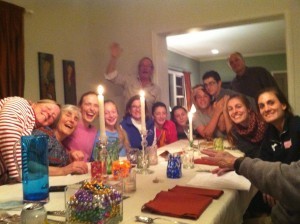
Some of my family at Thanksgiving…
The next day I crashed. But I crashed on the beach. Then I drove up to West Palm Beach to say hi at the nice bookstore there, and dinner with my old guitar friend Jon Zeeman. Hotel, dawn, airplane: Wichita!
Where I had a great time with friends I’d made at Watermark Books on my last trip, dinner after with my cousin Lindy and her husband, dancer and actor/director respectively, and most to the point: great company.Denver, San Francisco, Corte Madera, Danville, Portland, Bellevue, Seattle, home. Buffalo, Portsmouth, Augusta, home. My daughter flew with me to Atlanta, where I spoke at Georgia Center for the Book, then I left her there at my brother’s house and headed up to Washington DC, then back to Atlanta for Thanksgiving.At every stop friends new and old, family, too, people from every era of my life. And that’s the secret, folks: people. Save the exhaustion for home!
And wash your hands!
No more than two drinks per day!
Unless you want more!
And a day off once in a while, from everything.
December 1, 2014
Lundgren’s Book Lounge: “Something Rich and Strange,” by Ron Rash

Ron Rash
In the literary world “regional” often implies diminishment. This despite the indisputable truth that many of our most brilliant writers never left a very small world in their fictional creations; think Garcia Marquez and the mythical world of Macondo and Latin America or Faulkner and the characters and stories from Yoknapathawpa County, Mississippi or Jim Harrison’s tales from Michigan’s Upper Peninsula. Calling these writers “regional” as a form of criticism is absurd; their genius lies in bringing us, their readers, stories from a small world that expose universal truths, meaningful to any reader, anywhere.
And now we must add to this venerable roster of “regional” writers, the name of Ron Rash, whose new collected stories, Something Rich and Strange, never ventures beyond the borders of Wataupa County in the western mountains of North Carolina, in the process crystalizing the contemporary cultural tensions between the old and the new south. Rash is a virtuoso, moving deftly from the travails of a cover band singer who explains, that’s 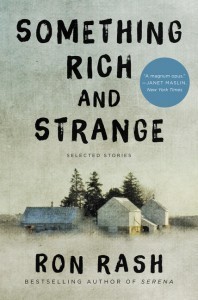 “…why I’m here from seven to two four nights a week, getting it done in the name of Lynyrd Skynyrd, alimony and keeping the repo man away from my truck,” to the very dark side of the methamphetamine scourge that has devastated parts of Appalachia. His stories travel from the battlefields of the American Civil War to a contemporary world where the conflicts between the traditional and the modern are daily being waged. And he does it all in language that is carefully exquisite, reminding the reader on every page that here is a writer who agonizes over words in the interest of getting it right. There is not a false note sounded in four hundred plus pages of breathtaking fiction.
There is an intensity here, as when the very poor and fiercely prideful farmer responds to an accusation that his dog is stealing eggs: “… the blade whisked across the hound’s windpipe. The dog didn’t cry or snarl. It merely sagged in (his) grip. Blood darkened the road. ‘You’ll know for sure now’ (the farmer) said as he stood up.”
But all is not darkness; Rash has a penchant for brilliantly and hilariously capturing the absurdity of the former Confederacy: “One of the great sins of the sixties was introducing drugs to the good-ole-boy element of Southern society. If you were some Harvard psychology professor like Timothy Leary, drugs might well expand your consciousness, but they worked just the opposite way for people like Sammy, shriveling the brain to a reptilian level of aggression and paranoia.”
Rash’s work has always been lauded by critics. Perhaps the publication of this wondrous collection and the release of a movie version of his novelistic masterpiece, Serena (in Feb. 2015, starring Jennifer Lawrence and Bradley Cooper), will garner him the attention he merits. Call him a “regional” writer if you must: this is a major writer, deserving of the widest possible audience.

[Bill Lundgren is a writer and blogger, also a bookseller at Longfellow Books in Portland, Maine (“A Fiercely Independent Community Bookstore”). He keeps a bird named Ruby, and teaches at Southern Maine Community College.
November 18, 2014
Brad in This Week’s New Yorker
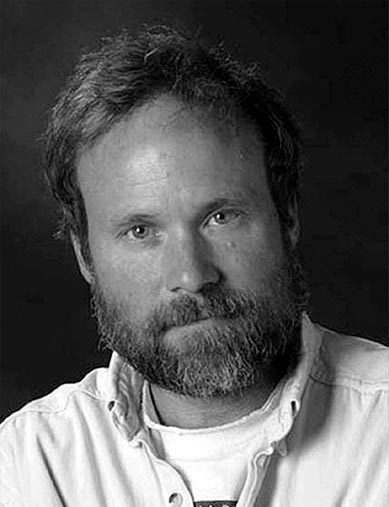
After losing several battles during the civil war, Brad decided to dedicate himself seriously to fiction.
Brad Watson, fellow bearded writer and friend of Bill and Dave’s, has a short story this week in a magazine called The New Yorker (an Ecotone rival). It’s called “Eykelboon,” and here he talks about it.
Nina’s issue should arrive in our mailbox today. True confession: I never read it. But this week I will make an exception.
And here is the link to the story.
November 14, 2014
We’re Number Two
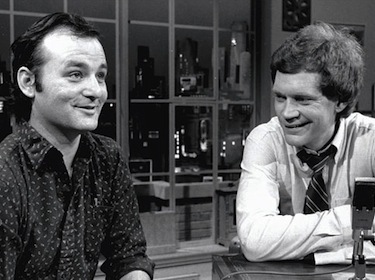
We are a little crushed here at Bill and Dave’s. The results are in and we came in second in the National Endowment for the Trivial’s much-watched and hotly-contested “Funniest Bill and Dave in History” Award. The good news is that we beat Hewllett and Packard soundly. The bad news is that we lost to these two clowns: