
Stephen R. Graves's Blog, page 3
December 27, 2021
Two Kinds of Friends for 2022
“A man of many companions may come to ruin, but there is a friend who sticks closer than a brother.” Proverbs 18:24
A few weeks back I was crafting my prayer list for the upcoming month. I am list guy. So, ahead of every month I sit down and create a list that steers my prayer for a month at a time. Try it out. Rather than making a commitment/decision for the whole year of 2022, just decide to pray some things for January. Then evaluate as February hits. And so on.
Just to get it on the table, I am not some prayer expert or giant. Just a guy praying my way through life because I need it. It keeps me tethered to the God of the universe and my heart in the right posture. And having a prayer list helps me stay relevant and gives me focus so I don’t just use the same things every day without meaning it after awhile.
But I digress. One thing on my list is praying for the people and relationships in my orbit.
As I was building my last that month, my birthday was about to hit, so I’d already started getting a few texts and calls from long-time friends.
One was a long text from Dan, a close friend from college days (which is a long time ago for me). We don’t talk a lot, but he always connects on my birthday or holidays. I read his text several times. Dan was easily one of my dearest and most impactful friends during college days. My wanderings with Dan during college solidified my love for the Bible and my love for fishing. He also helped me understand how to laugh as a Christian. Growing up I did not laugh a lot (per my own memory) and then, after I became a Christian, I apparently thought Jesus followers were a serious, contemplative lot. In came Dan. He wasn’t a joke telling comedian, but he laughed all the time. At himself, others, at life. Thanks Dan!
That memory of Dan got me thinking about good friends. Culturally, we struggle with friendship. One recent study found that 49% of Americans had three or fewer good friends, which means that the number has basically doubled since 1990.
I added a category to my prayer list that month called “legacy friends.” Friends I have had for decades who poured courage and hope into my soul over the years. Friends who shared fun and meaningful moments on the journey of life and work. Friends I have disclosed disappointments and failure with. Friends who have helped me stay true to my convictions and values. Friends who have made me a better husband, dad, neighbor, business partner and follower of Jesus. Friends who have occupied space in my life story since childhood. Some have been maintained and some have passed on. But my life today is undeniably shaped by them.
What makes a legacy friend? Simply having known them for a long time? We know that can’t be it. Might I offer an idea? A legacy friend is someone who has shown up in your life. And not just once but over and over again. Someone you have depth, breadth and/or inflection moments with.
Depth – You have gone deep together. There is pain, scars, iron on iron (as Oscar Wilde said after all, “True friends stab you in the front.”). It’s not just conversation of news, weather, sports on repeat (there are plenty of people for that). Legacy friends are those with whom you’ve penetrated the deeper layers of who you are and what you are going through. “I would rather walk with a friend in the dark, than alone in the light.”― Helen Keller
Breadth – You have known them a long time. They have seen you “over time,” seen you in the highs and the lows, the mundane and the thrilling. They know your personality and tendencies not because you took an Enneagram test together but because you have journeyed together. They have context for you. “It takes a long time to grow an old friend.” –John Leonard
Inflection Moments – You are different because of moments or seasons with them. They have shifted your life’s trajectory. It could be the way you thought about something or the way you were behaving or even the direction you were you headed. But the intersection of your life and theirs for even a moment created a lightning bolt of sorts that altered you. And you can point back to it.
“In everyone’s life, at some time, our inner fire goes out. It is then burst into flame by an encounter with another human being. We should all be thankful for those people who rekindle the inner spirit.” Albert Schweitzer
It’s been a fun month thanking God for my legacy friends. I have been reliving some fun and meaningful moments. I have reached out to some to say hi. I have prayed for what I think they need in their stage of life.
Those are legacy friends.
In addition to legacy friends, it’s also important to have proximity friends. Someone can be in both categories, but if you find that most of your legacy friends are far away geographically, you need to invest in some proximity friends. In an always connected/social network/flat world we can stay loosely linked to layers and layers of contacts, which has its place, but nothing takes the place of a proximity friend who is in your living community. We all need someone we can spend real time within the same room. Not on a screen.
Walking or driving by a proximity friend’s house to say hi is lifegiving for both parties.Hanging out around the table for a couple hours after you eat, like we did last night with three proximity/legacy couple friends, waters and warms relationship roots.Celebrating birthdays and special events together with proximity friends increases our gratitude.Running into a friend at a local restaurant and stopping long enough to swap pictures and latest stories is often better than the meal we just had.Having proximity friends should actually be a deciding factor in where you live. Too often, though, we prioritize other things (salary, career move, nicer house,etc.) and trust that friendship will work itself out. I was stunned to hear my friend Evan say some time back he and his wife chose community over everything else when picking where they live. These are two uber successful people who could live anywhere. But they rooted down in a neighborhood (and have been there years) to reinforce their conviction that nothing is more valuable for them and their family than real community. Only then, do we realize how much friendship, both proximity friends and legacy friends matter.
As you enter 2022, who are your legacy friends? Who are your proximity friends? How do you need to cultivate them in the month(s) ahead?


December 20, 2021
One of My Favorite Holiday Traditions
Most of us have a few bad annoying habits if we asked those closest to us. Talking with food in your mouth? Having a loud group conversation on your speaker phone in a public place? Rude interrupting during conversations? Not a focused good listener? I will not divulge mine at this point but just know we all have them.
But what about good productive habits? Have you built any virtuous habits that have turned into healthy traditions?
For my entire adult life, I have practiced a discipline that has been extremely helpful. I started this activity when I was in college and I haven’t missed a year since (which adds up to a big number these days). What is the practice? Sometime between Thanksgiving and New Year’s, I find a quiet space in my otherwise demanding and noisy world to do a bit of reflection. I look over my shoulder at the year winding down and then look ahead at the year fast approaching.
This reflective practice has been one of the best habits of my life. In the words of Harvard Business School, reflection is the art of articulating and codifying learning. For me, reflection has helped me stay clear-headed and honest. It keeps me vulnerable yet rooted. It has channeled some confused emotion and rowdy energy. And it bridges things I need to carry with me into the New Year while allowing me to put to bed things that need to be ignored or deleted from the past.
Take these shaping thoughts I walked away with after one recent year-end reflection time:
Life always comes back to relationships.Your life is only as rich as your relationships. Do you believe that? The Ecclesiastes writer said it was sad and senseless to do life alone (Ecclesiastes 4:7-12). We need community and the older I get, the more real that concept rings true. How about you?
Say thanks to the individuals that helped make 2021 a remarkable year for you. Give them a call. Shoot them a text. Write them a note. Take them to lunch. Not one of us made it to December living and working alone without help.Get serious about community in 2022. Structure your life and feed resources to healthy relationships in 2022. Who are the people that you need to spend time with for your sake? Who are the people that you should spend time with for their sake? Do you need to set any relational boundaries? Would others say you are a great friend?There is an element of mystery in life.We are constantly told that life is a calculation to figure out or a performance completely dependent on our practice, energy and grit. If we get up early enough, work hard enough, and don’t make any mistakes, then we can control everything. Oh yeah, and things will turn out in our favor. In short –we will win.
Sure there is some truth to this, but my understanding of this topic has dramatically changed over the years. I now try and practice what I call “a relaxed view of God’s sovereignty” on a daily basis.
Jesus told a story where two farmers are both growing a crop. One obsesses over his crop and stays up all night waiting for the morning to come. He is obviously the high achiever. The other goes to sleep and lets nature (God) do its thing. He would be the more relaxed, perhaps even passive achiever.
Put simply, growth and success (even in the kingdom of God) has more mystery to it than we are often comfortable with.
What difference does that make?
It means we need to loosen up with our expectations on others, ourselves and life itself.It means we should complain less and have more hope.It means we work steady and hard instead of frantically.It means we learn from our mistakes instead of fearing them.It means we distinguish between our role and God’s in life.Your theology frames your life and work.What is a theology? It’s simply our set of beliefs about God and His interaction with the world. C.S. Lewis wrote that theology is like a map. Whether you admit it or not, you walk through life as if a map exists. You assume there are landmarks, roadblocks, paths, and destinations. In other words, we all have a theology.
And it is your theology that answers the most profound questions in life: Who am I? (identity). Where did I come from? (origin). Why am I here?(purpose). Where am I going? (eternity). Show me your life and I can show you your theology. Tell me your theology and I can describe your life.
Your theology anchors your decisions during times of testing. Done well, it can give you motivation to keep going against a head wind or tether you down amidst the swirling crosswinds of crisis and culture.
Reflect on your theology. How deep, rooted and sustainable is it?
Faith, Hope, and LoveSome words are simply stronger than other words.
My theology says that these words—Faith, Hope, and Love—need to be weight-bearing words in my life. How I define and discover Faith, Hope, and Love is at the core of a satisfied flourishing life.
Faith first in God and second in ourselves. The order is important. God gives and I steward and develop. God controls and designs and I steward and develop. Get the pattern and sequence? Yes, I need to have confidence and faith in others and myself but I must have a bedrock conviction in God’s willingness and ability to manage His world and my part in it.
Hope that tomorrow can be better than yesterday. I don’t know how your year has been, but it’s been a busy full year for me. And busy, full hard years can test our hope. How’s your hope going into 2022?
Love. I am in a never-ending lab with the word love. Somedays I think I get it and other days I feel like I need a remedial learning tutor. Some days I clearly feel the extravagant love God expresses toward me. Other days, I feel alone and unsure. Some days I seem full of love for others; even those who annoy me. Other days I act like a pagan, to be completely honest. Or at least a childish 3 – year old.
So are you adequately armed with faith, love and hope for the coming year?
ClosingI would encourage you to do some reflection like this. Over the years, I have used all sorts of formats and instruments to tease out insights and face hard realities. Some years my reflection time was very prayerful; some years it was more intellectual and cognitive. Other years it was very emotional and cathartic. For me the practice was the priority, not the same format and venue.
Pull out your calendar—paper or digital. Give yourself the gift of reflection. Book it. Keep it. Invest into your soul. Lift above the daily grind and work on your life not just in your life. You’ll be glad you did.
Merry Christmas.
December 13, 2021
Three Principles for Your Leadership Toolbox
Apple or orange? Summer or winter? Country or rock and roll? Appetizers or desserts? Read a book or watch a movie? Morning person or night person?
These questions were split-second bullets being shot at the newcomer sitting at our kitchen table. I remember the scene well. My adult children happened to all be home at the same time and one of them brought a friend home to introduce him to the family and Northwest Arkansas. I watched from the other side of the room with interest and curiosity.
Dr. Samuel Barondes, a leading psychiatrist and neuroscientist, and author of Making Sense of People said, “Although we may spend hours methodically assessing a new smartphone before deciding what we think of it, our assessment of someone’s personality keeps being made by the seat of our pants.”
I don’t know if he would approve of the method that was unfolding at my kitchen table. I think he would contend we need a more deliberate process than rapid dyads in order to read and size people up. He argues you have to uncover troublesome patterns such as compulsiveness, narcissism, sociopathy, and paranoia, and consider how this might affect you.
Well, so much for methodical process. Let’s get back to the round-table game of testing the newcomer.
The speed increased with every question because everyone was now slinging contrasts faster than anyone could assimilate them and give a thoughtful response. Then finally someone said “Last question: Walk or drive?” The new guy paused—which brought everything to an abrupt stop—and then said, “It totally depends on where you are and where you are going.”
I smiled and said, “Checkmate” under my breath.
Context is usually crucial for the best answers and the best solutions. I’ve said for years the difference in strategy and useful strategy is trust, context, and rich subject matter expertise.
I am asked all the time: “So who is the best leader? What makes the most effective leader (note: not the perfect leader)?” My response is usually the same—“It is the right leader who fits the organization for a particular season.” The best answer is always filtered through context.
That being said, there are some timeless leadership insights that apply to every leader and every company regardless of the particulars of your situation.
I regularly share three specific leadership principles with CEOs. I’ll sit with them as they consider scaling their business or growing their team and shifting their role, and I keep coming back to these three leadership principles. They can seem simple, which is why we often forget them. If you move past these too quickly, though, then you are at risk.
Facilitating is not leading.Don’t misunderstand me—facilitating is usually an important trait for any leader in any enterprise. Juggling differing opinions and bringing people along in a process is crucial. After all, people best implement what they understand and buy into. But do not mistake equating facilitating with leading. They are not the same capability. Both have a place and both are needed. But at every rung of the leadership ladder, a leader must make a few leadership decisions and calls. Not all issues self-resolve or automatically go away. Not all issues will have harmonious energetic alignment with your team. You cannot always take a poll and count the votes and go with the majority.
By all means, be a collaborative leader. Those are usually the most effective leaders in the life and work world we live in today. But don’t think that collaboration is the ultimate currency. Leading is. If you are a leader, be ready for those occasions you have to lead…not just facilitate.
No strategic plan will ever self-execute.Every leader will answer this question correctly when asked in a vacuum. But we often forget the answer in the day-to-day demands of swirling activity, noisy options, and crushing demands. Will any strategic plan, even the really great, clearly aligned ones, self-execute? No, they will not. They never have and they never will.
Often leaders will put an enormous amount of energy and resources into creating a plan or map to guide their organization forward. And then they wilt or go into auto-pilot with implementation. It always takes some kind of mechanism to drive a plan forward. It does not have to be harsh, costly, or completely disruptive, but it does have to exist.
I love good, clear plans and maps. But I love even more a mechanism or process that a leader constructs to implement, measure, and pivot as real time results happen.
Inspiration is not a substitute for leadership.Or as Jim Collins said, “Great vision without great people is irrelevant.” I am a huge believer in inspiration. I love to be inspired and have epiphanies. I love to help others imagine forward. Every year I work with hundreds of organizations, and most of them have a robust vision and are brimming with inspiration.
But even the most compelling vision still needs the human element of a good leader leading. It needs someone carrying the torch of hope and coherence. It needs a leader voicing “This is the way forward!” It needs a leader setting the pace and urgency.
Yes, your particular context sets you apart in many ways. But all leaders practice baseline behaviors. Make sure you have the three items above in your baseline mindset and toolbox.
December 6, 2021
5 Ways to Grow Your Leaders
“At the end of the day, you bet on people, not on strategies.”
Larry Bossidy
Every client I’ve had in the last decade eventually works around to the issue of “How do I improve the talent of my team?” In my experience, there are only three good ways to answer this question: 1) hire better; 2) grow your people; or 3) both.
In other words, it always comes down to your people, doesn’t it? It’s almost impossible to overvalue talent. Whether we’re talking football, construction, a small not-for-profit, or a giant global business—growing and developing your people into great talent eventually becomes a priority.
Over the years I have helped hundreds of organizations think about growing their leaders. Here is a distilled framework I have used.
1.) Establish a leadership greenhouse
Build a culture that expects all leaders and managers to be self-developing and growing others. In other words, you have to constantly define and redefine leadership. Make sure your company understands that growth is the norm, not this.
Remember that development should be a mindset and not a seminar. As this Harvard Business Review article points out, having a leadership development culture means thinking ahead, developing strategies and plain and simple, making a commitment to “make people better.” Here’s five ways to put that commitment into practice.
2.) Benchmark the start
Make an objective and subjective judgment to index a starting point. Use any tool you want but get the starting point fixed for you and for each of your employees. When are you starting? And what are you measuring? As tennis great Arthur Ashe simply said, “Start where you are.”
You are benchmarking the mind, muscle, and hunger of each team member. And always keep in mind that you need employees with certain skill sets during certain cycles and others during different cycles. But typically, someone’s intelligence, their work ethic/stamina, and their hunger are the universal qualities you need to develop as a leader.
3.) Define what you mean by growth
Be specific and clear with your expectations of their growth: We agreed you should grow in this area, over this time, and we will measure it this way.
Pick only one or two growth traits at a time. Employ the big categories of soft and hard traits, character, skill, behavior, and attitude, and then drill down to delegation, finance, listening, hard conversations, asking questions, etc. One of the mistakes people often make in leader building is to stay too high and inspirational, chasing some perfect picture of leadership. Instead, find one or two specific things to work on.
But always keep agreement in mind. Over time, people implement what they understand and buy into.
4.) It’s about the process, not the epiphany
It takes more than an epiphany for people to grow and change. It takes a process. Yes, an epiphany moment, a “Wow! I never knew that before!” can get us off high center but it can’t hold us. It takes some combination of urgency and weight to drive sustainable change.
The process must be customized to the company and the individual. On the company level, the process must fit your culture and context. Every company has a culture that guides the organization’s life and workflow. For example, some companies/organizations are more academic and intellectual while others are more pragmatic and utility based. Some are driven by top-line growth, and some are more wired to micromanaging the bottom line. Some are more formal, and some are more relaxed.
On the individual level, consider an individual’s learning style, appetite, background, experience, as well as the areas where you think that person should grow for his or her own benefit and to fit the needs of the organization. Any development process must fit the person. That is why stock solutions usually don’t help senior leaders. They need customized solutions.
Finally, make sure the process is practical. Are the resources (time, money, expertise, mentoring, etc.) in place? How is leadership development going to be part of the daily workflow? If it’s an add-on to all the other job responsibilities, the leader begins to dread it. The growth plan must be woven into the rhythm, the targets, and the outputs of daily work.
5.) Measure often and give feedback
A McKinsey study once stated, “We frequently find that companies pay lip service to the importance of developing leadership skills but have no evidence to quantify the value of their investment.”
How do we know we’re actually growing our leaders?
Go back regularly to the original benchmarks and the standard you set for growth. Are you meeting goals, falling short, or exceeding? Where? Why? Be specific and personal. This is basic One Minute Manager stuff of, “When someone does something well or poorly, don’t wait to tell them. Give immediate praise or rebukes.” Look them in the eye, put your hand on the shoulder, and speak what you’re thinking.
Also, know your leaders and your culture well enough to appropriately use rewards. What financial incentives are in place? What promotions can you give to increase responsibility? Tie in to their intrinsic motivators to reward progress—as long as it’s objective progress.
Building leaders is something every organization must embrace. Any shortcuts or oversight will come at a cost. Done well, though, you win, your people win, your customers win, and even the markets win.
November 29, 2021
Let Generosity Flow
What do a nonprofit hospital in Indiana, an evangelistic Christian ministry in Central America, and a legal team trying to root out the sex trade in Thailand all have in common? More than you think.
A few years ago, I wrote a short book titled: The Business of Generosity: How Companies, Nonprofits, and Churches are Working Together to Deliver Remarkable Good. One of the things I learned was that generosity can be both an individual attribute and an organizational value, and it can thrive in just about any channel with the help of certain insights, guidelines, and collective right practices.
Here are three common best practices I discovered that are galvanizing the world of generosity, and they’re still true today.
1. Who’s the hero?
It’s easy for big donors, celebrity spokespeople, or the leaders of businesses and nonprofits to attract the spotlight of attention toward themselves. Look at me! Look at what we’re doing!
But the hero isn’t the do-gooder; the hero is the one who is the object of the good that is being done.
Smart leaders shape the narrative of their organizations so that the focus isn’t on an organization doing good but on the recipient of that good. If an organization tries to make itself the protagonist of the narrative, they will lose their generosity cred.
Of course, if yours is a company engaging in generosity marketing, or a nonprofit hoping to raise your profile, you want some attention for yourself. And here’s where it gets dicey. You’ll need to tread carefully. It is hard to have two people on the stage in the spotlight at the same time.
Remember how AT&T handled the original TOMS Shoes commercial a decade ago? I loved those original commercials. Did you realize you don’t hear the AT&T company name mentioned until twenty-eight seconds into the thirty-second commercial?
You should not be the center of the stage in the story of generosity.
2. Organic tastes better.
Every generous organization should make sure that the generosity fits comfortably with the organization’s ID.
Attempts to do good that are ill-fitting or self-serving create a bad taste in the public’s mouth. But if a generosity program is organic to the organization, it is more likely to survive and thrive. The issue is not is it real but is it core? In other words, the generosity work needs to be core to the organization’s mission, model, product lines, or service. Vaseline, Brita, Dove, Clorox, and many other companies have figured out that organic good works best.
Established companies that genuinely want to do good, as opposed to just looking good, can do it, but it may require some retooling of their ways. For every Warby Parker who has generosity as part of their startup DNA, there’s a Mars Candy that has put greater and greater emphasis on generosity as the years go by. It took transformation, time, and effort, but they’re doing it.
Don’t just make generosity an artificial add-on to your company service and products. Make it a part of your reason for being.
3. Collaboration.
Some institutional leaders are little more than business bullies. Some organizations are battlefields for turf wars fought both inside and outside the walls of the company.
Internally, the spirit of competition can be a good thing. But it can also be a devil of division. In some companies, promotion comes through a kind of social Darwinism where predator vanquishes prey—I win, you lose.
I firmly believe we have lost the symphonic tone of collaboration today in most workspaces. The pursuit of competitive advantage has replaced working with others to accomplish a greater good. Eventually, an unhealthy independence can eat through a company’s culture. But just as truly, rebuilding a collaborative strategy can make a company succeed while contributing to God’s process of social renewal.
Collaboration is a big idea to help solve many of the ills of our globe. For example, the African Comprehensive HIV/AIDS Partnerships bring together the government of Botswana, the Gates Foundation, and pharmaceutical giant Merck to enhance Botswana’s national response to AIDS.
Collaboration doesn’t cost much. It’s usually not hard to do. Just about any organization of any size, with any type of social focus, can do it.
An African proverb says, “If you want to go fast, go alone. If you want to go far, go with others.”
Conclusion
If there is ever a time of the year that pulls our attention to generosity, it is the holiday season. This time of the year is one extended manifestation of generosity. Since we are all recipients of generosity, we should also be the givers of generosity. Don’t let tight-fisted Scrooge take over your heart and mind during this holiday. Let generosity flow.
November 23, 2021
The 7 Enemies of Thanksgiving
We all have family Thanksgiving stories that fall on the scale between funny and sad and everything in between. Thanksgiving is pretty easy to mess up. Jimmy Fallon has a traditional segment on Thanksgiving fails, all of which are funny and fairly minor.
The true Thanksgiving collapse is when we celebrate the day but continue the very practices that destroy ongoing gratitude in our lives. And the lack of gratitude in our lives is harmful to our soul, not to mention our workplace.
So what keeps us from gratitude? Here’s a list of seven destroyers of thanksgiving. Check out this list and evaluate yourself. Which one empties the gratitude out of your heart? Or never lets gratitude get there in the first place?
Narcissism—I’m starting at the top. Narcissism is the king of all thanksgiving destroyers. Self-focused people are too busy considering their own desires and goals to recognize the litany of gifts that have been given to them—by God or by others.Unbridled appetite—You may be thinking I thought Thanksgiving was all about unbridled appetites? Pass the gravy. I’m not talking about that kind of appetite. Grateful people are marked by contentment. Ungrateful people are the opposite. Their ambition and/or their greed makes them unable to say, “enough is enough.” And if you’re too busy looking for more, you never say thank you for what you have.Disregard for the small and intangible—This problem is tied to an unbridled appetite, but I want to draw it out because it’s not just about being able to say “enough.” You need to be able to rejoice in what the world skips over, like the point this Charlotte, NC, church made. If everything has to be bigger and better, we’ll never be grateful. The most obvious way this appears is when valuing “stuff” over people.Captured by the consumptive culture—Our culture has conditioned us to buy, consume, and discard. The average American throws out four pounds of trash daily. While that number is unsustainable, what’s truly eye-opening is that Americans make up 5% of the world’s population but we create 50% of its solid waste. Our ability to consume and discard is unlike anything in history. That consumption mentality preaches that anything I want is mine, and if I think I’m entitled to something, I’m not grateful for it.Separated memory—Want to destroy gratitude? Forget the past. This article calls thanksgiving a “spiritual discipline,” and says that a good memory is key to developing gratitude. When I focus on the now, I forget the past. But when I consider the past, I recall blessings God gave me—that relationship, that opportunity, that first job, that second chance—and I recall times when I didn’t have what I do now.Upward comparison—We tend to compare ourselves with people who have more—people in the stage of life who have slightly better cars or vacations or houses. Why not get in the habit of comparing ourselves with people who have less? Not only would that make us grateful, but it might make us more generous, as Cindy Jones-Nyland of the non-profit Heifer International writes.Lack of vulnerability—If you don’t appear to have needs, you have placed yourself in the role of provider/giver/helper/leader. If you’re always in that role, it’s tempting to put your trust in yourself. Or said another way: you never have to say thanks to anyone for anything.G.K. Chesterton said, “When it comes to life, the critical thing is whether you take things for granted or take things with gratitude.”
Conclusion
It’s interesting that we have to have a whole holiday dedicated to Thanksgiving. We don’t have to have an “Asking Day.” Why? Because we don’t have to be reminded to ask for things. But we do have to be reminded to say thank you.
Someone recently asked me if most of my prayers were more about “Please help me or give me this or that” or “Thank You for whatever”. We have to be reminded to say “Thank you.”
Thanksgiving is hard to do (as Edward Gibbon said, “Revenge is profitable. Gratitude is expensive”) but it’s easy to fake, especially on the fourth Thursday of November.
Doing the hard work of building a grateful spirit pays huge dividends, though. And avoiding these thanksgiving destroyers keeps you on the right side of the gratitude orchard. You’ve got to keep tilling the soil, but you’re giving gratitude a chance to grow.
November 15, 2021
Four Faces of the Social Entrepreneur
The Social Entrepreneur is not confined to one age demographic, personality, or background. Nor is she restricted to one single role.
Mohammed Yunus, patron saint of micro finance, helps us clarify social business (which is often a muddy concept). Profit companies bring in. Social businesses push out. It’s that simple.
Profit-only companies are old news. Companies that are about a multiple–bottom line (MBL) are growing fast these days. Really fast. And in particular, millennials and down (younger) want to be part of something that matters; they want more than just a paycheck. Check out Forbes’s “30 under 30” social entrepreneurs and be impressed at the innovative thinking and entrepreneurship of Gen Y and Gen Z.
In my experience, social entrepreneurs can have four different faces:
ExplorerReformerOperatorSupporterExplorer—“Launching New Things”Blake Mycoskie, founder of TOMS Shoes and one of the archetypes of social entrepreneurs, put it simply, “Instead of looking to charity to solve [a] problem, let’s look to entrepreneurship.” While there are debates about Blake’s methods, his motivation seems straightforward. He saw a need in Argentina and determined to launch something new that would help.
Or take a look at Tyler Merrick of Project 7. By connecting the dots on cause and consumption back in 2008, Tyler was able to be on the front end of a wave of new exploration in how social enterprise is done, and he’s still rolling along.
That’s the M.O. of an explorer. See a need. Start trying to meet that need. If you fail, recharge your batteries, and then try something different.
2. Reformer—“Changing Old Things”
Reformers are those social entrepreneurs who take something existing and remake it to conquer new challenges. It could be an old established non-profit, a small private company, or an enormous worldwide brand.
The first steps could be repurposing the mission, layering on another bottom line, or aspiring sustainability. But all reformers are change agents.
To be fair, reforming can be harder than launching something new, but it can still be worth the effort.
Harvard Business Review dove into the art of reforming with this article, looking at companies as diverse as Nike and Vaseline, and found that social efforts can’t simply be an add-on to what your company already does. Good reforming looks at your core business and tries to find the social good that could naturally flow out of that–like Vaseline’s focus on skin care for the most vulnerable around the world.
3. Operator—“Optimizing Moving Things”
Not every entrepreneur is always starting things or changing things.
Jordan Kassalow is the founder of VisionSpring, a social enterprise that equips individuals to sell reading glasses. So VisionSpring provides jobs and improves eyesight around the world.
Kassalow is certainly something of an explorer, but he’s had to learn to be an operator as well. This Forbes article outlines how Kassalow tried something in China in 2005. It didn’t work. He modified the cost structure and tried again in Bangladesh in 2008. Another failure.
In 2010, he modified again and tried something in El Salvador, this time adding a store for prescription glasses, an adjustment that tipped the scale. The project in El Salvador quickly became self-sustaining. From there it moved to India, Uganda, Bangladesh and more. As of 2019, they were cresting towards 7 million pairs of glasses sold and $1.5 billion in economic impact. They keep trying new partnerships and programs.
Kassalow and VisionSpring will certainly have to make more changes, but that’s the nature of the operator. Watch costs closely, make adjustments quickly. Cut excess and improve production. That is the territory of an operator.
4. Supporter—“Helping All Things”
I have a good friend named Terry. He is a “come alongside” personality. On three occasions (that I know of) Terry has joined a founder to grow an idea forward. He isn’t really an explorer or a reformer. He is more the operator but truth be told, he is really a supporter.
The supporter is the forgotten one of the four faces. You probably wouldn’t even think of him as a social entrepreneur, but almost every social entrepreneur needs a Terry. We need someone to cheer us on, to believe in us, and to inspire us.
This face could be a board member, an investor or donor, or just an informal friend. Alone, a Terry will not launch a movement, but it won’t launch without him.
Conclusion
I work with hundreds of social entrepreneurs every year—Gen Z, Gen Y, Gen X, and even a few Baby Boomers like myself. Many of these entrepreneurs are my heroes because instead of making much of themselves, they make much of their cause.
If I listed their names, you would have heard of some—big names leading big organizations. Many of them, however, are not cover stories…they are just faithful leaders looking to push wealth and benefits out to others, whether that’s on a small scale or a large scale.
As social entrepreneurs, they know that their cause matters, so they focus on how to best advance the cause.
The Schwab Foundation for Social Entrepreneurship said that social entrepreneurs are people who combine the characteristics of Richard Branson and Mother Teresa. That’s a good start but from my seat, I would add a few faces to their cast of characters. That way we all get to play.
November 8, 2021
The Three Stages of Board Development
Andrew Youn did what most twentysomethings would do with a great idea; he talked it up to his friends.
It was 2006, and 27-year-old Youn had an idea for a new model for equipping the farming poor in Africa to increase profits. Like most entrepreneurs, he simply took the idea to a group of peers. It’s the same thing I do with my ideas. I talk to friends, get buy-in on the idea, and ask them to help out.
Youn’s friends agreed to help out, and before you know it, they’re the board of directors for One Acre Fund, a blossoming non-profit.
But that’s only the beginning of the story.
The Four W’s of a Great BoardStarting a business or organization is hard work. In From Concept to Scale, the book I wrote with my friends Dave, Josh, and Jason, we spent good space on the evolution of successful boards.
When it’s working right, boards, founders, and organizations walk hand in hand, taking turns leading but never getting too far ahead of each other. Literally, they leap frog each other forward in advancement and development.
Every great board provides four things: wisdom, wealth, work, and witness.
Wisdom—Advice and GuidanceWealth—Capital and AccessWork—Effort and ActionWitness—Advocacy and EnergyHonestly, it’s somewhat common sense to have a good board. As Boston-based entrepreneur puts it in this Inc.com article , “You need outside influence. Somebody needs to be the adult in the room.”
A board provides exactly the kind of things that I try to provide as an executive coach—outside perspective, energizing hope, useful strategy, and measured accountability. Four things that every founder and every organization must have if they hope to go anywhere.
In my experience, these four things are always needed but show up in varying degrees in the following three stages:
Stage 1Many businesses, and even more non-profits, start as the dream of a single individual. This dreamer needs a lot of help, and he goes to friends and asks for that help. He asks his accountant friend to keep the books. He asks his brother-in-law attorney to draft the corporate licensing documents. He asks his real estate buddy to lease him office space for cheap.
And before you know it, he’s got a board.
It’s not necessarily a bad idea, and if friends and family are skilled at what they do, then it’s actually a huge boon. This free staff will cheer on the founder and do whatever he asks. They operate informally—making decisions over lunch meetings, forming and absolving committees at the drop of a hat. They’re driven by a combination of imminent deadlines and available time. But in the end, they are primarily the cheerleader of the founder / friend.
It’s a fine place to start as an organization, but a bad place to stay.
Stage 2As the organization grows, the board grows along relational lines. The founder gets to know some new individuals whose gifting lines up even better, and they “come on board.”
At this stage, the board begins to be driven more by the vision of the organization than by the wishes of the founder. Board members are willing to disagree with the founder for the first time. They recognize the need to offer the four W’s (work, wealth, wisdom, and witness) and begin to solve tactical problems.
Of course, this isn’t to say family members can’t be on the board anymore. It’s more about a mindset than exact personnel, as this HBR article on family-run businesses points out.
Wondering if you’re in stage two? The most obvious indicator is that your founder is no longer your board chairman. For the first time, there are now multiple voices that carry significant weight.
Stage 3Many organizations stall out at stage two and thus limit their possibilities. Instead of reaching for great board members, they settle for good board members who are convenient.
In stage three, it’s all about board alignment. The articles you’ll read like this one by Jeffrey Sonnenfeld or ones in HBR usually focus on stage three boards. Do you have the right composition of people? Is there a culture of trust yet dissent? Is there a fluidness to the roles and yet a healthy use of committees? These are the types of questions you’re asking in stage three.
Stage three boards are engaged in strategy, not tactics. Instead of working for the founder, the founder works for the board. They’re no longer doing a favor to the founder; they’re doing their jobs.
Increasing Board EngagementA great organization must have an engaged board.
Of course, engagement looks different in each stage of board development, so I’ll close here with a couple of practical tips to increase board engagement in each stage of board development.
Stage 1Start calling it a “board” and give people the freedom to leave.Move to regular (though not too often) meetings with an agenda.Stage 2Lead a discussion on the 4 W’s and make sure all board members find a “W” to occupy.Elect a chairman, vice chairman, and maybe even a comp committee.Stage 3Identify the key areas where you need improvement in order to scale, and go find individuals who specialize in those areas to serve on the board.Formalize the feedback and audit of board and chairman performance.As for Andrew Youn, he’s led One Acre Fund through all three stages and the organization now has an international impact.
It wouldn’t have happened without a great board.
November 1, 2021
Voice, Center, Path, Toolbox
Frameworks are good. They help steer our imagination and energy. They help us focus on the things that matter most. They create repositories of insights that can be recycled at a later time.
It is common for me to find myself having a conversation with a bright-eyed millennial ready to change the world. And it is also common for me to have a conversation with a seasoned executive considering a 2.0 or 3.0 career. In other words, they are contemplating leaving their current platform and relocating to another.
More times than not I will think through a single framework to help. It is Voice, Center, Path, and Toolbox.
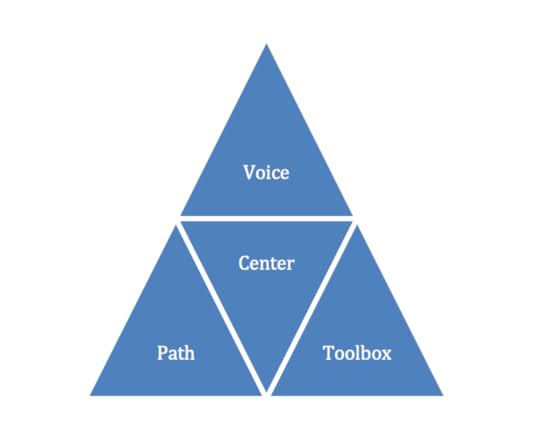
Voice—My Unique Sound
I have to discover and get comfortable with (but not get addicted to) my voice. In life, my voice is that unique sound of me operating in my created and discovered giftedness. It is my personal signature on life and work. It is me finding my unique wiring. Sure, others influence me but I don’t aspire to be other people. I aspire to be all that I was created to be.
When we operate out of our voice, others straighten up and pay attention.
Your Creator has hardwired you uniquely; no one has your exact DNA, no one has your exact set of experiences and passions. And certainly no one has the blending of all these things the way it shows up in you. It is the unique “you,” but unless what is created is discovered, it will stay buried under weeds and rubble. Find your voice regardless of how young you are, how old you are, where you sit on the org chart, what your title is, or where you derive your income.
Center—The Footing of My Life
Maybe this season in our world has shaken you—personally, organizationally, emotionally, financially. When, as the old hymn says, “all around my soul gives way,” what do you fall back on?
Options abound:
FamilyAchievementsReligionMoneyEducationNatural TalentsHard WorkFriendshipsAdventureServiceWhere are your security, significance, and success anchored? Your center is your bedrock, the core foundation that your personal operating system is built upon. It is the thing we default to over and over again.
Without a firm center, my point of view will always be moving around, my morals will always be shifting, and my goals will jump from one target to the next like Solomon in the Book of Ecclesiastes. I will be destroyed by indecision on the one hand and foolish hastiness on the other.
But with a strong center, there is true peace, genuine deep confidence, and astounding contentment. When we understand our center, we don’t try to do everything and we don’t simply respond to crises. We have a settled-ness that guides and governs our life and work.
Path—Journey and Destination
Where is your life headed? Are you truly making progress or are you just spinning in place for weeks, months, or years at a time? Do you have a compelling vision for the future pulling you forward or are you sidelined from progress and contribution?
Identifying my unique voice and establishing my foundational center assists when I am choosing the targets and paths of life.
Life’s path is never as straight as we envision. Traffic, potholes, and car trouble always change our plans. At least it does in my journeys, and for many of us, the past year and a half has felt more like a car crash altogether. We must have a doggedness to keep an eye firmly on the destination and the flexibility to adapt to changing circumstances.
Among the most strategic assignments of any leader is to determine where the organization is going and not going … at what speed … at what risk. That is a leader’s job. In the same manner we must determine those same items for us personally in our own journey.
What does this mean? It means you can’t get distracted by every shiny object. That will often send you down the wrong path. It means you can’t stand paralyzed, waiting for someone else to fix your world. It means you might have to step into an intersection and commit to a new direction that would require a new level of risk or energy.
Wanting to go somewhere and even knowing how to get there doesn’t automatically transport you there. You have to jump in and take the journey.
Toolbox—The Things We Carry
We need tools (resources) to accomplish our life and work. The better the instruments, the better our performance.
My toolbox contains the instruments that I acquire along my path that move my confidence and competence upward. These instruments might be a knowledge bucket, a skill, a relationship, a business model, a business sector, a style of work, a rhythm of work, a set of guidelines or truths, etc.
Another element in your toolbox is stage and setting. We perform and produce better in some settings than others. We are more comfortable and natural on some stages than others. Some people need a strong collection of support players around them. Others just need a computer and a coffee shop. Some people thrive in large corporate settings and others must have a fast-changing entrepreneurial culture. For some people, working from home during a pandemic has increased effectiveness. For others, productivity is way down. These are all part of your optimum toolbox.
Of course, no two toolboxes are exactly the same. Your toolbox has to fit your learning style, personality, temperament, and calling. Keep building it. The pandemic has probably revealed some tools you need. Beware of trying to get by with other tools, and don’t forget what you’re learning now. Figure out how to go get those tools.
Conclusion
I have been guiding executives for three decades. Those who have done the hard work of nailing down their Voice, Center, Path and Toolbox seem to thrive better than those who haven’t. During this challenging season, it’s becoming even more clear how these four things root us and drive us forward. Maybe it’s also becoming clear where your lack is in these categories. Don’t give up hope. I’ve told many an executive over the years the same thing—press in.
October 26, 2021
Hypergrowth: Leading in the Fast Lane
I once had a CEO who came to me with a problem that most people would love to have. In just fifteen months, his company went from a budget of a few million to an annual budget of over $100 million—fifteen months and about forty times the budget.
I say that most people would love that problem, and that’s true. But let’s be honest, it’s definitely a problem. My client’s stress was way up. He was being pushed out of his comfort zone of leadership and making a ton of quick decisions with less-than-perfect information. He was also losing connection with some of the people he’d worked closest with over the years. It was great, but it was hard.
If you’ve ever been in a season of hypergrowth (or if you’re in one right now), you know that feeling. Hypergrowth carries a different kind of stress, and it requires a different kind of leadership.
But it is possible. After working with a ton of clients running in the fast lane, I’ve gathered together a few insights about hypergrowth—a set of “truths” and a set of “to dos.” Call them general insights and actionable insights for living in hypergrowth.
General Insights (Truths)
Health should always trump growth. As you grow, always ask the questions, “Why do I want to grow?” and “What are the costs of growth?” Growth, after all, is not the goal. As Edward Abbey, author and environmentalist, said, “Growth for growth’s sake is the ideology of the cancer cell.”Rapid growth can wreak havoc on your people, culture, and cash. This insight goes to the question of the costs of growth—because there are definitely costs. Your employees, in particular, feel them, and it’s their engagement that often suffers. The costs may not pop up right away, but they will pop up in the months and years ahead, so identify them ahead of time.Hypergrowth usually comes because of the combination of strategy and luck. You can’t (and shouldn’t) take all the credit for hypergrowth, but that doesn’t mean you just stumble into it. Hypergrowth usually comes both because of chance and because of organizational readiness and market opportunity, and it takes strategy to pull those off.In hypergrowth, hierarchy is usually minimized, and culture is maximized. I’ve written elsewhere about the fact that you can’t structure for growth and control at the same time. So, if you’re in a season of hypergrowth…Hypergrowth wars against efficiency. If you place a high value on efficiency, rapid growth will be tough on you. The old adage “run fast and break things” applies here. You will break things, lose resources, and waste time in hypergrowth. That’s part of the cost.Pivoting is your best friend. We usually think of pivoting as something to pull you out of the ditch, but in high growth, it’s about avoiding the ditch altogether. When you’re going 75 mph down the interstate, you want to make a lot of small, slight changes so you don’t have to make one massive one.Actionable Insights (To-Dos)
Knowledge sharing and culture building is everyone’s job. You can’t afford isolated culture departments during hypergrowth. Create systems and spaces for knowledge-sharing between departments and reward it big time when it happens. Cultivate leaders who themselves pursue growth opportunities. You can’t afford to lose culture. Make it everyone’s job to build, protect, and advance a healthy culture.Find and nurture your high-growth levers. You have to pay a little (or a lot) more attention to the people, customers, and markets that will keep the momentum going. Don’t let it become backroom favoritism, but do structure your time and resources with those high-growth levers in order to keep things moving for everyone.Know what you are measuring. Peter Drucker famously said, “What gets measured gets managed.” In hypergrowth, you don’t have the bandwidth to manage everything, so you have to choose wisely what you’ll measure. Don’t measure too many things and don’t measure the wrong things. Find the right gauges to measure health and growth.Make sure people know to self-manage. As the leader, you’ll be putting a lot on people. They need to manage and communicate their own sense of balance and rhythm. Otherwise, you’ll either burn them out by never letting them take a break or burn yourself out by taking everything on yourself.Cover for each other. Build a culture of covering for each other. Mistakes and hectic weeks can actually strengthen your team. Things won’t go perfectly in hypergrowth, but imperfect moments provide an incredible opportunity for culture-building.Stay humble and smart. Hypergrowth tends to make leaders feel as if they could handle anything thrown at them—like they’re the experts in every room. You lead well through hypergrowth, though, when you use what you’ve learned in the past, but you stay a learner, not assuming you know it all.Be agile and pivot, pivot, pivot. When you get good, trusted feedback, put it into practice. What are your mechanisms for getting that feedback? Have you built a culture that allows you to pivot without getting pushback in favor of “the way we’ve always done it?”Anne Mulcahy, a former CEO of Xerox, said, “Turnaround or growth, it’s getting your people focused on the goal that is still the job of leadership.” She’s right. Leadership is leadership. You’re still getting people focused on the goal.
In hypergrowth, the road is coming at you fast and furious. You’re like a Formula 1 driver breaking 200 mph, and everything looks like a blur. But you can’t always slow down and win. Sometimes you must keep the pedal to the metal. Take it one lap at a time by practicing the insights above. You might be surprised at how good you are at leading in hypergrowth.


