
Stephen R. Graves's Blog, page 2
March 7, 2022
4 Keys to Producing Engaged Employees
Engaged leaders are those who are “all there” when they’re working. They are focused, alert, and ready to run hard after objectives.
A 2021 Gallup study reported that only 36% of employees were actively engaged in their jobs. That number is actually up over the past couple of decades, but it still says that just one in three employees bring some level of passion to the workplace.
Sure, some disengaged employees have jobs like these. After all, as Mark Twain supposedly said, “Choose a job you love, and you will never have to work a day in your life.” Often, however, I think you can’t simply blame employee disengagement on the assigned tasks. Many employees simply find themselves in a culture of disengagement.
And disengagement matters particularly now, according to the Gallup study. The report put it this way, “In 2020, the importance of having an engaged workforce was never more urgent. Organizations with high employee engagement were more resilient and able to weather the many challenges that came with a pandemic, an economic collapse and societal unrest.”
Put simply, disengagement carries a high cost, and while you can’t buy engagement, when you get it, it pays huge dividends.
So how do you upgrade engagement at work (either for yourself or others)? Here are four tips:
Let people have fun and grow personally at work.Millennials were perhaps the first to bring attention to the fun factor (just Google “Google headquarters pictures” for proof), but these days everyone wants to have fun at work. Sure, you can have too much fun, but emotional engagement at work often creates mental engagement as well.
In The Levity Effect, Adrian Gostick and Scott Christopher say, “An increasing body of research demonstrates that when leaders lighten up and create a fun workplace, there is a significant increase in the level of employee trust, creativity, and communication—leading to lower turnover, higher morale, and a stronger bottom line.”
They noted that Fortune’s “100 Best Companies to Work For” research found that 81% of employees working in the 100 best companies (labeled as “great”) said they work in a “fun” environment. By comparison, only 62% of employees at “good” companies said the same thing. It was one of the most sizable statistical differences they found. In other words, fun can make the difference between “good” and “great.”
Make the company and the work missional.The company and the work itself need to have some intrinsic muscle. It’s the thought behind an organization’s mission and purpose. But how do you get that mission and purpose off of a wall placard and into the organizational culture?
Among other things, it means emphasizing the “why” of employee actions over the “what.” The title of this 2015 Entrepreneur article still rings true: “The 4 Things Employees Want Most From a Job Cost Nothing.”
Remember Google’s 20% rule that employees can spend 20% of their time on creative thinking projects. Psychologist Edward Deci says the best way to motivate people is to support their sense of autonomy. Explain the reasons a task is important, and then allow as much personal freedom as possible in carrying out the task. “Instead of asking, ‘How can I motivate people?’ Deci says, “We should be asking, ‘How can I create the conditions within which people will motivate themselves?’”
Have a reward plan in place that is holistic and effective.We are all layered with multiple motivations that drive us to do what we do—motivations like personal development, making money, calling from God, etc. I think this is more than just OK; it’s healthy. Sure, there is some hierarchy, but motivation includes multiple layers. None of us operate out of one single motivator all day every day.
Consider the story of young David the giant killer in the Old Testament. He was surely fueled by his desire to spread the name of the one true God. But he also asked twice, “What’s the payout to the guy who kills the giant?”
Or consider the research study in which participants were paid to build with Legos (sweet gig, huh?). They were paid a small amount per Lego model completed. One group of participants had their work displayed in front of them while they built their second model. The other group had their work immediately disassembled before they started their second model. As you can imagine, the first group ended up completing more models. The compensation was no different, but the first group felt rewarded and therefore they worked harder. They were motivated by money but also by the sense of completion.
In other words, reward plans should include money but they can’t end there. Survey after survey shows that. Money is always on the list of important things for employees, but it’s never at the top.
Teach people the power of discipline and focus.In a culture that is always on, we have to learn the power of walking away, saying “no” or “not now,” “good idea but not the best idea,” “nice info but not my concern today,” etc.
Or as my friend Stacy loves to say—“Not my circus, not my monkeys.”
Fully engaged people learn to say “no” or “not now.” They can do Deep Work. Fully engaged people can zero in on a task or challenge or opportunity. Fully engaged people can sort, filter, and tag priorities. And vice versa—people who can prioritize become more engaged.
If you’re not a focused person, you may need to restructure your calendar and habits to make time for large, challenging projects and for forward thinking. Otherwise, you’re probably just plodding along, living and working reactively.
Of course, this is usually a learned skill. I’ve begun to teach myself and others how to focus using the idea of sprints. I’ve found that sprints, both personally and organizationally, really keep employees focused.
Conclusion
Employee engagement is rarely automatic—a fun culture, aggressive compensation, high growth…none of those automatically produce engaged employees.
But there is good news. Growth is possible.
This article lays out a “Me-to-We Continuum” to foster better relationships with employees. The author has five things to consider instead of the four I outlined, but it’s very similar:
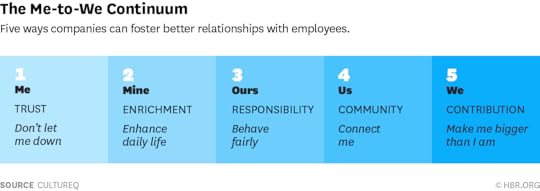
“The best employers,” he says, “help us each achieve our personal ‘me’ goals and dreams on the one hand, while simultaneously collaborating with us to solve more generalized ‘we’ worries about the economy, the environment, and the world on the other hand.”
Put another way, if you worked for a company that succeeded along all points of this continuum, wouldn’t you be engaged?


February 28, 2022
Aging Gracefully
Last year, I determined to spend 2022 pondering, praying, and studying the topic of “aging gracefully” (my term).
According to J.I. Packer in Finishing Our Course with Joy, I am entering the young-old category (young-old 65-75, medium-old 75-85, oldest-old 85-plus), and so, I decided it was time to direct a little intentional energy into the topic.
I researched and bought a huge stack of books, created a long list of Scripture verses and tagged some blogs and interviews to watch, all intending to spark, fuel, and challenge my thinking and learn about aging. (Quick heads-up that at the end of this, I’m going to invite you to share any great resources you’ve seen, read, or listened to on the topic as well.)
I initially started thinking about the topic of aging gracefully early last year when I came across a study I did over 25 years ago (back when I was “old-young,” if that’s a thing). It was on David the shepherd-turned-king. My notes were handwritten on long yellow-lined legal pads, and my handwriting was horrible even back then. It was a fun, nostalgic stroll reading my thoughts from decades ago.
I identified five different leadership seasons of David’s life. (I am thinking about rebooting the work, so let me know if you’d like more of these notes.) The following are the five seasons.
Sunrise – Early Training. This season of David’s life takes place in and around his hometown of Bethlehem and centers on the little things and the hidden things. It has some loneliness (herding sheep), danger (defending sheep from attacking animals), and family drama. This season provides the training that will shape his character, competence, and faith for his public years. We also see signs that God may have a plan for his life.
Morning – The Launch. David comes out of the shadows of complete obscurity and transitions to a public figure. Killing enemy No. 1 Goliath will do that for you. David is maybe 20 years old, so he’s still young, but it’s a more public test of his character and faith and hits the gas pedal on his brand, value, and street cred.
High Noon –Grad School. Sure, David had a moment of fame, but that actually only touched off a decade of challenge. He’s got a committed group of followers now, but he also has strong opposition.There’s some success in this season but also a full heap of failure.
Afternoon –The Long Career. David serves as the king of Israel for 40 years, from about age 30 to age 70. He is in the seat of the highest and best use of his giftedness. He has some huge successes professionally and personally, but he also has some huge personal failures. The tests of the heart, after all, are the most significant and often the toughest — and they often are repetitive. You often face a different version of the same test over and over again in your life.
Sunset – The Transition. The Bible actually gives us a lot of information about the final days of David’s life. It shows up at the end of the book of 2 Samuel and the beginning of the book of 1 Kings as David knows his end is near. It also is mentioned centuries later in Acts 13:36. Here we see one of the most explicit summaries of the final season of life: “Now when David had served God’s purpose in his own generation, he fell asleep; he was buried with his ancestors and his body decayed.”
In other words, even if he was a BIG deal, the sun set on his life. Anyone who has looked at the span of David’s life will quickly see he was not perfect — and anything but the sinless leader. But there are some benchmark insights to learn from riding into the sunset. Let me share a few high-level insights I see in David’s life.
He found his righteousness in his God, not his personal conduct or religious constructs. This is the differentiator between the evangelical Christian faith and other religions. I am made righteous not of myself but by the sacrificial death of Jesus, the Son of God. A person engineering their “righteousness” through their behavior or religious routine will find that it doesn’t hold at sunset.He knew how to handle both success and failure, and neither defined his identity, life, and work. Much has been written about how leaders handle success and/or failure. For example, this Harvard Business Review article says that success is dangerous because it makes leaders stop learning. Winston Churchill said, “Success is stumbling from failure to failure with no loss of enthusiasm.”He seemed to be settled in each season as it happened. He did not live ahead or behind himself but rather in step with himself. Many people put too much of their energy into a season different from their current one. Learning to be settled in a season is vital to a flourishing life.He was not obsessed with building an extended legacy of influence. He let that organically happen from his current life. He had some opposition and learned to live with it. As a general rule, David learned early to hear and follow the applause of the One over the shouts of social media likes.His sunset season was a tribute to his God, not his own accomplishments. He embraced the sunset of his life with the same kind of faith that carried him through the other seasons. As one of the Psalmists wrote, “Even when I am old and gray, do not forsake me, my God, till I declare your power to the next generation, your mighty acts to all who are to come.”I’ll keep you posted about my learnings on aging gracefully. But, again, let me ask for your help. Got any resources to recommend or send my way as I make this journey?
Thanks,
Steve
February 21, 2022
Three Stages of Business Growth
A while back I was headed to a meeting in Bentonville, which is just a quick, 25-minute drive north from my home. As I passed one development after another, I thought, Gosh, there has been so much change in Northwest AR since my wife and I arrived here in 1985.
In some ways, I’ve had a front row seat to observe the growth. For more than three decades, I’ve interacted with hundreds of start-ups, companies, and nonprofits looking to scale, and hundreds more that are somewhere in between. Over the years, I’ve spent my weeks talking with CEOs, business owners, and ministry leaders. Some are them are located here in NWA; others are scattered across the country.
I’m in some kind of daily dialogue with someone, ranging from a global CEO to a family member chasing a dream. A couple years ago, one family member, for example, launched an outdoor apparel company called Bearded Goat. (Good name, huh?)
These guys had a good concept, some great team members, and some big ideas. But the question was what was their best path to a long-term viable business? And how were they supposed to know where they are in the journey? Too often, we celebrate the wrong milestones, ignore the right ones, or get confused about next steps.
This is true for anything—a restaurant, church, barbershop, vendor team, nonprofit, and bearded goats.
After working with literally thousands of leaders and companies, I’ve discovered there are three stages for any business or enterprise growth. Don’t think days and weeks; instead, think growth and maturation.
0 to 1
The term “zero to one” has been used by others. There was even a book by Paypal co-founder Peter Thiel with that title. Thiel, now a venture capitalist, uses the phrase to encourage start-ups who offer something brand new rather than replicating something that already exists. Zero to one.
I don’t disagree with that, but that’s not how I’m using it.
For me, zero to one is going from nothing to something. You are past the point of just talking about your dream or your idea. Suddenly, you have something—a product or service, a revenue stream, a customer. It is now something more than just a well-crafted idea.
That something is real and that’s something that can potentially find momentum.
A food truck moves from zero to one when it’s actually open for business and making brisket sandwiches. A church shifts from zero to one when a core group actually chooses a date and then launches. A new apparel company is in zero to one when it turns on its website and/or opens the front door and starts selling product.
Somebody has to put some resources at risk to get off of zero—some capital, some time, some influence, something. As Peter Drucker said, “If you want something new, you have to stop doing something old.” That’s risky. No enterprise goes from zero to one apart from some resource risk.
One final note on zero to one: There can be still a whole lot of ambiguity during zero to one. This is fair in that you are still figuring out much of your core business model. Structure may change, people may change, revenue stream may change—even your core model may change. Roles may shift and leadership may consolidate or expand. Everything is still movable.
The sooner you discover, prove up, and begin to get traction around your particular strategic driver or business model, the sooner you can graduate to the “one to five” stage.
1 to 5
Here is one quick caveat of explanation: the three stages of growth are not about a specific time duration but rather the advancement of your offering, your customer, your financials, your people, and your culture.
There’s not a magical date when you leave one stage and move to the next. Rather, it’s about the season your company or organization is in compared to your own history and the market.
Amazon moved from one to five as it moved out of books, and said, “We’re not just a book company. We’re an e-commerce company.” Here’s how the New York Times described it in 1998. (My favorite line: “So far, Amazon.com’s only expansion beyond books has been to add music compact disks.” Don’t go crazy, Amazon. Compact disks are the future.)
At that point, they had to figure out how to source things. They had to clarify their messaging. They had to solidify their customer at each step.
In the one to five season you bring more precision and focus to things that could be scaled. This could be:
Offering (product or service)TeamRolesRevenue engine and driverCustomer segmentsWork/life balanceCompany cultureMission/visionCash flowMuch moreThis is the stage where the entertainment venue says, “We can’t go after everyone, so who is our target?” In every area, that’s the question—“We can’t have it all, so what we will go hard after?”
To be clear, growth doesn’t mean you have to become bureaucratic and exit the entrepreneurial spirit. You may still feel like a start-up and be in constant “whitewater.” In my book From Concept to Scale I talk about that turbulent ride between launch and scale. I refer to that as the “Prove” stage. In the one to five stage of growth, we are still proving up some things but we are also scaling some things.
5 to 50
This is the stage of organizational maturity. Not everyone makes it here. And to be honest, I’m not sure every organization should make it here. As Heisman Trophy winner Ricky Williams said, “Sometimes success gets in the way of maturity.”
People often say, “Five to fifty sure seems like a big range.” My answer? It’s supposed to be. In five to fifty you or a competitor are on the top of your vertical or category. There is not a lot of room to grow organically unless you reinvent yourself like Walmart has done a few times over the years or like Kodak stunningly failed to do.
The closer you get to the fifty marker, the more you become the company that others are benchmarking against or trying to niche into so they can start their own business. The closer you get to fifty, the more “enterprise” your company will become.
Remember though, even the last stage is not just about time duration. The app developer could move all the way from zero to fifty in a couple of years whereas it might take a logistics company 30 years and a church 50 years.
Time and industry make a difference, but type of company matters as well. Privately held companies mature in different ways than family-owned companies or public companies—not in every way but in some ways.
Conclusion
There are other ways of writing about the stages of business development. I’ve done it myself, but I find quantifying it in this way—0 to 1, 1 to 5, and 5 to 50—makes sense to a lot of my clients.
It works in any industry, any style of corporate culture, and every market I can think of. There’s not a prescribed timetable to moving through the stages, but there’s definitely a progression.
February 14, 2022
Two Common Mistakes in Hiring
These guys probably shouldn’t have a job. Or at least the job they have.
You probably could have avoided that hiring mistake, but the reality is, if you’ve hired more than a couple of people, you’ve probably made your own hiring mistakes along the way.
In my work and experience, I’ve identified two common wrong mindsets in hiring. Like a lot of mistakes, they’re easy to slip into because there’s some truth in them—which is why I want to call them out here.
Mistake #1—Just get the right people on the bus
The key word is “just.”
I love Jim Collins. He’s one of a handful of writers that have transformed the leadership industry and somebody I frequently reference.
He’s best known for his book Good to Great and his mantra of “Get the right people on the bus and the wrong people off the bus.” The premise is that you answer the question of “who” first, and then, with the right team in place, identify the what/where/how.
It’s a good push to look for great people, and there probably are times when we see really talented people and pull them onto the bus, trusting them to figure it out. (Peter Drucker once said he’d always put his best person on the most urgent task, even if it was sticking a dentist on a brass foundry.) So there’s truth in the bus-ism.
But as with any leadership saying that makes its way into popular culture, it’s often taken too far. You’ve got to weigh it, adapt, give them a little on-the-bus guidance, and even possibly know when to get them off the bus. It’s way bigger and more complex than just swing the bus over, open the door, and let the big talent jump on.
Yes, you should focus on the “Who.” But you should also have a pretty good idea of what the new hire will be doing, even if you know they could switch later to a different seat. Use clarity to inspire.
Mistake #2—Hire with your gut
In their book Who: The A Method for Hiring, Geoff Smart and Randy Street argue that one of every two hiring decisions is a failure. They do their best to measure the immeasurable cost of poor hires, and it’s in the multiplied millions.
Why are there so many hiring mistakes? It’s pretty simple: people primarily hire with their gut.
Smart and Street argue that companies fail to identify top candidates, fail to have a clear scorecard for interested candidates, fail to interview well, and fail to sell ideal candidates on the job. Instead, interviewers default to small talk or pet questions they think give them great insight into who would be a fit.
There’s certainly a significance to feeling comfortable with a person. As Arte Nathan of Wynn Las Vegas said, “You can’t teach employees to smile. They have to smile before you hire them.”
But just because you can get along with a person at lunch or you both like the Dodgers doesn’t mean they can accomplish what you need in the time you need it with the quality standards you have.
Interviews require a ton of prep work and digging into both the “who” and their ability to do the “what.” You can’t wing an interview.
The New York Times offers a sizable online hiring guide with good tips—How do they interact with multiple people in the office, including subordinates? What do their references say about them? But also, give them an assignment—see if they get back to you on time, with a good grasp on the issue and with clarity and creativity of solution. Ask them to write a proposal for a specific strategy in their new role.
You can’t (and shouldn’t) totally eliminate the gut. Just do enough research to decide whether to trust it.
Conclusion
The short version is you’ve got to hire for the “who” and the “what.”
Character is a baseline (as Warren Buffet said, “If you hire somebody without [integrity], you really want them to be dumb and lazy”), but“who” isn’t limited to character qualities.
Considered rightly, the “Who” you hire necessarily includes the “What.” I think in terms of character, competence, and chemistry when I hire, and good hires hit all three because they have character as a baseline, they improve the team dynamic, and they have competence for the job I’ve asked them to do—the “what.”
February 7, 2022
Growing People
People are interesting.
Not long ago, I was sitting at my regular breakfast place, planning the week, checking my email, making notes for a couple of projects—normal stuff. Then, in walks a young mom and her newly teenaged son. The boy is skinny and obviously in junior-high school—the definition of lanky with prominent elbows and big feet.
The two ordered and sat down. They were cordial but didn’t talk a lot (not unusual for junior-high boys). The boy’s priority seemed to be his looks. And he had some cool hair. As they first came in, I noticed he was locked on the reflective glass all around him. As they ate, he was constantly looking in the window and playing with his hair. At some point, he went to the restroom. Presumably to look in the mirror. Did I mention he had cool hair? Some cute fourteen-year-old girl had obviously told him, “Cool hair.”
I promise there’s a point to this story.
When they got ready to go, the kid did one last hair check in the window and then headed out the door. The son walked out first, and the door closed behind him as mom was approaching.
The mom opened the door, stuck her head out, smiled, and said, “Hey, come back and open the door for me, please.” Then she stepped back inside and waited. The son turned and, with a half-smile, went back to open the door for his mom. She smiled and thanked him. It wasn’t mean-spirited; they laughed together. And they went off to the junior-high school so he may grace the halls with that cool hair.
Why am I telling this story? Not because I have opinions on hairstyles—I don’t. The same person has cut my hair for thirty years. And not because I am an expert on junior-high parenting and behavior. I am not, though my wife and I did raise three teenagers.
In this moment, I saw something about growing and developing people.
Let me bundle this with a couple of other anecdotes, and you will see what I mean.
First, I had a call with a buddy with a teenager of his own. He was telling me a story about how he and his wife end up cleaning the house every night. “Why?” I asked. He replied, “I’m too tired to dog my kid to do it. It’s just easier to do it myself.” So clearly, every parent is walking through this dilemma (I know I did). Teachable moments start when they’re young.
But second, just the day before, I was with a CEO client of mine talking about his senior team and direct reports. His comment to me was, “I don’t have time to train my people. It is just easier and faster to do it myself.”
My response? “You are being short-sighted. You actually don’t have time not to train your leadership team.” Larry Bossidy said, “At the end of the day, you bet on people, not strategies.” And I think, especially over the work upheaval of the past two years, development has simultaneously become more vital and more neglected.
As a normal practice in my coaching, I will encourage CEOs to create a specific list of development goals for their leadership team and direct reports. So, this particular CEO and I got to work planning for his seven direct reports.
I typically aim for two development points (a knowledge area, attitude, behavior, skill, etc.) for employees: one that they come up with and one that the CEO comes up with. So, there are two items on the table, and these items become part of each employee’s performance evaluation, quarterly goals, etc.
Is it possible that you train them so well that they are dissatisfied in their current role? Sure. But as Henry Ford reportedly said, “The only thing worse than training your people and having them leave is not training them and having them stay.”
Let’s circle back to the mom in the breakfast place. She obviously had a plan that was bigger than getting out the door and to the car. After all, she could have gotten to the car faster had she not waited for her son to turn around and open the door for her. Literally, she had to go outside and get her son and restage the entire scene. She had the long game of parenting in mind. She understood her real job was the training and development (greenhouse and launchpad) of a gangly kid, turning him into a healthy, independent, mature adult. She had to create some processes and mechanisms to make that happen.
Was it a one-time deal? Likely not. My guess is she had to repeat it over and again. Learning, according to Harvard Business Review, must be an everyday experience. She was in rinse-and-repeat mode. It also probably wasn’t just about opening doors; it was about training him toward respect and patience. She had a grand aim.
Do you have a grand aim for the people under your stewardship? If you don’t, it’s worth getting one. If you do, it’s worth slowing things down to get there.
January 31, 2022
Everything Has Overhead
Entrepreneurs often deceive themselves in regard to the real ongoing costs of new ventures. We think things will happen sooner than they really will, cost less than they will and require less time and energy than will actually be required. Confidence, an indispensable characteristic for successful entrepreneurs, often leads us to bite off more than we can chew.
During the planning and dreaming stages we bypass one of the universal rules of all real deliverables and outputs – Everything has overhead costs.
Overhead is Inevitable…whether we acknowledge it or not
I was recently on a board call with a brilliant businessman and colleague who was making this exact case. This board member doesn’t speak often, but when he does I always capture and reuse his thoughts and comments. In this particular instance, we were trying to assess the capacity of the organization’s leadership. In short, we were trying to determine if they had enough margin – time, focus, resources – to launch a new initiative while juggling all the things already in the air. He gently reminded us that there is always overhead attached to our endeavors and if nothing else, there is an intellectual demand.
I was struck by how true this concept really is.
The overhead might be more mental or emotional than dollars and days, but there is an enterprise tax that must always be carried forward with dreaming leaders. Ouch… maybe I should have used a different image than taxes. I guess I was just thinking of the old adage of death and taxes as certain inevitabilities.
Oh well. When conceptually mapping a new idea or building the budget for what that idea will cost to launch or sustain into the future, I must always ask the question of overhead.
Evaluating Overhead – Shifting our Focus
To get at overhead I might have to push my concentration away from the exciting vision itself and to the methodical build-out. Or, I might have to predetermine what swaps are going to be in play to add something new. Everything and everyone has a finite capacity. Every competitive sports team has a roster limit, every airplane we jump on has a seat and weight limit, every tabletop, every 24-hour day. An entrepreneurial leader has to account for overhead. And more times than not to realize the dream around the corner, it is going to require all kinds of investments that are difficult to totally quantify ahead of time.
One trick is to build a little more margin in the process. Yes, you heard me. Cook in some fat into the books with regards to the time, mental exercises, finances and even the conversations needed to pull off your next big idea. Why? Because as Eileen Gunn’s article points out, entrepreneurs regularly underestimate how much things will cost to launch and sustain. Whether it relates to employee payroll, startup costs, or even our own salaries, we tend toward optimism.
Now I fully understand that overhead can make a profitable, inspiring P&L look much less appealing. Gunn, in fact, acknowledges that “estimating higher costs, lower revenue and a longer time to viability might seem intimidating.” But some overhead is necessary. Without it there is never scale and sustainability.
January 24, 2022
Hire Problem Solvers
We don’t need more problem identifiers; we need more problem solvers.
Few things are more valuable to a boss than having a problem solver working for them and with them. It doesn’t matter the industry or the size of the company or the spot on the org chart. Every leader needs problem solvers.
A quick story to make my point:
Last summer, my wife and I were flying. Our trip had two legs, and they couldn’t have been more different.
On the first flight, we got upgraded and so we were sitting in first class watching a problem solver in action.
It was a flight from Florida, and I felt like we were on a Disney cruise. The flight was packed, it seemed mostly with small children. The crew loaded everything up and was about to shut the doors when it became clear that there were three car seats that were going to have to be left planeside. There simply wasn’t room.
One flight attendant saw this and said, within our earshot, “We’ll just have to bring them on the next flight.”
That was the moment that launched the problem solver into action. Immediately, a second flight attendant said, “No, let’s figure it out.” Two minutes later, all three car seats were on board—1 in a closet, 1 on the jump seat, and I’ve got no idea where they stashed the other one. She was so determined she might have crawled out on the wing and ziptied the thing down.
Problem solved.
This flight attendant knew that no parent wanted to arrive at home and hear the car seat was on the next flight, so she owned the problem. She didn’t blame it on the gate or ticket counter for poor planning. She didn’t have time for that. She just solved the problem.
A couple of hours later, we’re on the second leg of our trip, and we should have been giving out prizes for the most lazy, non-responsive flight attendant ever. No kidding, I looked up at one point and the flight attendants were kicking back eating their own bags of snacks while playing on their phones.
That was after the flight started with me helping people get their luggage in the overhead bins because the flight attendants were spectators but before I had to walk my own trash up to the front just before landing because they never came around to gather trash.
It was as if someone had told them, “You need to be on this flight but you don’t need to do anything.”
The difference between the two flights was astounding, but it’s only a difference in degree from what shows up in every workplace every day of the year.
It got me thinking about problem solvers on teams and I’ve got a what, how and why.
What Is a Problem Solver?
This answer seems pretty self-explanatory and it often is (see the above example), but sometimes, on a team, it’s hard to tell. Or at least it’s hard to tell who is a problem solver deep down in their core.
Problem solvers have lots of good strategies, but let me give you two tips to spot problem solvers: first, the problem solvers on your team are people who take a stab at stuff. Colin Powell said, “Don’t bother people for help without first trying to solve the problem yourself.” Who on your team comes to you with their problems but also with what they’ve already thought or tried?
Second, problem solvers aren’t defensive when you point out problems. In most cases, they’ve already thought of the problem themselves, but even if they haven’t, an identified problem is more invigorating to them than threatening.
How Do You Get a Problem Solver?
The easiest way to get a problem solver is to hire one. It’s hard to develop problem solving passion in an adult so rarely do employees make that kind of dramatic shift later in life. That’s why you’ve got to have “problem solver” on your hiring scorecard. Tailor your interview questions and reference questions to identify problem solving as a competency and passion. Ask for examples of past problems an applicant had and how he or she went about solving them.
If it’s too late (you’ve already hired employees and realize they’re not problem solvers), change your culture to incentivize problem solving. Reward problem solving attempts, even those that fail. This 2021 Harvard Business Review article has a lot of helpful tips in this regard, but maybe its most helpful is the observation of how much we tend to fixate on pointing out all the facets of a problem rather than looking at the goal and moving forward. I love meetings that identify the problem / discuss the problem / solve the problem.
Why Do You Need Problem Solvers?
Every team is in desperate need of problem solvers because every company and organization has problems. The psychiatrist Theodore Rubin said, “The problem is not that there are problems. The problem is expecting otherwise and thinking that having problems is a problem.”
Problem solvers improve your culture, your customer interaction, and your bottom line. They improve your culture by exchanging complaints for creation. When there is less complaining at the office, employees enjoy coming to work and work harder. They improve customer interaction in the ways my first flight attendant did, which in turn reflects something about your organization or company that keeps customers coming back. Tell me you wouldn’t want this guy as your waiter again.
And they improve the bottom line by seeing and solving problems—new markets are broken into, supply chain obstacles are overcome, new offerings are launched, customers come back and more.
Conclusion
John Foster Dulles, the former secretary of state, said, “The measure of success is not whether you have a tough problem to deal with, but whether it is the same problem you had last year.”
Problems will always exist. Problem solvers ensure that you’re getting past them though.
January 17, 2022
Extra Grace Required: Dealing with Difficult and Annoying People
Perhaps you’ve heard of EGR people. It’s not a personality type—like an ENFP or an 8 on the Enneagram.
EGR folks are those who require extra grace. Extra Grace Required. EGR.
Somebody like this.
These are the folks who simply grate on our nerves. Perhaps it’s because of the way they step into your personal space or always top your stories with one of their own or don’t spellcheck their emails or act as if they’re the smartest person in the room or … and the list goes on and on. They are everywhere.
And once you notice it, it’s nearly impossible to turn it off.
EGR people try our patience, and they keep trying it.
Plot Twist
But here’s the bizarre thing—you are an EGR person.
So am I.
We all require extra grace from somebody. The way you live seems totally normal to you. We can’t imagine that anyone ever gets frustrated with our habits, tone, style, etc. We don’t even think that way.
As Harold Coffin once said, “The fellow who thinks he knows it all is especially annoying to those of us who do.”
And interactions with people always require grace. And often extra doses of it. Why? Because we are all human. We all fail. We are self-absorbed. We don’t like to change. We might have pretty good self-awareness, but even then, we have blind spots. We all have prickly edges. (My prickly edges don’t feel pointed and sharp to me; they only feel pointed and sharp to you.)
Dwight Shrute is an EGR person for Jim Halpert, but the opposite is true as well.
What do we do with this?
So, what do we do if someone needs EGR? And what do we do to improve our own EGR status?
Jesus said, “Why do you look at the splinter in your brother’s eye but don’t notice the beam of wood in your own eye? Or how can you say to your brother, ‘Let me take the splinter out of your eye,’ and look, there’s a beam of wood in your own eye? Hypocrite! First take the beam of wood out of your eye, and then you will see clearly to take the splinter out of your brother’s eye.”
Jesus’ harshest words were often reserved for those who thought they did everything right and for the proud who looked down on others. If you’ve got a lot of EGR people in your life, you just might think a little too highly of yourself, not worthy of being slowed down by all these “needy” folks.
Jesus also said (and I’m paraphrasing here), “You already love those who love you. That’s not that big of a deal. Everybody loves people who make them feel good about themselves. But when you love your enemies, that’s when the world stands up and takes notice.”
To be fair, this passage isn’t talking about people who are annoying. This is about people who are downright enemies of us. But I think followers of Jesus shouldn’t try to limit it. Limiting one’s love and care is kind of the concern here.
This doesn’t mean you have to become best friends with and feel warmly at all times toward the challenging people in your life. There are even practical strategies for managing relationships like these.
But there’s a greater opportunity here than simply to manage the hard relationships in your life, so push for more. Start by trying to mature a little in the way you see yourself. Then grow in your patience and love for others who rub you the wrong way more than normal. Make it a spiritual journey, not just a personal emotional irritation.
Imagine a society where everyone a) realizes they need extra grace; and, b) seeks to give it. Sounds pretty nice, doesn’t it? I’m in.
I know I need it.
January 10, 2022
Dig In, Go, or Stay and Grow: The Choice for Founders in Crisis
Here’s three phone calls I’ve received over the past six months. All were preceded by some version of the ever-ominous text, “You got time for a phone call this week?”
The Blindsided CEO: He said his board was pushing him out. He sure felt like the company was in great shape and his performance was solid, but clearly the board disagreed. “Is there some kind of conspiracy or power play?” he wondered. He was not a paranoid guy and had tons of experience and faith, but he was at a loss to explain what was happening ‘to him’.The Frustrated Board Chair—She had an executive director who was slipping in his leadership. After thirteen years, he was becoming stubborn in his leadership. Hard charging had worked the first few years and driven growth, but they were in a different season now and the executive director refused to adapt. “I think his season may have passed.”The Spiraling ED: This executive director of a global non-profit called me saying things weren’t going well. “The organization is in a bit of a tailspin, but I can’t even take time to fix it because of all the negative feedback and complaining and opposition on my team,” he spewed. “If they’d just back off, I could fix the thing.”All three had the same core issue. For the company or organization, it’s “How do we move forward when the leader seems to be the one holding us back?” And to the leader it’s “How do I as a leader move forward when everyone seems to be against me?”
This scenario is especially common for founder leaders, those leaders who have essentially tied the company or organization’s existence to themselves in their own minds—perhaps in unhealthy ways but perhaps just because they’ve been around forever and care about it so deeply.
The core issue was the same so my response to all three was the same. I said, “you basically have three options”:
Stand Your Ground
It’s you against the world. No one knows the organization like you do. You’ve been around the longest, you know the mistakes that were made and the turning point moments. So, when you have opposition, in most cases, you’re right and they’re wrong. They don’t have the full picture and you do.
This perspective sounds a little narcissistic, and it often is. You’re making it personal and essentially saying, “Fighting for myself is fighting for the vision so I have to fight for myself.” If you’re convinced it’s a personal attack, you’re in a danger zone.
But there actually are moments to dig in your heels a bit. Sometimes you really do see it rightly that someone is trying to take over and hijack the vision. Sometimes a founder leader ties a company or organization’s existence to himself not out of hubris but out of deep care and passion. It’s hard to tell the difference sometime but leaders don’t actually always make it about themselves, as Russell Moore writes.
Option one is when the crafter of the vision says, “This crisis is not really about my survival as a leader but about the survival of the vision of the organization all together.”
It’s Time to Go
You may be experiencing a divine hostile takeover. That’s a term I use for something like this that doesn’t make a bit of sense to us from our human perspective.
It’s like the quilt that appears unintelligible while the seamstress is making it until you flip it over and see the design. Or Joseph in the Bible saying years later, “God meant it for good.” It doesn’t mean the season was enjoyable or even good, but it’s still true that God is in control.
Could God be directing you elsewhere? He often does this after all—literally pulls you out of one thing to another. Whether it’s a relationship, a job, a deal, a church, whatever. Sometimes when we wouldn’t make the choice ourselves, he makes it for us. Is there a chance that God has a different assignment for you? Maybe on the same highway and just switching lanes. Or maybe switching roads all together.
It feels like a death and it’s okay to mourn, to be sure, but it is in fact not the end. As the poet Robert Frost said, “In three words I can sum up everything I’ve learned about life: it goes on.”
Stay and Grow
This is perhaps the most painful option because there’s no guarantees on how things will end. This is the option you choose when you say, “I don’t think it’s time to leave, but it’s also not time to fight like crazy.”
You might choose this option because you trust the people in the dialogue, so you must listen to them. You might choose this option because you know yourself and that you do need to change (either yourself or the company) and are convinced that change is possible.
Situational leadership is a leadership model that says you must be willing to adapt your leadership style to those around you. Are you willing to develop as a leader? Be willing to strike the balance between knowing your true leadership voice and translating that voice so you can be heard.
There’s no guarantee where this road leads. There will be pain and blood and drama, disruption and disappointments and discouragements, but maybe, just maybe, there’s something better and more beautiful on the other side—both for you and the organization.
Conclusion
Interestingly enough, each of my three phone calls went a different direction. Each of the three chose a different path of response to their opposition and, to be honest, it worked out well for each of them.
Keep in mind, then, that there’s not one right answer, but trying to do all three is definitely the wrong answer.
Get objective counsel. Someone who would have the guts to tell you to leave or the guts to tell you to stay. Examine yourself and determine if there are some personal growth areas for you. (As a person of faith, I would use language of “What work is God trying to do in me in this process?”) Then, consider if there’s a way to pressure test your decision. Could you run water through the impact of your decision in a small area or with a small group before fully committing to it?
Finally, remember that this is hard. Picking any of the three choices is going to be a step of faith. Read that sentence again. You’ve got obstacles, and they aren’t just going away, so it’s going to be a hard journey.
But of course, hard journeys can lead to beautiful places.
January 4, 2022
Buy-In
Over time, people only implement what they understand and what they believe in. Any parent knows that you get a better response from children when you take time to explain why a desired behavior is important and win their cooperation than when you issue orders like a drill sergeant.
If this is true with children, how much more so with adult employees?
The riskiest and most expensive implementation is the one that is mindless, with passionless people carrying out a strategy while being either heavily policed or bribed to stay on task. And that’s why, between a strategy’s creation and its execution, there is a step you can’t afford to skip—making allies of everyone else within your organization for the new strategy. When you skip this step, you risk having your very own Jerry Maguire ‘Who’s coming with me?’ moment.
Before you can expect the others in your business or nonprofit to make your idea a reality, you’ve got to present it to them in such a way that they can grasp it and accept it. In fact, you want them fired up about it!
We know the leader owns the strategy. After all, they created it. But the rest of the team must own it too. That’s buy-in. Without buy-in no one follows, and you know what they say about the leader with no followers…just a guy talking a walk.
Achieving Buy-in…even for the difficult stuff
In the mid 1990s, Hamot Health Foundation of Erie, Pennsylvania, was undertaking a strategy to reinvent itself. The leaders decided they needed to eliminate an entire layer of staff, including 125 people. They knew this action could devastate morale and threaten the participation of the remaining staff in the change actions that still lay ahead. But even in a situation as fraught with fear and resentment as this, gaining buy-in from the non-downsized employees proved not only possible but also highly effective. A journal article reported:
Frank disclosure of the downsizing and its purposes by Hamot’s leaders, along with ongoing dialogue with employees and the community, averted most of the negative consequences. Since then, Hamot has won recognition in multiple categories as one of the top 100 hospitals in the United States, gained seven percentage points of regional market share, and operated consistently in the black.
Are you buying into buy-in yet?
Making Buy-in a reality The process of helping others understand what you want to do in your organization will take time, patience, and planning on your part. Here is some advice for introducing your strategy in a way that gets everybody on your side:
• First, establish the need for having a new or fresh strategy. Help the others understand why your company is at a point where it has the opportunity, and even the requirement, to try something different.
• Then present the new strategy clearly and simply. Keep it short, avoiding unnecessary detail and background. Be realistic yet upbeat. Radiate enthusiasm.
• Anticipate questions. After all, upon hearing a new strategy, people will always think, What does this mean to me? They may be feeling fear. So, invite questions, even pushback, and be receptive and respectful when you get it. Have answers and assurances at the ready.
• As much as seems appropriate, seek input and constructive ideas on the strategy. If people can get their thumbprints on the strategy (at least the execution end of it), it will magically become theirs. Strategy can’t be all top-down; this is the bottom-up piece. Put the chalk in the hands of others for the moment.
• Don’t get sidetracked by criticism or resistance coming at you. Stay on message. Funnel the conversation toward positive action. Although the strategy may still be in development to some degree, it’s a go. And you’re leading the advance.
Ask yourself: What would happen to your strategy if something intervened and you couldn’t be involved in any of the implementation? Would the people you have passed the strategy on to take it and run with it? Or would the wheels quickly come to a stop?
John Kotter, in his book Buy-In, argues, “Our insufficient knowledge about how to get good new ideas accepted by others—a central piece of making anything happen—is becoming more and more of a problem as the world changes faster and faster.” Knowing how to gain buy-in, then, is a skill you’re going to have to learn as a practitioner of Strategy 3.0.
When you’re heading into the uncertainty of a new strategy, it’s a great feeling to know that your team is lining up at your back…and you aren’t just out for a walk.


