Robert Prentice's Blog, page 3
October 21, 2023
Princess Lilian-Sweden’s British Princess.
When Prince Bertil of Sweden, Duke of Halland-who was serving in London as assistant naval attaché at the Swedish Embassy-sowalked into the elegant London nightclub Les Ambassadeurs Club one summer’s evening in 1943, he couldn’t take his eyes off a woman in the room. The lady in question-a 28-year-old called Lilian Craig née Davies-hailed from Swansea in Wales. Her parents were William John Davies, a factory worker, and Gladys Mary Curran, a shop assistant. Lillian (the second ‘L’ of her birthname was dropped as the future princess thought it to be more professional) had left home at the age of 16 and moved to London eventually becoming a model, appearing in fashion magazines such as Vogue. However, during the years of the Second World War, British women without children were required to undertake work to help the war effort. Therefore, at the time of her encounter with Prince Bertil, Lilian was seconded to work in a factory making radios for the British Navy. She also worked for a spell at a military hospital in Sussex. Lilian subsequently moved into the Prince’s apartment in London after her own home was damaged during a German bombing raid. Prince Bertil came to her assistance after having learned of her plight when he telephoned her to check if she was unscathed. However, as Lilian was unable to find a hotel room that night, she later recalled that, ‘We went to his [Bertil’s] house and calmed down with a drink. I stayed overnight. Then I stayed…’ However, Lilian also happened to be married to a Scots actor called Ivan Craig, who was then serving in the British army in North Africa. He would also fall in love with someone else (an Italian) and an amicable divorce was arranged in 1947 following a meeting between Prince Bertil and the Scotsman. Mr Craig’s only request of Prince Bertil was ‘Promise me that whatever you do, you will always take care of Lilian.’
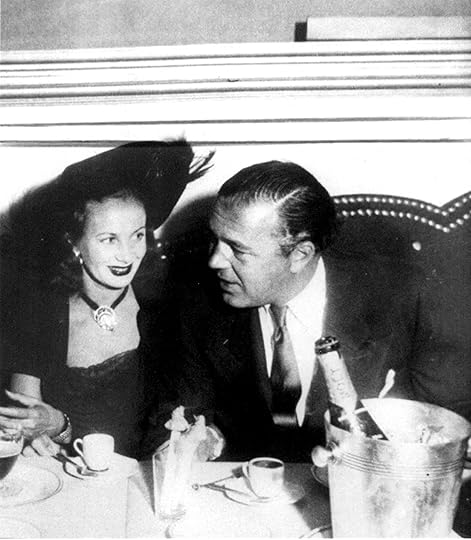 Prince Bertil of Sweden and Lilian Davies in wartime London.
 Bertil’s older brother, Prince Gustaf Adolf, Duke of Västerbotten, was second-in-line to the Swedish throne; but he died in an air accident in January 1947. The new heir-but-one to the throne was Gustaf Adolf’s only son, Carl Gustaf, who was not yet a year old. As the latter’s great-grandfather, King Gustaf V, was then aged 88 and his grandfather, Crown Prince Gustaf Adolf 64, there was every chance that Bertil would be required to serve as regent for his nephew until the latter reached his majority (Bertil’s brothers and two of his cousins having already renounced their princely titles and their places in the succession due to making ‘unequal’ marriages). The Prince therefore made the decision (or was told) not to make an ‘unsuitable’ marriage at this juncture (for Lilian was after all a divorced commoner), so as to keep secure the future of the royal dynasty. It was a great sacrifice on the part of both Bertil and ‘Lily’ (as the Prince referred to his partner) who would have liked nothing better than to have married. Thanks to a large measure of goodwill towards the couple on the part of the Swedish press, the couple’s relationship was kept a secret from the public for almost 30 years. According to the Swedish journalist Sten Hedman, who reported on royal matters from the 1960’s onwards, ‘the press never wrote about their relationship because Prince Bertil said that if we did, we would ruin their [his and Lilian’s] lives.’
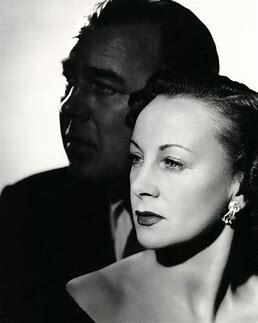 Prince Bertil and Lilian Davies circa 1950
 Meanwhile, in 1947 Bertil bought both the Villa Solbacken on Djurgården in Stockholm and the seven-roomed Villa Mirage in Sainte-Maxime on the French Riviera as homes where he and Lilian could live together in relative peace. Lilian was left in no doubt that this arrangement would mean both a life in the shadows, and without children. She had to content herself with reading of her husband’s official life in the newspapers or, in later years, watching him on television attending the famous Nobel Prize ceremonies. Lilian made sure not relinquish her links with Britain: Until her death, she maintained a small top-floor flat in London’s Mayfair and would visit the British capital several times a year. She remained close to friends (such as actor Roger Moore) and to her cousin, Jean Beaumond. Lilian was not warmly welcomed by some of those at court who knew of the relationship. This initially is said to have also extended to Bertil’s sister, Queen Ingrid of Denmark who, although based in Copenhagen, was still a very influential person in Stockholm as her father was after all King of Sweden.
Yet, the couple enjoyed a busy and fulfilling private life as they enjoyed a shared interest in dogs, gardening, playing golf (often at Halmstad), motor cars (Bertil was Chairman of the Swedish Royal Automobile Club [KAK]), the arts (the couple owned a large collection of artworks by artists of the avant-garde Halmstad group) and other cultural activities. They could sometimes be spotted shopping together in Östermalmshallen. At the Villa Mirage, where the couple spent several months of the year, a large terrace, overlooking the Mediterranean, was the duo’s favourite spot for eating and sunbathing. It was on the French Riviera that Lilian and Bertil could entertain members of the Swedish Royal Family and their eclectic group of friends. Bertil, Lilian admitted, was a ‘great cook’ and loved to hold a barbecue when they had guests. The villa had a fireplace, in the main sitting room, for cooler nights and Lilian recalled ‘We loved sitting in front of a crackling fire.’ Bertil also received the use for life of a small house, the Villa Solgården in Tylösand. This was a 40th birthday gift to the Prince and the residence was paid for via a fundraising campaign and owned by a foundation chaired by the County Governor of Halland. Lilian and Bertil paid visits here in the spring and autumn. The white-washed rooms were sparsely but tastefully furnished and the walls were hung with paintings by the likes of the post-war artist, Mats Norryd.
While in Sweden the press never breached their accommodation with the couple, it would prove more difficult when the duo travelled overseas. Prince Bertil and Lilian were photographed together as they arrived at the Sheraton Hotel in Munich in August 1972, to attend the Olympic Games. But times and attitudes were changing, as even the ageing King Gustaf VI Adolf seemed to realise. Thus, in November, Prince Bertil and Lilian made their ‘official’ debut in Sweden as a couple, when they were pictured arriving together at Stockholm’s Opera House for a gala evening in honour of the 90th birthday of Bertil’s father. For the first time, Lilian sported a magnificent antique family tiara.
In the summer of 1973 there was a large gathering of the younger generation of the Swedish Royal Family at the Villa Mirage. Those visiting included Crown Prince Carl Gustaf and his sisters Christina, Birgitta, Margaretha and Désirée, as well as their respective spouses (although Carl Gustaf and Christina had still to marry). But back in Sweden the old King was ailing and he was rushed from his summer residence at Sofiero to hospital in Helsingborg where Bertil and Lilian visited him. Gustaf VI Adolf died of pneumonia on 15 September. Bertil’s nephew now ascended the Swedish throne as King Carl XVI Gustaf. Lilian accompanied Bertil to the late King’s funeral. The prospect of a marriage between Bertil and Lilian was now drawing tantalisingly close…but first the succession required to be secured and all eyes now looked to the new King to settle down and begin a family. In the interim, although no longer called-on to act as regent, Prince Bertil proved to be an invaluable support to his somewhat reticent and inexperienced young nephew.
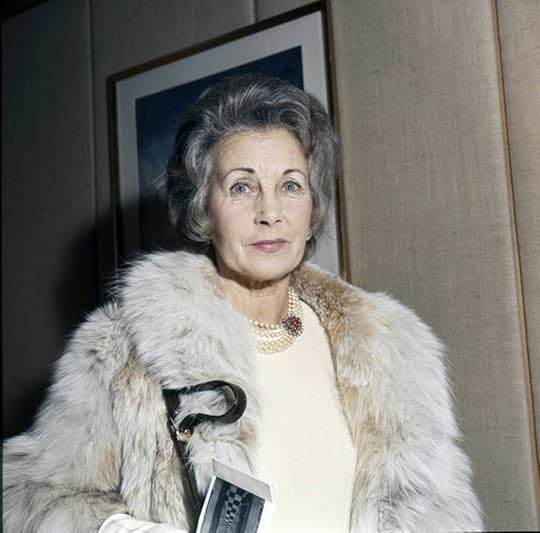 Lilian Davies 1971
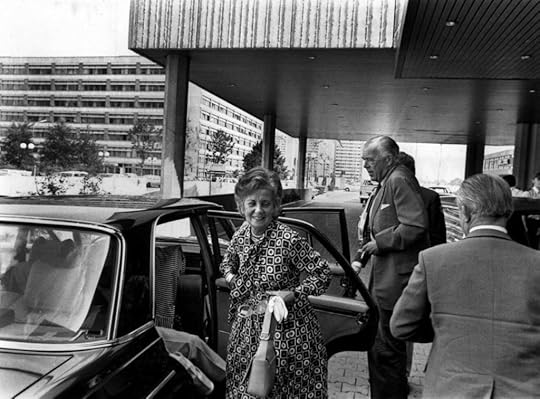 Prince Bertil and Lilian Davies arrive at the Sheraton Hotel Munich 1972
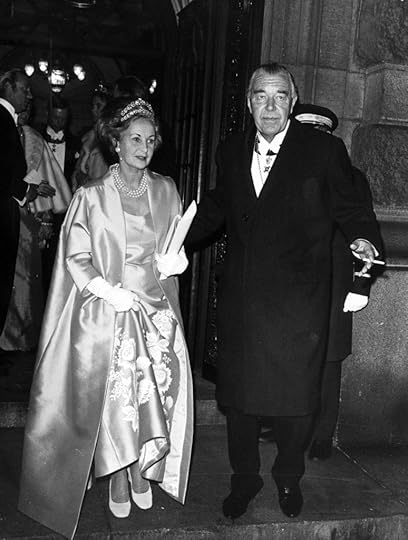 First ‘Official’ Appearance: Prince Bertil and Lilian Davies: 90th birthday celebrations of King Gustaf VI Adolf 1972
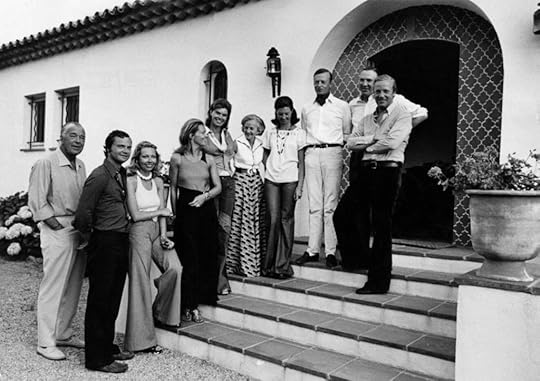 A Gathering of Swedish Royalty at Sainte Maxime, France Summer 1973.
On 19 June 1976, King Carl Gustaf married Silvia Sommerlath, a German-born translator who had been partly raised in Brazil. This was also a true love match for the newlyweds had met at the 1972 Olympic Games in Munich and immediately ‘clicked’. Following this happy development, Lilian and Bertil were at long-last able to become engaged. They married in the Royal Chapel at Drottningholm Palace in December 1976, some 33 years after they had first met. It had already been decided that Bertil would be allowed to keep his titles and place in the royal succession. Perhaps a reward from the King for his Uncle’s patience and sense of duty? The bride-now aged 61-wore a chic silvery-blue long silk twill dress, designed by the London-based designer Elizabeth Wondrak, accessorised by pearls and a diamond brooch. Lilian sported a feathery fascinator in her hair, rather than a hat. A delighted Princess Lilian later wrote to Ms Wondrak about her wedding outfit to say, ‘It really was a dream and admired by everyone’. The bride’s wedding bouquet was a large bunch of Lily of the Valley provided by Stockholm florist Anita Pelenius, who had risen before 4am on the morning of the wedding, to arrange this floral tribute. The couple-Lilian was now officially styled Her Royal Highness Princess Lilian of Sweden, Duchess of Halland- were interviewed by the press in Swedish-and it was clear that Lilian was well-versed in understanding the language of her adopted homeland, although she was a little reticent when she spoke in Swedish. Prince Bertil reflected that ‘There’s only one thing we regret and that’s that we haven’t been able to get married earlier so we haven’t been able to have children, it’s a bit sad, but after all, we are still very happy, aren’t we?’ Lilian looked at him as he squeezed her hand and answered:– ‘Very!’ The irony of how long this marriage had taken to achieve was not lost on Prince Bertil who joked that he and Lilian must have been ‘the world’s oldest cohabiting couple.’ The newlyweds honeymooned in Kenya.
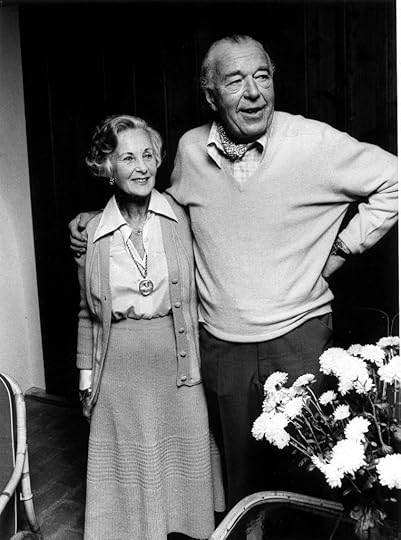 Prince Bertil and Lilian Davies Engagement Photo 1976
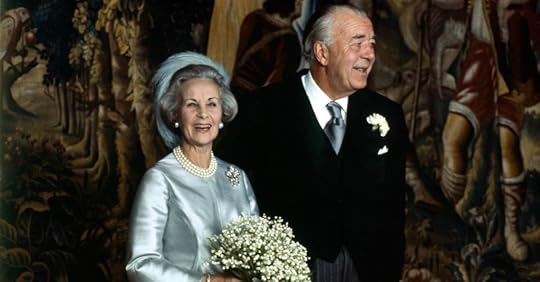 Prince Bertil and Princess Lilian on their wedding day, Stockholm, 1976
In due course, when the King and Queen Silvia had children of their own, Lilian and Bertil became devoted to them all and were treated as honorary grandparents. Princess Victoria (from 1979 Crown Princess) was born in July 1977 (Lilian and Bertil attended the child’s christening in September), her brother Prince Carl Philip in May 1979 (Prince Bertil was named as one of his great-nephew’s godparents) and Princess Madeleine, the youngest child came along in June 1982. Lilian sometimes accompanied Carl Philip to football matches; she was also a great support and comfort to Crown Princess Victoria, particularly in later years, when Victoria met and fell in love with Daniel Westling, a gym owner and personal trainer. The royal family initially hesitated to accept Daniel and Lilian was able to draw on her first-hand experience of what it was like to be an outsider on the fringes of the royal circle. It is said she helped smooth the couple’s path to marriage.
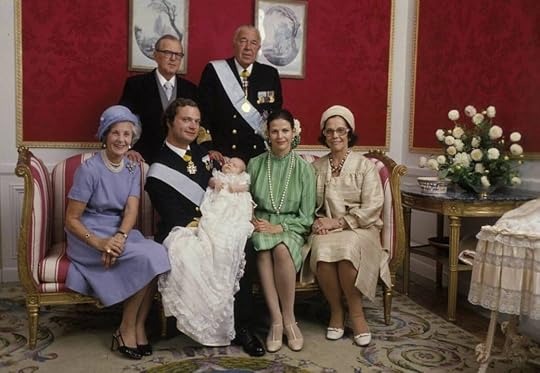 Prince Bertil and Princess Lilian attend the Christening of Princess (later Crown Princess) Victoria of Sweden 1977
Now that Lilian had married into the Royal Family, she was able to participate in royal duties. The Princess established connections with UNICEF and SOS Barnbyar [the Swedish branch of SOS Children’s Villages]. She was Patron of the Swedish British Society. On her 80th birthday in August 1995, Princess Lilian paid tribute to her husband Bertil: ‘If I were to sum up my life, everything has been about my love… He’s a great man, and I love him.’ Although by now Bertil was ailing (he suffered from heart problems and had mobility issues after breaking his hip during a fall), Princess Lilian was still a wonderful help to the King and Queen. For instance, she was present at proceedings held during the State visit from President and Mrs Meri of Estonia in September 1995. She also made regular appearances at events in connection with Sweden’s National Day. Fortunately, in addition to nursing staff, the Princess had the services of old family retainers to assist her in caring for Prince Bertil. Dagmar Nilsson and her sister Maj-Christian Nilsson were of particular help as they had worked as housekeepers for the Prince and Princess for many years and remained a constant presence at the Villa. Another loyal figure was the couple’s chauffeur, Stig Jurlander.
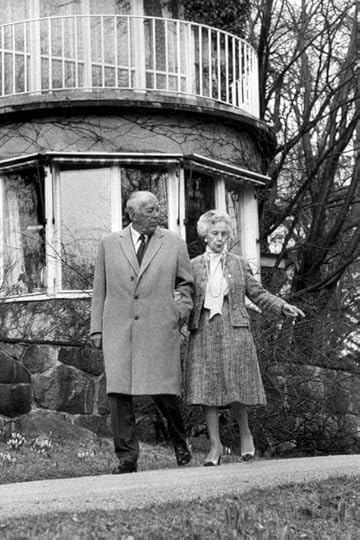 Bertil and Lilian in the grounds of Villa Solbacken
 Bertil and Lilian at racing event.
 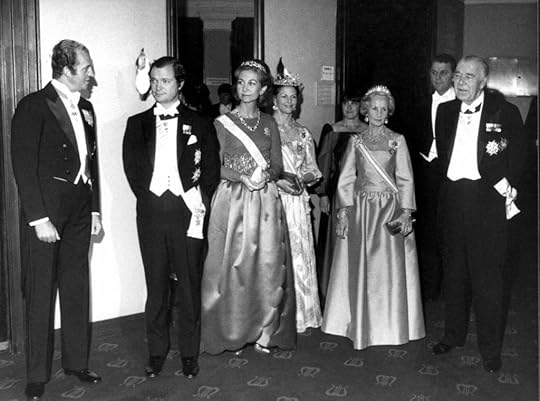 Princess Lilian with Prince Bertil at a State Gala for the King and Queen of Spain 1979
 Prince Bertil and Princess Lilian dance the night away.
 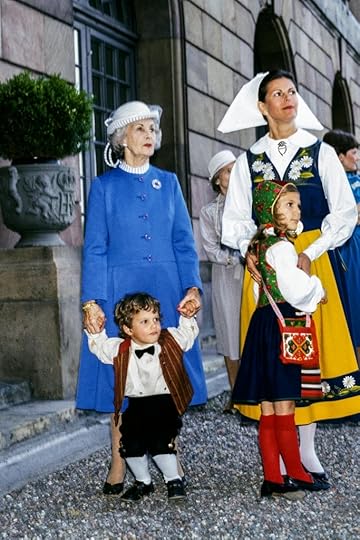 Princess Lilian with Queen Silvia, Crown Prince Victoria and Prince Carl Philip on Sweden’s National Day
Prince Bertil died on 5 January 1997, just shy of his 85th birthday. His funeral service was held in the Chapel of the Royal Palace in Stockholm. Particularly poignant, was the presence of Queen Ingrid of Denmark, who although bent with age, insisted on processing up the long aisle with some assistance from her great-niece Crown Princess Victoria. Also present were Bertil’s surviving brothers Sigvard and Carl Johan, as well as foreign royalty, including his niece Queen Margrethe of Denmark and Prince Philip, the Duke of Edinburgh, a nephew of the late Queen Louise of Sweden. Amongst the music performed was a composition by the Welsh composer Vaughan Williams. But perhaps the most moving was a rendition of the jazz number, Nat King Cole’s ‘Unforgettable’ which was Lilian and Bertil’s special song. Thereafter, the Prince was laid to rest at the Royal Burial Ground in the Hagaparken, his coffin borne on a horse-drawn funeral carriage through the icy streets of Stockholm.
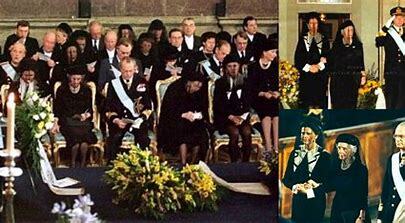 Prince Bertil’s funeral 1997
The Princess took a brief respite from royal duties following her husband’s death, often walking her golden retriever Bingo in the grounds of the Villa Solbacken. However, she was soon back at work and joked to one interviewer, ‘I’m very glad I’ve got a steady job’. One of her first events following Bertil’s death was her presence at the opening of a new session of the Swedish Parliament. Interviews with Lilian tended to be in her native English-it was still the language she was most comfortable speaking, particularly under the public spotlight. The Welsh-born Princess would continue to emphasise that ‘I want to carry on doing, as much as I can, all my husband’s jobs. I enjoy it. I don’t know what I would do without it.’
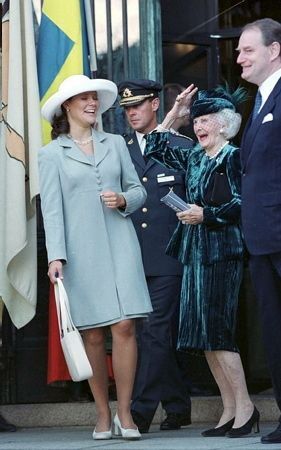 Princess Lilian with Crown Princess Victoria late 1990’s
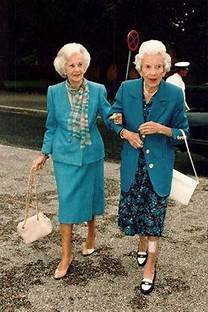 Princess Lilian and Queen Ingrid
Presenting a prize to Swedish conductor Stefan Solyom, she spoke too of her deep love for opera, be it modern or traditional, as well as the enjoyment she derived from the music and films of the 1920’s and 1930’s. When one interview ended after only a few questions, she seemed surprised and laughed, ‘Is that all?’ Many of the scholarships and grants which the Princess awarded were given by the Order of Free Masons of Sweden. Again this was a link with Prince Bertil who had been had been Grand Master of the Order. One interviewer-who admitted in advance that his question was somewhat controversial-asked Lilian if freemasonry had a place in modern society. She was slightly evasive on the subject, saying that she did not know much about it, as after all it was so ‘secret’. However, she was quick to agree the Freemason’s ‘do a wonderful job’ in relation to charitable fundraising. The Princess also presented awards for industrial design and glassware. Lilian admitted to having a penchant for Orrefors glass. However, she also mentioned a wonderful set of antique glassware, belonging to King Carl XIII, which had been a gift to Bertil from Prince Eugene, the youngest son of King Oskar II. Eugene had wonderful taste, for he was a renowned patron of the arts. He certainly might have been amused by Lilian’s outspokenness regarding a portrait of Prince Bertil which hung in the Freemasons’ Hall in Stockholm. In response to a question on whether it bore a resemblance to Bertil, she admitted to an interviewer that she did not like it as ‘It does not look like him’. Lilian then turned the question on the hapless questioner, ‘What do you think?’ He was left fumbling for a quick reply in English, eventually observing it was ‘a vague resemblance’. She retorted decisively, ‘Very vague!’
Meanwhile, in France the Princess continued to visit the Villa Mirage, sometimes accompanied by Queen Silvia, who was spotted shopping with Lilian at the local market. The visits to the south of France were not all for pleasure as the Princess was Patron of the Swedish Club on the French Riviera and also attended the local Swedish church for which she raised funds. Yet, despite these duties, Lilian would joke, on arriving back in Stockholm, ‘I just came back home to work…’ for causes which were ‘so close to my heart.’ As the years rolled on, the Princess visited the Riviera less and ownership of the villa was eventually passed over to the King and Queen who make use of the holiday residence to this day, although there was press speculation (Expressen) in September 2023 that the King was considering selling it.
 Princess Lilian celebrates the Millenium.
On the eve of the Millennium, Lilian joined other members of the royal family and their guests to watch a spectacular sound and light show with a historical theme sporting a shimmery, slinky, silvery outfit. The weather, however, in wintry Stockholm was icy cold. A concerned guest turned to Princess Lilian, then in her 85th year, and asked ‘Are you not freezing?’ She smiled impishly and retorted, ‘Oh no, darling, I’m well prepared!’ and opened her coat to reveal several hot water bottles secreted in the lining.
 Princess Lilian’s Memoirs 2000
When Lilian celebrated her 85th birthday in the summer of 2000, there was a great deal of attention from the press. Aftonbladet described her as ‘the Princess who steals the show.’ Lilian was filmed at Villa Solbacken (she practically skipped down the steps) receiving the gift of a copy of a newly-published book the Princess had written on her life with Bertil , co-authored by journalist Omar Magnergård and Elisabeth Tarras-Wahlberg, the Director of Information at the Royal Court. In it, Lilian singled out Queen Silvia for praise, recalling that she had come to her rescue during the final days of Prince Bertil’s life, even sleeping over several nights at the Villa Solbacken on a camp bed in the downstairs living room in order to provide her with support during those dark days. She also admitted to interviewers, ‘Yes, the Queen is my dearest friend.’ There were also happier revelations: Lilian’s favourite drink was a Bloody Mary; her favourite sportsman, tennis player Stefan Edberg. It is no wonder that Crown Princess Victoria is said to have ‘devoured it [the book] from cover to cover’ when she received her copy in person from her ‘Auntie Lilian’ at the Villa Solbacken, only days prior to its official release. And Lilian’s recipe for keeping fit as she approached her 86th year: ‘I work as hard as I can – it’s the only way to stay young’.
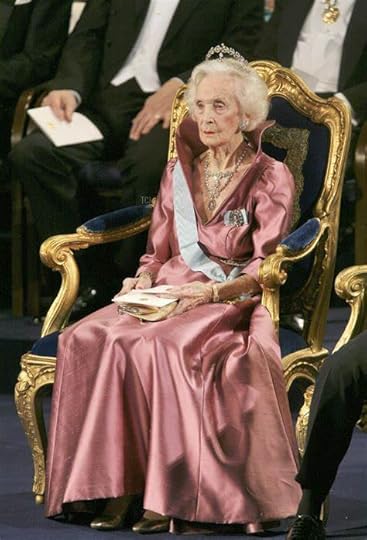 Princess Lilian at her final Noble Prize Ceremony 2006
A somewhat frail Princess Lilian attended the Gala Dinner at the Royal Palace to celebrate King Carl Gustaf XVI 60th Birthday on 30 April, 2006. She was also present at Crown Princess Victoria’s Birthday celebrations at Solliden Castle, Borgholm the following July. Lilian held the future queen in high esteem, telling the Swedish newspaper, Aftonbladet, ‘She will be an excellent queen, so ambitious, interested and talented.’ The Princess was also the VIP guest at the unveiling of the Princess Lilian Suite, named in her honour at Stockholm’s Grand Hotel. This year also marked her final appearance-her 29th-at the annual Nobel Prize festivities. Lilian had remained loyal to designer Elizabeth Wondrak who, each year, had been responsible making for yet another evening gown for the prestigious ceremony. That particular year the Princess wore a favourite diamond tiara by Boucheron, sometimes referred to as the ‘Laurel Wreath Diadem’ which had belonged to Bertil’s British mother, Crown Prince Margareta (‘Daisy’), who died tragically young in 1920, aged 38.
Yet, even at the grand old age of 90, and with her memory now failing, Lilian had not lost the ability to surprise. Her view of life remained touched by good humour: ‘I’m still hanging on [although] I’m not as young as I used to be but still…’ When two men called-by at the Villa Solbacken to present her with flowers, they asked an employee (who met them at the gate) if they could present them to the Princess in person. Although they were informed that the Princess was resting, the aide offered to speak to the the Princess. Lilian immediately agreed to meet them both and when the duo were shown into her presence, they found her to be both alert and happy to see them. Indeed, the Princess thought it was hilarious that two gentlemen in their 30s, not only knew where she lived, but had then taken the trouble to come and visit her. Lilian joked that the next time she must invite them to tea!
In 2008, the Princess fell and fractured her femur. An operation proved successful. Lilian then suffered another fall in February 2009 and was rushed to the private Sophiahemmet Hospital where another fracture (this time not of the femur) was confirmed. However no surgical intervention was necessary on this occasion. Nonetheless, she remained in the hospital for a period of recuperation. In June 2010 it was announced by the Princess’ Court Marshal that 95-year-old Lilian was afflicted with senile dementia (many of the Swedish newspapers reported it was Alzheimer’s disease) and would therefore be unable to attend Crown Princess Victoria’s wedding to Daniel Westerling. This must have been a particular blow for Victoria recalling her Aunt’s aforementioned approval of the romance. The Court Marshal also confirmed Lilian was currently being cared for at her home on Djurgården. Interestingly, at a press conference in connection with the announcement of her engagement to Mr Westerling, Victoria wore a brooch which Lilian and Bertil had given to her in the 1990’s, doubtless as a nod to ‘Auntie Lilian’.
The entire royal family was by her side when she died peacefully at her Stockholm residence on the afternoon of 10 March 2013. She had been most unwell for the last year and in need of constant nursing care. A communique from the King was issued by the Royal Palace:
‘It is with great sadness that my family and I announce that Princess Lilian passed away on Sunday 10 March. The princess was much loved by our family and we all remember her as a happy, funny and witty person. She was a true spreader of joy and had the ability to always create a good and cordial atmosphere around her. The young people of the family always appreciated the Princess’s cheerful antics and joking manner’. The King was also at pains to emphasise her loyalty to both the Royal Family and to Sweden. Prime Minister Fredrik Reinfeldt noted that she was ‘liked and appreciated by many people.’ Meanwhile, journalist Sted Hedman recalls, ‘She was a charming woman, she was human and always had a twinkle in her eye. I liked her very much’. There was comment too from her homeland. Ben Glaze of Walesonline noted that hers was a ‘Cinderella story in real life.’
The Mayor of Swansea, Dennis James, said the Princess, ‘one of Swansea’s most famous daughters’ who stayed ‘proud of her Swansea links’ and helped to raise the Welsh city’s profile overseas.
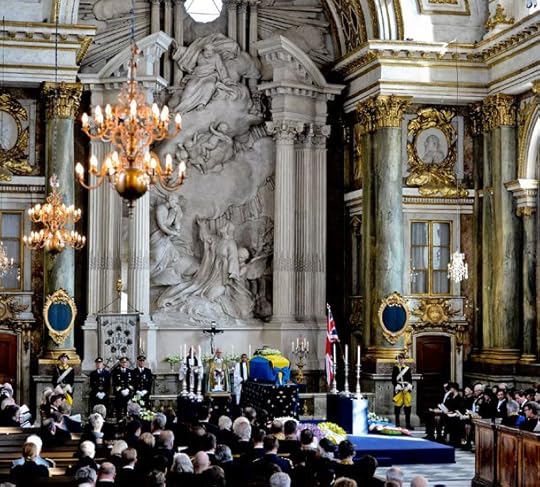 Princess Lilian’s Funeral Service in the Chapel of the Royal Palace. Note the British Union Jack Flag.
 Around a hundred invited guests had gathered in the Chapel of the Royal Palace in central Stockholm on 16 March to say a final farewell to Princess Lilian. Her coffin-surmounted by a crown which had belonged to Princess Eugénie, the daughter of King Oskar I of Sweden-was watched over by six royal guardsmen and the heavy scent of flowers filled the air. Outside, it was bright, sunny day and Slottsbacken was filled with people who had gathered to honour the princess, many of whom had lined the street well in advance of the funeral service commencing at 1.00pm. Others had already taken the opportunity to pay their respects the previous afternoon, when the doors of the Chapel were opened for three hours to allow people to pay their respects. Members of the Swedish Royal Family were visibly moved, as were Princess Astrid of Norway and Queen Margrethe of Denmark, Lilian’s niece by marriage (her late mother was Queen Ingrid). At one stage, Queen Silvia and her son Prince Carl Philip were observed holding hands. The Princess’ coffin was wrapped in the royal standard, with its distinctive three crowns, and adorned with a wreath of lily of the valley. Next to the coffin, hung a British flag, an acknowledgement of Lilian’s British heritage. The Reverend Nicholas Howe, a priest in the Anglican church in Stockholm (St Peter and St Sigfrid’s) participated in the service. Lilian had attended this church on special religious festivals. Also present in the Chapel was a relative of Lilian’s from Britain, Mrs Barbara Davis. However, there was no mention of Lilian’s half-sisters (they shared the same father), Janice Rees and Sonia Roberts attending from their home in Wales. The sisters-who were around thirty years younger than Lilian-had never met the Princess, although according to an article by the Swedish journalist Carl Juborg in the Expressen newspaper, they had sent Christmas cards to Sweden and Lilian had once replied to a letter sent to her, through her Court Marshal (and close friend of Lilian), Baroness Elisabeth Palmstierna, saying ‘I hope we will meet.’ Another Brit in attendance was Sir Roger Moore who was accompanied by his wife Kiki. The service-which was broadcast on Swedish television-was led by Bishop Emeritus Lars-Göran Lönnermark. He noted that, ‘Lilian Craig entered into the rules [of the Royal Family] for the sake of love.’ Shortly after the funeral service began, a 21-gun mourning salute was fired from nearby Skeppsholmen. Although most of the service was in Swedish, the psalm ‘Abide With Me’ was sung by the congregation in English. In a nod to her Welsh heritage, Vaughan William’s hymn ‘For All The Saints’ echoed through the chapel, as did Hubert Parry’s ‘Jerusalem’, a standard musical offering at most English funerals. The funeral concluded with the classic Scottish folk song ‘Auld Lang Syne’ played on the bagpipes. Crown Princess Victoria was literally moved to tears and could be seen dabbing her eyes with a hanky. The coffin was then transported by motorised hearse to the Royal Burial Ground in the Hagaparken where Princess Lilian was finally laid to rest next to her beloved Prince Bertil. Press photographers caught a glimpse of the King saluting his Aunt’s coffin as it was interred, with Queen Silvia and Queen Margrethe of Denmark standing to his immediate right and left.
In September 2013, the British Ambassador to Sweden, Paul Johnston, along with the Reverend Nicholas Howe, invited members of the Swedish Royal Family and friends of Princess Lilian to a memorial service at Stockholm’s Anglican church to celebrate her long life. Hymns were sung in English, with several other works of music performed by the violinist Hugo Ticciati and musicians from Lilla Akademien, a school which focuses on developing musical talent in children. Crown Princess Victoria and the British Ambassador both read poems, while Sir Roger Moore provided a fond tribute of reminisces. This was followed by a reception at the British Ambassador’s Residence. The service was deemed to be ‘private’ and no media attended.
Meanwhile, in November 2013, details of the Princess Lilian’s will appeared in the Swedish press thanks to a detailed account provided in an article by the Expressen newspaper. As was expected many of her possessions, art and jewellery went to the King and Queen and their three children. The Queen also received a monetary legacy of 5 Million SEK. There were smaller legacies to her two Swedish goddaughters; while the two housekeepers at the Villa Solbacken each received 50,000 SEK. Lilian’s chauffeur was bequeathed a Mercedes Benz car. Meanwhile, 10,000SEK was left to the Anglican Church in Stockholm and 100,000SEK to SOS Barnbyar. The Princess had also sponsored a child from overseas called Anita and she was bequeathed 10,000SEK.
Family members of Lilian in Britain were also remembered: Christine Robinson, the daughter of the Princess’ cousin, Jean Beaumond, inherited Lilian’s Mayfair flat in Chesterfield Gardens, along with a monetary legacy of 50,000SEK. Christine had already lived in the apartment for around 15 years and had been close to Lilian, whom she saw frequently during the Princess’ visits to London. Jean Beaumond, meanwhile, received a large legacy of 5 Million SEK (around £500,000) and a gold necklace with ruby and diamond medallions, as well as watercolour portrait of Princess Lilian. Nor did Lilian forget an old British friend: Rolla Campbell, the sister of the late actress Kay Kendall, received the gift of a portrait of Kay.
Although Lilian has been dead for around a decade now, she is certainly not forgotten. Queen Silvia of Sweden would recall that Princess Lilian had a very ‘dignified appearance’ and ‘lovely British sense of humour’; while a ‘twinkle in the eye’ indicated that she did not take herself too seriously. Yet, the Queen also reflected that ‘She was a very important part of our family, not least for me personally, and she participated to a large extent in our family life’. Lilian was also ‘an active person’ whether that be attending a large formal event or accompanying one of the young generation of royals to football practice on a rainy day.
In August 2015 an exhibition ‘Clothes for a Princess: the Lilian Look’ opened in the Pillar Hall at the Royal Palace. This featured day wear, evening gowns, hats and other accessories from the late Princess’ stylish wardrobe, many in her favourite pastel colours. The exhibition also featured sketches and correspondence between Lilian and the designers [notably Elizabeth Wondrak] who created her ‘look’. The Queen of Sweden made a speech at the opening during which she stated, ‘It is sometimes said that the clothes make the man. That is probably often true for both men and women. But with Princess Lilian it was the opposite. In her case, it was the woman who made the clothes.’ Thereafter, in October 2016, Princess Lilian’s British-designed wedding outfit was displayed in the Hall of State at the Royal Palace in Stockholm, as part of the exhibition, ‘1976-2015 Royal Wedding Dresses’. Again, in 2018, Britain’s Tatler magazine did a feature on the Princess and praising her as a style icon. The interest in Lilian, Sweden’s British Princess- the first British-born person to marry into the Swedish Royal Family since Princess Margaret of Connaught in 1905-remains enduring. This is unsurprising given that, as her nephew, King Carl Gustav noted during a speech at the time of her wedding to Bertil- the ‘recipe’ of his Aunt’s personality was a mixture of ‘charm’, ‘humour’, ‘wisdom’, ‘patience’ and ‘prudence’ combined with ‘lots of laughter.’
Robert Prentice is a royal blogger and has in the past contributed articles to Majesty Magazine and Royalty Digest Quarterly. He is the author of the biography: Princess Olga of Yugoslavia: Her Life and Times.


October 1, 2023
Queen Marie-Yugoslavia’s Motorist Extraordinaire.
When Princess Marie of Romania married King Alexander of Yugoslavia in June 1922, she arrived from Bucharest to a court in need of a woman’s touch. However, Cecil Parrot, who would later serve as Marie’s eldest son, Crown Prince Peter’s tutor, observed that Her Majesty was not really interested in the minutiae of court life. Nonetheless, Marie was most definitely fascinated with anything to do automobiles. How did this situation come about at a time when few women-let alone a Queen-had even driven a car?
Prior to Marie’s arrival in Belgrade, there had been no real interest shown by King Alexander in automobiles, other than as a mode of reliable transport. State cars used included a Rolls Royce saloon and a Fiat purchased by his father, the late King Peter at a cost of $23,500. Only Prince George (Djordje) of Yugoslavia-Alexander’s brother-appears to have regularly driven a car for pleasure (including a Peugeot purchased for him in 1908 by his father). George was also almost certainly the first member of the Karadjordjevic dynasty to take to the wheel of an automobile. Although King Alexander had taken ownership of a Fiat in 1910, he did not care for driving. Conversely, Mignon (the Queen’s family nickname) had long had a passion for motoring, dating back to the days of her youth in Romania. It is said that she even drove her mother, Queen Marie of Romania, from Bucharest to Belgrade, prior to the announcement of her engagement to King Alexander. This hobby she shared with her younger brother, Prince Nicholas of Romania, who would subsequently help to advise her on future motor car purchases.
In Belgrade, Marie’s fervour for motoring was inspired by a wedding gift of a British Rolls Royce Phantom 80CE, a powerful machine in which she was sometimes pictured driving her husband. This drew her the accolade of her being the first woman driver in her adopted homeland. Her Majesty was also said to have been stopped for speeding. Rather than use her royal status to avoid paying the fine, she quietly settled it. Interestingly, many of the Queen’s cars carried her royal cipher on the driver’s door.
By the mid-1920’s Marie had also decided to purchase a nippy three-seater, a Fiat 509. Interestingly, the previous year, her kinswoman (and some say rival at court in Belgrade) Princess Olga of Yugoslavia purchased, at a cost of £160, a two-seater Fiat following a visit to the Italian company’s famous roof-top test track in Turin. Had Olga’s purchase-with funds provided by her husband Prince Paul-inspired Mignon to look to Italy?
In due course, Marie’s husband’s subjects became accustomed to seeing Her Majesty adeptly handling her latest powerful automobile acquisition on local roads around Belgrade and her country residence at Bled in Slovenia, often with King Alexander and a Lady-in-Waiting in the rear passenger seats. On occasion, the King could even be found sitting up-front with his wife. A queen driving powerful cars, without a chauffeur present, quickly attracted the attention of the press, both at home and abroad. Articles began to appear in newspapers and magazines informing readers of Marie’s ‘marathon’ journeys by car between Belgrade and Bucharest, not to mention the eight-hundred-mile drive between Bled and Paris.
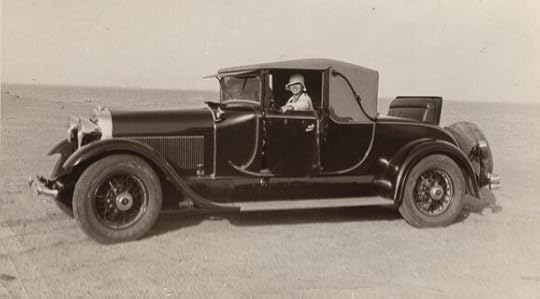 Queen Marie’s Lincoln
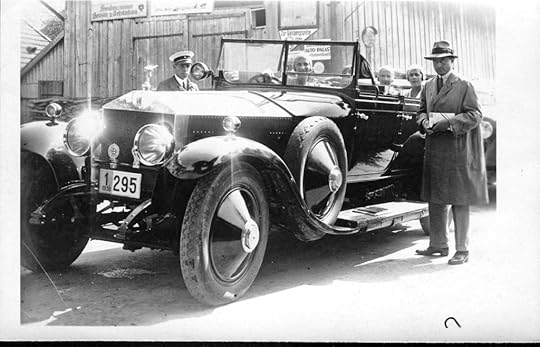 Princess Olga of Yugoslavia drives her Rolls Royce
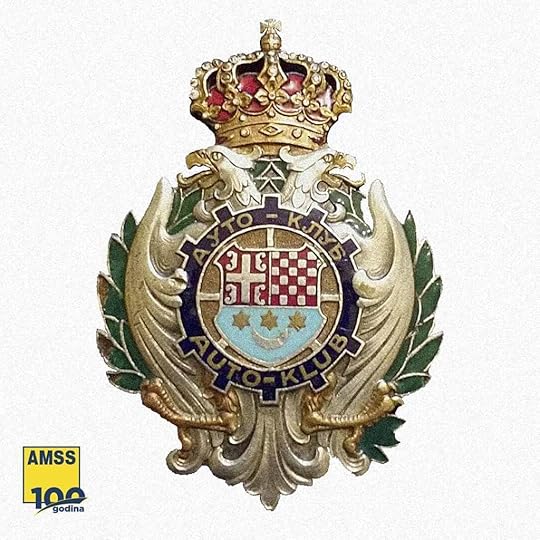 Auto Klub Badge
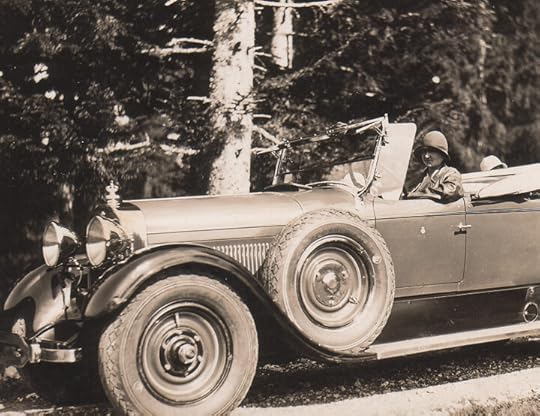 Marie driving Rolls Royce 80CE
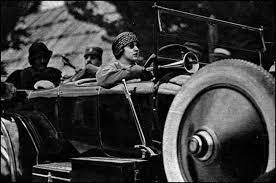 Marie driving Packard
 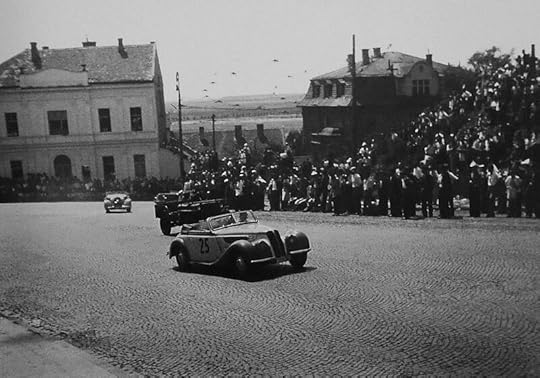 1939 Belgrade Grand Prix .
Her Majesty’s passion for motoring was formally acknowledged when, in April 1924, Queen Marie was made Patroness of the Automobile Club (‘Auto-Klub’) of the Kingdom of Serbs, Croats and Slovenes. A large portrait of the Queen was later unveiled in the entrance hall of the institution’s Ljubljana branch office, where it remained until the 1940’s. During a speech at a meeting to commemorate the tenth anniversary of the Auto-Klub in 1932 (the organisation had originally been established as the Automobile Club of Serbia in 1922) the Queen observed that she had owned no less than nine different cars since coming to Belgrade. One of the most recent had been a 1930 Lincoln Model L Roadster which featured what motor car aficionados refer to as a ‘beetle back’. However, the crowning glory of this period was her purchase of a 1931 Duesenberg Model J Convertible which had been displayed at the Paris Salon.
Meanwhile, Princess Olga was also driving a very up-market vehicle for, in 1928, King Alexander had given the Greek-born princess the gift of a magnificent Rolls Royce.
During one of Cecil Parrot’s first encounters with Queen Marie in 1934, at her newly-built holiday home at Miločer on the Dalmatian coast, Her Majesty (who had previously gravitated to Delâge cars) seems to have transferred her loyalties to cars from the United States. She owned a succession of Packard’s which were said to have a top speed of one-hundred miles per hour. However, Mignon also owned a Ford Roadster (which she referred to in English as the “bone shaker”) which was used for Mr Parrot’s outings with young Peter. Although the Queen had a chauffeur, Bóza, she still preferred to drive herself from Belgrade to Miločer . Mr Parrot, after a hair-raising encounter with some pedestrians, began to doubt his own driving skills on the winding Montenegrin roads, as did Court officials (fearing for the heir’s wellbeing) who now pressed Cecil to desist, so he made good use of the chauffeur’s service’s.
Marie was widowed in November 1934 when her husband, King Alexander, was assassinated in Marseille during a State Visit to France. Her son Peter now became King, although his father’s cousin, Prince Paul, acted as Prince Regent until the young man reached his majority. Nevertheless, even in widowhood, the Dowager Queen’s enthusiasm for automobiles remained undiminished. At the first-ever Belgrade Motor Show, held in from 5 to 15 March 1938, Her Majesty not only visited the show over many days, but she also arranged for her new Lincoln Zephyr 86x-probably purchased specially for the occasion-to be exhibited along with around 158 other motors which included brands such as Adler, Mercedes-Benz, Opel, Buick, Lancia and Fiat. There was certainly a need to boost car sales in the country for there were only around 12,000 cars on the roads in Yugoslavia at this time. Queen Marie’s Lincoln Zephyr would later be used by King Peter, who had been driving a motor car since 1937. He seems to have inherited his mother’s desire for speed. Peter owned an Adler and subsequently, during a holiday in Bled in 1940, he was photographed behind the wheel of an open-topped BMW 327/8. This may have been the same BMW car King Peter was observed purchasing at the 1938 show from the stand of Belgrade’s famous “Veleuato” car dealership owned by Sekula Zečević, while the Queen had settled on a Dodge Convertible from the same dealer.
In 1939 the Belgrade Grand Prix race was organized at a circuit in the Kalemegdan Park to honour of the birthday of King Peter II. However, the Queen’s influence was acknowledged when it was stated at the time that the youthful monarch’s love for (fast) cars and automobile races owed much to the influence of his mother. Her love for cross-country races now led to her being described as one of the few female rally drivers in Europe.
During and following World War 2, Queen Marie lived in England. However, this did not deter her desire to pursue a life of motoring. In May 1958, she arrived in Paris en route to Lucerne and lunched with Princess Olga and her husband Prince Paul. And the topic of conversation: the Queen’s acquisition of a new car!
There is a postscript to this story: Queen Marie’s grandson, His Royal Highness Crown Prince Alexander II attended the launch of a beautifully illustrated book “Cars and the Karadjordjevic Dynasty” by Miroslav Milutinovic at the Serbian Archives in May, 2014.
Robert Prentice is the author of the biography “Princess Olga of Yugoslavia: Her Life and Times” (Grosvenor House Publishing) available to purchase from Amazon etc..
September 25, 2023
Britain’s King Charles “Reboots” Entente Cordiale
On Wednesday 22nd September, Britain’s King Charles III commenced a State Visit to France, accompanied by his wife Queen Camilla. Although he had, as Prince of Wales, visited on 34 previous occasions, this was His Majesty’s first visit since his accession to the throne in September 2022. In the age of social media the President had already released a poignant message to his royal visitor: ”You visited as a Prince, you return as a King. Your Majesty, welcome”.
The visit started on a blustery note when the royal aircraft-an Airbus Voyager-flew into a windswept Orly Airport. First down the steps was His Majesty, dressed in a traditional suit. He was followed by his wife, Queen Camilla, who visibly struggled to keep her pink Philip Treacy hat from flying into the blue yonder, as she descended the aircraft steps. Fortunately, Camilla’s pink wool crepe coat dress by British designer Fiona Clare, refrained from adding to her obvious discomfiture.
Thereafter, there was to be a warm welcome throughout the stay, starting with an official greeting from the French Prime Minister, Elisabeth Borne. Also waiting patiently in line to shake hands with the royal couple were the British Foreign Secretary James Cleverly, the British Ambassador Dame Menna Rawlings and the French Ambassador to the United Kingdom, Hélène Tréheux-Duchêne. Twenty members of the Republican Guard formed a Guard of Honour.
The niceties over, the King and Queen then drove off in the State Bentley (which had been brought over to Paris from the mews at Buckingham Palace) to journey into central Paris surrounded by police outriders. Indeed, security was noticeably tight with French newspapers frequently mentioning ‘the ring of steel’ which had been put in place, with the aid of 8000 police, to help guard against any possible terrorist attacks or civil disturbance. The first engagement of the visit took place at the Arc de Triomphe where the King and Queen were warmly received by President Macron and his chic wife Brigitte. The President was seen to briefly giggle as Queen Camilla continued to struggle with her hat in the windy conditions. Yet soon all was serious as a service of remembrance commenced (attended by veterans and members of the military) during which the King re-lit the eternal flame of remembrance (in memory of those who died in the First and Second World Wars) using the Comite de la Flamme passed to him by Monsieur Macron. He and the King also laid a wreath together. In another symbol of togetherness, almost simultaneously, there was a joint flypast above the iconic monument by aircraft from Britain’s Red Arrows and their French counterpart La Patrouille de France.
After meeting British and French veterans, pupils from the British School of Paris as well as Scouts and Guides, the King joined the President to travel down the Avenue des Champs-Élysées in an official car. Security prohibited the use of an open top vehicle, but as a compromise the King and the President stood up and waved to waiting crowds through the car’s open sunroof. The Queen and Birgitte Macron travelled behind in a second vehicle.
Arriving at the President of France’s official residence, the Élysée Palace, the two couple’s paused briefly on the steps for a photographic opportunity. Once inside, protocol dictated that there by an exchange of gifts between the King and the President. Charles gave Monsieur Macron a set of the complete works of Voltaire, while the French President presented Charles with a specially commissioned gold coin from the Paris Mint which features the King’s image on one side and Highgrove, His Majesty’s Gloucestershire home, on the other. Charles was also given a rare edition of the Romain Gary novel, Les Racines du Ciel [The Roots of Heaven].
Subsequently, the King was in a visibly relaxed mood as he smiled and laughed with onlookers while walking with the President from the Elysee Palace to the nearby British Ambassador’s residence situated on the fashionable rue du Faubourg Saint-Honoré. From above, people gathered on balconies and cried out “Vive Le Roi” [God Save the King] as Charles passed below them, guarded by protection officers. On arriving at the Residence (which was once the home of Napoleon’s sister Princess Borghese), the King and the President planted an oak tree. This was a tradition which was a particular favourite of the late Queen Elizabeth II.
In the evening, the King and Queen were guests of the President at a sumptuous banquet held in the historical setting of the Salon de Glaces [Hall of Mirrors] at the Palace of Versailles. The palace was built by France’s King Louis XIV and is situated some 19 kilometres from the city centre of Paris. All eyes were Queen Camilla as she stepped from the royal car wearing a blue navy cape evening dress by Dior, accessorised by a superb Victorian sapphire and diamond necklace which had been a wedding gift from King George VI to his elder daughter, the future Queen Elizabeth II, in 1947. Sadly, Queen Camilla chose not to wear the sapphire and diamond tiara which her late mother-in-law had purchased in 1963 to compliment this necklace. 160 guest were invited to attend and included singer Sir Mick Jagger, actor Hugh Grant and former Chelsea boss Arsene Wenger. They dined on lobster, crab, Bresse chicken, thirty-month-old Comté cheese and renowned French pastry chef Pierre Hermé’s signature pudding Isfahan Persian Macaron which contains rose water, raspberries, and lychees.
In his speech, the King recalled the “profoundly moving gestures” in France, including the flying of the Union flag at the Elysée Palace at the time of his mother’s death, in September 2022. Charles continued by observing that “your invitation to visit France and your exceptionally generous hospitality, are symbols of the enduring relationship between our two countries.” The King also recalled the Entente Cordiale which had been promoted between the two countries 120 years ago, thanks to the support of his great-great grandfather, King Edward VII. As he proposed a toast to the President, His Majesty noted, “Whatever lies ahead, may it endure, faithful and constant, for centuries to come.”
Although it had been a late night, the King and Queen were up bright and early to undertake a busy day of engagements. Charles had the honour of being the first British monarch to address French parliamentarians in the Senate. The speech he made was political: His Majesty was particularly focused on Ukraine and environmental matters. Russia’s “unjustified aggression” against Ukraine was condemned and the King talked-up Britain and France’s “unwavering” joint determination to ensure Ukraine “will triumph.” Where the environment was concerned he was equally robust: “Just as we stand together against military aggression, so must we strive together to protect the world from our most existential challenge of all: that of global warming, climate change and the catastrophic destruction of nature.” Charles received a standing ovation for his efforts.
The Queen, meanwhile, was at an event at France’s recently renovated National Library to inaugurate a new UK-France Literary Prize, Le Prix de l’Entente Littéraire, for young adult fiction. Camilla is passionate about all things literary and she is patron of several British charities including BookTrust and the National Literacy Trust. Her Majesty also presides over an online book club, “The Queen’s Reading Room.” Interestingly, Madame Macron is a former teacher of literature. On display for the VIP guests to peruse in the Salon d’honneur were works by Shakespeare, a first edition of Victor Hugo’s historical novel Les Misérables and an original artwork from a comic strip featuring Astérix le Gaulois [Asterix The Gaul]. Subsequently, at a reception in the imposing Salle Ovale of the library, the Queen mixed with British authors Ken Follet and Sebastian Faulks, as well as the Editor-in-Chief of France’s popular Point de Vue magazine which regularly features articles on European royalty.
Thereafter, the King and Queen, accompanied by Madame Macron, ventured to the northern Paris suburb of Saint-Denis. The royal visitors visited the Saint-Denis’s historic basilica (the burial place of French monarchs) and the town hall. The King also ventured to the local Rugby World Cup village (France is currently hosting this event) where he met rugby players, sports commentators and others associated with sport including FC Paris Saint-Germain’s defender, Presnel Kimpembe. Charles was also introduced to the football club’s Qatari president, Nasser al-Khelaifi (who presented him with the a No 3 player’s top featuring name of Charles). However, Camilla and Madame Macron also had their moment in the limelight when they indulged in a game of table tennis at a local community centre. The Queen quickly realised her limitations and laughed at her attempts, “This is embarrassing”. This ability to laugh at herself is endearing, as is her lack of pomposity.
Charles and Camilla subsequently returned to the city centre to visit the Paris flower market, situated on Île De La Cité, Marche Aux Fleurs Reine Elizabeth II. This was renamed in honour of the King’s mother at the time of her State Visit to France, in June 2014, during which Her Majesty visited the market and unveiled a sign bearing the new name. The King and Queen were re-joined by President Macron and his wife as they inspected the ongoing restoration work at the Notre-Dame Cathedral which was devastated by a fire in 2019. It is hoped the cathedral will reopen at the end of 2024. The visitors met firefighters and craftsmen involved in the rebuilding works.
On the final day of the three-day State Visit, the King and Queen flew to Bordeaux for a packed schedule of engagements. They were originally meant to have travelled by the TGV high-speed train but details of this were leaked in advance, creating security concerns. This south-western city is home to around 39,000 Brits. Their Majesties first made a stop at le Palais Rohan (the city’s Hotel de Ville/Town Hall) on Place Pey Berland where they were received by the Mayor of Bordeaux, Pierre Hurmic. While the royal couple signed the visitors’ book, they were serenaded by a local youth orchestra, before venturing into the garden to plant a loquat leaf oak tree. Meanwhile, hundreds of enthusiastic bystanders lined the streets outside to wave Union Jack and Tricolore flags in greeting. While some clapped and cheered, others were heard to shout “Vive le Roi” . A particularly moving (and spontaneous) event occurred when the King encountered the Fiji National Rugby Team at a festival on the Place de la Bourse and they serenaded him with ‘Au Rai Vei Kemuni’, a hymn traditionally sung at Fiji rugby games. The King’s mother, Queen Elizabeth II was highly revered and was recognised in Fiji as Tui Viti [“supreme tribal chief”] by the Great Council of Chiefs. When the country became a republic in 1987, Her Majesty’s official portrait remained on the walls of Government House, looking down on successive Presidents of Fiji as they swore-in government ministers.
Later, Charles and Camilla attended an official reception on board the Royal Navy Frigate HMS Iron Duke. On arrival the royal couple were greeted by a Royal Guard of Honour (who were inspected by the King) and the National Anthem was performed by the Band of His Majesty’s Royal Marines Lympstone. During the event, Their Majesties spoke to Royal Navy personnel, as well as to their French counterparts from the Marine Nationale [French navy] in order to discover how the two nations are collaborating on defence matters. Also present were local dignitaries and members of local veterans groups.
The royal couple were then given an exclusive tour of the Chateau Smith Haut Lafitte vineyard by owners Florence and Daniel Cathiard during which Charles and Camilla sampled some ‘very good’ red wine (dating from 2005, the year of their marriage) and were introduced to one of the Llamas which are used to help weed the fields. The vineyard is known for its sustainable approach to wine-making and is said to be completely organic. It also produces solar energy.
The influential French newspaper, Le Monde, opined that the visit of Charles III had “launched a reboot” of the relationship between Britain and France. But was the aim of highlighting the closeness and friendship between France and the United Kingdom, despite the shockwave of Brexit, achieved? Time will tell. Certainly, despite the security, the crowds found a way of telling the King and his wife that they were welcome, both in the City of Light and in Bordeaux. Many of the French people clearly have a place in their hearts for royalty and, in particular, for British royalty. The memory of Elizabeth II-so often alluded to directly or indirectly throughout the visit-has gone a long way to ensure this is so. Yet, the King and Queen shone bright in their own right, undertaking engagements after their own fashion. Furthermore, the press commented on the warmth between the royal couple and the presidential couple. Indeed, the whole tone was so different from the more formal State Visits of the past. It is to be hoped, as the King said in his speech in the French Senate, that the United Kingdom and the France will always remain “best friends” of an “absolutely vital partnership” as “together we face the challenges of the world”.
September 22, 2023
Visite d’État du souverain Britannique à Paris.
Le 20 septembre 2023, le Roi Charles d’Angleterre a entamé une visite d’État de trois jours à Paris. Au cours de la visite (la 35ème visite de Charles en France, mais sa première visite d’État depuis son accession au trône) le roi était accompagné de son épouse, la Reine Camilla. La visite qui a été repoussée à cause des violences qui ont accompagné l’adoption de la réforme des retraites. Avant l’arrivée du roi et de la reine, le président Emmanuel Macron a partagé un message de bienvenue poignant, écrivant sur les médias sociaux: « Vous avez visité en tant que prince, vous revenez en tant que roi. Votre Majesté, bienvenue. » La visite d’État a été considérée comme une chance de reconstruire les liens qui se sont effilochés depuis la sortie de la Grande-Bretagne de l’UE en 2020.
La première ministre Elisabeth Borne, a salué les souverains à leur arrivée à l’aéroport d’Orly juste avant 14h00. L’ambassadrice britannique, La Dame Menna Rawlings, et son homologue française en Londres, Hélène Tréheux-Duchêne, étaient également présentes. Une haie d’honneur est formée par vingt hommes de la Garde républicaine. La Reine Camilla portait une robe en crêpe de laine rose sombre de Fiona Clare et un chapeau en forme de béret rose avec un motif de feuille de Philip Treacy.
Le roi et la reine ont été conduits dans la limousine Bentley officielle du roi au centre de Paris avec une escorte de policiers. Cela faisait partie d’une opération « anneau d’acier » qui visait à protéger le couple royal et à se prémunir contre les attaques terroristes et les troubles à l’ordre public. Environ 8000 policiers ont été amenés pour garder Charles et Camilla lors d’une pour une cérémonie de ravivage de la flamme et de dépôt de gerbe sur la tombe du Soldat inconnu à l’Arc de Triomphe. Les Red Arrows de Grande-Bretagne et la Patrouille de France ont fourni un spectacle acrobatique common qui a attiré les halètements de la foule ci-dessous. Le roi et la reine ont rencontré des représentants d’organisations locales d’anciens combattants, ainsi que d’organisations scoutes et guides, et des élèves de la British School of Paris. Après, Le roi et le président ont descendu les Champs-Elysées dans une limousine officielle, saluant du toit ouvrant du véhicule.
Par la suite, le roi et le président se sont ensuite rencontrés en face à face au palais de l’Elysée où les sujets abordés comprenaient le climat et la biodiversité. Le roi et le président ont également échangé des cadeaux. Charles a donné à Macron une édition complète des écrits de l’auteur français Voltaire. En retour, M. Macron a donné au roi une pièce d’or de la Monnaie de Paris représentant le portrait de Charles. Après la rencontre, le roi était d’humeur joviale, souriant et riant alors qu’il marchait du palais de l’Elysée à la résidence de l’ambassadeur britannique. Les passants-certains sur les balcons au-dessus de la rue-criaient « vive le roi». Suivant une tradition établie par sa mère, la Reine Elizabeth II, le roi a ensuite rejoint le président Macron pour une cérémonie de plantation d’arbres dans le jardin de la résidence de l’ambassadeur britannique.
Le soir, le roi et la reine ont dîné avec le président et son épouse Birgitte dans la galerie des Glaces du château de Versailles. La reine portait une robe Dior bleue accessoirisée d’un collier en saphir et diamants ayant appartenu à la Reine Elizabeth II. On leur a servi un somptueux banquet composé du homard, du crabe et du comté vieilli pendant 30 mois. Un dessert sucré a été créé par le célèbre pâtissier Pierre Hermé. Un plan de table méticuleusement préparé par les services protocolaires de l’Élysée et Brigitte Macron indiquait aux 150 invités estimés (politiciens, diplomates, acteurs et chanteurs) où s’asseoir. Parmi les invités britanniques présents figuraient le chanteur Mick Jagger et l’acteur Hugh Grant. Dans son discours au banquet, Charles s’est exprimé principalement en français, revenant sur la longue histoire et l’alliance durable des deux nations (« notre Entente Cordiale») qui a été inspiré par son arrière-arrière-grand-père, le Roi Édouard VII. Charles a également parlé de l’amour de sa défunte mère pour la France et a rappelé le dîner d’Elizabeth II à Versailles en 1972, lorsque le président Pompidou était l’hôte.
Au cours de la deuxième journée de la visite, le roi a prononcé un discours devant les parlementaires au Sénat. Il a été le premier monarque britannique de l’histoire à l’avoir fait. Le souverain a parlé de l’amitié étroite entre le Royaume-Uni et la France. Charles a également souligné sa vision environnementale et de la nécessité d’aller de l’avant avec espoir et courage. Il a reçu une ovation debout. Entre-temps, la reine (qui est un fervent partisan de nombreuses organisations d’alphabétisation et organisations caritatives au Royaume-Uni) a inauguré un nouveau prix littéraire franco-britannique (Le Prix de l’Entente Littéraire) à la Bibliothèque nationale de France en compagnie de l’ex-professeure de lettres Brigitte Macron. Dans le salon d’honneur, Camilla et Madame Macron ont vu plusieurs trésors appartenant à la collection de la bibliothèque qui ont un lien avec le Royaume-Uni et la France. Ceux-ci comprenaient des manuscrits anciens tels que Les Misérables, Shakespeare et Astérix le Gaulois. Lors d’une réception à la Salle Ovale, la reine a rencontré le rédacteur en chef du magazine français Point de Vue, ainsi que les auteurs britanniques Ken Follet et Sebastian Faulks.
Par la suite, Charles et Camilla se sont rendus à Saint-Denis, au nord de Paris, pour rencontrer des groupes sportifs communautaires et des joueurs célèbres alors que la France accueille actuellement la Coupe du monde de rugby. À un moment donné, la reine et Madame Macron joué une brève partie de tennis de table dans un centre communautaire. De plus, le roi et la reine ont inspecté les travaux de rénovation à l’emblématique cathédrale Notre-Dame. Le Président Macron et son épouse accompagnaient Leurs Majestés. Pendant son emploi du temps chargé, Charles trouva le temps de visiter le Marché aux fleurs Reine Elizabeth II, ainsi nommé, en 2014, en l’honneur de sa défunte mère. Enfin, l’intérêt de longue date du roi pour l’environnement a de nouveau été souligné lorsque Charles a assisté à une réception et à une table ronde sur la biodiversité au Muséum national d’histoire naturelle. Ainsi s’est terminé la deuxième journée de la visite d’État du roi et de la reine en France.
Le 22 septembre, le roi et la reine Camilla ont atterri à Bordeaux le dernier jour de leur visite d’État en France. Leurs Majestés sont arrivées Place Pey Berland, où se trouve l’Hôtel de Ville de Bordeaux, le Palais Rohan. Ils y ont été reçus par le maire de Bordeaux, Pierre Hurmic et ont signé le livre d’or tout en étant sérénadés par un orchestre de jeunes. Des centaines de personnes se sont alignées dans les rues de la ville et ont agité des drapeaux de l’Union Jack et des drapeaux français. Beaucoup ont crié « Vive le roi ». Au cours de la visite, le couple royal a assisté à une réception sur un navire de la Royal Navy avant de se rendre au centre-ville pour rencontrer des membres de la communauté britannique qui avaient établi des entreprises dans la région. Puis, ils se sont aventurés dans un vignoble bio à Martillac, château Smith Haut Lafitte, à la fois l’une des plus anciennes propriétés viticoles de Bordeaux et l’une des plus pionnières dans son approche du terroir.
L’influent journal français, Le Monde, a conclu que la visite de Charles III mettent en lumière une relation apaisée entre la France et le Royaume-Uni. Un autre sujet qui a été commenté était la relation chaleureuse entre le couple royal et le couple présidentiel, si différente des visites royales plus formelles du passé. Il faut espérer, comme l’a dit le roi dans son discours devant le Sénat français, que le Royaume-Uni et la France resteront toujours « les meilleurs amis » d’un « partenariat absolument vital » car « ensemble nous faisons face aux défis du monde ».
April 13, 2023
Coronation Countdown: The Crown.
When King Charles III is crowned on 6 May at Westminster Abbey -the site of coronations for over 900 years-the actual crown used during the ceremony is known as St Edward’s Crown. This coronation crown is regarded as the centrepiece of the Crown Jewels (or Crown Regalia) of the United Kingdom and is of a traditional design, being composed of a gold circlet supporting four jewelled cross pattée (a symbol of Christianity used, inter alia, by the Knights Templar during the Holy Land Crusades) as well as four jewelled fleur-de-lys. Rising from the crosses pattée are four half-arches, set with precious stones, depressed in the centre and at the point of intersection is the ‘monde’ (French for ‘world’). This is an orb which represents, as the name suggests, the world that the monarch rules over. This is topped by a single cross pattée (again representing the Christian world) from which hang two platinised-gold drops. The purple velvet cap is trimmed with ermine. Two rows of gold beads border the circlet and outline the arches of the crown.
St Edward’s crown was apparently made using gold from an older crown (probably that of Edward the Confessor who reigned in the 11th century and is buried in the Abbey) for the coronation of another Charles-that of King Charles II in 1661. The crown, which was commissioned from the then royal jeweller, Robert Vyner, is 26 inches (66 centimetres) in circumference, stands 12 inches (30 centimetres) in height and is very heavy, weighing 4 pounds 12 ounces (or just over 2.15 kilos) as it is made of solid gold. In the earlier years, the stones which adorned St Edward’s Crown were hired (in 1661 the cost for this alone was a mighty £500), but this practice was changed for the coronation of the present King’s great-grandfather, King George V, in 1911, when Garrard, the Crown Jewellers, reset the Crown with 444 semi-precious stones including rubies, amethysts, sapphires, garnets, topazes and tourmalines. 16 of these stones are large collets set into the band of the crown. The crown is normally on display at the Jewel House of the Tower of London, although it was removed from there to allow for ‘modification’ work to be undertaken prior to the Coronation.
Interestingly, although St Edward’s Crown is today regarded as the official coronation crown, only six monarchs have actually been crowned using it (the last being Queen Elizabeth II in 1953). For instance, Queen Victoria thought it too heavy and preferred to make use of the lighter Imperial State Crown in June 1838. Her son, the ailing King Edward VII, followed suit in August 1902. In addition, during the reign of Queen Elizabeth II, St Edward’s Crown was used as a heraldic symbol of royal authority, being incorporated into a multitude of emblems and insignia such as those used by the military and the police. However, King Charles III has instead chosen to make use of the old Tudor Crown of State (which was destroyed in 1649 following the execution of King Charles I) as the royal cypher (also sometimes referred to as King Henry VIII’s Crown). In doing this, he is following in the footsteps of Edward VII, George V, Edward VIII and George VI.
It is also worth noting that the United Kingdom is unique amongst European monarchies for making use of its regalia for the consecration ceremony of the crowning of the Sovereign. The actual placing of the Crown on the Sovereign’s head is seen as the climax of the service and during which the entire assembly stand as the Archbishop of Canterbury (the Primate of the Church of England) first raises high St Edward’s Crown which is then ‘reverently’ placed upon the Sovereign’s head. This done, all the prince and princesses, peers and peeresses put on their coronets and a great shout goes up from the congregation, ‘God Save the King.’ Trumpets then sound in the Abbey while outside, as a Royal Salute, the great guns of the Tower of London are fired by the Honourable Artillery Company, while those in Hyde Park are set off by The King’s Troop, Royal Horse Artillery.
March 18, 2023
Queen Margrethe of Denmark: Doyenne of Monarchs.
Princess Margrethe Alexandrine Þórhildur Ingrid was born on 16 April, 1940, at Frederik VIII’s Palace in Copenhagen, the eldest child of Crown Prince Frederik of Denmark (elder son of the reigning King Christian X) and his Swedish-born wife Ingrid, the only daughter of the Crown Prince Gustaf Adolf of Sweden (later King Gustaf VI Adolf). In addition to the Danish and Swedish royal houses, Margrethe also had strong links to the British Royal Family (her late maternal grandmother, after whom she was named, was Princess Margaret of Connaught, a granddaughter of Queen Victoria.) Margrethe was born at a time of great national crisis in her Danish homeland as, only a week earlier, troops of the German Third Reich had occupied Denmark. The princess’s birth would later be referred to as ‘a touch of sunshine.’ in an otherwise bleak landscape. Nevertheless, the new-born did not even feature in the line of succession, despite the fact that Crown Prince Frederik was the current heir, as it was not possible for a woman to ascend the Danish throne.
Margrethe was christened on 14 May at the Holmens Kirke in central Copenhagen by Provost Dr Michael Neiendam. Given the circumstances, it was hardly a time for a large celebration. Indeed, the occupation period was a dramatic time for the Danish royal family, who had to walk a difficult path in relation to the German occupying power. King Christian X seemed to catch the mood of the moment when he set out resolutely, most mornings, to ride through the streets of Copenhagen, to be greeted with great enthusiasm by his subjects. He soon became a national icon among the population for this symbol of opposition. Meanwhile, both the Crown Prince and Crown Princess had difficulty accepting Denmark’s ‘cooperation’ with Germany but soldiered on with their life. Some would argue that it was more a process of ‘negotiation’ for, whereas in other occupied countries an independent German administration was established, in Denmark, it was still the Danish authorities that had the formal responsibility for governing. However, matters changed in late August 1943, when extensive sabotage activity (for instance the Danish navy sunk many of its own ships at Holmen) and unrest (including strikes and protests) in several Danish major cities led to the imposition of martial law by the Germans. The King was placed under house arrest for around six weeks and the Danish parliament ceased to function. The birth of another daughter, Benedikte, in April 1944, provided a welcome addition to the royal family, not to mention a playmate for Margrethe who was now often pictured with her parents. Meanwhile, opposition to the German occupiers continued apace with further strikes in Copenhagen and other towns in Zealand, Lolland-Falster and South Jutland. Then, in September 1944, several thousand Danish police were sent to concentration camps by the increasingly embattled occupiers.
Denmark was finally liberated on 5 May 5, 1945, at 08:00, by British forces led by Field Marshal Montgomery. An exception, however, was Bornholm, which was liberated by Soviet forces. In August 1946, Ingrid gave birth to a third daughter who was named Anne-Marie. She was seen by many Danes as a symbol of a liberated Denmark. The three sisters would form a tight bond which survived marriage and many decades later would provide comfort in widowhood. Ingrid was a relatively strict mother who liked order and routine. For instance, the children had their meals earlier than their parents and went to bed at a reasonable hour. What has recently been revealed, and briefly discussed by Margrethe herself, was the future king had a problem with alcohol. However, his wife was an invaluable support to him in the battle to fight this addiction which he eventually overcame. Margrethe would later reflect that ‘there was something or other’ but it certainly did not seem to impact greatly on the equilibrium of a happy childhood home. One occurrence which did make an impression was a car crash in the summer of 1948, when Margrethe’s mother was at the wheel of her Ford Mercury and hit a tree near Graasten Palace. Anne-Marie and her eldest sister were in the front seat next to their mother. Margrethe recalled, ‘Suddenly there was a loud bang. The next thing I know, I woke up in a hospital bed at Sønderborg Hospital with a bandage around my head.’ This may account for the present-day Queen of Denmark’s preference to be driven rather than to drive herself.
On 20 April, 1947 Margrethe’s grandfather, King Christian X died and her father was proclaimed King Frederik IX. Although the heir to the throne was now Frederik’s younger brother, Hereditary Prince Knud, Margrethe would recall that when she was aged twelve, she was aware of discussions taking place to change the rules of succession in her favour. Interestingly, this period coincided with the ascension of her kinswoman, 26-year-old Queen Elizabeth II, to the throne of the United Kingdom (and numerous other realms), following the death of her father King George VI in February 1952. In later years, Margrethe would also remember how, some five years earlier, the then Princess Elizabeth had made a speech to the people of the British Empire from Cape Town, on her 21st birthday, dedicating her ‘whole life whether it be long or short’ to ‘your service.’ This broadcast made ‘an enormous impression’ on the young princess. In Denmark, changes were eventually enacted via The Succession to the Throne Act of 27 March 1953 which introduced conditional female succession in Denmark as of 5 June. This meant that a female descendant of the current reigning sovereign could now inherit the throne, providing that there was no male heir, which, of course, in King Frederik IX’s case, there was not as all his children were daughters. The princess was now referred to as Crown Princess Margrethe. Interestingly, in 2009, this Act was amended such that the eldest child, regardless of gender, will inherit the throne.
Margrethe received a good education but it was not that of a typical Danish girl of the period. From 1946-1949, she was tutored privately, along with six other girls, at the Amalienborg. She then spent a spell at the well-known N Zahle’s School for Girls. She found it hard to concentrate at school and admitted to being shy. Subsequently, during the 1955-1956 school year, the (by now) Crown Princess was a pupil at the North Foreland Lodge, a reputable girls-only boarding school in Hampshire, England. She returned to Copenhagen to complete her schooling, again at the Amalienborg, where teachers from several local high schools gave her instruction in their particular subjects. By the age of 17, the Crown Princess had started to smoke cigarettes, after having been offered one by her parents, who were both avid smokers (the King preferred a pipe, while Queen Ingrid used a tortoiseshell cigarette holder) although it has been said that they perhaps hoped that having tried some, she would not care to pursue the habit. When Margrethe graduated in 1959 with excellent grades, the press photographed her wearing the traditional matriculation cap which is worn in Denmark, accompanied by her (only) classmate Birgitte Juel. But even at this time the future queen had led a relatively sheltered life. For instance, at the age of 14, Queen Ingrid arranged for her daughter to participate in dancing classes which were held in private homes. The group was specially selected and composed of twelve girls and twelve boys.
On her 18th birthday, 16 April 1958, Margrethe was admitted to the Council of State, a body mainly composed of government ministers of cabinet rank, which meets around fifteen times a year for the coordination of government policy and the granting of royal assent to bills, the purpose of which are explained by the relevant minster. If required, she was now able, as heir to the throne, to chair meetings of the Council, in the King’s absence. Like her male predecessors, it was felt that the future queen should have a military education and so she enrolled for a period of training in the Danish Air Force.
Given her academic talents and future role, it was decided that the Crown Princess should proceed to university. In 1959, Margrethe studied philosophy at the University of Copenhagen before enrolling, in 1960, at Girton College, Cambridge from where, in 1961, she received a Diploma in Prehistoric Archaeology. She later studied political science at Aarhus University (where she lived on campus, often cooking for herself.) and, in 1963, attended the Sorbonne in Paris. She later moved to England in 1965 to complete her studies at the London School of Economics. However, archaeology would remain her enduring interest and she later admitted in a documentary that had circumstances been different, ‘If you had asked me when I was an 18-19 year old, there was no doubt; Then I would have studied archaeology. I would have spent ten years doing that and hopefully obtained a good job.’
While Margrethe was still undergoing her academic studies, her youngest sister, Princess Anne-Marie, became engaged to her third cousin, Crown Prince Constantine of Greece. He was also a Prince of Denmark, his great-great grandfather being King Christian IX of Denmark. The couple married on 18 September 1964 and, as Constantine had by then ascended the throne as King Constantine II of the Hellenes, following the sudden death of his father on 6 March, Anne-Marie was now known as the Queen of the Hellenes. This event caused the Danish press to speculate on who Margrethe might marry (and when!) They would have to wait a further two years for the answer. During her period at the London School of Economics, Margrethe was introduced at a dinner party to a charming French diplomat (then accredited to the French Embassy in London) of aristocratic lineage, Henri Comte de Laborde de Monpezat. They met again at a wedding of a friend in Scotland, in April 1966, when he invited her out to lunch. The Crown Princess had never been out on a ‘date’ with a member of the opposite sex and found that, although she had little appetite for the meal itself, the sparks were certainly flying between the two lunch partners. On September 2, 1966, Ekstra Bladet’s correspondent Sven Peter Sabroe revealed that an engagement was imminent. On 5 October, the engagement was formally announced and the duo appeared together on the balcony of the Amalienborg. The couple were married on the 10 June 1967 at the Holmens Kirke, with a reception for four hundred guests afterwards at Fredensborg Palace. Henri was now styled as His Royal Highness Prince Henrik of Denmark. The newlyweds soon settled into an apartment in the Amalienborg’s Christian IX’s Palace. They were also given the use of Marselisborg Castle, near Aarhus which was renovated using monies received from a ‘folk fund’ raised at the time of their nuptials. Henrik was already a talented linguist (he had lived in French Indochina) and spoke French, English, Vietnamese, Mandarin Chinese and now focused on learning Danish, although he and Margrethe invariably spoke French together in private.
The following year, on 26 May, the Crown Princess gave birth to a son, Frederik. His arrival was soon followed by another boy, Joachim, on 7 June 1969. These developments in Margrethe’s life galvanised her for the future, she feeling that ‘the home front was ready and there.’ She was fortunate in that the boys enjoyed a good filial relationship, as she acknowledged in a 2022 interview with Billed Bladet, ‘Since the boys were very young, they have been aware that there is a difference in their roles. However, this has not posed any problem in the brothers’ upbringing.’ She added, ‘Frederik and Joachim have always been a great support for each other. I remember thinking how incredibly lucky I was to have two boys who got along so well and who didn’t suffer from any jealousy.’
On 31 December 1971 Margrethe’s father made his New Year speech at 6 pm prompt. He looked tired and unwell. Immediately thereafter he took to his bed at the Amalienborg with suspected influenza. The traditional New Year receptions due to take place on 5 and 6 January were cancelled by the Court Marshall’s office. On 3 January King Frederik was admitted to hospital after suffering a heart attack. Margaretha was appointed Regent the following day, although by 5 January her father’s health had improved somewhat and this change for the better would continue over the next few days. Unfortunately, on 12 January, the King’s condition deteriorated and preparations were in hand for the transition. His Majesty died at 7.50pm on 14 January with Queen Ingrid and all his children and sons-in-law at the bedside. Later that evening the flags of the Royal Guard were moved from the late King’s home, the Frederik VIII Palace to Christian IX’s Palace, the new Queen’s residence, a neat way of signifying the new reign of the latest incumbent of one of the oldest royal houses in the world, stretching back some 1000 years to the times of Gorm the Old.
On 15 January, Queen Margrethe appeared on the balcony of Christiansborg Palace alongside Prime Minister, Jens Otto Krag who proclaimed, as tradition dictated, three times, ‘King Frederik the Ninth is dead. Long live Her Majesty Queen Margrethe the Second.’ The Queen was clearly affected as she made a brief speech to her subjects. Her Majesty was then joined on the balcony by her husband who bowed and kissed her hand. Both waved to the crowds before retreating indoors. The uncertainty she had displayed as a child now seemed to disappear as she had a kingdom to run and she admitted, ‘It was as if everything my father had taught me came into its own.’ His memory and example were of tantamount importance to her, for as she admitted in 2012, ‘He was a wonderful father and I loved him very much.’ There was no time for unnecessary self-reflection, ‘You pull yourself together.’ She also believed firmly that, ‘The least one can do is one’s best.’ There was certainly a hill to climb for at time of her accession, the monarchy had an approval rating of around forty-five per cent. However, Margrethe acknowledged that where the monarchy was concerned, ‘nothing can be taken for granted,’ and she was certainly of the view that ‘you give your life to your country.’
From the outset of her reign, Margrethe’s year has always been planned well in advance. The Amalienborg Palace (more specifically Christian IX’s Palace) is Her Majesty’s official base in Copenhagen and is used mainly in the winter months, although the Queen usually appears on the balcony on her birthday, 16 April. This is also the setting for the Queen’s New Year televised broadcast to her people. However, in spring and in the autumn, the Queen is in residence at Fredensborg Palace, located some 24 miles north of Copenhagen. This palace is often used for State Banquets and other official occasions. Christmas and Easter is usually celebrated at Marselisborg Castle, as are periods in the summer.
From the outset she was accessible to the public. For instance the Queen holds an audience at Christiansborg Palace on a number of Mondays throughout the year for members of the public who register in advance to attend. This is to give the Queen’s subjects the opportunity to personally thank Margrethe, for example, for the award of a royal order or medal, a royal appointment or for the Queen’s participation at an event or a visit. Throughout the conversation, only the person seeking the audience and the Queen are present. This tradition dates back the reign of Christian V. During these public audiences Margrethe wears a brooch bearing the insignia of the Order of the Elephant. This was a gift from her father on her 18th birthday in 1958.
The Queen also reaches out to her subjects when she makes her traditional New Year speech on Danish television. This is usually viewed by 2.5 million of her people. As a general rule, they are based on a draft speech provided by the Prime Minister’s office. Next, the Queen, with the help of her Private Secretary, personalizes the speech. During the filming of a 2010 Danish TV documentary “The Royal Family from Within” she states, ‘I’ll take it up and work on it and maybe add more from my own side. I’m trying to make it a speech that I can really vouch for myself.’ This process can take some time as she thinks it all through. It has to be the correct balance for as her then Private Secretary, Henning Fode noted, ‘Here the Queen has a political space that she uses and where it is fully acceptable and fully accepted that she uses that space in her New Year’s speech to express some opinions on essential societal problems.’ These can include immigration or climate change. Appropriately, in 31 December 2021, she sent thanks to those who had helped in the fight against the coronavirus. Margrethe delivers the speech ‘live’; it is not pre-recorded.
The Queen makes use of the Royal Yacht Dannebrog for expeditions to various Danish towns and cities in order to carry out an extensive range of official engagements (with dates varying from June right through to September.) The Dannebrog is also used as a base for visits further afield, particularly to Greenland and the Faroe Islands, the Queen having visited both on 10 occasions using this mode of transport. The Crown Princely couple have also used Dannebrog to travel to these destinations. Yet some engagements are more spontaneous such as her visit to Afghanistan in March 2011 to visit the Danish Battle Group of Task Force Helmand at Camp Price, where she was pictured alongside officers in a green jumpsuit and trainers.
Queen Margrethe regularly speaks to the press. This extends to international news organisations such as Britain’s ITV or CNN in the United States. She can be outspoken, certainly more so than say Britain’s late Queen Elizabeth II. In a recent interview with Weekendavisen, she gave a damning assessment of Vladimir Putin (whom she had met in 2011 and 2014) ‘I remember thinking he was not pleasant. I have never seen such cold eyes in my life.’ Yet, royal historian Lars Hovbakke Sørensen acknowledges that in speaking so frankly, Margrethe is being more political than in past times.
Margrethe receives important overseas guests such as heads of state, heads of government or foreign ministers in private audience which usually take place in Christians IX’s Palace at the Amalienborg. The monarch also receives foreign ambassadors to the Kingdom of Denmark either at Fredensborg Palace or Amalienborg who, before they can perform their duties as an official envoy, must hand over their credentials. They are conveyed to the relevant palace in a covered carriage accompanied by a court chamberlain. Often other members of the embassy staff, such as the military attache are included. The Queen also receives outgoing ambassadors in audience before they leave Denmark.
As a constitutional monarch, the Queen’s role is particularly limited. She certainly does not wield political power-at least not overtly-although she doubtless has influence. There is certainly an ample opportunity for dialogue between Margrethe and her Prime Minister (and Foreign Minister) when these politicians meet with Her Majesty to report on the latest political developments. Nevertheless, Margrethe openly admits that she was ‘brought up to be outside [day-to-day] politics.’ Ultimately, she has observed that ‘I should be able to be completely impartial.’ As head of state, she participates in the process to form a government, taking soundings from representatives of the various political parties. According to the website of the Danish Royal House, ‘the monarch [then] calls on the party leader with the most seats in parliament to form a government’. Furthermore, although the monarch signs acts of parliament, such legislation only becomes law when it is countersigned by the government minister of the relevant department responsible for the law.
The Queen, although more than content to undertake her public role to the full, has been keen to emphasise the need for a private life free from media intrusion, especially in these times when there is ‘more pressure’ from the press and social media: ‘We do need to have a home base which is unassailed where we can be at peace and where we can recuperate.’ She has been at pains to emphasise that this had nothing to do with maintaining the mystique of the monarchy; rather it is a case of ‘You can’t work if you aren’t able to relax.’
Prince Henrik, meanwhile, had to establish a role for himself at the Danish Court as he was the first male consort in Denmark’s history. Not an easy matter when there are no established boundaries, no dedicated funds initially with which to run an office and you are also being criticised for speaking indifferent Danish with a foreign accent! Nevertheless, he soon became involved with many organisations including, in 1972, assuming the role of President of the World Wildlife Fund in Denmark. He was also Patron of the Danish Red Cross and Honorary President of the Royal Danish Yacht Club. Furthermore, in 1974, the Queen and the Prince bought the Château de Cayx, located in the Cahors district of France. Although this would become a much-loved holiday home for the family, it had also been acquired for a commercial purpose as the Prince went on to successfully produce and sell wine for a period of more than 40 years. And of course it maintained the Prince’s links with his homeland and could act as a bolt hole if required. Certainly, there were many rumblings over the years about Henrik’s dissatisfaction over his role and place in the royal hierarchy. It certainly did not help that when the Queen was unable to attend the traditional New Year reception in 2002 for ambassadors and diplomats, it was Crown Prince Frederik who was called upon to deputise for his mother rather than Prince Henrik. Perhaps in attempt to make his role more defined, in 2005 he was given the title of Prince Consort. Press reports indicated that this still did not meet with his total approval. Some sources stated he would liked to have been known as King on the basis that if a King’s wife is known as Queen, then why should a Queen’s husband not be known as King? In a recent interview with Weekendavisen’s Editor-in-Chief, Martin Krasnik, the Queen blames herself for not paying more attention to Prince Henrik’s challenges in connection with his role and calls her younger self ‘ hilariously naïve’, for not anticipating these hurdles. Perhaps she is being a trifle hard on herself as, after all, while he was learning to play ‘second fiddle’ (as she puts it), Margrethe was herself adjusting to her new role as Sovereign.
In widowhood, Queen Ingrid remained a strong presence in her eldest daughter’s life. She certainly knew of the aforementioned difficulties with Prince Henrik, even sending, according to the British diarist Nigel Dempster, for a copy of an article which had appeared in the British press on the subject. Although she became increasingly frail, Ingrid’s mind remained sharp to the end. To Margrethe, her mother was, ‘a constant support and joy for me.’ Her death, on 7 November 2000, at her home, the Chancellery, in the grounds of Fredensborg Palace, was a blow, for Ingrid’s advice and wise counsel (always given quietly but firmly behind the scenes) had been a source of comfort to her daughter. Fortunately, all of the family (including Crown Prince Frederik, who had been in Australia for the Olympic Games but rushed home for he and his grandmother had always been very close) were at her bedside. The funeral took place in Roskilde Cathedral and was attended by the Kings and Queens of Sweden, Norway and Belgium, the Queen of the Netherlands, the Queen of Spain, Grand Duke Jean and Grand Duchess Josephine Charlotte of Luxemburg and Britain’s Prince Charles. Also present were many members of the extended Swedish Royal Family including Ingrid’s brothers Carl Johan and Sigvard Bernadotte. In keeping with tradition, Queen Ingrid was laid to rest next to her husband, King Frederik IX.
However, as in all families, new family members were welcomed into the fold. In May 2004, Crown Prince Frederik married an Australian marketing executive, Mary Donaldson in a ceremony held at the Cathedral Church of Our Lady in Copenhagen. The couple had met at the Olympics in Sydney in September 2000. Frederik’s mother formally gave her consent to the marriage at the a State Council meeting on 8 October 2003. The Queen and her daughter-in-law established a good rapport. Margrethe informed CNN in an interview in 2012 that she thought Mary, with whom she had a ‘warm relationship’, was ‘very competent’ and that she was ‘very confident in her.’ It perhaps helped that the new Crown Princess tactfully often asked her mother-in-law for advice on her public role. The couple have four children: Christian (who is second-in-line to the throne), Isabella and twins Vincent and Josephine.
Prince Joachim had actually been the first of the brothers to marry in 1995. His first wife was Alexandra Manley, a marketing executive, who was born and raised in Hong Kong. The couple had two sons, Nikolai and Felix. However, the marriage foundered (some say she preferred city life; while Joachim preferred living in the country). The duo separated in September 2004 and divorced the following year, with Princess Alexandra taking the title of Countess of Frederiksborg on her remarriage in 2007. Prince Joachim also remarried in the same year. His second wife is a Frenchwoman Marie Cavallier who had worked in advertising and finance. They have two children, Henrik and Athena and currently live in Paris where Prince Joachim, a Brigadier-General, is Military Attaché at the Royal Danish Embassy. The Queen’s face was said to light up when any conversation involved a mention of her two daughters-in-law and, during the 2022 interview with Billed Bladet, Margrethe emphasized that she enjoyed a very close relationship with both Crown Princess Mary and Princess Marie.
It has been said that the Scandinavian royalties had a more informal lifestyle than their British counterparts. This was perhaps true, but only to a point. For instance it is hard to imagine Queen Elizabeth II hanging out of a window at Windsor Castle, her hair somewhat unkempt and wearing night attire, to be serenaded by staff and family. Yet this is exactly what Margrethe and Henrik did at Marselisborg Castle on the 25 anniversary of their marriage. However, Margrethe is also a stickler for good manners, not to mention protocol. “I don’t think we went to school together,” she once rebuked a young journalist, who did not address her correctly. Nevertheless, she still has the ability to laugh at herself, as was proved when the Queen made a surprise appearance at a farewell performance by actor Ulf Pilgaard in 2021. For some forty years he had appeared in Denmark’s famous Circus Revue, often parodying Queen Margrethe with a queenly-style dress, tiara atop his head, dangly earrings and cigarette at a jaunty angle in his mouth. Margrethe gamely came on stage and presented Ulf with a small gift-said in the press to have been an ash tray-as a memento of this occasion.
The Queen has for many years been involved designing sets and costumes for television and theatre productions. This she acknowledged, came for ‘a need to express myself.’ Her natural talent was augmented by help and supervision from those with more experience and expertise. For instance, in 1987 she was in charge of costume design for the Danish television production of the Hans Christian Andersen tale “Hyrdinden og skorstensfejeren” [The Shepherdess and the Chimney Sweep] and as recently as November 2022, at the age of 82, she was at work on a production of the “The Nutcracker” at the Tivoli Theatre (with which she has a long association stretching back some thirty years-this is her fifth production there). The hope was at that time expressed that Margrethe might be involved in the Tivoli’s 2023 production “The Snow Queen.” As videos of her at work reveal, she is literally very hands on in her approach. The Queen is paid for the work she does and this money is given to her charities. She has found this to be ‘hard work’ but ‘great fun.’ In addition, Margrethe has embroidered copes for the clergy, made a decoupage drinks tray (‘pieces of imagination’) for use in a guest room and fashioned a zany floral raincoat out of a waxcloth tablecloth. This is perhaps not surprising from an individual who once admitted that she dreamed in vivid technicolour. Indeed, her talents seem almost without limit: What other Queen Regnant has translated works by Simone de Beauvoir into their native language? She herself acknowledges that one needs ‘a certain amount of confidence and perhaps, madness!’ It has to be said that it must also be a wonderful diversion from her everyday role as sovereign.
In terms of holidays, later in the summer the Queen will spend time at Graasten Palace, often in the company of her sisters, as this palace is filled with memories of their childhood and time spent privately with their parents (King Frederik and Queen Ingrid had adopted this as the family’s summer home as far back as 1935, when they were still Crown Prince and Crown Princess). The Queen usually takes a holiday, in February, at Gausdal in Norway and, in August, she enjoys a break with family members at the Château de Cayx. Her Majesty can also make use of a hunting lodge at Trend near Bjørnsholm Bay, Limfjorden. This was purchased by her parents in 1935 using monies received as a ‘folk gift’ at the time of their marriage.
During her New Year’s Eve speech in 2015, Margrethe indicated that Prince Henrik was to retire from public life. On 14 April 2016, he renounced the title of Prince Consort and was thereafter to be referred to as Prince Henrik. According to the Danish Royal House’s head of communications, this decision had been made on the basis that this title was better suited to the Prince’s new life in retirement. In the summer of 2017, it was revealed in the press that Prince Henrik did not wish to be buried beside the Queen at Roskilde Cathedral as he had never been treated as an equal in life, so he should not be treated as an equal in death. This view which was greeted with a mixture of incredulity and annoyance. Apparently, Margrethe had known of her husband’s decision for some time. There seems little doubt that by this stage the Prince was stricken by dementia. A close friend of Margrethe throughout her long life, Birgitta Hillingsø, states in a recent book by Thomas Larsen, that the diagnosis of Henrik’s dementia came somewhat late, the implication being that it had affected his reasoning over a longer period of time than was perhaps realised. Birgitta added that, ‘it was really a hard few years for her…but she never complained.’ Indeed, she would later praise him for his ‘love and support.’
2022 was a very special year for both of Europe’s reigning Queens. The senior monarch, Queen Elizabeth was celebrating an amazing seventy years on the throne, while Queen Margrethe was celebrating a reign of fifty years. Although the 96-year-old British Queen appeared very frail and was largely confined to ceremonial duties at Windsor Castle, her Berkshire home, Her Majesty managed to make an appearance on the balcony of Buckingham Palace, on 5 June, during a weekend of celebrations for her Platinum Jubilee (although her actual day of ascension had been 6 February, 1952). Margrethe was in awe of her sister sovereign, telling Britain’s ITV that, ‘the way she has faced her duties, the way she is dedicated-also she does it with a smile.’ The Danish monarch also commented on Elizabeth II’s ‘clear’ voice and ‘marvellous sense of humour.’ Margrethe also opined that, although Elizabeth had only the previous year lost her husband Prince Philip, ‘She is still bearing up beautifully.’ Indeed, at this time there seemed no reason to think that she might live to attain her centenary, as had her mother, Queen Elizabeth the Queen Mother, who lived to be 101. Then suddenly, on the evening of 8 September, a news flash over the BBC and other networks stated that Elizabeth II had died peacefully at her Scottish summer home, Balmoral Castle. Although not many people realised it at the time, this left Margrethe as the sole Queen Regnant in the world. Furthermore, she had also assumed the (admittedly informal) position as the doyenne of the European monarchical scene being the longest-reigning monarch in Europe. In terms of the world-at-large, only the Sultan of Brunei has currently ruled longer.
On 11 September 2022, there was what can only be described as a televised dinner (attended by 1000 guests) with music-some would say ‘a party’ at Christianborg Palace as part of the celebrations for Queen Margrethe’s Golden Jubilee. This was attended by Scandinavian royalties and presidents, as well as distinguished guests from all over Europe. Yet, Margrethe was somewhat pensive when she rose to make her speech to those gathered. She asked that everyone in the Great Hall stand and observe a minutes silence to the memory of her kinswoman, friend, and mentor Queen Elizabeth II whose recent death ‘has made a big impact on us’. However, it was very much Margrethe’s evening and Crown Prince Frederik made an emotional speech concerning ‘generations with the same mission’ taking ‘the helm’ of the Kingdom: ‘I follow you as you followed your father and as Christian will follow me.’ Yet, he also emphasised to his mother that currently, ‘You alone have the helm.’ On 19 September, the Crown Prince accompanied his mother to London to attend Elizabeth II’s funeral at Westminster Abbey. Margrethe was also later part of a select group of royalty who attended Elizabeth’s interment at St George’s Chapel in the grounds of Windsor Castle, led up the steep steps to the West Door by her nephew, Crown Prince Pavlos of Greece (Crown Prince Frederik had to leave earlier to fulfil prior engagements overseas).
On 28 September, to the bewilderment of the Danish nation (who had only recently given their sovereign an 80% approval rating) and most members of her own family, Queen Margrethe announced her decision to slim down and modernise the Danish monarchy by stripping her youngest son Prince Joachim’s four children, Nikolai, 23, Felix, 20, Henrik, 13, and Athena, 11, of their titles as princes and princess of Denmark which they had held since birth. Furthermore, they would also no longer be referred to as ‘His (or Her) Highness.’ This was to take effect from 1 January 2023. ‘It is a consideration I have had for quite a long time,’ Margrethe told reporters after the decision was announced. ‘I think it will be good for them in their future.’ The four grandchildren are now styled as His (or Her) Excellency the Count (or Countess) of Monpezat. Prince Joachim publicly criticized his mother for her action relating to his ‘sad’ children asking, ‘Why should their identity be removed? Why should they be punished in such a way?’ Apparently eldest grandchild Nikolai, who spoke of his ‘shock’ at the decision, also now wondered what name would be placed on his passport. The Queen subsequently conceded in a further statement that, ‘I have made my decision as Queen, mother and grandmother, but, as a mother and grandmother, I have underestimated the extent to which much my younger son and his family feel affected.’ There has been speculation that the Queen made the decision about the titles to avoid Crown Prince Frederik having to deal with such things when he becomes king, a fact Margrethe recently confirmed in Martin Krasnik’s Weekendavisen interview.
The Queen spent Christmas Eve of 2022 privately in the company of her sister Benedikte and some friends on the Djursland peninsula. Crown Prince Frederik and his family were on a Christmas visit to the Crown Princess’ family in her native Australia; while Prince Joachim and his family (wife Marie and all four children) were also ‘overseas’, doubtless licking their wounds. As usual, on the last evening of the year, 31 December, the Queen was back at the Amalienborg, to make her traditional New Year’s speech at 6pm. Queen Margrethe once again opened up about ongoing drama relating to Prince Joachim’s children losing their royal status, a decision which was due to come into effect in a matter of hours: ‘Difficulties and disagreements can arise in any family, including mine,’ adding ‘That the relationship with Prince Joachim and Princess Marie has run into difficulties causes me hurt.’ Yet, within days she was back at work, attending a diplomatic reception on 3 January.
Nevertheless, regardless of this recent development, both sons joined their rather frail mother and Princess Benedikte in Athens for the funeral, on 16 January 2023, of King Constantine of the Hellenes who had died on 10 January of a stroke (although his health and mobility had been in decline for many years.) At the graveside at the royal burial ground at Tatoi, Margrethe stood stoically behind her mourning sister, Queen Anne-Marie, her hand gently placed on the widow’s arm to provide reassurance, while to the rear, Princess Benedikte kept a careful watch over both her siblings. Margrethe and all of the Danish royal party later lunched with the Greek Royal Family at the Grand Bretagne Hotel. Frederik and Joachim then travelled together out to the airport, where they amicably parted ways-Joachim to fly back to Paris to his job at the Danish Embassy, while Frederik returned to Copenhagen as, the following day, he had official duties to undertake in relation to the UNESCO-UIA World Capital of Architecture 2023 events. Margrethe and Benedikte returned to Denmark next day, giving them a chance to provide comfort to their youngest sister. Yet, the media, Denmark’s TV2, even found a reason to find a link between this sad occasion and the stripping of titles from Prince Joachim’s children with the headline, ‘The Queen has cleaned up the Royal Family, but Constantine’s descendants are still princes and princesses of Denmark.’ TV2 pointed out that, ‘This is despite the fact that they have very little affinity with the country.’ Historically, the link goes back to when a Prince William of Denmark, the younger son of the future King Christian IX of Denmark, was selected in 1863 by the Great Powers to be Greece’s new monarch. He was to be known as King George I of the Hellenes. This decision was ratified by the Greek Parliament at the Danish prince’s insistence. According to historian Emma Paske, the King of Denmark, realising the volatile political situation in Greece, arranged a ‘safety net’ whereby the descendants of George I should bear the titles of princes and princesses of Denmark, so that they always had Denmark to come back to. Whether that will now change remains to be seen but Paske argues that this is a matter for the head of the Greek family, not Queen Margrethe.
On 8 February the Royal House issued a statement indicating that Margrethe was about to undergo surgery on her back (some twenty years ago she had an operation for spinal stenosis.) Then on 16 February, the Queen’s interview with Martin Krasnik received widespread coverage in the Danish press and on social media. Margrethe had been in a reflective mood (perhaps not surprising given that she was about to undergo surgery and had only recently buried her brother-in-law), noting that ‘The crucial thing is that you grow heartily with your country and become deeply connected to it. That has been my ideal.’ She also spoke of Ukraine. While some of her subjects still commented on the royal titles question on Det Danske Kongehuse Instagram page, most praised ‘ our super, cool Queen’ and frequently mentioned her ‘intelligence’ ‘skill’ and ‘wisdom’.
On 22 February Queen Margrethe underwent what was describe as ‘extensive back surgery’ at the Rigshospitalet in Copenhagen. Her condition was described as ‘good and stable under the circumstances.’ Her Majesty now required a longish period of convalescence and rehabilitation. Crown Prince Frederik (and during his absence abroad in India Princess Benedikte) acted as Regent. By the end of February, Margrethe was already out of bed and walking a little. On 3 March the Danish Royal House website indicated that she had been discharged from hospital and was back in residence at the Christian IX Palace. There are certainly tentative plans afoot for the Queen to embark the Dannebrog, in early June, for yet another summer tour in the Bornholm Municipality and Ertholmene archipelago, followed by visits to Nordsjælland and Halsnæs Municipality.
As Queen Margrethe recently explained in the interview with Weekendavisen, ‘The crucial thing is that you grow deeply with your country and become deeply connected to it. That’s been my ideal.’ There is little doubt that she has achieved this and more. Like Queen Elizabeth II there will be no abdication by Margrethe from her duties as sovereign (as has been the case in the Netherlands and Belgium) although doubtless Crown Prince Frederik will, as he is currently doing, take on an increasing amount of the day-to-day work.
We wish Her Majesty a speedy recovery.
Robert Prentice is the author of the biography Princess Olga of Yugoslavia Her Life and Times (link below for e-book) Hard Copy also available from Amazon.
February 11, 2023
Princess Ragnhild of Norway: A Life of Contrasts.
Princess Ragnhild of Norway was born on 9 June 1930 at the Royal Palace in Oslo, where her parents, Crown Prince Olav and his Swedish-born wife, Crown Princess Märtha had decamped some three weeks before, as a fire had almost destroyed their family home at Skaugum, in the village of Asker, west of Oslo. Ragnhild was the first Norwegian Princess born on Norwegian soil in over six hundred years. In her autobiography (published in 1995), Princess Ragnhild relates how her Swedish mother was anxious that her first-born child should come into the world on the 25th anniversary of the dissolution of Norway’s union with Sweden (7 June 1930), so that target was missed by two days! However, despite being the eldest child of the Crown Prince, Ragnhild was not destined to become queen, as at that time there was no right of succession to the throne of Norway for females. Had she been born under the constitutional rules of today, the Princess would eventually have succeeded her father Olav as Queen of Norway.
When a mere two and a half weeks old, Ragnhild was baptized by Bishop Johan Lunde in the Royal Palace Chapel in Oslo. The infant was carried throughout much of the ceremony in the arms of her paternal grandmother, Queen Maud of Norway (a daughter of Britain’s King Edward VII). To commemorate the occasion, 1,400 Norwegians bearing the name of Ragnhild collected sufficient money to provide a baptismal gift of a cross which was embellished with five natural pearls from different geographical areas of Norway.
The Princess was raised at Skaugum until the age of ten, receiving a private education at home. Joining her in the nursery, in February 1932, was a younger sister, Astrid. In February 1937, Crown Princess Märtha gave birth to a son, Harald. Being a male, he was second-in-line to the throne of Norway from the moment of his birth and the succession was secured for the future. Like all children, the royal trio enjoyed visits from their paternal grandfather, the recently-widowed King Haakon, who liked nothing better than to motor out to Skaugum to play with his grandchildren or watch them bicycling (or in Harald’s case tricycling) through the grounds. Haakon also enjoyed lunching with the family and was invariably full of jokes. Interestingly, Ragnhild was also old enough to remember attending the circus with her English-born paternal grandmother Queen Maud, who died in November 1938 in her native England. The children’s maternal grandparents, Danish-born Princess Ingeborg of Sweden and her husband Prince Carl, Duke of Västergötland, also relished entertaining their Norwegian grandchildren at their whitewashed Swedish summer home Fridhem, near Norrkoping. Fridhem was a children’s paradise, with a wonderful parkland to play in and a brick-built Wendy House filled with sturdy furniture and cooking utensils where the children could play ‘house.’ It was also at Fridhem that young Raghild spent time with her cousins who included the children of her mother’s younger sister Queen Astrid of the Belgians, Joséphine-Charlotte, Baudouin and Albert. Also often present were the much older Danish cousins, Georg and Flemming (the offspring of Crown Princess Märtha’s elder sister, Princess Margaretha, and her husband Prince Axel of Denmark).
Ragnhild and her siblings formed a close bond at Skaugum, which was fortunate as the Norwegian Royal family was soon to undergo a period of major change: A month after Nazi Germany flexed its muscles by occupying Czechoslovakia in March 1939, Crown Prince Olav and his wife commenced a ten-week, 15000-mile goodwill tour through thirty-four states of the United States, visiting many places with large Norwegian populations, particularly in the mid-west. They were invariably greeted by members of the fraternal Sons of Norway (Sønner av Norge) organisation. The royal duo returned in July with many gifts for their three children including native Indian outfits for the girls and a cowboy outfit for little Harald. However, as far as the future was concerned, the most important ‘gift’ was mentioned, at the beginning of the visit, during a stay with President Franklin D Roosevelt and his wife Eleanor at their private home, Springwood, close by the town of Hyde Park on the Hudson River. During a one-to-one meeting with the Crown Prince, the President made it clear to Olav that he would offer sanctuary to his three children in the event of any war in Europe reaching Norway. It would not be long before the Crown Prince would ask the President to make good on his promise for, on April 9, 1940, German forces invaded Norway. At Skaugum, the Crown Prince received news of the invasion in the early hours of the morning with deep concern. Almost immediately, the children were awakened from their slumbers, provided with a quick breakfast, and then bundled into a car alongside their parents, with Crown Prince Olav himself taking the wheel and driving at top speed to the Royal Palace in central Oslo.
In order to avoid capture by the occupying power, it was now decided that all the Royal Family, the Government and the Storting (Parliament) should leave Oslo immediately by a special train from Østbanen Station. Fru Ragni Østgaard, the Crown Princess’s Lady-in-Waiting, kept a diary and observed that it was only when the train arrived at Lillestrøm station, just as the nearby Kjeller aerodrome was being bombed, that the seriousness of the situation became apparent to the royal family, particularly where the children were concerned for they were growing anxious as wave after wave of enemy aircraft flew overhead. Although Astrid cried and appeared somewhat distraught, Ragnhild seemed to be a little less affected, asking Fru Østgaard if this was just a rehearsal.
By early evening, the royal group had reached Hamar, with accommodation and dinner hastily arranged at a manor house at the Sælid Estate. However, with the Germans still in hot pursuit, it was decided to travel eastwards to Elverum. At this juncture, the heart-breaking decision was made that while King Haakon and Crown Prince Olav should remain in Norway, the Crown Princess and her children should attempt to cross the border into Sweden, Märtha’s country of birth. Although the royal party had no passports, they managed to enter Sweden at a crossing near Trysil, just prior to 1am on the morning of 10 April. Later, the group found accommodation at the nearby Sälen Høyfjellshotell, a well-known hotel for winter sports enthusiasts. As it was a bright, sunny day, the children borrowed skis from the hotel and spent most of the day outdoors, doubtless recovering from the traumas of the previous day. A few days later, they were delighted to be joined, from Stockholm, by their grandmother, Princess Ingeborg. As the Swedish officials were keen for the Norwegian royals to relocate, as soon as possible, for fear of a German raid over the border to kidnap them, Princess Ingeborg arranged for them to stay with the Swedish King’s grandson, Count Carl Bernadotte of Wisborg, at his home at Rasbo, near Uppsala. The children thought it was exciting to sneak out of the hotel in the dead of night on yet another adventure. Indeed, so quick was the departure of the royal entourage that there had been insufficient time to pack food for the journey, so the royal party had to make do with pastries purchased en route.
A few weeks later Ragnhild and her siblings found themselves on the road again, when King Gustav of Sweden offered his niece the use of Ulriksdal Palace in Stockholm. However, neither King Haakon nor Crown Prince Olav were keen on Märtha and the children remaining there as neither particularly trusted King Gustav, who was thought to have pro-German leanings. Furthermore, this mistrust had been exacerbated by the Swedish King’s recent actions: When, on 11 April, King Haakon and Crown Prince Olav had been in dire danger from occupying forces and requested to cross into Sweden at the Lillo customs crossing, the Swedish Foreign Minister, given the uniqueness of the situation, had contacted King Gustav for his input. Back came the reply, which was imparted to his brother sovereign, ‘Cross the border and you will be detained.’ Olav now become so concerned for the safety of his children and wife that he wrote to President Roosevelt from his then hiding place at Trangen, Langvatnet, on 10 May, reminding him of his offer made at Springwood a year before.
While Ragnhild and her siblings enjoyed themselves swimming and playing in the grounds of Ulriksdal, Crown Princess Märtha was being subjected to considerable political pressure from the Administrative Council in Oslo, who indicated that they wanted her to return (with Prince Harald) and assume the role of Regent until her son reached his majority. This, it was argued, would save the monarchy. However, it would also require King Haakon’s abdication. In a telegram to Hitler, on June 16, the Swedish King openly encouraged the Germans to adopt this ‘Norwegian Regency’ model. The Crown Princess was clearly aware of King Gustav’s ploy and sent a telegram to London warning her husband and father-in-law that her Swedish family (i.e., King Gustav) and Hitler were conspiring to remove King Haakon and set up a regency.
Since there was now a very real danger that the Crown Princess and Prince Harald might be kidnapped and taken to Oslo, on 22 June Crown Prince Olav wrote again to President Roosevelt (this time from Buckingham Palace in London, as he and King Haakon were required to leave Norway on 7 June to set up a government-in-exile and carry on the fight against the Nazi regime from England) asking him to make good on his offer of sanctuary to his children, but this time he also included a request on behalf of his wife. On 12 July, the US Secretary of State sent a message to the US Minister in Stockholm saying that President Roosevelt was arranging for a naval transport vessel to be sent to Finland to evacuate the Crown Princess and her family along with a group of ‘stranded’ US citizens.
On 18 July, Crown Princess Märtha received a telephone call from the Norwegian Minister in Washington, Wilhelm Thorleif von Munthe af Morgenstierne, to inform her that an American warship, the USS American Legion was being sent to Finland to transport her and her children to the United States. On 12 August, Ragnhild and her siblings were once again on the move when, along with their mother and a royal entourage, they travelled by rail to the Finnish port of Petsamo (now Petsjenga, Russia) where, on 15 August, they embarked the American Legion which transported them across the Atlantic to New York. Märtha appeared on the ship’s manifest as ‘Mrs Jones.’ Others in the party included the Crown Princess’ Chief of Staff, Peder Anker Wedel Jarlsberg, her Lady-in-Waiting, Mrs Ragni Østgaard, the latter’s son Einar and the royal children’s nurse, Signe Svendsen.
The Norwegian royal entourage arrived in New York on 28 August, after a stormy journey. They were taken to the Waldorf Astoria hotel where an eight-room apartment on the 32nd floor was put at their disposal. Ragnhild was photographed with a posy of flowers at the hotel entrance. Inside, she found a room full of dolls and toys awaiting her in the family’s luxurious suite. The children later joined their mother in the sitting room where the Crown Princess held a press conference. Märtha emphasised that her family’s presence in America was temporary which must have given some reassurance to Ragnhild.
The families next stop was to the private home of their host, President Roosevelt, at his country home at Hyde Park, which had a wonderful informal retreat, Top Cottage, where Ragnhild and her siblings played happily in the swimming pool; while Märtha took the chance to have a long chat with the President about her current situation. The duo also discussed where she might live. Within days, the Crown Princess and her children were heading to the White House in Washington D.C., from where the President took the Crown Princess for a drive in his official car to view a large twenty-four roomed property, set in 105 acres, at Pook’s Hill, Maryland. This was subsequently leased by the Norwegian government-in-exile for the royal family’s use.
America was a whole new way of life, both for the children and their mother. Although Crown Princess Märtha was already proficient in English (albeit with a strong Scandinavian accent) the three children were soon completely fluent in English. Nevertheless, their mother insisted that only Norwegian was spoken at home. The Crown Princess remained focused on providing her children with a secure upbringing and, in this respect, the US President proved a good friend: Roosevelt would often drive out to Pook’s Hill to take tea with the Norwegian royals; in turn they were often asked for lunch, tea, dinner or for a swim in the heated pool at the White House. Sometimes they joined the President and his family on a sailing trip on board the Presidential Yacht USS Potomac, perhaps on a short trip down the Potomac River to Mount Vernon, the home of the Founding Father of the United States, George Washington. President Roosevelt also helped Märtha to find schools for the children. The Norwegian royals also invariably celebrated Christmas with the Roosevelt family. Otherwise, the children lived a peaceful and normal life, with only occasional glimpses of the war from newsreels and the like.
In September 1941, King Haakon broadcast to the people of the United States thanking them for their unwavering support. Ragnhild and her siblings joined their mother to listen to their grandfather’s words over the radio at Pooks Hill. Yet many Americans remained determined isolationists and did not want to be drawn into any conflict. However, when the Japanese bombed the US naval facility at Pearl Harbor in Hawaii in December 1941, the United States entered the war on the Allied side. This change would prove to be fortuitous for Norway.
During the summer of 1942, Ragnhild bid farewell to her mother as she flew to London for King Haakon’s 70th birthday on 3 August. The latter awarded his daughter-in-law with the Dame Grand Cross of the Royal Norwegian Order of St Olav for her role in promoting the Norwegian cause in the United States. Then, in September, the Crown Princess was present at Washington’s Navy Yard, when President Roosevelt handed over the gift of a submarine chaser to the Norwegian Navy. This was named the HNoMS King Haakon VII. Indeed, Ragnhild’s mother would now be regarded as a key figure in the Norwegian war effort, particularly in the USA, as she patriotically toured hospitals, churches, and schools with links to Norway. Nor was she averse to enrolling Ragnhild and her younger children to further the cause, as is exampled by the royal family’s regular visits to “Little Norway” the Norwegian Air Force training camp at Muskoka Aerodrome in Ontario. The propaganda value of such a patriotic royal visit was immeasurable, even more so if these pictures somehow found their way into the hands of Norwegians in their occupied homeland. The Crown Princess also invited the press into the family’s Maryland home for charming photographic opportunities, featuring Ragnhild and her sister and brother riding their bicycles or posing with their mother in the drawing room. Furthermore, on Norway’s National Day, 17 May, the royal siblings were photographed parading along with other children, their Norwegian flags held proudly aloft. These images were widely circulated to the US and international press. On other occasions, snaps were taken of the children with President Roosevelt whom they now called ‘Godfather,’ although he was probably more of a grandfather figure to these youngsters. They were on particularly good terms with the President’s photogenic Scottish Terrier, Fala. It all made for good publicity, as did Ragnhild’s mother’s radio broadcasts at Christmas to the people of Norway, in which she stated with emotion, ‘We think of you with sadness in our heart but also with unspeakable pride.’ For Christmas 1942, it was the turn of Ragnhild and her siblings to gather around the radio microphone to send Christmas greetings over the airways to those at ‘home.’
While in the States, the Crown Princess and her children enjoyed visits from Crown Prince Olav. However, they were never quite sure as to when he would arrive, although there was always a warm welcome when he did. Olav tried to spend several months of the year in the US and if it could be arranged to coincide with Christmas, all the better. During one of his visits, in May 1944, he accompanied Ragnhild to Chester in Pennsylvania where she christened a 10,000-ton tanker ship, assigned to the Norwegian Merchant Navy, the Karsten Wang.
Following the capitulation of Nazi forces on 8 May 1945, Ragnhild returned to Oslo on 7 June aboard the British ship HMS Norfolk, having set sail from Rosyth in Scotland, on 5 June, in the company of King Haakon, Crown Princess Märtha and her siblings Astrid and Harald. Wearing ill-fitting duffle coats, the teenage Princess’ and their brother were up on deck as the vessel sailed up the Oslofjord, escorted by happy Norwegians who took to the waters in all manner of flag-bedecked sailing craft, from fishing boats to tugs, to welcome their beloved Sovereign home. Ragnhild’s father, Crown Prince Olav, had returned to Norway on 13 May and he joined his family aboard HMS Norfolk at Moss for what must have been a very emotional reunion. In Oslo, the greeting from the hundreds of thousands of Norwegians who lined the streets by the Honnørbrygga was overwhelming and described by Aftenposten, a respected Norwegian newspaper, as ‘The biggest and most beautiful day in the history of free Norway.’ On one street alone, a large sign the breadth of the road read ‘Velkommen Hjem.’ King Haakon, Crown Prince Olav, Crown Princess Märtha and the three royal children later all appeared together on the balcony of the Royal Palace which was bedecked for the occasion with a large flag of Norway.
Yet, this must have been a difficult period of adjustment for Princess Ragnhild who had become used to the American way of life and education, not to mention the freedom which five years of relative anonymity (and a group of American friends) had brought. Nevertheless, following the family’s return to Skaugum in November (the royal residence had been occupied by the Nazi Reichskommissar Josef Terboven during the war and it had taken time to make it habitable again) she commenced her studies at the Nissen Girls’ School, obtaining her school leaving certificate in 1948. She later spent four semesters, between 1948 and 1949, studying at a finishing school in Lausanne, Switzerland. During this immediate post-war period, she met, and over time was to fall in love with, Erling Lorentzen, the son of a wealthy shipping owner and former member of the Norwegian resistance. He was seven years her senior. Post-war he joined King Haakon’s bodyguard with responsibility for his three grandchildren and he later taught Princess Ragnhild and her sister to sail aboard their sailing vessel Ukabrand. When Erling was attending Harvard Business School in the United States, around the same time Ragnhild was in Switzerland, the two continued to maintain a long-distance correspondence. In the meantime, a new batch of photographs was released to celebrate Ragnhild’s 18th birthday in June 1948. The Princess also began to undertake official engagements including a reception for US servicemen at the United States Embassy in Oslo in September 1949; while in May 1952 she attended events in connection with the visit of NATO supremo, General Dwight D. Eisenhower. Again, in October, she and Astrid jointly opened an exhibition of items from the recently independent nation of India.
Ragnhild also travelled abroad to undertake duties on behalf of her homeland. In June 1951 she travelled to Paris to open the House of Norway. While in the French capital, she also attended the wedding of Prince Michel of Bourbon-Parma to Yolande De Broglie. She was seen off at Fornebu Airport by her father, Crown Prince Olav. Also present was Erling Lorentzen which perhaps might indicate a measure of recognition of the situation that was developing on the part of Ragnhild’s father. There was no sign, however, of Crown Princess Märtha. Crown Prince Olav was also at his eldest child’s side when Ragnhild and Erling attended a cross-country ski event (known as the 50km Holmenkollen) in March 1952, only two weeks after the completion of the VI Winter Olympics in Oslo.
On August 3 1952, Ragnhild was part of large party (including her maternal grandmother Princess Ingeborg of Sweden) who gathered in the Bird Room of the Royal Palace for a group photograph to celebrate King Haakon’s 80th birthday. There was also a balcony appearance at an event at the City Hall. She had earlier been photographed (cigarette in hand) alongside her smiling grandfather in the more relaxed environment at Skaugum. However, behind the smiles both King Haakon and Crown Princess Märtha resisted the prospect of Ragnhild’s marriage with a commoner, a situation they knew might prove controversial with members of the public. At one stage the couple were not allowed to meet for a whole year, presumably as some sort of test as to their commitment to each other (or perhaps in the hope that Princess Ragnhild might change her mind and look for a more ‘suitable’ royal suitor.) Ragnhild was taken aback by her family’s attitude writing to Erling that, ‘If I do say so myself, they have been more than terrible to me in this difficult time of ours.’ In desperation, Crown Princess Märtha now tried to engage the services of the war hero and resistance fighter Gunnar “Kjakan” Sønsteby as an intermediary. He was a close friend of Erling Lorentzen, and the Crown Princess wanted Sønsteby to make use of his influence and persuade Erling to break up with Ragnhild. But Sønsteby refused. It is no wonder that Ragnhild would write that, ‘It is almost the worst thing for me, that they [also] say and act like that towards the one I am so incredibly fond of’. Lorentzen would later recall that, ‘It was undoubtedly a difficult decision for King Haakon… and it was certainly a difficult position for all parties.’ Indeed, after years of angst and little progress on the matter, Erling finally decided to speak to King Haakon directly. He recalled ‘We had an open conversation. He did not give me any blessing. I later understood that he had raised the matter with the Prime Minister and the President of the Storting.’ This was the case and, in January 1953, Crown Prince Olav wrote to his daughter to say that ‘Now Grandfather has received an answer from Torp [The Norwegian Prime Minister] regarding you and Erling, and I am happy to be able to tell you that Grandfather will give his permission for you to get married.’ Olav seemed keen to unburden himself further adding, ‘I know it has been a difficult time for you… but I hope you still understand that this has not been done out of ill will, but because …..above all, that we, your parents, could be completely sure that you fully understood what you were doing..’
The couple’s engagement was announced on 14 February 1953 with a press conference being held at the bride-to-be’s home at Skaugum. They married at Asker Church, on 15 May, in the presence of her parents, her grandparents King Haakon and Princess Ingeborg of Sweden, with the King and Queen of Denmark and Britain’s Princess Margaret (sister of Queen Elizabeth II) being among the better known foreign royal guests. Following her marriage, the bride became known as Her Highness Princess Ragnhild, Mrs Lorentzen. She was no longer entitled to be addressed as Her Royal Highness following her marriage to a non-royal personage. Furthermore, her birthday was removed as an official flag day in Norway.
Ragnhild and her husband now moved to Rio de Janeiro in Brazil, where Erling planned to work for a couple of years in the shipping and gas sectors. These interests would later be extended into wood pulp production and cellulose. But that did not mean that Ragnhild was cut-off from her Norwegian family. She returned to Norway to visit her ailing mother, Crown Princess Märtha, who died of liver failure on 5 April 1954. Sadly, she had become infected with the hepatitis virus during an operation undertaken shortly after the Second World War. The period following this surgical procedure was difficult for the family as the Crown Princess’s health continued to deteriorate, her family having eventually been made all too aware that ‘there was only one way’ this could end. For Ragnhild the anxiety must have been acute, for she was pregnant with her first child throughout the final months of her mother’s life. On 23 August, Ragnhild gave birth to a son, Haakon, at Oslo’s Rikshospitalet. The child was christened at Asker Church the following month in the presence of his great-grandfather, King Haakon, maternal great-grandmother Princess Ingeborg and grandfather Crown Prince Olav. (Ragnhild would also return to Oslo for the birth of her second child, Ingeborg, on 27 February 1957.)
Following Crown Princess Märtha’s death, Princess Astrid took on the role of First Lady of Norway, helping her father and grandfather to entertain foreign dignitaries and accompany them on official duties. However, this did not prevent Ragnhild from also being present in Oslo for official events, such as State Visits. Such was the case when her kinswoman, Britain’s Queen Elizabeth II paid a State Visit in June 1955 (the first of four visits by Elizabeth to Norway for the family bonds were close.) A wonderful memento of the visit was when Ragnhild and Astrid posed with ‘cousin’ Elizabeth in summery dresses. Over the years the Princess would also be present, inter alia, during State Visits by President Nyerere of Tanzania (1976), Queen Margrethe of Denmark (1992) and Queen Beatrix of the Netherlands (2010).
Only a few weeks following Queen Elizabeth’s visit, while Ragnhild was still on a family vacation in Norway, King Haakon suffered a bad fall in his bathroom at Bygdøy, breaking a thigh bone. Ragnhild and her husband paid him a visit at Oslo’s Rikshospitalet in August. The King would now be confined to a wheel chair and Crown Prince Olav appeared in public on his father’s behalf. When, on 21 September 1957 King Haakon died at the grand old age of 85. Princess Ragnhild travelled from Brazil for the funeral which was held on 1 October. She was also present at her father, King Olav V’s Consecration at Trondheim on 22 June 1958, a date which was particularly historic as this was the 52nd anniversary of the Coronation of King Haakon and Queen Maud on 1906. Ragnhild was prominently seated at the front of the cathedral and had a clear view of her father as he knelt before the high altar, while Trondheim’s Bishop Arne Fjellbu recited the consecration prayer in which he asked for God’s blessing on the King and his royal office. The Princess later appeared on the balcony of the Royal residence in Trondheim, Stiftsgården, alongside her father and her siblings.
On a cold, snow-covered day at Asker, in January 1961, Ragnhild, wrapped up against the cold in a long fur coat, attended the wedding of her beloved sister, Astrid, to Mr Johan Martin Ferner. Mr Ferner, an Olympic Silver medal winner in sailing, was not only a commoner (the son of a prosperous Oslo department store owner) but he was also divorced. The latter fact fanned the flames of controversy and even although Astrid had waited patiently for many years for permission to marry Mr Ferner, when King Olav finally gave his consent (following the inevitable consultations with the Prime Minister and President of the Storting) there was an outcry from many members of the clergy. Since Ragnhild had already been through the matrimonial mill, she was ideally placed to offer an empathetic ear to her younger sister during this difficult period. Having married a commoner, Astrid -like Ragnhild-was no longer entitled to be called Her Royal Highness. Henceforth, she would be addressed as Her Highness, Princess Astrid, Mrs Ferner.
Princess Ragnhild, meanwhile, lived a relatively quiet life in a large apartment in Rio de Janeiro, taking care of her children. She rarely gave interviews but when the veteran journalist Annemor Møst met the Princess in her adopted homeland, he found that the Ragnhild remained ‘absolutely Norwegian’ and continued to maintain Norwegian traditions, particularly at Christmas when she loved to light many candles in Brazilian heat (as it was the height of summer, temperatures there often reached over 40 degrees Celsius). Furthermore, her apartment near the beach at Leblon, became a gathering place for Norwegians to visit, and the Princess’s concern for them, as well as her care for the disadvantaged in Rio, won her many friends. Among other things, she established Princess Ragnhild’s Fund for Children in Brazil and in 1961 the Princess laid the foundation stone for the Norwegian Seamen’s Church in Santos, and was, according to one clergyman, a ‘driving force’ in raising funds over many years. She also opened the church’s annual Christmas bazaar. Ragnhild’s friends found her to be caring, faithful and loyal, with an infectious sense of humour. However, in large gatherings, she could appear to be shy and reserved. Jens Stoltenberg, who visited her in Rio, would later describe her as ‘our best ambassador to Brazil.’
In September 1967, Ragnhild was briefly in the limelight in her adopted homeland when King Olav paid a State Visit to Brazil. The Princess accompanied her father to his meeting with President Artur da Cost e Silva at the latter’s office in Rio (Ragnhild, as was the custom, subsequently met with the President’s wife). She and King Olav later attended Brazil’s Independence Day celebrations in Rio, on 7 September, where they joined the President and his wife on the review stand throughout the military parade (which included a fly-past by aircraft of the Brazilian air force). Ragnhild and her father then flew to the nation’s capital, Brasilia, on 8 July, to attend a formal state reception at the Itamaraty Palace. The following day, Ragnhild acted as hostess for the King at a return reception given by the Norwegian delegation at the Hotel Nacional. She then joined King Olav for a two-day visit to São Paulo.
On 8 May 1968 the Princess gave birth to a second daughter, Ragnhild Alexandra, at the Amparo Feminino Hospital in Rio. Although not born in Norway, the infant was baptized at Asker Church the following September. In the meantime, the Princess attended the wedding, on 29 August, in Oslo Cathedral, of her brother Harald to Sonja Haraldsen, a commoner. As with the marriages of his sisters, Harald (who had first met Sonja at a party in the summer of 1959) had been forced to wait (in his case for nine long years) before being permitted to wed. It is said that Harald grew so frustrated with the situation that he informed his father and the Norwegian Prime Minister, Per Borton, that if he could not marry Sonja he would remain unmarried for the rest of his life, thus threatening the future of the monarchy. Finally, the necessary consents were granted and the couple’s engagement was announced by the Royal Palace on 19 March 1968. Over 850 guests attended the wedding, including the King of Sweden and the King and Queen of Denmark. The Princess would later record that her ‘first impression’ of her new sister-in-law ‘was very good. I thought that the couple would probably get along well, because Sonja seemed both sweet and sensible.’ Ragnhild and her brother continued to remain close and, in September 1973, she made sure to be in Oslo for the christening of his son Haakon, the second-in-line to the throne of Norway. She was also present at Harald’s 40th birthday celebrations in February 1977.
In April 1982 Ragnhild attended the wedding of her son Haakon to Martha Carvalho de Freitas. This was followed two months later by the nuptials of her elder daughter Ingeborg to Paulo Ribeiro Filho. Harald’s daughter Princess Märtha Louise was a bridesmaid and Crown Princess Sonja also attended the celebrations. In September, Ragnhild and her husband were in Oslo for the events to celebrate King Olav’s 25 years on the throne.
On 17 January, 1991 King Olav died of a heart attack, aged eighty-seven, at his winter residence Kongsseteren. Ragnhild was present at his bedside, as were her brother and sister. Indeed, since her father had suffered a debilitating stroke in May 1990, the Princess had spent much of her time in Norway, full of daughterly attentions. King Olav’s death must have been a major blow for the Princess for the two were close. Furthermore, where she had previously stayed with her father in his royal residences, following his passing, Ragnhild decided to buy a flat in Oslo’s fashionable Frogner district as a base during her visits to Norway. It was here, now that her family in Brazil was grown up, that she would escape from the summer heat of Rio during the months of January through to March. Her life in Oslo (as in Rio) was mostly spent quietly: solo official engagements were few, although she still served as a Patron of the National Society for the Deaf in Norway. The Lorentzen’s also often vacationed at their cabin, which they named Arnfinnstølen, in the Votndalsåsen area, where Erling enjoyed meeting up with friends from his time in the Norwegian resistance. Back in Brazil, Ragnhild was also glad to make use of a new country house, at Pedra Azul, in the Serrana Region of Espírito Santo, where the temperature was considerably cooler than in Rio de Janeiro. The couple raised horses here, and there was sufficient accommodation for up to six guests with a cook to take the strain from entertaining.
The Princess attended the consecration of her brother King Harald in Trondheim’s Nidaros Cathedral in June 1991. A few years later, the Ragnhild and her sister Astrid inaugurated an exhibition of their grandmother, Queen Maud of Norway’s wardrobe at the Museum of Decorative Arts and Design. As she was over eight years old at the time of her paternal grandmother’s death, Ragnhild retained happy memories of the elegant Queen Maud gardening at Skaugum (where the two were often photographed together.)
Although a private person, in 1995 Ragnhild decided to write her autobiography (this was penned with the help of author Lars O. Gulbrandsen) published under the title, “Mitt liv som kongsdatter” [My Life as a King’s Daughter]. She wrote lovingly of her brother Harald noting that ‘The big age difference between Harald and me (6.5 years) made us never argue like most siblings. I thought my little brother was sweet, kind, and cheerful-yes, just as he is today.’ Ragnhild also admitted to being glad she was not the monarch noting that, ‘It must be a terrible struggle and responsibility to be a monarch, but Harald is doing a fantastic job.’ She added that,’ I see a lot of my father’s traits in Harald who, with each passing year, becomes more and more like him.’ In 1999, she also talked of her relationship with her homeland, in an interview with VG magazine, ‘We feel at home in both places. Our roots are both here [Brazil] and in Norway’ but she added ‘Now I couldn’t imagine staying 365 days in Norway.’
As the new millennium dawned, Ragnhild celebrated her 70th birthday. This caused some interest and Norwegian journalist, Tante P, conducted a television interview with the Princess during which she mentioned that she and her father had kept a up a regular(weekly) correspondence throughout her years in Brazil. She also indicated that these letters were currently in a safety deposit box and she had left instructions that they should be burned following her death, given that they were private correspondence of ‘no historical significance.’ However, when it emerged, in August 2001, that she had subsequently burned the correspondence (estimated in the press to be between 1500 and 2000 letters), historians were aghast. Author Knut Olav Åmås of the Norwegian Biographical Society stated bluntly that the Princess was hardly qualified to assess the historical value of this primary source stating, ‘It’s extremely sad to hear. A very important source of the history of the Norwegian monarchy has been lost. It’s shocking. It is a particularly unwise act by Princess Ragnhild…’ Yet, apparently, she was greatly influenced by the wishes of her late father. Indeed, King Olav described the letters as “his little chat with his daughter once a week” and according to his wishes, the letters were not registered in the Royal Court archives, nor did he want the letters to be made available to the public at any time, according to a Royal Palace press release.
Controversy or no controversy, in January 2001, Ragnhild attended her maternal uncle, Prince Carl Bernadotte’s 90th birthday party at the Grand Hotel in Oslo. This gave her an ideal chance to catch up with her royal cousins, her late Aunt Astrid’s daughter Josephine-Charlotte (then Grand Duchess of Luxembourg) as well as her son, Albert (at that time the King of the Belgians). Also present was Count Flemming of Rosenberg, the son of Crown Princess Märtha’s eldest sister, Princess Margaretha of Denmark. In early 2003, Ragnhild helped host an 80th birthday party for her husband Erling at the Grand Hotel. King Harald, Queen Sonja and Queen Silvia of Sweden (who had close family links with Brazil) were among the guests. Then, in July, Princess Ragnhild and her husband attended a football match between Norway and Brazil at Ullevåll Stadium. The result was a rather diplomatic draw. In November, there was the joyous occasion of the wedding of her youngest child, Ragnhild Alexandra to an American, Aaron Matthew Long. Princess Astrid and her husband were guests at the nuptials in Sao Pedro de Alcantara Church. However, the King and Queen did not attend which was not surprising given that they had recently concluded a State Visit to Brazil.
Princess Ragnhild was also known for having strong opinions, or rather what the former Norwegian Prime Minister Stoltenberg referred to as her ‘fresh remarks.’ The Princess let it be known, in an interview with Anne Fredrikstad of Norway’s TV2 channel for their documentary “Princess in Exile”, which was shown in early 2004 (but recorded at her home in Rio in the autumn of 2003) that she did not approve of her brother’s children’s choice of spouses (Crown Prince Haakon wed, in August 2001, Mette-Marit Tjessem Høiby, a single mother; while his sister, Princess Martha Louise married author Ari Behn in May 2002). Ragnhild observed that the royal family in Oslo must have had ‘bad advisers,’ adding that King Olav would never have approved of these matches. However, several Norwegian politicians, including Kjell Engebretsen, opined that the Princess should keep quiet about her private perceptions of the royal children, adding ‘I think that she should worry more about the President of Brazil.’ Ouch! Certainly, these remarks must have seemed surprising from the woman who, some fifty years earlier, had cleared the way for a member of the Norwegian royal family to marry a commoner for love. And after all, King Harald and Princess Astrid had both gone down a similar route. Furthermore, Ragnhild had been quite content to attend the nuptials of the couples whom she was now criticising. Meanwhile, Ragnhild and Erling celebrated their Golden Wedding with a trip aboard the car ferry MS Prinsesse Ragnhild which travelled the Oslo to Keil route.
Some commentators have indicated that Ragnhild’s remarks may have been prompted by her annoyance at her treatment by the Norwegian King and Queen during their recent State Visit to Brazil. Whereas in 1967, King Olav had chosen to place Ragnhild at his side throughout his State Visit, during the October 2003 visit King Harald’s sister received no official invitation to participate in any aspect of the visit. Indeed, when Ragnhild attended events, it was as the wife of her businessman husband, not in her role as a Norwegian Princess or the sister of the King. For this reason, she was unable to travel on the royal party’s chartered plane during a visit to Brasilia, the Norwegian Ambassador Jon Gerhard Lassen emphasising that this was because ‘Princess Ragnhild is not part of the official delegation;’ while the press spokesman for the Norwegian Foreign Minister, Karsten Klepsvik, stated somewhat disingenuously that, ‘She would probably have been invited to some events during the state visit if she were not married to a member of the business delegation.’ The only private contact King Harald and Queen Sonja had with the Lorentzen family during their stay in Brazil was a lunch in Búzios on the day they flew into Brazil, but prior to the State Visit officially commencing on 7 October. The King and Queen also saw fit to cancel-at short notice-a family lunch at the end of the tour with Ragnhild and Erling at their Rio de Janeiro home. Nevertheless, in his official speech at a dinner given by the Governor of Rio at the Palace of Laranjeirast, the King did go out of his way to mention his sister and brother-in-law, stating ‘We also feel a special connection to the city since my sister, Princess Ragnhild, and Erling Lorentzen have been living here with their family for fifty years.’ And really this was the point. Indeed, Norwegian commentator Stig Tore Laugen expressed his surprise that Ragnhild (and her husband) should have been treated in this way given that ‘the Lorentzen couple “are” the symbol of Norway in Brazil.’
All seemed to be forgiven and/or forgotten, when in September 2005, Ragnhild joined her siblings and sister-in-law, Sonja, in Washington for the unveiling of a statue at the Norwegian Embassy (their wartime home at Pook’s Hill had long been demolished and the site redeveloped as a housing complex). The statue was a gift presented to the citizens of Norway from the Norwegian American Foundation on behalf of the Norwegian-American community in the United States to mark Norway’s centennial, as well as the Nordic nations one-hundred years of diplomatic relations with the United States. Ragnhild had clearly not forgotten the words of the “Stars and Stripes” and could be seen singing along to the US national anthem. In 2007, on King Harald’s 80th birthday, a replica of the statue was erected on the grounds of the Royal Palace in Oslo, a gift from the Storting, Norway’s Parliament.
On 9 June 2010 the King hosted an 80th birthday dinner for Ragnhild. Among those on the guest list are several long-time girlfriends from her post-war schooldays in Oslo, many of whom she had kept up with over the years. In an interview with the weekly publication Allers, the Princess admitted that even at this age, she did not find it easy to open-up to strangers. She also indicated that she spent a lot of time alone and thrived in her own company. As far as gifts were concerned, Ragnhild indicated that she would prefer it if contributions could be made to her charitable fund for the aid of street children in Brazil. She and Erling had previously attended a Norwegian National Day event in Rio de Janiero on 17 May which was attended by several hundred Norwegians.
In December 2011, Se og Hør interviewed the Princess and Erling in Brazil. Ragnhild indicated that after 59 years in Rio, ‘We will probably not move to Norway again.’ This was consistent with what she had stated to VG in 1999. But behind the scenes she and Erling’s commitment to their homeland remained strong and it was revealed that, in 2011 alone, they had donated one million kroner to help children with cancer. These funds enabled individual grants of 50,000 kroner to be made to a family with a child affected by the disease in order that they could go on holiday or realize a dream together. This donation followed hard on the heels of a larger donation (five million kroner) made three years previously to help with the building and maintenance of a holiday cabin, overseen by the Support Association for Children with Cancer. Ragnhild expressed the hope ‘that the researchers will one day manage to crack the cancer riddle.’
In the same interview, the Princess mentioned that she had now passed over the torch to the younger generation where the hosting of the annual family Christmas celebrations was concerned (before this, up to twenty family and friends had been royally entertained at Ragnhild and Erling’s Rio home.) The reason was simple, ‘It is a lot of work…’ Certainly the years were rolling on and the pace of life had to be adjusted accordingly. In February, 2012 the Princess was photographed with her two siblings at a dinner party given at the Royal Palace to celebrate the 80th birthday of Princess Astrid. The image was later released by the Royal House. Ragnhild looked frail and much thinner than in past times, but appeared tanned and beautifully turned out in a tasteful couture silk outfit. However, she was not present at the joint 75th birthdays celebrations for the King and Queen which were held in May as, at Easter, the Princess had fallen and fractured her hip. However, on further investigation, it was discovered that Ragnhild, who had never been one for bothering doctors, was suffering from lung cancer. Erling was told that his wife would have only six months to live. Initially, he did not share this news with the Princess for several months and she managed to make what would be her final visit to Norway in the summer. Thereafter, Ragnhild returned home to Rio de Janeiro where, as her health faded due to the cancer, she was constantly surrounded by her devoted family. She died in her own bed, in her own house at 9.45am local time on Sunday, 16th September.
Following her death, flags were flown at half-mast in Norway, including at the Royal Palace. Norwegian Broadcasting (NRK) reported that the government had offered to pay for Princess Ragnhild’s funeral, but her family had gracefully declined the offer. The mortal remains of Princess Ragnhild arrived in Oslo on 24 September. Both the King and Princess Astrid were at the airport to receive them along with a bearer party of the Royal Guard. Ragnhild’s funeral was held at noon on 28 September in the chapel at the Royal Palace, where she had been baptized in 1930 and confirmed in 1947. This was followed by a reception for family and close friends at the palace. In the afternoon, Princess Ragnhild was laid to rest, as she herself had requested, in the cemetery at Asker Church where, touchingly, she and Erling had married nearly 60 years earlier. The committal was attended by close family only, just as the rather ‘private’ Princess would have wished.
How was Ragnhild remembered? The then Prime Minister Jens Soltenberg described her as ‘a warm-hearted representative of Norway.’ Kjell Arne Totland, former court reporter with Se og Hør, defined Ragnhild as, ‘a royal of the old school.’ He added, ‘She did not seek the limelight and so probably had a lot in common with her grandmother, Queen Maud. Therefore, I think she was happy that she could live a quiet and relatively quiet life in Rio all these years.’ Odd Nelvik, a former editor with the same publication also recalled that she was renowned for her direct speaking but noted too that, ‘She always had a twinkle in her eye.’
Perhaps the last words should go the Princess herself. In 2010, during an interview with Allers magazine, she stated, ‘My motto in life is to keep the wheels turning as long as possible! And when I think back on life, I am filled with gratitude for all the good times I have had. I have always focused on the positive.’
September 14, 2022
La Veillée: La reine Elizabeth II reçoit l’hommage final.
Sa Majesté la reine Elizabeth est décédée jeudi 8 septembre à son domicile des Highlands d’Écosse, au château de Balmoral. Dans le passé, la reine avait parlé avec d’autres, y compris sa fille Anne, la princesse royale, des plans à mettre en place si elle venait à mourir en Écosse (où elle a passé jusqu’à dix semaines de l’année). L’opération a été appelée “Operation Unicorn” (Opération Licorne) car la Licorne est un symbole de pureté pour les Écossais. Aussi, la licorne apparaît également sur les armoiries du souverain comme symbole de fierté et de force.
Dans le cadre de cette opération, à Édimbourg, dans la soirée de lundi jusqu’à trois heures de l’après-midi de mardi, plus de 26 000 personnes sont passées devant la dépouille mortelle de Sa Majesté dans la cathédrale St Giles pour rendre hommage à la souveraine dont on se souvient en Écosse comme “Queen of Scots” (la reine des Écossais). Le cercueil de la reine reposait sur un catafalque en chêne écossais spécialement fabriqué dans un atelier près du palais de Holyroodhouse. Au sommet du cercueil se trouvait la Couronne d’Écosse, qui fait partie des honneurs de l’Écosse (“The Honours of Scotland”), car les joyaux de la Couronne sont désignés en Écosse. Ce sont les plus anciens joyaux de la couronne au Royaume-Uni. Le cercueil était gardé par le garde du corps des souverains en Écosse connu sous le nom de “Royal Company of Archers”. Ils sont facilement reconnaissables à leur uniforme vert foncé distinctif et leur capot à plumes. Les enfants de la reine étaient tous présents à St Giles et, lundi soir, ils ont monté la garde sur le cercueil de leur mère pendant dix minutes alors que les personnes en deuil passaient.
Puis, mardi soir, la dépouille mortelle de Sa Majesté a été transportée d’Édimbourg à Londres par la Royal Air Force pour le début de la période de deuil là-bas. Le cercueil de la reine gisait, pour une nuit seulement, dans la “Bow Room” du palais de Buckingham, ce qui a permis à d’autres membres de la famille royale, qui ne l’avaient pas encore fait, de lui rendre hommage.
Aujourd’hui, 14 Septembre, à Londres, la foule a commencé à faire la queue pour le mensonge dans l’état de Sa Majesté la reine Elizabeth II à Westminster Hall. On s’attend à ce que des centaines de milliers de personnes assistent à ces événements émouvants. Le cercueil a quitté le palais de buckingham peu après 2 heures de l’après-midi et a été suivi par le nouveau roi, Charles III et ses fils, le prince de Galles (William) et le duc de Sussex (Harry). Également dans la procession se trouvaient les autres enfants du défunt souverain: la princesse royale (Anne), the le duc d’York (Andrew) and le comte de Wessex (Edward). Le neveu de la reine, le comte de Snowdon (fils de la défunte princesse Margaret) ainsi que le duc de Gloucester, cousin de la reine, faisaient également partie du groupe royal. Pendant ce temps, marchant devant le cercueil se trouvaient des membres de la maison personnelle de Sa Majesté. Les Grenadier Guards et la King’s Troop assurèrent l’escorte. Mais immédiatement à droite et à gauche du cercueil se trouvaient d’anciens écuyers de Sa Majesté accomplissant un dernier devoir envers leur défunt souverain.
Au-dessus du cercueil de la reine, qui reposait sur un chariot de canon, se trouvaient la couronne impériale d’État et l’étendard royal. On dit que la couronne contient les quatre perles appartenant à Marie reine d’Écosse qui était mariée à François II, roi de France. À l’avant se trouve l’énorme diamant Cullinan II qui pèse 317 carats (63 grammes).
À l’arrivée à Westminster Hall, le cercueil de la reine a été pris du chariot de canon et transporté par un groupe de Grenadier Guards et placé sur un cafalque, drapé de pourpre royal, au centre de ce grand bâtiment. Les chorales des chapelles royales de Londres chantaient des hymnes et l’archevêque de Cantorbéry dirigeait des prières pour Sa Majesté. Après le départ du roi avec d’autres membres de la famille royale élargie, les membres du parlement britannique ont rendu un dernier hommage à la défunte reine. Enfin, à cinq heures cet après-midi, les portes du Westminster Hall ont été ouvertes au grand public. La salle sera ouverte en continu à partir de ce moment jusqu’à 6h30 le matin du 19 septembre (jour des funérailles).
Robert Prentice est biographe (il a récemment terminé une biographie de la princesse Olga Yougoslavie et de Grèce et du Danemark intitulé “Princess Olga of Yugoslavia: Her Life and Times) et contribue régulièrement au magazine Majesty au Royaume-Uni.
Robert Prentice is biographer and regular contributor to Majesty magazine in the United Kingdom.
September 11, 2022
The Queen’s Final Journey.
Around 10.06 am on 11 September, the hearse bearing the mortal remains of Her Late Majesty, Queen Elizabeth II, passed through the gates of Balmoral Castle to commence a journey of 175 miles to Edinburgh and the Palace of Holyroodhouse, the Sovereign’s Official residence in Scotland. The oak coffin was covered by the Royal Standard of Scotland atop of which was a single wreath composed of the late Queen’s favourite flowers including phlox, dahlias, sweet peas, white heather and pine fur. Not long before, Her Majesty’s coffin was carried from the ballroom of the Castle, where it had lain since shortly after her death last Thursday, by six estate gamekeepers, to the accompaniment of the Sovereign’s Piper playing the haunting airs ‘Balmoral’ and ‘Glen Gelder’.
In the cortège immediately behind the hearse was Her Majesty’s daughter, the Princess Royal along with her husband, Vice-Admiral Sir Timothy Laurence. Also accompanying the seven-car royal motorcade, as it wound its way along the banks of the River Dee, on a bright Sunday morning, via the A93 towards Aberdeen, was the minister of the church near Balmoral, Crathie Kirk, the Reverend Kenneth Mackenzie (known officially as a Domestic Chaplain to the Sovereign).
At Ballater, the first village on the route (where the Queen knew most of the shopkeepers personally) local residents (and the Member of Parliament) lined the main street in sombre silence. However, the mood was subsequently somewhat lightened when a group of Aberdeenshire farmers mounted a salute by tractors in a roadside field, while an aptly equine tribute to this well-known royal horse owner (and accomplished horsewoman) was provided by some local riders on horseback. As the cortège reached the next main town, Banchory, gentle applause could be heard, and a local member of the British Legion dipped his banner in salute to his late Sovereign Lady.
After the procession had passed by Aberdeen’s Duthie Park, it took the A90 road southwards towards Dundee, quickly passing by fertile farmlands. En route, just after the cortège had entered the County of Angus, there was a brief ‘refreshment’ stop at the small cathedral city of Brechin, before recommencing the journey just after 2pm to travel past the county town of Forfar. It was this stage that the motorcade passed within a few miles of Glamis Castle (which lies just to the south), the birthplace of the late Queen’s sister, Princess Margaret and the ancient ancestral home of the Earls of Strathmore, from whom Her Majesty was directly descended, as a granddaughter of Claude Bowes-Lyon, the 14th Earl. It was at Glamis that the young Princess Elizabeth of York (as Her Majesty was then known) learned to appreciate the countryside of Highland Scotland during long summer holidays in the company of numerous cousins.
The cortège then gathered pace until it reached the city of Dundee. The long Kingsway (planned in the reign of King Edward VII but not completed until the reign of his son George V) was lined by thousands of Dundonians, many of whom clapped as the hearse went by. Although the Queen had often visited the city on official duties, she probably would have remembered it better from her youth, as she accompanied her grandmother, Cecilia, the Countess of Strathmore, to a local toy shop in Whitehall Crescent or when, accompanied by her mother, Queen Elizabeth, she enjoyed pre-war shopping trips to a local jeweller in the city’s Nethergate to buy gifts.
The small motorcade then journeyed down the Carse of Gowrie, a fruit growing area, famous for its succulent raspberries and strawberries. There were not so many convenient viewing points from the A90 roadside here, but wherever there was a flyover or a hill, determined groups of locals gathered to salute their late Sovereign. This was particularly so as the cortège merely had time to skirt past the eastern extremities of Perth on the M90 motorway, via the Friarton Bridge. Again, many inhabitants of the ‘Fair City’ travelled out by car to roadside lay-bys to pay their respects; others impulsively slowed down or stopped their cars in the neighbouring northward lane.
The M90 is a fast-moving motorway at the best of times, but it seemed even more so on this historic Sunday afternoon. Other than large clusters of people as the motorcade passed the towns of Milnathort and Kinross, the route was devoid of crowds and the pace quickened. Meanwhile, clearly visible over to the left was Loch Leven, where the late Sovereign’s ancestor, Mary, Queen of Scots had been imprisoned for nearly a year, following her surrender to the Protestant nobles at the Battle of Carberry Hill in 1567. Royal history of even earlier times might also be recalled as the cortège passed the turn-off for Dunfermline, a Royal Burgh and the final resting place of King Robert the Bruce in 1329.
As the might Firth of Forth appeared in the horizon, the hearse carrying the late Queen travelled across the Queensferry Crossing, the newest of three neighbouring bridges which traverse the River Forth at this point. The Queen had opened this structure in 2017, as well as the neighbouring Forth Road Bridge in 1964. Then, as the suburbs of Edinburgh beckoned, the pavements grew busier with onlookers, particularly so in Queensferry Road. After crossing the Dean Bridge spanning the Water of Leith, the motorcade turned right into Lothian Road and eventually ascended to the Royal Mile which links Edinburgh Castle (at the top) with the Sovereign’s official residence in Scotland, the Palace of Holyroodhouse (at the bottom). Here the crowds were up to ten deep on either side and as the road grew noticeably narrower, policemen had to ensure the way was kept clear. Again, just prior to reaching the Palace, the cortège passed by the Scottish Parliament which the Queen had opened in 2004. History, on this journey, was indeed all around.
On reaching the Palace of Holyroodhouse, around fifty staff, as well as members of the royal family including Prince Andrew and the Earl and Countess of Wessex and Forfar, were waiting at the palace entrance to receive the Queen’s mortal remains, along with officials including the High Constables of Holyroodhouse. They were soon joined by the Princess Royal and her husband as they exited the State Bentley in which they had travelled for over six hours from Balmoral. The Queen’s daughter subsequently curtsied deeply to the coffin. A bearer party, formed from the ranks of the Royal Regiment from Scotland, of which Queen Elizabeth II was Colonel-in-Chief, carefully carried the coffin from the hearse (provided by the Aberdeen funeral directors, William Purves) and proceeded with it through the central principal entrance, along the colonnaded piazza of the Quadrangle, up the tapestry-lined Great Stair and into the oak-panelled Throne Room. It is here the late Queen will lie at rest till the afternoon of Monday 12 September, to allow palace staff and members of the Royal Household in Scotland to pay their respects.
Then, a procession, led by His Majesty the King on foot, will accompany the coffin to St Giles’ Cathedral. After a short service to receive the late Queen’s mortal remains, it will lie at rest guarded over by members of The Royal Company of Archers, to allow the people of Scotland to pay their respects. The Queen’s coffin will travel from Scotland by Royal Air Force aircraft from Edinburgh Airport, accompanied on the journey to RAF Northolt in London by the Princess Royal, in the early evening of Tuesday, 13 September. As has already been announced Her Majesty’s funeral will take place at 11am on Monday 19th September at Westminster Abbey in London. Queen Elizabeth II will then be laid to rest at St George’s Chapel Windsor in the afternoon.
Robert Prentice is a royal biographer and regular contributor to Majesty magazine.
September 9, 2022
A Queen Without Equal.
Here in Scotland, as in the rest of the United Kingdom (and beyond), we mourn the death of our late Queen at her highland estate on Royal Deeside. In these parts, she was invariably referred to as the Queen of Scots, for the title of Elizabeth II did not sit well with many in Scotland, as-unlike in England (prior to the Union of the Crowns in 1603)-Scotland has never had a Queen Elizabeth I. This is why in Scotland the distinctive red post (pillar) boxes do not bear the EIIR insignia that is a common sight over the border in England, but instead carry an image of the Crown of Scotland in relief.
Scotland too had a different sort of relationship with the Queen to that of England. There was a little less overt deference; less curtseying and bowing perhaps. Nonetheless, this should not be confused with a lack of respect, for the Queen was highly regarded by Scots, who loved her work ethic and sense of duty. They also appreciated her deep love of Scotland and its people. Holyrood Week was a regular fixture in her diary, in early July, when the Queen and the Court went into residence at the Sovereign’s Official Residence in Scotland, the Palace of Holyroodhouse, in order to allow Her Majesty to undertake a busy schedule of engagements, not just in the Scottish capital of Edinburgh, but throughout her northern realm. On occasion, Her Majesty worshipped on a Sunday at the Canongate Kirk (church) just a few hundred yards up the Royal Mile (a mile-long street stretching down through the Old Town from Edinburgh Castle to the Palace). A highlight of the week was the annual royal garden party on the lawns of the Palace; while on alternate years there was a service in the Thistle Chapel of St Giles Cathedral for the Order of the Thistle, the great order of chivalry in Scotland, at which Her Majesty presided as Sovereign of the Order. This was usually followed by a lunch for the Knights and Ladies of the Thistle at the Palace of Holyroodhouse.
However, the late Queen is probably more identified with Balmoral Castle than Holyroodhouse. This is unsurprising as she spent far more time there (usually from late July until early October). In past years, she was sometimes seen walking on her estate or in the nearby village of Ballater, invariably wearing a headscarf. In the days when she sailed into Aberdeen Harbour aboard the Royal Yacht Britannia (which was decommissioned in 1997), at the end of her traditional cruise up the west coast of Scotland, small clusters of local residents would line the fifty-mile route to Balmoral in order to wave to the Queen, as she passed by in her Rolls Royce car.
Each week when in residence (pre-pandemic), Her Majesty travelled across the little bridge over the River Dee from the Castle (hence the name Royal Deeside) to attend the Sunday morning service at Crathie Church. Interestingly, on the last weekend of her long life, although she was no longer able to attend the service in person, the Queen entertained the Moderator of the Church of Scotland, The Right Rev Dr Iain Greenshields, who was preaching at Crathie, to dine at Balmoral on the Saturday evening and, after an overnight stay, to partake of Sunday lunch at the Castle the following day. Dr Greenshields remembers that ‘It was a fantastic visit. Her memory was absolutely amazing and she was really full of fun’.
Another ‘hardy annual’ in the calendar at Balmoral was the Queen’s attendance (as Patron) at the nearby Braemar Gathering. Although the royal party (which included the Duke of Edinburgh and Prince Charles) usually remained for only an hour, their attendance at these highland games (with a busy mix of a tug o’ war, highland dancing, hill race and caber [log] tossing) helped to attract a turnout of tourists from around the world. The Queen loved the sound of the bagpipes (according to one of her personal Royal Pipers she had a finely tuned ear) as the pipers marched ahead of the royal cars as they processed towards the showground’s Royal Pavilion.
But of course, in addition to relaxation, the Queen was never off duty at Balmoral. The red boxes followed her from London each day, with official documents to be perused and signed. Her Majesty also invited her Prime Minister and his/her spouse each year for a weekend stay. Although there were elements of fun to the visit, such as an informal evening barbecue somewhere on the Balmoral estate, the Prime Minister also had an audience with the Queen. Indeed, given the royal work ethic, it is hardly surprising that the last image of our late Sovereign was of Her Majesty undertaking one of her main constitutional duties: the receiving of the Hon. Liss Truss MP, the newly elected leader of the Conservative Party, to invite her to form a government as Prime Minister.
The new King (Charles III) also has a deep love of Scotland, some of it thanks to the influence of his late grandmother, Queen Elizabeth the Queen Mother, a member of the aristocratic Bowes-Lyon family, with deep roots in Glamis and the county of Angus (Forfarshire of old). Previously, His Majesty was known here as the Duke of Rothesay and Lord of the Isles. As such, he has regularly toured the islands and mainland of Scotland, involving himself with many projects, such as a major restoration programme at Dumfries House, which has brought work to many locals. However, the late Queen Elizabeth II has set a very high benchmark: to many (indeed, the vast majority) she was a Queen Regnant without equal.
Robert Prentice is a biographer and regular contributor to ‘Majesty’ magazine in the United Kingdom. His biography, ‘Princess Olga of Yugoslavia: Her Life and Times’ is available to purchase in hardback or as an e-book through Amazon.
#QueenOfScots #thequeen #britishroyalfamily #queenelizabethii #balmoral #royaldeeside #crathie #braemargathering #orderofthethistle #KingCharlesIII #dumfrieshouse