Robert Prentice's Blog, page 2
April 28, 2024
“Duty Above All”-Princess Benedikte of Denmark turns 80!
Princess Benedikte of Denmark was born on 29 April 1944 at the Frederik VIII Palace of Amalienborg in central Copenhagen. She was the second child of the then Crown Prince Frederik and his Swedish-born wife, Crown Princess Ingrid, who had close links with the British Royal Family (her British-born mother Margaret was a granddaughter of Queen Victoria of Great Britain and Ireland). The Princess was baptized on 24 May in Holmens Church. Ingrid’s older sibling (born in 1940) was Margaretha who, in 1972, would ascend the throne of Denmark as Queen Margrethe II.
The Princess’ birth came at a difficult time for Denmark which was under German occupation. Civil unrest, especially among younger Danes, was on the increase and in the summer of 1944 sabotage operations were carried out in the Copenhagen area, with strikes breaking out throughout Denmark. There were serious food shortages too and a feeling of apprehension as to what the future held. Yet, within the year, Denmark was liberated from the Nazi terror. In 1946, Crown Princess Ingrid gave birth to a third daughter, Anne-Marie. The Crown Princely family were now complete.
In 1947, Benedikte’s paternal grandfather King Christian X died and her father ascended the throne as King Frederik IX of Denmark. The Princess was a shy child and only spoke when she was sure of what she wanted to say. Yet, she certainly knew how to make a point: when an English nanny called Mary was employed by Queen Ingrid, Benedikte complained repeatedly that she could not understand a word the woman said. As Margaretha was four years older-quite a gap at that age-Benedikte would, during these pre-teen years, be closer to Anne-Marie. The younger princesses tended to be referred to en famille as ‘the little ones’, right up until Benedikte was on the cusp of entering her teens. Queen Margrethe herself has acknowledged that ‘even though we grew up in a home where we saw each other daily… there was actually a lot of distance.’ She also recalls that ‘I probably wasn’t nice to Benedikte all the time. I teased her and she would get very upset.’ Although Bendedikte adored her ‘humorous’ father, he too had a teasing nature. The King also instilled in his reticent middle child that people ‘wave and they want to see you, so you have to wave [back].’ Frederik would often call out to her as they drove along in the car to remind her to acknowledge the onlookers and even instructed her on which side to wave. Margarethe has opined that her ‘reluctant’ sister had ‘a harder time adjusting to that regime’ than perhaps she had. Princess Benedikte has also mentioned that there was some sibling rivalry-hardly surprising-especially when it came to deciding who was to sit next to their mother. It must be remembered too that Queen Ingrid and King Frederik were kept busy with official engagements, so were invariably occupied. Furthermore, the children did not normally eat meals with their parents, except at weekends when they enjoyed Sunday lunch together. So this added another element of “distance”. Nonetheless, all the sisters were close to their parents and to the outside world they were seen as forming a tight family circle. Ingrid was undoubtedly a loving, but at times exacting, mother. Benedikte would remember, somewhat ruefully, that when she attended the N Zahle school, which was quite a distance away from the palace, ‘we had to walk to and from school because my mother thought it was healthy for us to have fresh air.’
 Princess Bendikte (front left) with her parents and siblings.
At the time of Benedikte’s birth, woman were not permitted to succeed to the Danish throne, so there was no expectation that any of King Frederik’s daughters would ascend the throne. However, all this changed with the passing of the 1953 Act of Succession which permitted female succession to the throne following the principle of male-preference primogeniture. Benedikte’s elder sister Margrethe now became heir presumptive, while Benedikte and Anne-Marie became second and third in the line of succession respectively.
As the girls matured, Queen Ingrid, who retained some of the English customs of her late mother, loved nothing better than sitting down with her family each day at 4 p.m. to have “afternoon tea”. This fostered an atmosphere of ‘great cosiness’ especially in the winter months when the fire was lit in the sitting room. Summers were spent en famille at Gråsten Palace in Jutland; while Fredensborg Castle was the family’s home in spring and autumn. There was great fun too onboard the royal yacht Dannebrog, which visited ports all over Denmark each spring and summer in an orderly rotation. It was an ideal way for young Benedikte to become familiar with her homeland and the Danish people. On occasion, the yacht also made excursions to the Faroe Islands and Greenland, which were at that time Danish dependencies.
Initially, Princess Benedikte was educated at N Zahle’s school in Copenhagen. At that time it was a girls-only establishment. She subsequently studied at Benenden School in England, followed by a spell at a Swiss finishing school in Lausanne. This ensured that she had a good grounding in English (which was widely spoken in royal circles in northern Europe) and in French. By this time, Benedikte was becoming more self-assured and sociable. She also developed an awareness of the opposite sex and of fashion. As was typical in Scandinavian royal circles, she completed her education on a practical note with a course in fashion and design at Margretheskolen in 1965.
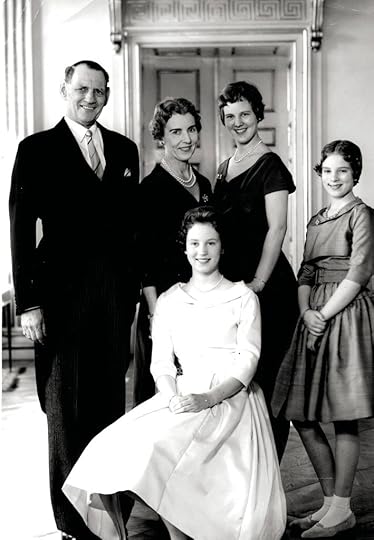 Princess Benedikte on the day of her confirmation in 1959.
In March 1967, at the age of 22, Princess Benedikte became engaged to His Highness Prince Richard zu Sayn-Wittgenstein-Berleburg. The couple had met at the nuptials of Princess Beatrix of the Netherlands to Claus von Amsberg in Amsterdam the previous year. Their marriage was celebrated in Fredensborg Palace Church on 3 February 1968. After the wedding, the couple lived in a house in the grounds of the impressive Schloss Berleburg in the north-western German town of Bad Berleburg, some six hundred kilometres south of the Danish/German border. The Schloss has been described as the ‘jewel in the crown of Germany’s most forested region.’ Wildlife, including deer, abound in the surrounding 13,000 hectare estate. It was all so different from Denmark. Unlike her sister, Anne-Marie, who resigned her right to succeed to the throne on her marriage to King Constantine of the Hellenes in 1964, Princess Benedikte remained in the line of succession. This was ‘a great wish’ of both King Frederik and Crown Princess Margrethe. As Benedikte recalled it, ‘I knew from the start that I would have these two lives.’
 Princess Benedikte, Prince Richard and royal guests on their wedding day at Fredensborg Castle.
 The birth of Crown Princess Margrethe’s children, Frederik (now King Frederik X) in 1968 and Joachim in 1969, underlined the fact that Benedikte’s role would now be to support the sovereign. An ideal niche was her ability to act as a Counsellor of State if both the King and the Crown Princess happened to be out of the country or were otherwise indisposed. This was not a particularly demanding role (and included signing documents and holding audiences) but it provided Benedikte with a link with her homeland which might otherwise not have been there. It was fortunate that the Princess-like her mother Queen Ingrid-was disciplined in her way of living and working, as this enabled her to juggle her role as a wife and (later) mother at Berleburg, whilst also travelling once a month to Copenhagen (where she maintained an apartment at the Amalienborg) to undertake her official duties. Over the years, these visits would increase both in terms of frequency and duration.
Nevertheless, during the early years of her marriage to Richard, Benedikte’s primary role was very much that of a wife and a mother. In January 1969 , the Princess gave birth to a son Gustav in Frankfurt. The following year she gave birth to a daughter Alexandra and, in May 1975, to a second daughter Nathalie (both girls were born in Copenhagen and they would become Danish citizens in 1998). Benedikte’s relationship with Prince Richard was excellent. They were in many ways opposites and the perfect foil to each other. He tended to be outgoing and outspoken and was not adverse to raising his voice. Conversely, as Queen Margrethe has reflected, ‘My sister never raises her voice.’ Benedikte was also more tactful. Prince Richard was also very proud of his capable wife, who put her wonderful organisational skills to work as hostess at the many large shooting parties which were held at Berleburg. She socialised with the many guests, devised the dinner menus, arranged the table decorations and coordinated the seating plan. The Prince understood too, from the outset, that Bendikte would lead a sort of “double-life” and never resented her royal duties or periods spent in Copenhagen. In turn, Richard would teach his wife all about antiques (for he was an enthusiastic and knowledgeable collector) and like any other married couple they would attend auctions together and browse antique shops.
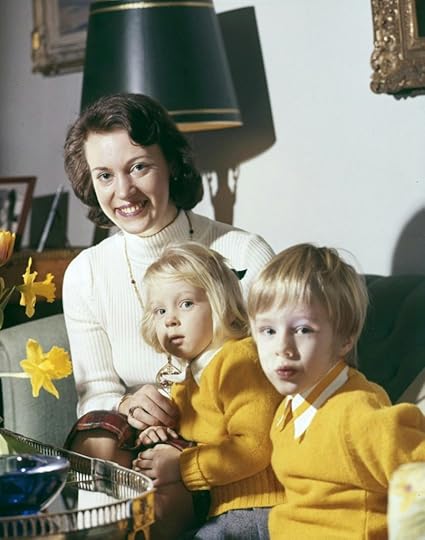 Princess Benedikte with her elder children Alexandra and Gustav at Berleburg.
 The death of King Frederik in January 1972 was a sad blow for Benedikte. He had been visibly frail for some time. With Margrethe’s children still toddlers and Queen Ingrid adjusting to a new life without her husband, Benedikte was a great support to the new Queen Margrethe II and was able to carry on with her duties as a Counsellor of State.
With the passage of time and other commitments permitting, the Princess has undertaken a plethora of engagements throughout Denmark. These increased following the death of her beloved mother, Queen Ingrid, in November 2000, as Benedikte would now assume many of her patronages. As she has previously revealed, ‘I was brought up to believe duties are not a burden but a joy.’ One can sense the influence of Queen Ingrid in that comment. The Princess is currently Patron or Chairman or Honorary Member of nearly fifty organisations in her homeland, and describing each of these in detail is beyond the limits of this article but it includes social, cultural, health and sport issues. However, here is a flavour of her involvement:
The Princess has always displayed a strong commitment to equestrian sports for she both owns and breeds throughbred horses. She is Patron of the Danish Equestrian Federation; Danish Warmblood Association (which is responsible for the breeding, selecting and sales of young horses) as well as Hestens Vaern (which deals with the wellbeing and welfare of horses). She is also involved with the World Breeding Federation for Sport Horses. 2022 was to prove a spectacular year for Danish equestrian sport: At the World Equestrian Championships which took place in Herning in August, the Princess, who was Patron of the event, was overjoyed when the Danish team won a total of ten medals, five of which were gold. Princess Benedikte was also able to proudly present the Lis Hartel’s Memorial Award to her daughter Princess Nathalie, who coached the Danish dressage team. To celebrate the medal wins, Benedikte held a party at the Amalienborg’s Christian VII Palace the following month for organisers, volunteers, and riders including the Danish dressage star and gold medallist, Cathrine Laudrup-Dufour.
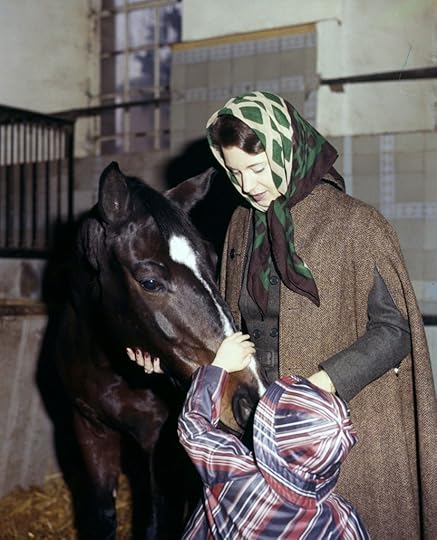 Princess Benedikte with foal and child (probably Nathalie) at Berleburg.
 Princess Benedikte is a long-time patron of the Alzheimer’s Association in Denmark and invariably presents the association’s annual Research Prize. The event is often serenaded by a “Dementia Choir.” The Association is involved in providing advice to sufferers, their families and carers. It also undertakes research into why dementia occurs, as well as examining new methods of treatment and care. On-line forums have also been introduced. In recent years, the Princess has opened a dementia-friendly garden and participated in a “dance-to- remember” event in Roskilde.
Her Royal Highness is also interested in work among the young and vulnerable. Four years ago she took a role as Patron of Hellebro which provides accommodation, welfare facilities, residential training and work experience opportunities for the homeless. On one occasion, the Princess visited the organisation at Christmastime and kindly arranged for the St. Annæ Girls’ Choir (of which she is also Patron) to provide a choral selection as part of the Saint Lucia celebrations which features a procession of candle-bearing young women dressed in white, all of whom are led by a young “Lucia bride” wearing a crown or garland of candles. Non-alcoholic mulled wine and nibbles were served and by the time Her Royal Highness departed, everyone seemed uplifted.
The Princess also has a long association with the Scout movement, as did her late mother Queen Ingrid, whom she succeeds. A keen girl scout in her youth, she is patron of the Girl Scouts, as well as of the Danish Scout Corps. Benedikte is also involved with the World [Girl] Guide Foundation and has, since 1984, been a board member of the Olive Baden-Powell Society (named after the wife of the founder of scouting, Lord Baden Powell) which oversees strategies for the advancement of Girl Scouting and Girl Guiding worldwide. In 1993 the World Association of Girl Guides and Girl Scouts presented Princess Benedikte with their prestigious Silver Medal for outstanding service. Furthermore, on her 70th birthday she was featured on a Danish stamp wearing her scout uniform. Her Royal Highness tries to attend local camps and the Princess Benedikte Award is given out annually, in her honour, to generous benefactors.
In recent years, the Princess, as Patron of the Association for Eating Disorders and Self Harm (a patronage she has held since 2001) has become greatly concerned by ‘the prevalence’ of eating disorders and attempts at self-harm. She puts this down to us being a ‘more self-centred society’ and feels that there has developed too ‘a culture of perfection’ which a lot of people find difficult to handle. She herself has participated in ‘workshops’ held in such places as a girls’ boarding school at Herlufsholm. Benedikte has also visited the Associations offices in Copenhagen’s Dronningens Tværgade and is a keen fundraiser for the organisation. Indeed, in 2020, she received a donation of DK200,000 from Danish Freemasons as they celebrated their 275th anniversary.
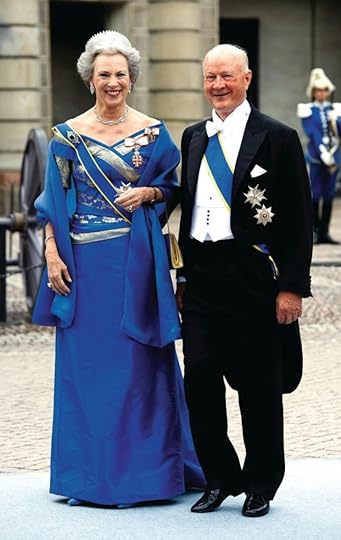 Princess Benedikte and her husband Prince Richard in Stockholm at the wedding of Crown Princess Victoria and Daniel Westling 2010.
However, Benedikte’s official work is not limited to the shores of Denmark. She has no less than ten overseas patronages. For instance, since 2001, she has been Patron of the Danish YMCA [Dansk KFUK] in London. Again, this role is especially poignant as Queen Ingrid previously held the position of Patron. The Princess has visited regularly, be it to open the Queen Ingrid’s Student Residence or to attend the annual Christmas Fayre or preside at the Centenary Celebrations. On the other side of the globe, Her Royal Highness is also Patron of The Princess Benedikte Institute (IPB), a non-profit civil association in Brazil which works with vulnerable children. In October 2019 she travelled to Curitiba, a city of around two million in the south, to inspect the organisations new headquarters which, in addition to administrative offices, also provides care and accommodation for around twenty children, up to the age of ten, who are awaiting court decisions on guardianship or adoption. These youngsters are often victims of mistreatment, sexual violence and or have serious impairments. The Institute also champions the rights of children and adolescents.
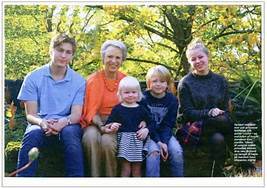 Princess Benedikte and grandchildren 2017
Following the death of Prince Richard in March 2017, at the age of 82 (he was said to have been suffering from skin cancer), Benedikte’s son Prince Gustav took over the running of Berleburg Castle and the estate. Gustav was in a long-term relationship with Carina Axelsson and the couple would go on to marry in June 2022. A son, Gustav Albrecht was born in May 2023 in the United States to a surrogate mother with both parents present during the birth. He is Benedikte’s fifth grandchild.
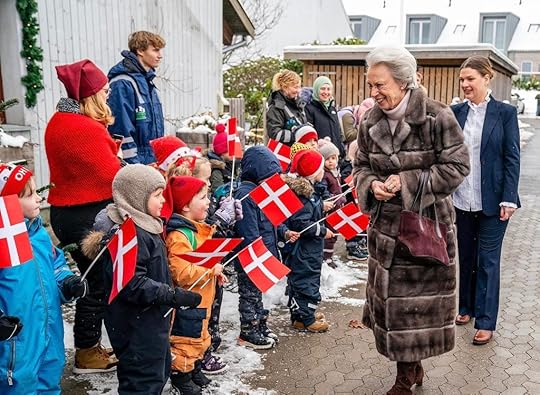 Princess Benedikte attends the 50th Anniversary Celebrations of the Princess Benedikte Nursing Home at Fredensborg.
 Benedikte was the first of the three Danish royal sisters to be widowed (Margrethe lost her husband Henrik the following year; while Anne-Marie’s husband, King Constantine died in January 2023). When not in Denmark, she again occupied the house in the grounds of Berleburg Castle where she had first lived following upon her marriage to Richard. The Princess has reflected on the fact that she had ‘a nice and happy marriage’ but has also conceded that for all her love of married life at beautiful Berleburg ‘if I had not also had Denmark and Copenhagen, it would have been more difficult for me, I think.’ It had certainly given her experience of living for spells on her own. Nonetheless, she naturally misses her husband greatly, especially being able to share some ‘fun experiences’ and to discuss things with.
For a period the Princess had been involved in breeding horses with her daughter Nathalie at Berleburg. The latter is a professional dressage rider and trainer who, until her divorce in 2022 was married to horse breeder Alexander Johannsmann. She has competed for Denmark in the Olympics, winning two bronze medals. Nathalie lives in the West Wing of Berleburg Castle with her children, Konstantin (born in 2010) and Louisa (2015). Benedikte has often dropped by for meals and to catch up with her grandchildren. She is particularly amused that Louisa has recently become interested in football; while Konstantin is a devotee of handball.
Meanwhile, Princess Alexandra currently lives with her second husband Count Michael Ahlefeldt-Laurvig-Bille on his family estate at Egeskov Castle on the Danish island of Funen. The couple married in 2019. She has two children (by her first marriage to a German nobleman, Count Jefferson von Pfeil und Klein-Ellguth) Richard (born in 1999) and Ingrid (2003). Princess Benedikte is a frequent visitor to Egeskov and has spent Christmas there in recent times.
Although the Princess intends to celebrate her birthday privately with family and friends, her diary has been busy over the past few weeks, as many of the organisations with which she is involved have sought to commemorate this milestone 80th birthday. On 19 April a birthday dinner was held at Sølyst in Klampenborg. Seventy guests attended and the event was organised by Friends of Dressage and the other equestrian organisations of which Benedikte is Patron. Then, a few days later, Her Royal Highness was guest-of-honour at a concert by the Saint Annæ Girls’ Choir who were celebrating their 50th anniversary. The Princess has a long-standing connection with the choir and was a treated to a selection of well-known Danish songs. However, the event which literally moved her to tears, was the opening of an exhibition, “Princess’ Dresses” at the Koldinghus Museum in Kolding, Jutland. Twenty of the Princess’ dresses were placed on show (including Benedikte’s wedding dress [over which she lingered for some time] and a maternity dress). Most of the costumes were designed by the Danish designer Jørgen Bender, who also counted Queen Ingrid and Queen Margrethe as esteemed clients. Her Royal Highness is the Honorary Custodian of Royal Danish Collection Koldinghus. Also attending the opening with her were Princess Benedikte’s cousin Count Ingolf of Rosenborg and his wife Countess Sussie.
 Princess Benedikte attends the Princess’ Dress event at Koldinghus Museum in Jutland.
On 2 May, Princess Benedikte will hold a reception in the Great Hall of Rosenborg Castle for representatives of the many Danish (and overseas) organisations with which she is affiliated. There is no sense of an easing of the pace and the Princess has recently appointed a new lady-in-waiting Countess Mette Ahlefeldt-Laurvig to help assist her as she undertakes official engagements. They both share a love for all things equestrian. This appointment is also a sure sign that the Princess intends to carry on with her royal duties. Indeed, in a recent interview with newspaper Billed Bladett, Benedikte indicates that she hopes that there is still a need for her to still participate in the royal round. Certainly, there is no indication that her nephew, King Frederik X, has any intentions of not allowing his beloved aunt to continue in her current role. Why would he? The Princess also revealed that she now lives permanently in Denmark in her apartment at Christian VIII Palace at Amalienborg. Benedikte’s Copenhagen home is filled ‘entirely of things that have been in my parents’ home’ and the Princess makes use of her late mother’s desk when undertaking her administrative tasks relating to her official life. She firmly believes that ‘You have a duty to take care of the furniture you have inherited.’ Of course, she will still return to Berleburg from time to time and she currently spends a month there in the summer, when there is a three-day festival on the estate. Up to 7,000 people attend and they can participate in clay pigeon shooting, dancing, listening to music and beer drinking.
On almost the eve of her 80th birthday, Princess Benedikte has been thrilled to learn that her daughter Nathalie has lately been ‘overwhelmingly’ elected to the board of the Danish Equestrian Federation. When making her representations for the post, Nathalie admitted that ‘I can get a little angry sometimes, it comes from my dad. But my diplomacy – I got that from my mother.’ Diplomatic skills are certainly useful for the daughter, sister and aunt of reigning Danish monarchs, past and present.
As she reflects on a long life well-lived, Princess Benedikte will draw strength from her Christian faith which she regards ‘as a firm ground to stand on.’ Although not a regular church goer, she admits to enjoying the services and ‘our lovely Danish hymns.’ She praises too the role of women priests and bishops today. They now make up the majority of the ordained priests in Denmark.
As one assesses the Princess long life, one is conscious of a life of devotion to family and to her homeland. Her sense of duty remains as strong as ever, as does her determination to undertake her duties to the best of her ability with a speech well-researched and written, the facts and the faces of the organisations she is visiting at her fingertips. Of the three sisters, it is in Benedikte that one sees so much of her highly-organised, well-dressed and demure mother Queen Ingrid. Certainly, Queen Margrethe has openly stated in an interview with Kristeligt Dagblad in 2019. that ‘Benedikte is really the most royal of us all.’ Happy Birthday Princess Benedikt and many more of them.
 Princess Benedikte with the new King and Queen of Denmark and her sister Queen Margrethe at Fredensborg. Margrethe was celebrating her 84th birthday.


April 13, 2024
Duke of Kent’s Wartime Visit to Canada
In late July 1941, Prince George, the Duke of Kent and youngest brother of King George VI commenced a six-week visit to Canada primarily, but not exclusively, to visit airfields which formed part of the British Commonwealth Air Training Plan (BCATP). The scheme which drew personnel from Britain, Canada, Australia and New Zealand-and was expanded following the fall of France in June 1940-would ultimately be responsible for the training of an estimated 131,553 Allied aircrew. Most of the training was undertaken in Canada and required the building of new air bases or the upgrading of existing facilities throughout the Dominion. The scheme was administered by the Canadian government and Royal Canadian Air Force (RCAF) with input from the Royal Air Force (RAF). His Royal Highness was accompanied for much of the trip by his Private Secretary, Lieutenant John Lowther, as well as Flight Lieutenant P.J. Ferguson and Group Captain Sir Louis Greig. The latter was a courtier of many years standing, as well as a friend of King George VI. Greig was currently assigned to the Air Ministry. Also in the party were the Duke’s valet and a Scotland Yard detective, Inspector Evans. Wartime restrictions meant that Prince George was permitted to take only two suitcases and a haversack with him for the long trip. The Prince was no stranger to Canada having visited the Dominion with his eldest brother, the Prince of Wales in 1927 to celebrate the Diamond Jubilee of the Confederation of Canada. In addition, he had visited Canada alone (including Ottawa) in 1926 and is said to have paid another (private) visit in 1928.
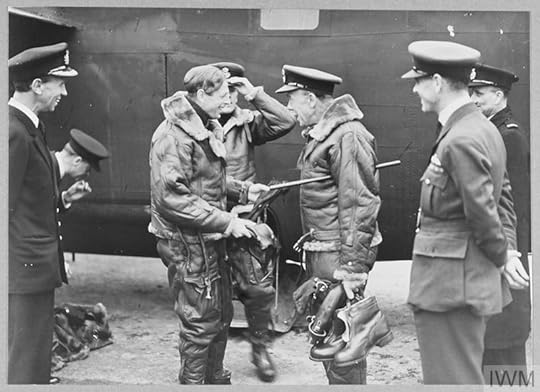 DUKE OF KENT LEAVES FOR CANADA (CH 3162) Original wartime caption: HRH the Duke of Kent in his flying kit, talking to his equerry, Wing Commander Sir Louis Greig, before the take off. Copyright: © IWM. Original Source: http://www.iwm.org.uk/collections/item/object/205444075
According to the diaries of the Canadian Premier, William Mackenzie-King, George VI himself was the driving force behind the visit, His Majesty being ‘quite decided’ on the matter. Indeed, the Canadian Prime Minister’s diary entry of 11 July states that the Governor-General of Canada, Lord Athlone, informed Mackenzie-King that ‘he thought the King himself had put it forward to give the boy something to do.’ Athlone opined too that ‘the British had approved the project but [he] thought that the suggestion should come from Canada.’ Mackenzie-King demurred and told Athlone (the youngest brother of Queen Mary and uncle of Prince George), that ‘if the Duke of Kent came we would, of course, welcome him cordially.’ Yet, he ‘did not feel, however, [that] I should make a suggestion..’ Ever the politician, Mackenzie-King ruminated that he would be bound to be asked questions as to ‘why I had invited him’ in the Canadian Parliament ‘and [he] did not feel’ that he ‘would be in a position to answer the question satisfactorily.’ More specifically, the reason for his lukewarm attitude towards the proposed visit was subsequently confided by Mackenzie-King to his diary on 17 July: ‘It looks to me like something cooked up between [the Canadian High Commissioner in London, Vincent] Massey and the Palace, something about which the Brit[ish] Govt. nor my own are particularly keen about.’ It must be mentioned that the Canadian Prime Minister was a complex character and his nose was undoubtedly put out-of-joint as a result of what he regarded as a lack of consultation with the government in Ottawa on the part of both Buckingham Palace and Vincent Massey. Even if such soundings had taken place, it is doubtful if Mackenzie-King would have been keen. Furthermore, there was another major factor in the equation, something which indubitably upset Mackenzie-King’s equilibrium: the Duke of Windsor (the former King Edward VIII, eldest brother of Prince George and now Governor of the Bahamas) had also recently made a request to visit Canada, where he owned a ranch in Alberta. The Canadian Prime Minister informed the British High Commissioner in Ottawa, Malcolm MacDonald, that he rather wished that the Duke of Windsor should not come at all but, if he did, Mackenzie-King reasoned that ‘they [the two royal dukes] certainly should not be here at the same time’ as ‘this would give rise to many questionings and might give rise to serious embarrassment.’ Fortunately, the visits of both royalties were scheduled so that they did not overlap. After meeting and entertaining the Duke of Kent, the Canadian Prime Minister then planned to take himself off to England for a visit with Winston Churchill and to pay his respects to Queen Mary at Badminton.
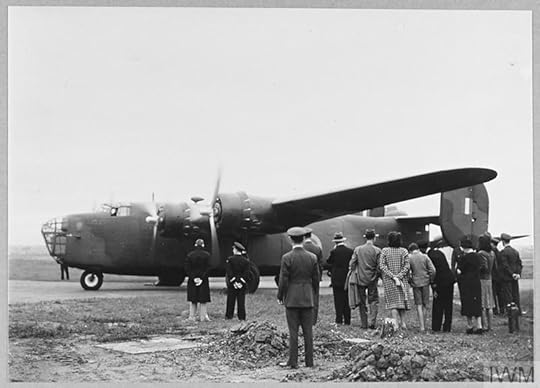 DUKE OF KENT LEAVES FOR CANADA (CH 3160) Original wartime caption: The American-built ‘Liberator’ with the Duke aboard, about to take off. Copyright: © IWM. Original Source: http://www.iwm.org.uk/collections/item/object/205444074
Meanwhile, Prince George and his party flew overnight from Prestwick Airport in Scotland to Rockcliffe Airport, Ottawa in a Consolidated Liberator Mark I bomber, AM261, of Royal Air Force Ferry Command, arriving at around 10am on 29 July (after a brief stopover in Montreal for breakfast). The royal visitor was welcomed at Rockcliffe by the Governor-General and the Prime Minister. During a conversation over lunch at the Governor-General’s residence, His Royal Highness admitted to Mackenzie-King that the air journey had been cold and uncomfortable. The Duke joked that although he had been given an electrically heated flying suit, there had been no where to plug it in! The Canadian premier, meanwhile, thought Prince George appeared, ‘pretty tired and nervous.’ For their part, the Canadian press were impressed that the Duke was the first member of the British Royal Family to make a transatlantic flight.
 The Duke of Kent answers questions from the press on arrival in Ottawa, 29 July 1941
Whilst in Ottawa, Prince George stayed with his “Uncle Alge” [the family name for Lord Athlone] and his wife “Aunt Alice” [Princess Alice, Countess of Athlone, the redoubtable granddaughter of the late Queen/Empress Victoria] at Rideau Hall, the Governor-General’s official residence. Also present in the happy family group were the Athlone’s daughter (and therefore the Prince’s first cousin) Lady May Abel Smith accompanied by her children. They were currently living in Ottawa. On the evening of 30 July, an official dinner of welcome, attended by seventy guests, was held by the Canadian government in Prince George’s honour at the Country Club in Ottawa. Mackenzie-King was seated between His Royal Highness and the Earl of Athlone and complained that neither was ‘easy to talk to.’ Earlier that day, the Duke had visited the Headquarters of the Royal Canadian Air Force, travelling through the crowd-lined streets of the Canadian capital in his official Buick with police outriders in attendance. Prince George ensured that he waved to the onlookers and this drew sporadic cheers from the “side walks”.
 The Duke of Kent drives through the streets of Ottawa, the Canadian capital.
 The following day, Prince George was also able to watch a group of Australian and Canadian pilots as they trained at The Royal Canadian Air Force [RCAF] No.2 Flying Service Training School at nearby Uplands. The visit lasted nearly four hours and the Chief of the Air Staff personally greeted the royal visitor, as did a Royal Canadian Air Force Band who provided the Royal Salute, followed by a rendition of “The Thin Red Line”, during which His Royal Highness inspected the Guard of Honour. The Duke then toured the Motor Transport Section, the NCO’s quarters and mess, the swimming pool, the hospital, the airmen’s mess and a barrack’s block. He later had drinks in the officer’s mess before lunching in the dining room where new side boards had been provided and decorated, according to the station daily log, by a ‘profusion of flowers.’ Prince George was placed at the centre of the top table. His Royal Highness subsequently toured the Ground School, the aircraft hangers and the control tower. Each of the airman or ground staff with whom the royal visitor spoke was asked their name, how long they had been in the service, and if they were enjoying it. Some of the airmen were even questioned about night flying. While earlier reviewing the Guard of Honour, His Royal Highness’ sympathy went out the men who were clad in the heavy regulation uniforms. He paused by Aircraftsman J.E.R. Nadon and asked, “Are those uniforms hot?” Nadon is reported to have replied, “Not too bad sir.” On departing, Prince George mentioned to his Canadian hosts that he had, been ‘impressed by the efficiency of the [Uplands] Maintenance Squadron’. That same day, he also made a tour of RCAF Rockcliffe, going through much the same operation as at the Uplands airbase. The combined tour of both of these bases amounted to seven hours in total. In the evening, an official dinner was hosted by Lord Athlone at Rideau Hall.
On 1 August, after touring the Gatineau Hills, the Duke was able to watch summer air manoeuvres by some of the many trainee pilots he had previously met at Uplands and Rockcliffe. The trainee pilots were apparently ‘picking up flying time lost during last two weeks’. The latter may have been partly due to the shooting of a Hollywood “movie” by Warner Brothers at nearby Pendleton Relief Field. This included several flying sequences, including one involving an impressive thirty-six aircraft. In the evening, the Duke enjoyed a picnic supper, with Mackenzie-King as host, during a visit to the Prime Minister’s private estate at Kingsmere Lake.
On 2 August, Prince George flew southwards to inspect RCAF Trenton, the largest air facility in eastern Canada and home to No. 1 Composite Training School [No. 1 KTS]. He was introduced to participants of the Aircrew Squadron and Disciplinarians Course. Thereafter, the Duke flew on to make an afternoon inspection of the No.1 Service Flying Training School [SFTS] at Camp Borden, said to be ‘the birthplace’ of the Royal Canadian Air Force. He ‘toured the various units’ before enduring yet another “meet and greet” session in the officer’s mess. On 3 August, after attending a Sunday morning church service with the Athlone’s, the Duke of Kent flew out from Ottawa to Winnipeg ‘on the first lap of the western section of his tour’. Mackenzie-King, confided to his diary that ‘I think the Duke’s visit, as far as Ottawa is concerned, has gone off very well.’ Praise indeed! The Prince landed at Stevenson Airport, Winnipeg and proceeded to Government House to spend the night. ‘Several hundred spectators’ lined the route of the motorcade. His Royal Highness was entertained to dinner by the Lieutenant-Governor and Mrs McWilliams. It was also at this juncture that it was announced that His Royal Highness would travel to the United States on 23 August to visit President Roosevelt at his private country estate.
 The Duke of Kent at RCAF Trenton before flying to Camp Borden 2 August 1941
On 4 August, a day of high winds which curtailed many training flights, the Duke flew from Winnipeg to Regina, Saskatchewan to pay what the press described as ‘an unexpected visit’ to No.15 Elementary Flying Training School [EFTS]. The stopover was brief, lasting merely 45 minutes. Nevertheless, a Guard of Honour was hastily arranged (and duly inspected) and the Duke also found time meet ‘civil leaders’ and talk with a group of Americans who had enrolled in the Royal Canadian Air Force. That same day, the Duke and his party then flew into RCAF Calgary (Lincoln Park) home of No. 3 Service Flying Training School, where the local Mayor was introduced to His Royal Highness, who also made time speak to a member of the Guard of Honour prior to touring the facility. Prince George later visited the nearby No. 2 Wireless School [WS]. The station diary notes that the Duke made a thorough visit of the Station Hospital where he insisted on speaking to each of the patients. After a visit to the officers’ mess, the royal party departed Calgary for a few days rest in the Canadian Rockies.
 The Duke of Kent makes an inspection of the Guard of Honour at RCAF Calgary.
 By 6 August, Prince George was feeling rested enough from his stay at the mountain resort of Banff in Alberta to spend many hours ascending nearby Sulphur Mountain. The following day he also climbed the 9000-foot Rundle Mountain. Whilst staying at Banff he was introduced to two members of the indigenous First Nation community, Chief Charlie Bear Paw and Chef Waving Feather. The Duke subsequently travelled to Vancouver where he spent an hour inspecting facilities at the airport. Thereafter, it was onwards to Vancouver Island where he toured the RCAF base at Patricia Bay (home to 32 Operational Training Unit). The OTU, as it was referred to, was the ‘last stop’ for aircraft crew in their training protocol.
His Royal Highness subsequently had a meeting with Major General Ronald Alexander, General Officer Commanding, Pacific Command at his headquarters at Esquimalt Fortress. Naturally, Prince George could not make a visit to the Island with visiting Victoria, the capital of British Columbia where, on 8 August, he visited the imposing Parliament House and posed for photographs at Government House with his hosts, the Lieutenant-Governor, Eric Hamber and his wife Aldyen. The Duke later flew over to Richmond, just south of the city of Vancouver, to tour the Boeing aircraft plant, as well as to visit RCAF Station Sea Island, the location for No. 8 Elementary Flying Training School. According to the station diary, “Air Commodore Kent”, inspected both trainees and flying instructors, before ‘thoroughly’ touring the air station.
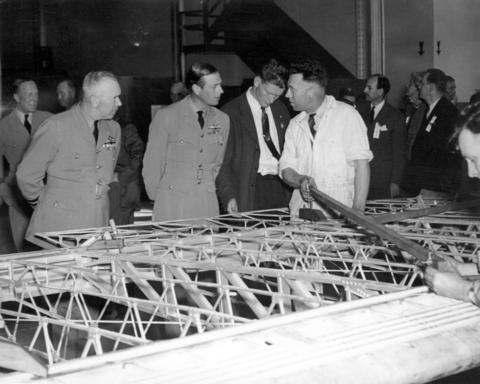 Duke of Kent tours Boeing aircraft plant near Vancouver August 1941
Thereafter, on 10 August, Prince George motored to nearby Vancouver, to undertake a tour of Burrard Dry Dock where Bangor Class Minesweepers were being built for the Royal Canadian Navy. His Royal Highness also toured the neighbouring North Van Ship Repair Yard, which had just been re-tooled so as to construct minesweepers, at the behest of the Canadian government. Three new launch ways had recently been built at this site and the Duke was given ample opportunity to inspect the facilities. It is clear from local photo archives that His Royal Highness made time to speak to many of the shipyard workers, as well as some war veterans from World War I. It so happened that the Prince was keen on naval history (having previously served in the Royal Navy as a midshipman) and he was Patron of the Society for Nautical Research. Prince George also met with patients at the recently-built Shaughnessy Military Hospital in Oak Street. News of his visit soon reached locals and as he prepared to depart in his open-topped official limousine, he was surrounded by a large crowd. Thereafter, the Duke made a short visit to Jasper in Alberta where he dined privately with Charles E Hughes, a retired Chief Justice in the United States.
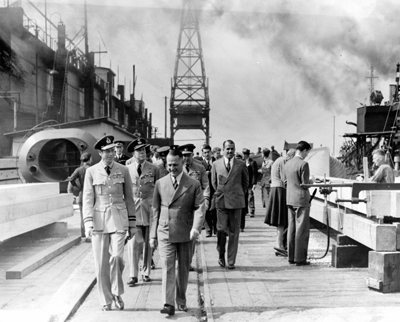 Duke of Kent visit Burrard Dry Dock, Vancouver, British Columbia.
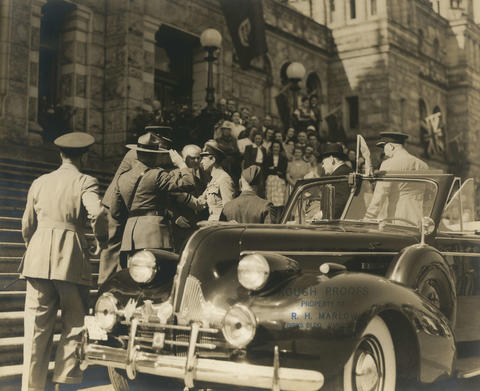 Duke of Kent arrives at Parliament House, Victoria on Vancouver Island.
 The Prince then made for nearby Edmonton. He was cheered by thousands as the royal motorcade advanced through the streets of Alberta’s capital city. The welcome was described in the diary of RCAF Edmonton for 13 August as the ‘ the most spontaneous and enthusiastic greeting yet received on the tour.’ The Duke first visited the No. 2 Air Observer Corps [AOS] where he toured classrooms at the Radio Technical School. He then inspected No. 16 Elementary Flying Training School where, after signing the register in the Administration Building, he spent a considerable time watching the trainee pilots taking off and landing. Prince George also questioned the officers, trainees and mechanics and other ground staff during a subsequent tour of the radio room, the hangars and the officers’ mess. His Royal Highness was then introduced to Mr Thomas Bull, a veteran of the Great War. Interestingly, Mr Bull had at one time helped with the construction of a summer house in the garden at Windsor Castle and he was keen to know if the building was still standing. The Duke was pleased to confirm that this was indeed the case, it currently being used by the King and Queen. On departing, His Royal Highness praised the ‘speedy expansion’ of the Air Training Plan.
On the morning of 14 August, the Duke paid a visit to RCAF Medicine Hat, Alberta (home of No. 34 Service Flying Training School), arriving in a Lockheed Hudson Aircraft. Somewhat unusually, he first attended a Civic Reception in the Town Hall before making a ‘thorough’ inspection of the Guard of Honour of one hundred airmen. The station diary keeper notes that His Royal Highness made time to speak to around twenty-five of the Guard. Starting his tour in the “Station Sick Quarters”, Prince George’s tour of inspection encompassed ‘practically every building.’ Prior to taking lunch in the Officer’s Mess, His Royal Highness was happy to pose with many of the airmen to have pictures taken. Lieutenant Lowther later wrote a letter of thanks to the Commanding Officer, Group Captain Ellis, stating that ‘His Royal Highness was greatly impressed with all he saw..’ and sent ‘his warmest congratulations on the efficiency of No. 34 Service Flying Training School.’ It was just the sort of morale boost that was needed.
In the afternoon, His Royal Highness flew on to No. 32 Service Flying Training School at Moose Jaw, Saskatchewan. The facility had recently been expanded to enable the Allied airmen to spend around sixteen weeks learning to fly Harvard and Oxford aircraft. The Duke was entranced by all he saw and spent a ‘considerable’ time up in the ‘watch tower.’ He later visited the No. I Aircraft Hangar, the Ground Instructional Block, a barracks block, the Drill Hall and the Station Hospital, where he spoke to many of the patients. Word of the royal visit had clearly reached the local population and so His Royal Highness made time to go over and speak to a crowd that had gathered just outside the air station boundary fence prior to entering the officer’s mess to take tea. The Mayor of Moose Jaw and the Town Clerk had also arrived and were formally received by Prince George. The party then left for RCAF Regina (his second visit) where he landed at 7.30pm and spent the night at Government House. During this brief stopover, His Royal Highness was able to meet up with Flight Lieutenant Robert Leavitt, who had spent a week, in May 1940, piloting the Duke in his Hudson aircraft over the north of France. Leavitt had only recently been awarded the Distinguished Flying Cross for reconnaissance work over Norway.
On 15 August, the Duke left RCAF Regina at 9.30am to fly to the No. 12 Service Flying Training School located at RCAF Brandon in Manitoba. The royal party arrived in good weather at 11am prompt. No Guard of Honour was deemed necessary. Nonetheless, the diary of the air station shows His Royal Highness inspected fifty ‘Security Guards’. He subsequently toured the Maintenance Hangar and the hospital and paid a visit to the officer’s mess to be introduced to each officer in turn and to enjoy an ‘informal’ lunch. By 13.30 he had left to inspect the No. 2 Manning Depot for new recruits located nearby. This was a most thorough affair, lasting an hour and included touring the barracks, the athletic grounds and watching a demonstration of the different stages of the training of new recruits, be it in rifle drill, foot drill, marching, saluting or other routines. The royal visitors then returned to the main Brandon airfield to fly eastwards to RCAF Carberry, home of No. 33 Service Flying Training School to participate in the ‘great event’ of the day, the “Wings Parade” at which the sixty-three Graduate-Pilots of the out-going course received their flying badges. Although the visit was only to have been a brief one, Prince George insisted on pinning the Emblem on each of the graduates.
 The Duke of Kent at Government House, Winnipeg with the Lieutenant-Governor of Manitoba and Mrs McWilliams
 The Duke of Kent during his tour of Hawker Hurricane production line at the Canadian Car and Foundry at Fort William, Ontario.
 The Prince next progressed to RCAF Winnipeg, the home of No. 5 Observer Corps (OC) and temporary home to No. 14 Elementary Flying Training School. The Duke was asked to present the Starratt Memorial Trophy to the most outstanding trainee of the flying school. He also met with the other trainees, instructors and officers and was also introduced to civilian pilots attached to the Winnipeg Air Observer School Ltd. Thereafter, the Duke enjoyed a few days free of duties at the summer home of the late E W Kneeland, a wealthy Winnipeg grain merchant, at Lake of the Woods Island near Kenora, Northern Ontario. From there, he paid a visit to the RCAF Fort William early on the morning of 19th August, where he inspected new barracks block, a recreation room and some storage buildings. Subsequently, Prince George visited the Canadian Car & Foundry Hawker Hurricane production line which was situated close-by. The plant also built Sea Hurricanes, described as a ‘navalized version’ of the Hurricane. The royal visitor was pictured for posterity talking to both men and women on the assembly line. This sent out an important message to the world, as women were now increasingly in war production in Canada, the United States and in Britain too. Thereafter, the royal party made a tour of the shipbuilding yard of the neighbouring town of Port Arthur before departing by plane for Porquis.
 The Duke of Kent with a Bren gun during his visit to John Inglis munition factory near Toronto, 21 August 1941.
 The Duke of Kent reached Toronto on the evening of 20 August to be greeted by crowds lining the streets as he arrived to dine with the Lieutenant Governor of Ontario and Mrs Matthews in the Vice-Regal Chambers of Parliament House. Next morning, His Royal Highness paid a ninety-minute visit to the John Inglis munitions plant where he was pictured inspecting a Bren gun (the plant was one of the main producers of this item). He also paid a visit to No. 1 Initial Training School of the RCAF at Eglinton in nearby Scarborough where, in addition to speaking to flying officers, he inspected the kitchen and spoke to the chef for His Royal Highness was constantly concerned about the welfare of those serving in the military. There was also rumoured to be a secret RCAF research facility at this site, though whether Prince George visited that establishment remains unclear. The Duke also made a visit to the De Havilland aircraft factory at Downsview Park, Toronto where the legendary Tiger Moth training plane was constructed, as was the twin-engine Mosquito combat aircraft. Both these aircraft were vital to the success of the Allied cause and this morale-boosting visit was just what was required.
 The Duke of Kent at the munitions plant of John Inglis and Co. Oshawa, Ontario. 21 August 1941
On 22 August, the Duke of Kent was present at the opening of the Canadian National Exhibition in Toronto. He made a speech to those attending in which he stated that ‘We are determined and confident that these temporary clouds shall pass and that much better days are to come for all classes of people. The knowledge that Canada is producing an ever-increasing volume of necessary weapons of war is a constant inspiration to the never-flagging courage of our people.’ At this time, Prince George also visited No.1 Manning Depot for RCAF trainees which was located on the National Exhibition site: He spoke to one of the workers in the YMCA canteen, a Mrs J. H. Domine about her work and welfare.
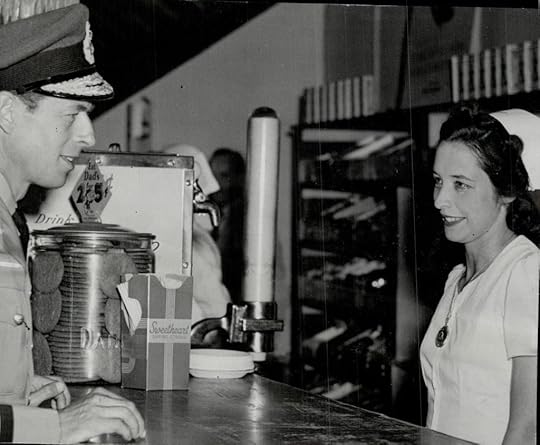 The Duke of Kent speaks to a Mrs Domine during a tour of the canteen at No.1 Manning Depot, Toronto.
 The following day, the royal entourage visited RCAF Oshawa, to open the No. 20 Elementary Flying Training School. The Duke was taken to a reviewing stand at the Parade Square and after speaking to officials, he was asked to declare the flying school ‘open’ which he duly did in a ‘short but well-delivered speech.’ Thereafter, he inspected the ‘pupil-pilots’ and their instructors, expressing his ‘admiration for the appearance of all ranks.’ Prince George then inspected motorised military equipment currently being produced at the General Motors Company plant nearby. Whilst there, he had the chance to meet a group of military veterans. He later returned to RCAF Oshawa to change into civilian dress for his flight to La Guardia Airport in New York. Before departing, the Duke presented his chauffeur for the last few days in Toronto area, Sergeant Earl Baxter, with a pair of cufflinks bearing his distinctive royal cypher.
After a brief stopover in New York, the Duke of Kent travelled onwards to stay with President and Mrs Roosevelt at their private Springwood estate, at Hyde Park, situated on the eastern shore of the Hudson River, some four miles north of Poughkeepsie. The Prince’s host took him on a tour of the new Franklyn Roosevelt Library and was keen to ensure that his royal visitor viewed an eclectic selection of the exhibits. A ‘highlight’ was the chance for a royal dip in the Roosevelt’s private swimming pool. The Duke and the President then travelled by rail together overnight to Washington D.C., arriving on the morning of Monday, 25 August. The Duke and his party then spent the rest of the day in Virginia visiting an operational unit at Langley Air Force Base, as well as touring the Navy Yard at Norfolk which was currently being expanded to better supply the combat ships that were required. At the latter he was greeted in person by Admiral Manley H. Simons, District Commander of the 5th Naval District. His Royal Highness returned to Washington to spend an overnight at the White House. A dinner was held there in Prince George’s honour (attended by eighteen guests who included his kinsman, Dickie Mountbatten and Harry Hopkins, who frequently travelled to Britain as Roosevelt’s “envoy”). That the President and the Duke of Kent had managed to spend some “quality” time together was seen as advantageous to the British cause, for with the United States not yet having entered the Second World War, the King and Churchill had been particularly anxious to sustain the “special relationship” between Britain and its long-time ally.
Meanwhile, Mrs Roosevelt had confided to the press that the Prince, like his brother King George VI ‘was very shy and thoughtful.’ Nevertheless, His Royal Highness was determined to raise Britain’s profile in wartime in the States: The following morning he was given the ideal opportunity: After a brief tour of the Presidential mansion and West Wing, the Duke paid a visit to the National Press Club where he made an upbeat speech underlining his confidence in an Allied victory. He emphasised that ‘the more material aid the United States furnishes, the quicker Britain will win’ adding that morale in his homeland ‘was good’. On a lighter note, His Royal Highness teased his hosts that he had not seen an orange or a banana for months until his recent arrival in Canada. Prince George subsequently visited Baltimore, the home town of the Duke’s sister-in-law, Wallis Warfield (whom the local Mayor insisted on calling “Our Wally”). His Royal Highness inspected bombers being built for the Royal Air Force at the Glenn L. Martin Aircraft Plant. The factory had recently been expanded due to Allies desperate need of combat aircraft such as the A-22 Maryland Bomber. During the visit, the Duke addressed some of the 13,000 workers at the plant and imparted another rousing, patriotic message, ‘You are playing a vital part in our fight. Every hour you work not only saves the lives of our men, women, and children, but brings victory nearer.’
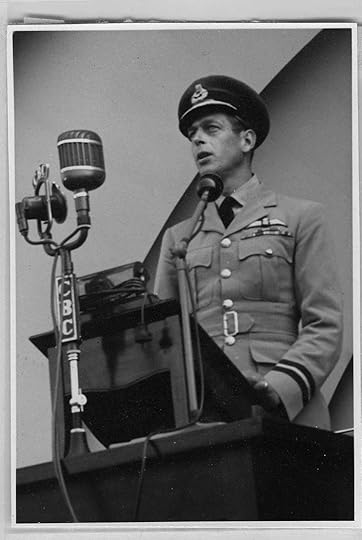 The Duke of Kent (“Air Commodore Kent”) in his RAF uniform making a speech in Canada
On 27 August, Prince George returned to Canada to visit Hamilton, Ontario, where he was greeted by cheering crowds as he visited Westinghouse’s Electric Plant. Originally a small appliance factory, the facility had been re-tooled and expanded to produce anti-aircraft guns and other components, including many for the Mosquito Bomber. In the afternoon, he paid a visit to RCAF Hamilton (Mount Hope) and spent an hour reviewing No. 10 Elementary Flying Training School. Meanwhile, at Badminton in Gloucestershire, the home of the Duke of Beaufort, and temporary wartime residence of Queen Mary, Mackenzie-King was quizzed by the Dowager Queen about the Duke’s visit. Her Majesty had been following her youngest surviving son’s trip with great interest and showed the Canadian Prime Minister a selection of newspaper clippings, including one of Prince George at Rideau Hall with the Athlones. Mackenzie-King enthused that ‘some very fine movies’ had been made of the royal tour, although he also divulged that the Duke of Kent had informed him ‘that he never liked to see himself in a movie.’
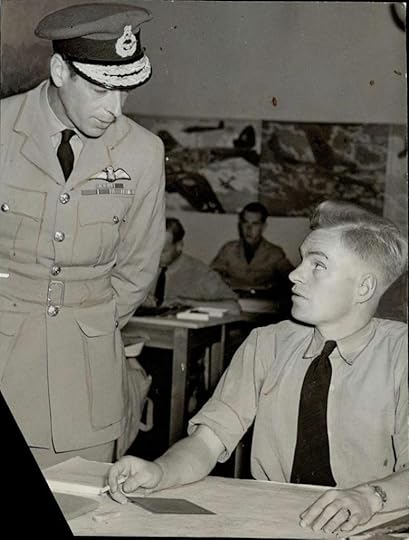 The Duke of Kent speaks to John Mack of Glasgow at RCAF St Thomas, London, Ontario.
 On 28 August Prince George was photographed with John Mack from Britain as he toured a No. 1 Technical Training School at RCAF St Thomas, near London, south-eastern Ontario. The site had a capacity to train up to 2,000 men at a time to work as skilled ground crew. The following day, His Royal Highness made an ‘unexpected visit’ to RCAF Cap de la Madeleine, the home of No. 11 Elementary Flying School. The Duke’s plane was forced to land here rather than at St Hubert, Montreal due to poor visibility. The air station diary notes: ‘Unfortunately for us the royal visitor had to be rushed to the [train] station at Three Rivers to catch the Quebec train. Consequently he didn’t have time to visit our school.’ His Royal Highness did indeed have a busy schedule as he had just visited the Fairchild Aviation aircraft at Longueuil, Quebec (where the Fairchild PT-19 training aircraft were being built) and was currently en route to Montreal for a busy schedule of engagements. These included a City Hall reception and a visit to No. 1 Wireless School at RCAF Montreal (currently housed in what had been the Nazareth School for the Blind) where the Duke was introduced to a large group of Australian and New Zealand airmen. Prince George also toured the classrooms and later lunched in the officers’ mess. The royal visitor then moved on to visit the huge Canadian Pacific Railway manufacturing and repair facility, known as Angus Shops. This depot-which was set over 1200 acres-was also now used to produce Valentine tanks for the war effort. The Duke also made time to visit the look-out at the top of Mount Royal, where he viewed a monument erected to commemorate the visit of the King George VI and Queen Elizabeth in May 1939. The Ottawa Citizen newspaper revealed that as a kindness to His Royal Highness, a Montreal department store opened specially ‘after hours’ to allow the Duke to do some shopping for his wife and family.
The New York Times revealed on 30 August that Prince George was thereafter enjoying a brief sojourn at the fashionable Quebec holiday resort of Murray Bay, east of Quebec city. However, by 2 September he had resumed his tour, arriving in New Brunswick from Murray Bay for a two-hour visit to No 8 Service Flying Training School, Moncton. This included a reception in an ante-room followed by lunch in the officer’s mess and then ‘an Inspection of the Station.’ Later that afternoon, Prince George and his party flew over the Northumberland Strait to RCAF Summerside, on Prince Edward Island. This was the base of the No. 9 Service Flying Training School. The Duke was there to inspect the new No. 2 runway and meet members of the public who had gathered there. However, 70mph winds severely restricted his interaction and had even led to his Grumman aircraft having to land on grass in the centre of the aerodrome, thus ‘ignoring the runways.’ Subsequently, His Royal Highness took tea in the officer’s mess and met members of the ‘permanent staff.’ Then, as the winds remained fierce, it was decided that Prince George would travel by car, rather than by plane, to his next engagement at RCAF Charlottetown (also on Prince Edward Island). This change in mode of transport meant that he was one-and-a-half hours late. There was an element of formality here as Members of the Provincial government were in attendance, as was the Lieutenant-Governor. Charlottetown was the home of No. 32 (Royal Air Force) Air Navigation School (ANS), as well as the No. 31 School of General Reconnaissance.
On 4 September the Duke of Kent visited Halifax, Nova Scotia where he toured Admiralty House and took the salute at a Royal Canadian Navy flypast. He also inspected the “Stad”, as the local naval barracks (official name HMCS Stadacona) were called. On the evening of 5 September, Prince George arrived at The Citadel, the Governor-General’s residence in Quebec City, where he was again entertained by his Uncle Alge and Aunt Alice. The Duke made a a tour of the nearby Valcartier Camp-home of the Canadian Infantry Training Centre. He also wrote a letter of thanks from the Citadel in his own hand to Mrs Roosevelt ‘for all your kindness and hospitality during my visit to the USA.’ The Prince had ‘enjoyed my visit to Washington so much, I only wish it could have been longer.’ He was returning home ‘next week full of wonderful impressions of what is being done over here to help our cause.’ The Duke also broadcast over the radio, on 9 September, prior to leaving Quebec City for Nova Scotia en route to Newfoundland. Prince George said that he had been ‘Impressed and inspired by the remarkable achievements of the Commonwealth Air Training Scheme in Canada.’ He also mentioned his brief visit to the United States and opined that out of the war would surely be ‘born a closer friendship and unanimity among people who spoke a common tongue.’
On 12 September the Duke of Kent flew into Newfoundland’s Bay Bulls Big Pond from Sydney, Nova Scotia in a flying boat accompanied by two escort planes. He was due to have arrived on 10 September but was delayed, yet again, by the inclement weather. His Royal Highness was greeted by a Guard of Honour from the Newfoundland Militia and lunched with the Governor (Newfoundland was at this stage not part of the Dominion of Canada and was proud to describe itself as the “Old Colony”), Vice-Admiral Sir Humphrey Walwyn at Government House, in the capital St John’s. In the afternoon the Duke proceeded to the Feildian Athletic Grounds and took the salute at a parade of Royal Navy, United States and Canadian military forces, as well as a contingent of Newfoundland Great War Veterans and of the Newfoundland Militia. Later, His Royal Highness visited the Grenfell Institute to meet more Allied servicemen and Newfoundland naval recruits. He spoke to many and was again particularly concerned about arrangements for their welfare and comfort. Then-in the company of the Governor- he motored to Bay Bulls Big Pond and departed for the journey back home to Britain. The Duke, it was said, had ‘encouraged…by word and deed [others] to carry on in their endeavours…’ in wartime.
On the return journey to England, following his 15,000 mile tour, the Duke took the controls of the Liberator bomber he was travelling in ‘for a short time’. The press were also keen to note that His Royal Highness ‘insisted’ in observing the usual travel etiquette such as showing his passport. The Prince also remembered his family from whom he had been separated for so long. His wife Marina received the gift of twelve pair of silk stockings, whilst his eldest child, Edward received the present of the model of an American bomber. Asked by the British press, on his return home on 13 September, about his return flight from Newfoundland, Prince George observed that “It was like flying back from Paris in peacetime. There wasn’t an incident.” Meanwhile, there were calls by some newspapers for the Duke to be sent out to Canberra as Governor-General, his previous appointment having been ‘postponed’ in 1939 due to the outbreak of war. A political commentator of one newspaper noted that ‘as he recently crossed in safety to Canada’ then ‘the risk of his now going to Australia could not be much greater.’ However, these comments were largely overlooked when the Duke spoke movingly in a BBC radio address on 17 September of the success of the British Commonwealth Air Training Plan: ‘this great air training organisation…which is not surpassed anywhere in the world’. He also enthused that ‘I found everywhere…an admirable spirit of comradeship, a deep consciousness of the gravity of the crisis which confronts us, and an eagerness to get on with the job, and see it through, no matter what personal circumstances it might entail.’ His Royal Highness added that ‘I was glad to be able to tell the King what I had seen and what I had heard in Canada.’ Prince George ended his address by noting, ‘the magnificent spirit and resolution of the whole Canadian population impressed me deeply.’ The Dominion Office in London stated the Duke’s tour was ‘most successful and widely appreciated.’
March 22, 2024
Princess Marina Visits Australia
On 16th July 1964 it was announced by the Prime Minister’s Office in Canberra that Princess Marina, Duchess of Kent would make a visit to Australia, the ‘main purpose’ was to visit the British Exhibition in Sydney. The typed two-page official communique noted that this was the Princess’ first visit to Australia and ‘many would remember the sorrowful circumstances which prevented her being in Australia with her late husband, the Duke of Kent, who, before his tragic death on Active Service had accepted a term of appointment as Australia’s Governor-General.’ The visit, which the Canberra Times observed was ‘planned for informality’ and ‘to allow as many people as possible’ to see the royal visitor, commenced with several days of engagements in Canberra. It was emphasised that this was a ‘royal visit’ and not a ‘royal tour’ which was in keeping with current federal government policy, and the Prime Minister would acknowledge to his cabinet: ‘we have been aiming at short and limited Royal visits so that they may be more frequent.’
For good measure, a few days prior to the Princess’ arrival, a new ‘portrait study’ of Marina, by the English society photographer Cecil Beaton, was released. The Princess’ visit was all the more anticipated as rumours abounded that her daughter Princess Alexandra, who had enjoyed a very successful visit in 1959, was to become Australia’s next Governor-General. The rumour was unfounded.
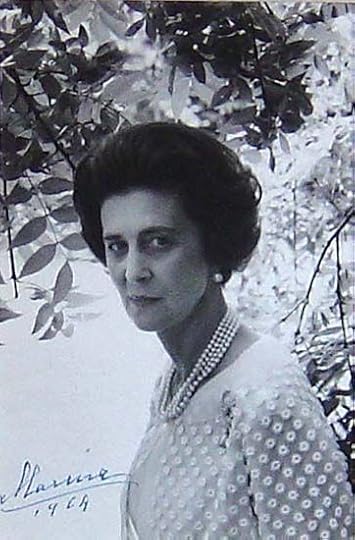 Princess Marina photographed prior to the 1964 Tour.
 Marina did not arrive unprepared. She had often spoken to Princess Alexandra about her five-week tour in August/September 1959 and her impressions of the country and people. Sir Robert Menzies, the Australian Prime Minister, had also recently dined with Marina at Kensington Palace to discuss the prospective visit. Marina had often met Sir Robert during his frequent visits to London over the years. According to Marina’s biographer, Stella King, the Princess also studied books that she and the late Duke had consulted together, as he prepared to take up his post as Governor-General in 1939, in addition to some speeches he had already drafted.
Marina’s schedule was initially neither taxing or ‘informal’ but doubtless gave the Princess time to recover from any residual “jetlag” (Her Royal Highness had travelled from London to Sydney in the Qantas Boeing 707 City of Adelaide with a brief stopover in San Francisco). Her subsequent arrival at R.A.A.F. Fairbairn, Canberra at 9.30am on 26 September was covered by Australian television in what was hailed in the local press as ‘the biggest national television link which has ever originated from the city.’ The event was enlivened by a 21-gun salute which certainly made an impression on the waiting officials (including the Governor-General) and the crowd of around 1,000 onlookers. The Royal Military College Band were also on parade. All were delighted when the Princess, dressed in a cherry red ensemble, made time to speak to many of those gathered and informed them, “What a beautiful morning it is. I can’t believe I’m here at last.” The Princess brought with her an entourage of ten including her Private Secretary Sir Philip Hay and Lady-in-Waiting Patricia Heaton. In the afternoon, a press conference was held at Yarralumla, the Governor-General, Viscount De L’Isle’s official residence in Canberra. The press reported that the Princess ‘smoked a cigarette and drank a glass of bitter lemon’ during the proceedings. Otherwise, it was a day clear of engagements which gave Marina time to familiarise herself with Government House, as Yarralumla was often referred to. The experience proved rather poignant (as would much of the tour) as she observed the blue satin-covered sofas, the silk tweed curtains, the Grecian rugs and the quality bed linen chosen by her husband, the late Prince George, in anticipation of his assuming the Governor-General’s position in November 1939. Indeed, preparations had been so far advanced that the Duke of Kent had ordered a new Rolls-Royce with which to undertake his Vice-Regal duties and a Private Secretary, Sir Eric Mieville had been appointed. However, following the outbreak of war with Germany, in September 1939, the Australian government were informed by Prince George himself that he and Marina had been forced to ‘abandon our intentions of coming out to Australia next month.’ From his reply, it is clear the Prime Minister (the then not yet ennobled Mr Robert Menzies) had viewed this as merely a ‘postponement’ of these plans.
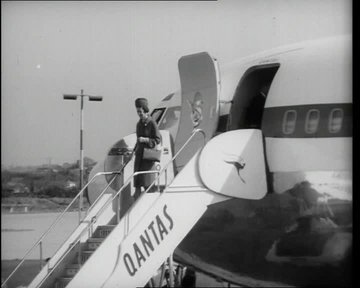 Princess Marina arrives in Australia on Qantas Boeing 707
But returning to Marina’s current visit: On the first full day of the visit-27 September-the Princess attended Sunday Divine Service at the Church of St John the Baptist. A Greek woman, Mrs. Jones (who was married to an Englishman) stepped forward from amongst the onlookers who lined the avenue outside the church (estimated at some 200 people) and said in Greek: “Welcome to Australia.” A couple, Mr and Mrs Xago, also conversed in Greek with the Princess (who complimented them on their “lovely boy”). The Xago’s were touched by her words and returned the compliment by praising Marina’s command of Greek after such a long absence from her homeland. In the evening, the Princess dined with, Sir Robert Menzies and his wife Pattie, at the Prime Minister’s official residence The Lodge.
The following day, the tempo increased somewhat: Princess Marina paid a visit to the Australian War Memorial to lay a wreath on the Stone of Remembrance and view the Roll of Honour. Her Royal Highness also undertook a brief drive through the ‘commercial centre’ of this city (which was actually more of a large country town of 70,000 inhabitants) where she was greeted en route at Vernon Circle by schoolchildren lining the route. However, her brief journey to her next engagement (the opening of the impressive new Defence Headquarters complex at Russell Hill) was somewhat delayed when high winds blew a piece of iron sheeting into the air close-by the royal limousine. This caused the chauffeur to swerve suddenly in order to try and avoid it. Unfortunately, the sheeting hit against the car and dented one of the doors. Marina was somewhat shaken by the incident but unhurt. Unbelievably, no sooner had the Princess arrived at the Defence Headquarters than a long piece of wooden facing, with nails still embedded in it, became dislodged from the dais canopy and tumbled to the ground just yards from where she and the official party were seated. Unperturbed (Marina’s sang-froid was duly noted) the royal guest carried on with her speech in her own unhurried style. She observed that “While we pray for peace and goodwill on this earth, we are conscious of the need for steadfastness and preparedness in a world beset by friction and conflicts.” The widowed Princess then chose to be more candid, “Twenty-six years ago my husband and I were preparing to come and live amongst you-but God willed it otherwise. But for the tragedy of war [Prince George was subsequently killed in an air accident in 1942 while on active duty with the R.A.F.]-a tragedy shared by so many Australian families-we would have become intimately familiar with this vast country and its people. My husband’s appointment as Governor-General in 1938 was a moment of great joy to us both.” Princess Marina also mentioned that she found it hard to express all she felt “in what will ever be for me a deeply memorable occasion”, adding that it had been a “privilege” to be present at such a ceremony in the changing and expanding Australian capital.
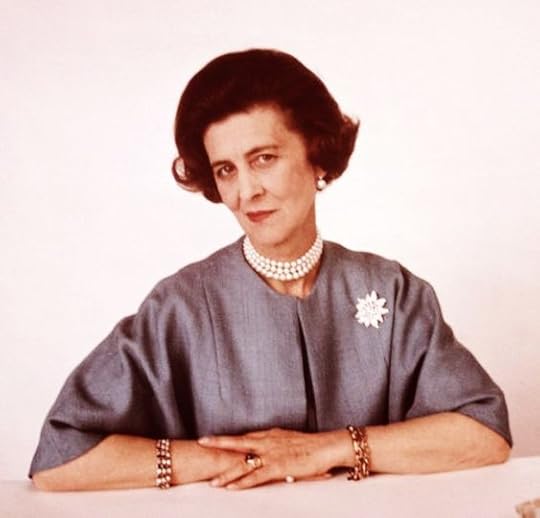 A colour image of Princess Marina from the 1960’s
In the afternoon, the Princess received Heads of the various diplomatic missions in Canberra and presided over a garden party attended by 3,500 guests at Yarralumla. The Australian press were impressed by what they described as Marina’s ‘lively interest in people’ as well as her ‘engaging manner’. The fashion commentators were in raptures over her lace-appliqued silk champagne coloured outfit offset by a hat of marabou feathers and accessorised with a massive emerald and diamond brooch. Yet the Canberra Times seemed rather unsure of the Princess’ royal pedigree and wrongly described her as ‘the daughter of King Constantine of Greece.’ Actually, she was the youngest daughter of the late King Constantine I’s younger brother, Prince Nicholas of Greece and Denmark.
On 29 September, Marina paid a visit to the Women’s Royal Australian Naval Service (W.R.A.N.S) at H.M.A.S. Harman, a communications hub where she observed operatives handling messages to naval ships off-shore. Marina was an Honorary Commandant of the Australian organisation. This engagement was much more the Princess’ “cup of tea”, for she had long held historical links with the “sister” organisation in Great Britain [the Women’s Royal Naval Service or W.R.N.S.] and currently served as the Chief Commandant. The W.R.A.N.S was formed at Harman in 1941 and the base was very much regarded as the “home” of the organisation. Before departing, Her Royal Highness inspected the W.R.A.N.S living quarters (Alexandra House) which had been opened by Princess Alexandra, during her 1959 royal tour. Thereafter, Princess Marina lunched with Commonwealth High Commissioners at Yarralumla and attended an evening reception for parliamentarians in the King’s Hall of Parliament House.
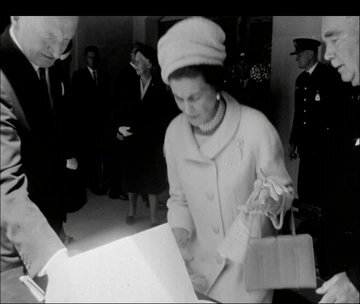 Princess Marina signs yet another visitor book during the trip.
 On 30 September the Princess flew in the afternoon from Canberra to Sydney, landing at Mascot Airport at 3.30 pm prompt in a R.A.A.F. Corvair. After inspecting the Guard of Honour mounted by the 1st Battalion Royal Australian Regiment, Marina also made sure to acknowledge the presence of the regimental mascot Shetland pony Septimus. From the airport Her Royal Highness drove straight to Government House and a brief visit with the Governor of New South Wales, Sir Eric Woodward. The Princess and her entourage were to stay across the harbour in the much more informal setting of Kiribilli House. Once again the fashion writers were soon busy commenting on Marina’s brocade suit and pillbox hat in a matching fabric, as she arrived for her first engagement at Sydney Town Hall, to meet 800 ‘city parliamentarians and dignitaries’. The Lord Mayor, Alderman Jensen, who greeted Her Royal Highness on arrival, seemed captivated by the royal visitor, as did the assembled crowds. Prior to entering the Town Hall, Marina made time to speak to a group of elderly people whom she noticed behind police barricades near the Town Hall entrance, before walking across George Street to greet the large crowd assembled there. This informal approach (for this was the era before “royal walkabouts”) was much commented upon. Later, the Princess entranced the waiting dignitaries inside, as she spent an hour progressing seamlessly from one group to another and ‘charming them with a mixture of down-to-earth talk.’
The following day, Princess Marina paid a four-hour visit to the British Exhibition. The objectives of the Exhibition (which complimented a “British Fortnight” currently being held in local stores and shops), was to demonstrate and strengthen the close ties which existed between Australia and Britain. After being greeted by Sir Peter Runge, the Chairman of the Exhibition, the Princess toured the Manufacturer’s Hall. Naturally, her visit caused much attention from the public. However, the press noted that despite officials panicking (and at one stage even threatening to close the exhibition during the royal visit) Her Royal Highness ‘resolutely refused to let a jostling crowd worry her.’ Instead, Marina ‘delighted the crowd with her off-beat charm,’ as she examined a pair of tables valued at £24,000 on the antiques stand of a local department store, Grace Brothers. Marina was also entranced by a Pye “manipulator” (a contraption with metal claws) which she learned could apply make-up to a lady’s face. For good measure, the Princess watched closely as the “manipulator” performed its magic, her face a study in concentration. Marina also found time to fuss over an infant who was determined to ‘see the Princess’. She also made the day of one elderly lady who asked if she would mind being photographed. Marina smiled and said “Of course not.” The only complaint came from the Princess’ security detail who said she was ‘very hard to keep track of.’ Marina’s tiring day ended with a “private” dinner given by the State Governor at Government House. However, a quick glance at the guest list reveals that her fellow diners were none other than an assorted group of local “worthies” including politicians (such as the Premier of New South Wales); members of the clergy (led by the Archbishop of Sydney); as well as the judiciary (the Chief Justice heading this section).
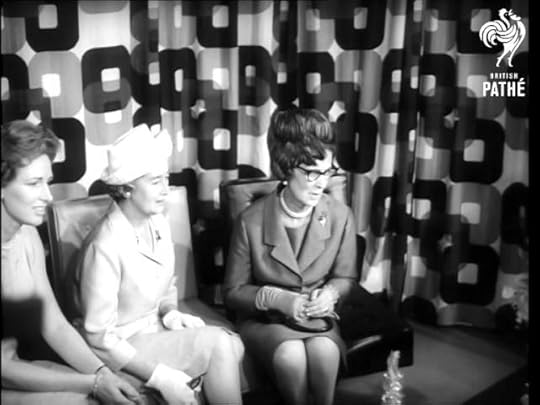 Princess Marina in a TV studio at the British Empire Exhibition. She is watching an coloured image of herself on a tv monitor.
 On the morning of 2 October, Princess Marina presided over another important event: the opening of the new Gladesville Bridge, a six-lane bridge over Sydney’s Paramatta River. This was to replace an earlier structure from the Victorian era. The new bridge had an arch span of 1000 feet and a total length of some 1901 feet and cost £4.5million. The impressive structure linked the suburbs of Gladesville and Drummoyne. Two thousand official guests had been invited to the opening. A Guard of Honour was provided by 100 girls from the Riverside Girls’ College. Her Royal Highness not only made sure to acknowledge their presence, but made time to have a brief chat. The Princess was then greeted by the State Premier of New South Wales, Mr Renshaw and the Minister for Highways, Mr Hills. Marina was soon beckoning both of them to pull their chairs nearer to hers, the better to speak to them about the project. After making a speech, in which she praised the project as a excellent example of Australian-British partnership (the bridge was designed by a British company, Reed and Mallik) the Princess ‘snipped the ribbon with a flourish’ and declared the bridge open. She then drove over in the official limousine, stopping at the highest point to admire the view with Mr Renshaw and Mr Hill, who pointed out the old bridge below. A war widow herself, the Princess later met a group of 1000 war widows at a reception held at Sydney’s Trocadero Restaurant. Some had travelled by air to be present at the event. The press stated that the widows gave Marina ‘the most enthusiastic reception’ of her visit so far. This was unsurprising given that the Princess was the first Patron (appointed in 1948) of the The Australian War Widows Guild of Australia. This particular event had been organised by the New South Wales Guild.
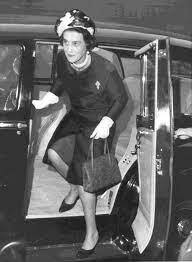 Princess Marina Arrives at the Trocadero for War Widows reception.
 As the visit progressed the positive plaudits continued. The Princess was ‘so charming, so interested in all she sees’ gushed the Canberra Times. A British Pathe reporter added that Marina ‘has really captured the hearts of the people of Sydney.’ Meanwhile, Marina attended the running of the Australian Jockey Club Derby at Randwick racecourse on 3 October, driving down the track in an open-topped Rolls-Royce to the delight of the 52,000 racegoers in attendance. A smaller crowd of onlookers then provided her with an informal Guard of Honour as she walked the 200 yards from her car to the Members’ Stand. The horse which won was aptly named Royal Sovereign. The prize money was an impressive (for 1964!) £7,000. Princess Marina also presented a special gold British Exhibition Cup to the winner’s owners, Mr and Mrs Angini. The Princess subsequently paid a weekend visit to the Warragamba Dam, staying at a local cottage and enjoying some relaxation as she walked through the nearby trails. She also attended Sunday morning service at the local St Paul’s Anglican Church and was pictured shaking hands with the church warden, Mr Harry Huddlestone.
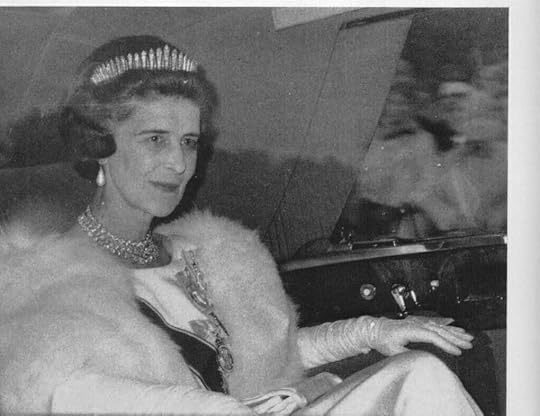 Princess Marina attends an evening engagement.
Back in Sydney, Her Royal Highness attended the Anglo-Australian Tattoo at the Showground. She wore an evening dress for the occasion and it was observed that her diamond tiara and earrings sparkled as she arrived at the venue. On her final day of engagements in Sydney, 6 October, Her Royal Highness visited the New South Wales Art Gallery. She confided to the President of the Board of Trustees, Mr Eric Landker, that she painted in watercolours. The Princess also admitted that she was “not particularly attracted to abstract art”, preferring impressionism instead. However, she was keen to see some Australian artists and praised the work of William Dobell as “very strong” art. Marina was subsequently presented with a book of his works, signed by the artist himself. After visiting the gallery, Marina ventured to the up-market David Jones department store nearby to view a selection of British products on display as part of their British Fortnight event. This visit was unscheduled, but her foray into the ladies’ fashion department was widely reported in the press. The Princess then paid her second scheduled visit to the British Exhibition at the Showground. In the evening, some koala bears were brought especially from Taronga Park Zoo to Kiribilli House so that Marina could examine this marsupial in the flesh. Her schedule meant there had been no previous opportunity for Her Royal Highness to view a koala in its natural environment.
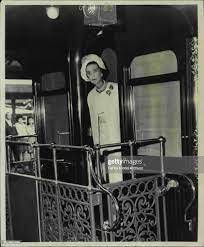 Princess Marina departs the Governor-General’s railcar at Wolloncong.
 The following morning, the Princess travelled in the Governor-General’s rail car (which was attached to the rear of the South Coast Daylight Express) some 50 miles southwards to the coastal town of Wollongong, where she toured the large Australian Iron and Steel Works at Port Kembla. This final engagement proved quite a contrast with anything else Her Royal Highness had previously encountered during her visit.
The Princess departed Australia on the morning of 8 October. A crowd of 500 gathered at Mascot Airport to watch as she was given an official farewell by a naval Guard of Honour. Again the press were impressed that Marina took time to stop and speak to several of the naval ratings. They also admired the way she made a point of thanking her chauffeur for his services as she left the official limousine. As during much of the tour, the wind proved somewhat troublesome and the Princess was required to lean against the gusts as she stood on a dais during the Royal Salute. And then after kissing some of the official party (including the Prime Minister’s wife, Dame Pattie Menzies, to whom Marina had earlier given a gift of a pair of silver sugar shakers) the Princess made her way to the waiting Boeing 707 for her journey homewards via Malaysia, where she was to be the guest of the British High Commissioner, Lord Head and his wife. This stay was ‘unofficial’ according to the Canberra Times.
The Princess arrived back in Britain on 12 October to be greeted at the airport by Princess Alexandra and her husband Angus Ogilvy accompanied by Marina’s daughter-in-law, Katherine, the Duchess of Kent.
Documents in Canberra reveal that the tour cost a total of £40,050. Unsurprisingly, given the distances involved, £23,000 of this was allocated to the hiring of aircraft for travelling to, from and within Australia. Such costs came as no surprise, as the canny Australians had estimated these well in advance, even to the point of, for comparative purposes, reviewing details of the costs associated with the visits of the Queen and Duke of Edinburgh in 1963, and the Duke’s 1962 solo visit. Furthermore, nothing had been left to chance (Marina’s Private Secretary, Sir Philip Hay, a war veteran, was a stickler for detail) down to a list of ‘car door openers’ in the archives and the provision of daily weather forecasts.
Sadly, Princess Marina would die less than four years later and she was never to return to Australia. Yet her solo visit had succeeded in endearing her to the Australian people. It would also be no exaggeration to say that Prince George’s widow found a special comfort in making this trip to a land he would have served so well.
For reference: The Prime Minister’s Official tour announcement (P.M. No. 54/1964) can be found at https://pmtranscripts.pmc.gov.au/sites/default/files/original/00000961.pdf
February 13, 2024
The Queen’s 1954 Tour of Australia
Around 10.30am on Wednesday 3 February, Queen Elizabeth II landed ashore in the Royal Barge at Farm Cove, Sydney to be greeted by the Governor-General, Sir William Slim, Her Majesty’s Official Representative in Australia. Elizabeth was the first reigning Sovereign to pay a visit to this far-flung kingdom which had such strong ties to the United Kingdom, for Australia’s population was largely composed of people who were descended from British stock or were recent settlers from that country. Her Majesty’s subjects were certainly ready to give the demure 27-year-old Queen a rousing welcome. Over 100,000 lined the shores around Sydney Harbour to witness the royal arrival. They almost immediately fell under her charm, as Her Majesty addressed her Australian subjects, observing that ‘I am proud indeed to be at the head of a nation that has achieved so much.’ When the Royal party departed Farm Cove to make a tour of the streets of central Sydney by car, it is estimated that 1 million people out of a city population of 1.86 million lined the route of the “Royal Progress”, with crowds as many as twenty deep at times. A particularly moving moment took place in Martin Place, where the Queen stopped at the Cenotaph to lay a wreath to commemorate Australians who had answered the call from the “Old Country” (as Britain was still referred to) and given their lives, whether this be at Gallipoli or during two subsequent world wars. An editorial in an Australian paper summed-up the events succinctly: “This day is one of the most momentous in our history.”
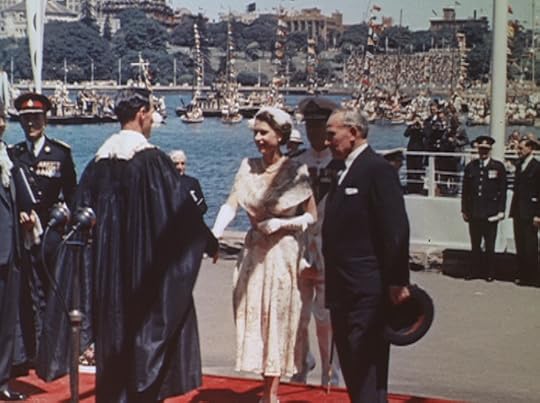 The Queen arrives at Farm Cove, Sydney, 3 February 1954
The Queen was scheduled to spend ten days in the State of New South Wales (NSW). Most of the time she and the Duke of Edinburgh were based at Government House in Sydney. From there the royals ventured out to carry out an eclectic mix of engagements throughout the State, some by plane due to the huge distances involved. The first engagement, however, only involved a car ride up the hill when, on 4 February, the Queen opened the Third Session of the thirty-seventh Parliament of New South Wales. From the royal throne in the Legislative Council Chamber she addressed both Houses, stating “This is the first occasion on which the Sovereign has been able to open a session of an Australian parliament. It is most fitting that this should take place in the Mother Parliament of Australia which had its birth over one hundred and thirty years ago..” In the evening Her Majesty donned an evening gown of golden tulle embroidered with sprays of wattle (Australia’s national flower) to attend a State Banquet given by the State of New South Wales in the ballroom of a local department store. Next day, Her Majesty and the Duke were greeted by 100,000 military veterans at a gathering at the Anzac Memorial in Hyde Park, the Queen stopping to observe the tasteful Pool of Remembrance. The royal duo subsequently were feted by 120,000 schoolchildren at three large gatherings arranged at different locations throughout the city, including the Sydney Oval, Centennial Park and the Showground. That evening was the Lord Mayor’s Ball but the Queen seemed to be tired and only remained for an hour. A crowd of 120,000 waited outside the Town Hall to see her and an estimated 2,000 had to be treated after collapsing in the pushing throngs. On the Saturday, the royal couple watched a display of life saving at Bondi Beach and travelled out to Randwick race course for an afternoon at the races, to the Queen’s obvious delight. The day ended with a gala concert at the Tivoli Theatre. However, there was no rest on the Sunday as the royal party attended morning service at St Andrew’s Cathedral. Fortunately, Monday 8 February was free of engagements.
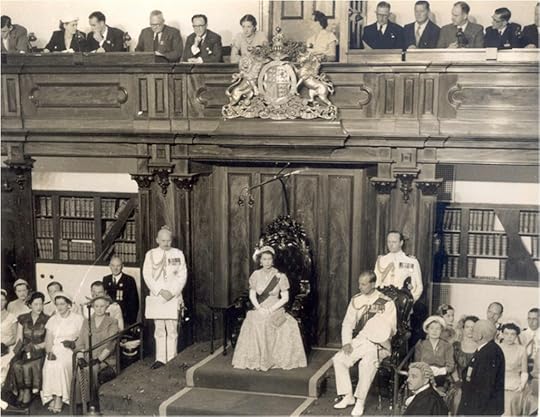 The Queen opens the State Parliament of New South Wales, Sydney, 4 February 1954
On 9 February, the royal tour moved out of Sydney when the royals made a three-hour afternoon visit to Newcastle on the East coast of NSW. They travelled the 100 miles by train (the royal duo spending most of the journey on the rear observation platform). On arrival, they visited the City Hall for a formal welcome, met veterans and war widows at No 1. Sports Ground and were later greeted by 35,000 schoolchildren at the Showground. A choir of 500 provided a rousing rendition of the National Anthem; while others formed a tableau marking out the message: “Welcome to Our Gracious Queen”. The Queen and the Duke then toured the Broken Hill Steel Foundry at Stockton and talked to some of the workers, before flying north, some 360 miles, to Lismore to spend the night in a local hotel. In the morning, Her Majesty drove in the rain to an engagement at the town’s Oakes Oval.
Having visited the West Coast, the focus shifted to the Central West of NSW: At Dubbo, in the Orana region of the state, which was reached by air, the itinerary for the two-hour afternoon royal visit included attendance at the Dubbo Agricultural Show (which had been moved from its usual May date to coincide with the royal visit) when the royal party were treated to a display of woodchopping and a sheep shearing contest at the Showground. Yet, for small towns such as this, the burden of a royal visit was bittersweet as the costs involved were decidedly onerous. Indeed, £3650 was spent on this visit (not including decorations and civic expenses) but fortunately contributions towards defraying these costs were made by around twenty neighbouring municipalities. Over the next few days the Queen and her husband paid visits to Wollongong, Bathurst and Lithgow, returning from the latter via Katoomba to view the splendour of the Blue Mountains before descending to Sydney by train. Then it was time to take to the air to fly to Wagga, on 13 February, where the town was holding a Saturday gala day or “bushland carnival” during which the royal party viewed a boomerang throwing display.
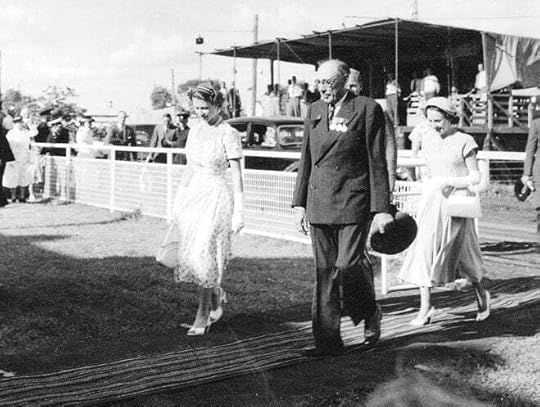 The Queen attends an agricultural show at Dubbo, NSW
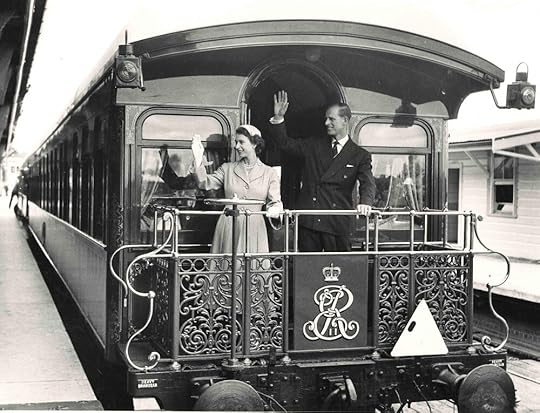 The Queen and the Duke on the Royal Train at Bathurst during a day spent in rural NSW.
 The day ended with the Queen’s arrival in Canberra in the Australian Capital Territory (ACT). She attended morning service on the Sunday at St John’s Church and later went privately (with the Duke at the wheel) for an afternoon drive through the Murrumbidgee Valley to visit a “show station”. However, Monday, 16 February was a busy day of engagements including an investiture at Yarralumla, the Queen’s residence in the capital, followed by the State Opening of the Federal Parliament which took place in the Senate Chamber of Parliament House, Her Majesty wearing her coronation dress and the star and ribbon of Order of the Garter for this momentous occasion, complimented by the sparkling Russian Kokoshnik tiara, a silver wedding gift to the late Queen Alexandra. Her Majesty and the Duke then took to a dais outside Parliament to review a march past by the 6,000 men of the Australian armed forces, some of whom were cadets from the Royal Military College, Duntroon. All of the Service Chiefs joined Her Majesty on the platform. That night Her Majesty attended a State Banquet at Parliament House with the finest of foods flown in from around Australia; lobsters from South Australia, oysters from northern New South Wales, Mildura Murray cod from Victoria, strawberries from Tasmania, and suckling pigs from the capital territory itself. The Queen also fitted in visits to Duntroon to present the Colour bearing her cipher to the Corps of Staff Cadets, presided over a Royal Garden Party for 3,000 at Yarralumla, laid a wreath at the Australian National War Memorial and unveiled a 220-foot high Australian National Memorial to the United States, many of whose military personnel had come to Australia’s aid in wartime. A 38-foot eagle surmounted the aluminium shaft of the monument.
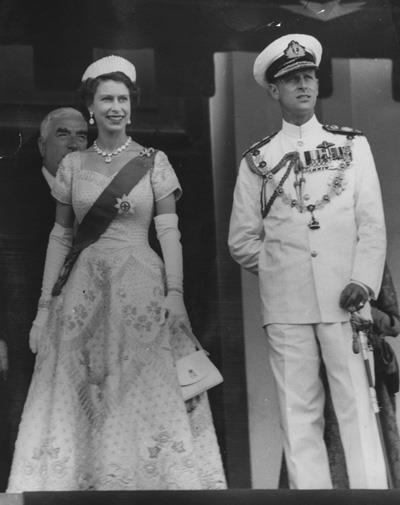 The Queen and the Duke of Edinburgh at the State Opening of the Federal Parliament, Canberra 1954
The royal visitors departed Canberra on 18 February and travelled by air to Sydney where the Queen and Duke presided over yet another Royal Garden Party (this time for 8000 guests) at Government House. At 5.30pm the royal party departed Government House to embark the SS Gothic (the vessel used during the Queen’s Commonwealth tour) at West Circular Quay. This “Royal Yacht” was to transport them to Hobart in Tasmania which was reached on 20 February. Two ships of the Royal Australian Navy, H.M.A.S. Australia and H.M.A.S. Anzac provided a royal escort.
On the first day of the visit to Tasmania Her Majesty and the Duke were greeted by a small flotilla of local sailing craft and crowds at Battery Point as they sailed down the River Derwent to their ship’s berth at Prince’s Wharf. After settling-in at Government House, the royal couple undertook a series of engagements which included a Children’s Rally at the North Hobart Oval, a visit to the Repatriation General Hospital for Servicemen, followed by a commemorative tree-planting at Anglesea Barracks. Her Majesty then unveiled a Sesquicentenary Memorial at Victoria Dock watched over by a crowd of 10,000. This monument commemorates the founding of Hobart in February 1804 by Lieut.-Colonel David Collins of the Royal Marines. In the evening, the royal duo were the guests of honour at a State Reception at the City Hall. The following morning, the royal party attended the Sunday service at St David’s Cathedral, the rest of the day being left free to allow for some rest and recuperation. 22 February, however, brought forth a busy schedule: the Queen opened Parliament, held an investiture which lasted some thirty minutes, attended the third Royal Garden Party of the royal tour at Government House and presided over a State Ball at City Hall. For this occasion, Her Majesty wore a gown of lilac organdie offset by a sapphire and diamond necklace, a diamond bow brooch and Queen Alexandra’s tiara.
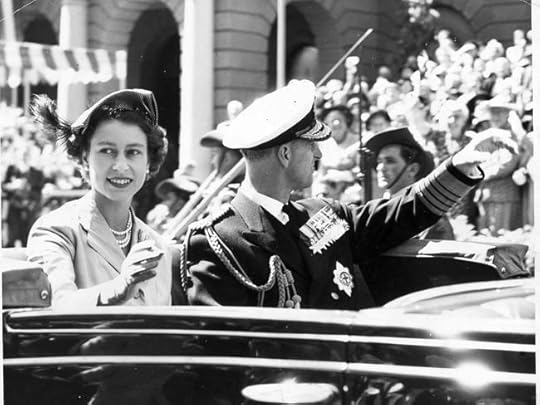 The Queen and the Duke of Edinburgh acknowledge the cheers from the crowds during their visit to Hobart.
On 23 February, the royalties undertook a tour of much of the north of the island, flying by air to Wynyard in North Tasmania and driving through the towns of Burnie, Ulverstone and Devonport to Cressy, where the royal party spent the night on a sheep farm belonging to a Mrs O’ Connor. All along the route children were waiting to greet the royal cavalcade with bunches of flowers, flag-waving and the singing of patriotic songs. The following morning, the Queen and the Duke paid a visit to Launceston, the second largest town of the island, where they attended a civic reception and were feted by a crowd said to number 75,000.
On 24 February the royal party flew from Launceston to Melbourne to begin the tour of the State of Victoria. It was estimated that 750,000 people lined the 11-mile route from the Essendon Aerodrome to Victoria’s Parliament House, where Her Majesty met officials of the Legislative Assembly and Legislative Council, before travelling on to the Town Hall to be greeted by the Lord Mayor. Then it was off to Government House, the largest and most magnificent royal residence in Australia, where the royal party would make their base for this portion of the tour. The following afternoon the Queen returned to Parliament House to open the Second Session of the thirty-ninth Parliament of Victoria in the Legislative Council Chamber. This event was followed by a gathering of 70,000 military veterans at Melbourne Cricket Ground during which those gathered serenaded Her Majesty with a rousing rendition of “Waltzing Matilda”. The day ended with a State Ball hosted by the Governor, Sir Dallas Brooks, in the enormous ballroom (10-feet longer than that at Buckingham Palace) at Government House.
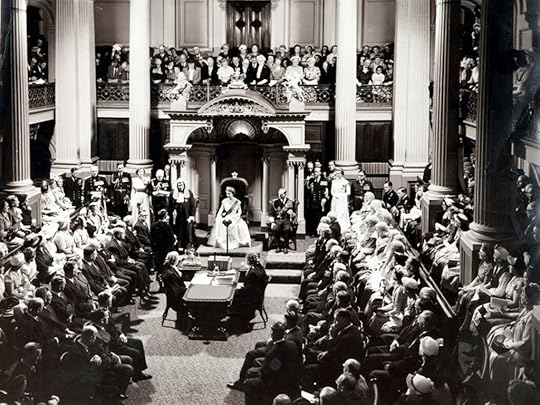 The Queen opens the State Parliament of Victoria in the Legislative Council Chamber, Melbourne.
 On 26 February, the royal party flew briefly into South Australia for a visit to Mount Gambier where the Queen and Duke were introduced to a twelve-foot-long carpet snake. Then the royal plane landed at Kanawalla to allow the royal visitors to make a two-hour visit to Hamilton, where a crowd of 13,000 gathered to give Her Majesty a right royal welcome. The Queen and the Duke made a circuit of the Melville Oval in a specially adapted open Land Rover to greet local children. They returned to Melbourne that evening by air. The following day was mostly given up to a race meeting at Flemington Racecourse at which The Queen Elizabeth Stakes was run. The race was won by a horse, Cromis, soon to be dubbed “Australia’s best horse”, the sire of whom, Helois, had been bred and raced by the Queen’s late father, King George VI. After a brief visit to a Davis Cup tennis event at Kooyong, a State Banquet took place in the imposing Exhibition Centre, at which the Queen was presented with a rose bowl made of gold from Victoria by the State Premier. And so the tour progressed with the familiar attendance at a Sunday church service at St Paul’s Cathedral; this was immediately followed by a visit to the impressive Shrine of Remembrance to allow the Queen to dedicate new additions which had recently been made to the memorial.
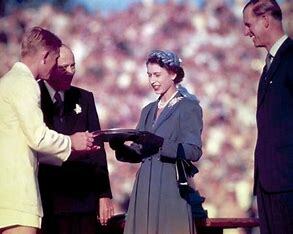 The Queen presents a silver salver at the Davis Cup tennis tournament in Melbourne.
 Thereafter the Melbourne days passed amid a flurry of events including a theatre visit, a Women’s Lunch at St Kilda Town Hall, a State Ball and a Royal Garden Party (the fourth of the tour). On 3 March the royal party spent the day in the Gippsland area of Victoria, flying first into the town of Sale and then proceeding by rail back to Melbourne via Traralgon, Yallourn and Warragul. The day (which included a visit to a giant open-cast coal mine) was long and the royal train, which slowed down frequently where groups of onlookers had gathered, did not arrive back until well after 7pm at Flinders Station. The Queen, however, was up bright and early next day to hold an investiture at Government House and a make a return visit to the Cricket Ground to meet local schoolchildren. Also present were 54 members of the Welsh Corgi Club of Victoria who proudly introduced their dogs to Her Majesty, who was a well-known owner and devotee of this breed. After a visit to the Repatriation Hospital, the Queen and Duke embarked a Royal train for an extensive tour over two days (5-6 March) of country areas of Victoria. Towns visited included Benalla, Shepparton, Tatura, Echuca, Rochester, Bendingo, Maryborough, Ballarat and Geelong. However, a localised polio outbreak caused last-minute changes in the schedule, such that the royal party was unable to leave the train at Castlemaine, at the urging of health officials. Locals had to be satisfied by a view of the Queen passing through and waving from an observation platform. Yet, this did not deter a 101-year-old lady being presented to Her Majesty at another stop en route. Saturday evening and all-day Sunday were spent in the Lake O’Shannassy mountain resort near Warburton. The Queen and Duke’s only foray was to attend the Sunday service at the local Presbyterian Church of St Andrews. On Monday 8 March, the royal entourage entrained to travel back to Melbourne to attend a State Reception for 8,000 guests at the Exhibition Centre. Twenty-two choirs joined together to sing a variety of tunes, while a dance band soon had many taking to the floor (when they were not partaking of the magnificent buffet). It was the final engagement in the State of Victoria.
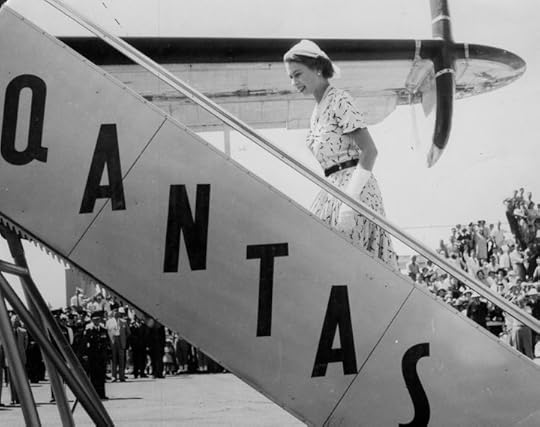 The Queen mounts the stairs of her Qantas Airways Constellation.
 The following morning the royal party boarded a specially adapted (half the seats had been removed to make a sort of flying royal drawing room) Constellation aircraft operated by Qantas at Essendon Aerodrome to fly up in to Brisbane in Queensland. The royal entourage touched down at Eagle Farm Airport, Brisbane to be greeted by the Premier of Queensland, Mr V.C. Gair at the start of nine-day tour of the State. En route to Government House, the Queen and the Duke attended a Civic Reception at the Exhibition Ground and laid a wreath at the circular Shrine of Remembrance in the city centre. Later, there was a State Reception in the former Legislative Council Chamber, the Upper House having been abolished in 1922. The temperature in Brisbane was much warmer, the humidity more intense, than in the South. After a night’s rest at Government House, the Queen and Duke were back on duty to attend a weekday service of morning prayer at St. John’s Cathedral. Then it was onwards to Parliament House where Her Majesty held an investiture. This event was followed by a Parliamentary luncheon. The afternoon schedule was interrupted when a four-year-old girl managed to climb up to the Royal Dias, during a children’s event at the Exhibition Ground, and threw her arms around the Queen who, although taken by surprise, smiled graciously. The child was quickly removed by a royal detective and returned to the care of her mortified mother. The Queen’s personal detective, Chief Inspector T. J. Clark and his colleagues were concerned enough by the incident to undertake a review of royal security to ensure that this did not happen again. Other events in Brisbane included a Civic Ball at City Hall on the evening of 10 March. Intriguingly, in the corner of the ballroom, eight koala bears clung precariously to what was described as a “simulated gum tree.” The royal couple seemed transfixed by this spectacle. The following day there was a royal awayday by air northwards to Bundaberg (where the Queen sensibly made use of a parasol to ward off the rays of the midday sun) and thence southwards by air to Toowoomba, west of Brisbane, where a group of indigenous people from the Northern Territory (which the Queen was unable to visit due to time constraints) performed intricate dances. The press noted that some people had travelled for hours by truck or bus or car from the outback to get a glimpse of Her Majesty that day. A group of bystanders informed a press reporter that they had waited eight hours under a camphor laurel with green ants biting their legs!
 The Queen accepts a bouquet in Brisbane outside City Hall.
 On 12 March, the royal party departed Government House and flew in the Qantas Constellation to Garbutt Airport, Townsville. Again, north Queenslanders had travelled for hundreds of miles to catch a personal glimpse of their Queen, many of whom lined Flinders Street. One of the largest events was a civic gathering of 7,000 at the Townsville Sports Reserve where 4500 children formed a tableau stating “Welcome To Townsville”; while others formed the Australian Coat of Arms. The Queen and the Duke toured the Reserve in an open Land Rover as temperatures soared to 100 degrees Fahrenheit. They were also introduced to a holder of the Victoria Cross (Lt. Colonel Murray) and watched a dancing display by Palm Islanders. The royal duo took a chance to view the town’s Olympic size swimming pool as they journeyed along the Strand which runs adjacent to the seafront. Standing off-shore was the SS Gothic, which was waiting to transport the royal party by sea to Cairns, some 200 miles to the north.
When the Royal party steamed into Cairns, the northern-most point of the Royal tour, on 13 March, they transferred to H.M.A.S Anzac which brought the them into the wharf. In addition to locals, they were greeted with a Guard of Honour, according to the press formed by “Torres Straits [Islands] Chiefs.” Also nearby were “members of former head-hunting tribes from New Guinea.” Unfortunately, there was a mishap when two of the stands, holding some five hundred persons, collapsed during the Civic Reception at Parramatta Park. Her Majesty was “distressed” to witness this scene, but apart from some minor cuts and abrasions, and a possible fractured ankle requiring a hospital visit, no major injuries occurred. The Queen was subsequently given a model sailing ketch to take home as a gift to Prince Charles as she toured an exhibition of “native crafts” which were reported to be worth between £15,000 and £20,000. The Queen and the Duke later visited the cruiser, H.M.A.S. Australia which, along with the Anzac, was to escort the SS Gothic southwards to the town of Mackay, where the Mayor had controversially chosen his own granddaughter (who did not live in the town) to present the royal bouquet. Thereafter, the royal party flew some two hundred miles south to Rockhampton to be treated to what local media described as “an imposing afternoon tea,” with several cakes baked in the shape of royal crowns, studded with sweets (to simulate jewels) and sandwiches cut in the shape of maps of Queensland and Australia. In the evening, the Queen and the Duke flew down to Brisbane-a distance of four hundred miles-in the sure knowledge that the following day had been left free of engagements. This break was necessary as the heat, humidity combined with the busy schedule had taken their toll on the resilient monarch, who was subsequently pictured wiping her forehead during a march past of 17,000 ex-servicemen at the Exhibition Ground, on the last full day of engagements in the State capital. Yet, by that evening, Her Majesty dazzled at a Governor’s Reception in the grounds of Government House.
On 18 March the royal party departed Brisbane by air for Adelaide and the beginning of the tour of South Australia. En route, they made a scheduled stop for a “150 minute visit” to the inland, geographically-isolated, mining city of Broken Hill, NSW where the Queen and her entourage were piped off the plane as they landed at 2pm. It was estimated that the crowd of 40,000 included many outbackers from the surrounding area. Her Majesty and the Duke made use of a more humble Humber Super Snipe for the Royal Progress to the civic reception at North Park. During a subsequent visit to the Flying Doctor base, the Queen inspected an ambulance plane and made a brief speech which was carried by Flying Doctor Network radio throughout the outback.
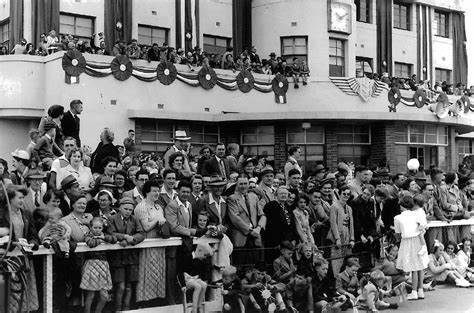 Crowds await the Queen’s arrival at Parafield Airport, Adelaide.
The royal entourage later flew in to Adelaide’s Parafield Airport which was reached in the evening, thirty minutes behind schedule. They were greeted by the Governor, Sir Robert George and his wife, Lady George. All along the ten-mile route to Government House, crowds strained for a glimpse of the royal visitors. The following day, there was an official Royal Progress by limousine through the city. The streets were filled with around 300,000 cheering, flag-waving onlookers, whilst others leaned out of balconies or windows which were decorated with streamers and banners in patriotic colours of red, white and blue. At the Town Hall the Lord Mayor, Mr Rymill, presided over the ceremony of welcome for the royals. The Queen made a brief speech, but seemed somewhat distracted by a piece of grit in her eye. This was later moved with the deft use of a handkerchief. The royal party then progressed to the State War Memorial to lay a wreath. Meanwhile diligent Girl Guides could be found lining the route at Victoria Square to give some semblance of order. In the afternoon, the Queen and her husband drove out from Government House to the Morphetville Racecourse to view the running of the Queen Elizabeth Cup. This event was organised by the South Australian Jockey Club. However, the 3,000 racegoers seemed to prefer looking directly at Her Majesty, rather than in the direction of the action on the turf. Thereafter, the royal duo travelled to the Adelaide Oval to watch a specially organised Country v City cricket match. Otherwise, it has to be said that many of the arrangements almost replicated what had occurred in the other State capitals and included, on 23 March, the Queen opening South Australia’s State Parliament, followed by her and the Duke’s attendance at a gathering of schoolchildren at Wayville Oval. In the evening, Her Majesty and His Royal Highness were present at a State Banquet at Parliament House. Nonetheless, the organisers of this leg also ensured that the Queen and the Duke undertook several day trips from Adelaide to various South Australian towns including, on 20 March, Whyalla (where indigenous dancers performed a corroboree) and Port Lincoln. This was followed by a trip westwards to Renmark and Wildura on 25 March. The latter town was actually situated over the state line in Victoria, but like Renmark, it was situated on the Murray River, and the Queen had made an express wish to view the Murray Valley Irrigation Project. She also found time to visit a local vineyard. Somehow, an investiture, a Woman’s Lunch, a Lord Mayor’s Garden Party (held at Elder Park) and an evening visit to a Royal Music Festival at Wayville Oval were slotted into the schedule on 24 March. At the Music Festival, the Queen sported a magnificent green-fire Andamooka opal pendant set in diamonds-the opal weighing a massive 203 carats. This pendant necklace-along with a matching pair of drop earrings-was a gift from the government of South Australia.
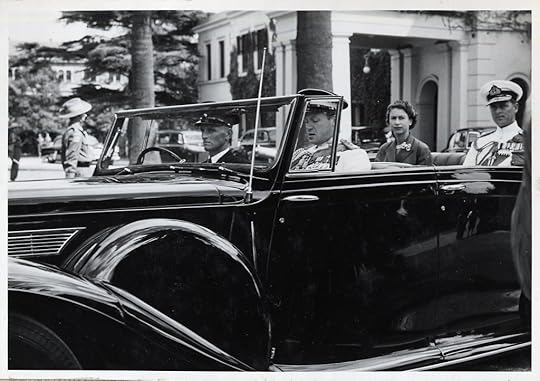 The Queen and Duke of Edinburgh during their Royal Progress through the streets of Adelaide.
  The Andamooka Opal Pendant Necklace and Earrings-the official gift of the State of South Australia in 1954
On 22 March, the Duke of Edinburgh made a three-hundred-mile journey by air, to enjoy a five-hour visit to the Woomera “secret” rocket range. For lunch he was served kangaroo tail soup! The Queen, by contrast, enjoyed a quiet day at Government House, doubtless attending to correspondence. However, she had an unexpected visit from the Prime Minister, Mr Menzies, who flew in from Tasmania (where he had been vacationing), seeking a royal audience to discuss the serious polio outbreak in Western Australia (some of the press had stated that this final leg of the royal tour might be cancelled). After discussions with Her Majesty and royal officials, Mr Menzies issued a statement which clarified that the tour to Western Australia would continue, with adaptations (the Queen and the royal party would live aboard the Gothic, indoor functions would mostly be cancelled or held outdoors, and the shaking of hands would not be permitted).
On 26 March, the final leg of the Royal Tour of Australia began when the Queen and the Duke flew via Kalgoorlie and Boulder to Perth, the State Capital of Western Australia. It was 6.25pm when the royal party arrived at Perth Airport. Following a brief welcome from the Governor, Sir Charles Gairdner and a crowd of 2,000 onlookers, the royal party drove around seventeen miles to Fremantle to board the SS Gothic, their base during this leg of the visit. The wellbeing of the royal party, due to the current polio outbreak in Western Australia, was paramount. As a precaution, the local press noted that “no local stores” had been taken aboard the Gothic. Rather food and water had been brought in from “eastern states”. When the royal party were resting between engagements at Government House in Perth, food was to be prepared and transported there by road from the Gothic in a refrigerated ice-cream van with a police escort. Then the “royal staff”, as opposed to local staff, were to handle and serve it to the royal couple. Cutlery and linen were also brought from the Gothic for use at Government House. Another precaution to be taken was that any officials greeting Her Majesty and His Royal Highness were required to remain at a distance of six feet.
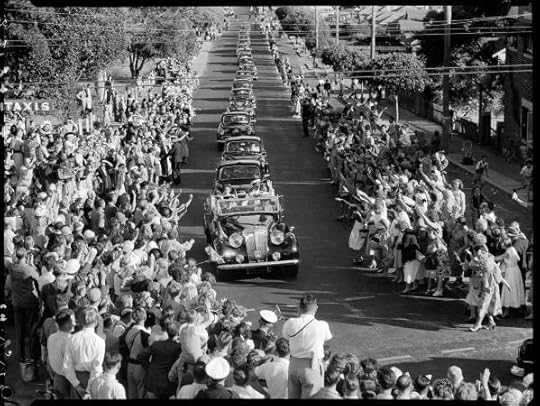 The Queen, the Duke and royal cavalcade travel through Claremont, a suburb of Perth WA
With such safeguards in place, the Queen and Duke carried on with their official programme starting at 10am on 27 March, a Saturday, with a car journey up the crowd-lined Canning Highway from Fremantle to Perth’s Government House where a meeting of the Executive Council was held. Subsequently, the Queen and the Duke toured the streets of Perth city centre, stopping en route at the War Memorial in King’s Park to lay a wreath. After a public welcome ceremony at the Esplanade-involving sixteen bands and 6,000 war veterans-the royal party returned to Government House to meet tour officials. Later, the Queen held an investiture and attended an outdoor Parliamentary Reception at Parliament House, before returning to the Gothic for the night. Sunday was free of engagements so a welcome rest was possible, the only “interruption” being a Sunday church service conducted aboard the Gothic by the Archbishop of Perth, Dr Moline. However, on Monday, the pace quickened with a visit to the University of Western Australia, a march past by 10,000 youth belonging to clubs affiliated with the National Fitness Council, a Royal Garden Party at Government House (with carefully “roped laneways” to keep crowds at length), followed by an evening at a trotting meeting at Gloucester Park. There were also the usual awaydays (to Busselton and Albany in the south by air on 30 March, as well as by road eastwards to Northam and York the following day).
At the close of the tour, 1 April, the Queen and the Duke held a gathering to bid farewell to tour officials at Government House. In the afternoon, they also attended a Civic Reception at Fremantle Oval. 100,000 people had earlier lined the verges of the Stirling Highway all the way from Perth down to Fremantle. Meanwhile, Federal officials, including the Prime Minister, Mr Menzies and the Leader of the Opposition, Dr Evatt had arrived in Fremantle to bid their Sovereign a fond farewell. They were joined by the Governor-General, who was the last person to accompany Her Majesty and the Duke to the bottom of the gangplank of the “Royal Yacht”. His Excellency then gave the royal couple a stiff military salute, surely fitting for a retired Field Marshal. The press noted that the Queen was wearing a magnificent diamond wattle brooch in her lapel (valued, according to press sources, at £25,000) which was the the State Gift from the Government and People of Australia. The Queen’s farewell message, broadcast as she departed Fremantle, in the evening, to the cheers of 40,000 onlookers (many of whom sang the words of “Auld Lang Syne”) included these touching words, “With the sounds of departure still ringing in our ears I want to say to you, my Australian people, how sad we are to be leaving the shores of your wonderful land”. As the Gothic departed the port, vessels at neighbouring wharfs sounded their sirens in a farewell salute. Guns boomed in a Royal Salute as the royal vessel moved through the harbour entrance to the open sea. The Queen and the Duke of Edinburgh stoically remained on deck till the shores of Australia disappeared into the horizon.
It was estimated that around 75% of the population of Australia had at least caught a glimpse of their monarch during the tour, a feat which would be unparalleled in the future. The Queen had travelled 10,000 miles by air in Australia, as well as 2,000 miles by road, much of it in Daimler limousines including a DE 36 Landaulette. The balance of the tour was undertaken by train or by sea in the SS Gothic.
The Queen would return as many as 15 times to Australia, but nothing could ever recapture the wonderful events of that first royal tour of 1954.
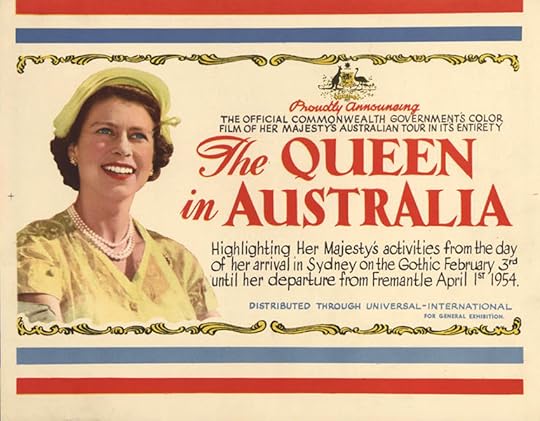
January 29, 2024
Queen Mary of Denmark-“The Worthy Centrepiece”
At around 14:13 hours Danish time on 14 January, a Tasmanian-born girl became Queen of Denmark, the first ‘Aussie’ to hold this title. But who is the new Queen Mary of Denmark? How did she meet Crown Prince Frederik? What are her interests in her official life? What hobbies does she enjoy? How has she coped with the limelight? What do the Danes think?
Mary was born on a late summer’s day, 5 February 1972, in the Queen Alexandra Hospital in Hobart, the state capital of the Australian island of Tasmania. She was the fourth child and third daughter of John and Henrietta (‘Etta’) Donaldson, who both originally hailed from Port Seton in Scotland (just down the coast from Edinburgh). While John Donaldson studied at Edinburgh University, his father, Peter (a trawler skipper) was offered a job with the Flinders Island Trading Company in Tasmania. Mary is named after Peter’s wife, her paternal grandmother, Mary Elizabeth Donaldson. When John Donaldson finished his studies in Edinburgh, he married Etta in 1963. The newlyweds both then joined the rest of the Donaldson family in Tasmania. John was fortunate to be offered a scholarship at the University of Tasmania, where he would eventually earn a PhD degree. Both of Queen Mary’s parents spoke with Scottish accents and the family was and is proud of their Scottish heritage.
 Queen Mary as a baby with her Scottish mother Henrietta ‘Etta’ Donaldson.
However, when Mary was barely two, John Donaldson and his family relocated temporarily to the United States where he had been offered a position as a visiting professor at the University of Texas in Houston. During this time, Mary briefly attended the kindergarten of the Clear Lake City Elementary School. The Donaldson’s returned to Tasmania in 1975 (where John found an academic position in the science faculty of which he would later become Dean) and settled in Taroona, a suburb of Hobart, where the family purchased a house on Morris Avenue. This environment provided Mary with a secure childhood in a loving household, although Mary’s father was sufficiently strict to ensure that school homework was done (from 1978 she attended Waimea Heights Primary School, and in 1983 Mary enrolled at Taroona High School) and not too much time was spent at the beach. One pastime that Mary enjoyed was horse riding. She would later join the Southern Tasmania Adult Riding Club and purchase her own horse Bold Interest. Mary also won awards for show jumping. Meanwhile, at high school she played hockey and was elected to the school council. The future queen finished off her secondary education at Hobart Matriculation College where she achieved her Higher School Certificate in 1988.
In 1989, Mary enrolled at the University of Tasmania to study commerce and law. She is remembered for being a diligent student, but also very sociable. She graduated in 1995 with a bachelor’s degree in commerce and law ( B. Comm. LLB). Like many Tasmanians Mary moved to Melbourne, where she found work as accounts executive with an international advertising agency DDB Needham. She then moved on to MOJO Partners as an Account Manager. Mary’s remit included working with Hard Rock Café and an offshoot, Melbourne’s famous Windsor Hotel. Mary Donaldson is remembered by work colleagues of that time as open and outgoing with a well-developed sense of humour.
However, in November 1997, Mary’s 55-year-old mother, who had also worked for the University of Tasmania (as an Executive Secretary), underwent heart surgery. Sadly, she died on 20 November following complications. This left the close knit family devastated. Perhaps this life-changing event made Mary Donaldson want to familiarise herself with her Scottish roots, as the following year, she made a visit to Scotland where she worked as an Account Manager for three months at the Rapp Collins, an advertising agency in Edinburgh. This extended visit gave her a chance to get to know her many relations in the area including her maternal Aunt, Catherine Murray.
 Mary Donaldson
 On her return to Australia, in the early months of 1999, Mary settled in Sydney where she enjoyed all the delights this wonderful city had to offer including sailing, swimming and cycling. She also kept her riding skills honed with frequent forays around Centennial Park. But the main purpose of her relocation was to advance her career and Mary found a post as an Accounts Manager at the respected international advertising agency, Young and Rubicon, where she was regarded as a safe pair of hands and a hard worker. Mary built on her time there to progress to brand team leader at Love Communications. One of her campaigns was for Tourism Tasmania who wished to promote the island’s potential as a tourist destination.
In 1999, widower John Donaldson met the British crime writer, Susan Moody who had a position as a visiting fellow at a local college in Tasmania, Franklin Hall. The couple married in 2001. Mr Donaldson began to spend more time in Europe (his wife had a home in Oxford) with a spell, in 2004, as a visiting professor of applied mathematics at Denmark’s Aarhus University followed by a period at the University of Copenhagen in 2006 . The Donaldson’s also purchased a new home together in Sandy Bay, a respectable Hobart suburb.
Meanwhile, Mary had rented a terraced house with two friends on Porter Street in Bondi Junction. However, soon this young woman’s life was about to enter a new phase. Crown Prince Frederik and his brother Joachim arrived in Sydney in September 2000 to attend the Olympic Games. They were accommodated at the Quay West hotel in the fashionable Rocks area and spent their first Saturday evening out on the town with Prince Nicholas of Greece and Norway’s Princess Martha-Louise. The royal group had arranged to meet with Beatrice Tarnawski, whose sister Katya was a good friend of Bruno Gomez-Acebo (a nephew of King Juan Carlos) at the Slip Inn. Beatrice had arranged for some others to make up the numbers and they included Mary Donaldson. Soon Mary and Frederik were in deep conversation as the group moved on to another venue, Establishment. Beatrice quickly came to the view that ‘something was afoot’ between Mary and Frederik. They saw each other a few times during his visit, but invariably Frederik had many engagements to attend.
On his return to Denmark, the Crown Prince phoned Mary frequently (some say daily). However, perhaps not wishing to leave anything to chance, Frederik decided to fly back to Australia for a prolonged visit of around five weeks. This time, with no official engagements to attend and little chance of the Crown Prince being recognised in suburban Sydney, he and Mary would go on long walks together, enjoy a barbecue or indulge in Frederik’s favourite pastime of sailing with Australian Chris Meehan and his then Danish girlfriend (and later wife), Lise Michaëla Ward, who had been a member of the Danish Olympic Sailing Team in Sydney. Subsequently, Mary Donaldson was to join the management team of Chris’s company, Belle Property in Sydney as Sales Manager. Her new boss thought her ‘deeply professional.’ Meanwhile, Frederik was also introduced to other friends simply as Frederik who came from Denmark. Many of the laid-back Australians even took to calling him ‘Fred’.
However, on 6 November, the Crown Prince had suddenly to break off his trip to return to Denmark, as his beloved grandmother, Queen Ingrid, had taken a turn for the worse. He reached home in time to spend some quality time with this Swedish-born princess, who was a great-granddaughter of Britain’s Queen Empress Victoria and thus a staunch Anglophile. Ingrid died the day following his return. Nevertheless, the Crown Prince would return again and again to Australia over the next year to cement his relationship with Mary. And still the cat was never out of the bag! The couple had now know each other for around a year, when in September 2001, Se og Hør [See and Hear] the Danish celebrity news magazine mistakenly revealed that Frederik was romancing an Australian Olympic Gold Medallist called Belinda Stowell, who had competed in the 2000 Olympics (and had indeed met the Crown Prince on several occasions as a friend). However, it was now only a question of time before the truth came out over the reason for his frequent visits to Australia and when it did, it was thanks to a scoop, in November 2001, by Anna Johannesen of Billed-Bladet, a magazine focused on royals. Anna encountered Mary Donaldson as she left her Sydney office and asked her straight-out if she was Crown Prince Frederik’s girlfriend. Miss Donaldson kept her cool and simply answered, ‘No comment.’ Ms Johannesen had the presence of mind to have a photographer on standby who quickly snapped Mary for posterity. Mary later admitted that, ‘I was so shocked that I couldn’t think of anything to say.’ Within days, this picture accompanied Ms Johannsen’s story on the front page of Billed-Bladet.
Suddenly, Mary Donaldson’s life was to change forever. The press were now omnipresent with photographers even chasing her while she was driving in the car. At one stage, Chris Meehan recalled that bodyguards had to be employed to protect Mary, who could not even leave her apartment to go for a walk. This period must also have given her a chance to reflect on the future, for only now was the reality beginning to dawn as to what a relationship with Frederik would entail. Perhaps this helped influence her decision to move to Paris in early 2002, where she taught English at a business language school, TRANSFER Etoile.
Immediately prior to this, Mary had made a brief foray to Denmark in the new year arriving via Hamburg from England (where she had been spending Christmas of 2001 in Oxford). The Crown Prince’s good friend Jeppe Handwerk and his future wife, Birgitte were waiting to pick Mary up in Germany and they all motored together up to Denmark. Frederik met them at a roadside rest stop in Jutland. He and Mary then travelled to Birkelse Estate in North Jutland, where the Crown Prince’s friend, landowner Jørgen Skeel, was hosting a new year party attended by many friends. As 2002 was about to dawn, one of the guests taught Mary to count down from ten and shout out “Happy New Year” in Danish, while jumping from a chair!
Later that same year, Mary relocated to Copenhagen where she joined Microsoft Business Solutions as a project consultant for business development, communication and marketing. She found a flat in Langelinie, which was only a few minutes walk from the Amalienborg. Little by little, she built up a small group of Danish girlfriends. The press was increasingly interested in her presence with a reward offered by Se og Hør for a picture of Mary and Frederik together on Danish soil.
During the late spring and summer of 2002, photographers snatched pictures of the couple together at a café in Aarhus and Mary was also spotted cheering on Frederik as he participated in the Dragon [Sailing] Race of Juland at Kalø. However, the most exciting encounter, from the press viewpoint, was when she and Frederik were pictured during the Christmas holidays with Queen Margrethe attending the Palads Cinema in Aarhus to watch the film The Lord of the Rings: The Two Towers. This was interpreted by the press as a sign of approval of Mary and her relationship with Frederik. A Crown-Princess-in-waiting? Certainly, Mary must have impressed her mother-in-law-to-be when they first met over afternoon tea, an English tradition brought to Copenhagen by the late Queen Ingrid.
With such media attention, Mary was therefore pleased during this early period of her life in Denmark to receive visits from her father and his second wife, as well as friends such as Chris Meehan and Lise Michaëla Ward. Other family members and friends back in Australia were only an e-mail or telephone call away. To them she could openly discuss the difficulties of learning Danish, for behind the scenes she was receiving an intensive course of lessons (this would subsequently increase to up to three hours a day as her relationship with Crown Frederik progressed). In addition to lessons in speaking the language, this instruction would also include writing essays in Danish, as well as reading informative books (including Palle Lauring’s The History of the Kingdom of Denmark) and local newspapers. For recreation, and a chance to de-stress, Mary turned to her favourite pastime of horse riding at a farm at Birkerød.
 Mary Donaldson and Crown Prince Frederik attend a wedding.
 In January 2003, she and Frederik visited Tasmania as the Crown Prince was competing in the Dragon Class World Championship biennial sailing regatta with his boat Nanoq. The couple met the press at a photo call in Hobart’s harbour area during which Frederik was photographed giving Mary a kiss on the cheek. It was yet another signal that an engagement between the two was surely not far off. Thereafter, it was back to work at Microsoft and a summer holiday spent at Skagen on the Jutland peninsula. Mary was also photographed with Frederik at the wedding of some of his friends.
On a warm summer’s day in August 2003, the Danish press were invited to Queen Margrethe and her husband, Prince Henrik’s summer home, the Château de Caïx in southern France. The subject of Mary Donaldson came up and the Danish queen deftly commented, ‘We have met her, as you well know, and appreciate her.’ When asked if Mary would make a suitable daughter-in-law she replied candidly, ‘I think it will be fine.’ This seemed to give the green light to a true media frenzy.
Mary became engaged to Crown Prince Frederik on 8 October. This came as no surprise as on 24 September, the Danish court had already announced that Queen Margrethe intended to give her consent to the marriage at the State Council meeting scheduled for that date. Just prior to this, Mary handed in her notice at Microsoft. It transpired that Frederik had asked her to marry him in the traditional way during a romantic visit to Rome. On 8 October, following the 10am State Council meeting at Christiansborg Palace, the betrothed couple appeared at noon with their respective parents on the balcony of the Christian IX Palace at Amalienborg to acknowledge the greeting of a crowd estimated at 20,000. She and Frederik then faced the press at 3.30pm in the Garden Room at Fredensborg during which the future Crown Princess spoke briefly in Danish and admitted to being ‘a little bit nervous.’ At times she seemed almost overwhelmed by the rapid questions in Danish in such a pressurised environment but Frederik did most of the talking. All the assembled photographers scrambled to obtain an image of the engagement ring: an emerald-cut diamond flanked by two rubies designed by the Brazilian jeweller Mauricio Monteiro. Mary did however subsequently manage to articulate her feelings about Frederik: ‘He makes me happy. He is smart, brave and caring, and he is quite funny and charming. He is warm and he has a big heart.’ Shortly thereafter, Mary travelled home to Tasmania to attend the wedding of her older sister, Patricia.
 Crown Prince Frederik and his new bride Crown Princess Mary 2004
Following the engagement, Mary received further briefings which were aimed at familiarising her with the life ahead. This included a tour of the Foreign Ministry which was useful as this government ministry would be involved in planning royal visits overseas in conjunction with the Royal House. There was also a visit to the National Bank (Danmarks Nationalbank). Following his marriage, Frederik was to receive a DKK 9,000,000 increase in his appanage payment, to cover the expenses of setting up a new home (the Frederik VIII Palace at Amalienborg was eventually allocated to the couple but required upgrading), added staff and housekeeping costs, an anticipated increase in public duties and for paying an allowance to his wife (it was estimated the latter would make up around 10% of the total). The future crown princess was also introduced to some young politicians from various Danish political parties. They discussed the world situation and what it feels like to be in the public spotlight.
Interestingly, a few days before the nuptials, there was a pre-wedding banquet at Christianborg Palace at which Mary wore the magnificent antique Danish Ruby Tiara which has its origins at the court of Napoleon. This had been a firm favourite of the late Queen Ingrid’s, having been originally brought from Sweden by Princess Louise (as a gift from her grandmother, Queen Josephine), at the time of her wedding to Danish Crown Prince Frederik in 1869. Mary would later recall that, ‘The first time I had to wear the diadem, I felt it was a great honour, but there was also a bit of pressure. It had last been worn by Queen Ingrid, who was much loved and admired by the Danes, so it came with some expectations’. She found herself questioning ‘Can I live up to them?’
The couple married in Copenhagen’s Lutheran Cathedral (sometimes referred to as the Church of Our Lady) on 14 May 2004 before an television audience estimated at 2.5 million. Guests in the Cathedral included a plethora of royals, Scandinavian presidents and the Governor-General of Australia, Michael Jeffery, who officially represented Mary’s homeland. The bride wore a wedding dress created by Danish fashion designer Uffe Frank with a veil of Irish lace first used by Crown Princess Margareta of Sweden (nee Princess Margaret of Connaught), the British-born mother of the late Queen Ingrid. She also wore a diamond tiara featuring a sophisticated fleur-de-lis design which was a wedding gift from her future in-laws. Mary’s older sisters Jane Stephens and Patricia Bailey, and her friend Amber Petty served as bridesmaids, while Frederik’s brother Prince Joachim (who was already married [in 1995] to Alexandra Manley) was the best man. The wedding reception was held at Fredensborg Castle. Queen Margrethe made an impressive speech of welcome to the new bride and, addressing Mary’s father in English, Her Majesty enthused, ‘The way we, her in-laws, have come to know Mary, we have come to love her and admire her. She possesses a great inner strength, and she radiates a calmness and a warmth that creates trust. She is now showing that courage to lay down her future in Denmark. May we always be worthy of her trust.’
Mary-who had previously held joint British and Australian nationality-became a Danish citizen on the day she married and swapped her Presbyterian worship for that of the Lutheran church. The latter step had been taken very seriously and Mary had received instruction on the Lutheran faith from Christian Thodberg, the Royal Chaplain. Mary also signed a prenuptial agreement which was not unusual in the Danish Royal Family as both Prince Henrik and Alexandra Manley were required to do so. Interestingly, there was soon a timely reminder to Mary that marrying a Prince might not always result in a fairy-tale ending, when it was announced in September that Prince Joachim and Alexandra were to divorce.
In the beginning, the royal couple settled at the Chancellery House, the late Queen Ingrid’s final home, close-by Fredensborg Palace. This would be their main base for many years, while the Frederik VIII Palace underwent extensive renovations. Thereafter, the Chancellery House would serve as the Crown Princely family’s weekend home and a swimming pool would be added to the facilities already available there. The Crown Princess’ office was quickly besieged by requests numerous public bodies, clubs and charities requesting that Mary become their Patron. These took some time to review. Yet, Mary appeared determined from day one to succeed in her role. Initially, the Crown Princess threw herself into the Danish fashion world and was named as Patron of Copenhagen International Fashion Fair. Another early patronage was the Danish Association for Mental Health. Unsurprisingly given the circumstances of her late mother’s death, so too was the Danish Heart Foundation. She took over this role from Frederik. The Crown Prince and Princess also focused on making several visits overseas in an official capacity in the spring of 2005. The first was to Mary’s homeland at the end of February. Although there was a chance to see family, the tour was packed with official engagements including four charity fund-raising dinners. It was around this time that Mary discovered she was pregnant. This was followed by a visit to Japan in April to attend the World Expo 2005 at Nagakute, with a brief visit to Thailand also included in the itinerary.
Over the coming years, Mary acquired over thirty patronages ranging from the Danish Refugee Council to the World Wildlife Fund (Denmark) to the Odense Flower Festival. Furthermore, in 2007, the Crown Princess established The Mary Foundation using a wedding gift of 1.1 million kroner which she and Frederik had received from the people of Denmark, the Faroe Islands and Greenland. The Foundation works to foster a feeling of belonging, that no one should feel left out or alone (“People Need Love”). This is achieved by bringing together the right people including professionals, financial institutions, and other organizations to form partnerships and target help to those in need, whether it be preventing loneliness or bullying or reaching out to those suffering as a result of domestic violence. According to Mary, the driving force for her undertaking this endeavour is a strong sense of justice, allied to her difficulty of seeing a person standing alone. She is totally committed and has no difficulty in donning a football kit to play with youngsters to highlight the work undertaken by the Foundation.
In the past Mary has said that she writes most of her speeches herself, measuring each word she writes carefully. She then goes through it, practicing again and again, until she feels confident in the final outcome. This was particularly important during the earlier years as she acquired total fluency in Danish. However, there has long been a professional assurance in her delivery, such that she had become-according to Danish journalist Hanne Juul, a ‘top professional queen candidate’. This was certainly evident when she spoke with great assurance at her husband’s 50th birthday party in 2018 in a speech addressed to her husband which was a mixture of humour (tales of Frederik dressed in Lycra, as well as alluding to his bad jokes) and seriousness (when talking of their first meeting: ‘We hit the spot without aiming’). Movingly, she mentioned too that it was in the shared family moments with Frederik and their children, that she felt most grateful, most connected and most in love. Unsurprisingly, she won the award for speech of the year by the speechmaking association Danske Taler. Furthermore, when Crown Princess Mary attended an official engagement, she made sure to pay close attention to the photographers, so as to ensure that they were able to capture some interesting photos which would help to promote the cause or event she was attending. If there is a criticism it is that sometimes she could appear a little too controlled. However, this could also be viewed more charitably as professionalism.
Womens’ rights have also been close to the new Queen’s heart. As Patron of the UN Population Fund, she spoke out, in April 2014, at an Amnesty International seminar at the Hotel Nyborg Strand dealing with the theme “My Body My Rights”, during which the right of women and girls to decide on matters of sexual and reproductive matters was placed under the spotlight and debated. Mary emphasised that ‘It is a human right to decide over one’s body’ and mentioned some frightening statistics on forced marriages, female circumcision and women’s deaths due to complications while giving birth (“maternal mortality”). The investigative work she had undertaken was a ‘shocking journey.’ In 2016, the then Crown Princess was appointed Patron of the world’s largest conference on women’s and girl’s rights, Women Deliver, held in Copenhagen. This examined gender equality, education, economic empowerment, sexual health etc. Six thousand delegates from 169 countries attended. Mary now described herself as ‘ dedicated to continuing the work to ensure that girls and women are at the centre of development work.’ Last year, in connection with International Women’s Day, she attended a Gender Diversity Roundtable in Copenhagen’s UN City. This discussed diversity, equality and inclusion in times of change and digitalisation in Danish companies and organizations. Among those attending were leaders from business, academia and civil society.
In 2018, Crown Princess Mary spoke at a conference at the UN General Assembly on “Protecting Health Rights of Women and Girls Affected by Conflict”. Indeed, health promotion in general is an area in which the Crown Princess has been involved over the years. As Patron of the WHO [World Health Organisation] Office for the European Region, she regularly met with members of the WHO for updates at the Frederik VIII Palace. Most recently, Mary was involved in addressing the problem of AMR (antimicrobial resistance) which is a growing global problem that affects both human and animal health . She made a keynote speech on the subject during an international conference held last spring in Copenhagen. The aim of the conference was to foster new partnerships – across sectors and national borders – for the prevention and treatment of AMR.
Mary has often undertaken duties to do with the promotion of Danish exports. Last spring, she and her husband visited the Indian cities of New Delhi and Chennai as part of a major Danish business campaign involving thirty-eight Danish companies who were looking to penetrate this large international market. Denmark is already making a significant contribution to India’s green transition by offering sustainable solutions in terms of water and energy. Then, in mid-April, the Crown Princess visited Milan at the head of a delegation promoting sustainable urban development products. Seventeen Danish companies were represented at the event “This is Denmark “at the Alcova Exhibition Centre under the auspices of Creative Denmark, the Confederation of Danish Industry and the Danish Embassy in Rome. This promotional trip took place during Milan Design Week 2023. The Crown Princess undertook a hectic schedule of duties over two days in Milan, which included a meeting with the Mayor and a roundtable event where experts held discussions to find solutions aimed at making up to one hundred European cities climate neutral by 2030. Mary also presided over an official dinner attended by Danish and Italian guests.
The results of climate change are to be seen everywhere and in late April 2023 the Crown Princess made a four-day trip to the island states of Vanuatu and Fiji, accompanied by the Danish Minister for Development Cooperation and Global Climate Policy Dan Jørgensen. The island of Vanuatu had recently been hit by two earthquakes and two cyclones. Fiji too was increasingly experiencing the consequences of global climate change. There was also a one-day stopover in Sydney where Mary took the chance to meet Danish business representatives involved in the green transition in Australia. This included visits to a number of Danish-led projects in the construction and transport sectors.
The Crown Princess Mary Centre at the University of Copenhagen was launched at the time of Mary’s 50th birthday in 2022. A particular focus of the Centre in recent times is the creation of a more sustainable society, including examining the role of individual citizens and their commitment to the “green transition” to alleviate the effects of climate change. Mary has attended meetings of the Advisory Committee.
Queen Mary, as with other members of the Royal Family, has been involved in an official capacity with the military over the years. She was initially “apprenticed”, at her own request, as a soldier at the Home Guard training centre in Christiansminde near Jægerspris in 2008. She received training in first aid, handling weapons, signalling and military drills complimented by fire and rescue work. The Crown Princess has risen through the ranks of the Home Guard from a Private in 2008 to Major á la suite in 2023. The latter promotion coincided with her attending a parade at Kastellet to mark the liberation of Denmark in 1945. Her rank will doubtless be reviewed now that Mary is Queen Consort.
 Queen Mary (when Crown Princess) in Army Fatigues.
 All this in addition to having given birth to four children in under six years: Christian (born 15 October 2005); Princess Isabella (21 April 2007); and twins Prince Vincent and Princess Josephine (born 8 January 2011). The Crown Prince and Crown Princess tried to give the children as ordinary a childhood as possible with attendance at public schools. Yet, she was very much aware that Prince Christian, in particular, had an important role to play in the future, and as she observed in 2018, ‘He has a predetermined direction of life, but it is important that he understands that he must shape it himself.’ Crown Princess Mary also expressed the hope that her children would be given the space to live a normal teenage life with all that entails during their ‘transformative and vulnerable years of making mistakes’ from which they would hopefully learn lessons for the future.
 The Crown Princely Couple and their four children.
 Of course, by this stage, Crown Princess Mary was regarded as a completely integrated part of the Danish royal family and was well-liked by the Danish population. Over the years, the new Queen has developed her own sense of style. Sometimes she might something as simple as a denim shirt on an informal outing but the look is deceiving, for the item is by the high-end fashion brand, Ralph Lauren. For a more formal look Mary might turn to the designer Marc Jacobs for one of his trademark wrap dresses. Emilia Wickstead, Erdem and Jenny Packham are also fashion brands in favour with Mary (as they are with the Princess of Wales). Mary also favours dresses (some off the peg and relatively affordable) by Beulah of London. In terms of evening dresses, she recently attended Queen Margrethe’s New Year Ball wearing a bespoke evening gown by Lasse Spangenberg and accessorised this with a J. Furmani clutch bag. Jesper Hovring is another favourite designer for evening gowns, from whom Mary first purchased items as far back as 2009. She particularly loves shoes and will coordinate them to the outfit she is wearing. However, Mary can be more daring and has often been seen out and about with snakeskin-print heels. Shoes can last Mary for some time: not so long ago she wore a pair of Tod’s Zeppa Beige Suede Wedges which she had purchased in 2014!
 Queen Mary wears a dress by Beulah of London. Note the snakeskin print shoes!
The new Queen Consort loves to sparkle. Although she had access to a plethora of jewels as Crown Princess, she has also indulged herself with new jewels. In 2012, Mary purchased an Edwardian tiara from Bruun Rasmussen auction house in Copenhagen for €8050, a very modest sum for a royal tiara. Also in her own collection is what has been referred to as the Midnight Tiara. This is of a contemporary design, which was originally made for an exhibition of tiaras at the Amalienborg and has been on permanent loan to the princess from Charlotte Lynggaard who created the piece in 2009. The Grecian-style diadem features diamond and moonstone buds and berries engulfed by rose gold, white gold and oxidised silver leaves.
To relax, Mary continues to enjoy horse-riding and attends equestrian events. However, she keeps a low profile. In recent times, she has become involved in dressage events and has ridden a a gelding called Edelman and another by the name of Wasabi. Her children are likewise interested in horse-riding as is Princess Benedikte, Queen Margrethe’s sister. Mary has also been instrumental in having a new riding arena developed at Fredensborg Castle. Historically, one had in situ there since 1720 but had subsequently fallen into disuse. All of Mary’s immediate family make use of it, as do the Guard Hussar Regiment (Gardehusarregimentet).
 Queen Mary is an accomplished horsewoman, dating back to her years in Tasmania.
In 2019, Mary received a great vote of confidence from Queen Margrethe II when it was announced that Her Majesty had given her consent to Crown Princess Mary acting as Regent on behalf of the Sovereign if say she was overseas. Following, the change of throne on 14 January 2024, Queen Mary, as is now her title, will continue to exercise such a function in the event that both King Frederik and Crown Prince Christian are prevented from carrying out duties as head of state.
Interestingly, when in September 2022, it was announced, by the Danish Royal House that the children of Prince Joachim would, from 1 January 2023, be stripped of their royal titles as Princes and Princesses of Denmark, and be simply known as Counts and Countesses of Montepezat, Crown Prince Mary seemed to back her mother-in-law’s decision: While observing that ‘Change can be immensely difficult and can be painful, ‘ she also added ‘But this does not mean that the decision is not the right one.’ However, she acknowledged that sometime in the future it might well be necessary to review the titles of her own children (other than of course that of the Crown Prince). Meanwhile, Prince Joachim, who was then living in Paris, was clearly upset by the decision and told the press, ‘We are all very sorry. It’s never fun to see your children hurt like that’. When asked by a reporter what their relationship with the Crown Princely couple was like, Princess Marie, Joachim’s second wife (they married in 2008), admitted ‘It’s complicated.’ It is fair to say that Joachim, his wife and family were all still in shock at this stage. Fortunately, a year on, the dust seems to have settled and they were able to join Queen Margrethe and the Crown Princely couple and their children at Marseliborg Castle, Aarhus for Christmas 2023.
A recent study conducted by Epinion for Danmarks Radio has given the (then) Crown Princess Mary a very high approval rating, 85%. Her husband, the (then) Crown Prince was at 84%. These are similar ratings as those for Queen Margrethe. Only 4% had a negative view of Mary. Quite an achievement. It is a world away for the approval rating of Prince Joachim (43%). And the reason for Mary’s high approval ratings? The Editor-in-Chief of Alt magazine, Rikke Dal Støttrup has possibly summed her appeal to the public pretty succinctly. She finds her to be ‘Purposeful, but human. Serious, but with a sense of a humour. Controlled in crisis situations. A mother with clear values and children who dare to be themselves.’
 Front (right to left) King Frederik X, Queen Mary, Crown Prince Christian. Rear (right to left) Queen Margrethe, Prince Joachim and Princess Benedikte, Folketingsalen, Christiansborg Palace, Copenhagen,15 January 2024 . (Photo: Ida Marie Odgaard/Ritzau Scanpix)
When Mary became Queen Consort, one television programme was keen to point out that she was Denmark’s first bourgeois queen. However, she is in good company in Europe for the same is true of Letitia, the current Queen Consort of Spain, not to mention Queen Sonja of Norway, Queen Silvia of Sweden and Queen Maxima of the Netherlands; while the heirs of all the Nordic thrones (and Britain’s Prince William) have also all married partners who are neither royal nor from aristocratic backgrounds. It might be said that she is a queen ‘in keeping with the times.’ Tasmania’s State Premier, Jeremy Rockcliff, congratulated the future Queen Mary, observing that ‘She is a wonderful ambassador.’ Although it is Frederik who has acceded to the throne on January 14, Mary’s role as Queen is viewed as important. Rikke Dal Støttrup has again summed this up perfectly: ‘We count on you as the worthy centrepiece.’ Historian Sebastian Olden-Jorgensen has for some time aired the view that ‘She will play a very prominent role. She will not be an invisible queen.’
January 14, 2024
Frederik X of Denmark-From ‘Turbo Prince’ to King
Frederik André Henrik Christian was born at the Rigshospitalet in Copenhagen on 26 May 1968, the eldest child of Crown Princess Margrethe and grandson of King Frederik IX of Denmark. He was thus the heir-but-one to the throne of Denmark which can trace its royal links back a thousand years. Frederik was thought to be shy as a child. Even today, Danish commentators note that behind the public façade, King Frederik is essentially a private person. The young prince was particularly close to his grandmother Queen Ingrid, who was widowed in January 1972. It was at this time that Frederik’s mother became Queen Margrethe II of Denmark and he was now created Crown Prince. Frederik had a good relationship with his parents, although Queen Margrethe has since admitted that the demands of her role as sovereign meant that she did not spend as much time with her children as she would have liked. Neither the Queen nor her husband Prince Henrik (born Comte Henri de Montepezat) seem to have discussed Frederik’s future role with their son, and he later admitted that this lack of communication on their part, ‘made me insecure and at times timid and awkward…’
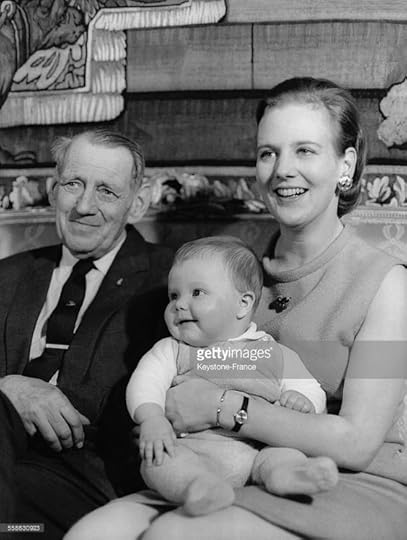 King Frederik IX, Crown Princess Margrethe and baby Frederik 1969.
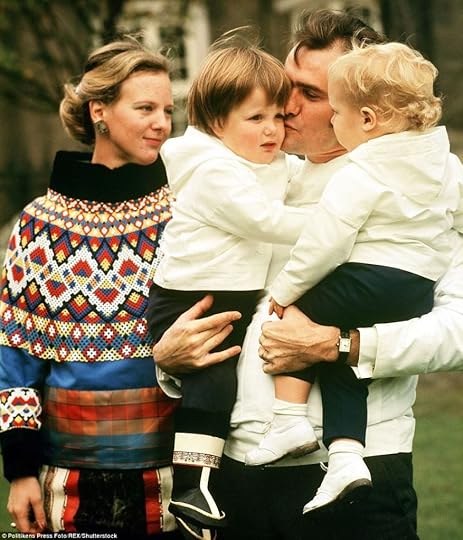 Prince Frederik and brother Prince Joachim in the arms of their father Henrik. Crown Princess Margrethe looks on.
 The Crown Prince attended Krebs’ School in Østerbro, Copenhagen from 1974 to 1983. This was followed by a year at boarding school in France at the École des Roches, Normandy. With a French father and a mother who has a great aptitude for languages, it is no surprise that their elder child is fluent in French, English and German, as well as his native Danish. The Prince finished off his secondary education at Øregård Gymnasium in Hellerup. On occasion, he entertained his classmates to a bite to eat at the Palace at the end of the school day. In 1986, Frederik joined Søren Haslund-Christensen’s expedition to Mongolia as a cameraman. This included lugging cumbersome and expensive equipment around with which to document the lives of the local people. That same year he commenced his life in the Danish military as a recruit with the Royal Life Guards and would go on to serve in all three branches of the Danish armed services including, in 1995, the elite special forces Naval Frogman Corps which is notoriously tough in terms of training. Quite an achievement for someone said to have been afraid of water in his youth. Frederik earned the nickname of ‘Pingo’ among his fellow cadets. An intensive air force training course in 2000 saw him become a Captain in the Royal Danish Air Force.
 A youthful Crown Prince Frederik commences his military training in 1986.
 In 1992, the Prince enrolled at Harvard for two semesters of academic study under the name of Frederik Henriksen. As their are many people in the ‘States of Scandinavian origin, this seemed an ideal choice. In later life, the Crown Prince would establish an annual Harvard scholarship payable from the Crown Prince Frederik Fund. This provides the awardee with financial support for one year of study at the John F. Kennedy School of Government at this prestigious university. Thereafter, there was a longer spell studying at Aarhus University where Frederik graduated in 1995 with a political science degree (cand.scient.pol.). The Crown Prince’s dissertation dealt with foreign policy in the Baltic countries. He is the first Danish royal to gain a master’s degree.
 Crown Prince Frederik with his beloved grandmother, Queen Ingrid.
 In 1994, in anticipation of his future role as monarch, Frederik undertook a three-month stint at the Danish UN Mission in New York. This gave a brief insight into the machinations of international politics. This was backed up by a year spent as First Secretary at the Danish Embassy in Paris from 1998-99. Meanwhile, in 1996, Crown Prince Frederik was named Dane of the Year and was presented with a sword to commemorate the award along with a cheque for DKK 100,000. This was the first of many occasions when he was to win this prestigious accolade.
The Crown Prince’s public profile was not always as those in authority might have wished it. In 1987, during his first visit (in an official capacity) to Japan, the Crown Prince visited Hiroshima where the atomic bomb was dropped. Frederik subsequently reflected that the visit had not made much of an impression on him, because the younger generation needs to look to the future. This was not well received at home.
The Crown Prince had his fair shares of scrapes like many youngsters. On one occasion, he was a passenger in a car driven by a girlfriend who had no driving licence and was over the alcohol limit. Although he was not at the wheel critics lambasted him as if he had been. Then, in 1988, during a holiday in France, he and his younger brother Joachim were involved in a car accident. Frederik was thrown from his car and suffered a broken collar bone. Soon the media were referring to him as ‘the turbo prince.’ The fact that he was a fan of Led Zeppelin’s music certainly was in keeping with this image. Indeed, Frederik’s well-known love for music saw him being asked onto radio station P3, at the invitation of radio presenter Alex Nyborg Madsen, to play a selection of the Crown Prince’s favourite music. Artistes selected included David Bowie and Soundgarden. Frederik’s was also often photographed with well-known international artistes who performed in Copenhagen, including the iconic Whitney Houston.
 The Crown Prince running a Copenhagen marathon.
But as the Crown Prince displayed during his time with the special forces, there was an inner steel behind the fun-loving image. Between February and June 2000, he took part in Expedition Sirius 2000, a tough Arctic expedition with five other participants through the challenging terrain of Northern Greenland. But it was not only physical challenges that were required of him. In 2002, Frederik also completed an exacting management course at the Royal Danish Defence College, a very necessary qualification for someone seeking promotion in the Armed Forces. He subsequently taught in the Department of Strategy of the Royal Danish Defence College.
By contrast, that same year the Crown Prince was appointed a Commissioner for the Danish Red Cross and Patron of the Save the Children Fund in Denmark. His official (charitable) duties were thus becoming well-established. At the time of writing they extend to over 30 patronages including the Danish Association for the Deaf, the Greenlandic Society and the Danish Railway Museum. Interestingly, Frederik had long shown that he had a caring side, for during his time in the United States he worked as a volunteer in a homeless shelter. The Crown Prince was also able to act in a formal capacity as Regent in the event that his mother was overseas. This entailed holding audiences, receiving Ambassadors and signing documentation. Among the Honorary Offices he also holds is his Presidency of the of the Royal Danish Geographical Society and a role as Chairman of the Royal Danish Yacht Club.
 Frederik and Mary at the time of their betrothal.
 On 14 May 2004, Frederik married a Tasmanian of Scots descent, Mary Elizabeth Donaldson, in a lavish ceremony in Copenhagen Cathedral attended by many of Europe’s royalty. The couple-who met when Frederik attended the Olympic Games in Sydney in 2000-initially lived at the Chancellery House at Fredensborg while the Frederik VIII Palace at Amalienborg was renovated. They then maintained the house at Fredensborg as a country residence. The royal couple have four children: Crown Prince Christian (born 2005), Princess Isabella (born 2007) and twins Prince Vincent and Princess Josephine (born 2011).
In 2009, the Crown Prince was criticised in some quarters for his decision to run as a member of the International Olympic Committee (IOC). Although he was in excellent company, with the likes of his uncle King Constantine and his kinswoman Princess Anne of the United Kingdom both serving with dedication as members, much of the criticism was aimed at the seedier side of sport involving dictatorships and financial irregularities. Frederik admitted, ‘Never before have I been subjected to such psychological pressure.’ Nonetheless, he persevered and remained an involved member of the IOC until 2021.
Over the years Crown Prince Frederik was active in promoting Denmark and the Danish brand overseas, be it in the field of business or culture or international development. This support came via state visits overseas or less formal patronage/ promotional trips. These were undertaken on a regular basis. The Crown Prince recognised the importance of international trade and accessing large international markets. Among other things, he is Patron of Denmark Bridge, which aims to ensure that Danish companies and entrepreneurs are given access to the knowledge, network contacts and capital investment required in order to better undertake business in the United States.
The Crown Prince has also been much focused on the challenges associated with climate change and the environment, particularly relating to Denmark’s role as a leading nation in green transition. In 2020, Frederik established the “HRH Crown Prince Frederik International Business Awards”. There are three categories (with an award for each): Business Excellence, Green Solutions and Export Achievement. The Award is given to companies overseas (this can include agents, distributors and subsidiaries of Danish companies abroad) who have made an outstanding effort in promoting sustainable Danish products, services and values worldwide.
Frederik’s trips to Greenland and the Faroe Islands, which are autonomous regions of the Kingdom of Denmark, have been-and will continue to be-an important feature of his official life. For instance in 2018 the Crown Prince and Princess, accompanied by their four children, made an extensive four-day tour of the Faroes, visiting numerous villages and settlements, a salmon farm, a gymnasium, a day care centre and attending the Faroese Football Cup Final at which Frederik presented the award. The royals also attended an official dinner hosted by the Prime Minister at the Nordic House. The Dannebrog-the Danish Royal Yacht-was an ideal base for the royal group as it provided them with somewhere to relax, as well as somewhere to offer official hospitality (including a large reception).
Frederik’s desire to be involved with the Olympic movement should have come as no surprise for he is passionate about sport. He runs marathons, plays golf, tennis and football, jogs, swims etc. and has tried to instil this love of sport in others. The Crown Prince observed, ‘In particular, I have been passionate about getting both young and old out of their chairs and starting a life of sports ….’ This personal involvement in sport and the promotion of it for the good of others has earned him the respect of Danes. He has certainly kept active himself: In 2016, he travelled to Norway to accompany war veterans on yet another exacting expedition. Then, in 2018, he instigated the establishment of “The Royal Run”, which is aimed at getting Danes to take up running. The Royal Run has become an extremely popular event with 80,000 Danes participating each year. Although the Crown Prince normally took part, on one occasion he was forced to withdraw as he was suffering from a herniated disc.
 The new King takes on the longest “Royal Run” of his life as he ascends the throne as King Frederik 10. Note the frogman outfit of ‘Pingo’.
 Meanwhile, in April 2015, the Crown Prince was appointed a Rear Admiral in the Royal Danish Navy and a Major General in both the Royal Danish Army and the Royal Danish Air Force. Yet there was no sign that his time as heir to the throne was coming any time soon. Queen Margrethe was still active and even undertaking state visits as far afield as Indonesia, Ghana, and Argentina. The Crown Prince accompanied his mother on the latter visit in 2019. This was a role his late father Prince Henrik (who died in February 2018) had previously undertaken with the Queen. Frederik also accompanied Queen Margrethe on a State Visit to Germany in 2021 and he was present, with his mother, for the funeral of Queen Elizabeth II in London in September 2022. By this stage Queen Margrethe-at the age of 82-had ongoing health issues. For some time she was required to sit while receiving long lines of guests at official banquets or levées for the diplomatic corps. [It is worth recalling that in 2003, the Queen had undergone a 4.5 hour operation for spinal stenosis.] It now became clear that further surgery on her back was required and, in February 2023, Margrethe underwent major surgery at the Rigshospitalet. Although she made a good recovery, Her Majesty has since walked with the aid of a stick. It was during this period that Queen Margrethe had a chance to reflect on the future. It must have influenced her decision-making that her eldest grandchild Christian officially came-of-age in October 2023. He was now eligible to sit on the Council of State and could act as Regent.
 The important triumvirate: Prince Christian acknowledges the cheers of the crowds as he celebrates his 18th birthday.
There was, however, in November, speculation in the press that Frederik was allegedly involved with a Mexican actress (who worked in Spain) called Genoveva Casanova. Ekstra Bladet in Denmark ran a report noting that the Spanish tabloid Lecturas had displayed various photographs in their newspaper. This included photographs of Crown Prince Frederik and Genoveva Casanova entering the Madrid’s El Corral de la Morería restaurant (a haunt of celebrities) and also going for a walk in El Retiro park. However, Ekstra Bladet emphasised that the photographs they had viewed ‘do not document any intimacy’. Meanwhile, Ms Casanova, 47, fiercely denied the allegations in Lecturas, describing the claims as ‘completely untrue’ and ‘malicious’. Royal Family officials chose not to be drawn and stated: ‘We do not comment on rumours and insinuations.’ However, both the Crown Prince and Crown Princess presented a united front when they were photographed at their son, Prince Christian’s side following his attendance at his first Council of State meeting. The message was clear-it is business as usual!
The Royal Danish House’s Head of Communications, Lene Balleby, allegedly told the Danish newspaper Berlingske that Queen Margrethe ‘informed’ Crown Prince Frederik of her ‘decision’ to abdicate on Thursday 28 December during a meeting at the Queen’s residence, Marselisborg Castle at Aarhus. Then, on 31 December 2023, Her Majesty announced during her annual New Year broadcast that she would abdicate the throne in favour of her son Frederik on 14 January 2024, 52 years to-the-day since she had succeeded her beloved father, King Frederik IX. Later that evening, Crown Prince Frederik, and Crown Princess Mary celebrated New Year’s Eve with their friends Jeppe and Birgitte Handwerk at their home on Vedbæk Strandvej. Frederik reportedly had tears in his eyes as he listened to the Queen announcing her abdication. Indeed, royal commentators in Denmark later observed that the Crown Princely couple were in ‘a state of shock’, as were most Danes. Three days is, after all, not long to take in such life-changing news.
 His Majesty the King of Denmark.
Today Frederik has an 84% approval rating among his people. Prime Minister Mette Frederiksen is appreciative of her new Sovereign, ‘I am sure that the Crown Prince will be a good and strong king for Denmark and the entire kingdom.’ Former premier, Helle Thorning-Schmidt opines that ‘I think he has found himself more in recent years.’ Commentators state that he will adopt a much more informal approach than his mother who is seen, according to Birgitte Borup, Culture Editor at Danish newspaper Berlingske as ‘more culturally distinguished.’ She also adds that ‘Queen Margrethe is serving him the monarchy on a silver platter,’ presumably a nod to the esteem in which it is currently held. It must certainly have been an emotional moment at Christiansborg Palace as the Crown Prince watched his beloved mother Her Majesty Queen Margrethe II sign the Instrument of Abdication just after 14:00 hours. At that moment, Frederik became King Frederik X and his mother would henceforth be known as Her Majesty Queen Margrethe, a loyal subject of her beloved son.
Yet, there seems little doubt that the well-travelled and multi-lingual King Frederik is equipped to represent Denmark overseas, drawing on his past experience in promoting Danish trade, green credentials and culture, as well as representing Denmark on the IOC and accompanying his mother on State Visits overseas. As importantly, he will be a rallying point for the Danish people, with whom he clearly identifies and likewise they with him. Some have derided his ‘sporty’ image but in so doing, not only do they underestimate his foresight, but they also clearly fail to recognise that through his own hard work, achievements, and initiatives in this field, he has ‘struck a chord’ with Danes. Who is to say that he cannot now rally them to other causes in the future?
January 8, 2024
Danish Queen’s Royal ‘Bombshell’- The Aftermath!
When Queen Margrethe II of Denmark sat down at 6pm on 31 December in the Audience Chamber of the Christian IX Palace at Amalienborg in Copenhagen to deliver her annual New Year broadcast, few can have realised that she was about to deliver what the Danish press as described as a ‘bombshell.’ The relevant portion of the speech started off innocuously enough: ‘In two weeks time I have been Queen of Denmark for 52 years. Such an amount will leave its mark on anybody – also on me! Time takes its toll, and the number of “ailments” increases. One cannot undertake as much as one managed in the past.’ But then Her Majesty gave her public an insight into her inner feelings: ‘In February this year I underwent extensive back surgery. Everything went well, thanks to the competent health personnel, who took care of me. Inevitably, the operation gave cause to thoughts about the future – whether now would be an appropriate time to pass on the responsibility to the next generation.’ Intake of breath among those watching! The Queen continued, ‘I have decided that now is the right time. On 14th January, 2024 – 52 years after I succeeded my beloved father – I will step down as Queen of Denmark. I will hand over the throne to my son Crown Prince Frederik.’
 Queen Margrethe makes her final New Year speech.
 The Danish people and others listening were mostly dumbfounded and caught totally off guard which is natural given that, as the Danish Royal House website notes, ‘This will be the first time in almost 900 years that this has happened in Denmark – it is thus an extraordinary and historic event’. The Danish press were also reporting that ‘the world is amazed’ by Queen Margrethe’s announcement.
Mette Frederikson, the Prime Minister-who made it known that she had been ‘briefed by the Queen’ personally ‘around Christmas’ or ‘just after Christmas’ depending on the source-was diplomatic and sincere in her response. She was quick to mention the ‘gratitude and admiration’ the Danish people felt for this iconic figure: ‘Many of us have never known another ruler. Queen Margrethe is the epitome of Denmark and throughout the years she has symbolised in words and feelings who we are as a people and as a nation.’ This was the general tone prevailing.
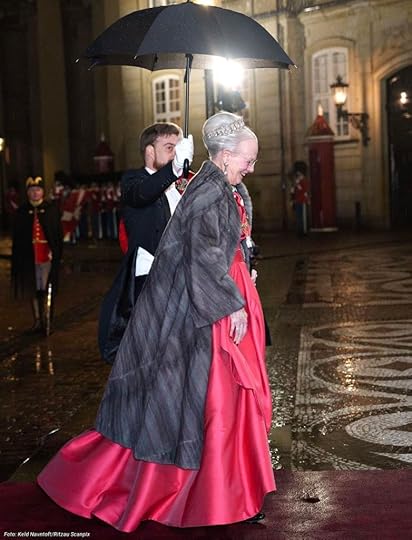
However, some commentators-a minority-such as journalist and radio host Astrid Johanne Høg, in a commentary piece in Altinget, posits that Queen Margrethe’s ‘choice to abdicate could have serious consequences for the Royal Family in the future. ‘ She points out that in the past the Queen herself ‘has said that you are born to the task and that it is for life.’ In this Ms Høg is correct for Margrethe explicitly stated this in an interview in 2010 with Danish journalist, Anders Agger. Ms Høg then tackles the crux of the matter (as she sees it), ‘The core of the Royal Family’s symbolic power is precisely [this] unfreedom. She has not chosen her task and we have not chosen her. That is precisely why the Queen is the personification of duty, and that is precisely why we owe her loyalty. With her abdication, she has introduced a free choice where there was not one before. The long-term consequences, I believe, are serious’. Ms Høg feels the ‘Monarch’s vocation is reduced to a job.’ One consequence is to ‘undermine the legitimacy of the institution,’ she states.
The reaction oversees has been interesting. In the United Kingdom, Channel 5 screened a documentary on Queen Margrethe’s life on Saturday 6 January. The channel is famed for its many programmes on the British Royal Family, but to dedicate a whole programme to a Queen of Denmark-or any foreign royal for that matter- is quite a departure. Meanwhile, the British-edition of Vogue magazine are focusing on the Queen’s ‘eccentric royal style’, with photos of Her Majesty in a brightly-coloured ‘mad’ floral raincoat and a shiny brocade evening dress.
 Queen Margrethe’s floral raincoat.
Once the initial shock had passed, commentators in Denmark wondered who had known what and when they had been informed. The Foreign Minister and Leader of the Moderate Party, Lars Løkke Rasmussen, who knows Queen Margrethe as well as most politicians, having twice served as Prime Minister of Denmark, had been ‘briefed’ on 30 December; the Speaker of the Folketinget [Parliament], Søren Gade, had been told early on the day of the announcement in a telephone call from the Prime Minister. Meanwhile, the Prime Minister of the Faroe Islands only learned of the abdication ‘a few hours’ before the speech was broadcast, he informed Ekstra Bladet.
In addition, according to the assessment of Lis Frederiksen, who is a former press officer at the Royal Danish Court, there were at least four people in the Royal House who would have had to be told of the abdication, as they were directly impacted by and involved in the process going forward: the Lord Chamberlain (Court Marshal), the Head of Communications, the Cabinet Secretary and the Crown Prince and Crown Princess’ Chief of Court.
As to royalty, we learn from Sweden’s Expressen newspaper that the Queen had personally informed her cousin, the King of Sweden, of her decision in advance. This information had come directly from a Swedish Court Information Officer, Margareta Thorgren. However, those contacted at the Royal Palace in Oslo were not prepared to comment. It seems inconceivable that King Harald of Norway did not know as Margrethe is close to her Nordic ‘cousin’. In Denmark, Queen Margrethe’s cousin Count Ingolf of Rosenborg was told ‘shortly before the speech’, he revealed to the journal Billed Bladet. The Count was said to have been ‘deeply affected’ by the news. Well he might have been: Had the law of succession not been changed in 1953-previous to this only males could inherit the throne-Ingolf’s father, Hereditary Prince Knud would have succeeded to the throne of Denmark on the death of his brother King Frederik in 1972. Meanwhile, the Queen’s sister, Princess Benedikte, thought it ‘a very, very, nice speech.’ Not informed were any of the Queen’s friends.
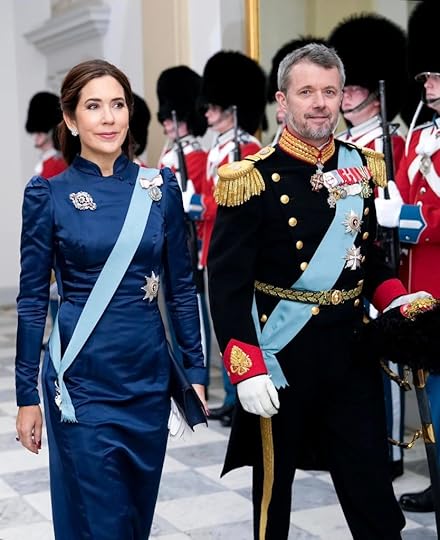 The Crown Prince and Crown Princess arrive at Christian VII Palace, Amalienborg for the New Year gathering I January 2024
(Foto: Keld Navntoft Ritzau/Scanpix)
Within less than 48 hours of the announcement, word came through via the Royal Family’s Website of “Changes in the Royal House of Denmark’s Leadership.” Of most importance among what Billed Bladdet called ‘major changes’ was the news that Christian Schønau, who had previously been Chief of the Court of the Crown Prince and Crown Princess will now take on the role of Lord Chamberlain (or Court Marshal) of The Royal House, a position held until now by Kim Kristensen. Schønau is an able individual with a law degree and has previous experience (at Permanent Secretary level) of working in government ministries. In addition, he will take on the duties previously undertaken by the Cabinet Secretary. The incumbent, Henning Fode is retiring after 16 years of loyal service in this post and he will not be replaced. However, Kim Kristensen is not retiring but will assume a new position as Chief of Court of the newly-established Court of Her Majesty Queen Margrethe. The Royal House of Denmark’s Master of Ceremonies, Lasse Harkjær, will leave his current position on 1 March to commence work as Chief of Staff in the Court of Her Majesty Queen Margrethe. He will be replaced as Master of Ceremonies by Commodore Anders Friis.
There have been many other questions since the news of the Abdication. A favourite one is as to where Her Majesty Queen Margrethe will live. It would be reasonable to expect that should she desire it, she will continue to have the use of her current apartments in the Christian IX Palace at Amalienborg. The new King, after all, has more than adequate accommodation in the recently modernised Frederick VIII Palace. It is equally possible that Margrethe will be able to spend time in the summer at Gråsten Palace in Jutland. Although this palace is owned by the State, it is hard to imagine that King Frederik would deny his mother the right to holiday at Queen Ingrid’s former summer home, as she has done in past times. Queen Margrethe also spent a lot of time at Fredensborg Palace, particularly in the spring and the autumn. It was often (and will continue to be) a centre for State Visits with ample accommodation to house the visiting Head of State and their suite. In addition, Ambassadors from other countries present their credentials to the Sovereign when the Court is in residence here. Given this official focus, it seems inevitable that the new King and Queen will eventually move into this residence. Nearby though is the Chancellery House, where Queen Ingrid lived following her husband’s death in 1972. It is currently used as a country home by the future King Frederik and his family. Might Queen Margrethe move there in due course, or at least use it as her country retreat? Meanwhile, another royal residence, Marselisborg Castle, was a wedding gift to the new King’s great-grandparents, the future King Christian X and Queen Alexandrine. Queen Margrethe used it mainly at Christmas and Easter. It is harder to predict what will happen with this residence in the new reign.
There have also been questions as to exactly when and how the Abdication and Accession process (or ‘change of throne’ to translate the Danish term) will proceed. Titles have also been a source of interest. The Accession of His Majesty King Frederik 10 (as the former crown prince will henceforth be known) will take place during the meeting of the Council of State at Christiansborg Palace (scheduled for 14:00 hours) and occur at exactly the moment when Her Majesty the Queen has signed the Instrument of Abdication. The new King is then scheduled to appear on the balcony of Christiansborg at 15:00 hours, when the Prime Minister will proclaim the change to those gathered below. This will also give His Majesty an opportunity to greet the people for the first time. Interestingly, The Danish People’s Party have indicated that they would rather see Queen Margrethe herself proclaim Frederik as King rather than Prime Minister Frederiksen. However, there seems to be little support for the idea in Parliament.
As to titles, the former crown princess will bear the title of Her Majesty Queen Mary. Invariably, the royal couple will be referred to as the King and Queen. Prince Christian, as heir to the throne, will now be designated as His Royal Highness, Crown Prince Christian. Meanwhile, the former queen regnant will be called Her Majesty Queen Margrethe.
At 17:00 hours that afternoon, the flags (or banners) of the Royal Guard will be moved from the Christian IX’s Palace (Margrethe’s residence) to Frederik VIII’s Palace, Amalienborg (the home of the new King and Queen), a neat way of signifying the new reign of the latest incumbent of the throne of one of the oldest royal houses in the world, stretching back some 1000 years to the times of Gorm the Old.
That evening, at 20:00 hours Denmark’s television channel, DR1 will broadcast a one-hour documentary on the life of the new incumbent of the throne. It will be titled, “Frederik – King of Denmark”, and in it a number of prominent figures will contribute to a profile of Denmark’s king.
There are also further implications following upon the ‘change of throne’: On 14 January, all patronages and honorary offices previously held by the Crown Prince and Crown Princess and Her Majesty The Queen will go into abeyance. A decision will then be made over the coming months as to which of the patronages will be maintained and who will become the relevant patron. The relevant organisations will be informed of this by the Royal Household.
Another implication of the accession of King Frederik 10 will be that will be the cessation of all Royal Warrants awarded to companies who supply goods and services to the Royal Danish Court and entitled to use “By Appointment to the Royal Danish Court.” However, they will still be able to make use of this ‘royal appointment’ wording until 14 January 2025 (at earliest) or until the expiry of the period for which the award was valid. Decisions will subsequently be made about future arrangements concerning the awarding of a Royal Warrant.
The Royal Court will doubtless give more details of further developments as the 14 January approaches in a forthcoming press conference on 10 January.
December 23, 2023
Queen’s 1953 New Zealand Tour-The North Island.
On 23 December 1953, history was made when Queen Elizabeth II arrived in Auckland aboard the liner S.S. Gothic to undertake a royal progress through her Kingdom of New Zealand. She was the first reigning sovereign to visit to do so. Her first greeting from her people was a welcoming escort of several hundred yachts and a 21-gun salute from the North Head battery as the royal ship passed Bastion Point. Soon tugs guided the Gothic safely towards the Central Wharf, as crowds gathered to greet their Monarch.
Shortly thereafter, the Governor-General, Sir Willoughby Norrie and the Prime Minister, the Right Honourable Sidney Holland, went aboard with their respective wives to welcome the Queen and the Duke of Edinburgh on behalf of the people of New Zealand. Once the official party had disembarked, a bystander spotted Her Majesty peeking out and a cry went up, the crowd responding by giving three cheers as the Queen made her way down the gangway in a fetching chartreuse silk dress, followed by the Duke of Edinburgh in a uniform of an Admiral of the Fleet. The royal couple then entered the waiting royal car and drove up the main thoroughfare, Queen Street, which was lined with flag-waving crowds to the Town Hall where Her Majesty was introduced to civic dignitaries and their wives. Thereafter, she met with war widows and 500 elderly people, the oldest of whom was 103.
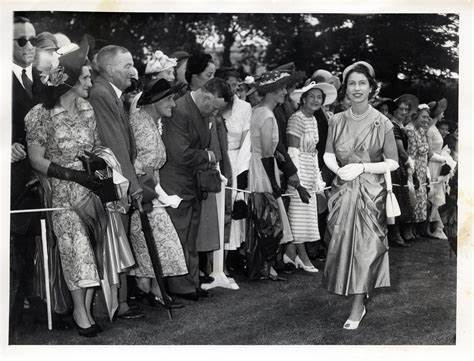 The Queen attends a Garden Party 23 December 1953 Government House Auckland.
The Queen arrived at Government House, where she would stay over the Christmas period, in time for luncheon. But there was to be no chance of a rest as the royal couple had to attend a garden party for 2,000 guests in the grounds. Both the Queen and the Duke spent over an hour chatting to invitees en-route to a roped-off enclosure, where they took tea and received yet more invitees.
On Christmas Eve, the royal duo travelled in open-topped car to the Auckland Public Hospital to inspect the wards and meet staff and patients. Then it was off to the Domain to attend a youth rally of 16,000 schoolchildren (and an additional15,000 onlookers!) during which the Queen and the Duke drove down the lines of waiting children in a specially adapted Land Rover with a reviewing platform. The Queen subsequently told the waiting throng that ‘Your welcome today has warmed our hearts because it has reminded us that even after this long journey we are still at home.’
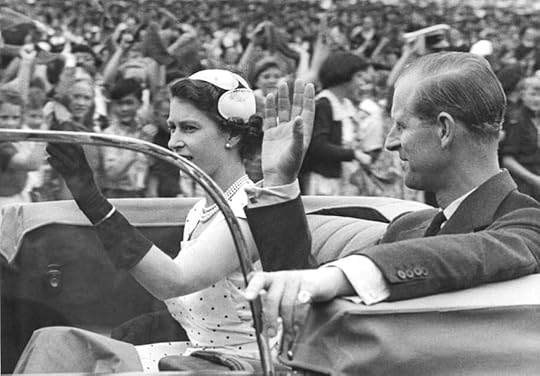 16,000 School Children gathered at the Auckland Domain to greet the Queen on Christmas Eve.
In the afternoon, the royal couple crossed over Waitemata Harbour in a commodore’s barge to Devonport to attend a Colour-presentation ceremony at the Naval Base. The Queen and the Duke were greeted by 1650 men of the Royal New Zealand Navy. Some 9,000 relatives, friends and dock workers also looked on as, following a brief drumhead service of dedication led by a naval chaplain, the new Colour was presented by the Queen to the leader of the new Colour party.
However, that evening, one of the saddest events in New Zealand history occurred when the Auckland-bound express train from Wellington plunged into the Whangaehu River at Tangiwai. The river had been in full spate and the force of torrents had weakened the concrete piles of the rail bridge. 151 passengers perished. A distressed Queen received regular updates on the situation at Government House.
On Christmas Day morning, after receiving Christmas gifts for their children, Charles and Anne, from 225 carol singing children (accompanied by Santa Claus) the royal couple attended Divine Service at St Mary’s Cathedral. Of course, this was the height of summer in New Zealand but, nonetheless, back at Government House the Queen and the Duke tucked into a traditional Christmas lunch of turkey and plum pudding.
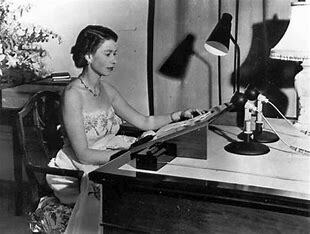 The Queen makes her Christmas Day Broadcast at Government House Auckland
At 9p.m. that evening, the Queen made her Christmas broadcast to the British Commonwealth (as it was then still referred to), her first since being crowned Queen in June. This was the only occasion that the festive royal broadcast would be made outside of the United Kingdom. She praised the Commonwealth and ‘the achievement and opportunity… it presents’. Importantly, Her Majesty also emphasised that this new union of increasingly independent countries ‘bears no resemblance to the Empires of the past. It is an entirely new conception…of equal partnership.’ Furthermore, the Queen made sure to include a moving message of sympathy on behalf of herself, her husband and all the peoples’ of the Commonwealth, to the survivors and to the relatives and friends of victims of the recent railway disaster.
On Boxing Day, the royal visitors attended the Royal Auckland Cup race at Ellerslie Racecourse where they were joined by 43,000 racegoers and the generally curious! At times, the police had to hold back the crowds to allow the Queen and the Duke to pass through. Her Majesty (a keen horse owner and bloodstock expert) was delighted to be asked to present the Cup to the owner of the winner, Coaltown. The race-which was run over two miles with a prize pot of £12650 Sterling-had ended in an exciting photo finish! Later, the royal couple paid a private visit to the home of the Falloon family who had survived the train crash, before returning to Government House to dress for the world premiere, at the St. James Theatre, of the British film, The Million Pound Note.
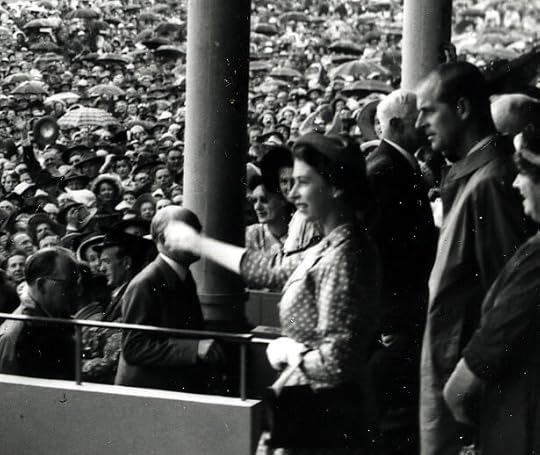 The Queen enjoys a day out at Ellerslie Race Course 26 December 1953
On 28 December, the royal party departed ‘The Queen City’ to travel by air in a Dakota of 42 Squadron Royal New Zealand Air Force (RNZAF) to Waitangi, the historic site of the signing of the 1840 Treaty which ceded the sovereignty of New Zealand to the British Crown. She first presented her Colour to the RNZAF at Whenuapai Air Base and informed those gathered that ‘I have heard much of your valour in war and of your skill and expertise at all times.’ On arrival in Northland, the Queen and the Duke were greeted by 10,000 people at Kaikohe, some who had travelled as much as 100 miles.
At Waitangi, a crowd of 5,000 had gathered to watch as the Queen and the Duke were greeted by 200 Māori men and women on the lawn in front of the Treaty House and watched a display of the traditional powhiri, which is the formal welcome ceremony onto the Marae (or gathering place). This ritual included what the press described as ‘the age-old ceremonial challenge’. The royal duo were escorted by E.B. Corbett, the Minister for Maori Affairs. The Prime Minister and other dignitaries were also present. Many Māori felt they had a special relationship with the sovereign through the Treaty of Waitangi and had wanted to express their loyalty to the Crown. It was also subsequently arranged for the Queen and the Duke to stop briefly at Tūrangawaewae, the Marae of King Korokī in Ngāruawāhia on 30 December where they stayed longer than expected as the King’s guest and entered the Meeting House (Wharenui).
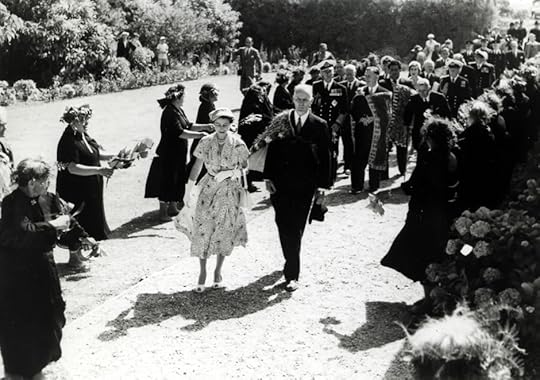 The Queen pays a visit to Waitangi on 28 December 1953.
 Meanwhile, on the evening of 28 December, the royal visitors arrived at Whangarei where they attended a civic reception at Kensington Park and stayed overnight at the Grand Hotel. After dinner, the couple appeared on the balcony to greet crowds chanting “We Want the Queen.” This would become a regular feature throughout the tour. After this brief visit, on 29 December, the royal party motored southwards back to Auckland via the village of Warkworth, where a crowd of 8,000 had gathered (ten times the normal population of this settlement). The motorcade stopped 30 miles outside of Auckland for a picnic at a farm near scenic Puhoi. Thereafter, the royals were cheered most of the way to the city by bystanders who included holidaymakers enjoying the beaches nearby. The royal day ended with an investiture at the Auckland Town Hall.
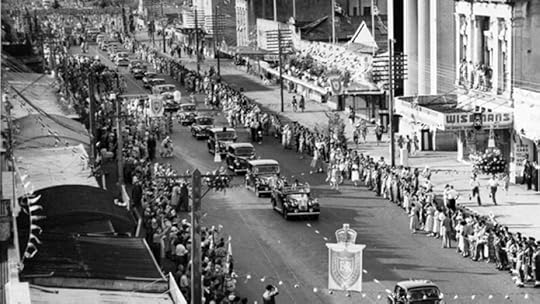 The Royal Cavalcade arrives in Hamilton 30 December 1953
The Queen and the Duke now travelled down through the North Island en route to the capital Wellington. Given Her Majesty’s interest in all matters equine, it is unsurprising the first stop on the 30 December was to Alton Lodge stud farm at Te Kauwhata, before travelling on via Huntly to Hamilton, the most populous city of the Waikato region where crowds were estimated at 25,000 lined the route and city centre. That evening there was Civic Dinner before Her Majesty retired for the night at the Hamilton Hotel. On New Year’s Eve, the Queen watched a parade of champion cattle and an exhibition of sheep shearing at the Claudelands show grounds. Meanwhile, the Duke of Edinburgh had, at his own request, travelled by air to Wellington in the early hours, to attend the funeral of unidentified victims of the rail disaster at Karori Cemetery. He and the Queen were reunited that afternoon at the limestone caves of Aranui and Waitomo. At the latter, the royal party were able to a journey by boat through the grotto which was lit by a mass of glow worms massed on the rock formations. In the evening the royal party spent the night at the Waitomo Hotel where they brought in the New Year of 1954 with a rendering of Auld Lang Syne.
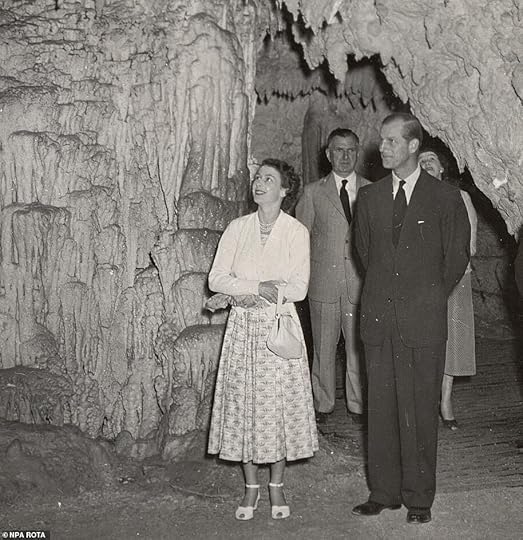 The Queen and Duke of Edinburgh visited the Waitomo and Aranui Caves on 31 December 1953.
As 1954 dawned, there was no day off for the royal tour as it passed through Te Awamutu and eastwards to Cambridge (where 15,000 had gathered) en route to Karapiro Hydro-electric Station. That evening, the couple spent the night at Moose Lodge overlooking Lake Rotoiti.
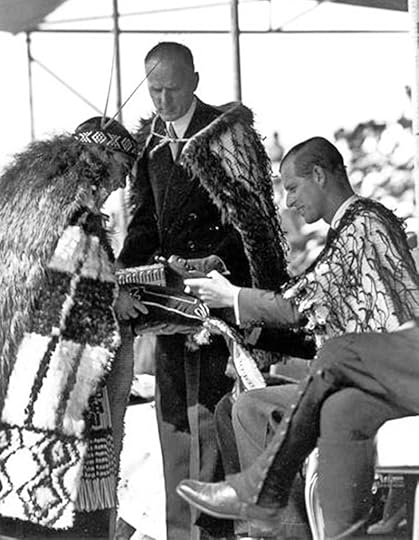 The Duke of Edinburgh receives some carvings at Awara Park during the royal visit to Rotorua on 2 January 1954
On 2 January the Queen travelled into Rotorua for a civic reception and official lunch. This was followed by what was described as ‘meeting the Maori people.’ A ceremonial site at Arawa Park had been converted for the occasion into a temporary Marae for this historic occasion which included the traditional powhiri welcome by 140 warriors. Her Majesty received speeches in which she was referred to variously as ‘O stranger from beyond the horizon’ and ‘O Royal daughter of an illustrious line’ for whom there was ‘unswerving devotion.’ After the giving of gifts, one of which was a flaxen Maori cloak, the symbol of a paramount chief (which the Bishop of Aotearoa fastened over the monarch’s shoulders) the Queen made a speech. She indicated she was greatly touched by the kind welcome she had received and expressed the hope that the Maori people would ‘hold fast to your own language and culture…’ She ended with the words ‘Kia ora koutou’ or ‘Good fortune to you all.’ This drew a deafening cheer from those assembled. Her Majesty’s speech was followed by a poi-dance by 300 women from the Arawa tribe, each of whom twirled poi balls of flax with graceful movements of the arms and wrists. Later those gathered joined in the traditional “Ka mate, Ka Mate” haka as the Queen made her departure with the Duke. The royals returned to Moose Lodge for a few days rest, the only engagements being attendance at a church service and a tour of a Maori village at Whakarewarewa.
On 6 January, the royal party travelled coastwards by air to Gisborne for a brief stopover which included a civic reception and a visit to Kaiti Hill to view the the beach below where Captain Cook landed in New Zealand in 1769. This was followed by a visit to the art deco town of Napier where 17,000 greeted the royal party at a welcome gathering in McLean Park. The royal duo spent the night at the Masonic Hotel, where the Queen appeared on the balcony to acknowledge the awaiting crowds.
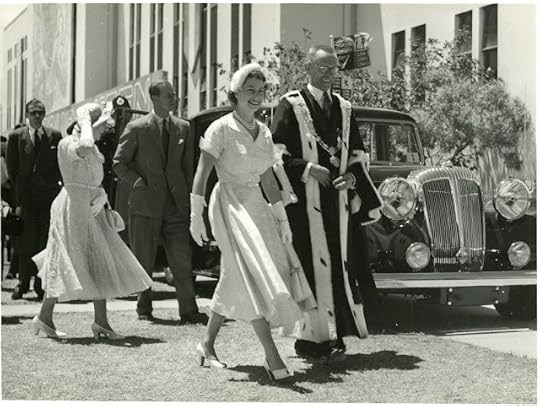 The Queen is escorted by the Mayor on her visit to Gisborne on 6 January 1954
The following morning the royal visitors departed for Hastings and a visit to J. Wattie’s cannery. The royal couple then undertook their first railway journey in New Zealand to make a tour of the farming centres of Waipawa and Waipukurau in Hawke’s Bay; while at Dannevirke, 7,000 people-many of Scandinavian descent-had assembled for yet another a civic reception. After reaching Woodville, the train tour proceeded through the tortuous Manawatu Gorge, the Queen and the Duke taking to the observation platform to take in the view of craggy cliffs and swollen waters. Palmerston North was finally reached that evening. 60,000 watched the Queen as she disembarked the train. Far from putting their feet up, the Queen and the Duke had to attend an official dinner.
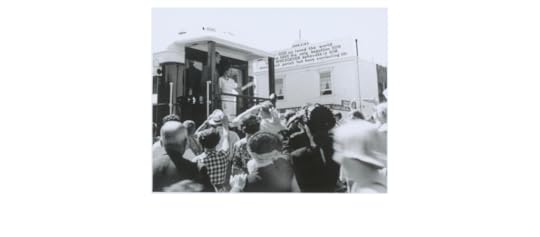 Palmerston North crowds greet the Royals
After an overnight stay, the royal train tour set off again at even more frenzied pace than the preceding day. After passing through the Manawatu Plains to Feilding and then into the fertile Rangitikea area, the party reached Marton (named after the birthplace of Captain Cook). At each place there were only the briefest of halts, but at least the people had the opportunity to actually see their Sovereign. At Wanganui, 40,000 people had converged on the town’s Cook’s Gardens for the official welcome. And then it was on to Patea (where local Maoris performed a haka) and Hawera, where a reception was held at the local racecourse. Later at Stratford, the Queen managed a brief walk along the Broadway. The 260 miles covered on this day alone ended at 6.15 p.m. in the town of New Plymouth where the royal party spent the night at the Criterion Hotel. The couple did not retire till gone 10 p.m. as they made several appearances on the hotel balcony due to public demand. Next morning, the Queen and Duke toured a the Bell Block Dairy and attended an official welcome gathering at Pukekura Park.
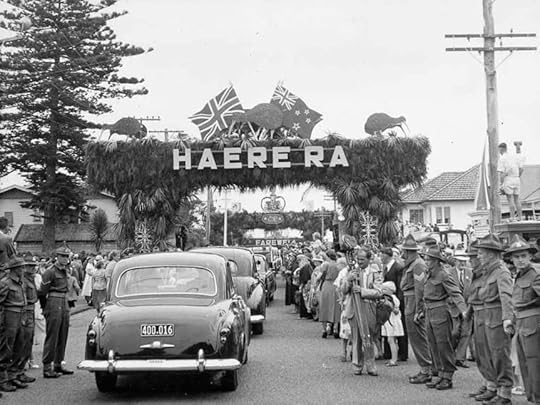 The Queen passes through New Plymouth on 9 January 1954
On the afternoon of Saturday, 9 January, the Queen flew down to the capital of New Zealand, Wellington. On the Sunday, she attended Divine Service at the Cathedral Church of St. Paul. The following day, 11 January, the Queen was schedule was particularly tight: in the morning, there was a Civic Welcome at the Town Hall, followed by a Wreath Laying Ceremony at the Citizen’s War Memorial, attended by a crowd of 5,000 locals. A State Luncheon followed in the Social Hall of Parliament House. The royal party then travelled through Petone to the Ford Motor Company’s factory at Lower Hutt. Thousands lined the route, it being a public holiday. In the evening, the Queen presided over a Diplomatic Reception at Government House.
The morning of 12 January saw the Queen and Duke up bright and early to travel to Athletic Park to attend a Children’s Gathering. 35,000 children and parents greeted the royal duo with boisterous cheering and the waving of Union Jack and New Zealand flags. The royal couple proceeded in an open Land Rover down through the lines of excited children. In the afternoon, Her Majesty presided over the “Royal Opening” of a special session of the New Zealand Parliament in the Legislative Chamber. For this historic occasion, she wore her dazzling Kokoshnik diamond tiara and Coronation dress. The Duke wore the uniform of an Admiral of the Fleet. Two new painted throne chairs, each covered in red brocade and featuring a fern motif, had been made in Christchurch by cabinet maker Charles McCracken out of Southland Beech especially for the ceremony. The Queen’s chair was emblazoned with her personal cipher of EIIR. Her Majesty acknowledged in her speech that the ‘bountiful lands’ of New Zealand had ‘grown to be a Sovereign and a mature state.’ That evening, Her Majesty held an investiture in Wellington Town Hall. 150 men and women received civil and military awards.
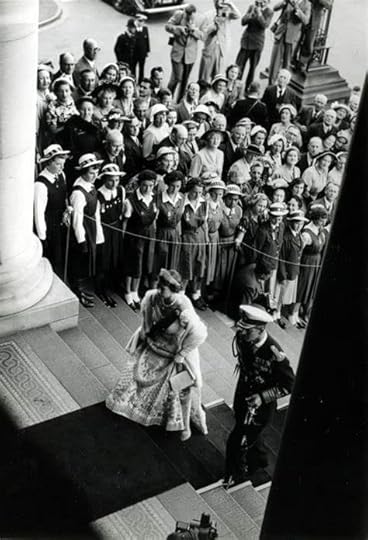 The Queen and Duke of Edinburgh enter Parliament for the “Royal Opening” on 12 January 1954
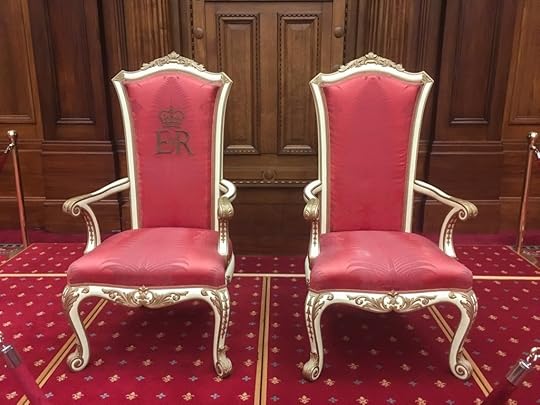 The new throne chairs specially commissioned for use at the State Opening.
On 13 January, the Queen travelled up to the suburb of Thorndon to lay the foundation stone of a new cathedral to replace the current wooden edifice nearby. The rest of the day was spent at Government House where the Queen joined 4,000 of her New Zealand subjects at a Garden Party. Her Majesty also presided over a meeting of the Privy Council and of the Executive Council, the latter of which advised the Governor-General (the Queen’s representative) on State and Constitutional matters.
The next day, the Queen and the Duke had a chance to relax when they attended the Wellington Racing Club’s meeting at Trentham. Her Majesty presented the Royal Wellington Cup to the owner of the winning horse, Golden Tan, Mr G. W. Hartstone. 30,000 people attended this equestrian event.
On 15 January, the royal couple travelled some 66 miles by train through the district of Wairarapa. At Masterton, the main township of the area, dignitaries and their wives queued to shake hands with the Queen and the Duke, who also later lunched there. At one stage of the journey, the royal train ascended the Rimutaka Range to a height of 1000 feet above sea level. At the summit, local railway workers and their families had a rare chance to greet their Sovereign. No less than two locomotives and three break-vans were then attached here to assist the train as it descended down the steep hillside to the plains below. The return journey to Wellington was by car through the townships of Carterton, Greytown, Featherston and Upper Hutt. And so ended the final day of the 24-day tour of the North Island, as the following morning (16 January) the Queen and the royal party would leave Wellington’s Paraparaumu Airport and fly down in a Dakota of 42 Squadron RNZAF to Woodbourne Aerodrome near Blenheim.
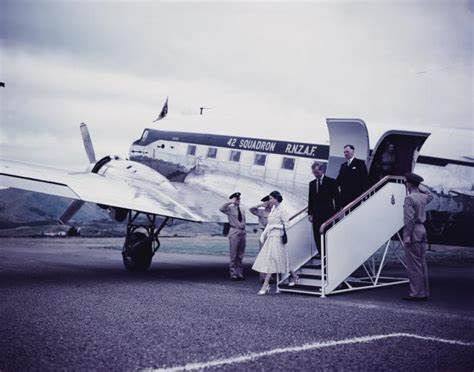 The RNZAF Dakota of 42 Squadron used to transport the Queen around New Zealand.
December 22, 2023
Queen Silvia-80th birthday Tribute.
Silvia Renate Sommerlath was born in Heidelberg, Germany, on 23 December 1943. Her father, Walther Sommerlath was a German-born company director; while her mother Alice Soares de Toledo hailed from Brazil. Alice’s father Artur Floriano de Toledo was a direct descendant of King Afonso III of Portugal, who lived and reigned in the 13th century. Walther first met his wife-to-be during a pre-war visit to Rio de Janeiro. Silvia had three brothers, Ralf, Walther and Jörg. The family lived in Heidelberg until 1947 when they relocated to São Paulo, Brazil, where Walther had been appointed Managing Director of the Brazilian offshoot of the Swedish company, Uddeholm AB. They were to remain there for a decade, meaning that in addition to German, Silvia was equally fluent in speaking Portuguese. She attended Visconde de Porto Seguro School and spent holidays at her maternal uncle’s farm in the country along with members of her extended family. There were many cousins as Alice Soares de Toledo came from a large family. She had eight siblings-all brothers.
 Silvia, her parents and brothers taken in Brazil
In 1957, the Sommerlath’s returned to live in Germany in the city of Düsseldorf. The reason for this relocation was that Silvia’s father had been asked to take charge of Uddeholm’s German operations. Silvia subsequently attended the Luisenschule there before enrolling, in 1965, at the Sprachen-und-Dolmetscher-Institut in Munich, to train as an interpreter, specialising in Spanish. On graduating, she was employed at the Argentine Consulate in Munich.
However, she was soon destined for higher responsibilities and oversaw the training of Official Hostesses for the Olympic Games which took place in Munich in 1972 from August until September. During the event itself she acted as Chief Hostess and interacted with many of the VIP’s who attended. It was during these games that she met Crown Prince Carl Gustaf of Sweden in the VIP room. It was, she recalled, a ‘particularly amusing’ encounter as Carl Gustaf was observing her through binoculars, even though she was standing only one metre away from him! Something must have clicked for the Crown Prince invited her to attend a private family dinner attended by himself, his uncle Prince Bertil, the latter’s future wife Lilian Craig, the Crown Prince’s older sister Princess Birgitta and her husband Prince Johann Georg of Hohenzollern-Sigmaringen. The dinner seemed to go without a hitch and soon Carl Gustaf and Silvia were dancing the night away at a local night club, Kinki. The couple were to keep in touch by phone, just as Carl Gustav was about to face many major changes in his life.
 Silvia during the Olympic Games in Munich in the summer of 1972.
In November of that year, the Crown Prince lost his beloved mother, Sibylla, to cancer, only weeks after she had attended the 90th birthday celebrations of her father-in-law, King Gustaf VI Adolf of Sweden. Born a Princess of Saxe-Coburg and Gotha, Sibylla had been ‘first lady’ of Sweden since the death of the King’s second wife, Queen Louise in 1965. Sweden was now without a matriarchal royal figure. Then, in September 1973, King Gustaf VI Adolf died and his grandson now succeeded him as King of Sweden, taking the title of Carl XVI Gustaf. The royal title had skipped a generation as the new king’s father, Hereditary Prince Gustaf Adolf had been killed in an air accident in 1947 at Copenhagen’s Kastrup Airport en route home from a hunting expedition.
By this stage, Carl Gustaf and Silvia had been meeting up in Sweden (where she was photographed with Carl Gustaf as he drove his Porsche sports car through the countryside on the island of Öland) and also in Germany. Sometimes, Silvia resorted to wearing a wig as a disguise but very few were fooled as to her identity, as she would later admit. In due course, the couple went skiing in the Alps or sailing with friends in Sardinia. Meanwhile, Silvia had been appointed deputy chief of protocol on the organising committee of the 1976 Winter Olympics which took place in Innsbruck in February of that year. It was a frenetic period with great responsibilities. Ironically, the skills she learned both now and earlier in Munich would stand her in good stead in the future. It helped that she spoke German, Portuguese, Spanish, English and French.
Within weeks of completing her duties in Innsbruck, Silvia travelled to Sweden where the couple announced their engagement on March 12, 1976, in the sitting room of what had been the late Princess Sibylla’s apartments in the Royal Palace. The news was widely covered on the world stage and suddenly everyone was interested in the young Swedish king and his beautiful bride-to-be, who had already learned to speak some Swedish. The Swedes seemed keen to embrace their future queen and cheered the pair as they left the Royal Palace, following the press conference, to lunch with Princess Christina and her husband at their Villa Beylon home in the romantic parklands surrounding Ulriksdal Palace.
 Silvia and Carl Gustaf at the time of their engagement in March 1976
The King married Silvia in Stockholm’s Storkyrkan before 1200 guests on 19 June 1976. Crowds, estimated at around 200,000 lined the streets of the capital city. Silvia’s wedding dress was beautifully designed by Marc Bohan of the Paris fashion house Dior using white silk with a train of just over 3.5 metres. As if it to emphasise her new role as Queen of Sweden, Silvia wore the historical Kamédiadem, a diadem formed of cameos, gold, pearls and brilliants which was originally a gift from Emperor Napoleon I of France to his wife Joséphine de Beauharnais. The diadem, along with the matching parure of necklace, earrings and bracelets, was subsequently inherited by Empress Joséphine’s granddaughter, Joséphine of Leuchtenberg who was Consort to King Oscar I of Sweden and Norway. The suite of jewels was then passed down through the family to Prince Eugen, the youngest, bachelor son of King Oscar II, who gave the historical jewellery to Princess Sibylla as a wedding gift in 1932. The diadem was subsequently worn by Sibylla’s daughters Princess Birgitta and Princess Désirée at the time of their marriages.
 Queen Silvia talks to Prince Bertil at her wedding banquet. Note the Kamédiadem, fragile but beautiful.
 At the time of Silvia and Carl Gustaf’s marriage, a royal charitable foundation was established, known as the King and Queen’s Wedding Fund. The fund, which supports the development of projects and activities, whether they be related to sport or culture or athletics, for the benefit of children and young people with disabilities through the award of grants (around 25 each year) to recognised bodies such as sports clubs or disability associations. This was an early indication of the charitable work the Queen would undertake with children and youths in the not too distant future. Indeed, today she has links with around 80 organisations in various sectors, some of which will be discussed in the course of this article.
The couple’s first child, Victoria, was born at Karolinska University Hospital on 14 July 1977. Carl Philip followed in May of 1979. For a brief period he was Crown Prince of Sweden. However, in a somewhat controversial move, the rules of succession of the Crown were changed from 1 January 1980, with the eldest child of the Sovereign becoming heir to the throne regardless of gender (where previously only males could inherit). This applied retrospectively, meaning Victoria was now Crown Princess. The royal couples youngest child, Madeleine, was born on 10 June 1982. The previous year the King and Queen and their children had moved out of the Royal Palace in central Stockholm and moved to a twenty-room apartment in the south wing of Drottningholm Palace in the suburbs. In the summer, Silvia and her family would move southwards to Solliden Palace, the King’s privately-owned residence on the island of Öland. Here Silvia still loves to garden, introducing new plants and enjoying the vistas of the extensive parklands. She has enthused too that ‘the air is so soft here.’
 The King and Queen with their children Carl Philip, Victoria and Madeleine.
The Queen had by now established her Swedish credentials. She spoke the difficult language fluently and was present at National Day celebrations throughout Sweden, accompanied by her husband and children, wearing the traditional Sverigedräkten outfit. Silvia also proved a sparkling presence at the annual Nobel awards ceremony each December, for she had one of the largest collections of royal jewellery in the world at her disposal and this was an ideal occasion at which to showcase these items. A particular favourite is the Leuchtenberg sapphire suite which features a magnificent tiara set with diamonds and nine stunning sapphires. This is complimented by a sapphire and diamond necklace and earrings.
 Queen Silvia and her daughter Crown Princess Victoria.
Yet, entering public life was not necessarily easy for the Queen. She is actually quite a shy person and during interviews she comes across as quietly spoken but concise. Princess Christina, the King’s sister, has recently admitted that ‘The Queen had no idea what she was getting herself into. And my brother wasn’t very helpful’. Neither, initially, were some of his friends nor members of his small staff from his bachelor days, who included a stern Finnish cook. It has also to be remembered that Silvia at that time had no friends or contacts out with the immediate royal family. Elisabeth Olsson, the Queen’s Lady-in-Waiting during those early years proved particularly helpful where matters of procedure and protocol were concerned. Another of the biggest challenges to be faced was the tremendous amount of planning that was required behind the scenes in relation to Queen’s forthcoming engagements. Like all newlyweds, the couple soon discovered their foibles: the King was punctual while the Queen was much more relaxed about timekeeping. This could put Carl Gustaf in a bad mood. However, the tension would soon dissipate.
On 23 December 1993 the Queen celebrated her 50th birthday. She received a most welcome gift from the people of Sweden: The Queen Silvia Jubilee Fund which provides assistance to children with disabilities. The Queen, as Chairperson, still takes a keen interest in the charity’s work.
In 1994, Silvia was involved in founding the what was then the Mentor Foundation and is today known as Mentor International, with operations in Sweden, Latvia, the United States and Arabia. This organisation provides mentors to children both to guide them in life decisions and to improve their self-esteem. A focus too is on a drug-free life environment.
Silvia established the World Childhood Foundation in 1999, the aim of which is to improve conditions for vulnerable children who are exposed to violence or sexual attacks. Over the years, the Foundation has supported more than 1,200 projects in 19 different countries. The Queen is currently the Honorary Chairperson of the Foundation.
 Queen Silvia and her daughter Princess Madeleine (board member) attend a World Childhood Foundation Event in New York.
 Queen Silvia makes a speech at the Global Child Forum 2014
The Queen was rightly gaining a reputation, both at home and internationally, for being hardworking and committed to her charitable causes. She was regarded by many peers as a major player in relation to children’s rights issues. However, Silvia was about to expand her interests in yet another direction: The growing cases of dementia also became of concern to the Queen who today feels strongly that ‘it is our duty to know how to deal with dementia.’ She initially realised that many did not recognise it as a disease. Silvia had first hand experience of the problem as her mother (who lived with her for a period in Stockholm in the 1990’s) was a sufferer. The Queen was fortunate in that she had the help of two nurses who had previous experience with the elderly, but that was exceptional. The charity, Stiftelsen Silviahemmet, came into being on Valentine’s Day, 1996 and firstly focused on establishing a school to teach nurses and care assistants about the rudiments of dementia care. Later this awareness was expanded to include doctors, dentists, taxi drivers and professional in the financial sector. Certification programmes were then established. Apartments were also acquired which had special adaptations to make life easier for those caring for a someone with dementia. Then, in 2012, the Queen Silvia Nursing Award was established to foster positive change, growth, innovation and excellence in the field of nursing, especially geriatric nursing. The award (a scholarship) is available to both practicing nurses and nursing students in Sweden, Finland, Germany, Poland, Lithuania and the United States. In recognition of Her Majesty’s dedication to the elderly and dementia care, the Queen was named an Honorary Ambassador of Alzheimer’s Disease International in December 2018.
 Queen Silvia at an event in Ekerö for her dementia charity.
But this deep interest in Alzheimer’s did not preclude Queen Silvia expanding her concern for matters relating to children and youths. In 2009, the Queen initiated the World Child & Youth Forum, now known as the Global Child Forum which works with business organisations to raise awareness of children’s rights, and develop effective tools to integrate these perspectives into their everyday operations. Then, in 2013, the Queen celebrated her 70th birthday with the establishment of Queen Silvia’s Foundation – Care About the Children. This provides support to at risk children both in Sweden and overseas through partnerships forged with established aid agencies.
Silvia’s commitment to child welfare now led to her receiving several international awards, including the Martin Buber Prize in 2014. What Queen Silvia would have made of once being ranked 68th in Forbes’ Magazines ranking of the world’s 100 most powerful women must remain open to speculation, but it would not surprise if she was quietly bemused, not to say slightly amused. It seems fitting, however, that Sweden’s largest children’s hospital, Queen Silvia’s Children’s Hospital in Gothenburg, is named after her.
On her 75th birthday, the Queen gave an interview at the Royal Palace in Stockholm to Dirceu Martins of Brazil’s EPTV, for their television series “Our People”. Speaking in faultless Brazilian Portuguese, Silvia spoke of the ‘pleasant joy’ of her childhood and her enduring and very strong connection with Brazil, emphasising that ‘Brazil is part of my life’. She joked, ‘I think I’m the only one who has a jaboticaba tree outside of Brazil that bears fruit’. The tree is carefully kept under glass in a greenhouse in winter but brought out in the warmer months. The Queen also indicated that she still had relations (cousins and second cousins) in São João da Boa Vista, in the municipality of São Paulo, and that ‘I try to come back every year’. But the interview was not just full of pleasantries. Mention was made of Childhood Brazil, a charity the Queen set up in 1999 after visiting a favela where she met a child who literally lived in a box. Silvia was haunted by his situation and decided to act. Today the charity works against the sexual abuse and exploitation of children and adolescents, many of whom have been described in the past as “street children”. It was a controversial move at that time, for as Her Majesty acknowledged, ‘no one wanted to talk about it.’ The Queen however remained determined to draw attention to the matter even though the discussions shocked many. Today, the charity is heavily involved with establishing protection procedures and networks. She also spoke of her cultural roots, ‘I have a Brazilian heart, a mind perhaps which is more German, but the whole thing is now Swedish. I bring together all three of these nationalities and cultures.’ She feels that ‘this helps me a lot now also here in Sweden, we now have many who arrive from other countries and this respect for other cultures is always alive, it helps me a lot.’
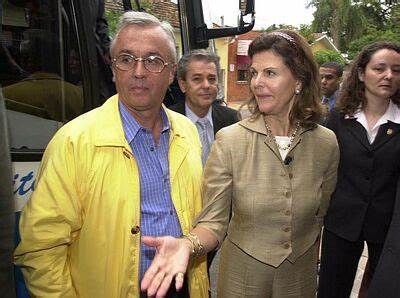 Queen Silvia on a visit to Brazil 2003
Leading such a busy public life, Silvia has to look her best. Peter Hägelstam has been the Queen’s hairdresser of choice almost since her arrival in Sweden. His business partner Johan Hellström has also been known to attend to Silvia’s locks. As to dressing for official occasions, the Queen has a very definite view of what suits her. For day wear two-piece suits are a favourite, although she is also sometimes seen wearing a blazer with trousers (or “pants” as they are referred to in North America). While the Queen may run to Chanel for special occasions, she has often been seen in clothes from high street outlets such as Zara or H & M. She is also keen on sustainability and on one occasion (at a Bea Szenfeld exhibition in Germany) she was photographed in a white suit which was forty years old. For evening wear, she is a devotee of the German fashion brand Georg et Arend, which is overseen by two brothers. During the recent celebrations held over three days in September and attended by Scandinavian Heads of State to celebrate the King’s fifty years on the throne, Queen Silvia wore several Georg et Arend evening gowns, one in a light pink colour, decorated with pearls and rhinestones and another in a striking yellowish-gold.
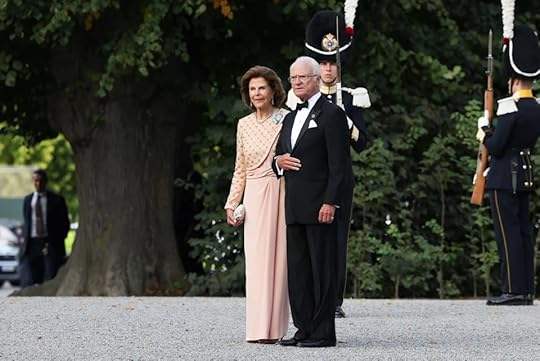 Queen Silvia and King Carl XVI Gustaf arrive for the Royal Swedish Opera’s jubilee performance at Drottningholm Palace Theatre September 2023
But having focused on the public side of Silvia’s life, it is also expedient to look at her private life. Where her children concerned, the Queen gave much time and thought on how to raise them, given their unusual situation as royal family members. She admits that ‘it is essential to show them what it all means, to teach them how to evolve in these special circumstances. They need to be helped to distinguish between what is “public” and what is “private”.’ This was particularly true of the heir, Crown Princess Victoria ‘who was always special, even when she was little. She was very observant as a child. She always looked at others with sympathy but also with great curiosity.’
The Queen has been fortunate to make some friends who can be relied upon for their loyalty and discretion. Four names in particular were mentioned in an article by Anna Clara von Hofsten of Svensk Damtidning in 2020. They are Catharina Stenbock Lewenhaupt, Elisabeth Fernström, Agneta Kreuger and Agneta Banér, who have been described as Silvia’s ‘inner circle’. These friends also rely on each other and each can also count on the Queen to be a caring, sympathetic ear should they have any issues or problems in their own lives. Furthermore, even with her busy schedule, Silvia never forgets her friends’ birthdays. Another friend, Marianne Bergengren, who lives in Klosters, notes that when Silvia pays her a visit in Switzerland, she is happy to make her own bed and load the dishwasher. A particularly close friend of the Queen was the late Agneta Génetay, who was married to a good friend of the King, Tim Génetay. This couple helped to ease Silvia’s path into Swedish society. The Queen is godmother to their daughter Josephine. The latter is also a friend of Crown Princess Victoria.
But of course, above all the Queen is closest to her growing family. In February 2012, Silvia’s first grandchild, a girl named Estelle, was born at Karolinska University Hospital in Stockholm. As the eldest child of Crown Princess Victoria, she is second-in-line to succeed to the throne of Sweden. Today, Silvia has eight grandchildren, ranging in age from two to eleven. Currently, the three children of Princess Madeleine and her financier husband Christopher O’Neill live in the United States, although they visit Sweden frequently and it is hoped they will the family will settle in Stockholm in the near future. In the summer the O’ Neill family often inhabit the Cavalier House, on the Solliden estate, as do Prince Carl Philip and his family. This property was originally used to house retainers and royal servants. Meanwhile, Crown Princess Victoria and her family also have their own “summer cottage” nearby, the ultra-modern Villa Skönvik near the Kalmar Strait which was built in 2013.
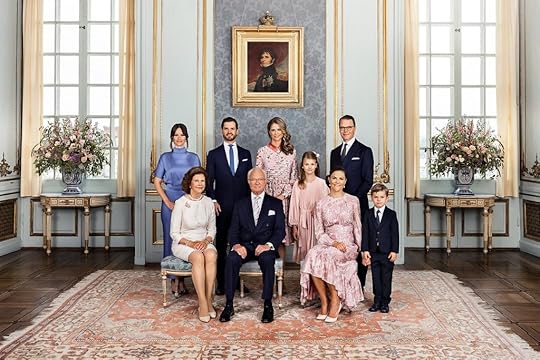 The Swedish Royal Family- A Formal Image.
 The Queen has also been kind over the years to many members of her extended family. When Prince Bertil was nearing the end of his life, she would sleep overnight on a makeshift bed at his home, the Villa Solbacken, so she could be of assistance to his wife Princess Lilian. The latter was full of admiration for Silvia and would recall how each morning the Queen would rise (probably after a disturbed night of sleep) and depart for her office at the Royal Palace and a full day of engagements. When Princess Lilian herself became frail and forgetful, the Queen was a constant and comforting presence. The King and Queen and their children were at her bedside when she died in March 2013 at her Djurgården villa at the age of 97. Furthermore, Silvia’s aged brother Walther Sommerlath came to live in Stockholm, staying with his wife Ingrid at Nedre Sjöflygeln, a house in the park at Drottningholm, once used by Crown Princess Victoria and her husband Daniel. He died, aged 86, in October 2020 after a period of illness. The Queen issued a statement stating, ‘I and my family feel great sorrow and loss for my brother Walther’. She also asked for privacy for his family. Her brother Jörg had already passed away in 2006. Meanwhile, Walther’s son, Patrick Sommerlath has lived in Sweden since 1987 and has always been part of the extended royal family. He came to live in Stockholm following the break-up of his parent’s marriage.
The royal children adore their mother. Princess Madeleine finds that ‘She’s so caring. She cares!’ while her son Carl Philip observes that ‘She’s brave and not afraid to ask the uncomfortable questions, but she does ask them in an elegant way.’ This comment has echoes of a remark made by the Queen’s late father concerning her ‘delightful behaviour’ in her dealings with people and situations.
When not working, the King and Queen will often walk his dog Brandie. Silvia is a keen swimmer too when she has the chance and in that respect, the Villa Mirage at St Maxime on the French Riviera (formerly owned by Prince Bertil and his wife Princess Lilian) must have seemed a welcome godsend for the house affords privacy and is set on a small private beach. Skiing too is a favourite pastime whether it be downhill or cross-country. For the latter Silvia only has to venture out to the parklands surrounding Drottningholm Palace, but for more adventurous skiing holidays she and the King venture to their lodge in the well-known ski resort of Storlien, near the Norwegian border, or they might even go abroad to Alpine resorts such as Klosters in Switzerland. Silvia also enjoys more leisurely pastimes, such as reading, visits to the opera, the theatre or to concerts (including the summer concerts held in the park at Solliden).
 Silvia and Carl Gustaf skiing at Storlien.
 Like everyone, the King and Queen had to adapt their lives to cope with the Covid pandemic. Meetings, audiences and conference calls were held on-line, as opposed to in person. Initially, a good deal of their time was spent at Stenhammar Palace near Flen, where they were joined for a period by Princess Birgitta, the King’s older sister. This mansion house (it is not particularly large) with farmland attached, has been used by Carl Gustaf since the 1960’s. The King and Queen often spend weekends here, which suits Silvia who loves walking and horse riding. Otherwise, the summer dining-room at Drottningholm was also used for on-line meetings.
As the Queen’s 80th birthday is reached, she has been keen to emphasise-through a court spokesperson, Margareta Thorgren, that she is does not dwell on her age; rather Silvia is focused on the future and what she wishes to achieve. Those who know and work with the Queen on a regular basis also observe that she is never short of ideas. Journalist and former court employee Barbro Hultman has said that ‘She places great demands on those around her, but even more on herself. Everything has to be perfect.’ Work is certainly her priority as she arrives most weekday mornings at her three-room office suite close-by the East Gate of the Royal Palace. Should it happen to be Tuesday, then the Queen will be faced with yet another of those interminable planning meetings to coordinate forthcoming engagements and to decide what she can or cannot fit in. Silvia’s own low-ceilinged office is reasonably large and is dominated by a large tiled stove. In one corner, there is a large antique desk at which the Queen works. There are also two separate seating areas for visitors, featuring gilded antique chairs set around tables. By contrast, Her Majesty prefers to make use of a workaday, modern office chair. Silvia clearly has a sense of humour for on display is a rectangular cushion on which are stitched the words “It Ain’t Easy Being Queen!” One downside, say observers, is that Silvia might continue to work too hard on her various projects when perhaps she should take a break!
 Queen Silvia applies make-up for a recent photoshoot.
 It is fair to say that the focus this year has been very much on the King’s Golden Jubilee with numerous events held throughout Sweden to help commemorate Carl VI Gustaf’s fifty years on the throne-the longest of any king of Sweden in history. This has meant the King and Queen undertaking extensive “county” tours the length and breadth of the Kingdom, in addition to the normal work schedule which included a State Visit to Sweden in late October from French President Macron and his wife Birgitte, together with a State Visit in May by the King and Queen to Estonia. There was also the death, in early November, of a close and trusted friend of the King and Queen, 100-year-old Count Hans-Gabriel Trolle-Wachtmeister, whose late wife, Alice, was Mistress of the Court. Silvia was seen to be visibly upset and wiping away tears at his funeral. It is no wonder that commentators noted that the Queen appeared somewhat drawn at the recent Nobel festivities.
 Queen Silvia with all of her grandchildren taken at the Royal Palace on 18 December 2023. In the background are the Forestry Students who traditionally provide these Nordic spruce trees.
 By contrast, on the 23 December, Silvia will celebrate her milestone birthday with a private dinner, attended by family and friends, at her home at Drottningholm Palace. There had earlier been a concert in her honour (on 30 November) organised by the Lilla Akademien (Music School for Youth) of which Silvia is Royal Patron. This event-which featured singing and musical renditions by pupils of the school-was also attended by representatives of her other charitable foundations. Present too were the King, Prince Carl Philip, Princess Madeleine (who had flown over from the United States), Princess Christina, her husband Tord Magnuson and Princess Benedikte of Denmark, representing the Danish Royal Family. The Queen (who was dressed in a two-piece light pistachio silk suit with sequin panels) and her royal party enjoyed a wide range of music including renditions of Bach’s Ave Maria and Abba’s Dancing Queen. According to Mr Magnuson ‘Silvia was super happy with the evening. It was only positive, so much fun.’ Another event was the Queen’s presence with her eight grandchildren, on 18 December, in the courtyard of the Royal Palace to receive Christmas spruce trees from the forestry students from the Swedish University of Agricultural Sciences at Umeå (who were dressed in Christmas attire). Silvia last did the honours some sixteen years ago.
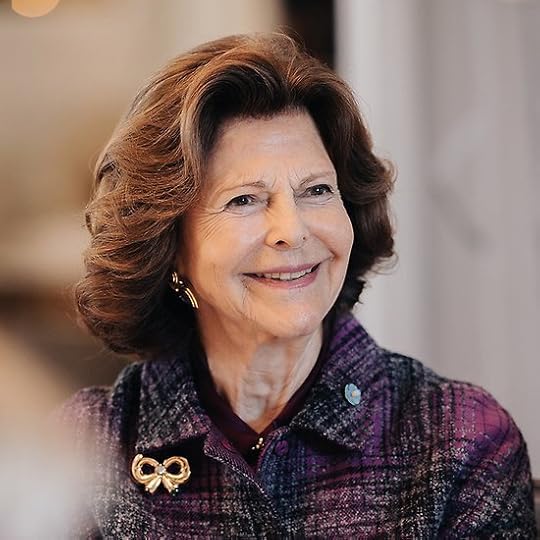 A recent image of the hard-working queen.
 As for birthday gifts, Her Majesty’s only wish is that people will show concern for the children of Ukraine by donating money to the Collection Box of the Children of the World campaign to improve their living conditions. Silvia has been keen to promote their plight and was filmed with a group in Stockholm, participating with gusto in the group actions to a well-known song.
For all her achievements the Queen remains remarkably self-effacing. She does not like to be described as powerful or having power. This is a sensitive area as the family must be politically neutral and power is very much associated with politics at this level. The most Silvia would be prepared-at a push-to acknowledge is that she has some influence and the ability to move matters forward on occasion using the ‘diplomatic ability’ her late father spoke of at the time of her marriage in 1976. In reality, she has become a formidable operator, with nearly fifty years of ‘regal’ experience behind her. Silvia’s friend, Catharina Stenbock Lewenhaupt has said ‘She [Silvia] really is the right person in the right place! And with the intelligence, dutifulness, thoughtfulness, and charisma she has, she really is a queen for her time. And a sweet and dear friend…!” Perhaps the last word might go to the Queen’s sister-in-law Princess Christina, who confided to royal biographer Ingrid Thörnqvist that ‘I admire her immensely.’ Sister-in-laws are not always known for kind words, so this is praise indeed.
Happy Birthday Ma’am!
November 28, 2023
The House of Bernadotte’s Long Goodbye to Norway
Sweden and Norway had been joined together in a union since 1814. From then, they had shared a common monarch, who was the pivotal link in this union of two nations, the last of whom would be King Oscar II of Sweden and Norway, who had been crowned as King of Norway in Nidaros Cathedral on 18 July 1873 (and in Stockholm Cathedral as King of Sweden on 12 May 1873) . This Swedish-born King, who spoke fluent Norwegian, was largely based in Stockholm, although he did make regular visits to the Royal Palace in Christiana (now Oslo) as well as to other parts of Norway. The Norwegians had their own parliament (the Storting) and Constitution (formulated back in 1814 and signed in May of that year). Furthermore, matters relating to foreign affairs were dealt with in Stockholm, where the Foreign Minister was based. This was to be a source of increasing discontent in Norway, for the Norwegians were a proud people with a strong sense of national identity and a Norwegian royal line which stretched back to the 9th century and the reign of King Harald I.
 King Oscar (seated centre) at the Villa Victoria on Bygdøy Royal Estate.
In the 1870’s and early 1880’s the King had repeatedly vetoed constitutional amendments passed by the Storting. Yet, royal visits from Stockholm continued regardless. In 1881 the King established-at the instigation of Christian Holst, who was manager of the Bygdøy royal estate-what was known initially as Oscar II’s Collection, a small group of historic buildings, taken from their original locations around Norway and rebuilt at Bygdøy. This collection was to be the forerunner of what would become known as the Norwegian Folk Museum. Another frequent visitor was Oscar’s eldest son, Crown Prince Gustav of Norway and Sweden. Gustav ventured to Norway in June 1877 during which he included a visit to Tromsø and the following year, he was accompanied on his trip by France’s Prince Imperial (the only son of Napoleon III) during which the royal duo enjoyed a stopover at Osebro.
In February 1882, a Welcome Arch was erected in Carl Johans Gate in Christiana to commemorate the visit of Crown Prince Gustav and his wife, Victoria of Baden. This was Victoria’s first visit as Crown Princess to Norway, the couple having married only five months previously. Several buildings were handsomely decorated with the letters of G and V and there was a huge torchlight parade as the royal couple made their way, in an open carriage, through the capital’s streets, which were thronged by well wishers, to the Royal Palace. On another occasion the Crown Princely couple ventured to the theatre during which they passed through a royal arch lit by electric bulbs-something of a rarity in those days.
 Crown Prince Gustav and Crown Princess Victoria enter Christiana in 1882
The Liberal Party, elected in 1884, led by Johan Sverdrup, was focused on establishing a strong parliamentary system (and some would say a diminution of the royal prerogative powers). The government would also become increasingly concerned with strengthening Norway’s position on the international scene, particularly as the country’s overseas trade became vital to energising the economy. It was argued by those in the business and shipping sector that there were now too few consulates to support this increase in foreign trade. Following their re-election in 1891, the increasingly nationalistic Liberal Party government, now led by Johannes Steen, therefore took the view that Norway should have its own autonomous consular service. They made NOK 50,000 available for this purpose. But a rattled King Oscar (who had also got wind of the possible appointment of an autonomous Norwegian Foreign Minister) was intent on vetoing such attempts by the government and this led to a constitutional crisis. This was only (temporarily) resolved by putting aside the matter of the consular service for the present.
The royal family, who were keen to maintain the union between Norway and Sweden, continued to make their presence felt in Christiana. In October 1893, King Oscar and Crown Prince Gustav made a joint visit during which they opened the Bandak Canal which connects Skien and Dalen in western Telemark. Another attempt, in 1895, in the Storting, to terminate consular cooperation with Sweden and push through a unilateral resolution for the establishment of a Norwegian Consular Service was met by menacing threats and sabre rattling on the part of Sweden (who were militarily superior to Norway). However, despite ongoing political rumblings, events were sufficiently settled to permit King Oscar to travel by train to Christiana in 1897 to mark the 25th anniversary of his accession to the throne of Norway. A service of thanksgiving was held in St Saviour’s Church, while the Stock Exchange, the Military Academy and many other official buildings were festooned with flags, bunting and greenery.
The Crown Prince also continued to make visits. For instance, in May 1898, he paid a visit to Ullensvang. However, another visit, in the spring of 1899, was to prove more eventful and troublesome as Gustav explained in a letter to his father, King Oscar, from the Royal Palace in Christiana. Most unusually, the Crown Prince had been jeered at by a crowd of around two hundred on his return to the palace from a meeting of the Military Society. Gustav was somewhat shaken by this turn of events, but put it down to ‘half drunk’ students. After the Royal Guard had eventually intervened and arrested a couple of demonstrators, the others soon dispersed.
The Crown Prince then issued invitations to members of the Storting to dine with him at the Royal Palace. Around 70 members (whom Gustav would later describe to his father, as being of a left-wing persuasion) returned their invites. Nonetheless, the Crown Prince went ahead with the dinner although he decided not to make the customary toast to the Storting (whilst simultaneously declining Mr Viggo Ullman, the President of the Storting’s, request to toast Gustav’s health). Instead, the Crown Prince limited himself to toasting the health of the King. Yet Gustav also made clear his displeasure at this snub by the Norwegian politicians to those members who did attend the event at the Royal Palace. This protest by the Norwegian politicians had also garnered much criticism in Sweden.
Indeed, by October 1900, Crown Prince Gustav was growing increasingly exasperated by events in Norway. Writing to his tennis partner, Pontus Quarnström, he spoke of his longing to leave Christiana and bemoaned the behaviour of Norwegian politicians, three government ministers having recently resigned. Furthermore, Gustav (who had vice-regal authority) felt that the government were not observing the necessary constitutional niceties, by not consulting him about the appointment of new ministers, in particular a Minister of War. A meeting about the matter had proved ‘unpleasant and difficult’ but the Crown Prince seems to have been equal to the task, warning the offenders that if they stepped on his toes, he would most certainly step on theirs. Despite these feelings, the Crown Prince continued to reach out to the Norwegian people and, in 1901, he was present on the balcony of the Royal Palace during Norway’s National Day, 17 May (the first member of the royal family ever to do so, for the Bernadotte’s had customarily avoided being in Norway at this time) to greet flag-waving Norwegians who had gathered before the palace, as had been the tradition for the past thirty years.
However, at least a war between Norway and Sweden-the thought of which King Oscar had regarded as ‘abhorrent’-was averted and an agreement was made whereby the matter of a separate consular service was to be considered by a joint committee of members from both countries in 1902. In February 1903, Gustav was once again in Christiana and complained to King Oscar of a ‘terrible state of affairs’ with ‘hardly a single person who now wants to support the present Union, and most of them are openly crying out for its dissolution’ rather ‘than remain…as a vassal of Sweden.’ Although ‘calm’, the Crown Prince admitted that he was ‘prepared for anything.’ On this occasion, Gustav was accompanied by his son Prince Wilhelm.
To his younger brother Prince Carl, Gustav wrote about the consular crisis on 22 February, 1903 ‘I think that you know enough both of my opinion and the views and thoughts of [Swedish Prime Minister] Boström to know that neither he nor I want to make any further concessions. I consider the Norwegian proposals to be completely unacceptable, well written to be sure, but very insidious.’ In other words, the chance of an accord on the consular matter seemed slim.
Nevertheless, despite the Crown Prince’s scepticism, a form of agreement was eventually reached and a subsequent communiqué issued by the joint committee, dated 24 March 1903. This proposed that any relations between the consuls (of both Norway and Sweden) and the still unified Foreign Ministry in Stockholm, as well as with the joint diplomatic missions overseas, should be governed by separate but identical laws, which could not be altered or repealed without the consent of the governments of both Norway and Sweden. Meanwhile, in July, King Oscar ventured to Norway to open the Ofoten Railway- the Norwegian section of a railway which carried iron ore to the port of Narvik.
 King Oscar II opens the Ofoten Railway in 1903.
In the spring of 1904, Crown Prince Gustav enjoyed a brief respite when he and his eldest son Prince Gustav Adolf participated in some cross-country skiing at Holmenkollen and watched some downhill ski action from the Royal Box. The political problems were not abating. Building upon the agreement reached the previous year, in May 1904, the Norwegian Government presented proposals for inclusion in the new ‘identical’ legislation. However, Swedish Prime Minister Boström’s government proved somewhat truculent and when the Swedes made their response in November of that year, one of their counter-proposals was that the Swedish foreign minister should have sufficient control over the ‘independent’ or ‘separate’ Norwegian consuls so as to prevent them from exceeding their authority. Norway interpreted this as placing their consuls in a subordinate position, effectively still under Swedish control.
It so happened that the Crown Prince was again in Christiana in the spring of 1905. One of his final vice-regal acts was the appointment, in March, of a coalition government led by Prime Minister Christian Michelsen. The latter announced in his inaugural address that his government would implement ‘Norway’s constitutional right to its own consular service and assert Norway’s sovereignty as a free, independent kingdom.’ On 29 April, Gustav informed his father that ‘The situation here [in Christiana] is utterly hopeless, and it is impossible to speak a reasonable word to a single person.’ Those politicians the Crown Prince encountered were acting like ‘wild dogs’; although to him personally, they were ‘polite, but ice-cold and there is a lot of hatred …in the air’. He now was firmly of the view that ‘I really cannot do any good here’.
Then, in keeping with Michelsen’s inaugural vow, in May 1905 both chambers of the Storting passed the Consular Act, to establish an independent Norwegian consular service, this to be effective from April 1 1906. On 27 May, King Oscar II refused to ratify the legislation during a cabinet meeting at the Swedish Royal Palace with Norway’s senior politician in Stockholm, Jørgen Løvlandat (also in attendance were Crown Prince Gustav, Norwegian ministers Harald Bothner and Edvard Hagerup Bull, as well as August Sibbern, a civil servant from the Norwegian Cabinet Department). Thereafter, the Norwegian government in Christiana duly resigned.
The crisis deepened when the King was unable to form a new government. In early June, the Prime Minister in Oslo, Christian Michelsen, prepared a statement which he would later make dealing with the current constitutional situation. He posited: It was the monarch’s responsibility to provide Norway with a constitutional government. Since King Oscar had failed to do this, the Norwegian monarchy had now ceased to function. And since it was the King who had bound the union together, these union ties were now broken. On 6 June, Paul Ivar Paulsen, a senior civil servant in the Ministry of Justice in Oslo, travelled to Stockholm on the night train. He had with him the Norwegian government’s final letter of resignation, addressed to the King and signed by Prime Minister Michelsen. The next day, 7 June, Paulsen handed this over to King Oscar II at the Royal Palace, around the same time as the Storting met in plenary session. After listening to the contents of Michelsen’s aforementioned statement, the Norwegian parliament proceeded to pass a resolution to dissolve the union with Sweden. It was then announced that the government ‘until further notice’ would now exercise ‘the authority [previously] granted to the King in accordance with the Constitution of the Kingdom of Norway and applicable laws’. In response, King Oscar sent a telegram to the government in Christiana protesting at this turn of events ‘in the most definite way.’
Meanwhile, the following evening, at Rosendal Castle, where he was currently in residence, Oscar II was joined by his wife and other royal family members to receive a touching tribute from his shocked Swedish subjects, thousands of whom gathered and sang the patriotic song, Ur svenska hjärtans djup [From the Depths of Swedish Hearts]. It was so moving that Queen Sophie and her daughter-in-law Princess Ingeborg (the wife of Prince Carl) could be seen wiping away tears.
 King Oscar in Norwegian Military Uniform taken in 1905 in Stockholm
In Christiana, on 8 June, top-ranking men in the military were required to pledge their loyalty to an independent Norway. Then early on the morning of 9 June the Union Flag was ‘struck down’ at Akershus Fortress. At 10am a crowd (estimated at between twenty to thirty thousand) gathered at the Fortress to watch the flag of an independent Norway being raised.
It is fair to say that the Swedish royal family (as they now must be regarded) were taken aback by the Norwegian position. It was all something of a ‘bombshell’ according to Prince Carl. His younger brother Eugen would later observe that ‘My old father [King Oscar] felt the blow as an insult that he had a hard time digesting.’ On 14 June, King Oscar himself was quoted in the Swedish press talking of ‘this illegal conduct’ on the part of the Norwegians being as ‘an incurable wound’ and paid tribute to ‘my Swedish people.’ Despite the distress, Crown Prince Gustav, who had been in England attending the wedding of his eldest son, Gustaf Adolf to Princess Margaret of Connaught, a niece of Britain’s King Edward VII, now advocated that the dissolution of the union should take place in a peaceful manner.
Meanwhile, a request was sent on 19 June from the Storting to King Oscar asking that negotiations commence for a final settlement on the dissolved union. The following day, King Oscar attended the State Opening of the Riksdag (Swedish parliament) in Stockholm, the Swedish Prime Minister, Ramstedt (who would soon be replaced by Christian Lundeberg) indicated that diplomatic negotiations, the commencement of which required the approval of the Riksdag, should now go ahead with Norway. All the members of Sweden’s State Council agreed with this proposal and King Oscar (keen to avoid what he regarded as the ‘greater evil’ of war) spoke movingly of the many years he had concerned himself with the ‘welfare of the brotherly people’ [i.e. the Norwegians] and how ‘it is painful to me to contribute to the dissolution of a union, in which I thought I saw the independence, security and happiness of both united kingdoms. If I am nevertheless willing to do this, it is to avoid a greater evil and in the conviction that a union without mutual consent would not bring any real advantage to Sweden.’ It should be stated that in Sweden, as in some other nations, the Storting’s actions were regarded as tantamount to a coup or revolution.
However, the King decided to appoint Crown Prince Gustav as Regent throughout the period of negotiations. Oscar admitted in a message his people on 7 August that having consulted with his doctors ‘I must now….seek rest and refreshing air… in order to, with God’s help, regain health and strength after the tiring time for body and soul which has been a consequence of the worries which during have followed me for the past few months…’ Of course, the worries over the situation with Norway had actually dogged his reign for decades. Although he did not realise it, Oscar only had a short time to live and he would die in Stockholm in December 1907, at the age of 78.
Meanwhile, on 13 August, the decision of the Storting of 7 June was backed by a referendum in Norway (held at the insistence of Sweden’s Riksdag) which resulted in 368,392 votes in favour of dissolution of the Union, and only 184 against. Negotiations between the delegations from Norway and Sweden took place in the Masonic Lodge in Karlstad from 31 August and lasted till 23 September, when a conditional agreement was reached. The main sticking point was border fortifications between the two nations. In the end several forts were demolished and a neutral zone established which could not be used for military purposes. Any further disputes would be solved by international arbitration. The Karlstad agreement was ratified by the Storting on 9 October; as well as by an extraordinary sitting of the Riksdag on 13 October.
Oscar II now formally recognised Norway as an independent state and, on 26 October, he abdicated from the Norwegian throne on behalf of both himself and his successors. The latter words are particularly important, as when the Storting unilaterally dissolved the union with Sweden, it also made an offer (sometimes referred to as the “Bernadotte proposal”) to King Oscar to nominate a prince of the House of Bernadotte to be the new King of an independent Norway. King Oscar wisely demurred fearing that the independence and impartiality of a new monarch in Norway with such close links to him and the House of Bernadotte might be constantly called into question. However, another (Swedish) source quotes him as having been ‘insulted’ by this offer and raging, “Sooner will they carry me to the Riddarholmen Church [at that time the final resting place of Swedish monarchs] than I consent to one of my family going to Norway [as king].” Yet Oscar also sent a final and conciliatory message to his ‘brothers’ in Norway: ‘To those who faithfully served me in Norway during my 30-year reign and who still have some love for their former king, I send my heartfelt thanks and my sincere good wishes in farewell.’
Yet the Bernadotte’s were still involved in one last act regarding the future of Norway. On 14 November Crown Prince Gustav of Sweden arrived in Copenhagen. He had been sent as an emissary to make it clear that, despite the recent dissolution of union with Norway, Sweden had no objections to Prince Carl of Denmark’s (the second born son of Crown Prince Frederik of Denmark) imminent elevation as King of Norway.
Gustav-now King Gustav V of Sweden-returned to Christiana by train from Stockholm for a three-day visit on 28 November 1917 to attend a meeting of the three Scandinavian monarchs. Not only was this Gustav’s first visit since becoming King of Sweden in 1907, it was also the first since the break-up of the Union in 1905. Gustav was now hosted by the Danish-born King Haakon VII in the city and at the Royal Palace he knew so well from his days as Crown Prince of Norway. Haakon’s older brother, King Christian X of Denmark, completed the trio. Gustav hoped that this current visit would demonstrate that the dissolution between Norway and Sweden did not stand in the way of any rapprochement between the two countries. The Swedish king was not disappointed by his reception, as crowds lined the streets to welcome the visiting monarch and his Danish counterpart. Two aeroplanes flew overhead briefly spooking the horses. Local hotels were filled by the curious, many of whom had travelled from western Norway. At the Royal Palace the press reported that the trio of kings feasted on lamb, chicken, ice cream and petit fours.
 King Haakon VII , King Gustav V and King Christian X pictured in 1914 during an earlier meeting in Sweden.
And today relations between the Royal Houses of Norway and Sweden remain extremely close. Sweden’s King has just celebrated his Golden Jubilee and his daughter, Crown Princess Victoria is a popular monarch-in-waiting. Meanwhile, King Harald of Norway, the mother of whom was a Swedish Princess, has reigned for over thirty years. He is the first Norwegian-born monarch of Norway since the Union with Sweden was dissolved in 1905 and he is due to be succeeded, in due course, by his Norwegian-born son Crown Prince Haakon and his Norwegian-born granddaughter, Princess Ingrid Alexandra, both of whose mothers were commoners.