
Stephen K. Ray's Blog, page 99
April 16, 2022
Finally Heading Back to the Holy Land!
I am happy to announce that we are finally heading back to Israel after two years of border closings.
Delightfully, Israel has removed all vaccine requirements and people are allowed to come in simply with negative tests.
My wife Janet and I leave on Easter afternoon to arrive a few days before the group to get over jetlag, meet with our agents and guides and make sure everything‘s in place. We have a sold out group of 57 intrepid travelers excited to walk in the footprints of Jesus and Mary.
We will pray every Mystery of the Rosary where it happened and celebrate Mass at the most amazing holy sites.
I will be posting videos every day so that everyone can virtually join us. Or better yet, join us in May, September, November or December!
The post Finally Heading Back to the Holy Land! appeared first on Defenders of the Catholic Faith.


April 15, 2022
How Long Was Jesus in the Tomb? Another Contradiction?
 “For just as Jonah was three days and three nights in the belly of the sea monster, so will the Son of Man be three days and three nights in the heart of the earth”
(Matt. 12:38-40)
Skeptics claim to have discovered an error in the New Testament —claiming Jesus was not in the tomb for three full 24-hour periods like he prophesied.
He was buried Friday afternoon and rose early Sunday morning.That seems to be only one full day and two nights.
Has the skeptic found an error in the Bible? How does one respond?
“For just as Jonah was three days and three nights in the belly of the sea monster, so will the Son of Man be three days and three nights in the heart of the earth”
(Matt. 12:38?40)
***************************************
 Then some of the scribes and Pharisees said to him, “Teacher, we wish to see a sign from you.” But he answered them, “An evil and adulterous generation seeks for a sign; but no sign shall be given to it except the sign of the prophet Jonah. For as Jonah was three days and three nights in the belly of the whale, so will the Son of man be three days and three nights in the heart of the earth.”
It is clear that Jesus rejects the call to perform various signs before the Jewish leaders in order to justify his claims and actions. Jesus would not give them signs, however, for he did not come primarily to be a wonder-worker but a Savior. His miracles were performed to display his power and identity and out of mercy to help the poor and sick.
Jesus performed many miracles in private and with a warning not to tell others about them. Yet, one great miracle would be given as a definitive sign. This would be the “sign of Jonah,” his resurrection from the “heart of the earth.”
The main problem encountered in Matthew 12:38-40 involves the temporal designation “three days and three nights.” Interpreting this designation literally, some try to solve the “problem” by arguing that Jesus was really crucified on Thursday rather than Friday. A Friday crucifixion and a Sunday resurrection do not provide sufficient time for three days and three nights.
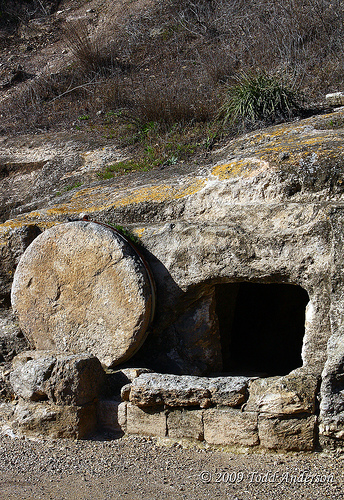 Authentic Ancient Tomb in Israel
There are numerous ways of figuring out the day-night scheme for this period of time, but it is clear that three separate days and nights cannot be obtained by a Friday crucifixion and Sunday resurrection scheme. Yet, it is clear from the Gospels that Jesus was crucified on Friday, the day of Preparation, that is, the day before the sabbath” (Mark 15:42) and raised on Sunday, the “first day of the week” (Mark 16:2). If the temporal designation of Matthew 12:40 is taken literally, a conflict does exist between the time indicated in this verse and the time indicated in the accounts of the passion story.
But should the expression “three days and three nights” be interpreted literally? Three arguments indicate that it should not.
First, it appears that this expression is another way of stating “on the third day” or “in three days.” This can be illustrated from 1 Samuel 30:12-13. The same Greek expression is found in 1 Samuel 30:12 in the Greek translation of the Old Testament (the Septuagint) as in Matthew 12:40.
Verse 13 refers to this three-day and three-night period as “three days ago” or, as the LXX literally states, “the third day today.” If “three days and three nights” can mean “on the third day,” there is no major problem in our passage.
By Jewish reckoning Jesus could have been crucified on Friday and raised on Sunday, the third day. Friday afternoon = day one; Friday 6 PM to Saturday 6 PM = day two; Saturday 6 PM to Sunday 6 PM = day three.’
A second argument against a literal temporal interpretation is the fact that Matthew did not see any conflict between this expression and either a third-day resurrection (Matt. 16:21; 17:23; 20:19) or a Friday crucifixion and Sunday resurrection scheme (Matt. 27:62; 28:1). For him, as well as for the other Evangelists, expressions such as “three days and three nights,” “after three days,” and “on the third day” could be used interchangeably.
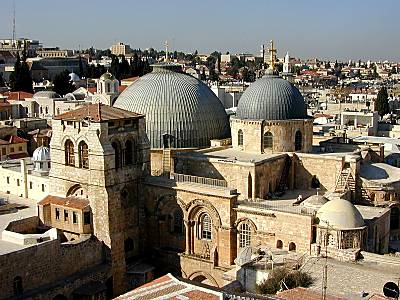 Holy Sepulchre, actual location of crucifixion and burial of Jesus
Finally, it should be pointed out that the main point of Jesus’ analogy in Matthew 12:40 does not involve the temporal designation but the sign of the resurrection. Only one miracle or sign will be given to this evil and adulterous generation. That sign will be Jesus’ resurrection from the dead. The temporal designation is much less significant. Perhaps Jesus refers to three days and three nights because this expression is found in the Old Testament passage which he wants to quote (Jonah 1:17).
Understood in the context of biblical Judaism—and knowing the idioms and figures of speech in the designation “three days and three nights”—there is no problem with the Friday crucifixion and Sunday resurrection scheme described in the passion narratives. Any Jew or Roman would have immediately understood; only those divorced from the historical context fail to understand.
It is only if a twentieth-century reckoning of time is imposed or if the idiomatic nature of this temporal designation is not understood in its context that a problem appears.
See also Dave Armstrong’s article “3 Days & Nights” in the Tomb: Contradiction?“
The post How Long Was Jesus in the Tomb? Another Contradiction? appeared first on Defenders of the Catholic Faith.
April 14, 2022
Join us this cold January in the warm Caribbean – Good News Cruise!
A great lineup of speakers and a delightful itinerary with a relaxing cruise in the sun. Check it out. Use promo code EASTER8 for $50 off per person.
Visit https://goodnewscruise.com/ for more info or to register!


The post Join us this cold January in the warm Caribbean – Good News Cruise! appeared first on Defenders of the Catholic Faith.
April 13, 2022
Be sure to see Fr. Stu at the theatre this weekend – great new movie!
 The movie tells the conversion story of Fr. Stu Long to Catholicism, and his late vocation to the priesthood. It’s an amazing story and journey for Long who lived a worldly, foul-mouthed, rough and tumble life as a boxer, a failed actor, etc., and yet by the grace of God, with the help of key people in his life, he converted and surprised everyone with his calling to the priesthood.The film focuses mainly on that challenging journey to faith for Long, with a gritty and powerful performance by Mark Wahlberg, as well as by Mel Gibson who plays his father, an equally rough character. The film is getting a lot of advance rave reviews in the Catholic world, though it is R-rated due to the bad language, which underscores the life and behavior of Long – and his father – before both of their conversions.Wahlberg, a practicing Catholic, heard about the story of Fr. Stu Long from a priest he knows, and after more research about Fr. Stu, he was so inspired by it that he decided to have a movie made about Fr. Stu, and put up all, or most, of the money to make it.Arroyo interviewhttps://www.youtube.com/watch?v=XCcvr0ePoqMMovie Website & Film Trailerhttps://www.fatherstumovie.com/trailer/Article in The Pillarhttps://www.pillarcatholic.com/p/meet-fr-stu-the-real-priest-and-true?s=r
The post Be sure to see Fr. Stu at the theatre this weekend – great new movie! appeared first on Defenders of the Catholic Faith.
April 12, 2022
Screams and Cries from Apartments in Shanghai – Welcome to Totalitarianism
Patrick Madrid put up this Twitter post of a confirmed video from Shanghai. It is very creepy and has haunted me ever since seeing/hearing it. These Chinese are locked in their apartments and not allowed to leave for any reason. Many of them are without food or any assistance. More troops are being brought in to Shanghai to enforced the covid lockdown.
This is the face of totalitarianism which must be resisted by us with all our might. Socialism is the first step, but once we give authority to governments (or allow them to take such authority), it is a fast downhill slope to authoritarianism and totalitarianism. Beware!
The post Screams and Cries from Apartments in Shanghai – Welcome to Totalitarianism appeared first on Defenders of the Catholic Faith.
April 11, 2022
Was Jesus Crucified Naked or Clothed?
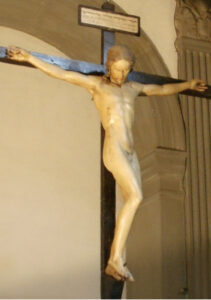
I mentioned on the radio that Jesus was stripped of his garments on the cross which was part of the whole aspect of crucifixion — the utter degradation and humiliation of the person and to strike fear in the heart of all observers.
A gentleman wrote to object to my assertion and so I provided this short answer. You can read it HERE.
PS. Here is a statue of a naked Christ on the cross sculpted by Michelangelo
http:// www.michelangelo.net/crucifix/
The post Was Jesus Crucified Naked or Clothed? appeared first on Defenders of the Catholic Faith.
April 6, 2022
When Was Jesus Crucified? How Long on the Cross? Do the Gospels Contradict Each Other?
Do the Gospels Conflict?
How Long was Jesus on the Cross?

(See also How Long Was Jesus in the Tomb?)
The question intrigued me sufficiently enough that I spent the best part of a day working on it. On the surface there seems to be a contradiction in the Gospels, mentioning different times for the crucifixion.
Maybe the Apostles forgot to check their watches!
Mark says Jesus was crucified at the 3rd hour and John tells us the crucifixion took place after the 6th hour. So, what are we to make of this seeming contradiction? And how long was he actually hanging on the cross?
For the whole story, click here.
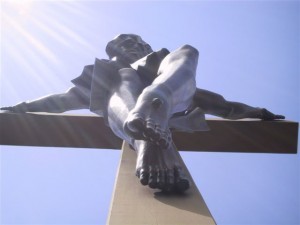
By the way, isn’t this a COOL picture? I took it several years ago at the Cross in the Woods Shrine in Indian River Michigan. It is the largest crucifix in the world and right across the street from my wife’s mom’s summer home.
The post When Was Jesus Crucified? How Long on the Cross? Do the Gospels Contradict Each Other? appeared first on Defenders of the Catholic Faith.
April 4, 2022
Questions I Answered on Catholic Answers Live – Q & A for Non-Catholics
Fun show today. Hope you enjoy it.
https://catholicconvert.com/wp-content/uploads/2022/04/ca220404a.mp306:33 – I heard a Capuchin Franciscan say that in the story in Mt. 15:21, Jesus was prejudiced, and he had to learn not to be. Is this true? https://catholicconvert.com/is-jesus-being-harsh-calling-a-woman-a-dog-in-todays-gospel-reading/ 15:00 – How do you go about overcoming hurdles like calling the pope holy father? I feel more inclined to believe what the early Church believed and not what the Catholic Church teaches? 24:42 – The canonization of Juan Diego is my reason why the Church is not the real Church. I don’t think the Church speaks infallibly on canonizations. What’s your response? 36:05 – What are the roots of the Catholic view of baptism? How is that different from the protestant view? 44:34 – There’s a verse in the bible that says to not pray to the dead. Praying to Mary is different because she’s dead. Wouldn’t that be more like a séance? 52:20 – Why do Catholics make the church services so boring?The post Questions I Answered on Catholic Answers Live – Q & A for Non-Catholics appeared first on Defenders of the Catholic Faith.
Is Jesus being harsh calling a woman a “dog”?
Jesus seems very harsh to the gentile woman in today’s Gospel Reading (posted on the day this reading was at Mass). He seems to call the woman a “dog”. Here is his comment,
 And Jesus said to her, “Let the children be fed first, for it is not right to take the children’s bread and throw it to the dogs.” (Mark 7:27)
She replies, “Yes, Lord; yet even the dogs under the table eat the children’s crumbs.” (Mark 7:28)
This passage is often taken as a cruel and harsh response from Jesus, but in the cultural context it is anything but. Here we see the bantering of Middle Eastern dialog and humor.
Jerome’s Biblical Commentary says,
“Jesus’s words no doubt sounded as harsh to Hellenistic readers of the Gospels as it does to modern commentators … The proverb is less harsh in a Near Eastern context than it would be to us, but it is not gentle.
“The dialogue is an instance of the kind of wit that was and is admired in the Near East, the same wit that is called wisdom in the Old Testament; it is the ability to match riddle with riddle, to cap one wise saying with another, to match insult with insult, or—as here—to turn the insult into a commitment.
“There is nothing unrealistic about the exchange at all; Jesus would not have been a genuine Palestinian if he had not occasionally engaged in a duel of wit. The scene is much more a scene of peasant good humor than it is of solemn theological debate.”
 Commentator Barclay writes,
“The tone and the look with which a thing is said make all the difference. Even a thing that seems hard can be said with a disarming smile.
“We can call a friend ‘an old villain’, or ‘a rascal’, with a smile and a tone which takes all the sting out of it and which fills it with affection. We can be quite sure that the smile on Jesus’ face and the compassion in his eyes robbed the words of all insult and bitterness”
R. T. France writes,
“So Jesus is expressing the contemptuous Jewish attitude to Gentiles in order to explain why her request does not fit into his mission to Israel. But written words cannot convey a twinkle in the eye, and it may be that Jesus was almost jocularly presenting her with the sort of language she might expect from a Jew in order to see how she would react. The point is a serious one, that a mission to Israel must have its limits, but the tone need not have been a humorless rudeness.”
In reading Scripture, not only is the whole context of a passage is important, but a knowledge of the culture and particularities of that culture and language are also crucial to understand the Bible.
The post Is Jesus being harsh calling a woman a “dog”? appeared first on Defenders of the Catholic Faith.
April 1, 2022
Did God Die on the Cross? How Can God Die?
Almost every day I get questions. I always try to answer, even if briefly. Today I received a question from Raymund in the Philippines. He is part of a apologetics group and they got very hung up on whether God died on the cross. Here is his e-mail:
 Greetings Mr. Stephen:
I am a great follower of yours and I’m from the Philippines. I’ve got a couple of questions here that bother me a lot.
1) Did GOD THE SON died literally on the cross? or 2) Did only the HUMAN NATURE OF GOD THE SON die on the cross?
I hope you can enlighten me on this matter.
My first response was brief, an attempt to get Raymund to think through it himself. I do this sometimes because some people prefer to just ask a question without giving it any thought or doing the research themselves. I wrote:
Let me ask you a question because it’s better for you to think through this on your own than for me to give you a pat answer. When you die, what dies? You are going to die and get buried in the ground, but are you dead?
Raymund wrote back:
You are putting more cobwebs in my brain….anyway, thanks. It has been an issue for us here (a little group of Catholics Faith Defenders, I’m new in this group). We were browsing the web found no definite answer. This issue has divided us.
– one of us says that GOD literally died on the cross for us to be saved. AND THAT IS A MYSTERY OF OUR GOD IN CHRIST JESUS..
– the other is saying that it cannot be since GOD cannot die. Jesus our Lord is both God and man. What died? Some say IT IS A HERESY TO SAY THAT GOD DIED ON THE CROSS LITERALLY. For me, the latter seems a logical point of view. GOD IS SPIRIT, ETERNAL, NO BEGINNING, AND NO END, therefore, cannot die. What died on the cross?
To sum it all, I’m sad for our group and at the same time, I’m confused.
So I responded further to Raymund and his group of Catholic Faith Defenders:
The reason I asked you about “when you die, what dies?” Is because it should help you think about what death is. Death is “separation.” It is the separation of the body from the soul. The soul goes to heaven or hell and the body is buried in the ground. Death does not mean annihilation, it means separation. When you die, you cease from your earthly existence, but you are still alive in your soul.
Jesus had two natures (human and divine) but he was only one “person.” He is a divine person (not a human person). He is God who has taken on human nature and therefore he is God and a man.
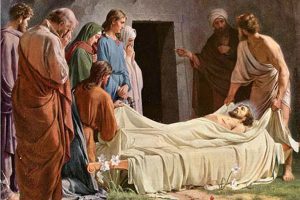
 Just like you, when this divine person of Jesus died on the cross it was a real death. But he was not annihilated or altogether dead. His body was buried in the tomb but he was soul and person was alive just like you will be alive in your soul when you die.
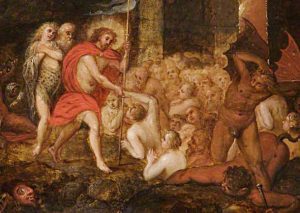
While his body lay in the tomb we are told that he ” he went and preached to the spirits in prison” (1 Peter 3:18–19). He was still alive though his body was in the tomb. The person does not die, the body does and earthly existence ceases.
Catechism 630 “During Christ’s period in the tomb, his divine person continued to assume both his soul and his body, although they were separated from each other by death. For this reason, the dead Christ’s body “saw no corruption” (Acts 13:37).
Catechism 626 “Since the “Author of life” who was killed is the same “living one [who has] risen,” the divine person of the Son of God necessarily continued to possess his human soul and body, separated from each other by death: “By the fact that at Christ’s death his soul was separated from his flesh, his one person is not itself divided into two persons; for the human body and soul of Christ have existed in the same way from the beginning of his earthly existence, in the divine person of the Word; and in death, although separated from each other, both remained with one and the same person of the Word.”
So, Jesus taking on human flesh died just like we all die. But the divine person of Christ did not end or cease to exist. Jesus’ spirit/soul never stopped living just like your spirit/soul will still live after your body and soul are separated in death. Remember, death means separation, not annihilation.
I concluded with a bit of advice: Raymund, When you have questions like this I suggest you go to the Catechism of the Catholic Church which is the best theology book, the best commentary on Scripture and a superb guide for your spiritual life. It is easy to read and you can find answers to questions like this.
The post Did God Die on the Cross? How Can God Die? appeared first on Defenders of the Catholic Faith.
Stephen K. Ray's Blog

- Stephen K. Ray's profile
- 27 followers

