
Stephen K. Ray's Blog, page 103
March 16, 2022
“Saved by Grace through Faith, not of Yourselves…”
Uh oh. What do we do now? Someone just discovered a Bible verse that destroys the Catholic view of salvation. Here is the previously “undiscovered verse” which Catholics seem to have missed somehow! Ephesians 2:8–9. “For by grace you have been saved through faith. And this is not your own doing; it is the gift of God, not a result of works, so that no one may boast.”
Actually, humor aside, this passage from Ephesians is the groundwork for a correct understanding of the Catholic teaching of salvation. A friend wrote to inquire about his passage so I took a few minutes to help explain it and how it fits into the whole picture.
Dear Richard: Glad to hear my humble efforts have had a positive influence in your life. Very personally gratifying but the glory goes to God who has blessed us, made it all possible and continues to grant his grace. Regarding Ephesians 2:8-9, people forget to keep reading on through verse 10: “For we are his handiwork, created in Christ Jesus for the good works that God has prepared in advance, that we should live in them.” Protestants are great with “sound bites” and “marketing slogans” and are very good at pulling a verse or two out of its context to misrepresent the understanding of the cultural and historical context of Scripture. They love to extract a verse or two out of context and to absolutize it. So let’s look at this passage in context and in the whole of Scripture.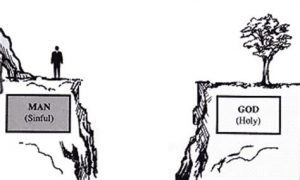 But let’s back up a bit to Square #1
. You are a sinner, there is an insurmountable chasm between you and a holy God. What can you do to get across? What good works or efforts can you perform to bridge the gap and make you acceptable to that holy God on the other side? Is there any way sinful and condemned “you” will be successfully able to stand before that holy God and say, “You owe me eternal life since I did so many good works for you!”
Now take another scenario
. You are a sinner, there is an insurmountable chasm between you and a holy God. You have no way to get across or to appease that holy God because if you’re condemning sin and disobedience. But that God in his great mercy decides to have pity on you and by a free gift of undeserved grace builds a bridge across the chasm which is the cross and the death of his Son (Jn 1:51) who took your penalty of sin upon himself and now by his grace opens the bridge across for you to freely be accepted as part of God’s heavenly family.
But let’s back up a bit to Square #1
. You are a sinner, there is an insurmountable chasm between you and a holy God. What can you do to get across? What good works or efforts can you perform to bridge the gap and make you acceptable to that holy God on the other side? Is there any way sinful and condemned “you” will be successfully able to stand before that holy God and say, “You owe me eternal life since I did so many good works for you!”
Now take another scenario
. You are a sinner, there is an insurmountable chasm between you and a holy God. You have no way to get across or to appease that holy God because if you’re condemning sin and disobedience. But that God in his great mercy decides to have pity on you and by a free gift of undeserved grace builds a bridge across the chasm which is the cross and the death of his Son (Jn 1:51) who took your penalty of sin upon himself and now by his grace opens the bridge across for you to freely be accepted as part of God’s heavenly family.
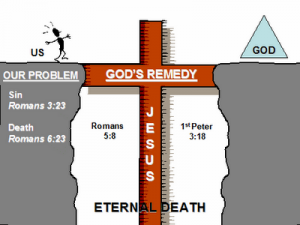 Now take another scenario
. God extends a bridge across that chasm which only requires one to accept the gift of the bridge through faith and baptism (Jn 3:5; 1 Pet 3:21; Rom 6:3-4). You take those first steps to cross the bridge of grace given freely by faith. It is not your works that put that bridge there or enabled you to cross. But now, you have been given the grace to be holy and live the life required by God. You are leaving the sin and old way of life behind. Now, are now required to be perfect as your Father in heaven is perfect (Matt 5:48). You are required to work out your salvation, notice the word work. Philippians 2:12–13 “Therefore, my beloved, as you have always obeyed, so now, not only as in my presence but much more in my absence, work out your own salvation with fear and trembling, for it is God who works in you, both to will and to work for his good pleasure.” Yes, we are INITIALLY saved by the simple grace of God received by faith. But when I believe, I DO something. Even in the act of believing I am doing something—a spiritual good work. Even when I receive the grace of God I am DOING something. Receive is a verb. The initial work was accomplished by God through Jesus Christ, but now it requires a response on our part enabled by the Holy Spirit.
Now take another scenario
. God extends a bridge across that chasm which only requires one to accept the gift of the bridge through faith and baptism (Jn 3:5; 1 Pet 3:21; Rom 6:3-4). You take those first steps to cross the bridge of grace given freely by faith. It is not your works that put that bridge there or enabled you to cross. But now, you have been given the grace to be holy and live the life required by God. You are leaving the sin and old way of life behind. Now, are now required to be perfect as your Father in heaven is perfect (Matt 5:48). You are required to work out your salvation, notice the word work. Philippians 2:12–13 “Therefore, my beloved, as you have always obeyed, so now, not only as in my presence but much more in my absence, work out your own salvation with fear and trembling, for it is God who works in you, both to will and to work for his good pleasure.” Yes, we are INITIALLY saved by the simple grace of God received by faith. But when I believe, I DO something. Even in the act of believing I am doing something—a spiritual good work. Even when I receive the grace of God I am DOING something. Receive is a verb. The initial work was accomplished by God through Jesus Christ, but now it requires a response on our part enabled by the Holy Spirit.  Now take another scenario. You have accepted and received that initial free gift of salvation earned for you by the death and resurrection of Jesus Christ. You are “saved,” correct? But what about Abraham who had already believed (Gen 15:6)? Would Abraham have been “saved” or justified before God if he had believed in God but refused to leave his homeland and refused to renounce the pagan gods? What pleased God? Faith alone or the obedience of faith? Would Abraham have been the Friend of God without good works? What if he said, “I’ll believe in you but I won’t do everything you ask?” We are required to become holy (Heb. 12:14). We are to do the works God now requires of us as his children. They are necessary for our salvation. Consider Colossians 1:22–23 “He has now reconciled in his body of flesh by his death, in order to present you holy and blameless and above reproach before him, [the gift, the grace, the ladder of the cross to heaven] if indeed you continue in the faith [good works, obedience, works of righteousness], stable and steadfast, not shifting from the hope of the gospel that you heard.”
 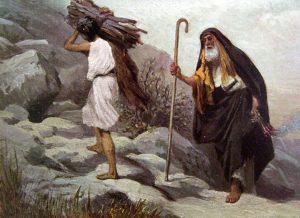 James 2:20–25 Do you want proof, you ignoramus, that
faith without works is useless
? Was not Abraham our father
justified by works
when he offered his son Isaac upon the altar? You see that faith was active along with his works, and faith was completed by the works. Thus the scripture was fulfilled that says, “Abraham believed God, and it was credited to him as righteousness,” and he was called “the friend of God.” See how
a person is justified by works and not by faith alone
. And in the same way, was not Rahab the harlot also
justified by works
when she welcomed the messengers and sent them out by a different route? Protestants of course have “fifty ways to leave their lover” when it comes to this passage. They do all kinds of gyrations and twisting in their effort to fit this round peg into their square “faith alone” hole. But its message is quite clear if you just read it and let it speak for itself. As a Baptist I believed in “cheap grace” in which I only accepted the gift of God but nothing was really required of me. My sins were forgiven past, present and future. I have eternal security; once saved, always saved. I now know that it is not only unbiblical, but a harmful and heretical position. Much is required of us! But how can I do good works acceptable and meritorious to God?
James 2:20–25 Do you want proof, you ignoramus, that
faith without works is useless
? Was not Abraham our father
justified by works
when he offered his son Isaac upon the altar? You see that faith was active along with his works, and faith was completed by the works. Thus the scripture was fulfilled that says, “Abraham believed God, and it was credited to him as righteousness,” and he was called “the friend of God.” See how
a person is justified by works and not by faith alone
. And in the same way, was not Rahab the harlot also
justified by works
when she welcomed the messengers and sent them out by a different route? Protestants of course have “fifty ways to leave their lover” when it comes to this passage. They do all kinds of gyrations and twisting in their effort to fit this round peg into their square “faith alone” hole. But its message is quite clear if you just read it and let it speak for itself. As a Baptist I believed in “cheap grace” in which I only accepted the gift of God but nothing was really required of me. My sins were forgiven past, present and future. I have eternal security; once saved, always saved. I now know that it is not only unbiblical, but a harmful and heretical position. Much is required of us! But how can I do good works acceptable and meritorious to God?  Consider my grandson Dominic wants to buy me a Christmas present but he has no money. He comes to me and asks for $100 so that he can buy me a nice Christmas present. On Christmas morning he proudly presents me with the present. Let me ask you a question. Who bought that gift? Dominic did? No I did? Wait, it was Dominic! No, it was me!
 God gives us the free gift of grace and the assistance of the indwelling Holy Spirit and requires us to live a holy life, to be sanctified…. We are required to do the good works in accordance with our new status and goal of holiness and heaven. It is God that gives us that grace—like I gave the $100 to Dominic. When God rewards our good works, he is simply rewarding his own good works achieved through his grace. Catechism 2023 Sanctifying grace is the gratuitous gift of his life that God makes to us; it is infused by the Holy Spirit into the soul to heal it of sin and to sanctify it. 2024 Sanctifying grace makes us “pleasing to God.” Charisms, special graces of the Holy Spirit, are oriented to sanctifying grace and are intended for the common good of the Church. God also acts through many actual graces, to be distinguished from habitual grace which is permanent in us. 2025 We can have merit in God’s sight only because of God’s free plan to associate man with the work of his grace. Merit is to be ascribed in the first place to the grace of God, and secondly to man’s collaboration. Man’s merit is due to God 2026 The grace of the Holy Spirit can confer true merit on us, by virtue of our adoptive filiation, and in accordance with God’s gratuitous justice. Charity is the principal source of merit in us before God. 2027 No one can merit the initial grace which is at the origin of conversion. Moved by the Holy Spirit, we can merit for ourselves and for others all the graces needed to attain eternal life, as well as necessary temporal goods.
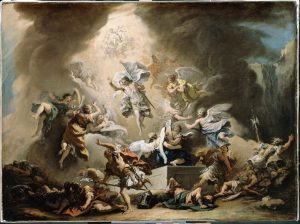 John 5:28–29 “Do not marvel at this, for an hour is coming when all who are in the tombs will hear his voice and come out, those who have done good to the resurrection of life, and those who have done evil to the resurrection of judgment.” Hope that helps. God bless you!
The post “Saved by Grace through Faith, not of Yourselves…” appeared first on Defenders of the Catholic Faith.


March 15, 2022
Did Jesus Re-name Simon the “Rock” – Confusion with Petra, Cephas, Rock and Peter
A loving wife of an unbelieving Protestant husband asked me to explain to her husband that Jesus renamed Simon as Peter and how that relates to Greek, Aramaic and Hebrew. So in simple terms I gave it a simple (though a bit long) explanation. I hope it helps you as well.
*******************************
Let’s give this a whirl for your husband’s sake. We know Aramaic was the daily language of the Jews in Judea after their return from their exile to Babylon in 586 BC. Jesus, though he obviously knew Hebrew and probably Greek, primarily spoke Aramaic.
“Greek took over as the language of government, literature, and commerce, but Aramaic remained the language of the common people in Palestine until the Arab Muslim conquest.”
“As Aramaic was spoken commonly in Palestine during the New Testament times, Jesus and his disciples spoke Aramaic (Matt 26:73). Fragments of Aramaic appear, for example, in Matt 16:17; Mark 5:41, 7:34, 14:36, 15:34; John 1:42; and Acts 1:19. The Gospel stories were probably first transmitted orally in Aramaic, although only the Gospel of Matthew is reported to have been written originally in Hebrew or Aramaic.” (CBD, “Aramaic”)
When under extreme pain on the crucifixion Jesus said, “Eloi, Eloi, lama sabachthani?” These are Aramaic words.
“According to Matthew 27:45–50…” says the Evangelical Bible Knowledge Commentary, “…near the end of this period of time, Jesus could bear the separation no longer and cried out in a loud voice, Eloi, Eloi, lama sabachthani? These Aramaic words mean, My God, My God, why have You forsaken Me? (a quotation of Ps. 22:1).”
Here we have clear biblical evidence that when Jesus spoke, even under the emotional terror of the crucifixion, he spoke in Aramaic. This is just common knowledge and undisputed by anyone who knows New Testament history.
 According to scholars, the dialogue going on in Matthew 16 about the rock and the keys was certainly in Aramaic which would be expected since it was the vernacular language. In Aramaic, there is just one word for rock and it is kepha.
Matthew had to translate his original Aramaic/Hebrew text or the dialog of Jesus into Greek and since Greek had feminine and masculine nouns—and rock was the feminine petra, he had to translate the word differently since a 200-pound fisherman could not go around with a feminine name like Petra. In the translation, Matthew made the Aramaic name Kepha — Petros—petra with a masculine ending.
Where do we first find the word Kepha used in the Gospels? It is in St. John 1:42 when Jesus first meets Simon. We so naturally think of him as Simon Peter that we think he had that name all along. However, when Jesus first met him he was simply Simon. But Jesus said, “Jesus looked at him and said, ‘You are Simon the son of John. You shall be called Cephas’ (which means Peter)” (John 1:42 (ESV)) The English Standard Version (ESV) is the new favorite translation among Protestants.
In the footnote to the word Peter it says, “Cephas and Peter are from the word for rock in Aramaic and Greek, respectively.” It must be emphasized that Cephas is the Greek transliteration of the Aramaic Kepha which means rock. Cephas (Kepha) and Peter are not different names. They are merely the same name, Rock, in two different languages, Aramaic and Greek, respectively. Cephas is the Greek transliteration of the Aramaic Kepha. This name was appropriately given to Peter near Caesarea Philippi. The water that flowed from the massive rock there was the source of the Jordan River.
Jesus says “You shall be called Cephas.“ When will Simon be called Cephas? Do we see any other later place in Scripture where he will be given that name since Jesus already predicted it will happen?
Yes, of course, in Matthew 16:18. Jesus speaking in the vernacular Aramaic (established earlier in this e-mail) he said to Simon, “You are kepha and on this kepha I will build my church.” In English Bibles, which are two languages beyond the original Aramaic, we read Peter where we lose the original Aramaic word parallel.
Protestants often use this sequence of languages and details of translation to obfuscate the text and confuse people. They use this obfuscation to deny what Jesus was actually saying about the Catholic Church has always taught.
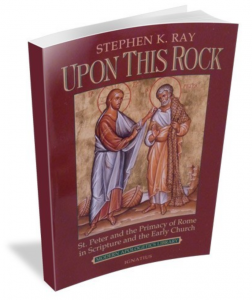 Quoting my own book Upon this Rock, “W. F. Albright, eminent Protestant scholar and internationally regarded as the “dean of biblical studies”, writes, “This is not a name, but an appellation and a play on words. There is no evidence of Peter or Kephas as a name before Christian times.… Peter as Rock will be the foundation of the future community.
Jesus, not quoting the Old Testament, here uses Aramaic, not Hebrew, and so uses the only Aramaic word that would serve his purpose. In view of the background of verse 19, … one must dismiss as confessional interpretation any attempt to see this rock as meaning the faith, or the messianic confession, of Peter. To deny the pre-eminent position of Peter among the disciples or in the early Christian community is a denial of the evidence.… The interest in Peter’s failures and vacillations does not detract from this pre-eminence; rather, it emphasizes it. Had Peter been a lesser figure his behavior would have been of far less consequence (cf. Gal 2:11ff.)” (W. F. Albright and C. S. Mann, The Anchor Bible: Matthew [Garden City, N.Y.: Doubleday & Co., 1971], 195).
“David Hill, Presbyterian minister and senior lecturer of biblical studies, University of Sheffield, writes, “It is on Peter himself, the confessor of his Messiah-ship, that Jesus will build the Church.… Attempts to interpret the ‘rock’ as something other than Peter in person (e.g., his faith, the truth revealed to him) are due to Protestant bias and introduce to the statement a degree of subtlety which is highly unlikely” (The Gospel of Matthew, New Century Bible Commentary [Grand Rapids, Mich.: Eerdmans, 1972], 261). For more information on this point, see James T. Shotwell and Louise Ropes Loomis, The See of Peter [1927; reprint, New York: Columbia Univ. Press, 1991], especially 23–24).
“Name changes held great weight in Eastern cultures. Abraham’s name change from Abram (father) to Abraham (father of nations) is a prime example. It signified a change of status or mission. Jesus changed Peter’s name from Simon to Rock. Jesus is making it obvious that something important is taking place; Peter’s status has changed for all time, and, as with Abraham, this change would have a continuing impact on the new covenant community.
The fisherman was now the steward of a kingdom. Fundamentalists may object, “Only Christ can be the rock.” However, the same figures of speech can be applied to more than one person in Scripture. In one illustration, Jesus is called the cornerstone, not the foundation, while the apostles are called the foundation (see Rev 21:14).
“God is called rock in Deuteronomy 32:4, and the name is now given to Peter, who shares in God’s rock-ness. Jesus is the one with the keys (Rev 3:7), but the keys are delegated to Peter. Jesus is the Good Shepherd, but Peter is also given the responsibility of shepherd (Jn 21:15–17). The apostles were to share in the authority and work of Christ.” (The Infallibility of the Church [London: John Murray, 1914], 338). (Stephen K. Ray, Upon This Rock: St. Peter and the Primacy of Rome in Scripture and the Early Church, Modern Apologetics Library (San Francisco: Ignatius Press, 1999).
And one must realize that in biblical terms a change of names is of earth-shattering importance. Abram received his new name Abraham when he received a new covenant and became the father of all those who believe by faith (Romans 4:11). Jacob was renamed Israel when the covenant was renewed and he became the father of the 12 tribes. We cannot assume that the change of Simon‘s name to Cephas—Peter—was any less significant in the eyes of Jesus. Jesus knew that this name change marked a huge statement of importance, change of status, and position.
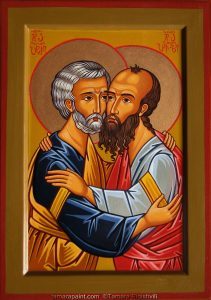 Paul is often considered to be at odds with Peter. People like to quote Galatians 2:11 to imply that Paul did not respect Peter’s primacy and authority.
But quite the opposite. If Paul intended to diminish Peters’ authority he would have referred to him merely as Simon, his given name. But instead, he emphasized Peter’s position and authority by referring to him as Cephas—the Rock! Here Paul uses the Greek transliteration of the very word Jesus spoke at Caesarea Philippi (Matt. 16:18). Peter was the authority but unhappily not living up to his own authoritative teaching regarding the salvation of Gentiles equally with Jews.
As a Baptist, I had to learn all this the hard way. I went to Israel and studied the location where Jesus said these words in the Gospel of Matthew, and studied in detail the Jewish context and background to this text and in short, I became a Catholic.
If anyone really wants to understand this whole Biblical passage I would suggest they read my book Upon this Rock, Peter and the Primacy of Rome in Scripture and the Early Church.
The post appeared first on Defenders of the Catholic Faith.
Sharing the Lord and Catholic Faith on our way to Italy
(SEE UPDATE BELOW)
We just boarded our plane to head to Italy where we will pick up 41 excited pilgrims including Teresa Tomeo and her husband Deacon Dom. We will travel from the north to the south of Italy on our “Saints and Shrines of Italy” pilgrimage. It’s good to good to be back in the air again!
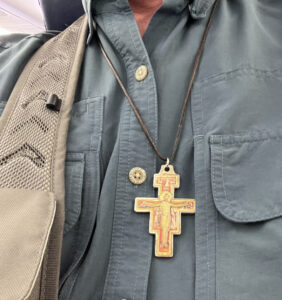 My wife and I have a commitment that we will share Jesus Christ and his Church with people every day. Today we had two great opportunities to share the Lord before we boarded our plane.
First, our driver taking us to the airport — his name was Bassam. I assumed he was from the Middle East. I asked him if he was a Christian. He said yes, a Greek Orthodox Christian. We had a delightful chat all the way to the airport encouraging each other in the Faith.
Second, one of the ticket agents commented, “I like your cross.” I thanked her for her nice comment and said, “I wear this cross so people know that I am a Christian.” She said me too, “I am also a Christian.” We had a nice little chat and ended with both saying “God Bless You!”
I wear this cross everywhere I go as a witness to Jesus Christ. I encourage all of you to do the same. It’s time we stop letting the world tell us to shut up and to start speaking the truth again with love and boldness.
I hope you can join us at virtually on our pilgrimage as I will be posting videos every night as we go all through Italy. God bless you!
UPDATE at 6:35 PM
Opportunity No.3. I saw this elderly gentleman in the JFK airport in New York who had a pilgrimage shell on his backpack. Since I’ve been to Santiago de Compostela Spain many times, I recognized it as a symbol of having walked the El Camino, the pilgrimage way to the Tomb of St. James. So I stopped him and we had a nice talk. I encouraged him on his next leg of the journey and said “God bless you!”

The post Sharing the Lord and Catholic Faith on our way to Italy appeared first on Defenders of the Catholic Faith.
March 14, 2022
How Big Was Jesus in Mary’s Womb at the Visitation – and what could he do?
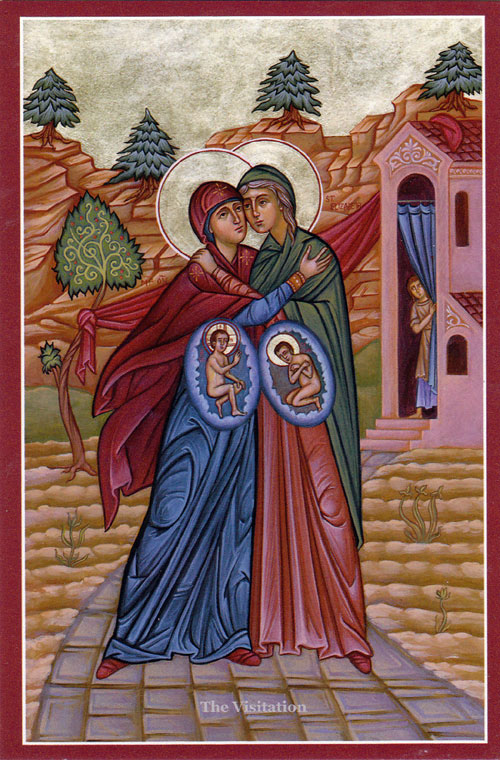 “How big was baby Jesus in Mary’s womb when Mary visited Elizabeth?” That is the question I asked myself while visiting the Church of the Visitation in Israel. What I learned was quite revolutionary and amazing. This is one of the best pro-life arguments from Scripture and one I’ve not heard discussed before.
It also says a lot about who Jesus was and the “stranger than fiction” event taking place in space and time in the womb of young girl about 15 years old.
Pictures sometimes show Mary very pregnant — better get to Bethlehem fast! But in reality that is not the case. In scientific terms Jesus was just a blastocyst, a few hundred miniature cells no bigger than a millimeter (0.039 inch).
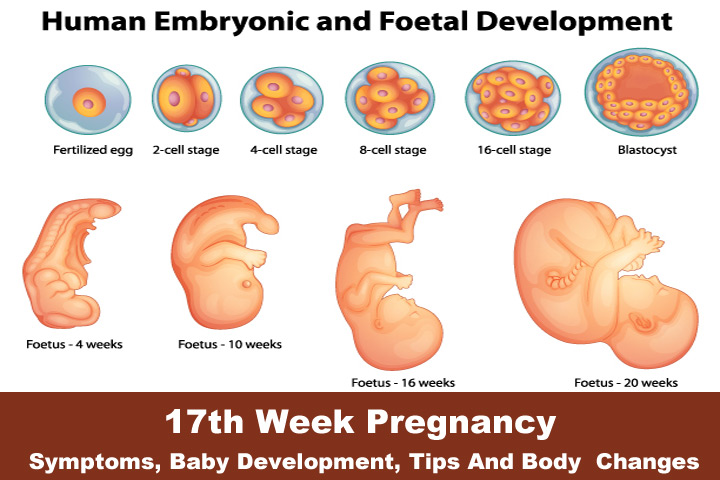 At the Visitation, Jesus was a “blastcyst” like on the top right
How big was Jesus? Read this article I just wrote and step back in time to the first days of Jesus’ life taking on a human body even though you could have barely seen him with the human eye at the time.
Here is an excerpt from my new article “How Big Was Jesus at the Visitation?”
“When Mary arrived for the Visitation, as we Catholics refer to the her visit, she was not “showing” yet. Isn’t if funny how we see pictures of a very pregnant Mary as though the baby was ready for Bethlehem. But in reality Jesus—100% God and 100% human — was so small he was practically invisible.
Though this blastocyst attached to Mary’s uterus had not seen the light of day He had created with his soon-to-develop eyes, nor breathed fresh air He had created with His still-to-develop lungs, yet He was very alive and very human. The cells were replicating at a rapid rate and they were already developing distinct bodily features. It contained the DNA—the genetic code of Mary.
The microscopic cells were not just extraneous tissue in the mother’s body—something to be discarded, a disease or something. It was human life with a soul. From conception Every baby shares in the image of God and true humanity with inestimable value long before it takes it’s first breath—right from conception.
These replicating cells in Mary’s body were truly human life, God himself taking on human flesh. St. John tells us, “And the Word became flesh and dwelt (literally, “pitched his tent” of flesh) among us, full of grace and truth; we have beheld his glory, glory as of the only Son from the Father” John 1:14).
One thing many people do not think about—what was Jesus’ size and the stage of development in the womb when Mary arrived at the house of Zechariah and Elizabeth? And, how did Elizabeth and the unborn baby John the Baptist react upon pregnant Mary’s arrival?” …
Continue reading the full article, click HERE.
The post How Big Was Jesus in Mary’s Womb at the Visitation – and what could he do? appeared first on Defenders of the Catholic Faith.
March 13, 2022
David Gray’s Story: From Prison and Attempted Suicide to the Catholic Church

In my articles ‘Losing and Finding it All’ and ‘The Day I Heard the Lord’s Voice; The Day I Knew Jesus Is Real’I talked about how I moved from being an Agnostic to a Christian. I wish I could say that I went to prison and found Christ, but that would not be the truth – It was Jesus who found me in very bad condition and gave me a new opportunity at life.
After Jesus spoke to me as I was in the process of trying to commit suicide and said, “I love you. I am here,” everything was different. I could no longer deny that Jesus was real and that He was interested in having a personal relationship with me, but some of those issues that troubled me about Christianity for all those years still lingered in my heart.
Ever since I was teenager, I could never understand how those Christians could be in so many different denominations, and each of them teaching so many radically different things that were at odds with what the other denominations were teaching, and, yet, all insisting that they each believed in the same God.
 David Gray (click image for more about him)
I kept asking myself how could they all believe in the same God and simultaneously accept that their God was confusing them with opposing and competing truths? As far as I was concerned, that was not a God worth believing in.
Moreover, I was not very knowledgeable about the New Testament, but one thing I knew for sure was that the YHWH of Old Testament always kept His people together and for His children there was nothing more important than the Shema, “Hear, O Israel: the LORD our God is one LORD” (Deuteronomy 6:4).
I knew that in the Davidic Kingdom there was only one God, one Temple, and one priesthood. Therefore, as an Agnostic, I concluded that either these Christians were not of the God of Abraham, Isaac, and Jacob, as they claimed, or there was no God.
There in October of 2004 it was good enough for me to finally know that God is real, and He truly does have a Son named Jesus Christ who loves me more than I love myself; so the restlessness and questions in my heart about those Christian denominations would wait until a later time. I was on my way to prison – my new life, and I had to figure out how I was going to adjust to that.
To read the whole astute story, click here.
The post David Gray’s Story: From Prison and Attempted Suicide to the Catholic Church appeared first on Defenders of the Catholic Faith.
March 12, 2022
Explaining Catholic View of Covenants with a Dispensational Baptist
click here.A Baptist antagonist claimed he had the proper view of God’s plan of salvation – working through dispensations.
I explained to him the more substantial, biblical and Catholic concept of covenants. I think you will enjoy the chart which makes salvation history easy to visualize and comprehend.
**********************************************
Hello Jerry:
It was good talking with you on the phone. Sounds like your summer is about as busy as ours. Anyway, . .
. . . . following is a chart describing my understanding of the Catholic teaching on the Covenants, followed by a few paragraphs from the Catechism of the Catholic Church (CCC). They relate to the covenants which I told you I would send over when we talked on the phone the other day.
These paragraphs appear early on in the Catechism and are in the context of the progressive revelation of God to His people. The Catholic Church has always taught the covenants of God are ever-expanding as he reveals Himself to an ever-expanding group of people in His plan to redeem back for Himself members of every tribe and nation.
I have an extra copy of the Catechism which I will give you; it is a fascinating piece of work. The New Covenant, ratified by the blood of Christ Himself, the Creator, brings all parties within the scope of salvation and the New Covenant – Jew and Gentile.
 Jesus tells us in John 10:16 that “And I have other sheep, which are not of this fold [non-Jews]; I must bring them also, and they shall hear My voice, and they shall become one flock with one shepherd.” Paul tells us that the great mystery is that the plan of God is to include not just the Jew but also the Gentile (Eph 3:3-6) – the whole world.
They would have a new covenant and offer a new and pure sacrifice (Mal 1:11) which has been understood from the first century to refer to the Eucharist: “My name will be great among the nations [gentiles], from the rising to the setting of the sun. In every place incense and pure offerings will be brought to my name because my name will be great among the nations,” says the Lord Almighty.” (Endnote 1)
Below is a brief overview of my understanding of the progressive covenants by which the Catholic Church teaches that God revealed Himself and brought His redemption to the world. I put it in a table format for ease of reading.
For the chart and the whole letter, click here.
The post Explaining Catholic View of Covenants with a Dispensational Baptist appeared first on Defenders of the Catholic Faith.
March 10, 2022
A Page from my New Book on Genesis
This book has been in the process for some time but is is editorial at Ignatius Press. Hopefully it will be for sale by the end of the year.
Genesis is such an exciting and foundational book. When I am completely finished with it I will miss Noah, Abraham, Isaac, Jacob, and Joseph. Feel like they are friends after all this research and writing. Well, if I have been a bit quiet over the last month, now you know why.
Here is a section of the book introducing Abram before he leaves Ur in modern-day Iraq. Our filming in Iraq several years ago for our documentary “Abraham, Father of Faith & Works” helped a lot.
Introduction to Abraham
Scripture now funnels the narrative down to one particular line within Shem’s family tree. There were ten generations from Adam to Noah followed by ten generations from Shem to Abraham which are provided here to arrive in our story to a major milestone in the history of salvation—the great patriarch and “the father of us all.” (Gen 10:10–26; Rom 4:16)
Again we see the new chapter in the story with the often repeated “These are the descendants of Shem. (11:10). In his line from Shem to Abram we find the name Eber. (11:16) “Êber in the Hebrew means “on the other side of.” The ancestors of Israel are described as those who ‘dwelt of old time beyond the River’ (êber ha-nâhâr = ‘on the other side of the Euphrates river’). See Josh. 24:2.” From his name comes we get the word Hebrew.
In verse 27 we find again the formula which announces a new phase in the story. A new funnel to direct us toward the line of the Messiah. “Now these are the descendants of Terah. Terah was the father of Abram, Nahor, and Haran; and Haran was the father of Lot. Haran died before his father Terah in the land of his birth, in Ur of the Chaldeans” (Gen 11:27–28). Haran means mountaineer, Nahor means snorting, and Abram means exalted father.
We have arrived at a huge juncture on the road of salvation history. We are now introduced to Abraham though that was not the name he was born with. His given name was Abram. Only later at the age of ninety-nine will God change Abram’s name to Abraham.
We must also remember that Abram was not a Jew, per se, since at this point Jews did not exist. The word Jew comes from Judah—one of the twelve sons of Jacob, son of Isaac, son of Abraham. Abraham was also not an Israelite since Israel was a new name given to Abraham’s grandson Jacob (Gen 32:28). To outsiders Abram was referred to as a Hebrew from the name Eber as we just discussed.
Abram was born in the city of Ur in Mesopotamia, between the Euphrates and Tigris Rivers, also known as the land of the Chaldeans. (Acts 7:2). Even today Christians from Iraq are called Chaldeans. The ancient site of Ur is located at Tel el–Miqayyar in Iraq, about 250 miles southeast of Baghdad, near the Persian Gulf. “The city of Ur is one of the oldest and most famous in Mesopotamia, with a recorded history of over two millennia…. Findings at the tell point to the Early Dynastic III period (2600–2500 B.C.) and the Third Dynasty (2111–2003 B.C.), especially under Ur-Nammu and Shulgi, the first two kings of the Third Dynasty, as the high points in the city’s history.
It was during Ur-Nammu’s reign that the famous ziggurat began to be constructed. … Ur was the center of Mesopotamian worship of Nanna/Sin, the moon god, the same god who was said to reside in Haran, the city to which Terah and his family migrated when they left Ur.”
Still standing in the archaeological site at Ur is the massive ziggurat, a square–shaped multi–leveled temple. While recently visiting Ur in Iraq we climbed to the top of this amazing ziggurat. Even after significant erosion of the the last 4,000 years it is not difficult to image the splendor that entranced the people of Abram’s time.
Mesopotamia is a flat land with no natural “high places” to ascend for the worship of the gods. The people of Mesopotamia made bricks to build their own “high places” which were called ziggurats, derived from an Akkadian word meaning to “build higher.” This ziggurat known by Abram was built to worship the god of the moon named Nanna-Sin in the 21st century B.C. The massive step pyramid was 210 ft. in length, 150 ft. in width and 100 ft. in height. The erosion makes it difficult to estimate the full hight. Projections suggest it was a hundred feet high. Saddam Hussein rebuilt portions of the ziggurat including the steps running up the face of the pyramid.
Famed British archaeologist Sir Leonard Wooley uncovered hundreds of tombs near the ziggurat some of which contained the remains of kings and queens with all their royal retinue. Wooley referred to the royal tombs as the Death Pits because the royal personages were surrounded by the skeletons of their entourage carefully arranged to accompany the royalty on their journey into the afterlife. Some tombs had over seventy skeletons strategically arranged around the king or queen, some of whom had declared themselves to be divine.
The people of Ur practiced human sacrifice. “In the corridors and in the wells, funerary chariots are found with their teams of equids, their drivers and a whole group of servants and musicians that must have accompanied the king in death. Sometimes more than 80 bodies have been found, certainly sacrificed before the funeral.”
When God called Abram, Abram was a pagan—an uncircumcised gentile living in an opulent land a thousand miles from Canaan. Abram’s ancestors, and certainly Abram himself worshiped Nanna–Sin, the patron god of the city. Ur was an upscale, wealthy urban center during Abram’s time. The musical instruments, pottery, jewelry and other treasures discovered attest to the wealth and elegance of the city….
The post A Page from my New Book on Genesis appeared first on Defenders of the Catholic Faith.
Can the pope just fire a bishop?
Published by The Pillar
The Holy See announced on Wednesday that Pope Francis had “relieved” Bishop Daniel Fernández Torres of the “pastoral care of the Diocese of Arecibo” in Puerto Rico and appointed an apostolic administrator to assume governance of the diocese.
It was a highly unusual announcement — bishops tend to only ever leave office by resignation, or by death. The move seemed to come as a surprise to Torres, and has made headlines around the globe.
But it has also raised a question: Can a pope just “fire” a diocesan bishop?
The Pillar explains.

“You’re fired!” — Ok, it isn’t quite that simple, but it’s close.
What happened?The announcement did not specify the reasons for Torres’ removal; he is 57 years old and in good health. But in a statement published on the diocesan website, the bishop gave his version of events, and branded the pope’s action “totally unjust.”
“A successor of the apostles is now being replaced without even undertaking what would be a due canonical process to remove a parish priest,” Torres said in his March 9 statement.
“I want you to know that it is not for me to explain a decision that I cannot explain myself, even if I accept it with the patience of Christ for the good of the Church.”
“I have not been prosecuted, nor have I been formally accused of anything,” he said, “simply one day the apostolic delegate verbally communicated to me that Rome was asking me to resign,” he added.
The bishop said he was told that, while he had not committed any canonical offense, he, allegedly, “had not been obedient to the pope, nor had [he] had sufficient communion with [his] brother bishops of Puerto Rico.”
Torres said he had refused to offer his resignation. He said he was incredulous that he would be removed without any canonical cause or process.
For the whole article, click here.
The post Can the pope just fire a bishop? appeared first on Defenders of the Catholic Faith.
March 9, 2022
Protestant Acknowledges “Five Things We Lost because of the Reformation” – one of the best I’ve read on it
This article was published by Nick Page in Premier Christianity Magazine in October 2017 but it’s as good today as then. He is trying to help Protestants understand that there were problems created by the Protestant movement. He explains five big loses: 1) Loss of unity, 2) Loss of monasteries, 3) Loss of silence, 4) Loss of “doing things”, and 5) Loss of color and beauty. I think this is must reading for Catholics and Protestants.
 And now for the bad news: what we lost because of the Reformation
Sorry to intrude on the Reformation celebrations, but Nick Page has some not-so-great-news to share.
It’s the anniversary! Woohoo! Five hundred years since Luther published his ninety-five theses and lit the touchpaper to launch the Protestant Reformation. There are books and TV programmes and celebratory articles. There will be cards and parties and bunting!
There will be cakes in the shape of Zwingli (with a low-fat, sugar-free, extra-roughage version in the shape of Calvin). Even Playmobil have joined the party and released a figure of Luther (over 34,000 of them were sold in three days, making it the fastest selling figure in the company’s history).
The anniversary of the Reformation is clearly a cause for celebration. But it’s worth remembering that for all its undoubted benefits, the Reformation wasn’t good news for everyone. Its heroes were not entirely without flaws, nor its villains entirely without merit.
Sometimes this comes as a shock to people. Many biographies of Luther, Calvin, Zwingli et al simply repeat the myths (such as Luther throwing ink at the devil, or even, dare I say it, the famous story about Luther nailing the theses to the Wittenberg door). The darker sides of these characters are carefully Photoshopped. Luther was famously abusive to his enemies and was responsible for some vile anti
Semitic writings. Zwingli had his theological opponents drowned in the river. Leaving aside his role in the arrest and execution of the Unitarian Michael Servetus, Calvin was so unpopular within Geneva that people tried to empty their chamber pots on him as he walked beneath their windows.
All three of these Premier League reformers – and many others in the lower divisions – had a propensity to banish anyone who spoke out against them. Now, I know all the arguments: they were not alone in this behaviour, it was the culture of the time, the Catholics were just as bad, etc, but if we want to truly remember the Reformation then the best way is not merely to get all excited about the theology, but also to be honest about the dodgy goings-on. Here are five key ideas which were lost from the Church.We lost unity
The Reformation destroyed the idea of a single, unified Church. True, this was already a bit of an illusion, given that the Western and Eastern churches had undergone the ‘Great Schism’ in 1054. And there had been that unfortunate business when there were two Popes. Then three
Popes for a bit. But, nevertheless, in Western Europe there was the idea of one catholic or ‘whole’ Church to which everyone could claim some sort of allegiance. But the Reformation shattered any semblance of unity. And it didn’t just split Western Christendom into ‘Catholic’ and ‘Protestant’, but into ‘Catholic’ and ‘Protestants’ – the latter encompassing many different flavors of evangelical and reformed belief.
The Reformation began an endless, fractal splintering of the Church. Because, as anyone who has ever tried to do the splits can tell you, once you start it’s very difficult to stop, and if there’s one thing we know about theology, it’s that other people always get it wrong. Even among the reformers themselves there was disunity. Luther and Zwingli hated each other….
For the rest of the “five things we lost”, click HERE.
The post Protestant Acknowledges “Five Things We Lost because of the Reformation” – one of the best I’ve read on it appeared first on Defenders of the Catholic Faith.
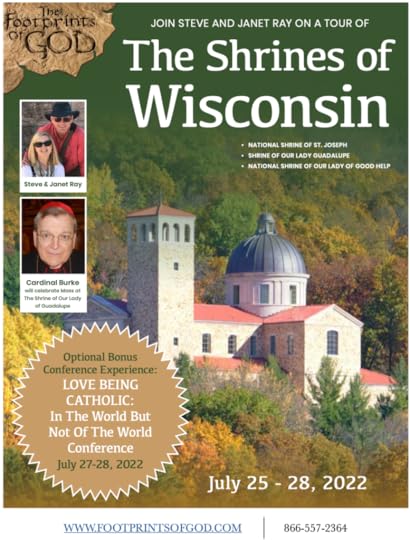
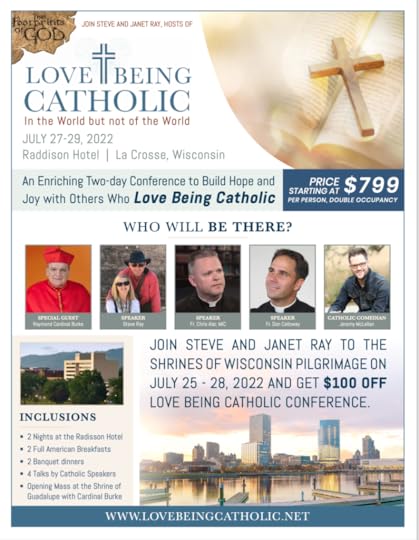
Fr. Donald Calloway MIC & Fr. Chris Alar MIC join our “Love Being Catholic” Conference
You can also contact our Reservations Team at 866-557-2364, or write them at FootprintsOfGod@ctscentral.net.
Or visit our website at www.FootprintsOfGod.com
The post Fr. Donald Calloway MIC & Fr. Chris Alar MIC join our “Love Being Catholic” Conference appeared first on Defenders of the Catholic Faith.
Stephen K. Ray's Blog

- Stephen K. Ray's profile
- 27 followers

