
Stephen K. Ray's Blog, page 102
March 22, 2022
Italy 4 Florence all day with Cooking Class
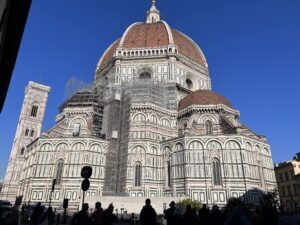 Leisurely first-rate breakfast before donning our walking shoes for an informative and lovely walking tour of Florence. From the Accademia with Michelangelo’s “David” to Giotto’s Bell Tower and Brunelleschi’s dome which is the largest masonry dome ever built and it coverages the Cathedral.
Everyone had free time to find wonderful cafés and restaurants and then a few hours free time for shopping and exploring and praying. We gathered again together to have Mass in the Duomo before our cooking class and dinner up on the mountain!
The post Italy 4 Florence all day with Cooking Class appeared first on Defenders of the Catholic Faith.


March 21, 2022
Should We Evangelize Protestants?
Excellent article in The Catholic Thing by Casey Chalk affirms that we SHOULD evangelize Protestants. I have always said evangelism does not stop until all Christians are eating one meal together, in one house at one table (altar). As a convert, I understand the blindness that prevails and the need to teach all of the truth, especially to our brothers and sisters out on the rafts. Bring them home to the ship, which is the fullness of the faith.
We should stop trying to evangelize Protestants, some Catholics say. “Let’s get our own house clean first, before we invite our fellow Christians in,” someone commented on a recent article of mine that presented a Catholic rejoinder to a prominent Baptist theologian. Another reader argued that, rather than trying to persuade Protestants to become Catholic, we should “help each other spread God’s love in this world that seems to be falling to pieces before our eyes.” As a convert from Protestantism, actively engaged in ecumenical dialogue, I’ve heard this kind of thinking quite frequently. And it’s dead wrong.
One common argument in favor of scrapping Catholic evangelism towards Protestants is that the Catholic Church, mired in sex-abuse and corruption scandals, liturgical abuses, heretical movements, and uneven catechesis, is such a mess that it is not, at least for the moment, a place suitable for welcoming other Christians.
There are many problems with this. For starters, when has the Church not been plagued by internal crises? In the fourth century, a majority of bishops were deceived by the Arian heresy. The medieval Church suffered under the weight of simony and a lax priesthood, as well as the Avignon Papacy and the Western Schism, culminating in three men claiming, simultaneously, to be pope. The Counter-Reformation, for all its catechetical, missionary and aesthetic glories, was still marred by corruption and heresies (Jansenism). Catholicism has never been able to escape such trials. That didn’t stop St. Martin of Tours, St. Boniface, St. Francis de Sales, St. Ignatius Loyola, or St. Teresa of Calcutta from their missionary efforts.
The “Catholics clean house” argument also undermines our own theology. Is the Eucharist the “source and summit of the Christian life,” as Lumen Gentium preaches, or not? If it is, how could we in good conscience not direct other Christians to its salvific power? Jesus Himself declared: “Truly, truly, I say to you, unless you eat the flesh of the Son of man and drink his blood, you have no life in you.” (John 6:53) Was our Lord misrepresenting the Eucharist?
Or what of the fact that most Protestant churches allow contraception, a mortal sin? Or that Protestants have no recourse to the sacraments of penance or last rites? To claim Protestants aren’t in need of these essential parts of the Catholic faith is to implicitly suggest we don’t need them either.
For the rest of the article, click HERE.
The post Should We Evangelize Protestants? appeared first on Defenders of the Catholic Faith.
Italy Day 3 Mass in Pavia at St. Augustine’s Tomb and on to Florence
Leaving Milan in the Lombardy region for Mass at Pavia at the Tomb of the great Doctor of the Church, St. Augustine of Hippo. From there SE to Florence, a city rich in art, history and culture in the Tuscany region.
Lunch along the way before visiting Santa Croce Church, a minor basilica in Florence, which includes the tombs of Michelangelo, Galileo Galilei, and Niccolo Machiavelli. Delicious dinner and night at the Grand Hotel Cavour.
The post Italy Day 3 Mass in Pavia at St. Augustine’s Tomb and on to Florence appeared first on Defenders of the Catholic Faith.
March 20, 2022
The Cross & the Crucifix: Letter to a Fundamentalist
The Cross & the Crucifix
(From a letter Steve wrote to a Evangelical Protestant who asked about the Catholic Crucifix)
Dear Evangelical Friend:
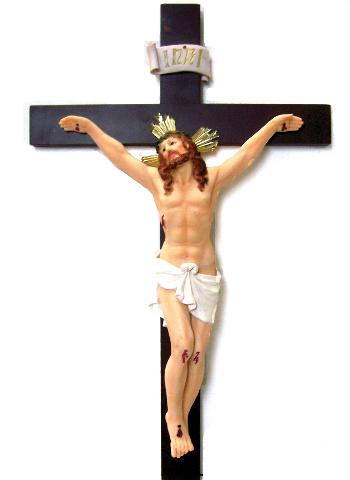
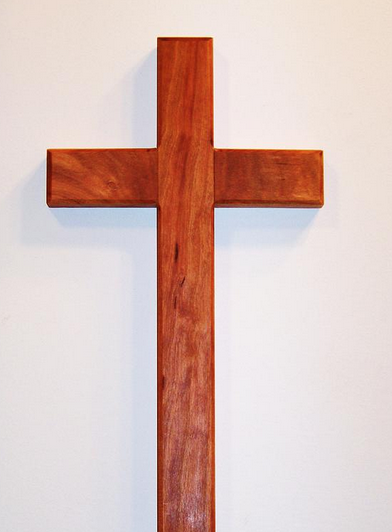 You display a bare cross in your home; we display the cross and the crucifix. What is the difference and why? The cross is an upright post with a crossbeam in the shape of a “T”. A crucifix is the same, but it has Christ’s body (corpus) attached to the cross.
As an Evangelical Protestant I rejected the crucifix, as you do—Christ was no longer on the cross; he had ascended into heaven. So why do I now tremble in love and awe at the site of a crucifix? Let’s examine the history and issues surrounding the two.
I will provide a brief overview of the Cross and the Crucifix, the origin, the history, and the differing perspectives of Catholic and Protestant. It will try to catch the historical flow and include the pertinent points. The outline is as follows:
 1. The Three Main Protestant Objections to the Crucifix
2. Images and Gods in the Old Testament
3. Images and Images of Christ in the New Testament
4. The Cross in the First Centuries
5. The Crucifix Enters the Picture
6. The “Reformation” and Iconoclasm
7. Modern Anti-Catholics and the Crucifix
8. Ecumenical Considerations
To read the whole article, click here. To read Steve’s other articles, click here. For Steve’s talk “The Pain of the Crucifixion,“ click here.
The post The Cross & the Crucifix: Letter to a Fundamentalist appeared first on Defenders of the Catholic Faith.
Italy 2 Milan and Tomb of St. Ambrose
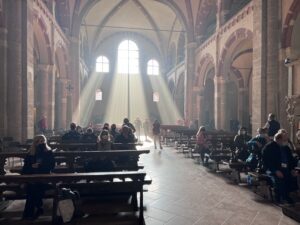 A wonderful second day in Milan Italy. Today we had Mass over the tomb of Saint Ambrose.
We were told that we were the first group in over 20 years that could have the Mass at the high alter over the tomb of the first Doctor of the Church.
also saw the last masterpiece of Michelangelo before he died at 88 years old.
Wonderful day and I hope you enjoy the video.
The post Italy 2 Milan and Tomb of St. Ambrose appeared first on Defenders of the Catholic Faith.
March 19, 2022
Why Didn’t Jesus Condemn Homosexuality?
Steve’s extensive response to new questions in the ComBox below. For the newly revised and full article click here.
IN RESPONSE TO MY BLOG JESUS IS NOT A HOMOPHOBE, ROD WROTE:
Steve,
Your posting is remarkable! It is remarkable that, despite your attempts at convincing yourself that Jesus did not accept homosexuality, you were unable to come up with a single reference in the Gospels in support of your statement. Nowhere in the Gospels, which is the only first-hand, direct account we have of Jesus’ message to us, does Jesus make any comment in support of what you are advancing (either against homosexuals or in support of the “hate the sin not the sinner” approach). In fact, Jesus’s message is at the other end of the spectrum. He talks of love, tolerance and acceptance.
How people interpret the bible on their own time in their own private lives is not my business. But when such ignorance of the scriptures is flaunted ….
Look into your heart, my friend, when judging your fellow neighbors … Then, when you’re certain of what you’ve done, what you’ve thought and where’s you’ve been: go ahead, cast the first stone.
Good luck with your search for truth and love. Rod
STEVE RAY RESPONDS:
Rod:
Thanks for your comment. Honest and irenic discussion is a good thing. You may want to read the blog I posted following the “T-shirt” post. It is titled “Was Jesus Nice?”
And, as to who is ignorant of Scripture – we will let others judge that after reading the next few paragraphs.
Now for your comments. You are correct: the gospels never mention Jesus discussing homosexuality, the gay lifestyle or same-sex attraction. But let’s stop and ask why?
First, Jesus addressed the issues that were prevalent in his time. Homosexuality was certainly not a front-burner issue in first century Palestine. Even today when I am in the Palestinian areas with people who still live and think much like earlier Palestine, the topic is taboo and they are embarrassed and shocked if you mention such things.
Second, the gospel writers recorded very few of Jesus’ actual words and deeds. Three years of teaching and instruction and only a few short accounts. St. John says that what he wrote is only a minuscule portion of the what he said and did (Jn 20:30-31; 21:25),. Jesus addressed and they recorded, the issues that were pressing in their own context and culture. Homosexuality was not such a topic.
Third, we cannot say Jesus did not mention or verbally condemn such behavior since we have so little of what he actually said and did during the three short years of his ministry. We have no recorded mention of abortion (again a non-issue in 1st century Palestine), yet Jesus obviously would have condemned it soundly. Jesus never mentioned riding donkeys slowly through intersections to avoid accidents. We have no record of him reminding people not to “drink and drive” or to eat good to avoid heart attacks.
Now, what we do know is the culture, the religion and the ethics of Jesus. He was not a 1st-century pagan, nor a San Francisco gay; not an atheist Marxist or a Hindu. Jesus was a Hebrew Jew through and through. He obeyed the Law of Moses completely. The hypocritical leaders knew this because they could never pin anything on him. He was the 2nd Person of the Trinity who made man and women and who gave them the Law at Mount Sinai.
Being the visible image of the invisible God (Col 1:15), Jesus was not likely to negate or reverse the moral law he imposed on the world based on his nature and attributes.
But even if you deny that Jesus was God, he certainly was an observant Jew with a love for and respect for the Law. He said in Matthew 5:17–19, “Think not that I have come to abolish the law and the prophets; I have come not to abolish them but to fulfill them. For truly, I say to you, till heaven and earth pass away, not an iota, not a dot, will pass from the law until all is accomplished. Whoever then relaxes one of the least of these commandments and teaches men so, shall be called least in the kingdom of heaven; but he who does them and teaches them shall be called great in the kingdom of heaven.”
Jesus did not negate the Law but upheld it and even upped the ante and made it more stringent. What does the Law say about homosexuality? Leviticus 18:22, “You shall not lie with a male as with a woman; it is an abomination.” The pagans—who even offered their children as living sacrifices—practiced such sexual deviations. God forbade his people to live and act like the despised pagans around them. They had a Law that ordered their society according to the will of God who had made them.
Interestingly enough, this next passage puts homosexual activity in the same category as incest and bestiality. The punishment was death. We read in Leviticus 20:13–16 “If a man lies with a male as with a woman, both of them have committed an abomination; they shall be put to death, their blood is upon them. If a man takes a wife and her mother also, it is wickedness; they shall be burned with fire, both he and they, that there may be no wickedness among you. If a man lies with a beast, he shall be put to death; and you shall kill the beast. If a woman approaches any beast and lies with it, you shall kill the woman and the beast; they shall be put to death, their blood is upon them.”
I could go on for pages with such passages—demonstrating the Law and the culture of the Jews. Jesus was an obedient Jew. No rational person would suggest that Jesus would condone, much less promote homosexuality, incest or bestiality. (I am not talking about homosexual inclinations but homosexual acts; inclinations are not sin, acting out the impulses is.) The only way to superimpose such “tolerance” on Jesus is to rip him from his own religion and cultural context and anachronistically paint him a different color with a modern brush. This “new Jesus” is a creation of a culture that wishes to create God in their own image.
The book of Revelation is especially applicable in this regard—especially since it is a revelation given to St. John by Jesus himself. It was written by St. John who is presumably the disciple of Jesus and one quite intimate with the teachings and practices of his Rabbi. And John claims that the book is the actual words of Jesus. But even if one refuses to accept the fact that it is written by St. John, it is still a man who understood the culture, law and acceptable conduct that the Jewish culture and the early Christian community expected of people. So the book claims to be words of Jesus in addition to what we find in the Gospels.
Revelation tells who will and will not be in heaven. We read in Revelation 21:27, “But nothing unclean shall enter it, nor any one who practices abomination or falsehood, but only those who are written in the Lamb’s book of life.” In the Jewish and biblical context, what is an abomination? We already confronted that word in Leviticus where such abominations were mentioned and condemned. Homosexuality, incest and bestiality were among the abominations which God abhorred. Those who practice such things will not be in heaven according to Jesus.
Later in Revelation 22:15, “Outside are the dogs and sorcerers and fornicators and murderers and idolaters, and every one who loves and practices falsehood.” Note, the Greek word used in Scripture for “fornication” is pornos which means illicit sexual relations or conduct. In the context, without twisting Scripture to suit one’s own purposes or to justify one’s own conduct, homosexuality, bestiality, incest and other deviant sexual activity are included in the word “fornication.” It would also apply to someone committing adultery, having sex outside marriage—or any other sexual activity outside of a monogamous man-woman marriage relationship.
It seems pretty clear that if one reads Scripture in context and one understands the life and moral teaching of Christ in context, and his words in Revelation, there is no possibility of concluding Jesus condoned or approved of homosexual conduct.
Now, having said that, Jesus loved the sinner without condoning the sin. We as Catholics and Christians strive for the same thing. To love and cherish every person no matter what their sexual orientation or conduct. However, we will speak out against deviant behavior, sin and conduct contrary to the laws of nature and of nature’s God.
If someone brings up the adulterous woman in John 8 to demonstrate Jesus’ tolerance and acceptance of sexual sins, we must remember that Jesus did not accept the sin of adultery. He accepted the sinner, forgave her, and told her to sin no more. Here he loved and forgave the sinner but did not love the sin and explicitly said, “Neither do I condemn you; go, and do not sin again” (Jn 8:11). In another similar situation a man was cured and Jesus. “Afterward, Jesus found him in the temple, and said to him, “See, you are well! Sin no more, that nothing worse befall you” (Jn 5:14). Love the sinner, hate the sin.
Jesus used the situation to expose the hypocrisy of the adulteress’s accusers. They wanted to kill her but failed to condemn the man involved in the sin and her judges were full of sin themselves. We who oppose homosexuality are not out to stone homosexuals, nor do we claim we are without our own sins. But we do make a judgment about moral norms and encourage all, including ourselves to come to Jesus for forgiveness and healing—and then to sin no more.
One often hears the mantra “Jesus said not to judge, so why are you judging?” This is a misunderstanding of what Jesus is saying. Here is the quote in Matthew 7:1–2, “Judge not, that you be not judged. For with the judgment you pronounce you will be judged, and the measure you give will be the measure you get.” He is simply stating that if you don’t want to be judged by others, then don’t start the ball ricocheting off the walls because it will come back to hit you. If you don’t want others to judge you, then don’t judge them. Yet he himself was at that moment being very judgmental (without the negative connotations of the word).
This is certainly not a command against making judgments. Obviously we make judgments every day—we discriminate all the time. We marry one person instead of another, we choose some people as friends and avoid others, we judge someone as wrong who punches us in the nose. Urinating on people in a crowded street would bring down judgment by the most tolerant among us.
And by the way, keeping things in their wider context, Jesus told us we are to judge. Consider these two examples.
Luke 12:57
“And why do you not judge for yourselves what is right?”
John 7:24
“Do not judge by appearances, but judge with right judgment.”
If someone is determined to promote the gay lifestyle and practice intolerance toward those who oppose such conduct, what I have said will likely mean nothing to them. They want to create God in their own image and continue to do whatever they want to do even if they have to twist the historical Jewish Jesus into a tolerant modern relativistic caricature.
Mother Theresa loved everyone equally without holding back an ounce of blood, sweat or tears; yet, she would never condone homosexuality. She would tenderly love and care for a dying homosexual with AIDS without condemning him. But at the same time she would clearly denounce homosexuality as a sin and to be utterly opposed to it. Neither would Mother Theresa condemn a woman who’d had an abortion, but no one was a stronger critic of the abortion than Mother Theresa.
Again, I don’t mean to offend or alienate and I do appreciate your candid comment. May God also bless you as you seek to know the God of creation and his Son Jesus Christ.
********************************
Catholic World Reports article: Jesus, Marriage and Homosexuality
The post Why Didn’t Jesus Condemn Homosexuality? appeared first on Defenders of the Catholic Faith.
Arrival in Milan; Duomo Cathedral – World’s 3rd Largest Church
And today it all begins! Our pilgrims arrived in good stead at 8:30 AM at the Melpensa Airport on their Delta flight from New York.
We were there to greet them and the deplaning process was simple. We boarded our bus for the hour drive to downtown Milan. Along the way we opened the pilgrimage with prayer, all got acquainted, and prepared everyone for the delights that await them!
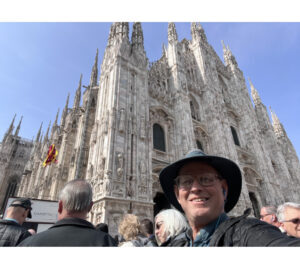 We arrived to tour the magnificent Duomo Cathedral which is impossible for a camera to capture, try as I will!
Five hundred years to build, 3,500 statues, and the 3rd largest church in the world. It’s Gothic construction makes it look light and feathery even though it is massive. We celebrated Mass at the Duomo.
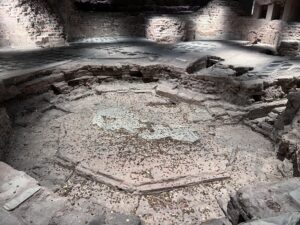 Fascinating for me to revisit, is the discovery of the baptismal font below the church in the remains of an earlier church where St. Augustine was baptized by St. Ambrose in AD 387.
“In the book Font of Life: Ambrose, Augustine & The Mystery of Baptism, we read of the remarkable moment when their lives intersected at one of the most important, yet rarely visited, sites in the Christian world. Hidden under the piazza of the Duomo in Milan lies part of the foundations of a fourth-century cathedral where, at dawn on Easter of 387, Augustine and a group of people seeking baptism gathered after an all-night vigil.
“Ambrose himself performed the sacrament and the catechumens were greeted by their fellows in the faith, which included Augustine’s mother Monica. Though the occasion had deep significance for the participants, this little cluster of devotees was unaware that they were creating the future of the Western church.”
 Free time for lunch in a whole array of pizzerias, cafes and ristorantes (Italian spelling). Lots of shopping and exploring before checking in to our Concorde Hotel for dinner and early to bed.
The post Arrival in Milan; Duomo Cathedral – World’s 3rd Largest Church appeared first on Defenders of the Catholic Faith.
March 18, 2022
What Do We Mean by “Unanimous Consent of the Fathers”
Unanimous Consent of the Fathers
By Steve Ray
The Unanimous Consent of the Fathers (unanimem consensum Patrum) refers to the morally unanimous teaching of the Church Fathers on certain doctrines as revealed by God and interpretations of Scripture as received by the universal Church. The individual Fathers are not personally infallible, and a discrepancy by a few patristic witnesses does not harm the collective patristic testimony.
The word “unanimous” comes from two Latin words: únus, one + animus, mind. “Consent” in Latin means agreement, accord, and harmony; being of the same mind or opinion. Where the Fathers speak in harmony, with one mind overall—not necessarily each and every one agreeing on every detail but by consensus and general agreement—we have “unanimous consent”. The teachings of the Fathers provide us with an authentic witness to the apostolic tradition.
St. Irenaeus (ad c. 130–c. 200) writes of the “tradition derived from the apostles, of the very great, the very ancient, and universally known Church founded and organized at Rome’ (Against Heresies, III, 3, 2), and the “tradition which originates from the apostles [and] which is preserved by means of the successions of presbyters in the Churches” (Ibid., III, 2, 2) which “does thus exist in the Church, and is permanent among us” (Ibid., III, 5, 1). Unanimous consent develops from the understanding of apostolic teaching preserved in the Church with the Fathers as its authentic witness.
St. Vincent of Lerins, explains the Church’s teaching: “In the Catholic Church itself, all possible care must be taken, that we hold that faith which has been believed everywhere, always, by all. For that is truly and in the strictest sense “Catholic,” which, as the name itself and the reason of the thing declare, comprehends all universally. This rule we shall observe if we follow universality, antiquity, consent. We shall follow universality if we confess that one faith to be true, which the whole Church throughout the world confesses; antiquity, if we in no wise depart from those interpretations which it is manifest were notoriously held by our holy ancestors and fathers; consent, in like manner, if in antiquity itself we adhere to the consentient definitions and determinations of all, or at the least of almost all priests and doctors” (Commonitory 2). Notice that St. Vincent mentions “almost all priests and doctors”.
The phrase Unanimous Consent of the Fathers had a specific application as used at the Council of Trent (Fourth Session), and reiterated at the First Vatican Council (Dogmatic Decrees of the Vatican Council, chap. 2). The Council Fathers specifically applied the phrase to the interpretation of Scripture. Biblical and theological confusion was rampant in the wake of the Protestant Reformation. Martin Luther stated “There are almost as many sects and beliefs as there are heads; this one will not admit Baptism; that one rejects the Sacrament of the altar; another places another world between the present one and the day of judgment; some teach that Jesus Christ is not God. There is not an individual, however clownish he may be, who does not claim to be inspired by the Holy Ghost, and who does not put forth as prophecies his ravings and dreams.”
The Council Fathers at Trent (1554–63) affirmed the ancient custom that the proper understanding of Scripture was that which was held by the Fathers of the Church to bring order out of the enveloping chaos. Opposition to the Church’s teaching is exemplified by William Webster (The Church of Rome at the Bar of History [Carlisle, PA: Banner of Truth Trust, 1995]) who misrepresents the Council Fathers by redefining and misapplying “unanimous consent”.
First in redefining, he implies that unanimous consent means each Father must have held the same fully developed traditions and taught them clearly in the same terms as used later in the Church Councils. This is a false understanding of the phrase and even in American law unanimous consent “does not always mean that every one present voted for the proposition, but it may, and generally does, mean, when a [verbal] vote is taken, that no one voted in the negative” (Black’s Law Dictionary). Second he misapplies the term, not to the interpretation of Scripture, as the Council Fathers intended, but to tradition. His assertions are not true, but using a skewed definition and application of “unanimous consent”, he uses selective patristic passages as proof-texts for his analysis of the Fathers.
As an example, individual Fathers may explain “the Rock” in Matthew 16 as Jesus, Peter, Peter’s confession or Peter’s faith. Even the Catechism of the Catholic Church refers to the “Rock” of Matthew 16 as Peter in one place (CCC 552) and his faith (CCC 424) in another. Matthew 16 can be applied in many ways to refute false teachings and to instruct the faithful without emphasizing the literal, historical interpretation of Peter as the Rock upon which the Church has been built his Church. Webster and others emphasize various patristic applications of a biblical passage as “proof” of non-unanimous consent.
Discussing certain variations in the interpretations of the Fathers, Pope Leo XIII (The Study of Holy Scripture, from the encyclical Providentissimus Deus, Nov., 1893) writes, “Because the defense of Holy Scripture must be carried on vigorously, all the opinions which the individual Fathers or the recent interpreters have set forth in explaining it need not be maintained equally. For they, in interpreting passages where physical matters are concerned have made judgments according to the opinions of the age, and thus not always according to truth, so that they have made statements which today are not approved. Therefore, we must carefully discern what they hand down which really pertains to faith or is intimately connected with it, and what they hand down with unanimous consent; for ‘in those matters which are not under the obligation of faith, the saints were free to have different opinions, just as we are,’ according to the opinion of St. Thomas.”
***************************************
Referred works:
St. Irenaeus’ quote: Ante-Nicene Fathers. Roberts and Donaldson, Eerdmans, 1985, vol. 1, p. 415, 417).
St. Vincent’s quote: Nicene and Post-Nicene Fathers, 2nd series, ed. Philip Schaff and Henry Wace, Eerdmans, 1980, vol. 11, p. 132.
Luther quote: (Leslie Rumble, Bible Quizzes to a Street Preacher [Rockford, IL: TAN Books, 1976], 22).
William Webster’s quote: (William Webster, 31).
Black’s Law Dictionary: Black’s Law Dictionary, Henry Campbell Black, St. Paul, MN: West Publ. Co., 1979, p. 1366.
Pope Leo XIII quote: Henry Denzinger, The Sources of Catholic Dogma [London: B. Herder Book Co., 1954], 491-492).
****************************************
The post What Do We Mean by “Unanimous Consent of the Fathers” appeared first on Defenders of the Catholic Faith.
Video Of Map and Overview of Italy Pilgrimage
In preparation for our group arriving tomorrow, I’m sharing a short video explaining with a map and pictures where we’re going and what we’re doing on this “Saints and Shrines of Italy“ pilgrimage.
The post Video Of Map and Overview of Italy Pilgrimage appeared first on Defenders of the Catholic Faith.
March 17, 2022
Meeting up with Teresa Tomeo and Deacon Dom in Milan Italy – awaiting our group!!
After being grounded for two years it is great to be back in the air and exploring biblical and Catholic lands again. Traveling is pretty easy again and Janet and I landed in Italy yesterday, Teresa Tomeo and her husband Deacon Dom today.

So, we prepare for our “Saints & Shrines of Italy” pilgrimage, culminating in Rome for a 3-day extension with our guide Liz Lev. Excited!!
We have a group of 41 excited folks arriving soon. We will then start in the north of Italy, in Milan (Milano), and move our way south covering many of the great saints and shrines of Italy. We will get them boarded on the bus for two days in Milan and Pavia (tomb of St. Augustine).

We had breakfast with Teresa and Dom at our Concorde Hotel. They will go ourt exploring today while Janet and I will read up on all the sites and get ready for talks and sharing along the way.
Stay tuned for our daily videos I will be uploading so you can share our adventure with us each day. God bless you all!!
Check out all of our upcoming trips this year to the Holy Land (5 times), Jordan-Israel (1 time), Obermammergau (2 times), St. Paul Mediterranean Cruise and — Shrines of Wisconsin combined with our 1st Annual “Love Being Catholic” conference.
The post Meeting up with Teresa Tomeo and Deacon Dom in Milan Italy – awaiting our group!! appeared first on Defenders of the Catholic Faith.
Stephen K. Ray's Blog

- Stephen K. Ray's profile
- 27 followers

