
 Could not find Kindle Notes & Highlights for that user.
Stephen K. Ray's Blog, page 100
April 1, 2022
Italy 14 Rome Party and Farewells
It is always hard to say “Goodbye” but we sure did it with a bang. Enjoy our last dinner and singing, our walk across the Tiber River and the farewells and comments from our pilgrims!
The post Italy 14 Rome Party and Farewells appeared first on Defenders of the Catholic Faith.


March 31, 2022
Prepare for the Skyline of the Future: Islam!
I wrote this several years ago while in Adana Turkey and thought it worthy to post again, especially since I am seeing it again, everywhere I go in the world. I my country hometown in Michigan the Muslims have built the largest mosque in America. But I shouldn’t get ahead of my story.
Europe is full of magnificent churches—Gothic, Baroque and even modern. Their steeples and crosses still dominate much of the skyline. They stand as impressive monuments to the Christian faith that built the free world and brought beauty and justice out of a pagan, barbarian wilderness.
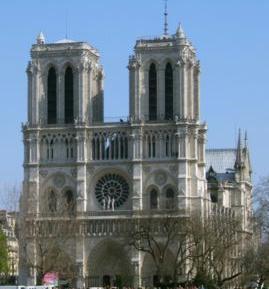 Today the churches in Europe are becoming museum pieces recalling the lost faith and collapsing backbone of Europe. (Paris’ Notre Dame Cathedral to left)
Paganism is on the rise — and along with it something just as alarming. The skyline will soon change, not only for Europe but for the whole Western World, including the United States. You will soon see new structures piercing the sky!
But before I tell you how your view of today’s horizon will change, let me tell you about what happened to Turkey. Then you will see that it can happen—and if we don’t move quickly, it will happen again.
Janet and I are now in Turkey with our Skyline Productions video crew working on our next documentary Apostolic Fathers for the Footprints of God series. We are driving/flying with our crew from one Christian site to another. This country is often called the Second Holy Land—why? Because it contains more Christian sites than anywhere other than Israel.
For a few examples: Antioch is where we were first called Christians, Tarsus was the home town of St. Paul, and Lystra the home city of St. Timothy.
 But, Turkey is also home to the Seven Church of Revelation. The Blessed Virgin Mary lived here with the Apostle St. John. Selçuk still boasts the tomb of St. John (see picture to right). Istanbul (Constantinople) was once a proud patriarchate of the Catholic Church and home to Ecumenical Councils.
Actually, the first Seven Ecumenical Councils were held here, including Constantinople, Chalcedon, and Nicea—from which we got Nicene Creed recited each Sunday. And don’t forget the Council of Ephesus which defined Mary as the Theotokos, the Mother of God.
And if you remember your New Testament, you will recognize cities that were in today’s Turkey: Galatians, Ephesians and Colossians. Turkey is also the land of martyrs, Fathers and Doctors of the Church like Sts. Ignatius of Antioch, Polycarp, Irenaeus, Gregory of Nyssa, Gregory of Nazianzus, John Chrysostom, and Basil the Great to name just a few.
So, when I look out over the horizon from my hotel room window, do I see the beautiful churches that once marked the skyline of Asia Minor (modern day Turkey)?
Nope. Sorry. I see something else.
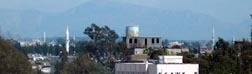 From my window just now, I counted no less than nineteen minarets! What are minarets? They are the tall slender towers above an Islamic mosque from which the muezzin calls the faithful to prayer (Notice two pictures from my hotel window–one wide shot with no less than five minarets; the second at the bottom of this blog showing a large mosque across the river. There is only one Catholic Church within a hundred miles of where I am now).
What happened to the churches? Let’s go to Istanbul together and I will show you! I have frequently visited the Hagia Sophia—the Church of Holy Wisdom. It was the glory of Christendom and for over a thousand years it had the largest dome — until St. Peter’s was built in Rome. Many people thought the dome stayed up by a direct miracle of God. How else could something so expansive stay up without crashing down?
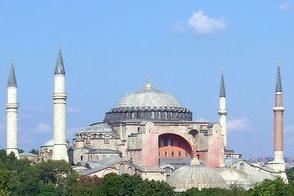 But when the Muslims conquered Contantinople they defaced the church, painted over the golden icons of our Blessed Mother and turned the spectacular church into a mosque. The crosses came down and the minarets went up.
Today the Hagia Sophia is a museum! (picture of modern Hagia Sophia to left)
It has been predicted that within fifty years Europe’s skyline will change. It will become a Muslim empire. Steeples will come down and minarets will go up. No longer will you hear bells — you will hear muezzin wailing from the balconies of slender minarets.
And America? We are losing our faith too, and our backbone. Will we be far behind Europe? I don’t think so. Islam has 1 billion followers, many of who will stop at nothing short of world domination. They won’t call it that, of course. They will say the world is now as Allah willed it.
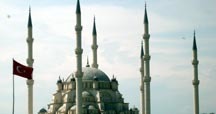 And like the Hagia Sophia—your church, and the Shrine of the Immaculate Conception in Washington DC and St. Patrick’s in New York will still pierce the skyline, but no longer as steeples. They will sport the latest in minarets. And our grandchildren’s’ children will wonder why we caved in so easily—why we lost our faith and our backbone.
Oh, so you don’t believe it can happen to us? Neither did the Byzantine Empire, the powerhouse of Christianity in the East! But, the East fell to Islam and the West may fall as well. Maybe not by military might, but by religious indifference, population control, and secularism. Islam can overtake us by persistence, population growth, and religious fervor.
What was once part of a powerful Christian Empire is now 99% Muslim. Out of a population of about 75 million, there are only 60,000 Christians (Catholic, Orthodox, Protestants, etc.). The past screams to us but will we listen.
Prepare to see the new skyline; prepare to be awakened at 4 AM with the wail of the muezzin.
Far-fetched? Read this article about Holland.
St. Ignatius, pray for us. Sts. Polycarp, Irenaeus and John Chysostom, pray for us!
The post Prepare for the Skyline of the Future: Islam! appeared first on Defenders of the Catholic Faith.
Italy 13 Rome’s Ancient Churches
An early start today in order to arrive at the Church of Saint Peter in Chains. This church housees some amazing relics and artwork. First, is Michelangelos Moses sculpture. Second, are the bones of the Maccabean murders. And third, and the way the church got its name, are the chains that bound to Saint Peter from both Jerusalem and Rome.
After Mass at this beautiful church and an organ recital, we walked to San Clemente Church. This is one of my favorites because it contains the bones of Saint Ignatius of Antioch and Saint Clement of Rome, the third successor of Peter. These guys made me Catholic!
And when you go underneath we walk through a fourth century Basilica and stepped back in time. Another flight of stairs takes us even lower to first century Rome. It’s like being in a time machine.
Everyone had their Covid test and they were all negative and the afternoon was free for lunch and napping, packing and shopping. We’re going to have our farewell dinner tonight which I will add to the next video.
The post Italy 13 Rome’s Ancient Churches appeared first on Defenders of the Catholic Faith.
March 30, 2022
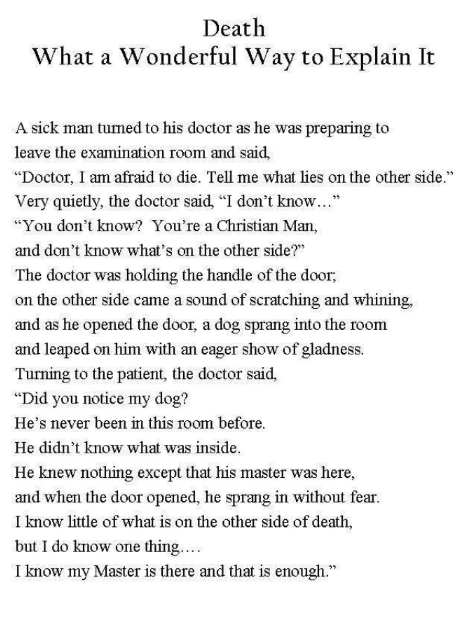
Death, What a Wonderful Way to Explain It
Hope you enjoy this. I found it quite nice with a ring of truth to it. When it comes my turn to die, this will be my attitude.
The post Death, What a Wonderful Way to Explain It appeared first on Defenders of the Catholic Faith.
Italy 12 Rome Papal Audience and Mass with the Martyrs
Raining a bit today but we headed out early to join the line to enter the Vatican Auditorium for the Papal Audience. Our group made it in and got pretty good seats.
The rest of the day was free until Mass at 5:00. Folks were free to explore Rome, visit churches, pray, shop, dine – or even climb up into the dome of St. Peter’s!
I gave a talk on the martyrs IN the church of the martyrs, San Stefano Rotundo, before Mass. We then invited the group to join us at one of our favorite restaurants where we eat while in Rome on our own. Great day!
The post Italy 12 Rome Papal Audience and Mass with the Martyrs appeared first on Defenders of the Catholic Faith.
March 29, 2022
Responding to an Eastern Orthodox Christian who challenged me about the Papacy on Catholic Answers Live
When I was last on Catholic Answers Live last week Constantine Regas called in to defend the Eastern Orthodox position against the Catholic Church’s teaching on Peter and the Primacy of Rome. Constantine’s words are in BLUE and my responses are in BLACK. I appreciated Constantine’s irenic tone and honest demeanor.
CONSTANTINE REGAS (CR): I called the “Catholic Answers Live” show last Monday to clarify the Orthodox position on authority in the Church.
STEVE RAY (SR): I remember Constantine. And the studio cut us off before we got very far in our conversation.
CR: My exact question was that, if Christ gave St Peter the Keys to the Kingdom, why isn’t the current Bishop of Antioch the head of the universal Church since St Peter was the founding bishop of that city several years before he became the bishop of Rome? Part of your response was that he was also the first bishop of Jerusalem. The Apostle James was Jerusalem’s first bishop.
SR: Jesus promised him the keys to Peter in Matthew 16:19. The Royal Steward steps up to his position of authority when appointed, especially to fill in for the King in his absence. Once Jesus ascended into heaven and the Holy Spirit fell Peter picked up those keys and exercised his authority on the day of Pentecost. From that point on we hear no words of the other Eleven. Except for Paul, none of the others have any recorded words in Acts. Peter is the Bishop, the Pope and the visible Head of the Church from that point.
In his massive history of the Church, Warren Carroll gives a very cogent outline of Peter’s movements. You can read this list here as I provided in my book Upon this Rock.
30 AD Death and Resurrection of Jesus
30-37 Peter head of the Church in Jerusalem
38-39 Peter’s Missionary journeys along Mediterranean Coast and Samaria
40-41 Peter in Antioch
42 Imprisonment in Jerusalem and departure to “another place.’
42-49 First sojourn to Rome
49 Expulsion from Rome by edict of Claudius
49-50 In Jerusalem for the Apostolic Council (Acts 15)
50–54 In Antioch, Bithynia, Pontus, Asia, and Cappadocia (or some of them)
54–57 Second sojourn in Rome; Gospel of Mark written under Peter’s direction
57–62 In Bithynia, Pontus, and Cappadocia (or some of them); Mark in Alexandria, Egypt
62–67 Third sojourn in Rome; canonical Epistles of Peter; Mark with Peter in Rome
67 Martyrdom in Rome and burial near the Necropolis at the Vatican
You say that the Apostle James was the first bishop of Jerusalem. If you referring to James the son of Zebedee, you are incorrect because he was killed by the sword about 42 AD as recorded in Acts 12:2. The James that became bishop of Jerusalem was James “the Lord’s brother” (Gal 1:19). He was referred to as James the Righteous. He became bishop of Jerusalem after Peter’s departure for Antioch around 40-41.
Doctor of the Church, St. John Chrysostom (an Eastern bishop) says, “‘And having spoken thus,’ the Evangelist declared, ‘he said, “Follow me.” ’ In these words He was once again referring indirectly to His solicitude for Peter and to the fact that He was on terms of intimate friendship with him. And, if someone should say: ‘How is it, then, that it was James who received the bishop’s chair in Jerusalem?’ I would make this reply: that Christ appointed this man [Peter], not merely to a chair, but as teacher of the world.” (John Chrysostom, Commentary on Saint John the Apostle and Evangelist: Homilies 48–88, trans. Thomas Aquinas Goggin, vol. 41, The Fathers of the Church (Washington, DC: The Catholic University of America Press, 1959), 473.)
Peter was the leader of Jerusalem for 10 years before going to Antioch for 2 years then ending up as the leader of the Church in Rome about 42 AD.
CR: The point I was making is that primacy of honor (not authority which rests with Christ alone) was given to the bishop of Rome because it was capital of the empire.
SR: Unfortunately, you are incorrect again. Never was the phrase “primacy of honor” used until after the Eastern churches broke away from Rome, took a new name (Orthodox) and used this phrase as a justification for rejecting the honorary and jurisdictional authority of Rome. One only needs to read history to find the Eastern churches in heresy for much of their existence and always depending on Rome to establish the truth of the faith and to appoint orthodox bishops in Eastern churches.
Rome was established as the See of Peter because Peter chose it to be. Jerusalem had become a backwater city after the destruction of Jerusalem by Titus and the 10th Legion. Yes, Rome was the capital of the Empire and the hub of the wheel (“all roads lead to Rome”). Peter and Paul established the Church of Rome by their blood and it was by their appointment, the See of Peter and the Head of the Church.
Of course, Jesus is the head of the Church. But he left his royal steward with the keys of the kingdom as a visible head of the Church and a source of unity. There is no contradiction here.
CR: The second canon of the Second Ecumenical Council A.D. 381 explains this clearly. After the capital was moved to Constantinople, primacy of honor became shared. Feel free to investigate.
SR: I see you do not provide the quote from the source you cite. It is easy to say a council said this or that, but proving it is quite another thing. And claiming the primacy was “shared” is an eastern idea and refuted by the facts of the first 1000 years of the Church. This I have made abundantly clear in my book Upon this Rock.
Yet in that very Council, in the beginning of the very next Cano it contradicts tour claim. Here is the except from that Canon of that Council:
Canon III
The Bishop of Constantinople, however, shall have the prerogative of honour after the Bishop of Rome; because Constantinople is New Rome.
Ancient Epitome of Canon III: The bishop of Constantinople is to be honoured next after the bishop of Rome.
CR: I also noticed that the above comment (among others) was edited out of yesterday’s rebroadcast.
SR: I am not aware of that, nor is that under my care. The sound techs at Catholic Answers Live handle what is posted in the podcast.
CR: One last point if I may: All the Eastern bishops can trace their authority back to one of the Apostles. The Vatican recognizes this and therefore acknowledges the validity of the Orthodox priesthood and sacraments.
SR: We have no argument here. That is why we consider the eastern churches to be legitimate churches. We don’t consider Protestants to be churches since they have lost the apostolic succession, which the Eastern Orthodox churches have maintained. However, that has nothing to do with the fact that Rome has the primacy both in honor and in jurisdiction. The Eastern churches are in schism and we all hope that one day there will again be unity.
St. Pope John Paul II said it best when he stated his desire that the Western and Eastern lungs be breathing together again in one united Body of Christ.
If you are interested in my thorough study on all of these matters, in which I interact a great deal with Orthodox theologians, I suggest you get my book referenced below.
I appreciate your irenic tone and honest discussion. God bless you my brother in Christ!
(Stephen K. Ray, Upon This Rock: St. Peter and the Primacy of Rome in Scripture and the Early Church, Modern Apologetics Library (San Francisco: Ignatius Press, 1999), 67.)
The post Responding to an Eastern Orthodox Christian who challenged me about the Papacy on Catholic Answers Live appeared first on Defenders of the Catholic Faith.
Italy 11 Ancient Rome & Vatican Museums
Another fast paced and busy day. We started out with Liz Lev and Francesca Barbarini guiding our group through the Vatican museums. Always stunning! Then back into Saint Peters Basilica for a very thorough tour there. So much to see and do!
After lunch at the many local cafés and pizzerias, we took off for the Roman Colosseum and the Roman Forum for a walking tour through ancient Rome.
Then we had Mass at Saint cCosmos and Damian Church which used to be a pagan building but is now a church in the center of the Roman forum. Free evening and to bed for early morning with a Papal Audience.
The post Italy 11 Ancient Rome & Vatican Museums appeared first on Defenders of the Catholic Faith.
March 28, 2022
“Call No Man Your Father”
“Call No Man Your Father”
By Steve Ray
 I received several questions recently and will post my answers separately over the next few days. Here is the first question which I received and answered.
1.) In Matthew 23:9 Jesus says: ” And call no man your father upon earth: for one is your Father which is in Heaven.”
I find this point quite confusing especially concerning the Catholic church where the priests are called “father”.
Also I’ve heard people address priest on Catholic radio call-in shows as “good father” and they accept this greeting without protest…..Jesus clearly stated that none is good but God the father. Surely man can only be “good” in a relative sense compared to other men but compared to God the Father, surely man is not good.
First, regarding the word good. I would agree with you that “good” is somewhat relative based on the context and meaning. They called Jesus good, and we all know he is good, yet Jesus said only the Father is good. Is Jesus denying here that he is good? Of course he could not mean that since it would be contrary to the truth. So we have to understand that there must be more to this than what we see on the surface.
Jesus is making a subtle argument with the Pharisees using rabbinic hyperbole and certainly not arguing that he is not good, nor that others can be good. I often say to my son, “You are a good boy!” or to my wife, “You are a good wife!” I do not think either of these comments would be offensive to God, any more than to say to a pastor “You are a good pastor.”
I too wondered many times in my past about calling a priest “father.” Upon further study and reflection I resolved the issue in my mind. There are several ways to approach the issue of calling a priest “father.” Let me begin this way. This passage does not forbid us from calling a man “father”; rather, it says “Call no man your father.” As I see it the command would not forbid me to call a priest father but forbids the calling of someone your father. A seemingly small detail, but actually rather important if we read Scripture carefully.
Now, if Jesus commands me to call no man my father then that would seem to include my earthly dad. Taking the words of Jesus literally here, would it not mean you cannot call your biological father father? Of course it would, even more so than calling a priest father since I am not actually calling the priest my father but a father. However, I do call my biological father my father. The words related to my biological father would be more in violation of Jesus’ command than to call a priest father. So, I think we see the need to be careful with our interpretation here.
Second, usually verse 9 is taken out of context, neglecting to mention the verses before and after it. Here is the the immediate context, “But do not be called Rabbi; for One is your Teacher, and you are all brothers. 9 “Do not call anyone on earth your father; for One is your Father, He who is in heaven. 10 “Do not be called leaders; for One is your Leader, that is, Christ.”
I used to refuse to call a priest or pastor father, yet I never hesitated to call my Sunday School teacher teacher. It seems that if we take Jesus extremely literally here we would stop calling any man or women teacher, father, or leader. I don’t think this is the actual point Jesus is trying to make, and if so, we are all being disobedient to his commands both Catholics and Protestants. But even Scripture freely uses these titles for offices and gifts within the Church (e.g., Eph 4:11)
It seems that Jesus is using what it referred to as rabbinic hyperbole, meaning speaking in exaggerated terms to make a point in the opposite direction. For example, Jesus says if your right hand or eye offend you, cut it off and pluck it out! (Mt 5:29-30). Most people recognize that Jesus was not commanding us to amputate or blind ourselves but is emphasizing the seriousness of sin and the eternal consequences of our actions. If we followed this “command” to the extreme limit we would all be eyeless and handless.
He is using hyperbole to demonstrate the foolishness of the Pharisees in their extreme positions in the other direction. It is the way rabbis argued in the first century which is important to understand so as to properly interpret Scripture within its proper context. Historical and cultural context is as important as the textual context.
Now, another point that should be made here. If Jesus is literally forbidding us from calling a man father then it seems that he and other Scriptural writers, under the inspiration of the Holy Spirit, violated this injunction themselves. In Matthew 1 alone the word father is used 39 times referring to men. Jesus himself calls Abraham father both as a physical and a spiritual father (Lk 16:24, 30; Jn 8:56). Stephen refers to Abaham as our father (Acts 7:2) and Paul speaks of “our father Isaac” (Romans 9:10).
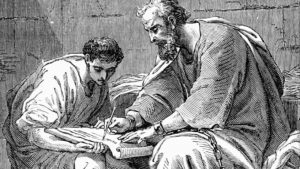 Paul regularly referred to Timothy as his child: “Therefore I sent to you Timothy, my beloved and faithful child in the Lord, to remind you of my ways in Christ” (1 Cor. 4:17); “To Timothy, my true child in the faith: grace, mercy, and peace from God the Father and Christ Jesus our Lord” (1 Tim. 1:2); “To Timothy, my beloved child: Grace, mercy, and peace from God the Father and Christ Jesus our Lord” (2 Tim. 1:2).
“This charge I commit to you, Timothy, my son, in accordance with the prophetic utterances which pointed to you, that inspired by them you may wage the good warfare” (1 Tim 1:18); “You then, my son, be strong in the grace that is in Christ Jesus” (2 Tim. 2:1); “But Timothy’s worth you know, how as a son with a father he has served with me in the gospel” (Phil. 2:22).
Paul also referred to other of his converts in this way, even referring to himself as a spiritual father: “To Titus, my true child in a common faith: grace and peace from God the Father and Christ Jesus our Savior” (Titus 1:4); “I appeal to you for my child, Onesimus, whose father I have become in my imprisonment” (Philem. 10). None of these men were Paul’s literal, biological sons. Rather, Paul is emphasizing his spiritual fatherhood with them.
Ultimately, God the Father IS the only father since he created us all, yet Paul says that he himself is a spiritual father with spiritual children. Here is what he writes to the Corinthians:
I do not write these things to shame you, but to admonish you as my beloved children. For if you were to have countless tutors (teachers) in Christ, yet you would not have many fathers, for in Christ Jesus I became your father through the gospel. Therefore I exhort you, be imitators of me. For this reason I have sent to you Timothy, who is my beloved and faithful child in the Lord, and he will remind you of my ways which are in Christ, just as I teach everywhere in every church (1 Cor 4:14-17).
Not only does Paul say there are spiritual fathers, but calls himself a spiritual father. Does not this violate the words of Jesus? Paul does not think so, nor does the Holy Spirit who inspired his very words. Beyond that, Paul even tells us to imitate him, to follow his example — which we can suppose would extend to calling our spiritual fathers father.
By referring to these people as their spiritual sons and spiritual children, the writers of the New Testament imply their own roles as spiritual fathers. Since the Bible frequently speaks of this spiritual fatherhood, we Catholics acknowledge it and follow the custom of the apostles by calling pastors/priests “father.” Failure to acknowledge this is a failure to recognize and honor a great gift God has bestowed on the Church: the spiritual fatherhood of the priesthood.
As Catholics we know that we are members of a local church, a parish, and that the parish has been committed to a pastor’s spiritual care, thus we have great respect and affection for pastors/priests and call them “father.” Pastors also follow the apostles’ biblical example by referring to members of their flock as “my son” or “my child” (cf. Gal. 4:19; 1 Tim. 1:18; 2 Tim. 2:1; Philem. 10; 1 Pet. 5:13; 1 John 2:1; 3 John 4).
Understanding Jesus’ words in the full historical, cultural, and literary context, Catholics see no contradiction between the real meaning of Jesus’ words and the use of the word father in relation to our earthy fathers (dads) or those who act as our spiritual fathers and teachers.
I hope that helps a bit. If you’d like to read further I might suggest this website http://www.catholic.com/library/Call_No_Man_Father.asp
The post “Call No Man Your Father” appeared first on Defenders of the Catholic Faith.
Italy 10: Peter & Paul Day in Rome
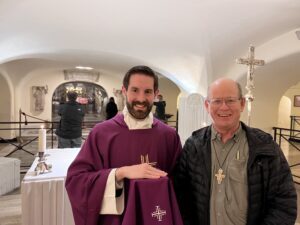 We called this the Peter and Paul day because we started with Mass at the tomb of St. Peter in St Peters Basilica thanks to my friends Fr. Andrew Dalton LC and Fr. Michael Baggot LC.
We then went to the Tre Fontanne where Paul was beheaded and and visited St. Paul Outside the Walls where his bones are interred.
We also take a slow and casual walking tour of Rome (see video for all the sites) and went down in the St. Sebastian Catacombs were Peter and Paul’s bones are both kept for a while in the early centuries. Liz Lev gave us her famous talk and the Sistine chapel and we had a great dinner.
The post Italy 10: Peter & Paul Day in Rome appeared first on Defenders of the Catholic Faith.
March 27, 2022
Steve Ray: Six Minutes on the Church Fathers
Six minute interview at Franciscan University of Steubenville.
The post Steve Ray: Six Minutes on the Church Fathers appeared first on Defenders of the Catholic Faith.
Stephen K. Ray's Blog

- Stephen K. Ray's profile
- 27 followers

