Anna Jones Buttimore's Blog, page 6
October 29, 2013
The Cheapest Editing You'll' Ever Find

Many authors today are opting to self-publish, but because editing can be expensive they often choose not to have their book professionally edited. This is a mistake. A good editor can not only correct spelling, punctuation and grammar errors, but can spot inconsistencies in your story, suggest ways to polish your prose, and generally help make your manuscript sparkle. A better book means better reviews and better sales, which means more money for you.
If you would prefer to be traditionally published, having your manuscript edited prior to submission means that you are more likely to land that agent or publishing contract.
Although I don’t have any qualifications in editing I have worked with three professional in-house editors as my own books were prepared for publication. I have an honours degree in English literature, and have been writing for over ten years.
I am offering an excellent deal for aspiring authors: I will edit your entire NaNo-length novel for just £100, and a full-length novel (under 80,000 words) for just £150. (US residents, that’s $150 for 50,000 words, and $225 for 80,000.)
Not only that, but I will edit your first chapter COMPLETELY FREE as a trial so that you can see whether you like my editing style and can work with me, and I can see whether your book needs further revision before it is ready for editing.
Sounds too good to be true? The catch is that I can’t work quickly. I have a day job, my own writing career, and three children. I fit in maybe an hour a day of editing if I'm lucky. That means it could be weeks or even months before I can finish editing your book. If you’re in a hurry I'm not the right editor for you, but if you don’t mind waiting then this might just be the solution you've been looking for.
Also, if your book contains sex scenes or swearing, then I'm sorry but I can’t be your editor, although I’ll refer you to someone who can, and at the same prices that I offer.
Interested? Here's what you need to do:
1. Ensure that your manuscript is ready for editing. It should be your absolute final draft. You should have read and re-read it, checked and re-checked it, drafted and re-drafted it. Maybe you've already had your critique group or beta readers go through it too. Editing is the final polish, and you should be certain that your book is as good as you can get it alone before you send it to me.
2. Like everyone else in this industry, I like to see manuscripts presented in a certain way. Your book should be in Times New Roman 12 point, double spaced and with wide margins. First lines and dialogue should be indented. There must be only one space after a full stop (period) and no additional gaps between paragraphs unless it's a new scene. Each chapter should begin on a new page.
3. Think about your market, genre and readership, and what you are hoping to achieve with your book. Let me know this information so that I can work accordingly. If you've written a back cover blurb, I'd love to see that too.
4. I accept payment by Paypal, cheque or Amazon voucher. Payment will become due when I email you to let you know that I've finished editing your manuscript, and once the payment has been received I will email you the completed manuscript.
Once you've got all this in order, we're ready to begin. Drop me a line at anna@buttimore.org.uk attaching your first chapter in Microsoft Word format, and with some detail about your book (maybe a synopsis) in the body of your email. In a week or two I’ll reply with the edited chapter and we can take it from there.
I look forward to working with you in making your book the best it can be!


October 21, 2013
Why I am not an Evangelical - Part 6

The Book of Mormon.
I grew up with the Bible alone as scripture and assumed, as do many Christians, that the canon of scripture is closed. After Revelation was written God wrote "The End", put down his pen and closed the book. And that's it. We have a Bible and there cannot be any more Bible. (See 2 Nephi 29:3)
However, Biblical Studies at A level showed me that actually the canon of Scripture has only recently stopped changing and evolving, and there was much debate over which books to include and exclude. In fact, the Roman Catholic Church and Eastern Orthodox churches use different books in their Bibles. Even then I found myself wondering who drew the line under the Bible. Who said "God has finished speaking to man" and decreed that no-one else was permitted to write down what God had said to them and call it scripture? Why is something God said to an apostle in 75AD called scripture, but something He said fifty years later not called scripture?
I am studying the Book of Mormon this year with my Seminary class. I don't know it as well as I should. I have read the Bible daily for 30 years and studied it at an academic level (including learning some Greek), so I'm pretty good on Biblical knowledge, but I've only read the Book of Mormon through about 3 or 4 times.
However, it is an amazing book, rich and complex and with some really profound sections, powerful imagery and beautiful lessons. Even anti-Mormons - who have never been able to satisfactorily explain where it came from - admit that it doesn't contradict the Bible. What it does is complement, complete and clarify the Bible.
Reading the story of Nephi's broken bow with my Seminary students, I gained so much knowledge and insight just from that short section that I found myself feeling pity for those who don't have this wonderful scripture to enrich their lives. Since then we've read further, and I found myself feeling the same sorrow as I read Jacob's advice to the pure in heart, and many other passages. The Book of Mormon is such a strong and powerful book; I'm lucky to have it, and I'm eager to learn all I can from it, and I wish everyone else could read it too. I suspect that were I to leave the LDS church and ally myself with an evangelical congregation in another denomination I would be required no longer to read, study, refer to or quote from the Book of Mormon. I'm not able to do that.
Here are a few of my favourite verses:
"And we talk of Christ, we rejoice in Christ, we preach of Christ, we prophesy of Christ, and we write according to our prophecies, that our children may know to what source they may look for a remission of their sins. (2 Nephi 25:26)
"...when ye are in the service of your fellow beings ye are only in the service of your God." (Mosiah 2:17)
"And if men come unto me I will show unto them their weakness. I give unto men weakness that they may be humble; and my grace is sufficient for all men that humble themselves before me; for if they humble themselves before me, and have faith in me, then will I make weak things become strong unto them." (Ether 12:27)
"Wherefore, ye must press forward with a steadfastness in Christ, having a perfect brightness of hope, and a love of God and of all men. Wherefore, if ye shall press forward, feasting upon the word of Christ, and endure to the end, behold, thus saith the father: Ye shall have eternal life." (2 Nephi 31:20)
"Wickedness never was happiness" (Alma 41:10)
"O Lord, I have trusted in thee, and I will trust in thee forever." (2 Nephi 4:34)
Conclusion
In this series (see sidebar for previous posts) I have listed five reasons why I do not subscribe to the doctrines of the evangelical Christian movement. Swift recap, they are:
1. The doctrine that anyone who doesn't make a confession of faith in Jesus will got to hell, including little children too young to do so, and those who live in parts of the world where they never have the opportunity to hear the gospel of Christ. So toddle Jamie Bulger is in hell, but his killers can repent and confess Jesus as Lord and go to heaven. That's not fair, and I don't want to worship a god who isn't fair.
2. The fact that by Evangelical doctrine I am already saved, and thus I don't need to leave the LDS church or subscribe to their philosophies.
3. The antagonistic and often downright hostile attitudes of some individual Evangelical Christians, and sometimes whole church groups, against Mormons, which seems to me unchristian and divisive.
4. The doctrine of the trinity, which I don't see in the Bible.
5. The Book of Mormon, which is self-evidently scripture.
Those aren't the only reasons, there are many others. I could never belong to a church which doesn't forbid alcohol, for example, and I love having a living prophet at the head of my church. I was an evangelical for many years, and struggled to get to grips with certain things – the Pentecostal movement, the trinity, the inerrancy of the Bible, and especially my own lack of a spiritual witness. I’m not saying it’s easy being a Mormon either. My evangelical friend told me that her "Why I'm not a Mormon" blog would start with "The possiblity of being called to teach early-morning Seminary"! Mostly it's very tough being a Mormon. It requires far more commitment than many other churches, and you get a lot of flak.
But I have a testimony - that spiritual witness - that my Heavenly Father wants me in the Church of Jesus Christ of Latter-day Saints. That it is Christ's true church, and where I can get closest to him. So with apologies to all those who, with evangelical zeal, try to persuade me to return to the mainstream Christian path, I'm staying put.
October 15, 2013
Why I am not an Evangelical - Part 5
.jpg)
The Trinity
A while ago I received an invitation to buy an extremely expensive “Book of Little-Known Facts” published by Reader’s Digest. The leaflet listed several of these facts to whet my appetite, one of which stated, “The doctrine of the Trinity is not mentioned in the Bible, but was invented in 325 AD”. I had known this for some time – but many in mainstream Christian churches are not aware of it.
The problem facing the early Christian church was that it believed that there was only one God, but Jesus also appeared to have claimed to be God and was believed to be divine. To further complicate matters, the Holy Spirit was given to the believers, which again appeared to be a god. How could there be three gods when Judaism’s primary tenet is that there is only one God?
Under the Roman Emperor Constantine the matter was addressed in the Councils of Nicea and Chalcedon, attended by around 300 Bishops – a fraction of the total. Various solutions were put forward, and eventually the matter was put to a vote. The “winning” doctrine was that God is a formless spiritual substance, able to divide himself into three parts at will. This doctrine was then formalised in the words of a creed. Having recited the Nicene creed weekly for a couple of decades, I can still recite it, in two languages, including that sticking-point clause which says that Jesus is "of one substance with the Father."
The purpose of the creeds was to denote orthodoxy. Those who agreed with the points of the creed were acceptable as part of the Christian communion; those who didn't were heretics and non-Christian. The same is true today. The fact that Mormons don't believe in the traditional Trinity doctrine is one of the most obvious and major doctrinal differences between "Mormonism" and mainstream Christianity. It's where we part company with the Nicene Creed, and thus where most Christian churches cease to include us in their ecumenical gatherings and projects, and start to include us in their outreach to non-Christians. There is no escaping the fact that the Mormon view of God is very different from the mainstream Christian view, and this area is where I most understand the non-acceptance by the rest of Christendom.
If your version of Christianity is fundamentally rooted on the trinity doctrine, then of course a non-trinitarian Christian is going to seem like an oxymoron. I'm not going to pretend that this isn't a big deal. It is a major fundamental difference, and I have chosen to come down on the side of the unorthodox. I shouldn't be surprised if mainstream Christians get a bit upset about it (see last week's post).
To be honest, even when I was a dyed-in-the-wool Anglican reciting that creed each week, I never really could get to grips with the doctrine of the Trinity. I'd like to claim that was because of my serious Bible study and failure to find scriptural support for it, but actually it was because, with my limited human understanding, I never could get my head round the idea of a God who was somehow three people while only one, for all the allegories of eggs, clover and mother/wife/daughter I found. I expect other, more intelligent, people can understand it, and yet more don't worry that they can't, because someday they will.
Latter-day Saints believe that Jesus is the firstborn (Psalm 89:27, Hebrews 1:6, Colossians 1:15) of God the Father. Under the direction of his Father he created the world (John 1:3, Ephesians 3:9, Hebrews 1:2) and was the Jehovah of the Old Testament, the God of Abraham, Isaac and Jacob (Exodus 3:14, John 8:58). He was born as a man, and was able to pray to his Father (John 17 - note especially verses 21 and 22), and to feel forsaken by him (Matthew 27:46). He now sits and reigns with his Father at his right hand (Romans 8:34, 1 Peter 3:22).
I admit I rejoiced when I fully embraced "Mormonism" and was able to abandon my struggle to believe in a God who was a formless substance which was somehow the same person as Jesus and the Holy Spirit, and yet not. I finally felt I could relate to a God who was like me, who really was my Father, and who was separate and distinct from Jesus Christ, his son (Acts 7:55-56). A major reason why I could never be an Evangelical, or a member of any mainstream Christian church whether or not it fully embraces Evangelical doctrine, is that I cannot believe in the traditional doctrine of the trinity. Nor do I see any need to, when it isn't in the Bible.
October 8, 2013
Why I am not an Evangelical - Part 4
See the links on the left for previous posts in this series of personal apologetics.
3: Attitude of Evangelicals towards Mormons
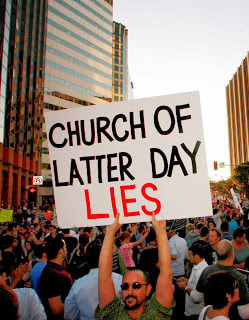
One major reason why I could never be an Evangelical is what I see as the very unchristian behaviour of some (but by no means the majority of) Evangelicals towards Latter-day Saints. I have already mentioned in a previous post that I was forbidden from attending a Bible Study group. In addition, Christian bookshops stock books which misrepresent, mock and insult my beliefs; Christian ministers warn their congregations against the “cult”, and Christian groups will even protest at Church buildings and try to disrupt Church meetings. This does not endear them to me any.
It happened this past weekend, in fact. It was General Conference weekend, which means no church since the Conference Broadcast doesn't begin until 5 p.m. our time. I usually take the opportunity to visit other churches on these occasions. This Sunday I went to an Evangelical church I attended as a teenager. I found it delightful: the people friendly, the service relaxed, and I enjoyed singing the traditional hymns. I felt the Spirit more than I have in any church apart from my own, and as the meeting concluded I was left feeling that this really was my kind of church.
Afterwards, however, the man next to me started to chat (like I said, the people were friendly) and asked what church I usually attended. I wish I hadn't told him. He was very nice about it but I got the usual "You believe that Jesus and satan are brothers", "baptism for the dead is a pagan ritual", etc. It was very helpful for me, however, as it confirmed what I talked about in this post in that I asked him whether the two Cambodian girls I sponsor, who have never even heard of Jesus and to whom I am not permitted to mention religion, are going to hell when they die. And he said that they are. And like I said two weeks ago, I am not about to worship any God who could do that, or go to any church which preaches that.
Whilst I was admittedly the most vociferous of anti-Mormons once, it annoys and upsets me now to be told by Christians that my church is a cult, when they will, with the next breath, admit that they know little about it, have never met a Mormon before, and recoil in horror when I suggest that they might like to come to a church meeting.
Evangelicals regularly gather at Temple Square in Salt Lake City at conference time where they attempt to provoke anger and incite violence. In a recent example, when a “Christian” was pretending to wipe his backside with an item of Temple clothing, one of the LDS passers-by grabbed the garment from him to prevent it being desecrated in this way. The “Christian” then had him arrested and charged with theft. Again, such behaviour leads me to think that I want nothing to do with people who would mock the deeply held beliefs of others in this way. I would never dream of pretending to wipe my backside with a Jewish prayer shawl in front of devout Jews.
In comparison, the LDS church is a vociferous proponent of freedom of religion, encourages dialogue and ecumenical projects, and our eleventh article of faith states, "We claim the privilege of worshipping Almighty God according to the dictates of our own conscience, and allow all men the same privilege, let them worship how, where, or what they may." It's also very careful never to be critical of the beliefs of others. A few years ago our ward was organising a blood drive, and as part of that I wrote an article for our ward newsletter about the Jehovah’s Witnesses refusal to accept blood transfusions, and the scriptures it was based on. Although I wasn't criticising the Watchtower Society in any way, the Bishop refused to let me print it. He told me that we never do anything which could be interpreted as critical of other religions. (Gosh, I hope he's not reading this blog.)
What I have experienced personally from a few Christians, and seen online, leads me to observe that a minority of Christians are filled with hatred for Mormons. I can live with that - I think the number is falling, and things are certainly better than they were in the days when Mormons were killed or driven out of their homes. But it troubles me that this hatred is encouraged by churches which put literature about “cults” on their back tables, donate money to anti-Mormon organisations, or attend conferences and festivals which have speakers talking about the evil threat of the cults*. My feeling now is that I have no wish to be part of a religion that encourages such hatred.
* Several years ago the New Wine conference included a "Mormon expert" speaker who told those listening that Mormons celebrate the birthday of Joseph Smith more than they do Christmas. I don't even know when Joseph Smith's birthday is!

3: Attitude of Evangelicals towards Mormons
One major reason why I could never be an Evangelical is what I see as the very unchristian behaviour of some (but by no means the majority of) Evangelicals towards Latter-day Saints. I have already mentioned in a previous post that I was forbidden from attending a Bible Study group. In addition, Christian bookshops stock books which misrepresent, mock and insult my beliefs; Christian ministers warn their congregations against the “cult”, and Christian groups will even protest at Church buildings and try to disrupt Church meetings. This does not endear them to me any.
It happened this past weekend, in fact. It was General Conference weekend, which means no church since the Conference Broadcast doesn't begin until 5 p.m. our time. I usually take the opportunity to visit other churches on these occasions. This Sunday I went to an Evangelical church I attended as a teenager. I found it delightful: the people friendly, the service relaxed, and I enjoyed singing the traditional hymns. I felt the Spirit more than I have in any church apart from my own, and as the meeting concluded I was left feeling that this really was my kind of church.
Afterwards, however, the man next to me started to chat (like I said, the people were friendly) and asked what church I usually attended. I wish I hadn't told him. He was very nice about it but I got the usual "You believe that Jesus and satan are brothers", "baptism for the dead is a pagan ritual", etc. It was very helpful for me, however, as it confirmed what I talked about in this post in that I asked him whether the two Cambodian girls I sponsor, who have never even heard of Jesus and to whom I am not permitted to mention religion, are going to hell when they die. And he said that they are. And like I said two weeks ago, I am not about to worship any God who could do that, or go to any church which preaches that.
Whilst I was admittedly the most vociferous of anti-Mormons once, it annoys and upsets me now to be told by Christians that my church is a cult, when they will, with the next breath, admit that they know little about it, have never met a Mormon before, and recoil in horror when I suggest that they might like to come to a church meeting.
Evangelicals regularly gather at Temple Square in Salt Lake City at conference time where they attempt to provoke anger and incite violence. In a recent example, when a “Christian” was pretending to wipe his backside with an item of Temple clothing, one of the LDS passers-by grabbed the garment from him to prevent it being desecrated in this way. The “Christian” then had him arrested and charged with theft. Again, such behaviour leads me to think that I want nothing to do with people who would mock the deeply held beliefs of others in this way. I would never dream of pretending to wipe my backside with a Jewish prayer shawl in front of devout Jews.
In comparison, the LDS church is a vociferous proponent of freedom of religion, encourages dialogue and ecumenical projects, and our eleventh article of faith states, "We claim the privilege of worshipping Almighty God according to the dictates of our own conscience, and allow all men the same privilege, let them worship how, where, or what they may." It's also very careful never to be critical of the beliefs of others. A few years ago our ward was organising a blood drive, and as part of that I wrote an article for our ward newsletter about the Jehovah’s Witnesses refusal to accept blood transfusions, and the scriptures it was based on. Although I wasn't criticising the Watchtower Society in any way, the Bishop refused to let me print it. He told me that we never do anything which could be interpreted as critical of other religions. (Gosh, I hope he's not reading this blog.)
What I have experienced personally from a few Christians, and seen online, leads me to observe that a minority of Christians are filled with hatred for Mormons. I can live with that - I think the number is falling, and things are certainly better than they were in the days when Mormons were killed or driven out of their homes. But it troubles me that this hatred is encouraged by churches which put literature about “cults” on their back tables, donate money to anti-Mormon organisations, or attend conferences and festivals which have speakers talking about the evil threat of the cults*. My feeling now is that I have no wish to be part of a religion that encourages such hatred.
* Several years ago the New Wine conference included a "Mormon expert" speaker who told those listening that Mormons celebrate the birthday of Joseph Smith more than they do Christmas. I don't even know when Joseph Smith's birthday is!
September 30, 2013
Why I am not an Evangelical - Part 3
This post is the third in a series. Click here to read part 1, and here to read part 2.

I'm saved already!
The Evangelical message of salvation (from death, sin, hell and separation from God) is that everyone must to repent, turn to Christ and accept him as Lord of their lives. Thus far it is the same as the message the LDS Missionaries preach (see Article of Faith 4.) However, in the Evangelical version, salvation is then guaranteed for life. As a teenager I clarified that with my sister – did this really mean that I was saved eternally, whatever I might do in future? She assured me that it did; salvation is a gift, and God does not take a gift away once it is given.
[Quick aside here: The Mormon version of salvation is slightly different. We believe that salvation is a covenant. That in order to be saved we must repent of our sins, turn to Christ and follow him. Following him includes enduring to the end and striving to live righteously. While the gift of salvation is given freely, as is forgiveness when we mess up, the recipient can reject it at any time by turning away from Jesus, his gospel and his church. So it's not enough just to simply believe and confess and then go about our merry way as though nothing has happened, we have to show our faith by our works, and it has to be a lifelong commitment. Some Evangelicals call this a "gospel of works", but the "works" are simply believing in Christ, repenting of our sins, being baptised and following him.]
As a teenager and young adult I responded to the altar call in various situations, from Billy Graham’s Mission England crusade to a talk given by Nicky Cruz at the Cliff’s Pavilion. You might think I only needed to repent and be saved once, but I repeatedly prayed that prayer of commitment because I was never really sure it had been heard. Having given my life to Christ I found I didn't feel any different. It was 30 years later - just a couple of weeks ago, in fact - that I finally heard a Christian pastor (thank you, Dave Smith) say that it's not uncommon to make that commitment to Christ and not feel any different, but despite that we can have that assurance that we are saved. I didn't know that; for many years I was waiting for that amazing moment when the rays of the sun would shine on me and I would hear the hallelujah chorus. So I was indeed saved all those years ago when I gave my life to Christ in a back room at Thundersley Gospel Hall, despite my uncertainty.
A couple of years ago I used an online forum to ask, “What must I do to be saved?” In less than 24 hours I received 33 answers from Christians, and almost all of them said simply “Believe on the Lord Jesus Christ and repent of all your sins.” (Acts 4:12; John 14:6; John 3:3). I then asked, “Once I am saved, can I ever be unsaved again?” Again, general consensus was that while I might sin or backslide, provided I had meant the original prayer then I was eternally saved.
So why do some Evangelicals still preach at me, telling me to do what I have already done? I have given my life to Christ, and he is Lord of it and has been for over 30 years. By their own theology, I am saved - irrevocably. At what point in my life did I renounce Christ? I never have, I have sought only to become closer to him. I have had at least two Christians tell me that joining this church is the only thing I could do to lose the salvation I already had. That if I had murdered, stolen, or even renounced Jesus, I would still be saved. But because I joined the Mormon church, I'm going to hell. Go figure.
Some Evangelicals go as far as to say that Mormons have a “different Jesus”. Let me assure them that the Jesus I worship is the Son of God, the one created the world, who was born of a virgin, healed the sick, suffered and died for our sins and was raised to eternal life and glory on the third day. That is the one I have covenanted to follow and in whose name my sins have been forgiven. If there's another one out there, I'm not interested.

I'm saved already!
The Evangelical message of salvation (from death, sin, hell and separation from God) is that everyone must to repent, turn to Christ and accept him as Lord of their lives. Thus far it is the same as the message the LDS Missionaries preach (see Article of Faith 4.) However, in the Evangelical version, salvation is then guaranteed for life. As a teenager I clarified that with my sister – did this really mean that I was saved eternally, whatever I might do in future? She assured me that it did; salvation is a gift, and God does not take a gift away once it is given.
[Quick aside here: The Mormon version of salvation is slightly different. We believe that salvation is a covenant. That in order to be saved we must repent of our sins, turn to Christ and follow him. Following him includes enduring to the end and striving to live righteously. While the gift of salvation is given freely, as is forgiveness when we mess up, the recipient can reject it at any time by turning away from Jesus, his gospel and his church. So it's not enough just to simply believe and confess and then go about our merry way as though nothing has happened, we have to show our faith by our works, and it has to be a lifelong commitment. Some Evangelicals call this a "gospel of works", but the "works" are simply believing in Christ, repenting of our sins, being baptised and following him.]
As a teenager and young adult I responded to the altar call in various situations, from Billy Graham’s Mission England crusade to a talk given by Nicky Cruz at the Cliff’s Pavilion. You might think I only needed to repent and be saved once, but I repeatedly prayed that prayer of commitment because I was never really sure it had been heard. Having given my life to Christ I found I didn't feel any different. It was 30 years later - just a couple of weeks ago, in fact - that I finally heard a Christian pastor (thank you, Dave Smith) say that it's not uncommon to make that commitment to Christ and not feel any different, but despite that we can have that assurance that we are saved. I didn't know that; for many years I was waiting for that amazing moment when the rays of the sun would shine on me and I would hear the hallelujah chorus. So I was indeed saved all those years ago when I gave my life to Christ in a back room at Thundersley Gospel Hall, despite my uncertainty.
A couple of years ago I used an online forum to ask, “What must I do to be saved?” In less than 24 hours I received 33 answers from Christians, and almost all of them said simply “Believe on the Lord Jesus Christ and repent of all your sins.” (Acts 4:12; John 14:6; John 3:3). I then asked, “Once I am saved, can I ever be unsaved again?” Again, general consensus was that while I might sin or backslide, provided I had meant the original prayer then I was eternally saved.
So why do some Evangelicals still preach at me, telling me to do what I have already done? I have given my life to Christ, and he is Lord of it and has been for over 30 years. By their own theology, I am saved - irrevocably. At what point in my life did I renounce Christ? I never have, I have sought only to become closer to him. I have had at least two Christians tell me that joining this church is the only thing I could do to lose the salvation I already had. That if I had murdered, stolen, or even renounced Jesus, I would still be saved. But because I joined the Mormon church, I'm going to hell. Go figure.
Some Evangelicals go as far as to say that Mormons have a “different Jesus”. Let me assure them that the Jesus I worship is the Son of God, the one created the world, who was born of a virgin, healed the sick, suffered and died for our sins and was raised to eternal life and glory on the third day. That is the one I have covenanted to follow and in whose name my sins have been forgiven. If there's another one out there, I'm not interested.
September 24, 2013
Why I am not an Evangelical - Part 2
First off, go here to read part 1. And now that you've read that, here's the first reason I am not an Evangelical.

1. Jamie Bulger and the Bible Study Group
While living in Criccieth, North Wales, and attending the Criccieth Family Church (an independent evangelical church run by some Scripture Union Beach Mission staff) I went along to their evening Bible Study group for almost a year, which was held in a hotel owned by the church. I rather enjoyed it, and I learned a lot and took part in some interesting discussions.
One one occasion we were having a discussion about the recent (then) news that the teenage killers of toddler Jamie Bulger had been released from prison. One of the ladies present remarked how sad it all was but that the poor little boy was now in heaven. The pastor corrected her, saying that since Jamie Bulger had not been old enough to make a confession of faith in Jesus, he was therefore in hell.
The ensuing debate made it quite clear that Evangelical theology is that children are not innocent of sin and go to hell if they die before being able to “accept Jesus”. My second daughter was about Jamie Bulger’s age at the time and I left that meeting swearing that I would never worship any god who could be so cruel and unjust.
Many Evangelicals have since protested to me that there surely is something, somewhere, which means that this isn't the case, that little children who die are automatically saved. Unfortunately there really isn't anything in any Evangelical doctrinal statement I've ever seen, or the Bible itself, which allows for this. The Bible is completely silent on the matter; it merely states, quite clearly, that to be saved one must profess belief in Christ and be baptised. Children can't do that. The doctrine of original sin (the belief that we are all born with the guilt of Adam and Eve's sin) is generally believed by mainstream Christian denominations. It states that children are born sinful, and they will remain sinful until they are old enough to repent and turn to Christ for forgiveness. Those who die in a state of sin (evangelical doctrines states) go to hell.
The Book of Mormon isn't silent on this issue. In fact, Moroni devotes an entire chapter (chapter 8) to explaining that little children are innocent of sin and don't require baptism. Mormons believe that children are born innocent and remain so until the age of accountability when they are liable for any sins they commit. The second article of faith states, “We believe that men will be punished for their own sins, and not for Adam’s transgression.” They also believe that all will have the opportunity to hear and accept the gospel of Jesus Christ either in this life or the next. Not only that, but anyone, adult or child, who dies never having heard the gospel of Jesus Christ, and thus never having had the opportunity to repent, will have that chance in the spirit world. (See this link for a list of scriptures and more information about this issue.) By LDS theology, Jamie Bulger is in heaven.
Some time later the Criccieth Bible Study Group was taken over by another church leader who, knowing that I was an inactive Mormon, told me that I would no longer be permitted to attend the group because it might “send out the wrong message”. I was never able to establish what message that might be. I’d still like to know. Alistair, if you're reading this, please tell me why I wasn't allowed to study the Bible with your group?

1. Jamie Bulger and the Bible Study Group
While living in Criccieth, North Wales, and attending the Criccieth Family Church (an independent evangelical church run by some Scripture Union Beach Mission staff) I went along to their evening Bible Study group for almost a year, which was held in a hotel owned by the church. I rather enjoyed it, and I learned a lot and took part in some interesting discussions.
One one occasion we were having a discussion about the recent (then) news that the teenage killers of toddler Jamie Bulger had been released from prison. One of the ladies present remarked how sad it all was but that the poor little boy was now in heaven. The pastor corrected her, saying that since Jamie Bulger had not been old enough to make a confession of faith in Jesus, he was therefore in hell.
The ensuing debate made it quite clear that Evangelical theology is that children are not innocent of sin and go to hell if they die before being able to “accept Jesus”. My second daughter was about Jamie Bulger’s age at the time and I left that meeting swearing that I would never worship any god who could be so cruel and unjust.
Many Evangelicals have since protested to me that there surely is something, somewhere, which means that this isn't the case, that little children who die are automatically saved. Unfortunately there really isn't anything in any Evangelical doctrinal statement I've ever seen, or the Bible itself, which allows for this. The Bible is completely silent on the matter; it merely states, quite clearly, that to be saved one must profess belief in Christ and be baptised. Children can't do that. The doctrine of original sin (the belief that we are all born with the guilt of Adam and Eve's sin) is generally believed by mainstream Christian denominations. It states that children are born sinful, and they will remain sinful until they are old enough to repent and turn to Christ for forgiveness. Those who die in a state of sin (evangelical doctrines states) go to hell.
The Book of Mormon isn't silent on this issue. In fact, Moroni devotes an entire chapter (chapter 8) to explaining that little children are innocent of sin and don't require baptism. Mormons believe that children are born innocent and remain so until the age of accountability when they are liable for any sins they commit. The second article of faith states, “We believe that men will be punished for their own sins, and not for Adam’s transgression.” They also believe that all will have the opportunity to hear and accept the gospel of Jesus Christ either in this life or the next. Not only that, but anyone, adult or child, who dies never having heard the gospel of Jesus Christ, and thus never having had the opportunity to repent, will have that chance in the spirit world. (See this link for a list of scriptures and more information about this issue.) By LDS theology, Jamie Bulger is in heaven.
Some time later the Criccieth Bible Study Group was taken over by another church leader who, knowing that I was an inactive Mormon, told me that I would no longer be permitted to attend the group because it might “send out the wrong message”. I was never able to establish what message that might be. I’d still like to know. Alistair, if you're reading this, please tell me why I wasn't allowed to study the Bible with your group?
September 17, 2013
Why I am not an Evangelical - Part 1

I found this document on my computer recently. I wrote it a couple of years ago to clarify why I have made the decisions I have, and chosen the path I am following, rather than the oh-so-easier one of being part of the biggest and most dynamic and popular Christian movement today. I think I wrote it with Betrand Russell's 1927 essay, "Why I am not a Christian" in mind, although of course I am a Christian, however much people may try to claim otherwise.
I'm sorry that it's so long that it has to be posted in seven parts. Well, not all that sorry, as it gives me a break from having to come up with topics to blog about each week, and I need that time to actually write and edit at the moment as I have a deadline looming.
Comments welcome, although I reserve the right to gleefully delete any I don't like.
Introduction
Since becoming a Christian at the age of 14, I have attended various churches. Starting off with the Brethren congregation where I attended the Covenanters Youth Organisation which persuaded me of the need to turn my life over to Christ, I attended a couple of other local churches briefly (Thundersley Congregational Church and Hadleigh Elim) before settling into the Anglican Parish Church with my Dad. On arrival at University I went to an Assemblies of God church, a Baptist Church and an independent Evangelical Church for several terms. I also attended the University Christian Union. Although I eventually returned to the Anglican church I have, at various times, been seized with the desire to see whether I can “feel the spirit” in other environments and have thus been to other churches including Salvation Army (a small but very friendly congregation in Bangor), Southend and Rayleigh Vineyards, and several other evangelical gatherings.
From the age of 19 I studied the LDS (Mormon) religion in some detail, initially from the perspective of vehement opposition. Extremely fascinated by this philosophy from the beginning, I discovered over the years that much that is taught about it in evangelical circles (and in the anti-Mormon books I devoured) is at best misrepresented and often grossly untrue. Many evangelicals know next to nothing about the religion except that they don’t like it. Often they imagine Mormons to believe or practice wildly ridiculous things, but do not bother to check whether this is true. Such ignorance irritated me as an anti-Mormon (I often found contradictions and errors in anti-Mormon books which I felt rendered them useless) and infuriates me now.
My studies went on for several years and led me eventually to conclude that this was not only a lamentably misunderstood sect, but a living, thriving and growing Christian church where, for the most part, members live what they believe and exhibit true devotion to the saviour in every aspect of their lives. I set out in 1988 to prove the church wrong; several years later I was forced to admit that I had failed. If you can’t beat ‘em, join ‘em. I came to know that it was Jesus Christ’s true restored church, having the dramatic witness of the Holy Spirit which I had never experienced anywhere else. Since 2001 I have attended the LDS church. And I love it.
My previous Christian experiences had been in denominations that, for the most part, embraced the Evangelical model. Several friends and family members who hold to this creed are dismayed at my apparently joining what they consider to be a “cult”, and some have made and continue to make efforts to bring me back to the Evangelical fold. I have therefore written this document in an attempt to explain why I could never again embrace the Evangelical understanding of Christianity.
What is an Evangelical?
The Evangelical movement began in the 1730's, but the word Evangelical does not denote a church denomination, although there may be churches that use the name. The Evangelical movement might be defined as a set of beliefs held by many Christians across most of the mainstream churches. The following might be seen as the central core beliefs that characterise the Evangelical experience.
There is an emphasis on the importance of giving one’s life to Christ and accepting Him as Lord and Saviour. I have found that in strongly Evangelical churches this message is often repeated again and again. There is a widespread belief that other churches are attended by many who pay lip service to Christ but have not been “born again”. Some Evangelicals will call themselves “born-again Christians” or “Bible-believing Christians” to make it clear that they have taken this step, and distinguish themselves from those whom they consider are not really Christians at all.
In the LDS Church, the need to have faith in Christ, repent and follow Him is the message brought by the missionaries. Once the person is baptised and has thus demonstrated that they have taken this step, the teaching they will receive in church is largely based on increasing their knowledge of the scriptures, strengthening their relationship with the Saviour, and learning to live a Christlike life.
There is a belief that once someone is “saved”, they can never be “unsaved”. Accepting Christ and becoming a Christian ensures that the person will go to Heaven, whatever sins they may commit later. Salvation is by faith alone, and is guaranteed the moment that person prays their declaration of faith.
Latter-day Saints believe that accepting Christ is a two-way Covenant; He forgives our sins through His atonement, and we choose to follow Him for the rest of our lives, living according to His commandments and repenting as necessary when we fall short. Should we choose to cease following Him, we are rejecting His free gift of salvation and can thus be “unsaved” again. [Luke 8:13 shows that it is possible to lose one’s salvation, and Matthew 10:22 shows that it is necessary to endure to the end to be saved.]
There is a belief that the Bible is complete and inerrant, the final authority, should be read and understood literally, and is the “foundation of prophets and apostles” on which the Church is to be built (Ephesians 2:20).
Latter-day Saints honour the Bible as scripture, study it intensively, refer to it frequently and most also interpret it literally. However, Article of Faith 8 states, “We believe the Bible to be the word of God as far as it is translated correctly”. We do not accept that it is without error, nor that God no longer speaks to mankind nor inspires further scripture to be written. [It is fairly simple to prove that the Bible is not inerrant – compare Genesis 50:13 with Acts 7:15-16, for example. It’s also simple to prove that it is not complete – Joshua 10:13, 2 Samuel 1:18.]
There is an emphasis on gifts of the spirit. Being “baptised by the Holy Spirit” is seen as a separate experience from the initial conversion, and spiritual gifts are expected to be manifest when this occurs, primarily speaking in tongues. I have even heard some evangelicals argue that anyone who does not speak in tongues (by which they mean babble unintelligibly, generally in church gatherings) is not truly “saved”. Many predominantly evangelical churches may also be “Pentecostal” which means that services are characterised by such gifts of the spirit. As a result, meetings are informal and generally very noisy, with a great deal of enthusiastic singing (“worship”), hand waving and clapping, dancing, speaking in tongues and prophesying (making declarations about God’s will or thoughts.)
Mormons would call this same experience with the Holy Spirit a "testimony”. By this they mean the powerful inner spiritual witness which can, among other things, help them to discern truth from error, prepare and give inspired talks and lessons, gain direction for themselves and their families, and know how they might best help someone. Mormons also believe in spiritual gifts, but have a different interpretation of the gift of tongues, seeing this as the ability to speak clearly and intelligibly a language the recipient has never learned, or has only briefly studied, generally in order to preach the gospel to others in that language. Missionaries sent to foreign countries frequently report that they find that they are able to teach and bear testimony in that language through the spirit.
There is a sense of urgency in conveying the message of salvation to others – hence the word Evangelical. Evangelicals are often anxiously engaged in spreading the word and winning converts. Strongly Evangelical churches are the only ones in the UK (apart from the LDS church), which are growing in numbers rather than declining.
Mormons also accept Christ’s great commission: we recognised that every member is a misisonary, and 75,000 young men and women and elderly couples are currently serving full-time missions.
Although I attended evangelical churches for many years, and identified myself as a “born-again Christian” I was never really comfortable with all that it entailed. I didn’t like all the hand waving and hysteria of the Pentecostal churches. I didn’t like the unstructured and informal meetings, and I found the words of the songs and choruses rather meaningless and repetitive. Most of all, however, I never really "felt the Spirit". Although I saw many people have deep spiritual experiences, it never happened for me in that context. I never really felt close to God or Jesus in those churches.
With the benefit of experience and greater knowledge now, and the safety of having found a Church in which I really have experienced the baptism of the Holy Spirit and received answers to all my questions, I can reflect on these matters and give definitive reasons why, despite the desires and attempts of others, I could never again be an Evangelical.
September 10, 2013
Book Review: The Unlikely Pilgrimage of Harold Fry, by Rachel Joyce
Harold Fry is sixty-five years old, the sort of man who thanks the speaking clock, a gentle-man in the truest sense. Six months into his retirement he spends his days sitting in a chair, and he and his sour wife Maureen barely speak. When he learns from a letter that a dear friend is dying, he sets out to post a reply to her. And then he just keeps walking, in his yachting shoes and without his mobile phone, towards Queenie's bedside six-hundred miles away.
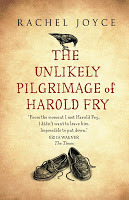
Before I picked up this book I felt the premise of Harold's journey was somewhat far-fetched (maybe even "unlikely"), but the book handles it well and makes it seem strangely plausible. Anyway, it hardly matters whether or not a sane man would decide to walk six-hundred miles in order to save a friend's life, because it's not the journey itself which is of interest. What really resonates with me, even weeks after reading it, is what Harold considers and learns as he thinks about his life. It addresses the regrets and "what ifs", the changes inherent in growing older, and the trials and challenges which can alter the course of our lives. More than that, it addresses them gently, thoughtfully and effectively. One part which resonated a great deal with me, for example, was Harold's memory of his mother abandoning him when he was twelve. In a letter to her "Deer son" she told him that "muthering" was not for her. Harold was crushed not only that she had gone, but that she couldn't even spell correctly in her final communication to her young son.
I found even the minor characters compelling and unusually well-rounded. From the businessman concerned about his rent-boy's shoes to the disillusioned film star, each is fascinating and contributes to the story. Then there's the writing, which was so good that I am planning to use the first few pages in a writing club as an example of show, don't tell.
There was much emotion in the book, heightened by the fact that it was at odds with the narrative's matter-of-fact tone and Harold's stiff upper lip and polite resolve. The relationship between Harold and Maureen was beautifully drawn and very moving, but it was the shock revelation at the end (although I suspect many readers, like me, will be kicking themselves for not having guessed at it all along) which really inspires the tears.
A truly excellent book, and one which will stay with me for a long time.

Before I picked up this book I felt the premise of Harold's journey was somewhat far-fetched (maybe even "unlikely"), but the book handles it well and makes it seem strangely plausible. Anyway, it hardly matters whether or not a sane man would decide to walk six-hundred miles in order to save a friend's life, because it's not the journey itself which is of interest. What really resonates with me, even weeks after reading it, is what Harold considers and learns as he thinks about his life. It addresses the regrets and "what ifs", the changes inherent in growing older, and the trials and challenges which can alter the course of our lives. More than that, it addresses them gently, thoughtfully and effectively. One part which resonated a great deal with me, for example, was Harold's memory of his mother abandoning him when he was twelve. In a letter to her "Deer son" she told him that "muthering" was not for her. Harold was crushed not only that she had gone, but that she couldn't even spell correctly in her final communication to her young son.
I found even the minor characters compelling and unusually well-rounded. From the businessman concerned about his rent-boy's shoes to the disillusioned film star, each is fascinating and contributes to the story. Then there's the writing, which was so good that I am planning to use the first few pages in a writing club as an example of show, don't tell.
There was much emotion in the book, heightened by the fact that it was at odds with the narrative's matter-of-fact tone and Harold's stiff upper lip and polite resolve. The relationship between Harold and Maureen was beautifully drawn and very moving, but it was the shock revelation at the end (although I suspect many readers, like me, will be kicking themselves for not having guessed at it all along) which really inspires the tears.
A truly excellent book, and one which will stay with me for a long time.
September 3, 2013
My take on the Gay Author Fiasco - Part 3

Quick précis: Cedar Fort, an LDS publisher, cancelled a contract on a book they were set to release because one of the author biographies showed that he was gay. You can read more about this scandal, and my thoughts on it, in last week's post, and the post from the week before that.
Today, however, I am going to do a quick about-face, and defend LDS publishers. I stand by my belief that this has been badly handled, and that LDS publishers have in the past been far too hard-line when it comes to insisting on totally wholesome books which uphold every aspect of LDS standards. But I do believe that there is an important place for LDS publishers in the market.
Here's why. I recently downloaded a sample of a book which I very much enjoyed. It was the beginning of a fascinating romance, and I was disappointed to get to the end of the sample and discover that the ebook was quite expensive. I want to read the rest of the story but I don't know whether it is going to have any steamy scenes in it. I don't read sex scenes. I consider it pornography in print, and it's against my values and beliefs.
Amazon listed the book as "Romance" rather than erotica, but I've discovered that that's no guarantee. The backliner and reviews didn't give me any clues either. So I sought out the writer on Facebook and messaged her to ask whether I should buy the book, or whether there were scenes in it which I would object to and which would require me to abandon it. I'll let you know what she says when I hear back from her.
The point of all that is, had the book been published by Deseret Book, Covenant, Walnut Springs, Cedar Fort or any number of other LDS publishing houses, I would have no such worries. I would know that the book contains no swearing, no sex, nothing which is going to offend me. I would be able to buy it with confidence and feel entirely comfortable reading it.
The thirteenth Article of Faith ends, "If there is anything virtuous, lovely, or of good report or praiseworthy, we seek after these things." I think the place of LDS publishers is to provide books and other media which is virtuous, lovely and praiseworthy. For the most part, they do so very well, and I'm proud to be one of the authors who writes for this market.
That's not to say that the LDS market can't produce books which are edgy and challenging. Jennie Hansen's Shudder is one example. It tackles the difficult issue of domestic violence and does so with understanding and depth of emotion. It is moving and eye-opening, and it conveys a powerful message, but it does so appropriately and without descending into crassness.
I started writing for the LDS market because I thought it would be easier to get into than the general market. I was wrong. Publishers take seriously their duty to provide books which are every bit as good as those in the secular market, and the literature they produce is generally excellent. Kerry Blair and Stephanie Black are my favourite LDS authors. Their novels are beautifully written and constructed, Kerry's are often very funny, and Stephanie's are as gripping as any Dan Brown thriller. I consider myself very lucky to have been able to break into this market and share a publisher with these excellent writers. And I feel that LDS publishers have a very important role to play in bringing clean, quality works "of good report" to a world where these are becoming increasingly difficult to find.
August 27, 2013
My Take on the Cedar Fort Gay Author Fiasco - Part 2

Last week I blogged about the fact that Cedar Fort, a leading LDS publisher, had cancelled a publishing contract because one of the book's authors wanted to be open in his bio about the fact that he is gay. This week I want to move on from that and talk why this should come as no surprise.
It's happened before.
Something really quite similar happened to me with my first book, Haven. I should mention that Haven is the archetypal LDS book. It's light and sweet and fluffy, with lots of people embracing the gospel, learning valuable life lessons, and even a touching chaste romance. It was picked up by Covenant Communications, the second-biggest LDS publisher (now owned by the LDS church) and I happily signed a right-of-first-refusal contract. (More about those another day.)
As with King and Jensen's Woven, the manuscript was edited several times, polished, the cover designed and blurb written, artwork set out, and bookmarks, posters, advertisements and catalogues prepared. Then I sent in my author bio.
My editor objected to one word, and edited it out. When I read the copy I was disappointed to see this word gone, and felt I had been misrepresented. I emailed my editor back to say that I really wanted the word included because otherwise it gave a misleading impression of who I am.
My editor explained that the LDS Church officially didn't approve of what this word represented, and that they would much prefer it to be left out to avoid alienating readers.
What was the word? Rock.
My bio stated that I loved rock music. I still do. Muse, Queen, Def Leppard, Nickelback, AC/DC. But the LDS Church officially doesn't approve of riotous music, and fearing that readers would imagine me to be some tattooed tearaway (I am indeed tattooed) and refuse to buy my book, Covenant wanted my bio simply to say that I loved music. Problem is, I don't. I can't stand jazz, opera, folk, country, house, soul or rap. I like rock, metal and some classical (my iPod, when playing alphabetically, jumps straight from Mormon Tabernacle Choir to Motorhead) and I really didn't want people to misunderstand me from my bio.
I stuck to my guns, and I won. The word was left in, the book was published, and proved to be very successful, as was the sequel. (Both will be republished next year along with the third and final book in the Haven trilogy.)
Much as I love Covenant, Cedar Fort and, Walnut Springs for publishing my books, I am aware that there is an issue with LDS publishers in that they tend to err on the side of caution when treading that difficult line between artistic integrity and LDS values. They can't risk upsetting anyone, so they take the hard-line Mormon stance, often to the detriment of the the author, the book, or both. Most authors with an LDS publisher could cite an example. Here are just two:
A good friend wrote a detective novel. Her detective needed to speak to people who might have witnessed the crime which occurred (as crimes tend to) in the early hours of the morning. In her manuscript the person the detective interviewed was a prostitute. Covenant objected to that, so my friend turned it into a drug-dealer. Covenant objected to that too, at which point my friend threw up her hands in despair and was forced to do some major rewriting to circumvent the entire incident. Because it's seriously quite difficult to have a crime which occurs at 2 a.m. on the seedy side of town witnessed by decent, wholesome people on their way back from church, or a little girl taking her puppy for a walk.
More disturbing still is what happened to Anna Maria Junus, a fellow author I have never met but much admire, and who has possibly the most interesting feed among all my Facebook friends (read: interests in common).
She wrote a book, published by an LDS publisher, in which she "had a non-LDS character drinking wine and there were no consequences." Shock horror. Rule 1 of LDS literature - if someone does something really bad (like drinking wine or coffee, or skipping church) they have to suffer. After a single complaint from a reader, "my book was pulled from shelves" and "I was then yelled at about it" by the publishers, and dropped.
She belonged to a group which supported LDS writers, but when she discussed the situation with them they were critical, unsupportive, and saw to it that she was blackballed by all the other LDS publishers.
So there you have it. If you want to be published by an LDS publisher you have to be whiter-than-white. You have to live an exemplary life with your (heterosexual) spouse and nine children and have no interest in anything the deeply-traditional church leadership might disapprove of, from an extra ear piercing to watching television on a Sunday. No character you write about, whether they are LDS or not, must ever drink coffee, utter an expletive or tell a lie unless they are the baddie and get their come-uppance. Neither must they speak to or interact with anyone who might be involved in nefarious activities.
The book on the top of this blog post is Anna's. I've just bought it and I'm currently reading it myself. Please do likewise if you would like to show support for her.
I also pledge to buy, read and review Woven whenever and wherever it is eventually published.