Anna Jones Buttimore's Blog, page 12
October 9, 2012
Vanity or Validation
I always wanted to be a writer, but I also always knew it was a difficult gig to get in on. When I was growing up I knew that you had to send your manuscript to publisher after publisher (agents didn't seem to be big back then) but if no one accepted it, that was it. Your book wasn't good enough and it never saw the light of day. End of.
Of course, there was the Vanity Publishing option. That was for people who were really terrible writers (as evidenced by the fact that no publishers wanted their work) but had lots of money. They could pay several thousand pounds (multiply that by 1.64 to get the dollar equivalent) to have the book printed up for them. They then got boxes and boxes of their very poorly produced book which they stored in their garage, and had to go round local bookshops asking very nicely whether the manager would be so kind as to sell their book in his shop. I suspect many of those 1970's and 80's would-be writers still have boxes and boxes of damp and mouldy books in their garage.
Vanity presses were looked down on by us would-be serious authors. Pah! I knew that I would never resort to Vanity publishing. Real authors didn't pay to get their books into print, they were paid for the honour of producing and marketing their wonderful words.
Then things changed a little. Print-on-demand technology arrived and Self Publishing appeared in the form of agencies which would do everything for you at a much more affordable rate than the old vanity presses. Some of these were even a little bit respectable. And some of their authors actually made back a small percentage of the money they had spent on publishing their poorly written, badly constructed and error-strewn unedited work.
And then along came ebooks and everything changed. With Kindle Direct Publishing and similar schemes would-be authors could not only publish their books for free, but could actually make decent royalties from them. They could even set up their own publishing companies and have all their books published under a particular imprint. These independent small publishers, Indies, led to the latest incarnation of publishing your own work, Indie Publishing.
Indie authors are proud bunch, Just the word conjures up tie-dye and free-spiritedness, bucking the trend and challenging the status quo. The huge old publishing houses are dinosaurs, they tell us, and their time is over. Readers are now the gatekeepers of quality, not submissions editors. We don't need them any more. What do they do for authors anyway, apart from pay a tiny royalty and set stress-inducing deadlines?
Indie publishers spend a lot of time and effort assuring themselves, and each other, that their work is only self-published because it doesn't fit into any accepted genre, or because agents are over-cautious and make arbitrary and meaningless decisions these days. Their book is wonderful (their mum said so), and they weren't prepared to kowtow to the demands of Bloomsbury or HarperCollins but instead chose to maintain control of their own masterpiece.
I sit somewhere in the middle. I don't have an agent, but I have been published by three traditional publishers (albeit in a small niche market). They edited my books, designed the covers, took the financial gamble, did varying levels of marketing and paid me varying levels of royalties (mostly varying from tiny to miniscule.)
But you know, a little part of me wonders whether we have come that far from the old days, really. Whether, in fact, these Indie publishers are not prepared for knockbacks, so they bypass that stage altogether. Their own vanity demands that their book be published by any means, but most of them are still insanely jealous when someone they know gets picked up by an agent, or accepted by a publisher. And maybe they have the sneaking suspicion that actually their book isn't that good and that's why they can't persuade anyone to publish it.
I'd still always rather be published by a traditional publisher. For me, it's about validation. If my work is any good, someone should want to pay me for it. What about you? Do you go for Vanity or Validation?
[Next weeks blog: Why my next book will be self-published]

Of course, there was the Vanity Publishing option. That was for people who were really terrible writers (as evidenced by the fact that no publishers wanted their work) but had lots of money. They could pay several thousand pounds (multiply that by 1.64 to get the dollar equivalent) to have the book printed up for them. They then got boxes and boxes of their very poorly produced book which they stored in their garage, and had to go round local bookshops asking very nicely whether the manager would be so kind as to sell their book in his shop. I suspect many of those 1970's and 80's would-be writers still have boxes and boxes of damp and mouldy books in their garage.
Vanity presses were looked down on by us would-be serious authors. Pah! I knew that I would never resort to Vanity publishing. Real authors didn't pay to get their books into print, they were paid for the honour of producing and marketing their wonderful words.
Then things changed a little. Print-on-demand technology arrived and Self Publishing appeared in the form of agencies which would do everything for you at a much more affordable rate than the old vanity presses. Some of these were even a little bit respectable. And some of their authors actually made back a small percentage of the money they had spent on publishing their poorly written, badly constructed and error-strewn unedited work.
And then along came ebooks and everything changed. With Kindle Direct Publishing and similar schemes would-be authors could not only publish their books for free, but could actually make decent royalties from them. They could even set up their own publishing companies and have all their books published under a particular imprint. These independent small publishers, Indies, led to the latest incarnation of publishing your own work, Indie Publishing.
Indie authors are proud bunch, Just the word conjures up tie-dye and free-spiritedness, bucking the trend and challenging the status quo. The huge old publishing houses are dinosaurs, they tell us, and their time is over. Readers are now the gatekeepers of quality, not submissions editors. We don't need them any more. What do they do for authors anyway, apart from pay a tiny royalty and set stress-inducing deadlines?
Indie publishers spend a lot of time and effort assuring themselves, and each other, that their work is only self-published because it doesn't fit into any accepted genre, or because agents are over-cautious and make arbitrary and meaningless decisions these days. Their book is wonderful (their mum said so), and they weren't prepared to kowtow to the demands of Bloomsbury or HarperCollins but instead chose to maintain control of their own masterpiece.
I sit somewhere in the middle. I don't have an agent, but I have been published by three traditional publishers (albeit in a small niche market). They edited my books, designed the covers, took the financial gamble, did varying levels of marketing and paid me varying levels of royalties (mostly varying from tiny to miniscule.)
But you know, a little part of me wonders whether we have come that far from the old days, really. Whether, in fact, these Indie publishers are not prepared for knockbacks, so they bypass that stage altogether. Their own vanity demands that their book be published by any means, but most of them are still insanely jealous when someone they know gets picked up by an agent, or accepted by a publisher. And maybe they have the sneaking suspicion that actually their book isn't that good and that's why they can't persuade anyone to publish it.
I'd still always rather be published by a traditional publisher. For me, it's about validation. If my work is any good, someone should want to pay me for it. What about you? Do you go for Vanity or Validation?
[Next weeks blog: Why my next book will be self-published]


October 2, 2012
Marriage - my thoughts
An American friend, visiting from the very heart of faithful Mormon Utah, was shocked to discover just how many people in Britain live together as couples without being married. I assumed that her objection was due to her religious sensibilities. Whilst I share her belief in the sanctity of marriage and importance of the law of chastity I live here so I'm used to other opinions. I have many friends who say "Marriage is just a piece of paper", or "I don't need a ring to tell me we're in love" and I'm quite happy to accept that as their view and let them enjoy their chosen lifestyle.
I was surprised, then, when my friend told me her real objection to the idea of living together. "They are setting women's rights back years!" she protested.
I naturally asked her to explain.
"What they are saying to those men," she said, "Is 'I will pay your mortgage with you, do your housework, have your children and raise them, but I expect no commitment from you in return.'"
I was shocked by what a good point she made. Because ultimately, that is true. And when those relationships break down, it is always the woman who comes off worse. There's a case currently in the news which perfectly illustrates this. [http://www.lawnewsuk.co.uk/Legal-Areas.aspx/Family-Law/the-myth-around-common-law-marriage] The wealthy couple had lived together for fifteen years but when he decided he'd had enough of her, she was out on her ear and entitled to exactly nothing. She is taking him to court, but she isn't his wife and never was, so legally he doesn't have to provide for her.
If you think that case is sad, it's nothing to the women who readily engage in a sexual relationship only to find themselves pregnant and the man who professed to love them disappearing over the horizon in a cloud of dust. Their hopes for an education, a career or even a little time to develop their hobbies, interests and skills are subsumed as they struggle to cope with the life of a single mother, wondering whether the CSA will ever be able to get any money out of the feckless individual they once trusted enough to sleep with.
Do they ever think how different things would be if they had insisted the man married them before they jumped into bed with him? Either he would have disappeared over the horizon in a cloud of dust right then, before pregnancy was even a possibility, or he would be legally obliged to be at her side, helping with childcare and actually showing what real love is.
The fact is that there is no such thing as common-law marriage. In the eyes of the law even if you have lived with someone for fifty years if you are not married you are no more than two random strangers. You are not next of kin for medical purposes. You have no rights to the other person's property. If you have children in common, then they have only one parent - the mother. A friend's father found this to his cost when the woman he had lived with for over forty years developed Alzheimer's Disease. Although he wanted her to remain at home with him and was fully prepared to care for her, the woman's son (her legal next-of-kin) not only insisted she go into a home but ordered that her octogenarian "boyfriend" be denied visiting rights. She died within months. Had they been married it might have been a very different story.
Many people protest that marriage is an outdated and meaningless institution. I think they are wrong, and I think that the wider society also thinks that they are wrong. I cite three points in support of this:
Weddings. Everyone loves the idea of getting a big dress and having a grand wedding in a fairytale castle. There seem to be hundreds of wedding programmes on TV at the moment, from "Don't Tell the Bride" to "Battle of the Brides", and one I've forgotten the name of about the Beverley Hills Bridal Salon. I love them all, and they are popular precisely because weddings are wonderful. A wedding is the affirmation of love and the happy formation of a new family. Marriage may be less popular these days, but somehow weddings are definitely not outdated or meaningless.
Gay marriage. Across the world, gay people are fighting for the right to get married rather than just be part of a "civil partnership". Whatever your view of this, the point it makes very clearly is that marriage is not just "a piece of paper" or "an outdated or meaningless institution". Marriage either is meaningful and special, or it isn't. And I think thousands of gay people are fervently telling us that it is. Society can't have it both ways by devaluing marriage on the one hand, and demanding it on the other.
Divorce statistics. Yes, a lot of marriages end in divorce–although the levels are dropping–but more than half don't. But statistics show that couples who live together and then get married are much more likely to divorce than couples for whom their honeymoon is their first experience of sharing a home. And couples who live together unmarried are 40% more likely to split up than married couples. The most secure home, still, is that where the mother and father are married to each other.I don't think marriage is outdated or unnecessary at all. I think it is wonderful and needs to be celebrated and protected. And I, for one, intend to do both.
I was surprised, then, when my friend told me her real objection to the idea of living together. "They are setting women's rights back years!" she protested.
I naturally asked her to explain.
"What they are saying to those men," she said, "Is 'I will pay your mortgage with you, do your housework, have your children and raise them, but I expect no commitment from you in return.'"
I was shocked by what a good point she made. Because ultimately, that is true. And when those relationships break down, it is always the woman who comes off worse. There's a case currently in the news which perfectly illustrates this. [http://www.lawnewsuk.co.uk/Legal-Areas.aspx/Family-Law/the-myth-around-common-law-marriage] The wealthy couple had lived together for fifteen years but when he decided he'd had enough of her, she was out on her ear and entitled to exactly nothing. She is taking him to court, but she isn't his wife and never was, so legally he doesn't have to provide for her.
If you think that case is sad, it's nothing to the women who readily engage in a sexual relationship only to find themselves pregnant and the man who professed to love them disappearing over the horizon in a cloud of dust. Their hopes for an education, a career or even a little time to develop their hobbies, interests and skills are subsumed as they struggle to cope with the life of a single mother, wondering whether the CSA will ever be able to get any money out of the feckless individual they once trusted enough to sleep with.
Do they ever think how different things would be if they had insisted the man married them before they jumped into bed with him? Either he would have disappeared over the horizon in a cloud of dust right then, before pregnancy was even a possibility, or he would be legally obliged to be at her side, helping with childcare and actually showing what real love is.
The fact is that there is no such thing as common-law marriage. In the eyes of the law even if you have lived with someone for fifty years if you are not married you are no more than two random strangers. You are not next of kin for medical purposes. You have no rights to the other person's property. If you have children in common, then they have only one parent - the mother. A friend's father found this to his cost when the woman he had lived with for over forty years developed Alzheimer's Disease. Although he wanted her to remain at home with him and was fully prepared to care for her, the woman's son (her legal next-of-kin) not only insisted she go into a home but ordered that her octogenarian "boyfriend" be denied visiting rights. She died within months. Had they been married it might have been a very different story.
Many people protest that marriage is an outdated and meaningless institution. I think they are wrong, and I think that the wider society also thinks that they are wrong. I cite three points in support of this:
Weddings. Everyone loves the idea of getting a big dress and having a grand wedding in a fairytale castle. There seem to be hundreds of wedding programmes on TV at the moment, from "Don't Tell the Bride" to "Battle of the Brides", and one I've forgotten the name of about the Beverley Hills Bridal Salon. I love them all, and they are popular precisely because weddings are wonderful. A wedding is the affirmation of love and the happy formation of a new family. Marriage may be less popular these days, but somehow weddings are definitely not outdated or meaningless.
Gay marriage. Across the world, gay people are fighting for the right to get married rather than just be part of a "civil partnership". Whatever your view of this, the point it makes very clearly is that marriage is not just "a piece of paper" or "an outdated or meaningless institution". Marriage either is meaningful and special, or it isn't. And I think thousands of gay people are fervently telling us that it is. Society can't have it both ways by devaluing marriage on the one hand, and demanding it on the other.
Divorce statistics. Yes, a lot of marriages end in divorce–although the levels are dropping–but more than half don't. But statistics show that couples who live together and then get married are much more likely to divorce than couples for whom their honeymoon is their first experience of sharing a home. And couples who live together unmarried are 40% more likely to split up than married couples. The most secure home, still, is that where the mother and father are married to each other.I don't think marriage is outdated or unnecessary at all. I think it is wonderful and needs to be celebrated and protected. And I, for one, intend to do both.
September 25, 2012
Punctuation I Haven't Met Yet
Boy, do I have egg on my face. I have been busily correcting people's punctuation, and writing about how important punctuation is (http://annajonesbuttimore.blogspot.co.uk/2012/09/punctuation-matters.html) but I've just got my manuscript back from the editor, and it seems I've got it all wrong. Me!
Specifically, em dashes. I hadn't heard of them until today, but I've just had to Google them to find out what they are and how I should be using them.
Let me point that out again. I am the author of five books, and vast numbers of articles in the legal press, and I had not heard of em dashes before today.
I certainly wasn't taught about them at school, and even now, having read all about them on Wikipedia and blogs and several other grammar sites, my co-author and I are looking in bewilderment at each other wondering whether we really do need to go through the entire manuscript replacing all our hyphens with a symbol which isn't even on our keyboard. (We've gone with "yes", by the way.)
So my question is, what other punctuation is there out there, hiding deep within the world of professional editors and similar experts, which I have not yet been introduced to? Because now might be a good time to get to know it.
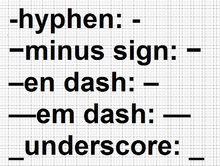

Specifically, em dashes. I hadn't heard of them until today, but I've just had to Google them to find out what they are and how I should be using them.
Let me point that out again. I am the author of five books, and vast numbers of articles in the legal press, and I had not heard of em dashes before today.
I certainly wasn't taught about them at school, and even now, having read all about them on Wikipedia and blogs and several other grammar sites, my co-author and I are looking in bewilderment at each other wondering whether we really do need to go through the entire manuscript replacing all our hyphens with a symbol which isn't even on our keyboard. (We've gone with "yes", by the way.)
So my question is, what other punctuation is there out there, hiding deep within the world of professional editors and similar experts, which I have not yet been introduced to? Because now might be a good time to get to know it.
September 18, 2012
And my New Project is...
Among the many writing tips I have been given over the years, my favourite is "Always be working on the next project."
I've found it to be great advice and have always acted on it. Books can take a year or more in editing and publication, so I've always been working on the sequel, or a new story, and have, on occasion, been taken slightly by surprise when a book I'd largely forgotten about hits the shelves. (These feeling of "What, that old thing?" must be even more marked for actors, who can find themselves travelling around giving interviews and generally promoting a movie they finished working on years ago.)
So I didn't sit around waiting to hear from agents about Emon and the Emperor, because I was too busy working on The Saved Saint. That meant that when the rejections started rolling in, my disappointment was tempered by my excitement for my new project. And now that The Saved Saint is being edited, rather than checking my email twenty times a day waiting for it to come back, I've started a new project.
Quite a lovely one, actually. Over the years I've written a few short stories either for competitions, or challenges for my writing group, or just for fun. So I'm polishing them and compiling them into a book which I will probably call "A Thousand Words" because my short stories are never longer than that. It's great fun, and although I'm finding that rather too many of my short stories are Twilight Fan Fiction and thus can't be used, part of the challenge is writing new ones too. There's a real sense of achievement in putting together a complete story in just a day or two.
But the real achievement is that I've moved on from mooching about over Emon or getting overexcited about The Saved Saint. I'm distracting myself from the business side of writing by doing what I actually love most - writing.
I've found it to be great advice and have always acted on it. Books can take a year or more in editing and publication, so I've always been working on the sequel, or a new story, and have, on occasion, been taken slightly by surprise when a book I'd largely forgotten about hits the shelves. (These feeling of "What, that old thing?" must be even more marked for actors, who can find themselves travelling around giving interviews and generally promoting a movie they finished working on years ago.)
So I didn't sit around waiting to hear from agents about Emon and the Emperor, because I was too busy working on The Saved Saint. That meant that when the rejections started rolling in, my disappointment was tempered by my excitement for my new project. And now that The Saved Saint is being edited, rather than checking my email twenty times a day waiting for it to come back, I've started a new project.
Quite a lovely one, actually. Over the years I've written a few short stories either for competitions, or challenges for my writing group, or just for fun. So I'm polishing them and compiling them into a book which I will probably call "A Thousand Words" because my short stories are never longer than that. It's great fun, and although I'm finding that rather too many of my short stories are Twilight Fan Fiction and thus can't be used, part of the challenge is writing new ones too. There's a real sense of achievement in putting together a complete story in just a day or two.
But the real achievement is that I've moved on from mooching about over Emon or getting overexcited about The Saved Saint. I'm distracting myself from the business side of writing by doing what I actually love most - writing.
September 11, 2012
Punctuation Matters!
My husband brought home an unsolicited fax received at his office yesterday. It was advertising company workwear, and said:
"We always send a visual proof and will not start production. Without your approval we keep your logo on file so you can repeat order year. After year prices exclude VAT and carriage."
It took me a good five minutes to figure out what it meant. Why won't they start production after sending the proof? I think I would rather they sought my approval to keep my logo on file! So let me get this straight - tax and carriage are included for orders during the first year but not after that?
Here's what it should have said:
"We always send a visual proof and will not start production without your approval. We keep your logo on file so you can repeat order year after year. Prices exclude VAT and carriage."
Someone at this company knows about full stops and capital letters. They just have no idea where they go, and sprinkle them randomly across a paragraph, like salt, completely altering the meaning of what they have written. My seven-year-old could have done a better job.
The upshot of this is that neither I nor my husband will ever order anything from this company, because if their employees are not as literate as a primary school child, it doesn't bode well for the working relationship. How will we know if their invoicing is accurate? If I order ten t-shirts for the staff at "Nigel's Cameras" how do I know I won't get ten which say "Nigels Camera's"? (A shop in Chester really did have that problem.)
It gets old, banging on about punctuation. People hate me for correcting it. (Sometimes it's called vandalism, but hey, if the council can't find anyone among their staff who knows how to construct a sentence they deserve to have their signs attacked with permanent marker.) But the fact is it really does matter.
Here's one reason why. Let's say I decided to order from the workwear company, and I sent them £150 for 30 embroidered polo shirts. They might then come back to me and ask for a further £38.95 for the VAT and carriage charge. So I could respond to them that their original advert says "After year prices exclude VAT and carriage." I have it in writing that I don't have to pay the tax or postage on my orders within the first year. And here's the great thing - in British law you have to sell the product at the advertised price. So if they decided to take me to court for that extra £38.95, I would win.
Someone told me recently that there is such a thing as "punctuation dyslexia". Well, I Googled it, and there isn't, but punctuation is part of the problem in general dyslexia and I accept that people who struggle with reading and writing also struggle with punctuation. But if you are such a person and you work for a company, why not ask someone else to check over your work before you fax it to hundreds of local companies?
Here's a really easy way to figure out where your punctuation should go. Read your paragraph aloud the way you want it to sound. Where you pause for a breath you should put a comma. Where you drop your voice as you conclude the statement you should use a full stop. Where you raise your voice to begin a new statement, that should have a capital letter. (There's a little more to it, of course, with question marks, quotes, etc, but for the example above, this would have sufficed.)
When you send your paragraph to someone else those little marks tell them how to read your words and make them sound exactly as they did to you. That helps keep the meaning clear and the tone the way you intended. And avoids people being offended that you propose keeping their logo on file without their approval.
"We always send a visual proof and will not start production. Without your approval we keep your logo on file so you can repeat order year. After year prices exclude VAT and carriage."
It took me a good five minutes to figure out what it meant. Why won't they start production after sending the proof? I think I would rather they sought my approval to keep my logo on file! So let me get this straight - tax and carriage are included for orders during the first year but not after that?
Here's what it should have said:
"We always send a visual proof and will not start production without your approval. We keep your logo on file so you can repeat order year after year. Prices exclude VAT and carriage."
Someone at this company knows about full stops and capital letters. They just have no idea where they go, and sprinkle them randomly across a paragraph, like salt, completely altering the meaning of what they have written. My seven-year-old could have done a better job.
The upshot of this is that neither I nor my husband will ever order anything from this company, because if their employees are not as literate as a primary school child, it doesn't bode well for the working relationship. How will we know if their invoicing is accurate? If I order ten t-shirts for the staff at "Nigel's Cameras" how do I know I won't get ten which say "Nigels Camera's"? (A shop in Chester really did have that problem.)
It gets old, banging on about punctuation. People hate me for correcting it. (Sometimes it's called vandalism, but hey, if the council can't find anyone among their staff who knows how to construct a sentence they deserve to have their signs attacked with permanent marker.) But the fact is it really does matter.
Here's one reason why. Let's say I decided to order from the workwear company, and I sent them £150 for 30 embroidered polo shirts. They might then come back to me and ask for a further £38.95 for the VAT and carriage charge. So I could respond to them that their original advert says "After year prices exclude VAT and carriage." I have it in writing that I don't have to pay the tax or postage on my orders within the first year. And here's the great thing - in British law you have to sell the product at the advertised price. So if they decided to take me to court for that extra £38.95, I would win.
Someone told me recently that there is such a thing as "punctuation dyslexia". Well, I Googled it, and there isn't, but punctuation is part of the problem in general dyslexia and I accept that people who struggle with reading and writing also struggle with punctuation. But if you are such a person and you work for a company, why not ask someone else to check over your work before you fax it to hundreds of local companies?
Here's a really easy way to figure out where your punctuation should go. Read your paragraph aloud the way you want it to sound. Where you pause for a breath you should put a comma. Where you drop your voice as you conclude the statement you should use a full stop. Where you raise your voice to begin a new statement, that should have a capital letter. (There's a little more to it, of course, with question marks, quotes, etc, but for the example above, this would have sufficed.)
When you send your paragraph to someone else those little marks tell them how to read your words and make them sound exactly as they did to you. That helps keep the meaning clear and the tone the way you intended. And avoids people being offended that you propose keeping their logo on file without their approval.
August 14, 2012
Launch Parties
A friend and I are launching a book next month. It's rather exciting, really, because it'll be my first self-published title (and her first anyway-published title) and I feel we really should mark the occasion with a party. Any excuse to get out the chocolate fountain.
They seem to be all the rage these days -my Facebook events page tells me that I could go to one every day this week- so I suspect it really is de rigueur for the discerning author. But I'm not really sure how this celebration of our literary contribution is to be achieved.
When my first book, Haven, was published I held a party. I booked a room in a local small hotel, and we had canapés, and I sat at a table with copies of my book which I offered to sell to the friends and family who attended. I think I sold two copies, and the cost of the party ended up being more than I made in royalties, but, it being my first book, I didn't suspect that at time. It ended up feeling like rather too much of a "Yay, me!" exercise, looking back, and that was almost a decade before London Tipton, ahem, graced our screens. Throwing a party to celebrate the wonderfulness of me? Erm, not when I'm working hard on my humility these days. (Maybe Hellen and I could be throwing a party to celebrate the wonderfulness of each other. I certainly know I couldn't have written this book without her.)
Many things have changed in the twelve years since my first launch party. In fact, some people are holding their launch parties online these days. How, I have no idea. I mean, do attendees sit at their screens with a canapé and a drink and Skype about the book? (Because I've been to better parties, and I don't drink.)
Apparently I might consider holding the party in a local bookshop, or library. Now, forgive my ignorance, but I hadn't hitherto believed libraries to be places which were very keen on hosting rowdy parties. And since it's entirely possible that my new release will be an ebook only, I think I'm going to have a tough time pitching it to bookshops.
I'm going to have to give this party thing some thought. Any suggestions? In the meantime, we're having an End-of-all-the-Olympics party (during the closing ceremony of the Paralympic games) so I'm off to dust off the chocolate fountain.
They seem to be all the rage these days -my Facebook events page tells me that I could go to one every day this week- so I suspect it really is de rigueur for the discerning author. But I'm not really sure how this celebration of our literary contribution is to be achieved.
When my first book, Haven, was published I held a party. I booked a room in a local small hotel, and we had canapés, and I sat at a table with copies of my book which I offered to sell to the friends and family who attended. I think I sold two copies, and the cost of the party ended up being more than I made in royalties, but, it being my first book, I didn't suspect that at time. It ended up feeling like rather too much of a "Yay, me!" exercise, looking back, and that was almost a decade before London Tipton, ahem, graced our screens. Throwing a party to celebrate the wonderfulness of me? Erm, not when I'm working hard on my humility these days. (Maybe Hellen and I could be throwing a party to celebrate the wonderfulness of each other. I certainly know I couldn't have written this book without her.)
Many things have changed in the twelve years since my first launch party. In fact, some people are holding their launch parties online these days. How, I have no idea. I mean, do attendees sit at their screens with a canapé and a drink and Skype about the book? (Because I've been to better parties, and I don't drink.)
Apparently I might consider holding the party in a local bookshop, or library. Now, forgive my ignorance, but I hadn't hitherto believed libraries to be places which were very keen on hosting rowdy parties. And since it's entirely possible that my new release will be an ebook only, I think I'm going to have a tough time pitching it to bookshops.
I'm going to have to give this party thing some thought. Any suggestions? In the meantime, we're having an End-of-all-the-Olympics party (during the closing ceremony of the Paralympic games) so I'm off to dust off the chocolate fountain.
July 31, 2012
Fifty Shades of No Thank You
The book which is currently flying off the shelves and creating a stir everywhere is by a British author who, inspired by the Twilight novels (which I love) self-published her book, and then saw it become just as successful as the books she was inspired by. Her trilogy has now sold over 31 million copies and been picked up by a major publisher. It's sold on a huge display in the supermarket I shop in. To such I aspire.
But I won't be reading it. The book is "Fifty Shades of Grey" by E.L. James and it has sold the way it has because it is, essentially, pornography in print. Most of the book is about the characters (Christian Grey and Anastasia Steele - or Edward Cullen and Bella Swan in Ms. James's original manuscript) having sex. Not just any sex either, but sadism, dominance and other unpleasant and twisted things.
Now, call me a prude (no, please do, I'm fine with that) but I have never written a sex scene (and never will) because I happen to believe that sex is a very special and beautiful thing which is meant to be private and personal between a couple in love. Even when that couple is fictional. And while a good novelist can stir deep emotions, I don't believe that titillation is an emotion worth stirring in this context. Surely literature is above such things? I was horrified, for example, to learn that people are writing sequels to Jane Austen novels which include sex scenes featuring well known characters. Elizabeth and Fitzwilliam Darcy getting down and dirty? Now that's sacrilege. How dare they.
Actually, now I have to shock you and admit that I have read some of it. In the interests of seeing what all the fuss was about I downloaded the Kindle sample having been assured that there was nothing offensive in those first few pages. So, filth aside, what did I think of the book?
It was terrible. Really badly written, amateurish and clunky. For example:
"Miss Steele could you wait here, please?" She points to a seated area of white leather chairs. [page 5]
Seated area? The chairs are sitting down? I think she means seating area. In any other book I'd assume that this was a typo, but based on the poor use of language throughout I think the author actually doesn't know the correct form. Like the many annoying people who say "could of" rather than "could have". And first person present tense is not something I enjoy in a book.
Doesn't this book have even one redeeming feature? Well, yes it does. This review:
http://www.amazon.co.uk/review/R53SXA5IQFRKH/ref=cm_cr_dp_title?ie=UTF8&ASIN=0099579936&channel=rw-dp&nodeID=266239&store=books
Now that's some good writing.
But I won't be reading it. The book is "Fifty Shades of Grey" by E.L. James and it has sold the way it has because it is, essentially, pornography in print. Most of the book is about the characters (Christian Grey and Anastasia Steele - or Edward Cullen and Bella Swan in Ms. James's original manuscript) having sex. Not just any sex either, but sadism, dominance and other unpleasant and twisted things.
Now, call me a prude (no, please do, I'm fine with that) but I have never written a sex scene (and never will) because I happen to believe that sex is a very special and beautiful thing which is meant to be private and personal between a couple in love. Even when that couple is fictional. And while a good novelist can stir deep emotions, I don't believe that titillation is an emotion worth stirring in this context. Surely literature is above such things? I was horrified, for example, to learn that people are writing sequels to Jane Austen novels which include sex scenes featuring well known characters. Elizabeth and Fitzwilliam Darcy getting down and dirty? Now that's sacrilege. How dare they.
Actually, now I have to shock you and admit that I have read some of it. In the interests of seeing what all the fuss was about I downloaded the Kindle sample having been assured that there was nothing offensive in those first few pages. So, filth aside, what did I think of the book?
It was terrible. Really badly written, amateurish and clunky. For example:
"Miss Steele could you wait here, please?" She points to a seated area of white leather chairs. [page 5]
Seated area? The chairs are sitting down? I think she means seating area. In any other book I'd assume that this was a typo, but based on the poor use of language throughout I think the author actually doesn't know the correct form. Like the many annoying people who say "could of" rather than "could have". And first person present tense is not something I enjoy in a book.
Doesn't this book have even one redeeming feature? Well, yes it does. This review:
http://www.amazon.co.uk/review/R53SXA5IQFRKH/ref=cm_cr_dp_title?ie=UTF8&ASIN=0099579936&channel=rw-dp&nodeID=266239&store=books
Now that's some good writing.
July 24, 2012
The People Who Bring a Book to Life
Bringing a book to life takes a whole host of very talented people. Here's who they are, and what they do.
Alpha Reader: Reads the first draft of the completed manuscript and gives feedback. In most cases the Alpha reader is the author because most first drafts are pretty terrible and authors don't like anyone else seeing it. The first draft is often just a "getting the ideas on paper" exercise, and the author will then polish it. I tend to just do this once (my second draft being pretty close to the finished product) but other authors may go through many, many drafts.
Beta Reader(s): Reads the manuscript with a critical eye, and gives feedback to the author on things like style, plot, characterisation and even spelling and grammar. Authors may use several beta readers to get a rounded opinion. Beta readers are generally not paid for their work - the payment is getting to read an advance copy of the book, and sometimes a mention in the acknowledgements.
Critique Group: This is a group of people - often other authors - who serve as something as a "conglomerate" of beta readers, giving verbal feedback to the author during a meeting. Sounds horribly painful to me. And critique groups don't get paid for this either; when they are a group of authors, they repay the favour by critiquing each other's work.
Proofreader: This should be someone other than the author who checks for errors in spelling, grammar and punctuation, and those little typos which the author always misses. Proofreaders charge for their services but if you're using an editor then you can often skip this stage, because the editor will serve as a proofreader.
Technical editor: In non-fiction, this is the person who checks the recipes, facts or references. In fiction, this is an edit (often performed by the author) checking for continuity, accuracy, consistent chapter length, etc.
Line editor: (or just Editor.) I think editors are amazing. They go through the manuscript line-by-line making sure that every word, every punctuation mark, every scene, is as good as it can be. I was once told by my publisher that my manuscript was very "clean" and yet it still came back from the editor covered in red corrections. I respect editors as the experts, and they really can improve a manuscript tremendously.
I have worked with both in-house editors employed by my publishers (much-missed Val, Megan and Linda) and editors I have paid privately (dear Val again) and they have all been worth their weight in chocolate. I firmly believe that no book should ever be published which has not been professionally edited. Most editors charge by the page.
Agent: Agents get a percentage of the royalties in return for representing your book to publishers and working to get you the best possible deal. It is possibly to bypass an agent (by submitting direct to those few publishers who will accept direct unsolicited submissions, or self-publishing) but if you can secure a hard-working and experienced agent your book stands a far higher chance of being successful.
Publisher: The publisher is more than just a glorified printer. They design the cover, blurb and overall look of your book, work with the distributor to get your book into the right shops, do much of the publicity (or tell you how to do it), deal with any legal issues (including copyright) and they take most of the financial risk. Despite this, they pay you - an advance if you're lucky, but certainly a percentage of the selling price of the book. If they want you to pay them (and you were unaware that they were a vanity press) run away very fast.
Copy editor: This is the last stage in bringing the book to print. The copy editor doesn't change the text, but prepares it for typesetting by formatting it and adapting it to house style, checking for widow and orphan lines, and having a last read-through of the text to ensure that it is clear and makes sense, and that there are no remaining errors.
What, you thought I just write the thing and it appears on the shelves a few weeks later?
Alpha Reader: Reads the first draft of the completed manuscript and gives feedback. In most cases the Alpha reader is the author because most first drafts are pretty terrible and authors don't like anyone else seeing it. The first draft is often just a "getting the ideas on paper" exercise, and the author will then polish it. I tend to just do this once (my second draft being pretty close to the finished product) but other authors may go through many, many drafts.
Beta Reader(s): Reads the manuscript with a critical eye, and gives feedback to the author on things like style, plot, characterisation and even spelling and grammar. Authors may use several beta readers to get a rounded opinion. Beta readers are generally not paid for their work - the payment is getting to read an advance copy of the book, and sometimes a mention in the acknowledgements.
Critique Group: This is a group of people - often other authors - who serve as something as a "conglomerate" of beta readers, giving verbal feedback to the author during a meeting. Sounds horribly painful to me. And critique groups don't get paid for this either; when they are a group of authors, they repay the favour by critiquing each other's work.
Proofreader: This should be someone other than the author who checks for errors in spelling, grammar and punctuation, and those little typos which the author always misses. Proofreaders charge for their services but if you're using an editor then you can often skip this stage, because the editor will serve as a proofreader.
Technical editor: In non-fiction, this is the person who checks the recipes, facts or references. In fiction, this is an edit (often performed by the author) checking for continuity, accuracy, consistent chapter length, etc.
Line editor: (or just Editor.) I think editors are amazing. They go through the manuscript line-by-line making sure that every word, every punctuation mark, every scene, is as good as it can be. I was once told by my publisher that my manuscript was very "clean" and yet it still came back from the editor covered in red corrections. I respect editors as the experts, and they really can improve a manuscript tremendously.
I have worked with both in-house editors employed by my publishers (much-missed Val, Megan and Linda) and editors I have paid privately (dear Val again) and they have all been worth their weight in chocolate. I firmly believe that no book should ever be published which has not been professionally edited. Most editors charge by the page.
Agent: Agents get a percentage of the royalties in return for representing your book to publishers and working to get you the best possible deal. It is possibly to bypass an agent (by submitting direct to those few publishers who will accept direct unsolicited submissions, or self-publishing) but if you can secure a hard-working and experienced agent your book stands a far higher chance of being successful.
Publisher: The publisher is more than just a glorified printer. They design the cover, blurb and overall look of your book, work with the distributor to get your book into the right shops, do much of the publicity (or tell you how to do it), deal with any legal issues (including copyright) and they take most of the financial risk. Despite this, they pay you - an advance if you're lucky, but certainly a percentage of the selling price of the book. If they want you to pay them (and you were unaware that they were a vanity press) run away very fast.
Copy editor: This is the last stage in bringing the book to print. The copy editor doesn't change the text, but prepares it for typesetting by formatting it and adapting it to house style, checking for widow and orphan lines, and having a last read-through of the text to ensure that it is clear and makes sense, and that there are no remaining errors.
What, you thought I just write the thing and it appears on the shelves a few weeks later?
July 17, 2012
"The Jury finds for the Bacon"
 Hubby Dearest and I had a jolly adventure this past weekend. We drove 30 miles to the beautiful ancient town of Great Dunmow and, as ambassadors of marriage, took part in a tradition so old that it is referred to in Chaucer's Wife of Bath's Tale and the even earlier Piers Plowman. In fact, the Dunmow Flitch Trials are rumoured to go back to 1105, although the first recorded winner's name dates from 1445.
The Trials are celebrated every four years in Dunmow. Over the course of a day five couples come before a judge, are cross-examined by barristers, and have to satisfy the Jury of 6 maidens and 6 bachelors that in 'twelvemonth and a day', they have 'not wisht themselves unmarried again'. If they can demonstrate that their marital happiness is such that they are worthy of a prize, they win a flitch. That's half a pig, cut lengthways.
 Prior to the day we'd applied (online) and been interviewed by the Judge. Our prepared statement had been circulated to the barristers, and before our trial we met with the (very lovely) barristers representing us to go through it. Our trial was the first in the afternoon session, so we and the other couple (Dave and Sue, also very lovely) then joined the procession to the trial marquee.
 And what a procession it was! Led by the Town Crier, it included morris dancers, a brass band, majorettes, the flitch (carried overhead on a frame by bearers in historical costumes), the two chairs similarly borne aloft, the Jury wearing their smartest suits and white dresses, and finally the judge and counsel in all their finery. And we were cheered and clapped as we walked. HD and I were applauded when we walked into the marquee too. That was quite a thing.
 It was pretty uncomfortable in the dock, with only a narrow step to stand on, but we managed to hang on, although my hands were purple by the end of the trial (I found out later that the dock had only been painted the day before). I wondered initially whether counsel would focus on the fact that HD had taken on three children when he married me, or that in our wedding vows we married not "Till death us do part" but "For time and all eternity".
 But no. The subject of most interest was our nerdiness and shared love of sci-fi, from the fact that our first date had been spent watching Doctor Who at my house, to my walking down the aisle to the theme from Star Trek: Voyager. But it got a lot of laughs. The barristers were amazing and hilarious and so good at thinking on their feet. Far more than I was. Asked to sum up, I found I was lost for words. (Now, of course, I know exactly what I should have said. That I'd had a tough first marriage and wished myself unmarried every day. But since I married Roderic I wake up every morning and give thanks that I am married to such a good man.)
 In the final summing up the counsel for the bacon (whose job was to stop us winning it) focussed on the fact that, after Roderic proposed, I had gone off to the toilets to examine the ring. I wanted to check it was expensive enough, they purported. At that point I wasn't allowed to say anything, but wished I could point out that I wasn't some gold-digger, but he had proposed to me in the dark (in the back row of the Odeon cinema in Southend, in fact, during the closing credits of Harry Potter IV) and I just wanted to be able to see the ring I had accepted.
So the Jury went off to deliberate, and we chatted with the Chaplain (another lovely man - being nice seems to be a requirement for living in Dunmow) who warned us that we might not win, and might be disappointed about that. Luckily, this is the twenty-first century, and failing to be awarded half a pig doesn't mean that our family will starve over the winter. (The expression "bringing home the bacon" is thought to originate from the Dunmow Flitch Trials and a family could live on the meat for six months, so it was no trifle.)
We were, in fact, the only couple that lost that day, but not the only couple not to bring home the bacon; Dave and Sue live in Spain, so they donated their flitch to the local hospice. And yes, we were disappointed, but consoled ourselves with the fact that we didn't have to be carried precariously through the wet slippery streets of Dunmow. I think the chair-bearers were quite pleased about that too.
Neither did we have to kneel on sharp pointed stones and take the Oath:
 "You do swear by custom of confession
That you ne'er made nuptual transgression
Nor since you were married man and wife
By household brawls or contentious strife
Or otherwise in bed or at board
Offended each other in deed or in word
Or in a twelve months time and a day
Repented not in thought in any way
Or since the church clerk said amen
Wish't yourselves unmarried again
But continue true and desire
As when you joined hands in holy quire."
We did have to stand on the "drey" in the market place, however, and be awarded our consolation prize of a gammon, and a bottle of champagne. Knowing that we are teetotal, someone had very kindly bought us a big tub of hot chocolate too and I was quite touched by that gesture. As was the judge when we gave him the champagne to celebrate his retirement, since this was his last Trials day after 40 years' service. So it all worked out perfectly at the end. And we know that our marriage is worth half a pig, even if the Jury couldn't see that.
So to sum up, we drove to a lovely historic town, met some very nice people, took part in an ancient tradition which very few people get the privilege of being involved in, and went home with a large slab of meat and Cadbury's hot chocolate, a toy pig and a commemorative mug. It was a great day.
Yes, it is all completely mental, and a bit surreal, but huge fun and great entertainment for the crowd. And it is also rather beautiful to know that marriage is still alive and well and that there are plenty of people prepared to stand up in front of 300 strangers and testify to their love and marital harmony.
http://www.bbc.co.uk/news/magazine-18851860
(Sorry about the ridiculous spacing in this post - Blogger is a total pain.)

July 10, 2012
Difficult Writing
One of the tasks I have at work today is to write a press release about the support being offered to the charity I work for by another, larger and much richer, charity. I have to announce this with major fanfare about how delighted we are to be working with them, what exciting new opportunities it offers for both charities as well as those despairing souls we aid, and generally proclaim a new age of harmony, happiness, rainbows and fluffy bunnies. But ... I'm not allowed to actually explain what it is they are doing to help us. Now that's going to be a challenge.
A few months ago I was asked to write a letter of support from a group of friends to another friend who had been wrongly accused of a crime. That wasn't easy either. In fact, I think I gave up in the end and we all expressed our support verbally instead. Over an all-you-can-eat Chinese buffet, as I remember.
In my writing group a couple of months ago we did an exercise where we had to describe in detail a scene, but from the perspective of a blind person. The photograph I was asked to describe was of St. Pancras Station in the Victorian age. We had five minutes. Here's my effort:
"I judged it to be almost midday by the radiant warmth of the sun which beat heavily upon my shoulders through the station’s famous glass roof. About me was the gentle hum of many muted conversations, the swishing of silken skirts and the tapping of canes and umbrellas. The sounds, like the sun, were amplified by the cavernous space. The smell of hot steam mixed with coal dust was thick enough almost to mask the rich musky odour of the leather trunks waiting to be loaded, and from it I estimated that at least four trains impatiently awaited those cases and passengers."
For most writers, writing comes fairly easily, even naturally. But to be a really great writer, you need to exercise your writing muscles. That means relishing challenges that come your way; offering to write a Best Man speech for a friend, or taking the opportunity to put pen to paper and remonstrate with a child's teacher over a grade, or writing to a missionary who's struggling in the field. It's all good practice.