
Andrew Sweet's Blog: Reality Gradient, page 6
April 27, 2022
The Dystopian Road…
It’s easy to get wrapped up in the cool technologies that we see in dystopian science fiction. In Divergent by Veronica Roth, the chamber that Four and Tris experience where they face their worst fears is truly magnificent. The idea of chemical-induced simulations and mind-control are pretty unique technological advances as well. The author does an excellent job of walking that line between what’s potentially believable and what’s not in the way that she explains how some of these inventions work. Even so, the future she draws is undeniably dystopian. Nothing drives the point home quite as hard as when the Dauntless play capture the flag in an abandoned amusement park. The juxtaposition of these children playing an almost life-or-death game in an environment that would have entertained families and communities is staggering.
Break over into the “real world”. As society progresses into the future, we’re being sold an idea of something called a meta-verse. What is that? It’s an interesting concept. Technology companies are creating more and more online content to the extent that soon we won’t need real lives at all. Rather, there will be no distinction between “real life” and virtual. The future of human civilization may reside in virtual reality.
Enticing. Living in a virtual world would be so much easier and potentially more fun than living in a world that seems to get more and more dangerous by the day and by the year. Every so often a new virus is unleashed upon humanity either by mutation (COVID-19) or by climate change (Anthrax in Siberia). Increasing resource battles mean a world that is becoming more divided, and yet nations seem unable to unite even around the very real fact that climate change is happening. As I type this, many around the world believe that we’re on the cusp of World War III. All of these are driving factors increasing the attractiveness of a world in which participation isn’t a death sentence. A kind of faux immortality happens in virtual life. However, even as we embrace technology for our escape, we must recall that the more we disconnect, the less we concern ourselves with the affairs of reality, and the more we hasten in as opposed to stave off the negative changes of things like climate change and resource wars. In other words, the faster we bring ourselves into the very situations that dystopian novels are meant to warn us against.
Dystopian is not a destination. We don’t write the dystopian futures I do in the hopes that we will use them as a blueprint to the future. We write the dystopian futures as warning shots. Each deteriorating society and dismal landscape is one possible future that we may be faced with if we can’t find a way around it. I never for once hoped that a climate change event like Equilibrium in Models and Citizens would actually occur, and yet here we are on the cusp and past the point of avoidance. I had hoped, as I believe a lot of dystopian authors do, that by revealing a world so easily recognizable from our own trajectory, enough people would recognize the risks we face and combined effort would help us to avoid or at least be prepared for the possible futures that we face. All while entertaining the reader. The reader is king! Or queen.
While we can provide technological distractions from the world in which we live, no amount of technology can replace the red-headed woodpecker that lives in the birch tree outside of my library window, hunting for his meal among the insects hidden in the bark. Nothing can replace the smell of the air just before the rain, or even the frustrating stubbornness of those bright yellow flowers that spread their seeds into the wind once the flower is spent. Nothing can ever replace the sensation of warm summer rain against my face and the sun on my skin. The soft gentle touch of a lovers fingertips, the excruciating pain of stepping on a Lego, the bitter way that coffee lingers in your mouth after only one taste — these are things of which technology can only offer a sanitized version. And even if it could offer a real enough experience for some, not all of human experience could be conveyed within something like a Metaverse.
As the U.S. Army Officer says in Hedwig and the Angry Inch, if you want to go (into the Metaverse, in this case), you have to leave something behind. And that something that we leave behind is true, personal touch.
I’m not a luddite. Technology is amazing and opens the future up to us. Even the idea of a Space Force, though perhaps premature, didn’t offend me the way it did many others. However, I do wonder about the use of money here. Having worked in the technology space, I understand the trade-offs quite well. The near constant disruption of the early 21st century made many technology companies paranoid. Stay on the bleeding edge, or suffer irrelevance. This never-ending innovation that seems to pour out of technology giants like Google or Meta or Microsoft (and others) stems from the same place: staying relevant amidst the churn and making the right bet on the future. All three of these have stepped into the Metaverse space.
At the risks of boring you with some dry business stuff, the trade-off in Research and Development is always between finding that new trend and solving an immediate problem. Tech companies are trying to solve to the future, a future that’s five, ten, or even twenty to fifty years away. As such, they tend to lose sight of the immediate problems, and the problems that they’re willing to solve, however kind a company may seem, have to eventually pan out as investments. Not all of them do, but enough do to offset the losses.
The consequence of this is that we’re always solving for the worst case scenario. Metaverse comes from a rather cynical place. The widely-accepted origin of the term was in Snow Crash, a novel about a dystopian future after a global economic collapse. Metaverse is an alternate reality (kind of like Mijloc and Inferiere in my own Reality Gradient series) that people pay to play in while the rest of the world is soaking in darkness and pain. This is the thing about Metaverse concepts: they always spring out of worlds that are too impossible to live in. And this is the kind of hedge that we make when we talk about latching onto things like the Metaverse, however cool they sound. We can see the amount of money and investment in the area almost as a giving up on the world outside of such a place. Imagine what that money could do for society.
Instead of doing it better here, we’re just doing it the same somewhere else. This is not me speaking out against Metaverse. The fact is Metaverse makes a lot of sense to me — it sounds fun. But technology brings with it a lot of the same problems as staunchly held religious beliefs: it can sometimes focus on the future to the detriment of that very same future. There’s an integral balancing act — a tightrope that must be walked: keep society functioning juxtaposed against chasing the promise of a blissful future. This is why we must be careful where we focus, and for how long that focus endures.
Like I said at the beginning — dystopian literature isn’t a roadmap. Works in this vein lay out like warning signs along the road of social progression so that, hopefully, we don’t end up in a similar situation. From When Late the Sweet Birds Sang and the declining population uncovering the ponsi-nature of most world economies to Snow Crash, wherein there’s a similar economic collapse that kicks things off, to Models and Citizens where climate change is a precondition for the dystopian landscape, we are not meant to actually see the futures being described so painstakingly. None of us are creating worlds that are particularly fun to be part of — and that’s for a reason: they’re warning signs, not goalposts.


April 15, 2022
Romancing the Science Fiction
Science fiction as a genre has consistently had a vein of romanticism and sexiness underlying much of the writing. One need only browse the genre over the last hundred or so years to see covers replete with buxom, scantily-clad women, and men with massive…laser guns — and those are the more mainstream and accepted stories! Just outside of the mainstream are stories that dive deep into sexuality and romance, crossing boundaries that stand as firm barriers in other genres. In my own writing, specifically Libera, Goddess of Worlds, there’s implied sex and love between an artificial being and a human. I am not alone.
There’s a good reason for this. Science Fiction explores the possible and asks big questions about the universe in which we live. As such, it is forever probing the boundaries of our understanding and challenging our assumptions about everything, including love. Like most genres, really great science fiction deals with what it means to be human.
My Reality Gradient series focuses on that humanity concept as a core throughout the entire trilogy. When asking the question “what does it mean to be human”, then all sorts of related questions tumble out — the most prominent of these being “what does it mean to love?” And once that question comes out, then another, deeper question forms about sexuality, which in human society, is often associated strongly with this concept.
A couple of examples come to mind as we discuss how that exploration unfolds. The first is from one of my favorite authors and long-time inspiration who gave me the freedom to write the Reality Gradient trilogy the way that I did — focusing on a slightly different subset of characters in each novel.
Dawn by Octavia E. Butler, first published in 1987, opens with a woman captive on an alien vessel and few initial memories of how she got there. These ‘aliens’ roam the universe seeking other alien species with whom to merge (my word, not hers). This entails swapping DNA during something like sexual intercourse and three-way love partnerships. The process requires one participant to connect with two others in a deep, emotion-sharing, bond analogous to love, and the other two to actually participate in the act of sexuality directly.
Another readily-accessible example that pops up in my mind is Floodtide by Helen Claire Gould published in 2015. In this, something similar happens, but among humanoids. An alien race forms bonds in groups, one woman with multiple men. The men are connected through telepathic bonds. In this way, sexuality is explored as something that can be shared across multiple people — questioning whether love is truly something limited to two people, or whether it can be shared by many. Both of these novels sit firmly in the realm of science fiction.
To be clear, there’s also a sub-genre of erotica that focuses entirely on interplanetary sex in less subtle ways than either of the above novels treat the issue — leaning more on sex and less on the relationship aspect. Specifically what comes to mind is the Chosen series by Stacy Jones. In this series, the protagonist is abducted by aliens and subsequently abandoned on a planet where her only companion social outcasts from a humanoid species that — you guessed it — form matriarchal harems. This seems like a common theme in recent science fiction writing.
This exploration doesn’t only take place in science fiction novels. Several movies of late have been made that explore relationships with artificially intelligent beings. Through movies like Ex Machina and Bladerunner, we see a trend in science fiction to include riskier material that would possibly fail in other genres. More recently, Netflix has paved the way with a lot of such subject matter. Consider Better than Us, a television series in which an android is malfunctioning in a way that brings her some level of self-awareness — and unleashes terror on several people in her orbit. Like many other artificially intelligent beings in science fiction, she is trying to interpret her world and understand what love is — both platonic and romantic. The movie explores her humanity through the sometimes less-than-human interactions she has along the way.
Sex in science fiction, with the notable exception of the Heavy Metal franchise, is rarely just about sex. In most cases, the subject is approached in tandem with romantic love and that ever-elusive definition of humanity. Sex, for fun or love, is an integral part of what it means to be human — as much as violence is.
Yet sex is far less common in our entertainment, even in science fiction. Consider the children’s movie Star Wars or a multitude of other Space-Opera-type movies. Consider Ender’s Game, where an entire civilization of sentient beings is destroyed by a boy who is routinely tortured in a space training camp. I love the Star Wars franchise and the novel Ender’s Game was my first real exposure to the idea of emergent A.I. However, it’s impossible to deny the level of violence in both. If either novel dealt with sex in similar proportions to violence, both would be easily TV-MA or worse.
Why so much violence? It’s simple, really. Violence is much more prevalent in United States culture, in the form of books or movies. Don’t get me wrong — I love a good horror flick just like the next person. How many movies start out with someone’s wife or husband getting killed in some horrific way, unleashing a chain of events so macabre that if they were to happen in real life, even the resulting revenge killings would be universally condemned. Science fiction is the art of the possible, so we do ourselves a disservice when we chain ourselves to violence in our visions of the future. The full impact of science fiction is much more than the glorification of violence. In science fiction, we find gentle touches, an ever-present widening of what it means to be human to include virtual and artificial entities who have achieved self-agency. In fact, in Another Life, a short-lived Netflix series involving Katee Sackoff, we see the furthering of this exploration of inter-being romance to include some of the emotional and psychological side-effects of such activities. Even artificial beings react poorly as spurned lovers!
There are a lot of unexplored territories still in cross-being relationships. As the writing world evolves to its new normal, more and more authors seem to be taking up these sorts of topics — a good thing if you consider how mired we’ve been in Space Opera-type science fiction since Star Wars. Even Star Trek has turned more space-opera in the later series that they have produced while ToS was more of an examination of society. Independent science fiction authors haven’t shied away and continue to ask the pertinent question: what does it mean to be human? As mentioned, when we do, there’s always that tangential question lingering behind: why would it ever be taboo to love who we want to love? And very often, usually, even, the answer is that love among intellectual equals can’t be taboo. Even the most severe cultural differences are overcome in science fiction to reveal the intimacy and ultimately the humanity lying just beneath the surface.
Science fiction romantic encounters are less about the romance and more about confirming and acknowledging humanity while affirming that what it means to be “human” is more dependent on who an entity is on the inside, whatever outward appearances may seem to dictate.
April 8, 2022
The Ultimate Act of Defiance: To Survive
As a science fiction writer, I can’t help but look out onto the world through the lens of the possibilities that science provides. The pandemic is one area where we were able to witness the power of science in real-time, as advanced scientific techniques began to enter into the common parlance. For example, PCR, or polymerase chain-reaction, is the amplification of genetic material that was first developed back in 1985 by Kary Mullis. Now we have PCR tests and common people like me know enough to ask for differences between the different types of testing kits to detect COVID-19. The technology to detect biomarkers in spike proteins had been developed and tested in recent years by trans-national partnerships reaching across the globe.
When I was younger, such a feat was impossible. The very idea that we could in only a couple of years develop a vaccine and return to something that looks very similar to ‘normal’ was an impossibility. In fact, in my younger days, I recall taking a trip to Disney World in Florida and marveling at the idea of instantly communicating with someone over a video and audio feed in real-time, anywhere on the planet when exposed to the small world ride.
Today’s science fact is yesterday’s science fiction.
This is the miracle that get’s lost in the interpretation of today’s world. Chaos surrounds us, chipping away at everything we create. That’s natural — entropy is the currency of the universe, and we’re part of that universe. The miracle is that we’ve carved out among the stars a future here on this planet, and we’ve steered it in a way that we have discovered the secrets of the atom, of flight, of establishing societies. And every single one of those advances originated first as an idea in the mind of someone, who shared it with someone else, and so on to eventually make that vision a reality.
If you think as I do, the first science fiction was that person who observed the natural process of a seed sprouting into a plant and saw in that seed the possibility of harnessing the powers of nature. How revolutionary is it to tame nomadic impulses long enough to realize that such a possibility exists? I wonder how much of the future that person saw. Imagine a story that begins with a nomadic society, wandering the earth. They then observe a seedling sprouting in the wilderness, and begin to tell a story about that. The seed grows into a plant, and a fruit from that plant feeds the people beneath it. They plant more and discover they’ve stopped wandering. The futile and perpetual search for food has finally given way to stability.
Imagine how revolutionary that thought is. The original science fiction was exactly the imagining of the possibility of the future, so it’s no wonder that science fiction continues to do that today — pave the way toward the possible in the minds of the world’s citizens. So what can we expect the future to bring us?
Trends in Science Fiction
According to KindleTrends, the ten most frequent blurb words in science fiction included terms like world, new, life, and alien. If you’ve been paying attention, alien-based science fiction has had its moment in the spotlight. People are looking to other worlds, and the pandemic hasn’t yet broken through into the mainstream (well, mainstream science fiction). There are some notable exceptions like The Lunar Chronicles, which still are doing well and feature a pandemic in central stage. Also, the amount of post-apocalyptic or dystopian fiction has only increased since Hunger Games broke through and other series followed suit (like the Divergent series).
Fear is driving the future right now. Fear and escapism. We’re having a difficult time processing the world that we’re living in and we authors are doing what we always do — comment on the times. But if we look within these series, we see that there’s an embedded sense of hope and a general distrust of authority. In Hunger Games, the world that was created was manufactured in a way that many elites ruled everything to the exclusion and starvation of the masses. Divergent was more creative and was a social commentary. The world had been split into “houses” like Harry Potter, with different personalities driving each. Yet again, there were an elite few who managed to take over everything.
Yet at the end of both of these series, there was a win. It wasn’t a big win though — at least not in Hunger Games. Gone are the days where the hero upends society and “wins”. In these worlds, the ultimate act of defiance is to survive. That’s a reflection on society too. With the news pounding on us about how we’re about to enter WWIII globally, or civil war in the United States, or Climate Change will kill us all, it’s little wonder that our collective imaginations are limited to survival at the moment. Considering this, it’s no wonder that many of our science fiction readers are also looking to other planets for possibilities, having lost some amount of faith in our ability to manage the one planet we have.
Did I say hope?
Yes.
The hope is in the survival and the creativity of the societies dreamed up. Science fiction, like Divergent, like Hunger Games, and like Beggars in Spain, imagine vastly different societies to what we have today. It’s as though we’ve begun to try to collectively imagine our way out of the current gridlock and inability for our international communities to address the needs of common people, and through the trial and error of the societies we create, are seeking out alternatives. This portends significant shift in thinking. Consider Day of the Triffids, written during the beginning of the Cold War before we knew it was a Cold War. The condemnation of the Communist lifestyle was an entrenchment of Western values. Today’s writing has no such glorification, and instead questions the very foundations upon which societies are established.
Some aspects of these writings will find their way into our common lives.
February 4, 2022
Tommy
This is a short story I wrote several years ago. Reading it now, I still like this one for its macabre… mwahahaha! The narrator is named Carlos (a derivation of Charles — my first name), and this story was an attempt to come to terms with how it felt growing up in small-town Caldwell, Texas, where some of us would leave, and others would remain. Of those who remained, not all of us wanted to be there.
None of the below really happened. The feelings this piece captures I feel are pretty accurate. Warning if you’re expecting science fiction: this story is not science fiction. It’s a ghost story. And a tragic one at that. Another warning: drug use and murder in the frightful tale below .
Read at your own risk…
Tommy
He’s a genius.
Oh, I’m gifted. All the documents say so. My intelligence quotient is in the Mensa range, so you would be right to say I’m a genius too — on paper. Tommy is a genius in the way that you don’t need paper to prove. You feel it when you walk into a room and you sit next to him. You can’t help but admire his lanky gait and obsessively neat demeanor from afar, just prior to introducing yourself as his new best friend. And he’s always doing something.
Not me. I’m bored — always bored. The seconds of each day drip like molasses into minutes, and then congeal into the pudding of hours, aggregating finally into something resembling glass — days which shatter only with the introduction of some sort of controlled substance or another.
By the time we met, I had already turned my life into a series of mini-adventures. My favorite game was to wait until the last minute on class projects — to lower expectations on what anyone thought I could produce. Then I liked to bang out something just barely enough above average to justify my admission into gifted programs.
Then I would go home and get baked. Um, where was I? Oh.
Thomas Michael Johnson is a hard worker too (something I’m way too unmotivated to consider). I have some very over-achieving friends. Being in the gifted program puts you in that sort of company. We were all gifted kids together in middle school. Tommy, Heather, Nathan, Tanya, and me, Carlos. In Sniggs, Texas, population 3,000, the meager gifted program was the closest we could get to actually having a private education. Most of us could barely afford our “free” lunches.
But the five of us stayed together for over a decade. From middle school through community college, we went to each other's birthdays, lost teeth, traded favorite comic books. We went to the same Sniggs Baptist Church for most of it. The other four all shared the same intangible dream — leaving Sniggs, Texas, and making something of ourselves. Anything.
I only shared my weed sometimes.
Over the years, the gifted program turned into honors courses, turned into A.P. classes, and finally into college applications. I fell asleep during the SATs. Everyone else got into their first choice.
Clubhouse
We had something that I guess you could call a clubhouse if you lower your standards. It used to be a solid, two-room cabin, in which my brother and I lived without such luxuries as running water, or electricity. That was before he ran away and joined the Army. Asshole.
One of the rooms was narrow, with a faded orange recliner that was dilapidated almost to the point of uselessness. In the other room sat a piano I didn't know how to play. By then my family had moved to what we called “the big house”, and left the clubhouse to us. I remember this one time that Tommy and Heather, forever joined, sat atop that reddish-brown piano bench tickling the keys.
Tommy stood quickly, almost before Heather could relocate from his lap. She slid down toward the warped plywood floor before twisting to catch her balance. I remember thinking that was great because the worst thing about falling on the floor was falling through it. Nothing was scarier than planting a leg through into the dark unknown below. I knew that from experience. This time, her reflexes saved her.
His tousled mud-brown hair shook like a mane. Gray-brown eyes took on that glassy stare that penetrates through you but doesn't really see you in moments like this. He was in some sort of weird geeky zone.
I snickered.
"Watch out, the man who stutters...duh, duh, duh...".
It was a continuing joke (that I wouldn't let die). When he got like this, it was kind of like that moment in a slasher movie when the killer pulls back the shower curtain and starts talking about their mother or something. I don’t remember how the joke started. It was probably me that started it. I do that sort of thing.
Heather smacked me in the arm with one manicured hand balled into a fist. Her family, like all of ours, lived paycheck-to-paycheck — somehow she always had her nails and hair done up as good as Tanya’s.
"You know it's true, listen!" I responded.
"If you bothered to think like he does, you'd prolly stutter too," she told me.
Heather always found a way to prod me to apply myself, no matter what we were actually talking about. I knew already that none of us would ever leave Sniggs, so, why bother. I mean, sure, they could go off to college, but what next? The three of them were still delusional enough to try, but I knew for a fact Heather’s family didn’t actually have the money to finish a college program. Nope. We were working-class, through and through.
"Hey Tanya, d-d-do you have those pills?" (See, I told you he stutters when he gets like that).
Tanya fished her anxiety medication out of her purse. I'd never seen her take one. She seemed more anxious about toying with her medication than she was about treating her anxiety.
He took a handful of pill capsules and emptied them into a metal pan. Then he took something, I think it was a cleaner or something. I was already high by this time, Tanya and Heather were on their way.
I'd kind of expected something flashy. So did Heather and Tanya, who both managed to find their way across the tiny two-room cabin, and into the next room.
Interrupted
"Wait, Carl...you're not tellin it right."
Suddenly Heather stands before me. A maroon turtleneck peaks out from under a cosmopolitan leather jacket. I've never seen her dressed like this. It suits her — it’s like the Heather she could have become. Sadness grips me.
"It wasn't like that, Carl," she tells me. Her hair flows in some intangible breeze. A breeze, if I am to believe her face, not too unpleasant, but not pleasurable enough to distract her from improving me.
"Then what was it like?" I retort to her. Dead people should be more considerate of the living.
"Gifted, yes, he was," she corrects me. "Not all that lovey stuff. That was him and Tanya."
"No. I'm sure it was you."
"What you saw," she tells me, "was me trying and him not trying."
"Let me think ... just a minute," I respond, reflecting again back over the events. "You may be right."
She flickers in gratitude. A light like a moonbeam passes over her body.
“Weren't none of us saints."
I nod in acquiescence because I remember now. The pills mixed with lacquer congealed into a misshapen mass of something that hardened like plastic. Now I remember that he was like plastic sometimes — cold and hard. When he was like that, the only thing he loved was science and his precious experiments.
Heather loved him, though. I was never sure why, I just assumed he must have felt the same way. It would have been strangely out of character for him to love her, now that I think about it. He would risk his pre-nascent ivy-league education to get tangled up with the locals.
Wait.
Heather's still here.
I have to ask her something.
Her brown hair is suspended in the air as if the air, for her alone, is water in disguise.
"Why was he always around?"
"What, hun?"
Heather called everyone hun or shoog.
"Why was he with us all the time? He was so much smarter. He coulda made it all by himself."
"I'll tell ya, shoog," she responds, wiping a wayward curl from the center of her forehead. "Not yet. You won't believe me."
I'm sure her hair is wet. It hangs in front of her face now, blocking hazel eyes. I sometimes forget how beautiful she was.
Maybe I can figure it out without her though.
Tractor Beam
Glorious, amazing, every affirmation you can think of — that was Tanya. It wouldn't be fair to reduce her to physical beauty, but the highlights are sculptured, voluminous platinum locks and piercing blue eyes. Sometimes I compare her eyes to a tractor beam. They grip like that, and kind of make you stay locked in until it's well past awkward, and on to being stalker-ish. I'm surprised now that Tommy and Tanya didn't find each other sooner.
"Hey!"
"Sorry, I forgot you're here," I joke with her. Heather and I have always prodded each other. She likes to push me, and I like to see her laugh. She doesn’t laugh as much as she should. Not like Tanya, who was always laughing — sometimes when nothing funny happened. That was good for me, the purveyor of bad jokes. She thought my "man who stutters" thing was hilarious.
In fact… back in our moment in the clubhouse, she laughed out loud. I remember not realizing she was in the room. I was too fixated on Tommy. Her laugh erupted out more like a cackle, and I jumped. I nearly hit my head on the four-by-eight beam separating the two halves of the cabin. Sweat poured over my head as that little room slowly baked its contents under the Texas sun. I will never know how Tanya keeps her makeup so flawless.
I jumped, she fell, and Tommy showed us his plastic blob.
"It'll change the world," he said. He had it wrapped around his hand like a paper mache mold.
Then orchids. The heavy orchid smell of vanilla cream wafted across the room as I took a drag.
Tears rained across the graveyard, pounding the dirt like tiny mallets over my head.
Wait. That's later...or...now? I’m having a hard time remembering. I look to Heather, but she says nothing.
The smell was there. I remember now; that smell was very distinct. Where did it come from?
"Carl," she tells me. Her hand reaches toward mine, but we never touch. We didn’t when she was alive, and we won’t now that she’s dead. The gesture is somehow comforting.
She’s dead.
I shake my head. Every time. Every damn time it ends the same.
"I miss you," I let her know. Eventually, I know, she will leave me. I want her to know that she was my sister.
"It was orchids, wasn't it?"
I’m confused. It's harder and harder for me to tell. Foggy.
"Yes," she tells me. Her micro-expressions flash pity, then empathy, then fear?
Orchids
My phone rings. It's one of those flip phones you might see in old science fiction movies trying to be futuristic. I can't even get on the internet with that phone. I can afford it, though, unlike the fancy touchscreen things.
I look at the caller-id. (I'm not completely obsolete yet). It's him, and instantly I'm torn. I have questions for him now, but the look of fear Heather gives me transforms into something else. Rage?
I hang up, not ready for him yet.
"What about the orchids?"
She shakes her head. No orchids. The smell is still there. It's overpowering, as though all the oxygen has changed into vanilla extract.
“It’s not orchids,” she tells me. She holds up her hand. A dark blue splotch spreads from her little finger, eating each finger in succession.
“You don’t remember?”
I struggle to think. There’s something I’m missing. She’s giving me clues. I’m a genius. I should be able to figure this out.
My phone rings again. She shimmers violently. It’s Tommy.
“Answer it,” she points to my pocket where the phone hides snug beneath blue denim. I comply.
“Hello,” I mutter.
“Carl, go to the hospital,” his voice calmly tells me. “Go now.”
“Tommy,” I respond. “What’s going on.”
“Tanya is dead. I’m at the hospital. Can you make it here?”
I look up. Heather shakes her head and brushes my hand. This time, I feel it — just a little, like that puff of air you get in your eye when dilating your iris…but on my arm instead. I look down to where she touched me, and see that I have my own bruise. It’s tiny — barely noticeable.
Tanya appears in front of me now.
“There’s no point crying, Carl,” she tells me, with a smirk across her face. Her own bruise creeps up her neck.
“Who killed you?” I ask her, my mind reeling from the knowledge that drops into my brain uninvited.
“Carl, are you still there?”
Tommy’s voice reverberates far away, like the din of strangers in a sports bar and I’m talking on a phone outside.
“No,” I tell him, and hang up. What’s the point?
That day, in my memory, we were happy. I’m going back there. I’m pretty sure Heather will go with me this time. Tanya’s kind of a bitch, but with a fantastic sense of humor. She might go just for the laugh of it.
Coumarin
That’s what it was. The vanilla — it wasn’t vanilla. It was coumarin. He’d laced my pot. The congealed mass was a diversion. I get it now.
“He studied us,” I tell Heather, as I point to where I hid my stash in the small cabin that now holds all three of us.
She nods at me.
“We all loved him,” she tells me and then whispers. “And we all knew about you.”
I loved him, too.
It was a secret desperate kind of love, the kind that puts people on a pedestal, beyond reproach or wrongdoing. It was the kind of love that makes you believe despite the evidence that someone really cares. It was the kind of love that makes you dismiss the smell of coumarin as orchids in a climate in which orchids absolutely do not grow. The kind that accepts an unusually intense high as “really good weed”, and the kind that doesn’t see fault when Tommy’s not joining us this time. It was a delusional, dangerous kind of love.
“I did too,” Heather tells me, grabbing for my hand, gripping it with her soft fingers. Her fingers were never this soft, but it suits her.
“And me,” Tanya says, stifling a giggle. That’s pretty respectable, I guess. At least she tries.
“But it doesn’t make sense,” I tell them. “Why? Why call me? Why kill you?”
“I was pregnant,” they both say in unison. How strange that I now hate them a little for that.
“Nobody knew,” I explain. “I didn’t.”
“Tommy did,” they again harmonize. It’s pretty fucking creepy when they do that. I remember now, but I’m not sure that it matters. The bruise is spreading, maybe a little, maybe a lot, I can’t tell anymore. And I’m not sure that it matters anyway.
I step up away from my body, holding hands with my sisters, and we walk into my memories. We walk back to that moment when Heather falls, and Tanya laughs, and I take another hit.
We walk back, and we stay there because to do anything else would be to admit that he killed us all. We’re all too in love to ever admit that.
December 31, 2021
Book of Joel
*Draft - Currently being professionally edited.
Chapter 1Joel Emerson Haines searched for God in the brown-haired woman prostrating herself before his mother. Even the soft glow of the crucifix hanging over the woman’s wrenched body stirred nothing in his heart; he despaired. He may as well not have existed for their sense of his presence in the room. The woman wailed. It was similar to a scream, but Joel thought it different in that a wail was a full-body event. Screams could happen from someone standing in the corner, but for a wail — that was special. Nothing drove home the message of repentance like a good wail, or so his mother told him.
And that’s what this woman did. The woman and his mother were nearly the same age if he had to guess — in their mid-thirties, or twenty-nine as went the white lie that his mother said wouldn’t send her to Hell. Sweat trickled down his back between his shoulder blades as he played witness to the scene before him. The woman’s wails cut through the air and pierced his ears, working their way into his nerves.
He knew better than to interrupt.
“Get up, Caitlyn, the Lord sees you.”
The way Evie Haines, Joel’s mother, smiled down at parishioners, especially wailing ones, made her seem like Mother Theresa crossed with the Mona Lisa. The thick black hair was pulled up into a tight bun because she was always presentable. Her dark walnut-colored skin and ebony irises set into those big white eyes expressed so much warmth and compassion that Joel almost believed there could be some left for him.
Caitlyn, shorter than his mother by an inch and with hair that was so white it shimmered blue, pushed herself to her knees while his mother hooked an arm underneath one of the woman’s arms. A quick glance told Joel that he needed to get up and help and that he wasn’t as invisible as he thought. Without hesitating, Joel rushed over the thick carpet to support the woman’s other arm and the two lifted her into a nearby chair.
“I don’t know what to do, Evie. I’ve been giving to the Lord. I come to church. I even come to Bible study every week. Why would He do this to me?”
“The Lord has a place for you, Caitlyn. There’s a meaning here, you just have to trust.”
“The cancer is back. I pray and pray, but it doesn’t make a difference. The doctor says it’s metastasizing, and the only treatment is the nanites. What does the Lord even think about those disgusting little creatures flowing through my blood, eating pieces of my body?”
Joel let go of the woman’s arm and stepped back behind her, trying his best to blend into the wall in that cramped office.
“Caitlyn, what do I always say?”
“Keep giving, and the Lord will provide?”
“Exactly. Get the treatment or don’t get it. The Lord works how the Lord will. But the Lord needs what’s his.”
“The treatment — it’s one hundred and forty thousand dollars. That’s all of our savings, Evie. I mean, it’ll be one or the other, I’m sure.”
“The Lord takes care of his own, Caitlyn. If you just make sure the Lord gets his share, then he’ll do what’s right.”
Every weekend, Joel personally witnessed over two-thousand people give the Lord his share in the form of checks, or cash, though more usually cash-coins of varying denominations. The digital currency was like a bearer bond and tracked how much was left on it at any given time. The largest denomination he’d ever cashed in for the church was twenty-thousand on one coin.
“Well, Caitlyn, I can’t tell you what to do. Only the Lord can. But I can tell you what I would do. I would make sure the Lord got his share and I would trust the Lord to look after me. Just ask in your heart, Caitlyn. Ask your heart what the Lord would want.”
The woman closed her eyes and raised her hands, feeling out for something Joel had never felt - the touch of the Lord. One second. Then two. Then she lowered her arms to her armrests. She blew out a thin breath.
“You’re right, of course, Evie. You’re always right. This is a test of faith. That’s what it is. The Lord is testing me.”
Joel’s stomach churned with an unfamiliar feeling, and he felt sweat collecting on his palms as his hands clenched into fists. One thing he knew not to do was correct his mother. That was in the Bible — obey your parents.
“What happens if I die, though, Evie? You know how Ethan feels about how much I give. He’ll stop, you know he will.”
His mother looked at the woman with eyes furrowed in deep concern.
“I thought you’d willed it all to the Church? And the Lord loves you for it.”
“He said he’ll fight it. He said I need to get the treatment, or he’ll put you in court for years to come.”
He saw the glint of anger that his mother then managed to hide in less than a millisecond.
“Caitlyn, the Lord getting His helps Ethan, whether Ethan wants to admit it or not. The Lord is looking out for you and yours.”
“I know. What can I do though?”
“Why wait? Bring the money on Sunday, and once the Lord has it, Ethan can do whatever he likes. And we’ll all pray for you. A thousand people, Caitlyn, all asking the Lord for your recovery.”
The woman nodded, bobbing her head up and down on a neck that seemed too thin to support it.
“Good, Caitlyn. The Lord provides. Bring the money and the Lord will do as the Lord wills. Bless you, child.” With another glance, his mother sent the clear message that it was time for Caitlyn to leave. Joel swooped in to grab the woman’s arm and lift her to her feet before escorting her through the door, closing it behind her. He turned to his mother, whose eyes beamed. A smile stretched across to her face.
“Joel, did you see the devotion in that woman? The Lord will be so pleased. I can feel His presence in the room right now.”
Joel felt only indigestion and embarrassment, but forced a grin that he didn’t feel, and nodded to confirm a presence that he couldn’t sense. Two lies in the matter of a minute. The list of reasons Joel would eventually wind up in Hell just kept growing.
When Saturday came, Joel’s feelings about the incident hadn’t improved. His ineffectual morning prayers didn’t fill the emptiness that consumed him. Joel arose from his knees to tend to the multitude of events that brought the church to life.
The church building seemed huge when it was empty. Joel looked out over the pews where he knew screaming worshippers would congregate in just a few hours. The seats fanned out away from the stage at a slight incline, just enough so that people could see without having to stand — though most members chose to rise to their feet during the lengthy sermons. Terraced steps led up to the stage, with walkways bifurcating on either side to disappear into the preparation areas on the left and right. Behind the stage and elevated was a holographic projector. This he flicked on from his control panel in the back to project a replica of the lectern where his mother stood. With a dial and a few entries in a keypad, he brought up the statistics from the previous Sunday.
In addition to the hundreds who filled the auditorium each weekend, almost a million people signed into the virtual projection of it. Up from the week before by almost ten percent. He flicked the stats and holograph back off and then moved to test the audio.
“Joel?”
Joel glanced up to see his mother approaching him, already wearing a crisp suit. She exuded concern as she slowed just three feet away from him.
“Test, one, two, three,” he said, ignoring her for the moment. The speakers boomed his voice across the room causing her to jump. Joel bit his lip to keep from laughing. He knew better than to let a laugh escape in his mother’s presence.
“Are you almost done setting up? There are people outside.”
“What time is it?”
There were no clocks in the main room because the Lord didn’t like distractions.
“Eight o’clock already. It’s time to open.”
“This is the last bit, Mom. I’m just finishing up.”
He didn’t look up at her directly, afraid that she would see the absence of God in his eyes.
“What’s the matter, baby?”
“Nothing.”
“If there is, you know you can talk to me, right? I’m your mother before anything else.”
Joel fought the temptation to accept her invitation, however genuine she made the offer sound.
“I’m okay, Mom.”
Another lie. Add that one to the list.
“I’m just asking.” She paused for a moment and turned to face the doors again, a movement he saw from the corner of his eyes. Then she marched off toward her ready room.
He focused without moving his head to see in the same direction that had caught her attention. He saw the bodies then, pressed against the translucent windows like zombies in the holovids his mother didn’t know he watched. She marched off with crisp steps back toward the ready room, where he knew she would spend the next ten minutes either praying or drinking coffee and reading up on the information they’d collected about the parishioners. Probably Caitlyn would be among those she read up on.
Finishing the soundcheck five minutes later, he made his way from the stage just as the loud metallic clank announced the opening of the doors. His mother had always been impatient, and people flooded in quickly like ants filing toward an abandoned cookie. Joel watched for a minute, mesmerized by how they just kept coming, and then by the thought of the ten times more than watched her virtually.
Even in her weakened state, Caitlyn had managed to push to the front and took her seat just before the stage. As soon as the pews behind her filled, Joel flipped the switch to start the opening music so that the people wouldn’t need to sit for long in boredom. That was also the signal to his mother to come out and start. Right on cue, she emerged from the ready room to booming applause, all smiles and raised hands.
“Welcome, welcome friends,” she began as the music and applause died down. “We’re here today to learn and further the cause of the Lord. Does anybody remember what we talked about last week?”
Almost a hundred hands shot into the air, and Joel reached for his microphone. When she pointed, he darted from his sound booth down into the crowd to deliver the microphone to a skinny man with dark, bushy eyebrows.
“We talked about Satan, and we talked about models - and how the models were created in man’s image.”
“Good, Jim Kent, that’s really good. You do remember. Do you recall how the Lord feels about that?”
“They are abominations unto the Lord. These are the sons and daughters of Ham, who witnessed his father naked, to be cursed for all time.”
Joel didn’t see that connection, since genetically-altered clones called models were made in something like ceramic pods, and couldn’t possibly be descendants from anyone. But the idea seemed to resonate with the laypeople, and his mother kept pushing it, so he guessed that he was wrong about that just like he was wrong about everything else. He smiled at the man and reached for the microphone back, but the man didn’t relinquish it at first. He had more to say.
“They are unclean. They fill the brothels and bring sin to the good people, engineered for temptation. They work in the refuse and filth, as they should. They are incapable of any real emotion, as the name would suggest. They model people, like shadows of humans. Don’t be tempted to believe that they are real.”
The man had strayed from the teachings, and Joel’s mother interrupted to bring the point back. As she did, Joel reached again for the microphone and this time grabbed it away from the man.
“Praise be to Jesus, Jim. Praise be. But the Lord gave them a place in His mercy, didn’t he? He made them the laborers, the toilers, that they may work their way to His redemption. Amen.”
The entire crowd echoed an eerie Amen in response, that lingered for a moment before she began again.
“Let’s talk about that some more. Now, I know that some of you,” she said as she scanned the crowd, seated in silence and awe. “Some of you have been going to those rallies, haven’t you? You’ve been coming in here, and listening to His word but not hearing it. You’ve been lying to us, and lying to the Lord.”
She glared at first, horrible in Joel’s vision, as she cut through the crowd. A lady with purple hair in the front row visibly winced, a look that his mother homed in on instantly.
“Kelly Mandrake,” she said, pointing to the woman, who tried to push back into the row behind but was blocked by her seat. “Come up here please.”
The woman’s eyes went glassy and she shook her head. Anonymous hands pushed her forward and guided her in an irresistible wave toward the front. Joel had been in that wave before. Once it caught you up, there was no way out of it. She stopped at the edge of the terraced steps just below where his mother stood.
“It’s okay, baby, come up to me. Confess to the Lord - the Lord forgives.”
The woman took one shaky step up onto the first tier, then another, and finally, shoulders slumped in defeat, pushed her way up the rest. Tears streamed down her face.
“Kelly, the Lord loves you, but the Lord sees all, and He wants to know why you abandoned Him.”
“I didn’t abandon the Lord, I swear. Just… those poor people. Did you hear about the one who got crushed under a box of nails at the construction plant? His arm was smashed and useless, and they sent him to be destroyed. They killed him for it.”
“That’s their lot, Kelly. The Lord has made it so.”
“I -I know, it’s just so hard, Evie. I don’t understand how the Lord can…”
“That’s because you don’t believe,” his mother’s words stung with accusation. “You don’t have the faith that it takes to be here, do you? Will you trust the Lord in His almighty judgment? Will you open yourself to Him, and believe what He tells you?”
The woman staggered backward as though his mother had struck her with a knife.
“I do believe,” she protested, but since she didn’t have a microphone and the crowd had already begun to boo, Joel only barely made out her words. She mouthed them again while staring out with teary eyes over the crowd of her friends and relatives and one-time confidants.
“Repent!” Joel’s mother held up her Bible hand and Joel quickly flipped the lights to subtly shine up from beneath her, giving her an otherworldly glow. “Repent and be forgiven.”
“I don’t under…”
“Repent before the Lord!”
The woman looked up and then back out at the crowd, and then fell to her knees.
“I’m sorry, I’m sorry. I won’t do it again. Lord, please forgive me.”
His mother brought the Bible down again and the most genuine-looking smile that Joel had ever seen, born of his mother’s mastery, replaced the hellfire and damnation on her face.
“You are forgiven, dear.”
The woman had been reduced to a proper wailing on the floor, and the crowd began to applause. One man near the front leapt over the steps to assist the woman back to her seat.
“Let’s pray for her soul.”
The crowd joined together for a moment of silence while Joel’s mother led them in prayer. Once complete, she turned her ferocious eyes toward Caitlyn.
“There’s one more we need to pray for today.”
That’s when Joel noticed the man beside Caitlyn. As his mother rattled off about Caitlyn’s disease, a story he already knew, the man next to Caitlyn focused all of his energy on the stage. At first, Joel thought it was him the man’s gaze was locked to. Then he realized that his mother was just beyond him from the man’s vantage point. The man stared unblinking at her, nodding along, transfixed by her words. In his heart, Joel felt jealousy growing, as he longed for the security of such a deep faith and devotion. There, amidst the crowd of believers, this man with reddish-brown hair, light blue eyes, and a scraggly beard, dressed in an uncomplicated t-shirt and jeans, held more faith the Joel. When Joel’s mother got to the part about the recurrence of cancer, the man’s eyes filled with tears as though he channeled the woman’s pain.
“But she has made the decision to give everything to the Lord and to trust Him with her life. Over a hundred thousand dollars of her hard-earned money, money that she struggled her entire life to build, has come to the church this morning.”
Joel turned his attention back toward Caitlyn. A man on her other side of her bore a look of shock, with furrowed angry eyes stabbing at his mother. That one wasn’t a regular, and Joel guessed he’d come precisely to prevent something like that from happening, but Caitlyn had managed anyway. The man turned and worked his way back through the crowd.
“Let’s pray for her, everyone. Let’s heal Caitlyn Parker.”
The crowd began to chant the mantra of healing, taken from a spattering of scriptures. Joel chanted them under his breath by reflex. The red-headed man screamed the words, eyes bright with hope and joy.
November 16, 2021
Enter the Goddess
On Friday 11/19/2021, Libera, Goddess of Worlds launches for the first time. This release will be ebook-only, as the paperback will be released separately. This is because I’ve got some editing outstanding still and I don’t want to distribute paperbacks that can’t be updated. This reminds me to let you know that if you buy your electronic copy before the paperback goes on sale, you will be given a free copy with the changes. All you have to do is sign up for my newsletter and let me know you purchased!
Born into poverty and abandoned to fend for herself, Aida Lothian was only ten when her mother failed to return home from a routine shopping trip. Rather through pity or simply as an oversight, the family with whom Aida lived allowed her to stay on, as isolated as she was alone in the servant’s quarters. A video game, first an escape, and then an obsession, eventually led to Aida’s gainful employment at Paivana Thoughtforms in her early twenties.
Eighteen years later, Lincoln Montague struggles to come to terms with her mother’s death as her father slowly withdraws into his own private hell. Convinced that the woman was murdered, everyone in her little town has tried to convince her that there wasn’t any nefarious murderer lurking within their city. Unconvinced, Lincoln becomes almost as isolated as her father as the people shut her out one by one until even the town sheriff won’t discuss her mother’s case any longer. Frustrated and alone, when her best friend Sarah admits to wanting them to be more, Lincoln isn’t ready to deal.
Meanwhile, Bodhi Rawls, owner and CEO of Paivana Thoughtforms, creator of the virtual world Mijloc and the virtual prison Inferiere, investigates some anomolies. People are dying when they aren’t supposed to die, and living when they aren’t supposed to live.
As Bodhi pursues his truth, Lincoln pursues hers, but neither of them are ready for what that truth is. Only Libera knows for sure, and her truth will shake the foundations of the reality.
I’m super excited to share Aida’s story with you! This story has been (believe it or not) over 10 years in the making and is nothing like it was when it began. I’ll share just a smidge of the ‘before’ so you can see the difference. The original trilogy will never see the light of day in its entirety, but here’s chapter one from the third book, which (very) roughly follows this novel. You may notice that Lincoln is ‘Tague’ in the original story, and is a star football player instead of a band geek. As it turns out, I was/am involved with music and made regional in Tuba back in high school. I have no experience in football, so trust me when I say that this particular change (football to band focus) was worthwhile.
Also, and this is going to seem weird to anyone who isn’t a writer, but Tague always felt flat. He never seemed to do anything or develop a personality. When I finally figured out that Tague wasn’t actually supposed to be a boy but a girl, Lincoln was “born” and she came in with attitude and goals and the full package. It’s interesting how a little thing like getting her gender wrong crippled the story at first. Anyway, here’s that first chapter I promised - don’t judge me too harshly. I’ll share some additional chapters out of the other two unpublished (and never to be published) novels.
Very little of this survived into the final version of the story besides the character names. Lincoln is rash and impulsive and anything but calm and collected. Sarah isn’t a flighty enamored farmgirl in the new version but is more of a stabilizing force and one of the stronger characters. I hope that you enjoy!
Original Series Name: Recurrence
Novel: Leaving Lothania (Book 3)
Chapter 1
The pre-dawn sun teased at the world from beneath the horizon. Another long, black night was
subdued by the slight luminosity of an early morning. Crisp earthy tones filled a young man’s nostrils,
carried by damp air into his lungs. A barn’s oversized doors sprawled nakedly to receive him. As he passed
through, they creaked slowly, tenuously. They stopped short, inviting him, but not forcing him, into his
morning’s work.
The farm boy, almost too old to be called a farm boy, tossed one bale after another through the chilling
air. Muscles taxed under repeated strain as he hoisted 40-pound bales from one pile heaped by the door, into
another pile a little further in for better protection from the weather. Occasionally he placed a suspect bale in
a separate pile for further inspection. Sometimes the hay would spoil before it was ready.
Tague was thankful for the hard work, and the fact that the Montague family still owned the farm after
4 generations. That was a lot more than many neighbors were able to do.
Another mini-bale flew up on top of the stack, as the stretching of his tendons incrementally relieved
the stress in his mind. The genesis of that stress: his father. The man would willingly let the farm go, he’d
said so on many occasions. Lincoln Douglas Montague couldn’t imagine that happening. These days, he
dodged his father, avoiding the unnecessary conversation about leaving this “god-forsaken life”. There
wasn’t a conversation to be had, as Tague saw it.
Rough straw fell into place, one bale after another, some now poised for goat consumption, and others
stacked on slats to keep them off the ground and away from the insects and the rodents. A final bale landed
roughly and began to teeter slightly to the right. He reached under with a practiced hand, grabbed the string
binding the blades together, then hoisted it back atop the others. He tugged off the worn orange-yellow glove
wrapping his left hand and then freed the other. His breath misted furiously in the cold as he exhaled, and
the smell of manure and feed saturated his nostrils as he sucked breath back in. Tague squinted his eyes as
sunlight finally penetrated the doorway. The crunch of his feet against crisp, dewy grass subdued the low
hum of insects and shrill whistles of morning birds.
His family had raised goats since the farm was built by his great, great grandfather in 1906 (and
almost lost in 1930 due to some bad investments). With few exceptions, most of them were early risers like
he was. The does had already congregated around the rusted iron gate - waiting in anticipation of their
morning milking. He snapped and let out a shrill whistle with two fingers wedged between his teeth. His
mutt, Carla, padded her way toward him but changed course as soon as she saw the increasing buzz of
activity in the pen. He counted the speckled brown and white animals as they ambled around in the yard.
The more ambitious ones would be testing the perimeter of the fence, looking for a way out, and oblivious to
the cushy life they had been blessed with. It was always that small group that required most of his attention.
“She’s a beautiful dog.”
A familiar voice echoed against a backdrop of silence. It contrasted against a conspicuous absence of
crickets, which made it seem more like a freight train whistle than a girl of twenty. Tague shuffled his feet on
the formerly grass-covered entrance, forced a smile, and twisted just enough to see the young woman poised
against one of the treated fence posts, her hands tented with fingers interwoven beneath her face. She still
looked like that bookish girl with glasses from his third grade
“Thanks. She does look pretty running like that.”
“You busy?” she asked him, “well, aside from the obvious.”
“Yeah, give me a minute to get these girls set up.”
Three obsidian crows distracted her as they circled over a rural telephone pole. The new sunlight
reflected opalescence from their wings in a greenish flicker. One of them drifted down for a moment as if to
say hi, and then lighted again to rejoin the others. They reminded Laura of vultures by the way they soared
in jagged circles and testified to the otherwise overlooked demise of some poor woodland creature. Her eyes
followed the telephone line toward Lincoln and his father’s little farmhouse, which was dwarfish compared
to her own home. It fit the very definition of quaint, with vivid maroon plywood walls and tiny white tin
shutters. That house always reminded her of something out of a storybook.
Her eyes fell next to the flower beds lining the walkway underneath the bay windows, which poked
out like little monocles on either side of an overcompensating front door. Perennials stabbed up through the
Fall dirt, some withering away already, while others were making a vain attempt to carry on. Weeds crowded
the once elegantly kept rose bush a few feet from the flower bed, itself covered in daffodils and other herbal
invaders. The flowers were tragic, juxtaposed against the dying weeds as a constant reminder of the painful
absence of the woman who had once nurtured him. Tague’s mother was the only adult in town who had
treated Laura like a person instead of a pariah. For Laura, she was sorely missed. Laura tucked her aqua
scarf in a little tighter between her tan jacket and her neck as a chilly wind gusted, lit, and then settled into
the gaps in her clothing.
“What’s up?” Tague finally asked, latching the metal gate against a backslide of does in the hallway.
He casually caught a six-month-old, scooped it up, and relocated it farther into the pen.
“Well,” she began. She took a quick gulp of air, feeling its brisk massage in her chest, and slowly
blew it back out. She had been waiting long enough, so she would have to do it.
“Have any plans this weekend?”
Tague curled the corners of his lips up into something resembling a grin.
“You asking me out on a date?” he questioned.
“Actually...” She paused before answering. Tague watched her part her lips slightly as if to answer,
and then close them again. She sucked in and bit her lower lip, hard enough to leave red marks. Then she
led her lips back up into her usual quick smile.
“Maybe, yeah” she toyed, grasping her hands together behind her back, and swaying just slightly side
to side. She cocked her head down, as though she had just been tricked into revealing a secret. Tague
checked quickly on the herd, and switched his attention back her way, meeting her expectant gaze with his
own.
“Absolutely.”
“Really?” she asked.
He broke into a grin, “Yeah, really. Did you come all the way over here to ask me that? I mean, you
could have called.”
“I was just, you know ... out,” she responded, beaming on the inside, but petrified that something
might change within the next few seconds. Tague kept his grin going, and thoughtfully muttered to himself
loud enough for her to hear.
“All the way over here...”
“Hey, cut it out.”
“I’m just teasing. What time should I pick you up?”
“Seven?”
“I’ll be there.”
Laura ran out of things to say, at least, things to say which she thought she could say. She fixed her
gaze on an old oak tree behind the house, with its multitude of branches stretching toward the heavens, and
focused on keeping the blush down and out of her face. She counted in her head to try to steady her nerves.
She was a little surprised at the intensity of her embarrassment since she had known Tague, since before he
was a star quarterback in high school, back when people used to call him by his first name, Lincoln.
“So...I guess I’ll be getting back,” she said, more casually than she had intended. She took one step
down from the planked wooden fence and twisted on the balls of her feet. Her hair swished around the side
of her face and hit her on the nose. She blew it away and started the long walk back to her house, one step
at a time, careful not to let any step fall too closely to any other.
“I’ll give you a call later, date,” he called after her.
She smiled as she continued without breaking stride.
October 17, 2021
Reality Gradient Reading Order
Have you wondered what order to read the Reality Gradient stories in? There are a lot more than just novels in this list, but here I present a reasonable order to read these in if you want to be surprised as you go. Of course, any order works - I enjoyed writing and even going back to read over all of these, so I think you’ll like them in any order.
Reality GradientEquilibrium - This short story is about Aayushi, one of the secondary characters in Models and Citizens. This story starts before the beginning of Models and Citizens, and introduces Aayushi and Ordell’s relationship before tragedy strikes at the beginning of the novel. A short, fun bit of writing that reads a bit like a love story and will fill in some character depth for Aayushi, who plays a side role in every other novel in the series.
Models and Citizens - Harper Rawls arrives home after college to discover that her parents are fighting again. This time, something is different. Her father has become more and more immersed into extremist beliefs that models, or genetically-altered clones, are abominations and should be destroyed. Learning about Aayushi’s infidelity with Ordell, a model, pushes him over the edge and starts the novel with the destruction of her family. She spends the rest of the novel picking up the pieces while trying to keep Ordell, her only living link to her mother, alive long enough to possibly escape to Canada. Oscillating between unintentional activist and “normal” proves to be almost impossible for her, and dire consequences result.
Ordell - At the beginning of Bodhi Rising, Ordell is an officer in the Siblings of the Natural Order. This group is a quasi-religious organization of models who are essentially terrorists. In this short novella, which is $7.99 on Amazon (but free if you sign up for my newsletter), Ordell is recruited and meets Monica Caldwell for the first time. We also get to see a bit more into how the Siblings work and learn about Lancaster’s rise in the Order. Ordell’s rise, we witness firsthand. You don’t have to pay $7.99 though! If you’re
Bodhi Rising - After Models and Citizens, Harper has a child who has a disease that is going to kill him before he reaches adulthood. When Emergent Biotechnology offers a solution to his disease in the form of an experimental treatment, she swallows her pride and goes back. The treatment comes with side-effects that tie his fate to that of corporate heiress Christine Hamilton. The two circle each other like dragons as the story unfolds to a dramatic conclusion that leaves Bodhi in the state we find him in at the beginning of Bodhi Rising (intentionally vague here as I don’t want to ruin the ending).
Ms. Barnett’s Favorite - This short story is a first-person account from one of the “offscreen” characters in Libera, Goddess of Worlds. Amanda Briggs is a fighter, as all Briggs are by design. After she can’t fight anymore, she’s relegated to work in Emergent Biotechnology home office. She also happens to be Aida Lothian’s mother (you might recall that she’s a protagonist in Libera, Goddess of Worlds).
The Gemini Book - This is a collection of short stories that highlight the technology present in the Reality Gradient universe. The story that fits into this series is The Little Rebellion, which details what ultimately happens to the Madison Rule, and reveals a bit more about what life is like as a model.
The Fighter - There’s a 60k word novel that follows Amanda’s life at Emergent Biotechnology. It’s not published. I’m considering making it available as a download for members of my newsletter group or folks who want to be in my ARC team (not formed yet - stay tuned). This follows Amanda’s exit from Emergent Biotechnology into a model community in New York known as the Village, the birth of Aida, who opens Libera, Goddess of Worlds.
Libera, Goddess of Worlds - This novel picks up with Bodhi in Bodhi Rising, as he attempts to handle the intricacies of managing a rapidly growing virtual world. That’s been reduced to a side plot, though. In this story, Lincoln Montague is investigating the death of her mother from two years prior. Nobody in her town wants to talk about it any longer, not even her best friend. Aida Lothian, a brilliant engineer with a completely awkward personality tries to fit into her new job with mixed success. As anything else in the Reality Gradient universe, the impact of these two will be felt worldwide.
The Virtual Wars (0% done - just an idea at this point) - Not yet written at all. So after the end of Libera (which you will see in November at least in ARC form), a lot of really strange tangles have to be picked apart. The original stories finish and most of the secondary arcs too, but Qadesh is basically a force to be reckoned with at the end as they flex their abilities (or she, it just depends on how you look at it - you’ll see). Existing in all worlds, she’s become almost unstoppable, especially with the confluence of technologies of the time. This leads to the virtual wars, a period of turmoil in which the entire world is cast into chaos as a simultaneous conflict erupts in virtual reality at the same time as real-reality (a term which has a lot less meaning by the end of Libera anyway).
Birthers (about 10% done) - After the Virtual Wars, civilization has turned a corner toward a more dystopian path that leaves women with almost no rights at all. Phoenix Dozie’s relationship with her husband has deteriorated as he, in an effort to keep her safe, strips more and more of her agency away. Finally, forced to carry a child she doesn’t want, Phoenix leaves him. Rather, Phoenix’s “installation” - Vera Reverte - leaves Bruner, taking Phoenix in tow. Tracked by the Barter Boys, the armed wing of the Custodi Liberti, Phoenix doesn’t know why. But Vera does. And so does Phoenix’s milquetoast former friend Betty Ackerman, who aids in Vera’s escape. For Vera, the virtual wars aren’t over. Phoenix must decide whether to do the safe thing, and return to her lover, or follow Vera’s path as a revolutionary.
Southern Highlands (working title - about 50% done) - Apryl Sallow’s relationship with her ex-lover should have ended five years ago. But somehow he’s worked himself into the position of leading Mars on a path to independence from Earth. This makes him the person who can sink her job at the Southern Highlands Company, working with a commission from the Induna of United Africa to do trade with Mars. A manipulative abuser, she loses patience and sets off to Mars to correct his behavior, only to discover that Liu Jian has transitioned from male to female, and the new Liu Anoki has plans for her. Once again sucked into his manipulations, this time, the future of Martian civilization hangs in the balance as Apryl struggles to break the patterns that have kept her in Liu’s orbit for so long.
October 6, 2021
Birthers

In Bodhi Rising, Harper has her first (and only) child, Bodhi, in a compound in Canada. It’s much more than a compound - more of a biodome, actually. In the early chapters of that novel, I go into some amount of detail about her experience in the hospital and what the birth experience is like for a woman coping with a child who hasn’t been born yet, and yet is terminally ill and won’t live very long at all. In Models and Citizens, I talk about genetic alterations and how children can be bioengineered.
The reproductive process is something that’s always been intriguing to me. As a young computer scientist, I wrote (and still have the code) a world to study reproduction and evolution in automata I called Neophytes (before I knew there was a poem called Then was my Neophyte). I think the obsession started with The Red Queen by Matt Ridley. The point here is that I haven’t lost that obsession. In fact, I kind of lean into it in my writing. My latest work is going to be possibly my strangest ever (though I have 2 other books to write before I can publish it). I do have the first chapter, and you’ll see some of the same trends. This is really rough and hasn’t been edited at all!
As a bit of a preface, this is after Libera, about 10-20 years. The world has changed dramatically due to an event called the Virtual Wars, which is a battle for the control of technology, and in a strange way, a battle between the sexes. By the end of Libera, you’ll know what I mean by all of the above. It’s almost inevitable what happens. But after the dust “settles” (does it ever really settle?), society must lumber on. This is what happens after the Virtual Wars, but the wars are still very real memories. Some of the concepts I love to write about, like consciousness transfer, are still very active in this latest novel. Without further ado, here’s the first chapter of Birthers for you!
Trigger Warning: Rated R for Violence, Implications of Domestic Violence
Birthers - Chapter 1Even magnified a hundred times in the holographic display, the fetus dancing before Phoenix Dozie didn’t reveal anything about who it wanted to be. Common knowledge, bestowed by the only friend she was still allowed to see since the uprising, said that it would be obvious. If the fetus moved a lot in one direction, then it had an ambitious drive, and they should pick someone accustomed to wielding power. Slow and lazy movements made a great poet, and patterns in motion made good military men.
But this fetus didn’t move, and there wasn’t lore for the stationary fetus. The only other guidance that her friend Betty had conveyed in her obstinate pre-war parlance was that Phoenix would “just know”. No such knowing happened. It could have been anyone to her. The only decision in the entire process still left to the mother, and Phoenix couldn’t make it.
Nor was she sure she wanted to.
From the blank-yet-thoughtful look on her husband, Bruner’s face, she guessed he held the same indecision she did.
The display looked the trunk of a sequoia tree that had been cut off at human height. Within the concave glass (though it wasn’t glass - but something else), the tiny shape finally squiggled and shivered, but there wasn’t personality in it’s movements. Phoenix’s head began to throb while the indecision festered there between her temples.
What a stupid word, temples - as though something akin to worship happened there.
The finger and thumb on her right hand pressed into them anyway, stupidity of the name aside, and she felt the transient relief of an endorphin rush with each squeeze. Unsolicited, her husbands hand snaked its way into her free one, intertwining his calloused fingers with her hour-long-manicured ones until she realized that he was doing it and clutched her hand back.
“Stop it, Bruner. This was your stupid idea.”
“We don’t have to,” Bruner told her. The child was barely 15 weeks old, and already it was a pain in her ass. She didn’t want it, and had told him she didn’t want it. Told the doctor and whoever would listen that she didn’t want a baby, not to raise on this hell-hole of a planet. The world was cramped with people and there was barely enough water to feed them. Little hope could be had for a child here.
Bruner had begged and pleaded for months, and she’d denied him for as long as she could. His idea was that maybe the next generation could do better. Phoenix knew better. The 3-degree temperature rise would take nearly a thousand years to fix, if the entire focused on it. The Custodi Liberti in control of every nation didn’t have that particular agenda item listed. Instead, it was far more important that women not own property and obey their husbands. Out of deference for the law, Phoenix complied and did her part so that now there was a child growing inside of her with as little future as she did.
Maybe that’s why she couldn’t decide. Why bother when it was all just a miserable illusion anyway. She ran her hands through her hair.
“Those,” she pointed to the bank of faces hovering beside the child. “How do I choose when I don’t know any of them?”
The doctor, from somewhere between Bruner and the door, gave the equivalent of a verbal shrug.
“You just choose. They’ve all been vetted. No serial killers or models in the bunch. Not even a single model or Martian. These are prime Earth material, all looking for a new start.”
“And they wanted to come back to this shithole?” Phoenix looked around at the tiny room with no windows, missing because there was nothing to see beyond the walls but the sides of buildings leading up to the imposing Canopy being constructed overhead. The rich get the sunlight, the poor get the shadows.
She looked to the doctor when she made her comment, intent on getting his reaction, and there was an unmistakeable cloud of guilt hovering about his slumped shoulders.
“Some thought we’d be through the worst of it by now,” the doctor said. “Others are only interested in not-dying.”
“So my child is a back-up plan for some rich snob,” she said. “I told you I didn’t want one. It was his idea.”
“Our child, Phoenix. And he will be amazing, you’ll see. We’ll raise him right and he and the next generation - they’ll help us fix things.”
“Why not a girl?”
Bruner backed away, his swoop of sky-blue hair swishing down to block his right eye. He raised his hands in the process, a protective gesture that pissed her off even more as he explained.
“You don’t even want this.”
“Why not a girl, Bruner? Is there something wrong with the way women are treated?”
The doctor cleared his throat in a pre-emptive intervention as Bruner dropped his eyes and hands simultaneously.
“I just wanted a little version of me.”
They exchanged glances then. Bruner’s cold brown eyes told the truth that they both knew but couldn’t say. Phoenix returned his stare with a glare that she hoped penetrated through to the man that had dated her and brought her flowers once upon time. Rage at the deception of courtship rose up inside of her chest and wouldn’t be denied.
“And not me, is that what you mean? Not the crazy bitch you married?”
It was as close as she could come to the truth under the watchful gaze of the doctor, whose sensitivities neither of them knew. She felt her eyes scrunch as she turned her gaze quickly to the doctor, who steadily examined the place where a window would have been if they’d been a decade earlier. Now it was only boards and nails. An empty circle of hair surrounded his pinnacle of a bald head jutting up like a mountain through foothills.
“A girl,” she told the man, who nodded and muttered something she couldn’t hear. Bruner threw up his hands.
“That’s fine, just fine. Which installation?” He swiped his hand in the air before him and the male-seeming faces cleared away, leaving only a sea of women to choose from.
“What’s the difference?” Bruner said. Phoenix knew he was probably scratching at his hairless chin even if she couldn’t see anything but the back of his head. He turned so that they were both eyeing the doctor, whose round face toggled back and forth between them before fixing on Bruner. She could tell by the way his Adam’s apple lunged upwards and back down that Bruner saw something he liked up there.
“Are you certain you want a child?” The doctor looked ashamed to have asked the question when she turned her attention back to him. He shrank away from her glare until he backed into the wall.
“Ignore my wife,” Bruner told the doctor. “The women can be so emotional sometimes. She’s pregnant, and you know how that gets.”
Phoenix bit at her lip, then ground her teeth together, searching within her for some poise to stop the next outburst that would prove Bruner right in both of their eyes.
“Are you sure you should be a doctor?! Who are these women?”
“That one is descended from the Suote family of Devonshire form England, back before Germany and Portugal invaded. Her mother fled the massacre and genocide, leaving behind her entire family to die. Her mother’s dead now, and she had no children, so there’s no danger of anyone showing up on your step. Excellent choice.”
“I didn’t say she was my choice. That one?”
She pointed her hand to a different woman, one that reminded her of her childhood friend Roxanne, complete with hair as black as the void of deep space. A cute little button nose extended forward from her flattened features, and hazel eyes shone out at her. Not that any of that mattered for a consciousness transfer, but she had limited information to work with.
“Excellent choice…uh question,” the doctor stammered. “Not descended from a family of prominence, but she was a very successful defense attorney. Most of the people she worked with avoided prison sentences. Of course, that was before.”
Whoever she had been, the woman would probably be disappointed to find that she couldn’t be a lawyer anymore.
“Not that one,” she muscled out between grinding teeth.
“Let me do it,” Bruner said. “Don’t pretend you care about this.”
Bruner turned his hard eyes toward her and she caught the warning hidden between them. The redness of his face and way the muscles in his forearms twitched told the rest of the story. The evening would be one of consequence if she didn’t shape up.
“Whatever,” she said, flexing her public freedom more than she probably should have. Phoenix turned her head toward the wall, intentionally placing both of the men at her back. “You boys figure it out. I’m going to the bar.”
Phoenix could feel Bruner’s eyes popping out of their sockets and landing on the floor with the dull thud of a filled grain sack. It wasn’t real, but it was real enough to make her lift up slightly onto the balls of her feet as she passed through the doorway and into the open space beyond.
It was better this way. Bruner could pick whichever of the beautiful, accomplished, not-her, women, and she wouldn’t even have to know which it was. None of it really made sense to her, nor had it since twenty years earlier, when she was five. Her mother had tried to explain it to her then.
~
Phoenix she was a cute child. That day, she’d worn pigtails so the cuteness was amped up. She sat down and her mother began telling her about the Net-Zero policy that was supposed to stave off the pending crisis. She’d just asked what happens when a person dies, a question that had clearly caught her mother off-guard in the living room of their original home.
“People don’t really die anymore, baby girl.”
“But what about the news? One-two-three people died in Vegas last week.”
Phoenix counted the people off on her fingers for emphasis. She hadn’t known where or what Vegas was.
“It’s more like they went to sleep, Phee. They’ll wake back up when it’s time to. The same thing will happen to you. Everybody comes back.”
“What will I look like when I come back?”
“I don’t know, Phee.”
Her mother spit the words out as quickly as the clicking of an unstable drone fan. The woman let loose a quick snort as she pronounced Pheonix’s nickname and Phoenix could see the light through the window clearly reflected in the sheen on the woman’s forehead.
“Did you come back?”
Phoenix’s mother seemed as though she might collapse in on herself, but seconds later she set her jaw, and fixed her eyes on Phoenix’s.
“Baby girl, there are no new souls on the entire planet.”
“Did I come back?”
Her mother nodded.
“Every one of us.”
“Did I die in Vegas?”
Phoenix’s mother then burst out in laughter, her jaw unclenching quickly to allow her to show off her thirty-one original teeth and one crown. Phoenix remembered watching that laugh, and seeing the black dot in the center of her molar on the right side bounce up and down with the movement of her head.
“No, sweetie. You were never in Vegas.”
~
That’s where the memory ended, but there were many similar discussions, eventually allowing Phoenix to piece together her own past - or at least as much of it as her mother had known. In her own previous life, Phoenix had been a migrant worker. It had been just like her hippie parents to decide to bring a migrant worker into their upper-class home, and into their child, to raise. Phoenix was a hard worker, but any other sign of being a migrant worker hadn’t survived the transfer.
A long stretch of unrecognized buildings broke Phoenix from her reminiscing. She was going the wrong way. She’d lied about the bar just to irritate the doctor and Bruner. Her actual desire was simple - she wanted to be home. Only five years before, she’d have taken the car. But the fallout from the Virtual War was far reaching, and as a woman, the right to drive had disappeared along with everything else. So to get home, nearly thirty blocks away, Phoenix had to walk it - in the opposite direction.
Turning slowly, she felt the vibration in her mind that told her a message had arrived. Flipping her animus module into augmented reality mode so she didn’t accidentally run into a building, Phoenix examined the message closely. Bruner had decided. Naturally he’d picked the most stunning of the faces that had been presented to him. The photo in the message had dark-black hair and green eyes, and brought with those features a secretive smile, as though she had something juicy to hide. The woman had been a homemaker and a trophy wife. Phoenix remembered the blurb beneath the face. She sighed deeply.
Probably that decision was for the best. The drive to be a solid homemaker would work well in the society as it had become. She shoved down a lump in her throat.
Phoenix’s hand found its own way to her abdomen, shielding the now fetus from the endless dangers of the world. A man with a crew cut and a smile paced towards her, adhering mostly to the sidewalk but occasionally veering into the street where the few cars that still didn’t know how to fly gave him wide berth. Then he straightened course at an angle that would have him collide with her inside of three minutes. In a desperate move to avoid him, Phoenix also stepped out into the street, trying for the space just beyond a pothole. A silent automobile swerved to avoid the same pothole at the exact same time, causing Phoenix to pull her foot back and drop it early, deep into the middle of the recess that extended up to the top of her calf. The momentum of the sudden fall pushed her torso forward and her face went flat against the side of the car as it passed.
Time stopped moving. Then she heard a ripping sound as the car continued past without even slowing. Her left eye, until then accosted by the up-close blur of the moving vehicle, went completely black. Stooping, she caught herself before she hit the ground, left hand pushed out and discovered that her right hand had never left her belly. Turning her right eye toward the ground, she watched a puddle of red growing as a sticky stream connected it back to her face.
Phoenix breathed in, filling her chest cavity, and bellowed out a scream that mirrored the pain flaring up where her left cheek had been peeled away. She clutched her hand at loose skin, attempting to focus her eyes, but with only one working, the ground swayed before her.
But she still had her ears, and her scream only stopped when she sucked in more air. Between each she heard steps approaching. They seemed to be dancing to a beat that she couldn’t quite make out. Thinking that it was Bruner or possibly the doctor responding to her screams, she felt her heart lift with each flutter. It wasn’t enough to ease her pain or to stop the screaming, but it kept her hopeful, all the way up until the moment a fist connected with the back of her head. As she faded into unconsciousness, she heard someone whistling a far off haunting melody, trembling as he, and she was certain it was a man or a large woman from the timbre, attempted the higher notes.
September 21, 2021
Creating the Future
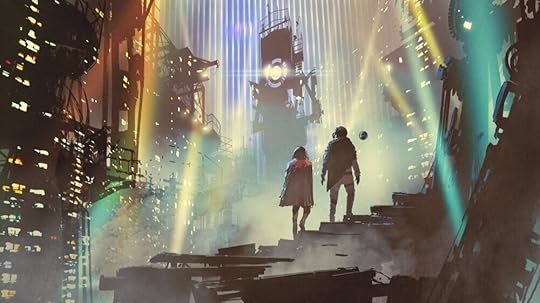
When people ask why I write, it’s always a strange question to me because it reminds me that there are people out there, in fact, most of humanity probably, who don’t makeup stories and write them down. For me, I guess I’m a little bit of a writer cliche. My father was an English major, and a consequence of that was that we as a family always had novels in our home, and usually quality literature too. Another consequence was that we always, as children, had a set of notebooks and pens within arm’s reach. And, if you’ve read previous posts of mine, you’ve probably gathered that my childhood was a little unconventional, so for the formative years of my life, we didn’t have such distractions as television, electricity, or running water - other things that might distract someone from the arts.
In a sense, my fate was sealed at an early age.
Occasionally, though, people wonder how we writers come up with the different possible futures that I write about (after all, science fiction - unless you’re doing revisionist history sorts of things - is about the future and the possible). How do concepts such as a proton rifle come into existence?
For me, that answer is years and years of study of two things - society and computer science. You’ve probably read on my author’s bio that I have a bachelor’s degree in Applied Computer Science in Bioinformatics. That gave me cutting-edge insights into the state of bioengineering, which fed into Models and Citizens. To supplement and stay current, I’ve worked in the computer science industry for more than twenty years, so I’ve witnessed first-hand the global transition from Assembly Language programming (I’ve written code that directly interfaces with hardware registers moving a handful of bytes at a time) to basic websites to the evolution of mobile apps and platforms, to cloud storage. This has given me a certain amount of insight into the evolution of technology, which is a cornerstone of science fiction if you write Hard Sci-Fi like I do.
So how does technology evolve? Well, in fits and starts. Think about the Model-T for example. For 19 years, the Ford Model-T dominated the nascent automobile industry. Before that? Horses. And buggies. The buggies kept getting better and better, more and more comfortable, but they were still buggies. So for most of Victorian history from as far back as Roman history and before, even, horses and buggies were the mode of transportation for those with means.
Then, suddenly, cars.
And then flying cars, right? Wrong! The next logical step in automobiles was flight, but it turned out that flying cars is really, really hard. So for the next century, we were steeped in cars. They may have gotten better, more efficient, faster, but the bottom line is that the automobile was a staple in society. In the meantime, other evolutions took place (like the invention of the television and movie theatres and entertainment generally). But there we were, stuck with cars.
This is how society evolves. Some aspects of technology leap forward while others stay stuck in the past. And it isn’t limited to technology. If we observe the past, then we can extend this lesson into society as well. Look at slavery, for instance. We evolved multiple advances in agriculture from a technology perspective, from better irrigation to the cotton gin (for instance), but we still held firmly to that one constant for centuries. Then, suddenly, it was over-ish. This post isn’t about that institution though - I’m only using it as an example here.
In Models and Citizens, I hold hate groups and the mentality that nurtures them fixed as a staple in a dystopian future. In fact, that’s a large part of what makes the Reality Gradient series dystopian - the over-representation of hate groups. The outclass - models (clones that have been genetically engineered for specific types of labor) - are on the receiving end of a lot of hate. Even though they were created to supplement a dying population, most of society sees them as encroaching and stealing jobs and livelihoods. I also hold corporate influence as a staple. In fact, if you read between the lines, you get a glimpse of a global corporate take-over that occurred just before Models and Citizens opens. The subtext, in case you were wondering, is that it is directly because. of the off-scene global corporate take-over that models were reduced to second-class citizens in the first place.
That may seem fantastical, but it’s taken directly from history, fed by my study of human society. If you’ve heard the term ‘banana republic” then you can understand how corporate manipulation in government can create two-tiered societies, creating a clear and enforced line between the haves and the have-nots. The only thing I had to do with this idea was to blow it up to a global scale.
You can think of creating the future as making soup. I start with a base, a handful of things that don’t change and pour in changes in certain specific areas. For example, volantrae, or flying cars, in this future aren’t your traditional flying cars. I took the idea of the flying automobile and threw away the “must look like car” limitation. There are all sorts of volantrae in this future, from flying breadboxes to flying Mobius strips. After all, if you’re flying, do you really need the wheels? This is more apparent in Bodhi Rising, and if you look closely, you can see that the volantrae in Models and Citizens and those in Bodhi Rising are actually a little different. Even within the series, the volantrae continue to evolve. They move from internal combustion to distributed ion engines, which is part of what allows their shape to stray.
Fun fact: distributed ion engines are based on ion thrusters, used in space travel today and in recent history. The ‘distributed’ part is the science fiction bit. Engines in Reality Gradient don’t have a sole exit for thrust, but multiple pin-point exits, which allow the various shapes to emerge.
So when I think about science fiction universes, the first thing I look for is a believable evolution in technology and society. I look for what’s the same and what’s changed. If the world is fifty years in the future, and everyone has a personal spacecraft, well - that’s not as believable for me. But if everyone has access to space travel, I’d buy that. A good hard science fiction story shouldn’t have too much change in it without connecting the dots on how to get there from here. If we’re honest with ourselves, we discover that society doesn’t evolve that quickly, and when it does, it’s not as though everything changes at once, at least with regard to technological advances.
September 5, 2021
The Soul of SciFi
I don’t have as much time as I would like to consume science fiction television, but I have watched a few episodes of Star Trek Discovery, and I was blown away. The force with which the Star Trek franchise leaned into the love between Culber and Stamets was revolutionary in both what it did and what it didn’t do. Though Culber might seem the typical on-screen male homosexual stereotype, Stamets really didn’t. Stamets gives us another perspective on strength through his love and sacrifice as the relationship navigates the challenges of interstellar war and the discovery of new species. What was perhaps most endearing about it was that the relationship wasn’t the central plot of any episode, but just a relationship that was explored as any other. Star Trek was late with this one though. Look to the 100 for another example of a great non-centric depiction of homosexual relationships, at least for the women. There were homosexual men in the series as well, but the director was very obviously more comfortable with the women’s relationships than the men’s.
This, to me, is science fiction. Challenging the status quo and exploring a future that we think is denied to us. In the Star Trek ToS, the kiss between Kirk and O’Hara shocked audiences across the United States because it revealed one of our national secrets: miscegenation happens. Oh, it happened before Star Trek, to be sure. But Star Trek, through imagining the future and being untethered from the shackles of the current, was able to step past the laws and create a world where it was okay to have cross-racial relationships. Star Trek Discovery and the 100 both delivered on the grand tradition of science fiction - to allow the previously disallowable and challenge the status quo.
A lot of science fiction novels steer clear of the complex social issues that challenge us. This is for many reasons, not the least of which is that authors need to sell copies of their books to make a living, and sadly to say, many of us aren’t yet comfortable questioning some things, at least not in a social perspective. Many, many authors will flex imagination when it comes to what technological advances lay ahead as yet undiscovered. Less explored are the impacts of those tools on society as a whole and even less examine the imaginings of a future society very much different than our own. Those novels that sometimes venture into the idea of future societies often do so in analytical, sanitized ways that do little to challenge the reader. But some, like the Xenogensis Series, the Divergent series, and Beggars in Spain, challenge the very structure of society itself. These novels (and others in fantasy such as anything in the Hundred Thousand Kingdom series - but from my experience, the tendency is far more prevalent in science fiction) bloom from the rich science fiction tradition of challenging the very definition of normal.
This is where Reality Gradient sits. It might be bold of me to suggest that this series has kinship with these greats, but we all do strive for a common goal - challenge the status quo and make the reader think. In fact, Libera, Goddess of Worlds brings together themes from several of the above. From slavery to LGBTQ+ issues like polyamory and acceptance of unconventional lifestyles to personality disorders and acceptance of people who perceive differently - these are all themes that percolate across the Reality Gradient series.
Libera, Goddess of Worlds comes out in November, and holds the truest of the three in adhering to what I call the soul of science fiction - which is to challenge the status quo. I use the term soul because it differentiates the concept from the idea of science fiction altogether. Could science fiction strictly rely on advanced technology and those impacts without weaving in social change? Absolutely. But since the invention of psychohistory and through the 3 laws of robotics, and even before through Metropolis for example, the soul of science fiction has been focused on changing society.
One important thing that the aforementioned authors do well is balance the social implications with a storytelling style that’s entertaining and not off-putting. This was my goal in the Reality Gradient series as well. Did I succeed? I suppose you’ll have to answer that question for yourself. Regardless, I will always continue to push the boundaries of the acceptable and challenge your imagination of what could be!
Reality Gradient

- Andrew Sweet's profile
- 55 followers

