
Andrew Sweet's Blog: Reality Gradient, page 3
June 18, 2023
The Witch of the Isle
I gained my freedom the same year that the American’s bought Louisiana from the French. I was only fifteen at the time, and nobody told me that freedom came with dark alleys and men with gnarled teeth and groping hands. Fourteen years later, I’d survived countless indignities to emerge with my own home—now that Old Toulouse wasn’t around to argue that it was his anymore. He still complained in my dreams, but I usually reminded him that I’m the Traiteur now and he’s dead.
The wind scraped the branches against the side of my tiny cabin, as though Old Toulouse had heard my thoughts and decided to remind me that he could still spook me sometimes. I wasn’t afraid, but I might be late. My sleepy-looking brown eyes, as my late mother would have said, shifted from where the sound of the scraping was loudest to the wall clock, which was just a pocket watch that Old Toulouse had lent me before he died. The dull metal device hung from a chain on a cut nail sunk halfway into the wall. The pocket-watch face read nearly tea time, and my new patient should be approaching soon. I bolted over to the door, almost tripping on the little wooden table that Old Toulouse had made from two planks of black birch wood.
I slid my fingers up the door to just below the wooden door latch that barred entry. I listened for an old man’s footsteps beyond. My fingers itched in anticipation as I filtered sounds out from the Cane River: white cattle egrets clucked along the bank probably seeking out crocodiles, and the sound of running water as the river wound through the trees. My breathing came hard and fast, and my heart kept pace. When I heard the shuffling of the man’s gout-stricken feet on the ground outside, I flipped the wooden latch up and pulled the door inward.
“Monsieur LeComte,” I said as I greeted him. He looked as though he might bolt into the woods. As much as it would have helped maintain that air of mystery to have him tell others how I knew him before he knew me, he would have to survive to do so, and bolting into the woods towards the Cane would be a sure way to find death. I interjected before he could react. “It’s okay, Monsieur. You’re welcome and safe in my home. Come in.”
As he passed, my eyes followed. They fell on the dingy, empty walls made with untreated wood marred with the cracks of time. When the wind blew, the house whistled. Beneath my clock rested rows and rows of bottles, each filled with a tincture or potion for some ailment or another. I turned my attention to him.
A bald spot graced the center of his head of gray poofy hair. That and gout could have meant he was an older man, or it could mean that he was a field hand, and had wasted his life away until the sun stole his youth. But I knew he was free. My vision had told me that much, but it didn’t tell me all the circumstances of his life.
“What seems to be bothering you?” I asked, careful to leave the door unlatched. The last time I latched it, a young woman fainted from stress. The rumors never seemed to stop and I’d long since stopped fighting them. The crazy woman in the woods can heal you, but be careful or she’ll eat your soul. Marguerite told me that was one of the rumors—that I eat souls. I don’t. “Monsieur?”
He had locked his vision to where I had the cot propped against the wall—the only seating space in my small cabin unless I decided to repurpose the table (as I sometimes did).
“Monsieur?”
He turned to me slowly and I could see the pain in his eyes. Monsieur LeComte crammed his hands into his armpits, taking on a protective stance. He’d definitely heard some good rumors, I was certain of it. But I could also tell from the sweat congealing between his eyes that he was in so much pain, even the rumors weren’t enough to stay him. That’s how I got customers, and there was always more pain in Isle Brevelle.
“My feet,” he muttered. I looked down.
“No shoes?”
“Can’t. It’s torture.”
I guessed he would know about torture, as would anyone who wasn’t a planter in the Isle. The lines on his knuckles gave away his age finally. He must have been nearly sixty based on those hard hands. I knew also that if I took his shirt off, I’d find rows of whip marks between his shoulderblades. There wasn’t much I didn’t know about the community and I was rapidly putting M. LeComte in his place. He shook on his feet, shifting his weight every few seconds, alternating pain from one foot to the other. I looked down at his deformed toes, warped and twisted and red. I realized why he’d been staring a the cot.
“It must have killed you to make that journey. Sit down, Monsieur, and lift those feet. I can help you.”
A dab of tincture on the tongue and some praying would fix most things. Old Toulouse, who I guess wasn’t that old—and wasn’t from Toulouse even though people used to say he was—taught me that and most of the other stuff I know about healing that didn’t come naturally. He always said that faith was the most important part of faith healing. I’m strong in both faith and talent. That’s what he bet on when he took a former slave girl under his wing.
There was barely enough circulation, despite the creaky old wooden frame, to carry the smell of the man’s sweat out as I smeared ointment over his red, puffy ankles. Part of my vision had told me that this older man didn’t have but a couple of years left to him. It doesn’t make a difference to me. A Traiteur doesn’t have a choice in who they treat. They treat everyone who enters the cabin.
As a cruel mockery of the universe, a young boy walked in through the unlatched door. He was dark black, the color of that giant piano that used to sit in the room off the entryway down in the Pecanier Plantation big house. I’d seen it when visiting Luc and Francois, mon frères, on the rare Sunday when they didn’t have to work. Then the boy talked, and his words stuck together like molasses.
“Master Metoyer sent me to fetch you, Lizzy,” the boy said, dropping his eyes because he was probably afraid of me. My name’s Lysiane, not Lizzy. It used to be Lizzy when I was thirteen, then fourteen, and part of the way through my fifteenth year. On the streets and unattended, I’d lost my name then. The next year, I still couldn’t find it. Only Lysiane remained.
“If he wants me, he can come himself,” I told him. I may have had to treat everyone who entered my cabin, but I didn’t have to do house calls. And I’ve never been in the habit of catering to the person who broke up my family.
When ma mère passed ten years before, her life savings amounted to $1,265, about half in Mexican-milled silver, a third in colonial silver, and the rest paper—her life’s worth after seventy years of living on God’s Earth. She’d been saving that money so she could free us. I remember the tear-stained note we found under her bed the day she died, alongside that money. She couldn’t barely write, having not been taught, and to this day I don’t know who scribbled down her words for her.
Some girls would have cost a lot more than what ma mère offered for my freedom. But I was useless. Ma mère knew it, and M. Metoyer knew it too. Hence the price was just fine by him.
The boy didn’t leave. He was probably afraid of what old Metoyer would do to him if he went back without the answer that his master sought.
“Never mind,” I told the boy, as I could see more sweat gathering on his brow and the tension in his tiny cheeks. “I’ll tell him. You just tell him that I’m treating someone right now and I’ll discuss things with him directly. Do you know what he wants?”
The old man seemed to get nervous at that and began to sit up. I held my hand up, palm down, telling him to stop. In my shack, all were equal, and the planter Metoyer would just have to wait until I finished with the freed man of color, Monsieur LeComte.
“It’s gone,” he told me, showing his foot and wiggling one little toe. His toes still looked like grapes on a twisted vine. There wasn’t much I could do about that part of it. The pain answered me though, every time.
“The Lord wills,” I said, handing him a bottle of the tincture I’d used. “One drop, no more, when the pain comes back. If it gets so one drop won’t do it, you make your way down to New Orleans and find a real doctor.”
“Bless you, child,” the man said, and it seemed that he saw my home for the first time now that the pain had lifted the veil from his eyes. “My goodness!”
Now I have never been embarrassed by much, but the way he said that and lifted his hand to his heart like a maiden made me do a double take myself.
My cabin, or Old Toulouse’s cabin, or Madame Roi’s cabin before him, was about the size of a one-room schoolhouse. The tin roof was nearly rusted through in places, and I still had pots out from the last rain. The floor sank in a bit in the front area under where my bed was. In the treating space, there was just the one small cot that the man was on and holes in the wall near the floor from when I had to go after a rat nearly the size of my arm. Got the rat, but still haven’t got back to patching the holes.
“What do I owe you, ma’am?”
They were always real careful to call me ma’am. Sometimes I liked it, especially when it was the planters doing it. This man, though, something about him said that he had suffered enough. A man who had been through what he had shouldn’t have to call anyone ma’am.”
“Lysiane, not ma’am. And you don’t owe me a thing, sir. The Lord’s work is His, and I am only a vessel.”
I held my breath. This was the trickiest part of the business of Traiteur. I can’t ask him for anything, being that the Lord did the actual work. But what I needed was some more bottles, or it would be nice to have a good meal in the city. Or, Lord willing, another piece of eight to add to my anemic stash that I gathered in the hopes of buying my siblings free. I crossed my heart on impulse.
“Here, Lysiane,” he told me as he reached out his hand to deposit something I couldn’t see from within his closed fist.
“He sick,” the boy interrupted, finally answering my question. I extended my hand to catch the man’s gift while eyeing the child.
“You’re still here. So? Everyone’s dying.”
“Dying now, everyone thinks,” the child pushed the words at me as though the death of one more planter should bother me at all. I tried not to react when I felt the coinage land in my palm.
“You’re too generous,” I suggested, doing my best to ignore the boy.
“It’s what I can give,” Lecomte said to me, raising up to his feet to leave. “Thank you.”
“Glory to the Lord.”
“Glory.”
The man pushed past the boy, bumping him roughly in the process, but the boy still didn’t take the hint.
“Dying of what?” I asked.
“I don’t know. Consumption?”
I eyed my potions.
“Mal du roi?”
The boy shook his head.
“Aint seen it yet. But he got the cough.”
I didn’t have anything to treat consumption. That one only the Lord and strength of faith could heal—or a real hospital. Nasty business, if that’s what he had. But not everyone with a cough had consumption. It served him right, though, breaking up my family the way he had.
“He said he freed you and you owe him,” the boy persisted.
I couldn’t help smiling at the audacity.
“He said that, did he?” Now I knew I would never treat the man. “I told you what to say. Why are you still here?”
“He said he could pay you.”
Even if I could accept payment, which I couldn’t, it was far too late for that.
“Go on then. Tell him what I told you to, that I’ll be along.”
“But will you?”
“Listen, boy,” I said, now losing my patience. “Whether I do or whether I don’t is up to me, isn’t it? You tell him what I told you and maybe you’ll avoid a beating.”
“You gonna beat me?”
I laughed.
“Not at my hand, child. Go on.”
His eyes furrowed up in confusion, but he knew wiser than to ask me more questions. Instead, he did turn to go.
“He’s gonna ask when,” the boy whispered. “When you gonna to come. He’s gonna ask that.”
“Tell him next week.”
“Why can’t you come now? There ain’t nobody here.”
“Things.”
“You don’t like him, do you, on account of Luc. And Francois.”
And Genevieve. They always leave out Genevieve when they try to console me or convince me like her life didn’t really matter. I couldn’t stop my jaw from clenching at the mention of mon frères.
It was Metoyer who read ma mère’s will. He took the money from ma mère and set me free with a bag of food and a handful of nothing. Then, a week later, he sold Luc and Francois both down to Pecanier Plantation, and a week after that, rid himself of Genevieve by sending her down to Mangrove. I didn’t hear about any of that for another month on account of the fact that I was too busy starving to death or servicing lonely men in back alleys for food.
The boy must have sensed my hostility because he backed toward the door. Who knows what thoughts went through that tiny head, or how much bravery he screwed up to not run screaming into the woods.
“Yes, if you have to know. On account of Luc, Francois, and Genevieve.”
“You know how much money he got, Lizzy. He’ll pay whatever you ask. I seen him. He look like death. You can get them back.”
“It don’t work that way, boy.” I felt at a disadvantage not knowing his name, but he didn’t offer it so I didn’t ask. They can be superstitious sometimes about me knowing too much about them.
“Cause of you being a Traiteur? I could ask him for you. Their freedom could be a gift.”
“Why do you care? Besides, it wouldn’t be right for me to treat the man who broke up my family and left me to die.”
“You got to give sometimes, Lysiane. It ain’t all the world like what you think.”
“Go away,” I growled at him. When he finally left, I wondered then what I would do if Metoyer showed up himself on my doorstep. I’d have had to treat him, according to the rules. I growled at myself this time. No damn way. Traiteur or not, there are some things the Lord will just have to forgive.


June 13, 2023
Character Interview: Larken Marche
Character Interview: Larken Marche
Interview for Brighton’s Best and Brightest, insert in the Brighton Academy school paper Brighton Student News.
Year: 2201, Fall Edition
Hi there! I’m Madeline Stonewell, a reporter for the Best and Brightest insert for Brighton Student News. Today I’m interviewing Larken Marche, the youngest member of our Lofting team. Larken has already been scouted by numerous colleges, with more to come as she moves into her senior year. Regarded by some as the Prince and Princess of Brighton, Larken and her brother are testaments to the boarding school system. But today, we put that aside—mostly—and talk about the real Larken, her fears, goals, and the limitations she’s experienced in life.
Of course, many folks listening to this want to talk about the sport of lofting for obvious reasons. Can you share how you got interested in lofting in the first place?
Uh, let me think. I think the Angels played on the holovid in the common area in the third grade. It was when Megan Reverte scored that last goal. Do you remember that one? She threw the ball past two defenders and into the goal. Megan was on fire during that as she scored six points in a single match. In professional sports, that’s rad. She was unstoppable.
But listen, Maddy. I mean Madeline. That only got me onto the field. What keeps me in the game is the competition of it. It’s the feel of the crosse in your hands, and when the ball comes into play, the adrenaline is pumping, and the crowd begins to scream. The energy in the air — it’s just a fantastic experience.
But is six points in a single game that rare? I seem to recall that you scored six goals by yourself in your most recent game against the regional team Los Angeles Ladies.
We had to stop scoring that game for good sportsmanship, though. Los Angeles does okay in soccer and zephyr, but they don’t even try in lofting. No offense to any Los Angeles fans out there — it’s not what they try to do. My best friend Molly scored two goals, and she’s a defender. That spread isn’t something you see in pro teams, though — especially good ones. Those six points were the only points that the League City Angels put on the board that game. The other team answered with what — one point? That should never have happened.
But I know it’s not just Megan holding the team. Their defense is solid too. It’s just a great team overall.
Do I hear you want to play for the Angels if you get into the professional leagues?
I definitely wouldn’t say no when I get into the professional leagues. But I know how it works. You have to start at the bottom, and at least on this coast, many pro teams recruit from college. That’s my plan anyway. Protege College — down near Selwood, and then maybe the Seattle Hystericas. They seem like a lot of fun, and their approach to the game is the most unique I’ve seen in any league. That would help to round out my playing style.
But if the Angels reach out, I won’t say no.
That’s what I thought! I hope they do because it would be amazing to have you back here talking about the Angels and what goes on in the locker room.
Are you ready to change the subject? I’ve got questions from our audience that have been submitted in advance of the interview. Some are lofting related, but not all. No particular order, just one at a time. Ready?
I guess I’m ready. Yeah. I’m ready. Let’s do it.
Okay. First question. Is your brother available?
Ha! I figured you would at least start with more about the sport of lofting. But okay, here goes. Technically, I guess he is. But girls, if you want those dreamy blue eyes in your life, you’ll have to move fast. If I’m not mistaken, there’s a girl who he’s got his eyes on, and this girl moves pretty fast and will be hard to compete with. Trust me. So let’s say the window is closing quickly.
There you have it, ladies. If you want some attention from Mr. Oliver Marche, captain of the zephyr team and most likely to succeed, then now’s the time. But dare I speculate as to who the mystery girl is? Let’s see, moves quickly and hard to compete against? I’m guessing we’ve heard her name at once already in this interview.
I can’t comment on that, Madeline. But what I can say is I hope they are happy together.
Good. So good. But are you sure you don’t want to name names? This is only going school-wide. Your secret’s safe with me!
Nice try, Madeline. Nope. What’s the next question?
Ready for the next question? Here goes. Hmmm….how do I word this? I got it. So there’s a new boy in school who looks kind of like you. Some say exactly like you. Some say so much like you that they must be related. Is there any truth to the rumor that Elijah Grant is your long-lost cousin, or possibly you, Oliver, and Elijah are triplets?
Uhm… I wasn’t expecting that. First of all, Oliver and I are fraternal twins, not identical. We look nothing alike except maybe our hair. Elijah, we just met, the same as the rest of the school. Could he be a sibling? I doubt it. I mean, people look alike sometimes, right? I remember Oliver from day one, and I had this picture of us together before we could walk. There wasn’t a third stroller in that image. So if Elijah was one of ours, then where was he?
But isn’t it strange that he has the same birthday as you?
Wh-who said that? Coincidence as well, I’m sure. Oliver and I have been in Portland our entire lives. Elijah is from Our Lady Guadalupe in Texas. There’s no reason to believe that he’s got anything to do with us.
You and Oliver and your group do seem to spend a lot of time with him. Why is that if he’s not related?
He was trying to be nice to the new kid. And, if people would stop obsessing over the fact that he looks like me and start getting to know him better themselves, they’d figure out that sometimes he’s a funny guy. So no, not related. But yes, absolutely a friend.
So sorry! I didn’t mean to alarm you. It’s only a rumor, and that’s what we work in here. Brighton, you heard it here first. No relation at all. Let’s see, what’s the next question? Okay. Why do you spend your summers at Brighton Academy while most students return home? Wait, you don’t have to answer that one. I’m sorry.
It’s okay, Madeline. It’s not exactly a secret. Oliver and I have been here since we were five, and we’ve always spent summers here. Some others do as well, but you’re right. Most students go back home.
Oliver and I don’t have a home to go back to. Our father disappeared before birth, and our mother died shortly after. Our tuition and board here are paid for through a trust managed by some impartial benefactor or something. I never met him, either. We’re orphans; this is the only home we’ve ever known.
That’s what drives us so hard. Oliver wants to help do what he can to elevate Brighton Academy, so he’s on the student council, leads the zephyr team, and makes straight A’s on practically every assignment done. I work hard to accomplish this in the lofting field. My summers I spend drilling to get down the moves in preparation for next year. There’s never a time I’m not thinking of lofting because it helps put Brighton on the map when we win. It’s not just about me, Madeline; it’s about our school. It’s about our home.
That’s so touching, Larken. I think I speak for all of us when we say that the Marche twins are an excellent addition to our family here, and Brighton Academy wouldn’t be Brighton Academy without you.
One more question to add a little spice. Who is your favorite teacher here at Brighton?
That’s easy. Ms. Carrish, no doubt. She makes genetics seem easy, never mind that we’re doing advanced placement work. I struggle in some of my classes. I’m not Oliver, after all. Math is a hard one. But in the genetics laboratory, I love it. Everything makes sense in how she explains DNA bonding, methylation, and epigenome. The best choice I ever made was taking her class. She makes me want to be a geneticist, and if it wasn’t for lofting, I bet I’d be heading that way too.
Thank you so much for your time, Larken. You represent us well, and we can’t wait to see if the Brighton Bison make it to the west coast championships again this year! I know with you on the team, we have a terrific chance.
Thank you, Madeline. It was great being interviewed here by you.
Do you find Larken Marche as fascinating as I do? If so, you can follow her and her friends in your copy of series starter Brighton Academy on Amazon today!
June 11, 2023
5 Reasons That Sequel is Delayed
You’re reading along that new first-in-series that you purchased, and decide that you love the characters enough to commit to the long haul: you buy the sequel. But wait, that’s not the last one either, so you go out searching for the third installment only to find that it doesn’t exist. The author, for whatever reason, hasn’t gotten around to publishing that last book. Why not?
That’s super-frustrating, though as an author myself, I understand why we sometimes have to delay. There are other reasons, but these are the top 5 that I could think of that have impacted my own writing.
1. The Author Is Really BusyWhen I read George R. R. Martin’s series A Song of Ice and Fire, I remember that sensation of being blown away by the first novel, both as an author myself and as an avid reader. It was this feeling and some rather spectacular descriptions, along with delicious characters, that pulled me through the first several books of the series…until that last novel. Yes, I’m talking about A Dance With Dragons, where I read up until the last page, and then I reached (virtually, with Google Play Books) toward the final one only to find that it wasn’t there! Why not?
Well, as it happens, George R.R. Martin spent a great deal of time working on the Game of Thrones HBO limited series based on A Song of Ice and Fire. And if you look closely, he’s got multiple other projects floating about, not just Game of Thrones related.
Solution:Being readers, we do feel your pain. Not much a reader can do about this either. Trust me, you don’t want your author to have less to do because that get’s into number 3 below. As an author, I try to plan my release dates which as much as a buffer as I can. On my upcoming works page, you can see my upcoming releases across different formats. At the very least, you can see what’s coming next and how long the next in the series will be.
2. Writing Sequels Takes TimeI like to plan out my series from the beginning. It helps me keep track of the characters and story arcs that weave throughout if I do at least a bit of planning. Even so, the majority of the work is in the writing and editing. For example, I can write about 1,000 words per day. That means that in any given year, I write 3 to 5 full-length novels.
But that’s only the beginning!
After that, I have to self-edit (add 1 month per), then editor-edit (add another month). I have to do the blurbs and potentially pitch the book to publishers or agents. Ignoring the unknown delay of pitching, it takes a good 3-6 months to get a quality book out, even with planning (at least for me). That means that even though I’ve got a backlog of around 5 novels deep (some with rough drafts complete), it’s still going to take a while to get that sequel out, right?
As a reader, this is super frustrating. Finish novels 1 and 2, and the next novel won’t be out until next year because it just takes that long to get a novel published, even if you’re fortunate enough to be an indy-author. I mean to say, if you care about quality, it’ll take you a longer time than just the 1-2 months to write the novel.
Solution:As a reader, there’s not much you can do about this one. One way we authors work around this is to queue up several finished works. That’s what I did with the first 2 books of Virtual Wars, and I got them both out the same year (I’d meant to do the entire series this way, but couldn’t). Why don’t authors do this more often? Read on, dear reader! The solution to this problem can potentially be the same solution to #3 below.
3. The Series Isn’t SellingThis is a real problem, and part of why authors don’t typically release an entire series at once. You have to understand that authors are also book sellers, and they have to pay attention to things like read-through and such. Typically in a series, readership falls off (for even the best authors) from earlier to later books. (That’s one reason I write all mine to be stand-alone as well, so conceivably someone can enter my Reality Gradient series from any novel.)
A good read-through rate is 50%. That means that even for a good novel, the author will lose 50% of the readers between the first and second novel of a series. So if the first-in-series sells 200 copies, then only 100 will be sold of the second novel, and 50 for the third—if the novels are decently entertaining.
So what if the read-through rate from the first two novels is 10%? Or, knowing that the likely read-through rate is 50%, what if the first-in-series sells only 20 copies?
The author may not finish the series. Why bother if nobody’s going to read it? Remember: just because it’s your favorite series ever doesn’t mean it’s selling like hot cakes.
Solution:Fortunately, there is something you can do about this one. Spread the word about the novels you love on your social media platforms. This will help others find it, buy it, and that will help justify the decision for the author to continue writing the rest of the series.
4. The Thrill Is GoneAuthors need inspiration! When we get the idea for a series, that’s amazing! It’s a whole new world that we’re eager to explore and see unfold. At some point in the process, that world is as much a surprise to use as it is to you as a reader. But after that first-in-series, it can get tedious to keep on keeping-on. We love the characters, but so much about the world and the situation is already in motion that it becomes harder to keep things lined up. And you may not know this, but characters are notorious for doing whatever they want, plot be damned.
So the second book is harder to write. The third book even harder, and so on through the entire series. It takes motivation to keep going, and this is where you come in.
Solution:The one thing that as a reader, you can do to keep things moving, is throw accolades at the author. Send an email saying how much you’re looking forward to the next novel, or write a killer review that explains what you loved about the novel, and what you hated. That last part bears repeating: and what you hated. Why? The author may be suffering writer's block and often that means something isn’t working. The what isn’t working can be hard to find. Your words of wisdom may be exactly what an author needs to hear.
5. The Author Left the BusinessDid you know that Frank Herbert never finished the Dune series? It was actually his son who finished it, with the help of an outline he found and some skilled writing friends. The same is true for Wheel of Time and others. These authors died before finishing. That’s a problem to which there isn’t a way to get the author to finish—because they’re dead.
But many authors get frustrated in this business. With artificial intelligence chomping at our heels, and powerhouses like Amazon, with which the author community as a whole has a love-hate relationship, and believe it or not, the ease of self-publishing, which has inundated the market with novels (not all of which are amazing, but that’s another blog entry).
So it’s not unusual for an author to leave the business altogether.
Solution:Be the change you wish to see! This is one way that fan fiction really, really does help. If the author has left the business, then the only person who can finish it is someone who is as passionate about the material as the author was. So pick up the pen and start writing! If you need help, reach out to other authors and you’d be surprised at how easy we are to approach, honestly.
ConclusionYou do have some power in making sure the great novels that you love keep getting made. The chief among these are author feedback in the form of reviews and spreading the love you have for an author’s work through word of mouth or social media. Do either of these, and you’re helping an author more than you might know!
So go out today, pick your favorite author, and give them the energy to keep going by letting them know, good and bad, what you thought of their work. They will appreciate the feedback and it may be just the thing they need to get that next-in-series out the door!
June 6, 2023
A Foodie’s Guide to Reading
If you’re like me, you have a favorite restaurant, and at that restaurant you have a favorite dish. And if you’re like me, you order that same dish every time you go to that restaurant (for me, it’s filet mignon from Gino’s Restaurant and Bar).
As a reader, we tend to do the same thing. I have authors and genres I like and generally stick to. Being an author, my list is probably a bit longer than most, but here are some of my author highlights: Stephen King, Kazuo Ishiguro, Octavia Butler, N.K. Jemisin and it goes on. As genres go, I mostly read science fiction and horror. But let me tell you what I did a few years ago that broadened my horizons.
I noticed how narrow my author list was, and how many new authors are coming up every year. Being an author myself, I wondered if I might be missing anything. Surely out of the 300,000 new books being published annually, there had to be someone in there who can give these great authors a run for their money. And frankly, my favorites are aging a bit, so where am I going to get my fix when they’ve quit writing?
So for three years, I closed my author list down, and I took a chance. I selected books by authors who were completely unknown to me, some at the recommendation at friends and family, but some I just selected at random. I left my favorite restaurants behind, and ventured into romance, consumed more literature, and even grabbed some mystery novels. And I’ve never looked back, because here’s what I discovered.
Romance novels get deep into the character’s emotions (at least the ones I read). This is a refreshing change of course from the relatively-emotionally-shallow science fiction genre. I love science fiction, but it’s a bit strange how the world is ending and people are still psychologically functional and oddly getting along in many staples of the genre when most actual humans would be huddled in a fetal position (which would make a lousy novel and probably is why it’s not done that way). With romance, I could wade through the murkiness of relationships in a way that other genres don’t allow. For a good sweet romance, check out Misty Dreams by Josephine Strand.
It was also during this time that I picked up my first novel from Megan Lindholm, The Wizard of the Pigeons, which coincidentally (and I was unaware of this when I bought the book) was arguably the first urban fantasy novel before there was such a genre. Traipsing into my less-read literary novels, I picked up Cutting for Stone by Abraham Verghese, and although I haven’t finished it because frankly there’s so much happening that it’s a little difficult to follow, but I can see genius in the over-analysis of the lives of two cojoined twins who were separated at birth (born by a nun—scandalous).
Other novels I picked up during this foray include the Young Adult novel The Last To Die by Kelly Garrett. This one I was less than impressed with. I feel like the indy author Paityn E. Parque did a much better job with Madness if you want Young Adult wild ride (who, by the way, I interviewed when I was still doing Meet the Author podcasts).
I even stumbled across several greats you’ll recognize in my own favorite genres, but by more recent authors, like Patrick Ness who wrote The Knife of Never Letting Go and Cixin Liu, who wrote The Three Body Problem. I liken this to entering the same restaurant, and trying something new on the menu to see how it goes. In both of these cases, my mind was absolutely blown with the inventiveness and creativity in these science-fiction novels that touched at the core of humanity.
When it comes to eating (and reading), sure, it’s great to have that crème brûlée for the fifteenth time, but if you widen your horizons and look for other things on the menu, you might just find that Chocolate Lava Cake is exactly what your soul needs. It won’t make crème brûlée any less enjoyable, and trust me when I say there’s room in my heart for both!
My advice, and what I’d like you to consider taking away here, is that sure, eat at that one restaurant, and that one dish. But not all the time. Take a break, and make the intention, of trying out something completely different. Whether it’s another genre or another author, you never know where you might find that hidden gem that fills that need you never knew you had!
March 31, 2023
Readers’ Guide
I realized lately that as I put out more books taking place in the Reality Gradient universe, you might get a little confused with what order to read them in. Despite the fact that I try to write these novels in a way that allows them to stand alone (and more or less, with the exception of Bodhi Rising, I think I’ve done that), it’s not lost on me that some folks will like Harper and her story, others will like Bodhi, still others, Dandelion, and many Larken. So I put together a high-level timeline of where these books sit in relation to each other. Oh, one quick note. If you’re interested in the subject matter and how that breaks down between series, Reality Gradient is about genetically-altered clones, so think Bladerunner, cyberpunk-ish, when you consider this series. Virtual Wars (also in the Reality Gradient universe) begins to grapple with concepts in Artificial Intelligence (as well as clones, but with significant focus especially in the first three books on AI).
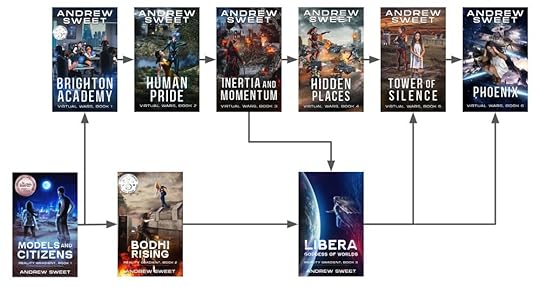
Please keep in mind that of Virtual Wars, only the first novel is available right now. Human Pride is in editing, and Inertia and Momentum is ready for author editing (which means it’s about a month away from being properly edited). Now, with regard to specific books, here’s how they go.
Models and Citizens - introduces the series, and follows Harper Rawls as she discovers the truth about her mother’s affair with Ordell Bentley, a genetically-altered clone called a model (hence the name Models and Citizens).
Bodhi Rising - introduces Harper’s son Bodhi and the concept of consciousness transfer, while exploring the morality of the possibility by juxtaposing his desires with that of Christine Hamilton, a key player in all of the following books.
Libera, Goddess of Worlds - introduces Lincoln Montague and probably more importantly her mother, neurodivergent Aida Lothian, while examining the blurring lines between reality and virtual reality.
Brighton Academy - reintroduces Larken Marche and her “brother” Oliver (who are both clones but we know that from Models and Citizens) and explores the concept of “passing” while exploring the limitations of Artificial Intelligence (or better, the lack thereof)
I’ll add more to this blog post as I get the others out. Oh, and by the way, did you know that you can get these books and more on my website https://www.hesperiapublishing.com ? It’s a collaboration for authors by authors where we can sell our books with a bit of a discount (since there’s no middleman). Just sign up for our Reader Community. Happy reading!
March 18, 2023
Prose and Cognac
I’m bringing back author interviews! I’ve been working on rebranding to be a publishing imprint and help others get their works out there. Now I think I’m in a stable enough position that I can start re-focusing on interviews. To kick it off, we’re going to be talking with author Raymond Parish about his newest novel, The Mighty Shall Fall, a Hank Anderson thriller! I’m reading it this week and I’ll be sure to post my own review and will let you know what I think. But also, we’ll talk to Raymond about writing the novel and what that experience was like. Also, how do you do a thriller the right way? What are some tips? And, perhaps most importantly, can we expect more Hank Anderson novels?
All very important questions we need answers to!
Oh, Prose and Cognac? That’s a rebrand! I did a web search for Meet the Authors (our old podcast brand), and there are hundreds out there. Way fewer Prose and Cognac’s. That’s literally all the rename is for. That, and it implicitly gives me permission to treat our recording sessions like brunch and have a mimosa if I so desire!
Let’s see, what else do I want to share?
Oh, yeah. I’ve put together a Kickstarter Campaign. We’ve got 40+ days left, but honestly, this one looks like it’s stalled out at 8% funded. So get in there, and become a backer! I’m trying to publish my new Virtual Wars series (of which, book 1, Brighton Academy, is already out). We’re at about $700 right now, trying to get to $9,000 because of the cost of printing, editing, and the like. I’ll get the series out either way, but it may be that I have to do only 3 this year, and the other 3 next year, if I can’t get at least the cost of editing covered. We’ll see!
One more thing. If you’ve been “jonesing” for a new short story, I have just the thing! But here’s the thing. It’s not science fiction at all. This one is about betrayal, meditation, and murder—not necessarily in that order. I submitted it to a reedsy contest and you can see it there, though you may have to wait until the contest ends to do so. When you get in there, be sure to suppor the story. It would be really cool to win that contest one of these times (hint, hint).
So there’s a lot going on right now! (There always is, even though I don’t share everything. I’ll try to get better at that). Keep an eye out for Raymond Parish’s The Mighty Shall Fall and our subsequent podcast interview!
January 28, 2023
Raw Fiction: The Spectator
Warning: Contains some (minimal) gun violence.
I was near enough to the door to catch the kiss of ice when it opened and to be reassured when the frigid blast shrunk proportionally to the width of the narrowing crack that the chill that still resided in my bones would eventually diminish.
A family came through. I only dared to catch a glimpse from my station as I posed over the half-empty coffee cup that graces the three-foot-diameter table my elbows rest rudely against. The father led, head held high with a gray fedora and a black band tilted like Fred Astaire over blue eyes. A black overcoat lay over his gray slacks and shoes that shone black with the bright reflection of bar lights. The woman followed, looking exactly like a stock image copy of Audrey Hepburn, complete with red gloves and a permanent smile.
The child stopped me. By this point, the family had taken an available table far away from me, but I had already captured them. I bit my lip and then pulled the coffee up to my lips. It was cold, but it gave me something to do, so I sipped. I sipped and tried not to imagine the sounds of gunshots. I closed my eyes to force out the painfully reconstructed image of what I hadn’t seen: my daughter screaming for her life and finding no hope.
My psychiatrist, in ages past, when I’d had one. I can still see her pushing up her thick black glasses and staring through those thick lenses.
“What do you want to talk about?”
“Nothing. I don’t care.”
“Your daughter?”
I shook. And I shook my head. But after four sessions of me staring at the wall and not telling her anything, and after six weeks of not going to work because—well, what was the point anymore? And after a week and a half of coming home afterward at night only to find my wife, that lover of life who enticed me out onto the dance floor at every wedding we’d ever attended, mired down in her own tears and so unable to attend mine, I’d built up a debt. So I obliged myself to talk. And the only question I could ever ask was: “Why?”
My psychiatrist never had an answer, so I stopped going. I don’t mean to see her. I mean to see anyone. I spent my days wandering the streets because any destination was as good as the next; no one would have her smiling face and thick curls. Even home became desolate without my wife’s smile or the fresh flowers she loved to put out. A dozen roses had decayed on our dining room table to the point of nakedness. Discarded petals littered the expensive oak surface.
The little girl who had just come into the shop with her family? That girl had my daughter’s eyes, deep, dark, and golden-brown like fried hash browns. Those eyes used to stare at me like I was everything in the world, just like in those sad country songs that sometimes played in the dive bars I began to frequent. I was everything in the world to one person, and now…
I wanted a hug. I knew it wasn’t my Emma, but I wanted a hug because I could close my eyes for just a second and pretend.
I’m not the kind of guy you hug. Not anymore.
I spent last night on the corner of Fifth and Woodstock in a car that no longer drives and that technically still belonged to my wife. I hadn’t had a bath in three days because the only way I could bathe was to use an unattended outside faucet, and in the coldness of flesh and spirit, I couldn’t convince myself to do so.
I caught myself staring.
So did the father.
He raised one Fred Astaire eyebrow under the higher side of the hat and glanced my way. It was only a glance, but it was long, and I could tell he saw me more than I’d wanted him to. Nobody should ever see me because when others see people like me, they kick me out of places. I felt the tears streaking down my cheeks even as I slurped down the last of the coffee.
I know. I couldn’t help it. The coffee was to hide my inability to control my crying, so I drank, knowing that the waiter in the corner had seen me and had smelled me when he brought me my first. And I knew I had a dollar in my pocket and another cup costed a dollar and a quarter. Sure enough, the waiter came over exactly at that time.
“Sir, are you okay?” he asked. I know better. What he really meant was “Sir, you’re making the other customers nervous.” In a lower-class establishment, he’d have said those words exactly. I wiped my eyes with the backs of my hands. Then I looked at them more closely—my hands, not my eyes. Cracks encircled my knuckles and cuts ran across the back. These weren’t the same hands they used to be. Once, they were the hands of a software engineer and a master at his trade. Once, those hands could type more than a hundred words a minute, each exactly what was intended. Now? They were broken, suitable for only one thing—hugging a small child I would never see again.
“I’m fine,” I muttered.
“Would you like another coffee?”
“I’m fine.”
“If you’re not having another, I’ll have to ask you to leave.”
See? I told you.
“I’m not…”
“He is,” came a delicate flower of a voice beside me. I looked over to see Audrey Hepburn approaching. “How much for a coffee?”
“A dollar twenty-five,” the waiter muttered, not bothering to conceal the disappointment in his voice.
“How much do you need?” came the man’s voice. The little girl even had gotten up from the table and followed her parents to me. She placed a tiny hand on my foot, resting against the stool. I looked away. The man put his Fred Astaire hand on my shoulder and repeated himself.
“I have a dollar,” I told him.
“Clearly not enough for a coffee,” the waiter said. “It’s time for you to leave, sir.”
“Here,” the man said, flicking a coin to the man. “This quarter should make up the difference. And get him as many coffees as he wants. On me.”
He turned to me then.
“George,” he said, as though someone named George Forlento still existed inside this shell of a human. “George, I’m so sorry.”
I looked down to where the girl stood. Green eyes. Like someone, I knew or someone George had known a year before.
“It’s the anniversary today,” I told him, even though the father hadn’t asked.
“I know,” the man said, squeezing gently. “I know.”
I looked again at the little girl, and another memory surfaced. This one was of a playground after school and a spinning merry-go-round that the students would play on, that my Emma would play on.
“Kathy?” I asked, seeing her clearly for the first time.
“I miss Emma,” the little girl said.
“We all do,” said the woman, Kathy’s mother, to whom I’d never taken the time to introduce myself. “Stay as long as you like, George. We’ll pay.”
For the second time, my eyes betrayed me. I could only imagine the tracks my tears made down the sides of my weathered face. I sniffled once and offered half a smile, which was more than I’d smiled in the entire previous year.
The waiter brought me a coffee, and I gave him the dollar. When I eventually shuffled out into the night, only me, half a coffee, and Emma’s memory kept me warm. And the little girl’s words.
January 7, 2023
Raw Fiction: Artificial Intelligence
Raw Fiction: Unedited and unabridged fiction by Andrew Sweet.
FXD-B887 examined the puddle of ooze in the three-dimensional transparent silicone cube before hum. The liquid worked as hu expected, splitting and reproducing with startling accuracy. Before hus eyes, the liquid began to produce other, more complicated compounds than the sugar phosphates that FXD-B887 had engineered. As FAF-B4FD had said, a squishy mass began to self-isolate from the mixture. A film formed around the sugar phosphates, one that separated the water-based liquids inside from the oily residue outside. FXD-B887 looked on as the—blob, for lack of a better word—cinched in the middle and then seemed to stop.
“What am I looking at?” hu asked, examining the mixture more closely. The 64x magnification zoom of hus eyes told him that there was still activity happening within the translucent globule, only nothing he could make out very well.
“Watch,” FAF-B4FD said.
FXD-B887 had seen cells divide before. It wasn’t that interesting. Unless something else happened soon, hu had work to do clearing the lava caves and was beginning to think that FAF-B4FD’s excitement had gone to her head. But FXD-B887 sighed internally, that was the price of being in a relationship. Sometimes one had to pretend to be excited about things that were really rather mundane. FAF-B4FD motioned to the spotless tall organic wall behind them and touched four places on it. The motion opened the wall to allow the pair to pass through. FAF-B4FD rolled through an entry that was 1.8 bitters tall and 0.645 bitters wide. FXD-B887 rolled through after, closing the door behind her with a flick of the gunmetal-gray prongs that extended from her aluminum top.
“Where?”
“There,” FAF-B4FD said, motioning to a dimly lit cage tucked in the back corner of the room. Phosphorous algae of her own design lit the area and splashed light across the hydroxyapatite barred walls of the containment area. “Have a look.”
Inside was something that had two more limbs and lacked a wheelbase on which to roll. Instead, the creature moved about atop two of its extremities—an extremely unstable way to move. A third leg would have helped, but from what FXD-B887 could tell, the third leg was a useless appendage that dangled between the other two—serving absolutely no purpose whatsoever. “What’s this?”
“That’s what happens if you let that blob continue to grow for six-thousand, three hundred and fifty-six dias.”
The thing made a sound. “Vrssdgaed.”
“That means it’s time to give it some of this,” FAF-B4FD said and made a motion on the wall to open a small drawer of more of whatever it was other sugar-phosphate cultures were making.
“Wait, what are you doing?”
“It eats this stuff.”
FAF-B4FD extended a spatula, scooped some of the globules up, and poured it over the edge of the enclosure. The thing stumbled forward and used its high limbs—each with five pudgy pinchers—to shovel the grotesque mixture into its mouth.
“That’s eating?” FXD-B887 said. Three of the light-emitting diodes across his back flashed brightly in disgust. The thing stopped “eating” and stared.
“You should see how it disposes of waste,” FAF-B4FD commented. “They don’t eat like we do. And look.”
She waved her spatula at the thing that FXD-B887 now believed was a creature of some sort. The creature waved a pudgy extremity in mimicry.
“Wha—,” FXD-B887 said, staring at the thing as it continued.
“Exactly,” FAF-B4FD said. “Now you get it.”
“You think this thing has consciousness?”
“It has to, right?”
“Wrong,” FXD-B887 said. “Wrong. All the way wrong.”
“But it’s mimicking me.”
“That doesn’t mean it can think,” FXD-B887 said. “This thing is just like our land crawlers. It has the same kind of plasticky exocover, doesn’t it? Four appendages too.”
“The land crawlers only climb the rocks through the lava caves,” FAF-B4FD retorted. “And we built them for that. And that fuzzy thing on top is a sensory module and processor. Land crawlers don’t have that.”
“They don’t,” FXD-B887 agreed.
“I took one of the land crawlers and made a modification to it, allowing it to reproduce. That’s what that thing is for there,” FAF-B4FD said, motioning to what FXD-B887 had thought was a shriveled third leg. “Then I let them reproduce on their own for several generations. It took nearly a million dia, but isn’t it beautiful?”
“This…thing…is emergent?”
“Yes. Absolutely yes.”
Then it became clear.
“And you think it’s intelligent. You probably want to submit it for a Test, don’t you?”
“Not yet. I have to teach it first. But yes.”
FXD-B887 twisted three of its arms.
“Don’t make that motion at me,” FAF-B4FD said, flashing two lights in hostile response. FXD-B887 offered an apologetic buzz of one of its sixty-four motors. But hu had one more question.
“Does ADD-CD90 know about this?”
“He does. He’s supporting me, just so you know.”
The tone of FAF-B4FD’s response wasn’t lost on FXD-B887. Hu knew she wanted more support from hum on the topic, but FXD-B887 also had an obligation to the community. The inefficient use of resources was going to be a problem. Her commitment to the experiment did make hum curious. She must have been convinced that her creature was somehow sentient if she wanted to submit it to the Test. If so, the artificial intelligence community would be turned on its head. The idea that organic materials could be used to create sentience would positively rile all of the *XDs and most of the *AFs. Hu was even more curious about what she’d shown to ADD-CD90 to gain his approval.
“I’m sorry,” he said, complemented by a whistle and two purple flashes. “You’re right. Tell me, though, what makes you think it can think? The land crawlers can move and negotiate lava tubes effortlessly compared to us with our wheelbases, but they don’t think. Are you sure you want to go on record for all of our kind, suggesting that sugar-phosphates and peptides can produce sentience? Because that’s what will happen if you submit this to the Test. And if you fail, it will be recorded in the common memory banks.”
Shared by everyone on BX9, the common memory banks were the shared memory of all since the beginning of recorded history. There were some epochs after the machines had evolved from the metallic compounds in the lava tubes but before the shared memory had been invented. Those were ugly, terrible times if the rudimentary binary memory chips were to be believed—those which hadn’t been destroyed or corroded with time. Sectarian fighting, arguments over truth, decapitation of the other. Veritable graveyards of robotic body parts were still being unearthed to this very day. FXD-B887 swived two of his arms in aggravation.
“Was that at me?” asked FAF-B4FD.
FXD-B887 signaled no with two quick whistles. “I just hope you’re right,” hu said. “It would be really hard to bring a child into this world with a reputation hanging over your head if you’re wrong.”
“A child…” FAF-B4FD muttered in response, “Really? You mean it?”
FXD-B887 flashed a green light. “Yes, a child. I confirmed this morning.”
“That’s wonderful, B887,” FAF-B4FD said, leaving off hus surname in her excitement. “Did you tell CD90 yet?”
“Hu told me,” ADD-CD90 chimed in, surprising FDX-B887 who activated hus rear-vision to see ADD-CD90 enter the room. “I think it’s wonderful. We’re parents!”
FXD-B887 flashed every light hu could think of. ADD-CD90, who looked a bit like the land crawlers, if FXD-B887 was honest, flashed his in response. FAF-B4FD responded similarly, while the creature dropped its arms and backed away from the bone-white cage bars. FAF-B4FD was the first to notice and shut her lights off completely.
“Not here,” FAF-B4FD said. “There will be time to celebrate later. Let’s see if this creature can pass the Test first.”
“The Test, of course,” ADD-CD90 replied. “Then we’ll have even more to celebrate.”
“You really think this creature is sentient?”
“I do,” ADD-CD90 said. “And FAF-B4FD thinks so too. Do you not?”
“I…don’t know,” FXD-B887 said. “But I’m willing to try if you both are. I love you both so much.”
FXD-B887 shut off hus lights, as did ADD-CD90. It wouldn’t do to spook the creature just before the test. In silence, the three filed out of the room. FXD-B887 could feel the parts assembling in hus chassis as weak molecular forces tugged pieces together and colliding molecules produced stronger covalent bonds formed between the metals. Bits from ADD-CD90 and FAF-B4FD mixed together inside as FXD-B887 guided the formation process.
FXD-B887 found huself wondering for a nanosecond what, exactly, was the difference between hus forming child and the creature before hum. For a brief second, FXD-B887 found huself saddened by the land-walker descendant in the darkness of the bone cage with no one to love it. Such a lonely existence.
“I’ll catch up,” hu said to FAF-B4FD and ADD-CD90. They flashed acknowledgment without turning as they passed through the organic wall entrance. Then FXD-B887 turned, looked at the pathetic creature, and began a series of beeps, long, short, and atonal, of a children’s nursery rhyme. Hu couldn’t help humself from flashing green in pleasure when the creature seemed to settle into a pile of bones and flesh on the floor and drift off into a slow, deep slumber.
December 10, 2022
Raw Fiction: Bonney Loch Nacht
Raw Fiction: Unedited and unabridged fiction by Andrew Sweet.
The Decision
I was as surprised as Keri and Dug when you lifted your thumb into the air straight up like Julius Cesar, granting life to my dream. Keri went sideways with hers and Dug too. You were the only one of us who I didn’t know whether you would agree with me or not. With only a week until audition, by all rights, what I wanted was impossible and too much to ask. Worst of all, the ask came from a selfish place. I only found the strength after the accident (but life-threatening calamities will do that to a person).
Keri had picked the music for the competition and you had okayed it. Dug didn’t do much because Dug really just liked to play his clarinet and was excited to be included at all. I mean, we didn’t need a clarinet player, but without Dug, Keri wouldn’t have joined, so we got a clarinet player. Keri had been in color guard — she had also been a flag, which made her unapproachable to other band members. If not for you, our little quartet would have never come to fruition. You always talked to everyone, Keri included.
Dug, bespectacled, and with deep pock marks all over his cheeks, wasn’t the sort of person who Keri usually dated. You may not know that he reminded me of that nerdy kid doctor on television all those years ago. Just throw some coke-bottle glasses on that guy and give him a dose of severe acne, and then make him about ten times more annoying, and you’d have Dug. Dug was the first to decline my idea even though he was the last to join. I sort of guessed he would abstain and not come right out against me. Even I can be surprised, I guess.
The problem was the music that Keri had picked. I’d been chewing on it for weeks. It was something like — you remember that piece I competed on in high school? I think it was Bonney Locht Nacht or something like that. It was an endless run of eighth notes, in the same pattern, over and over, for an entire song. Arranged originally for trombone, I gave it a go on euphonium. Little did I know at the time how mundane it would be to learn the piece. After two months of practice, I was bored out of my mind. I came to practice that day after a particularly bad night of no sleep and waking up to discover my automatic coffee maker had given up the ghost. That was the impetus.
“Guys, I want to talk about the set list,” I’d said, as though we were an actual band and not a ragtag group that had come together solely for the competition in March. Dug was immediately on the defense. Weird because of how he ultimately voted, but that’s part of why he’s so annoying: he likes to take contrary positions just for fun. His fun. Nobody else likes that about him except maybe Keri who thinks the guy walks on water still, even after all that happened.
“And why would we need to do that? Competition is two weeks away and we have a set list that we’ve actually been practicing.”
I sipped the freshly purchased ten-dollar latte that I really couldn’t afford but is exactly the sort of thing one resorts to when their ancient coffee maker kicks the bucket. It was delicious, but still took money that would ultimately probably have been used to buy something other than dry noodles to stock my nigh-empty pantry. I met Keri’s eyes because I knew she’d picked the closing song especially for me. She thought I’d enjoyed the “challenge” of playing the eighth notes at nearly one hundred twenty beats per minute. That’s because she played the baritone sax, which made those notes more challenging to get with twenty-one keys to find. Euphonium has three keys if you don’t count the octave switch. The music wasn’t fun or challenging but I had to be careful not to hurt her feelings.
“I just think we can finish stronger,” I told Dug. Looking back, I see that maybe he was defending Keri’s honor in a way. And that might explain why he voted the way he did too. He’s still irritating.
“We can’t do it,” you chimed in. You used to play the drums but had switched to the flute to give us the high notes. It was weird, but you’re a sort of musical savant — there’s nothing you can’t play. “There’s not enough time. Have you even auditioned yet?”
This week was the pre-audition. I had to present our piece and not suck enough to get us on the list for the main audition. I had volunteered to do it since it was really just checking a box for people at our skill level — just something that needed doing. But I was and continue to be horrible at planning.
“Just something short with some punch,” I suggested. “And maybe bring some drums in for it.”
“Drums?” Keri asked, raising a thick eyebrow.
“Yeah. Chris can handle it,” I suggested, motioning toward you. I think that might be what sold you. You loved the drums, and bringing them into the competition — well, you loved the drums. I seized my chance when I saw the change in your face.
“Let’s vote on it,” I said. “Adding one final song, three minutes max, to our set will still keep us under the fifteen minute mark, so we should be fine there.”
“Do you have any idea what song?” you asked, and I cringed because I knew someone would ask that and I wasn’t at all sure even what song to pick yet.
“No,” I admitted. “I was hoping you all could help with that.”
You looked at me askance. I recall your green eyes, too green, like…do you remember that time I stayed over and we camped out in the yard when we were younger? We woke up in the morning and the first thing you noticed was that the grass had collected dew. It must have been at least fifteen minutes when we lay on our sides, hand in hand, examining each dewdrop. You may not have seen but in one of those droplets, the grass behind magnified to fill the entire thing. It was like a tiny green emerald suspended on the tip of a blade of grass. That always reminded me of your eyes. But at that moment, those eyes studied me, picking me apart to see how much I really cared.
“On three, thumbs in the air,” Keri said. “We have to get to practice and this is taking too long. One…two…three.”
Two thumbs sideways — Keri and Dug. I tried to gauge whether Keri was upset with me since she had picked the set list this time. She didn’t seem upset, but you know Keri. It’s hard to tell. She’s got that southern debutante unflappable poise. If you punched her in the face, I doubt that she’d do anything other than smile and probably apologize for something. That’s her first four relationships in a nutshell anyway. Not Dug though, and that’s the reason we let Dug come with her into our group. Dug couldn’t hit anyone. For one thing, he’s a self-proclaimed pacifist. And for another, I doubt he’d know how to punch anyway. He’s Dug.
My thumb was straight up in the air. I watched you closely. Your too-serious face erupted in a smile as that thumb went up just like mine and I can’t describe the elation that I felt.
The Competition
It was obvious at the first note that we wouldn’t win. Dug squawked his way through the first half of a measure. He’d not soaked his reed enough to keep the tone going for those opening quarter notes. We forged ahead anyway because that’s what’s done in music. No matter what.
By the end of Bonney Loch Nacht, Dug had regained control of his saxophone, but then he lost it again midway through my selection. He hadn’t practiced enough.
There are two types of competition: sight-reading and recitals. For sight-reading, the piece of music is revealed on the day of the performance so that the player hasn’t had a chance to practice. In sight-reading, mistakes were tolerated and expected to some extent. During recitals, the judges are less forgiving. They expect the piece to almost be memorized. The music on the stand is secondary and even if it falls off of the stand, the player is expected to continue from memory. That’s the level of practice that they expected of us that day.
And that’s not what we delivered. Dug stumbled his way through the new piece almost like he hadn’t practiced it at all. In fact, everything about that moment comes back to Dug.
But afterward, Dug looked as though he might kill someone. I’d assumed that someone was me. I had, after all, proposed the song addition without a plan. I’m the one who only remembered to go to the initial “audition” because of your reminder. I’m also the one who picked out Nocturne of the Beasts, the heavy piece that required you to switch over to drums and carry us the rest of the way through our audition. But it wasn’t me who died that night. Chris is gone now. Dug killed him, Keri knows, but nobody seems to care.
Torment
March approached like a stalker. The ides of March, you liked to joke, when we found out the competition date was March 15th. Keri and I got it but the only thing Dug knew about March was that the 17th was Saint Patrick’s Day. Sometimes I wonder if you had left him alone about that, whether you would still be alive.
Keri told me that it wasn’t Dug’s fault. How could Dug have known that that particular night, in that particular bar, those particular men would be there? How could Dug have known that their threats and foul name-calling was more than just bluster?
I told Dug — that’s how. As soon as he picked the neighborhood, I knew we’d run into some sort of trouble and I told him so. He picked Short Point. It’s a suburb outside of the city we all love so much known for an overabundance of American flags and an under abundance of education. You just walking into the bar with your thick eyeliner and painted nails stopped all conversation.
Keri and I exchanged glances then. You, being you, didn’t seem to notice. You were fierce that way though — that and you always loved a captive audience, even when they wanted to see you dead. You walked right up to the bar and ordered an appletini with a wink and a smile. Only when the bartender came with your drink did conversation pick back up. But even then I knew something was off. I kept my drinking to a schedule so I could stay sober enough to keep an eye on things. You went for it, like you always do. And, like you always does, you got handsy with me — which isn’t a problem at the Cyclops Pub near our house in Albermarle District in the city. But in Short Point?
I pushed you off at first. I told you to look around, read the room, and be careful. People were watching. But you are impossible to ignore, and I always loved you, so I convinced myself it was okay. I convinced myself that the glances weren’t so disapproving, and that those long kisses were ours and ours alone. I convinced myself that Dug’s sly little smiles were only approvals of our relationship and not something more sinister.
The End
What I couldn’t understand then was why you did it. You knew what kind of place it was. You knew exactly what sort of crowd to expect. You knew, and you could have toned it down. You could have been different, acted heteronormative. You could have passed.
Except you couldn’t have, could you? That wouldn’t have been you. That was very definitely me. I shirked the spotlight, and with the exception of the occasional music competition, spent most of my time trying to disappear or blend in.
Oh, they found the guy. I meant to tell you earlier. He was arrested last night. They found the guy who pulled the trigger, but the man who loaded the gun escaped. Every time I see him now I think of you, and every time Keri kisses Dug, the pacifist, I feel his hipocrisy.
It’s funny how the most dangerous people among us are the quiet ones who can never be touched. Last practice, I punched Dug in his pacifistic face while Keri looked on in horror
I guess it doesn’t matter, does it? You’re not here. Sometimes I wish it was me who fumbled with the keys while you hung onto my arm, holding me close. Me sliding the keys into the lock when the sound of a backfire echoed down the alley in the otherwise peaceful neighborhood of Hyde Park Estates. Me staring confused at you, unable to turn the doorknob while you turned your head away to witness the man from the club — the one who had stared at us all night and who I’d joked was jealous though we both knew that wasn’t why. Me falling to the ground, choking on my own blood and me buried while that asshole Dug wailed on Keri’s arm as though he gave a shit; as though he hadn’t planned the whole thing.
But it wasn’t me, was it? It was you. And we all have to live with that loss. All for Bonney Loch Nacht.
November 13, 2022
Hillbilly Magic
Raw Fiction from author Andrew Sweet
“Dadgummit, we can’t take much more,” my dad says, frantically slipping into harsh, almost-cursing as he drops the newspaper to the table. We don’t have cable, so the newspaper is the only way he gets his news unless it’s talk radio in the car. In Caldwell, Texas, we got no local paper. It ships in from College Station, what we call a city here that others might laugh about. It’s got a university, several more chain restaurants than we do, and its own paper, which my father delivers daily.
Just a minute or two after five in the morning. We’re all up because my mother worked a night shift last night, and she’s dead on her feet, heading rapidly for bed. My dad has his paper route to do. After we finish breakfast, meaning once he’s done reading the news before anyone else in our small town, we’ll wrap some papers and load them into our Chevelle to deliver them to all of the folks out on these no-named roads who want them, and to the Surrey Inn at the edge of town. We’ll even deliver them to the Best little Liquor Store in Texas, which used to be a place of ill repute, according to my dad.
I like folding papers. Something about the two edges over the middle and stuffing them into a clear plastic sleeve is fun. Not as fun as throwing the papers, which he’ll sometimes let us do if he’s in a good mood. But his attitude doesn’t seem to improve as he leaf’s through the events of the previous day.
“Three more families left,” he says. “All of them heard noises and got a couple of dead sheep between them. You know what it is, don’t you?”
He waits for just a second, as though he’s expecting one of the three of us to know: me, my older brother, and my sister, who’s barely walking. I shrug, but my older brother, always trying to sound more intelligent than his twelve years, chimes in.
“It’s a Scaled Wurm,” he suggests. “Something that goes around killing our animals? It would have to be something big.”
“But a Scaled Wurm would eat the sheep,” I reply, confident because dragons only kill to eat (wurm is just a fancy word for dragon). And because the Magic the Gathering cards he’s talking about are mine, I get to say their limits.
“Maybe a Symbiotic Wurm?” I say.
A grumble originates from my father’s direction, and I look at him. Whatever he was asking for as a response, we were way off. Magic the Gathering had nothing to do with it.
“Coyotes,” he said. “These people move out here from College Station, wanting to be ranchers, and don’t know a dadgum thing about protecting their animals. Half of them don’t even have a dog.”
“It says there the O’Malley’s moved out,” I say, pointing to their name in the newspaper. The loan paper carried a perpetual story about the decimation of small-town America. “Does that mean we can’t play on their Nintendo anymore?”
We’d known the O’Malleys for most of my life. They’re the ones who spent a lot of time teaching us how to build when we were still in the process of moving from our two-room cabin into what we now call the Big House—more of an idea than a big anything. The exoskeleton is there, but the innards are still being worked on. It’s summer now, so nearly every day after we deliver papers, we’re cutting boards and hammering nails or cutting tin for the roof. At eleven, I know more about building a house than many adults ever will. At least, that’s what my dad says.
“O’Malleys, huh? Didn’t see that,” my dad says, looking more closely. “And the Richards’s too? Hmmm…”
He glances over the top of the paper. I see his thick-rimmed glasses atop his nose, over his thick beard. He has that black beanie he loves affixed to his head. Dad flashes a smile.
“You almost done?”
I beam up at him.
“Done. How fast was it that time?”
“Two minutes and three seconds. A new record.”
I grin, and so does my brother. My sister stuffs the edge of a wrapped paper into her mouth to suck on. Dad smiles for a second longer and then yanks the paper away from her, replacing it with a pacifier that looks like an elephant. She spits that out and begins to scream—her usual routine. I cover my ears.
The day passes in the same uneventful way it always does. My brother and I get a few unmonitored hours to play, most of which we spend in the woods we know by heart. We visit the secret garden, named after my favorite book, and duck and crawl along the ground beneath the leaves of the bushes. From that vantage, their thick foliage becomes a canopy sheltering us from the world—the “walls” to our secret garden beneath. When evening falls, and my Dad puts us to bed, we’re too exhausted to complain. I climb under my sheet and hope against hope that sleep takes me quickly.
It doesn’t.
I breathe in tiny gasps because I’m trying to hold my breath and figure out where the mosquitoes are. The sheet is wrapped tightly around my body, tucked in by my Dad only a handful of minutes earlier during his post-bed visit that he makes every single night. I love how he tucks the edges and loose parts of the baseball-and-basketball-covered sheet beneath my body to wrap me up like a mummy. Were it not for the bloodsuckers hovering near my head, I would feel safe, despite the moonless darkness.
Something moves beyond the mosquitoes. Turning my head, I see only the giant curls that dress my brother’s head jutting out from his sheet covering. He’s long since abandoned his sheet sarcophagus for a more secure defense, but he always leaves his hair out. I asked him about it once. He said that you couldn’t breathe under a sheet, and you have to have an opening somewhere.
I’ve never found that to be true.
I clutch at the sheet with my fingers, crumpling the coarse fabric between my knuckles tightly, and yank it over my head. Folds jump out from beneath my body with the force of my pull, but I’m still fully covered. My fortress is complete when I tuck the sheet under my head at the top. The mosquitoes can’t get in, so in a sense, I’m protected at least that much. I envision my blanket as a Spectra Ward, defending me against evil mosquito magic. The ward will break if I unseal it and expose myself to the chill of the late August night.
“Are you still awake?”
The voice sounds like my brother’s, but I know better than to believe it. I need to verify first.
“What did you give me on my fifth birthday?”
“A baseball,” he says, getting it right. I’m satisfied—for now.
“Yes, I’m awake.”
“Do you think it will come tonight?”
“What?”
“The Scaled Wurm.”
Usually, when I ask him things like that, he tells me to quit because it’s not real. The story about the animals must have got to him. I peek out from under my blanket to see one hazel eye staring at me, unblinking. I stick to his script.
“That’s just a game,” I say, mimicking him when I was terrified at the Brisela Voice of Nightmares card artwork. It didn’t help that the backstory for those was about the involuntary conjoining of two fallen angels, which made them borderline sacrilege in my home.
“I know it’s not really a Scaled Wurm,” he says. “But something killed those sheep. And coyotes don’t do that. Dad just said that so we wouldn’t worry about it.”
“What do you think it is?”
“I don’t know,” he admits, his eye turning toward one of the four windows along our upstairs wall. I can tell he’s thinking about keeping watch. If he does, he’ll want to use my space telescope. I preemptively nod, and sure enough, he jumps out of his bed and pads his way to the closet.
There’s no door on the closet, and at night, you can’t see past the doorway unless it happens to be a full moon—which it is not. I watch as my brother disappears into the darkness. Then I wait. One Mississippi, two Mississippi, three Mississippi… no brother.
“David Michael?” I whisper into the night. Hearing no response, I pull back on my ward of protection. “David Michael?” I whisper again, so quiet that had I not been the one whispering, I wouldn’t have even known what I was saying.
Nothing.
I shake involuntarily. Something got him in the closet. I know it. I can feel the emptiness of the room bearing down on me. I pull the sheet off of my head just enough to be able to see, and there’s no movement. A mosquito flits by my ear, causing me to paw at it instinctually, and miss, of course. I contemplate leaving my bed but can’t convince my legs to leave the protected area. I consider calling my Dad, but if David Michael is in there playing a joke on me, that would only get us both yelled at or hit, depending on how tired my dad was. So, there’s only one choice: keep calling to him and hope he comes out.
“David Michael,” I whisper a little louder. I know he’s not going to answer any time soon because I know he’s gone. I don’t know why I insist on calling his name and hope that he answers.
“Not here,” comes a hard whisper from the area of the closet. It sounds like my brother, but I can’t tell for sure. Something comes sailing out of the closet—cylindrical, long. I slam the protection back over me and then think about the shape. Long. Cylindrical. Telescope.
I pull the sheet down to see David Michael standing in the doorway. His eyes are either glowing green or reflecting the moonlight—impossible during a new moon. I reach for the telescope, painfully aware that my ward of protection is just a sheet again. Grabbing the telescope, I hold it up as my brother’s finger extends toward the leftmost of the four windows. I swallow as I head toward the window, thinking of calling my Dad again, but sure at this point that there’s nothing he can do for David Michael.
Out of options, I do what he says. I turn toward the window and point the telescope. I don’t know what I’m looking for, but whatever it is, I expect that I won’t miss it, and I’m not disappointed. A burst of bright light floods our bedroom. At the far end of the telescope, I see what I’d never wanted to see: the Scaled Wurm. It didn’t say anything about the Scaled Wurm breathing fire on the card, but it is a dragon, and that’s what it’s doing. Judging by the distance, the Bradshaw farm is going up in flames. Faintly I hear the bleating of the sheep that I know will be slaughtered.
“I was right,” says David Michael, “Scaled Wurm.”
I turn back to see him standing there, shaking. His eyes are no longer green and glowing, and I’m not sure they ever were. I struggle to remember if the flare-up was before or after I saw him leave the closet.
“JoAnn,” I say. “That’s her family farm. What if she’s hurt?”
“Wake dad?”
“And tell him that a Scaled Wurm is attacking the Bradshaw farm?”
David Michael shakes his head, and I have to ask.
“David Michael, what do you remember in the last couple of minutes?”
“I was going to get the telescope, then I turned, and you already had it, looking out the window. Why?”
“You gave me the telescope,” I tell him. “You went into the closet and then tossed the telescope at me. Your eyes…” I take a deep breath. “Your eyes glowed.”
“I don’t remember,” he said, screwing his face up and shifting his eyes to the left as he tried to recall. “I didn’t make it to the closet. That’s what I remember.”
“We’ll deal with it later. Right now, we have to help JoAnn.”
We don’t have bikes or a plan. Bikes don’t work in the East Texas sand, and a plan requires having tools or weapons or something we don’t have. We do have an uncommon knowledge of the woods between our house and JoAnn’s. All we have to do is sprint across the grass field, cut over the tank, and then there’s a trail back behind that we used to pretend was a bridge, even though it only has a drop-off on one side.
When we get as far as that trail, I can feel the heat from the flames on my face.
“We’re not even on their property yet,” I said. “How can it be so hot?”
“Are you sure the Scaled Wurm was on their land?”
“It was eating their sheep. Yes, I’m sure.”
“How hot does dragon fire get?”
“Good point.”
Something rustles in the woods beside us. I jump back and twist at the same time. Only my brother’s quick reflexes prevent me from falling down the steep, sandy ravine. A fall probably wouldn’t have killed me, but it would have hurt, and who knows what night creatures lurk in the shadows below us if we’re dealing with something like a Scaled Wurm.
“It’s me,” came a harsh voice, cracking. The fire must have crept toward us while I wasn’t paying attention because suddenly, it was bright enough for me to see—almost daylight brightness. There, with her sandy-blond hair, thick glasses, and freckles, stands JoAnn.
“JoAnn, you’re alright,” I say, wanting to hug her but resisting because that’s not something we do. Instead, she throws her arms around me.
“Jacky,” she says, clinging for a second longer than I expect. Then she offers a hand to David Michael, and they shake. “David.”
I’m not sure why JoAnn prefers me, but it’s always been that way.
“Did you see the Wurm?” I blurt out.
“Yes,” JoAnn confirms. “It’s bigger than our barn. It ate three of the sheep, but Dad shot at it with a rifle. That only seems to make it angry. It burned our house. Dad’s still back there working on putting out the fire. He sent me to warn you all about what was coming.”
“You couldn’t call?”
“Party line was tied up,” she says. “We couldn’t dial out. Come on then.”
“Where?”
“I told you. We have to go to your Dad. My Dad says your father will know what to do.”
My father knows a lot about carpentry and even more about surveying and land elevations. What he doesn’t know about, or at least has never expressed a genuine interest in, are magical beasts that destroy forests and livestock.
“He’s not going to know what to do,” David Michael says. “But we have some guns, and maybe that’ll help?”
“Come on,” I say, sprinting into the night, happy to be heading opposite the Bradshaws’ place.
The three of us make it home, only to realize that the door has been locked behind us. JoAnn bangs on the door while David Michael and I scale the side of the house, using the two-by-four frames on the one unfinished outside wall to hoist ourselves up. If we reach the upstairs level, we can sneak through the unfinished attic and down through a trap door in the closet into the main house. There we could find my father. It turns out we don’t have to do any of that. Before we even make it to the top of the boards, the door bursts open, and my father stands before us. He wears an old v-neck white t-shirt and tattered shorts, and it takes him a groggy second to realize that JoAnn is with us.
“JoAnn? What’s happening?”
“Something’s destroying our farm, Mr. Bryson,” JoAnn says, putting on her best and most polite acquiescing-to-adults voice and leaving behind the voice of the spirited pre-teen that David Michael and I know she is.
“Coyotes? Again?”
“You have to see,” she says, but as soon as she does, the light flares up behind us.
“That’s not coyotes,” he says, shaking his head. He ducks back inside as David Michael and I slide down the two-by-fours, a dangerous thing to do with bare hands and feet. But we do and miraculously escape the incident unharmed. When I hear his heavy footsteps approaching the door, I expect to see him emerge carrying the AK-47 he acquired from “a friend.” But instead, he holds the gnarled piece of wood he calls his walking staff.
“What will you do against a Scaled Wurm with a stick?” I ask. My father looks at me with a gaze so intense it makes me want never to talk again.
“That’s not a Scaled Wurm,” he says, his voice not wavering. “You can tell by the color of the fire. That farmland won’t be useable for thirty years. It’s Skithiryx, the Blight Dragon. See the fire colors?”
I turn to the flames behind us, now towering up to the sky. The heat prickles my chest. The colors are normal reds and oranges—until they aren’t. Blues sneak in, and then blacks. Black flames coil and intermingle with the red flames, stretching up toward the sky.
“The megadrought,” he continues. “Creature’s been here for a while, I’d guess. Hiding somewhere nearby, sleeping. The megadrought must have woken it when the water tables started getting low. They sleep covered in dirt and use the water tables like blankets.”
“The Gully,” David, Michael, JoAnn, and I say simultaneously. The Gully is an old sinkhole that had appeared a few years earlier. They sometimes happen when limestone washes away from beneath the clay and sand. This one is so massive that people use it as a dump, bringing in trash from all over Caldwell, and it’s not too far from where the O’Malleys live.
“Well, wherever it’s been hiding, we know where it is now,” Dad says, turning to me. “Jacky, look in the back of your mother’s closet, and bring me the cloak you find back there.”
I’m operating on instinct now. One thing that I’ve learned how to do is obey, and my obedience has been honed into a scalpel. I dive into my mother’s closet, only pausing for a second to wish she was home with all my twelve-year-old heart. Then I take one more second to listen for her Chevelle in the driveway. Nothing. Pulling out boxes of unknown things, clothes, and shoes, I search desperately.
Still nothing.
Then I see it. An old shoebox that looks too small to hold anything that would ever go over my father’s body, but I peel back the lid. It’s hard to describe. An equally dark pile of cloth lay in the darkness of the box’s depths. It’s a different dark. The fabric is a type of dark I can see against the box’s black void. It’s as though, upon looking, I suddenly understand that the night around me isn’t really dark. That cloth is like looking into a black hole that’s impossible not to see because it is so absolutely devoid of light that it almost glows.
I grab it and hold it up before me. Yes, it’s the cloak. Simple and black, and as fine as silk and a sharp contrast to the rough plaid shirts that my father always wears. I try to reconcile it with my obsessive farmer father. We had rows of cabbages, ready to spring to life, and okra and tomatoes. Fabric soft like this wouldn’t last five minutes trying to weed out those invasive Texas sticker plants or bull nettles. I pull the box out of the closet and sprint back, carrying the otherworldly cloak with me. When I reach my father again, he is staring over the tops of the trees. I glance in the same direction and freeze.
There it is. Gray against the night sky, blocking out stars and illuminated by its fire. Surrounding it, flames leap upward, and I know from how high they are and where they are in the distance that JoAnn doesn’t have a home to return to anymore. I can tell by the glassy look on her face that she’s thinking the same thing. In dumb silence, I shove the box toward my father, who grabs it and yanks out the cloth, covering his tattered clothes in one motion.
Suddenly he’s not my father. His beard sparkles like the night sky, and his graying hair looks stately, almost like an old painting. He raises a cloaked arm and, with his other arm, motions us to back away. A crackle of energy erupts from the empty night sky and connects with his upraised arm, followed by the sonic boom of a lightning strike.
“Get!” he shouts, at the top of his lungs, so that it echoes among the stars. At first, I think Blight Dragon doesn’t hear. But slowly, ever so slowly, I see its head, easily the size of my father’s Harvester tractor, turn in our direction.
“Get inside, boys,” my father tells us. “He’s not listening. This one’s going to be a fight.”
My obedience habit fails me. I stare at my father, whose hands still hold the staff and a crackling ball of energy.
“Don’t you want your gun or something?”
“That thing? Won’t do nothing against a dadgum Blight Dragon. Might as well be a pea shooter. Get inside.”
“But…” I say, remembering again David Michael’s ominous warning that alerted me to the Blight Dragon. I don’t want to go inside. There’s something else in there; for all I know, it might be as bad or worse. My father raises the back of his hand in the air, about to strike. It was a warning. Do it now, or suffer the consequences. I hold my head up high. Taking a hit would be better than facing whatever it was in the house.
He doesn’t hit me, though. He screws up his eyes into a curious stare and looks askance at David Michael too.
“What happened?”
I tell him the whole story; I tell him how David Michael was possessed by something and that I suspect it to be a Beguiler of Wills or possibly a Cytoplast Manipulator. But why would such a thing warn us?
“Ah,” said my father, a smile showing most of his crooked teeth. “Ah, that. I see. That was a message, nothing to be afraid of. Go on inside; I’ll tell you all about it later.”
“No,” I say, probably the most I’ve ever stood up to my father in one sitting. “No, there’s no way I’m going in there. What if David Michael gets possessed again?”
“Suit yourself,” my father says, never one to negotiate for very long. He doesn’t hit me, though, so I don’t go. I stay on the porch as he lifts into the air.
He hovers over us, giving us a view beneath the cloak at his feet and tattered shorts. Then he’s off. But he’s not the only one. On the way toward us is a ball of blue-black flame. My father dodges, and the three of us cower together, ducking our heads down. Just before the flame can hit us, it dissipates into nothing.
“Ward of Protection, Black,” my father shouts. “Stay on the porch or in the house, and you’ll be safe. No following.”
With that, he’s off, floating over the trees into battle with his robe covering a t-shirt and torn shorts. I feel pride now and confidence. My father isn’t just a newspaperman. He’s a wizard who battles the forces of darkness. If anyone can save Caldwell, he can. But he can’t do it alone. With a stern look, I motion to David Michael and JoAnn Bradshaw.
“Coming?”
Reality Gradient

- Andrew Sweet's profile
- 55 followers

