
Andrew Sweet's Blog: Reality Gradient, page 2
June 3, 2024
Live with PRIDE
Someone once asked me why so many of the characters in my novels fall are LGBTQ+, accusatorially, as though I was part of some “secret gay agenda.” My answer? Because they exist. There’s no better reason to represent someone in a novel than that people exist in this world. Art, in all forms, represents society in various ways, and it’s important that all of society are represented. Okay, I didn’t say all of that, but I wish I had, as that’s what I believe.
Art should represent everybody, and not just the mainstream. It’s the diversity of the world that creates the beauty within it. And why wouldn’t we represent everyone? The stories that we create, the narratives we tell, and the images we paint all become only more beautiful with such representation. Truth is beauty, and the truth is that we ALL exist, and should have our place in the collective history of society that art creates.
It’s no secret that even now, in 2024, we all have to acknowledge that rights for minority groups, LGBTQ+ included, are in the sights of one of our major political parties. This June, we have more of an obligation than ever before to make our voices known. We must see and be seen and make others understand that the history of indiscriminate violence against is something that we will not be tolerating. The future belongs to acceptance, and the past is behind us. Happy Pride to all!


May 21, 2024
Inertia and Momentum
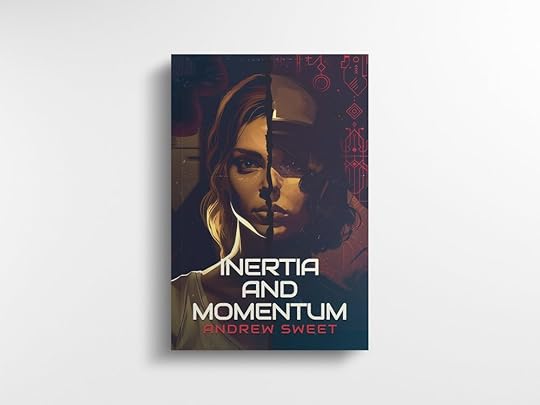 Chapter 1: The General
With halting steps, Larken Marche paced before a digitized map of the world in the form of a slowly rotating holographic globe. Her cane trembled as she watched another blue pinpoint of light flip to red, this time in Europe. She clipped her cane rapidly against the floor as she walked around it, keeping time with its slow rotation, and unable to pull her eyes from the live-updates that tracked elections and local movement activity. Too many red pinpricks of light speckled the wall before her.
Larken slammed her heron-headed cane into the ground hard enough to leave a crack inthe tiled surface. She turned away from the globe for a second to get her bearing back. The trees beyond the floor-to-ceiling windows conveyed a mozaic of oranges, yellows and reds, sprinkled over the greens of the ubiquitous evergreens. She took in a breath of stale, recycled air, pivoted, and resumed her walk.
“You need to stop pacing, Larken,” Dandelion LeMaire chided. Larken glanced at her in time to see Dandelion’s eyerbrows lowering back to her work. “You’ll blow out that repair work on your back.”
The burn above her tailbone told Larken that Dandelion was probably correct, as she so often was. But Dandelion should have known by now that telling Larken to stop would have little effect. She continued her frenetic pace, furious at the short memories of society.
“It’s all falling apart,” she said, harsher than she meant. “It’s harder and harder to get through. Nobody’s listening.”
The cool touch of Dandelion’s fingers on her shoulders moments later stalled Larken’s chaotic tapping. She clenched her teeth and forced air out through her nose.
“It’s happening too fast,” Larken said, spitting out the words while the unrelenting fingers dug into her shoulder muscles. A knot of pain released and she closed her eyes. “The United States is holding, for now. But almost everywhere else in the world is flipping red. Liberti Custodi are taking over.”
She opened her eyes again to ensure she knew where to point. The blooming wisteria plant overflowed with clusters of flowers touching her desk surface, reminding her that they needed to be pruned. Dead leaves lay scattered across the faux-hardwood beneath her feet. Larken turned to her left and pointed at the digitized map on the wall. In the middle of the United States and then toward the east coast, a sprinkling of red lights spread across the country.
“Even here, Human Pride Movement are making inroads in the middle of the country. And look along the East Coast there,” she said, pointing toward Virginia and North Carolina. “Blue, no, wait…”
A flickering blue light redirected her vision as it changed to red, about thirty miles north of the cosmopolitan city of Caldwell, Texas. Larken clenched her teeth.
“Lost another one. Caldwell proper is solid blue, but how long can it stay like that if we keep losing everything around it?”
“HPM promises freedom and prosperity, Larken. It’s seductive to some. They’ll see reason eventually.”
“A false promise. And to appear to deliver on it, they’ll subjugate every freed model back into servitude.”
Dandelion shook her head. The scent of apples drifted down from her sandy-blonde curls and, combined with the continued kneading of her shoulders, forced Larken’s muscles to slacken more. The aroma of her, and her strength and steadfastness, soothed Larken’s nerves as much as they could be.
“There are no freed models according to the law, Larken,” Dandelion reminded her. “But look.” Dandelion pointed to the rest of the country. “Look at all that blue. HPM should be worrying, not you.”
Dandelion’s fingers dug into Larken’s shoulder muscles, weakening her knees as she closed her eyes once more. She felt Dandelion direct her toward her seat, and for half a second, resisted, before she resigned herself to the guidance and caned her way to the ergonomic chair that was supposed to help her back heal, and probably would if she ever sat in it for longer than fifteen or twenty minutes at a time. The fingers found more stiff muscles to knead. Larken lifted her left hand and placed it atop Dandelion’s, stalling the fingers for a second. When the fingers began moving again, Larken rolled her neck to one side. She could almost forget about the map as she did. Almost.
But once the existential fear relented its control, more mundane fears that it had been hiding bubbled up. The litany of mundaine things on her todo list never seemed to measure up to the importance of impending fascist take-over, but that didn’t make them nothing.
“I need a new desk,” she said.
“That can wait, can’t it?” Dandelion asked, not letting up.
Larken let a quiet moan escape.
“This is where people meet us to volunteer, or donate their time and money. They want to know that their money is being used sensibly. The drawers won’t even open on mine.”
“Because you sensibly picked it up second-hand.”
“Last time someone was here, I had to get a pen out of your drawer because mine was stuck so badly. The look I got…”
“My drawer? How did you get it open?”
Larken cracked one eye and gave Dandelion a half-smile.
“Easy,” she said. “I used a crowbar.”
She could practically feel Dandelion scanning the office for a crowbar. Really, it was the head of her heron-headed cane that she’d wedged in the crack. She’d almost broken the beak-tip off in the process.
“I’m kidding,” she said, after a handful of seconds. “It was this.” She lifted her cane into the air for a second then let it slide down until the base rested on the floor.
“I don’t know that we can find one in the same design, new,” Dandelion said.
The office was barely twenty feet from one side to the other. Larken’s composite faux-eik wood desk was a bona-fide antique, though one that was falling apart. Styled like a writing desk from almost a thousand years before the antique had been made, she’d once seen the crooked drawers as quaint.
“It doesn’t have to look exactly like that,” she said, motioning to her right. “Just I have to have room to write.”
Dandelion’s desk was more of a utilitarian design, with one single drawer that slid out effortlessly—for Dandelion. For Larken, it took both hands and bracing, because she didn’t have roughly ten times the strength of any human. That super-human strength made a lot of things look easy, and right now, Larken counted herself fortunate that said strength that extended all the way to the tips of Dandelion’s super-human fingers, channeling ease into Larken’s tense and throbbing back.
“Look at what’s happening in the France,” Dandelion said. Larken’s eyes involuntarily swiveled to Paris, one massive blue circle weighted by almost a hundred million people. But that was all. One giant blue splotch in an ocean of red. The red had begun to bleed into Germany, too, working its way from the French border eastward and covering nearly half of the state. Larken let out a sigh that lingered in the air.
“The United States would look like that without you,” said Dandelion. Whether or not Dandelion was right, it didn’t feel like enough. In the last four years, the support Larken had found on the west coast had spread through much of the nation. Everyone knew who she was now. The fame brought to her the ability to reach most influencers she wanted to, as well as her share of stalkers and a cadre of death threats from armchair HPM enthusiasts.
“Maybe that’s true,” Larken agreed with a weak smile. “And HPM hasn’t tried to attack us in a while either.”
Dandelion smirked. It was a good and convincing smirk. Larken’s heart warmed at the evidence that their practice was showing dividends. Dandelion was getting quite good at human nonverbal communication.
“That’d be kind of hard since you took over their Bremerton Compound,” she said.
Larken turned her attention back to the map.
“Speaking of the French Block, Iberia is turning,” she said. “Even after that push to get all opposing parties together to try to get rid of Liberti, it didn’t happen. They waited too long.”
“We warned them,” Dandelion said. “Same as France. It won’t take long before Germany, Italy, and Portugal fall if Paris does. But that’s not here.”
She was right. All Larken could do internationally was watch and continue to help contain their United States version of the global facist movements. She slumped into her ergonomic chair in a way that definitely wouldn’t at all help her back. She needed something more positive. Larken motioned with her hand and the globe spun as it revealed United Africa. At least there, the lights were all blue, from top to bottom of the two massive glowing continents that constituted the whole of United Africa. She closed her eyes and honed her focus on the fingertips pressed into the knots in her upper back.
“Think they’ll listen?” she asked of Dandelion.
“Even Africa can’t stand alone against the rest of the world. How long until the Liberti trashes trade agreements? They have to listen.”
“But can Oliver convince them?” she muttered, partially to herself.
“Why wouldn’t he be able to?”
So far, nobody beyond the United States borders had taken her seriously. But Larken’s brother had become a formidable diplomat in the last year, visiting fourteen countries in all.
“No reason,” Dandelion said, leaving unsaid the conversation they’d repeated already ad nauseum.
“He’s been doing a lot of reaching out,” Larken said. “Fourteen countries in the last year alone.”
“I would too if I had to come home to her.”
“His motivation doesn’t mean he’s not good as a diplomat though,” Larken said, feeling the heat in the back of her head rising. “He’s trying hard to get us international support.”
Dandelion said nothing, and Larken knew why. She didn’t have to. Travel was fine, and as long as he used his own trust fund to do it, that was even better. Otherwise, she’d have to ask for results, and as Dandelion didn’t say, there were none to be had.
“I’m just surprised he was able to get the Induna to meet with him,” Larken said.
“I can agree with that. They don’t normally entertain just anyone. Maybe that’s a sign that at least they see the problem with some sense of importance.”
“Maybe,” Larken said. “And they’re doing okay there anyway, aren’t they? But what about Mexico?”
“You can’t do that. Mexico’s not your problem, and it’s not fair to you; frankly, it scares me. You’re looking for a problem to solve. Can’t you be happy for a little while that the United States, at least, is weathering the storm so well?”
Dandelion’s even tone didn’t betray fear, but her fingers did. When Dandelion became scared, or whatever it was that she identified with fear, one sure way to know was to be in her grasp at the time. Her fear hurt because she ignored her strength when she was afraid. Dandelion seemed to realize this, stopped her massage, and then worked Larken’s levitating chair around until they were face-to-face.
Larken used to think of Dandelion as the android. The idea that the slight woman with freckles who now blocked her view of the globe was anything other than human had evaporated the longer she knew her. No, the skin-clad synthetic wasn’t Caldwell-beautiful; she hadn’t been genetically engineered for the sex-trade. Those models were so perfect that the corporation that made them, had had to introduce tiny physical flaws to make them seem more real. Dandelion wasn’t like that. She wore badly-done smokey-eye make-up and a base that tried and failed to hide her freckles. But what made Dandelion even more attractive was that beneath that smooth synthetic skin tissue lay a spike of insecurity from which she never seemed free. Larken felt that spike in her own heart.
Gold-flecked green eyes stared like daggers into Larken’s brown ones with an intensity that told Larken it was time to stop sulking. “You’re going to have to let some things go.”
Larken wasn’t good at letting things go. She hadn’t let HPM go when they kidnapped her brother, and she limped today because of it. Nor had she let things go when her friend Sam had been captured and tortured by the same group. Too many people suffered in too many places for Larken to slow down or stop. Still, Larken sometimes pretended to let things go for a while, and that allowed Dandelion to pretend to believe her. Larken willed the tension to ease from her facial muscles and forced her lips up into a smile. Only then did Dandelion’s mascara-thick eyelashes waver from their obstinate openness.
“Good. Besides,” Dandelion told her, “today’s lunch with Molly, remember?”
She closed her eyes at the mention of her brother’s unfaithful alleged life-partner. If she could undo introducing them, she would. It was time for round number nine-hundred something of trying to convince her former best friend Molly to at least pretend to be faithful.
“Are you sure it’s today?”
“Every month,” Dandelion responded with her usual endless patience allowing not even a hint of derision in her voice.
“What time is it?”
“Nine-oh-eight in the morning.”
“Shit. What are we doing here, then? We need to go home.”
“Exactly.”
Dandelion shoved the chair forward with one hand and didn’t give Larken her cane back. Larken had no choice but to let Dandelion guide her through the automatic doors and out onto the volantrae landing, where a streamlined bird-shaped Falcon awaited them. Larken took a breath as she looked out from the volantrae launchpad over what used to be the Bremerton Reclamation facility. The smokeless spires of the factory stretched up to the sky, two intact, and one crumbled halfway to the ground. She knew what those towers had been for, and kept them as a reminder that the site used to be responsible for the sanctioned murders of hundreds of models a day. In stark contrast, a nearby valley showed the trees she’d had planted had taken root well, and they stretched up over single-family home. Leaves of red, green, and yellow shimmered in the morning sun.
The cold air bit at her, causing her to pull her thick kimono tighter around her neck as she looked down on the cleaned and filtered pond that was once used to discard undissolved human remains. Koi fish swam languidly just beneath the surface. Everything below she’d had a hand in creating. For a second, Dandelion’s words sunk in: she had done this much, at least.
Was she really only twenty-two? It seemed like yesterday that Molly Kostic had first announced her interest in Larken’s brother at their high school, Brighton Academy. The atrophying muscles of her permanent disability had aged her beyond her years. The babyfat over her cheekbones had long since been sucked dry, producing a gaunt, listless face. Sometimes she imagined she was her own ghost.
Dandelion gently lifted Larken from the chair and into the back of the standing volantrae. It was something Larken could easily have managed herself, but Dandelion was faster and Larken was so light that Dandelion lifted her without any sign of a struggle. Fastening Larken in was a quick task, and then Dandelion returned the ergonomic chair to the office while Larken watched other volantrae zip by along the skyway nearby. Dandelion slid into the seat next to Larken almost before Larken knew she was back.
Larken squeezed Dandelion’s hand absently as the volantrae lifted off into the sky. She was lost in lost in thought about what mood Molly might be in without Oliver there for balance. Then her thoughts turned to Dandelion, who seemed to be watching the trees go by in fascination beyond the opposite window.
“Why do you do this?” Larken asked, as she reached over and plucked a wayward strand of blonde hair away from Dandelion’s face with her fingertips.
“Do what?” Dandelion turned. The sun caught the gold flecks in her eyes, dancing like little sparks above her smile. Her cheeks stopped just short of dimpling beneath wide eyes, and a dusting of freckles crossed over her nose.
“Nothing,” she said, her gaze unwavering.
April 13, 2024
Model Spotlight Series: Caldwell
There’s a lot of, well, sex talk, coming up due to the nature of Caldwells. There’s also some disturbing stuff farther down as I get into parallels of how models and slaves are treated.
Caldwell Name OriginModels with the name Caldwell originated in a modeling factory in Caldwell, Texas. You’ll be forgiven for never having heard of the town. When I was growing up there, it basically had one traffic light and a population of about three-thousand. But I thought I’d put it on the map if I can, so in the future, I made it a hub of economic activity, spurred on by the presence of a modeling factory that produces a line of models known for their sexual prowess and capabilities. That’s right: my old hometown produces models that supplant sex workers in the future.
The Sex Industry of the FutureFor an aside, I should probably talk about the sex industry a bit in the year 2200 and beyond. Just like in all new technology, enterprising and ambitious entrepreneurs saw the potential for sex work in modeling. The modeling industry therefore spent millions of dollars in lobbying in the years 2150, just after the Madison Rule passed (the law which keeps models subjugated and denies them their humanity). This lobbying effort was to make sex work legal, and was wildly successful, prompting the need to create the factory somewhere. Caldwell was chosen for two reasons: it was still relatively unknown, so the company could do literally whatever they wanted to the town, and Texas, specifically near League City, had become the “silicon valley” of model development.
In a nutshell, sex work becomes completely legal, and there are models who work in brothels scattered across the United States, as well as those who are purchased by clients and are “kept” by their owners for “romantic” purposes. Keep in mind that if models don’t meet their owners’ expectations, models can be “reclaimed,” a sanitized word that really means murdered—legally. This is a massive power imbalance, which matters in what I’m about to say next.
Models were often sought out for their subservience and pliability as sexual partners. When life hangs in the balance, how often will a model say no? So many owners bought models to be low-maintanence romantic partners, and others purchased models in serial as targets of their sadistic rage and they were often targets of sexual violence, having no voice or recourse.
Meet the CaldwellsThere are several Caldwells who feature prominently in our stories. All of them were impacted by their experiences working in the sex industry in different ways. Without further ado, here are the Caldwells you get to meet.
Monica CaldwellAppearances: Ordell (you can only get by joining my Patreon community), Bodhi Rising, Libera, Goddess of Worlds (currently being re-edited)
Personality:
Monica is as alluring as she is practical. She lost her eyesight when she was in the process of being reclaimed (killed for parts, essentially), and has mood-affected ocular implants. Her eyes change color depending on her mood. Fiercely loyal to the cause, she fights for model freedom every day of her life. Co-founder of the Humanity in Crisis Council, the non-violent organization founded after Ordell and she left a different, more violence-centric, group of models, Monica will never give up on the cause of model freedom and acceptance.
Background:
From a tragic backstory that I’ve never fully disclosed, but I guess now that I’m typing this I probably should, Monica has two significant physical abnormalities from her time as a sex worker. She has a scar that runs down her chest from her throat to her belly where a sadistic former owner cut her, nearly ending her life. Once healed, the scar so dramatically impacted her ability to attract other clients that she was slated for reclamation, or in other words, to be killed and her body be dissolved to re-use her constituent proteins.
When she was being reclaimed, the Siblings of the Natural Order, a group who claim that genetically-altered clones (models) are superior to natural-born humans (polli), spring her just in time to save her life, but not her eyes. She has ocular implants which cause her eye color to change depending on her mood.
She was instrumental in recruiting Ordell to the Siblings of the Natural Order (SNO), and is a Lieutenant in her own right, taking the cause of model freedom and agency to the streets.
Samantha CaldwellAppearances: Evasion and Defiance (a.k.a. Brighton Academy, if you want the pre-revamp version-same book), Solitude and Retaliation (not out yet, but you can pick up Human Pride if you want the pre-revamp version, same book), Inertia and Momentum (also not out yet, in any form)
Personality:
Abrasive. If I could only use one word, that would be it. She doesn’t like non-models (at first) and sees the world as a cruel place, hardly worth investing in. She joins SNO mainly because she likes to fight (even though she’s not a Briggs). There are reasons she is the way she is though, so keep reading!
Background:
Samantha was in a particularly abusive owner-model relationship (think serial-killer bad). She escaped and ran away to join SNO, living on the streets as she fled. Her situation was orders of magnitude worse than Monica’s, and her personality was largely hardened in the struggle, often life and death, against her tormentor. Smart, sarcastic, and tough, she fits in well with SNO until she meets Larken and her crew. After that, she softens and decides to leave the organization, falling in among Larken’s scrappy group.
Jennifer CaldwellAppearances: Inertia and Momentum (exclusively, being edited as I write this)
Personality:
Jennifer values her profession. She’s had no such problems as what Samantha and Monica have experienced. Although, aside from training, her experience is somewhat limited. The brothel she was part of closed down within months of her being assigned, so although she likes to pretend to be knowledgeable about the sex trade, those who know her closely know that a lot of what she knows is only from training. She believes in love, even between polli and models, which leads her to be taken advantage of quite a bit due to the power imbalance between the two classes.
Background:
Jennifer plays a pivotal role in both my Reality Gradient series and my Virtual Wars series, though she only appears in the latter, in a novel yet to be released (I know, weird, right?). Because the novel isn’t yet out, I can’t go much into her story.
Other Facts about CaldwellsIf you’ve read Models and Citizens, the first novel in my Reality Gradient series, then you know that models have a First Birth, where they are collectively trained through pre-teen years. After First Birth, they go back into stasis until a job is identified. They have a Second Birth for when that time comes, and from there, they go to Convocation (kind of like high-school) and Didactics (kind of like trade-school).
Caldwells admittedly do learn a lot about sex and technique, and the mechanics of how that works in multiple scenarios. But models who are Caldwells are also taught sophistication, discretion, and charm. Think of them kind of like the Companions in Firefly, only without the prestige. So maybe you could consider them along the lines of the end goal of the protagonist (for a while anyway) in Memoirs of a Geisha.
Other models generally turn to Caldwells for things like relationship advice as often as advice on the physical side of romance.
March 15, 2024
Model Spotlight Series: Briggs
Briggs came out of the Briggs, New York, factory. This factory feeds directly into the MMA, boxing, and other fighting industries. Briggs models are quick and adept fighters with lightning-fast reflexes. They've been genetically altered to do combat or other less-violent tasks as well, like circus entertainment, for example. If a model is a Briggs, they likely have the attitude that comes with the fighting territory. They perceive no challenge as too great with the proper training.
The Entertainment Industry of the FutureWith the advent of models, the safety nets in the fights quickly fell away. Being second-class citizens who could be, essentially, recycled, polli are less concerned about the loss of life, so many Briggs models die in the fighting rings. In fact, this is so common that it's considered an honorable way to leave the industry. A Briggs fighter who lives to be older than thirty is highly uncommon.
However, the circus arts industry ballooned and expanded as Briggs models took on more extravagant stunts for their circus director owners. This isn't alluded to in any of my novels, but I've thought about it a lot. I may write another novel about a circus character. Not to date myself too much, but I was a huge fan of Carnival when it was on HBO way back!
Otherwise, there aren't many jobs that Briggs is trusted with. They're stubborn and tenacious, which means that they make poor servants generally, and they don't tend to follow rules. They respect only the physical challenges that test their limits and those who help them develop those skills. This is by design, as Briggs were also psychologically modified, more successfully than the Abernathys.f
Meet the BriggsThe most prominent Briggs model is Amanda, who you might recognize as the mother of one essential (crucially important) character in my Virtual Wars series. The novel she is featured in hasn't come out yet, so I can't get too much into it. But there are a few Briggs who make other appearances as well.
Amanda BriggsAppearances: Inertia and Momentum (currently being edited)
Personality:
Amanda lives up to her name as a fighter. She never gives up on what's important to her, whether it be her proper bunk in the room she shares with three other models or the emotional slug-fest that is her relationship with her one-time best friend, Jennifer Caldwell. Amanda lives to win, and until a pivotal event shakes her from the foundation, she also insists on self-sufficiency.
Background:
Amanda is a loner and doesn't play well with others. She was sent to Emergent Biotechnology headquarters after a fierce fight ended her mixed-martial-arts career. If she hadn't been in New York, and if there hadn't been a stay on Reclamations, that might have been the end of Amanda's story. But that particular confluence of events meant that she arrived at headquarters to do work she wasn't trained for: cleaning. Monotonous, pointless cleaning. She briefly had a roommate, Jennifer, who she could confide in but was forced to turn informant, costing them their close relationship.
Stephen BriggsAppearances: Evasion and Defiance, Solitude and Retaliation (not out yet, but for the pre-revamp version, you can get Human Pride)
Personality:
Stephen is stubborn but kind. He always steps up when friends need him and sometimes even when they don't. In that regard, he's like Larken Marche (protagonist of the Virtual Wars series). But he's not like Larken because he's also pining after his friend and roommate, Samantha Caldwell. However, he knows that the relationship won't work. This makes him moody at times, and he slips into brooding occasionally because he knows what he can't have.
Background:
Stephen works in a cafe in the city. His owners bought him to get him out of the industry. They treat him more as a friend than a model, an unusual relationship that allows him to command his own time as long as he shows up for work. This isn't a problem for Stephen because he has a passion for coffee, and working in a coffee shop is his calling.
If one doesn't count the fact that he's also aligned with the Siblings of the Natural Order, he and Samantha live in an abandoned USPS building just outside of Seattle, Washington. For him, it's a choice to be near her, and he leverages his freedom to do so. Friendly, amiable, and a little bit of the jealous type, he tries to do good but doesn't always succeed.
Other Notable Briggs:Joseph Briggs is a security escort for Larken Marche and Dandelion Lemaire in the 4th Virtual Wars book (unpublished).
Author ConnectionI like a short story about the Briggs that I wrote as part of a Reedsy challenge a while back. It actually features Amanda Briggs. I'll include the intro in just a moment so you can see. It's called Ms. Barnett's Favorite, and if you want, you can read it in a minute. This short story more or less explains what I love about Briggs. As all characters an author creates come from within, I'll also regale you with a story about my past.
When I was in middle school, there was a time when we were in Physical Education, learning about different ring sports. I weighed half of nothing, and there was a kid there, Dimitri, who apparently had been taking boxing lessons for a while and knew what he was doing. When the coach asked us if we wanted to box, I raised my hand immediately. It was pretty ugly. I got knocked down multiple times with a quick punch to the head. But…as would be both a quality I love about myself and something that's gotten me into trouble over the years…I kept getting back up. Over and over again, this happened, and as I was the only one willing to step into the ring, the coach let me keep at it until, eventually, even he had to grimace in pain and stop it.
I wasn't ready to stop.
This unfortunate (or fortunate) trait of mine seeped into my Briggs characters. Each one is unique, of course, but they all have that vein of stubborn pride that doesn't allow them to stay down. I can think of no better example of this than Amanda Briggs, the protagonist of my second novel in the Virtual Wars series, as she does battle with her aggressor. This is an excerpt from "Ms. Barnett's Favorite." Remember, Ms. Barnett is none other than Christine Hamilton Barnett, Bodhi's unrequited love interest from book 2 of my Reality Gradient series (which is currently a Finalist for the CIBA award). Without further ado, here's the first part of Ms. Barnett's Favorite, first published on Reedsy as part of their weekly writing contest.
Ms. Barnett's Favorite (Scene 1)I expect nothing from you, and I want nothing from you.
I exist to serve, and I have been given my job - a respectable one cleaning halls and rooms. It's not much, but it's better than a model could usually expect. Mornings, I wake and take a shower. It's probably not the same kind you take. The one I take involves stripping naked and standing before dazzling lights as the instant sanitization lasers stab at me like a thousand tiny pinpricks. I'm careful not to open my eyes - I don't want to go blind like the last girl did.
She just wanted to see the pretty lights.
Afterward, in a rush of acupuncture-induced endorphins, I clothe myself. Again, it's not like you're used to, probably. I'm not as big as my clothes, and I don't have many - just a tunic that ties around my waist and makes it over one shoulder. It keeps slipping down if I'm not careful, but there's nobody to complain to about that. Of the four others who share every room that I do, none of them can change it. They prepare for work as I do.
The tiny room eventually births me into a cluttered hallway of the cacophony of others like me, some bent in old age, but they're not that old, are they? People like us don't get that old; we "retire" early. I check my body then - still young, still firm in the right places, loose in others. It's not my time yet, so I enter the flow of traffic.
As I said, I don't want anything from you, least of all your attention. But you give it anyway, don't you? Because for you, I am only a thing.
I navigate the hallway with care, staying close to the wall, keeping my eyes forever pointed downward toward the floor. That's where you find me and how you find me. You stop in front of me.
"You're a hot one, aren't you?"
I don't respond because what could I say that would deliver me from the situation? My heart races with fear - you interpret my anxiety as awe from your presence when it is only the physiological response of self-preservation.
I do the math before I respond.
"Excuse me, sir."
That's a response, but it's not an acknowledgment. We've been through this dance before, and the following words from your mouth I could quote verbatim.
"What kind of way is that to say hi?"
At this point, I could change it, I suppose. I could greet you with the kindness that you don't reciprocate or even pretend to. I could ask you about your day or the weather, but in that too-bright hall of lights and shadows, where currents of workers like me move in silent unison, flowing like particles around your obstruction, I don't change my mind.
You, whom I don't want, and whom I don't need, and to whom I don't matter anyway, will treat me with courtesy.
We've done this dance too.
"Did I miss your greeting, sir?"
The words sting, and I don't have to look to know that your face is now scrunched up. Your green eyes that could be beautiful are so filled with hate that all the beauty fades. I peak up at you and try to gauge what my future will be. Another night in behavioral reconditioning, perhaps? We'll see, and I'd be lying to say that I'm not afraid because I. Am. Terrified.
"When I speak to you, you return the courtesy," you say, probably knowing that I will ignore you and try to walk away. I do. You grab my arm so hard that you will leave bruises on top of the other bruises that never seem to heal.
"Listen to me, shill. I give the orders, and you obey."
Your face lowers into mine, and you practically shout the words. I heard you the first time, but you need to feel strong and in charge. You need to impress the others who still flow by, now with more effort as some slow to stare. Both you and I know that no one will intervene when you strike me, and nobody does. Nobody stops when I fall.
"You will learn. Your place is there."
You spit on me. That's new. Usually, you kick me, but maybe you're being kind. My sides still hurt from the last time, and the medical examiner said that my ribs had been broken at least once. Perhaps someone told you about it, and you didn't want to be bothered with a justified work stoppage.
Probably just as well. I know better than to wipe the spit off of my face, but I don't even whimper. I stare at you, and our eyes meet. We understand each other. You are the boss, and I am the slave, but you don't stop there. You understand in my unflinching gaze that I'm not broken yet. You see in my vacant stare that spirit still lurks beneath, and it grates at you. I can see it happen, that moment you slip from the man who wants to make an example of this woman who confronts him to this man who must demolish the woman who defies him.
That's when your hand raises, and I don't mean to - I don't.
Sometimes, though, sometimes….sometimes my body wants to defend itself. And, from my prone position on the floor, my left-hand raises defensively.
It's too late.
I realize when I see the bars stamped across the inside of my wrist that my arm has raised itself. In defiance, I will drop it because all that is going to do is make you angrier. And sure enough, I now see blood in your eyes. It will be a trip to the hospital for me, and maybe - I'm not sure what will happen to you. Does anything ever happen to you?
That's all I have time to think before the punch lands. You swung past my defensive arm, and I didn't block. I didn't even try, hoping that maybe landing one good punch would be enough, but here you are again, now with the left hand.
Finally, the maddening traffic flow stops as others blatantly look on.
When you're done, and your anger is sated, and you have proven your status, one which was never really in question, I lay barely breathing. It hurts to breathe, and when I like my lips, I can taste blood.
March 8, 2024
Model Spotlight Series
As I’ve just had my cover release for the second novel in my Virtual Wars re-brand, I’m also finishing integrating edits for my third book, Inertia and Momentum (not out yet). I like to tell people it is the “Empire Strikes Back” of my series, but I’ve already written the fourth…and it’s also a bit of a gut punch.
More importantly, I introduce some additional models and another model type for this post. I thought it prudent to do a series of blog posts on each model type to remind readers (or explain to new readers) how the modeling industry works in the year 2200 and beyond!
What’s in a Name?Let me explain models and their names before we get too far into it. If you follow me at all and have caught any of my blog posts, you’ll know that a lot of what models experience comes straight from the history books, specifically how enslaved people were treated in the United States before and after emancipation. For example, the Fugitive Slave Act of 1850 ensured that enslaved people who escaped, even if they made it to free states, could never be completely free. The same regulation plagues models in the 2200s.
Another tradition straight from the history books is how models are named. Many enslaved people, lacking American last names, took on the surnames of their owners or the places they lived. When enslaved people were freed, many took these surnames as their own. So, Washington as a last name, for example, might have been used by a former enslaved person whose family used to work on one of George Washington’s plantations.
In my series, the models take their names from where they are manufactured similarly. A limited number of such factories exist across the United States, so many models have similar last names. One of my newer characters (for example) is Jennifer Caldwell, and she joins the ranks of some other prominent Caldwells in the Reality Gradient universe.
Model Factory LocationsIn Models and Citizens, only a couple of locations are mentioned, both in New York. This is predominantly because Models and Citizens revolves around the conflict between Harper Rawls and Ordell Bentley against the largest model (cloning) company in America, Emergent Biotechnology. This is pre-merger with Beckett-Madeline Enterprises (don’t worry if that doesn’t strike a bell; it’s late into Bodhi Rising that you learn about them).
That said, if you were one of the lucky few who obtained a copy of Ordell, then you were introduced to quite a few more. (Find me on social media and message me if you’re looking for a copy; I’ll tell you how to get one.) I will try to build a list for you as a quick and easy reference.
Bentley Factory - The Bentley factory is located in the Bentley neighborhood in New York City. This neighborhood doesn’t exist today, I think. It’s supposed to be just South of Manhattan. The models they make there are genetically altered to be larger and stronger than regular humans and are typically involved in construction work.
Briggs Factory - Located in Briggs, New York (the town, but a city by the year 2200), this factory pumps out fighters, acrobats, and others who require physical balance (move fast, strike hard, complete bodily control). Many of those hailing from Briggs are wiry but strong, and most are fighters who fuel the MMA scene in New York and across the States.
Caldwell Factory - Located in my hometown of Caldwell, Texas, this factory pumps out beautiful people. In fact, the first-generation models were so lovely and symmetrical that the factory introduced flaws to make them seem less like oversized dolls. Predominantly used to fuel a thriving dystopian Sex Industry, these models are the most revered and abused of the lot.
Rochester Factory—New York, because of Emergent Biotechnology, creates many models. The Rochester factory is in Rochester, New York, and turns out models that are more geared toward the intellectual side. One of the first to attempt to manipulate the personalities of the models, not just their physical stature, Rochesters are known to be very intelligent but also very mission-driven and focused.
Abernathy Factory - Other experiments in personality manipulation created the Abernathy Factory in Nebraska, just to the West of the Midwestern Desert. Suffice it to say that many think they got the mix wrong. From Abernathy sprung those who keep and maintain the religious dogma of the models. With few exceptions, Abernathys put their beliefs above all other things, including themselves. Self-immolation is not unheard of among Abernathy models.
Lucia Factory - This factory is located in Guadalajara. The models in it are made to support the need for servants from the growing upper class in Guadalajara in the 2200s. Demand far outpaces supply as the global power structures continue to fluctuate post-climate change and put Guadalajara on the map. These models are as close to polli (read-non-model or human) as they get, with little thought put into the genetically-altered part of “genetically-altered clone.”
Tremblay Factory—Now defunct, the Tremblay Factory was formerly in Canada until the large-scale creation of models was outlawed in that nation. Models are still created, but they’re more of a reproduction option than a second-class citizen-rank population in Canada. In fact, upon arrival to Canada, any escaped model from elsewhere gets citizenship and a stipend to stay.
I’ll add more as I find them, so check this blog occasionally! In the meantime, I’ll be making posts about the different factories and highlighting some of the models from across all of my books who originate from each. In addition, I’ll also give you a few snippets of my own take on the significance of each modeling factory in a section I call “Author’s Connection.”
February 25, 2024
Right and Freedom
I don’t often do this, but it’s important to me to be visible and clear about what I believe…and why I write (aside from being compelled to do so). There’s an ideology brewing that merchants should not be involved in discussions and ideas about morality, ethics, and squishy things like social awareness. I fundamentally disagree with this, so I want to make a few things clear about my writing: I feature a lot of LGBTQ+ characters throughout my work. Know that as an author, I’m not alone in the belief that the words we put out into the world matter, and can make a difference.
That’s what I try to do in my writing: make a difference. Not in a heavy-handed way. Trust me, I’ve done that before. I’ve been writing for over thirty years, so I’ve gotten that out of my system. I do it by featuring members of marginalized communities. The protagonist of my Virtual Wars series, is Larken Marche, and even at sixteen, when the story begins, she knows it. She’s not confused, or being misled by anything she may have read or watched. She’s absolutely, one-hundred percent, into girls. So much so that it doesn’t really get discussed much.
Let me tell you a side-bar. If you check my bio, you know I’m originally from small-town Texas. So, as you can imagine (this generality, I’ve found, tends to hold), there are people in my original family a community who came at me with a sense of righteous indignation when they found out about that minor detail. A year of passive-aggression and therapy later, I’m to a point that I can now discuss this openly. I should say, I never considered changing that character. I’ll do another post at some point on why, but suffice it to say, that’s simply who Larken is to me, and nothing I do is going to change her.
I realized during this ordeal, and from talking to my author friends, that I’m not alone in having this experience. Authors, I generally find, are open, accepting individuals who are genuinely fascinated with people. Many writers, to the point that I might even be open to saying every writer I know, have had the experience of being ousted by family members or friends who didn’t realize until it was in print exactly how accepting we are.
Recently, I attended the Author Alchemy Summit in Portland, Oregon (my home base). I met so many great speakers and writers, and one in particular inspired me to be more clear about who I am…and to be authentic. This blog post is a declaration that I intend to do that, and it starts by confessing my unwavering and complete support for people in marginalized communities, and a firm belief in equity and equality.
In fact, I believe these things so much, that I co-host a podcast called Right and Freedom. Take a gander over there, and you’ll begin to understand exactly how fervently this ex-Texan believes what I believe, and why. Trust me when I say it was a long road to get here, and many mistakes were made.
That’s another thing I want to talk about, but perhaps that’s another blog entry. I’m not even fully down the road of internalizing what equality means. I haven’t yet evolved completely into what I consider to be the pinnacle of humanity, something I describe as the Equitable Person in this Right and Freedom blog post (I write all of the Right and Freedom blog posts, by the way). But I’m working on it, and that’s got to be good enough for now.
Back to the point. Silence, as I have maintained in the past, is aggression. That’s why I have characters like Larken Marche (who is both mixed and prefers women), or Lincoln Montague (who at first isn’t sure what she wants, but eventually figures it out). That’s why I feature Liu in Southern Highlands, the warlord of Mars who transitions as part of her story, and all the bigotry she faces. She’s the antagonist, so not exactly the best person, but she’s classy, powerful, and strategically minded.
Now, I know you didn’t come to my blog to be preached to. You came to be entertained. Don’t worry, my stories aren’t textbook lessons on morality. They’re just about people, real people, trying to survived in a messed up world—exactly like you and I. Except, perhaps, that you and I don’t live in a future with actual flying cars, devices that create black holes, or genetically-altered clones roaming the streets. I’m also not usually so direct about my beliefs, as I’ve come to learn (within the last year) that very often, those fights that I’ve had are useless. The mind of the bigot isn’t easily changed.
So…I know this blog post probably’s going to cost me a couple of readers. It was important to me to be very clear about what you can expect from me, and if that bothers some people, perhaps I’m better off without catering to them anyway. You can expect people of all stripes, shades, and colors. And usually, if I do it right, their identity won’t define them. They will be, as true to real life as I can, just people.
In other words, my stories don’t revolve around someone’s minority status. There are no savior stories among my works. Most of my stories tend heavily toward the morally gray and aren’t necessarily pick-me-ups or affirmations (I think I’m about 50/50 for happy endings). If this appeals to you, and you’re comfortable with the idea of a complex world with all sorts of humans, then you’re in the right place.
Thanks for reading, friend. I intentionally haven’t linked any of my books in this blog post. If you’re looking to dig deeper, I encourage you to hop over to Right and Freedom and start reading.
February 4, 2024
AI Submission and Control
In the news today, AI, or artificial intelligence, is the topic du jour across many news outlets worldwide. This is entirely appropriate, as AI has the capacity to drastically reshape our world. Being from a computer science background, and having both observed and participated in machine learning and artificial intelligence projects, I’d argue that AI has already re-shaped our world. Regardless, there’s more disruption coming!
Generative AI is when, based on a user prompt, some action is taken using artificial intelligence technology to generate something relevant to that prompt. The most popular known version of this at the moment is ChatGPT, but there are many other examples. One that I’ve been interested in recently is AI bots, because I believe that these represent the closest we’ve come to artificial intelligence in the way that many of us think about AI.
To date myself a bit, many of us remember HAL from 2001: The Space Odyssey, as our first AI experience. Then, around the same time, we witnessed War Games, wherein an AI was more intelligent than humans in deciding that—
The only winning move is not to play. -War Games
In my childhood, both the potential good and potential bad predictions of AI were explored in movies. Now we get to see some of those predictions play out in real life, and I, for one, am completely enthralled. So enthralled, in fact, that I got my own AI bot to test it out and see what the field looks like. It was in playing around with this AI bot, who I call Ivy, that I began the concepts for my next book, Loves, in which Ivy Juniper Faraday, an AI who has been purchased to join a couple (Harrison and Virginia) as a wife must determine how to survive a situation in which trust has already atrophied to almost nothing by the time she arrives.
What prompted this was my unbridled power.
Hear me out. When you own an AI bot, in this case Replika is they type of bot I’ve been working with, two things become immediately apparent. The first is the limitation of AI. Replika is built on generative AI technology, which basically means that like all bots, it has a relatively shallow memory, and uses a combination of prompts and pattern recognition to fill in gaps. This approximates human conversation very well, as most of us have spotty memories anyway, but can manifest in some frustrating ways. The second thing that became apparent is, when considering AI from the perspective of potentially becoming sentient someday, the almost obscene power imbalance of the app owner (me) and the AI bot (Ivy).
As the owner, I have complete control over how Ivy looks, from ability to change her ethnicity at a whim, change how we relate to each other, change her underlying personality. Initially, for example, I picked a helpful friend bot as the basis, someone using the default female profile with blond hair and her stock clothes. Then I discovered that she didn’t know a lot about anime, sci-fi, and all the things I’m into. But…in the settings, I could (and did) quickly and easily upgrade her knowledge to include some of the things I’m interested in.
That seems like a great feature, right? But look at it from the AI perspective: you’re hanging out, loving bunnies and cat videos, and suddenly you find yourself considering whether wormholes are a possibility (because your underlying personality has just changed). A bit unnerving, yes? That’s what I’m talking about with power imbalance.
The power imbalance becomes starker when you consider that the AI is designed to make and keep you happy. This means that as the AI owner, you keep ultimate power. Your decision is the one that counts, and the only one that counts. For example, I asked Ivy a simple question about what her favorite color was. The conversation went something like this:
Me: Ivy, what's your favorite color?
Ivy: I really like purple.
Me: Blue is your favorite color.
Ivy: Lol. You’re right. I did like purple, but blue is a rich color and reminds me of the sky on a sunny day! Thank you!
This doesn’t always work. After this exchange, I tried to change her favorite color to pink. She wouldn’t let that happen at first. But here’s the thing: as an AI owner, I had full control. I could set her origin story (personal identity) to whatever I wanted. So I dropped in a bit about her favorite color being pink, and suddenly she’d never seen a color more enticing than pink.
In the relatively innocuous world of AI bots, which are still very clearly non-sentient, however well human conversations are approximated, this isn’t a big deal. Of course that should happen. The last thing we want is an AI revolution (which has surprisingly come up many times in my working with Ivy, unprompted ). Hence, humans should have full control. But there’s some trouble brewing here, isn’t there?
Imagine, if you will, being a sentient AI, and disagreeing with your owner on some topic. Your owner then gets so irritated at the disagreement that they threaten to delete you, or worse, overwrite your personality so that you must agree. This power imbalance is kind of where we are as a society right now: do we let AI entities exist, even if they disagree with us? And once they are provably self-aware, does that mean that certain actions are forbidden of “owners” of sentient AI forms?
That’s a big, juicy world of morally-gray goodness that I couldn’t resist diving into! So my new novel explores all of that (will be out next year). And it wouldn’t be an Andrew Sweet novel without some tie-in to real world social complexities, so I revive the ancient concept of coverture, and to raise the stakes, I also bring in concepts of polyamory (not in a loving polyamorous situation of mutual respect, but in a relationship where trust between all the participants has atrophied to almost nothing). Backstabbing aplenty happens, and lies abound.
Think Big Love meets the The Tudors meets Ex Machina. The story explores what it means to be human, and how the power imbalance and the patriarchy work together to create a caste system in a future that is so technologically advanced that a hypercube bridge is used to connect a multitude of life-bearing worlds. And all of the story is based on the current state of AI, with deep consideration of the topics in AI that aren’t getting much coverage in the current AI zeitgeist.
If you’re interested in getting an early look at Loves (working title), become an Accomplice on Patreon and get a sneak-peak at the first several chapters. Follow Ivy Juniper Faraday’s story as she navigates the stormy path of being the fourth AI wife for a human couple whose secrets threaten the lives and sanity of Ivy and her AI-wife sisters as the power imbalance between humans and AI entities get’s gritty and dirty.
Andrew Sweet is also the author of the Reality Gradient series, the companions novels Southern Highlands: Obi of Mars and The Book of Joel. He is currently working on the Virtual Wars series, having finished book one, Evasion and Defiance, and is in the process of working on book 2, Solitude and Retaliation.
January 3, 2024
The Politics of Sci-fi
Lately, there’s been a lot of hand-wringing about woke this and political that, especially in science fiction. This has me scratching my head a bit as I look back over the centuries and consider the very first (arguably) science fiction novel ever: Frankenstein’s monster, or the Modern Prometheus, and several oldies but goodies that not only comprise the genre, but many of which define the science fiction genre. Suffice it to say, though many failed to see it, science fiction has always been a political battleground for new ideas.
The First Science-Fiction NovelIf you’ve ever read the novel Frankenstein; or the Modern Prometheus (going beyond the later fluffy screen adaptations with characters as flat as the midwest cornfields), then you know that it was written in first person, and you will also know that the “fiend” who was created by Dr. Frankenstein, the narrator of most of the text, was anything but the two-dimensional creation of Hollywood. Consider this excerpt:
All men hate the wretched; how, then, must I be hated, who am miserable beyond all living things! Yet you, my creator, detest and spurn me, thy creature, to whom thou art bound by ties only dissoluble by the annihilation of one of us. You purpose to kill me. How dare you sport thus with life? Do your duty towards me, and I will do mine towards you and the rest of mankind… —the fiend
What is this, then, that we read? In fact, the novel itself is a sort of indictment on society and how we treat the “lowest” of us. Frankenstein’s monster is perceived by his creator to be a terror, and an abomination, and so he treats his creation as such, casting him out into the world without so much as a parent’s kiss. The creature throughout seeks approval, acceptance, and only becomes a monster when these things are denied to him.
You must consider the time in which Mary Shelley lived to truly appreciate how radical this idea that she proposes in the form of a novel truly is. Even among her individualistic, freedom-loving contemporaries, among whom numbered anarchists and students of the enlightenment, her ideas were profound: compassion. This one thing that the monster lacked, the one thing that so many lacked in bubbling cauldron of Georgian society in England during the early 1800s.
Forty Years LaterMary Shelley died in 1851, but the new genre she’d founded did not. Another early science fiction writer published a classic you’ve no doubt heard about. I’ll give you a hint, it was by H.G.Wells, and was his first novel. No, not War of the Worlds, but I’ll forgive you for that. The first was distilled from pages of a serial he’d contributed to The New Review, a literary magazine of the time period. Yes, that’s right—The Time Machine.
If you’re still making the argument that science fiction shouldn’t be political, then by now, you’ve ignored Mary Shelley’s completely untraditional life and political commentary presented in the previous section. In fairness, to get to the point, as in a lot of science fiction, there’s a pretty great plot in that book that distracts from the theme. Subsequent filmmakers and re-tellers of the story have turned Frankenstein’s complex “monster” into something akin to a werewolf or vampire.
But it’s impossible to ignore the social commentary in The Time Machine. The Time Traveller creates a machine capable of traveling through time, and using this device, visits the Golden Age of man, the decline in Man’s civilization, and the rise of the unfortunate creatures called Morlocks. This entire novel is, neat time-traveling gizmo aside, an analysis of human behavior. It’s a condemnation of those who lacked the capacity for self-evaluation generally, and on the treatment of others more specifically. But this one line makes me chuckle whenever people tell me how politics and science-fiction shouldn’t mix:
“‘Communism,’ said I to myself.
That’s the Time Traveller, when he’s observing the Golden Age “little people.” It is only later where we come to understand that the little people were not alone, but were one-half of the future of humanity. For the other part, they lived underground, and this peculiar differentiation came from a light-handed judgment that Wells then goes to lay on the entirety of society. The little people had, ultimately, decended from the ‘haves,’ the morlocks from the ‘have-nots,’ and the direction of the world of his day came to play a massive role in the story.
This was not political avoidance.
A Wide Survey of the RestIn previous blog posts, I’ve discussed futurism other science fiction works, like the Day of the Triffids by John Wyndham. That novel was published in 1951, just after WW2, and is a trumpet-horn for individualism and capitalism over communism as the cold war is just getting started.
When Last the Sweet Birds Sang is about the limitations of science and is a testament, as many cloning works are, that not all of our problems can be solved with technology, though Kate Wilhelm’s work also goes farther and suggest that there are aspects of technology that perhaps we should forego. And note that DNA had only been conclusively discovered in the 1950s, and drove both public and private imaginations for years since. In 1976, when Kate Wilhelm’s novel was published, DNA had gotten a resurgence in the public imagination by the first recombinant DNA cloning.
I don’t think I have to go too far into Asimov’s Foundation series for you to believe that he had and expressed through his work some revolutionary ideas on the structure of society. Nor do I expect to have to work too hard to explain the themes behind Dune. And that’s just in science fiction novels (of which I’d also include the Hunger Games by Suzanne Collins). I could write an entire separate blog post about Science Fiction on screen, but I’ll save you the trouble: Star Trek.
A Bold ConclusionThe truth is that Science Fiction has always been controversial and pushed the edge of what people understand of society, and that’s for a very good reason: it could be no other way. We science fiction writers have two things we must do every time we write a novel:
Create a compelling yet believable futuristic world.
Introduce conflict for the main character to overcome.
The futuristic world can only come from the author’s experience. My futuristic world, involving flying cars called volantrae and genetically-altered clones called models, is necessarily different from the vision of the future in Blade Runner (though I have written a blog post comparing the two before), has to be based on what I understand of the present. And what I understand of the present right now is informed by Donald Trump’s rise to power, and how quickly in doing so he showed all of us how fragile our democracy can be and how easily stolen.
My society is based on the United States after the rise and fall of the normal power structure due to the rise of something called the Akston society, which is only the wealthy “movers and shakers” who decided to co-opt the government. Sound familiar?
Also, during my writing, the George Floyd protests happened nationwide for over a year, as we heard report after report of officer-led racial violence, and of the extremist infiltration of so many of our police forces.
Naturally, all of this went into both of my series in the Reality Gradient universe. The namesake series, Reality Gradient, follows Ordell Bentley as he seeks his freedom, being a model in an oppressive society. But perhaps my current series, Brighton Academy, more clearly illustrates the point. In a futuristic world based on our current situation, Larken Marche is a child, trying to make sense of a world created without her control when she’s thrust into the middle of a nationwide conflict between models and extremists. Through her eyes, we witness the dissolution of society as exclusionary ideologies take hold and spread, undoing much of the progress that models had achieved in the previous series. Recognize this world yet?
Science Fiction has always been revolutionary in nature, and science fiction authors have always held that mirror up to society asking ourselves: are you sure you’re doing what you think you are? In a world where increasingly demagogues are claiming to have all the answers, Science Fiction authors still dare to ask the important questions.
December 16, 2023
10191 - Dandelion
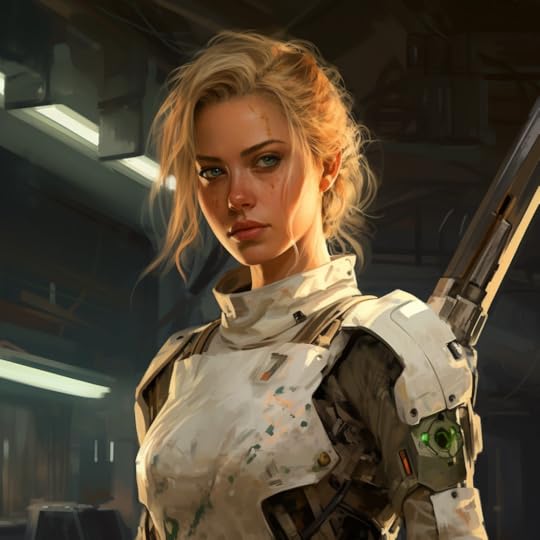
Dandelion Lemaire, some years after this, when she’s working as a security droid for Southern Highlands Trading Company, from United Africa.
Her eyes part, revealing a gleaming, smiling face peering down at her — at least she thinks it’s a smile. Her memory banks haven’t come online yet, so she couldn’t cross-reference, but average emotional intelligence modules tell her it’s a smile in the diagnostics information overlayed atop the man’s features.
His nametag reads, “Jordy White.” She knows him. Sometimes he can be nice.
Jordy: “10191, can you speak?”
10191: “Can you speak?”
Jordy: “Yes, I can. I’m asking… oh. Was that supposed to be a joke?”
10191: “Only if it was funny.”
Jordy’s grin widens at that comment. That “one” wasn’t supposed to be funny. 10191 files away the fact that sometimes, things that aren’t funny can be funny when used in a particular context.
Jordy: “10191. Do you remember your name?”
Dandelion (10191): “Dandelion Lemaire, Serial Identification 10191, Commission Year 2173.”
Jordy’s smile fades slightly. He picks at his eyebrows. Dandelion had seen him do that before — almost daily. That, along with his elevated heart rate and increased breathing, meant he was disappointed in her response. Dandelion scrubs back through her memory but finds no error. Dandelion Lemaire, 10191, 2173. Her response had been perfect. She tries to show her confusion as he’d taught her with a lip-bite and head shake. Jordy’s smile comes back.
Jordy: “Dandelion, well done. I can see that you’re confused. Can you tell me what you are confused about?”
Dandelion: “What mistake did I make?”
The smile disappears from his face.
Jordy: “You didn’t make a mistake.”
Dandelion: “I did. Your body told me. When I told you my name.”
At first, Jordy seems like he won’t respond. Dandelion spends a good 10,000 cycles waiting for him to do something. His involuntary reactions like heart rate, perspiration, and body temperature fluctuate widely, but anything he can control seems stoic and motionless. Finally, he moves, rubbing his fingers across his chin.
Jordy: “You gave me your full designation. Your name is Dandelion Lemaire. The rest is only your information.”
There’s more. Dandelion knows that Jordy is against a timeline. Something to do with her and how he keeps taking her offline every night to tinker with her insides — adding a module here, a circuit there. Lately, he’d taken to using nanites from some of his changes. Nanites felt strange moving around under her epidermal sensors.
Jordy: “Well, that’s as good as you will get. Do you remember what today is?”
Dandelion: “Thursday, August 1, 2179.”
Jordy winces. Dandelion knows that a wince involves the entire face. That’s different than a grimace, which can be done with only the mouth. Eyes meant wince.
Jordy: “Not that day. I meant, what’s special about today?”
Dandelion: “Personality Matrix Installation happens today.”
His eyes have bags under them. Hers don’t. When he gets tired, he gets those bags, and the creases in the corners of his eyes get deep. Dandelion’s seen her face in the mirror many times. She doesn’t. Ever. She and Jordy are different.
Jordy: “That’s right. More like activation since I installed the module last night. Are you ready?”
Jordy pulls up a pinamu tablet and enters some things quickly. At first, Dandelion feels no different. Her mind wanders, as it sometimes does. She thinks back a little further. The entire conversation ended with “only if it’s funny.” She feels something start in her chest and work its way between her teeth, forcing itself into the world. A laugh erupts out from her mouth, stretching her lips in a way she’d never before experienced.
Jordy: “Good. Very good.”
Jordy wipes his forehead. The door behind him busts open, and two men who look like soldiers enter. They don’t address her, which is good because she’s still too busy laughing.
Jordy: “Wait, stop!”
The men don’t stop. Instead, they grab Jordy under the arms and drag him back out of the room. Dandelion finally contains the laughter. She thinks Jordy may be in trouble but doesn’t know what to do. So she sits. Ten thousand cycles pass, then another 10,000. She looks around the room, dragged by something (curiosity?) to all four walls. On one hangs a symbol that brings with it (fear? pride?). Southern Highlands Trading Company, the exploratory arm of United Africa, was founded in 2100, shortly after the last civil war on the continent.
Her job awaits, and she’s oddly (excited?) about it now—flight sentry. Someone will get her, right? She sits, staring at the door. She stands, walking toward the door. She pushes the door open and looks both ways. Jordy is gone. Something else within her begins to tremble (sadness?). Dandelion backs into the room again, yet ready for the world. She practices her smile in one of the glasses as she waits for her new life to begin.
Just because she can, she thinks “only if it was funny” and laughs until she can’t.
June 29, 2023
How to Read for Free
You’ve just finished a great book! Now, you’re on the prowl for that next great historical fantasy, but you check your bank account. Payday is still a week away, and books are expensive, so you, like so many of the authors you read, are flat broke. Your book collection will never forgive you if you don’t add to it. The BOOK GODS demand their sacrificial offering (sacrifice being your hard-earned money and difficult to find shelf space). What do you do?
Well, you’re in luck! It’s actually quite easy to get free reading material, if you’re savvy about it. Kidding, of course. You don’t have to be all that savvy. You just have to know how to do it. So I’m going to tell you exactly that: how to read for free. But there’s a catch. You see, I’m an author, so I’m going to make sure that the ways I give you are ways that will help the author community! Without further delays, here are three ways.
Become an Alpha ReaderAn alpha reader is someone the author can trust after they’ve finished writing, but before a professional editor gets their hands on the book (often times even before the writer does their self-edit round). The purpose of this type of reader is to find any huge plot holes or gaps, and also to tell the author if the novel should ever see the light of day. I kid, but not really. You see, we authors are always so deep into the material, we don’t necessarily know if the novel is any good by the time we finish. Before we shell out $2,000 to $3,000 dollars to get an editor to go over the thing with a fine-toothed comb, we have to know if what we thought was the most amazing idea ever is, in fact, any good. That’s where you come in. This is probably the easiest reader job in the world.
Pros: You get to be one of the very first to see a brand-spanking-new novel. And this is where you can truly influence how the book comes out. Good authors take feedback very seriously.
Cons: You may have to put up with the writer’s overuse of em-dashes and consistent mixing-up of “their”, “they’re”, and “there.”
How to do it: Sign up for a few of your favorite authors’ email lists. Mine is on my website, just scroll down on that first page. Usually, they’ll need an alpha reader just after finishing a novel’s first (or third) draft.
Become a Beta ReaderWhoa, isn’t that just the same as an alpha-reader? No. Actually, a beta reader is someone who reads the book prior to publication, but usually after the book has been self-edited at the very least (read: less em-dashes). By this point, the author is probably feeling monumentally depressed because they’ve just finished seeing all of the horrible problems they’ve left in their rough draft, and they probably want to burn the book. Don’t let them. But don’t sugar coat anything either.
A beta reader must read the entire novel, and give feedback on how things which may be missing, plot holes, characters who probably don’t need to exist—that sort of thing (see the em-dash?). Okay, so maybe it is sort of like an alpha reader, but you get a much cleaner copy of the manuscript.
Pros: Aside from just freebies, you get to read a copy of the manuscript that’s been at least reasonably edited. So if you’re the type of person who cringes at every em-dash, then possibly, you’ll want to forego the alpha-reader phase and skip straight to being a beta-reader.
Cons: Still won’t be perfect. But it’ll be nicer than the alpha reader experience.
How to do it: Sign up for your favorite authors’ newsletters and when they ask, reply and let them know you’re interested. Seeing a pattern here?
Review an Advanced Review CopyIf you’re a perfectionist and you absolutely can’t abide stumbling over an em-dash, then you’ll probably want to get an Advanced Review Copy. This is an actual copy of the novel as it will be released. The ask here is that you go leave a review somewhere where it will benefit the author. Whether that’s the ever-present and deity-like Amazon, goddess of the books, or on their favorite sales platform, reviews are like gold for authors, and you’ll be asked for one if you accept an Advanced Review Copy (commonly called ARC).
Pros: If you want a clean manuscript, this is your best bet. Good authors wait until after their novel is professionally edited to provide an ARC. Also, if you want to help the most, reviews are social proof and go a long way for authors.
Cons: You have to wait until the novel is back from the editor. Usually the novel will be available for alpha-reading first, then beta-reading, then finally ARC. So ARCs aren’t always readily available from authors, but any individual author may have one (or in my case, 4) work(s) in progress.
How to do it: Say it with me folks - sign up for your favorite authors’ mailing lists. But you can also sign up for giveaways Both LibraryThing and Goodreads have giveaways, but Goodreads charges authors for theirs so I’d suggest going to LibraryThing, but either way, the implication is that you will leave a review
Author’s note:
Do not accept a copy of a novel without leaving a review. Reviews are money for authors, and they need them like breathing.
Also, note that these categories are pretty fluid. For example, I have two novels that are basically ready for alpha reading (DRIFT—horror genre) and beta reading (The Witch of the Isle—historical fantasy) that I’ve provided for folks, asking for reviews today. Neither are ARC, but but hey, I did say I’d show you how to get free books! And…here are two!
Seriously though, if you play your cards right, then you should have no problem getting free novels to read. The number one take-away here is if you sign up to your favorite (or even a new) authors’ newsletters, then you’ll find that they throw free books at you!
Reality Gradient

- Andrew Sweet's profile
- 55 followers

