Julie Mathison's Blog, page 2
February 12, 2022
The best classics of children's fantasy for readers of any age!
I was recently invited to recommend five books of my choice by Shepherd.com. I knew immediately what my category would be ~ classic fantasy from my youth that can be enjoyed by children and adults alike. Check out my five picks here. I hope you'll find some new titles to enjoy!
CLICK HERE for my picks!


The best classics of children's fantasy for readers of any age!
I was recently invited to recommend five books of my choice by Shepherd.com. I knew immediately what my category would be ~ classic fantasy from my youth that can be enjoyed by children and adults alike. Check out my five picks here. I hope you'll find some new titles to enjoy!
CLICK HERE for my picks!
December 18, 2021
Happy holidays!
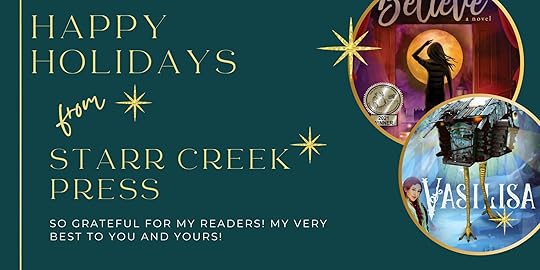 All my best wishes to you this holiday season! It's been an amazing year for my fledgling press with new readers, a couple of surprise awards, and a new novel in the works. My number one goal as an author is TO BE READ, and you make than possible. Thanks for making my dreams come true!
October 28, 2021
Join me for this free zoom event!
Do you love books?
Whether you're a reader, a writer, or just curious about the changing face of publication, please join me on Zoom, Thursday, November 4th at 4:30 pm. (PST) for a conversation about writing, publishing, owning your voice and following your dreams. This free event is part of the Social Action Works series through Oregon State University’s College of Liberal Arts — open to all. Hope to see you there!
Reserve your spot: Click to register
/.../WN_cToyg1ZtSaKUVAlTBpdxxQ
Whether you're a reader, a writer, or just curious about the changing face of publication, please join me on Zoom, Thursday, November 4th at 4:30 pm. (PST) for a conversation about writing, publishing, owning your voice and following your dreams. This free event is part of the Social Action Works series through Oregon State University’s College of Liberal Arts — open to all. Hope to see you there!
Reserve your spot: Click to register
/.../WN_cToyg1ZtSaKUVAlTBpdxxQ
October 23, 2021
BookLife Prize News!

VASILISA has made the cut! The Publisher's Weekly BookLife Prize has narrowed the field from 32 quarter finalists in the YA / Middle Grade category to four semi finalists. I truly did not expect this result and am equal parts humbled and elated. Thank you again to all of you who have cheered this book on. Finalists are announced in November!
July 13, 2021
The best way to spend a birthday
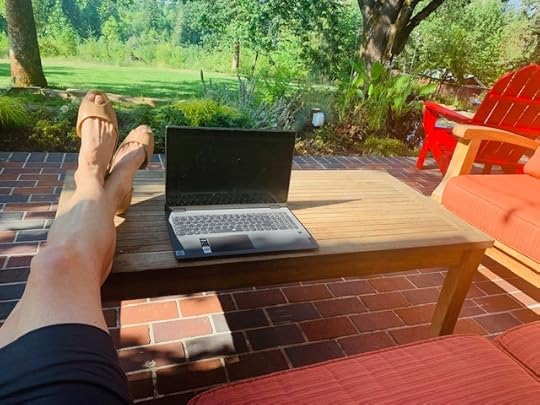
Spent my birthday afternoon with Elena, Mitya and Sasha, adventuring down the river Dnepr in Old Rus and loving the little romance that has sprung up between Elena and Mitya. Writing is like being your own first reader, then getting to share it with everyone else! Exactly what I love to do on birthdays. Now, I'm waiting for a few friends on the side patio (a.k.a. my summer office) while my husband and kids do all the work. Aren't birthday's great?
June 6, 2021
Outsider DNA
This is how it begins.
You’ve just gotten the call – your dream agent loves your book. After years of steady effort, you are on your way! The two of you get down to work – reviewing, revising, refining – until you both love the product, and it’s time to go live. The manuscript goes out to a carefully selected list of editors from all the big houses. Will you get multiple offers? A bidding war? Then, the emails trickle in, excerpting the editors’ replies. Phrases like, “beautiful, lyrical prose,” and, “rich and smartly spun,” are followed by other phrases not so welcoming. “I’m afraid I won’t be able to get this into the hands of enough readers,” or, “I fear the voice is not firmly-enough middle grade."
Your beautiful book does not quite fit.
Every year, scores of high-quality books are released by traditional publishers. These books have been closely edited, not just by the author but by agents and editors until they are declared ready to compete. They know exactly where they fit on the shelf. Even if they break new ground, it is that they are “marketable” that defines their fate: a mysterious, ever-changing formula, interpreted by the curators of our nation’s shelves. The traditional publishing system is necessarily a commercial entity, shaped by market forces and populated by gatekeepers whose job it is to cull and shape content to delight, educate, and transport readers – but above all, to sell.
This is not a bad system, but it is a closed system, and in the natural world, closed systems wither and die. At the very least, they are not robust. All systems benefit from the infusion of material that is disruptive to established norms. When the literature that comprises our shared canon consists only of that which can be funneled through the gatekeeper’s door, its bounty is diminished. Content necessarily conforms to standards and ideals that are often unexamined and poorly understood, even by those who uphold them. And we find, even in an era that celebrates diversity, that the bold, new expressions of the day quickly become hegemony, dogma, and eventually variations on a theme.
Independent publishers can provide this needed infusion of outsider DNA. Voices that do not "fit" find they need not fit in order to be heard. Small, independent, and academic presses, and self-publishers who maintain high standards of quality, are essential to keeping our literary ecosystem open, diverse, healthy, and democratic.
Last year, as a global pandemic raged and the world was shutting down, I decided to take the indie plunge. I had gotten the agent. I had lost the agent. And in the end, I was forced to embrace my own voice, on my own author-ity, without the benediction of the establishment. I set about to replicate the functions I had abandoned. I found beta-readers, young and old, in the place of developmental editors. I hired a cover designer and copy editor. I learned how to use Adobe InDesign, how to typeset, to create a website, a social media platform, and finally how to distribute my creation through both digital and physical marketplaces. It was hard work but intensely empowering. No longer was I waiting to be anointed by the powers-that-be. I was my own rainmaker, with all the creativity, ownership, and responsibility that such a role entailed.
Fast forward one year. My author imprint, Starr Creek Press, has produced two books, BELIEVE, published last August, and VASILISA in February of this year. In May, BELIEVE was named the winner of the Eric Hoffer Book Award, one of the largest, international awards recognizing salient writing and the pioneering spirit of small, independent, and academic presses. Such recognition was a boon, but no longer one I yearned for as a vindication of my literary self-worth. Instead, I found myself swept away by the useful implications of such an accolade. How could I use this to get my books into the hands of more readers? How could I use it to support other authors in embracing the power of their own voices?
In the end, it is connecting with readers that has conferred my greatest sense of accomplishment. My universe is perhaps smaller than the one I envisioned when the powers- that-be tapped me on the shoulder and promised me the stars. But it is all the richer because it is mine.
April 21, 2021
Sneak Peek! First Draft of Chapter 1: Elena the Brave

The sequel to Vasilisa is coming next fall! Elena the Brave picks up the story with Vasilisa and Ivan’s daughter, Elena, who is destined for more adventure. Spoiler — if you like dragons, this book is for you! This is a first draft of chapter one, but I like it, so it’s chances of survival are good 🙂
Chapter 1
Plus ca change, plus c’est la meme chose.
The more things change, the more they stay the same. It was a French saying, not Russian, though the old wives might well have muttered its like down the ages as Prince became Tsar, and Tsar became Commissar, and all the while the Russian heart beat in a peasant’s breast. That was the way of worlds both old and new, and the crossing of oceans to make a new start did nothing to alter it.
Elena’s mother had been born on a steamship on the high Atlantic seas, and so it was that Elena called Edenfall home, not St. Petersburg — Edenfall, Pennsylvania, where steel was king and the tsar was just a character in an old tale. By now, the old wives who remembered Mother Rus had mostly passed on — all but her grandmother, dear Babka, who was too stubborn to die — and the old wives’ children had all but forgotten the steppes and forests, the snow-banked villages and onion domed churches of what seemed a fabled land. There was too much change afoot right there in Edenfall to dwell on distant shores.
It was 1942, and the world was at war.
Glenn Miller was on the radio, bombers plied the airspace over Hamburg and Rostock, and the newsreels bore witness to Hitler’s march, even across the Russian wastes where it seemed only winter could defeat his ranks.
Yes, even on Edenfall’s familiar, hillside streets, Elena Ivanova Volonsky could feel change in her bones like the distant rumble of a B-17. It was a Saturday afternoon in late April, and Elena was down in the First Ward beside the Brandywine River, skirting the barricades of the demolition zone where piles of rubble marked what once had been tired but tidy factory houses, clapboard tenements and courtyard complexes — all razed, not by bombers, but by wrecking balls.
The Edenfall Steelworks was growing.
The expansion was funded by the government, for this war would be won with steel, or so the headlines shouted, and Edenfall had never been busier. Gone were the breadlines and soup kitchens Elena could recall from her earliest years as she straggled behind her mother, tending the poor, the needy, the homeless or jobless whose numbers only grew. The stock market had crashed when Elena was two, and as the destitute reeled from year to year, those who were more fortunate had come to their aid, opening doors, pocketbooks and larders – especially Elena’s mother, who had saved more than one soul from the bottle or the bridge.
But now, the Works blazed with light day and night, the hiss and clang and roar of its furnaces never ceasing so that only silence was strange. Shifts on the smelting floor were doubled, paychecks were padded, and more than a thousand residents of the First Ward were told to sell out or lose out as plans were drawn up for a new complex, five blocks long and wide. It was exciting, in its way, but sad too, for Elena knew the families who called this tattered ward home, not slum, who had tended gardens even here in the shadow of the mill. Streets that once rang with the cries of children playing in the dusk would now know only fire and steam and molten slag.
But Elena was not one to dwell on losses. The future, that was where hope lay. In all her fifteen years, she had known only waiting and wishing and wanting — and occasionally scheming, for there was nothing to vex one like the word no. But now, change was in the air, right alongside the B-17s that swelled her heart and fueled her dreams, and even Mama did not have time to keep track of her comings and goings. Had the old wives’ warnings on the nature of change reached her ears, she would never have believed them, less still the observation that history repeats itself, again and again, until lessons are learned, and evils mastered. To the young, change is always the herald — never the crone, trailing portends like shadows and warning that what has gone before will come again. And even if she had believed them, what of it? What had life in Edenfall ever been except boring and predictable, just like her mother, Vasilisa Petrovna Volonsky, who lived for others and had never had a day of fun in her whole life?
But then, she knew nothing of her mother’s secrets.
*****
“There you are,” Vasilisa said with little fuss as she hurried up Front Street in a pale green blouse and pleated skirt that somehow managed to look elegant. Her auburn hair was swept up in the simple twist she always wore. “You forgot, didn’t you.” She stopped before her daughter, a glint of mischief in her eyes. “I’m giving you the benefit of the doubt here — don’t make me regret it.”
Drat her. It would be so much easier if she would only nag Elena, like a normal mother.
“The Purdy twins!” Elena cried, slapping her forehead. “Poor little urchins. How do they get on with no one to wipe their snotty little noses?”
Mama’s lips were set in a small smile, but behind her eyes lurked a glimpse of real despair. Elena could hardly bear it.
“But Mama, it’s Saturday.”
Vasilisa sighed. “Elena, they’ve lost their mother. And old Mrs. Purdy is no match for them, especially with her cataracts. Why, she can hardly see the twins, let alone manage their pranks.” She eyed her daughter a moment longer. “It’s only for the afternoon. They’ll be going to their uncle’s house for the rest of the week.”
Elena cast a glance back at the glorious destruction that was underway not fifty yards off as the wrecking ball smashed into the Walker’s backyard henhouse. Those Purdy twins were more than a handful, even for someone like Elena who not only knew every trick but had written the book, for pity’s sake. She turned back to her mother with a look of pious resignation, placing her hands before her in mock prayer.
“I live to serve.”
Vasilisa laughed. Double drat! It was so hard to hate her, even when she plied her dastardly whip!
“Perfect. I’ll have biscuits waiting for you when you get home.”
Elena’s painted smile melted with affection.
“With marmalade?”
“Would you expect anything less, Saint Elena?” her mother quipped, pivoting with a wave. “Don’t be home past six!”
Elena returned the wave, then slumped theatrically for the benefit of her non-existent audience. Perhaps she would take the scenic route to the Purdy’s wretched little hovel on Green Street. If she went down Main, she could cut up the hill just before the old Moravian cemetery and at least take a peek at what was playing at the Regency.
It was a good plan, and it lightened her mood. She headed down Front as far as the old Works, then climbed the steep grade one block to Main Street where storefronts bustled with weekend shoppers. Saturday was always a lark, what with shiny new Buicks honking their horns at creaky Model T’s or the occasional old-timer who had saddled up his horse, even if it meant a ticket from Officer Crupp. You had to give it to those codgers, they had spunk, especially old Mr. McCurdy who had never been quite right in the head since they took his funeral cart away.
Speaking of which, there he was, clomping up the roadside on his old nag, Rosie, with the cars swerving around him and honking for all they were worth.
“What ho, Mr. C,” she said, adopting the aristocratic accent that was their private joke. She grabbed Rosie by the bit and guided her up onto the curb — earning glares from a coven of tight-lipped biddies in hats and heels. “Making a statement again, are we?” she said over her shoulder as she led Rosie up the sidewalk.
Mr. McCurdy gave something between a snort and a chuckle — a snortle, maybe, or a chuckort, Elena thought, grinning widely as he drifted sideways in his saddle.
“Watch it there, Mr. C, or you’ll be carting yourself off to Happy Havens next.”
This small morsel of blasphemy had the desired effect, and Mr. McCurdy righted himself with a different kind of snort, one of utter disdain.
“I’d nah be buried there if t’were the last patch of grass on God’s green earth!” he shouted, garnering a few more looks from passersby to Elena’s satisfaction. There was nothing worse than a stodgy housewife. “If the Moravians won’t have me, just plunk me in the back yard next to my Rosie!”
Elena brought the mare to a halt, stroking her neck as she gazed up fondly into Mr. McCurdy’s ancient face. Once an undertaker, always an undertaker — though he’d hung up his hand pump long ago. Victorian embalming techniques hadn’t fared well in the era of modern refrigeration.
“You must be an honorary Moravian by now, considering how many of them you’ve buried,” Elena said reasonably. This was the kind of straight talk the old man favored.
He gave a brisk nod. “’Tis so, ‘tis only right, I say. Why, in my day I could fix ‘em up on the kitchen table and have it cleaned up by suppertime.” He leaned forward. “Fancy another gander at the tool kit, missy?”
Mr. McCurdy’s gruesome kit was something else, full to bursting with hooks and screws, scalpels and syringes, and something called a trocar for poking holes.
“I wish I could, but I’ve got to watch the Purdy twins.” She glanced at the wristwatch Papa had given her last Christmas. The twins would be breaking into their rubber fly stash right about now, floating them atop their poor grandma’s warm milk. Grief had done nothing to curb their genius. “Promise me you’ll stay out of the road?”
Mr. McCurdy’s eyes tried to slip away but she narrowed her gaze and held firm.
“Dagnabbit!” he said, snatching his old straw hat off his head to give Rosie a swat. But the twinkle in his eyes was worth a million bucks. “Have it your way, missy. Ye come by soon, now. And don’t take any wooden nickels!”
Elena hurried on, aware now that she was treading the line between truancy and outright desertion. But a few more minutes couldn’t hurt, and there was sure to be something new on the marquee at the Regency. She picked up her pace, craning her head around a slow-poke wearing high-waisted trousers and an ivy cap that looked to be straight out of Dickens. Every time she moved to pass him, he’d meander back in front, just as though he had eyes in the back of his head. At last, she whisked by, grateful for the long legs that were her one good feature, if schoolyard gossip were to be credited. Personally, Elena couldn’t care less about her feminine attributes — or lack thereof. Skinny and tall, she couldn’t fill out the bodice of latest V-cut tea dress, and her shoulder-cropped black hair was as thick and straight as a horse’s tail, but she liked it that way. She could run the 440 yard dash in a minute flat, and with so few suitors to slow her down, had gotten halfway through her sophomore year at East Edenfall High with time to spare.
Time better spent looking up at the sky.
Today, high clouds masked the sun, casting a glare. Not her favorite kind of sky, but not every day could dawn pillowed in rose-lit cumulous clouds. Elena was an aficionado and had mentally catalogued at least three dozen types of skies over the years, from cozy, socked-in drizzlers to dramatic cloud-bursters, to your run-of-the mill picnic under the noonday sunners.
Halfway up the block on the north side of Main, a row of bulbs glowed dimly in the glare— the Regency, with its marvelous limestone facade, framed by great, curved pillars like shrugging shoulders. It had opened at the height of the Depression, perhaps because that’s when people needed it most, even if they’d had barely a quarter to spare for the ticket. Elena crossed the street, dodging a bulbous-nosed Oldsmobile, then hopped up on the curb, shading her eyes to peer up at the bright red letters splashed across the marquee.
Captains of the Clouds!
The over-sized poster in the display window featured James Cagney in the cockpit of his bush plane, raising a hand in salute. Elena’s heartbeat quickened. James Cagney and planes? It was too good to be true!
“Hey, Elena. What’s buzzin’, cousin?”
“Hi Eddie.” Eddie Morgan always had the latest slang on the tip of his tongue. Elena came up to the ticket window where he was slumped on his stool in a ratty cardigan. “Is today the debut?”
“Nah.” Eddie dislodged something from between his two front teeth with a flick of his toothpick. “Been playin’ all week now. Where you been?”
Elena’s mind flashed on the long hours after school spent strategically outwitting two criminal masterminds who were barely out of diapers.
“Here and there.” She pushed the thought of the Purdy twins away. It must be past four o’clock by now. They’d have moved on to the old lady’s unmentionables drawer and before long would be putting on an impromptu fashion show. “Have you seen it yet?”
Eddie shrugged, which was as enthusiastic as he got. “It’s about some Canadian fellers. Pilots and stuff.”
“And the newsreel?” This was like pulling teeth.
“Something about… em… the Flying Lions. No… em… the Flying Tigers, that’s it.”
The Flying Tigers! Only President Roosevelt’s elite squadron pledged with defending the Republic of China from Japanese aggression! Not that she knew that much about it.
She looked at her watch again. Four twenty-five.
“Starts at 4:30,” Eddie said, misunderstanding her gesture. He gave a yank with his head. “Go on, ‘fore the boss comes around.”
Elena peered behind the ticket booth to where a glimpse of red crushed velvet beckoned through the plate glass doors.
“Just for the newsreel.” She flashed Eddie a grin that seemed to snap him out of his slouch, at least for a second. “Thanks, Eddie. I owe you one.”
He experimented with a smile. “Em… you got it, Elena. Maybe I’ll see you around.”
But Elena was already gone, flashing through the double doors and into that gilded lobby with the stealth of a panther. She’d stand at the back, where the ushers would walk right by in their pillbox hats, none the wiser.
Just fifteen minutes, she promised herself. How much damage could the twins do?
February 23, 2021
VASILISA release day!
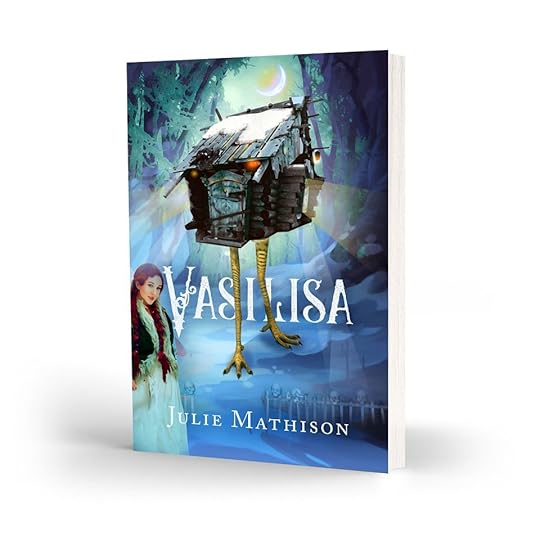 It's finally arrived! If you haven't had a chance yet, join me on my Facebook page to celebrate the release of VASILISA with my short video and reading from the book! You can watch here: Vasilisa Launch Video
Over 1800 readers joined my Goodreads giveaway, and copies have already gone out to the winners! Thanks to everyone who threw their hat into the ring. Comment after viewing my video on Facebook at any point today, 2/23, and I'll enter you to win a signed, hardcover copy -- another chance to win :)
Thank each one of you for your support and interest, for you amazing reviews of VASILISA, and for sharing the book with others. Please follow or friend me so we can stay in touch!
February 9, 2021
Chapter 1 Sneak Peek!
With Vasilisa's release right around the corner, I thought I'd give those of you who haven't had a chance to dig in a sneak peek!
1 * Willow End
DO YOU believe in fairy tales?
Vasilisa Petrovna Nikolayeva did not. Loved them? Most certainly. Needed them? Quite probably. But believed? Not at the age of thirteen, and not in the year 1919 with the dust barely settled over the rubble of the Great War, and definitely not in the small steel town of Edenfall, Pennsylvania, where Vasilisa lived with her mama and grandmother, long miles from the Russian homeland.
“Come, Pigeon,” grandmother would say. Her name was Vasilisa too, though she went by Babka. “Let us talk of Old Rus,” she would say, and then the words would come, and Vasilisa would disappear—into the forests of the northern wastes where witches and ogres lay in wait, or across the steppes of the Mongol Hordes, or down the Volkov River to Constantinople on a barge heaped high with furs and wax, honey and wood.
Best of all were the tales of the old witch Baba Yaga who lived in a hut on chicken legs, and who ate children when she could and helped them when she could not, and best of these was the story of how Vasilisa the Brave outwitted her and lived to tell. Both Vasilisa and her grandmother were named for this girl of lore, who had a bogatyr heart, fearless and true, and a mind for riddles, and a face to melt a prince’s heart.
But never in her wildest dreams would Vasilisa have believed that such a girl had ever existed, or perhaps still did, or that even someone ordinary, like herself, might someday be called to the strangeness of impossible horizons. No, she never would have dreamt such a thing.
Until, one night, she did.
Now, that was still some days distant when the letter came announcing the beginning of the end of hope. It was hand delivered by a messenger and bore a seal, which meant it was bound to be bad news. Mama read it on the stoop with shaking hands while Vasilisa dug in the garden bed beside the door, watching from the corner of her eye. And when Mama had gone inside, still Vasilisa dug, even when Babka stumped down the stairs with her walking stick to put a hand upon her shoulder.
“Pigeon, shhh,” she soothed, “there is nothing to be gained by such foolishness. Only the durachok buries his heart with the potatoes.” Always, Babka pitied the ways of the durachok, the Russian fool, but this time Vasilisa did not laugh.
“Papa’s not dead,” she said, stabbing her spade into the dirt, again and again. “He’s just missing, that’s what the letter says.”
And no one could say anything against this because it was exactly true that Peter Nikolayev had been declared missing in action, having last fought in the trenches near Flanders. But still Mama wept as if he were dead, and nothing Vasilisa or Babka said made any difference, for when Mama got something into her head, there was no getting it out.
* * * *
So it was that later that day, Vasilisa was sent to Miss Meredith’s house for some soothing herbs. For a while, Vasilisa forgot her troubles as she trod steeply downward, past the houses of the mill workers, planted side by side like stalks of corn in a victory garden. The air was sweet with the turning of leaves, even over the reek of the mill, acrid like smoke gone to rot, but so familiar that even it inspired a kind of hope. Papa would return, perhaps with the snows, and then everything would be as it was, with Papa in his favorite chair, the hearth fire burning, and Mama full of smiles for her beloved Peter.
Vasilisa could picture the homecoming clearly as she turned onto Main Street. Just down what remained of the hill, the steel mill smoked and glowed in the half-light like a dragon out of the old tales, reclining in the mists. The shopkeepers were shuttering their wares for the night—Lowell’s Hardware and Fleishman’s Meats, and of course Edenfall General Store where Mr. Bickham sold penny candy in big, glass jars with a smile to match.
It was a scene that never failed to comfort Vasilisa, though Babka would say it lacked prostor, that feeling of space and freedom that every Russian craved. Prostor was the sweep of fields and broad rivers, horizons vanishing into sky. It was why the low huts of the village were scattered so widely, yet also why Russians praised a warm heart over a tidy home and had at least twenty words for kinship instead of just one. In the face of vastness, one craved company. Vasilisa would point out that she was not Russian but American, and Babka would counter that no Russian could escape her fate, even one born upon a steamer on the high Atlantic seas.
These thoughts had just brought Vasilisa to the old Moravian cemetery when a skeletal form materialized from the mists.
“If it is not the lovely Miss Nikolayeva,” Mr. Goladyen said, doffing his hat. “Is it not late for you to be abroad, and so near to the wood?”
Mr. Goladyen always spoke like the starch in his shirts, and his eyes did not match what he said. Vasilisa did not like him. He had emigrated from Russia only last year, shortly after the October Revolution when many of the aristocracy had fled, and his name, though surely Russian, was not one any honest kinsman knew. It meant hunger. It meant starving. And it was this one could see glimmering in his eyes.
“Yes, it is late, sir, so you will forgive my hurrying on,” Vasilisa replied, not bothering to hide her distaste.
He replaced his hat with a tug and a smile so humorless that Vasilisa felt the brush of dread. “But of course. Do not let me detain you. We will see each other soon enough.”
And then he was off, vanishing into the mists as quickly as he’d appeared.
We will see each other soon enough.
What was that supposed to mean? Vasilisa redoubled her pace, for Meredith lived not much farther on in a cottage at the end of Willow Lane. There it was now, amid the tangled herbs and flowers that were Meredith’s trade. The Welsh were the best sort of healers, versed not just in the mysteries of leaf and root, but in other things too. Meredith had a way of knowing things.
A lantern was burning in the window as Vasilisa hurried up to rap on the door. She heard a clatter of pots, and a moment later the door was thrust wide.
“Vasilisa,” the herbalist said with that vague air she often wore. She tucked a lock of steely hair into her bun. “Dear me, but it’s late. Your mother is poorly?”
This was not one of Meredith’s prophecies. Gossip followed Mama like smoke followed beauty, and for the same reasons. Her recent fragility had only made her more beautiful—and more hated. But Meredith was not like that.
“She’s fine, thank you,” Vasilisa lied.
“Is she, now,” the healer said wryly.
Vasilisa felt her cheeks flame. The healer couldn’t find the glasses perched atop her head, but she always found the truth.
“Well don’t just stand there!” She turned and waved Vasilisa in. “Come, sit by the fire. Mr. Perkins has been missing your company.”
The last of Mr. Goladyen’s shadow slipped from Vasilisa’s heart as she closed the door and wiped her boots on the mat. How could anyone feel gloomy at Willow End? There sat Mr. Perkins on the stuffed chair before the fire, licking his fur and purring like Mr. Brown’s brand-new Model T.
Vasilisa settled the cat on her lap, where he set to work, making a nest of her calico skirts. “We’ve run out of chamomile and St. John’s wort—oh, and tulsi,” she called after the herbalist, who was already muttering as she passed through to the tiny kitchen.
“Holy basil, yes,” Meredith said above the sounds of rummaging. “Now where did I see that?”
Mr. Perkins settled into a ball as Vasilisa stroked his fur, thinking of nothing in particular for the first time that day. Meredith bustled in with a mug of tea, muttering about the state of her kitchen and the house elves and such a lot of other nonsense that Vasilisa laughed. Then, the healer was off to do battle with the cupboards, and Vasilisa was left to gaze into the flames, ponder the titles of old books, and breathe in the smell of herbs drying on the rack—marjoram and thyme, lavender and mint, sunlight and earth. For no reason at all, her eyes filled with tears.
“Tut, what’s the matter?” a soft voice said, and there was the blurred form of Meredith in her frumpy skirts.
Vasilisa took a shaky breath and wiped her eyes. Somehow, she felt better, both happy and sad, as if her heart had a language all its own that she had only just understood.
“Is it your Papa? Have you had more news, pet?”
Vasilisa found it all pouring out, how Papa must still be alive, because otherwise Vasilisa would know, and why couldn’t Mama see that, and shame on her for just giving up. The words hardly seemed to make sense as they tumbled out, but Meredith just cooed and tutted and put them all back together in a way that made sense, and finally said, as if it were the most obvious thing in the world, “I imagine you’ll bump into him when you least expect it.” This prediction sounded strange, even silly, and they gazed at each other, startled, then burst into laughter.
“My, the things I do say!” Meredith cried.
And yet, Vasilisa felt a thrill. What if Miss Meredith was right? Hadn’t she found old Mrs. Boxer’s heirloom brooch when everyone else had given it up for lost? And in the ice box, of all places, where it had fallen from the widow’s scarf. As the tale went, Miss Meredith was sitting in the parlor when her eyes popped wide, and she said, “Well, bless me, if it isn’t right next to the Christmas ham!”
The herbalist wiped her eyes, gazing at Vasilisa fondly. “You’re a beauty like your mother, but cat’s whiskers, you don’t seem to have any use for it, do you. You mustn’t make it too hard for them, Vasilisa. Why, when I was a lass—”
This last word hung in the air as Meredith’s hand flinched back from Vasilisa’s cheek. Her ruddy face blanched white beneath its freckles, and her eyes glazed over as she began to murmur in a lilting whisper.
“Gall pechod maur thu-fod troy throos buh-chan…”
What could it mean? Meredith’s lips moved quickly, two fingers raised while she repeatedly made the sign of the cross over her heart.
“Miss Meredith! Oh, stop!” Vasilisa cried, gripping the healer’s hands to still the awful gesture.
The words died away, and the gray eyes closed. When they opened again, the old woman blinked twice.
“I do believe I’ve taken a turn.” She placed the back of her hand against her forehead. “I wasn’t speaking more nonsense, was I?”
“You said all sorts of things,” Vasilisa cried with relief, seeing the healer’s eyes search hers with all the muddled curiosity she knew so well. “But I couldn’t understand.” She tried to approximate the first sounds she had heard.
The herbalist’s eyes darted away. “Did I now? Well, isn’t that odd. That would be Welsh, the language of my youth. It does sound pretty, doesn’t it?”
“But what did it mean?” Vasilisa pressed, but still Meredith evaded her questions until finally, in a muted voice, she gave her reply.
“Just an old proverb, dear. Something along the lines of a great evil can enter through a small door. Must be all these late nights I’ve been putting in. Did I tell you I’m writing a book on herb lore?” And on she rambled until, rising, she said in a shaking voice, “Now, it’s late. Best you were getting home.”
And despite all of Vasilisa’s protestations, she was soon bustled to the door, unseating Mr. Perkins who complained loudly as he leapt to the floor. The linen bundle of herbs was thrust into her hands, and the coins she had taken from the kitchen tin were refused. Miss Meredith would only accept a promise that Vasilisa would return within the week to help harvest the herbs.
“Tell your grandmother, a visit before the last leaf falls, or sooner, yes sooner,” she urged, for Babka and she were thick as thieves. Her hand trembled as she placed it on Vasilisa’s arm, just before the girl was let out into the night.
“Miss Meredith?”
The forest behind the shack seemed to whisper with many voices, but it was only the wind.
“Hurry, now,” the healer said with a laugh like a sob. “There’s a lass. I’m an old fool, but my heart says you’ll be needed, and before the hour is out.”
1 * Willow End
DO YOU believe in fairy tales?
Vasilisa Petrovna Nikolayeva did not. Loved them? Most certainly. Needed them? Quite probably. But believed? Not at the age of thirteen, and not in the year 1919 with the dust barely settled over the rubble of the Great War, and definitely not in the small steel town of Edenfall, Pennsylvania, where Vasilisa lived with her mama and grandmother, long miles from the Russian homeland.
“Come, Pigeon,” grandmother would say. Her name was Vasilisa too, though she went by Babka. “Let us talk of Old Rus,” she would say, and then the words would come, and Vasilisa would disappear—into the forests of the northern wastes where witches and ogres lay in wait, or across the steppes of the Mongol Hordes, or down the Volkov River to Constantinople on a barge heaped high with furs and wax, honey and wood.
Best of all were the tales of the old witch Baba Yaga who lived in a hut on chicken legs, and who ate children when she could and helped them when she could not, and best of these was the story of how Vasilisa the Brave outwitted her and lived to tell. Both Vasilisa and her grandmother were named for this girl of lore, who had a bogatyr heart, fearless and true, and a mind for riddles, and a face to melt a prince’s heart.
But never in her wildest dreams would Vasilisa have believed that such a girl had ever existed, or perhaps still did, or that even someone ordinary, like herself, might someday be called to the strangeness of impossible horizons. No, she never would have dreamt such a thing.
Until, one night, she did.
Now, that was still some days distant when the letter came announcing the beginning of the end of hope. It was hand delivered by a messenger and bore a seal, which meant it was bound to be bad news. Mama read it on the stoop with shaking hands while Vasilisa dug in the garden bed beside the door, watching from the corner of her eye. And when Mama had gone inside, still Vasilisa dug, even when Babka stumped down the stairs with her walking stick to put a hand upon her shoulder.
“Pigeon, shhh,” she soothed, “there is nothing to be gained by such foolishness. Only the durachok buries his heart with the potatoes.” Always, Babka pitied the ways of the durachok, the Russian fool, but this time Vasilisa did not laugh.
“Papa’s not dead,” she said, stabbing her spade into the dirt, again and again. “He’s just missing, that’s what the letter says.”
And no one could say anything against this because it was exactly true that Peter Nikolayev had been declared missing in action, having last fought in the trenches near Flanders. But still Mama wept as if he were dead, and nothing Vasilisa or Babka said made any difference, for when Mama got something into her head, there was no getting it out.
* * * *
So it was that later that day, Vasilisa was sent to Miss Meredith’s house for some soothing herbs. For a while, Vasilisa forgot her troubles as she trod steeply downward, past the houses of the mill workers, planted side by side like stalks of corn in a victory garden. The air was sweet with the turning of leaves, even over the reek of the mill, acrid like smoke gone to rot, but so familiar that even it inspired a kind of hope. Papa would return, perhaps with the snows, and then everything would be as it was, with Papa in his favorite chair, the hearth fire burning, and Mama full of smiles for her beloved Peter.
Vasilisa could picture the homecoming clearly as she turned onto Main Street. Just down what remained of the hill, the steel mill smoked and glowed in the half-light like a dragon out of the old tales, reclining in the mists. The shopkeepers were shuttering their wares for the night—Lowell’s Hardware and Fleishman’s Meats, and of course Edenfall General Store where Mr. Bickham sold penny candy in big, glass jars with a smile to match.
It was a scene that never failed to comfort Vasilisa, though Babka would say it lacked prostor, that feeling of space and freedom that every Russian craved. Prostor was the sweep of fields and broad rivers, horizons vanishing into sky. It was why the low huts of the village were scattered so widely, yet also why Russians praised a warm heart over a tidy home and had at least twenty words for kinship instead of just one. In the face of vastness, one craved company. Vasilisa would point out that she was not Russian but American, and Babka would counter that no Russian could escape her fate, even one born upon a steamer on the high Atlantic seas.
These thoughts had just brought Vasilisa to the old Moravian cemetery when a skeletal form materialized from the mists.
“If it is not the lovely Miss Nikolayeva,” Mr. Goladyen said, doffing his hat. “Is it not late for you to be abroad, and so near to the wood?”
Mr. Goladyen always spoke like the starch in his shirts, and his eyes did not match what he said. Vasilisa did not like him. He had emigrated from Russia only last year, shortly after the October Revolution when many of the aristocracy had fled, and his name, though surely Russian, was not one any honest kinsman knew. It meant hunger. It meant starving. And it was this one could see glimmering in his eyes.
“Yes, it is late, sir, so you will forgive my hurrying on,” Vasilisa replied, not bothering to hide her distaste.
He replaced his hat with a tug and a smile so humorless that Vasilisa felt the brush of dread. “But of course. Do not let me detain you. We will see each other soon enough.”
And then he was off, vanishing into the mists as quickly as he’d appeared.
We will see each other soon enough.
What was that supposed to mean? Vasilisa redoubled her pace, for Meredith lived not much farther on in a cottage at the end of Willow Lane. There it was now, amid the tangled herbs and flowers that were Meredith’s trade. The Welsh were the best sort of healers, versed not just in the mysteries of leaf and root, but in other things too. Meredith had a way of knowing things.
A lantern was burning in the window as Vasilisa hurried up to rap on the door. She heard a clatter of pots, and a moment later the door was thrust wide.
“Vasilisa,” the herbalist said with that vague air she often wore. She tucked a lock of steely hair into her bun. “Dear me, but it’s late. Your mother is poorly?”
This was not one of Meredith’s prophecies. Gossip followed Mama like smoke followed beauty, and for the same reasons. Her recent fragility had only made her more beautiful—and more hated. But Meredith was not like that.
“She’s fine, thank you,” Vasilisa lied.
“Is she, now,” the healer said wryly.
Vasilisa felt her cheeks flame. The healer couldn’t find the glasses perched atop her head, but she always found the truth.
“Well don’t just stand there!” She turned and waved Vasilisa in. “Come, sit by the fire. Mr. Perkins has been missing your company.”
The last of Mr. Goladyen’s shadow slipped from Vasilisa’s heart as she closed the door and wiped her boots on the mat. How could anyone feel gloomy at Willow End? There sat Mr. Perkins on the stuffed chair before the fire, licking his fur and purring like Mr. Brown’s brand-new Model T.
Vasilisa settled the cat on her lap, where he set to work, making a nest of her calico skirts. “We’ve run out of chamomile and St. John’s wort—oh, and tulsi,” she called after the herbalist, who was already muttering as she passed through to the tiny kitchen.
“Holy basil, yes,” Meredith said above the sounds of rummaging. “Now where did I see that?”
Mr. Perkins settled into a ball as Vasilisa stroked his fur, thinking of nothing in particular for the first time that day. Meredith bustled in with a mug of tea, muttering about the state of her kitchen and the house elves and such a lot of other nonsense that Vasilisa laughed. Then, the healer was off to do battle with the cupboards, and Vasilisa was left to gaze into the flames, ponder the titles of old books, and breathe in the smell of herbs drying on the rack—marjoram and thyme, lavender and mint, sunlight and earth. For no reason at all, her eyes filled with tears.
“Tut, what’s the matter?” a soft voice said, and there was the blurred form of Meredith in her frumpy skirts.
Vasilisa took a shaky breath and wiped her eyes. Somehow, she felt better, both happy and sad, as if her heart had a language all its own that she had only just understood.
“Is it your Papa? Have you had more news, pet?”
Vasilisa found it all pouring out, how Papa must still be alive, because otherwise Vasilisa would know, and why couldn’t Mama see that, and shame on her for just giving up. The words hardly seemed to make sense as they tumbled out, but Meredith just cooed and tutted and put them all back together in a way that made sense, and finally said, as if it were the most obvious thing in the world, “I imagine you’ll bump into him when you least expect it.” This prediction sounded strange, even silly, and they gazed at each other, startled, then burst into laughter.
“My, the things I do say!” Meredith cried.
And yet, Vasilisa felt a thrill. What if Miss Meredith was right? Hadn’t she found old Mrs. Boxer’s heirloom brooch when everyone else had given it up for lost? And in the ice box, of all places, where it had fallen from the widow’s scarf. As the tale went, Miss Meredith was sitting in the parlor when her eyes popped wide, and she said, “Well, bless me, if it isn’t right next to the Christmas ham!”
The herbalist wiped her eyes, gazing at Vasilisa fondly. “You’re a beauty like your mother, but cat’s whiskers, you don’t seem to have any use for it, do you. You mustn’t make it too hard for them, Vasilisa. Why, when I was a lass—”
This last word hung in the air as Meredith’s hand flinched back from Vasilisa’s cheek. Her ruddy face blanched white beneath its freckles, and her eyes glazed over as she began to murmur in a lilting whisper.
“Gall pechod maur thu-fod troy throos buh-chan…”
What could it mean? Meredith’s lips moved quickly, two fingers raised while she repeatedly made the sign of the cross over her heart.
“Miss Meredith! Oh, stop!” Vasilisa cried, gripping the healer’s hands to still the awful gesture.
The words died away, and the gray eyes closed. When they opened again, the old woman blinked twice.
“I do believe I’ve taken a turn.” She placed the back of her hand against her forehead. “I wasn’t speaking more nonsense, was I?”
“You said all sorts of things,” Vasilisa cried with relief, seeing the healer’s eyes search hers with all the muddled curiosity she knew so well. “But I couldn’t understand.” She tried to approximate the first sounds she had heard.
The herbalist’s eyes darted away. “Did I now? Well, isn’t that odd. That would be Welsh, the language of my youth. It does sound pretty, doesn’t it?”
“But what did it mean?” Vasilisa pressed, but still Meredith evaded her questions until finally, in a muted voice, she gave her reply.
“Just an old proverb, dear. Something along the lines of a great evil can enter through a small door. Must be all these late nights I’ve been putting in. Did I tell you I’m writing a book on herb lore?” And on she rambled until, rising, she said in a shaking voice, “Now, it’s late. Best you were getting home.”
And despite all of Vasilisa’s protestations, she was soon bustled to the door, unseating Mr. Perkins who complained loudly as he leapt to the floor. The linen bundle of herbs was thrust into her hands, and the coins she had taken from the kitchen tin were refused. Miss Meredith would only accept a promise that Vasilisa would return within the week to help harvest the herbs.
“Tell your grandmother, a visit before the last leaf falls, or sooner, yes sooner,” she urged, for Babka and she were thick as thieves. Her hand trembled as she placed it on Vasilisa’s arm, just before the girl was let out into the night.
“Miss Meredith?”
The forest behind the shack seemed to whisper with many voices, but it was only the wind.
“Hurry, now,” the healer said with a laugh like a sob. “There’s a lass. I’m an old fool, but my heart says you’ll be needed, and before the hour is out.”