
Allan Kelly's Blog, page 19
January 11, 2021
Warning signs of a failing outsourcer
It is 2021 and unfortunately on Friday I felt the need to repost “Dear Customer, The Truth about IT“. Little has changed in the 10 years since I wrote the original – if I was writing it today probably the only thing I would change is “IT”, I’d write “Digital” (I should probably also change Manchester United but …).


January 8, 2021
Dear customer, the truth about IT
10 years on I feel the need to repost this classic letter from the IT industry to our clients.
Audio version, read by Allan Kelly.
Dear customer,
I think it’s time we in the IT industry came clean about how we charge you, why our bills are sometimes a bit higher than you might expect, and why so many IT projects result in disappointment. The truth is that when we start an IT project, we don’t know how much time and effort it will take to complete. Consequently, we don’t know how much it will cost. This may not be a message you want to hear, particularly since you are absolutely certain you know what you want.
Herein lies another truth, which I’ll try to put as politely as I can. You are, after all, a customer, and, really, I shouldn’t offend you. You know the saying “The customer is always right”? The thing is, you don’t know what you want. You may know in general terms, but the devil is in the detail – and the more detail you try to give us beforehand, the more likely your desires are to change. Each time you give us more detail, you are offering more hostages to fortune.
Software engineering expert Capers Jones believes the things you want (‘requirements’, as we like to call them) change 2% per month on average – thats close to 27% over a year once you compound changes. Personally, I’m surprised that number is so low.
Just to complicate matters, the world is uncertain. Things change, and companies go out of business. Remember Enron? Remember Lehman Brothers? Customer tastes change. Remember Cabbage Patch Kids? Fashion changes, governments change, and competitors do their best to make life hard. So, really, even if you do know absolutely what you want when you first speak to us, it is unlikely that it will stay the same for very long.
I’m afraid to say that there are people in the IT industry who will take advantage of this situation. They will smile and agree with you when you tell them what you want, right up to the point when you sign. From then on, it’s a different story; they know that changes are inevitable, and they plan to make a healthy profit from change requests and late additions at your expense.
While I’m being honest, it is true we sometimes gold-plate things. You might not need a data warehouse for your online retailer on day one. Yes, some of our engineers like to do more than what is needed, and yes, we have a vested interest in getting things added so that we can charge you more.
It is also true that you quite legitimately think of features and functionality you would like after we’ve begun. You naturally assume something is ‘in’ when we assume it is ‘out’. And, in the spirit of openness, can you honestly say that you’ve never tried to put one over on us? (Let’s not even talk about bugs right now: it just complicates everything.)
Frankly, given all this, it is touching that you have so much faith in technology to deliver. But when IT does deliver, does it deliver big. Look what it did for Bill Gates and Larry Page, or Amazon and FedEx. Isn’t it interesting that when the IT industry develops things for itself, we end up with multi-millionaires? When we develop for other people, they end up losing money.
How did we ever talk you into any of this? Well, we package this unsightly mess and try to sell it to you. To do this, we have to hide all this unpleasantness. We start with a ritual called ‘estimation’ – how much time we think the work will take. These ‘estimates’ are little better than guesses. Humans can’t estimate time. We’ve known this since at least the late ’70s, when Kahneman and Tversky described the ‘planning fallacy’ in 1979 and went on to win a Nobel Prize. Basically, humans consistently underestimate how long work will take and are overconfident in their estimates.
To make things worse, we have a bad habit we really should kick. Between estimating the work and doing the work, we usually change the team. The estimate may be made by the IT equivalent of Manchester United or the New York Yankees, but the team that actually does the work is more than likely a rag-tag bunch of coders, analysts and managers who’ve never met before.
Historical data – data about estimates, actuals, costs, etc – can help inform planning, but most companies don’t have their own data. For those that do have data, most of it is worse than useless. In fact, Capers Jones suggests that inaccurate historical data is a major cause of project failure. For example, software engineers rarely get paid overtime, so tracking systems often miss these extra hours. Indeed, some companies prohibit employees from logging more than their official hours in their systems.
So we make this guess (sorry, ‘estimate’) and double it – or we might even triple it. If the new number looks too high, we might reduce it. Once our engineers have finished massaging the number, we give it to the sales folk, who massage it some more. After all, we want you to say “yes” to the biggest sticker price we can get. That might sound awful, but remember: we could have guessed higher in the first place.
Please don’t shoot me: I’m only the messenger.
We don’t know which number is ‘right’, but to make it acceptable to you, we pretend it is certain and we take on the risk. We can only do this if the number is sufficiently padded (and, even then, we go wrong). If the risk pays off, we get a fat profit. If it doesn’t, we don’t get any profit and may take a loss. If it’s really bad, you don’t get anything and we end up in court or bust.
The alternative is that you take on the risk – and the mess – and do it yourself. Unfortunately, another sad truth is that in-house IT is generally even worse than that provided by specialists. For a software company development is a core competency – such companies live or die by their ability to deliver software, and if they are bad, they cease to trade. Evolution weeds out the poor performers. Corporate IT on the other hand rarely destroys a business – although it may damage profits. Indeed, Capers Jones’ research also suggests specialist providers are generally better than corporate IT departments.
Sales folk might be absent, but the whole estimation process is open to gaming from many other sources and for many other reasons. The bottom line: if you decide to take on the risk, you may actually increase risk.
I know this sounds like a no-win scenario. You could just sit on the fence and wait for Microsoft or Google to solve your problems with a packaged solution, but will your competitors stand still while you do? Will you still be running a business when Google produces a free version?
Beware snake oil salesmen selling off-the-shelf applications. Once people start talking about ‘customisation’ or ‘configuration’, you head down a slippery slope. Configuring a large SAP installation is not a matter of selecting Tools, Options and then ticking a box. Configuring large packages is a major software development activity, no matter what you have been told. The people who undertake the configuration might be called ‘consultants’, but they are really specialist software developers, programmers by another name.
There really isn’t a nice, simple solution to any of this. We can’t solve this problem for you. We need you, but you have to work with us. As the customer, you have to be prepared to work with us, the supplier, again and again in order to reduce the risk. Addressing risks in a timely and cost-effective manner involves business-level decisions and trade-offs. If you aren’t there to help, we can either make the decision for you (adding the risk that you disagree), or spend your time and money to address it.
You need to be prepared to accept and share the risk with us. If you aren’t prepared to take on any risk, we will charge you a lot for all the risk we take on. Sharing the risk has the effect of reducing the risk, because once the risk is shared you, the customer, are motivated to reduce risk. One of the major risks on IT projects is a lack of customer involvement. You can help with that just by staying involved.
Ultimately all risk is your risk: you are the customer, you are paying for the project one way or another. If it fails to deliver value, it is your business that will suffer. When you share risks, when you are involved closely, risks can be addressed immediately rather than being allowed to fester and grow.
Finally, you may have grand ambitious, but we need to work in small chunks. I know this may not sound very sexy, but software creation works best when small. Economies of scale don’t exist. In fact, we have diseconomies of scale, so we need to work in tiny pieces again, again and again. If you are prepared to accept these suggestions, then let’s press ‘reset’ on our relationship and talk some more.
Yours sincerely,
The IT Industry
Dear Customer was first publishing this blog nearly 10 years ago, a polished version became famous in Agile Journal (now Agile Connection) a few months later and forms the prologue to Xanpan, 2015.
Subscribe to my blog newsletter and download Project Myopia eBook for Free
The post Dear customer, the truth about IT appeared first on Allan Kelly Associates.
January 5, 2021
My story, my why
I thought I’d open 2021 year with a personal story of how I got where I am today (no, I’m not in San Francisco, although that is the Golden Gate in the picture)

I started programming when I was 12 (ZX81 then BBC) and then led a very successful career into my 30s – including a spell in California. Increasingly I found the code was not the challenge, I could make the code do what I wanted. The problem was the way we were managed, or mismanaged, the things we were ask to do and the way we were organised.
So began my journey into “management”. Determined to be a better manager than those I had worked for I took myself back to school. During a year in business school I learned a lot of good stuff, I discovered “organisational learning” and I reconnected with my dyslexia.
“Agile” was just breaking at the time and in agile I saw the same ethos of learning I was getting so excited about. The reports of agile teams I read described the best aspects of the developments I had worked on. For me, managing software delivery and enhancing agile are the same thing.
My mission became to help my younger self: help technologists deliver successful products and enjoy satisfying work. Most of what I do falls under the “agile” banner but really it is about creating the processes and environments were people can learning, thrive and excel.
When people are getting satisfaction from their work delivering great products, businesses succeed and grow. And as software has come to underpin every digital initiative my work has expanded.
For my latest blog posts, give aways and special offers on books and training subscrbe to my newsletter – and as a thank you download my Project Myopia eBook for free
The post My story, my why appeared first on Allan Kelly Associates.
December 15, 2020
Videos: ITIL & the Product Owner
Last month I appeared in two videos now available on YouTube.
First I was interviewed by Adrian Reed about the Product Manager and Owner roles for The BA Fringe. My interview appears about 12 minutes into the programme and lasts about 10 minutes.
I also joined an expert panel discussing the ITIL 4 High Velocity IT – aligning agile and lean. It was a great conversation and a lot of fun to record, we hardly mentioned ITIL but #NoProjects did get a look in.
I know, ITIL is not something I’m usually associated with but digital and agile means ITIL is changing and I contributed chapters on Product Owner and Continuous Digital (aka #NoProjects) to the recent ITIL High Velocity IT book.
The post Videos: ITIL & the Product Owner appeared first on Allan Kelly Associates.
November 18, 2020
Most software dies young
My old ACCU friend Derek Jones has been beavering away at his Evidence Based Software Engineering book for a few years now. Derek takes an almost uniquely hard nosed evidence driven view of software engineering. He works with data. This can make the book hard going in places – and I admit I’ve only scratched the surface. Fortunately Derek also blogs so I pick up many a good lead there.
Next short online workshops
Edinburgh Agile are now taking bookings for my next set of short online workshops. Agile Estimation & Forecasting has been added to the established User Stories Masterclass.
Upcoming dates are:
7 December: User Stories Masterclass
15 December: Agile Estimation & Forecasting
18 January: User Stories Masterclass
The code 15USERSTORY9YP should get you 15% off on the Edinburgh Agile website and there are some early bird offers too.
These are all half-day workshops which run online with Zoom. As well as the online class attendees receive one of my books to accompany the course, the workshop slides, a recording of the workshop and have the option of doing an online exam to receive a certificate.
These workshops are also available for private delivery with your teams. We ran our first client specific course last month and have another two booked before Christmas.
We are also working on a User Stories Masterclass 2 which should be available in the new year.
The post Next short online workshops appeared first on Allan Kelly Associates.
October 1, 2020
The big mistake with Platform Product Owners and what to do about it

From time to time I come across software platform team – also called infrastructure teams. Such teams provide software which is used by other teams rather than end customers as such they are one step, or even more, removed from customers.
Now I will admit part of me doesn’t want these teams to exist at all but let’s save that conversation for another day. I acknowledge that in creating these teams organisations act with the best intentions and there is a logic to the creation of such teams.
It is what happens with the Product Owners that concerns me today.
Frequently these teams struggle with product owners.
Sometimes the teams don’t have product owners at all: after all these teams don’t have normal customers, they exist to do work which will enhance the common elements and therefore benefit other teams who will benefit customers. So, the thinking goes, coders should just do what they think is right because they know the technology best.
Sometimes an architect is given the power of product ownership: again the thinking is that as the team is delivering technology to technologists someone who understand the technology is the best person to decide what will add value.
And sometimes a product owner exists but they are a developer, they may even still have development responsibilities and have to split their time between the two roles. Such people obtain their role not because of their marketing skills, their knowledge of customers or because they are good at analysing user needs. Again it is assumed that they will know what is needed because they know the technology.
In my book all three positions are wrong, very wrong.
A platform team absolutely needs a customer focused product owner. A product owner who can appreciate the team have two tiers of customers. First other technology teams, and then beyond them actual paying customers. This means understanding the benefit to be delivered is more difficult, it should not be the case of ducking the issue, it should be a case of working harder.
If the platform team are to deliver product enhancements that allow other teams to deliver benefit to customers then it is not a case of “doing what the technology needs.” It is, more than ever, a case of doing things that will deliver customer benefit.
Therefore, platform teams need the strongest and best product owners who have the keenest sense of customer understanding and the best stakeholder management skills because understanding and prioritising the work of the platform team is a) more difficult and b) more important.
A platform team that is not delivering what other teams need does more damage to more teams and customers – in terms of benefit not delivered – than a regular team that just delivers to customers. Sure the PO will need to understand the technology and the platform but that is always the case.
So, to summarise and to be as clear as possible: Platform teams need the best Product Owners you have available; making a technical team member, one without marketing and/or product ownership experience, the product owner is a mistake.
The post The big mistake with Platform Product Owners and what to do about it appeared first on Allan Kelly Associates.
September 30, 2020
User Stories Masterclass: October & November
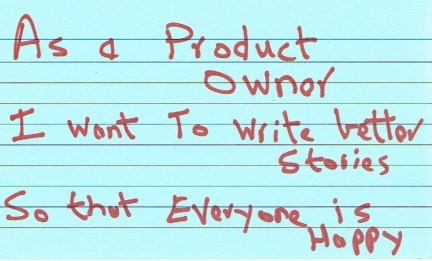 As a Product Owner I want to write better stories
A success story from the dark days of lock-down: my online User Stories Masterclass. The Masterclass is running again in October and November. The October run is the half-day version on the 26th, while November is four 90 minutes sessions, one a week for four weeks, November 9, 16, 23, 30th
Both these versions have run before and I have multiple reviews via Google. The mid change this time is I’m working with Edinburgh Agile who are handling ticket sales and who have added a certificate and exam.
There is an early bird discount and 10USERSTORY9YP will get you an extra 10% off.
The post User Stories Masterclass: October & November appeared first on Allan Kelly Associates.
Allan Kelly's Blog

- Allan Kelly's profile
- 16 followers

