
Cyndi Norwitz's Blog, page 5
December 25, 2020
Yavapai Dances
Among our time travelers is a sibling group (Zach, age 10, and twins, Helena and Yelena, age 9) who are one quarter Jewish and one quarter Native American, from the Yavapai tribe. The girls are ballet dancers back home and therefore pick up other styles of dance quickly. They’ve learned a few dances from their time attending Yavapai ceremonies and events with their family.
_(cropped).jpg?ssl=1) “Yampai Indians,” British Library digitised image from page 51 of “Report of an expedition down the Zuni and Colorado Rivers by Captain L. Sitgreaves. (Also here) [Note: Yampai is a Yavapai county town about 70 miles NW of Prescott, which is near Barberry Lake.]
“Yampai Indians,” British Library digitised image from page 51 of “Report of an expedition down the Zuni and Colorado Rivers by Captain L. Sitgreaves. (Also here) [Note: Yampai is a Yavapai county town about 70 miles NW of Prescott, which is near Barberry Lake.]The early Yavapai practiced traditional dances such as the Mountain Spirit Dance, War Dances, Victory Dances and Social Dances. The Mountain Spirit dance was a masked dance, which was used for guidance or healing of a sick person. The masked dancers represented Mountain Spirits, who were believed by Yavapai to dwell in [four mountain peaks] near present-day Prescott….The modern Yavapai take part in several dances and singing, such as the Apache Sunrise Dance and the Bird Singing and Dancing of the Mojave people.
Yavapai. Wikipedia.
Since our siblings were born in 1985 and 1986, they would have learned the modern dances.
The Sunrise Dance is a four-day rite-of-transition for young Apache girls, which typically takes place from March through October. The sunrise dance is an ancient practice, unique to the Apache. It is related to the myth of the Changing Woman, a powerful figure in Apache culture who is believed to grant longevity. The power of Changing Woman is transferred to the pubescent girl through songs sung by the Medicine Man. A medicine man is joined by other tribal members in singing a series of songs, up to 32 which are believed to have first been sung by Changing Woman….
Originally part of the culture of the Mojave people of the Colorado River region, bird singing and dancing has been adopted by modern Yavapai culture…According to Mohave elders, the bird songs tell a story. An entire night is needed to sing the whole cycle, from sun down to sun up. This story tells the creation of the Yuman people and how they came to be. Bird songs are sung accompanied by a gourd, usually painted with various designs and made with a handle made of cottonwood. Modern bird singing and dancing is used for various purposes such as mourning, celebration and social purposes.
Yavapai. Wikipedia.
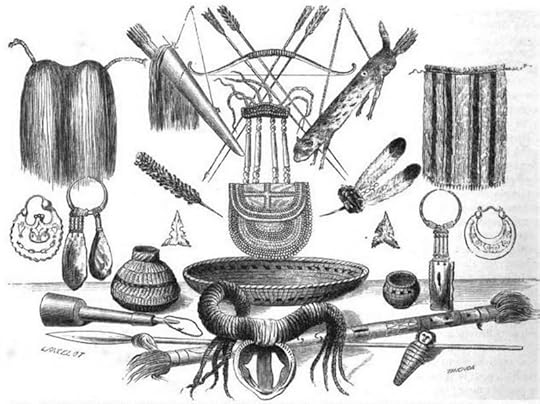 Weapons, ornaments, utensils of Mohave, Yampai and Chimehwhuebe Indians, Le Tour du Monde, volume 1, 1860. [Note: it’s hard to tell what’s what in this drawing, but the cup/rattle on a string in the lower left could be a musical instrument, or a toy.]
Mountain Spirit dancers in New Mexico perform at night. But Western Apache Mountain Spirit dancers (from Arizona) can perform during the day. A UCSB article has photographs of both ceremonies.
Mountain Spirits perform healing rites, as well as dancing at na ih es, the girls’ puberty rite. The masked dance performances may be used to protect against illness, to cure (even when witchcraft is the cause), and to control the weather….Mountain Spirit masks are buckskin hoods, usually painted black, that fit snugly over the head and are secured by a drawstring gathered about the neck. Tiny holes are cut for the eyes and sometimes one is cut for the mouth.
Attached to the top of the hood is a complex upright structure, brightly painted and decorated, sometimes referred to as horns. Its basic framework is a construction of wooden slats. On each side hang short wooden slats (earrings) that strike against one another, making the distinctive sound of the approaching Mountain Spirits….
Often appearing with the Mountain Spirit dancers is a clown figure, known variously as ”Gray One,” “Long Nose,” or “White Painted”….He carries messages between the masked dancers and the people. He makes fun of everything and creates fun by enacting foolishness as requested by the audience.
Apache Indian Legends: Apache Indian Mountain Spirits Legend. Native American Art. 2010. [Note: please see article for a photograph of the dancers.]
A detailed description of the 4 day long coming of age ceremony for girls, along with multiple photographs, is at YAN News. More descriptions and pictures of an “Apache Girl’s Puberty Ceremony, “Na’ii’ees”, the Sun Rise Ceremony” are on Pinterest.
Video from an Yavapai-Apache Exodus Day commemoration shows the main portion of the dance as heavy-footed stepping (some dancers turn it into a skip) in patterns and in a snaking line around a large circle. Both men and women dance, often in non-touching pairs, and there are some children as well. The men wear the elaborate headdress described in the Mountain Spirit dances.
References
Yavapai. Wikipedia.Mountain Spirit Dancers. University of California, Santa Barbara. Introduction to Archaeology, Brian M. Fagan. 2016.Apache Indian Legends: Apache Indian Mountain Spirits Legend. Native American Art. 2010.Honoring traditions-Changing Woman. Don Decker, YAN News. 2015.Apache Sunrise Ceremony. John Running. Pinterest.Apache Crown Dancers @ Yavapai-Apache Exodus Day commemoration in Camp Verde, AZ on 2/26/11.


November 24, 2020
Plants of Tabuk Province, Saudi Arabia
After our travelers cross the Red Sea, they find themselves in what is the northwest corner of modern day Saudi Arabia. They walk through desert and wadi and eventually find themselves in the mountain range not far from the crossing.
Many (perhaps most) put the Red Sea crossing in the Western edge of the modern-day Sinai Peninsula and they put Mount Sinai in the Central Southern area of Sinai. My research aligns with those who put the crossing and so forth much further East (so that the Hebrews actually leave Egypt; the modern day Sinai Peninsula area was part of Egypt in ancient times, and remained so until well after any dates attributed to the Exodus).
What plant life would the Hebrews have encountered in Northwest Saudi Arabia? How would it have differed from the coastal Sinai Peninsula of their journey before the Red Sea crossing? And from their life in the Eastern delta of the Nile.
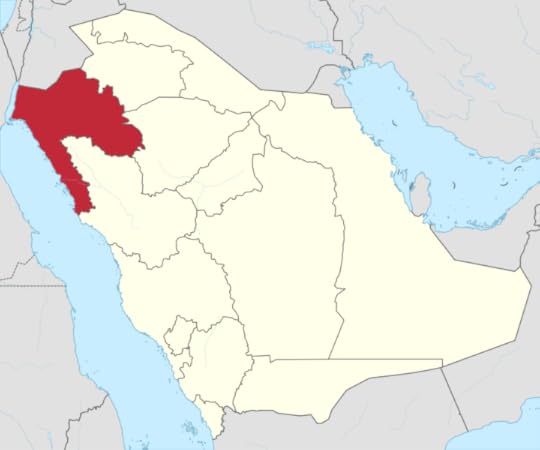 The Tabuk Province of Saudi Arabia along the eastern edge of the northern Red Sea and the Gulf of Aqaba
Immediately after the Red Sea crossing, they would have walked through Ras Alsheikh Hamid, “an uninhabited headland” in the Tabuk Province. In fact, all of their post-crossing wanderings through to establishing a camp at Jebel Al-Lawz, the mountain I am presuming is Mount Sinai, are in the Tabuk Province.
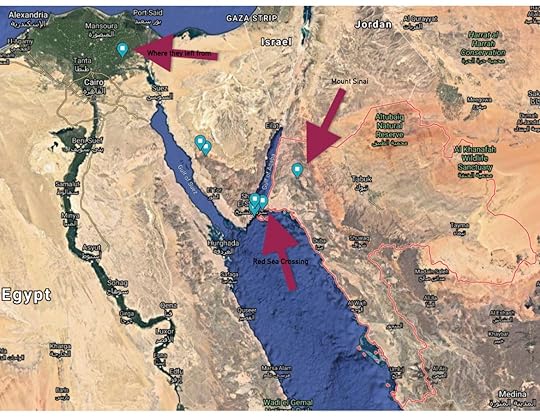 The fine red line outlines Tabuk Province, whose western end contains my placement of both the landing point of the Red Sea crossing and Mount Sinai. Click on the graphic for a larger rendering.
Tabuk province could be the most historical of all provinces in the Kingdom and the most beautiful of all coastal areas and beaches. It is the only province that has a good amount of snow falls in every winter. The region’s sand deserts winding through steep and artistic rock formations are stunning sights…Islands and islets are many in the visible distance of coastlines…crystal clear waters of Gulf of Aqaba and Red Sea…
People of Thamood, Aramean, and the Nabataean lived here [“more than 8000 years”] in addition to Prophet Shuaib and Prophet Moses whose water springs and well are living signs in the province of Tabuk….Taima remains associated with the Mesopotamian civilization. The Midian and Edomite civilizations, and the Islamic period, including the Mamluk and Ottoman rules are felt by a traveler….
Tabuk Province (Splendid Arabia)
The coastal areas of Tabuk Province are quite humid, as is the Nile Delta area the Hebrews came from and the coastal roads they took in the Sinai Peninsula. Once the Hebrews move away from the coast and into the mountains, it will be more arid.
Summers, from June to August, are hot, with daytime temperatures in the shade exceeding 100 °F (38 °C) in almost all of the country. Temperatures in the desert frequently rise as high as 130 °F (55 °C) in the summer. Humidity is low, except along the coasts, where it can be high and very oppressive.
Saudi Arabia (Britanica)
Moving away from the coast takes them to water (wadis are seasonal creeks) but the roads will be slow going.
“In the north, the western highlands are upward of 5,000 feet (1,500 metres) above sea level…There are virtually no permanent surface streams in the country, but wadis are numerous. Those leading to the Red Sea are short and steep.
Saudi Arabia (Britanica)
Tabuk Flora
[A study of Tabuk investigated] the floristic diversity and phytogeographical distribution of plant species along four sites i.e. Sharma, Alqan, Al-Lwaz Mountains and Alzetah from Tabuk region, Saudi Arabia. A total of 96 species belonging to 75 genera and 38 families (34 dicots and 4 monocots) were recorded. Asteraceae had the highest contribution (12.5% of the total species) followed by Fabaceae (10.42%), Zygophyllaceae (6.25%) and Lamiaceae (5.21%)…Most species belonged to Saharo-Arabian (37.21%), Irano-Turanian (11.63%) and Sudanean (10.47%) elements, and that constitute almost 60% of the total number of plant species. By comparing the plant diversity among the four studied sites, the highest plant diversity was reported in Alqan and Alzetah, while the lowest was reported in Sharma. It was concluded that Tabuk region had remarkable floristic diversity.
Floristic Diversity Of Tabuk Province, North Saudi Arabia.
Palm Trees
Palm trees are the prominent feature of Elim, an oasis with multiple wells that the Hebrews camp in on their way to Mount Sinai. It’s not far from the Red Sea but is not right on the coast.
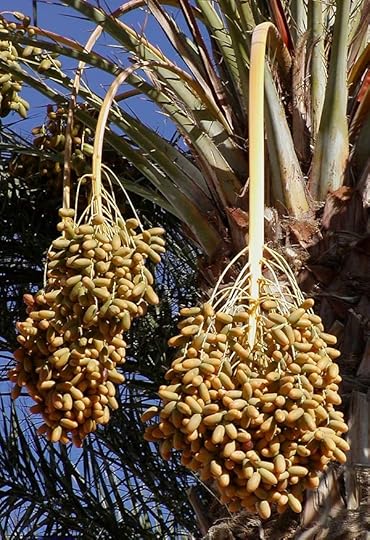 Photo of dates on a date palm in Las Vegas, Nevada
Date palms (Phoenix dactylifera) in particular are well represented in Saudi Arabia, as well as Egypt and many other areas. It does not appear to be native to the Tabuk Province area, but we might imagine that a magically appearing oasis could make use of plants from across the peninsula.
Date fruit itself is well known and has many uses but other parts of the plants are edible or otherwise useful.
Date seeds are soaked and ground up for animal feed….also ground and used in the manner of coffee beans, or as an additive to coffee…Stripped fruit clusters are used as brooms…Wild date palms…can be also tapped for [sweet] sap…Leaves are…used for making huts. Mature leaves are also made into mats, screens, baskets and fans. Processed leaves can be used for insulating board. Dried leaf petioles are a source of cellulose pulp, used for walking sticks, brooms, fishing floats and fuel. Leaf sheaths are prized for their scent, and fibre from them is also used for rope, coarse cloth, and large hats. The leaves are also used as a lulav in the Jewish holiday of Sukkot.
Young date leaves are cooked and eaten as a vegetable, as is the terminal bud or heart, though its removal kills the palm. The finely ground seeds are mixed with flour to make bread in times of scarcity. The flowers of the date palm are also edible. Traditionally the female flowers are the most available for sale and weigh 300–400 grams (11–14 oz). The flower buds are used in salad or ground with dried fish to make a condiment for bread.
Date palm (Wikipedia)
Aerva javanica, the kapok bush or desert cotton
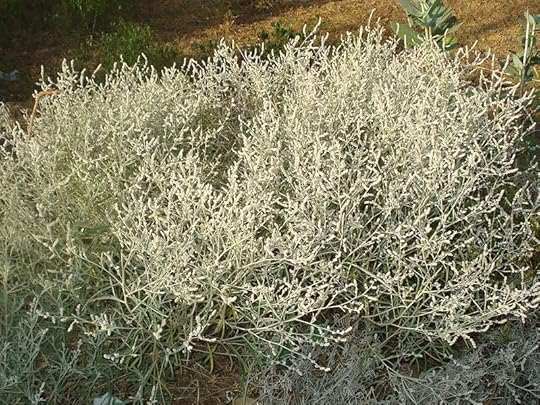 Aerva javanica
(Syn. Aerva tomentosa) (Bui) herbal plant found in Thar desert
Aerva javanica
(Syn. Aerva tomentosa) (Bui) herbal plant found in Thar desertIt is used for fuel and for fodder for goats. In traditional medicine the seeds are believed to cure headaches. A gargle is made from the plant to try to treat toothache…The thick, white inflorescences have traditionally been harvested in Arabia for stuffing cushions and saddle pads. Today, the soft fibres are still used as kapok for pillows.
Aerva javanica (Wikipedia)
Lavender
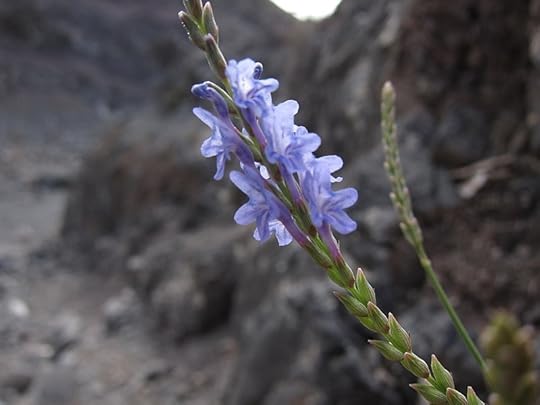 Lavandula coronopifolia Poir., Monts Goda, Djibouti
The two species of lavender found in the area are Lavandula pubescens (aka downy lavender) and Lavandula coronopifolia.
Haloxylon salicornicum aka Rajasthan
Used as a “famine food” where “seeds mixed with other grains for bread making, young branches eaten.”
Phoenicean juniper
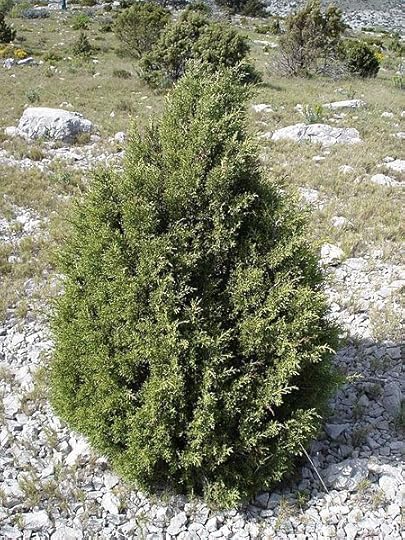 Juniperus phoenicea
Juniperus phoenicea is a large shrub or small tree reaching 5–8 metres (16–26 ft) tall, with a trunk up to 1–2 metres (3 ft 3 in–6 ft 7 in) in diameter and a rounded or irregular crown. The bark, which can be pealed in strips, is dark greyish-brown.
Juniper berries are used as a seasoning in cooking or in alcoholic beverages, particularly to flavor gin. Juniper berries have also been used in traditional medicine for different conditions…Juniper wood is used for small manufactured objects and inlay works in carpentry, and in building construction in Africa where it is mainly used for fuel and producing charcoal.
Juniperus phoenicea (Wikipedia)
Umbrella thorn acacia
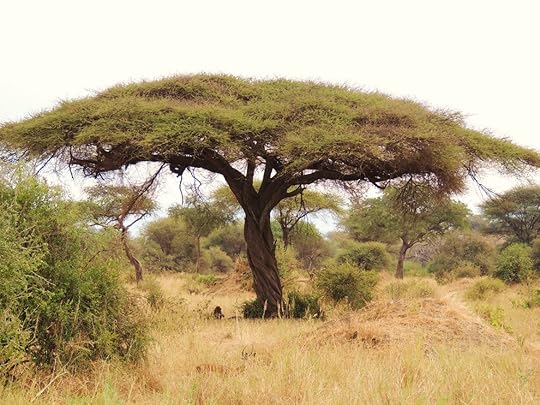 Vachellia tortilis
(syn. Acacia tortilis)
Vachellia tortilis
(syn. Acacia tortilis)Vachellia tortilis, widely known as Acacia tortilis…is the umbrella thorn acacia, also known as umbrella thorn and Israeli babool, a medium to large canopied tree native to most of Africa…but also occurring in the Middle East. In extremely arid conditions, it may occur as a small, wiry bush. It grows up to 21 m (69 ft) in height…Flowers are small and white, highly aromatic, and occur in tight clusters. Seeds are produced in pods which are flat and coiled into a springlike structure. The plant is known to tolerate high alkalinity, drought, high temperatures, sandy & stony soils, strongly sloped rooting surfaces and sandblasting…
Timber from the tree is used for furniture, wagon wheels, fence posts, cages, and pens. Vachellia wood was also used exclusively by the Israelites in the Old Testament in the building of the tabernacle and the tabernacle furniture, including the Ark of the Covenant. The pods and foliage, which grow prolifically on the tree, are used as fodder for desert grazing animals. The bark is often used as a string medium in Tanganyika, and is a source for tannin. Gum from the tree is edible and can be used as Gum Arabic. Parts of the tree including roots, shoots, and pods are also often used by natives for a vast number of purposes including decorations, weapons, tools, and medicines.
Vachellia tortilis (Wikipedia)
Lycium
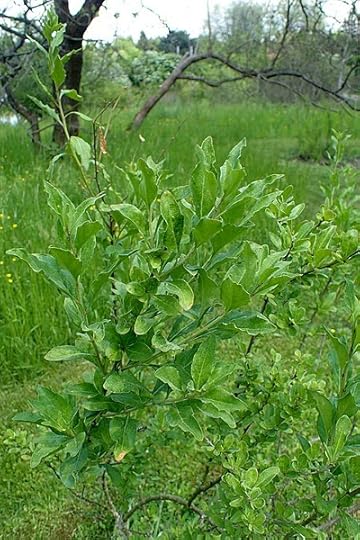 Lycium depressum in the Botanischer Garten, Berlin-Dahlem
Related to goji berries (Lycium barbarum or Lycium chinense) and sometimes called Wolfberry, these species of Boxthorn have edible berries and the leaves are used medicinally to heal wounds in addition to being edible.
The Tabuk Province has both Lycium depressum Stocks and Lycium shawii Roem. & Schult (aka desert thorn or Arabian boxthorn).
Lycium shawii is an erect, spreading, sometimes scandent, intricately branched, very spiny shrub growing 1 – 3 metres tall, exceptionally becoming a small tree up to 4.5 metres tall…Dry to relatively moist areas such as hilly country to the edge of floodplains; riverbanks and dambos; mixed woodland and wooded grassland; extending into miombo mainly on termitaria; cultivated areas and along roadsides….
Edible Uses
Fruit – raw. The globose, red fruit is 3 – 5mm in diameter
Leaves – cooked and eaten as a vegetable. A salty flavour.
This species is much used in traditional medicine in Africa
Lycium shawii (Useful Tropical Plants)
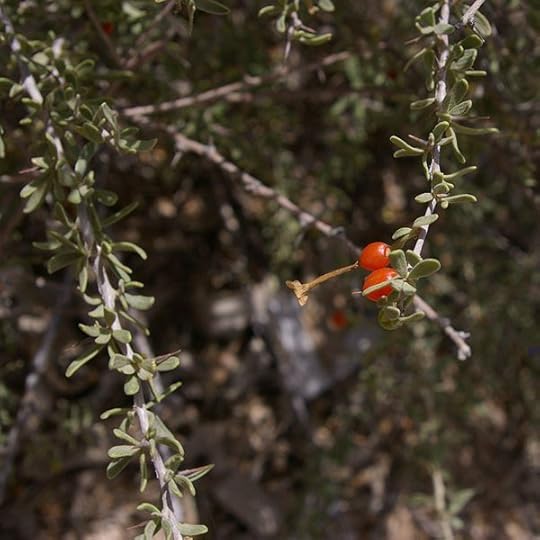 Lycium shawii
Another study came up with some different species.
In general terms, the vegetation of Tabuk Region is composed mainly of Chenopods, especially the Salsola tetrandra-Salsola cyclophylla associations. However, a few other xerophytic vegetations can also be seen in some localized centers…Haloxylon salicornicum, Retama reaetam, Pulicaria undulata, Acacia tortilis, and Lycium shawii. On the western sides of the region, Acacia tortilis is dominating…Tree species are rare in this region. However, species like, Acacia raddiana, Maerua crassifolia, Moringa peregrina, Ziziphus spina-christi, etc can be seen in some of the wadis. Other perennials which form into communities in some parts of the region are: Salsola tetrandra, Traganum nudatum, Retama raetam, Artemisia sieberi, Hyoscyamus muticus, Astragalus spinosa, Haloxylon salicornicum, Rhanterium epapposum, Farsetia aegyptiaca, etc…Halophytic vegetation is also dominant in certain salt marsh ecosystems. These include: Pharagmites australis, Tamarix nilotica, Aeluropus lagopoides and Zygophyllum coccineum. A significant number of annual species are also found in the Tabuk region, most of which are belonging to the families, Brassicaceae, Asteraceae and Paplionaceae. Common annual species include: Eremobium lineare, Plantago boissieri, Anthemis melampodina, Cutandia memphitica, Silene villosa, Plantago ciliata, Savignya parviflora, Astragalus schimperi, A. annularis, Ifloga spicata, Trigonella stellata, Astragalus tribuloides, Schimpera arabica, Plantago amplexicaulis, etc.
Topography and vegetation of Tabuk Region (from Vegetation of Northern Provinces, Plant Diversity of Saudi Arabia)
Chenopods
The vegetation of Tabuk Region is composed mainly of Chenopods, especially the Salsola tetrandra-Salsola cyclophylla associations.
Topography and vegetation of Tabuk Region (from Vegetation of Northern Provinces, Plant Diversity of Saudi Arabia)
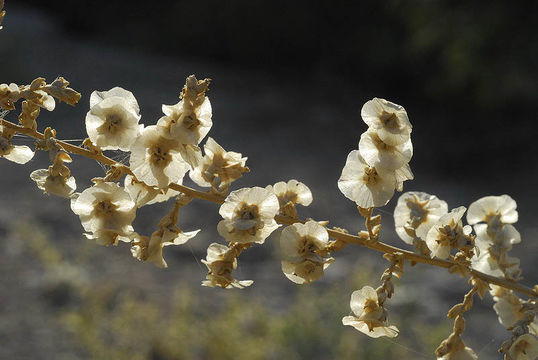 Salsola tetrandra Forssk
What are Chenopods? They refer to the Chenopodioideae subfamily in the Amaranthaceae family (the classifications for these families changed in recent years). It includes spinach, goosefoot, lambsquarters, amaranth, and quinoa, though those specific plants aren’t found in Saudi Arabia.
Salsoloideae is another subfamily of Amaranthaceae and includes saltwort and many grazing plants for cattle. Salsola tetrandra is a small scrub also known as belbel or lharad. Salsola cyclophylla is “5-8 inches high silvery flowers. Prostrate spreading habit.” (A great picture is here)
Resources
Specific Plants
Date palm (Wikipedia)Chenopods (The Daily Garden; nice pictures)Characterization Of Four Salsola Species And Their Genetic Relationship By AFLP. Amal M.E. Abdel-HamidPak. J. Bot., 48(3): 1183-1187, 2016.Chenopodioideae (Wikipedia)Amaranthaceae (Wikipedia)Salsola (Wikipedia)Salsola cyclophylla Baker (Flora of Qatar)Aerva javanica (Wikipedia)Juniperus phoenicea (Wikipedia)Vachellia tortilis (Wikipedia)Lycium shawii (Useful Tropical Plants)
Flora Studies
Traditional use of ethnomedicinal native plants in the Kingdom of Saudi Arabia, Hanan Aati, Ali El-Gamal, Hamdy Shaheen, & Oliver Kayser. Journal of Ethnobiology and Ethnomedicine volume 15, Article number: 2 (2019)Wildlife of Saudi Arabia (Wikipedia)Native Plants Of Saudi Arabia, John Misachi, WorldAltas, 2017Wild plants diversity of Red Sea coastal region, Tabuk, Saudi Arabia. Mohamed M. Moawed and Abid Ali Ansari. Journal of Chemical and Pharmaceutical Research 7(10):220-227, October 2015.Topography and vegetation of Tabuk Region (from Vegetation of Northern Provinces, Plant Diversity of Saudi Arabia)Floristic Diversity Of Tabuk Province, North Saudi Arabia. K. Al-Mutairi, S. A. Al-Shami, Z. Khorshid, and M. M. Moawed. The Journal Of Animal & Plant Sciences, 26(4): 2016, Page: 1019-1025.
Geographic/Regional Studies
Ras Alsheikh Hamid (Wikipedia)Tabuk Province (Wikipedia)Tabuk Province (Splendid Arabia)Sinai Peninsula (Britanica)Saudi Arabia (Britanica)
November 19, 2020
The Stations of the Exodus
As I sat down to write about my characters’ time in Elim, I realized I needed to decide how long they were staying. Torah doesn’t say. We know they probably stayed at least a couple of days, but it could be a couple of weeks. To figure out the range, I needed to look at my sources and map out where they need to be when.
I’ve done this one stop at a time since they left their village in Egypt. But the timeline is more muddled now and I need to sort it all out. So let’s start from the beginning and go through to the end.
The Exodus story appears, unsurprisingly, in the Book of Exodus. Forty chapters.
The Book of Exodus
Chapters 1-6 — The Hebrews in Egypt.Chapters 7-12 — The Ten Plagues.Chapters 13-14 — Leaving Egypt to crossing the Red Sea.Chapters 15-18 — From the Red Sea to Mount Sinai.Chapters 19-20 — At Mount Sinai, people experience God by the mountain.Chapters 21-23 — At Mount Sinai, giving of ordinances.Chapter 24 — At Mount Sinai, Moses ascends mountain.Chapters 25-31 — At Mount Sinai, instructions for Mishkan (ending with giving of first set of tablets).Chapter 32 — At Mount Sinai, the Golden Calf.Chapter 33 — At Mount Sinai, Moses communes with God, returns to mountain.Chapter 34 — At Mount Sinai, the second set of tablets.Chapters 35-40 — At Mount Sinai, making of the Mishkan.
The story continues in the Book of Leviticus, and on through Numbers and Deuteronomy. For all 40 years that the Hebrews wandered between leaving slavery and entering the land of Israel.
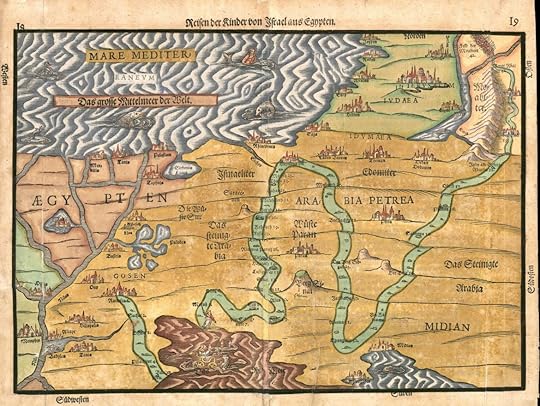 A map of Exodus, The National Library of Israel Collections, Map of the Exodus of the Israelites from Egypt, 1585, Heinrich Bunting.
The Campsites (Stations) of the Exodus
The narrative in Exodus has many details of what the Hebrews experienced, but does not delineate every stop. This you can find in Numbers 33. A list of every place the Hebrews set up camp for at least one night, from leaving Egypt until entering the Holy Land.
Most of the stations come after the Hebrews leave Mount Sinai. I will annotate those verses in reference to the journey to Mount Sinai only.
These are the journeys of the children of Israel who left the land of Egypt in their legions, under the charge of Moses and Aaron. Moses recorded their starting points for their journeys according to the word of the Lord, and these were their journeys with their starting points.
Numbers 33:1-2
The Hebrews lived in the eastern Nile Delta of lower (Northern) Egypt. In an area referred to both as Rameses and Goshen.
Succoth
They journeyed from Rameses in the first month, on the fifteenth day of the first month; on the day following the Passover sacrifice, the children of Israel left triumphantly before the eyes of all the Egyptians. And the Egyptians were busy burying because the Lord had struck down their firstborn and had wrought vengeance against their deities. The children of Israel journeyed from Rameses and camped in Succoth.
Numbers 33:3-5
Exodus confirms the date, which is 15 Nissan, in the instructions to Moses about leaving. For the actual leg, it merely says “The children of Israel journeyed from Rameses to Succoth” (Exodus 12:37). Though it adds a bit about the route in general.
It came to pass when Pharaoh let the people go, that God did not lead them [by] way of the land of the Philistines for it was near, because God said, Lest the people reconsider when they see war and return to Egypt. So God led the people around [by] way of the desert [to] the Red Sea.
Exodus 13:17-18
I discuss the overall route in The Road to Succoth. The Hebrews are moving quickly but they do not yet have the cloud during the day or the fire at night to guide them. They are not traveling day and night. We can interpret this as saying that they make the journey between Rameses and Succoth in one day, or we can say that they did stop at night, but briefly, not a full camp.
Etham
They journeyed from Succoth and camped in Etham, at the edge of the desert.
Numbers 33:6
Now we have the cloud and the fire, because the Hebrews do not stop until they reach Etham. The cloud/fire stays with them all 40 years. Exodus doesn’t tell us how long this leg took, only that they traveled “day and night,” which implies at least 2 days total.
Pi hahiroth & the Red Sea (the crossing)
They journeyed from Etham and camped in Pi hahiroth, which faces Baal zephon; and they camped in front of Migdol.
Numbers 33:7
They could not move forward at Etham and had to turn back.
The Lord spoke to Moses, saying, Speak to the children of Israel, and let them turn back and encamp in front of Pi hahiroth, between Migdol and the sea; in front of Baal Zephon, you shall encamp opposite it, by the sea. And Pharaoh will say about the children of Israel, They are trapped in the land. The desert has closed in upon them.
Exodus 14:1-3
This leg is quite short because Pharaoh catches up with them here. The Red Sea is split in two for an entire night and the Hebrews finish crossing in the morning.
According to midrash, Rashi, and other sages, the crossing took place one week after leaving Goshen. On 21 Nissan.
Marah
They journeyed from Penei hahiroth and crossed in the midst of the sea to the desert. They walked for three days in the desert of Etham and camped in Marah.
Numbers 33:8
Exodus does not mention any stay on the Eastern side of the Red Sea longer than it took to sing about it. Midrash tells us Moses was eager to get out of there because the Hebrews were mesmerized by the jewels from the drowned horses and chariots.
Exodus also states this leg took three days (which I interpret as inclusive of the day they left the Red Sea and the day they arrive in Marah). But with more dire consequences.
Moses led Israel away from the Red Sea, and they went out into the desert of Shur; they walked for three days in the desert but did not find water. They came to Marah, but they could not drink water from Marah because it was bitter; therefore, it was named Marah.
Exodus 15:22-23
We don’t know how long the Hebrews stayed in Marah. Only that, after telling Moses how to make the water drinkable, God “gave them a statute and an ordinance, and there He tested them” (Exodus 15:25). Commentaries state that the Hebrews were given teachings there to prepare them for the giving of Torah. So it’s reasonable to assume they stayed a few days.
Elim
They journeyed from Marah and arrived in Elim, and in Elim there were twelve springs of water and seventy palm trees, and they camped there.
Numbers 33:9
Exodus’s account is similar.
They came to Elim, and there were twelve water fountains and seventy palms, and they encamped there by the water.
Exodus 15:27
Again, we have no idea how long they stayed in Elim, but they have a couple weeks before they get manna, and this is a comfortable place with not just water but food (palms give dates, among other things). Given that they are safe from Pharaoh and in no particular hurry, Elim appears to be the perfect place to rest and rejuvenate.
The Red Sea (not the crossing)
They journeyed from Elim and camped by the Red Sea.
Numbers 33:10
There is no mention of this stop in Exodus. We just know that it isn’t the same place where they crossed.
The Desert of Sin
They journeyed from the Red Sea and camped in the desert of Sin.
Numbers 33:11
Also known as the Wilderness of Sin or of Zin (with no relationship to the English word “sin”). Exodus gives us a date for this campsite.
They journeyed from Elim, and the entire community of the children of Israel came to the desert of Sin, which is between Elim and Sinai, on the fifteenth day of the second month after their departure from the land of Egypt.
Exodus 16:1
They arrive on 15 Iyyar, which is the Sabbath. It is 24 days after crossing the Red Sea.
This is where the Hebrews run out of food (the food they brought from Egypt and anything they managed to gather in Elim or other places they passed through). That evening and every evening (except for the Sabbath) they had quail to eat. The next morning and every morning (except for the Sabbath) they had manna to gather and eat.
We know that the Hebrews stayed in the Desert of Sin at least a week (though it may not have been in the same camp). They are there on 22 Iyyar, the first official Sabbath they celebrated. They probably leave on 23 Iyyar, though it could be later.
Dophkah
They journeyed from the desert of Sin and camped in Dophkah.
Numbers 33:12
There is no mention of this stop in Exodus.
Alush
They journeyed from Dophkah and camped in Alush.
Numbers 33:13
There is no mention of this stop in Exodus.
Rephidim
They journeyed from Alush and camped in Rephidim, but there there was no water for the people to drink.
Numbers 33:14
The previous two stops may have been waypoints within the Desert of Sin, after the initial stop where they were introduced to manna. Exodus describes it as a single leg.
The entire community of the children of Israel journeyed from the desert of Sin to their travels by the mandate of the Lord. They encamped in Rephidim, and there was no water for the people to drink.
Exodus 17:1
This is where Moses strikes the rock and gets water. Then they discover that Amalek has come to fight. This battle takes place the entire following day, until sunset. So we can assume they spent at least two nights camping in Rephidim.
Mount Sinai
They journeyed from Rephidim and camped in the Sinai desert.
Numbers 33:15
Now they have arrived to the camp where they will settle for a good long time, about a year. Exodus gives us a date, 1 Sivan.
In the third month of the children of Israel’s departure from Egypt, on this day they arrived in the desert of Sinai. They journeyed from Rephidim, and they arrived in the desert of Sinai, and they encamped in the desert, and Israel encamped there opposite the mountain.
Exodus 19:1-2
This gives them seven days to get from the Desert of Sin to Mount Sinai, though it might be less if they stayed longer in the Desert.
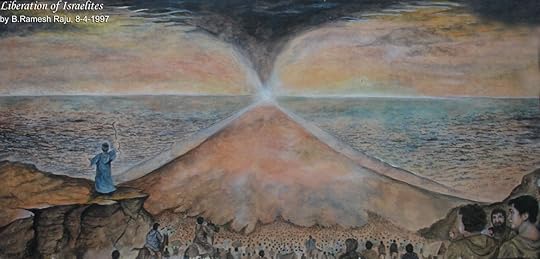 A Scene from Exodus – Moses separating the red sea to free Israelites from bondage of Egyptians, Ramesh Raju, 1997.
Resources
Book of Numbers, Encyclopaedia Judaica.Stations of the Exodus (Wikipedia)Parshat Massei In-Depth, Numbers 33:1-36:13 (Chabad)Parashat Shelah 5760/2000, The Eight Strands in the Tzitzit — We Follow the Thought, Boaz Spiegel, Bar-Ilan University’s Parashat Hashavua Study Center
November 17, 2020
My Sources in Order
Where does my source material come from? With a novel adapted from history and known texts, the framework comes from outside. I use my imagination to make it blossom. I follow the belief that Torah is true, but not necessarily factual. But, for the purposes of my novel, I’m assuming that it is (more or less) factual. So here are the sources I use, in the order in which I apply them.
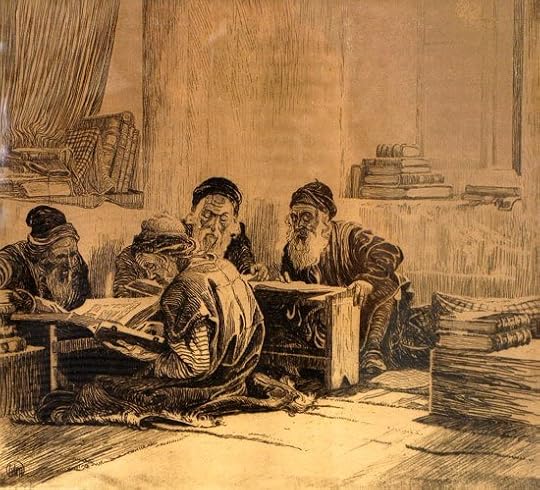 The Talmud students, Ephraim Moses Lilien (1874–1925), etching, 1915
Torah — If it’s in the Torah, then it’s canon. My novel expands the universe as outlined in our most sacred text. But that’s hardly sufficient. Many of the details simply aren’t there and I need to construct them. In other cases, there are outright contradictions. Sometimes the text is not in chronological order (an issue Rashi expounds upon at length). Or a straightforward description where the body of the story is (in this case, Exodus) might pull in more details elsewhere (in this case, Numbers).
Tanakh — This is the Bible in full. Or what some might call the Hebrew Bible. It includes Torah (the first 5 books), the Prophets, and the Writings. Sometimes a detail comes from outside of Torah and, if it doesn’t contradict Torah, I generally consider it canon.
Sages and Historic Commentators — Rashi is the one I use the most (because he comments at a very concrete practical level, which is most useful for my purpose in bringing the tales to life) but there are many others. A good place to find them is Sefaria. Highlight any line with your mouse as you read through the texts and you’ll get a menu leading you to commentaries and other materials relating to that text.
Midrash and Talmud — Sometimes I lean on these sources heavily (for example, Miriam’s Well is not in Tanakh at all but comes from Midrash (early stories as commentary on the Bible). Other times I must firmly dismiss it (for example, there is a sizable chunk of Talmud (an “intergenerational rabbinic conversation“) that calculates that a middle-aged Miriam married and had a child with a pre-pubescent Caleb; sometimes you have to leave the Rabbis to their imaginings and move along).
Jewish Commentary — This includes all sources of resources. Some quite old, some very modern. From all over the world. And from all sects of Judaism. I consider anything well researched and thought out, whether it be Orthodox or Liberal. Commentaries don’t have to come from Rabbis or scholars either. I am neither and my novel is Torah commentary.
Other Religious-Based Sources — I use a few sources from Christians and from Muslims. Or anyone else who adds to the discussion.
Secular Sources — I actually rely on these quite heavily, despite being listed last. The order of the listing is only to say what I consider as true first, when there are contradictions. The secular sources (some of which come from religious commentators speaking of secular subjects mentioned in Torah) fill in the gaps. Archeology, food history, ecology, astronomy, history, and all sorts of subjects like how to make bread.
November 16, 2020
A Gay Old Time
Every single society ever has had members who fall in love with people deemed the wrong gender for them (or it’s a society that doesn’t place those restrictions on relationships). Because my novel is middle-grade (about tween ages), I’m obviously not going into detail about sex, but there’s still love. And longing. And building family.
Same sex relationships are hardly a new concept. Nor is it true that they were once forbidden but now, in our enlightened modern era, they are finally being recognized. The reality is that every culture has them and there’s a huge variety in how they are treated.
What is a newer concept in Western culture is the idea that one marries for love. Love is a desirable side effect of marriage, but it was secondary to procreation, creating family units, and building community relationships (or political relationships). All of those things can be done without regard to gender, but most Biblical and descendent cultures prioritize male-female unions.
There’s really not much about same sex romantic or sexual relationships in the Bible. We have King David and his love, Jonathan (though David was married to many women and had children with them and Jonathan was also married with a child). And hints of others.
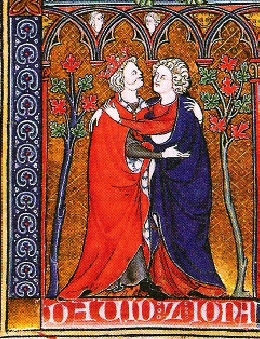 Biblical Prince Jonathan and David embrace, circa 1300 AD. The British Library, London, United Kingdom
In Seven Gay Texts: Biblical Passages Used to Condemn Homosexuality, Christian writer Robert K. Gnuse analyzes four texts from Torah and three from the Christian Bible. Both the story of Noah and his sons and of Sodom and Gomorrah reference male/male sexual activity, but neither has anything to do with consensual sex, love, or relationships. The Christian texts are not relevant to our treatment here, but they make an interesting read.
That leaves only the two near identical lines from Leviticus.
Do not lie with a male as one lies with a woman; it is an abhorrence. (Sefaria)
Leviticus 18:22. Sefaria translation and Chabad translation.
You shall not lie down with a male, as with a woman: this is an abomination. (Chabad)
Then a couple of chapters later.
If a man lies with a male as one lies with a woman, the two of them have done an abhorrent thing; they shall be put to death—their bloodguilt is upon them. (Sefaria)
Leviticus 20:13. Sefaria translation and Chabad translation.
And a man who lies with a male as one would with a woman both of them have committed an abomination; they shall surely be put to death; their blood is upon themselves. (Chabad)
While interpretations both old and modern often assume this means same sex relationships and sex are wrong, there’s no real evidence of that. Gnuse does a much better job than I could in delving into the meaning of the passages, how they are situated with other parts of Torah, and historical background.
His conclusion is that the prohibition is on Canaanite cultic behaviors (specifically, male religious prostitution) and doesn’t really have anything to say about same sex romance.
Regardless of how you choose to interpret it, my point isn’t about whether same sex relationships were officially allowed (and note that the text says absolutely nothing about relationships between women) but how they manifested. Because they did exist.
Let us start with Ancient Egypt around 2380 BCE (about 1000 years before the assumed timing of the Exodus).
In 1964, archaeologists in Egypt opened the tomb of Niankhkhnum and Khnumhotep…[and found] the two were depicted in many of the stereotypical ways that heterosexual couples were shown in Egyptian funereal art: kissing nose-to-nose, holding hands, and standing very closely together, almost in an embrace. Their wives (and children) are also depicted in the tombs, though curiously, there are no paintings of either man embracing or kissing their wife.
If a man and a woman were depicted in this way, they would obviously be interpreted as a couple. And so, faced with all this evidence, archaeologists leapt to the conclusion that Niankhkhnum and Khnumhotep were… brothers — really, really close brothers.
themstory: Ancient Egypt Was Totally Queer
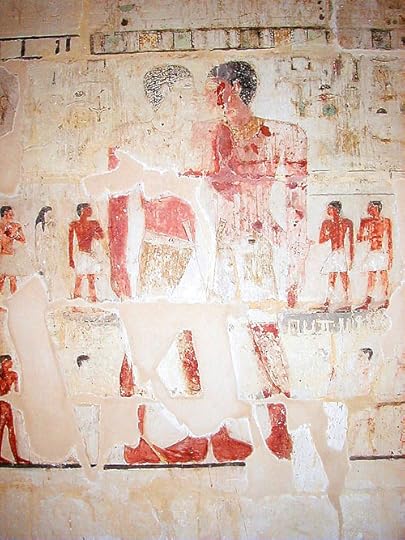
Mastaba of Niankhkhum and Khnumhotep. Photo of their tomb painting.
Then there is a piece of pottery from the Ancient Egyptian Rammeside-period (circa 1292–1069 BCE, just after the time period associated with the Exodus) which shows a rather explicit male sexual act. (Click here to see the very NSFW picture.)
An Egyptian statue from the time period just before the Exodus shows “two women, Idet and Ruiu, depicted in a form typical to married couples.”
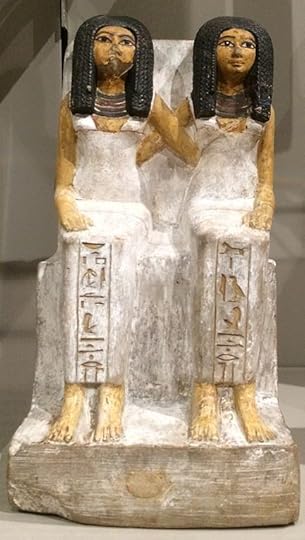 Egyptian statue of Idet e Ruiu. Limestone, probably from the Theban Necropolis, New Kingdom, 18th dynasty, 1480-1390 BC.
We also want to move forward in time to when the Book of Exodus was likely written.
The book of Exodus began as oral tradition when the Hebrew people arrived in Canaan in approximately 1,200 BCE according to Mosaic scholarship. It remained as such until sometime after 922 BCE when the unified kingdom of Israel was divided into Northern and Southern kingdoms. Between 922 and 722 BCE these stories were written down in different forms by priests of the two kingdoms. After the Northern Kingdom was conquered by the Assyrian Empire in 722 BCE and the population was exiled, some to Israel and some to other territories, the stories were combined into one text. This process occurred from 722 BCE to 587 BCE with a new Priestly line, Jeremiah the Prophet likely being one of the contributors. The final text was edited by a Redactor and completed around 400 BCE.
Biblical Historian Ari Hilton, personal correspondence with author, Nov 16, 2020
Within the Assyrian Empire, circa 700 BCE, there were no recorded laws against homosexuality. In fact, there were specific prayers for blessing same-sex male love relationships, as well as art, poetry, and religious iconography depicting homosexual intercourse.
Given that the Israelite population had been severely decimated by the Assyrian Empire in 722 BCE, and then by the Babylonian Empire in 587 BCE, later prohibitions on same sex relationships could be a response to the need for procreation and therefore the survival of the religion. Surrounding cultures also practiced same-sex sexual relationships and as Israelites left their faith practices this same need would occur.
Regardless, same-sex relationships have existed throughout history and were occurring throughout the time of the Exodus itself and during the writing of the book as well.
From Ancient Egypt to Ancient Greece and Rome, and societies in-between and elsewhere, you can find examples of male couples or female couples, as well as consensual sexual relations (usually between men). There are entire books on the subject and I won’t duplicate their findings.
So what does this mean for the characters of my novel? The time travelers from 1995 America are growing up in an era where openly gay relationships are reasonably common (and even on television), though same sex marriage is a distant hope.
For the Hebrews living first in Egypt then in the Sinai wilderness over 3000 years ago, they would not have used the words gay or homosexual, in any translation. But they would have understood same sex attraction and relationships.
I can imagine families sharing living space that consist of two couples, one male, one female. Or people forming romantic relationships with members of their gender after their spouse has passed away. And in all cultures there will be a few people who never marry at all, despite the importance that culture might place on the married couple as an economic unit or upon procreation. While not all such people are gay, some are and may find a way to join households with their partner of choice.
Resources:
What Does the Bible Say About Homosexuality? Human Rights CampaignSeven Gay Texts: Biblical Passages Used to Condemn Homosexuality, Robert K. Gnuse, Biblical Theology Bulletin: Journal of Bible and CultureDavid and Jonathan (Wikipedia)themstory: Ancient Egypt Was Totally Queer, Hugh RyanKhnumhotep and Niankhkhnum (Wikipedia)Homosexuality in ancient Egypt (Wikipedia)Biblical Historian Ari Hilton, personal correspondence with author, Nov 16, 2020Judaism and Homosexuality: A Brief History, Elon Gilad (Haaretz)
November 4, 2020
Honoring Your Parents
If the ten commandments are Torah distilled, then each of the ten is vitally important and reflects far more than the surface meaning. “Honor your father and mother” is the fifth commandment and it’s one that the sages say was explicitly taught at Marah.
Honor your father and your mother, that you may long endure on the land that the LORD your God is assigning to you.
Exodus 20:12
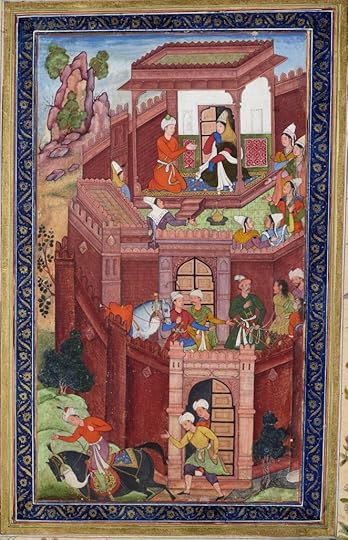 Babur Seeks His Grandmothers Advice. The “Memoirs of Babur” or Baburnama are the work of the great-great-great-grandson of Timur (Tamerlane), Zahiruddin Muhammad Babur (1483-1530).
 Honoring ones parents is also said to be honoring God.
You must be extremely careful to honor and revere your father and mother for Scripture compares their honor and reverence to the honor and reverence you must have for the Almighty…Three partners share in the formation of man: The Holy One, Blessed is He, his father, and his mother. (The man contributes, the woman contributes, and the Holy One, Blessed is He, breathes a soul into him, endows him with eye sight, hearing and speech.) When man honors his father and mother, the Holy One, Blessed is He, says, “I account it to them as though I dwelt among them, and they honored Me.”
Kitzur Shulchan Arukh, Siman 143:7
Honoring does not mean obeying them in all things, or in following their ways, should they not be good people. You’re allowed to leave them, even if they are elderly and require care (so long as others are caring for them). You don’t even have to love them.
The Shulchan Aruch, the authoritative code of Jewish law, [states]: “How much should a person have awe of his parents? Even if he was wearing formal clothes and sitting at the head of an assembly, and his father and mother came and tore his clothes, beat him, and spit at him, he may not insult them but rather should remain quiet, and be in awe of the King of kings who commanded him thus. . . How much should he honor his father and mother? Even if they took his wallet full of money and threw it into the sea, he should not insult them nor irritate them nor get angry at them, rather he should accept the dictate of Scripture and remain quiet.”
We see two things: First of all, we see that the trial you face, where a parent shows contempt for the child and takes his or her money, is considered the most difficult ordeal of all in upholding honor of parents. Second of all, we see that even in this case the child is not allowed to insult the parent.
However, we learn from this same chapter of the Shulchan Aruch that the child is allowed to sue the parent for the money. Having a monetary disagreement with someone doesn’t mean that you don’t respect them, and parents are no exception.
The Jewish Ethicist: Taking the Fifth (Commandment)
The honor extends to other family members as well. Stepparents, aunts and uncles, grandparents, and anyone older or who helped raise you.
But how much further does it go? Which other commandments and concepts does “honor your father and mother” imply? Rashi discusses the twin nature of the Ten Commandments as part of his explanation for twin metaphors in the Song of Songs.
Like two fawns, twins of a gazelle. It is a gazelle’s nature to bear twins, similarly, they [Moshe and Aharon] are equal, this one to that one. (This is in accordance with Rashi in Shemos 6:26 who states “there are places where the Torah sets Aharon ahead of Moshe and there are places where it sets Moshe ahead of Aharon, to tell you that they were equal.”)
Another explanation, “Your bosom,” is a reference to the Tablets, “twins of a gazelle,” they are equal with one measure; five commandments on this one and five on the other, each commandment corresponding to the other. [I.e., the five commandments on one side of the Tablets correspond to the five commandments on the other side of the Tablets.]
“I [am Adonoy…],” corresponds to, “You shall not murder,” for the murderer diminishes the image of the Holy One, Blessed Is He.
“You shall not have other gods,” corresponds to, “you shall not commit adultery,” for one who commits idolatry is like an adulterous woman who takes strangers while bound to her husband.
“You shall not take [the name of Adonoy your God in vain],” corresponds to, “You shall not steal,” for one who steals will eventually swear falsely.
“Remember [the day of Shabbos],” corresponds to, “You shall not bear [false witness],” for one who profanes the Shabbos testifies falsely against his Creator, saying that He did not rest on the Shabbos of Creation.
“Honor [your father and mother],” corresponds to, “You shall not covet,” for one who covets (His friend’s wife) will eventually beget a son who [unknowingly] slights him and honors one who is not his father.
Rashi on Song of Songs 4:5. Note: Square brackets are from the original. Parenthesis are relevant footnotes from original. Paragraph separation added.
The fifth commandment addresses not only various parent/child relationships, and also the relationship we have with God, but in addition relationships within our community.
From the roots of this commandment is that it is fitting for a person to acknowledge and return kindness to people who were good to him, and not to be an ungrateful scoundrel, because that is a bad and repulsive attribute before God and people.
Sefer HaChinukh 33
As slaves, the Hebrews did not have control over their work schedule or their judicial system, which is why learning about Shabbat and justice are vital things being taught at Marah, things they need to prepare themselves for the revelation of Torah at Mount Sinai.
At first glance, the commandment of honoring your parents doesn’t seem to fit. To some degree, it’s part of every healthy culture. And not a large element within society.
But the Hebrews also had only marginal control over their families. While their form of slavery was more like serfdom (where they live mostly independently in their own villages), the Egyptian slavers could at any time take away a child or adult to work in the mines or the palace. They murdered newborn boys at the time that Moses was born. They required that the Hebrews honor Pharaoh and used the Hebrews only for the labor they could perform.
Now that the Hebrews were free, they no longer had a human ruler to pay homage to. They could turn to God and honor God as well as the humans who gave them life. They could form new forms of respect based on merit and relationship.
Resources:
Honour thy father and thy mother (Wikipedia)Kitzur Shulchan Arukh, Siman 143:7 (19th Century commentary and rulings)Between Heaven And Earth: The Fifth Commandment, Candace R. Kwiatek, The Dayton Jewish Observer, July 2010The Jewish Ethicist: Taking the Fifth (Commandment), Rabbi Dr. Asher Meir, AISHABCs of Honoring Parents, Rabbi Shraga Simmons, AISHA Blurry Line, Yanki Tauber, ChabadTen Commandments or Five? Yanki Tauber, ChabadTen Commandments (Wikipedia)Rashi on Song of Songs 4:5, SefariaHonoring Parents, Sefaria (citations from the site)Sefer HaChinukh 33 (Sefaria)
November 1, 2020
The Teachings of Marah
The once bitter, now sweet, waters of Marah aren’t just a place for the Hebrews to refresh their water barrels after finally freeing themselves from the terror of slavery. They’re where they fill their souls with the lessons of Judaism.
They came to Marah, but they could not drink water from Marah because it was bitter; therefore, it was named Marah.
The people complained against Moses, saying, What shall we drink?
So he cried out to the Lord, and the Lord instructed him concerning a piece of wood, which he cast into the water, and the water became sweet. There He gave them a statute and an ordinance, and there He tested them.
And He said, If you hearken to the voice of the Lord, your God, and you do what is proper in His eyes, and you listen closely to His commandments and observe all His statutes, all the sicknesses that I have visited upon Egypt I will not visit upon you, for I, the Lord, heal you.
Exodus 15: 23-26
God saved the Hebrews from the Egyptian slavers not because they were practicing Jews, but for their potential. The first part of their journey was to leave Egypt and, in crossing the Red Sea, to forever close the door to returning or being captured. Now they were free.
Marah is their first real stop after leaving the shores of the sea. One that transforms them from a group of people thirsty for water to a People thirsty for knowledge.
The Gemara discusses the second of Ezra’s ordinances: And that they should read the Torah on every Monday and Thursday. The Gemara asks: Did Ezra institute this practice? But it was instituted from the beginning, i.e., long before his time. As it is taught in a baraita with regard to the verse: “And Moses led Israel onward from the Red Sea, and they went out into the wilderness of Shur; and they went three days in the wilderness, and found no water” (Exodus 15:22). Those who interpret verses metaphorically said that water here is referring to nothing other than Torah, as it is stated metaphorically, concerning those who desire wisdom: “Ho, everyone who thirsts, come for water” (Isaiah 55:1).
Talmud Bava Kannah 82a
They camped at Marah and started classes. The first formal introduction to being a Jew. But what did they teach? What courses did they need to prepare themselves for the revelation of Torah at Mount Sinai a few weeks later?
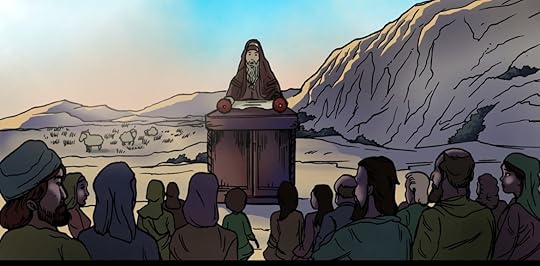 Unlettered excerpt from Let the Beet Go On, by Cyndi Norwitz, art by Greg Woronchak, colors by Andrea Blanco. Published in
Why Faith: An Anthology Hoping to Find Answers in the Unknown
.
Unlettered excerpt from Let the Beet Go On, by Cyndi Norwitz, art by Greg Woronchak, colors by Andrea Blanco. Published in
Why Faith: An Anthology Hoping to Find Answers in the Unknown
.Talmud says:
The Gemara asks with regard to the list of the Noahide mitzvot [these are rules for “descendants of Noah” of which Jews are a subset; Jews also have additional rules]: Were the descendants of Noah commanded to establish courts of judgment? But isn’t it taught in a baraita: The Jewish people were commanded to observe ten mitzvot when they were in Marah: Seven that the descendants of Noah accepted upon themselves, and God added to them the following mitzvot: Judgment, and Shabbat, and honoring one’s father and mother.
Talmud Sanhedrin 56b
Talmud Sanhedrin 56b goes on to discuss the details of “judgment.” Not mere establishment of a court system which “is a Noahide mitzva” (though some dispute that), but some of the details that created a Jewish system of judgment. Some suggestions are: the number of judges, the number of witnesses, additional fines on the guilty party, the type of punishment.
This is similar to other writings:
“There He made for them statute and judgment”: “statute” — Sabbath; “judgment” — honoring of father and mother. R. Elazar Hamodai says: “statute” — illicit relations, viz. (Leviticus 18:30) “not to do according to the statutes of the abominations that were done before you.” “judgment” — the laws of ravishment, penalties, and injuries. “and there nisahu”: He elevated them to greatness, as in (II Kings 25:27) “Evil Merodach … elevated (“nasa”) Yehoyachin, etc.”, and (Numbers 4:22) “Elevate (“nasso”) the sons of Gershon.”…There the L rd tried Israel.
Mekhilta d’Rabbi Yishmael 15:25
Rashi cites both of the above texts but comes to a very different conclusion.
There He gave them: In Marah, He gave them some sections of the Torah so that they would busy themselves with them, namely [they were given the laws governing] the Sabbath, the red cow, and laws of jurisprudence. — [from Mechilta and Sanh. 56b]
Rashi commentary on Exodus 15:25
Where does the Red Heifer (aka red cow) come into this? Dr. Ephraim Yitzhaki of Bar-Ilan University claims it’s an error. Either born of a scribal mistake or an overstep by Rashi, as no other sages include the Red Heifer in their list of things taught at Marah.
Interpretation of Teachings:
The majority of sources state that at Marah the Hebrews were taught three basic things they were not already familiar with:
Details of their justice system (as a people they could have their own and not be subject to Pharaoh’s decrees).Honoring their mother and father (including rules for family relationships).Shabbat (a day for rest which, as slaves, was mere fantasy, but now would be part of their lives going forward).
Resources:
“Chok and Mishpat” – From Logic to Metalogic Beshalach (Exodus 13:17-17:16), Rabbi Ari Kahn, AISH.Laws: Beshalach (Exodus 13:17-17:16), Rabbi Ari Kahn, AISH.Parah at Marah: a Red Herring? Dr. Ephraim Yitzhaki, Bar-Ilan University’s Parashat Hashavua Study Center.Torah Like Water, Rabbi Ismar Schorsch, My Jewish Learning.
October 12, 2020
Turquoise
A sky blue gemstone found in only a few places in the world. Including Egypt and Arizona.
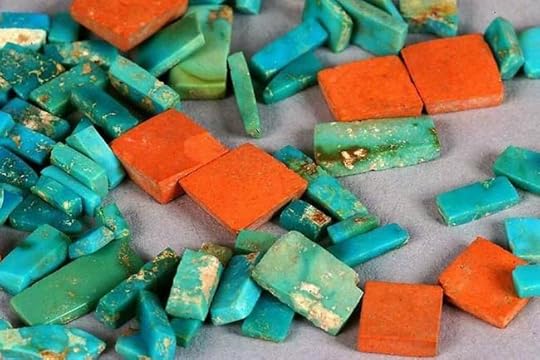 Turquoise found in Cañón Chaco. Ancestral Puebloan (Anasazi) turquoise and argillite (orange) inlay pieces, circa 1020-1140 CE. Pueblo Alto, Chaco Culture National Historical Park. New Mexico, US.
Turquoise is a blue-green copper-aluminum phosphate mineral much associated with ancient Egypt…It is a relatively rare stone, mined today primarily in the American Southwest, Iran, and China; the sources of turquoise most easily available to the ancient Egyptians were in the southwest Sinai, from deposits that apparently were long ago substantially depleted. The most important ancient turquoise mines in the Sinai are found in two locations: Wadi Maghara and Serabit el-Khadim.
Turquoise in Ancient Egypt (The Metropolitan Museum of Art)
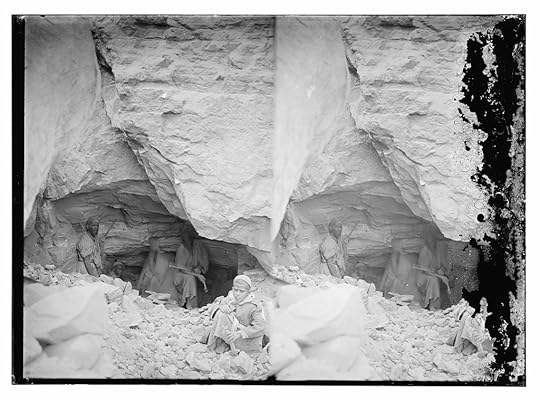 Turquoise mine at Sinai, between 1898 and 1946, Library of Congress
In many cultures of the Old and New Worlds, this gemstone has been esteemed for thousands of years as a holy stone, a bringer of good fortune or a talisman. The oldest evidence for this claim was found in Ancient Egypt, where grave furnishings with turquoise inlay were discovered, dating from approximately 3000 BCE…
The goddess Hathor was associated with turquoise, as she was the patroness of Serabit el-Khadim, where it was mined. Her titles included “Lady of Turquoise”, “Mistress of Turquoise”, and “Lady of Turquoise Country”…The turquoise is also a stone in the Jewish High Priest’s breastplate, described in Exodus chapter 28. The stone is also considered sacred to the indigenous Zuni and Pueblo peoples of the American Southwest. The pre-Columbian Aztec and Maya also considered it to be a valuable and culturally important stone.
Turquoise (Wikipedia)
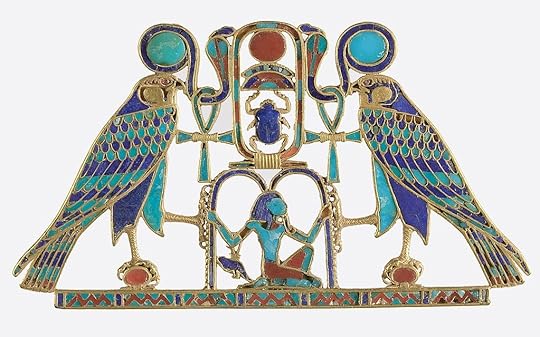 , circa 1887 –1878 B.C., Middle Kingdom, 12th Dynasty. Gold, carnelian, lapis lazuli, turquoise, garnet (pectoral) Gold, carnelian, lapis lazuli, turquoise, green feldspar (necklace). Metropolitan Museum of Art.
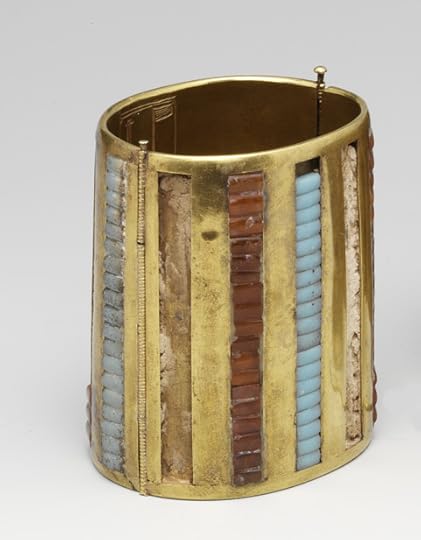 Hinged Cuff Bracelet, circa 1479 –1425 B.C., New Kingdom, 18th Dynasty. Gold, carnelian, turquoise, glass. Metropolitan Museum of Art.
 Turquoise is important to many Native American tribes, especially those in the American Southwest. The specific symbolism varies among the tribes but includes protection from evil or harm, strength and vitality, rain/water, and tears.
For the Yavapai-Prescott Indian Tribe, the tribe closest to where Barberry Lake would be, turquoise is part of their flag.
The color blue represents that the Yavapai are “from the sky.” Blue also represents water and Komwidamapokwia, the mother of this generation of Yavapai, who was the only survivor of the world flood…
Komwidamapokwia gave the Yavapai four stones for medicine and directions. These stones were white, turquoise, red and black and are depicted near the edges of the basket in the four directions.
The Symbolism of the Yavapai-Prescott Indian Tribe Flag
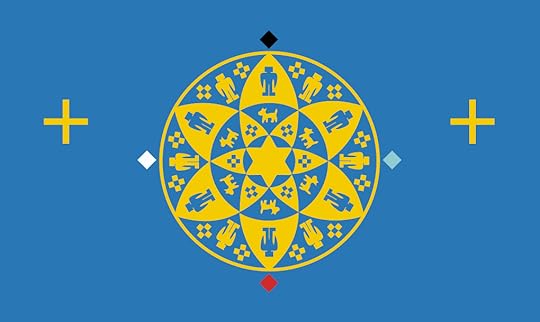 Flag of the Yavapai-Prescott Tribe.
My sibling characters Helena, Yelena, and Zach are 1/4 Yavapai. I don’t state which Yavapai tribe because those tribes are small and I don’t want to confuse the characters with real people.
References
Turquoise in Ancient Egypt (The Metropolitan Museum of Art)Turquoise (New World Encyclopedia)Turquoise (Wikipedia)Why is Turquoise Significant in Native American Culture?The Symbolism of the Yavapai-Prescott Indian Tribe Flag
September 30, 2020
From the Red Sea to Marah
Once our travelers cross the Red Sea and find themselves on the Arabian Peninsula, they watch the Egyptian soldiers drown, sing a song of praise to God, and get the heck out of there.
Moses led Israel away from the Red Sea, and they went out into the desert of Shur; they walked for three days in the desert but did not find water.
They came to Marah, but they could not drink water from Marah because it was bitter; therefore, it was named Marah.
Exodus 15: 22-23
Here we have the first instance of the Hebrews having trouble finding fresh water. They have (barely) enough food still, but have run out of water for themselves and their flocks.
The people complained against Moses, saying, What shall we drink?
Exodus 15: 24
We might not be surprised that the people are, once again, complaining. But in this case not having water is pretty serious. Now they’ve finally found water, but it is bitter.
What is bitter water? It’s not a term that comes up much in modern conversation. But it generally means the water is very hard (usually with a high pH aka alkaline) which means it has more minerals than usual, and not the nice tasting ones we might seek out. Dissolved copper is a common cause (and copper is abundant in that region, hence the multiple copper mines).
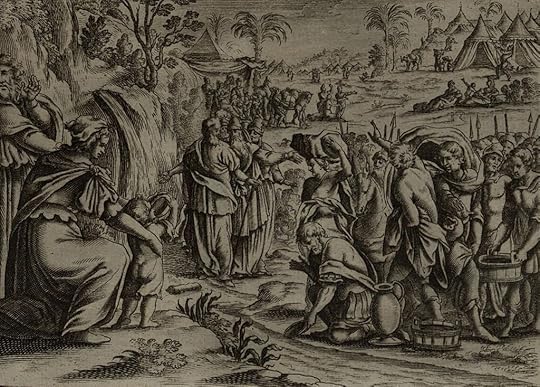 The Water of Marah, engraving by Gérard Jollain, 1670.
So he [Moses] cried out to the Lord, and the Lord instructed him concerning a piece of wood, which he cast into the water, and the water became sweet. There He gave them a statute and an ordinance, and there He tested them.
Exodus 15: 25
Is there wood that will remove bitterness from water? Not really. Some commentators speculate that the wood itself was bitter, to cure like with like.
Another interpretation (of Exod. 15:25): AND THE LORD SHOWED HIM A TREE. What was it? R. Joshua says: It was an olive tree; R. Nehemiah says: A willow tree. Some say: The roots of a fig tree; and others say: The roots of a pomegranate, since there is nothing as bitter as those. But the sages say: It was ivy wood, and there is nothing as bitter as that. R. Ishmael the son of R. Johanan ben Baroqah said: See how great are the miracles of the Holy One! [Those of] flesh and blood cure the bitter with the sweet, but the Holy One cures the bitter with the bitter.
Midrash Tanchuma Buber, Beshalach 18:2
Other texts (various commentaries on Sefaria) posit that the wood was acacia wood. I wondered if the species was as important as the state of the wood. If the wood was charred enough to become charcoal, would that not purify the water? Turns out I’m not the only one to have thought of that.
As for the purification of the water, Dr. Humphreys asserts that the piece of wood that Moses threw into the spring may have been charred Acacia seyel wood. Charcoal has been used across many civilizations to purify water, and even simply by putting some charcoal into the water, and allowing the coal’s porous surface to absorb the minerals and other contaminants in Marah’s bitter spring.
The Bitter Spring of Marah
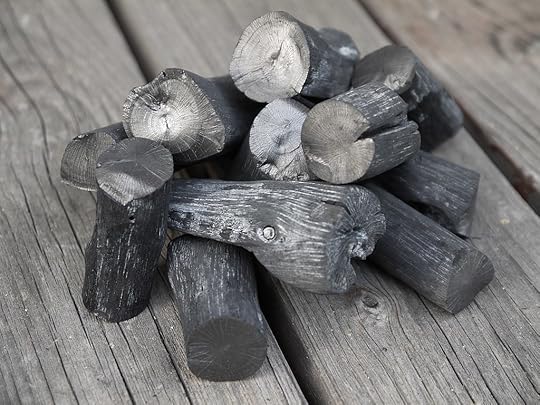 Japanese Binchōtan (Japanese high-grade charcoal produced from ubame oak).


_(cropped).jpg)


_tortilis.jpg)


.jpg)