
Cyndi Norwitz's Blog, page 4
July 9, 2021
A Wedding in the Desert
Jewish weddings even today follow traditions thousands of years old. Still, a modern wedding, no matter how strictly observant, will not be the same as one from Biblical times. So let’s take a look at what we know about ancient Jewish weddings.
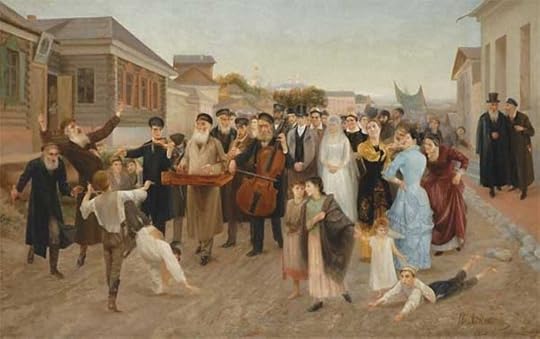 Jewish wedding in a Russian shtetl, featuring a Klezmer band. Painting by Isaak Asknaziy, 1893.Traditions of Jewish Weddings
The typical order of a traditional (but relatively modern) Jewish Wedding (which includes both the betrothal and marriage ceremonies) is as follows:
Gathering in a separate room or other space (or two rooms, for those who separate men and women) and signing the Ketubah. Badeken (veiling the bride).Procession to the Chuppah, usually the groom first, then the bride. Each with their parents.Circling the bride (or each other). Only in Ashkenazi communities.Betrothal Blessings (first of 2 cups of wine).Giving of the Ring, using the words, “by this ring you are consecrated to me according to the law of Moses and Israel”. This is the central part of the marriage ceremony. The Reading of the Ketubah out loud. The Seven Blessings (Sheva Brachot) (done over second of 2 cups of wine). The first is the blessing over the wine, then there are 6 blessings for God and for the bridal couple. Then the couple drinks the wine.Breaking of the GlassYichud (seclusion). Ashkenazi couples go just after the ceremony. Sephardic couples wait until after the reception.The wedding receptionBetrothal and Marriage: Kiddushin and NissuinBefore the giving of the Torah, it would be that if a man happened upon a woman in the marketplace and they wanted to marry each other, he would bring her into his house and consummate the marriage between them privately, and she would be his wife. Once the Torah was given, Israel was commanded that if a man wanted to marry a woman, he would acquire her first through witnesses, and afterwards she would be his wife, as it says, “When a man takes a woman and comes (sleeps with) to her…” (Deuteronomy 22:13).
Mishneh Torah, Marriage. Chapter 1:1. Rambam.
So the Biblical marketplace (in a time from before the first year of the Exodus from Egypt) is a bit of an odd duck, but the basic idea is that two people who agreed to get married simply moved in together and had sex and then they were considered married. For the time period afterwards, the marriage needed to be a bit more formal.
Dowry/BridepriceDOWRY (Heb. נְדֻנְיָה), the property a wife brings to her husband at marriage; the Yiddish equivalent, nadn, is from the same root. The custom of nedunyah became clearly defined and institutionalized only in the talmudic period. In biblical times, mohar (מֹהַר), whereby the groom bought his wife from her father (Gen. 24:53; Ex. 22:15–16; Hos. 3:2), was the accepted practice. It was then customary that the groom give the bride gifts, and that she bring certain property to her husband’s home upon marriage: slaves, cattle, real estate, etc. (cf. Gen. 24:59–61; 29; Judg. 1:14ff.; I Kings 9:16). Evidence of the custom of nedunyah is to be found in Tobit (7:14; 8:21) and in the Assuan papyri (Cowley, Aramaic, nos. 15, 18). Gradually, mohar was superseded by the ketubbah custom according to which the husband merely assumed the responsibility of compensation to his wife in case he divorced her: he had to pay her 200 zuzim if she had been a virgin at the time of marriage, and 100 zuzim if a widow or divorcée.
Dowry. Encyclopaedia Judaica. © 2008. Jewish Virtual Library.
Although the idea of a groom buying a bride is an outdated notion (as in modern scholars do not believe that is how the ancient Jews thought of it), it seems pretty clear that there was a tradition of the groom (or his parents) giving substantial gifts to his in-laws, to compensate them in some way for the loss of their daughter (since women typically moved in with their husbands). As well as property the bride brought with her to her new home.
The Ceremony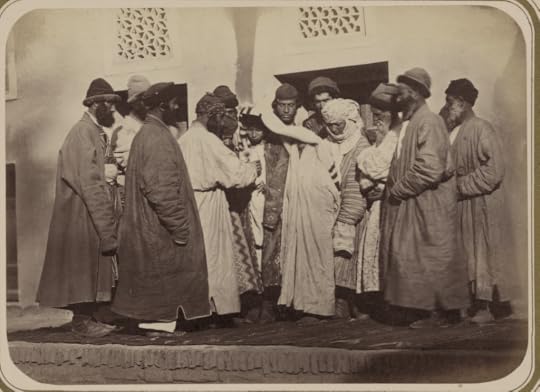 Jewish Wedding Rituals. Wedding Ceremony. Kun, Aleksandr L., 1840-1888. This photograph is from the ethnographical part of Turkestan Album, a comprehensive visual survey of Central Asia undertaken after imperial Russia assumed control of the region in the 1860s. Brides; Ethnographic photographs; Grooms (Weddings); Jews; Photographic surveys; Rites and ceremonies; Weddings.
Illustration in Turkestan Album, Ethnographic Part, 1872, part 2, volume 1, plate 80, no. 255
The Sheva Brachot (Seven Blessings) are in the Talmud (Ketubot 7b-8a) and may have come from earlier prayers, but there is no sign they come from Biblical times, let alone Exodus times.
Wedding rings come from Ancient Egypt, from well before Exodus times. They used the fourth finger on the left hand (same as the ring finger of today) and placed a circular ring (often made from hemp or other non-metalic materials) on the bride’s hand. Many sites share this much, but there is little on how this tradition evolved into the Ancient Greek and Roman traditions of doing much the same thing, only with metal (usually iron). It’s not clear that the tradition stayed the same for these thousands of years. Nor do we know what the Jews did.
The Egyptian rings represented the Sun God Ra, so it seems unlikely the Exodus-era Jews would have accepted the tradition, but we can imagine this and other traditions moving into secular life. Jewish wedding rings are important now and there are good records showing them as far back as the 10th century C.E. What we don’t know is what happened before that.
Breaking the GlassThe tradition (not required by Jewish law, but commonly done) of breaking a glass at the end of the ceremony is quite old, from Talmudic times (70–640 CE), but even that is well over a thousand years after the Exodus.
Standing Under the ChuppahThe canopy held aloft on poles seems to be a Middle-Ages Ashkenazi innovation. Traditions in other communities, as well as older ones everywhere, seem to include a chuppah signified by a bride’s veil, a tent, a canopy of tree branches, or even a room in a building.
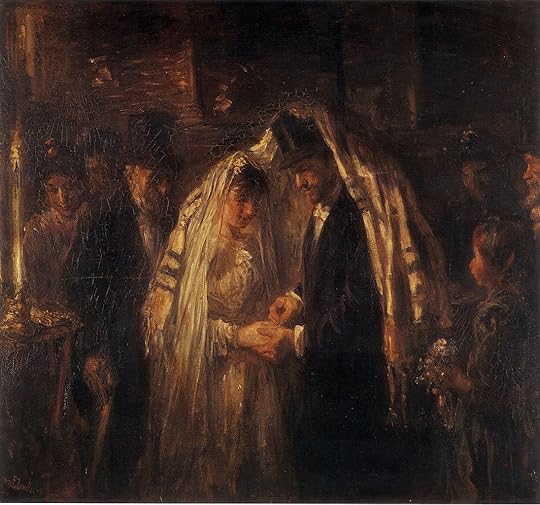 A Jewish wedding, Jozef Israëls, 1903
The Bible mentions the Chuppah (חֻפֶּה) three times. Once in the Prophet Joel (or Yoel), where the translation can be “canopied couch” as written here, but also refer a canopy, chamber, or divine protection:
Gather the people, Bid the congregation purify themselves. Bring together the old, Gather the babes And the sucklings at the breast; Let the bridegroom come out of his chamber, The bride from her canopied couch.
Joel 2:16
In Psalms we also see a reference to a groom inside a chuppah.
He placed in them a tent for the sun,
who is like a groom coming forth from the chamber, like a hero, eager to run his course.
Psalm 19:5-6
Here, the chuppah is not for the wedding, but the place where the bride and groom spend the night (though it may be the same room where the wedding took place).
In the morning as he comes out in his brightness and beauty he is like a bridegroom coming forth from his chamber, for all rejoice before him; so of the sun, all rejoice at his light. And my revered father – may his memory be blessed ! – has interpreted that the Psalmist compares him to a bridegroom coming forth from his chamber because the latter is longing to return to his bride, and so the sun returns each day to the place of his brightness.
Radak on Psalms 19:6:1
Then we have the use of the word chuppah to mean coverings in a sense not related at all to marriage.
When my Lord has washed away The filth of the daughters of Zion, And from Jerusalem’s midst Has rinsed out her infamy— In a spirit of judgment And in a spirit of purging—
the LORD will create over the whole shrine and meeting place of Mount Zion cloud by day and smoke with a glow of flaming fire by night. Indeed, over all the glory shall hang a canopy,
which shall serve as a pavilion for shade from heat by day and as a shelter for protection against drenching rain.
Isaiah 4:4-6
Though the Exodus text does not mention the word Chuppah, the idea of the Revelation being like a wedding comes from a variety of commentators.
There was one event in Jewish history which was considered the paradigm of all weddings: the revelation of the Torah at Mount Sinai. In the biblical account of the marriage between God and the people of Israel our sages also discovered allusions to the presence of a huppah, whether in the enveloping cloud of darkness that hovered over the people, or in the fact that the Israelites, about to enter into their marriage with God, were made to stand “beneath the mountain“–just as the bride stands beneath the sheltering huppah on her wedding day.
The Huppah: From Eden to Today. Eliezer Segal. From the Source.
So what exactly did bridal couples use in Exodus times? We don’t know. But it’s reasonable to imagine there is some sort of covering during the marriage ceremony itself, but one open on all sides, like the modern chuppah which reflects the openness of Abraham’s tent.
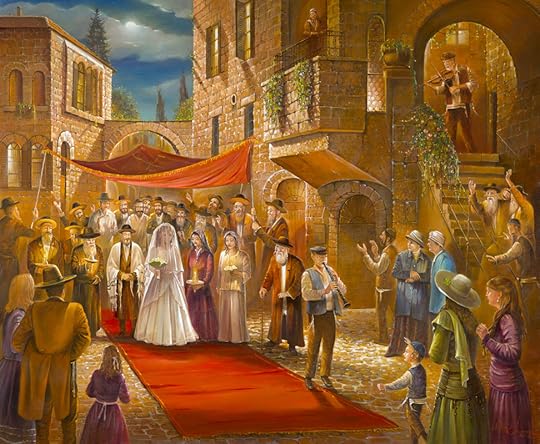 Chuppah Painting (Huppah in Jerusalem). Alex Levin (GeneNY). 2012.Entering the Yichud
The Yichud is a private space (a room or a tent) where the newly married bridal couple go to legitimize the wedding. This is not the wedding night but, rather, the few moments of sacred space that Jewish law requires for the wedding to be valid.
The modern approach is to hold the ceremony under a canopy then send the couple off to a private room. But older traditions overlap more and the chuppah and the yichud may have been combined in a single practice.
Ketubah: The Marriage ContractIn references to marriage throughout the Bible, the mohar was paid and gifts presented, but a written contract was never mentioned. However, the Book of Deuteronomy specifically states that if a man dislikes his wife, “he writes her a bill of divorcement and gives it in her hand” (24: 3). Modern critics of the Bible have agreed that on the whole, the Deuteronomic law is a product of the century preceding the Babylonian exile. If a written document was employed at that period in dissolving a marriage, we have to assume that it was also employed in contracting a marriage.
Ancient Jewish Marriage. By Hayyim Schauss.
There is no reason for us to think that Hebrew slaves in Egypt would have marriage contracts to tell them about spousal rights and obligations to each other. Nor even in the first year of the Exodus, when freedom was new (and they did not yet have a permanent home). Deuteronomy is the last book of Torah and takes the form of Moses’ final speech to the community, just before the 40 years of living in the desert were up. Even if you believe that Moses wrote the Torah, this book came 40 years after they left Egypt.
ReferencesAncient Jewish Marriage. By Hayyim Schauss. My Jewish Learning.The Jewish Marriage Ceremony: “According to the Laws of Moses and Israel”: Ke’ dat Moshe Ve’ Yisrael. By Maurice Lamm. Chabad.Jewish Wedding Ceremony. Chabad.Breaking the Glass at a Jewish Wedding. By Anita Diamant. My Jewish Learning.Jewish wedding. Wikipedia.Weddings and Marriage Traditions in Ancient Israel. Tracy M. Lemos. Bible Odyssey. Chuppah. Wikipedia.The Chuppah, or Wedding Canopy: A Jewish wedding takes place under a chuppah, which symbolizes the new Jewish home being created by the marriage. Dr. Michael Kaufman. My Jewish Learning.Strong’s Dictionaries of Hebrew and Greek.Radak on Psalms 19:6:1. Composed in Provence, France (c.1185 – c.1235 CE). A commentary on the Tanakh written by Rabbi David Kimchi, Radak (1160–1236).The Huppah (Chuppah): What You Need to Know. Anita Diamant. My Jewish Learning.The Huppah: From Eden to Today. Eliezer Segal. From the Source.Two Stages of Marriage. Rabbi Dov Linzer. YC Torah Library.Mishneh Torah, Marriage. Chapter 1:1. Rambam. Composed in Middle-Age Egypt (c.1176 – c.1178 CE). The fourth book is Nashim (Women). Ishut: laws of marriage, including kiddushin and the ketubah.A guide to the Jewish Wedding Ceremony and Order of Service under the chuppah. 2014.The Seven Blessings (Sheva Brachot) and Other Wedding Rituals. Gabrielle Kaplan-Mayer. My Jewish Learning.Sheva Brachot. Wikipedia.The History of Jewish Wedding Rings. Chloe Lee Carson. October 13, 2014. Many photos.Where did the tradition of wedding rings come from. Elaine Zelby. Medium. Jan 31, 2019.Dowry. Encyclopaedia Judaica . © 2008. Jewish Virtual Library.Yichud Room. Chabad.The Procession. Chabad.The Chuppah, or Wedding Canopy. Dr. Michael Kaufman. My Jewish Learning.

May 22, 2021
Where in the World is Mount Sinai?
That’s the question, isn’t it? Many people are sure they know where Mount Sinai is but it’s hardly settled. Most will say, okay, duh, Mount Sinai must be in Sinai, right? Which means the Sinai Peninsula. But the name of the Peninsula came from the assumption that that’s where the Biblical mountain was.
The name ‘Sinai peninsula’ is modern. It is derived from the Christian tradition, according to which Sinai was located in the south of the peninsula. This Christian tradition goes back to the fourth century, to the time when the Spanish pilgrim Egeria (or Etheria) visited Sinai in A.D. 383. From this time onwards, Christians grouped all the Old Testament memories round the Jebel Musa.
The Early History of Israel: To the Exodus and the Covenant of Sinai. Roland de Vaux. 1978
For a variety of reasons, I’m not siting Mount Sinai in the modern-day Sinai Peninsula. Rather, I’m putting it in Tabuk province, Saudi Arabia. This is a short distance northeast (about 60 miles (95 km) as the crow flies) from the Straits of Tiran, where I place the crossing of the Red Sea (though of course the Hebrews have to take a more roundabout route).
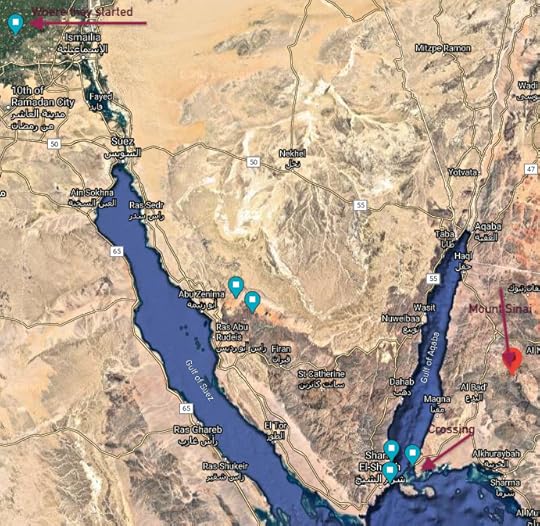 The Theory
We know that Mount Horeb is in modern day Saudi Arabia (Tabuk Province or close by) because Midian is well established to be there.
Now Moses, tending the flock of his father-in-law Jethro, the priest of Midian, drove the flock into the wilderness, and came to Horeb, the mountain of God.
Exodus 3: 1
This is where Moses encounters the burning bush. Where God tells him to return to Egypt and free his fellow Hebrews.
Most commentators assume that Mount Horeb and Mount Sinai are the same place. Both being alternate names for the Mountain of God, each one used by a different set of people who wrote and/or edited/compiled the books of the Hebrew Bible.
The Biblical Mount Sinai is an ambiguously located mountain at which the Old Testament states that the Torah was given to Moses by God. In certain biblical passages, these events are described as having transpired at Mount Horeb, but though there is a small body of opinion that Sinai and Horeb were different locations, they are generally considered to have been different names for the same place. According to textual scholars, the name Sinai is only used in the Torah by the Jahwist and Priestly source, whereas Horeb is only used by the Elohist and Deuteronomist.
Mount Sinai. New World Encyclopedia
We also know that Moses’ family (his father-in-law, wife, and sons) visit him at Mount Sinai. So it was a reasonable distance to their home in Midian.
Some who agree that Mount Sinai was not in the modern-day Sinai Peninsula put it quite far north, just east of the northern tip of the Gulf of Aqaba, at a place referred to in the Bible as Mount Seir. This is much further north than where I am putting it.
So this leaves a mountain at or near Jebel al-Lawz. Are there problems with this placement? Yep, lots of them. But it seems the best of the available possibilities, and one supported by a fair number of commentators, including Muslim ones. Plus its the one that matches best with the Red Sea crossing at the Straits of Tiran (which, based on my research) seems like the best placement for that. I’m not going to get into the details of the various Biblical (almost all Christian) theorists arguing amongst themselves. I’m just going to plunge ahead.
The MountainThere are nine large mountains in Tabuk Province in Saudi Arabia (and several smaller ones). All named Jebel or Jabal (“mount”). The tallest, at 2,549 meters (8363 feet), is Jebel al-Lawz, also known as the Mountain of Almonds (some sources say 2580m). The road leading up to the top appears to have a plateau “slightly below 2100 meters.”
Topographical maps show the surrounding areas to be around 2000 meters above sea level. 500 meters is 1640 feet. If the trail leading up is only a mile each way, that elevation gain makes it an extreme hike but it drops down to a mere “difficult” hike if the trail is 2 miles each way.
The problem is that there is no nice flat plateau that is big enough for 50,000 people plus cattle and also close enough to the summit to make going up and down doable in a day. On the other hand, all the times Moses went up and down in a day, it’s implied that he didn’t go all the way (or at least we can interpret it that way). The times it says he went to the top, it was for multiple days.
We do have a couple flat areas to the north and east of the summit. They are 2200-2300 meters (7200-7500 feet) high and the largest (the northern one) is about 150×150 meters (500×500 feet).
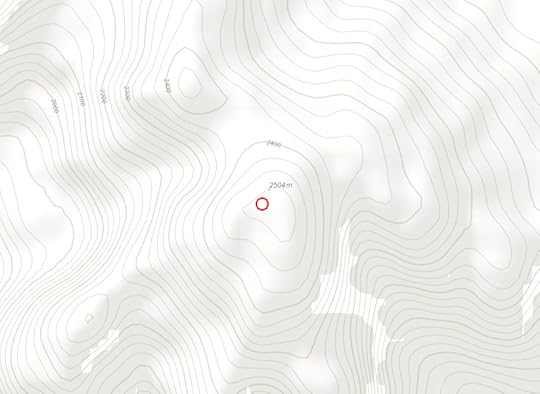 From Peakbagger
Some choose the nearby Jebel Maqla (2,326 meters/7631 feet) as the Mount Sinai contender. It’s famous for a darker color up top, which might be evidence of previous volcanic activity (or not). It’s about 3 miles SSE of Jebel al-Lawz.
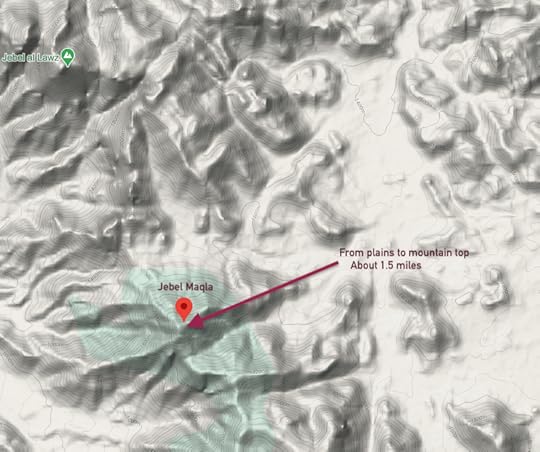 Google Maps
This to me seems like the best of the possible choices. It has a good plain nearby, it’s got the black top, and it’s near to where ancient Midian most likely was.
The summit of Jabal Maqlā consists mainly of dark-colored hornfels derived from metamorphosed volcanic rocks that originally were silicic and mafic lava flows, tuff breccias, and fragmental greenstones. The middle and lower slopes of Jabal Maqlā consist of light-colored granite, which has intruded into the overlying hornfels.
Jabal Maqla. Wikipedia.
Weather on Jabal Maqlā is pleasant. Not nearly as hot as it is by the coast. Today, May 22nd, is just after Shavuot (the day of the Revelation). This week the forecast calls for sunny skies with lows around 48°F (9°C) and highs around 80°F (27°C). Light to moderate winds of 2-16 mph, from all directions. Humidity ranges from about 16-21% during the day, but goes up as high as 45% overnight. Sunset today: 07:26pm. Sunrise tomorrow: 05:44am
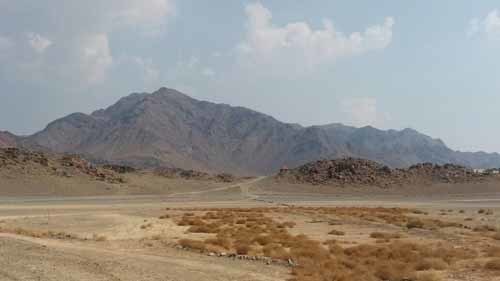 A picture of Mount Hobeish from the northern side. Aalhobishi. 2016. Mount Hobeish is part of the Midian mountain range, which also includes Jabal al-Lawz and Jabal Maqla, though it is about 20 miles southeast.
For many gorgeous pictures of Jabal Maqal, please see Jabal Maqla’s Blackened Peak.
ReferencesSinai Peninsula. WikipediaMount Sinai (Bible). WikipediaThe Early History of Israel: To the Exodus and the Covenant of Sinai. Roland de Vaux. 1978SINAI, MOUNT. Joseph Jacobs, M. Seligsohn, Wilhelm Bacher. 1906 Jewish EncyclopediaMount Sinai. New World EncyclopediaMount Seir. WikipediaSinai Peninsula. New World EncyclopediaJabal al-Lawz. WikipediaMount Sinai is NOT Jebel al-Lawz in Saudi Arabia. Associates For Biblical ResearchWhy You Should Visit the Majestic Tabuk Mountains in Saudi Arabia. Clarice Awa. 6 November 2019Jebel al-Lawz: A mountain like no other in Saudi Arabia. Florent Egal. March 11, 2018. The Saudi Arabia Tourism GuideJabal Maqla’s Blackened PeakJabal Maqla. Wikipedia.Midian. Wikipedia.Current weather Jabal Maqlā‘. Also here.April 23, 2021
From Sin to Sinai
What is the timing of the Hebrews’ journey within the Wilderness of Sin and then to Mount Sinai?
While Torah gives us this information, there are some contradictions and places where it is vague. This post helps me to lay out the different timelines so I can structure the chapters.
Please also see: The Timing of the Tablets
We know that the Hebrews first enter the Wilderness or Desert of Sin (also called Zin) on 15 Iyyar, one month after leaving their village in Egypt.
Setting out from Elim, the whole Israelite community came to the wilderness of Sin, which is between Elim and Sinai, on the fifteenth day of the second month after their departure from the land of Egypt.
Exodus 16:1
That was on a Saturday (Shabbat aka the Sabbath). They first got meat (quail) that evening, after sunset. And they first got manna the following morning. We know the arrival was on Shabbat because “the 6th day” of receiving manna was when they were to collect a double portion of their morning manna so they would not need to gather any the following day, Shabbat.
They were in the Wilderness of Sin for that full week, at least.
From the wilderness of Sin the whole Israelite community continued by stages as the LORD would command. They encamped at Rephidim, and there was no water for the people to drink.
Exodus 17:1
They got water the same day and there is nothing about how many days may have passed (if any) before the next event. Though the last day of this battle took place the day after Amalek presented a threat.
Amalek came and fought with Israel at Rephidim.
Moses said to Joshua, “Pick some men for us, and go out and do battle with Amalek. Tomorrow I will station myself on the top of the hill, with the rod of God in my hand.”
Exodus 17: 8-9
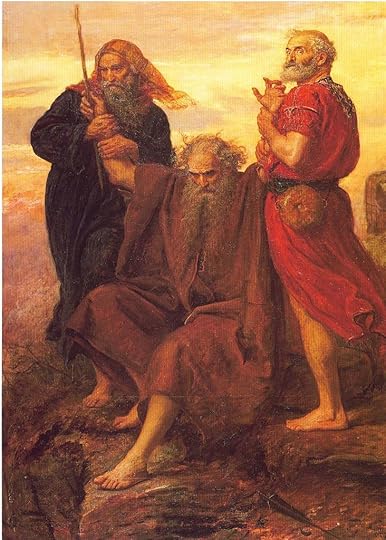 John Everett Millais (1829–1896), Victory O Lord!, 1871. “This biblical scene is from the book of Exodus and shows Moses flanked by Aaron and Hur. They survey Joshua’s battle with the Amalekites, which he can only win while Moses’ hands are aloft. As tiredness sets in, his arms are supported until sunset, which forms the backdrop of Millais’ painting.” (Description from Manchester Art Gallery)
After their defeat of Amalek, we have Chapter 18 which is about Moses’ family (his wife, children, and father-in-law) arriving to meet the Hebrews. The day after that, Moses spends all day trying legal cases and Jetro, his father-in-law helps him out. Jetro leaves after Moses takes some time to take his advice, but we don’t know when. Zipporah and their sons stay.
Immediately after Jetro leaves, it is 1 Sivan and the Hebrews are in the Wilderness of Sinai.
On the third new moon after the Israelites had gone forth from the land of Egypt, on that very day, they entered the wilderness of Sinai.
Exodus 19: 1
This is not the only instance of Torah relating stories out of order. It’s clear from the context of the events that the Hebrews were already at Mount Sinai when Moses’ family arrived. Not to mention, it says so.
Jethro, Moses’ father-in-law, brought Moses’ sons and wife to him in the wilderness, where he was encamped at the mountain of God.
Exodus 18: 5
Moses soon goes up the mountain but perhaps only partway, as God appears to be higher up in the mountain. And Moses has some back and forth with the elders as well.
Having journeyed from Rephidim, they entered the wilderness of Sinai and encamped in the wilderness. Israel encamped there in front of the mountain,
and Moses went up to God. The LORD called to him from the mountain…
Exodus 19: 2-3
Moses relays God’s instructions for the people to be ready for God’s arrival the day after tomorrow.
and the LORD said to Moses, “Go to the people and warn them to stay pure today and tomorrow. Let them wash their clothes.
Let them be ready for the third day; for on the third day the LORD will come down, in the sight of all the people, on Mount Sinai.
Exodus 19: 10-11
Torah does not say the day of God’s arrival, of the Revelation. But Judaism is clear this happened on 6 Sivan, which is a holiday called Shavuot. This means that the instructions to prepare for the day were given on 4 Sivan.
What we don’t know is how the time between 1 and 4 Sivan is broken up. Did they reach the camp on the same day they entered the Wilderness of Sinai or did it take a day or two? Did Moses go up to the Mountain the same day they made camp, or did he wait? Or maybe Moses spent more than one day going back and forth to relay God’s words to the elders.
On 6 Sivan, the Revelation began at dawn. Moses led the people out of the camp to the foot of the Mountain. In the middle of all the goings on, Moses makes another assent.
The LORD came down upon Mount Sinai, on the top of the mountain, and the LORD called Moses to the top of the mountain and Moses went up.
Exodus 19: 20
Again, it can’t be very far because God called Moses up just to tell him to head back down and return later with Aaron. Moses goes back down and tells the people the Ten Commandments.
Next, as the people freak out, God speaks to Moses from the cloud that descended (or from up top, it’s not clear) and tells Moses many more laws, starting with (surprisingly given how recently they were slaves) rules on how to treat slaves. He adds rules on how to deal with accidental death and thieves, plus a large number of others. Then rules for the three annual festivals (Passover, Sukkot, and Shavuot). And more miscellaneous.
After that, God calls for another assent.
Then He said to Moses, “Come up to the LORD, with Aaron, Nadab and Abihu, and seventy elders of Israel, and bow low from afar.
Moses alone shall come near the LORD; but the others shall not come near, nor shall the people come up with him.”
Exodus 24: 1-2
Before that happens though, Moses tells the people all the rules, builds an alter, and sacrifices cows.
Moses went and repeated to the people all the commands of the LORD and all the rules; and all the people answered with one voice, saying, “All the things that the LORD has commanded we will do!”
Moses then wrote down all the commands of the LORD. Early in the morning, he set up an altar at the foot of the mountain, with twelve pillars for the twelve tribes of Israel.
He designated some young men among the Israelites, and they offered burnt offerings and sacrificed bulls as offerings of well-being to the LORD.
Exodus 24: 3-5
Now they can go.
Then Moses and Aaron, Nadab and Abihu, and seventy elders of Israel ascended;
and they saw the God of Israel: under His feet there was the likeness of a pavement of sapphire, like the very sky for purity.
Yet He did not raise His hand against the leaders of the Israelites; they beheld God, and they ate and drank.
Exodus 24: 9-11
At this point, God calls Moses to the top of the mountain. I outline this and further events in The Timing of the Tablets.
The Timing of the Tablets
What is the timing of Moses’ ascents to the top of the mountain and his bringing of the two sets of the tablets of the pact aka the Ten Commandments?
While Torah gives us this information, there are some contradictions and places where it is vague. This post helps me to lay out the different timelines so I can structure the chapters.
Please also see: From Sin to Sinai
Now it’s time for the trip up the mountain. Aaron, his two eldest sons, Nadab and Abihu, and seventy elders of Israel all head up but don’t go very far. Moses and Joshua go further.
The LORD said to Moses, “Come up to Me on the mountain and wait there, and I will give you the stone tablets with the teachings and commandments which I have inscribed to instruct them.”
So Moses and his attendant Joshua arose, and Moses ascended the mountain of God.
Exodus 24: 12-13
Oddly, the others are to wait in that lower elevation, a place where the people in general were not allowed to be, a place where they could see God. But then people are encourage to approach if needed.
To the elders he had said, “Wait here for us until we return to you. You have Aaron and Hur with you; let anyone who has a legal matter approach them.”
Exodus 24: 14
Moses stays on the mountain for 40 days and 40 nights, the first week of which was waiting for God to call him to go inside the cloud where God was.
When Moses had ascended the mountain, the cloud covered the mountain.
The Presence of the LORD abode on Mount Sinai, and the cloud hid it for six days. On the seventh day He called to Moses from the midst of the cloud.
Now the Presence of the LORD appeared in the sight of the Israelites as a consuming fire on the top of the mountain.
Moses went inside the cloud and ascended the mountain; and Moses remained on the mountain forty days and forty nights.
Exodus 24: 15-18
This is where God first outlines the instructions for building the Mishkan aka the Tabernacle. In some cases these instructions seem to be in the right place: “And deposit in the Ark [the tablets of] the Pact which I will give you.” (Exodus 25:16) And in others, it’s clear that these verses are in the Torah out of order: “As you were shown on the mountain, so shall they be made.” (Exodus 27:8) As a general rule, most commentators seem believe the Mishkan instruction details came after Moses brought the second set of tablets.
God’s description of the eternal flame and his choice of priests come after the Mishkan instructions and before the instructions for the priestly garments and their consecration, so it’s unclear if this section also was one that came much later.
You shall further instruct the Israelites to bring you clear oil of beaten olives for lighting, for kindling lamps regularly.
Aaron and his sons shall set them up in the Tent of Meeting, outside the curtain which is over [the Ark of] the Pact, [to burn] from evening to morning before the LORD. It shall be a due from the Israelites for all time, throughout the ages. 28
You shall bring forward your brother Aaron, with his sons, from among the Israelites, to serve Me as priests: Aaron, Nadab and Abihu, Eleazar and Ithamar, the sons of Aaron.
Exodus 27: 20-21 and 28: 1
After the instructions concerning the priests, there are a few more about the Mishkan, then it goes into the taking of the census, another section that came later in time, after the giving of the tablets. Then God tells Moses to put Hur’s grandson, Bezalel, in charge of much of the work of the Mishkan creation, with assistance from Oholiab son of Ahisamach, of the tribe of Dan.
Finally, in Chapter 31, God admonishes Moses to impress the rules of the Sabbath upon the Hebrews. And then:
When He finished speaking with him on Mount Sinai, He gave Moses the two tablets of the Pact, stone tablets inscribed with the finger of God.
Exodus 31: 18
Now we switch our attention to the foot of the mountain.
When the people saw that Moses was so long in coming down from the mountain, the people gathered against Aaron and said to him, “Come, make us a god who shall go before us, for that man Moses, who brought us from the land of Egypt—we do not know what has happened to him.”
Exodus 32: 1
Aaron then makes the Golden Calf and declares the following day a festival to God. God tells Moses what is happening and threatens to wipe out the Hebrews and start over with Moses. Moses convinces God not to do this, then he hurries down to the camp, bringing Joshua who was waiting for him.
As soon as Moses came near the camp and saw the calf and the dancing, he became enraged; and he hurled the tablets from his hands and shattered them at the foot of the mountain.
He took the calf that they had made and burned it; he ground it to powder and strewed it upon the water and so made the Israelites drink it.
Exodus 32: 19-20
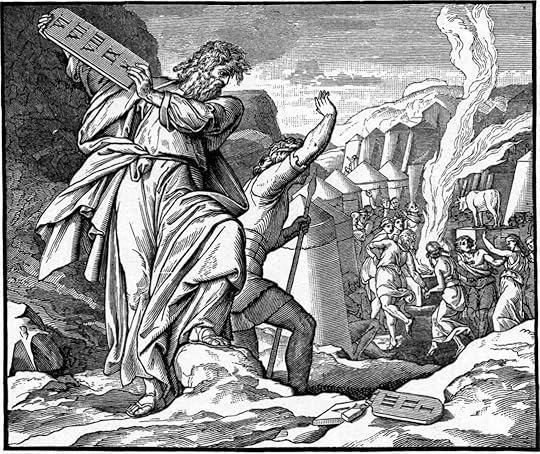 Foster Bible Pictures 0069-1 Moses Throws the Tablet of Stone. From Illustrators of the 1897 Bible Pictures and What They Teach Us by Charles Foster. Artist and date of illustration not mentioned.
Moses confronts Aaron who claims it wasn’t his fault, but Moses is not convinced. Next, he calls the Hebrews who are “for the Lord” and the Levites come. He tells them to murder those who worshiped the Golden Calf.
The Levites did as Moses had bidden; and some three thousand of the people fell that day.
Exodus 32: 28
The next day, Moses tells the people he’s going back up the mountain, where he convinces God not to punish the Hebrews as a whole, but only those who sinned. God does this by sending a plague.
God reiterates the plan to give the Hebrews the land of Canaan, but says also: “But I will not go in your midst, since you are a stiffnecked people, lest I destroy you on the way.” (Exodus 33: 3)
The people were upset to hear this and took off their finery. God tells them to keep it off and they do from then on.
Next we hear about Moses’ daily actions, so it seems there is a break before he returns to the mountain top.
Now Moses would take the Tent and pitch it outside the camp, at some distance from the camp. It was called the Tent of Meeting, and whoever sought the LORD would go out to the Tent of Meeting that was outside the camp.
Whenever Moses went out to the Tent, all the people would rise and stand, each at the entrance of his tent, and gaze after Moses until he had entered the Tent.
And when Moses entered the Tent, the pillar of cloud would descend and stand at the entrance of the Tent, while He spoke with Moses.
When all the people saw the pillar of cloud poised at the entrance of the Tent, all the people would rise and bow low, each at the entrance of his tent.
The LORD would speak to Moses face to face, as one man speaks to another. And he would then return to the camp; but his attendant, Joshua son of Nun, a youth, would not stir out of the Tent.
Exodus 33: 7-11
Moses then convinces God to continue to lead them after they leave Mount Sinai. He also asks God to show God’s self to him and God agrees to show him all but God’s face. Next we jump right into the second set of tablets.
The LORD said to Moses: “Carve two tablets of stone like the first, and I will inscribe upon the tablets the words that were on the first tablets, which you shattered.
Be ready by morning, and in the morning come up to Mount Sinai and present yourself there to Me, on the top of the mountain.
No one else shall come up with you, and no one else shall be seen anywhere on the mountain; neither shall the flocks and the herds graze at the foot of this mountain.”
So Moses carved two tablets of stone, like the first, and early in the morning he went up on Mount Sinai, as the LORD had commanded him, taking the two stone tablets with him.
Exodus 34: 1-5
Moses and God converse and God gives more commandments and offers them as a covenant. But this time God does not inscribe the tablets, Moses does.
And the LORD said to Moses: Write down these commandments, for in accordance with these commandments I make a covenant with you and with Israel.
And he was there with the LORD forty days and forty nights; he ate no bread and drank no water; and he wrote down on the tablets the terms of the covenant, the Ten Commandments.
Exodus 34: 27-28
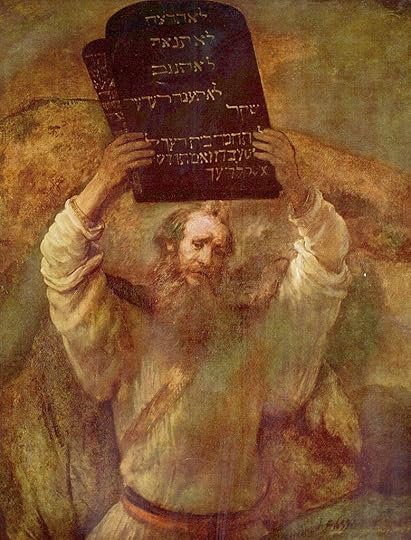 Rembrandt Harmenszoon van Rijn (1606–1669),
Moses with the Tablets of the Law
, 1659
Rembrandt Harmenszoon van Rijn (1606–1669),
Moses with the Tablets of the Law
, 1659 When Moses returned to camp, his face was radiant, which scared the Hebrews. From then on, he wore a veil at times when he was not speaking to God or conveying what God had told him.
Next, in Chapter 35, Moses reminds the people of the Sabbath then asks for gifts of both material objects and of skilled work, so they can begin to build the Mishkan.
The rest of Exodus’ 40 chapters describe the building of the Mishkan and its consecration. Ending with:
When Moses had finished the work,
the cloud covered the Tent of Meeting, and the Presence of the LORD filled the Tabernacle.
Moses could not enter the Tent of Meeting, because the cloud had settled upon it and the Presence of the LORD filled the Tabernacle.
When the cloud lifted from the Tabernacle, the Israelites would set out, on their various journeys;
but if the cloud did not lift, they would not set out until such time as it did lift.
For over the Tabernacle a cloud of the LORD rested by day, and fire would appear in it by night, in the view of all the house of Israel throughout their journeys.
Exodus 40: 33-38
February 27, 2021
The Evening Quail
Before there was manna in the Wilderness of Sin, there was quail. Manna came the morning after they ran out of food. And every morning thereafter for 40 years. But the quail came that same evening.
How did the quail arrive? What type of quail? How often did the Israelites get to eat it? How did they prepare it? These questions and more are answered (okay, speculated upon) below.
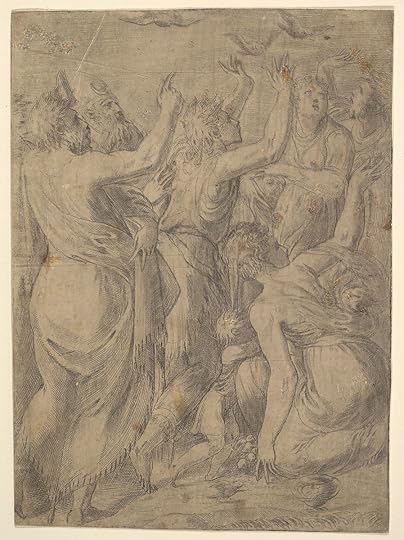 Moses showing the quails to the Israelites (the miracle of the quails and manna), ca. 1545. Andrea Schiavone (Andrea Meldola) Italian. The Met.Torah
The LORD spoke to Moses:
“I have heard the grumbling of the Israelites. Speak to them and say: By evening you shall eat flesh, and in the morning you shall have your fill of bread; and you shall know that I the LORD am your God.”
In the evening quail appeared and covered the camp; in the morning there was a fall of dew about the camp.
Exodus 16: 11-13
Not much there. The rest is about manna. But there is another mention of the quail in Numbers 11. The Hebrews are complaining (again) and God sends a plague. Immediately afterwards:
The riffraff in their midst felt a gluttonous craving; and then the Israelites wept and said, “If only we had meat to eat!
We remember the fish that we used to eat free in Egypt, the cucumbers, the melons, the leeks, the onions, and the garlic.
Now our gullets are shriveled. There is nothing at all! Nothing but this manna to look to!” …
Moses heard the people weeping, every clan apart, each person at the entrance of his tent. The LORD was very angry, and Moses was distressed. …
Where am I to get meat to give to all this people, when they whine before me and say, ‘Give us meat to eat!’
I cannot carry all this people by myself, for it is too much for me.
If You would deal thus with me, kill me rather, I beg You, and let me see no more of my wretchedness!”
Then the LORD said to Moses…say to the people: Purify yourselves for tomorrow and you shall eat meat, for you have kept whining before the LORD and saying, ‘If only we had meat to eat! Indeed, we were better off in Egypt!’ The LORD will give you meat and you shall eat.
You shall eat not one day, not two, not even five days or ten or twenty,
but a whole month, until it comes out of your nostrils and becomes loathsome to you. For you have rejected the LORD who is among you, by whining before Him and saying, ‘Oh, why did we ever leave Egypt!’”
But Moses said, “The people who are with me number six hundred thousand men; yet You say, ‘I will give them enough meat to eat for a whole month.’
Could enough flocks and herds be slaughtered to suffice them? Or could all the fish of the sea be gathered for them to suffice them?”
And the LORD answered Moses, “Is there a limit to the LORD’s power? You shall soon see whether what I have said happens to you or not!”
Numbers 11: 4-23 (truncated version)
This narrative implies that they did not have the quail every evening since that first night in Sin. Prof. Jonathan Jacobs in The Double Quail Narratives and Bekhor Shor’s Innovative Reading carefully goes through both Exodus and Numbers as well as numerous commentary to provide a variety of possible answers. But the narrative continues.
A wind from the LORD started up, swept quail from the sea and strewed them over the camp, about a day’s journey on this side and about a day’s journey on that side, all around the camp, and some two cubits deep on the ground.
The people set to gathering quail all that day and night and all the next day—even he who gathered least had ten ḥomers—and they spread them out all around the camp.
The meat was still between their teeth, nor yet chewed, when the anger of the LORD blazed forth against the people and the LORD struck the people with a very severe plague.
That place was named Kibroth-hattaavah, because the people who had the craving were buried there.
Then the people set out from Kibroth-hattaavah for Hazeroth.
Numbers 11: 31-35
Jacobs presents commentaries that say the quail did come daily but this was extra meat for those who were not satisfied, though the text says they only had manna to eat. Other commentaries say that the quail came for a while then stopped sometime in the first year. Others say the quail came now and then.
Quail SpeciesThe best bet for the type of quail the Hebrews encountered was the Common Quail aka European quail (Coturnix coturnix). It nests in the ground, migrates (the only species of quail or of land fowl that does), and moves between northern Africa and Europe.
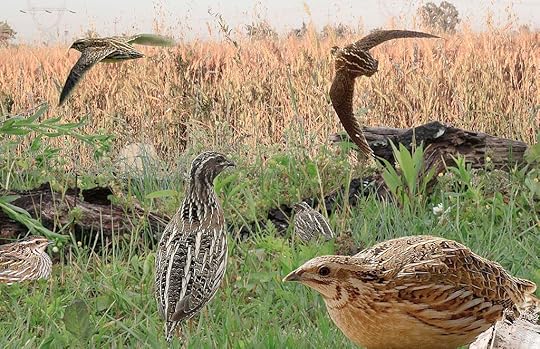 Quail from the Crossley ID Guide Britain and Ireland
The Common Quail sings at sunset and has a characteristic triple trill. Its range is fairly large and it has been spotted in modern times in Tabuk Province, where I am placing Mount Sinai (it’s also in Egypt and the Sinai Peninsula).
How & When Did They Arrive?Breeds in taller grassland and grain fields from western Europe east to central Asia and winters in similar habitat in Africa, southern Europe, and South Asia. Rarely seen, and most often detected by male’s emphatic whistled “wet-my-lips!” song, which can be given at night. When flushed, explodes from underfoot and flies off strongly with whirring wingbeats and short glides. Plumage cryptic and streaky brown with pale eyebrow; male has black throat stripe.
Galliformes > Phasianidae. Common Quail, Coturnix coturnix. eBird.
By all accounts, they were alive and well when the Hebrews caught them. Presumably they were resting during a migration. The first appearance of quail in the Exodus takes place a month and a couple days after Passover. Passover in the modern era is usually in late March to mid/late April. So this would be April or May. Common Quail winter in northern Africa (among other places) and start breeding in Europe around mid-May.
Are They Poisonous?The account from Numbers certainly describes a sudden bout of poisoning. And it turns out that Common Quail are known for this.
Coturnism is an illness featuring muscle tenderness and rhabdomyolysis (muscle cell breakdown) after consuming quail (usually common quail, Coturnix coturnix, from which the name derives) that have fed on poisonous plants.
Coturnism. Wikipedia.
The Wikipedia page on Coturnism mentions Numbers 11 and James Tullis, in “Don’t Eat the Quails.” references it as well. It’s uncertain which plant causes this. Most writers assume hemlock. Tullis suggests bitter almond.
PreparationTorah doesn’t say how the quail were prepared in the Wilderness of Sin (later, in the Numbers 11 story, they may have been eaten raw and undressed).
Under normal circumstances, a bird would be killed then plucked clean of all its feathers, and its entrails removed. Then cooked. But in this case the Hebrews were out in the desert in a temporary camp without any sort of a kitchen.
And it was night time! Whatever religious reasons there may be for providing bread in the morning light and meat as the sun went down and it was too dark to see, this may have been when the migrating quail needed to rest for the night.
Fires of dried animal dung would have been the way to cook the quail. Probably roasted on a stick or rock. Maybe boiled in water.
ReferencesThe Double Quail Narratives and Bekhor Shor’s Innovative Reading. Prof. Jonathan Jacobs. The Torah—com.Tullis, James L. “Don’t Eat the Quails.” New England Journal of Medicine 297, no. 9 (1977): 472-75.Common Quail, Coturnix coturnix. Cornell Lab.Common Quail. Wikipedia.Coturnism. Wikipedia.Common Quail. Singing birds. Wildlife World. YouTube video, July 24, 2020.Quail. Encyclopaedia Britannica.Galliformes > Phasianidae. Common Quail, Coturnix coturnix. eBird.Coturnix coturnix: common quail. Animal Diversity Web.Starving in Sin
The Hebrews leave their lives of slavery, flee Pharaoh’s soldiers, then cross the Red Sea into freedom. After extended stops in Marah and Elim, they head towards the mountains. Upon entering the Wilderness of Sin, they run out of food.
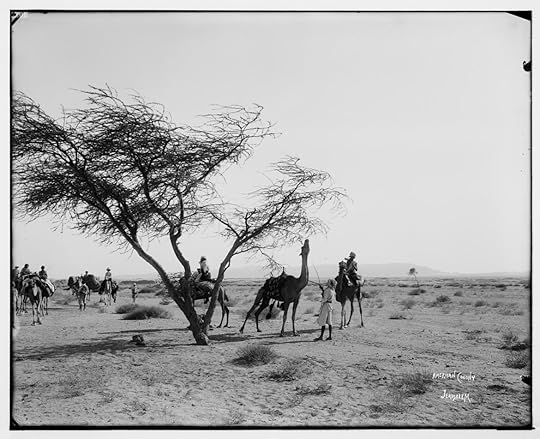 Sinai. Caravan in the heart of the desert of el-Ka’a (Wilderness of Sin). G. Eric and Edith Matson Photograph Collection. Between 1898 and 1914.
Setting out from Elim, the whole Israelite community came to the wilderness of Sin, which is between Elim and Sinai, on the fifteenth day of the second month after their departure from the land of Egypt.
In the wilderness, the whole Israelite community grumbled against Moses and Aaron.
The Israelites said to them, “If only we had died by the hand of the LORD in the land of Egypt, when we sat by the fleshpots, when we ate our fill of bread! For you have brought us out into this wilderness to starve this whole congregation to death.”
Exodus 16: 1-3
Perhaps this is sounding familiar. Something bad happens and a number of travelers kvetch and moan to Moses and Aaron about it, telling them how Egypt was so much better. Bread and meat, that’s all they want. To some, these two things are more important than freedom.
Most of us know that God’s response to this was to give the people an unusual form of bread which they called manna. It appeared every morning, except on the Sabbath.
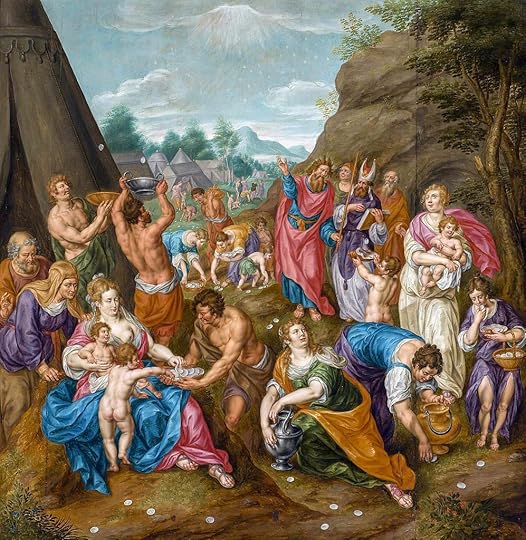 Israelites gathering Manna. Hendrick de Clerck. 1620s. National Museum in Warsaw.
What a lot of us don’t remember, is that God also gave the Hebrews meat. Quail in the evening. And all of us was done as a test. To hammer in the Sabbath laws they’d learned at Marah.
And the LORD said to Moses, “I will rain down bread for you from the sky, and the people shall go out and gather each day that day’s portion—that I may thus test them, to see whether they will follow My instructions or not.
But on the sixth day, when they apportion what they have brought in, it shall prove to be double the amount they gather each day.”
So Moses and Aaron said to all the Israelites, “By evening you shall know it was the LORD who brought you out from the land of Egypt;
and in the morning you shall behold the Presence of the LORD, because He has heard your grumblings against the LORD. For who are we that you should grumble against us?
Since it is the LORD,” Moses continued, “who will give you flesh to eat in the evening and bread in the morning to the full, because the LORD has heard the grumblings you utter against Him, what is our part? Your grumbling is not against us, but against the LORD!”
Then Moses said to Aaron, “Say to the whole Israelite community: Advance toward the LORD, for He has heard your grumbling.”
And as Aaron spoke to the whole Israelite community, they turned toward the wilderness, and there, in a cloud, appeared the Presence of the LORD.
The LORD spoke to Moses:
“I have heard the grumbling of the Israelites. Speak to them and say: By evening you shall eat flesh, and in the morning you shall have your fill of bread; and you shall know that I the LORD am your God.”
In the evening quail appeared and covered the camp; in the morning there was a fall of dew about the camp.
When the fall of dew lifted, there, over the surface of the wilderness, lay a fine and flaky substance, as fine as frost on the ground.
When the Israelites saw it, they said to one another, “What is it?”—for they did not know what it was. And Moses said to them, “That is the bread which the LORD has given you to eat.
Exodus 16: 4-15
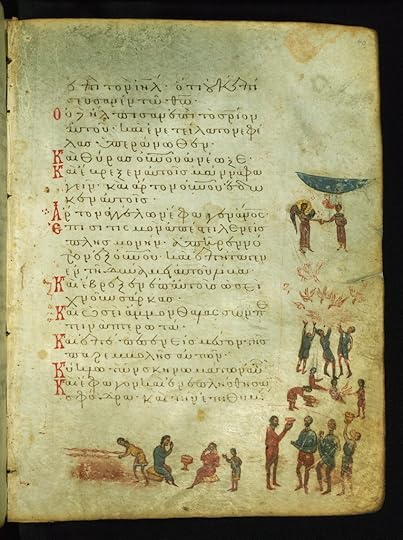 Psalter, The Bread of Angels; The Gathering of Quails; The Gathering of Manna, Walters Manuscript W.733, fol. 40r, by Walters Art Museum Illuminated ManuscriptsFor more on manna, see Manna—What Is It?For more on quail, see The Evening Quail
Manna—What Is It?
There is lots of speculation about the manna that God sent to the Hebrews every morning for 40 years. Was it a substance that exists in our world already? Was it like bread or something else? Let’s first look at the Exodus verses that describe it.
In the morning there was a fall of dew about the camp. When the fall of dew lifted, there, over the surface of the wilderness, lay a fine and flaky substance, as fine as frost on the ground. (Exodus 16: 13-14)
When the sun grew hot, it would melt. (Exodus 16: 21)
The house of Israel named it manna; it was like coriander seed, white, and it tasted like wafers in honey. (Exodus 16: 31)
This implies that the manna was eaten raw, with no processing, probably for breakfast. But the account of this time in Numbers talks about cooking it.
Now the manna was like coriander seed, and in color it was like bdellium.
The people would go about and gather it, grind it between millstones or pound it in a mortar, boil it in a pot, and make it into cakes. It tasted like rich cream.
When the dew fell on the camp at night, the manna would fall upon it.
Numbers 11: 7-9
If the heat of the sun melts it, it is not unreasonable to heat it in a pot instead, if you want to make a drink or soup. But how exactly is something so fragile able not only to be pounded but also ground in a millstone?
Some form critics posit conflicting descriptions of manna as derived from different lore, with the description in Numbers being from the Jahwist tradition, and the description in Exodus being from the later Priestly tradition. The Babylonian Talmud states that the differences in description were due to the taste varying depending on who ate it, with it tasting like honey for small children, like bread for youths, and like oil for the elderly. Similarly, classical rabbinical literature rectifies the question of whether manna came before or after dew, by holding that the manna was sandwiched between two layers of dew, one falling before the manna, and the other after.
Manna. Wikipedia.
Some claim that manna is really kefir grains.
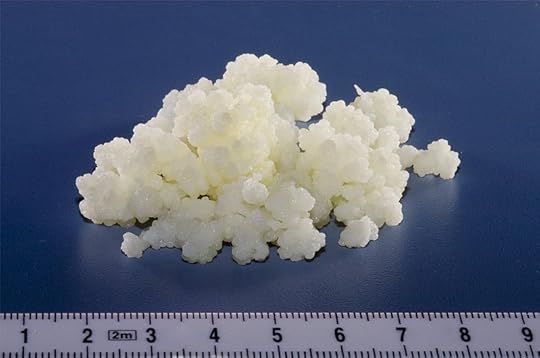 Milk kefir grains, A. Kniesel, 2005.
Others say it must be a type of algae.
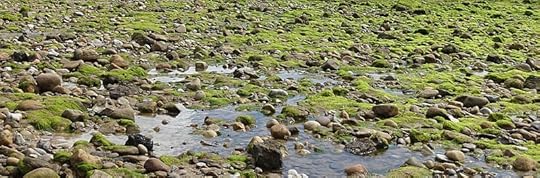 Algae on Langland Bay coast. 2018. Tiia Monto.
Or perhaps lichen.
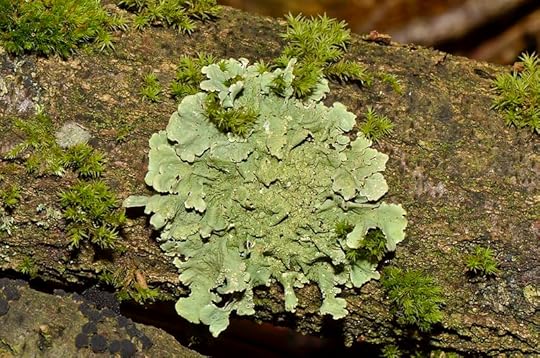 Flavoparmelia caperata (lichen), Hesse, Germany. 2011. Norbert Nagel.
A lichen is a composite organism that arises from algae or cyanobacteria living among filaments of multiple fungi species in a mutualistic relationship. Lichens have properties different from those of their component organisms. Lichens come in many colors, sizes, and forms and are sometimes plant-like, but lichens are not plants. Lichens may have tiny, leafless branches (fruticose), flat leaf-like structures (foliose), flakes that lie on the surface like peeling paint (crustose), a powder-like appearance (leprose), or other growth forms.
Lichen. Wikipedia.
And let’s not forget various forms of “honeydew” from insects and also from trees (though manna was found on the ground, not in trees).
In Numbers we’re told the manna is brown. “In color it was like bdellium.” If it means bdellium being the resin of various African trees.
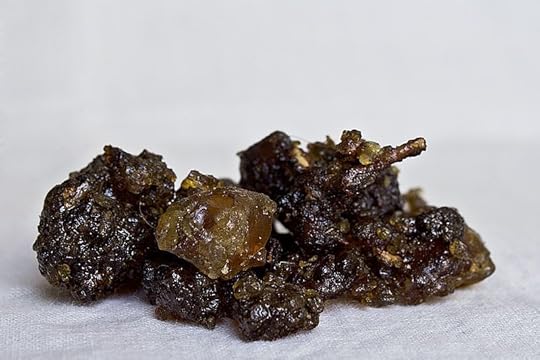 Bdellium resin. 2013.
Or whitish-green. If it means bdellium the fruit aka Commiphora wightii.
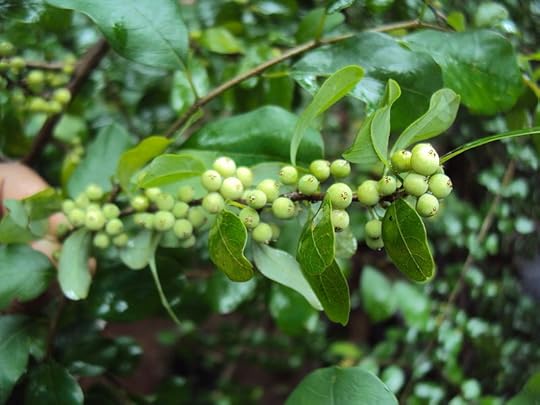 Commiphora wightii. 2013.
My view is that the purpose of manna wasn’t just to feed the Hebrews but to free them from the work of finding, cultivating, harvesting, and preparing food. Despite the passages about cooking the manna, which seem to be unnecessary work, it appears that manna is something one can gather and eat as is.
Each person gathers his or her own manna. “So they gathered it every morning, each as much as he needed to eat.” (Exodus 16:21) So aside perhaps from people helping children or others who could not do it themselves, this is a simple task that does not take much time.
Those who worked in the brickyards and fields back in Egypt (mostly men) were now free. The addition of manna freed those who toiled all day in the gardens and kitchens (mostly women).
My image of manna is something easy to gather and store. Something that does not require additional preparation (though people who wanted to cook with it could do so).
It could be any of the above choices. But somehow, in my head, I imagine it looks a lot like water kefir grains (water kefir is related to, but not interchangeable with, milk kefir).
 Water kefir “grains”. 2017.ReferencesKefir Grains, A Gift From God. Hazel Correll. 2012. The Natural Healing Room.What Is Kefir And What Are Kefir Grains. Kefir Guru.Manna. Wikipedia.Lichen. Wikipedia.Bdellium. Wikipedia.Commiphora wightii. Wikipedia.The Very Real Search for the Bible’s Mythical Manna: Scholars, soldiers, and scientists have long puzzled over the supernatural substance. Erica X Eisen. March 19, 2019. Atlas Obscura.
February 6, 2021
Zipporah’s Story in Torah
We don’t hear much about Moses’ wife and sons. To start the process of studying them, I’m first collecting Biblical mentions, which are below.
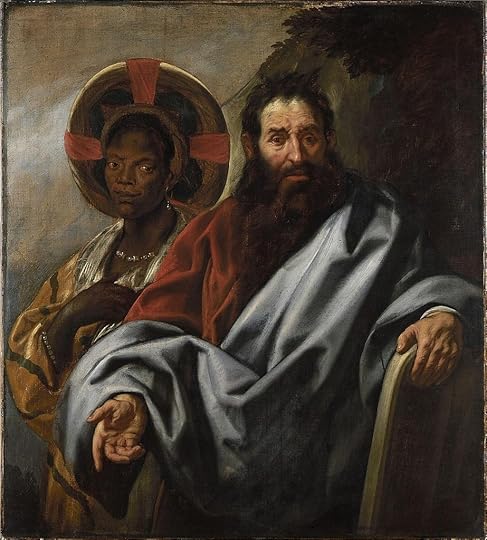 Moses and his Ethiopian wife Sephora (Mozes en zijn Ethiopische vrouw Sippora). Jacob Jordaens, c. 1650.
Moses was born a Hebrew slave but set upon the Nile as an infant and raised by Pharaoh’s daughter. As an adult, he murdered an Egyptian who was beating a Hebrew.
When Pharaoh learned of the matter, he sought to kill Moses; but Moses fled from Pharaoh. He arrived in the land of Midian, and sat down beside a well.
Now the priest of Midian had seven daughters. They came to draw water, and filled the troughs to water their father’s flock;
but shepherds came and drove them off. Moses rose to their defense, and he watered their flock.
When they returned to their father Reuel, he said, “How is it that you have come back so soon today?”
They answered, “An Egyptian rescued us from the shepherds; he even drew water for us and watered the flock.”
He said to his daughters, “Where is he then? Why did you leave the man? Ask him in to break bread.”
Moses consented to stay with the man, and he gave Moses his daughter Zipporah as wife.
She bore a son whom he named Gershom, for he said, “I have been a stranger in a foreign land.”
Exodus 2: 15-22
“A long time after that, the king of Egypt died” (Exodus 2:23) and God remembers the Hebrews in bondage. “Moses, tending the flock of his father-in-law Jethro, the priest of Midian” (Exodus 3:1) discovers the burning bush and God tasks him with freeing his people.
Moses went back to his father-in-law Jether [sic] and said to him, “Let me go back to my kinsmen in Egypt and see how they are faring.” And Jethro said to Moses, “Go in peace.”
The LORD said to Moses in Midian, “Go back to Egypt, for all the men who sought to kill you are dead.”
So Moses took his wife and sons, mounted them on an ass, and went back to the land of Egypt; and Moses took the rod of God with him.
Exodus 4: 18-20
We don’t know how old Moses’ and Zipporah’s sons are. If a “long time” passed after Gershom was born, that implies he’s too big to share an ass with his mom and brother (whose age we can only guess at). Nor do we know how old Zipporah is.
Torah tells us Moses was 80 when the Exodus began (about a year after he returned to Egypt) and that he spent 40 years away. So he was certainly much older than Zipporah.
We also can’t assume the Torah story is in chronological order. We know that in other places it is not. The time that passed may have been after Moses fled Egypt and before he met Zipporah and her sisters at the well.
Now the story takes a bizarre turn.
At a night encampment on the way, the LORD encountered him and sought to kill him.
So Zipporah took a flint and cut off her son’s foreskin, and touched his legs with it, saying, “You are truly a bridegroom of blood to me!”
And when He let him alone, she added, “A bridegroom of blood because of the circumcision.”
Exodus 4: 24-26
You might think I left something out but, no, this is it. Immediately before are God’s instructions to Moses to threaten the life of Pharaoh’s first born son (which could relate to Moses’ son, thought we don’t know which son was involved in this story). Immediately after is God speaking to Aaron, telling him to meet his brother in the wilderness.
There is no mention of Zipporah’s family until Exodus 6:25: “And Aaron’s son Eleazar took to wife one of Putiel’s daughters, and she bore him Phinehas.” Putiel is another name for Jethro. So this is one of Zipporah’s sisters. There is no way this marriage could have taken place before the start of the Exodus. So here we have a clear example of Torah setting aside chronology in order to tell a story.
The next mention comes in Exodus 18, just before the Hebrews arrive at Mount Sinai, though the events described take place at Mount Sinai.
Jethro priest of Midian, Moses’ father-in-law, heard all that God had done for Moses and for Israel His people, how the LORD had brought Israel out from Egypt.
So Jethro, Moses’ father-in-law, took Zipporah, Moses’ wife, after she had been sent home,
and her two sons—of whom one was named Gershom, that is to say, “I have been a stranger in a foreign land”;
and the other was named Eliezer, meaning, “The God of my father was my help, and He delivered me from the sword of Pharaoh.”
Jethro, Moses’ father-in-law, brought Moses’ sons and wife to him in the wilderness, where he was encamped at the mountain of God.
He sent word to Moses, “I, your father-in-law Jethro, am coming to you, with your wife and her two sons.”
Moses went out to meet his father-in-law; he bowed low and kissed him; each asked after the other’s welfare, and they went into the tent.
Exodus 18: 1-7
Here we learned that Moses did not continue traveling to Egypt with his family, that he sent them home. We also have the remarkable happening that Moses, after a year long separation from his wife and sons, does not appear to acknowledge them at all. He only greets and spends time with his father-in-law. Some (as represented by the painting below) speculate that Torah only mentions greeting Jethro to emphasize Moses’ respect for him, not because he ignored his family.
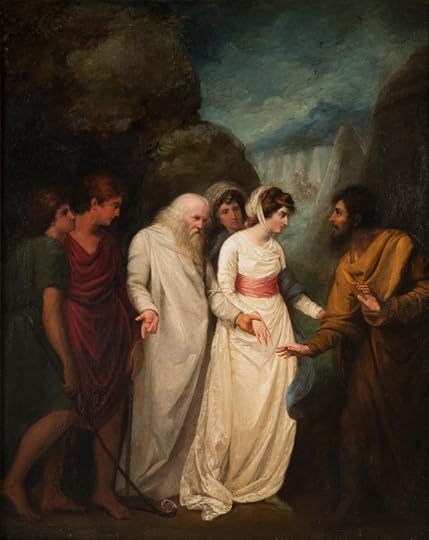 Moses Meeting His Wife and Sons. William Artaud. c. 1791. Carnegie Museum of Art. [Here a much younger than 80 Moses greets his young wife, his aged father-in-law, and his two pre-teen sons. Who is the other women in the picture? Could it be Zipporah’s sister, come to wed Aaron’s son Eleazar?]
And Jethro, Moses’ father-in-law, brought a burnt offering and sacrifices for God; and Aaron came with all the elders of Israel to partake of the meal before God with Moses’ father-in-law.
Exodus 18: 12
Jethro was a Midian priest but this passage implies that he has converted to Judaism, something many commentators assume. We don’t know when he or his daughter converted or if the children were born before or after that fact, but the circumcision scene tells us they were Jewish at that time, if not before. If the conversion came later, that would explain why they were not already circumcised. It would not be unreasonable to assume the family converted after Moses’ encounter with the burning bush.
Jethro gives Moses advice on leading his people, then he goes home. We don’t hear anything more about Zipporah until Numbers 12, long after the giving of the Torah and the tablets, but while they are still at Mount Sinai.
Miriam and Aaron spoke against Moses because of the Cushite woman he had married: “He married a Cushite woman!”
They said, “Has the LORD spoken only through Moses? Has He not spoken through us as well?” The LORD heard it.
Numbers 12: 1-2
God lectures Miriam and Aaron and then punishes only Miriam. We aren’t sure why she is punished (or why just her) or why Moses’ siblings were complaining about his marriage. Also, Zipporah is not named here. Some commentators take this to mean this is Moses’ second wife. But most believe Zipporah is his only wife. Nor do we know if Cushite refers to Kush, in Africa, or if it refers to Saudi Arabia (where Midian is) or if it just means beautiful and/or dark-skinned.
Many commentators do not consider Miriam and Aaron to be complaining about Moses’ choice of wife but, rather, that he was neglecting her.
Regardless of how old Moses’ sons were when led the Hebrews out of Egypt, they were adults when the Hebrews made it to the land of Canaan 40 years later. Yet Moses does not appear to train his sons to follow in his footsteps. Instead, he appoints Joshua (who is not even from the tribe of Levi) to be his successor.
The sons don’t die or bring shame upon their family. They just simply are in the background. We have to go to the end of the Bible to hear from them again.
As for Moses, the man of God, his sons were named after the tribe of Levi.
The sons of Moses: Gershom and Eliezer.
The sons of Gershom: Shebuel the chief.
And the sons of Eliezer were: Rehabiah the chief. Eliezer had no other sons, but the sons of Rehabiah were very numerous.
I Chronicles 23: 14-17
Moses’ grandsons and later progeny may not have been big names but they were trusted with important duties.
ReferencesZipporah. Wikipedia.Gershom. Wikipedia.Eliezer. Wikipedia.Zipporah: Bible. Frymer-Kensky, Tikva. Jewish Women: A Comprehensive Historical Encyclopedia. 27 February 2009. Jewish Women’s Archive.Moses and the Kushite Woman: Classic Interpretations and Philo’s Allegory. Dr.Elad Filler. TheTorah.com.The Mystery of the Cushite Woman. June 7, 2012. Shlomo Skinner. Thinking Torah.The Untold Story of Zipporah, Wife of Moses. Levi Avtzon. Chabad.Moshe, Miriam, Aharon and the “Cushite Woman. Yoseph Yaffe. The Art of Biblical Interpretation.
Shebuel son of Gershom son of Moses was the chief officer over the treasuries.
And his brothers: Eliezer, his son Rehabiah, his son Jeshaiah, his son Joram, his son Zichri, his son Shelomith—
that Shelomith and his brothers were over all the treasuries of dedicated things that were dedicated by King David and the chiefs of the clans, and the officers of thousands and hundreds and the other army officers;
they dedicated some of the booty of the wars to maintain the House of the LORD.
I Chronicles 26: 24-27
January 13, 2021
The Four Elements of the Exodus
Breaking up the world into elements is not a new concept, nor is it limited to Western thought. While Ancient Greece often gets the credit for the concept of four elements: water, air, earth, and fire, many cultures have created the same breakdown. Sometimes there are five elements, and in some cases, they’re categorized a bit differently.
It’s unclear that any of these concepts were developed in the time of the New Kingdom of Egypt, many hundreds of years before the rise of what is now called Ancient Greece. But there are echos of it in Jewish writings about that period.
Rabbi Yosei, son of Rabbi Yehuda, says: Three good sustainers rose up for the Jewish people during the exodus from Egypt, and they are: Moses, Aaron and Miriam. And three good gifts were given from Heaven through their agency, and these are they: The well of water, the pillar of cloud, and the manna. He elaborates: The well was given to the Jewish people in the merit of Miriam; the pillar of cloud was in the merit of Aaron; and the manna in the merit of Moses. When Miriam died the well disappeared, as it is stated: “And Miriam died there” (Numbers 20:1), and it says thereafter in the next verse: “And there was no water for the congregation” (Numbers 20:2). But the well returned in the merit of both Moses and Aaron.
Taanit: Daf 9a. The William Davidson Talmud. Composed in Talmudic Babylon (c.450 – c.550 CE). Sefaria.
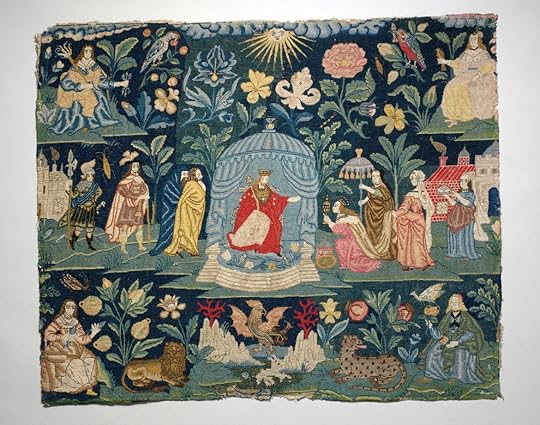 The Meeting of King Solomon and the Queen of Sheba, with the Four Elements, ca. 1700. The Metropolitan Museum of Art.
In the Prophets we have the line:
In fact, I brought you up from the land of Egypt, I redeemed you from the house of bondage, And I sent before you Moses, Aaron, and Miriam.
Micah 6:4. Sefaria.
Midrash on this Biblical passage describes in detail the benefits to the Hebrews brought by God by merit of the three siblings.
However, when you were slaves to Pharaoh in Egypt and when I brought you out from there, I had you lie down under clouds of glory and raised up three redeemers for you to serve you, [as stated] (in (Micah 6:4): AND I SENT MOSES, AARON, AND MIRIAM BEFORE YOU. [Through the merit of Moses you ate manna, which the holy ancestors had not seen, as stated (in Deut. 8:3)…
Through the merit of Aaron I surrounded you in clouds of glory, as stated (in Ps. 105:39): HE SPREAD A CLOUD FOR A COVER AND A FIRE TO GIVE LIGHT AT NIGHT. There were seven clouds: one from above, one from below, one from each of the four winds, and one before you. He smote snakes and scorpions, leveled the mountains and valleys for them, and burned the thornbushes so that they sent up smoke….
Now the well through the merit of Miriam, who uttered a song by the waters ….The manna was through the merit of Moses.
Midrash Tanchuma Buber: Bamidbar, Siman 2. Composed in Talmudic Israel/Babylon (c.150 – c.750 CE).
Some commenters assign the 10 plagues to one of the four elements. Rabbi Kornfeld (following many others) adds in a 5th element of the soul and divides them as follows:
Water: Blood and FrogsEarth: Lice and Mixed Beasts (others say Wild Beasts)Fire: Boils and HailAir: Locusts and DarknessThe Soul: Pestilence and the Death of the FirstbornPut these ideas together and we have our three children of Jochebed and Amram, each with power over one or more elements. While the commentaries I’ve seen assign water to Aaron, clearly water is Miriam’s dominion, though Torah gives her no role in the ten plagues (she did not even go to the palace).
If we look at the actions of the two brothers during the ten plagues, we see some patterns:
The Ten Plagues1. Blood: Aaron struck the water with his staff.2. Frogs: Aaron stretched hand over the water.3. Bugs: Aaron struck the earth with his staff.4. Wild Animals: No mention of who started it but Moses ended it with prayer.5. Pestilence: By the word of Moses.6. Boils: Moses tossed soot in the air.7. Hail: Moses stretched forth his staff. He stopped it by spreading his hands.8. Locust: Moses raised his arms and the wind brought the locusts. He sent the locusts away via the wind by prayer.9. Darkness: No mention of how it started.10. Death of the First-Born: Moses predicted the timing but did not do anything to bring it forth. This one was all God.Additional: At the Red Sea, Moses called the wind that divided the water.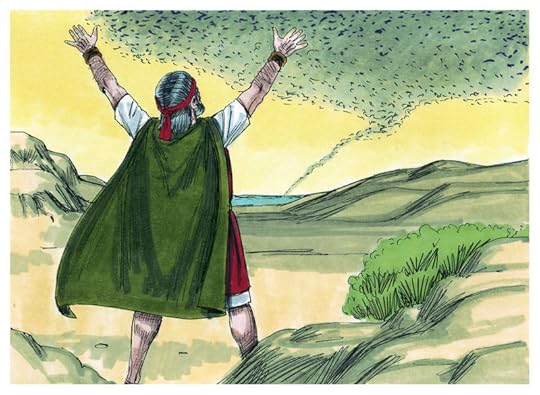 Book of Exodus Chapter 11-5. Biblical illustrations by Jim Padgett, courtesy of Sweet Publishing, Ft. Worth, TX, and Gospel Light, Ventura, CA. Copyright 1984.
I use the 4 elements as a motif throughout my story. My main character, Ruth, comes to Egypt when Miriam calls her. And they find what they have in common is the power to control water.
I divide the powers as follows:Aaron, the power of EarthHe “leveled the mountains and valleys” on their journey, caused the floor of the Red Sea to be flat for the fleeing Hebrews and uneven and muddy for the pursuing Egyptian soldiers, and struck his staff on the earth to bring forth insects and other plagues.
Moses, the power of AirHe tossed soot in the air to bring about the plague of boils, brought both the plagues of hail and locusts by manipulating the wind (and sent away the locusts with the wind as well), and his role in parting the Red Sea was by calling a strong wind against the water.
Miriam, the power of WaterMiriam’s well watered both humans and animals during the Exodus (from Midrash and a story so strong most Jews might not realize it’s not in the Torah). She was also a midwife (amniotic fluid being a living water)(midwives are mentioned in Torah but we only know Miriam is one through Midrash). In the early chapters of Exodus, she saved the life of her baby brother Moses by convincing her mother to place him in an ark on the Nile and then she followed him to make sure he was found safely.
God as FireGod requires sacrifices by fire as part of our worship, and punishes others who try to control fire. God appeared to Moses as a burning bush (that did not require the bush as fuel). God leads the Hebrews through the Exodus with a column of fire by night and a cloud (of smoke?) during the day.
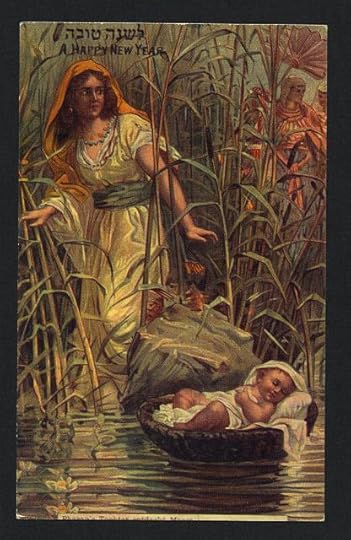 A happy new year: Print shows Miriam watching over the infant Moses among the rushes, as she becomes aware of the entourage of the Pharoah’s daughter coming nearby. Postcard from Hebrew Publishing Co., [between 1900 and 1920]. Ephemera from the Alfred Bendiner Memorial Collection (Library of Congress).
Are these perfect divisions? Nope. Each of the siblings takes on roles outside of their specialty. For example, Moses brings forth water on several occasions. But he struggles with it. It’s not truly his power.
Whether you call it magic or powers or gifts from God, the facility to manipulate the elements in a way beyond normal human ability defines the Exodus.
ReferencesTaanit: Daf 9a. The William Davidson Talmud. Composed in Talmudic Babylon (c.450 – c.550 CE). Sefaria.The Ten Plagues. Chabad.Classical element. Wikipedia.Midrash Tanchuma Buber: Bamidbar, Siman 2. Composed in Talmudic Israel/Babylon (c.150 – c.750 CE).Divine Order in the 10 Plagues. Rabbi Mordecai Kornfeld’s Weekly Parasha-Page. Passover 5757January 3, 2021
Reflecting in Elim
Our travelers walk from the eastern shore of the Red Sea three days into the desert only to find bitter water at Marah. After Moses makes the water drinkable, they stay for a bit then leave and find the oasis they were looking for.
They came to Elim, and there were twelve water fountains and seventy palms, and they encamped there by the water.
Exodus 15: 27
Other translations use “springs” instead of “fountains.” But all commentaries note that there are 12 tribes and 70 elders. As if the oasis had been prepared especially for them.
Then they came to Eilim. This was close to Marah so they should not have needed to camp there. For this reason it is written “they came” rather than “they camped.” In fact, when they first arrived they did not intend to camp but only to avail themselves of the water from the springs. The twelve springs and seventy date palms signified that after receiving statutes and ordinances at Marah they were now to have appointed over them seventy elders and twelve tribal princes. Only after this are they referred to as “the community of the B’nei Yisrael,” for they are only a “community” when led by the elders.
Malbim on Exodus 15:27
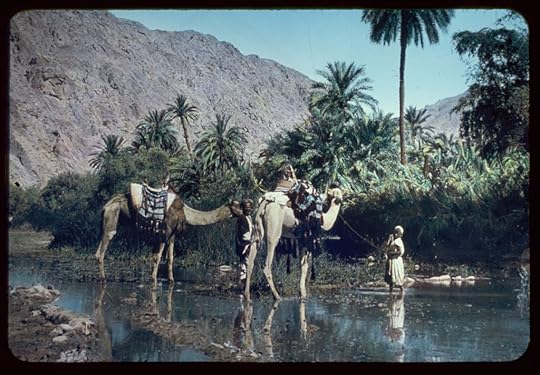 Sinai. Oasis of Wady Feiran, Elim. Exodus 16:1. Matson Photo Service, photographer. 1950. [Note: This wadi is located on the Sinai Peninsula, nowhere near where I’m placing Elim.]
Was Elim in fact an oasis? I’m taking it as such. One with plenty of water for drinking, watering the animals, and bathing. And fruits there for the picking. Yet some interpretations are less optimistic.
And now removing from thence they came to Elim; which place looked well at a distance, for there was a grove of palm-trees; but when they came near to it, it appeared to be a bad place, for the palm-trees were no more than seventy; and they were ill-grown and creeping trees, by the want of water, for the country about was all parched, and no moisture sufficient to water them, and make them hopeful and useful, was derived to them from the fountains, which were in number twelve: they were rather a few moist places than springs, which not breaking out of the ground, nor running over, could not sufficiently water the trees. And when they dug into the sand, they met with no water; and if they took a few drops of it into their hands, they found it to be useless, on account of its mud. The trees were too weak to bear fruit, for want of being sufficiently cherished and enlivened by the water.
Josephus: The Complete Works. Chapter 1, section 3.
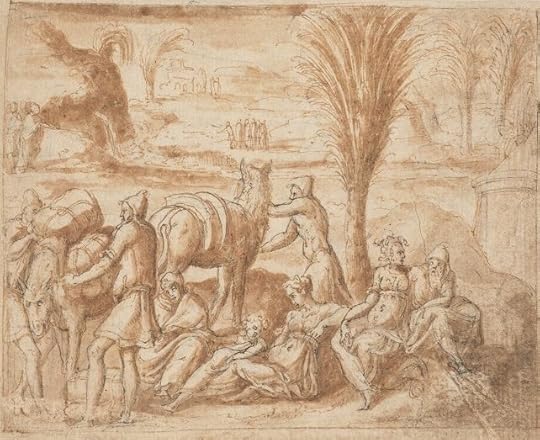 The Hebrews camping in Elim. Original drawing by Bernard Salomon, circa 1550, illustrations for Claude Paradin, Quadrins historiques de la Bible. TypDr 515.S766.50q (15), Houghton Library, Harvard University
References
Malbim on Exodus. Composed in (c.1844 – c.1874 CE). Popular Biblical commentary by Rabbi Meir Leibush ben Yehiel Michel Wisser (Malbim).Josephus: The Complete Works. Chapter 1. How Moses When He Had Brought the People Out of Egypt Led Them to Mount Sinai; But Not Till They Had Suffered Much in Their Journey.Elim: The Desert Oasis. Doubting Thomas Research Foundation.



._LOC_matpc.07228.jpg)


.jpg)
_-_camping_in_Elim.jpg)