Deedee Cummings's Blog, page 2
August 3, 2025
Why Empathy Is at the Heart of Every Make A Way Media Book
 Make A Way Media highlights empathy through books and stories that open hearts, build bridges, and help kids see the world with kindness.
In a world that often moves too fast to stop and feel, we believe one thing can still slow us down just enough to change everything: a good story. At Make A Way Media, we create more than books—we create tools for emotional growth, connection, and healing. And at the core of every one of our stories is a powerful, transformational value: empathy.
Empathy is not just a buzzword for us. It’s the lens we write through. It’s the lesson we want children to walk away with. It’s the reason our books exist in the first place.
Books About Empathy Change How Kids See the WorldChildren aren’t born knowing how to understand other people’s feelings—they learn empathy by watching, listening, and engaging with the stories and people around them.
Books about empathy are one of the best empathy-teaching tools we have. That’s why every Make A Way Media story is designed to:
Show kids characters who feel deeply and respond with compassion
Reflect real-world situations that help readers connect to others’ struggles
Offer hope in hard times, and remind children that they’re not alone
Through our books, children learn to see people—not just problems. They begin to imagine what life might feel like for someone different from themselves.
What Makes a Make A Way Media Book Different?While many children’s books entertain, we aim to go deeper.
Each Make A Way Media title is built around what we call “soul-first storytelling”—stories that teach without preaching, and nurture emotional intelligence in every chapter.
Here’s how we intentionally embed empathy in our books:
✅ Relatable Characters: From Nick in Hope In the Nick of Time to Kayla in Kayla: A Modern-Day Princess, our characters face challenges that mirror real life—poverty, injustice, exclusion, and fear—while modeling resilience and kindness.
✅ Diverse Representation: Empathy is easier when children see themselves and others in the pages. Our books prioritize inclusion, ensuring every child feels seen and celebrated.
✅ Emotional Literacy: We don’t just tell children what characters feel—we help them understand why they feel that way, and what they can do about it.
✅ Guided Reflection: Many of our books include conversation guides, activities, or affirmations that encourage kids and caregivers to go deeper together.
Empathy + Emotional Wellness = Real ImpactResearch shows that kids who develop empathy:
Have stronger relationships
Handle conflict better
Are less likely to bully or be bullied
Grow up to become more emotionally healthy adults
That’s why we’re not just telling stories—we’re helping build better futures.
Books like This Is the Earth and Hope In the Nick of Time spark meaningful conversations about kindness, fairness, and justice. Others, like Kayla: A Modern-Day Princess, instill pride, confidence, and cultural awareness—all foundational to growing an empathetic worldview.
Empathy Is the Heart. Hope Is the Skill.At Make A Way Media, empathy and Hoping Skills™ go hand-in-hand.
When kids learn to see the world with compassion, they also begin to see the possibility for something better. That’s what hope is: the belief that things can improve. And that belief starts with how we treat each other.
Empathy teaches us to care.
Hope teaches us to act.
Together, they give children the emotional strength to make a way—for themselves and for others.
Explore our full collection of children’s books that model empathy, courage, and kindness at MakeAWayMedia.com. Fill your bookshelf with hope!
Because books don’t just shape readers.
They shape people.
The post Why Empathy Is at the Heart of Every Make A Way Media Book appeared first on Make A Way Media.


July 29, 2025
The Best Books About Empathy For Kids
Help your child build kindness, compassion, and emotional awareness one page at a time with these great books about empathy for kids.
 Empathy is one of the most important life skills we can teach our children. It helps them understand others, navigate their own emotions, and become kind, thoughtful members of the community. Reading is a beautiful and engaging way to start building this skill even from an early age.
Books about empathy give children the chance to walk in someone else’s shoes, to see the world from a different perspective, and to feel compassion for characters who are different from them—or just like them.
Great Books About Empathy For KidsWhether you are a teacher looking to increase the empathy in your classroom or a mom wanting to instill more empathy in her kids, these books were written for you. They show empathy on every page.
1. Hope In the Nick of Time by Deedee CummingsThis heartfelt holiday story goes beyond festive cheer. It shows children to how to maintain hope, understanding, and empathy for those experiencing overwhelming feelings in a chaotic and confusing world. It teaches that compassion and action—no matter how small—can change lives. This story is a powerful reminder that we all need hope, and we all need each other.
2. Last Stop on Market Street by Matt de la PeñaThis lyrical and beautifully illustrated book explores the beauty of everyday life, generosity, and perspective. CJ’s grandmother helps him see the world through the lens of gratitude and kindness, especially toward those who are often overlooked.
3. The Invisible Boy by Trudy LudwigBrian feels invisible at school. One day, a new kid shows him kindness. This touching story highlights the deep emotional effects of exclusion and the transformative power of inclusion and empathy. You never know when a simple act will make a big difference in someone else’s life.
4. Those Shoes by Maribeth BoeltsJeremy wants the shoes everyone else has. Instead, the boy learns a profound lesson about wants vs. needs. He sees that generosity can shine even in disappointment. This book teaches empathy through subtle, real-world scenarios that kids face every day.
5. I Walk with Vanessa by KerascoëtThis is a powerful wordless picture book that shows how one small act of kindness can grow into a movement. In this sweet story, kids learn to stand up for others and offer support when it matters most.
6. Each Kindness by Jacqueline WoodsonChloe and her classmates ignore the new girl, Maya, until it’s too late. This story delivers a gentle but impactful message: missed opportunities for kindness leave lasting marks. It’s a must-read for empathy-building discussions.
If you’re not sure what to say to start important conversations about kindness and empathy, these questions that build empathy will help.
7. In My Heart: A Book of Feelings by Jo WitekThis vibrant, visually engaging book helps kids explore a wide range of emotions. Naming and normalizing feelings creates a foundation for self-awareness and understanding of others.
8. We’re All Wonders by R.J. PalacioBased on the novel Wonder, this picture book adaptation makes the theme of empathy more accessible to younger readers. It encourages children to see the wonder in everyone, regardless of our appearance or differences.
9. Saturday by Oge MoraAva and her mother’s special day doesn’t go as planned, but together they navigate disappointment with love and resilience. This story teaches kids how empathy can show up in relationships, especially during challenging moments.
10. A Sick Day for Amos McGee by Philip C. SteadAmos is a friendly zookeeper who is always kind to the animals. When he gets sick, the animals decide to return the favor and care for him. This story reminds us that empathy is a two-way street. Supporting others is just as important as receiving help.
11. These Olive Trees by Hazar ElbayyaOraib finds herself saying goodbye the beloved olive trees that she and her family have loved, cared for, and depended on. She makes a promise to care for her olive trees, even as the war forces her to leave her trees behind. This book not only shows empathy but also hope for a future better than the one we currently see.
12. This is the Earth by Deedee CummingsThis book has the language of empathy on every page. The simple yet profound text combined with the breathtaking illustrations make it a favorite for readers of any age. We are reminded that we don’t have to speak the same language, live in the same country, or even share the same beliefs to show empathy. We are all already connected, all neighbors, sharing one big, beautiful home.
13. Watercress by Andrea WangSometimes, as kids, we don’t understand the things our parents do. This is the story of a Chinese immigrant family spotting watercress by the side of the road. At first, the young girl is embarrassed as her family stops to collect as much watercress as they can. After listening to her mother’s story about gathering food with her family in China, the girl begins to see things differently.
Why Young Readers Need Books About EmpathyTeaching empathy isn’t about lecturing—it’s about modeling, storytelling, and letting kids feel their way into understanding. These empathy-focused books help children:
Recognize emotions in othersReflect on their own experiencesBuild stronger relationshipsMake kinder, more thoughtful choicesEach of these stories serves as a bridge between the child reading and the world they are growing into.
Fun Activities for Teaching EmpathyHere at Make A Way Media, all of our books and resources speak to the power of empathy in different ways. We believe that every teacher, parent, grandparent, etc. should have access to the tools they need to raise great humans. That is why we are constantly giving away free resources for children and adults. Here are some free printable activities to help you bring more empathy to your home, school, or classroom.
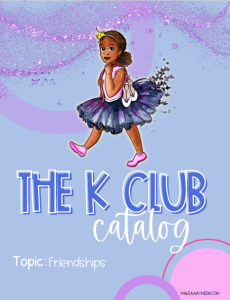
Did you know that you could get a free printable guide each month full of activities that teach kids the social emotional skills they need to thrive? From listening skills to dealing with bullying, the K Club invites kids, parents, and teachers to tackle tough topics while having screen-free fun together. Join the K Club today to get your free guides!
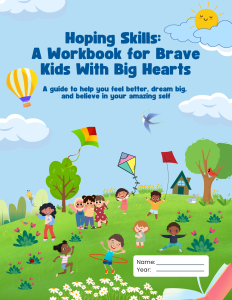
Hope is a skill. It’s a skill we can grow, measure, and strengthen. This free, printable workbook shows kids exactly how to strengthen their “hoping skills” and share hope with others. Get your copy today!
The post The Best Books About Empathy For Kids appeared first on Make A Way Media.
11 Books About Empathy For Kids
Help your child build kindness, compassion, and emotional awareness—one page at a time.
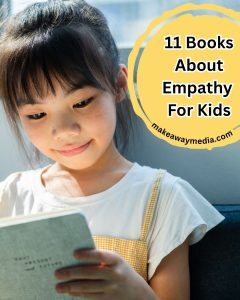 Empathy is one of the most important life skills we can teach our children. It helps them understand others, navigate their emotions, and become kind, thoughtful members of the community. Fortunately, there’s a beautiful and engaging way to build this skill from an early age: through reading.
Books about empathy give children the chance to walk in someone else’s shoes, to see the world from a different perspective, and to feel compassion for characters who are different from them—or just like them.
Whether you’re a parent, educator, therapist, or librarian, this list of children’s books that teach empathy will be a powerful tool in helping kids connect, understand, and grow.
1. Hope In the Nick of Time by Deedee CummingsThis heartfelt holiday story goes beyond festive cheer to introduce children to hope, understanding, and empathy for those experiencing overwhelming feelings in a chaotic and confusing world. It teaches that compassion and action—no matter how small—can change lives. A powerful reminder that we all need hope, and we all need each other.
2. Last Stop on Market Street by Matt de la PeñaA lyrical and beautifully illustrated book that explores the beauty of everyday life, generosity, and perspective. CJ’s grandmother helps him see the world through the lens of gratitude and kindness—especially toward those who are often overlooked.
3. The Invisible Boy by Trudy LudwigBrian feels unseen by his classmates—until a new student shows him kindness. This touching story highlights the deep emotional effects of exclusion and the transformative power of inclusion and empathy.
4. Those Shoes by Maribeth BoeltsWhen Jeremy wants the shoes everyone else has, he learns a profound lesson about wants vs. needs, and how generosity can shine even in disappointment. This book teaches empathy through subtle, real-world scenarios kids face every day.
5. I Walk with Vanessa by KerascoëtA powerful wordless picture book that shows how one small act of kindness can grow into a movement. By following Vanessa’s story, kids learn to stand up for others and offer support when it matters most.
6. Each Kindness by Jacqueline WoodsonChloe and her classmates ignore the new girl, Maya, until it’s too late. This story delivers a gentle but impactful message: missed opportunities for kindness leave lasting marks. It’s a must-read for empathy-building discussions.
7. In My Heart: A Book of Feelings by Jo WitekThis vibrant, visually engaging book helps kids explore a wide range of emotions. By naming and normalizing feelings, it creates a foundation for self-awareness and understanding others.
8. We’re All Wonders by R.J. PalacioBased on the novel Wonder, this picture book adaptation makes the theme of empathy more accessible to younger readers. It encourages children to see the wonder in everyone, regardless of their appearance or differences.
9. Saturday by Oge MoraAva and her mother’s special day doesn’t go as planned, but together they navigate disappointment with love and resilience. This story teaches kids how empathy can show up in relationships, especially during challenging moments.
10. A Sick Day for Amos McGee by Philip C. SteadAmos is always kind to the animals at the zoo, and when he’s unwell, they return the favor. It’s a gentle story that shows how empathy is a two-way street—and how being there for others matters.
11. These Olive Trees by Hazar ElbayyaThe story of a Palestinian family’s ties to the land, and how one young girl finds a way to care for her home, even as she says goodbye.
Why These Books MatterTeaching empathy isn’t about lecturing—it’s about modeling, storytelling, and letting kids feel their way into understanding. These empathy-focused books help children:
Recognize emotions in others
Reflect on their own experiences
Build stronger relationships
Make kinder, more thoughtful choices
Each of these stories serves as a bridge between the child reading and the world they are growing into.
Looking for More?At Make A Way Media, we believe that every book is a chance to teach empathy, resilience, and hope. Visit our shop to discover more children’s books that nurture emotional wellness and celebrate diversity.
Pin It for Later!“11 Children’s Books That Teach Empathy in Powerful Ways” — because kindness starts on the page.
The post 11 Books About Empathy For Kids appeared first on Make A Way Media.
July 17, 2025
How to Teach Kids About Hope with the Hope Meter™
Did you know that hope isn’t a feeling? It is a skill that we can all learn, practice, and grow. As a therapist, I have spoken with many kids and adults lately who feel overwhelmed, stressed and anxious. Some are struggling with things going on in their own lives. Others are struggling with events taking place in the world around them. For some, it’s a combination of both.
Although we can’t make these challenges go away, we can equip ourselves, and our kids, with tools for overcoming adversity. Hope is truly the most valuable tool I’ve found. Being able to find the bright side and develop an optimistic outlook is a key life skill. Here’s how to teach kids about hope and a few tools for cultivating hope in everyday life.
Why Hope MattersWe all face challenges. We can choose to let those challenges knock us down and keep us stuck or we can view them as little speed bumps on our journey. When we know how to keep a hopeful mindset, we can see beyond the hard moments, toward a brighter future. Hope empowers us to keep moving forward, adapt to change, and believe that better days are possible.
How to Explain Hope to Young PeopleAlthough hope is a powerful tool, it can feel a bit abstract to kids. It will be easier for your kids to develop a hopeful mindset if you are able to explain hope to them in a way that makes sense to their growing minds. Here’s how to break hope down for different age groups:
Preschoolers (Ages 3-5): Hope as Simple OptimismFor preschoolers, hope can be introduced as the idea of looking forward to something good. Use simple, tangible examples they can relate to. For example, you might say, “Hope is like when you plant a seed and believe it will grow into a flower.” You can also connect it to their daily experiences: “Remember when it was rainy and you believed the sun would come out soon? That’s hope!”
Activities like drawing pictures of things they’re excited about or making a “hope jar” where they place notes of things they’re looking forward to are great ideas to help children practice their “hoping skills“.
Elementary Age (Ages 6-11): Hope as a Belief in What Could BeElementary-aged kids can start to understand hope as a combination of wanting something and working toward it. You could say, “Hope is when you believe something good can happen, and you do your best to make it real.” For example, “If you hope to get an A on your spelling test, you have to study the words and believe you’ll be able to learn them all.”
Encourage kids to set small, achievable goals and talk about how hope helps them stay motivated. A fun activity could be creating a “hope tree,” where each branch represents a goal they’re working toward. You could even add leaves as they make progress.
Middle and High Schoolers (Ages 12-18): Hope as Resilience and VisionTeenagers can handle a more nuanced understanding of hope, seeing it as a mindset that helps them navigate challenges and work toward a better future. You might explain, “Hope is believing that even when things are tough, they can get better. Hope reminds you that you’re never truly stuck. You have the power to make a difference.” Use relatable examples, like hoping to make the soccer team and practicing every day, or hoping for a better world and volunteering each week at a local organization.
The Connection Between Hope and GoalsHope and goals are connected, like two sides of the same coin. Hope is the belief that a better future is possible. Goals, on the other hand, are the specific milestones we set to make that future a reality. Without hope, goals can feel meaningless or unattainable. Without goals, hope can feel aimless and abstract. When combined, they create a powerful roadmap for progress.
If you or your child are feeling overwhelmed by negative thoughts, the first step in cultivating hope is to define what you are hoping for and what you can do to make it happen. If the situation that has you feeling hopeless is out of your control, find a way to make a difference, no matter how small. Teach kids to recognize the ways they can impact the world around them. Being able to do something helps us feel hopeful in hard times.
Ways to Grow HopeThere are truly hundreds of ways to grow hope but they all boil down to two things:
1) Search for the good.
2) Take action to make things better.
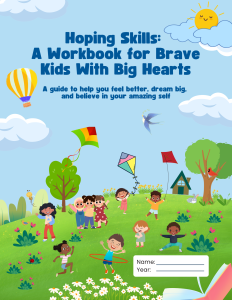
If you are looking for fun activities to help kids recognize hope and their own ability to make good things happen, this free activity book is full of fun ways to help kids grow their hoping skills. Kids and parents alike will have fun writing, creating and playing together as they explore hope as a family.
Teach Kids to Measure HopeOnce kids know what hope is, and how to grow it, you can use this fun tool I call the Hope Meter™ to check in on their hope levels and respond with intention.
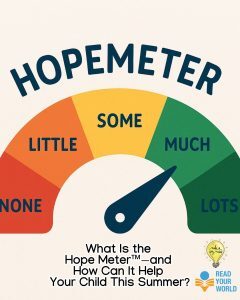
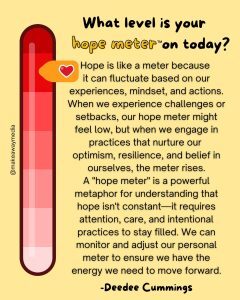
The Hope Meter™ is a visual scale—from empty to full—that helps children:
Recognize when they’re feeling low on hopeName what’s contributing to that feelingTake action to refill their meterView hope as a skill they can strengthen over timeThe Hope Meter™ is not about forcing a positive attitude no matter what. It’s about learning how to spot the signs of despair before they grow into something bigger. This tool helps us recognize our power to change situations. It helps kids build emotional awareness while reminding them that hope isn’t something you either have or don’t. It’s something you can work on and strengthen, like a muscle.
How to Use the Hope Meter™ at HomeTry this simple check-in once a day (or a few times a week) with your child:
Ask Your Child:
“Where is your hope meter today? Empty, low, halfway, or full?”
“What do you think brought it to that level?”
“What could help fill it back up?”
Then, brainstorm ideas to boost their hope levels if needed. Hope refills don’t have to be big.
A hope refill could be:
A walk outside to search for beauty in natureDrawing or journaling about your dreamsReading hopeful storiesHelping someone elseGetting a good night’s sleepSaying something kind to themselvesThese small activities reinforce the reality that hope is a skill we can all develop, just like learning to ride a bike or tie our shoes. By regularly checking their hope meter, kids learn that their feelings are valid and that they have the power to influence those feelings. We aren’t victims to our circumstances. We all have the power to create change.
Hopeful Stories to Read This SummerThe Hope Meter™ and hoping skills are valuable tools we all need. You can see the power of hoping skills in action in my upcoming book, Hope In the Nick of Time, the third book in the In the Nick of Time series.
In this heartwarming new story, young Nick’s day isn’t going as planned. A few unlikely interactions remind him that he doesn’t have to wait for things to get better. He can become the kind of person who knows how to find the light, even in dark places.
Hope is one of the best gifts we can give our children. The Hope Meter™ reminds them of their power to check in with their hearts and refill their hope levels anytime it’s running low. When we know how to monitor and grow our hope, we will never let it run out.
Get your free hoping skills workbook today to teach your kids that they’ll always have a way to find the light, no matter how cloudy the day.
You can find more helpful blog posts like this one on the Read Your World blog. Together we are doing a summer series all about how to grow your kids’ hope and empathy through diverse books.
The post How to Teach Kids About Hope with the Hope Meter™ appeared first on Make A Way Media.
July 9, 2025
The Christmas Book I Had to Write for My Son
I am excited to share that the In the Nick of Time series has grown again! This Fall I will release the third installment in the series called Hope In the Nick of Time and the series will now have an activity book too. Both of these new additions will focus on hoping skills for kids and couldn’t be more timely. (If you are looking for a way to talk about hoping skills with your child, please download our free guide.)
When my son Nick was ten years old, I set out to find him the perfect Christmas story. My family loves Christmas and we have many many Christmas books, but I could not find a story where a child—not just any child, but a Black child—got to help Santa save the day.
I searched high and low. I combed through bookstores and scoured online retailers. But no matter how hard I looked, I couldn’t find what I was searching for.
There were books with reindeer and elves. Books with talking snowmen and twinkling lights. Books about Santa going missing or being in trouble. But in every version of those stories, the heroes never looked like my son.
Not once did I find a story with a Black boy who gets to be brave, helpful, and kind. Where that child gets to step up, solve a problem, and save the day right alongside Santa himself.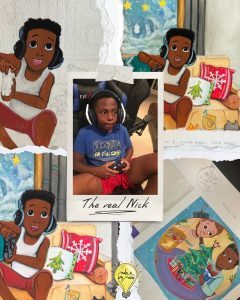
As a mom, an author, and a lifelong lover of children’s books, that story called out to me. That story pulled at my heart. I knew that if I could not find it, that meant I had to write it!
In the Nick of Time was born from a deep love for my child, for storytelling, and for the kind of joyful representation every child deserves. The story is a whisper to the universe about the kind of world I want my son to grow up in.
It matters that Black children get to see themselves in stories of magic and wonder.
It matters that they’re not just present, but centered—as the ones with big hearts, brilliant ideas, and the power to make a difference.
So often, books that feature Black characters are rooted in pain or history. Those stories are vital—but they shouldn’t be the only stories. Our children deserve to be the stars of festive, funny, uplifting adventures too. They deserve to experience themselves as the heroes in everyday, joyful, and magical tales—especially during the holidays.
Why I write books filled with empathyRepresentation is not about exclusion. It’s about expansion.
When we make room for all kinds of stories, we expand what’s possible in the hearts and minds of every child—Black or white, rich or poor, city or country.
Because the truth is: this story isn’t just for my son. It’s for yours, too.
Every classroom, library, and community center should have books that reflect the diversity of the world around us. And not just during Black History Month.
When kids of all backgrounds read stories about Black children being brave and kind, they grow up with more empathy. More respect. More understanding.
This series—In the Nick of Time—is a celebration of hope, friendship, courage, and kindness. Book one addresses friendship and poverty. Book two shines a light on racial bias and diverse holiday traditions. Book three, Hope In the Nick of Time, explores homelessness and the power of hope. Each one helps kids start important conversations. Each one invites them to dream a little bigger and believe a little deeper.
And now, this growing series is joined by a first-of-its-kind activity book that gives kids tools to build coping skills, regulate emotions, and develop a growth mindset. It’s a much-needed antidote to screen time—a thoughtful, joyful way to help kids unplug and reconnect with themselves. And it centers a Black child doing just that, which is almost unheard of in the world of activity books.
What It Feels Like to See This Book Brought to LifeThere is no way to fully describe the feeling of seeing my son’s name on the cover of a book. Or of watching him light up when he realized: This is me. I get to be the one who helps Santa. I get to save the day.
When Nick was only ten and first saw the cover of the book and a drawing that looked like him made by fine artist Charlene Mosley, Nick said, “This book makes me feel like Christmas… and I like feeling like Christmas.”
It’s overwhelming. It’s emotional. It’s healing.
It’s also a reminder of how powerful stories are. They don’t just entertain—they shape how we see ourselves, and how we see each other.
And I will never stop writing the stories I needed when I was young, or the ones I wish my older children had when they were little.
Because somewhere out there, another parent is searching for that perfect book—and I want them to find this one.
The post The Christmas Book I Had to Write for My Son appeared first on Make A Way Media.
July 1, 2025
Why Mindset Matters: The Secret to Pursuing Your Dreams With Purpose and Power
Your mindset shapes success, resilience, and your ability to dream big.
You can have the vision.
You can write the plan.
You can even have the talent and tools.
But without the right mindset, your dreams will stay stuck on the shelf.
If you’ve ever wondered why you keep stalling, why your confidence dips just before a breakthrough, or why you second-guess your own dreams, the answer often starts here: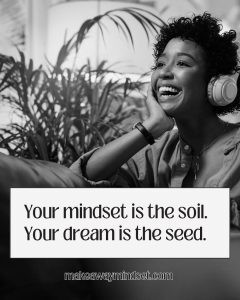
Here is why your mindset matters: mindset is everything.
It’s the filter through which you see the world. And it’s the foundation on which your entire dream is built.
What Is Mindset (And Why Does It Matter)?Mindset is the collection of beliefs, assumptions, and emotional habits that shape how you think, feel, and act.
It influences:
How you respond to failure
Whether you believe you’re worthy of success
How you handle uncertainty, rejection, or comparison
Whether you give up—or get back up
A growth mindset fuels progress.
A scarcity mindset creates fear and self-doubt.
A fixed mindset keeps you stuck where you’ve always been.
When you change your mindset, you change your life.
And when you strengthen your mindset, you give your dreams a fighting chance.
Dreams require vision—but they also require emotional resilience.
Here’s how your mindset directly affects your ability to pursue your dreams:
People with an empowered mindset don’t see failure as the end. They see it as feedback.
Without this mindset shift, even one obstacle can make you quit on yourself.
Inner voice: “Who am I to do this?” vs. “I’m learning and growing. I can try again.”
Mindset shapes that voice—and that voice shapes your entire path.
Success requires just as much mindset work as failure. If your nervous system doesn’t feel safe with visibility, abundance, or being seen—you’ll sabotage it.
4. It Builds Grit and VisionMindset helps you keep dreaming—even when things are moving slowly. It gives you the ability to hold a vision, take aligned action, and keep going.
What Happens When Your Mindset Is Out of AlignmentWithout mindset support, even the most talented dreamers can:
Procrastinate on their purpose
Feel like they’re “too late” or “not ready”
Play small so others stay comfortable
Burn out trying to do it all perfectly
This is why mindset work isn’t fluff—it’s foundational.
How to Strengthen Your Mindset for Dream-Building1. Practice Self-AwarenessCatch yourself in limiting beliefs. Replace them with more empowering truths.
Ask: “Is this thought helping me move forward or keeping me stuck?”
Your environment matters. Connect with people, books, music, and messages that water your dreams.
3. Normalize Starting OverGrowth isn’t linear. Mindset work helps you embrace the restart, not fear it.
4. Celebrate Small WinsMomentum builds when you acknowledge your progress. Don’t wait for the big milestone—celebrate the next brave step.
5. Develop Hope & ResilienceThis is where my concept of hoping skills comes in. Hope isn’t just a feeling—it’s a skill you can grow.
And it’s what keeps you moving when motivation fades.
Without the right mindset, your dreams may never take root.
But with the right mindset? You can grow something beautiful—no matter how long it takes, or how many times you have to try again.
You don’t need to have it all figured out.
You just need to believe that your dream is worth the work.
And you are worth the dream.
The post Why Mindset Matters: The Secret to Pursuing Your Dreams With Purpose and Power appeared first on Make A Way Media.
June 14, 2025
Honoring Juneteenth: How Make A Way Media Celebrates Black Freedom Through Storytelling
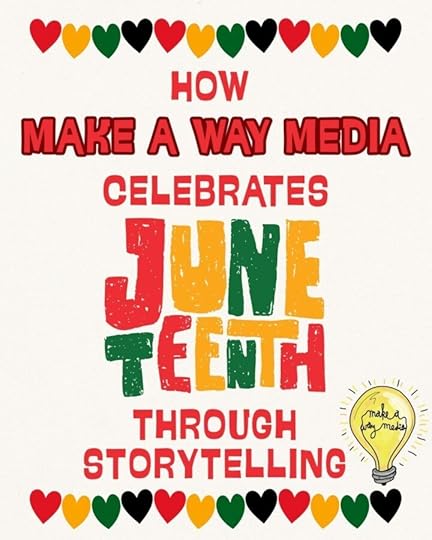 Juneteenth is more than a holiday—it is a moment of reflection, remembrance, and hope. Celebrated every June 19th, Juneteenth commemorates the day in 1865 when enslaved people in Galveston, Texas finally received word that they were free—two and a half years after the Emancipation Proclamation was signed.
At Make A Way Media, we believe Juneteenth is not just a historical milestone—it’s a call to action. It is a reminder that storytelling matters. That representation matters. And that Black freedom is not just about the past—it’s about the stories we tell today and the futures we dare to imagine for tomorrow.
Make A Way Media Publishes Books About EmpathyStorytelling is essential to building empathy, and it is essential for fostering the remembrance of Juneteenth. This historic day shines a light on the resilience of Black communities, the unfinished work of liberation, and the power of truth-telling.
At Make A Way Media, we pay tribute to this day by publishing books that:
Center Black children as heroes, dreamers, and leadersTeach children about history, justice, and joyOffer tools for emotional wellness and self-loveEmpower families to have conversations about freedom, identity, and hopeOur stories reflect the depth of Black culture—not just its pain, but its possibility.
How Make A Way Media Honors the Spirit of JuneteenthEvery book we publish carries the spirit of Juneteenth. Here’s how:
We Preserve History with HeartOur books introduce young readers to powerful historical concepts in a way that is accessible and affirming. Whether through stories of overcoming, family traditions, or reflections on justice, we ensure our readers know that Black history is American history.
We Elevate Black JoyJuneteenth is a celebration. And our books celebrate Black children—their magic, their minds, and their everyday lives. We believe representation isn’t just about trauma—it’s about triumph, wonder, and love.
We Support Mental Health and EmpowermentLiberation is not just political—it’s emotional. Many of our books include tools to help children and families talk about big feelings, cope with challenges, and practice what I call “hoping skills”—a practice of resilience and future-building that is especially important for Black communities.
We Spark Conversations Across GenerationsJuneteenth invites families to talk, learn, and remember together. Our books help parents, teachers, and caregivers start those conversations in a safe, inclusive, and developmentally thoughtful way.
Featured Titles That Honor the Juneteenth Spirit
Some of our most beloved titles that reflect the themes of Juneteenth include:
“In the Nick of Time” Series — Featuring a Black Santa who uplifts communities and teaches compassion, diversity, and hope“Kayla: A Modern-Day Princess” Series — Centering a young Black girl finding confidence, kindness, and pride in her identity and in the direction of her dreams“This Is the Earth“ — A poetic, inclusive celebration of environmental justice and global belonging“If A Caterpillar Can Fly, Why Can’t I?”— A beautiful activity book that empowers all children to dream beyond limitsEach title reclaims the narrative and provides mirrors for Black readers—and windows for others to grow in empathy.
Juneteenth Is a Beginning, Not Just a DateJuneteenth reminds us that freedom delayed is still freedom worth fighting for. Through storytelling, we pass the torch. We equip the next generation with the truth, the tools, and the hope they need to keep moving forward.
At Make A Way Media, our mission is rooted in this belief:
When children see themselves in stories, they begin to believe in what is possible.
This Juneteenth, we invite you to celebrate with us—not only by remembering history, but by shaping it through the books we choose to read, share, and create.
The post Honoring Juneteenth: How Make A Way Media Celebrates Black Freedom Through Storytelling appeared first on Make A Way Media.
June 10, 2025
When the World Feels Too Loud: How to Tune Out the Chaos and Create the Life You Want
In a world filled with noise, pressure, and uncertainty, it’s easy to lose your sense of direction. If you’ve ever felt overwhelmed by everything happening around you—and wondered how you’re supposed to stay hopeful in the middle of it all—you’re not alone.
Here’s a truth I want you to hold onto: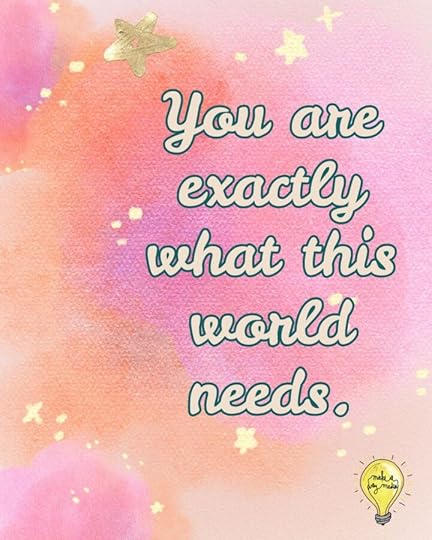
When the world gets too loud, turn inward. Tune out the chaos—not by escaping, but by creating. Build the life you want, one choice, one breath, one brave step at a time. You are your greatest work.
This is your invitation to return to yourself. We need you. The world needs you. And we can’t have you giving up. You can rest. You can reflect. You can readjust. But you cannot quit on hope. You are a light.
Hope Begins with Tuning In, Not Tuning Out
Most of us think that finding peace means avoiding the world. But real peace doesn’t come from escape—it comes from intention.
It comes from learning to focus on what you can control, even when everything else feels out of reach.
Start small:
Turn off the news for an hour.Put your phone on silent.Breathe in the quiet.Ask: “What do I need right now?”And then listen for the answers.This is the beginning of reclaiming your life—and your hope.
How to Create the Life You Want (Find Hope Even in a World That Feels Overwhelming)
You don’t need to have it all figured out. You just need to take one step. Here are a few ways to start building your life—your way:
Clarify Your ValuesWhat matters to you? What kind of life feels meaningful? Write it down. Let it guide your choices.
Create Small Daily RitualsWhether it’s journaling, reading, meditating, or walking, anchor your day in actions that make you feel grounded.
Use Your Energy Where It MattersYou can’t fix everything, but you can invest your time and love into what’s in front of you—your body, your mindset, your dreams.
Say No to NoiseNot everything that demands your attention deserves it. Learn to protect your peace and guard your energy. Ask yourself, “What do I have time for?” And then carve away everything that is not that. Intentionally, purposefully, and with finality. If it does not serve you, you do not serve it.
Be Kind to YourselfSpeak to yourself the way you would speak to someone you love. When you fall short, try again gently. When you’re tired, rest without guilt. Hope grows when we treat ourselves with grace—not punishment. Your inner voice matters. Make sure it’s kind. Wake up in the morning talking to yourself like you would talk to a friend on the phone. You deserve the same grace.
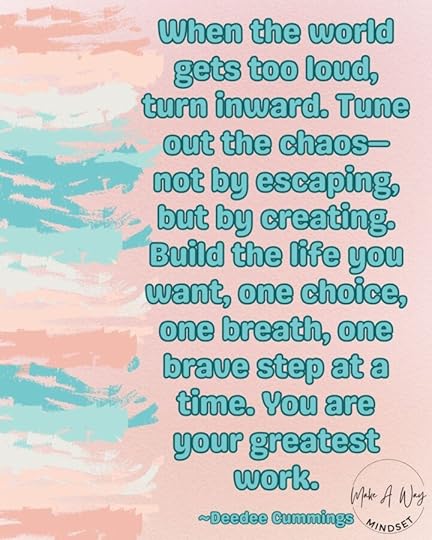 You Are Your Greatest Work
When the world feels too heavy, your job is not to carry it all. Your job is to return to yourself—to keep showing up, keep dreaming, and keep choosing hope. I know it is hard, but this can be done and it is the way we will get through some of life’s toughest times. If you are looking for just a little more support, affirmations, words of encouragement or testimonies I encourage you to checkout How to Dream and the How to Dream workbook. Both are designed to help you stay focused, tap into your inner voice, and believe that the dream (whatever your dream is) is real.
You don’t have to wait for the perfect moment. You can begin right now. I believe in you.
One breath. One choice. One brave step at a time.
This is the perfect time to work on you.
The post When the World Feels Too Loud: How to Tune Out the Chaos and Create the Life You Want appeared first on Make A Way Media.
June 5, 2025
A Guide for Teens: How to Protect Your Mental Health
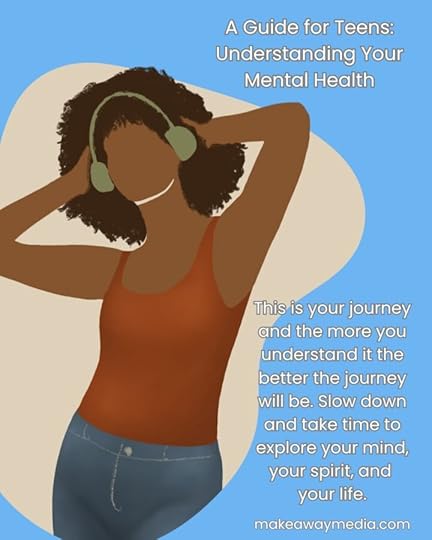 Your mental health can change based on what’s happening in your life, but you can take steps to protect it.How to Protect Your Mental HealthTalk About It. Keeping feelings inside can make things worse. Find someone you trust to talk to.Find Healthy Outlets. Writing, music, art, exercise, or deep breathing can help manage stress.Pay Attention to Your Circle. Some people lift you up; others bring you down. Stick with those who support you.Take Care of Your Body. Sleep, food, and movement all affect how you feel. Take small steps to take care of yourself.Set Boundaries. If something or someone makes you feel bad, it’s okay to say no or walk away.Practice Positive Self-Talk. Replace negative thoughts like “I can’t” with “I will try.”What Can Hurt Your Mental Health?Unhealthy Relationships. Friends or family who pressure or put you down can hurt your mental well-being.Bottling Up Emotions. Pushing feelings down can lead to anger or sadness coming out in unhealthy ways.Negative Influences. Constant violence, negativity, or social media pressure can be overwhelming.Feeling Like There’s No Hope. Hard times don’t last forever. Even when things feel bad, there is always a way forward.
Remember: You Have Control Over Your Mental Health. Making small, positive choices can help you feel stronger, even in tough situations.
Take Control of Your Mental Health with This Activity
Feelings Check-In: What’s one word that describes how you feel today?Safe Space List: Write down three people or places where you feel safe and supported.Positive Actions: Name one thing that makes you feel better when you’re stressed or upset.Boundaries Practice: Think of a time someone treated you unfairly. How could you set a boundary next time?Self-Talk Shift: Write down a negative thought you’ve had. Now rewrite it in a more positive way.Future Focus: What is one small step you can take this week to improve your mental health?Holistic Mental Health: Taking Care of the Whole You
What is a Holistic Approach?A holistic approach means looking at all the parts of you—your thoughts, body, emotions, spirit, and environment. It’s about understanding that everything is connected. If one part is hurting, the others can hurt too. But small changes in each area can help you feel more in control.
Holistic Actions You Can TryMind: Try journaling, deep breathing, or positive affirmations. Body: Do some stretching, drink water, or get sleep when you can. Emotions: Talk to someone, draw, or express your feelings in safe ways. Spirit: Say something you’re thankful for or take quiet time to reflect. Environment: Clean up a small space, listen to calming music, or take a break from social media.
Reflection Prompts:What is one thing you did today that helped your mind feel calmer?What does your body need more of right now—sleep, food, movement?Who do you feel safest talking to when you’re upset?What’s one place that helps you feel more peaceful?What’s a small goal you can set to care for your spirit this week?What music, space, or habit makes you feel more positive?These are some things to think about, but get creative with this. Write about your thoughts in a journal, write a poem, or make a collage that answers these prompts. This is your journey and the more you understand it the better the journey will be. Slow down and take time to explore your mind, your spirit, and your life.
You Are Strong. You Are Worthy. You Have Hope.
The post A Guide for Teens: How to Protect Your Mental Health appeared first on Make A Way Media.
May 29, 2025
Easy Holistic Mental Health for Teens
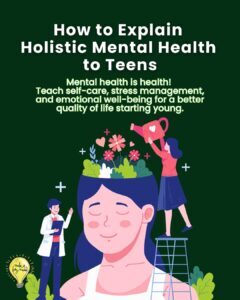 Taking care of your mental health doesn’t have to be complicated or expensive. A holistic approach means checking in with your thoughts, your body, your emotions, your spirit, and even your environment. It’s important to understand what holistic mental health for teens means. Try small things in each area—you don’t have to fix everything at once. Just start with one thing, and build from there. You matter.
“Holistic” means looking at the whole you—your mind, your body, your emotions, your spirit, and your environment. It’s like taking care of all the parts that make you, you. If one part is hurting, the others can hurt too. Holistic mental health is about doing small things in different areas of your life that add up to help you feel better, stronger, and more in control.
Why We Need to Talk to Teens About Mental HealthWe live in a loud world and it is getting louder every day. Teens today are facing unprecedented mental health challenges with mounting pressure from peers, social media, and testing among other things. It is important to start these conversations early and provide kids with the tools they need to build coping strategies and hoping skills.
An Easy Way to Explain Holistic HealthExplain to the kids in your life that holistic just means we look at everything that affects your well-being—not just your thoughts, but your body, your surroundings, your habits, and even what you believe about yourself and the world. Start pointing out ways that you see different sides of their health displayed throughout the day when you notice that they are:
Tired- they need a napHangry- they need a snack“Bored”- they need to fill their soul with a book or a craftLonely- they need connection. Try a call to a friend or relative.Overstimulated- they need quiet and calming activitiesEasy Holistic Approaches Teens Can TryHere’s a list of doable, no-cost or low-cost holistic mental health options for teens—each linked to a part of the self:
Mind (Thoughts & Focus)Journaling – Write down your feelings or what happened in your day.Affirmations – Say something positive to yourself every morning like, “I deserve peace” or “Today I’m starting fresh.”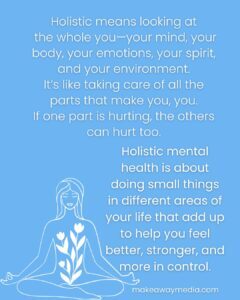 Breathing exercises – Try 4-7-8 breathing (inhale 4 sec, hold 7, exhale 8).Mindfulness – Sit still for a few minutes and focus only on your breath or a sound nearby. Body (Movement & Nourishment)Stretching or light exercise – Even 10 jumping jacks or a walk can lift your mood.Eat when you can, drink water – Hydration and steady meals stabilize energy and emotions.Sleep routine – Try going to bed around the same time, even if life is chaotic. Emotions (Expression & Connection)Talk to someone safe – A friend, mentor, teacher, or therapist.Creative expression – Draw, write lyrics, braid hair, dance—anything that lets feelings out.Crying without shame – Sometimes you just need to let it out. That’s healing too. Spirit (Hope, Beliefs, Inner Peace)Gratitude practice – Write or think of one thing you’re thankful for each day.Spiritual time – Prayer, reading something inspirational, or just sitting quietly with yourself.Acts of kindness – Helping others can boost your own sense of meaning and worth. Environment (Surroundings & Influences)Declutter your space – Even tidying one area helps your brain feel calmer.Music check – Listen to songs that build you up, not ones that drag you down.Limit toxic people – Spend less time with people who make you feel bad about yourself.
The best way to teach these as a skill is to do these things right along with them. The more you practice addressing each of these areas together the more likely this will become a habit that will stick for life. Give it a try! We all need to show more empathy to ourselves and this is a great way to implement more self-compassion in your life. Leave a comment about the holistic approaches you have discovered that work!
The post Easy Holistic Mental Health for Teens appeared first on Make A Way Media.