Alicia McKay's Blog, page 26
September 10, 2019
Out of the Weeds You Love
Get Out of the Weeds You Love
The paradox of leadership, according to Greg McKeown, is that as we advance in seniority, we can become so overwhelmed with new tasks and responsibilities we actually get further away from how we contribute and add value.
I see this a lot, with reluctant managers – often those who have progressed through their careers as technical experts – who don’t want to extract themselves from the ins and outs. They are brimming with expertise, and they can’t help but provide project input, even once they’re in a senior leadership position.
It’s great to care about the details – particularly about the accuracy and quality of the work produced by our teams, and the logistical implications of our strategies.
“What’s most likely to distract us on any given day are the things we have a good reason for doing but not a great reason for doing.” – James Clear
The potential problems with being too focused on details, and not conscious enough of the bigger picture, are that:
We work more hours but feel like we achieve less
Teams don’t have the opportunity to learn and grow
People become frustrated and disengaged by our meddling
We don’t see big shifts coming until it’s too late
We close our minds off to out-of-the-box solutions too early.
As Marshall Goldsmith writes in What Got You Here Won’t Get You There, our success can be more in spite of our behaviour than because of it. Keeping a close eye on the details is one of those behaviours – we get an immediate payoff, but long-term, we find it harder to connect to context.
When you get out of the details, you empower others to be good at their jobs and help to keep your teams and organisations responsive, creative and future-focused. Some of my most rewarding work is coaching executive teams to strike the right balance, maintaining useful oversight, adding value and empowering their people to get on and be awesome.
Stay out of the weeds! Even when you love them and you know a lot about them. They’re not your weeds anymore.
Til next week
- A


September 3, 2019
Design and Delivery: Better Together
Collaboration that actually SAVES time and money?!
Some years ago, I had a job writing tender responses for large construction and infrastructure projects. One thing I noticed was a real push toward ‘Early Contractor Involvement’ (ECI) or collaborative contracting models. It's one of those common sense, briliant ideas that levels up the value offered by everyone involved. It may also be the only form of collaboration I know of that adds people but saves time and money.
The main idea of ECI is that the contractor who will be delivering the project should be involved in the design phase. Why?
Because expensive mistakes are avoided when the contractor says extremely useful things like “you can’t put a pipe there", “we don’t have the equipment for that” or "try it this much easier way."
Big internal projects are much the same. When we try to make change happen, we tend to split up the ‘design’ and ‘construction’ phases by tier. Senior leaders are the architects of change, while people managers and operational staff are the construction teams. This can lead to wasted time and money.
“The wise man is not he who gives the right answers; he is the one who asks the right questions.”
― Claude Lévi-Strauss
Keeping design and delivery separate exposes us to problems:
We underestimate the risks and barriers involved with change
We create a disconnect or divide between designer and contractor
We make silly, avoidable mistakes.
Bringing people managers and subject matter experts into the room with senior leaders when there is still an opportunity to influence the planning process is a smart way to apply ECI thinking. Done well, it’s a chance to take the handbrake off internal processes before we start trying to get change off the ground.
ECI doesn't work like magic, though. It needs us to plan well in advance, so we have the time to do these conversations well and to make any changes that come through. It also needs a genuine openness to diverse opinion, and to changing direction if we need to.
What do you think about "internal ECI"? Are you grounding design with your delivery team?
Til next week
- A
August 27, 2019
Take the handbrake off
Eating well sucks. I’m in training season for marathon at the moment, and doing my best to put the right fuel in for long Sunday Rundays. I’m also on a continual quest to make my life difficult, it seems, by trying to be the kind of mother who does weekly-ish baking for her kids lunchboxes. These two visions are not aligned. How many date scones can I run this Sunday? The mind boggles.
The policy wonks among you will be familiar with the concept of a ‘nudge’. The rest of you might enjoy reading the Blinkist of the appropriately titled book, by Thaler and Sunstein. The basic concept is that it’s much easier to influence people’s behaviour by providing an environment that supports ‘good’ choices, than it is to rely on agency, willpower or sheer determination. The lesson: stop baking, if you want to stop eating scones.
I had a blast co-hosting a Morning Out for The Public Sector in Melbourne yesterday morning, where I spoke about the frustration for public sector teams who feel like they’re driving around with the handbrake on.
On the one hand, we’re asked to work toward an exciting aspirational outcome with good at its heart. On the other, every attempt to do this is stymied by policy, process, or bureaucracy.
One of the government agencies I work with has a team that is all about supporting communities to shape their own futures – putting together their own projects, running their own initiatives and engaging their people. This is great stuff…. Until you’re one of the community groups who want to be involved, and find out that the red tape requires a formal constitution, charitable status and $2 million in public liability insurance.
Oops.
Making good stuff happen is hard enough at the best of times. But it’s close to impossible when the way we do business directly contradicts our goals and intentions. Achieving strategic coherence means eliminating all the points of friction we can find, by looking at things like policy process, people, budgets and systems.
How To... Lift the Handbrake
Ask your team (and customers and stakeholders!) what’s making progress hard – trust me, they know!
Think outside the budget box. More people or funding won’t make any difference if we continue to work in the same way. In fact, it will be worse, because now you have new people to train and new cost codes to account for. Think about systems, policies and processes first.
Indulge in some dangerous thinking. What if you started from nothing? What if there were no rules? What are the harms you’re trying to prevent? What would minimum prescription and maximum delegation look like?
August 20, 2019
Time to light some fires
Firefighters have a demanding job. On the one hand, they do all the stuff that we expect in a crisis, like turning up and fighting a roaring blaze. Behind the scenes is all the important stuff we don’t see – getting prepared for the next big fire, and working to create conditions that make fires difficult to take hold at all.
In many ways, public leadership is the same. Part of the job is in responding to issues as they present, while another is front-footing fires before they can kindle. The critical difference between leadership and firefighting though, is that leaders have the capability to do something that many firefighters don’t - lighting the flame.
(And sometimes, we need to think more like bush firefighters and set a controlled burn, to clear out the litter that's accumulated underfoot...)
Brave public leaders set the world on fire occasionally. They do this by thinking big and embracing new opportunities to achieve their vision for the community.
Lighting fires shouldn’t be done willy-nilly however - bold, effective decisions mean we need to be really clear about where we’re going, and what might get in our way.
“Wind extinguishes a candle and energizes fire.
Likewise with randomness, uncertainty, chaos; you want to use them, not hide from them. You want to be the fire and wish for the wind.”
- Nassim Nicholas Taleb
Some of the most enjoyable work I do with boards and leadership teams supports better, faster decisions through understanding strategic risk. (I ran a free webinar on this yesterday – watch the recording here.)
Senior leaders don’t always understand strategic risk very well. The strategic gets all mixed in with garden-variety operational risk management. When this happens, decision-makers get stuck in the weeds and risk falls by the wayside, is delegated or ignored.
The result: slow and scattered decision-making, wasted time and lost opportunities.
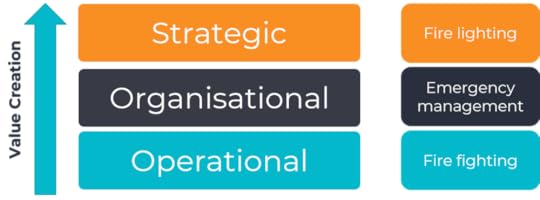
Strategic risk management, then, is about lighting the odd fire. While operational risk management focuses on prevention – protecting the value we already have, strategic risk management is about creating new value.
While operational risk asks the question: “how do we keep everything ticking over safely?” strategic risk asks: “what might stand in the way of meaningful change?”
The difference is like night and day – and when senior leaders and decision makers focus on those questions, we can think bigger and focus on the stuff that really matters, to have real impact.
Where is your board, team or Council on this the continuum?
Is it time to light some fires?
Til next week
A
August 13, 2019
Preparation beats prediction
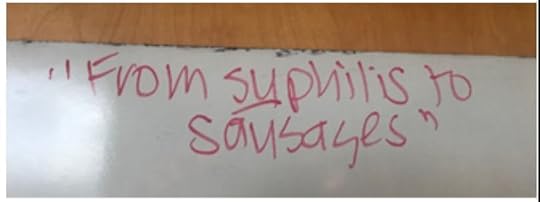
Hands down my favourite workshop output yet.
I’ll retain some mystery on what that was all about – but I can tell you what the goal of that workshop was: preparing for the worst.
Sounds dire doesn’t it?
Not the way I see it. Working out what might go wrong is one of my favourite strategy conversations. Getting real about what stands between us and our big goals is one of the most important steps to move us from thinking and dreaming into doing and delivering.
We’re so weird about risk, though. I get it. The words 'risk management' inspire equal parts boredom and confusion in me too.
We overcomplicate risk. We treat it as a negative, we try so desperately to predict likelihood that we bring in dodgy maths and traffic lights.
Even worse: sometimes we totally avoid conversations about what we might need to risk on the path to greatness - which leads to crappy decisions.
Facebook reminded me of this little tidbit the other day.
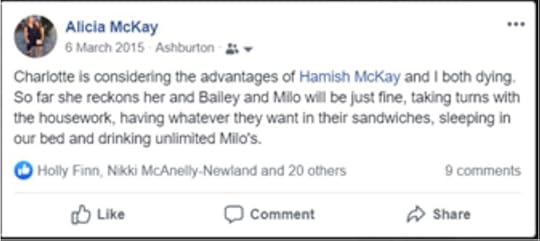
When I was pregnant with my youngest daughter, my then five and ten year old daughters engaged in a bit of scenario planning around what might happen if I was to die. (Charming kids, eh). They had it all figured out – they would walk the baby to daycare on their way to school, Bailey (my eldest) would get a job at McDonalds once her pocket money ran out, she'd bring leftovers home for dinner every night, and they’d have a bang old time.
(To be clear – the cat’s name was Milo, and they weren’t going to drink him.)
Smart kids.
There is incredible value in talking about big-picture worst case scenarios - which goes well beyond the surface of risk management. Thinking like this helps us to unearth fears and assumptions, to have unsaid conversations and to build confidence in managing inevitable setbacks.
“We suffer more in imagination than in reality”
– Seneca
Tim Ferris made the idea of ‘fear-setting’ trendy, but researchers had figured out the value of a premortem (or ‘prospective hindsight’) at the University of Colorado in the 80s. Turns out, this kind of prelaunch risk analysis heads off some of our silly optimism bias and actually boosts the odds we will succeed.
Of course, as with most things, the Stoics had it nailed thousands of years prior. Nice one, Seneca.
“Our comforting conviction that the world makes sense rests on a secure foundation: our almost unlimited ability to ignore our ignorance.”
– Daniel Kahneman
Humans are inherently very poor assessors when it comes to risk. It’s not our fault, we’ve got lots of fears and biases that hold us back from being objective. We overvalue the risk of unlikely things that we’ve heard a lot about, yet we’re stupidly optimistic about the likelihood of our own success.
We even pay through the nose to insure ourselves for things that are extremely unlikely, while remaining totally exposed to the things that actually take us down.
Prediction is not the ticket - we can't trust ourselves to do it accurately, especially not for the vague, uncertain, big picture stuff.
Preparation, however is very important. Once we let go of the idea that we can predict what's most likely with any accuracy, we can focus on what the biggest impacts to prepare for might be instead.
TL;DR: Less guessing, less fear, more gutsy conversations and good planning, eh? We've got goals to get on and achieve.
Til next week,
A
Are you suffering more in imagination than in reality? Or worse - not confronting reality at all? Does your team ‘get’ risk?
You may want to join my free webinar on strategic risk next Tuesday – link here - where I give my positive take on doing risk well.
August 6, 2019
Making Your Own Rules
Have you ever opened your calendar, only to see nothing but other people’s priorities staring back at you? Take a look at it now and see what the balance is like.
This happens so easily – and our calendar is just the tip of the iceberg. If you’ve ever felt swept up in the rhythm, and frustrated at how little space there is for the stuff you really care about, you are not alone.
There’s a whole lot of well-intentioned professionals walking around out there right now, feeling like plastic bags being tossed about in the wind.
Two years ago, I cleared Mondays in my calendar, and ‘Mummy Mondays’ were born. It seemed absolutely radical at the time – things had just started going mental on the work front, and I was already feeling like there weren’t enough hours in the week. I knew then that if I didn’t carve out the quality time for my girls, especially before my youngest started school, all of the urgency would eat away my time until they were left with the scraps.
Turns out, the world didn’t stop - I still don’t work Mondays, and pretty much everything waits until Tuesday. (Full disclosure: sometimes I work stupid times on Sunday, Monday and Tuesday nights!)
But with very limited exceptions, I just don’t work on Mondays and everything else fits around it.
True freedom isn’t the absence of rules – it’s the power that comes from choosing some of your own.
Last week, I talked about rules – learning the rules of the game, so you could achieve mastery. This week is all about setting some rules of your own.
True freedom isn’t the absence of rules – it’s the power that comes from choosing some of your own.
In a group coaching session last week, I had to reframe my conversation around ‘criteria’ instead, to get buy-in from a couple of the rebels. With this group, we have a great new strategy nailed, but unless senior leaders can commit the time and energy to moving it forward, it will die a forgotten death, or survive only on scraps.
Derek Sivers famously wrote a great blog post on this, for the over-committed or scattered individual – Derek suggests that if you’re not saying “HELL YEAH!” to something, then you should say no.
“You take your life in your own hands, and what happens? A terrible thing: no one to blame.” - Erica Jong
You might not need to go that far to see a change in your work environment – but if you don’t prioritise the work that matters, it won’t prioritise itself.
What rules do you need to set for yourself, to do more of what matters?
Til next week
A
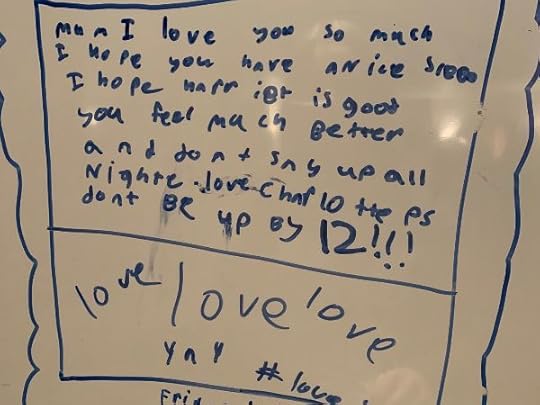
PS - One of my most recent rules has been the establishment of a curfew – which I’ve roped my kids into making me accountable for. My 9 year old wrote this note on my work whiteboard a couple of weeks ago, and I’m considering keeping it there forever.
July 30, 2019
Creativity, Strategy and Magic
I’ve spent my life in a quiet awe of musicians and creative people. People that seem to be able to create beauty out of nowhere. What an incredible gift, right?
Some things in life, we treat a bit like magic. Art and music are two. We classify ourselves pretty early on as either talented or not and assume there’s a gene that determines whether we’re one of the chosen few.
Listening to beautiful music, reading incredible writing or admiring art feels a bit magic, doesn’t it? Like there’s a mystical, creative process that determines whether we can be good at these things.
Strong, visionary leaders are the artists of any corporate structure – to make it to senior leadership, they must have been born with something special …. Right?
Wrong. I’ve done a few things recently that have lifted the veil.
I’ve started learning music theory for the guitar (more here)
I just spent two days at a stand-up comedy 'bootcamp'.
For both, success depends largely on understanding rules, formulas and patterns.
Whether it’s musical scales or understanding how to structure an effective joke, each of these skills is less mystical than I’d ever realised.
Mastery, while helped along by flair, is about becoming so proficient at applying the rules and patterns that they become invisible. Behind any successful artist is a deep understanding of the rules and thousands of hours of practice and toil.
Making good decisions about the future is the same. There are rules and patterns that need to be learned and practiced. There’s no strategic thinking gene – like art or music, there are people that have a natural aptitude, but that doesn’t eliminate the importance of understanding the rules.
"We assume that management and governance are strategists by virtue of their professional success. This is dangerous thinking, and these assumptions can hold back teams, boards and entire organisations."
We don’t teach these skills. Worse, we assume that management and governance are strategists by virtue of their professional success. This is dangerous thinking, and these assumptions can hold back teams, boards and entire organisations.
In her book ‘The Strategist: Be the Leader Your Business Needs’ Cynthia Montgomery talks about “the myth of the super-manager” – those confident, visionary leaders that blow us out of the water.
Once in a generation leaders, heading up companies like GE, Virgin, Starbucks, Apple, or LinkedIn. But, as Cynthia says “none of these strategies appeared out of the blue from the unfettered minds of super-managers. They came from a deep comprehension of the industries involved and the conditions at work in them.”
"Preparing our teams and leaders for the future means shaking the artist paradigm and learning the rules and patterns that help us be better decision-makers and strategists."
There’s no magic here, and mastery is within reach. The 2018 World Economic Forum report on the future of work is crystal clear on the skills we need to tackle our changing context, and they’re not technical. They’re about creativity, connection and critical thinking.
Preparing our teams and leaders for the future means shaking the artist paradigm and learning the rules and patterns that help us be better decision-makers and strategists.
Does this mean the magic is gone? That art, life and music is nothing more than a series of predictable formulas? Of course not. Some of my favourite musicians have a unique sound that can be pinpointed to an unexpected shift in the rules. Josh Homme from Queens of the Stone Age (a totally overlooked lead guitarist…) is one example.
His distinctive sound doesn’t follow any of the traditional scales. I was suitably impressed by this, until I googled “Josh Homme scale” and watched a 14-minute interview where Homme explains the patterns he uses – and has used consistently since he was 13 years old. Even a rebel like Homme is following the rules – his own, that he adapted from a clear understanding of the fundamentals.
Learning the rules opens opportunities – to experiment, explore, adapt and build a toolbox of skills for situations we don’t expect. Even rebels and creatives need to know the rules to be able to break them to good effect.
My favourite definition of creativity is buried inside a little book called ‘Mindfulness for Creativity’ by Denny Penman.
"Creativity is the ability to perceive the world in new ways, to find hidden patterns, to make connections between seemingly unrelated phenomena and to generate solutions.”
If that’s not what strategy is all about, I don’t know what is.
TL;DR
Strategy and creativity are one and the same.
Creativity is not magic.
Get to work!
‘Til next week
A
July 23, 2019
Focus – To Have, To Do, or To Be?
I had a minor mutiny on my hands last week. I got so little “work” done in the last two weeks that my long-suffering Business Manager Diane revolted. Well, revolted is a strong word – but she did gently suggest last Tuesday that if I wasn’t going to be able to give her any of the things she needed to do her job, she may as well take the rest of the week off.
The reason? I had two weeks at home with my three girls for the school holidays. In fact, the first week I had two extras – five kids total!
On many levels, it was a high performing two weeks. That is, if we are measuring success by how many cans of spaghetti were consumed, how many books were read, or how many sleep-ins we had.
I did lots of great lateral thinking - strategy needs space, after all. But admin and preparation? Forget it. As anyone who has ever tried to work at home with kids will tell you – kids can smell focus, just like dogs can smell fear. As soon as you start to get a fraction of it, they sniff it out and immediately interrupt you.
No wonder Sir Isaac Newton spent two years in solitary confinement to write Principa Mathematica. Not a bad book, I’ve heard. Reasonably famous for the 3 laws of motion and the theory of universal gravitation.
Imagine if he’d had the kids home for the holidays? He wouldn’t have been able to rub two thoughts together, much less change the face of science.
That’s the thing about focus. Focus doesn’t happen by accident. Being focused requires intentional, consistent choices. For old mate Isaac, he had to keep making those choices every day for two years.
Focus doesn’t happen by accident. Being focused requires intentional, consistent choices.
I talk a lot about why focus is so important. Clarity of focus is the single most important factor to good strategy – without it, everything else is a waste of time.
According to Paul Leinwand’s research, organisations with between 1-3 priorities outperform others on almost every metric. They produce better financial results, they achieve more of their work programme and their staff are happier and more engaged. There’s some great literature out there and little in the way of bad news. With focus, teams work better together, time and money is spent more wisely and organisations have greater impact.
Greg McKeown, who wrote Essentialism suggests that focus isn’t something you have – it’s something you do. I couldn’t agree more. I’d add a bit - focused is something that you can be… if you can commit to intentionally and regularly removing distractions.
Nature abhors a vacuum. Which means that as soon as you clear the space for what matters, it will fill again quickly. If you’re committed to putting first things first, you need to constantly fight against the clutter.
Nature abhors a vacuum. Which means that as soon as you clear the space for what matters, it will fill again quickly.
This doesn’t have to mean solitary confinement for two years – that kind of fixation, while possibly quite good for developing earth-shattering mathematical theory, is generally unhelpful for those of us who just want to get some meaningful work done at the office.
As with any skill, consistent practice is the key. Like our eyesight, focus doesn’t mean staying fixated on one spot. It needs constant adjustment and adaptation. It needs us to have the temerity to reject distraction, and to do the things that matter by being clear about our non-negotiables. To be focused requires us to say no - courageously, graciously and often.
Or, you know, to drop the kids at the movies and work for a couple of hours at a nearby café. I’m not judging.
TIl next week,
A
July 16, 2019
Strike While The Iron Is Hot
I went to a blacksmiths festival recently. A bit out of the ordinary for my general weekend entertainment, to be honest, but talk about impressive. It’s incredible what can be done with a bit of heat. Even the hardest of metals can be reshaped into something new and beautiful under the right conditions.
Funnily enough, blacksmithing is the origin of the saying: “to strike while the iron is hot.” In the beginning, this was all about a blacksmith striking a horseshoe when the temperature of the metal was exactly right to take shape. If they waited too long, then the metal would get too cool and be difficult to shape.
In 2019, we’re more likely to use this as a metaphor – taking action early and seizing momentum while the conditions are right. We talk about “cooling off” too. With contracts, for example, we know we might feel differently about our commitments after our excitement wears off.
Cooling off happens inside teams too. Under the right conditions it’s possible to get people excited, create some heat and build momentum. Wait too long for action and things will harden, becoming difficult to shape.
I see this a lot when it comes to strategy days and communicating change. We go on away-days or run fancy roadshows, use screeds of post-it notes and promise people a new world. Three months later, the loop was never closed, there’s been no action, and people have cooled right off.
This is often where I’m called in, and it can be a tough environment. I’m working with people who’ve had their trust broken, who’ve hardened, and tend to fold their arms with a raised, cynical eyebrow at the idea of talking about strategy again.
I read a McKinsey report recently that less than half of our senior leaders are satisfied with the way we do strategic planning, and only 23% think that decisions made in that context will actually lead to action. Hardening and cynicism isn’t just inside our teams – it’s coming all the way from the top.
And who can blame us? Strategy execution rates are dismal – especially in the private sector. We don’t close the communication loop, we get stuck in a paperwork black hole somewhere between thinking and doing and implementation suffers.
It doesn’t have to be this way. If action is going to take time, keeping people in the know, visibly valuing their contribution and providing opportunities to take small steps of their own will keep the heat alive.
There’s an extended version of our idiom which, like most quotes, is attributed to half a dozen potential thinkers throughout history, including Sprague, Hemingway, Cromwell and Yeats. One confirmed version, cited in a letter to a friend from Richard Sharp in 1806 states:
“ We must not only strike the iron while it is hot, but strike it till “it is made hot.”
I like this even better. As with blacksmithing, we can make and keep the iron hot ourselves. How? By striking. Seeing opportunities, pushing back on bureaucracy and taking continued, incremental action creates momentum and shows leadership.
It also makes my job in supporting your strategy rollout easier, so thanks in advance!
Are you striking while the iron is hot? What are your opportunities to keep striking?
Til next week
-A
July 9, 2019
Let Go of the Good
Are you a hoarder? A minimalist? Or something in between?
I moved house recently, which is always a pain. On the bright side, every time I move I get to engage in my favourite activity – throwing things away. Every time I shift, I sort through all of our things, and I become merciless with what qualifies for box status. No danger of hoarding around here!
I’ve always loved the prospect of clean slates, letting go and fresh beginnings. There’s something so mentally freeing about turfing out a box of old things you don’t use anymore.
If just reading about me throwing away my stuff makes your heart beat a bit faster, you’re not alone. It’s hard to get rid of things we already have and do – even when we know they’re not serving us, or there’s a better option out there.
We’re inherently loss averse – we value things we already have more highly, simply because we have them. One in the hand, two in the bush and all that.
“Getting to the next level always requires ending something, leaving it behind, and moving on. Growth itself demands that we move on. Without the ability to end things, people stay stuck, never becoming who they are meant to be, never accomplishing all that their talents and abilities should afford them.”
― Henry Cloud, Necessary Endings: The Employees, Businesses, and Relationships That All of Us Have to Give Up in Order to Move Forward
I see this at work too. I ran a wonderful Strategic Focus workshop last Thursday where we were racing through the programme – priorities, outcomes, action streams, tick tick tick. Everything came to a screeching halt, however, when I asked the group to make some trade-offs, so we could find the time and money to get change happening.
Strategy is all about choices, and the hardest part of any choice is the road not travelled (or box of stuff thrown away, or project, relationship or commitment we need to let go of!)
I hear the same protests all the time - “I have to do everything I’m doing!” “Nothing is negotiable!” But the thing about real change is that it can’t be as well as – we’re already at maximum capacity. Real change needs to be instead of.
Which is fine if we’re releasing things we don’t enjoy, that don’t add value or that we don’t care about – like my boxes of stuff when I move. Those are choices between right and wrong.
How about when we need to choose between right and right? Or chuck out stuff we’re still using? This is hard, uncomfortable territory. We have to let go of the good, to get to the awesome - or we don’t grow.
Henry Cloud nailed the best analogy for this issue in ‘Necessary Endings’ when he talked about pruning rosebushes.
Rosebushes produce more buds than they can sustain and require regular pruning to be healthy and thrive. Cloud distinguishes between three types of pruning – the first is to remove dead branches. These branches are no longer contributing, and are taking up space that makes it harder for the others to grow. Easy. The second is to remove sick and diseased branches who are unlikely to recover and are taking energy away from healthy branches. Not bad.
The third type of pruning, though, is the removal of perfectly healthy buds. Having too many ‘good’ buds prevents the rosebush from totally thriving, by directing energy away from the buds that have the potential to be great. Without this critical third type, your rosebush will never be fabulous.
What perfectly healthy things do you need to prune, to get to great?
Til next week
- A