Alicia McKay's Blog, page 22
April 21, 2020
Meetings that matter.
How many meetings have you been to this week?
I ran an afternoon workshop for one of my learning communities recently where one of the participants was on meeting 8/10 for the day. The day! Bloody hell. I’d rather be taken outside and shot.
When did we stop valuing people’s time and presence?
Also: when did we decide that a meeting was the answer for everything?
I’m all for less content and more connection. But like everything, more of anything isn’t necessarily better. We’ve spent all this time apart over the last month and I’m hopeful that once we start slowly getting back to physical meetings (three cheers for level 3!) we value in-person presence a bit differently.
What do you want of your meeting? A decision, some ideas, or a plan?
If it’s none of those things, do something else – use an email, a typeform, a text or a shared document. Meetings are for communication and collaboration, not for sharing information.
Treating people’s time with respect means making your meetings matter – single purpose, clear process and total presence. (Digby Scott and I had a chat about the way we might value time and presence differently after lockdown in Episode 8 of What’s On Your Mind that you might like to check out too).
Important decisions need leadership. One thing I’m liking about online workshops is the requirement that all meetings have a leader, with the “host” function. I’ve been running strategy meetings for a long time, with a lot of teams and I’m yet to see people self-organise productively!
Meetings that matter don’t happen by accident. If you’ve got important decisions to make and you’re wondering why your “catch-up” isn’t getting anything useful done, it might be worth a re-think about your purpose, process and presence.


April 14, 2020
Chasing cows.
Ever started a job and had that new-starter clarity? You're baffled by all the things that don’t make sense and say annoying things in meetings like: “Why are we doing it like this?”
It’s a short window, before those fresh eyes wear off. We quickly slip into the routine of our new workplace and what seemed mad a few weeks ago becomes our new default.
Why do systems matter?
Defaults can be hard to spot, because that’s how systems work. Done well, they become invisible, embedded and difficult to challenge. 'The way things are done around here.’
That’s not a bad thing. Systems do the heavy lifting for us – operational and mental. They stop us having to think about every little thing, so we can get on with other stuff. Most of our systems evolved, intentionally or accidentally, for a good reason. They served what we needed at the time.
But when our environment changes, we need to adapt.
We may need to change the way we communicate, run our work days, deliver services, manage money, plan, report, or work with customers. Maybe all of them. But how?
Where do you start?
Changing your systems can seem hard, especially when things keep shifting. It's hard to see the big picture under pressure, especially when we're removed from daily operations. We come up against all kinds of assumptions and norms, and worry about overloading our stressed out teams.
It doesn't have to be this hard! We can change our systems faster and more easily than we think. We don't need complicated strategies, process audits, innovation labs or expensive training in design thinking either.
Step 1. Make space
Take the time to reflect, explore and ask good questions. Skipping this bit risks missing the point. Unless we think broadly about what we're trying to achieve, we end up tweaking when we need to delete or transform, or we apply old solutions to new problems.
Step 2. Delegate
Leadership teams cannot change systems they don't work with. Especially not alone. When we give agency and control to the very people we're afraid of upsetting, we get incredible results. With direction and support, anything is possible.
The NZTA Fast Forward programme is a great example - over a dozen simultaneous initiatives are transforming organisational processes from planning to delivery, over just 8 weeks. We're at the half way point of our first cohort (with 3 of those weeks mid-COVID!) and we've made incredible progress on everything from planning and funding to delivering safety improvement contracts.
Step 3. Just do something
Do nothing is not an option for any business or team right now - inertia is death.
If we don't adapt our systems to our new environment, we risk:
Lost productivity
Unsupported and disengaged teams
Wasted time and money
Loss of momentum
Failure to deliver when our customers and community need it most.
Day to day survival has worked for a while, but not anymore.
If we don’t start building the right fences now, every day will be spent chasing cows!
April 7, 2020
When the cracks start to show.
Crisis is a bit exciting, isn’t it? It's different to regular drama, because it has:
Surprise
Serious threat
Short decision times.
Tick, tick and tick.
When crisis first hits, we fire into emergency response mode. We make important decisions with urgency and take high-stakes protective action. We were straight into it here, checking in with clients and pivoting quickly to online delivery. We ran around getting tech and home studio gear, juggling big decisions about split-custody bubble life with three kids alongside. I was in super-organiser mode, and it felt like we worked every minute of the day, with an inexhaustible supply of energy.
Thanks, adrenaline! Crisis boosts adrenaline production to keep us moving, which is great for temporary heroism.
But hero mode is unsustainable (which I seem to keep learning the hard way) and if we're not careful, it's followed by a crash.
After the emergency response dies down, there's an awkward transition between response and recovery. This is where the cracks often show.
Now the initial madness has died down, our house is in that transition. At our best, we laugh and problem solve together. At our worst, we argue over housework (my partner and I) let communication drop off (my team) or scrap over Lego (the kids). Everyone seems to need more sleep, as enthusiasm is tempered by a creeping exhaustion.
This is pretty normal, as crisis excitement gets replaced by everyday reality. Things seem… harder. Recently galvanised partnerships and leadership teams start to fragment. A nagging tension builds as people get tired and can't try so hard all the time. Communication gets patchy or fraught. Progress dips. Momentum and productivity slows.
There's a fine line between thriving and surviving, and it's OK to have some sh*t times. There's also a couple of things we can adjust that might help:
SUSTAINABLE EXPECTATIONS
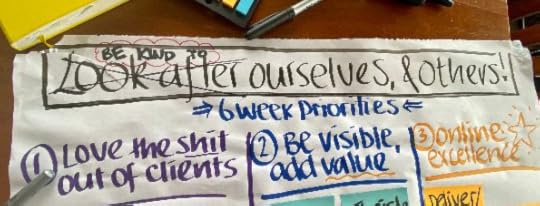
We can’t maintain sprint pace for a full marathon. You might remember we shared our 6 week priorities a couple of weeks ago. We've tweaked our key expectation this week - can you spot the difference?
SUPPORTIVE SYSTEMS
When everything changes, our carefully developed, useful systems can become irrelevant or go out the window. We default to our hard-wired and familiar habits. If the default is good, that's great. But when it isn't...
My default can be a bit of a control freak. Also, resentful of others for not being similarly inclined. Talk about charming to live with.
If we can't be 'on' all the time, we need to reset our routines and practices to support us out of the negative default. The test for a good system is one that makes it easier to do the right thing than anything else,
Commit lightly to new ways of making things work with your family, partner and team by trying something new a day or a week at a time.
And be kind, hero time is over.
When the cracks are starting to show
Crisis is a bit exciting, isn’t it? It's different to regular drama, because it has:
Surprise
Serious threat
Short decision times.
Tick, tick and tick.
When crisis first hits, we fire into emergency response mode. We make important decisions with urgency and take high-stakes protective action. We were straight into it here, checking in with clients and pivoting quickly to online delivery. We ran around getting tech and home studio gear, juggling big decisions about split-custody bubble life with three kids alongside. I was in super-organiser mode, and it felt like we worked every minute of the day, with an inexhaustible supply of energy.
Thanks, adrenaline! Crisis boosts adrenaline production to keep us moving, which is great for temporary heroism.
But hero mode is unsustainable (which I seem to keep learning the hard way) and if we're not careful, it's followed by a crash.
After the emergency response dies down, there's an awkward transition between response and recovery. This is where the cracks often show.
Now the initial madness has died down, our house is in that transition. At our best, we laugh and problem solve together. At our worst, we argue over housework (my partner and I) let communication drop off (my team) or scrap over Lego (the kids). Everyone seems to need more sleep, as enthusiasm is tempered by a creeping exhaustion.
This is pretty normal, as crisis excitement gets replaced by everyday reality. Things seem… harder. Recently galvanised partnerships and leadership teams start to fragment. A nagging tension builds as people get tired and can't try so hard all the time. Communication gets patchy or fraught. Progress dips. Momentum and productivity slows.
There's a fine line between thriving and surviving, and it's OK to have some sh*t times. There's also a couple of things we can adjust that might help:
SUSTAINABLE EXPECTATIONS
We can’t maintain sprint pace for a full marathon. You might remember we shared our 6 week priorities a couple of weeks ago. We've tweaked our key expectation this week - can you spot the difference?
SUPPORTIVE SYSTEMS
When everything changes, our carefully developed, useful systems can become irrelevant or go out the window. We default to our hard-wired and familiar habits. If the default is good, that's great. But when it isn't...
My default can be a bit of a control freak. Also, resentful of others for not being similarly inclined. Talk about charming to live with.
If we can't be 'on' all the time, we need to reset our routines and practices to support us out of the negative default. The test for a good system is one that makes it easier to do the right thing than anything else,
Commit lightly to new ways of making things work with your family, partner and team by trying something new a day or a week at a time.
And be kind, hero time is over.
March 31, 2020
Less content, more connection.
There’s a lot happening online right now.
Social media use has hit record levels in the last few weeks. Whatsapp use has shot up 40% globally – over 70% in Spain. Video calling has more than doubled. LinkedIn, Instagram and Facebook users are posting more, and people are watching more.
This increase in connection is unprecedented, and incredible. We’re joining group chats, games nights and remote meetings with open hearts, tossing our principles about screen-time out the window, and it’s brilliant.
Not all online interaction counts as connection, though. There’s a lot of noise out there, as we scramble to sense-make. Advice. Blogs. Videos. Photos. Screenshots of remote meetings. Helpful tips to make it through lockdown.
I don’t know about you, but it seems to depend what mood I’m in when I scroll, how it lands. Some posts really hit the spot. Others feel hollow, or add to my overwhelm.
A great friend Lisa O’Neill recently said something recently that stuck – “What we need is less content, but more connection.” Bang on, right?
Nothing we do or say is ever going to reach everyone the same, now more than ever. Online presence aside, how do we connect with our teams and clients, who are all in different places? It’s hard to get right. Even talking about it is adding to the noise. Meta, eh?
In this week’s “new normal” webinar, we talked about this environment we’re all trying to make sense of. The space and mandate to transform, as traditional business-as-usual collapses. It was a fantastic chat - but honestly, it wasn’t the best webinar I’ve run.
The content/ connection ratio was off – I did too much talking, and not enough listening and opening the floor to sharing. Oops. Our team debrief immediately afterward was clear – we need to be mindful of that ratio, in everything that we do. Fewer posts, more phone calls. Less talking, more listening. Less ‘help’…. and more help.
Less content, more connection
There’s a lot happening online right now.
Social media use has hit record levels in the last few weeks. Whatsapp use has shot up 40% globally – over 70% in Spain. Video calling has more than doubled. LinkedIn, Instagram and Facebook users are posting more, and people are watching more.
This increase in connection is unprecedented, and incredible. We’re joining group chats, games nights and remote meetings with open hearts, tossing our principles about screen-time out the window, and it’s brilliant.
Not all online interaction counts as connection, though. There’s a lot of noise out there, as we scramble to sense-make. Advice. Blogs. Videos. Photos. Screenshots of remote meetings. Helpful tips to make it through lockdown.
I don’t know about you, but it seems to depend what mood I’m in when I scroll, how it lands. Some posts really hit the spot. Others feel hollow, or add to my overwhelm.
A great friend Lisa O’Neill recently said something recently that stuck – “What we need is less content, but more connection.” Bang on, right?
Nothing we do or say is ever going to reach everyone the same, now more than ever. Online presence aside, how do we connect with our teams and clients, who are all in different places? It’s hard to get right. Even talking about it is adding to the noise. Meta, eh?
In this week’s “new normal” webinar, we talked about this environment we’re all trying to make sense of. The space and mandate to transform, as traditional business-as-usual collapses. It was a fantastic chat - but honestly, it wasn’t the best webinar I’ve run.
The content/ connection ratio was off – I did too much talking, and not enough listening and opening the floor to sharing. Oops. Our team debrief immediately afterward was clear – we need to be mindful of that ratio, in everything that we do. Fewer posts, more phone calls. Less talking, more listening. Less ‘help’…. and more help.
March 24, 2020
The new normal
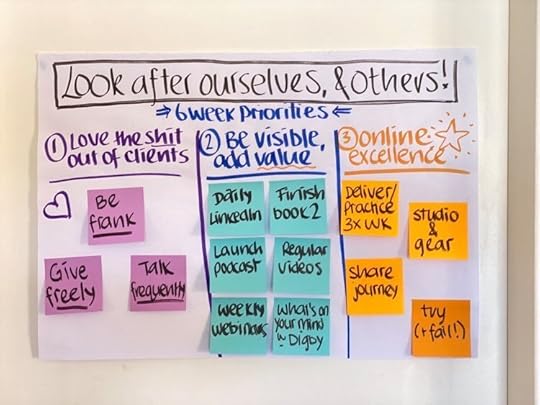
We're hearing the phrase “new normal” a lot this week.
That’s a funny one isn’t it. I’ve never been much of a fan of normal… but this week, I get it. Give us something to grab onto, that we can understand. We need some certainty and direction to cling to, when there’s so much on shaky ground.
There's a great line in Greg McKeown's Essentialism:, where he says “You cannot overestimate the unimportance of practically everything." This has never felt truer this week.
But the things that matter right now... they really matter.
In yesterday’s awesome webinar, we talked about agency – how to own and embrace the things we can choose to do and learn.
For me, this has meant getting really clear on what, from a work perspective, we can do to serve others. Above is our priority list, showing what our new normal will be for the next 6 weeks at Alicia McKay NZ.
What would yours look like? How do you decide what matters most, and focus on that?
For the next six weeks, I'll be running a conversation space every Monday afternoon, to talk about grappling with strategy and change at a time of unprecedented disruption..
This week, we're going to talk about how to get focused on what really matters, as we come to grips with a new normal.
I'd love you to join us.
March 17, 2020
Going off plan and staying on strategy
When I was a broke student and single mum, I remember doing countless household budgets to try and keep on top of things. I’d put the ideal budget together, and then think “well, it won’t work this week, because the car registration is due, but next week, this will be the ideal budget…”
Next week never comes though, does it?
No plan survives first contact with the enemy. Our current operating environment is proof of this.
But here’s the thing – when it’s not pandemic, it will be something else. Natural disaster, weather, regulatory change, financial upheaval, restructuring, political scandal, community change… see what I mean?
The ticket is knowing that while it’s perfectly acceptable, desirable and in fact unavoidable to go off-plan – we need to stay on strategy.
The big picture that you’re aiming for, the priorities that you’ve set, and the way you want to work with people need to be guiding your change response, not put aside. If you’ve set a priority for high-performance culture, or community resilience, or making internal operations easier, this is time that those priorities are being tested.
Rather than seeing your strategy as an extra thing you don’t have time for now, it should be the lens you use to filter your decision-making.
Ask yourself:
- How do we respond in a way that reflects our priorities and gets us closer to our long term vision?
- What is the opportunity here for us to ‘prove’ we are dedicated to our why?
Stay safe out there everyone.
March 10, 2020
Organisational culture - a wild goose chase?
I hear a lot about organisational culture. It’s pretty trendy, and seems to be blamed for a full spectrum of ills at work. Makes sense, it’s nice and easy to point the finger at – “it’s just the culture around here.” It’s also not useful, because it makes whatever we’re talking about – lack of progress, hesitance to take risks, dysfunctional leadership - a nebulous, unsolvable problem without clear accountability. Here’s my take on culture: it’s a higher order need, and mostly an output.
Most of you will be familiar with Maslow’s Hierarchy of Needs, and the ascension of needs from basic to self-fulfilment. The idea is that you can’t start tinkering at the top unless the basics are taken care of.
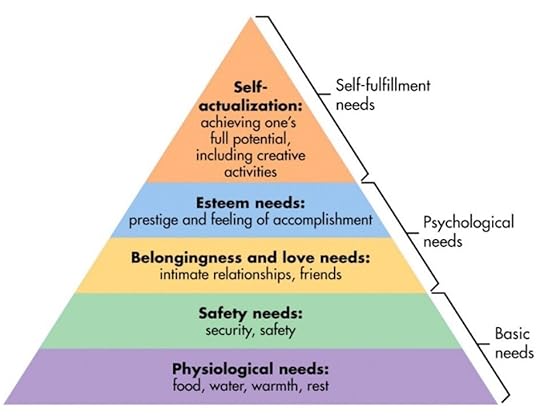
I reckon organisational culture is a bit like self-actualisation. Here’s McKay's Hierarchy of Organisational Needs.
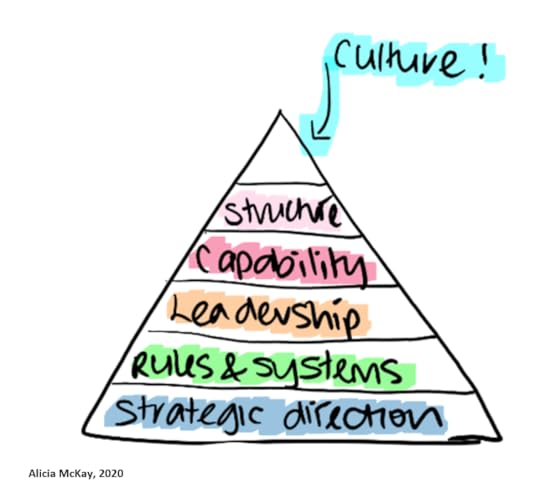
The evidence supports this, particularly when it comes to public service transformation. While service transformation is unlikely without culture change, the heart of culture change is organisational development and leadership development. Makes sense.
My take: Clarify your direction, align your systems, equip your leaders, build your capability, get your people in the right place (preferably in that order, or thereabouts)….. and then see where your culture’s at.
March 3, 2020
Systems and mindsets.
Do what you’ve always done, and you’ll get what you’ve always got. Think about changing your systems and mindset.
Man, I’ve felt like a fraud for the last month. I work with leaders on strategic focus, supporting them to spend their time and energy more effectively, instead of working themselves into the ground for nothing… and I’ve been working far too many hours. An unsustainable number of hours.
I’ve been flat out travelling and working, kicking off exciting new programmes, and spending lots of time with clients setting up training, mentoring and development for 2020. My practice manager made an exciting move to Korea in January, which left a gap before my new practice manager started. In the gap, I was busy handling the back and front end, as well as getting my new manager up to speed.
I’ve been working crazy hours, and it’s impacting my sleep, family time and balance… and what a gift it’s been. I haven’t had much choice when it comes to managing, but I do have two important tools that I have the power to choose and change. They’re critical parts of my toolbox – and you have them too, in your own life and your organisation.
Mindset – Healthy framing, and renewed intention that this is not my default pace
Systems - Visibility of hidden friction points
Mindset
The funny thing is, I haven’t felt resentful or negative about the amount of time I’ve been working, because I’m so excited about everything I’m working on. I’ve also never been more aware of how unsustainable this sort of pace is – and so I set up my intention and accountability to suit. I sat down with my three girls a few weeks ago and explained to them that for seven weeks, I was going to have to break our rules and boundaries about work. I asked them for their understanding and support, created some accountability for some new temporary boundaries, and agreed an end point. With my kids, my clients, and my team, I know that my reputation is built on what I do, not what I say I will do – and I’m committed to keeping that promise.
The value of that mindset – excitement instead of overwhelm, creating intention and setting boundaries has totally changed my experience, even though the pressure has been the same. It’s like chalk and cheese compared to other periods in my life where I’ve run on fumes, gin and bananas until I’ve crashed, burned, and started all over again!
Systems
Temporarily managing all my practice administration has sparked an intense focus on the way my business runs. I’ve had to streamline my systems, find and eliminate friction points and set up better, more consistent ways to manage our work.
Could I have done that when things were calmer, instead? Sure, but I didn’t.
And I wouldn’t, for a couple of reasons.
“You don’t rise to the level of your goals. You fall to the level of your systems.” – James Clear, Atomic Habits
Systems, by their very nature, are largely invisible – even when they’re broken. When you’re a busy senior leader, you’re removed from the mechanics of how your business runs, and it’s easy for issues, delays and inconsistencies to fly under the radar. There’s no burning platform there for you – but there’s plenty of fires burning elsewhere!
Our goals are born in the boardroom, but they die in the backroom.
Systems are often the secret ingredient to real progress. Our goals might be born in the boardroom, but they die in the backroom. When our delegations, software tools, financial rules, policies, customer service or IT systems get in the way, progress lasts about as long as our motivation does. When one dies, the other isn’t far behind.
Not only are they invisible, we don’t actually want to see them. We rarely have the push to transform, when things are going fine. Growth comes from challenges, changes and breaking points – which is just as true for organisations, and teams as it is for us in our personal lives.
Not many of our important catalysts feel good. Regeneration and transformation demand pain. Think about the hardest and most important decisions you’ve had to make – relationships, job changes, health issues. How much pain did you absorb before you finally took action?
Systems and mindset at work
The same principles apply in large teams. I’m working with two public sector organisations who are facing quite opposite challenges, but applying exactly the same two tools I’ve pulled out for my seven week sprint: changing mindsets and enhancing systems.
Problem 1: No Money
The first team is a Council in Melbourne, who are grappling with a funding slash. The Victorian government announced a 2% rates cap on local government for the next financial year, which was half a point lower than initially expected. Eesh. Councils across the state are left reeling as they work out how to deliver on ambitious community strategies, demanding work programmes and organisational goals inside a smaller envelope.
Impossible task? Maybe… or an exciting opportunity.
We’re choosing to treat it as the latter. Finally, the executive team have the burning platform for change that they’ve been looking for, to mobilise Councillors and officers to make bold, long overdue trade-offs and changes to the way Council runs and delivers services.
Problem 2: All The Money
The second team is a central government agency in NZ who’ve had a huge funding announcement. Nice problem to have, right?
Except that delivering on a massive new programme of work inside an already stretched-to-capacity work environment is going to require a lot more than funding to make it possible. Adding more money without changing the way they’re doing business would be like pouring water into a sieve.
Realising this, we’ve put our heads together and kicked off a ‘fast forward’ programme with managers and experts across the business. Fast Forward is all about delivery acceleration through systems and mindset - making the boat go faster by empowering people to look at their challenges differently, identify bright spots and find concrete, specific ways to do more, faster and better.
As the old cliché goes: necessity is the mother of invention. When we face constraints, we tend to make better decisions, because we engage a different part of our brain.
Do what you’ve always done, get what you’ve always got
I recently discovered the phrase ‘amor fati’. Coined by Nietzsche, amor fati is Latin for ‘a love of one’s fate’. I’m so into this. This powerful phrase encapsulates the idea that we need not just to manage adversity as it presents, but to love it. To embrace the opportunity presented by everything that happens to us, whether it looks positive, negative or neutral.
In psychology, this is captured in the literature on post-traumatic growth. Some people seem to not just cope well with adversity, but actually thrive as a result. Death, loss and disability can break us - but some people flourish, finding meaning in their experience and applying lessons for the future that improve their lives.
In economics and politics, Nicholas Taleb talks about being antifragile, as opposed to strong. Antifragility is about building the capacity to improve thanks to external shocks, progressively increasing our resilience to manage the next crisis – because, make no mistake, there will inevitably be another one.
I had a conversation with a senior leader at a NZ university lately, who mentioned that coronavirus had derailed their strategy execution for the coming year. “Once things get back to normal, though, we’ll be back on track….”
Awkward, right? Sure, the pandemic will end – but it will be replaced by the next crisis. A funding change, an unexpected competitor, a natural disaster or a scandal.
Because real success is not coping with change, or managing the fallout well.
Real success is succeeding because of our challenges, rather than in spite of them.
Real success is succeeding because of our challenges, rather than in spite of them
If your team is managing unexpected change, grappling with funding constraints – or announcements! – or struggling to get plans and projects moving, take heart. Rather than questioning the quality of your leadership, the motivation of your people, or the value of your goals, try looking at the way you work, and the way you think.
Ask yourself these questions:
What is the opportunity inside this issue?
What invisible or ignored issues has this brought to light?
What processes and systems are making things harder?
What is working well, that we can do more of?
Who makes decisions and where are the potential bottlenecks?
Where can bureaucracy be minimised?
When it comes to systems, a clear understanding of what needs to shift – and clear accountability and timeframes for changing them - can be the difference between strategy that flies and strategy that flops.
Recognising and making that shift is often down to our mindset. How we understand and harness our response to change –and noticing our resistance to improve until there’s no other option!
In 48 Laws of Power Robert Greene argues that we should aim to “accept the fact that all events occur for a reason, and that it is within your capacity to see this reason as positive.”
Skeptical? Fair enough.
But it’s happening to you anyway, so you might as well.