Barbara Wade Rose's Blog, page 5
November 16, 2012
Pedestrians and pies in Vancouver
Waiting for my ebook is taking longer than I thought (something about Booktrack updating their app) so we are on the wet coast of Canada for a month and I’m deep in the draft of a new novel. Our older daughter Jessica is in second-year law at the University of British Columbia so Vancouver seemed like a nice place to visit.
My mom and dad met on campus at UBC’s Faculty Club, where she was a dietitian and he was a waiter paying for his engineering degree. We ate there yesterday and it was hard not to think of the fading photographs from Back to the Future — if they’d never met, etc. My mother’s ashes are scattered in the garden at the little on-campus church St. Anselm’s, so her time at UBC must have been a happy period of her life. It’s clear as I grow older how little we know our parents just as how little our children know us. I want my daughters to be cognizant of me as more than their mother but when I look back, that’s exactly how I saw my own.
We spent the first few days settling into our Kitsilano flat, buying groceries and reaching to the wrong spot on the wall for the light switches. Things I notice: pedestrians are seriously at risk in Vancouver, where a flashing green lets one road have the right of way and walkers hoof it between cars. There are a million coffee shops in which to write, many with a charming fake fireplace on the wall. The fake fireplace is needed because it is FREEZING COLD here. Ten degrees Celsius feels like zero. Nonetheless, window cleaners in Kitsilano do their jobs in kilts. I thought this was ubiquitous (and fun to stand under the ladders) until I noticed the truck was labelled the Men With Kilts Window Cleaning Company. I’m writing about eighteenth century psychiatry and eating exquisite chocolate banana cream pies. More to come.


October 15, 2012
Consider the witch (3)
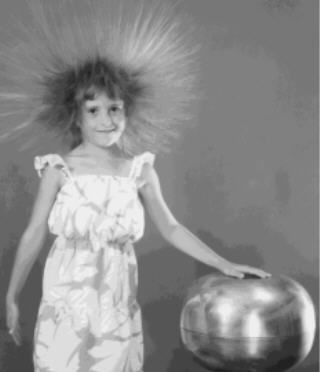
Who wouldn’t see this as witchy?
Consider my witch, anyway. I added a fictional characteristic to Thorel Felix, in The Priest, the Witch & the Poltergeist that exists in up to five per cent of the population: electromagnetic power. That is, he gives off sparks. Everyone has felt the bone-twisting jolt from touching a metal doorknob in winter. A mother I once knew saw her toddler — too late — insert a screwdriver into an electrical outlet and — boom! — shoot across the room, absolutely fine but somewhat mystified.
Some people give off sparks from their touch. Two hundred years ago this was called the vertue and made people suspicious.
Thorel, the witch in my book, causes painful jolts of electricity when he touches someone, definitely enhanced by him first rubbing the sheepskin he keeps around his shoulders or wearing a wool cloak or shuffling as he walks. It’s his shtick as a witch, so to speak, the attribute that makes people believe he has powers. The trouble is that for a witch, having power is a double-edged sword (or in his case, athame knife). Seem to be supernatural and I’ll buy your hex. Seem to be supernatural and I’ll report you to the priest. But those of you getting your witch costumes ready for trick-or-treating might consider rubbing a piece of nylon and then offering your hand for a little extra fun.
October 12, 2012
Consider the witch (2)
British scholar Robin Briggs wrote a terrific and well-researched book called Witches & Neighbors which I read while writing The Priest, the Witch & the Poltergeist. The powers attributed to witches through history seem both petty and extraordinary at the same time: he blighted my crop, she gave me warts, she gave my child scarlet fever, they made my pigs ill. A British man once claimed witchcraft when a woman arose from her seat and offered it to him . A woman who had lost all of her children through miscarriage and stillbirth was accused of witchcraft because she no longer cried at the death of others’ babies.
Briggs writes that the prelude to accusations of witchcraft are usually a quarrel, followed by a misfortune. In my book the ‘quarrel’ between the witch and the priest is that the priest prosecuted the head of a coven — a beloved figure to the witch — and sent him to jail for medical charlatanry. The witch frightened/hexed? two boys who lived at the local parsonage with the same priest. Within two weeks mysterious noises were heard at the parsonage, noises which grew and got stranger. The poltergeist is the ‘misfortune.’
What would you think if you were that priest?
Science explains most misfortunes to us nowadays, but the need to blame remains the same as it did in the days of the witch hunt. It’s the plumber who fixed the pipes or the doctor who didn’t diagnose us quickly enough or the government that never listens.
There’s a 60ish wiry man in my downtown Toronto neighbourhood who frequently takes up his post at a busy intersection holding a large sign that lists all the grievances and injustices he says he endured since coming to Canada, and the government departments he blames for them; his teeny-tiny witch hunt of a great big witch. There’s a 14-year-old girl named Malala Yousufzai in Pakistan who was shot by the Taliban this week because she wanted to attend school; witchcraft in their myopic eyes. Blame feeds resentment and resentment paralyzes progress. I’ll think of that, next time blaming seems like the logical thing to do.

Malala Youfuzswai
October 9, 2012
Consider the witch (1)
The witch in The Priest, the Witch & the Poltergeist is a 30ish shepherd named Thorel Felix, based on the real witch Felix Thorel in the Cideville witch trial of 1851. Why invert his name instead of change it? Well, one of the character’s attributes is a tendency to see things backwards — he speaks of the past being in front of him, for example, as our memories are for most of us, and the future being behind him because it is not seeable. I picked up that tidbit from a story about South American witches (Peruvian, I think, but don’t quote me). He carries an athame, a ritualistic knife with a pentagram engraved in its handle that you can see an example of here.
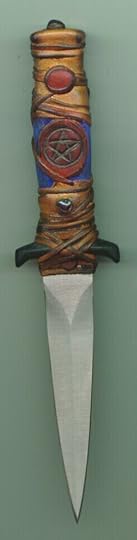
The athame, a witch’s ritual knife now available on the Internet.
Felix has a job as a shepherd for a local farmer. That’s a rarity among witches, as is the fact that he is male. France had a higher proportion of male witches than other European countries, and it tolerated them better — although ‘better’ still wasn’t ‘live comfortably among your neighbours’ — because of its pro-peasant political stance. I think of him as the ordinary shmo witch, albeit with a dark and handsome stare, trying to make a living selling hexes and setting bones. That was another name for witches in 19th-century France — les rebouteux. The bonesetters. So in this spooky month of October, 2012, as we head towards Halloween, spare a thought for the ordinary shmo witch, slipping out his ritual knife to cut the umbilical cord of a newborn lamb or slice bandages for a broken ankle, wondering which of his neighbours will try to avoid paying a bill by calling him a menace.
September 24, 2012
The past is another country
We live in Toronto most of the time, but for a few years in the late 1980s we lived in Palo Alto, California, the nerve centre of Silicon Valley and the home of Stanford University, where J was doing a post-doctoral fellowship. We also stayed a sabbatical year in 1995-96. The first time we lived here I worked as the San Francisco correspondent for Maclean’s magazine and we had our first child. There are people we look up every time we come and the area is like a second home.
If your second home was Nirvana, that is, the state of freedom from ever suffering. In 1986 we attached our boxy home computer to the Internet by stuffing the telephone into a bra-shaped plastic device that let out a wail before sending cryptic emails. In 2012 computers are hand-held devices and the Internet is everywhere. At our favourite breakfast restaurant, Hobees (where Steve Jobs used to eat sometimes), most people aren’t having conversations, they are staring at their mobiles and thumbing buttons. Even the kids.
I wrote a piece for the Globe and Mail back then about how East Palo, over the highway bridge, was where Silicon Valley pushed real life — grime, crime and poverty. In 2012 the area is much nicer than it used to be and a few big box retail outlets have moved in, mostly because real estate in Palo Alto became impossible to afford. I guess that’s trickle-down economics in a rare good light, but it took a lot of suffering people to get there.
Outside our hotel room across the parking lot is an electric-car filling station. We’ve seen a few of them, and as usual with Silicon Valley that means a trend we’ll be seeing more of elsewhere. Trickle-down environmentals in a good light too.
That’s mostly great news, and we’re having fun on our trip. So why don’t we choose to live here? Because we’re Canadians, for one thing, and Canada’s future matters. Because we have family around Toronto. And because to make Toronto more like Palo Alto you’d have to drain it of bad weather, pretty up the buildings and remove the cultural enclaves that make you feel you’re in Bangalore or Barcelona as the streetcar passes by another neighbourhood. We roll in Toronto’s atmosphere like happy dogs. Palo Alto, conversely, is rolling in it.
September 18, 2012
Beer and bricks
Everyone thinks that researching and writing a novel involves thinking deeply in front of a computer screen. It does, but in the case of The Priest, the Witch & the Poltergeist here’s what else it involved:
- drinking Stella Artois beer and eating moules frites in Rouen. I liked this part.
- learning more about Joan of Arc because (see above) we were in Rouen. I did not know, for example, that she was only 14. What is it about adolescents and visions? Nor did I know that she was denigrated by the Catholic church for many years, referred to as la pouce (the flea). Some flea. Some bite.
- calling a British paranormal society about Andrew Lang, a nineteenth-century anthropologist, and telling the receptionist helpfully that he wrote about the Cideville poltergeist. ”Oh!” she gasped. ”How did you know?”
- handing husband and two daughters bricks and blocks to bang on the walls of our house to simulate a poltergeist one night after dinner. Turns out doing this can blow out candles and cause squabbles. We have since moved.
- accidentally putting poltergeist sounds (for Booktrack ebook on sale Oct. 22) on iPad and discovering I kind of like walking in the woods with them. A change from Lady Gaga.
So see? Write something and find out for yourself.
September 4, 2012
What’s this book about?
I’ve been puttering around on Goodreads (and this blog now heads there too). Goodreads is easily the book-reading website with the widest international reach and the greatest number of lovers of reading. It’s great for authors too, particularly in this era with old barriers breaking down just like in the music industry. There are reading groups on Goodreads about all kinds of things, and I am thinking about creating one for lovers of Based-on-a-True-Story books.
I picked a handful to put on the bookshelf (a virtual act for a virtual shelf). Josephine Tey’s classic The Daughter of Time was one of my first picks: a detective story that ‘solves’ the murder of the Princes in the Tower from the reign of the supposed villain Richard III. Then I thought of Into the Wild by Jon Krakauer. Is that a true story or based on a true story? If you say it’s ‘based’ then you’re arguing that any scenes imagined by Krakauer take it out of the realm of nonfiction. Since he researched the story with exceptional diligence, that’s not really fair. The same thing may be said of Natalie Zemon Davis’ The Return of Martin Guerre.
I had a similar cataloguing problem with The Priest, the Witch & the Poltergeist. When I first tried to write the story a decade ago I resolved it would be a nonfiction journalistic account. But there was very little English-language material about the trial. The story is, of course, better known in France, and I was given a French account called Le diable serait t’il dans le canton? by a very nice French woman with the improbable name of Madame Marzac, who was visiting her husband’s grave at the little church in Cideville once presided over by the priest from the trial. It provided a lot of information. But imagination was needed to make the story more than an essay. In fact it was good for it. But agents and publishers kept saying, what genre is it? Fiction or nonfiction? Creative fiction? Historical fiction? One might think yes to that last, but there is a good deal of romance in historical fiction, which is a great improvement on history but not quite true of my little book.
We really need better book categories. Speculative fiction? Imaginative memoir? Historical fiction romance or mystery? Based on a true story or based on a sketchy anecdote heard in a bar? You be the virtual cataloguer. It’s one of the few library jobs left.
August 30, 2012
Just what is the paranormal?
A movie has just been released called ParaNorman, a sweet-scary animated feature about a boy named Norman who sees the dead. (Not to be confused with The Sixth Sense, the movie with Haley Joel Osment, a boy who sees the dead, which scares the bejeebies out of you.)
“Paranormal” means events or things which are outside the scope of scientific understanding. I love this. It means that every technological advance of the last century would have been paranormal to my grandmother and anyone born before her. You can see that kind of reaction when my mother-in-law Betty looks at her computer screen as if she is gazing into another world — although, to be fair, Betty is a devout atheist who, if she saw a ghost, would tell it she did not believe in it.
But to most people a belief in the paranormal means a slight wackiness, because they’re thinking only of the dead or of ghosts. When people heard I was writing about a poltergeist (which means, literally, “noisy ghost”) that actually happened in rural France in 1851, a lot of them listened with a look on their faces that read, “But you don’t believe in this stuff, right?” and body language that said they were prepared to shift away from me on the sofa if I did. For the record, I don’t really. There is usually an explanation for things temporarily incomprehensive — a mischievous person, a faulty wiring, a desire to believe.
The most interesting paranormal events to me are those that lie beyond the comprehension of human understanding. An impoverished male witch, beaten bloody by a priest, who crawls to his feet and threatens to sue. A man with a shopping bag in Beijing who stands alone in front of an oncoming tank. An enslaved or condemned people that manages to survive. Our greatest paranormal events involve not the dead but the living.
[image error]
August 24, 2012
Making a noise
So I’ve got a book, that’s not a paper book with pages and everything. I’ve got a book that exists in bits and bytes on an iPad or an Android. And it’s not a book that lies silent in your hands. It makes noise. A lot of noise. While there’s lovely musical themes to go with the major characters in the story, the main character is a poltergeist, so it expresses itself by hollering in your ear.
Hm. Maybe that won’t sell.
To look at it another way: I’m using 21st-century publishing technology to tell a 19th-century story. So maybe we could call up a poltergeist of sorts at a book launch, inviting the press and the guests to hear what it’s like to be surrounded by a noisy ghost. The Cideville poltergeist really existed in 1850 in a sleepy little town in Normandy, France. I don’t know exactly what it sounded like, although a witness who stayed at the parsonage said “the noises seemed to me so extraordinary that I would vouch for them with my blood.”
Hm. Maybe that’s an risky way to launch a book. We could do a contest instead, perhaps, one where people upload to my Twitter account or Facebook page short clips of their own personal daily poltergeists — the noises that annoy them, and consequently anyone who’s tuned to my Twitter account or Facebook page, the most.
Hm. This ain’t Tess of the d’Urbervilles or Margaret Atwood’s latest novel. Any other ideas?
August 19, 2012
Making a fool of yourself
Today I looked at the first research notes I made for the book that became The Priest, the Witch & the Poltergeist and saw they were dated March 18, 1999. That’s 13 years ago. The paperback was published two years ago and the soundtracked e-book will come out this fall.
Over a decade, I thought reflexively, that you’ve been making a fool of yourself.
It’s the go-to phrase for anyone who takes a risk or opens herself to ridicule or persists in something that ‘everyone’ understands is futile. Nobody wants to lose dignity accidentally, but to make a fool of yourself is to do it on purpose. Writing books is considered a stellar way to start. So is abandoning nonfiction for fiction, which I did both in my career and in this particular story, because there wasn’t enough historical information about the Cideville poltergeist and I wanted to get into the heads of the people affected by it.
In order never to make a fool of yourself, however, you have to hold yourself tighter and tighter until something in the centre of you can’t breathe. Nor can you tell for the hundredth time the strange story of this male witch who was beaten by a priest over a poltergeist, and who had the courage to stand up for himself and sue. I get to resurrect Felix Thorel a little bit each time I tell the 150-year-old story of a man considered worthless by his village and a scapegoat by the village priest–in other words, considered a fool–who decided he wasn’t going to lie down bleeding and broken, literally, and take it.
Thirteen years of making a fool of myself seems an easy price to pay.