Barbara Wade Rose's Blog, page 4
February 25, 2013
Dis place meant
The experience of being away is always beneficial, but in ways you might not expect. We are in a three-day hiatus between guests, so Jonathan is writing lectures he will be giving here and I am working on a new manuscript, and for some reason we felt more homesick yesterday than we had been to date. In my case it probably had something to do with not being able to watch the Oscars, which would be embarrassing if I were capable of it. For him it probably had something to do with his wife asking him to fix the Internet connection every half an hour.
In your home environment you have, if you’re lucky, tailored everything for efficiency: your route to work, your morning and afternoon habits, where and with whom you’re having lunch, what to have for dinner. Here Jonathan works on the dining table in our apartment, as he doesn’t have an office. To go to a cafe to work means finding an actual cafe, not a tea shop, and trying to communicate with the waitress who rightly doesn’t know what Wifi or ‘cheque, please’ means, so you find your app and type it in and hold it up. They must occasionally want to take our smartphones out of our hands and thwack us upside the head with them.
We’ve worked out a routine for taking the subway into town, but we can’t take taxis without painstaking preparation involving intricate characters and sounds we don’t understand. We got into a cab the other night, waving our Fudan University characters at the driver, realized he didn’t have a meter, and spent the ride wondering which field he’d dump our bodies in. He was actually very nice considering his passengers were yelling hysterically at one another.
This is easy for a month. What’s it like for immigrants? Maybe you learn a little of the language or a lot, or you watch your children become a seamless part of the society to which you’re raggedly stitched. But there must always be homesickness for you, not just for a while. Toronto has entire neighbourhoods of immigrants, Koreatown, Chinatown, Little Italy, Little India and more, where there are foods and clothes and cafes that feel a little like home. Until now I just thought of them as great places to visit, because I took for granted that the whole city belonged to me. We are so bloody lucky.


February 21, 2013
Dining at the Oriental Pearl Tower
Yesterday we (me, husband, OD or Older Daughter) did the most touristy thing we could think of for OD’s last day in Shanghai. We took the metro to the financial district, rode an elevator up to the 88th floor of the Oriental Pearl Tower and ate a buffet dinner while the sun went down. The Oriental Pearl Tower is a part of a twinkly, panoramic scene of the Shanghai skyline in James Bonds’ Skyfall. The scene in the film could easily be called breathtaking, but for real-life diners breathtaking means the cloud of pollution that envelops the revolving restaurant, as dense and brown as the streets of London circa 1880. I found it shocking. But dark falls, you have a cocktail, pick up a couple of plates of roast beef and tater tots, watch the twinkly coloured lights and the barges floating on the Bund, and forget what you are breathing.
Outside the tower we walked along an elevated sidewalk over a highway right through the financial district. Apparently 30 years ago where we walked was mostly marshes, where frogs croaked and cranes nested and the wind blew. But once China gets an idea in’er head, there’s no shiftin’ it, and China’s idea was to make Shanghai’s future as splendid as its past. It really is extraordinary.
We had to wait in line for the downward elevator after dinner, and stood in a happy group admiring their baby girl. Before I knew it the mother handed me her baby. We smiled at each other, out came all the smartphone cameras, including Jonathan’s, and we all had a moment with the air apparent.

February 20, 2013
Year of the snakes and ladders
Life is beginning to turn right side up. The students are returning to our Fudan University campus from their spring festival visits to family. We got our Metro cards and submitted knapsacks to the security scanners that sit at every subway entrance and blessed whatever Chinese authority put English underneath the Mandarin signs. At rush hour the subway cars are full but not crammed with young people texting or playing video games or listening to music as the car rolls along. One young man quietly turned his smartphone away from me, but I got a glimpse of fat little animated animals running up and down some kind of snakes and ladders jungle.
One of our first subway journeys was led by Fudan students, who helped us navigate the Bund and the former French Concession. If you don’t insert the word ‘former’ when describing this delightful old rabbit warren of shops and cafes, you can be charged under the Banish Colonialism Statute. (I made up the name but not the law.) We ordered Italian food in an empty mediterranean restaurant and watched the waitress and bartender leave the restaurant and bring back minestrone and pasta. We don’t know where it came from but it was tasty.
After dark Shanghai is a giant jewel box of coloured lights that was a marsh a generation ago. You know that already, but each traveller, from Toronto or France or anywhere else in the world looks at the skyline and thinks, I’m in China!
Crossing this jagged footbridge downtown against hordes of others brings you good luck for the year. I am just trying to stay upright.
February 19, 2013
Shanghai Diary #1: Stock the Lodging
I’m really glad we live near the original Chinatown in Toronto, when we’re living in Toronto. Now we’re in Shanghai for a month, and the sight of dangling ducks or the sound of Mandarin (okay, in Toronto it’s mostly Cantonese) doesn’t faze us. In fact it makes my husband salivate. We landed on Saturday (afternoon) (Friday middle of the night) and some very nice graduate students who will be working with Jonathan guided us to the sublunar landscape that is Fudan University before spring. There were very few other students around because of Chinese New Year. They came back today (Tuesday morning) (Monday night) (whatever) and immediately started firing off the firecrackers their parents must have told them put that away, it’s too dangerous. There are little pink wet firecracker skins all over the sidewalks.
We’ve been eating at the canteen for lunch (stir fry), supper (stir fry) and breakfast (rice gruel, called congee). I would kill for a slice of Stilton.
We have gone on month-long sabbatical trips to London, England, Berkeley, California, Vancouver, Canada, plus shorter trips here and there. We are very lucky. By now we know we pass through certain stages: Quest for the Lodging, Stock the Lodging, and Overcome the Desire to Leave the Lodging and return Home. I’m sure many of you think it’s a great adventure to travel like this, and I agree with you. I will feel that way in about a week.
January 29, 2013

January 7, 2013
Consider the poltergeist (2)
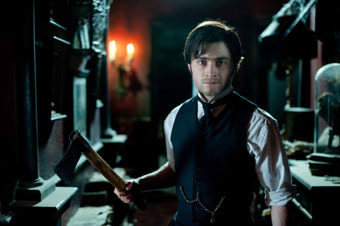
Perhaps he’d represent the poltergeist once he takes care of that woman in black.
A paranormal specialist named Herbert Thurston wrote an interesting book in 1976 called Ghosts and Poltergeists that included a chapter called “Poltergeists before the Law Courts.” Thurston noted how rare it was that “spiritistic phenomena are subjected to any such test of their authenticity as is supplied by the taking of oaths and cross-examination of witnesses before a legal tribunal.” The earliest case Thurston discovered was a 1575 haunting in Tours, France, that was cited in a lease annulment. Living with a poltergeist was a reasonable excuse for not paying rent.
Thurston notes that the Cideville poltergeist, the subject of The Priest, the Witch & the Poltergeist, is an example of a poltergeist being used as justification for assault — in this case by the priest of Cideville upon a witch. “It must be admitted that the procedure [of the Cideville witch trial] seems very confused, and that the witnesses were allowed to ramble on and give hearsay evidence with a freedom that would not be tolerated in an English court,” Thurston observed tartly. As the novelist of said trial, I was delighted. That the two opposing lawyers even came to blows over French politics, a detail which I at first hesitated to include because it didn’t sound believable, delighted me even more.
Thurston believes the majority of law cases involving poltergeists can be ascribed to trickery, and in those that cannot the magistrate is best advised to consider all supernatural evidence as inadmissible and to try to decide the case on other matters. To which I say — applause for your in-depth research, sir, but where’s the fun in that?
January 4, 2013
Consider the poltergeist (1)
As Booktrack has released the soundtracked version of The Priest, the Witch & the Poltergeist and faint rumblings can be heard on Ipod and Android devices across the land, it’s time to think about poltergeists. They are noisy disruptions to a place rather than a person, such as a house or castle. If you saw Anne Boleyn at the Tower of London that would be a ghost. If she caused bangs and thumps behind the Tower walls, that would be a poltergeist. The Lithobolia poltergeist of 1698 caused objects to fall on people. The Drummer of Tedworth rat-a-tat-tatted with military precision in the home of a man who failed to pay his debts to a local musician — guess which instrument he played.
They have happened throughout history, and the Cideville poltergeist of 1850 on which our story is based is one of the loudest. The most natural human reaction, after taking an aspirin and covering one’s ears, is to try to figure out why.  Many poltergeists are caused by clever if malicious humans. Some are believed to be caused by faults in a building (although why your plumbing should suddenly clang like cymbals in the middle of the night is beyond me and most paranormal specialists). More than one scientist has blamed psychokinesis, the mental ability to move things through tension or stress or adolescence changes in the body.
Maybe there’s something to that. There can be a youth or young woman around when a poltergeist erupts, as the Marquis de Foursin explains to an uncomfortable Father Lariat in The Priest, the Witch & the Poltergeist: ”There is such an energy about the birth of manhood, no? The eruption of many things: the muscles, the hair, the testes. It is entirely enough to disrupt the pneumatic energy around a house.” Is that the cause of the poltergeist in the story? Or is it a hex made by the local witch in revenge for the imprisonment of his coven leader by the priest? Read on.
December 17, 2012
This witch trial is utterly unique
When you hear the phrase “a witch trial,” you probably think of a group of 17th-century villagers in Salem or Samlesbury deciding a local woman is a witch and inventing hopeless tests for her to prove herself otherwise.
That’s not the witch trial of The Priest, the Witch & the Poltergeist. First of all, we’re in 19th century France, not 17th century colonial America or rural England. You might think witches ceased to exist in Europe by the 19th century. It was the Industrial Revolution, after all. But covens existed here and there, performing the kind of medical services today performed by nurse-practitioners or naturopaths, and throwing in a hex if they could get paid for it.
Furthermore, the coven in our story was all composed of men. I’ve imagined their natures for the novel, but they are men because for some reason in France male witches were more common. The witch at the centre of our story, Felix Thorel, was certainly male, and a shepherd for his day job.
But that’s not the most unusual aspect of our witch trial. What is unique about the Cideville witch trial is that in it, the witch was the plaintiff. Think about that. He was slandered and beaten by the village priest — nothing unusual in a witch being treated this way, although in this case the priest was being driven to distraction by a poltergeist he thought the witch had caused — but his response was: I’ll sue. I’ll see you in court. Lawyer up, Father, because you’re going to need it.

She should have got herself a lawyer.
As far as I have been able to discern that makes the Cideville witch trial utterly unique. A witch trial where the witch was the plaintiff. I was able to secure a French account of the trial called Le Diable sera it-il dans le Canton? in which it seems the unusual nature of the witch trial was taken utterly for granted. Felix Thorel was a French citizen 70 years after the Revolution, and he had the right to sue whomever he pleased. The trial was therefore not conducted as a 17th-century witch trial, but as a French civil trial with affidavits given before a judge.
And what happened? Aah . . .that’s something you’ll have to read The Priest, the Witch & the Poltergeist to find out.
December 4, 2012
Wet and wonderful
More to come! Ha! I did spend the month in Vancouver (coming home to Toronto yesterday) writing a new novel, getting 36,000 words out, and am pretty chuffed with my work. But I sure didn’t write any daily observations of life in Vancouver. I think my best intentions were rained out. We started multiple names for different kinds of rain — spritzy mist, drizzle, big ole fat rain (stolen from Forrest Gump), spitting, pouring, and hydroplaning, when the car you’re driving with the wipers doing triple time goes through a massive puddle and water shoots out the undercarriage. Vancouverites just dress in hooded jackets and get on with it. You can figure out who the out-of-towners are because we’re the ones carrying umbrellas and pouting.
Which we did even on hikes in the woods. The Pacific Spirit Park at the University of British Columbia has a web of trails through tall Douglas firs and the stumps of old giant redwoods, some nearly disintegrated, others with the scars of axe cuts shoulder-height up their trunks, all green with moss. The height of the firs lends a walk an atmosphere of entering a European cathedral, except more peaceful. I loved walking in the park, and as I had to drive Jonathan to work and back in order to keep the car, sometimes parked the car for a quick hike either coming or going. Once I met a jack russell terrier and his owner. The terrier climbed up to the top of every stump he could, then walked round proudly in a sort of ‘I’m the king of the castle’ strut.
And the banana cream pies from Aphrodite’s — I mentioned those already. Had a total of three pieces. All the walking in the world couldn’t offset that little slice of heaven. Please don’t tell me there’s an equally great pie place in — oh, wait. Wanda’s Pie in the Sky in Kensington Market. Coming home is harder than I thought.