Barbara Wade Rose's Blog, page 3
January 26, 2014
The non-category of ‘collaborator’
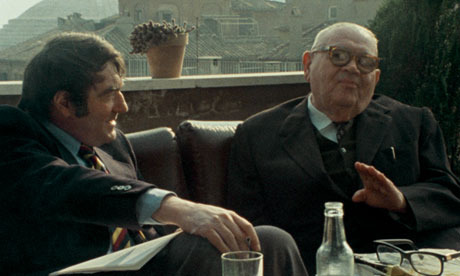
Filmmaker Claude Lanzmann and Benjamin Murmelstein in the 1970s.
A Claude Lanzmann documentary film is coming out in a few weeks that examines over three hours (that’s like a short for Lanzmann) the life, personality and Holocaust role of Rabbi Benjamin Murmelstein. Lanzmann originally interviewed Murmelstein (who died over 20 years ago) as part of his work for the film Shoah, the monumental documentary of Holocaust suffering, ‘collaboration,’ and complicity that was released in the 1980s.
Murmelstein was the third and only surviving Jewish Council leader of the Theresienstadt ghetto in Czechoslovakia (there called Terezin). Theresienstadt was a mock-concentration camp used by Adolf Eichmann to show Red Cross visitors that in fact Jews in camps throughout occupied Europe were living splendidly — hence its sardonic nickname, the “Paradise Ghetto.” Murmelstein helped spread this fiction about Theresienstadt, ran the camp, and drew up lists of Jews for deportation. The title of Lanzmann’s film, The Last of the Unjust, is how Murmelstein referred to himself. According to a Jan. 26 article in the New York Times, he has been considered variously a scheming friend of Eichmann and a forced collaborator who did more for others than for himself. Lanzmann adopts the latter view.
The discussion about Murmelstein got me thinking about the human desire to decide what someone is. We want our pantomime characters no matter how awful the story is: our damsels, our heroes, our villains. In a genocide, surely the only people to whom can be affixed a label, or judgement, are the perpetrators.
But to make such a statement is to tell the survivors and refugees and chroniclers of the Holocaust that they, (being part of the humanity I address), may or may not judge Rabbi Murmelstein. Who am I to do that? It seems that with each ethical question or discussion about the Holocaust, we open another Chinese box. To paraphrase Theodore Adorno: After Auschwitz, no more poetry — nor mathematics, nor logic, nor law, nor history. Nor answers.
I look forward to seeing the film.


September 17, 2013
A melancholic’s guide to Disney World
This is my eighth trip. The first was when I was 19 years old. The two daughters I bring with me are older now than I was then.
“This might be the last chance we get before we have to bring grandchildren,” I say as we board the Magic Express at the Orlando airport. “You said that last time,” the 25-year-old replies. A second-year law school student, she has avoided telling her friends what this trip to Florida is for. The 21-year-old is graduating from university; that’s why we’re here this time, I tell them. They smile, trying to be nice.
We are staying at Disney’s Grand Floridian. In the past have stayed at every resort on the monorail—the Polynesian, the Contemporary–and a couple that are accessible by bus. One, the Wilderness Lodge, we had to get to by boat. I think that’s eight trips; I’m afraid to count. We know how to use FastPass, Magic Your Way, Extra Magic Hours and bribery so well we can canvas the Magic Kingdom’s fastest rides in less than three hours. Ten years ago, on an Amazing Race that seems insane in hindsight, we went by taxi from the Orlando Airport between flights to visit. My husband stayed at the airport. We only got on Pirates of the Caribbean, but it was worth it.
Here’s where I mention in a sidelong kind of way that I have a master’s degree in English literature from one of North America’s premier universities, that I was a journalist for 15 years and won two national writing awards, that I have authored two books, and that my favorite writers are people like D.M. Thomas or Virginia Woolf or Lauren Hillebrandt, people whose writing is so stellar the literary conversation saddens you as it ends.
When a conversation ends with people who work at the Magic Kingdom, they say, “Have a magical day.”
I know you’re thinking that going to Disney World means pursuit of some plastic magic, a synthetic joy that comes with too much sugar, speedy rides, stunning lineups and cranky people. Nope, as Goofy would say. You maybe think it’s chasing nostalgia, but my parents never took me to anything Disney because it was the Spawn of the Crass American Devil. Canadian television had Bugs Bunny cartoons, not Disney, and our TV trays on Saturday evenings (hamburgers, potato chips, celery sticks) were angled towards to the cynical, out-of-focus futilities of Wile E. Coyote and Ralph and Sam. My dad loved Ralph and Sam. He said it reminded him of being in the army.
I go to Disney World because I am a melancholic person by nature. It delivers a silly serotonin to which my brain responds (Silly Serotonin would have been a much better title for the Warner Bros. cartoons than Merrie Melodies). It gives us the selfish, give-me-the-Mickey-shaped-chocolate-potato-chips childishness that growing up with people who believed in the Spawn of the Crass American Devil denied. It bleeds the adult right out of you–all right, that’s enough. Which is what I say every time I leave this magic kingdom. Until next time.
March 21, 2013
An indelible impression
We returned to Toronto five days ago and are still feeling the effects of jet lag, and of the trip. Our Beijing guide, Babbitt, was kind enough to send a note asking how we’re doing. The people connections we made through design or circumstance are the best part of our time in Shanghai and Beijing: the cleaning woman who smiled at us every morning, the quiet guide Simpson whose grandfather was Chiang Kai-shek’s bandleader and whose family fled Beijing for Chengdu, kind people on the subway who waved at us or grinned just because we were the only Occidentals around.
My favourite souvenir of China is something Babbitt and I bargained with a stonecutter for at the foot of the Great Wall, one I’ll be using for the rest of my life. It’s the kind of stone stamp often used by artists instead of a written signature at the foot of their work, often called a chop stamp. What you see in the impression here is the name WADE ROSE, one on top of the other, in Mandarin. Easy to do, Babbitt told Jonathan of the characters, which Jonathan reproduced on his iPhone, and the price was 110 RMB or a little over $20 for a stone stamp with a lion carved on the top for me to grip. “Cool,” said Babbitt when he looked at the finished impression. I agree. I hope it’s the signature on lots of paintings to come.

March 17, 2013
Beijing dogs

A distant relative of my dog plays in a Beijing alleyway.
This is a short blog about Chinese dogs written partly because I am a dog fancier. What I had heard mostly about Chinese dogs from Canada is that they were considered delicious, so I didn’t expect to see any. Like most stereotypes that was nonsense, of course. In the cities there are little dogs everywhere: mutts and Pekingese and pugs (yay!) and, in the wealthier neighbourhoods, Pomeranians. The mutts are usually short-legged, snouted alert little fellas with medium hair. They live in alleyways, rabbit-warren neighbourhoods and apartment buildings. Very few of them walk with leashes. Almost none. I was cringing every time a car drove by but after it passed, there was the dog, looking comfortable and safe. Even the pugs, which are notorious for being stupid about cars. Certainly mine, at any rate.
During a downtown wait for a traffic jam to clear I watched a black-and-white dog trot by itself down a busy city street, wait for the light to change, cross the intersection, and carry on its way. My dog has been getting away with too much for too long. Starting next week, it’s her turn to get the groceries.
Things for the new leadership to consider
It’s the middle of our last night and I can’t sleep. I might not post this come morning when there’s light, but for now, a few complaints to the Central Party Congress now meeting in Beijing.
* Some Chinese toilets are dreadful. The women’s are usually squat toilets, which means a piece of porcelain in the floor that looks like a mini-urinal.

To say nothing of the street snacks.
* Some bathrooms have a toilet or two called the “handicapped” toilet and the tourist crush on these is fierce. I was holding the door closed for one elderly British woman to preserve her modesty when the other handicapped stall became available and I am sorry to say I abandoned her.
* You must bring your own toilet paper, and once it’s used, toilet or squat, it goes in a basket in the corner of the stall. A mixture of blood, urine and feces sits there all day and makes an unbelievable stench. But visitors get to come and go – there is a woman in the toilet employed to stay there all day, picking up stray bits of paper with a footlong pair of bamboo tweezers and wiping the sinks when she can no longer bend over. In India this kind of job used to be the lot of the untouchables.
* There is MSG in a lot of the food. You’ll know when you lie in bed at night feeling like you just drank five cups of coffee. C’mon, people, MSG is so 1970s.
This is kind of minor, but still – the spitting. Both men and women do it, but mostly men, and you know one’s coming in a crowd when you hear the hawwwwkk before the ptui. I think we have panda videos with that hawwwwkk in them and then the lens moves away from the ptui. Also the pandas.
You can’t pour water from a tap in a country with some 2 billion people.
And always, always, the air. Breathe in, breathe out, aspirate, respirate, and – no payoff. Sooty trees, dusty throats. Always on the edge of taking oxygen in but never quite getting the satisfaction of a deep sweet breath . I have a cold now. I can’t sleep because it’s hard to breathe; that’s normal with a cold, but now my lungs hoover in the fog and the filthy air and wonder what the new Chinese leadership plans to do about it.
Disco and dumplings
The Chinese elderly are the most vibrant seniors I have ever seen, although our guide Babbitt pointed out that I am only seeing the vibrant ones. They participate in morning exercise and evening exercise in the parks of Beijing and Shanghai in several ways:
Tai chi. You could have guessed that, right? But also:
Hackey sack. Instead of a small ball they used an oversized badminton birdie. If the birdie comes your way you have to kick it once before kicking it to someone else in the circle.
Seniors’ disco. Someone brings a boombox and plays cheerful boppy music and lines of seniors, mostly women, follow the leader in lines of 20 to 30 people.

Jonathan loves his dumplings.
Ballroom dancing. Lots of men do this too. Couples do stately moves to another boombox.
Karaoke singing. Not really exercise, but sometimes the singers, who usually sing old Chinese revolutionary tunes, attract a moving audience.
Outside our Beijing hotel, blocks from the Forbidden City, a conga line of old ladies bops back and forth to a boombox in the evenings. Just up the street there is a church plaza where on one side, seniors ballroom dance, and on the other, young people spin and breakdance. What a phenomenal way to spend your evening. What a phenomenal people.
March 9, 2013
Waffles in hoisin sauce
It’s our last full day in Shanghai today (a Sunday) and we’re going to spend it going into town and seeing the Shanghai Museum. We’ve had three weeks of a high technology campus, canteen Chinese food (not bad) and occasional forays into Byron Beans, a western cafe on the edge of campus run by an Australian, Nick, who introduced us to Tasmanian beer. We could not get warm when we first came here mid-February. Yesterday the temperature reached 27 degrees Celsius, the birds sang and all the yellow buds popped out.
Tomorrow we fly to Beijing. I did floor exercises in our Shanghai apartment yesterday morning, watching the Communist party people’s congress proceedings in Beijing on CCTV, so I think I’m ready. They used (translated) phrases like “socialism with Chinese characteristics” and “social democracy” so often I thought Ontario’s Waffle party had resurrected itself in China. Which would not be all bad.
What has made this part of the trip particularly delicious is that people we love wanted to visit; my sister, her partner, and two old friends. The apartment has been full of conversations so good I hurry back from brushing my teeth, worried I’ve missed something. London (where we spent three months in 2009) and Shanghai were like that too, and I’d say the common denominator was the people. Find some friends and travel with them, no matter what your age. Repeat as often as you can. There’s no life like it.
March 6, 2013
After the flags were taken down
I just returned from two nights in Suzhou where our friend works for a university. Suzhou is known as the Garden City and it has entertainment complexes and restaurant-malls that are much fancier than what I have seen in Shanghai — and they remind me a little bit of Palo Alto, California. Perhaps it’s the newness of the construction, perhaps it’s the coloured lights at night. Nice dining — we got our first Indian food meal since being here, at Ganesh. We could see a sparkly ferris wheel further along the lake.

The future: pretty and it never ends.
Suzhou is also a community that has been transformed in a short time. When our friend moved here the high-rises were being built, and she remembers seeing holdout houses festooned with Chinese flags as a symbol of their desire to avoid demolition. That was two years ago. Now there are 7- or 8-highrise apartment complexes everywhere. It makes me wonder what the treed land between Ottawa and Toronto would look like someday, paved by highrises. ”Scenic view of Lake Ontario” is what the brochure might read.
China has nearly two billion people, and its needs are huge. What are they doing for arable land now that Suzhou has been paved over? Getting it from Africa.
March 3, 2013
Miao Miao and the illicit kiss
We recently took a China Eastern Airlines flight to Chengdu to visit the Giant Panda breeding centre.
Chengdu, our young guide Simpson said, has grown from one million people to 20 million people within the last 30 years. Construction makes the scenery a lunar landscape. The air is brown, the trees are grey and workers in orange uniforms with twig brooms sweep the dust on the curbs to no apparent effect.
But the people! Half of them ride motor scooters, zipping through intersections the size of superhighways whether the lights are red or green, some wearing masks, carrying groceries or boxes or their kids. There is a dedicated lane for them or the roads — are you listening Rob Ford? Course not — and the dance with pedestrians is balletic.
The Panda Centre sits in a suburb of Chengdu ripped up for construction of a high-speed train line. You only know you’re there because the roadside stands change from strawberries and cabbage to stalls of stuffed pandas of all shapes and sizes, like it’s a local crop. Which it is.
You cross the dusty road and pass the construction and walk for about 20 minutes into a progressively greener surroundings. After a little while the colours around are brighter and you can hear birds. We were lucky — there weren’t many people that day. Finally on the left in a large, hilly enclosed with wooden climbers similar to those in children’s parks, and bamboo stalks set in containers below the grass so they can ‘harvest’ them, were a giant female panda and three babies about 8 months or so. One of them was clearly hers: she nibbled on it and rolled with it while another baby snoozed in a tree crook and the third played mountaineer, climbing anything within range of its stumpy legs.
If you make a donation of 2000 yuan (about $300 Canadian) you can don surgical garb and hold a baby panda for five minutes. My birthday’s coming up, so Jonathan bought me this as a present. I followed the other lucky squealing donors inside the breeding centre to a bench, put on a paper gown and plastic gloves, glanced to my left and saw an attendant bringing in what looked like a soccer ball in a bucket. Miao Miao lifted her head and the squeals got louder. I’m sure every heart melted but the attendant has clearly done this before. She methodically plonked this perfectly content baby (four months?) from lap to lap, yelling “Next!” like we were waiting in line at the bakery.
I was third. Miao Maio was surprisingly light, a fur covered basketball munching on short stalks of bamboo and as oblivious to me as Richard Parker the tiger was to human feelings in Life of Pi. Her fur was rough and soft at the same time, like a crew cut, and nice and clean. I see from the video we took that I ran my hands up and down her little legs and arms and it looks like I kiss the top of her head when I shouldn’t have. Inside it felt like I had split into five senses all reporting back Bliss.
We don’t get to touch wild creatures very often. For me it was like touching another dimension. You can tell I’m the perfect person to market panda holding to, eh?
Then a voice shouted “Next!” and Miao Miao, munching on her bamboo, was lifted and deposited in another waiting human.
February 26, 2013
Sunday painters etc.
A few days ago we walked through the bookstore section of Shanghai and found we were in the art supplies section as well: stores carrying slim and fat brushes, most with tapered points for calligraphy or watercolour, ink pots, and stone tablets for pouring and mixing the inks or other materials, many of them beautifully carved to look like mountains or countryside scenes around the edges. The stores were busy helping weekend artists select their tools.
In the parks you’ll see such artists working with their brushes. Nearby, others in our group heard tinny music coming from a cassette player and came upon elderly couples practising ballroom dancing. Another group practised spinning giant tops about the size of woks that worked on a principle similar to that of yo-yos, except harder.
Those who spend their weekends this way seem to be better at work-life balance than westerners. No renovating the deck even if you work hard all week. Maybe a little gambling instead. It makes for a great tourist tableau. Check this out: IMG_4251