Joseph Lewis's Blog, page 5
June 14, 2024
Two Snippets from Two Books!
Thriller – Crime – Mystery by Joseph Lewis
I was happily busy this past week. My youngest daughter, Emily, got married this past Saturday. It was such a joyous weekend. Understandably, I didn’t have the time to post this until today. They are driving back from their honeymoon as I write this, and because it was a special weekend, I wanted to give you a special treat.
I’m giving you two snippets of two books based upon my work as a counselor, and from my volunteer work with the Wetterling Foundation for Stranger Abducted and Sexually Exploited Children. My job was to present to parents, educators, and caring adults what they can do to protect children and how to spot something questionable with regards to a child. The second task I performed was just as, if not more important: help children protect themselves from adults who might harm them.
The first snippet is from Taking Lives, Prequel to the Lives Trilogy. It hit #3 on Amazon in several categories. This is actually the second book I ever wrote, but the first book that was published. My previous publisher, who is no longer in the business, wanted me to write a prequel to introduce the reader to the Lives Trilogy. That’s exactly what Taking Lives is.
Set approximately two years before Stolen Lives, it introduces you to the series, but more importantly, it introduces you to four important characters that are in most every book I’ve written. The other interesting thing is that it ends on a cliffhanger. There is no easy or neat ending, but it leads directly into the first book of the trilogy, Stolen Lives. Here is a snippet from Taking Lives, Prequel to the Lives Trilogy.
Chapter Thirty-Six
When Chet arrived at the Hoover Building that morning, Pete and Summer were already waiting for him at his cubicle. Summer sat on his chair, while Pete leaned up against the desk with his arms folded across his chest.
Pete stood up straight and smiled when he saw him. “Chet, I think we have an idea.”
Summer stood up, looked out over the top of the cubicles at the rest of the bullpen, knowing that there wouldn’t be a lot of privacy. She said, “Why don’t you bring your laptop and we’ll go to the conference room, okay?”
Chet had a leather computer bag hung over his shoulder as usual, and didn’t bother to take it off. He dropped his car keys into his top drawer and followed the two of them out of the bullpen area. The three of them never said a word, choosing to walk in silence.
When they arrived at the conference room, they entered and Summer shut the door behind them. Chet noticed a map of the continental United States with colored push pins, marking the places where the four boys had been found, with one end of a piece of colored string attached to the pushpin, and the other attached to a pin under the picture of the boy who was found there.
“Someone’s been busy,” Chet said as he sat down and fired up his laptop. He reached into his bag and brought out another.
“Why two?” Summer asked.
“In case I have to switch between two sites. It’s faster and easier for me if I do it this way.”
Chet also pulled out two thumb drives and plugged one into the USB port in each of the computers.
“Okay, I’m ready.”
Pete looked at Summer and then back at Chet. “Here’s what I’d like you to do. For each dump site… the location where we found a body, I want you to look for any statewide Amber Alerts for boys whose ages were eleven to thirteen, either ten days previous to the body being found, to ten days after the projected time. Do this for each boy we found.”
Stunned, Chet opened his mouth, eyes wide. “Jesus! That’s brilliant, Pete. Why didn’t we think of that sooner?” And before either Pete or Summer had an opportunity to answer, Chet’s fingers flew over the keys.
“Okay, I found an alert for a boy… a Marcus Caleb Delroy, age eleven from Las Vegas, Nevada, four days after we found Brian Mullaney; still missing, listed as suspicious circumstances.”
“What race?” Pete asked.
“Caucasian,” he paused at the keyboard and looked up, “Because pedophiles mostly stay within their same race, right?”
Summer nodded. “Usually, and because the other boys are Caucasian, it might mean our same perverts.”
Pete went to the map and placed a different colored pushpin in the map marking the city, and then went to the whiteboard and wrote in marker the information Chet had just given them.
“Is that the only Amber Alert you found for Nevada?” Summer asked.
“Yes, at least within that time frame, and that matches our boys,” Chet said, not looking up from the keyboard, fingers still flying.
He worked the laptop a while longer and said, “That’s it.”
Pete sighed, as did Summer.
“But wait. I found something interesting if you’re looking for patterns,” Chet said absentmindedly.
“What?” Summer asked.
“Okay. We found Robert Monroe in White Cloud, Michigan, but he was from Terre Haute, Indiana and that’s only one state away. We found Gary Haynes in Coal Run, Ohio and he was from Michigan; again, one state away. We found Richard Clarke in Victorville, California and he was from Arizona.”
“One state away,” Summer finished for him.
“And we found Brian Mullaney in Nevada, and he’s from California.”
“All boys were found one state away from where they were taken,” Summer said.
“So, it could be that they dump a kid in one state and pick up a kid in a neighboring state. Maybe,” Chet said tentatively, not sure if his detective work was in the same league as Pete’s or Summer’s.
“Whoever is doing this…” he trailed off as he thought about it, and then said, “Possibly, they dump a body in one state and pick up a kid in a different state, like Chet said.”
Pete said with his back to Summer and Chet. “Or, they dump a kid in the same state where they pick a boy up,” he paused, “Maybe. As nearly as we can tell.”
“Maybe, as nearly as we can tell,” Summer echoed.
“We might have something, Guys. We might have something,” Pete said.
“So, when do we want to run this theory by Musgrave and Rawson?” Chet asked.
Neither Pete nor Summer answered him.
—

Taking Lives, Prequel to the Lives Trilogy
Available in both Kindle and Paperback
Total Strangers, One Man and Two Boys, each hold a piece of a deadly puzzle and they don’t know it.
The bodies of six boys are found in remote areas in different states with startling characteristics. FBI Agent Pete Kelliher and his team from the Crimes Against Children Unit investigate and discover a curious pattern that his superiors refuse to believe. Unfortunately for Pete, there are no other leads and nothing else to go on, and no proof to verify his theory.
The second snippet is from Stolen Lives, Book One of the Lives Trilogy. It hit #2 on Amazon in several categories, and was selected as a Finalist in the BestThriller Book Awards competition, and won a Gold Book Award from Literary Titan.
George, a fourteen-year-old Navajo boy, is sitting on the back steps of Jeremy Evans’s house. He was placed with Jeremy by FBI Agent Pete Kelliher, because Kelliher wanted George safely hidden from those seeking him in Arizona. George identified two suspects in the human trafficking ring.
He woke up in the dead of night from a troubling dream. In the Navajo culture, dreams are recognized as spirits offering messages to the individual. In this case, the subject of the dream was George’s grandfather, who had mentored and helped raise George from little on. Grandfather Tokay is important to George, and George often sought advice from his grandfather. Here is the snippet from Stolen Lives, Book One of the Lives Trilogy.
Chapter Thirty-Five
… He put his arm around George’s bare shoulders and George moved closer to Jeremy, allowing himself to be held. He liked Jeremy, found him to be sensitive and caring. There was goodness about him. His grandfather had taught him to look for those qualities in others and then to surround himself with the people who had possessed these qualities. He liked both Randy and Billy and thought that in another time, in another place, they would be good friends. George didn’t know many biligaana, but George understood that his grandfather would have liked this little family. He flashed back to a discussion with his grandfather years ago about biligaana with hearts of the Dine’.
“George, I can’t imagine what you’re going through,” Jeremy said softly, almost in a whisper. “I’m so sorry.”
A rabbit hopped out of the hedge line on the left side of the yard, separating the Evan’s house from the Schuster house, a family he had not yet met.
George lowered his head, weeping again.
Jeremy hugged him closer and kissed the top of his head.
George was as tall as the twins, maybe a bit shorter, and lankier. He wasn’t as solidly built, but that wasn’t to say he wasn’t strongly built. Jeremy had coached for years and knew an athlete by a certain look, a certain walk. George had both.
“The boys and I have been talking and we’d like you to consider living with us.”
Jeremy stopped at that. The boy had just lost his family and they knew nothing of one another. Yet, Jeremy had a gut feeling about George, much as he had about Randy when he had first met him. In so many ways, he had the twin’s sensitivity, Randy’s seriousness, and Billy’s athleticism. Again, it was only a hunch, but Jeremy rarely missed on people.
Yet, they had only known each other for less than a day and George had to be reeling from the loss of everything in his life, including all of those who had meant so much to him. He couldn’t imagine the loss this boy experienced.
Even in his grief, his sadness, George caught a scent of cologne, different from the deodorant he or Jeremy used. It was faint, but present. At first he thought it was the lilacs at the corner of the house, but it wasn’t. He had recognized it as being similar to the cologne or aftershave various male tourists wore when they visited or drove through the reservation.
Jeremy noticed that George had said nothing and was staring off into backyard. Perhaps he should have waited until morning to have had this talk. Real morning and not the middle of the night morning.
“I hope you consider the offer. We’d love to have you.” Jeremy said sincerely. It didn’t even seem like George had heard a word.
“Mr. Jeremy, I’m tired,” George said with a yawn and stretching. “Let’s go back inside and go to bed.”
They stood on the porch facing each other and Jeremy held George’s face gently and said, “It might not seem like it right now, George, but things have a way of working out. You’ll be okay.”
George embraced him, and then without another word, George opened the door and waited for Jeremy to enter. He did and before George followed, he took one last look at the backyard and then shut the door behind him, taking care to lock the dead bolt and the chain.
Jeremy turned to say something, but George put a hand on Jeremy’s chest and said very calmly, “Mr. Evans, there’s someone in the backyard.”

Stolen Lives, Book One of the Lives Trilogy
Available in Audio, Kindle and Paperback
Three fourteen-year-old boys are inextricably linked by abduction and murder.
Two of them were just abducted off a safe suburban street. Kelliher and his team of FBI agents have 24 hours to find them or they’ll end up like all the others… dead! They have no leads, no clues, and nothing to go on. And the possibility exists that one of his team members might be involved. A fourth boy, George Tokay, a Navajo, holds a key piece to this puzzle and doesn’t realize it.
Kelliher and his team have been on this case for two years. There isn’t much to go on, and each time he gets a break, potential witnesses are found dead. The stories of these boys are like loose threads on a sweater: pull the wrong one and it unravels completely. Slowly, Kelliher realizes that there may be one or more members of his team behind it all.
2021 Finalist, The Best Thriller Book Awards on BestThrillers.com
2021 Literary Titan Gold Award Winner
“Mr. Lewis’ characterization and descriptive powers are great. He writes his people with enormous warmth. However, he never goes down the road of over-sentimentalizing when it comes to the victims. This is hard and gritty, and he keeps it that way.” -Best Book Editors
“Stolen Lives represents an exciting probe of abduction and unusual connections between fourteen-year-old victims, and is recommended reading for thriller and intrigue fans …” -Diane Donovan, Midwest Book Review
“A harrowing and unforgettable FBI thriller.” –BestThrillers.com
“A riveting murder mystery that slowly unravels a puzzling crime that will have readers furiously flipping pages.” –Literary Titan
I hope you enjoyed this post. I’d like to hear your thoughts, so please use the comment section below. As always, thank you for following along on my writing journey. Until next time …


June 4, 2024
Yet Another Snippet from Caught in a Web
I like Caught in a Web a great deal. It has heart and it holds together in the face of a thriller-crime-mystery. Like all my books, there is a coming-of-age thread throughout, and this particular book introduces Brian. He appeared briefly at the end of the previous book, Splintered Lives, Book Three of the Lives Trilogy, but his character wasn’t fully developed until Caught in a Web. Since Web, Brian has become a readers’ favorite, and I have to admit, one of my favorites, too.
Throughout my years in education, I’ve met many kids like Brian, whether it was in the classroom, on the basketball court, or my counseling office. Sometimes, it was just striking up a conversation with a kid in a hallway or the cafeteria when I was a principal. Some kids shared their lives and their stories with me, while others tended to keep to themselves.
I’ve always believed that if a kid had at least one caring adult in the building, the kid would be a success. I preached this to my staff at my various schools, and I sought out and hired teachers with a heart. Kids need them.
Brian is one such kid. This snippet is just a glance into what Brian held in his heart, how he felt about his family, and what his life had become.
CHAPTER FORTY- TWO
“Dad, I think I’m going to play tomorrow night,” Brian said as he hopped into front seat of his dad’s black 4Runner. He shut the door to the dark and cold late afternoon.
He had skipped showering after practice, because his dad was already in
the parking lot waiting for him. Brett disapproved stating, “It’s unhealthy
leaving the locker room sweating and gross without showering.” Brian had
smiled and said, “I gotta go. Dad’s waiting,” and out the door he ran, slipping a little on some ice formed from snow melt during the day that refroze after the sun and temp went down. He caught himself before he fell using the door handle for support.
“That right?”
Brian beamed. He had a good practice. Coach Harrison said so. He wasn’t
a starter, but he and Randy were the first subs.
“Coach Harrison said he wants me to shoot.”
“That right?” his dad said again.
“Yeah. He said when I’m open I’m supposed to let it fly. That’s what he
said. He said he wants me to let it fly. Pretty cool, huh?”
“Okay, Bri.”
Brian glanced at his dad questioningly. He could tell from his dad’s voice
and from his expression that his dad wasn’t excited. Brian didn’t think he had heard a word he said.
“I think I bombed a math test this morning,” Brian said without passion,
almost in a monotone.
A lie. Maybe the first lie he had ever told his parents. He turned his head,
his breath frosting the inside of the window making it difficult to see
anything. Or maybe it was a tear or two. He wiped them away angrily.
“Sounds good, Brian.”
All the joy, all the life was sucked out of Brian in that one moment. It was
something he had thought about ever since the summer of death. It was
something he had suspected. But in that moment, he understood that he had stumbled unwilling onto the truth. No matter what he did, no matter what he said, his parents had only cared about Brad.
He didn’t matter anymore. Maybe he never did.
—
There will be quite a few more hurdles and curveballs coming Brian’s way in Caught in a Web. (Remember, my book titles have multiple meanings and you might have just uncovered one of them … kind of.)
But remember, first and foremost, Web is a thriller-crime-mystery with MS-13 running around terrorizing and murdering, maybe torturing, all who get in its way.
For your convenience, below, I gave you the short synopsis, a review or two, and the purchase link for Caught in a Web. I would love to hear what you think, so please use the comment section below. As always, thank you for following along on my writing journey. So until next time …

The bodies of high school and middle school kids are found dead from an overdose of heroin and fentanyl. The drug trade along the I-94 and I-43 corridors and the Milwaukee Metro area is controlled by MS-13, a violent gang originating from El Salvador. Ricardo Fuentes is sent from Chicago to Waukesha to find out who is cutting in on their business, shut it down and teach them a lesson. But he has a dark and deadly ulterior motive.
Detectives Jamie Graff, Pat O’Connor and Paul Eiselmann race to find the source of the drugs, shut down the ring, and find Fuentes before he kills anyone else.
A PenCraft Literary Award Winner
“…probes the worlds of teens and gang members…precise, staccato details; …the right blend of tension and intrigue …” Midwest Book Review
“Important, nail-biting … one of the year’s best conspiracy thrillers” Best Thrillers
May 30, 2024
Meet J. Ivanel Johnson – An Author!
This interview was a blast! J. Ivanel Johnson is quite the character! I was taken by her humor and her strength of character. She has a way with words and after the interview, I found myself searching her website for some to read, even though I don’t read cozy mysteries.
J. Ivanel reminded me of Joan Livingston, another strong woman writer, though I doubt the two of them ever met.
J. Ivanel Johnson is a retired English and Drama high school teacher, formerly having taught in Stratford, Ontario, Canada, and in Browning, Montana, and in West Yorkshire and Lancashire, England. She coached the Junior Olympic levels of Eventing, which are three equestrian disciplines in all three of those countries, as well as in Scotland, where she lived for a year. Coping with a progressive (dis)Ability all her life, she has now settled ‘quietly’ in the beautiful Appalachians of New Brunswick, Canada on their small farm to write more seriously. She has been, according to an agent she once had, only ‘playing at it’ since she had her first poem published at the age of 12.
Here is my interview with J. Ivanel Johnson, and I’m sure you will find yourself chuckling and laughing just like I was. Such an interesting person!
What was it that made you decide you had a story to tell and to become an author?
I have always written–short stories, novels, poetry, songs, plays, and musicals. But my first published novel by Black Rose Writing began 75 years ago with an outline from my grandmother, who also wrote many manuscripts but never tried very hard to get published. I always promised her I would push on to that ultimate goal.
As an author or writer, what sets you apart from others?
I have, it seems, become known for writing a lot of diverse characters in all my works. An article by a Co-op magazine in our province https://nbmediacoop.org/2022/08/01/disabled-playwright-pens-historical-n-b-musical/ in mid-2022 has equated to a number of other media articles with the same theme, and several diverse groups of artists contacting me as well. Living with (dis)Ability, having coped with much bullying in school, then teaching in marginalized communities like First Nations and inner-cities has given me unique insights and rare friendships for which I’m very grateful.
How do ideas for your stories present themselves? How do you know what story lines to follow and which to ignore?
I never ignore a story line. Something ALWAYS gets written – sometimes I just never push it forward to the outside world. So, of course, I have trunks full of unpublished, and sometimes unfinished work. And I find I can’t keep up with the ideas for stories – since I was young, they have always flown fast and furious and used to keep me awake all night too. Now I listen to audio books to try to focus on someone ELSE’s ideas when I’m not actually sleeping.
What genre do you write, and why?
I write many things, in many styles and genres. But most recently, I seem to be either scribbling humorous, multi-cultural work for the stage, or publishing cozy mysteries – both novels and short stories. Because I’ve always been involved in theater, I was awarded a $20,000 national grant last year to workshop my musical Rough Notes, and am now looking for a company/artistic director to give it its premiere production. And two novels in my JUST (e)STATE mystery series have been published in quick succession, with a third in the planning stages. Follow me on FB at @J Ivanel Johnson and join ten of us cozy mystery writers at the Facebook group: Cozy Crime Collective if you love this genre, too – and want some great deals, contests and prizes!
Besides writing and telling a good story, do you have any other talents?
Before I got too disabled to do much physically, I enjoyed acting – especially performing in musicals and fast-paced ‘bedroom farces’. I once played a prostitute with flashing red lights on my nipples in No Sex Please, We’re British. My mother was a music teacher, and she made sure we learned piano and at least one string instrument. Naturally, acting led to directing. And of course, my own competitive eventing career, as well as coaching it, has seen me heavily involved in the equestrian world for nearly fifty years.
I like to joke that, given my inherent ability to be loud and bossy, it’s a good thing that hollering at both galloping riders and large casts of noisy people on stage became my two careers. And of course, those are two professions where, through the ages, it’s been deemed acceptable to be seen striding about in high, black leather boots snapping a riding crop. I won’t – um—mention the third one.
If you were to name one or two books that you deem unforgettable and that had a major impact on you, what would they be, and why?
Any and all Agatha Christies have been so important to me for nearly five decades that I study them almost like text books. I lived for a time in Haworth, W. Yorks, because the Brontes’ work has been so inspirational – especially Jane Eyre. And To Kill A Mockingbird is probably an example of the one book in the whole world I’d like to have written myself. There’s a reason it’s a classic, in the truest sense.
What authors do you read regularly? Why?
Again, Christie, and the other Golden Age traditional whodunnit mystery writers – Sayers, Marsh, Tey, etc. When I was younger, I also read more of the gritty detective novels of that age like Stout and Ellery Queen. The latter, as well as modern writers like Evanovich and Grafton, I have used to emulate their humor and eccentric characters. The former – I try to replicate their pacing, red herrings, settings. Literary clues and features are something I’ve developed as my own particular device. My most recent book uses Dickens-related names, slightly changed. And much wordplay. Always lovin’ the wordplay!
If you were to have dinner with 5 individuals living or dead, who would they be and why?
Agatha Christie, of course – we have a lot in common outside of mystery-writing, too. Then I think Charlotte Bronte. What a life of misery, yet she kept up the hope and talent! Jimmy Carter, because I’ve always so admired him even though I’m Canadian. Wangari Maathai, because she did so much for the environment as well as strong women and Blacks. And – just for purely pleasurable reasons: Hugh Grant!
What is your writing routine? When you write, do you plan or outline ahead or are you a “pantser”?
I haven’t got a routine. I used to write late into the wee hours, but I’m getting too old for that anymore. I do better just waiting for that ‘Muse’ and then try to get somewhere quiet when She arrives. For anything non-fiction, such as essays or speeches, or for short stories, which are much harder to ‘do properly’ than novels, I think. I’m very much a planner and have sticky notes and colored recipe cards everywhere. But for fiction, novels or my plays, I very much let my characters drive the plot. So in that way, I guess I’m a seat-of-the-pantser. After all, I was born breech, and I’ve always said I do everything bum-first.
When writing, how much do you read? Do you read in or out of your genre?
When writing, I sadly haven’t much time for reading. But I nearly always read inside my genre when I can, and now that I get so many manuscripts from other authors to read also, I’m going to more or less start requesting that those also be primarily in the mystery or thriller genre.
Is there something you set out to do, but somehow, it didn’t work out for you? (In writing, or something else you felt was important to you at the time?)
I’m pretty stubborn and determined. Living with chronic pain/disability can really teach one how to not give up if it’s something one really wants to do, or feels driven to accomplish. If I knew I was to die tomorrow, I could pretty much go without regrets, at least as far as achieving my aspirations. Of course, it would have been nice to have gone further with some of my projects or competitive equestrian goals. But I’ve tried a lot of things, worn a lot of different hats, and lived in a lot of wild, beautiful places that I’d always wanted to experience from a very young age.
What tips would you give to new or even experienced writers?
Oh, my – crack open another Diet Coke, would ya? I don’t think I’m experienced enough to be giving anyone advice about the writing world, despite having done it all my life and being asked to make speeches about it from time to time.
Essentially: just keep writing, practicing and revising. Have a cry at the rejections but then just remember it’s all very, very subjective and somewhere out there is the right fit for you. And, coming from a ‘breech-born’, sometimes it works to think outside the box. Oh, dear – is that rude? When using those two phrases together, I think that might be naughty! So try something a little unique if the old habits or formats don’t seem to be working.
How did you “teach” yourself to write or did it just come naturally? What lessons would you pass on to others?
Sorry, but the writing part has always come naturally. It’s always been bursting out of me. When I was four, I wrote my first poem. No, you don’t want to hear it. But it had both rhyme and rhythm.
That doesn’t mean that because something comes naturally, it doesn’t also take decades of work and determination, revision and re-invention. Because that’s what it’s always been like. A big ole struggle. And that’s so that when things do finally start to happen, you can just appreciate them all the more.
How do you handle a rejection or a negative critique?
I cry. And stomp my crippled old legs. Why else do you think my knees got so bad? Why? Is there another way?
Is there a type of writing/genre that you find difficult to write? Why?
As I mentioned above, those short stories are so difficult. They are meant to be either full of symbolism like a long free-verse poem or if it’s a mystery, you’re meant to introduce a bunch of characters and red herrings in such a minimum number of words. It’s next to impossible. After being told by one critique group of mine that my latest whodunnit short, Winter’s Warmblood was never going to make it as a ‘short’ and I should work it into a novel premise. It actually got accepted the very next week by a jury of editors for the, A Warm Mug of Cozy first anthology, now out in e-book form. And, if your readers needed it, there’s yet more proof that one should never give up, or even take criticism too much to heart. Subjective, subjective!
Also, like my grandmother before me, I thoroughly despise writing a sex scene. When I read, I skip them. Yawn, yawn. I find them so unnecessary, gratuitous, exploitative and not plot-forwarding, so why would I write them? The reason my grandmother only ever attempted to send her manuscripts out a few times was because she was told by a publisher early on that she ‘needed more boudoir scenes’. She refused. And I’m happy to follow family tradition and thus keep on writing cozy mysteries! I mean, did Poirot ever get hot and heavy with Countess Rosakoff?
How important are the elements of character, setting, and atmosphere to a story, and why?
Every single one of those is so crucial, especially in the mystery genre. In that genre, as in many musicals which I also write, you need plenty of character – so the more eccentric and interesting the author makes them, the more the audience will a) stay interested and b) not get confused about who is who.
Setting and atmosphere, as well as pacing in a mystery, are also imperative to get just right. I, of course, like the traditional rural settings, or locked room type. And atmosphere, come on! Really, even in a contemporary upmarket fiction book, atmosphere should be there, gradually raising the pulse rate, or lending to the imagination of the reader, at least. And you can’t describe atmosphere. It has to trickle out subtly, like seepage down the walls …
Do you see yourself in any of the characters you create? How/Why?
Physically, I’m most like Monty Tiggs, the Yorkshire woman in Just A Stale Mate. She’s a rough-and-tumble antiques dealer and also used to ‘ride to hounds’ back in England, so in her new Canadian home, she still squishes her chubby body into jodhpurs and boots to keep riding out on the trails and inadvertently finding clues after getting dumped into the mud by her horse or stung in the arse by a wasp.
But my series protagonist, P.J. Whistler, is most like my grandmother, who first outlined her as “Aunt Polly” in 1947. P.J. loves watching and reading mysteries and trying to figure out the clues. She loves a fire in the fireplace and her tea and apple crisp beside her. And she loves gracefully dancing in the moonlight overlooking the shadows of the mountains. Of course I like all those things, too. But when I try to do the latter, I invariably fall down thanks to my next-to-useless legs. So that’s why imagination in writing can also be therapeutic!
Is there an unforgettable or memorable character that will not leave your head, either of your own creation or from a book you’ve read?
They are simply too many to name, both from my own and others’ writings. However, in my recent musical Rough Notes, I created a slightly sarcastic female Indigenous elder, a woman of few words. But when she does speak, it is with wry wit. Last October, thanks to the workshopping grant from Canada Council for the Arts, I had the pleasure of seeing her and the rest of my cast of characters in Rough Notes brought to life very much as I’d imagined her, by Mi’kmaq actress Natasha Barlow. Every time, her Gookum Perley Bear got giggles from the audience, I think she and I both wanted to stand and cheer!
Tell us about your most recent book.
Some of this has been mentioned above, and I don’t think either of us should start another Diet Coke, Joe. We both know it’s not exactly healthy herbal tea.
The first book in the series was outlined by my grandmother when she was still alive 75 years ago. I think this most recent one, Just A Stale Mate, was also somehow being written by her, dead these 30 years. I feel like I didn’t have a lot to do with it – it just came a-flowing! And it’s set where she and I both grew up, too, which I didn’t really plan on!
How did you come up with the title?
Most of my titles I have before I start writing, and they are usually double or triple-meaning. They don’t always have the prefixes like “Just A” when I come up with them, of course. I love two-word titles, but most of them have been over-used by others by the time I get to publish or produce. So I fall back on prefixes to make them original.
From your book, who is your favorite character? Who is your least favorite character? Why?
As above, I do love Monty and P.J., but I also love Trevor – he’s struggling with being a gay cop in the 1960s Toronto. He stays very much in the closet and pretends to have a macho exterior, but he isn’t fooling Philip Steele, my primary detective. I can’t tell you my least favorites, because that would be giving away the murderers or, in some cases, the victims, wouldn’t it?
There you have it! As I said, such a colorful character and such an inspirational person. I am happy I got to know J. Ivanel, and I’m proud to count her as a writing and author friend!
 OLYMPUS DIGITAL CAMERA
Links to her Social Media:
Links to Purchase Most Recent Work:
May 27, 2024
A Snippet From Fan Mail
I will admit that Fan Mail is one of my favorite books, and I think what I like most about it is that it isn’t a typical thriller-crime-mystery. It certainly is a thriller and full of suspense, but there is a true coming-of-age thread embedded and running throughout the story.
Each of my books featured one or more of the Evans family of adopted boys. Each adolescent has baggage- some small, some large, and a couple of the boys baggage so large a semi has to lug it around for them. Yet, none of the boys break, though Brian, Brett, and George have come close to losing their lives. In Fan Mail, I push the envelope even more.
There are several threads running through the book. There is fan mail sent to Randy, Bobby, and Danny (not a family member, though I’ve painted the picture in each of my later books that Danny is seen and accepted as one of the family through his father’s friendship and mentorship of the Evans boys). The letters get more threatening and take a dark, if not deadly turn as you will see in the snippet below. There is also the car bomb that was set off in an earlier book, and the person who set the bomb off was never found. Could it be the same person who is sending the fan mail?
There is so much stress in the Evans family, Jeremy, the father, has a heart attack. The boys point fingers at each other and in one or two cases, as themselves as the cause. And it is this stress and strain that threatens to pull the family apart.
While Fan Mail is told through Brian’s eyes, it is the story of the Evans boys. I’ve kept it as real and as raw as I could, because I want the reader to feel what the boys feel- the good and the bad, the beauty and the ugliness, as well as the deeply embedded love they have for and share with each other. More than anything, it is this love of family that makes Fan Mail come alive.
You already know the boys receive ever threatening fan mail. In the snippet below, I’m letting the writing speak for itself.
CHAPTER TWENTY-NINE
Jeff scrubbed his hands with dish soap, the kind that is especially strong on grease. Then he ran to the bathroom and poured hydrogen peroxide on his hands, and then washed them again with soap and water.
After drying his hands, he called Brian. Trying to keep the fear and
urgency out of his voice, he asked, “Brian, has anyone gone to your mailbox and picked up the mail yet?”
Brian stood at the sink, getting ready to pack the dishwasher, and then
wash dishes and pans that wouldn’t fit. He looked over at the counter and
other places the guys put the mail, and not seeing it, he said, “I don’t think
so. At least, I don’t see any.”
“Ask the others, please.”
Brian stared at the phone, shrugged, and then said, “Guys, did anyone
get the mail yet?”
Buried in homework or helping with homework, heads shook while one
or two muttered, “No.”
“Nope. No one picked it up yet.”
George stood up from the table, went to the cupboard where the latex
gloves were, and pulled out a left and right.
“Looks like George is going to go get it.”
Almost climbing through the phone, Jeff yelled, “No! Don’t let him! No
one goes near it!”
It was so loud the guys sitting at the table looked up at Brian. George
froze where he stood.
“Eiselmann, Graff, and O’Connor are on their way. I’ll call them and
have them stop for your mail, too.”
Alarmed, Brian said, “Jeff, why? What happened? Are you and Danny
okay?”
Calming some, but not much, Jeff said, “Yes, we’re fine. Just don’t go
anywhere near your mailbox.”
—
Cam Torrens, author of a terrific new thriller, Scorched – Burn Me Once … wrote a 5 Star Review for Fan Mail and he pretty much nailed it when he wrote: “A heart-wrenching thriller? What? Joseph Lewis knocks his latest “coming of age” novel out of the park by bringing back familiar characters and instantly thrusting them into physical and emotional jeopardy. Fan Mail is a gripping and intense thriller that follows the story of Randy, Bobby, and Danny—family, friends, and bandmates—who receive threatening letters from a devotee. The situation escalates quickly, leading to a car bomb and a heart attack that shakes their family of adopted brothers to its core. As the violence continues to escalate, the relationships between the boys become strained, with Brian flashing back to a previous incident where he almost lost his life, saving his brothers. With suspenseful and heart-pumping action, Fan Mail delves into the bonds of brotherhood, the challenges of unconventional love, the cost of loyalty, and the lengths one would go to protect their loved ones. A must-read!”
Sharon Middleton, author of the McCarron’s Corner series writes, “Tough. Gritty. Lewis cuts deep as he tackles teen sexuality questions as well as dangerous stalkers. The story explodes with tension and strength reflective of the personalities involved. Highly recommend it!”
And Tina O’Hailey, author of Dark Drink writes, “Starts with a bang and does not stop its relentless shrapnel barrage until you are crying with the characters. Fabulous job by the author. You want to read this one.”
For your convenience, you can find the synopsis and the purchase link for Fan Mail below.
A barrage of threatening letters, a car bomb, and a heart attack rip apart what was once a close-knit family of adopted brothers.
Randy and Bobby, along with fellow band member and best friend, Danny, receive fan mail that turns menacing. They ignore it, but to their detriment. The sender turns up the heat. Violence upends their world. It rocks the relationship between the boys and ripples through their family, nearly killing their dad.
As these boys turn on each other, adopted brother Brian flashes back to that event in Arizona where he nearly lost his life saving his brothers. The scars on his face and arms healed, but not his heart. Would he once again have to put himself in harm’s way to save them? And, if faced with that choice, will he?

As always, I’d love to hear what you have to say, so please use the comment section below. And, you can also find Fan Mail and all my other books on my website at www.jrlewisauthor.com
Thank you for following along on my writing journey. Until next time …
May 22, 2024
A Snippet from Blaze In, Blaze Out
I was honored to have received the Crime Thriller Book of the Year for Blaze In, Blaze Out from BestThrillers in 2022. In this book, I tried to keep a narrow lane focusing mostly on the cops and their personal lives as much as I did on their professional lives. Of course, I still had a coming-of-age thread entwined within the story, but for the most part, that took a backseat to the cops.
Eiselmann, O’Connor and Graff have been consistent characters in my books going back to Stolen Lives, Book One of the Lives Trilogy. That’s where they were first introduced. They weren’t the central characters in that book, but they still played a central part, and have since become three of my readers’ favorite characters.
O’Connor and Eiselmann are a ‘Mutt and Jeff’ duo. O’Connor being tall and lanky with long brown hair, while Eiselmann is short and stocky, built like a fire hydrant, with dark red hair and with freckles everywhere. When O’Connor goes under cover, Eiselmann is his control. Eiselmann also serves as the chief techy of the department, having been trained by the FBI.
Eiselmann is also newly married and he and his wife, Sarah have a blended family. Sarah was separated from her first husband, who died during the ‘summer of hell’ as the cops and the Evans family calls it, leaving her with two children, Stephen and Alexandria. When Eiselmann married Sarah, he adopted both children. And up until this particular scene, all had been going well. The family was happy and healthy.
The story behind Blaze In, Blaze Out is that O’Connor and Eiselmann testified and put the head of a crime family in prison. They thought the guilty verdict was the end, but it was only the beginning. The crime lord through intermediaries hired two individuals to kill O’Connor and Eiselmann and everyone in their way in an act of revenge.
The scene I’m about to present to you is the aftermath of an intended hit on Eiselmann and his wife. While they were saved, another cop, acting as a decoy, ended up in intensive care and on life support.
CHAPTER FORTY-TWO
Sarah and Paul spoke to each other in short, clipped sentences. More unsaid than said. She couldn’t help being angry. If the two of them had been in their car instead of Albrecht and Beranger, Paul would be in the hospital bed fighting for his life instead of Tom, and she’d be there holding his hand instead of Brooke. Worse, if Stephen and Alexandra were home and if that shooter had gotten into their house and did something to them, she couldn’t finish the thought.
“Jennifer and Mark offered to come pick me up and bring me to their house. At first, I declined. I decided to take them up on their offer. I’m spending the night there. I’ll see you sometime in the morning. I’m not sure when. I’ll pick up Stephen and Alex.”
“I understand,” Paul said meekly.
“The hell you do!” she shouted. She regained her calm and said, “You don’t understand. She waited outside our house. If Stephen and Alex were home . . .” She closed her eyes and shook her head, and said, “So please, don’t give me any crap that you understand. You don’t!”
“I … ” he caught himself and shut his mouth, not wanting to repeat it.
She was right. He didn’t understand. He was a cop for so long and a bachelor for even longer that he didn’t understand the role of husband, much less the role of being a dad. He tried. He loved her and he loved the kids. He wouldn’t hesitate to give his life for them. But Sarah was right. He didn’t understand.
He ignored his cell vibrating in his back pocket. He was pretty sure Sarah had heard it.
“Are you going to the hospital?” Sarah asked.
“Eventually. I’m waiting for ballistics on her gun, and the forensic work on her cell and laptop.”
She frowned at him and said, “You usually do that,” Sarah said.
“Usually, but I can’t be directly involved this time.” He didn’t want to elaborate because that would be like poking the not so invisible beast that sat between them.
She nodded at him and said, “Is that what that phone call is?”
He tried to shrug it off, but couldn’t hide his anxiousness. “Or an update on Tom.”
“Better answer it,” she said as she walked past him out of the kitchen.
—
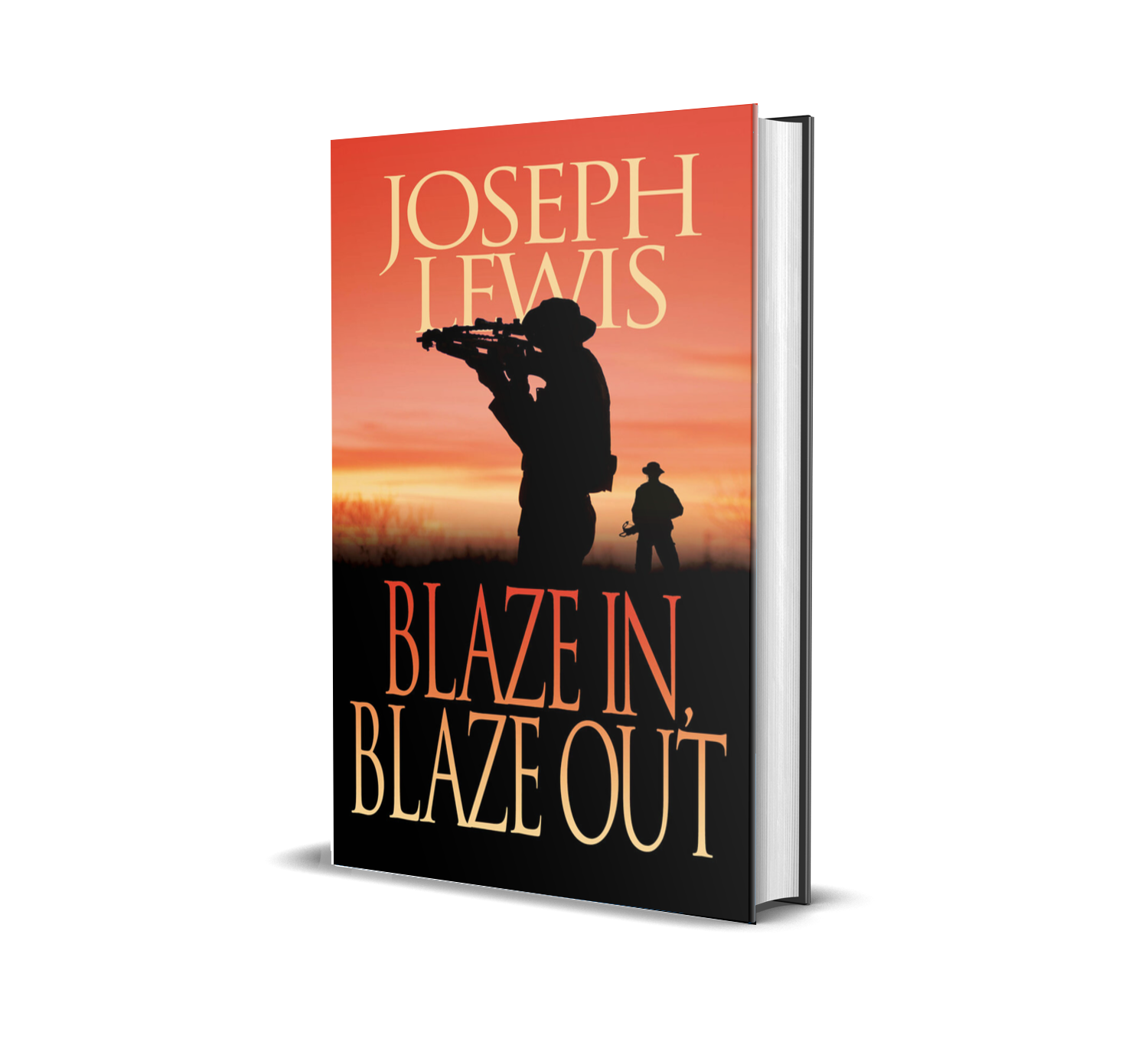
For your convenience, I’ve included a link for purchase, the book synopsis, and some reviews. I hope you check it out. You can find Blaze In, Blaze Out and all my books on my website at https://www.jrlewisauthor.com
I would love to hear your thoughts, so please use the comment section below. As always, thank you for following along on my writing journey. Until next time …
Blaze In, Blaze Out
Action Thriller of the Year -BestThrillers Book Awards
Working with a joint multi-law enforcement task force, Detective Pat O’Connor infiltrated a Ukrainian crime family headed by Dmitry Andruko. O’Connor and his control, Detective Paul Eiselmann were the linchpins in the guilty verdict.
The two detectives thought it was over.
Eiselmann planned for a quiet weekend with his family at home. O’Connor planned on attending a high school soccer game and then head to Northern Wisconsin for a fishing trip with another cop, Detective Jamie Graff and four teenage, adopted brothers: George Tokay, Brian Evans, Brett McGovern, and Michael Two Feathers.
But Andruko is ruthless and vindictive. From his prison cell, he hires two contract killers to kill both O’Connor and Eiselmann and anyone else in the way. The killers can be anyone. The killers could be anywhere, and the killers could strike at any time.
The quiet weekend and the short vacation turn into a deadly nightmare as O’Connor’s and Eiselmann’s lives and the lives of the four boys are in peril.
2022 BestThrillers.com Awards – Best Action Thriller
Readers’ Favorite Honorable Mention – Fiction – Crime
Author Shout Recommended Read
Literary Titan – Gold Book Award Winner
“Blaze In, Blaze Out is an over-the-top thriller. Lewis jumps you seamlessly between timelines of one exhilarating roller-coaster ride to the next.” -Authors Reading
“Blaze in, Blaze Out with its engaging plot and deep themes is a riveting novel and fast read that will keep readers in suspense and hooked till the last page.” -Literary Titan
“A story that is so much more than you expect with well-drawn characters that keep you turning the pages.” -Beyond the Books
“This book was not what I expected. I thought it would be about a mobster and hired assassins. It was, but it was also about so much more.” -Charlie Bees Books
“Blaze In, Blaze Out is a crime thriller that captures a reader’s attention right from the start. Author Joseph Lewis is a strong storyteller, using characters from his previous novels and once again putting them in danger.” -Joan Livingston, author of the Isabel Long Mystery Series
“Joseph Lewis uses carefully constructed settings and intriguing characters to create this unique and captivating action-packed thriller.” -Sublime Book Review
“A superb crime drama simmering with suspense and deep character studies en route to an explosive finale.” –BestThrillers.com
Available in Kindle and Paperback, and Audio!
May 19, 2024
Another Snippet From Caught in a Web
This next month, June, my newest book, Black Yéʼii (The Evil One) goes into production for release in January, though it will be available for presale much sooner than that. This book is a sequel of sorts to an earlier book of mine, Caught in a Web. At the end of Web, a pact was made and a story invented to protect the lives of four individuals. In Black Yéʼii, the secret was broken, and people are dying as a result.
Yéʼii are spiritual deities of the Dine’, or Navajo people. There is one they seldom, if ever, speak of: Black Yéʼii. They consider Black Yéʼii, to be The Evil One. The Dine’ believe that by just speaking the name, they are inviting it into their lives. Black Yéʼii uses the five senses to trick an individual into seeking pleasure in areas of life, but, by doing so, they bring harm to themselves or others. Black Yéʼii interferes with living in the light of inner life and harmony, or Hozho, and Black Yéʼii violates Hozho by creating darkness and evil among people. This is the heart of the story behind my newest, Black Yéʼii (The Evil One).
In this post, I want to highlight two things: first, Detective Pat O’Connor, who you know to be a character in each of my books; and second, give you a snippet from Caught in a Web, highlighting O’Connor’s work and investigative skills, especially, his intuition.
O’Connor is a staple in my books. Dependable, quirky, intuitive, and fiercely loyal, and is a friend to several of the Evans boys, particularly Brian, Brett, and George. The Evans boys, in one way or another, appear in each of my books.
O’Connor’s father walked away from his mom and two brothers, and it became a struggle growing up. His mom, seldom home, had to work two or three jobs just to put food on the table and to pay the bills. His two older brothers dealt drugs, and expected Pat to also join them. He refused because he wanted a better life.
It was on an undercover assignment that O’Connor discovered his brothers running drugs and weapons for a large criminal enterprise and it was Pat who placed the handcuffs on them and read them their rights.
Paul Eiselmann is his partner and is his best friend from elementary school on. Paul’s dad was a father to Pat, and treated him as his own son. So it was only natural that O’Connor “fathered” Brian, Brett and George, three of the Evans boys, much like Paul’s father did for him.
O’Connor is known for working alone, and in this scene, O’Connor is doing just that, searching for a missing kid, fearing that MS-13 has taken him.
CHAPTER 70
O’Connor drove slowly around Waukesha searching. He started with one broken down and abandoned building and moved on to others, all the while knowing where he would end up. He had even checked out an abandoned house or two, but leaving bodies in houses didn’t feel right. That was something he would never have done and the only way he had succeeded and lived as long as he had was because he thought like a criminal.
With each strike out, the thought solidified that perhaps Fuentes and Manny Benevides hadn’t strayed too far from their killing ground.
He drove past the YMCA slowly dreading what he might find. His eyes darting from side mirror to rearview mirror and back out the windshield. Streets were pretty empty. Nothing looked out of place or out of the ordinary.
He turned onto another, darker street and it too was empty. Nothing moved. Snow gathered unimpeded in the street, on the parked cars and on sidewalks like a sparkling white blanket. His car making the only tracks.
O’Connor loved freshly fallen snow. He loved the purity of it. In his world it was the only thing that could be classified as pure.
He parked down the street from the building and sat in his car with the engine off.
Across the street sat the crumbling apartment building. Only a few lights were on behind the curtains. The rest were dark.
Out on the street nothing moved. All was still. That didn’t bring him any comfort though. He knew what he was going to find. He just didn’t know how gruesome it might be. He shook his head considering the irony of the purity and the whiteness of freshly falling snow and the ugliness of what he knew he’d find down in that basement.
He had stalled long enough so at last he opened the door of his car, unfolded his lanky body and shut the door with barely an audible thud. He pulled the .357 mag out of his shoulder holster and held it tightly to his leg, his index finger at first positive position.
O’Connor moved with purpose, his head on a swivel. By the time he reached the familiar doorway, his long hair and his shoulders were covered with big, wet snowflakes.
First thing O’Connor noticed was that the yellow police tape had been torn away as was the sticker warning away any intruders that the building was a crime scene and therefore anyone entering would be trespassing. Fitting, he supposed, that they would disregard a simple warning that would have been effective for most right-thinking individuals. But Fuentes and MS-13 were not right-thinking. No, they were twisted and somewhere around the corner and down the street from right-thinking.
He slipped on a pair of latex surgical gloves and gingerly and carefully tested the door latch on the handle and found it unlocked.
O’Connor took a deep breath, swung his gun up at the ready, opened the door and stepped quickly in and to the side, crouching down and blinking rapidly allowing his eyes to adjust to the darkness.
—

For your convenience, I’ve included a short description for Caught in a Web, along with a couple of reviews and the purchase link. Of course, you can find it, along with all my books, on my website at https://www.jrlewisauthor.com
“This important, nail-biting crime thriller about MS-13 sets the bar very high. One of the year’s best thrillers.” – Best Thrillers
“…the right blend of tension and intrigue …” Midwest Book Review
The bodies of high school and middle school kids are found dead from an overdose of heroin and fentanyl. The drug trade along the I-94 and I-43 corridors and the Milwaukee Metro area is controlled by MS-13, a violent gang originating from El Salvador. Ricardo Fuentes is sent from Chicago to Waukesha to find out who is cutting in on their business, shut it down and teach them a lesson. But he has an ulterior motive: find and kill a fifteen-year-old boy, George Tokay, who had killed his cousin the previous summer.
Detectives Jamie Graff, Pat O’Connor and Paul Eiselmann race to find the source of the drugs, shut down the ring, and find Fuentes before he kills anyone else, especially George or members of his family. The three detectives discover the ring has its roots in a high school among the students and staff.
May 11, 2024
A Snippet from Caught in a Web
I wanted to give you a snippet from my book, Caught in a Web. It is the first book I wrote after I wrote the Lives Trilogy, and it deals with gangs and drugs, particularly drug overdoses from a mix of heroin and fentanyl. At the time I wrote the book, fentanyl was just coming into its own as lethal and deadly, especially as it was mixed with heroin.
Caught in a Web deals with cops trying to shut down a drug ring before MS-13, a violent gang that controls the drug, sex, and weapons traffic from Chicago to Door County Wisconsin and Northern Wisconsin. My story takes place in Waukesha, Wisconsin just like my other stories.
In this scene, we find a frustrated and tired Detective Jamie Graff, who is heading up the investigation. He is having no luck so far in tracking down the source of the drugs, and at this point, has no idea MS-13 is in town searching for the same thing, but in a deadly way to send a message. Graff has enlisted the help of two veteran detectives, Pat O’Connor and Paul Eiselmann, and the three of them are sitting in a diner discussing the case and the lack of evidence.
CHAPTER 41
There were times when Jamie wondered if he was tripping down the bramble path scraping up the palms of his hands and tearing holes in his knees as he crawled along blindly. There were other times he felt like he was speeding along the autobahn in a shiny red convertible with the top down on a sunny day at a hundred and twenty miles an hour. Police work was like that. As John Denver used to sing, Somedays are diamonds, somedays are stones. And Jamie understood the thing about police work was that he never knew from day to day or from moment to moment if he was on the bramble path or the autobahn. At this point in the investigation, he had the sick feeling he was on the bramble path and didn’t know how to get off.
He had worked this case for what- two or three days? And he still didn’t know what he had or where he was going. Shit, it felt like two or three years. When kids died ugly deaths, it always felt like years, not days.
The three cops didn’t say a word. The closest thing to a word was a grunt from O’Connor. He’d read something, run a hand through his long hair and grunt. More like a “huh” or an “um.” Something like that. The first couple of times he did that, Jamie would look up expecting a comment or an insight. Instead he got nothing, so after the fourth or fifth time, Jamie didn’t look up at all.
Jamie rubbed his eyes. He was tired of reading and frustrated from not finding much to work with. He just wanted to get home to Kelly and Garrett, eat a nice dinner and drink a beer.
“Okay, what do we have? Tell me one of you found something useful.”
Eiselmann said, “I don’t see anything here you don’t see. I mean, we have Kevin Longwood’s prints and DNA in the building. Hell, they were easy enough to match, since his prints and DNA were all over his car. So one thing we know for sure is that he was involved in at least two deaths, probably more.”
“And,” O’Connor started and stopped. “And my gut tells me that whoever killed him is the other set of prints in the building and in the car. Whoever it is, I’m guessing it’s a boy, not a girl and probably the same age as Longwood. I’m betting they were friends. He has prints on the syringe and on the rubber thingy and prints all over Longwood’s car.”
“Tourniquet. The rubber thingy is called a tourniquet,” Eiselmann said.
Ignoring their banter, Jamie asked, “But we don’t know who it is?”
“Yet,” Eiselmann said pointing a pen in his direction. “If we run the school security tapes back, we find who hangs with Longwood, find a way to get his prints and we get him. We watch the places in the notes given to Jeremy and I’m willing to bet our guy shows up. It’s only a matter of time.”
Speaking to Eiselmann, O’Connor said, “You don’t believe just one kid and Longwood were behind all of this, do you?”
Eiselmann shook his head and said, “Nope. But if we find the kid who killed Longwood, he’ll lead us to whoever is behind it all.”
—

“This important, nail-biting crime thriller about MS-13 sets the bar very high. One of the year’s best thrillers.” –Best Thrillers
“…the right blend of tension and intrigue …” Midwest Book Review
It is a PenCraft Literary Award Winner and won several other awards. Caught in a Web is available in Kindle, Paperback, and Audio formats. Here is the link to Amazon: https://amzn.to/2GrU51T
I would love to hear what you think, so please drop your comments below. I hope you check Caught in a Web out, and I appreciate you following along on my writing journey. As always, until next time …
May 10, 2024
A Snippet from Spiral Into Darkness
I want to share with you a snippet from my book, Spiral Into Darkness my book about a serial killer. This book is fun for the reader because I hide the why behind the murders until the very end.
To set this up, like most serial killers, he is successful, intelligent and methodical. There are no clues, no leads, and the only thing the FBI and local police have to go on is the method of death: two bullets to the face- gruesome and meant to send a message. But it’s difficult to understand any message from a dark and damaged mind.
CHAPTER SEVENTY-SEVEN
Waukesha, WI
The snow came down in big, wet flakes. At first, it didn’t stick to the ground but instead melted on contact. And then as if the earth said, “Screw it,” the amount of snow grew. Inches so far, but George guessed they might end up with a foot or two. For Wisconsinites, one or two feet of snow was no big deal, although schools and businesses might be delayed or closed. Maybe. Every kid’s wish, even George’s. That way, they could go sledding or have a snowball fight.
For a kid who grew up in the desert, snow was both mysterious and a delight. He could sit for hours and watch snow fall. He’d catch snowflakes in his hand or on his arm and study them, marvel at them. And he’d smile.
On this day however, he didn’t care about snowflakes. He didn’t care how much snow would accumulate. Restless and anxious, he spent time in the woods separating the Limbach property from the Evans property after they had returned from school and practice. He had started on the shoulder of the highway facing the woods. He didn’t enter right away, but studied it looking for a path, any path. He didn’t see one. At least one that showed itself easily.
At last, he made his way in slowly. Bending this way and that as he avoided breaking brittle limbs and twigs. He looked for footprints as if they’d magically appear before him as they did in his dream. Only in his dream, he didn’t see footprints. And if there were footprints, they’d be swallowed up by the rapidly falling snow.
—

I hope you liked it. If so, check it out. Here is what some readers had to say about it:
“A thoroughly compulsive police procedural by one of America’s most promising new writers.”
Best Thrillers
“The most bone chilling and terrifying read of Lewis’s yet!”
Jill Rey, Book Reviewer
“Spiral into Darkness literally begins with a bang, actually two, because a serial killer is on the loose in Milwaukee. But fortunately author Joseph Lewis assembles a talented group of investigators we know well from his previous books to tackle this case. Look for strong writing and a great deal of suspense in this well-crafted thriller.”
Joan Livingston, author of the Isabel Long mystery series
“Powerful! The best to date. Masterful use of imagery and the ability to manipulate the reader’s emotion! An outstanding read!”
Theresa Storke, Reviewer
“Another excellent read – this author doesn’t disappoint. Fast-paced, intrigue and unexpected twists. Characters build from earlier books, but the story is so well written that this book can stand alone. Definitely a must read. Loved the book!”
Sharon King, Reviewer
You can watch the YouTube Book Trailer for Spiral Into Darkness here: YouTube: https://youtu.be/PrDxfbfqV_8
Spiral Into Darkness is available in Kindle, Paperback and now in Audio formats. You can find it at: https://tinyurl.com/thebm67a
I would love to hear your thoughts, so please feel free to use the comment section below. As always, thank you for following along on my writing journey. Until next time …
May 3, 2024
Uh Oh – Foreshadowing

There is an art to foreshadowing in fiction, and as a reader, I’m aware of when it is clumsily handled. I’m sure you are too. As a result, I work hard in my writing to bring it on gradually, but there are times when I stick it right in the reader’s face and then build the story around it.
An example of me confronting the reader abruptly is in my book, Betrayed. Here is the first couple of paragraphs of the story:
CHAPTER ONE
It was still. No breeze. The air, dead, smelled of red dirt and decay. A hawk circled overhead, cawed once, and glared at him. At least Brian thought it did. He wondered vaguely if it was an omen, a message from the spirit world George often talked about. A warning, perhaps. Fitting if it was, Brian thought. If they survived, he would ask him.
He lay prone in the dirt and glanced behind him. Brett was not visible. That was good. He wanted his brother safely behind the big boulder. Hidden.
Brian wasn’t afraid to die. He just didn’t want to die. Not yet, anyway. Fifteen was too young. However, he made a promise to watch over George and Brett, and that he would do. If it came to it, he would protect his two brothers any way he could, including sacrificing his own life.
—
The plot of Betrayed is right there. This is what the book is about, in addition to several other storylines, but the meat of the book of the book is found in the opening paragraphs.
The reader knows a fifteen-year-old named Brian (a recurring character in my books) might die along with two other guys (his brothers, also recurring characters in my books). They may or may not come out alive. The reader doesn’t know the who, the what, the why or the where until he or she gets further into the story, but the reader is already set up for suspense and a mystery.

That’s foreshadowing in a nutshell.
Taken directly from a website, Literary Devices: Foreshadowing is a literary device that writers utilize as a means to indicate or hint to readers something that is to follow or appear later in a story. Foreshadowing, when done properly, is an excellent device in terms of creating suspense and dramatic tension for readers. It can set up emotional expectations of character behaviors and/or plot outcomes. This can heighten a reader’s enjoyment of a literary work, enhance the work’s meaning, and help the reader make connections with other literature and literary themes.
The links are included by Literary Devices to help explain further. For any writer or reader, this website can be valuable to you, so check it out.
John Cheever is an American author who wrote both short stories and novels. I was introduced to him in one of my English classes in undergrad, and his short story, The Swimmer, is one of my favorites. The entire story is foreshadowing at its finest. It just builds and builds until the last word and period.
His character, Neddy Merrill, has it in his head to “swim home.” Not an easy task, since he is nowhere near a lake or river. He is sitting poolside with his feet dangling in the water. His idea is to swim from one backyard pool to another until he reaches his own.
Weird? Yes! Unusual? Absolutely! But that is Neddy’s quest. Along the way, the weather builds up from sun to cloudy and from cloudy and cool until the end of the story when the reader finds out it is fall, not summer, and the pools in question are not bright and clean, but dirty and not in use because of the season.
But throughout the story, Cheever uses the weather and various characters’ expressions and words to foreshadow the end of the story.
The trick of foreshadowing is to not give it all away, but introduce it bit by bit, letting the reader work for it. Done well, foreshadowing can make for an enjoyable read.
Another example of foreshadowing is from my book, Fan Mail, and once again, this bit takes place at the beginning of the story.
CHAPTER 1
The boys, victorious in the soccer match against their cross-city rivals, walked away from their end-of-game team huddle when the first of the explosions rocked the ground they stood on. No one knew what the explosion was, only that it came from the stadium parking lot. Several explosions, actually. Two at least, maybe a third.
The stadium shook. The press box, not the newest of structures, fell down on one side and those in the box scrambled, pushing and shoving to get out.
Stunned, the crowd was silent.
At first. Then, in panic and confusion, they ran, sometimes climbing over one another, knocking down whoever was in their way.
—

In this passage, the foreshadowing isn’t clear like it is in Betrayed. The reader knows something is up, but again, doesn’t know the why or the who. Rather, I took time rolling out the story, but the endings of my short chapters propel the reader forward.
I write short chapters to not only move the story along, but to create a sense of urgency in the reader to keep going, keep the pages turning. I call them “Patterson Chapters,” because I stole the idea from James Patterson who readers say I emulate. But my chapters are constructed in such a way as to foreshadow the coming action.
You can find the links to all nine of my books, including Betrayed and Fan Mail on my author website at https://www.jrlewisauthor.com
Let me know your thoughts by commenting on this post in the comment section below. And as always, thank you for following along on my writing journey. Until next time …
April 26, 2024
Meet Frank DeRuosi – An Author!
There were times when I had to stop and think, ‘Am I talking to and about myself, or am I talking with Frank DeRuosi?’ Perhaps more than any other author I’ve interviewed, I am probably more like DeRuosi than not. Both of us have been in education for many years, though DeRuosi has spent his time at the elementary level, while I spent my time at the middle and high school level.
More than that, though, his characters are adolescents, since he writes in the Young Adult Fiction genre, while my characters (besides my three detectives) are adolescents. But I write in the thriller-crime-mystery genre. But the similarity of writing, including our approach to writing is astonishingly similar. Both of us deal with adolescent angst, and inner turmoil is at the core and crux of what we write.
Frank grew up in East Boston, Massachusetts, but moved to Philadelphia in 1991, and has called Pennsylvania his home since. He currently resides in Ambler, Pennsylvania – a small town about 17 miles northwest of Philadelphia – with his wife Karin. He has worked in education for 21 years, teaching second grade through fifth. He recently became a published author with Black Rose Writing. His debut novel, Holding Back the Tide, a young adult coming of age story, was released in May 2023. Based upon my interview with him, I know I will pick up his book and give it a read.
I hope you enjoy the interview as much as I did. Here is Frank DeRuosi!
What was it that made you decide you had a story to tell and to become an author?
I have always been an avid reader, and I think my love of reading influenced my desire to write. From an early age, I enjoyed disappearing into a good book and living amongst the characters there. Writing was just an extension of that love of reading. I wanted to create people, and worlds, and events that drew the reader in and made them a part of the world unfolding in the story.
As for the story I had to tell, my neighbor asked me to read his personal narrative for his high school writing class. It was about his struggle as a teenage boy coming to terms with his emotions, being told all his life that boys don’t cry, and how his trying to keep his emotions buried has led to a good deal of anxiety in his life.
As an author or writer, what sets you apart from others?
Well, my first novel is written from the point of view of a teenage boy. But rather than him being a strong, self-assured, over-confident person, he’s vulnerable and uncertain. He second guesses every choice he makes, and allows his own self-deprecating voice to be the loudest in his head. He’s not your typical male main character, in that he is his own antagonist. I think he allows teenage boys to see themselves as something other than stoic and in-control. They can relate to the main character’s struggle with being a person and how that conflicts with the gender box boys are taught to fit into.
How do ideas for your stories present themselves? How do you know what story lines to follow and which to ignore?
It’s difficult to say. The idea for Holding Back the Tide, as I mentioned, came from proof reading a personal narrative. I am currently working on a second novel. That idea came to me as I was listening to No One is to Blame by Howard Jones. As I’m writing, I try to run ideas almost like a movie playing in my head. Sometimes I can see the action, the dialogue, the imagery needed for the chapter. Other’s I hit a wall. I may not be able to describe something well, or hear the dialogue of the characters, or not quite nail the setting. I tend to leave those moments behind and look for a new avenue to travel down.
What genre do you write, and why?
Right now, I’m enjoy writing young adult fiction. I’m a fiction reader to begin with. It really is the only thing I enjoy reading. Teaching fifth grade, I have read so many wonderful middle grade books – Jordan Sonnenblick immediately comes to mind, that I wanted to write something that would resonate with kids, though a bit older than primary school. It’s always been tough to be a teenager- the changes taking place in their lives and the battle with their own feelings and self-doubt. I wanted to write for them. To help them, I guess, navigate that constantly changing landscape.
Besides writing and telling a good story, do you have any other talents?
I love to cook. As a kid, I would watch my mom cook dinner, and I guess it rubbed off on me. I’m a ‘let’s see what is in the refrigerator’ sort of cook. While I have followed recipes, I enjoy flying by the seat of my pants approach to meal prep. And, I am a huge fan of the one pan dinners – where it all just comes together in one frying pan or one pot. Easier clean up.
If you were to name one or two books that you deem unforgettable and that had a major impact on you, what would they be, and why?
That’s an easy one: A Prayer for Owen Meany by John Irving. John Irving can pen an incredible tale. What I loved about Owen Meany, beyond the story itself, was how Irving sprinkled what seemed to be random details, and happenstance situations throughout the book, but somehow wove them all together in the end. I have read that book many times and still am enthralled by it.
What authors do you read regularly? Why?
John Irving, of course. I enjoy Richard Russo, Caleb Carr, Jerry Spinelli, and Neil Shusterman. The list is extensive. What I like about these authors is their ability to draw you into the story. It’s not just that the book is good. When you finish their books, you feel like the characters are your friends, and you’re left wanting to know more.
If you were to have dinner with 5 individuals living or dead, who would they be and why?
I’m never good with questions like this. My students are always posing ‘what’s your favorite’ types of questions and I’m almost always at a loss. But, having to choose five, I would say Mark Twain, because he just seemed like the sort of person you’d want to chat up at a bar. Paula Poundstone because I enjoy her sense of humor. I’ve always been interested in the colonial period of the United States, so Ben Franklin would be someone I’d like to sit down and talk with over a meal. Chrissie Hynde, from the Pretenders, simply because I think she writes well and has a beautiful voice. And finally, Martin Short. I think that would be one interesting evening.
What is your writing routine? When you write, do you plan or outline ahead or are you a “pantser”?
I am definitely a “panster” to be sure. I generally have an idea for how I want to the story to start, and a loose thread of where I want it to end up. But, writing works best for me when I let the characters and the events of the story drive the plot. Sometimes the dialogue in a chapter can spur on a new direction, or give way to a change in events. I like to see where my writing takes me. There are times the chapters are gushing like a ruptured six-inch water main, and times when it’s just a dribble from a garden hose. It really depends on the day.
When writing, how much do you read? Do you read in or out of your genre?
I don’t read much when I’m writing. I find that it’s too easy to mimic what is in the stories I’m reading. Also, I second guess myself, my style, whether my writing is good enough. So, I try not to delve into books when I’m in the middle of a manuscript.
Is there something you set out to do, but somehow, it didn’t work out for you? (In writing, or something else you felt was important to you at the time?)
Oh gosh, doesn’t everyone? I had every intention of being a lawyer. I’ve always been interested in the law. My bachelor’s degree is in criminal justice. In my twenties, I took a job as a paralegal and realized I hated working in a law firm. So, there was that. And then there was the time as a teenager I had convinced myself to become a Navy pilot. I met with a recruiter, but after some thought, and the realization that I’m afraid of flying and being in water that is over my head, decided that wasn’t a road I should travel down. The list isn’t exactly endless, but it goes on.
What tips would you give to new or even experienced writers?
Don’t be afraid to let other people read what you write. Feedback is so important, even negative feedback. To grow as a writer, you have to be open to what people like and what they don’t like. You learn how to improve upon what is lacking, and how to craft what resonates with people. Just write. Like anything, the more you do it, the more skilled you become.
How did you “teach” yourself to write or did it just come naturally? What lessons would you pass on to others?
Well, I have no real formal training as a writer. I never took creative writing classes in college or grad school. I was never a part of a writers’ group, either in-person or on social media. I think what helped me was the fact that I love to read. Books introduce you to so many writing styles. It gives you background to call upon. I enjoy writing, whether it’s a witty email at work, or a social media post, or a manuscript, writing for me, is almost like therapy.
How do you handle a negative critique?
That’s a great question. I was the president of my school union, as well as an elected official to my town’s council. I’ve gotten rather used to less than flattering critique. At first, I was bothered by it, taking it way too personally. Now, I just brush it off. I saw a meme on Facebook once that read: ‘You can be the sweetest, juiciest peach in the basket. But there will always be someone who doesn’t like peaches.’ I think that applies to writing. There will always be someone who doesn’t like your book for whatever reason. You just have to accept that. Hopefully, there are more people that do like it.
Is there a type of writing/genre that you find difficult to write? Why?
Yes! Non-fiction. Don’t like to read it. Don’t like to write it. I read for entertainment. And non-fiction is the furthest from entertaining for me. I want to tell a story, one that you can see in your mind. Non-fiction writing is like producing a grocery list, or an itemized accounting of your day. It really doesn’t allow for creativity, which is why I like to write.
How important are the elements of character, setting, and atmosphere to a story, and why?
About as important as oxygen. Character, setting, and atmosphere is the story. They are the very thing that draw us into the story and help us decide if we like it or not. Those three-story elements are the lifeblood of the book. They all need to work together in harmony. If they don’t, you lose the reader. When they do, it’s magical.
Do you see yourself in any of the characters you create? How/Why?
If you read Holding Back the Tide, there is a little bit of me in the main character, Charlie McIntyre. I wrestle with my feelings, not really wanting them to be seen. Charlie is like that. John Irving once said, “write what you know” so I think, where characters are concerned, there is a little bit of the author in each character. It might be a mannerism, or a certain personality trait, or even a preferred style of banter, but the author is there.
Is there an unforgettable or memorable character that will not leave your head, either of your own creation or from a book you’ve read?
This may come across as vain or a bit self-involved, but I find myself thinking of the characters in my book. The novel itself took just about two years to write and then another eighteen months or so of edits and revisions. Over that time, I really came to know the characters, and I think of them often. Weird, I know, as they are not real people. The book takes place in Ocean City, New Jersey. I had a reader comment that when she is in Ocean City or on the beach, she finds herself looking for Charlie and his friends. That’s about the best compliment a writer can get, I think.
Tell us about your most recent book. How did you come up with the concept? How did you come up with the title? From your book, who is your favorite character? Who is your least favorite character? Why?
To date, there is only the one book published. However, I am working on a new manuscript tentatively titled No One Is To Blame. It’s about a fifteen-year-old boy who loses his best friend to illness. The story is about his loss, and how he comes to terms with the immense hole left in his life by his friend’s passing. There is a line in the same titled song by Howard Jones that goes “Doctor says your cured, but you still feel the pain” and I thought to myself, that is what loss is like: a loved one dies, and you go on, but the pain is always there. I wanted to write about that, but from the point of view of a young man. Again, I think teenage boys need to see that it’s okay to be vulnerable. It’s okay to not always be okay.
From my current book, my favorite character is Charlie. He is empathetic and caring. But he is also moody and angry – like most teenage boys. It’s his inner struggle that endears him to you. You want to take away his pain, but you know he must live through it, and find his own way to rid himself of it.
Well, I hope your interest has been nudged enough for you to check out his book, just as mine was. For your convenience, the links to Holding Back the Tide are below. I am also looking forward to the one he’s currently working on, No One Is To Blame.

Author/Media Contact Information:
Facebook: https://www.facebook.com/FrankDeRuosiAuthor
Instagram: https://www.instagram.com/frank_deruosi_author
Links to Book:
Amazon:
Amazon.com: Holding Back the Tide: 9781685131968: DeRuosi, Frank J.: Books
B & N:
Holding Back the Tide by Frank J. DeRuosi, Paperback | Barnes & Noble® (barnesandnoble.com)
Good Reads:
Holding Back the Tide by Frank J Deruosi | Goodreads
If you are interested in any of my books or any of my writing, check out my author website at https://www.jrlewisauthor.com to find my books, their descriptions and links, as well as two blogs I write. My other author interviews are there, too. Until next time …