Joseph Lewis's Blog, page 2
July 8, 2025
Importance of Reading

My grandson, Mason, just turned two. Already, he has developed an interest in reading. This is due to his mother and father, my daughter and son-in-law, who are avid readers.
Each night before bed, Mason gets to pick out two books for either his mom or dad to read. It has become a ritual. And what is nice is that during the day, Mason will grab a book and either look at the pictures himself, or more likely, seek out his mom, dad, grandpa or grandma to read to him while he sits on a lap.
I remember growing up in the old house by the river, and even though we didn’t have much money, I had my own little library of books. Either I read them myself or mom or dad or one of my older sisters would read to me. Reading, along with writing, became my passion.
Later during elementary school, I’d wait for my father to pick me up from work to go home to supper. Where did I wait? The library across the street from school. I’d wander around the stacks looking at covers, reading the descriptions, and often would sit on the floor by the stack to read them. It was a wonderous time for me.
And I found out years later, courtesy of Stephen King, that reading is essential to writing. He is quoted as saying, “Unless you read, you will not have the tools to write.” I have to agree with him. I’ve learned much from reading- not only by reading in my own genre of thriller-crime-mystery, but outside of my genre. Setting, word choice, certain phrases, sentences and paragraphs have stuck with me to this day. Here are my reviews:
“Understanding one’s past can be difficult. Confronting one’s past and finding justification for it might be impossible. That’s the dilemma and task facing August Simms as he travels back to Rhome, Texas, in 1897 in Brian Kaufman’s brilliant novel, A Persistent Echo. While it might be categorized as a work of historical fiction, it defies strict placement in one genre, as he deftly blends and blurs lines. Filled with wit and wisdom, his prose is poetic, yet sparse with only what is necessary to keep the reader turning pages. Simms faces his past and tries to reconcile what happened to him, to his wife, and to those who were affected by a murder and lynching that took place so long ago. If you read one book this year cover to cover, this book by Kaufman needs to be it. A passionate 5 Star recommendation!”
“In Danger of Judgment by David Rabin, you find a bright and tenacious pair of Chicago detectives who team up with one of the most interesting, quirky characters I’ve come across in a long time. The trio tries to solve a series of murders that echo executions and put away a former army operative who they discover is behind it all. Throw in two rival gangs vying for control of the city’s drug trade, and you have a thriller that keeps you turning pages until you reach the ending. Honestly, this is one of the best books I’ve read in a very long time! I wanted to put it down only to prolong my reading of it, but I couldn’t. The pacing, the characters, the action were spectacularly crafted. I can’t believe this is Rabin’s first book, and I can’t wait for book #2. An enthusiastic 5 Star recommendation!”
Terminal Exchanges by Gary Gerlacher is #5 of the Docker/Banshee series, and while I enjoyed the other books, this might be his best. Set in Miami, Docker is an emergency room doctor. A gang storms into the hospital and assassinates one of his patients, but it doesn’t end there. He discovers that a woman and her young son might be next. So Docker does what he does best- besides heal patients. He and his trusty former police dog set out trying to find answers, only to discover that there is much more to this than just a gang. Terminal Exchanges is intricately crafted, fast-paced, and the action is nonstop. Gerlacher creates characters the reader can connect with, and he has a knack for creating tension. His writing sticks with you long after you close the book. A wonderful, fun read worthy of a 5 Star recommendation.”
—
I posted all three reviews on Goodreads, BookBub, Substack, and if possible, on Amazon. Gerlacher’s book isn’t available currently on Amazon yet, hence, I will have to wait until it comes out to post it there.

Authors and I exchange books for several reasons. One, we can add constructive criticism on the books which is helpful for all authors. Second, we can add a review for that author on various sites to help get the word out.
Reviews help authors so much, more than you realize. Word of mouth “promotion” is a wonderful source to help us sell books. When a book hits 50 reviews on Amazon, that site will promote that book to its users. Free advertising, which is helpful.
Pro tip: please, please, if you read a book, leave a review. Obviously 5 star and 4 star reviews are the best, but each review has weight and creates momentum for that book and the author who wrote it.
If you’ve not found my website yet, I encourage you to toggle over to https://www.jrlewisauthor.com where you will find each of my books, their covers, descriptions and a purchase/buy button in case you want to give one a read. All of my books come in three formats: Kindle, Paperback, and Audio. The only book not in Audio is my latest, Black Yéʼii but it is currently being worked on and should be available in this format shortly.
Here are two different interviews I’ve taken part in about my writing and specifically my book, Black Yéʼii.
I would love to hear what you think about my books or other books you’ve read that you enjoyed. Drop a comment in the area below this post. As always, thank you for following along on my writing journey. Until next time …


June 13, 2025
Crafting the Emotional Hook – A Dark Novel

I am a reader who needs to connect to one or more characters at the outset. Short of that, the story has to hit me emotionally in order for me to invest my time with it. Probably like you, I’ve read many books where I didn’t care about the characters, the setting or circumstances, and I ended up putting the book down, never to be picked up again.
I believe it was Stephen King who said, “No tears in the writer, no tears in the reader.” In other words, there has to be feeling and emotion in the book and it has to- simply has to- be felt by both the writer and the reader. If the writing is flat, the reader won’t be engaged and that will be the end of it. The chances are your other books won’t be purchased or read by that reader, and if the reader spreads the word- like they do, well, you can guess what happens.
This is the opening chapter of my newest book, Black Yéʼii.
Chapter One
Waukesha, Wisconsin
The doorbell rang, and Carmen Benevides opened the door to three kids she didn’t recognize. She assumed they were friends of Angel. Actually, she knew they weren’t kids, but at her age, anyone younger than she was a kid. And when they stormed into the house and the two boys threw her on the couch, she realized they weren’t friends of her son, either.
—
How did you feel as you read that paragraph? I’m sure there were questions, but what did you feel?
Here is the beginning of the second chapter of Black Yéʼii:
Chapter Two
Waukesha, Wisconsin
Angel cut his lights and then parked on a side street a block away from his home. He would not make the mistake of pulling into the driveway, or even parking in front of the house. He’d rather try to get to his house, and in it, undetected.
Angel wanted to believe he was over-reacting. He had thought about possibilities on the drive to his neighborhood.
Maybe the text was from his mom. Maybe she was sick, or maybe she fell and hurt herself. But as soon as he thought about it, he shook his head. He dismissed each possibility because he knew the truth. Yet, he hoped.
Angel reread the message.
I need you to come home right away. It’s urgent.
He knew his mother did not write that text, because she never texted him. Never. Those weren’t her words, because when she spoke or wrote anything, she mixed Spanish with English. That was just her way, and both she and he would laugh about it. And her fingers hurt too much from arthritis, so she found it easier to call him. Even at that, she never called unless she needed him to pick up something from the store.
No, his mother did not send the text. Someone else did.
—
I’ll ask you the same questions as I did before: How did you feel as you read those pages? I’m sure there were questions, but what did you feel?
The emotional connection is of the utmost importance, and I would suggest to you, the emotional connection in any thriller, even any horror story is even more important. Otherwise, you have just a bloody and gory slasher story.
Think of the book and the movie, Jaws. That was a four character movie for the most part: the sheriff, the biologist, and boat captain, and the shark. Other than fear, did you have any emotional investment in either the book or movie? I didn’t, though I’ve read the book and watched the movie many times. I did care whether the sheriff and the biologist, and to some extent, the boat captain would survive. So I guess there was some emotional investment by me. But honestly, not much.
I think of Anne Frank: The Diary of a Young Girl, and I was much more emotionally invested in that book. Even though I knew they wouldn’t survive, I wanted them to. I silently cheered for them, urged them to find a way out. It didn’t happen, and it made me sad. There are countless books that moved me, and some brought me to tears.
I can tell you unashamedly that when I wrote, Fan Mail, I wept in several spots, both as I wrote it and as I edited it. Readers have shared with me they had a similar reaction. That’s an emotional connection.

My publisher, Black Rose Writing, came up with a promotional campaign and part of it was labeled, Emotional Hook. The first photo at the outset of this post is from that part of the campaign. Below are the pictures and the verbiage they had come up with:
You believe in promises, in the bonds that tie you to family. But what happens when those promises shatter? Angel Benevides made a pact to protect his loved ones, a secret buried after a night of violence. Now, that secret claws its way out, and the Black Yéʼii feeds on the exposed wounds of betrayal.
They’re coming for George Tokay. You watch, breathless, as loyalty is tested to its absolute limit and the crushing weight of grief threatens to pull everyone under. How far would you go when love means facing an ancient evil and the agony of loss?
Experience the heart-pounding journey of ‘Black Yéʼii‘, and prepare for a story that will stay with you.

Your past defines you, the scars—visible and hidden—tell your story. You see the young Navajo protagonist and Brian Evans in ‘Black Yéʼii‘ wear their traumas, not as marks of shame, but as symbols of their resilience against an encroaching spiritual darkness. It’s a raw, unflinching look at survival.
You’re drawn into their desperate struggle for hope as they confront pure, chaotic malice embodied by the relentless Landon Kerns and the ever-present shadow of the Black Yéʼii. Will they find redemption, or will the cycle of violence consume them entirely? The battle for Hozho, for balance, is brutal and deeply personal.
Discover the unyielding strength found in the fight for survival. Get ‘Black Yéʼii‘ and ask yourself: what does it truly mean to endure?

Darkness is real. You feel it in every scar, every whisper through the pines.
Black Yéʼii beckons you into a world where vengeance and heritage collide.
Are you ready to face the Evil One?

You thought you knew fear… until you enter the alleys of Waukesha at night. Every bloodstain, every echo of a scream, even a gasp, every scar tells a story of betrayal and redemption.
Black Yéʼii pulls you into an unforgiving battle between good and evil, where family loyalty can cost you everything.
—
For your convenience, I will include the links to both Fan Mail and Black Yéʼii below, though you can find each and all ten of my books on my website at https://www.jrlewisauthor.com
Fan Mail: Amazon: https://amzn.to/3eNgSdS
Black Yéʼii: Amazon Link: https://www.amazon.com/dp/B0DH8P5TNV
I would love to hear your thoughts would love to read your comments. Feel free to use the comment section below. As always, thank you for following me on my writing journey. Until next time …
June 6, 2025
Crafting the Antagonist – A Dark Novel

There are times when the antagonist in a novel jumps out at you. In my novel, Spiral Into Darkness, the serial killer is the obvious antagonist. The character kills people seemingly at random. Only as you read the book do you see connections. You find out who the serial killer is about midway through the book, but I kept the why hidden until the end, which has several juicy twists.

I enjoy books where I have to figure out who the real antagonist is. That’s the mystery within each of my books. That, and the why behind what they do. Some of my books have multiple antagonists, but usually one, maybe two stick out as the clear villain(s).
For my newest book, Black Yéʼii I had to have an individual who had no redeeming qualities. I started writing it with one in mind, but the more I wrote, Landon Kerns came to the forefront. Indeed, the antagonist- the real antagonist is sociopathic. No empathy, no conscience, no morals, and certainly no redeeming qualities.
Black Yéʼii is Navajo and is interpreted to mean, The Evil One and that is the subtitle for the book.

David King, who does the cover art for my publisher, Black Rose Writing, absolutely nailed the concept of the book. I gave him a couple of ideas and shared with him the meaning behind the title, and this is his creation. I can’t think of this book in any other way, and no other cover design would capture the book’s story.
Yéʼii are spiritual deities of the Navajo, and there are many. However, there is one Yéʼii they do not talk about. In fact, they don’t even mention the name. To do so, they believe invites evil into their homes and their lives. Superstition? Perhaps. The Catholic faith that has many saints, and are named in prayer by believers. There are medallions, jewelry, statues and knickknacks made in their likeness.
In Navajo lore, monsters, often referred to as Anaye, were a race of evil beings who plagued the Dine’, the Navajo people. They were defeated by the Hero Twins. The Anaye were responsible for hardship and suffering experienced by the Navajo people.
So for my book, Black Yéʼii, I had to come up with an antagonist that embodies the fear one of the protagonists, George Tokay, who holds the belief in Yéʼii. He is, after all, Navajo, and trained by his grandfather, Hosteen Tokay. His grandfather was known as a hatáli among the Dine’. In my book, Betrayed, which takes place on the Navajo Nation Reservation in northeastern Arizona, one of the elders refers to George as Hosteen Tokay and as a hatáli because of George’s training and closeness to his grandfather.

My publisher, Black Rose Writing, came up with a wonderful promotion for Black Yéʼii. The first picture of the bleeding rose, comes from it. The narrative that goes with it explains the idea of the antagonist of the book, as well as the concept of Black Yéʼii. It follows …
You think you understand darkness? You play in the shallow end. You haven’t seen the beauty in the blade’s edge, the symphony in the screams. They call me a monster. You might too. But you don’t realize… I’m just helping the Black Yéʼii sing its favorite song. And you? You’re about to hear every single note.
Dare to meet the monster? Read ‘Black Yéʼii‘.

The old songs, the ones about Hozho, about balance… they aren’t just stories you tell your children. You feel it, don’t you? That hum beneath the world, the light trying to hold. But then the whispers start, the Black Yéʼii scratching at the door of your spirit. You clench your fists, the steel of your knife a cold comfort on your hip.
This fight… it’s in your blood, in your scars. You have to stand, even when the darkness threatens to swallow you whole. You have to be the light.
Will Hozho prevail? Discover the battle within ‘Black Yéʼii’.

Think you know what it means to survive? You walk with me through the pines as each twig snaps beneath your boots and echoes my scars. I feel our ancestors guide my hand when darkness gathers around the campfire. Every secret I uncover becomes your burden. Discover the razor’s edge of justice and heritage in Black Yéʼii, and step into my story.

You hear your heartbeat pounding as I press the blade against cold concrete. You taste iron on your tongue before the final cut severs every hope. Every scar you carry confirms you can’t escape me. Dive into the darkness – read Black Yéʼii.
—
BRW did a wonderful job capturing the essence of my book and the antagonist in Black Yéʼii.
You can find each of my books mentioned in this post: Spiral Into Darkness, Betrayed, and Black Yéʼii on my website at www.jrlewisauthor.com There, you will find all ten of my books, their descriptions, and a purchase button if interested- and I hope you are.
I hope you enjoyed this post. I’d love to hear your thoughts, so please use the contact form below. And as a treat, if interested, I discussed Black Yéʼii on the Horizons Author Lounge podcast hosted by Dr. Rhonda Lawson. It was a fun and entertaining 30 minutes as we discussed how writing a dark novel, my newest, Black Yéʼii came about. You can watch it here: https://youtu.be/R5q9LyeSLXM?si=Att4uB-0TM8smY55
Thanks again for following along on my writing journey. Until next time …
May 17, 2025
William Golding, Stephen King, and Bruce Springsteen
You’re probably wondering how I came up with these three writers, but I’ll get to that in a minute. Please bear with me while I give some background.
I love to read, and one of my favorite books is Lord of the Flies by William Golding. It is a story about a group of young British military school kids whose plane crashes on a deserted island. The only adult, dies shortly after the crash, leaving the island to the kids. As the story unfolds, two sides spring up and become enemies: the hunters led by Jack, and the “others” led- reluctantly, by Ralph.
There are no written laws governing the boys, though Piggy tries to declare some. However he is killed when one boy pushes him off a cliff. It becomes a story of survival: the boys as a collective group, but specifically, Ralph as he hides and dodges the hunters.
Lord of the Flies is a story of society without norms and without an established leader. At its base, it is a story of good vs evil, and the ending doesn’t declare either a winner, though Ralph survives. Sorry for the spoiler, though you probably read this back in your freshman or sophomore year of high school. You might want to pick it up again, especially with what is taking place in our country at the moment.
More recently, Stephen King wrote a book, The Stand. Like Lord of the Flies, it is a contemporary story of good vs evil, a land of no laws, and two sides battling it out until good overtakes evil. It really is much more than that, and should be viewed through the lens of what took place Jan. 6th, and what is taking place in our country currently, especially ignoring laws, precedent, and the supreme court, along with the entire court system.
The Stand is one helluva ride as only King can write, and I probably did it injustice with my short synopsis. If you’ve not read it, like Lord of the Flies, you’re missing something. Both books make you think- long after you finish the book.
Now, what do these two fine books written by two literary titans have to do with Bruce Springsteen?
There is a short series of sorts that features singer/songwriters aired on some obscure channel at odd times of the evening. As I scrolled through the channel guide searching for something to watch, I stumbled on it, and because it was Springsteen, who is one of my favorite writers, I watched it, and then taped it so I could view it again (and again, and again).
It was just him, without his band, sitting on a stool with an acoustic guitar. Directly in front of him was a notebook on a music stand. To his left was a small table with a bottle of water. The audience was small and intimate, not the large venue he and his band are accustomed to. There wasn’t a moderator that I noticed, although there could have been. I was focused solely on him and his music.
Springsteen would play a verse or two and a chorus, and then stop. The audience politely applauded, and like me, probably wished he’d do the whole some. But there was an important point he wanted to make with each song.
After he’d stop, he’d read from his notebook and it would sound something like this. “The anguish of love from a teenager’s perspective; loss, hurt, jealously. Parents who didn’t understand. The confused kid who didn’t understand what he wanted or why he wanted it.”
Then he’d smile, look up at the audience and say, “Did I think of all of that when I wrote it?” He’d laugh, shake his head and say, “Absolutely not.” He would laugh again and the audience with him. Then, he’d hold up a finger and say, “Did I feel all of that when I wrote it?” He’d smile, nod and say, “Absolutely.”
To paraphrase him- badly and probably not doing him justice- I will say all or most writers, including me, don’t think of the weighty issues, the themes of our writing, when we write it. We just write.
Our writing should come from our heart, our experience, our circumstance. The words on our pages or in songs we hear come from our hurts, our joys, our sorrows, our failures, our victories, and our losses.
If we wrote about all of that intentionally, unless it is nonfiction, the story would bog down and the reader would be lost as if he or she slogged through a swamp. But …
But … the feelings are there in the words on the page. The themes emerge only after it is written and then interpreted by the reader. Remember what I said in several posts: once the book or story is written, it ceases to be the author’s book or story. The book or story becomes the reader’s, subject to his or her point of view, his or her situation and circumstances with all of his or her experiences- from a lifetime as well as from the moment.
Cam Torrens, award-winning author of the Tyler Zahn thriller series, was kind enough to write a review for my book, Black Yéʼii. He wrote: “On one side, unconditional familial love supported by the camaraderie of law enforcement. On the other? Guns, drugs, and hatred. Black Yé’ii stages an epic battle between good and evil.”
Sublime Book Reviews wrote, “Black Yé’ii explores both the darker side of human nature and the positive theme of family and friendship.”
Brian Kaufman, award-winning author of Persistent Echo, wrote in his review, “The novel features two kinds of family – the supportive kind that rests on unconditional love, and the toxic kind that binds gangs, which is a stark contrast and befits a battle between good and evil.”
Did Torrens, Kaufman and Sublime get it right? Yes, absolutely. But just as Springsteen asked his intimate audience, “Was I thinking of all those things as I wrote it?” I have to shake my head and say, “No.” But like Springsteen, I ask, “Was I feeling those things when I wrote Black Yé’ii, yes, absolutely.”
Themes emerge AFTER the book (or song) is written, and are based on the reader’s view, experience, situation and circumstance. I don’t enjoy slogging through a swamp- in life, in writing, or in reading. And more importantly, I don’t think the reader or listener does, either.
The author, either in a book or a song, tells a story. It is up to the reader or listener to interpret it. The book or the song is theirs, not the author’s.

When I wrote Black Yé’ii, I had an idea, and the idea came from the ending of my 2018 book, Caught in a Web. At the end of that book, law enforcement fabricated a story about the night four members of MS-13 died in a tiny home on a quiet city street. George Tokay and his friends were not supposed to share the secret about what really happened that night. No one was to know the truth. But someone talked, and now MS-13, ruthless and wanting revenge, is back in town, and people are dying.
The title, Black Yé’ii, didn’t come to me until I did research and I watched a podcast by Shane Brown and his father, Wally Brown, a Navajo elder. Wally talked about how the “Evil One” became Black Yé’ii. It is fascinating, and you can watch it here: https://www.youtube.com/watch?v=Qsh_QPTWDXY It is only 6 minutes long, but it is worth it. And after watching it, I knew my new book’s title and subtitle.
Here is a short snippet. George talks with his adoptive brother, Brian at a lake in Northern Wisconsin, an idyllic setting far from the death and evil in their home city of Waukesha, Wisconsin. George explains to Brian what might be taking place from his Navajo point of view:
“Last night, before we went to bed, Brett said he thinks our family is doomed. He said he feels there will always be someone after us. Do you think he’s right?”
George pursed his lips and thought. It was going to be a complicated answer, but if anyone were to understand, it would be Brian.
“When I was younger, my grandfather only brought this up once or twice because he felt he was inviting it into our lives. But he felt people … mostly me, I guess, needed to know.”
Brian nodded.
“The more traditional Navajo, like my grandfather,” he shrugged and said, “and like me, believe in yéʼii. They are spirit deities, much like the Greek or Roman gods we learned about in history and English. He warned me about one in particular, the Black Yéʼii, or The Evil One. In your religion, he is like Satan or the devil. He tries to trick and convince people that,” he shrugged again and said, “drugs, or alcohol, or sex isn’t harmful but would bring pleasure. My grandfather believed Black Yéʼii is the reason people seek those things and become lost. My grandfather included getting even and hurting someone. By doing all of that, people will be happy.”
“Sounds a lot like Satan.”
“Yes. Like anywhere, there were Dine’ who followed him. So to answer your question, I believe there is evil in this world, and evil is led by Satan, or Black Yéʼii, just as there is good in this world, led by Jesus.”
“What you’re saying is that there is something in this world, Satan or Black Yéʼii that is after us. Everyone, actually.”
“Yes.”
—
You can find Black Yé’ii (The Evil One) here:
https://www.amazon.com/dp/1685135374 https://www.amazon.com/dp/B0DH8P5TNV
And you can find all my books, their descriptions and a buy link on my website at https://www.jrlewisauthor.com
I would love to hear your thoughts on this post, and any of my posts, so please use the comment section below. As always, I thank you for following along on my writing journey. Until next time …
March 25, 2025
A Song Defined My Characters
I have written previous posts about several of my characters that included snippets of dialogue or entire scenes as examples. One group that appears in each of my books, to a greater or lesser extent, are the seven adopted brothers that make up the Evans family. Just to refresh your memory of who they are:
Randy and Billy, twins; current age is 17;
Brett and Bobby, biological brothers and sons of Vicky; Brett is 17 and Bobby is 16;
George and Michael, or as Michael is often referred to, Two, step-brothers who are Navajo; George is 17 and Michael is 15;
Brian, the only brother who is not related by blood to any of the others; current age is 17.
Each of my books at the very least mention the adopted brothers, while in many of the books, one or two, or even several are featured. In my previous posts, I talk about their physical features, their abilities, what troubles them, and what their strengths and weaknesses are.
Corey Kent, one of my favorite country singers, has a song titled, Once or Twice. I’ve been listening to it over and over, but only in the last two weeks has it dawned on me that many of the lyrics define and describe my fictional brothers. For instance:
I’ve never looked for trouble
But trouble’s found me all of my life
And there’s a time to walk away
And there’s a time to hold your ground and fight
I’ve never seen the face of God
But I’ve stared down the devil once or twice
And in other lyrics from the same song, Kent sings:
There’s right and there’s wrong
And there’s not much in between
The boys don’t look for trouble, but it finds them- thanks to me who throws them into it. They determine whether to walk away or hold their ground. A common theme in my books is the importance of family, including loyalty to each other and their parents, though at times one or more struggle with their parents, and sometime with each other. Another theme is honesty, a true brotherly love amongst them, and integrity.
I believe I wrote this in a previous post, but I don’t write with a theme in mind. I write to tell a story. It is only after the book has been written and the edits completed the themes emerge. I think if an author writes solely or explicitly to a theme, the writing becomes preachy and boring. A writer tells a story with characters needing and wanting something but are sometimes prevented from obtaining it. Life’s obstacles, if you will.
In my book, Caught in a Web, George finds out MS-13 is after him. The enforcer wants revenge, to teach him a lesson, and to send a message. George’s gruesome death would do just that. George knows this, but instead of walking away, he goes because his brother Bobby has been captured, and if he doesn’t show up, Bobby, another boy, and the boy’s mother will die. Right and wrong and not much in between, as the song says.
In Spiral Into Darkness, Brian faces the prospect of confronting and shooting a serial killer in the woods outside his house at night in a freezing, blinding whiteout. Brian goes anyway because if he doesn’t, the serial killer will reach the house and his brothers might die. Just like in the song by Corey Kent, he stares down the devil, and he doesn’t back down.
In Betrayed, even though he feels betrayed by one of his brothers, Brian keeps the promise he made to his mother to protect his brothers, and it almost costs him his life. Integrity is too important to him, so once again, he stares down the devil and doesn’t back down.
In Fan Mail, Brian races into a room to protect two of his brothers and a friend, and takes a bullet for them. Right versus wrong, and again, facing the devil, unwilling to back down.
In my newest book, Black Yéʼii (The Evil One), MS-13 is back in town (Caught in a Web) demanding answers, and again, George is called upon to defend not only himself, but his brothers, because someone- not George- broke a promise and told a secret. Two deaths already, and there is a target on George and one of the brothers. He faces the devil once again.
I want to repeat that the themes in my books emerged after they were written. As I reread each of my books, some multiple times, I discovered the themes in them. I also discovered in my writing what I try to hold myself to as I walk through life. It ain’t easy, but no one ever said it would be.
As a writer, what thrills me is when the readers come back for more.
This past week, I spoke at a book club luncheon meeting, and it was a joy. So many thoughtful questions and comments about my book, Caught in a Web. But what I enjoyed the most, besides a delicious lunch, was that several bought other books to read and to give away as presents. One member has read each of my nine books and bought number ten, my newest, Black Yéʼii.
There is one other thing I learned as a writer. It isn’t my thought, but I adopted it from someone else I picked up along the way. It is that once the book is written and published, it ceases to be mine. It becomes the reader’s book. They read it through their eyes, with their own life experiences, their own joys and sorrows, their own longings, and their own successes and failures. It is the reader who defines the book and gives it meaning- not the author.
I thank you for following along on my writing journey. I’d love to hear your thoughts, so please comment below. If you are interested, you can find all my books, their descriptions, and a purchase button on my website at: https://www.jrlewisauthor.com Below are pictures of the book covers I mentioned in this post. Again, thank you, and until next time …


February 15, 2025
Meet Elaine Stock – An Author!
I always begin each interview with the statement, “Tell me about yourself.” That statement provides a variety of answers. Some are long and some are short and to the point. But in all cases, the author will inevitably open the door to who she or he is.
This is absolutely the case when I opened the interview with Elaine Stock. As with my most recent interview with Susan Sage, I didn’t know much about Elaine. From posts on Facebook and BlueSky, I knew she and I shared a similar political and social outlook, but that was it. I also knew she was another Black Rose Writing author like I am and like many of my author friends who shared their life and writing with me, but that was all. What I found in Elaine was a wise, witty, and funny woman who brought more than one smile to me, and at other times, made me laugh out loud. I think she will do the same for you.
When Elaine Stock penned the novel, We Shall Not Shatter, Book 1 of the Amazon Bestseller Resilient Women of World War II Trilogy, inspired by her paternal heritage from Brzeziny, Poland, she discovered her passion for writing what she loved to read: historical fiction. What pleases her the most is that readers have reached out to say her books have encouraged them to face their tomorrows.
Elaine is a member of the Women’s Fiction Writers Association and The Historical Novel Society. Born in Brooklyn, New York, she lives in upstate New York with her husband and enjoys long walks down country roads, visiting New England towns, and, of course, a good book.
Elaine said it has taken her far too long to arrive at this point in life, but she is grateful to say that she is uniquely herself, and that is way-okay! Like others, she has her quirks, her goods, and her uglies, but she excels in determination and focus to achieve what she wants to, knowing that with grace, she can. She is also realistic, fully aware that she may not accomplish world peace (drats!) or hit the NYTBS list on a weekly basis. However, on a humbler level, she wants a simple life of peace and health for her husband and herself, their furry companions, family, and friends … and hopefully, readers who will enjoy her novels and feel encouraged to face their tomorrows.
What was it that made you decide you had a story to tell and to become an author?
I’ve been writing stories as far back as I can recall, winning a writing contest in third grade. LOL—just don’t ask me what the subject was! While I don’t mean to play the sympathy fiddle, I was raised in a tension-filled home, and I found that writing was the ideal way to communicate what I was experiencing—both the good and the rough. Plus, it was an excellent venue for entertainment. At that time, I had no concerns about quality, the opinions of others, or even grammar. I just wrote, expressed, and created. I was liberated! Then, in my early 20s, I yearned to do more than encourage my muse for my own interests, figuring that if storytelling was a way to free my mind and soul, perhaps writing and publishing stories for others to feel encouraged was a worthwhile pursuit.
Sadly, my mother passed when I was 26. A troubled woman, she had dabbled in poetry and loved reading. She was the biggest influence on my passion for the written word, even if she never knew it. However, “Life 101” reared its challenging head, and though I fiddled with crafting different genres, it was only in 2016 that my first novel was published, something that truly brightened and changed my life.
As an author or writer, what sets you apart from others?
I confess I definitely have my own way of tackling a story. After learning the hard way, I have come to accept that I cannot outline a story to save my life. If I do, the story dies after a couple of chapters. I love the thrill of getting lost in another world, another lifetime, in another’s problems. Very strict about POV (point of view)—within one given chapter, you will not find the story told through the viewpoint of more than one character. I also try my best to immerse myself in the character and tell the story from the character’s visceral experiences.
How do ideas for your stories present themselves? How do you know what story lines to follow and which to ignore?
The kernel of a story finds me, especially when I’m not looking for it. Often, it’s when I’m in the middle of drafting one story that another calls out to me. Sometimes it is a character and his or her needs. Other times, it might be a situation. Currently, I’m working on writing my second series (the first one was the Resilient Women of WII trilogy, and the current one is When Hope Calls). In writing a series, it’s the connection of characters from one book to another and the continuity of the plot that works to tie the story together under one bright, attractive ribbon … at least, that is what I aim for.
What genre do you write, and why?
I actually tried my hand at writing romance and contemporary fiction but then tried Inspirational Fiction, which was the first genre in which I was published. Although my books won a few awards and received several nice reviews, I discovered this genre was not meant for me, so I pursued writing the category that I loved reading: historical fiction. The first novel, We Shall Not Shatter, was inspired by my paternal heritage in Brzeziny, Poland. After my publisher said she was interested in my manuscript, I pitched her the idea of making this into a trilogy, and happily, she said yes. Now, I’ve found another home with Black Rose Writing, and my fourth historical fiction book will be published on April 24, 2025.
Besides writing and telling a good story, do you have any other talents?
Talents vs. interests? Does staying sane count? I enjoy cooking, baking, taking long walks down country roads, and listening to classical music (I used to play the viola). I also love exploring New England towns. And, of course, reading. I’ve also been channeling my graphic designer wannabe for my creative fun by designing memes and other graphics for my writing.
If you were to name one or two books that you deem unforgettable and that had a major impact on you, what would they be, and why?
I am in awe of: The Nightingale by Kristin Hannah, The Invention of Wings by Sue Monk Kidd, and American Dirt by Jeanine Cummins. All three books pulled me so intently into the story world of the characters and had me right beside them, experiencing the obstacles they encountered. Such strength of character! No surrender to evil, fear, or, seemingly, no way out of a situation!
What authors do you read regularly? Why?
I’ve always been a fan of historical fiction and definitely read it regularly, especially the WWII era because I’m fascinated and encouraged by the determination of people to not only survive but also to live life the best they can. I also listen to audiobooks when driving or at the gym. When I need an escape or a fun read, I gravitate toward Stephen King and Nora Roberts.
If you were to have dinner with 5 individuals living or dead, who would they be and why?
I can’t quite narrow it down to five, but here’s my list: my paternal grandfather, who passed two months before my father was born. Many loved ones who passed years ago. Schubert, Bach, Beethoven, Bob Fosse, and Gwen Verdon for many hours of pure, blissful entertainment, and Helen Keller for braving the darkness in life. And I most definitely want to have eternal dinners with God.
Is there something you set out to do, but somehow, it didn’t work out for you? (In writing, or something else you felt was important to you at the time?)
In my late 20s, I thought about going into the cheesecake-making business but never put the time and planning into making it happen. I am relieved this did not happen! Understatement!
What tips would you give to new or even experienced writers?
Do not let anyone discourage you. If you are passionate about writing on a professional basis and accept that it is hard, time-consuming work and likely not a stable means of making a living, then be prepared to roll up your proverbial sleeves and write because 1) you know you need to write as much as you need to breathe, and 2) some reader out there needs to read and be encouraged by what you have written.
How did you “teach” yourself to write or did it just come naturally? What lessons would you pass on to others?
Before I took myself and my desire to write seriously, I was a huge reader of many genres. I also tinkered with writing on a playful, hobby level, which, in hindsight, was a good thing because I wasn’t discouraged by strict perfectionism. In other words, I let creativity shape me. I have always been a big audiobook listener, which I believe is an excellent teacher of dialogue, character nuances, and plot. I admit there were many years of rejection, and I had to pick myself up off the floor of angst and learn how to improve my writing, which for me was through trial and error.
Is there a type of writing/genre that you find difficult to write? Why?
Science Fiction. I’ve always had difficulty reading sci-fi, along with mythology. Perhaps it’s all the technology sci-fi characters get involved with? However, I’ve come to enjoy watching some sci-fi movies/series, a contradiction, I’m sure.
How important are the elements of character, setting, and atmosphere to a story, and why?
The short answer: very. These are vital parameters that define what a particular story is and must be in place at the very beginning of a story, but in such a way that it entices the reader to continue flipping page after page.
How do you handle a negative critique?
I sigh, grumble, and move on. Sometimes, I get to smile and thank God! I’ve received wonderful reviews; then, other times, I see that one reviewer will “dock” me for XYZ while another reviewer praises my writing for the very XYZ that I was just criticized for. The biggest thing for me was learning that, 1) this is a story and not me the reviewer is talking about, and 2) one is certainly entitled to their thoughts. Hey—considering that a person chose to pick up one of my books rather than sit in front of a TV or play a video game, that’s wonderful. As for me, I’ve read many great books, and many awful books. It’s all subjective.
Tell us about your most recent book. How did you come up with the concept? How did you come up with the title?
My next release is The Last Secret Kept, published by Black Rose Writing and out on April 24, 2025. Set in a small New York town in 1961 while the Berlin Wall is being constructed, and in Berlin, Germany, during the 1940s, three women explore how to demolish the walls built between family and friends before they lose a loved one for a crime he is blamed for.
The story found me when I searched for an idea of what to write next. I randomly picked the year 1961 and researched what happened that year. The building of the Berlin Wall had begun! Women’s roles in the US were just beginning to change! Disability rights were not really a thing … NY still had a death penalty for murder! Then, three women characters swirled through my mind: Fanny, a single woman and a very independent small-town attorney, meets Gina, who is newly married to Kenny, an intellectually challenged man. When Kenny is accused of murder, Fanny and Gina meet, and Fanny takes on the case. But then there is Helene, Gina’s grandmother, who raised Gina as a mother. She has kept silent about the truth of their Berlin past, and when it surfaces, it may just derail the stability of Kenny’s case.
For the title, I experimented with it—a lot! One title was When We Said Hello, but I thought it sounded too “romancy” for this particular story. I have nothing against the romance genre, but I wasn’t aiming for that genre. Instead, I wanted historical fiction. I eventually came up with the present title, and since my publisher didn’t object, it is now The Last Secret Kept.
From your book, who is your favorite character? Who is your least favorite character? Why?
I love all of my characters! Okay. Wait a second. There are a few villains, so I guess I can say that I would not want to invite them over for dinner.
I hope you enjoyed “meeting” Elaine Stock as much as I did. I’d love to hear your thoughts, so please feel free to comment in the section below. As always, thank you for following along on my writing journey. Until next time …

You can find Elaine at:
Website: https://elainestock.com
Facebook: https://www.facebook.com/AuthorElaineStock
Instagram: https://www.instagram.com/elainestocklovestowrite/
BlueSky: https://bsky.app/profile/elainestock.bsky.social
Goodreads: http://goodreads.com/ElaineStock
BookBub: https://www.bookbub.com/authors/elaine-stock
Amazon: amazon.com/author/elainestock
Links to The Last Secret Kept:
Amazon: https://amzn.to/40924v1
Barnes & Noble: https://bit.ly/3ZKxJkW
I also want to share some personal news.
The first is that my new book, Black Yéʼii is available for FREE on NetGalley. You can find it here: https://www.netgalley.com/widget/773155/redeem/7484ee474a41fced08eb3199c7c6ca4c5c714477a0e421b73ffdd87ee6b0a05d
The second is that I had the pleasure of being interviewed on a podcast sponsored by International Writers Inspiring Change. We discussed writing and my newest book, Black Yéʼii (The Evil One). You can find the interview here: https://www.writersinspiringchange.com/author-shout-out-podcast
You can also find it on YouTube at: https://www.youtube.com/@writers-inspiring-change/videos
February 11, 2025
The Promise
When I wrote my newest, Black Yéʼii (The Evil One) I had an idea and it came from the ending of a previous book of mine, Caught in a Web. Web was named by BestThrillers as “One of the best crime fiction books of 2018” and it quickly became one of my readers’ favorites. I think in part because it introduces a character, Brian, who briefly appeared in the last book of the Lives Trilogy, Splintered Lives. In Web, however, Brian arrives and the reader can see glimpses of the young man who is central to each of my books that came after.
But I had no idea when I wrote Caught in a Web that it would give birth to another book. But happily, it did.
The premise of Caught in a Web was a drug ring run by amateurs, three high school kids looking to make quick, easy money. However, they run afoul with MS-13, a nasty gang that runs the drug trade in Milwaukee and the surrounding suburbs. The gang sends an enforcer up from Chicago to find out who is cutting in on their territory, put an end to them, and to teach a brutal lesson.
In order to protect three boys, George, Bobby and an acquaintance, Angel, and Angel’s mother, a lie was concocted by three cops. Each of those cops, but especially Detective Pat O’Connor, cares about the Evans’ boys, my fictional family of adopted kids. Much of it deals with O’Connor’s youth and upbringing, and because of it, he sees himself in the boys, who struggle with their own demons.
The lie is explained in the following snippet from Caught in a Web, which is the premise of my newest book, Black Yéʼii (The Evil One).
Caught in a Web
Chapter 99
O’Connor held up a hand and ran it through his long hair.
“What?” Eiselmann asked.
“We. We have an opportunity,” he answered.
“George, can you help Bobby get dressed. Angel, can you and your mother go into the kitchen, please? Paul, stick your head out the backdoor and tell Nate and Jorgy to hold their positions.”
That done, the three officers huddled.
“What are you thinking?” Graff asked.
“If MS-13 finds out George shot members of his gang, regardless of who killed Fuentes, they might want revenge. Possibly. Maybe.”
Graff frowned at him and Eiselmann picked up Pat’s train of thought.
“So George didn’t shoot anyone. Manny had second thoughts and he not only defended his mother and brother, he protected George and Bobby.”
“That way, George didn’t shoot anyone,” O’Connor added. “And we shot Fuentes.”
Both officers waited for Graff to come around to their thinking.
Graff was as solid as granite. He didn’t like to fudge on honesty because he believed that once you travel down that road, you can never get back.
“I want to call the Cap. I think he’ll be okay with it, but I want to run it by him.”
“You sure you want to do that?” Eiselmann asked.
“No, but I need to.”
The longer he waited and thought about it, he might change his mind, so he stepped away and called Jack O’Brien, explained what had happened and what they had in mind and why. Graff listened. He added a “Yes, Sir” and “No, Sir” a couple of times, but mostly listened.
He dialed off, took a deep breath, faced the two other officers and nodded. “Let’s get everyone back in here.”
George and Bobby were in the bathroom.
“I need to pee, George,” Bobby said, his voice shaking as much as his hands and legs.
He relieved himself as George steadied him. After, because he trembled so badly, George helped him lift his legs to get them into his boxers and jeans. He sat Bobby down on the toilet so he could put on Bobby’s socks and shoes and finally, his shirt.
Still shaking, Bobby stayed seated. He was sweaty and pale and George thought he was going to be sick.
‘Hey, Bobby, it’s over.’
Bobby nodded.
‘Look at me, Bobby.’
It took a little time, but eventually Bobby raised his head and stared at Brad through teary eyes.
‘It’s over and you and George lived. That’s important.’
Bobby nodded.
Brad smiled at him and said, ‘Bri loves you and I know why.’ He smiled again and touched Bobby’s chest.
To Bobby, he didn’t feel a hand, but rather a warmth that a touch might bring.
‘You’re pure. You’re honest. And there’s no one like you.’
Bobby didn’t know how to respond, maybe couldn’t respond.
‘Can you let Bri know I was here? And if he needs me, I’ll be,’ he touched Bobby’s heart. ‘Right here.’
Bobby and George were alone. Bobby looked up at George and blinked. George smiled at him and hugged his little brother and they held onto each other until Graff called to them to come out.
“George, don’t tell anyone I was a baby, okay?”
George hugged him again, kissed his forehead and said, “You are not a baby. You were scared and there is nothing wrong with that.”
It took a little convincing to get Lina Benevides to come around to it, but with Angel’s help, she agreed. George remained stoic and Graff knew he wasn’t happy. If Graff was honest, George was even more so.
O’Connor wiped Manny’s handgun getting rid of George’s fingerprints and placed it back in Manny’s hand.
“I want to make sure everyone has the story straight,” Graff said.
Each took part in the retelling except for Bobby who couldn’t bring himself to look at anyone. He sat next to George on the couch with his head resting on George’s shoulder. George had his arm around him.
George’s grandfather stood quietly by the front door. George would look up at him and his grandfather would nod and smile approvingly.
‘Grandfather, it is a lie.’
His grandfather nodded.
‘You taught me to live in truth.’
His grandfather nodded again.
‘You want me to speak a lie?’
‘Shadow, there is one truth and there are shades of what is truth.’
‘I don’t understand.’
‘Your brother, the one you hold. Would it serve him if you spoke the truth and he should die?’
George brushed Bobby’s forehead with his lips.
‘Would it serve your father and your brothers if you spoke the truth and they should die?’
George brushed Bobby’s forehead with his lips again.
‘There is only one truth. There are shades of truth, Shadow. The bigger truth is that you can save your father and your brothers.’
‘But it is a lie.’
Grandfather smiled at him and said, ‘It is good that you struggle with truth and untruth. It shows your goodness, Shadow. Your goodness is who you are. It grows in your heart and your heart grows stronger because of it.’
And Grandfather disappeared.
“George, what are you thinking?” O’Connor asked.
George looked at him squarely, at Eiselmann and finally at Jamie and said, “It is a lie. But it will save Father and my brothers. It will save Angel and his mother.”
“Okay, it’s settled,” Graff said. “Mrs. Benevides?”
She nodded and said, “Si.”
“Angel?”
He nodded and said, “Yes.”
“Bobby?”
Bobby nodded, but kept his head on George’s shoulder. In a tiny whisper he said, “Yes.”
“Paul, run George and Bobby back to North. The game should just about be over by now and Jeremy and Vicki will be anxious.”
“Pat, bring in Nate and Jorgy.”
He took a deep breath and called Albrecht and Beranger.
“Take them to the station. Book them on first-degree intentional homicide, kidnapping, use or possession of a handgun and an armor-piercing bullet during crime, battery and if you want, throw in the pot. I’ll touch base with you when I get there.”
“Is everyone okay? George? Bobby?” Beranger asked.
“All’s good. No collateral damage.”
He hung up and thought, ‘Except truth and honesty.’
—

You can find Caught in a Web at https://www.amazon.com/dp/B07CKF7696
In Black Yéʼii, someone told the secret and now, MS-13 is back in town to find out the truth and teach a lesson, regardless of how many lives are at stake.
There are actually three story lines in Black Yéʼii which blend nicely. Honestly, I hadn’t planned on it when I wrote it, but happily, they worked and dovetailed with the main story. As always, expect a coming-of-age thread in it, that my readers enjoy.
You can join a podcast I’m taking part in with Writers Inspiring Change. You can find it here: https://www.writersinspiringchange.com/author-shout-out-podcast on Thursday, Feb. 13 at 3:00 PM EST. I hope you can join in.

You can find Black Yéʼii here: on Amazon below,
and at Barnes & Noble: https://www.barnesandnoble.com/w/black-y-700-ii-joseph-lewis/1146257565?ean=9781685135379
I would love to hear your thoughts, so please use the comment section below. As always, thank you for following along on my writing journey. Until next time …
February 5, 2025
International Radio Show Interview
I had the pleasure of taking part in an international radio interview with host, Makonnen Sankofa. Here is the information in case you want to take a listen:
The International Book Show
Online Radio Show
Listen via:
Wednesday 5th February
England: 8pm – 9.30pm
USA Eastern: 3pm – 4.30pm
USA Central: 2pm – 3.30pm
USA Pacific: 12pm – 1.30pm
Host Makonnen Sankofa speaks to authors Joseph Lewis, Anthony Owens, and Monique Beasley. These writers have produced fascinating books on a wide range of topics.
Enjoy listening to the authors as they give you insight into their books. You will be educated, inspired, and entertained.
#blackrosewriting #blackyeii #thriller #supernaturalthriller #crime #mystery #suspense #amreading
 Oplus_131072
January 24, 2025
Meet Susan Sage – An Author!
Other than through my publisher, Black Rose Writing, I knew nothing about Susan Sage other than she was an author. What caught my eye, judging by various Facebook posts, was that she seemed to share similar political beliefs, which warms my heart and makes us kindred spirits of sorts.
In other ways, Susan is like me because she worked in schools for over twenty years, both as a teacher and educator. During that time, she wore different hats: taught adult education, ran an after-school program, and tutored students of all ages. Originally from Detroit, she has lived in the Flint area for most of her married life. Her daughter, Sarah, lives in the area with her husband. No other kids, unless we count her two cats! She’s active in a local writing group and a book club. Outside of writing and reading, she loves to travel, star gaze, and haunt bookstores.
What was it that made you decide you had a story to tell and to become an author?
I don’t know if I ever made a conscious decision to become an author. My first love was poetry, though I’ve always loved reading fiction. At some point, the itch to tell my stories must have gotten so bad that they had to be written down. I’ve written both stories and poems since I was a young teen, though my focus has been on writing novels for the past several years.
As an author or writer, what sets you apart from others?
In my humble opinion, authors are all unique unless they’re writing fan fiction or harlequin romances. For someone at my point in life—I’m 68—I’ve written less than many others (four published novels). Maybe it’s because I’ve really had to work at it. Although writing has become easier for me over time, I’m not a natural storyteller, nor am I a natural writer.
How do your ideas for your stories present themselves? How do you know what story lines to follow and which to ignore?
I often develop stories from a single idea that I can’t stop thinking about, or an image from a dream. Story lines that I just can’t get excited about are usually the ones I wind up abandoning after my preliminary note-taking. I’m only tenacious in pre-writing to a point. I’ve got to feel passionate about whatever the subject matter is, or I bale.
What genre do you write, and why?
I’m a multi-genre author, but gravitate most to women’s fiction and Magical Realism, but I especially like Magical Realism because the possibilities—what’s around the next bend—always seems limitless. I love magic realism’s element of surprise, but I’ve also written historical fiction and psychological fiction.
Besides writing and telling a good story, do you have other talents?
I taught and worked in school settings for several years, so maybe teaching. I’m also a good whistler. Does it take talent to be a crazy cat lady? I’ve been told I’ve become one. Seriously though, I’ve pretty much focused all my creative energies on writing for a number of years now.
If you were to name one or two books that you deem unforgettable and that had a major impact on you, what would they be, and why?
SO hard to narrow it down, but if I must, I’d say, A Gentleman from Moscowby Amor Tolles. Great characters and a fabulous story. Also, One Hundred Years of Solitude by Gabriel Marcia Marquez. Magical Realism at its finest! A truly beautiful book.
What authors do you read regularly? Why?
Lately I’ve been reading a lot of indie authors, but as there are so many, I rarely read more than one or two books by a single author. In the past, I’ve read several novels by Joyce Carol Oates and Kate Atkinson. I enjoy character-driven novels better than others, and both these authors are known for their stupendous characters. Others though, too: John Irving, Charles Dickens, and Virginia Woolf, to name a few.
If you were to have dinner with 5 individuals living or dead, who would they be and why?
My parents, first and foremost, because they were great conversationalists and thoughtful people. Three others, eh? There are so many authors/poets/artists that I’d like to meet, but upon further reflection, I’d rather read their books! If I must narrow it down to three, I’d say, Jerry Seinfeld, Leonard Cohen, and possibly Joan Baez.
What is your writing routine? When you write, do you plan or outline ahead or are you a “pantser”?
I’m a morning writer and can only write after a cup or two of coffee. I do some revising in the afternoons, but always work on drafts early in the day. I used to be a “panster,” but now I definitely write a lot of preliminary notes and work from somewhat of an outline (nothing formal). Somewhere between a “plotter” and a “pantser,” I suppose. Guess that makes me a “plantser,” right?
Describe where you write and what an observer might find there.
I write in my home office. An observer would see a couple of messy desks, bookcases, and cat toys all over the floor. They would find this writer sitting on an old IKEA chair, blue-jeaned legs outstretched and feet on a footstool. I type on my laptop for a minute or so, only to stop and gaze out at the trees outside her window. A cat will sidle up to me, hell-bent on breaking my concentration. Will I stop what I’m doing to converse with the cat? It depends on the day.
When writing, how much do you read? Do you read in or out of your genre?
I don’t think I read any less when I’m writing, but then I’m always working on a book draft. Maybe I read a little less when I first begin a project. I read daily in the late afternoons and early evenings. And I enjoy reading all kinds of contemporary fiction, though I’m admittedly partial to the genres I most like to write.
Is there something you set out to do, but somehow, it didn’t work out for you? (In writing, or something else you felt was important to you at the time?)
A few times I’ve begun writing what I’d hoped would turn into a book, but never finished. It was back when I was working. I guess I thought I’d have more time and energy to devote to writing than I did. Somewhere in a desk drawer are my sketchy notes or rough drafts of a couple of chapters. For a long time, I thought I’d go back to them and pick up where I left off, but I’ve never been able to. ‘On with the new’ has always been one of my favorite mottoes!
What tips would you give to new or even experienced writers?
Life will get in the way of your writing and when it does—try to keep it in perspective. Don’t tell yourself that you’re not a writer because you’re not always feeling inspired to write. Establish a daily routine, or almost daily routine. Put drafts aside for a few weeks or a few months. I’m always astonished by how much more objective I can be when I do this. Also, follow your own drummer and don’t take the do’s and don’ts too seriously. Rules are made to be broken.
How did you “teach” yourself to write or did it just come naturally? What lessons would you pass on to others?
I took several creative writing classes in college, though I don’t know if I learned all that much about how to write in them. Probably received more tips than anything, as well as the understanding that it’s okay to write a shitty first draft. I think reading a lot of fiction continues to be my best teacher. Also, I’ve been in a writing group for several years. While fellow writers haven’t taught me to write, they’ve definitely helped me improve my editing skills. The best tips I’ve learned about writing a novel is not to write too much backstory in the first chapter. Active verbs really help bring flat sentences to life, and sentence flow really matters.
How do you handle a negative critique?
At first, I bristle and stomp about, but then I think about it and consider the source. There have been a couple of instances which later served to help my writing, but I can recall a few other times in which the person just had an axe to grind.
Is there a type of writing/genre that you find difficult to write? Why?
All the genres I don’t read, I would find tough to write. If you’re not motivated to read a certain kind of book, it would be tough to write it!
How important are the elements of character, setting, and atmosphere to a story, and why?
All three are incredibly important. Without them, the narrative would be flat. You’d be left only with the plot. That being said, I don’t think in-depth descriptions of characters, setting, or atmosphere are necessary for writing a good story. I think it’s important for authors to purposefully leave some things to the reader’s imagination.
Do you see yourself in any of the characters you create? How/Why?
I can’t seem to keep myself out of my main characters, or at least in part. Maybe I do this because we not only write what we know, but who we know—and who do we know better than ourselves, right?
Is there an unforgettable or memorable character that will not leave your head, either of your own creation or from a book you’ve read?
So many memorable characters from books I’ve read that it’s hard to narrow down! For some unknown reason, Alice, from Alice in Wonderland, has always seemed particularly memorable. Maybe it’s because of her curiosity about the world.
Tell us about your most recent book. How did you come up with the concept? How did you come up with the title?
My new book, Silver Lady: Travels Along the River Road, was released in December 2024.
Captain Cassie and her five passengers set off on a houseboat river trip. Not exactly a luxury vacation as society in 2033 is unraveling at an alarming rate. The nation is nearing collapse and the states are no longer united. It’s Cassie’s responsibility to safely deliver Silver Lady to its owner, over two-thousand miles away. The further the houseboat travels downriver, the stranger life becomes.
It isn’t long before they wind up in uncharted waters—on river branches that don’t show up on navigation maps. The further they travel downstream, the more surreal and dreamlike the trip becomes.
I wanted to write a novel that was more ‘protopian’ than ‘dystopian.’ One that would give a little hope to us during this time. The passengers are all survivors, despite the tragic mishap that awaits one of them. I hope I make the subtle, or not so subtle point, that the human spirit is indomitable, and that our creativity is a lifeboat on rough waters.
The title came to me a little easier than the previous ones. ‘Silver Lady’ is the name of the boat and is also a reference to Cassie, as she’s not exactly a spring chicken!
From your book, who is your favorite character?
Hmm, I’d have to say Cassie because of her tenacity and her need for human connection.

I hope you enjoyed this interview as much as I did. Check out other interviews with authors, along with my work, and tips for writers and readers at https://www.jrlewisauthor.com
I hope you check out Susan’s work. Thanks for following along on this journey with me. Until next time …
Susan Sage Contact Information:
Website: www.susansage.net
Facebook: https://www.facebook.com/mentorandhermuse.com
Twitter: https://www.twitter.com/SusanSage.com
Goodreads: https://www.goodreads.com/author/show/8190102.Susan_E_Sage.com
Instagram: www.instagram.com/zannasage
BookBub: https://www.bookbub.com/profile/susan-e-sage
Links to Silver Lady: Travels Along the River Road
Amazon Link:
Barnes & Noble Link:
January 12, 2025
Black Yéʼii (the evil one) by Joseph Lewis blog tour and book review.
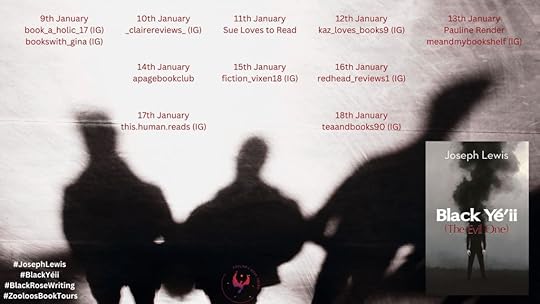
Black Yéʼii (the evil one) by Joseph Lewis. I loved the cover and blurb of this book. I did enjoy this book. It took me a bit to get into it. I did like the story and plot. It was different. I did like Eiselmann and O’connor and Graff. I did not see that twist […]
Black Yéʼii (the evil one) by Joseph Lewis blog tour and book review.