
W. Terry Whalin's Blog, page 51
June 2, 2016
Where Do You Buy Books?

http://www.barnesandnoble.com/h/coupons-deals
Whenever I ask other writers where they buy their books, I receive a variety of answers but often it is Amazon. This online retailer has been around a long-time and makes it easy to purchase their books since all of your information is often stored in their system.
Amazon is not the only place to purchase books. I encourage you to support your local physical bookstore but also consider Barnes & Noble. If you check out my website for my Billy Graham biography, you will notice I have a number of different ways you can purchase my book. You can get it directly from me (and signed) or you can get it from your favorite independent bookstore or from Barnes & Noble or Amazon. Readers love to have different purchase options instead of sending them to one place.
In fact, if you take action today, you can get my Billy Graham book at Barnes & Noble and save 20%. Here's how:
1. Use this link to go to the book on Barnes & Noble.com

2. When you check out, use this coupon code: BNSUNNY20 and it will immediately take off 20% of the price. In fact, you can purchase other books or items from Barnes and Noble and save 20% on other purchases. To get this discount, you will have to move quickly since the coupon will expire after June 2nd.
There are many different ways to purchase books and if you are in a rut if buying from one website, I encourage you to explore your options. There are many terrific places to purchase books online or in the bookstore.
Tweetable:
Where do you buy books? Here's some fresh ideas from a long-term editor. (ClickToTweet)


May 31, 2016
Why You Must Follow-up

These words could change the course
of your writing career—if you take action and follow-up. I know this is a bold statement but I want to explain why I'm saying it.
During a writers' conference, I meet with many
different writers. I listen to their ideas (pitches), read some of their work
and then respond saying something like, “I love this idea and concept. Please
send it to me.”
At this point in the process, we exchange business
cards and I tell the writer to send the proposal or partial manuscript or all of the manuscript to
my work email address as an attachment. The writer will frequently circle my
email and make a note on their business card. If they have an extra hard copy, I
will take this document home with me. Why? So I can follow-up our conversation
with an email (and sometimes a phone call).
If you respond to this request, then you will be
among the few from the conference who take such action. I understand the
challenges of life. You return home from the event and plunge into your family
and life. All sorts of things pull at your attention and prevent you from
sending the requested manuscript.
Several of the people I met with gave me flash
drives with their submission. Even during the conference, I used these flash
drives and put their work into our internal system at Morgan James
Publishing. Later this week those writers will receive a letter of
acknowledgement in the mail (part of our unusual practice at Morgan James). To
be honest, it does not mean they will receive a contract from the publisher or
be published with the company since there are still a number of other steps to
go before that happens. But they have taken a huge step in the right
direction.
We work with people that we know, like and trust.
This principle is a basic of sound business. It's true that we receive thousands
of submissions and only publish about 150 books a year yet even with the mounds
of material to examine, I am always looking for solid authors to
publish.
Over the next few days, I will be creating and
sending follow-up emails to the people who gave me promising proposals and
submissions and exchanges. I follow-up to encourage the writer to take action
and send me their submission. When they send the requested material
(electronically) then they will keep moving forward in the process and possibly
get their book published. It never happens if they do not follow-up and
take action.
Years ago my first book was published after a
conversation with an editor during a writers'
conference. She encouraged my pitch and asked me to send my manuscript to
her. I made a note about it, went home, wrote the manuscript and sent it. There
were many more steps in the process before my book was published but the ball
began rolling from my follow-up action.
Sometimes authors will follow-up with me many
months after my request. That is OK with me because eventually they took action.
I'm always eager to read their material and keep it moving in the
process.
What follow-up work do you need to do with your
writing? It might be a short email to an editor or literary agent? Maybe
you've sent something and never got a response. Did they receive it? You must
follow-up. Each of us as professionals have many things in motion. Your
follow-up work is critical to the process and why you must follow-up.
Tweetable:
Why you must follow-up. Here's some insights from a much-published editor. (ClickToTweet)
May 24, 2016
How Writers Can Attract Editors and Agents

As writers, we want literary agents and editors to
love our words and be attracted to our book proposals and manuscript pitches.
The process is subjective and each editor and agent is looking for what will be
right for their agency or their publishing house. Yet after years in this
business, we are attracted to great writing (and you don't have to read much of
a manuscript to recognize excellence). Also writers who understand their target
audience—and more importantly know how to reach them are attractive.
Today I want to give you four ways you can become
more attractive to an agent or editor. This attraction factor can show up in any
type of communication such as a phone call, an email or in person. I want to
begin with something that does not attract or attracts negative
attention. Recently I was corresponding with a novelist who was pitching her
novella. She said, “I am no marketer.” As an editor, I don't want to work with
an author who has this attitude. It started me thinking about how writers can
attract literary agents
and editors.
1. Have the Right Mindset. You may
long to be a “writer” or “storyteller” and not a marketer. I understand and you
are exactly like every other writer with this longing. Yet saying such words to
an editor or agent does not attract them. In fact, it can drive them away from
you. These publishing professionals are looking for authors who “get it.” If you
have the right mindset, you understand you have to build your audience and work
every day at being connected to readers. Everything begins with the right
attitude or mindset.

2. Commit to consistent time to learning
about the craft of writing and how to build your audience. It will take
time to build your email list or your following. Get ideas from my free ebook,
Platform-Building Ideas for
Every Author . Your consistent effort in this area will pay
off.
3. Don't let rejection get to you.
When Jack Canfield and Mark Victor Hansen were rejected repeatedly as they
pitched Chicken Soup for the Soul (before they were published and when
they were looking for a publisher), with each rejection they looked each other
and said, “Next.” See the upbeat and looking ahead way they handled rejection.
When you get rejected (and yes it will happen because it still happens to me
after all these years), say the word, “Next” and move forward to the next
opportunity.
4. It takes persistence to find
the right publisher and editor for you. Editors and agents are looking
for great material that will sell (subjective I know). You can be attractive to
these professionals as you hone your pitch and test it with other writers. Get
it down to a sentence or two that pulls the agent or editor to want to know more
details.
Your persistence will pay off and if I can help in
this process, don't hesitate to reach out to me. I'm always looking and as an acquisitions
editor, I send contracts to authors every week.
Tweetable:
Discover 4 Keys for Writers to Attract Editors and Agents. (ClickToTweet)
May 17, 2016
4 Ways NOT to Be A "Lost Author"

Last week I attended Book
Expo America, the largest trade show for books in
the U.S. I was there because of my work as an acquisitions editor at Morgan
James Publishing. Thousands of booksellers, media,
librarians and others from the publishing industry were showing their latest and
forthcoming books. It was exciting to see bestselling authors and enthusiastic
readers of books.
This massive event can be overwhelming—especially
to the new author. Several times during the week, I met authors who were “lost.”
Now to be honest some of them didn't know they were lost. From my interaction
with them, I knew they were in this category.
In different places of this trade show, there are
small booth exhibitors. One booth was attracting people with fresh cookies. I
stopped but didn't eat a cookie. I listened to the author. This former
journalist had written a novel. I recognized the book was self-published from a
company where I've met authors who have spent $20,000 with them and the books
are only online and not inside any brick and mortar bookstore. I asked if she
fell into this category in terms of her personal investment. To my relief, she
had not. Wisely this author had spent most of her budget on editing her book.
As I listened to her pitch about the book, I
learned she had written a civil war historical novel based on her part of the
South. The cover was a “different” looking drawing (not your typical
eye-catching book cover). I could hear the passion in this author's voice. It
was not only a historical novel but a young adult time travel fantasy. See the
challenge for booksellers and librarians to process this string of categories?
It doesn't neatly fall into a single place in the bookstore or library. While I
admired her passion and commitment to market her book, I knew this author was
lost in the market and probably had no idea why her book wasn't getting
attention and readers.
A little later, I met another author.
This former pro-athlete who gave me a copy of his book. I took a quick look and
noticed it was also self-published. The book was small and an odd size. When I
opened it, the typeface was not what you find in books and had full color
photos. This author had passion and had invested in publishing his book—yet I
knew he was also lost and unsure how to find readers and sell books.
While self-publishing is exploding with almost
5,000 new books entering the market every day, my personal bent is to get
the broadest exposure for my writing and books. In other words, I want my books
to be available online but also in brick and mortar bookstores. I want to give
you four ways not to be a “lost author.”
1. Study the publishing
world and get to a writers' conference, take classes and
meet experienced professionals. I'm speaking at several events so check them out and I'd love to
meet you at one of these conferences.
2. Write a good book. Your book needs a good foundation so
make sure you have a target audience in mind and are writing for that audience.
Get an outside editor or join a critique group to get feedback on your book before
publishing it.
3. Create a book which fits the
market. The details matter in publishing. Even if you are going to
self-publish, make sure you have an attractive cover and interior. Show the
cover to the target market and get their honest feedback. Does your book look
like books from major publishers? Does it have a little logo on the bottom of
the book spine? If not, change it so it does. You don't want people to wonder
about such details but to simply accept your book as a solid
product.
4. Take your own responsibility to market and tell
people about books. Get others to give honest reviews for your book. Tell the
media about your book and get booked on radio programs and other venues.
Even if you do everything “right” with a solid
publisher or have a literary agent, not every book sells or some books still
have dismal sells or they take several years to take off. There is no set
formula for a book to sell but there are good practices in
publishing.
Tweetable:
Are You A “Lost Author?” Here's Four Ways NOT to Be “Lost” (ClickToTweet)
May 9, 2016
Social Proof Is Required for Experts and Teachers

If you are an author or speaker or teacher or expert, are you backing up your expertise with social proof?
With a few key strokes on Google, anyone can check out the background and expertise of another person. Now admittedly not everything on the Internet is true (a fact you have to keep in mind) but each of us have access to the information.
Last week I was teaching at a writers' conference. During a break, I checked out the bookstore and noticed one of the participants had written a book with tips about Twitter. As I flipped through the book, it had some good information. Then I wondered about the credentials of the author. With my smartphone, I found this author on Twitter and began to follow her. I noticed the number of her followers (less than 1,000). To “qualify” as a Twitter expert, I expected this author to be above average with at least several thousand followers. Next I checked out her page for this book on Amazon. This book had been out several years and had four reviews. To her credit, these reviews were Four and Five Star but they were few in number—not at least 25 reviews or hundreds of reviews for this book. I did not purchase the book at the conference because this author did not have the social proof to be writing on this topic.
While at the conference, I taught a class on the business of writing and included information about some of my own social media techniques. In the weeks ahead, I will be teaching this workshop at the Blue Ridge Mountains Christian Writers Conference as well as at Write To Publish. Anyone can follow me on Twitter or check out my books online. They will discover my social proof backs up my expertise for what I'm teaching.

Everyone has to begin their platform building and their presence in the marketplace some place. If you want my free ebook on Platform Building Ideas for Every Author, follow this link. For many years I've been encouraging authors to blog, write book reviews, get reviews for their own books and take an active role in social media. You have to be wise about the amount of time you spend on these endeavors because they can become a huge time suck. But it does not have to consume massive amounts of time. The key is consistent and focused effort.
My caution is to understand you need to build the background and expertise in an area before you jump in and publish a book or teach a class about it. If you are just beginning in a particular topic or area, one key method to build expertise is through the world of print magazines. If you don't know how to get started, follow this link for a detailed article. In general, print has a higher standard of excellence than online publications. The articles are short and easy to create through interviewing others or your own background. As these articles appear in print, they will add to your own expertise in a topic and give you this required social proof to begin writing books or teaching workshops on the topic.
Tweetable:
Teaching on a Topic or an Expert? Why Do You Need Social Proof? Find out here. (ClickToTweet)
May 3, 2016
Four Tips To Meet Your Deadlines

Meeting deadlines is one of those basics that I
learned years ago as a journalism student in high school and then college. What
I didn't know back then is writers are notoriously late on their deadlines (magazine or book deadlines). If
you consistently hit your deadlines with quality writing (key), then you will
stand out from other writers.
When I became an
acquisitions editor years ago, I sat in hours of scheduling meetings where
we went through all of our books to see if they were on schedule or not and made
adjustments to the schedule.
Authors have no idea about these meetings and the
trauma you cause to your own book when you miss a contract deadline. Your
book may not get sent out to reviewers or the press release may get skipped or the catalog copy on your book
may be wrong or any number of other things. Yes you got sick or your child or
grandchild got sick and you needed two more weeks or a month extra. You will not
see the results of your moved deadline for several years when your book
doesn't find your audience or has poor sales. That is the truth of publishing.
Here are four tips about deadlines:
1. Understand the
importance of hitting the deadlines large and small. You will be
positioned as a different writer if you hit or exceed your deadlines--since most
of your colleagues miss them or slide them. In this crowded market where there
are many submissions, you want to stand out as a writer. One of the easy ways to
stand out is to meet your deadlines.
2. Use reminder
tools. Most of us have a smart phone and there is an app called
reminders. I use it all the time to set up a reminder about a deadline I need to
hit. That deadline may be writing or a call I need to make or something
personal. It flashes on my phone on that time and date.
3. When the inspiration
strikes, work ahead. I have been blogging at least once a week for years--but I've learned to
crank out the draft of the blog in a few minutes. I've also learned to schedule
blog posts--something I didn't know or use at first. Learn to use these
different features and it will help you.
4. Create your own system
for meeting deadlines and creating great content. Everyone wonders how
I tweet so much with great content. I've developed a system (follow this link to learn details
about my system). You will have to find your own system but I use tools like
Hootsuite to post content on a schedule (free). I also have created a plan for
each day and a template that I fill in with different tweets. For example, every
day I begin with an inspirational quote and if I have room, I include a photo
(to get attention). I find these quotes all the time and put them into future
tweets. It only takes seconds but helps me.
Hit your deadlines for magazines or
books or
blogs or whatever. It's
important and will distinguish you in the writing community.
Tweetable:
Discover why writers need to meet deadlines and four quick tips to achieve it. (ClickToTweet)
April 26, 2016
Authors Need A Practical Plan

Authors know the online world is important to their book marketing efforts. Yet many authors are overwhelmed with the possibilities. The majority of writers want to write instead of market their books. Every busy author has limited time and resources to market their book. Where do they begin and how can they create an effective in their online marketing strategy?
From my many years in publishing, when you face such questions, it is best to learn from someone who knows the world of online book marketing intimately and can give you sseasoned direction. Long-time publicist Fauzia Burke is one of these experts. Recently I read Fauzia's new book, Online Marketing for Busy Authors, A Step-by-Step Guide . This an eye-catching book is easy to read and loaded with practical information.
The book is organized into three phases. First, you need to get organized, then you need to turn your thinking into action and finally, you need to learn to stay the course. In the first section to get organized, you have to dream big, know your reader (target), set realistic goals and have a priority list.
The second section helps you turn your ideas into action with step-by-step information to create an online marketing plan, build a website, create a mailing list, blog and social networking. I found each section to be straightforward and easy to apply advice. In order to cut through the confusion, Burke encourages authors to focus on six priorities: website, mailing list, blog, LinkedIn, Facebook, Twitter, Goodreads and video. Her detailed recommendations are in the book.
In the third section, Burke encourages authors to promote without being promotional. I understand it is a fine distinction.
Scattered throughout the book are a series of “Tip for #BusyAuthors” and each one is simple yet full of insight. For example, “You don’t have to be an early adopter and chase every social media tool. Use tools that have a track record for success.” (Page 40)
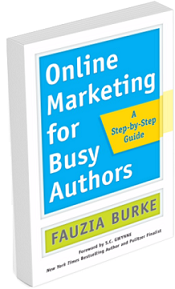
In the final pages of Online Marketing for Busy Authors, A Step-by-Step Guide , Burke writes, “The famous line said it all: “You gotta be in it to win it.” If you are not available online when people are searching for information, the chances of them finding your book and buying it are slim. Remember: Every reader who takes the time to seek information on a related topic is an interested, and qualified buyer—a warm lead. Just the kind we like.” (Page 140-141)
I loved the simplicity yet power in Online Marketing for Busy Authors, A Step-by-Step Guide . I highly recommend it.
Tweetable:
Busy Authors Need a Practical Online Marketing Plan. Get details here: (ClickToTweet)
April 22, 2016
Writers On the Move

I have a new article on Writers On the Move. A couple of months ago I learned about this group and got the opportunity to contribute once a month.
My article today about How To Grow A Large Twitter Following is not new information to readers of The Writing Life. Yet I want you to know about it for several reasons:
First, support Writers On the Move by reading their content. Notice in the right-hand column there is a simple place to subscribe to the blog. I encourage you to do this and get their different posts via email (so you will not miss anything). I'm a subscriber and have been learning a great deal from my fellow contributors.

Second, understand the value of guest blogging on other people's site. In my article, I include several links to some of my other online resources. It's what you can also do when you guest blog. From my experience sometimes they restrict the use of these links to your brief bio but even this case is exposure to a new audience of people. It will help you generate traffic and other things to your own content.
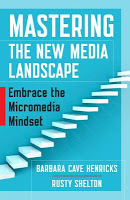
In Mastering the New Media Landscape , Barbara Cave Hendricks and Rusty Shelton call this type of content “rented media.” It is not my blog or content yet I get to contribute here once a month. In this particular instance, one of my friends recommended me as a contributor. There are numerous opportunities where you can also ask to become a guest blogger or a regular contributor. I want to encourage you to go after this type of exposure for your own writing life.
As writers, we are surrounded with many opportunities. Will you seize the day and take advantage of this opportunity for your own writing?
Tweetable:
How can you become a "writer on the move?" Get several ideas here. (ClickToTweet)
April 20, 2016
5 Ways to Become An Action-Taker

Many of us have dreams and desires for success in the publishing world. We want to have people read our books and write material that is read and appreciated. Almost every day I'm speaking or emailing people who hold this dream. About 83% of Americans plan to write a book during their lifetime and many people have written a manuscript but can't seem to figure out how to move forward with it.
From my years in this business, I want to give you concrete and practical steps you can take to become an action taker and move forward with your dreams. I define an action-taker as someone who does more than dream but takes daily action to move toward making those desires a reality.
1. Create a specific goal and write it down. If your goal is not written, then it will be hard to achieve it. You can write it in a notebook or in a little card that you carry and look at from time to time.
2. Break this goal into action steps that you can take to achieve it. Maybe your goal is to start a blog on a consistent basis. People are amazed at the volume of content in The Writing Life—over 1300 entries. The volume comes from consistently taking action and adding to the content. I also have a lot of information about blogging in this free teleseminar on the topic (follow the link).
3. Commit to moving on toward that goal every day. Some goals like a book manuscript or a book proposal take time and can't be created overnight but can be done with consistent effort. The old saying, “Inch by inch it is a cinch” is true. If you decide to write a page or two every day, then you will be able to keep your momentum going and complete each of the parts of a book proposal or a book manuscript. Getting your ideas down on paper is one of the first steps to completing the project—but it will take consistent action and effort to get it done. I've done and you can do it too. Use my free Book Proposal Check List to guide you in this process. Also make sure you check out the various resources and links to other information on this one-page document.
4. Seize unexpected opportunities. In the past, I've written about the need for every writer to respond to their emails and phone calls—which is the essence of good customer service. Anyone connected to publishing is in the communication business. Admittedly communication doesn't often happen so if you communicate, you will stand out in a positive way.

Last week Julie Eason sent a short email asking if I was available to participate in her Business Book Summit and could she interview me right away. I did not hesitate but said yes and scheduled a time to be interviewed. The summit begins next week in a couple of days and is free. I'm grateful to be able to talk about book proposals and Morgan James among such a great line up of speakers. Yes, Julie asked me—but I read my email, said yes and scheduled the interview. Unexpected opportunities will come to you as well. Are you taking action?
5. Face Your Set Backs or challenges and keep on moving forward. Everyone has bumps in the road. These bumps could be a personal or family crisis or something with your work or even a technical challenge with your computer or software or ???? These challenges happen to all of us including me. The key is what are you doing to get through the roadblock or challenge. From my experience, there is a way through your challenge. Don't ignore them but take action and work your way through them.
Often I read about someone who is an “overnight” success. They have suddenly skyrocketed on to the national front through a book or a YouTube video or a media outlet. Yet if you carefully examine the life of that “overnight” success you will learn (as I have) the person has been faithfully in the trenches and taking action. Many people tout the best-selling success of Chicken Soup for the Soul by Jack Canfield and Mark Victor Hansen. Throughout the first year of this series, each author followed the “Rule of Five.” It is a stellar example for each of us.
Tweetable:
Are You An Action-Taker? Learn Five Ways to Become One. (ClickToTweet)
April 16, 2016
Get Answers for Your Book Proposal Questions
For over 25 years, I've been in the publishing business and I continue to learn new information every day. One of the keys (which no one controls) is making the right connection with the right person at the right time and the right place.
While you can't control that element, you CAN be actively working to learn all that you can about how to make the best possible pitch. Also you can get insights and answers from experienced editors.
I want to help deepen your understanding of how editors and agents make their decisions about your proposals and pitches. Remember editors and agents don't read manuscripts. They read book proposals.
Even if you are going to self-publish, you still need a book proposal because this document gives you a business plan for your book. It's true whether you are writing nonfiction, fiction or even children's books.
As a frustrated acquisitions editor to help writers send better submissions, I wrote BOOK PROPOSALS THAT $ELL, 21 SECRETS TO SPEED YOUR SUCCESS. This book has helped many would-be authors to get an agent or a publisher. This book has over 130 Five Star reviews.
But don't get this book from Amazon. Why?
In recent weeks, I have purchased all of the remaining copies of the book from my former publisher. I slashed the price from $15 to $8 and created new bonuses for anyone who gets this book:
http://BookProposalsThatSell.com
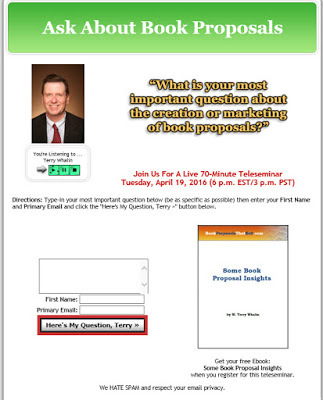
On Tuesday, April 19 at 6 p.m. EST or 3 p.m. PST (starts promptly according to www.Time.gov), I'm going to be answering your questions in a FREE 70-minute teleseminar. You can sign up and ask me any question about proposal creation and proposal marketing at:
http://askaboutproposals.com
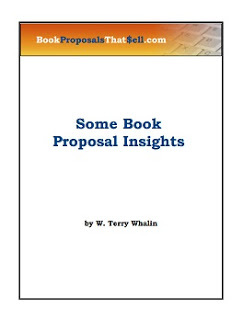
In addition, I've created a new FREE Ebook for everyone who signs up at the teleseminar: SOME BOOK PROPOSAL INSIGHTS. For the last few years I've written a column for Southern Writers Magazine. You can gain my proposal insights in this 30-page Ebook packed with content when you sign up at:
http://askaboutproposals.com
I'm excited to help many more writers to be successful
with their publishing dreams as they read and study BOOK PROPOSALS THAT $ELL) http://BookProposalsThatSell.com). I encourage everyone to ask a proposal question at:
http://askaboutproposals.com
I look forward to speaking with you on April 19th. If you can't make the time of the call, please go ahead and sign up anyway. The entire teleseminar will be recorded and EVERYONE who signs up will receive an email with the replay link. Also if you sign up, you will be able to
download the FREE Ebook right away. This report is loaded with valuable advice.
Tweetable:
Get your book proposal questions answered during this free teleseminar. (ClickToTweet)


