Kara Dennison's Blog, page 9
September 11, 2024
September 2024 Book Reviews

Finally, September is here. It's the beginning of the 'bers, my favorite time of year. This is when tea, a cozy reading chair, and a stack of books all feel the most right.
This month's books run the gamut from modern fantasy to hard sci-fi, from the atrocities of the past to the dangers of the present and the possibilities of the future. Thanks as always to every author and publisher who sends me ARCs. And be sure to support these writers (and anyone whose work you read) by sharing your own reviews on Amazon and GoodReads—it really helps!
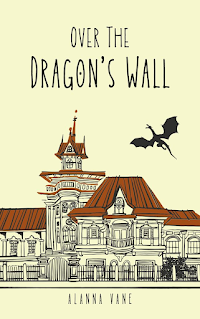
OVER THE DRAGON'S WALL
by Alanna Vane
Available Now
Sage is barely a teenager, and her life has taken a terrible downward turn. Her mother, an accomplished violinist, recently passed away. Her father, angry and unable to provide for his children, abandons them. Now Sage has been separated from her siblings Wren and Violet by the foster system. But in her darkest hour, she receives a key that could answer all her questions: one that unlocks the door in the wall separating the world from Nytari, the dragon who rules over fate.
Now in a world of ghosts and talking animals, Sage finds herself in the company of Igor. But this musician-turned-priest doesn't know how to help the dead move on, or how to wake Nytari. In her time at Nytari's mansion, she struggles with what she wants. More than anything, she wants to find her mother and heal her family. But she also feels the pull of music: learning to play the violin in her mother's absence. Overshadowing both, though, is a fear of taking up space: a belief that she is unlovable and selfish. As she navigates riddles and paranormal dangers, she discovers new truths about fate, suffering, and herself.
Over the Dragon's Wall is a weighty, but beautiful, book for young readers. It's a pitch-perfect examination of grief amidst emotional abuse: the desire to ask for what you need, dampened by the belief that having needs makes one unlovable. This is one of those rare books that will find the people it's meant for; some may not fully comprehend Sage's struggle, but those who have struggled similarly will feel seen and benefit from its gentle message. The fact that this appears to be the first in a series is exciting; I can't wait to see what other experiences will be dissected in this close-to-home fantasy world.
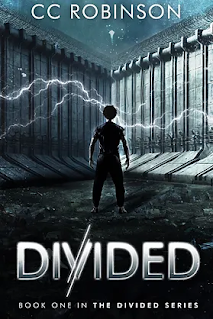
DIVIDED
by CC Robinson
Available Now
It's the late 21st century, and the former United States of America has rebuilt after the Great Civil War. Under the thumb of a dictator named Martin who believes that ethnic groups simply cannot mix, the nation's remaining major cities are each walled off into four segments: Ivory, Obsidian, Havana, and Little Asia. Everything from greetings to holidays to food is segregated, and different groups may not mix even in academic or professional situations. At least, that's how things are aboveground.
In the decades since the Great Civil War, a resistance has been pushing forward. And now four young people in one segregated city find themselves in the midst of it. Marcos dreams of leaving Havana to be a truck driver, but finds himself moved to a prison camp. Harriet has been an Obsidian code-runner for much of her life, but her participation is about to ramp up. Rose, a Little Asian, pursues academic success while contending with the new knowledge that her mother has been resistance for a long time. And Jason, the son of a powerful Ivory man, finds himself tasked with overseeing these secret prison camps. As Rose and Harriet train, Jason attempts to use his clout to bring the camps down while Marcos works to strengthen their forces from the inside.
Divided is the first in a planned four-part series, with second book Caged coming next year. While the book is technically well written and the characters are believable and unique, this is a very by-the-numbers YA dystopian fiction. There's nothing especially bad or wrong with being a by-the-numbers example of a genre, but we've come to a point where I read a very similar book practically once a month. It's true that fiction, especially YA fiction, follows trends. Just because it's understandable that we got a bumper crop of zombie and plague fiction in the wake of the pandemic doesn't mean we can't wish for more variation amongst it. The same is true of dystopian near-future American fiction under a divisive dictator: I understand that everyone wants to tell this story, but this is an opportunity for multiple insights rather than the same one on repeat.
There's also a concern that, in many cases, I don't know what's an in-universe issue versus an author oversight. For example, while it's demonstrated in the text that the four racial subdivisions are messy (with some people being "misclassified" and disparate cultures being Occam's Razored), there's no mention of Indigenous people at all. If that's a plot point, it's tense and menacing; if the author simply forgot about Indigenous people, it's concerning. Similarly, are the on-the-nose names of the subdivisions uncomfortably bad because we're meant to cringe away from them as readers? There are so many things in this book that could go either way like this; and while I want to give the benefit of the doubt, I can't know in one book if I should.
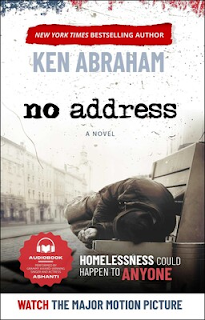
NO ADDRESS
by Ken Abraham
Available Now
On the day of her high school graduation, after years being bounced around in the foster system, Lauren finds herself homeless. At first, she's convinced it's just a temporary inconvenience. But soon she finds herself folded into a street family of people in her same position. Each has found themselves unhoused for reasons beyond their control—including Jimmy, who has fled an abusive home. Veteran Harris, recovering addict Violet, and former movie star Dora work together to make their situation as livable as possible.
But Robert, a high-earning gambling addict, has other plans. It's his job to ensure that this street family's encampment is cleared away to make room for a new development. But he, too, will soon find himself in unexpected circumstances. As Jimmy struggles to find work, Violet seeks healthcare, and Harris does what he can to keep his found family together, a local charity makes plans to renovate a motel into a haven for the unhoused. And Lauren, who once rejected the kindness of Harris and company, finds herself falling for Jimmy.
No Address is a novelization of the upcoming film of the same name, coming to theaters this fall. As a narrative, it's a strong one, and makes me look forward to what the attached film has to say. The novelization itself isn't bad, although your mileage may vary in terms of the backloaded spiritual message. Even speaking as someone "with religion," I found the talk of God to run hot and cold for a community in dire straits. The story itself is a keen reminder that every person has their own story and circumstances, and we can never truly know why someone has ended up where they are. While five characters could never encompass every circumstance, these five provide an insightful cross-section.
With all that being said, the No Address Movement is a multifaceted organization with many aspects to it: the film, the documentary, an album, a study guide, and this book. 50% of proceeds from these many projects will go to nonprofit organizations addressing homelessness. To me, these actions speak far louder than any slightly imperfect messaging.
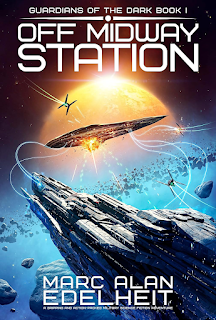
OFF MIDWAY STATION
by Marc Alan Edelheit
Available September 13
Jim Garrett's career is not off to an auspicious start. After firing the deciding shot to stop a space mutiny, he is simultaneously commended and punished: lauded for his loyalty, but unlikely to ever lead a ship of his own as he dreamed. Years later, he prides himself on his technical work. But his luck may be about to change.
Once every 50 years, an alien threat known as the Push launches an attack. But this time, they're early. And the only defense is an experimental ship, the Surprise. With lives on the line and time no longer on their side, Garrett and his peers must combat enemies both within and without to save lives. But what they discover as they fight could change the course of this battle forever.
Off Midway Station is an intriguing story hobbled by messy pacing. The first chapter, and many chapters in between, are compelling. The late-stage discovery about the Push is a game-changer. However, the majority of the book is taken up with very long play-by-plays of launching procedures, characterization that is told directly after being shown, and long-form worldbuilding. (Note that I am a huge proponent of worldbuilding; however, much of this book read less like a book and more like the Edelheit's worldbuilding notes.) The moments of intrigue and action were there, and were good, but were hidden amongst long chapters in which the entire action consisted of Garrett buying a drink and getting on a train. I respect the author's dedication to realistic worldbuilding; however, I hope that later entries in the Guardians of the Dark series allow the world and character to speak for themselves and flow from scene to scene more naturally.
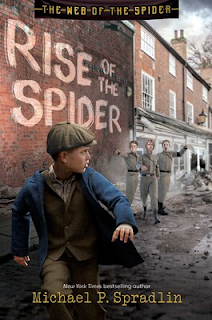
RISE OF THE SPIDER
by Michael P. Spradlin
Available September 24
12-year-old Rolf lives with his older brother Romer and their widower Toymaker father in Germany circa 1929. He doesn't know a lot about politics, but he knows that the two new boys in town, Hans and Nils, have some strange ideas. They've joined the youth branch of the growing National Socialist party, which claims it will fix all of Germany's ills by instating strong leadership. And before long, Romer himself has been lured into the Hitler Youth, putting an even larger wedge between the elder brother and the rest of their small family.
Soon, Rolf suspects that Romer may have a hand in the attacks on Jewish shopkeepers in town. But playing sleuth like his favorite storybook hero won't be enough to stop the violence. Before long, he must tell his father. And together, Rolf and his dad witness up close the beginnings of the Nazi Party and its stranglehold on Germany.
Rise of the Spider is the first book in The Web of the Spider, a middle-grade series offering a child's view of the rise of Hitler between the wars. It's a chilling and poignant story: starting with the all-too-common disagreements over the dinner table and "my dad says" commentary and spinning out into violent attacks. Spradlin's prose is perfect for young readers: relatable without being stilted, both insightful and believable for its preteen narrator. This series would make an excellent accompaniment for young students who might find history lessons of a century ago otherwise distant.


September 4, 2024
TTRPG REVIEW: Oh Captain, My Captain! and The Düngeonmeister Book of RPG Trivia

Thanks to Simon & Schuster for sending these samples!
I love building out my TTRPG library—but there was a point at which I realized that building out that library means more than having a bunch of modules and guides. It was around the time I read How to Defend Your Lair. The thing is, anyone can DM and anyone can play, and that's the beauty of it. But for people who do want a bit more, there is more.
On September 24, we get a one-two punch of TTRPG library must-haves. One is for roleplay, and one is for fun.
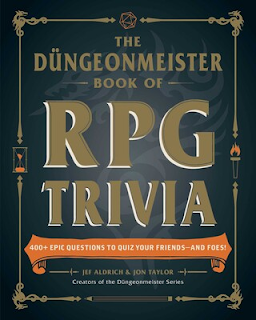
The Düngeonmeister Book of RPG Trivia By Jef Aldritch & Jon Taylor
Available September 24
I've loved the Düngeonmeister book series ever since friend and collaborator Rob mixed us up themed drinks at one of his monthly games. The number of books I have to hand by Aldritch & Taylor is constantly growing, and each has made me (I like to think) a better player.
This one, though, is mainly for funsies.
This handy book serves up more than 400 trivia questions about RPGs and RPG culture. From the beloved to the obscure, from the games themselves to the media around them, this one is full of thinkers.
Since I got my copy, I've enjoyed pulling the book out before one of my weekly games and testing my friends at the table. Who was the rogue who died at the beginning of the Darkest Dungeon Chick tract? What was Marlon Wayans's character's class in that one D&D movie we don't talk about? Which video games shaped the TTPRG industry? All that and more is covered in this book. Plus, there's "Critical Info" throughout, offering more details on especially bizarre trivia tidbits.
Will this book make you a better player? Probably not; but it's not meant to. Will it start some fantastic discussions at the table before and after games? Absolutely. And you'll find out why Gary Gygax spent his life on an FBI watchlist. And isn't that worth the price of admission on its own?
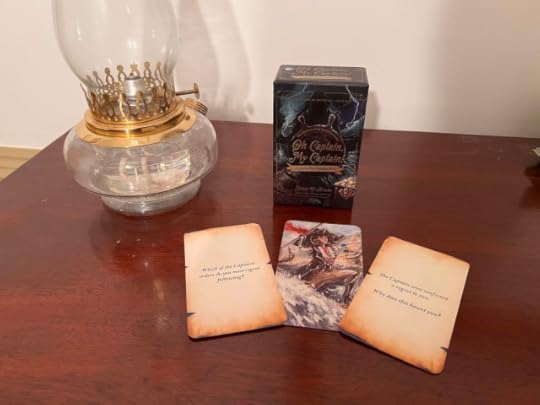
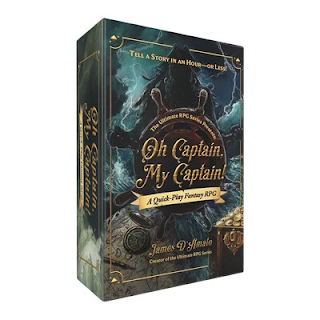
The Ultimate RPG Series Presents: Oh Captain, My Captain!
by James d'Amato
Available September 24
Whether I'm writing a story for publication or crafting an RPG character, one of my favorite ways to build them is by answering questions. It's how one of my regular groups starts every session, and it leads to some of the most intriguing plot points. Now imagine a short-form TTRPG where that's the entirety of the process. That's Oh Captain, My Captain!... and it's one of the most surprisingly satisfying one-shot RPG experiences I've ever had.
Each player is a member of a crew led by a bold captain. Only one thing is known about that captain: the crew trusts them implicitly. This small crew is accompanying the captain on a quest for a legendary treasure—and you also don't know what that is. Details about the captain, the treasure, and the characters at the table are revealed by taking turns answering questions. At the end, players come to a consensus on what the treasure is, what sort of captain they follow, and how they confront one final challenge once the treasure is in sight.
I played this game with Phoenix and Katy, the former being a local DM whose table I'm at fairly regularly, the latter of whom is usually at those tables with me. Starting out with nothing but one of the "Captain Cards," we ended up with surprisingly fleshed out characters of our own. Through pointed questions, Phoenix created a strait-laced former paladin who refused to execute the captain and was recruited into her crew; Katy created the captain's secret lover; and I created a young prisoner captured by another crew and offered freedom in exchange for help on this quest. We were all shocked at how naturally and quickly these characters arose through nothing but questions.
That said, the questions are extremely well written and lead to a series of follow-up questions in the group. For example, one card states: "The captain once confessed a regret to you. Why does this haunt you?" Note that the question is not focused on the minutiae of what that regret was (though it will come out while answering the question). Rather, it asks how the character was affected by the revelation. All the questions are like this, leading to insightful discussions.
If there is one issue with this deck, it's that the voting on the captain's nature is a bit too open-ended—to the point of causing confusing rather than encouraging discussion. The three options are "strong or evil," "weak or foolish," and "wise or righteous." Two of us voted the third; one of us voted the first. But we were all agreed that our captain was equally strong and righteous, but that the strength took priority. The best way around this is likely to have a discussion about your choices after they're made and figure out what each of you is really voting for.
Oh Captain, My Captain! is a fun game for people who enjoy character building. But it's also a fantastic exercise to help new groups learn to roleplay together. It demonstrates, in a contained game, just how quickly collaborative storytelling can bring a cast of characters to life. For longer gaming sessions, it's also a great warm-up to get your brain into that "yes and" space. This will not be living on my bookshelf; it will be living in my gaming bag, accompanying me everywhere. I am legitimately in awe of this game.
August 28, 2024
BOOK PREVIEW - The Black Archive #72: Silence in the Library/Forest of the Dead by Dale Smith

The impostor syndrome that comes with being an editor for the Black Archive range is offset by the fact that I get to read these amazing books before the majority of the world. It's also a reminder that there's no one way to write a Black Archive, and every approach comes with its own flavor. Some are deep dives into history; others are careful looks at the production of a specific story and everything that went wrong (or right) at the time. Some analyze the surrounding literature and media that influenced the story, while others pick apart the story itself. A hard line for quality bounding a nebulous playing field for approach makes this one of my favorite series to read, edit, and write for.
As ever, it would be disingenuous of me to review, but I can preview. Dale Smith's treatment of Silence of the Library and Forest of the Dead marks the 72nd entry in this series, and it's a reminder of the wildly different approaches a Black Archive can take. Rather than a straightforward analysis or a production brief, Smith uses the two-parter to launch off into a variety of topics—branching out into the wider world and then back into the episode itself. Sections of the book cover everything from women in media to the nature of fear to how one might oversee a library the size of, well, the Library. There's also a discussion of the nature of writing long-game story arcs: how much is planned, how much is happenstance, and how much does it matter which is which?
Personally, I especially enjoyed the discussion of how Steven Moffat's grounding in comedy informs his drama—and, by extension, how comedic beats can be transformed into dramatic beats. This book also pulls from Smith's own life and experiences: a reminder that a good Black Archive is, at its heart, the event horizon of a Doctor Who story and its observer.
As I read each of these new entries, I also re-evaluate my own role as a Black Archive writer. What does it mean when I sit down to talk about an episode? What can I bring to a reading of a story, and where does that intersect with my interests and life experiences? That will be addressed for a second time soon.
Pick up a copy of The Black Archive #72: Silence in the Library/Forest of the Dead
August 21, 2024
August 2024 Book Reviews

August is the busiest of months at my day job, hence this set of reviews coming a bit later than intended. This month's books include middle-reader and YA tales, vampires, Jinn, witches, and one of my favorite literary detectives making a comeback.
Thanks as always to every publisher and author for sharing their ARCs with me! Follow the link above each book to get a copy for yourself, and be sure to leave a review of your own to support them!
A BITTER TASTE
by Josh Reynolds
Available Now
There are few feelings better than opening a new Daidoji Shin novel, and A Bitter Taste is no exception. Set in the world of Legend of the Five Rings, the series follows a seemingly lazy and empty-headed member of the courtly Crane Clan. But like every excellent gentleman detective, Shin has hidden depths, and spends his ample spare time turning his mind to puzzles and mysteries. In his fifth outing, the walls are closing in as his family is demanding he finally settle down and get married. He's convinced this is the direst thing that could happen to him... until he's accused of the murder of Kenzo, a Crane Clan auditor.
Now, Shin and his allies—including bodyguard Kasami, investigator and former fiancee Ko, and loyal gambler-turned-servant Kitano—must clear his name. Diving into this strange murder, however, unearths even more mysteries, many dating back across all the books so far. Shin may know he hasn't committed murder, but there's much more he doesn't know. And his discoveries will call into question every choice he's made and every associate he's trusted since his crime-solving adventures began.
A Bitter Taste is a concentration of everything that makes Daidoji Shin novels so good, from the Wodehousian dialogue and social antics to the multilayered mystery waiting to be unraveled. Long-time readers will have a lot to contend with, as the events of this book upend much we thought we knew, and not everyone will make it out alive. It's a novel as glib and dramatic as the white-haired sleuth himself. This is Reynolds at his best—which, as his work is always top tier, is saying something.
JOSEPHINE'S TEAR
by V.I. Davis
Available Now
In Sophie Devereaux's world, humanity's only protection from the threat of Dark Witches is vampires. In exchange for safety, humans offer the nobles of each vampire clan a vassal: a companion to feed from, who will be returned home after year's end. After her mother was killed, allegedly at the hands of Dark Witches, Sophie has stepped up to be a vassal herself. But it's not out of gratitude: in truth, her mother was killed by a vampire, and the key to ending the threat of both vampires and Dark Witches lies in a magic amulet somewhere in the manor she now calls home.
As Sophie navigates the world of vampires, she also learns more about her lord, Henry. This handsome, seemingly penitent vampire isn't like the others. As she contends with her feelings for Henry and discoveries about her mother's demise, she seeks out the amulet known as Josephine's Tear. But as the truths of this world become more evident, Sophie's path forward becomes more difficult. In the end, she may have to sacrifice someone she cares about—and perhaps her own humanity—to set things right.
The character work in Josephine's Tear is excellent, and this vampire romance sidesteps (and even calls out) a lot of the issues I personally have with paranormal romance in general. Lack of consent and the involvement of underage parties were both addressed and laid bare in the form of subplots involving the story's less savoury parties. That said, less care seems to be given to the crux of the story. Josephine's Tear itself is a macguffin, there's no denying; however, much of the meat of the story speeds by in a page or two. While it's clear that the focus of the book is the romance, it would be nice to see the seeds of that excellent fantasy adventure plot really bloom. Davis is an excellent new voice with
THE LAST WITCH IN EDINBURGH
by Marielle Thompson
Available Now
Nellie Duncan lives in an alternate Edinburgh in the 1800s—one where women are hanged as witches in the town square. Nellie doesn't fully believe in witches; but one night, as she's helping her drunken father keep watch for resurrectionists, she sees a woman brought back to life: one she'd only just watched hang.
This discovery leads her to Rae Women's Apothecary, where certain women of Edinburgh care for the locals and fight for the winter deity known as the Cailleach. Those who fully embrace their role as the Cailleach's daughters become "witches" of a sort: gifted with longevity and a second life. As Nellie finds a lover in Jean Rae and a place among these women, the Cailleach's jealous son fights back, seeding the ground with hate for any woman who might serve her. And decades later, when Nellie returns to the site of her defeat with her adopted daughter, she discovers she's not as alone as she thought. Not only that, but the battle against Angus and his withering summer heat must be fought with new tactics.
The Last Witch in Edinburgh brims with love of all sorts: romantic, familial, the love between friends, and the love between mentors. It also speaks a lot of often-forgotten truths about violence against women—notably, that women can be guilty of it, and that men are not born violent and hateful. In its latter half, it does occasionally suffer from the same issue as many modern books with a message: a seeming uncertainty about whether or not it's speaking the message clearly enough, leading to the dialogue to drive said message home occasionally being stilted and reading more like a college course than a narrative. That, however, is the only real downside of an otherwise engaging and heartfelt novel.
NOT NOTHING
by Gayle Foreman
Available August 27
Alex—more commonly referred to in the pages of Not Nothing as "the boy"—has done something terrible. At the age of 12, he has an impending court date, the threat of a reform home, and community service ahead of him. He's taken up work he can't stand at a retirement home, forced to work alongside a girl named Maya-Jade whom he instantly decides to dislike. Then, while delivering meals during a lockdown, he meets Josey: a 107-year-old man, blind and nonverbal. But something about Alex makes Josey break his silence.
Soon, the two begin to talk, with Josey telling the story of how he met his wife Olka and the two's trials during the Holocaust. Their time together inspires Alex to do more: befriending Maya-Jade and the other residents of Shady Glen, fighting for what's right, and telling the stories of the rest of the residents. But as Josey's story nears its end, the truth of Alex's crime comes out—to Josey, Maya-Jade, and everyone.
Not Nothing may dwell on dark topics, but it's ultimately a hopeful read. It posits that, no matter how little you've done before, or how badly you've acted, you are always in a position to change. To use Alex's most hated word, there is always an opportunity to become a better person. It's an important lesson, especially for young readers—we can always become the best version of ourselves, even when others have seen us at our worst.
DAUGHTER OF LIGHT AND DARK
by Ahlam Faris
Available August 30
Mina has been called many things in her time, not all of them kind. In a world where humans summon and enslave Jinn into rings, Mina has the uncommon ability to see and speak with them freely. So she knows what it means for a Jinn's freedom to be taken—not just for the Jinn themselves, but for the very fabric of reality. So, with the help of her Jinn protector Ashrush, she sets out to free the powerful spirits trapped inside a dozen gold rings. That includes the one belonging to her late mother.
On the first leg of this daunting task, Mina faces opposition from many fronts. Four of these rings belong to members of the Sultan's family, and Mina must engineer friendships in high places to even get close to them. Meanwhile, a cult is systematically killing off the Seers who commune with Jinn, and it would seem that Mina's friend Saif has some sort of connection to them. And there's something else: a dark power within Mina that has begun to emerge for. Could this have something to do with the name the Jinn use for her—the Daughter of Light and Dark?
Ahlam Faris's first book is enjoyable, with a good structure and an interesting narrative. It does suffer a bit from the common issues of a first book, especially a self-published first book: unchecked typos and occasional grammatical issues, plot points that could be better grounded with a second pass, and so on. But none of these factors counts against Faris's talent. She's brewed up an intriguing story in an equally intriguing setting, and I look forward to seeing her writing grow and evolve over time.
August 7, 2024
Now Available: Otaku USA Magazine, Fall 2024

It's that time again—time for me to get a new issue of Otaku USA Magazine in my mailbox and remember I wrote about a whole bunch of anime several months ago. The Fall 2024 issue is the latest, and I've got several pieces about some shows I really liked very much.

The first of my three reviews in this issue is for , a fantasy/romance about a cursed heir to the throne and the long-lived witch he loves. This has a lot of Frieren energy, particularly in terms of the toll of immortality.
Given the Black Archive draft I'm currently working on, I've actually been thinking a lot about immortality in fiction and how it's often seen as a curse or a monkey's paw. The examination of longevity as neither a blessing nor a curse, but rather a new spin on the human condition with its own joys and difficulties, is extremely refreshing.

Speaking of paranormal beings in love, my second review is for Vampire Dormitory. This series is pure shoujo bait, she said affectionately—about a vampire named Ruka who's so obsessed with 2D girls that he can't fall in love with a real woman. Instead, he decides to love on sad boy Mito, showing him affection until his blood tastes good again. The twist? Mito is actually a girl!
I had a lot of fun watching this series, and sometimes you just need the shoujo formula to bring you a bit of joy.

Finally for my reviews this issue, but not for my contributions this issue, is Tonari no Yokai-san. Set in an alternate universe where yokai and other beasties live alongside humans, this is a surprisingly cozy series with a lot of heart.
The deeper you dive into this series, the more there is to love: from examinations of what it means to be human to some truly dark mysteries. But all of it keeps a sort of Ghibli-adjacent vibe that makes even the most dramatic episodes feel like a warm hug.

And then there's my feature on Astro Note. This is an absolutely fab original rom-com series with lovely animation and great writing. But what really makes me love it is its retro vibe... in particular, the similarities it bears to not one, but two Rumiko Takahashi classics.
Check out your local newsstands for the latest issue, and keep an eye on the Otaku USA website for more features from me!
July 31, 2024
Helldivers 2: The Good, the Bad, and the Democratic

Helldivers 2 has been getting lots of attention lately—and, speaking from experience, that attention is very justified. Between being raised by grandparents who frowned on video games and having a neurological condition that makes motion and visual effects in games uncomfortable (if not outright dangerous), I am not as entrenched in gaming as many of my fellow X-ennials. I don't have decades of muscle memory that make Soulsborne games rewarding or first-person shooters second nature. It's why I follow video game channels, to be honest: it's the only way I can interact with most offerings long-term.
So when I find a game that I both can play and want to play, it's huge. So when both the oshi and my friend group couldn't shut up about Helldivers 2, I had to give it a go. And it is one of the few games, ever, that I have stuck with consistently since picking it up. Or as consistently as I can while holding down multiple jobs.
It's Starship Troopers meets the Terminator franchise. It's a blunt and unsubtle satire of modern warfare. It's also fun as hell and shockingly welcoming to new and untested gamers. So, in advance of the upcoming Escalation of Freedom update, I thought it was time to give a rundown of what works, why it works, and also a diplomatic assessment of where the game could be a bit better. Because we're all about spreading democracy, right?...

The thing that first attracted me to Helldivers 2 is how it handles multiplayer. I've never enjoyed PVP, and not just because I don't have the time or skills to "git gud." I have more fun figuring out how to deploy resources to solve a problem—whether that be through tactical games like Super Robot Wars or real-time co-op. I do, in fact, love it when a plan comes together.
So knowing that Helldivers 2 is co-op only was a huge draw. Sure, a rando could drop in on your mission and make life difficult, but the way things are set up, there's only so much they can do that. Alongside that, it's hard to be a detriment to your team just by being unskilled, which makes the learning curve much more welcoming. When you're in an environment where everyone's working toward the same goal, coming back to learn and improve is way more fun.
I really appreciate that you can set up for private games, friends-only matches, or open things up to anyone. The in-game voice chat works pretty well, too; I've only encountered a few glitches in my time, and they can generally be fixed by rebooting.
Visually it's a gorgeous game. The planets all feel like different planets, even if you're doing similar missions and fighting similar baddies. Evacuating civilians on any planet requires the same steps (regardless of if you're fighting bugs or bots), but whether you're braving blizzards or fire tornadoes depends on where you land. Leveling up your ship actually leads to aesthetic changes, which both look good and help you get a better sense of how far you've come. And maybe this is just the propane porn fan in me talking, but those explosions are glorious.
Best of all, I love the game devs' involvement. This ranges from actively handling the wargame aspect to doing some frankly magnificent social media work. While there are very few interpersonal problems, they fix the ones that arise (like the issue of "grief kicking"). And they're also just damn good people—don't forget how they matched players' motivation to save in-game children by donating to Save the Children.
The Bad

I will say, the good outweighs the bad in Helldivers 2. If it didn't, I wouldn't keep coming back. But many are the times when a night's diving has ended in frustration. If I was soloing, I would chalk this up to me just sucking at gaming and call it a day. But when I'm in the company of leveled-up friends who do have the gamer instincts I lack, and even they're frustrated beyond the bounds of fun, something's up.
The two biggest issues, at least in my experience, are glitchy crossplay and whatever is going on with enemy spawning. In the case of the former, I'm simply hoping this is a matter of growing pains. The fact that there's cross-system play at all is magnificent. But as a Steam player, I have a much harder time friending my actual friends. This is even with my PSN account hooked up. You can generate friend codes, but they reset whenever you log off, meaning I can't just pass a code to my buddy for them to pick up at their convenience. (Accursed time zones.)
Now, spawn rates. Again, I wouldn't complain about these if it were just me, because I generally assume any major problems I have in video games are a skill issue. But there's a strange disconnect between how many outposts you close up and how many breaches come in. A friend apparently found the formula: shutting down outposts lessens the wave of enemies until it doesn't. There's some kind of magic number at which they'll start calling in outside forces, so there's a degree of management to be done. This has my little brain ticking over: more tactics to work out.
But I have found myself on lower-level missions where the sheer amount of spawns makes no sense. The storyteller in me wants to believe they're stressing us out in advance of introducing new power-ups. The baby gamer in me just feels frustrated.
Your Mileage May Vary

There are shades of grey in anything, of course—things I think I want, but that I'm aware might unbalance what already works. Things that might suit only me as opposed to the broad player base. So this is where I throw those: things I've observed, but that I'm aware might just be a "me" thing, so I'm not confident enough to file them under things that are "good" or "bad."
First is squad size. Four might be the magic number, and if that's what the devs have found works, so be it. I will admit that my desire for a more flexible squad size comes from the fact that I have lots of friends who play, and I want more of us to get to convene. I think all of us have been stuck outside "4/4 fighting Terminids" at some point. That desire, though, is absolutely not a good reason to unbalance the gameplay. But I wouldn't say no to the occasional super-duper-democracy mission with bigger squads.
I also crave a bit more storytelling... but again, that's the storyteller in me. I am absolutely the personal who interacts with non-mission-critical prompts, trying to glean whatever I can about the setting. And considering we are the ones shaping this universe with our actions, there's only so much story one can pre-plan. If we fail to liberate a planet, that just happens and the course of the war changes. (See also the "Save the Children" thing—we chose saving kids over upgrades and that happened.) And that's a part of the game I love a lot because of how important it makes even one player feel. But if the devs ever feel so inclined, I'd love to see some story points backfilled after the fact. Aconyte, if you ever pick up the license for tie-in books, call me.
Last thing... I just want to be able to swim. Or even to get some armor in a warbond that lets me swim. Just give me some little orange floaties. Something.
All things being equal, this game is magnificent. I love the visuals. I love the music. I love the explosions. I love that, as war-torn and ridiculous as it is, the player base as people is so good. If you're wondering whether you should play, the answer is yes.
I'd give you my info so you could friend me, but again, Steam friend codes are a mess.
July 24, 2024
Anime from This Season That I'd Actually Recommend to You

Writing about anime as (part of) my day job absolutely influences how much I write about it outside my day job. It's just logical. If I can monetize an article idea, I'm going to pitch it over to a magazine. Besides, a good chunk of my readership here on the blog and on my social media is more interested in the other parts of my career Venn diagram, so there's not a huge point in talking more.
That said, there are some things that just don't belong in an anime magazine or on an anime news website. Stuff like "Okay but seriously, here are the ones I'd tell you to watch without any sidebars or cautions." There are plenty of things I'd recommend if you're a hardcore anime fan, if you're into this or that specific subgenre, etc. But sight unseen? I don't get many.
So, here under my own roof, I'm going to try and give some occasional new anime recommendations to people who might not be as anime-focused. I've yet to see a Cowboy Bebop or a Keep Your Hands off Eizouken! this season, but there's still some fun to be had.
The Elusive Samurai

Tokiyuki Hojo was the ninth and final head of the Hojo clan, whose family fell apart during the 1333 siege of Kamakura. His attempts to return to power involves a cycle of fleeing, amassing armies, and fleeing again. By 1352 he managed to recapture Kamakura, but was beheaded a year later.
This is all historical fact. It is also the basis for The Elusive Samurai, an award-winning manga recently adapted into an anime. In this retelling, Tokiyuki Hojo is depicted as a young boy with a talent for evading capture. With the help of Suwa Yorishige (depicted here as a deity-level being with future vision), he hones his skills, turning the battlefield into his own brutal game of tag.
The love for the original manga of The Elusive Samurai is more than warranted, and its anime adaptation is possibly the most beautiful show currently airing. Its blend of anachronistic humor and stunningly animated action has left me speechless so far. If you only watch one new anime this season, go for this one. You don't need any anime knowledge: just an interest in history and a willingness to play along with some tonally-dissonant goofiness.
Ramen Akaneko

Sometimes you just want to chill, and I get that. Ramen Akaneko is my laid-back show of the season. It's a show about a ramen shop run by cats. And that's it. That's all you need to know.
The shop has just accepted its one human employee, who works part-time keeping the staff brushed and will occasionally don a kabuki stagehand outfit to wash dishes up front. (Patrons are here to see the cute feline staff, after all.) A gentle giant of a tiger works in the back making the shop's fresh noodles. And that's pretty much it. The stakes are low, with the most dramatic event so far being a YouTuber trying to take video inside the restaurant to boost his viewing figures.
I've already recommended this one to several friends, and I'm sure many more would enjoy it. Sometimes you just need something laid-back and cute at the end of your day.
Pseudo Harem

I'm recommending this one with full awareness that it will be a harder sell. But Pseudo Harem really surprised me. And you only need one basic piece of knowledge about anime to enjoy it, which you might have already: an awareness of harem anime.
For those who don't know, "harem anime" are those shows where one guy (often with nothing to recommend him) is fawned over by multiple love interests, each representing a very specific character trope. Kind of like horny commedia dell'arte: you will know the characters even if you've never seen the show before. There's the aloof cool girl, the spoiled needy girl, the big sister and little sister types, the shy bookworm, the flirt, and so on.
Pseudo Harem is about two drama club nerds in love. The boy, Eiji, dreams of having his own harem of anime girls. The girl, Rin, is a gifted actress who improvs all these different character tropes on the fly to amuse him. In actuality, though, she has a massive crush on him. These different personas let her voice her feelings safely, but she also has no idea whether Eiji reciprocates her feelings or just has fun interacting with her cast of characters. It's an earnest and self-aware little show that I did not expect to enjoy—definitely my wild card of the summer.
If you'd like to see more of my writing on all things anime, check out my news coverage on Crunchyroll and my features on Otaku USA!
July 17, 2024
I Finally Watched Bridgerton Season 1

I give off a vibe of being a person who has seen (and probably read) Bridgerton, but I've only recently gotten around to diving into it. And yes, this may have been spurred on slightly by the Doctor Who episode "Rogue"—when something is deep enough in the zeitgeist that it's influencing one of my favorite shows, it becomes much more difficult to put off.
So, all right. I've seen season 1. My thoughts? In short, I enjoyed it... even if it was laden with my #1 least-liked literary trope.
Generally Speaking

When I told bestie and regular collaborator Ginger that I was going to be diving into Bridgerton, she told me the description she'd heard of it before: "Cocomelon for white women." Which, I'm not going to argue that. If you're not already invested in the machinations of Regency society, you're probably not going to be all that invested in this. It is Pride & Prejudice on steroids, commentated by Dame Julie Andrews with carte blanche to cuss. That either will or won't appeal to you.
Anyway it appeals to me.
Overall I like the cast, and I recognize a lot of them. I did kind of walk backwards into this series, meaning that Regé-Jean Page will always be Xenk Yendar first and foremost to me. (And thus I love him unconditionally.) Ben Miller is always fun to see, and I'm always delighted to see an actor I like manage to make me hate him. Adjoa Andoh (to me, always Martha Jones's mom in Doctor Who) steals every scene she's in, to the point that I have to wait to talk about her or I won't talk about anything else.
I'm not as familiar with the books, though my friend Katy (who is walking me through the series) has given me some background on what's changed and how the books are arranged. I may end up reading them myself eventually. As it stands, I generally like the pacing, and the fact that in season 1 we have a central couple around whom all the other stories revolve. Things like Lady Whistledown's identity and the elder brothers' various crises of identity are all focused through the lens of Simon and Daphne. And I'll be curious to see how that evolves when the focus shifts to other couples in later seasons.
However...

While there are a lot of things I like about Bridgerton, the fact that Simon and Daphne's plot is motivated almost entirely by a lack of communication started to drive me up a wall after a while. Which is not to say that bad communication isn't a valid theme in a story like this: upper class double-talk, the silencing of certain people for no reason other than the boxes they fit in, and sheer misinformation are all valid and interesting pieces of action.
One of the biggest lapses in communication—Violet failing to give Daphne "the talk" and Simon assuming she's had it—falls under this category. It accentuates an aspect of this society, of the different expectations placed on husbands and wives, and of the Bridgerton family as the "head of household" distinction is tossed around like a hot potato.
There was a sense of relief when the Duke and Duchess finally addressed the elephant in the room, but not the pleasant kind that comes after intrigue and anticipation. As engaged as I was by their story, I didn't feel like this reticence to discuss something as important as "children: yes or no" was warranted. Maybe that's my mistake for being a contemporary viewer of a classically-style story.
That said, I think it could have worked. There were ample threads to tie this reticence to rather than simply choosing not to talk about it. I can do the legwork in retrospect to justify it, but having it there of its own volition would have been so much more meaningful.
But Also...

Lady Danbury could have turned this 8-episde series into a 30-minute featurette.
There's something both wonderful and terrible about having an eminently sensible person floating through an ensemble cast—knowing they could solve everything with a bit more screen time. Lady Danbury is honestly one of the best characters in the series, and not just because I feel like she must be seeing the people around her much as ew do. She's managed to make this world work for her, rather than bending herself to fit within it. I'm looking forward to eventually watching Queen Charlotte and seeing how that played out.
Her discussion toward the end of the season with Simon in which she (quite literally) tells him to use his words is as close as we get to a meaningful thematic reason for the lack of communication with Daphne. That salvages some of my issues with that story arc, but it still felt like a lot of drama balanced on a very small infrastructure. For that reason, the stories radiating out from the central story ended up feeling much stronger and more fulfilling in a lot of ways.
That said, I will absolutely keep watching. I want to see what else there is, and I want to see how these characters grow and change. And maybe, when my TBR pile has shrunk a bit, I'll try the books.
July 10, 2024
July 2024 Book Reviews

I'm grateful that a big part of my work has always involved reading as much as possible. And it's been a good summer for books. My batch for July includes graphic novels, magical technofutures, murder mysteries, and a very fun slasher pastiche. Thanks as always to the generous reviewers and publishers who send their advance copies my way!
(Candle is Garden Shed Library, the July scent of the month from Frostbeard Studio. Get book-inspired candles from their website!)
READY OR NOT
by Andi Porretta
Available now
It's Cassie's last summer before her close-knit friend group heads off to college. Everyone else, from the artistic Marcy to the musical Nico to future lawyer Aaron, seems to have their future sorted out. But Cassie can't seem to get her life together as quickly as the rest of the world would like. As she stares down adulthood, she only has two things on her mind: her seemingly unrequited crush on Nico, and making memories while she still can.
To that end, she suggests a summer-long game, based on one the four invented as kids. A travel cup carries slips of paper around, each inscribed with a dare. Some are simple, some are downright illegal. But they'll all be memorable. Failing your dare means you're out of the game. Winning carries with it a variety of forfeits for the losers, depending on who wins. But as the friend group navigates their game, cracks form. Nico appears to be invested in someone other than Cassie, and she can't hold her jealousy in. Meanwhile, Marcy and Aaron seem to be changing... or maybe Cassie just wasn't paying close enough attention to them. What began as forging precious memories is now threatening to tear the group apart, and Cassie can't help but feel she's to blame.
Ready or Not is a single-sitting graphic novel read, full of bright colors and vibrant art. Porretta's layouts are excellent, integrating group chats (a major part of the friend group's communication) in a way that's still visually interesting. Most of all, though, it's a relatable story of that time in our lives when we and the people we love change forever—and how to weather those changes.
LADYKILLER
by Katherine Wood
Available now
Gia and Abby have been best friends since childhood, separated by class and brought together by teenage tragedy. Years later, heiress Gia has made a snap decision to marry near-stranger Garrett in the wake of her father's death. Abby has been keeping her distance from this ill-advised match, foregoing the wedding and agreeing to meet up again only because Benny—Gia's brother and Abby's longtime crush—will also be along.
But things are becoming uncomfortable. Gia has failed to show up for the reunion, sending apology texts that sound nothing like her. Alongside these are threatening emails, calling Abby out for a long-buried lie. When Abby and Benny make it to Gia's home in Greece, all they find is her latest autobiographical manuscript: a terrifying story of betrayal, scandal, and infidelity. All signs point to Garrett, as well as the couple's two new friends, targeting Gia. But how much of Gia's manuscript is true? As the truth of Abby and Gia's shared trauma resurfaces, Abby and Benny scour the city for both the truth and absolution.
On the surface, Ladykiller is a slow-burn mystery. But dig deeper, and readers will discover that it is in fact a long-form character study. Gia's manuscript plays out alongside Abby's own narrative chapters. As we discover more about both ladies, we are cast as judge and jury: who is telling the truth? Is anyone telling the truth? Katherine Wood subverts expectations right in front of our noses, with the true convoluted mystery emerging in the final pages and sitting with us long after the book has been closed.
A MAGIC FIERCE AND BRIGHT
by Hemant Nayak
Available now
Four centuries ago, magic entered the world, bringing technology down with it. Now, in a rebuilt future, only technomancers can operate electronics and machines, speaking to their "souls" to bring them back to life. Adya is one of these rare practitioners, and she's putting all her energy into one goal: crossing the deadly spell wall that keeps her isolated and finding out if her twin sister Priya is still alive.
Her adventures unite her with unlikely friends: old frenemy Dsouza, a princess who can't control her magic, and an enthusiastic motorcycle who dreams of racing once again. But crossing the spell wall is just one challenge: petitioning the maharajah for help in finding Priya is an even bigger ask than anticipated, and uncovers unpleasant truths about the war raging between England and India. To survive, and to bring her family back together, Adya must reach out to new allies and embrace her trie potential.
A Magic Fierce and Bright is a fascinating techno-future vision, depicting magical castles built over the bones of skyscrapers and rusted vehicles with burning spirits. The little Yamaha in particular is one of the most compelling characters. The backdrop of Indian religion, legend, and culture makes this a stand-out entry in the genre, and the combat leaps off the page in epic fashion. This is truly gorgeous sci-fantasy.
THE PERFECT SISTER
by Stephanie DeCarolis
Available July 16
Despite being a year apart, sisters Maddie and Alex have always been as close as twins. But that changes after the death of their aspiring actress mother. Maddie disappears to the Hamptons, abandoning her sister and her medical school dreams in the wake of a fight. Desperate to reconnect, Alex follows her. But instead of Maddie, she finds the Blackwells.
The wealthy family is full of secrets, lies, and guilt. And it seems everyone around her has more information than they're letting on, and no intention of revealing it. The narrative changes hands throughout, from Alex to each Blackwell, and even to Maddie herself in flashback, as a web of deceit begins to form. Why did Maddie disappear into the Blackwells' home? What are Blackwell patriarch James's actual intentions for her. Will Alex make it out of the Hamptons alive?
The majority of The Perfect Sister is enticing and intriguing, with an undercurrent of untempered grief as the sisters struggle with their conflicting memories of their mother. However, the build-up of the story is a bit hampered by an eleventh-hour twist that feels a bit unsatisfying, coupled with an in-the-moment monologue to justify it. While the central mystery of the book—what happened to Maddie and why—is compelling and well handled, the final confrontation feels like it doesn't blend with the rest of the book. A decent enough summer read, but the finale may feel people leaving a bit turned around.
THE BLONDE DIES FIRST
by Joelle Wellington
Available July 30
Devon and Drew are twins, but they couldn't be more different. Drew is smart, driven, and goes to a high-end private school from which she's about to graduate a year early. Devon prides herself on her bleached blonde hair, vibrant makeup, and chill personality. But Devon is determined to have the Best Summer Ever™ before Drew goes off to take her genius to the next level. Unfortunately, the first stop on this summer sojourn involves taking their friend group to meet Drew's friends at a rich kid party, complete with a Ouija board—and the whole thing is flying scarily close to a recent horror movie.
Devon doesn't know how close until a coworker is killed by a literal demon: a demon that was coming after her first. As more people are targeted, the group realizes that the attempted kills and their surrogates are following the classic horror movie pattern. The bleached-blonde Devon nearly died first, only to be replaced by her natural blonde coworker. Now they have to use genre awareness to predict the kill order, save themselves, and stop the demon. That includes training up Yaya—a lovely ballerina and Devon's unrequited crush—to be the Final Girl and slay the demon. But along the way, Drew and Devon both discover that their preconceptions may be off.
This self-aware supernatural slasher is a perfect summer read. Beyond the surface-level fun and terror, it's also an insightful treatment of identity: how we view ourselves and others, the expectations that come with those assumptions, and how the roles we assign ourselves may hold us back from realizing our true potential. You can be a genius and an asshole; a love interest and a victim; and you might just have it within yourself to be the Final Girl.
July 3, 2024
TTRPG Review: Vaesen

I finally figured out why this game sounded so familiar: "vaesen" is the term Grimm used to refer to its monster-people. Remember Grimm? It was on around the same time as Once Upon a Time during that big wave of "dark fairy tale" stuff? Anyway, that's not important, just something that's been bugging me.
Now, Vaesen the tabletop game hails from Free League Publishing, who have done several other cool titles I like. The concept is "Nordic Victorian fae horror," which is four words I like smashed together in a very appealing way. James Bojaciuk of 18thWall invited me and several others to play a test campaign for review purposes. And we all sort of ended up liking it a lot. Look for his review, and reviews from other players in the campaign, down the line. But this one is mine.
As a system, I like the majority of it. And the peripherals are a bit like the little girl with a curl: when they're good they're very, very good; and when they're bad... well, I'll get into that.
The Core System

I've mentioned in other TTRPG reviews that I really appreciate any system that has characterization baked into the mechanics. For example, PBTA games will tie leveling/progressing to making difficult rolls, failing rolls, or addressing your character's backstory or class while playing. In that vein, a huge chunk of the Vaesen character sheet is given over to characterization—not just your own, but how your character interacts with everyone else.
Each character has a Trauma and a Dark Secret that guides their bit of the story. And, as you're solving spooky mysteries with your group, you're encourage to air out the group's Dark Secrets as well. This is a great mechanic and also encourages at least some secrecy at the table (which is great for players like me who enjoy less inter-party pre-planning). The down side to this is that, when your Dark Secret is discovered, you're encouraged to take on a new one. That's fine for a short campaign, but it can start to feel like your character's backstory is back-heavy or fragmented for longer ones. Some of the suggested Traumas and Dark Secrets are also a little iffy, but most of us came up with our own anyway.
In terms of actual mechanics, you're building pools of d6es for your stats and have levels of physical and mental harm (affected by attack rolls and fear rolls, respectively) rather than hit points. 6's are successes and 1's are failures. The presence of a 6 cancels out any 1's, but the absence of either can be read either as a failure or as a success with complications at the DM's discretion. A relatively easy system to get used to, with minimal math.
Players also get a base that they can build out over time using resources and points from doing missions. I really loved this aspect of it, as it presented little bonuses that helped everyone while also creating a setting for character-centric roleplay.
Mythic Britain & Ireland

This is where our campaign actually started, and boy was it great. Maybe it's because our group was made up of people who are already interested in the mythology of the British Isles, but this was such a good fit for us.
The book contains three playable mysteries and lots of resources for various beasties and creatures. If you're an expert on this aspect of history and mythology, you might notice a few things that don't quite fit into place. Regardless, the mysteries were really enjoyable and a good way to get our feet wet at the beginning.
The one downside is that there are occasional dead ends and red herrings during the information-gathering phase. These are fine in non-interactive fiction like books and TV shows, where the path to the finish is already set in stone. But when you have a group of people chasing down leads in real time, it doesn't really add to the thrill of the hunt to find out that you've been hitting your head against a brick wall for half an hour. Fortunately, our DM agreed, and would tell us outright if something was engineered to be a dead end.
Overall, this was a great introduction to the world of Vaesen, and I highly recommend it to anyone looking for a solid introduction.
Now, though—woe, Lost Mountain Saga be upon ye.
Lost Mountain Saga

It should be very telling that, at one point, we ran a timer to see how long it took until our group went in a direction that the campaign book didn't account for. (15 minutes, by the way.) While the conceit of The Lost Mountain Saga is super intriguing, the execution does not live up to the promise. Most of the action relied on the player characters going along with whatever the story wanted, even if it went against all logic. Simply to keep the game entertaining, our DM had to retrofit a lot of things. He would, however, read to us what was supposed to happen.
Now, I am a big believer that it's on you as the player to figure out why your character is here, and not on the rest of the group to convince your character to be there. However, there's a difference between embracing the flow of the story and, say, following an obvious cult into a forest, accepting food from them, and watching them kill a horse. Especially in a game in which you play a supernatural investigator. There's only so much narrative causality one can endure before one starts to wonder why this wasn't just a book instead.
The actual mythos of the expansion, which involves an archaeological dig and ancient Norse god-giants, got me really excited. It also made a great setting for our characters' expanding stories. But so many of the mysteries just felt... off. A man of the cloth attempting to bring back witch-burning and going completely unopposed in the era in which this game was set felt strangely out of touch, and yet it was still not the most out of touch thing in this expansion.
From what I understand, this expansion was based on an actual play podcast, which I have not listened to, so I can't comment on how it was transferred. All I know is that our DM did the absolute most to bring it up to playable standards, and that's the opposite of what a ready-to-play campaign book should be.
To sum up: Vaesen is a fantastic, atmospheric, character-forward TTRPG. It's so good that our party is looking to play more in the near future, even though the review process is over. It's so good that it's inspired characters we still talk about in Discord DMs. Mythic Britain & Ireland is excellent, and will be catnip for enjoyers of British folk horror and lore. The Lost Mountain Saga... is, I'm afraid, simply not good.
At the very least, I would recommend picking up the core book and Mythic Britain & Ireland. There are two other books of mysteries that we've yet to try, but the concepts intrigue me. I'm hoping our little group will band back together again soon to investigate them.