Kara Dennison's Blog, page 26
August 8, 2018
Fate/GO: A Summer of Arthuriana

NOTE: This piece covers the second half of the summer event currently running on the Fate/Grand Order US servers. If you are currently playing and don't want spoilers for the second half, come back when you're done. Otherwise, read on.
The special events of Fate/Grand Order have managed to strike a weird and welcome balance, and it can't have been easy. I've talked before (and probably will continue to talk) about how the mechanics of each event are tweaked here and there, and how they're slowly but surely finding their format. I also say this with full awareness that the US server is two years behind and the JP server is on to a second story arc, but even so.
The other difficulty they face is the story concept. Because it has to be three things: it has to be engaging, it has to be themed to whatever's going on, and it has to be largely "irrelevant" to the main story line. From a writing standpoint, I class that as both a "challenge" and a "bitch."
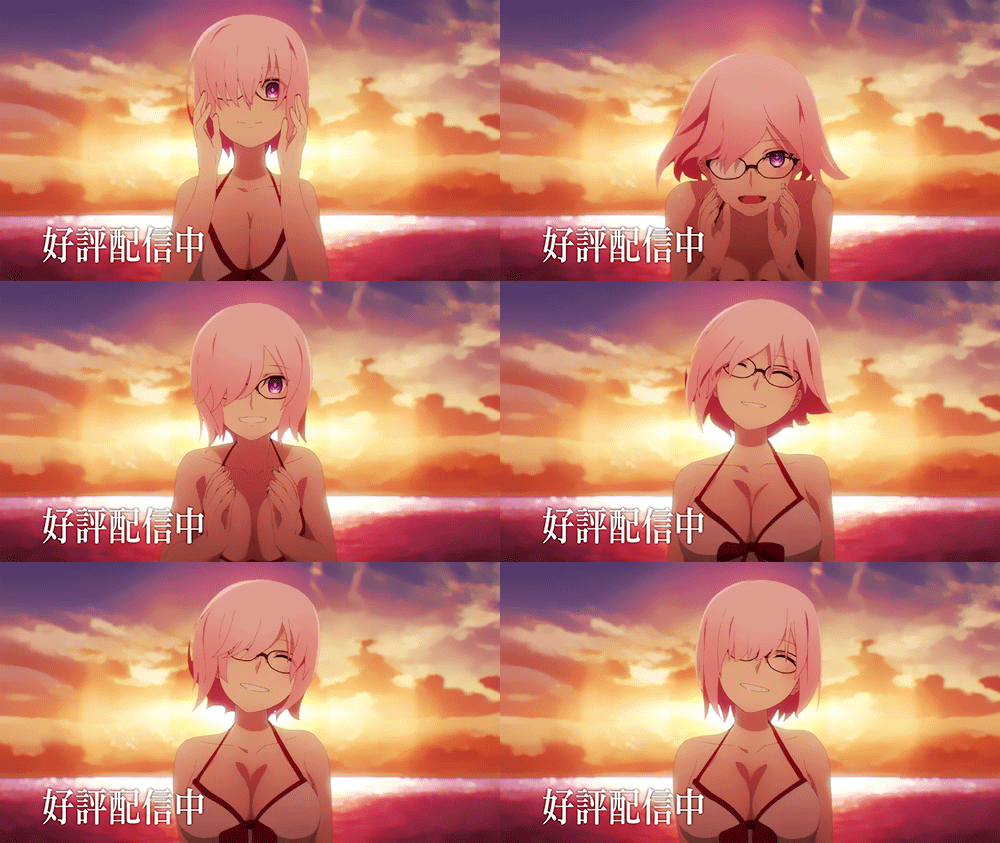
The game's first summer event made it happen, creating an alternate island world cut off from Chaldea and a time travel mystery that unfolds over the course of the two-part campaign. The summer theme allows for new versions of fan-favorite Servants, with Scáthach tidily hand-waving the new Summons by "altering their Spirit Origins" so they can be comfortable at the beach. Side quests allow for both one-on-one time with the new Servants (so you'll be more motivated to whale for them) and an opportunity to pick up higher-end goodies. And there's even a choice-driven mechanic that, while only influencing one cut scene and your map, is still pretty cool.
What I wasn't expecting was for the game to go this hard into some fairly obscure Arthurian legend.
He's a Big Pig.
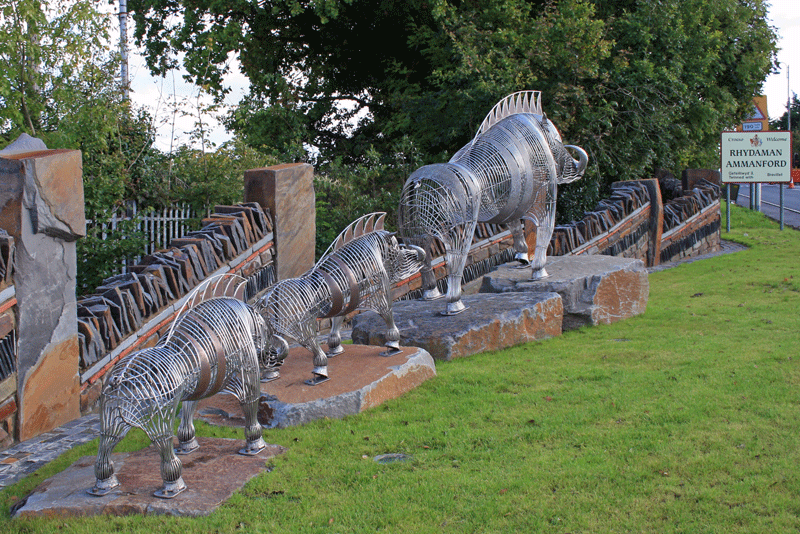
Culhwch and Olwen is an oldie when it comes to Arthurian legends -- potentially the oldest of prose stories to mention King Arthur, as it's dated to around the 1100s. It's also not one you're going to be heavily invested in unless Arthurian legends are Your Thing.
In the latter half of the story, the hero Culhwch is tasked by the father of his beloved Olwen (a giant named Ysbaddaden... whoof) with a quest. Which is... to go get a comb and a pair of scissors with which to take care of Ysbaddaden's beard. Okay, fine. But the comb and scissors are on the head of a giant boar named Twrch Trwyth. Which is pronounced "torhhhgh troyse," before you give yourself the same aneurysm I ended up with.
Which, okay. Except that only a very specific dog can hunt Trwyth. And only on a very specifically made leash, which can only be held by a very specific person, and actually Culhwch go get your cousin Arthur, he can help.
The upshot is that King Arthur hunts and kill Trwyth, but not before discovering that said boar also has a razor tucked up on top of his head, too. As you do. Culwch brings the three items back to his soon-to-be dad-in-law... and then has to go kill another boar named Ysgirhyrwyn. But that's not really relevant here so.
What is relevant is that Trwyth wasn't always a boar — in the tale, he's the son of a prince, cursed to take the form of a boar with poisonous bristles. He also has seven piglets. So there's a lot more going on here than just "dude has to go kill animal for loot."
All that said. As heavily as the Fate franchise leans on these legends, I was genuinely not expecting the beach episode to do a deep dive like this.
Though I guess the demon boars everywhere should've been my tip-off.
A Summer Adventure

If a giant cursed boar-man packing a toiletry kit on his head isn't weird enough for you, Fate/GO's summer campaign just adds to it: Altria (the game's female analog to King Arthur) encounters Trwyth on the mysterious island where your team is stranded, and is immediately recognized. The moment is a bizarre throwaway soon buried under the other Servants begging you to build them castles and theme parks, but it stayed pretty heavily in the back of my head. After all, the main storyline is currently exploring an alternate Camelot, where a differently-motivated Altria has taken over the Crusades.
By the campaign's second arc, we discover that a temporal loop has dropped your party back on the same island you just left mere days ago... except for the island, it's been two thousand years. Highly-evolved boar piglets have, with the help of a now-hibernating Thomas Edison, nearly made it to their own space age. (I swear I am not making a damn bit of this up.) But then disaster strikes.
"Disaster" has taken the form of Twrch Trwyth, so fueled by hate that he has become an eternal monster in much the same way Servants become Heroic Spirits, and has created a mechanical body for himself to stay alive until such time as he can disguise himself as Altria, destroy the island, and tarnish her good name forever.
I swear. I am not. Making any of this up. (Though frankly, this storyline is downright sedate compared to the majority of Arthurian romances.)
As I said before, I kind of expected an Altria-centric story. Because even though main plots and event plots rarely cross over in any sort of essential way, the Camelot story is Kind Of A Big Deal. And any time a new Altria is introduced, it is also a big deal. (Hell, there was an event about the proliferation of Altrias.)
As a character, Altria may not be one of the core figures in Grand Order: she, like the rest of the Servants, is there primarily for support and fan service. You yourself, Mash Kyrielight, and the team back at Chaldea are the "stars," as it were, with others shifting through the spotlight during different stories. But so much of the mythos is rooted in these legends (with an equal footing in the Celtic) that there are a few things you will always see return. And it's wonderful, honestly.

Like. Honest talk, cards on the table. The Fate franchise started as a porn game. Lots of popular franchises did. (Maybe someday I'll talk about why that's a thing.) It hasn't exactly just discarded its past -- while Grand Order doesn't contain nudity, you've got entire events focused on characters in swimsuits, you've got alternate versions of Nero (also a female iteration) with a wedding gown with a butt window. You've got Mata Hari for Christ's sake. I'm really not going to look you in the eye and tell you that this is high literary art with no regard given whatsoever for a consumer desire for scantily clad girls.
I'm just saying these nerds are really doing their homework and I'm wondering how they're going to impress me next.


August 3, 2018
I'd like you to go buy this new book what I worked on.

So I've been talking about Seasons of War: Gallifrey for... a while now.
But it's available now. Like now-now. Like you can go buy it and there's a print or digital copy that will be immediately sent to you, and then you can read it.
And how rad is that.
Working on this has been a wild ride from start to finish. The writing process went on in what I'll generously call a turbulent time in my life, and the "post-production" phase came as I was decompressing from said turbulent time. My collaborator Paul Driscoll did a lot of the heavy lifting in that period, for which I'm eternally grateful. Now I'm in a position to do what I do well — social media and the like — so I'm pulling my weight at least a tiny bit in that respect.
I'll talk a little bit more about the future of these characters once the book has been out in the wild a bit longer and there's a reason to wonder and care. For now, I just want to send up the flare that the book exists and you can have it.
Scoot on over to Altrix Books to grab yours. It'll only exist for a limited time, so grab it while you can!
August 1, 2018
What Junji Ito Taught Me About Writing Horror

Yesterday was Japanese horror legend Junji Ito's birthday, and man, I'll take any excuse possible to write about this dude.
I discovered Ito's work on an insomnia-riddled night, coasting around through Tumblr (back when I still used it). I first encountered, as most of us did, The Enigma of Amigara Fault. It was equal parts ridiculous and utterly horrifying, with an ending so viscerally weird that I just had to have more.
Fortunately, Ito has been creating manga for literal decades, so I ended up with more than enough reading material for a long time. And he scratched that itch that so few horror creators scratch: actually going full-throttle with the worst case scenario.
What Ito does is such a dangerous mix of things you're taught to never do and things you're taught to absolutely do that straight-up imitating him would be about as productive as straight-up imitating Douglas Adams. But as someone who loves to throw dashes of horror and surrealism into her work, I come away from each encounter with Ito's stories learning something new I'd like to attempt to play with.
The Joy of the Uncanny
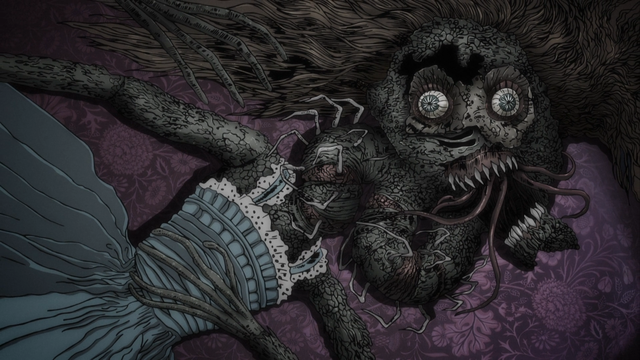
As an artist, Ito has a tool at his disposal that many horror creators don't: the ability to draw a visual hard line between the normal and the supernatural. And he does that in an absolutely gorgeous (and disgusting way): by heightening the realism of the unreal.
Weirdly, the tendency toward horror being "real squared" is something I see turn up a lot in lost episode creepypastas — you know, the ones where someone ran across a video of The Simpsons or Spongebob Squarepants and everyone died and it drove the animation staff crazy or something. There's a repeated theme of the horror of the episode being depicted as "photorealistic," standing out hard against the animation. Doki Doki Literature Club put this into action with Yuri's photorealistic eyes in the game's second act.
And, well, that's really Ito's MO. His moment-to-moment art style is... "average" isn't the right word because he really is a good artist. But even though his standard art style is fairly recognizable, it's also fairly straightforward. Not overly cartoony, but simplistic enough that it's obviously a comic.
But when something horrible comes in — a monster, a corpse, whatever — suddenly it's there in full HD. And it sticks out amid the standard style like some sort of hallucination.
It's a fantastic approach... sadly, it's what makes adapting a lot of Ito's work to live-action so difficult, since the swerve into realism is how he evokes much of his horror. But it's a good working model of how jarring realism is amidst our escapism. Not a thing I can literally put into practice in my writing, but it's absolutely an element I can bear in mind when offering descriptions.
When Imagery Outweighs Empathy
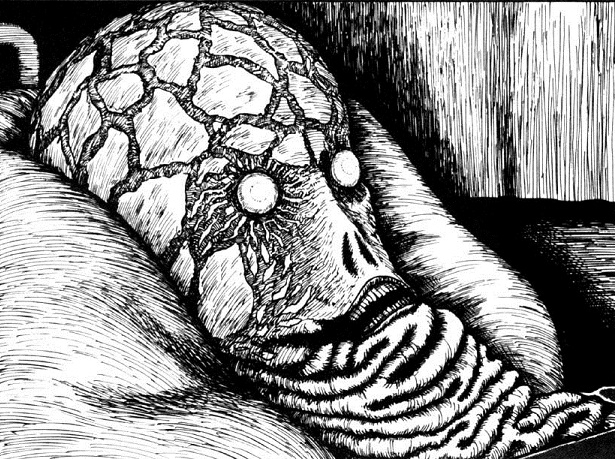
As storytellers, one of the main things we're called upon to do is make our audience feel a certain way about our characters. We want them to be liked, or disliked, or in some way seen the way real people are seen.
But Ito achieves something that seems like it should be a mistake, and yet is essential to what he does: with the occasional exception, he makes his characters completely unremarkable.
This isn't to say he does "bad" characterization. We can look at his creations and understand that this man feels disconnected from his family, or this woman has a crippling moment-to-moment phobia of death, or this boy is scared of being left home alone. They're all people we can observe successfully for the span of their story. But if something were to happen to them, we would be largely unaffected. And considering misfortune is a recurring character in Ito's work, that's a good thing.
When we form opinions of characters, how they end up at the end of their story will characterize it as "happy" or "unhappy," as a "bad ending" or a "good ending." When we're largely unconcerned with the well-being of the protagonist, a curse or a debilitating transformation or what have you can take place without it coloring the "tone" of the ending. If someone we like succumbs to a strange sleeping curse, it's sad. If a guy we're sort of watching from a distance becomes a millennia-old future-human overnight before disintegrating, our focus is on the happening, not on whether or not it was "deserved."
Obviously this is a "sometimes food." Making characters unremarkable is not something to do in every story. But if the centerpiece of your creation is "hey look at this weird scary shit," the people it's happening to need to exist at a safe distance from the audience.
You Decide if You Need a "Why"

When it comes to long-form series like Uzumaki, Ito absolutely sets up a question-and-answer scenario. Everything in the town is getting warped into spiral shapes. Why? By having his characters search for an answer, he has established that there will be an answer. And in the end there is one. It's pretty insane, but it's there.
Meanwhile, many of his short subjects don't have a firmly established "why" to them. Again, the horror is the show piece, and we're here to observe it. For example, Marionette Mansion never explores the background of its seemingly cursed puppet, and it leaves the ending largely ambiguous. But the protagonist, the audience association character, never shows interest in an explanation — he only shows an interest in making the weirdness end.
There will always be audiences who want a full answer to absolutely everything, and that can't necessarily be helped. But when you write, if you're gearing up for an unexplained ending, you need to prep for that. If you want the story to simply exist and a deeper dive is not forthcoming, then it's helpful to not situate your characters and their thoughts in such a way that you make false promises. (Unless that's what you're going for, I guess.)
Perhaps if Ito's characters asked more questions, more of them would survive. But from a creative standpoint, having them focus away from wanting reasons and instead trying to brute-force away the horror helps the reader immerse themselves in the spectacle without expecting an eleventh hour lore dump.
Junji Ito's work isn't necessarily for everyone, but for me it's the closest I've found yet to what I want to achieve when the horror bug bites me. If you're unfamiliar with his work and want bite-sized introductions, check out the anthology series Junji Ito Collection on Crunchyroll.
And, of course, here's wishing him many more years of creating his beautiful weirdness.
July 27, 2018
Fate/GO: Summer! The Sea! Half a Dozen Servants I Can't Whale For!

So straight up, the summer event in FGO is the one I've been most looking forward to over the last few months. I only knew a bit about it, but what I saw was a really creative interpretation of the usual item farming moves. I still didn't quite have a handle on where it (the first part, anyway) was going until I was actually playing it.
It's... a typical harem beach episode, really. The player, Mash, and a whole bunch of Servants end up on a desert island with no way to contact Chaldea. The Servants are fine since they don't really have human needs, but there's you to worry about. So, with the help of Scathach and her runes, you and your Heroic Spirits gather resources, battle monsters, and build a new life for yourself on your little island.
Oh, and everyone's in bikinis because that's how it is.
The campaign started literally yesterday and will run in two parts. From what I understand (I'm actually attempting not to read too much about Part II), there will be different drops and different Servants once the second part kicks in. The first is all about constructing your island home. And so far I'm liking it while also being... a little?... stressed?
Farmville: Grand Order
In the first half of the campaign there are five resources (which also serve as currency) available to you: food, fresh water, lumber, stone, and iron. And besides your main base, there are four regions — caves, jungle, grasslands, and beach — where these items are dropped with varying frequency. Good so far, right?
Now, as with other campaigns, certain Servants give you a bonus to certain drops. For example, in the recently Momotaro campaign, all Servants of Japanese origin gave a bonus. Fairly straightforward, right? And fortunately, they tend to have characters across the board, so if you don't have any 5-stars, you're not out of luck.
For the summer campaign, every Servant offers a bonus to one of the resources. Every. Single. One. This is good because it means no one is out of luck because the spread is so wide. But it also means I have to keep a guide open in a browser window. I eventually just saved five new formations (Food, Water, Lumber, Iron, Stone) with bonus-offering lowbie Servants backloaded into the Support positions. It's literally the only way my sieve-brain is going to remember to keep bonuses on until I get some Craft Essences.
I enjoy the conceit of your collectibles actually having plot relevance... the idea of having to go out and gather wood and fresh water is interesting. At the same time, it makes me absolutely terrified to buy anything in the shop right now because I don't know when I'll want to make something very specific.
That's another side of it: choice. Whenever it comes time to build something, you're given three options of varying difficult, each presented by a different member of your team. For example, when it comes time to construct a water supply, you can go with a traditional wooden well, a brick one, or a long school-style faucet arrangement. (I went for the last one.)
I'm not sure yet if these different choices affect anything, or if it's simply aesthetic choice. I do know you can "reset" later on and rebuild it. Either way, it's an interesting... albeit occasionally very slow... mechanic. Fortunately, it looks like we're going to get some occasional shipwrecks to loot and move things along.
The Swimsuit Issue

Naturally with a summer island/beach story comes swimsuits everywhere. And this means more limited versions of familiar Servants... including class changes, of course.
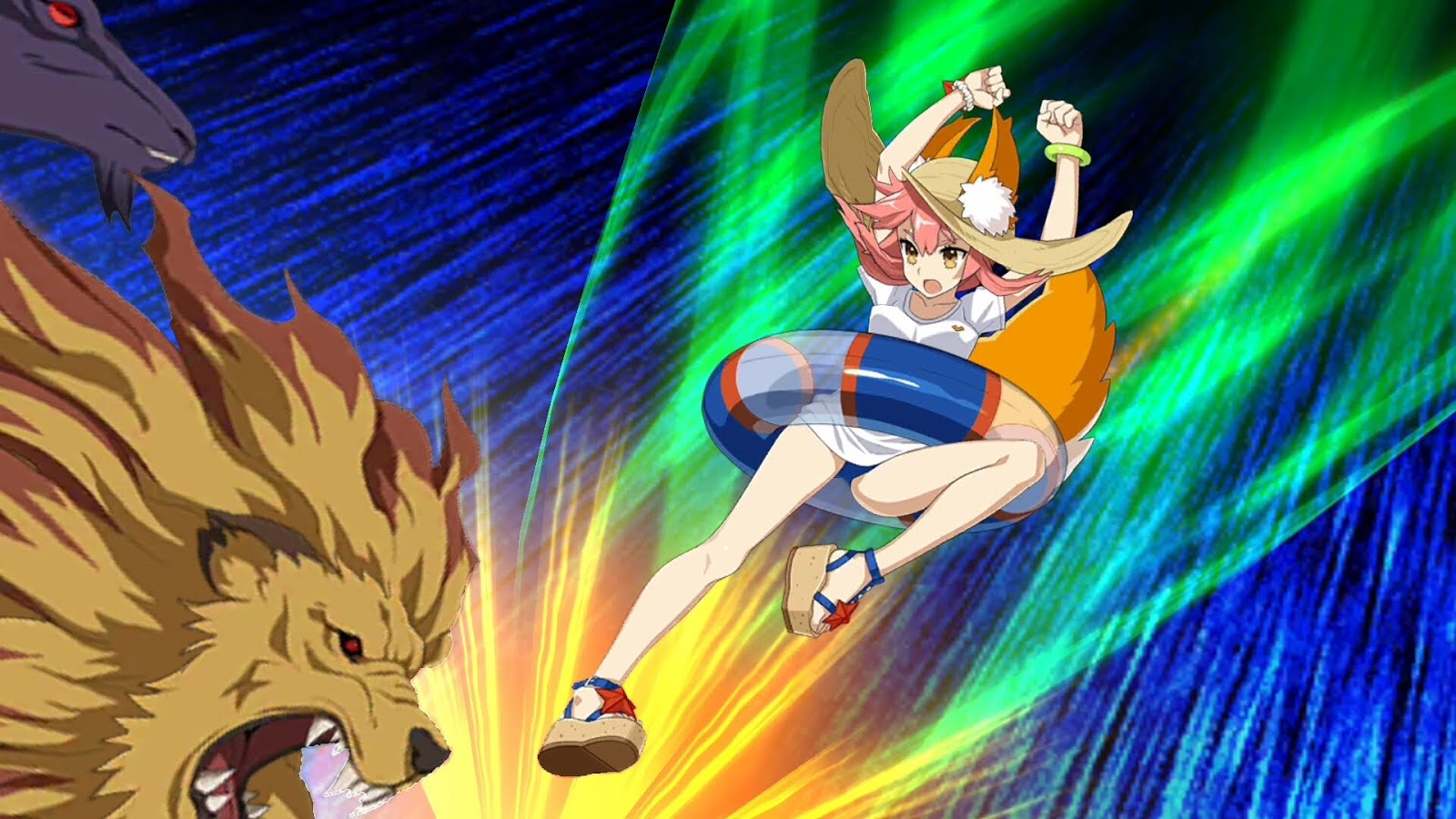
The new looks include (but aren't limited to) Archer Altria with a super soaker, Ruler Martha in a very posh sun hat, Lancer Tamamo with a floaty and T-shirt, and Lancer Kiyohime who's otherwise just as nuts as usual.
Those you all have to roll for and hope for the best. But there's also one to earn — temporarily by the end of Part I, permanently by the end of Part II. The Assassin look for Scathach is pretty neat, and she's pretty much the one new Servant we haven't had an opportunity to test out. Likely on purpose.
I've pretty much just contented myself with the fact that I'll have Scathach at the end of this, and I'm not putting any sort of emotional investment in earning a surfer Mo-san or a Marie Antoinette with an adorable baby crab on her head. The human heart can only withstand so much.
Very Good Arthuriana... But Why?

Since I'm me, I'll always appreciate extra effort put into representing the Arthurian side of FGO. I mean, it's obvious it'll be there once in a while — considering Altria Pendragon was a central character in its first iteration, it's sort of a thing.
Barely in (it's only been a day, after all), and I've already seen a lot of dips back into discussion of Altria's life as King Arthur and her time at Camelot. And sure, one of those instances was because I took her advice and made my cabin out of stone.
But with both Altria and Mordred on hand, we get a lot of talk about the legends' imagery and the billions of named things. Arthur's dog and horses get a name check, as does his boat, Prydwin (which ends up becoming Mordred's surfboard in her new Noble Phantasm). As for Altria's NP, "Excalibur Viviaine" takes its name from the Lady of the Lake.
Okay yes good Kara. Lots of Arthurian stuff in Fate, well spotted. What does it matter? At the moment, quite a lot.
In the main storyline, we're smack in the middle of the Sixth Singularity: Camelot. Or, rather, the time of the Crusades, overrun by an alternate Round Table. At the forefront is an alternate Altria, one who wields the spear Rhongomyniad rather than the sword Excalibur, and who expects some high-end purity and loyalty from her knights and subjects.
Events are rarely integral to the main storyline, though you'll see references to them creep into your dialogue options. They also serve as a way to "soft-launch" Servants, like Florence Nightingale in the Count of Monte Cristo event. That said, the special events do have a sort of second level of continuity to them, and do feed into the main story.
So something tells me it's not just casual Arthurian fanservice causing all these references. I suppose we'll find out when the second event rolls around.
So far... yet another different event, and I'm enjoying it so far. I suppose by the time I'm in the swing of designing my island, it'll be time to switch to Part II. But I like the style, the sense of humor, and the amount of choice (regardless of how on-rails I still am) in this particular event so far.
I'll check back in for Part II.
July 25, 2018
I've never edited an anthology before, what am I doing.

I followed the hype around Alexandria's mysterious black sarcophagus because of course I did. It's me. And while I enjoyed a lot of the silly theories around who or what was inside, I noticed a lot of them getting pretty samey. It struck me that I knew tons of writers, teachers, artists, and other clever sorts who could take this unopened mystery and dream up a lot of amazing things from it.
Since I'd read in the news that it would take a while to open it, I kicked off an idea: a charity anthology of writers and artists predicting what's inside. It could be logical, fanciful, whatever, as long as there was an answer and it wasn't "sweet death come to remove me from this crapsack world" or something. I got a lot of positive response, and was prepping to get things rolling...
And then they opened it up and it was skeletons and poo water. Ah well.
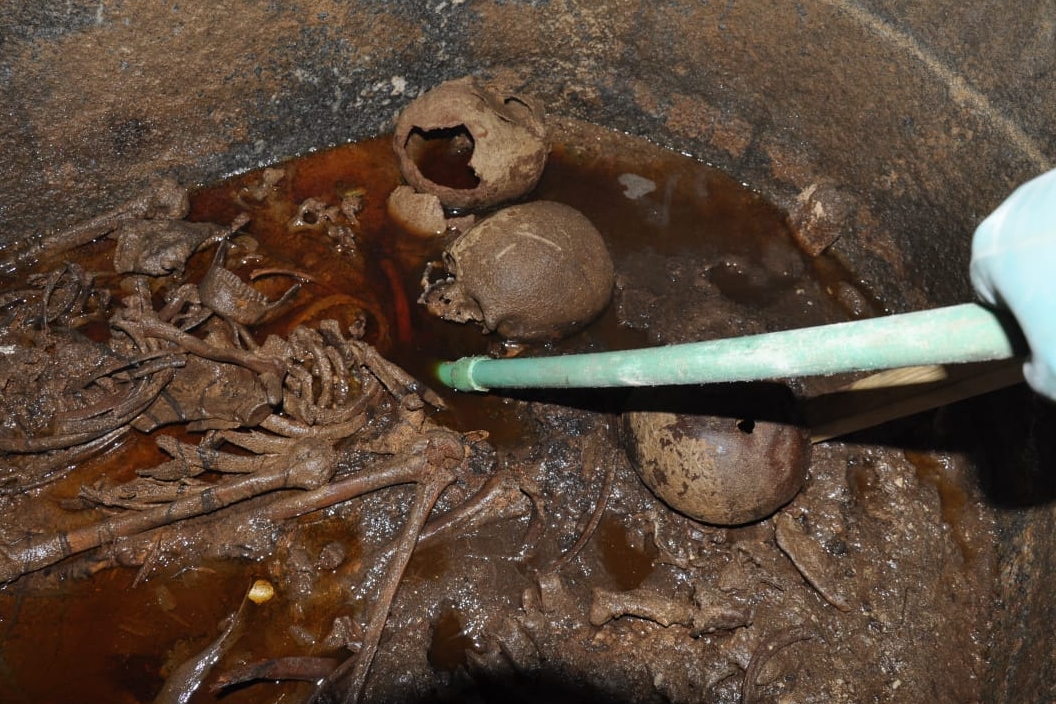
I considered scrapping it, but checked with interested parties first. The idea of a general "what's in the box" type anthology still appealed to both readers and contributors, and a friend found a good charity for conservation and restoration of Egyptian artifact. So uh.
I guess I'm doing an anthology, guys.
UNEARTHED is open for pitches, and I've already gotten a few in. It's going to be fun to go through them, I think, and also to write something of my own for it. That said... I've never done this before. I've only been on the writer end, never the editor side. Fortunately, Keith deCandido has offered his guidance (as he has done this before) so I should at least have a decent fallback.
The antho will be released under Altrix Books, the imprint Paul Driscoll and I created to release Seasons of War: Gallifrey and some other upcoming projects, so that meant cranking out social media and everything. I had a busy handful of days getting everything in line buuuut...
I'm looking forward to it.
I'm a bit excited to be overseeing something that other people will be contributing to.
And since I was big into Egyptology as a Tiny Kara, I'm glad to be dipping back into that.
More news as this madness progresses.
July 23, 2018
She-Ra: It's Not About Power or Beauty. It's About Fear.
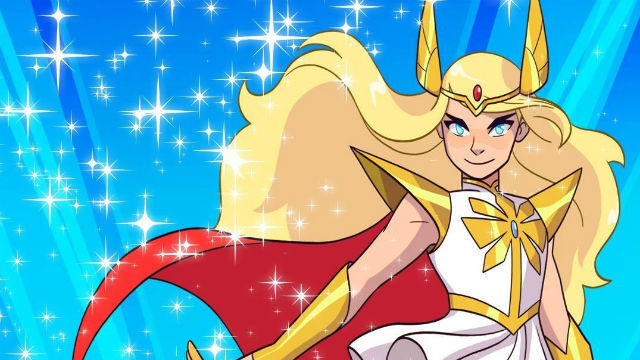
Discussion of the upcoming Netflix reboot She-Ra and the Princesses of Power has been fast and furious in all directions. There are people who love it. There are people who hate it. There are artists cranking out fanart, either for their own fun or to spite the haters. There are takes of all temperatures concerning how this is the "end of femininity," how the new Adora looks like a butch lesbian, and the general expected reactions.
Up front, I was a She-Ra fan as a kid. Of course. I was the target audience. I had the toys and everything. I was more into He-Man and kind of viewed She-Ra as "my girly He-Man alternative because for some reason no one wants me watching the Boy Cartoon," but I still enjoyed it. I've not been a hardcore enough fan to follow the nostalgia over the years. But I'll be watching the Netflix reboot because I'm always interested to see what my generation does when handed the reins to the shows they love.
Also, new Princess Adora straight-up looks like a PreCure so I'm down to clown.
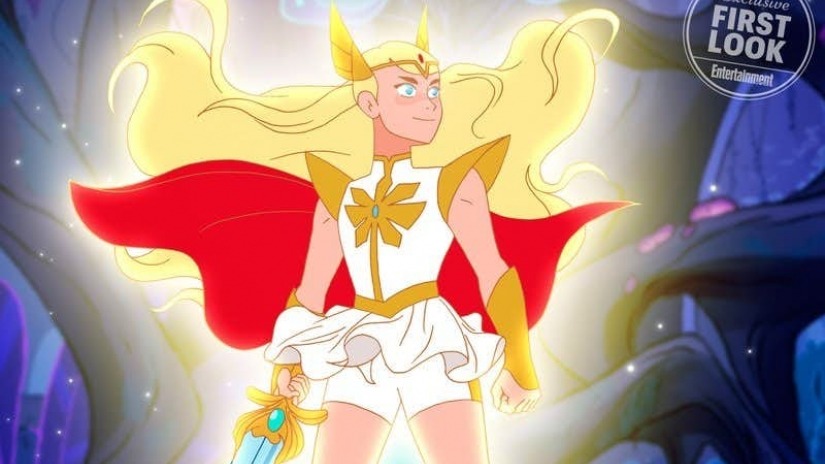
That said, I can totally understand why a fan of the original might genuinely feel a bit odd about the new art. The original series had that sort of rock'n'roll fairy tale Heavy Metal feel to it that a lot of fantasy and action cartoons did at the time. I think honestly it'd be a bit ridiculous to expect every She-Ra fan, or every 80s cartoon fan, to immediately embrace this huge stylistic change that is (literally and artistically) decades removed from its original.
That doesn't mean it's not good or that I don't like it personally or that I think anyone who liked it immediately is being disingenuous. It just means I can completely see why being handed this would make some people need a minute. You can't slap someone in the face with the Fish of Change and expect them to immediately thank you for it.
It grew on some people. Awesome. Some still don't like it. Also awesome. Did you know there are modern cartoons I don't watch because I can't jam with the art style? It's true. Me, an entertainment journalist, can be turned off by art styles. Welcome to the world of subjective opinion and free will.

I'm sure there are people out there not jamming with the new style for reasons that aren't even remotely misogyny- or socially-motivated, but they don't wanna say anything because they're terrified they'll be called sexist or some shit. If you don't dig it for no reason other than you just don't, that's fine. Rock on. Watch what you like.
Y'all aren't who I wanna talk about anyway.
What we are seeing is an influx of hitherto un-self-identified male She-Ra fans of my era, angry as all get-out because the new Adora is "ugly" or "unfeminine." To which I say two things:
1. She looks just like a friend of mine's kid so don't go calling her ugly.
2. You and I both know that's not what's bothering you.
My Law of 7 Billion doesn't permit me to state that none of the guys complaining about the reboot has ever watched the original She-Ra. (For those who don't know: I have a law, which I use to call out mostly myself, saying it's more likely that at least one person in 7 billion has done something than that 0 in 7 billion have. Thus I can't say "None of the people saying this has ever done this" because the odds are against me.) So it is possible, even probable, that at least one guy mourning the existence of the reboot actually does have that deep a childhood connection to the show. It's improbable, though, that all of them do.
What's more probable is that these guys are invoking the exact language that they know will get responses: talk of the "death of femininity," referring to the new Adora as a "butch lesbian," or basically anything else that's going to get the Woke Patrol up in arms. It's to a tee. It's too to a tee. And it's working.

In conjunction with my previously stated Law of 7 Billion, I'm absolutely sure that there are people out there who believe that the teenage Adora now looks like a teenager is indeed the Death of Strong Womanhood as we know it. I'm sure there are some people who, when they say it, really do believe it inside and out. But again, I feel that's just scratching the surface of what's going on here. Because we're looking at people who, in large part, only now are taking an active interest in the IP.
This has zero to do with the show. It has zero to do with strength, beauty, femininity, or (thank God) sex appeal. Across the board, this is about fear. And I'm not talking "weak men scared of strong girls." I'm talking about fear of erasure and irrelevance because of just how strongly many people equate fandom and identity.
Even if She-Ra is not a person's show of choice, it is (theoretically) representative of an era. It is very Eighties. It was never, until now, reimagined in any significant official form, so we don't have the benefit of regular reboots to loosen us up about the idea that the characters could look any different. So for someone who has banked the majority -- if not the entirety -- of their identity in being an Eightes Kid and a Cartoon Fan, the mere existence of the new version is an affront to their literal personality. And that's... gonna make 'em fighty.
Now, He-Man and She-Ra were made to be fun and sell toys. And the art style was made to match the standard art style of its genre. In other words, both shows were very standard. Look at the new She-Ra and the Princesses of Power, and -- no offense, just speaking objectively -- it is very standard. It looks like a 2018 Netflix cartoon, just as much as the original looked like an 80s fantasy cartoon. In other words, nothing's really changed. The story still exists in its moment, in the style most accessible to present-day viewers of its chosen demo.
tl;dr on that last paragraph, so far She-Ra is what it always was: a cartoon in the standard present-day animation style, made to appeal to a specific age range and maybe shift some molded plastic.
But the fact that it still functions as it did 30 years ago, even though it doesn't look like it did 30 years ago, is not going to make a difference when someone's primary concern is "they're destroying what makes me me."

Being a fan of something -- even being a huge fan of something -- is fine. God, look at me. But the danger comes when it becomes your primary, or even sole, identifier. Because now you've built your house on sand, and if a wave comes along, there's nothing left.
And I'm not talking, like, shorthanding your personality via a Hogwarts house or something. (Slytherin, BTW.) I'm talking situations where, if you extract the object of the person's fandom from the equation, there's really nothing left. The show, the team, the band, the era, whatever, is their literal everything. It's how they identify themselves, it's how they measure their worth.
This is the real face of gatekeeping: over-dedicated fans so terrified of their primary identifier being corrupted that they need to check any and every change. To them, a show like the new She-Ra is the equivalent of having a stranger's fingers stuck in their DNA. That's the fear. Not the decline of womanhood, not the value of the original product, but their own sense of self-worth.
But they don't say that -- either because it's frankly embarrassing, or because they themselves don't connect the dots that this is why these negative feelings won't process and go away. So, deliberately or subconsciously, they grab the modern keywords. Then people will debate them. Then they'll know they've been heard, even if (or because) they're being deluged with disagreements.
That's their problem. That's their baggage. It's not ours to solve or step around. But it does behoove us to understand this, and to place our energy in other things. Yelling that they're wrong won't fix their hecked-up self image. Only they can do that. In their own time.

I can't speak for the quality of the new She-Ra because it's not out yet. I've only seen pictures, which I'm cool with. But I haven't read scripts, heard voices, or been told about story arcs. I've not seen these images in motion. It would be disingenuous of me to say I will love it (or anything) no matter what, because frankly I learned the hard way that it's called "ride-or-die" for a reason.
But as a fan of the original She-Ra, as a fan of fantasy-action and magical girls, and as an active writer and reviewer of fiction, I am interested enough in what I've seen to give it an enthusiastic chance. I really think that's more than fair to say.
For those who dislike it or aren't sure: that's fair. You do you. Netflix is full to the brim of things that need watching. There's so much entertainment in the world that focusing on what we don't like is just taking time away from discovering things we do like.
And for those actively protesting the existence of the reboot, as well as those engaging them long-term: thing about why this protest exists. Remember that people only fight when they're scared. And be happy to detach and let people unpack their own baggage. This time could be better used engaging in what you love.