
Tade Oyebode's Blog, page 4
October 17, 2021
Obaluaye: Ancestry Is Complicated
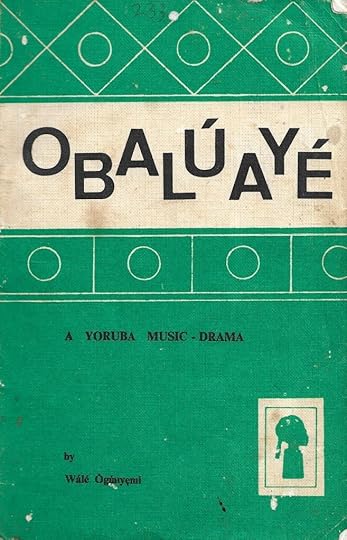
Of all the deities of the Yorubas, Obaluaye is the most feared. You probably know him by the name Sonponna, the deity that the Yorubas of old believed can inflict small pox even on the vaccinated.
The Yorubas of the South Western part of Nigeria are very accomplished in dramatic arts. Growing up in the South West, we were spoiled for choice with a variety of quality drama programs, both in Yoruba and English Language. Some of them were contemporary, others were historical.
There were several giants of performing arts. The biggest name of course, was Hubert Ogunde. Ogunde was a pioneer in cinema. Two of his productions, Aiye and Jaiyesinmi were hugely successful. Kola Ogunmola and Duro Ladipo were also big names in performing arts. Sadly, early deaths truncated the career and contributions of Ogunmola and Ladipo. There must have been a demand for entertainment in the South West of Nigeria because many of these performers, including the less known ones like Ishola Ogunsola, traveled across the whole of South West and beyond, effectively, taking their performances directly to the people.
One of the big names, who was inspired by the works of Kola Ogunmola and Duro Ladipo was Wale Ogunyemi, you can navigate the link to read more about him. One of his works was the play “Obaluaye”, which he wrote in 1972.
This is the story in a nutshell. A low ranking king in a small Yoruba town converted to Christianity and stopped his people from worshiping the deities, including Obaluaye. Obaluaye summoned a council of the deities. In attendance were Obaluaye (Sonponna), the god of small pox, Ogun, the God of Iron, Esu, the trickster, Osanyin, Orunmila, Egungun (masquerade) and Osun, a river goddess. They agreed to place a curse on the town so as to catch the attention of the people.
I am not writing a review on the book today but just wanted to highlight something that caught my attention in the very first page of the book. As Obaluaye was summoned, the drummers were praising him with these words:
Nupe god, strong like rain drop
As he danced out, the drummers changed tune:
Huku Huku comes, Gambari comes
Even Sonponna, a Yoruba deity is not quite Yoruba! The Nupe people are dominant in Niger state, though they are also minorities in Kwara and Kogi states of Nigeria. They have their own language. Who are the Gambaris? Some say it is a variant of the word “Kyamberi”, from Zamfara state in the North. Since this is a play that is rooted in Yorubaland, we just need to know who the Yorubas think Gambaris are. There is no doubt that to the Yorubas, Gambaris are Northerners.
Obaluaye, the most feared deity among the Yorubas of old, was probably a deity that the Yorubas acquired from outside their own people group, from communities that spoke different languages, probably from Nupe or Hausa speaking people.
When did our great ancestors acquired this deity? Who knows! Samuel Johnson, in “The History of The Yorubas” claimed that Oduduwa, the father of the Yorubas, Kings of Gogobiri and of the Kukawas all descended from Lamurudu. It is of note that Gogobiris and the Kukawas are people groups from the Hausas of Northern Nigeria.
If we shared deities with the Nupe and the Hausas, who knows what else we share? DNA?
When you think about it, the earliest civilisation found in Nigeria is the Nok Culture, centred at a village in Kaduna state bearing the same name, and dates back to 1500BC. Archaeological excavation at Nok revealed sculpture similar to that found at Ife and Benin. If the sculptures are similar, what else is? DNA?
The people of modern day Nigeria are very ethnocentric: we see ourselves as Yorubas, Hausas, Fulanis, Ijaws, Igbos, etc. However, no man is an island. An ancient civilisation like the Nok Culture, which independently had iron smelting technology, must have exerted influence over a vast area. Is it possible that the same ancestors from the Nok Culture gave birth to all these proud cultures, each of whom believe in its exceptionalism?
I don’t know. I just feel that ancestry is complicated. As you go on and on about how wonderful the Yorubas are, as you write and post about how having a Yoruba nation will cure all the problems that you are experiencing in Nigeria, have some humility and note that it is possible (just a possibility) that many of the nations of Nigeria share the same provenance.


October 1, 2021
Nigeria at 61
I wish Nigeria a happy birthday, at 61.
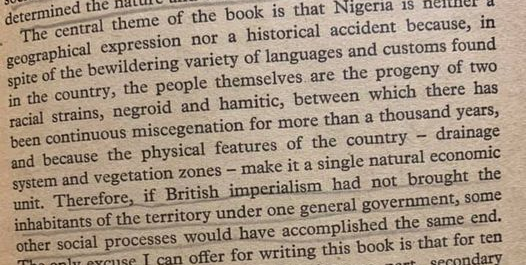
Praying that our leaders would have the hearts of shepherds who genuinely care for their flock. Praying that our leaders would seek knowledge and understanding as they solve the enormous challenges facing the nation. This prayer is inspired by Jeremiah 3:15.
Above is from the preface of “The Development of Modern Nigeria” by Okoi Arikpo, a book written before I was born. It belonged to my father but I inherited it in 2017 . The book was given to my father when I was 2 years old by the pastor who dedicated me to the Lord and prophesied I would be a preacher, a prophecy that has been fulfilled.
I want to make a few comments on the entity called Nigeria. Okoi Arikpo made these point well and I will just comment on it. First, a story.
Is A Resident of Wroclaw, Poland, Polish or German?
Before the pandemic, I made a business trip at least once year to our Wroclaw, Poland office, flying out on a Monday and returning on Friday evening. On one trip, we gathered together on Thursday evening for a meal and farewell drinks.
It was in the summer, therefore, we sat outside. I pointed out my fascination with the majestic and awe inspiring church buildings. On all my trips, I always find an evening to visit Ostrow Tumski, where there are a few of these church buildings. My Polish colleagues pointed out that 100 years or so earlier, the very spot where we stood was in Germany!
If you were born and bred in Wroclaw, are you German or Polish? It depends on how you choose to look at it. The ancestors of some Wroclaw citizens probably saw themselves as Germans. Nationalities are not as fixed as we often like to imagine, it all depends on far back we wish to go.
Orikpo claimed that the racial strain in Nigeria are Negroid and Hamitic and that those strains have intermarried for a thousand years. Note that this is not the same thing as the discredited “Hamitic hypothesis” which attributed African civilisation to European influcence. Robert S Smith in his book, “Kingdoms of The Yorubas” wrote about the languages in Nigeria: “Yoruba separated from Edo, Ibo and Ijo about 5,000 years ago, from Idoma 6,000 years ago and from Igala, 2,000 years ago”. Various parts of Nigeria have very distinctive sense of identity but if you go further back our ancestry may suggest that we have a lot more in common.
Should we not leave to one side this obsessions with the current configuration of Nigeria and focus more on the inequality, which unites the poor of ijaw, Igbo, Yoruba and Hausa/Fulanis? The obsession with structure probably plays well into the hands of those who are benefiting from the current situation. The truth is Yorubas, Igbos, Hausas, Ijaws, etc have all contributed to how Nigeria is today.
I am not a fan of the scramble and partition of Africa, how the colonial powers partitioned the continent without any recognition of existing linkages (via language for example). Nevertheless, Orikpo’s claim that “If British Imperialism had not brought the inhabitants of the territory under one general government, some other social processes would have accomplished the same end” is worth some reflection.
Orikpo’s point is very important. The various groups which comprise Nigeria today are naturally dependent on one another. Many in Southern Nigeria talk as if they can just cut off Northern Nigeria, carve out their own nations and carry on business as usual. This is sort of thinking comes from cloud cuckoo land.
Think about Libya. The refugee crisis in Europe got out of hand when Libya failed as a nation. Libya is separated from Europe by the Mediterranean sea. When Syria’s civil war started, it became a headache in Western Europe. Why do people in Southern Nigeria think that carving out their own nations bring an end to the current crises? It won’t.
The problems of Nigeria is more extreme in the North, but the same problem is everywhere. It is a story of concentration of wealth, education opportunities and health benefits into a very small minority of the populace. A story of “winner takes all” with nothing left for the populace. As a small example, if the 500 million dollars spent to educate children of the most affluent abroad are poured into the educational sector, the benefits to Nigeria will be immense. First of all, better opportunities will be available for those working in the sector. Then, the quality of educational provisions in Nigeria will be boosted. Next, that 500 million dollars that we do not have to spend abroad directly boost our foreign reserve. Furthermore, we will be able to release potentials of bright children whose parents could not send them abroad or pay for expensive private education within Nigeria.
I close as I started:
Praying that our leaders would have the hearts of shepherds who genuinely care for their flock. Praying that our leaders would seek knowledge and understanding as they solve the enormous challenges facing the nation. This prayer is inspired by Jeremiah 3:15.
September 25, 2021
Oluwa Lo Mejo Da (God is the fair and wise judge) – Act 1 Scene 1
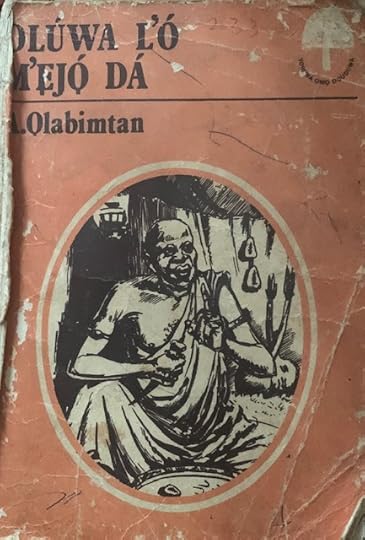
This is an old book, written in 1966. The last reprint was in 1971. Admittedly, my copy is very worn and rugged.
One of the main characters in the book is depicted on the cover. Please meet “Dr” Raimi Ewedogbon. By the way, he is a native doctor and also a priest of one of the foremost deities of the Yorubas, Ifa. Raimi is the same as Raheem, therefore, I guess that apart from being an Ifa Priest, he was probably also raised as a Muslim. In those days in the South West, this was not unusual.
His surname, “Ewedogbon”, hints at his wisdom in “herbs”. A native doctor is capable of prescribing “herbs” to solve physical health problems (such as headaches, stomach ache, cancer) but also for spiritual problems (for example, bad dreams, inability to prosper because of enemies “from your father’s house”, breaking curses, etc).
The author of “Oluwa Lo Mejo Da” was Afolabi Olabimtan, an academic from South West of Nigeria, with a PhD in African Languages. Later, he became a politician. He died in 2003. The book was written in my mother tongue, Yoruba.
Raimi Ewedogbon also had an alias “Ogboju Onisegun Ti Mba Esu Muko”. “Ogboju” could be translated “bold”, “brave”, “experienced”. Onisegun means physician but in this case, not a western style one. The full translation of his alias is “The bold, brave experienced Native Doctor-cum Ifa Priest who breakfasts with the “Devil”). I put “Devil” in quote because there are controversies on whether the deity “Esu” is the same as the “Devil” that the Bible describes. Regardless, of the controversy, the key thing to take away is that we are dealing with a very powerful individual.
The book opens with a scene in Raimi Ewedogbon’s house. His first client was an “Alufa”, which you could be translated as “Vicar”, “Pastor”, “Rev Father”, etc. Raimi quickly recognised his visitor, which showed that was not the first visit. Raimi’s greeting was “Se mejeeji ni ti-nyin, ise Orun l’e nse laiye”. Raimi affirms that the Vicar is mixing two things together: Christianity and African Traditional Religion (ATR), as he tried to do God’s work on earth. He then went on to quote a verse of Ifa, followed by an ifa rhyme:
Aiye o fe roAiye o f'osikaAiye o fe roAyie o f'oskiaOna gbonrangandan laiye a feTranslatedThis world does not want a liarThis world does not want the wickedThis world does not want a liarThis world does not want the wickedThis world does not want honestyThe message of the rhyme became clearer when Raimi Ewedogbon expounded the Ifa verse by telling a short story. A man came from heaven to earth, determined to be honest but in the end, the people of the earth destroyed him. Therefore, Raimi concluded that if you are on earth, you are better off adjusting to how people on earth behave and when you get back to heaven, you can behave as they do there. The admonition is rather blunt when you think about it: you cannot be honest and straightforward in this world, according to the wisdom of our Yoruba ancestors.
What was the purpose of the visit of the Vicar/Pastor? He came to thank Raimi that the fetish device he secured earlier was a game changer. Everybody in the church had fallen in love with him. The elders that were a pain in the neck are now his bosom friends. The Vicar/Pastor then gave Raimi the offering that he brought for him. The services offered by Ewedogbon was “try before you pay”.
Before the Vicar could leave, another visitor turned up. Akanni was a robber who stole 1,000 pounds (in those days, the currency of Nigeria was the pound). Raimi concocted some fetish for him and he escaped jail. Unlike the Vicar though, he claimed he was broke because he had to pay the lawyer and bribe the police. Akanni did not want to fulfil his obligation, partly because he wanted to use some of the stolen money to marry a new wife.
Akanni was shocked to find the Vicar/Pastor consulting the Ifa Priest and challenged him. He had two issues with the Vicar. The Vicar prevented Akanni’s sibling who had a set of twins from doing the necessary rituals. Moreover, he also prevented one of Akanni’s acquaintances from making a concoction for his child. In both cases, the Vicar said Christians should not consult native doctors/Ifa priests.
Raimi intervened and chided Akanni saying “the world does not want this”, he continued:
Who is not doing God's work? Who made work, who made man?The work and the one doing it, who owns both, but God?Leave the Vicar/Pastor aloneWhere are you going with this? This is where I will stop the review of Act 1, Scene 1.What was South Western Nigeria like in 1966? I have no idea. Through this book, I can allow my imagination to take me there. Some issues sounded very familiar: the bribing of policemen, the insinuation that a man of the cloth was mixing together Christianity and ATR; the role of a powerful individual like Raimi in society who is believed to have supernatural powers, able to solve problems; allegations of hypocrisy in the pulpit; the belief that prison can be avoided by consulting an Ifa priest to intervene, yet the bribing of the police and hiring of a good lawyer to hedge your bet (just in case the supernatural solution did not work) .
There is a theme running through the first scene. Raimi represented the thinking that Christianity and ATR can mix together. That was the viewpoint of Raimi. Reflecting on this, it goes much further than that. The power relationship between the Vicar/Pastor and Raimi suggests that ATR was considered more powerful, at least by the Vicar/Pastor. After all, it was the Vicar/Pastor, who went meekly to bow before the Ifa priest, looking for a solution to his problem and not the other way round. Furthermore, it was a discreet visit, immediately another visitor turned up, the Vicar/Pastor became uncomfortable and hurriedly departed.
The narrative that ATR is very powerful endures, even in South Western Nigeria of today. It carries on as urban myths. I once heard about a very “powerful” General Overseer who “supernaturally” knew some of the pastors under him were sourcing “power” from ATR priests. I received the information not directly from anybody who was present. How can I be certain such an information is authentic?
Another source of evidence for the belief that ATR is considered more powerful than prayers can be found in Nollywood films with similar theme.
The problem with the “power” of ATR is that evidence for it is very scant. The demonstration of ATR “power” no longer appear to happen where people can witness it. There are very few credible evidence. Instead, there is abundance of second or third hand information and of course, numerous urban legends and Nollywood films to back it up.
The Yorubas of old believed that small pox was inflicted on people by Sonponna. We do know now that Small Pox is a virus that has been around for thousands of years and one of the wonders of modern vaccination program is the eradication of small pox, robbing Sonponna of his one weapon. Sango is believed to be the god of thunder, yet secondary school physics paints a different picture.
Even if a phenomenon does not exist, the moment we start discussing it, we have given birth to it!
July 31, 2021
Eegun Alare (Magician Masquerades) and Yoruba Poetry
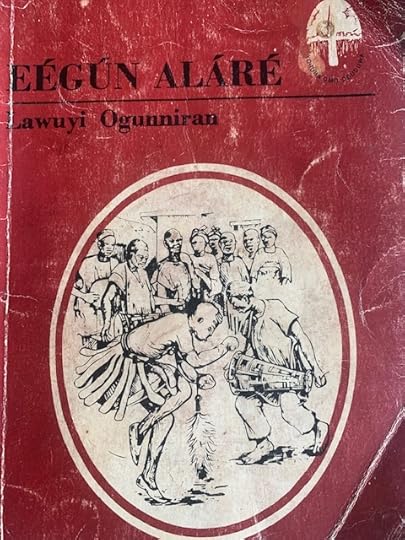
When I was growing up, authors of Yoruba novels were very prolific. This novel came to my attention in year 8 as it was our text for Literature in Yoruba language. It was written by Lawuyi Oguniran (navigate the link to his Wikipedia page).
As I read the book recently, I was struck again by the richness of the Yoruba culture and language. The Yoruba language itself is a tonal one: a word has no meaning until you know the tone and the signs that guide its pronunciation.
Poetry is all over the Yoruba language and culture, it shows up everywhere. Each family has its own poem. Towns also have poems about the people, their history and environment. Poems and rhymes are used to celebrate and extoll. They can also be used to mock. The closest to how poetry is used in Yoruba culture is a musical theatre in the UK.
In the preface to Eegun Alare, Ogunniran identified four forms of poetry:
ewi: this is straight forward poem, verses that are recited as if somebody is reciting a rhyme. onirara: these are praise singers. Often found in the royal courtyard but they can turn up in various social events, whether formal or informal.ijala: When hunters and warriors gather together for their events, they will communicate using ijala. Ijala is like a poem that is sung with a ritual and religious edge. Legend has it that at such gathering, there could be some display of Yoruba “powers”. Having never witnessed such or met anybody who did, it is difficult to verify.Esa: This is another poetry used by Eegun Alare performers and played a big part in Ogunniran’s book.I translated Eegun Alare as magician masquerades. In Yoruba culture, Masquerades are “ara orun” (heavenly beings). In many Yoruba towns, masquerades come out once a year, during a particular week. It is a form of ancestral worship. Ogunniran in the preface to Eegun Alare wanted to distinguish them from the annual masquerades. He described them as masquerades that move from town to town throughout the year, entertaining people with their supernatural power display. Legend has it that these masquerades can turn into snakes, though Oguniran himself never witnessed such an event.
What Ogunniran wanted to celebrate was how these magician masquerades use another form of Yoruba poetry, Esa to communicate with one another. He believed that Esa was already dying out. As people in Yoruba speaking area converted to Islam and Christianity, they branded vast aspect of our culture as pagan worship. There is a balance to be struck. The Yorubas are very spiritual people, so, culture and religion are hard to separate. In fifty years’ time, Ijala and Esa may be lost to the Yorubas because of their “pagan” connotations. We need to find a formula that will preserve cultural heritage so we don’t throw away the baby with the bathwater.
I will wrap up by looking at how a couple who were about to be separated for a while said goodbye to each other in Ogunniran’s book.
There were two very good friends, Oje Larinaka and Oje Dasofunjo. Oje means both were Eegun Alare, and travel around entertaining people with their magical skills. Larinaka decided he wanted to seek a new base and had to leave his wife who was expecting their first child at home by herself.
As they parted, Iyadunni, Larinaka spoke to her husband in Esa
Baale mi, oko mi,Iremogun, omo Awuse,Iremogun, ara Ilagbede, a-wo'rin-tun-rin-roBa a rebi, a da ni logun odunBa a rajo, ada ni logbon osuOje Larinnaka nlo, ko da'gba kanOje Larinnaka, oko Iyadunni ElegunOje Larinnaka, dakun ma gbagbe mi........I will translate line by line. In the first line, Iyadunni addressed Larinnaka as her lord and husband. In the next two, she reminded him about his ancestry. Clearly, the ancestors of Larinnaka worshipped Ogun the god of iron: a-wo’rin-tun-rin-ro is an iron worker, somebody who can shape iron, probably blacksmiths, who were Ogun worshippers by heritage.
Larinnaka’s wife continued by saying typically people would indicate how long a trip will last but her husband is travelling without specifying a returned date. There is a sense of premonition that this trip might be life changing for her. She then begged her husband not to forget her, putting it in a very moving manner and three times she repeated that statement while she was in this musical dialogue with her husband.
After Iyadunni was done, Larinnaka replied:
Ooto ni, bee naa niOju o ni o o ti, o o ni teEmi l'Egun Alare, a bi koko leti asoEmi l'Oje Larinnaka, oko Iyadunni,Orimoogunje, oko lemi agbeIyadunni, o, dakun ma ya lehin meBi ko sigi lehin ogba, wiwo ni i wo.....Iyadunni o, dakun ma gbagbe me.........Larinnaka started with prayers that his wife would neither be disgraced nor be ashamed. He constructed his identity from his profession as an Egun Alare and also as the husband of Iyadunni. Using the same phrase as Iyadunni did earlier, he beseeched her never to forget him and promised never to forget her. In verses I did not show above, he waxed lyrical on the theme of forgetting using several metaphors and figures of speech. Clearly we have a couple who are deeply in love, just about to part and very emotional about it.
Critical parts of the book are written in Esa, poems that would have been chanted. I hope these poetry are not lost to our culture.
If you follow this link, you will hopefully come across a few examples of these Esa performance. You will also spot why this artform is dying out. They are mostly used during Egungun festival and often used to worship ancestors, something that will make devoted Christians and Muslims uncomfortable. I think we need to be able to separate some of these arts from their worship dimension so that they can be preserved and enjoyed.
February 7, 2021
A Second Look at Ireke Onibudo: Fagunwa and His Extraordinary Characters.
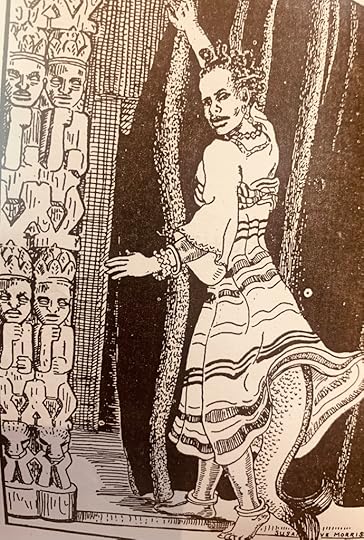
When it comes to characters, D.O. Fagunwa did not impose any limitation; he allowed his imagination to run riot. This was what made his books fascinating.
The title of the first chapter of Ireke Onibudo was “Pipade Awon Abami Eda”, translated “An Encounter with Strange, Unusual and Extraordinary Beings”. He opted for “Eda” (being, creation, creature) instead of “enia”, which is very narrow in meaning and refers to human beings. A student of Yoruba language would know straight away that the characters in this chapter won’t all look like the next door neighbour.
In the first chapter, there was a boy on the way to the farmstead during the school holidays with his sister, Mary. However, the river had overflowed, so, he sent his sister back to town but he swam across to the other side of the river. As he continued his journey on foot, he noticed a strange man ahead of him. The first unusual thing about the man was his height. He was so short that he only reached the hips of the boy who himself was short. At the time the boy noticed him, the strange man was ahead of him. Before he knew it, the man ahead disappeared only to reappear behind him.
As if that was not enough, the face of the unusual man was more surprising. There was only one eye on his forehead. The eye was like a small mirror that young ladies put in their purse. To cap it all, the strange being was exercising influence on the boy’s vocal chords and his somatic nervous system, preventing him from being able to shout for help or run away.
The image in this post is that of another Fagunwa character: Arogidigba, the queen of the all the fishes in the sea. Ireke Onibudo, the main character, was travelling by boat when a storm overturned it. As he tried to survive by clinging to the boat, he was captured and taken right down to the sea bed into the kingdom of the fishes. Ireke Onibudo described his captor as a man but once again, a very unusual one: he wore an apron to cover his modesty, had no hair, his nails were very long, his eyes were several times bigger than that of humans and was shaped like the moon; his teeth were like that of a lion, he had hair in his nose and he had a tail that looked like the tail fin of a fish.
It turned out the queen of the fishes, Arogidigba, was looking for human meat to celebrate a festival, the very reason Ireke Onibudo was captured. On the first look, the queen of the fishes did not look like a fish at all. Instead, it was the visage of a young lady, with a nice hairdo (hairdo always matter!). When Arogidigba rose up, her tail fin became visible to all. Arogidigba’s mother had more tricks: she had some pots in her house and once she enters a particular one, a big snake comes out.
The animal characters in Fagunwa’s books are also fascinating ones. For example, there was “Ewure Iberu” (the fearesome goat), with a very substantial beard who made his residence in hell with the devil himself. Also of note was Ologbo Ijakadi ( the wrestling cat) who was so full of mischief that he was eventually caught in a web of his own making.
The last character I want to mention in Ireke Onibudo is Itanforiti, a man (can we actually call him that?) who lived in a hole in the ground. Itanforiti was the epitome of wisdom, despite dwelling in a hole in the ground. He had the head of a human but the feet of a cow. Furthermore, he was also the most powerful man (in terms of the supernatural) in the world. To reach his dwelling, Ireke Onibudo had to travel through a couple of unusual towns one of which was a town of men only. When it wass time for a man to marry in that town, a custom made woman from heaven had to be sourced. Surprise, Surprise, the next town was a town of women only. On a more serious note, Fagunwa used these two towns to illustrate the complimentary role of men and women in human society.
And what about the trees in Fagunwa’s book? They were full of surprises. Ireke Onibudo described a few trees that were white in colour and free to walk around! As he passed through a forest called “Aginju Mimo” (Holy Wilderness), Ireke Onibudo described trees that were planted in one day and on the the same day grew and brought forth “fruits”; those fruits included snakes, scorpions, lions, and a human being. As we say in Yoruba, Irohin Kayefi! (astounding stories).
January 23, 2021
First Look at Ireke Onibudo (a book written by D.O. Fagunwa)
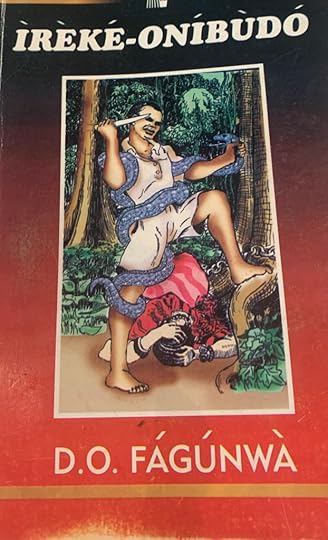 Ireke Onibudo delivering a princess from a flying Snake
Ireke Onibudo was the fourth book written by D.O. Fagunwa, a pioneering author from the South West of Nigeria. There is a pattern to most of Fagunwa’s books. There is a narrator, who had a very fascinating story to tell about his adventures in life, who turned up unannounced and instructs the author to write his biography.
The book opened up with “Enyin Ore Mi”, the equivalent of “Dear Friends”. Fagunwa has a very distinctive manner of writting: long sentences with commas and semi colons used to break the sentences. The first sentence in Ireke Onibudo was 181 words long. Ireke Onibudo was published in 1949.
Although Fagunwa was writing the book in 1949, it is probably the case that the first chapter drew heavily on his own school days. He was born in 1903, therefore, it is likely the accounts he gave of South West Nigeria portrayed life at a time much earlier, probably as early as 1920.
Using the voice of the author of the story, we see a picture of life in South West Nigeria in 1920. The author remembered his school days when he lived in town during school term but traveled to the farmstead during the holidays. It was not uncommon in those days that children of farmers were educated away from their parents, returning to the farm stead during the weekends and holidays. The author described his times on the farmstead as enjoyable because of the following: fresh maize, pounded yam wrapped in banana leaves, mushroom broth, eating meat you hunted, snails, etc. He also described his love for fishing in a big river near their farmstead. These days pounded Yam is no longer wrapped in banana leaves, nevertheless, its appeal remains as strong as ever.
I think Fagunwa’s belief system (as seen from his books) is very complex, a mixture of Yoruba religions and Christianity. This is not surprising: it was probably in his teens that his family converted to Christianity. Therefore, unlike most inhabitants of South West Nigeria today, Fagunwa had a direct experience of practicing Yoruba religion. Coupled with his exposure to Christianity both at school and when his family converted, his books reveals a complex integration of both.
God and his awesomeness is often emphasized in a Fagunwa book. Just over a page into Ireke Onibudo, we read:
Oba ni Olodumare fi awon agbe je si inu oko, oniruru awon nkan ti oni iyi ni oju awon ara ile, yepere in ju won: igi gbigbe ko jamo nkankan, ewe ko ni iyi rara, onje si po lo yanturu
The translation here is “God has made farmers king in their domain, surrounded with abundance of food and other things that people who are not farmers marvel at.” This gives us a glimpse into Fagunwa’s ontology, his understanding of reality: everything derives from God, a very biblical and Yoruba ontology.
In the same paragraph, Fagunwa launched into the awesomeness of God:
Bi enikan ko ba mo bi Olodumare ti lagbara to ki oluware lo wo oniruru nkan abami ti mbe ninu oko, bi igi giga ti mbe beni igi kukuru mbe, bi eiye kerere ti mbe beni eiye nla mbe, ibiti erin wa ibeni ijapa wa, ibiti ejo ti nsare kiri lo ni igbin unroral lo, alantakun n ranwu, ikan nba ise lo lori okiti ogan, awon eiye miran gbe inu igi, omiran ngbe inu ile, omiran ngbe inu ite, adan ndorikodo sun, owiwi nkigbe kiri larin oru, adaba nso akoko fun awon agbe, on duro bi agogo ti Olodumare so lojo sarin igbe, igbati awon agbe ban jeun tan, nwon a bu omi tutu mu
In the quote above, Fagunwa extolled the power of God as revealed in nature. He alluded to the mysterious beings in the forest bringing out a series of contrasts: very tall trees and very short ones; tiny birds and big birds; elephants and tortoise; fast moving snakes and snails. Furthermore, he wrote about spiders spinning their webs, the variety of birds that dwell in a variety of places, bats that sleep in an inverted position, owls disturbing the peace at night and so on. This sentenced showed that Fagunwa was a keen observer of nature. Like the Psalmist (Psalm 8, Psalm 19), he attributes the diversity of creatures under the sun to the awesomeness of a creative God.
The forest is always a very strong presence in Fagunwa’s books. The forests in Fagunwa’s books are no ordinary ones. Those were not just forests where dangerous animals lurk. Instead, they were also centres of supernatural activities where supernatural beings, powerful humans and animals interact. In fact, in one of these mythical forests, Igbo Olodumare, a snail was several factors bigger than a tortoise. It was not unusual for animals to speak and for humans to travel directly to heaven or hell via these forests.
It is in the encounters that Fagunwa’s characters had in these forests that we see a very strong departure from biblical ontology and the ontology of Yoruba religion emerges in its distinct form. For example, Ireke Onibudo’s dead mother often visited in his dreams to assist him in times of trouble. Arogidigba, the mermaid , who was half fish and half human, set up various challenges for Ireke Onibudo. Those challenges were a set up for failure but Ireke Onibudo’s dead mother would come back to earth to provide wisdom and insight. In a final epic encounter, Ireke Onibudo’s dead mother came back with the host of heaven to finally destroy Arogidigba.
Fagunwa’s books reflected where people in South West Nigeria were in the period during which he lived. The belief that supernatural things happen in forests was widely held by many. Some of the indigenous churches that were thriving in those days held similar beliefs and would go into those forests to minister deliverance to the land and cast out demons they believed inhabited those forests.
If you compare our Christian beliefs in the South West of Nigeria and many countries in the African continent to the ones in Europe for example, the influences of the Yoruba religion (and similar religions across the continent) are still palpable. Knowledge and experience (whether spiritual or secular) are situated socially, culturally, and historically.
January 16, 2021
Is Democracy Descending Into Decadence and Tyranny?
If you don’t read any further, please watch this “prophetic” video, produced in January of 2017 by somebody who worked for Newsnight, before Donald Trump was sworn in:
https://www.youtube-nocookie.com/embed/cnzo9qXLFUo
When I started working on this post, a friend posted the video to me on Whatsapp. I was struck by how relevant it was. It was my biggest surprise that this was a video that was made about four years ago. Very prescient.
The first time Plato’s book, “The Republic”, was subject of my blog post was around the middle of Novembe 2018, over two years ago. It was in the context of Nigerian politics. Follow this link for that article if you are interested: https://ajarofclay.co.uk/2018/11/17/nigerian-politics-and-platos-republic/
As the events at the Capitol unfolded on January 6, 2021, Plato’s Republic was all that I had at the back of my mind. Plato’s republic was reportedly authored in 375 BC. The first point to make is the democracies in Plato’s time were different from representative democracies that can be found in the US, UK, Europe and around the world. Athens operated direct democracy where every citizen can vote on every important decision. Nevertheless, there are enough similarities between representative democracies and direct democracies.
The Republic was several discussions between Socrates and a few others. The dialogue of interest to this post is in Part nine of the book captioned “Imperfect Societies”. Socrates and his friends discussed four types of government: timarchy, oligarchy, democracy and tyranny. Amazingly, Socrates and his friends agreed that Democracy is only better than tyranny. Furthermore, their conclusion was that Democracy eventually gives birth to tyranny. If I heard a statement like that twenty years ago, I would have considered it a crazy idea. Unfortunately, events in the UK (a Prime Minister illegally proroguing parliament),what is happening in some democracies in Eastern Europe (e.g. Hungary, Poland as examples), the antics of Brazil’s Bolsonaro, the Trump years to name just a few examples, have shown that the opinion expressed by Socrates and his friends are very relevant today.
It is time to dip into the Republic. Socrates offered an opinion on how Democracy originates:
Then, democracy originates when the poor win, kill or exile their opponents and give the rest equal civil rights and opportunities of office, appointment to office being as a rule by lot
To an extent, most democracies arose from a power struggle, the nature of the struggle is not identical. In Western Europe, most democracies arose from a feudalistic/hereditary monarchy government. In Africa and a lot of Asia, democracies arose out of a struggle between colonialism/imperialism and the desire of the occupied nations to be masters of their own destiny. The dividend promised by democracies is the same: liberty and equal civil rights. The mechanism of selecting leaders are similar: lot (these days we vote).
Democracies are very attractive on the surface, and this paragraph from the republic makes this pont:
‘I dare say that a democracy is the most attractive of all societies’, I said. ‘The diversity of its characters, like the different colours in a patterned dress, make it look attractive. Indeed,’ I added, ‘perhaps most people would, for this reason, judge it to be the best form of society…’
Liberty and freedom are the main selling points of a democracy, but that liberty can lead to individualism and prevents individuals from seeing their responsibilities to others:
‘Then in a democracy’, I went on, ‘there is no compulsion either to exercise authority if you are capable of it, or to submit to authority if you are capable of it, or to submit to authority if you don’t want to…’
The resistance of individuals to wearing masks and sticking to social distancing rules has been very glaring in the democracies of Europe and America. In Europe and America, people have insisted on exercising their rights to protest despite the implication this has on the spreading of the virus in the communities. More surprisingly, people in America, UK, Germany, France, Spain, Italy, Republic of Ireland have protested against lock down policies.
Many in democracies around the world are arguing that they have a right not to take the vaccine. Yet, when they fall sick, they will want to exercise their right to be treated. Moreover, how different is the right not to be vaccinated from the right to infect others?
One of the most concerning development in democracies is that the content of the character of a leader no longer matters, all that people care about is popularity. Socrates and his mates discussed this. They were concerned that the gifts and the training of a prospective leader were not relevant in how democracies select their leaders:
Democracy with a grandiose gesture sweeps all this away and doesn’t mind what the habits and background of its politicians are; provided they profess themselves the people’s friends, they are duly honoured… This then, and similar characteristics are those of democracy. It’s an agreeable anarchic form of of society, with plenty of variety..
In the past, the character reference of a politician mattered in the Western Europe and America. This is no longer the case, at least in the UK and America. Boris Johnson won a landslide after the Supreme court ruled he unlawfully prorogued parliament. In the video below, Donald Trump boasted he would not lose a supporter if he shoots somebody dead in broad daylight:
https://www.youtube-nocookie.com/embed/iTACH1eVIaA
Voters are happy to overlook the misdemeanors of their “populist” leader as long as he gives them what they want. If a leader knows there is no political cost for his or her actions, the seed of tyranny is sown. This brings us to the next statement I want to quote from Plato’s Republic:
Well, my dear Adeimantus, what is the nature of tyranny? It’s obvious, I suppose that it arises out of democracy
How does democracy degenerates into tyranny? Socrates believed it is because of the excessive desire for liberty:
‘Liberty’, I said. You must have heard it said this is the greatest merit of a democratic society, and that for that reason, it’s the only society fit for a man of free spirit to live in. …’Then, as I was just saying, an excessive desire for liberty at the expense of everything else, is what undermines democracy and leads to the demand for tyranny‘
In the quote above, Socrates claimed that people in a democracy eventually demand tyranny. This sounds counter intuitive. Why would a society that values liberty demand a tyrant? Just focus on some examples. How can a society like the UK which prized the rule of law reward Boris Johnson (I am not claiming he is a tyrant), who was judged by Supreme Court to have acted unlawfully, with 80 seat majority? It is because the majority believed he would do what they wanted: get Brexit done (whatever it meant to them). Democracy allows populists to flourish. Populists are smart at know what the people wanted to hear, and how they want their leaders to talk. They are prepared to lie and the people no longer penalise them for it.
When Trump’s policies separated children of asylum seekers and prospective immigrants and put those children in cages, his supporters could have paused to imagine the character of such a man who would authorize such a policy. They didn’t. Instead, they focused on the end: ending immigration. The end justifies the means.
If we focus on our own liberty and do not reflect on how it impact others, we can push our societies into a downward spiral. This is how Socrates put it:
‘What it all adds up to is this,’ I said.; ‘you find that the minds of the citizens become so sensitive that the least vestige of restraint is resented as intolerable, till finally, as you know, in their determination to have no master, they disregard all laws, written or unwritten.’
There are at least two dimensions in which we see this play out in modern democracies. In the first place, people in ‘matured’ democracies have not responded to the common sense guidance from their government. Selfishly, the laws of lock down in the UK is flouted on daily basis. It is worse in America. In the middle of a pandemic, citizens of Michigan protested against the lock down, encouraged by their populist president, Donald Trump.
The second dimension of lawlessness in ‘matured’ democracies is how the politicians use undemocratic means to win democratic elections. Think about it: Hilary Clinton won the popular vote by more than 3 million, yet she lost by 74 electoral votes. In 2020, Biden won by 74 votes, but required more than 7 million votes to achieve this. This is the outcome of sophisticated gerrymandering in the drawing of constituency boundaries. In order to win democratic elections, undemocratic means such as voters suppression are deployed. A Republican presidential aspirant requires fewer votes than a Democratic aspirant. Undemocratic means are baked into the electoral process and becomes part of the law. Politicians want to win at all cost. And the people turn a blind eye as long as they think that their narrow interest is satisfied.
Another point that Socrates and his mates made was that the leader reflects the character of a society. Therefore, the character of a democratic society has to change in order for it to produce an tyrant. This makes perfect sense. When a democracy reaches tyranny, it has to be because the character of the society itself has changed. This is the glimmer of hope that we have in the UK and America. In the UK, 37% of the country rated Boris’ performance as well (20th December 2020), 56% gave him a bad rating. In America, Trump was voted out. Neither reached a “Dear Leader” status before the people’s eyes opened to the con. We don’t know how things would play out in the future because Trump had 46.9% of the votes and Boris Johnson is in the early part of his premiership. We can only hope that as citizens, we start to engage with ethics and morality of our leaders so we don’t drive our nations towards tyranny.
January 9, 2021
Is There a Lesson Europe And America Can Learn From China?
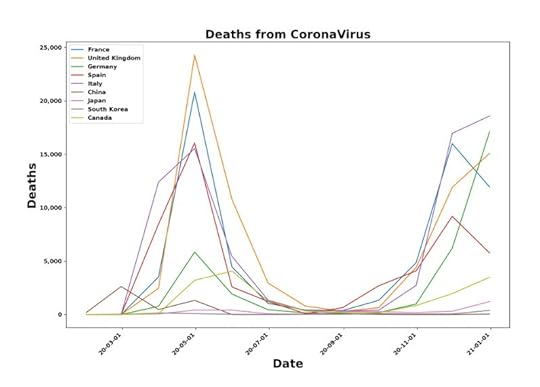
The figure below shows the total number of deaths per month in 2020 for some countries in Western Europe, Asia and North America:
In the same vein, the one below shows the number of cases per month in 2020 for the same countries:
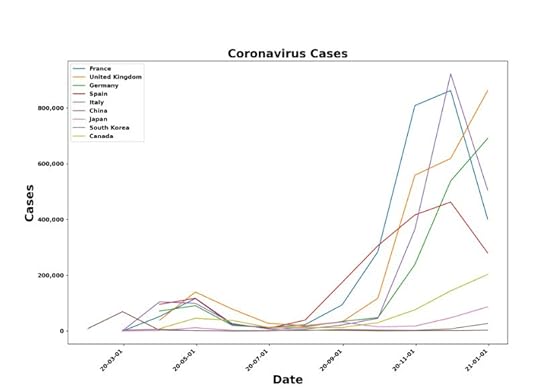
America is deliberately left out because it will skew the graph and flatter the European nation.
The remarkable story is China. The worst month for China in 2020 was February, with 2,624 deaths and 69,554 cases. Cases in China picked up in December but the numbers are still astonishing low: 3061 cases and 39 deaths.
For Western Europe, there is a common thread. Whereas deaths peaked around the middle of the year, it has gathered momentum again in the last quarter of 2020. Unfortunately, cases have outstripped the peak of the middle of the year. For example, in the UK, cases in December 2020 was over 860,000 compared to just under 140,000, a staggering six times more than what was recorded in the first wave. What is more worrying is that in the first week of January 2021, cases in the UK is over 470,000!
Germany, widely praised in the first wave, recorded 690,608 cases in December 2020, and deaths of 17,907, more than total deaths in the first wave.
Japan, South Korea and China also recorded the biggest number of cases in December 2020 since the first wave. There is no doubt CoronaVirus is on the increase across the world.
There are those who like to believe that numbers that China declares is much lower than what is happening there. Is there any evidence for this? I have not see any personally. Just think about the population of China. If just 0.12% of the population died from COVID19 as is the case in the UK, that will be close to 1.7 million people. If 4% of people in China contracted COVID19 in one year, you are looking at over 62 million people. Will China be able to hide this level of incidence without the rest of the world knowing? Won’t their health care system be overwhelmed? Didn’t we find out when China created a camp for the Uighurs Muslims?
It is more likely that China has been able to control CoronaVirus better than Europe and America because in the beginning, it understood how important it was to limit its spread.
Here is a good article from “The Lancet”, which highlights the reasons why China was so successful: https://www.thelancet.com/journals/laninf/article/PIIS1473-3099(20)30800-8/fulltext. The article highlighted the following points:
Previous experience with SARS-CoV, which had a higher mortality rateAgeing parents are not concentrated in care homes as in western countries, only 3% does; the rest live with their childrenThe speed of response in China compared to western countriesChina tried to contain it within Wuhan76 days of strict lockdown, the like of which cannot be imagined in the western countriesPublic transport was suspended14,000 health checkpointsSchool reopening delayedDozens of cities implemented similar measuresOnly one member can leave the house every couple of days to collect suppliesIn Wuhan, China tested 9 million people within weeks. It ramped up production of personal protective equipmentCitizens adopted mask wearing. Drones deployed for mass information campaign16 “Fangcang” hospitals in Wuhan alone, with capacity to host thousands of people , a centre where those showing mild to moderate symptoms had to isolate. This helped to reduce community spread.The people of China did not hold on to conspiracy theories about the origin of the virus.Here is another article with a slightly different take on the success of China: https://www.wired.co.uk/article/china-crushed-coronavirus-pandemic
China adopted a policy of “infected until proven healthy”. It is interesting that the current public information campaign in the UK is now adopting a similar message. Why did it take so long?China also vacillated initially, therefore, the virus was seeded around the world. However, once it realized the threat to its people, it kicked into gear. China campaign was a grass root one. Nigeria was judged to have handed Ebola epidemic well years ago, using a grass root campaign. Lock down was managed by the lowest rung of the bureaucracy: on a street by street basis. In the UK, compliance to the lockdown was based on the assumption that the Brits are reasonable and will use sound judgment. Everybody flying has to isolate to become a “normal person” (quote from the article).If you flew into Shanghai, you are assigned three people: a doctor, a policeman and neighborhood committee member. Quarantine was mandatory and enforced by technology and humans. A very high testing capacity. China claimed to be able to test 3.8 million people per day. Ability to produce masks internally meant China was able to scale up her capacity very quickly.Those of us in the western world need to accept that China’s methods enabled it to keep COVID19 from establishing a strong hold in the community.
It is clear that liberal democracies cannot follow China’s play book because they don’t have the same tool set. Moreover, the expectations of the people are very different. Nevertheless, there are lessons to learn from China. While the western world might have been at a disadvantage in fighting the pandemic, there is no doubt that a different attitude may have saved thousands of lives. For example, couldn’t we have done better in the following area:
China appeared to understand early that it should focus on health. It has reaped enormous benefits in economic prosperity. When China was locking everything down, the UK was busy seeding the virus by allowing thousands of people to gather at sports events and horse racing shows. China’s capacity to produce personal protection equipment at home became a big asset. Countries in Europe lacked this capacity and faced shortage at a critical time. No nation can produce everything but we need to give some thoughts to how we will cope with supply when there is a worldwide shortage. We can support some capacity to produce at a loss so that in times of crisis we have something to fall back on. Why were we so resistant to masks in Europe and America? Apparently in Japan, a country that has handled COVID19 better than in the UK, children in primary school wear masks all day long.We need to juggle our personal liberties and responsibilities to others better. What was all that protests against the lockdown about? When does my quest for personal liberty becomes a selfish act? Don’t we also need to sort out our pride in the western world? Shouldn’t we have looked at China and try to learn as much as we could?The distrust for scientific evidence is growing and should be of concern. Inability to accept expert opinion and go for “gut feeling” played a big part in the Brexit vote. The outcome is a decision that will cost the UK 4% of GDP (informed Brexiteers don’t context this). What is the benefit? red tapes for our businesses, obstacles in the way of our young people wanting to work abroad. And of course, sovereignty!If China is hiding the impact of Coronavirus, we would have found evidence by now. Nobody knows the future, but so far, China appears to have successfully prevented this virus from establishing a foothold in the community. When the next pandemic come, it may even be deadlier. Therefore, it is very important that the western world learn and learn very quickly.
Is There Something Europe And America Can Learn From China?
The figure below shows the total number of deaths per month in 2020 for some countries in Western Europe, Asia and North America:
In the same vein, the one below shows the number of cases per month in 2020 for the same countries:
America is deliberately left out because it will skew the graph and flatter the European nation.
The remarkable story is China. The worst month for China in 2020 was February, with 2,624 deaths and 69,554 cases. Cases in China picked up in December but the numbers are still astonishing low: 3061 cases and 39 deaths.
For Western Europe, there is a common thread. Whereas deaths peaked around the middle of the year, it has gathered momentum again in the last quarter of 2020. Unfortunately, cases have outstripped the peak of the middle of the year. For example, in the UK, cases in December 2020 was over 860,000 compared to just under 140,000, a staggering six times more than what was recorded in the first wave. What is more worrying is that in the first week of January 2021, cases in the UK is over 470,000!
Germany, widely praised in the first wave, recorded 690,608 cases in December 2020, and deaths of 17,907, more than total deaths in the first wave.
Japan, South Korea and China also recorded the biggest number of cases in December 2020 since the first wave. There is no doubt CoronaVirus is on the increase across the world.
There are those who like to believe that numbers that China declares is much lower than what is happening there. Is there any evidence for this? I have not see any personally. Just think about the population of China. If just 0.12% of the population died from COVID19 as is the case in the UK, that will be close to 1.7 million people. If 4% of people in China contracted COVID19 in one year, you are looking at over 62 million people. Will China be able to hide this level of incidence without the rest of the world knowing? Won’t their health care system be overwhelmed? Didn’t we find out when China created a camp for the Uighurs Muslims?
It is more likely that China has been able to control CoronaVirus better than Europe and America because in the beginning, it understood how important it was to limit its spread.
Here is a good article from “The Lancet”, which highlights the reasons why China was so successful: https://www.thelancet.com/journals/laninf/article/PIIS1473-3099(20)30800-8/fulltext. The article highlighted the following points:
Previous experience with SARS-CoV, which had a higher mortality rateAgeing parents are not concentrated in care homes as in western countries, only 3% does; the rest live with their childrenThe speed of response in China compared to western countriesChina tried to contain it within Wuhan76 days of strict lockdown, the like of which cannot be imagined in the western countriesPublic transport was suspended14,000 health checkpointsSchool reopening delayedDozens of cities implemented similar measuresOnly one member can leave the house every couple of days to collect suppliesIn Wuhan, China tested 9 million people within weeks. It ramped up production of personal protective equipmentCitizens adopted mask wearing. Drones deployed for mass information campaign16 “Fangcang” hospitals in Wuhan alone, with capacity to host thousands of people , a centre where those showing mild to moderate symptoms had to isolate. This helped to reduce community spread.The people of China did not hold on to conspiracy theories about the origin of the virus.
Here is another article with a slightly different take on the success of China: https://www.wired.co.uk/article/china-crushed-coronavirus-pandemic
China adopted a policy of “infected until proven healthy”. It is interesting that the current public information campaign in the UK is now adopting a similar message. Why did it take so long?China also vacillated initially, therefore, the virus was seeded around the world. However, once it realized the threat to its people, it kicked into gear. China campaign was a grass root one. Nigeria was judged to have handed Ebola epidemic well years ago, using a grass root campaign. Lock down was managed by the lowest rung of the bureaucracy: on a street by street basis. In the UK, compliance to the lockdown was based on the assumption that the Brits are reasonable and will use sound judgment. Everybody flying has to isolate to become a “normal person” (quote from the article).If you flew into Shanghai, you are assigned three people: a doctor, a policeman and neighborhood committee member. Quarantine was mandatory and enforced by technology and humans. A very high testing capacity. China claimed to be able to test 3.8 million people per day. Ability to produce masks internally meant China was able to scale up her capacity very quickly.
Those of us in the western world need to accept that China’s methods enabled it to keep COVID19 from establishing a strong hold in the community.
It is clear that liberal democracies cannot follow China’s play book because they don’t have the same tool set. Moreover, the expectations of the people are very different. Nevertheless, there are lessons to learn from China. While the western world might have been at a disadvantage in fighting the pandemic, there is no doubt that a different attitude may have saved thousands of lives. For example, couldn’t we have done better in the following area:
China appeared to understand early that it should focus on health. It has reaped enormous benefits in economic prosperity. When China was locking everything down, the UK was busy seeding the virus by allowing thousands of people to gather at sports events and horse racing shows. China’s capacity to produce personal protection equipment at home became a big asset. Countries in Europe lacked this capacity and faced shortage at a critical time. No nation can produce everything but we need to give some thoughts to how we will cope with supply when there is a worldwide shortage. We can support some capacity to produce at a loss so that in times of crisis we have something to fall back on. Why were we so resistant to masks in Europe and America? Apparently in Japan, a country that has handled COVID19 better than in the UK, children in primary school wear masks all day long.We need to juggle our personal liberties and responsibilities to others better. What was all that protests against the lockdown about? When does my quest for personal liberty becomes a selfish act? Don’t we also need to sort out our pride in the western world? Shouldn’t we have looked at China and try to learn as much as we could?The distrust for scientific evidence is growing and should be of concern. Inability to accept expert opinion and go for “gut feeling” played a big part in the Brexit vote. The outcome is a decision that will cost the UK 4% of GDP (informed Brexiteers don’t context this). What is the benefit? red tapes for our businesses, obstacles in the way of our young people wanting to work abroad. And of course, sovereignty!
If China is hiding the impact of Coronavirus, we would have found evidence by now. Nobody knows the future, but so far, China appears to have successfully prevented this virus from establishing a foothold in the community. When the next pandemic come, it may even be deadlier. Therefore, it is very important that the western world learn and learn very quickly.
December 21, 2019
A Jar of Clay, Part 2: Broken
My second book is finally available on Amazon, but first how a word about Kindle application.
The Kindle application is available on both IOS (IPhone) and Android (Samsung, Huawei, Google, etc). Create an account on Amazon and you can download the book. My books are free to read for now if you are subscribed to Kindle Unlimited (this will cost you 8 pounds a month though).
Here is the front and back cover of the new book:
[image error]
Here is the ebook version, cheaper than the paperback and easier on the environment..
For those who love to physically turn the pages of a book there is a paperback edition:
https://www.amazon.co.uk/dp/1916433014/ref=sr_1_1?keywords=a+jar+of+clay+part+2+broken&qid=1569744584&s=gateway&sr=8-1
To remind you about the first book, I have this new banner on Facebook:
[image error]


