Tade Oyebode's Blog, page 2
December 4, 2022
JE NG LO GBA TEMI by TAA Ladele and the Girl Child of South Western Nigeria, circa 1971
This short post is about the first page of JE NG LO GBA TEMI by TAA Ladele, a book written in 1971. A work of fiction but I believe fictions always have some basis in reality.
JE NG LO GBA TEMI can be translated “Let me have fun”, “I want to enjoy this season of my life”. The book explore the impact of Christianity and the “ilaju” (development) that accompanied the religion on a fictional town called Owo ,using the choices made by two young girls, Adeoti and Eeesita (Yorubanisation of Esther). This post will just focus on the first page.
The first few words were non controversial and they introduced us to Adeoti’s background: she was born into a middle income family where there was no struggle to make ends meet. The moment the readers were told that although Adeoti’s mother was overjoyed to have a girl, her father, Bankole did not share the same feelings, things took a different turn, at least from the point of view of a reader like me who is based in the UK. I will translated the words that shocked me:
We cannot blame Bankole for being disappointed his first child was female. Who does not know that the first child is the heir? Yes, the first child is the heir. Who wants the girl as heir? A girl scatters her father’s house because, no matter how much she loves her parents, one day she will marry, move to her husband’s house, visiting her parents’ house once in a while. On the other hand, a boy builds and expands his father’s lineage because he would go and marry and bring up children in his father’s house, he may even have two or three wives.
Yes, JE NG LO GBA TEMI is a fictional work but it is hard to conclude TAA Ladele just made this up. These few sentences show that at some point in their history, the Yorubas valued boys more than girls. Based on the short passage, it seems to be due to the fact that a girl marries and leaves home eventually. A girl takes the name of her husband but double barrel names are now allowing girls to carry their family names, in addition to their husbands. Did people in the South West of Nigeria really perceived the female child in this manner?
Evidence abounds that the girl from the South West of Nigeria does not have the same status as the boy. The Yorubas have an expression “Olori Ebi” to describe the head of an extended family. Invariably, “Olori Ebi” is the oldest male. In royal families, only the men can aspire to become kings though girls/women can serve as regents, a temporary assignment. Traditional chieftancy titles are generally a men only affair, apart from titles such as Iyalode (the leader of all women), Iyaloja (the leader of all market women) and the more modern traditional tiles that are convered based on achievements.
In the South West of when I was growing up, if you take a superficial look, you would see equal opportunities for boys and girls. Regardless of gender, there was equal access to education. And girls did as well as boys academically. I remember that the best student in the department of Computer Science during my university days was female. In our family, a boy did not have any special privilege. As a boy, I ironed my parent’s clothes, a task that I detested and filled my saturdays with boredom. I took part in household chores like sweeping the floor. On days when we cooked pounded yam for lunch, the youngest two that are strong enough participate in the task, regardless of gender.
I do think there were subtle differences in how boys and girls were brough up because their role in the society later in life are not considered identical by the Yorubas. Girls would stick around their mothers, so they learn some practical skills such as cooking and nurturing younger children in the process. However, a boy who is close to his mother could pick up the same skillset if he sticks around her, and I know several examples who did.
Honestly, I have thought very hard and it is hard for me to say that I found evidence that the male child was treated with more privilege either in the school system or in our family circle. What I think existed was different expectations based on what the culture expected from the different gender later in adulthood. I think this can be found in marriage dynamics but the same apply in Europe. For example, paternity leave is a very new thing even in western culture, showing that there has always been different expectations about the role of men and women in society.
Although TAA Ladele wrote in 1971, his book may have reflected how things were when he was much younger. He might have been giving us an insight into the thought processes of the Yorubas of a few decades earlier. It is also worth pointing out that it is not only among Yorubas that different expectations exist about the roles of men and women in society. Social Psychologists have observed this difference in Western culture, they often cite the example of how men are often thanked by their wives when they do household chores, as if they are doing them a favour.


November 19, 2022
“The African Child” By Camara Laye: West African Spirituality
The African Child was first published in 1954. The author was Camara Laye, an African immigrant from Guinea. who lived in France at the time of publication. The author was born in 1928. The first chapter of the book, the focus of this essay, was set at a time when he was very young, he estimated his own age as being between 5 and 6. Therefore, we are looking at an account of events that happened circa 1933/1934.
Laye opened the book with this paragraph:
I was a little boy playing round my father’s hut…My mother was in the workshop with my father, and I could hear their familiar voices above the noise of the anvil and the conversation of the customers”.
Later in the book, Laye will tell us more about his family. His father sounded like a combination of a blacksmith and goldsmith. Laye was of my father’s generation, therefore, the West Africa of his time would have been significantly different from the West Africa of when I was growing up. Nevertheless, reading his book I had flashback of memories. Blacksmiths abounded in the South West of Nigeria of my youth. We also had goldsmiths. I have vague memories of my mother visiting goldsmith or talking about them. I do wonder what globalisation did to indigenous crafts like blacksmith and goldsmith?
Laye lived in a hut, the inference one can draw is that it was not in a built up area. And decades later when I was growing up, most places were not very built up. For example, my high school where I spent five unforgettable years, was in an area that was sparsely populated. I remembered one year during a football match in one of the afternoons when one boy came across a green snake on the pitch.
The most interesting incident in the first page of African Child was an almost deathly game Laye played with a snake. It must have been his first encounter with a snake because he was oblivious to the danger inherent in such a meeting. Laye stuck a reed into the reptile’s mouth and it swallowed it gradually and would have bitten him had not one of his father’s apprentices shouted to trigger a rescue. The response of his mother was very familiar: warnings and some smacking to ensure he doesn’t do that again.
On the second page, there is a description of his father’s hut. It was made of mud “that had been pounded and moulded into bricks with water”. It had only one tiny window. Very quickly, on the second page we had an encounter with the religious/spiritual:
On the left were the boubous and the prayer rugs…hanging over the pillow and watching over my father’s slumber, there was a series of pots that contained extracts from plants and the bark of trees…it did not take me too long to discover that they were the most important things in the hut: they contained the magic charms, those mysterious liquids that keep evil spirits at bay, and smeared on the body make it invulnerable to black magic, to all kinds of black magic. My father, before he went to bed, never failed to smear his body with a little of each liquid, first one, then another, for each charm had its own particular property: but exactly what property I do not know…”
And then, there was that other snake, the black one with strikingly marked body. One day, Laye saw it progressing leisurely towards his father’s workshop. He called his mother, expecting the usual drama, followed by certain death for the snake. However, this was an exception. His mother told him an astonishing story:
My son, this one must not be killed: he is not as other snakes, and he will not harm you; you must never interfere with him…this snake, … is your father’s guiding spirit
Laye watched as the little black snake disappeared into a hole in his father’s workshop. When Laye asked his father about the snake, the response took a while, but it eventually arrived:
That snake is the guiding spirit of our race. Can you understand that? …That snake has always been with us; he has always made himself know to one of us. In our time, it is to me that it has made himself known. …He made himself known in the semblance of a dream…
Laye recollected how his father had known about events that happened when he was not at home and realised it was the snake that revealed those events to his father. His father hinted that Laye could be a potential beneficiary of this power in his generation if not for his absence from home:
There is a certain form of behaviour to observe, and certain ways of acting in order that the guiding spirit of our race may approach you also…but nevertheless, it is true that if you desire the guiding spirit of our race to visit you one day, if you desire to inherit it in your turn, you will have to conduct yourself in the selfsame manner; from now on, it will be necessary for you to be more and more in my company… I fear, very much fear, little one, that you are not often in my company. You are all day at school and one day you will depart from that school, and you will leave me alone, little one…
Laye never discussed the little snake again with his father but once he sees the snake disappeared into the hole, he goes to his father’s workshop where he sees the snake proceeds to his father, with its jaws open. His father will stroke the snake with his hands. The little black snake responds by quivering its whole body, without biting Laye’s father. What an incredible account!
How did Laye’s father develop such a relationship to a snake? Was this a natural, human taught technique of domesticating an animal? Afterall, there are snake charmers. Or was there a supernatural dimension to events that Laye witnessed? Clearly from Laye’s point of view, there was a spiritual and supernatural angle to it: the snake first making its appearance in a dream, and the snake’s capacity to reveal the future to his father.
We see another spiritual/supernatural dimension to what on the surface looks like a man practicing his occupation in the second chapter of the book. A woman brought some gold to be transformed into trinkets. In order to persuade Laye’s father to do this job, she brought a praise singer, who can deploy all his knowledge of history to eulogise Laye’s father and ancestors. Laye remarked that there was more to this operation beyond smelting gold:
The operation that was going on before my eyes was simply the smelting of gold; but it was something more than that: a magical operation that the guiding spirits could look upon with favour or disfavour; and that is why there would be all round my father that absolute silence and expectancy. …The gold now had the fluidity of water. The guiding spirits had smiled on the operation!
Laye continued about the spiritual/supernatural/magical dimension of smelting of gold and the reasons why the task could not be delegated to the apprentices:
Only my father was versed in the science of conjuring the spirits of fire, air and gold, and conjuring evil spirits, and that is why he alone conducted the whole operation.
And the little black snake with patterned body was always around for the big occasions:
But it was extraordinary, was it not miraculous that on these occasions the little black serpent always coiled up under the sheep skin? He was not always there, he did not visit my father everyday, but he was always present whenever there was gold to be worked. …The snake’s presence came as no surprise to me; ever since that evening when my father had talked to me about the guiding spirit of our race, it had ceased to surprise me; it was quite natural that the snake should be there: he had knowledge of the future.
Spirituality is woven into every aspect of their lives, even the smelting of gold. African Traditional Religion no longer dominates the spirituality of the people of West Africa. Christianity and Islam are the dominant religions but intrinsic spirituality of Africans has been fused into these religions.
November 12, 2022
NIGER. West African Frontier Force. Colonel F.D Lugard. 1897-1898.
In 1897 to 1898, Lord Lugard reported back to the Secretary of State for the Colonies about two of his achievements of the year, the raising of the 1st and 2nd Battalion. Full details of the report can be found here. The document is only 36 pages long but be warned that many comments there denigrate Africans.
Lt Col Pilcher built the 1st Battalion and it had 900 soldiers. What had not dawned on me before I read this document was how the colonial master staffed most his fighting forces with Africans! This is very sad as it means Africans are deployed against one another as the colonialists carried on its conquest of the land.
On page 4 of this document, Lugard noted “The difficulty of recruiting Hausas has prevented the Battalion from reaching more than three quarters (900) of its establishment”. The organisation of the West African Frontier Force was very sophisticated and divided into several departments: Artillery, Engineers, Telegraph Section, Transport Department, Medical Department, Accounts Department and Headquarters. Of note was the Medical Department of which Lugard (page 6). said “Of the senior officers, Dr Poole and Dr Rees not only earned the complete confidence of all, and were unceasing in their attention, but by microscopic research, have endeavoured to elucidate the obscure origins of malaria and blackwater”.
The commander of the 1st Battalion, Lt Col Pilcher described his brief (page 10):
..I was asked by the Military Secretary whether I would raise and command a battalion of Hausas and Yorubas in the hinterland of Lagos. I accepted.
He continued later (page 11):
Since the month of June, the Governor of Lagos had been enlisting Yorubas at Ibadan, which is in the centre of the Yoruba country
On page 13, Pilcher reported the arrival of 98 Hausa recruits. On the same page, Pilcher reported how the 1st Battalion, staffed mostly by Yorubas, Hausas and Nupe, were deployed in war (which he called expedition!) against the Emirs of Lapai and Argayeh. After the “expedition” Pilcher reported:
The behaviour of my recruits was good, their volleys being perfect…
Another “punitive expedition” was organised to Asaba. The mission was to “punish the tribes in the neighbourhood of Anam, about 100 miles below Lokoja and on the Niger”.
On one occasion, the colonialists underestimated what was needed for an “expedition” to arrest the Chief of Hello Island, “situated at 30 miles above Boussa” and suffered the loss of one of theirs, Lieutenant Keating. The group included some Nupe soldiers. Pilcher gave an account of their role;
The only consoling feature in this sad affair is that all died fighting, and that the men (Nupes) from all accounts which can be gathered, fought with determination and courage, until they fell at the side of their leaders
The Africans working as soldiers for the colonialists were just trying to survive. The perfect condition of domination is to reduce people to the level at which all they can think about is how to survive from day to day. The survival of those African soldiers became synonymous with the success of the colonialist who was simply there to dominate them. Sad, but not different from what obtains today: the people who exchange their votes for a fee so that they can continue to be dominated and exploited by politicians who are just in it for their own narrow interests.
October 29, 2022
Nigeria and Feb 2023
Fitch Solutions has released a report on Nigeria, which will set you back 1,488 dollars:
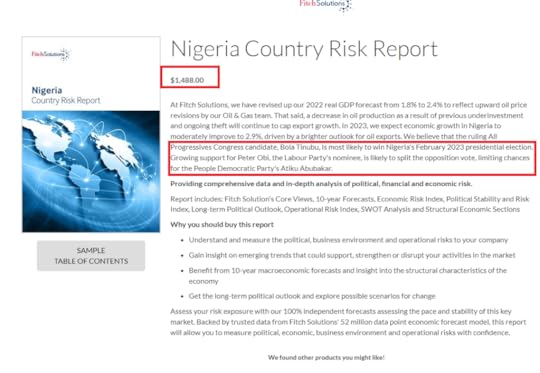
Obviously, I have not paid 1,488 dollars for a copy, but a friend forwarded a summary yesterday (Friday, 28th October 2022). The conclusion of the report forwarded to me is the same as what I found at Fitch Solutions website. The summary forwarded to me was five pages of A4 sized paper. The conclusions are
The polls putting Labour party as favorites are significantly overstating its support because only 36% of Nigerians are on the internet.APC most likely to win because Labour Party will split the votes of Labour, North is a stumbling block for LP, incumbency factor. However, this is caveated with factions within the APC in Northern Nigeria.An APC win will make Nigeria less stable because of a few reasons: Christians may feel marginalized, the young urban Labour party voters who are expecting their candidate to win may be disappointed.Below is my reflection on Feb 2023 elections.
Until 2015, when the APC contested her first election, the People’s Democratic Party (PDP)was the only national party. The remaining parties, regardless of their names were regional parties: Alliance of Democracy (AD) and later Action Congress of Nigeria (ACN) were based in South West (SW) of Nigeria without any hope of winning elections outside the area. The Congress of Progress Change (CPC) was a party with a strong base in part of the North.
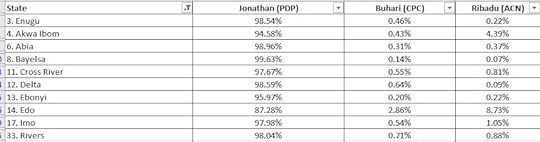
Unlike these parties, the PDP was a national alliance, the core partners were part of the North, the South East (SE) and South South (SE). In 2011, before the APC was formed, Jonathan Goodluck of the PDP, who comes from Baylesa State in the SS received more than 94% of the votes in each state of the SS and SE, apart from Edo where he scored 85%:
In 2015, the feat was repeated for Jonathan Goodluck of the PDP who received more than 92% of votes in the South South and South East, apart from Edo where he scored 57% and Imo (79%):

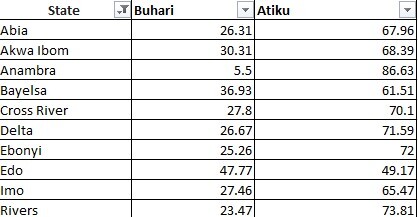
In 2019, Nigeria had two Northern candidates. Atiku, of the PDP again scored more than 61% of the votes in each states of the South South, apart from Edo where he scored 49%. This shows the PDP’s base in the South is in the South South and South East:
In 2011, the dominant party in the South West was ACN. The ACN, candidate was a Northerner, Ribadu. He only did better than Jonathan in one state, Osun, where he managed 58%:

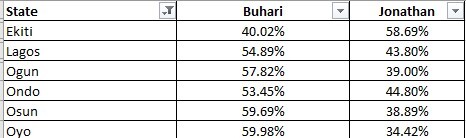
The APC was in place as a political force in 2015. Apart from Ekiti state where Buhari polled 40%, the APC won the South West states with a percentage of between 53 and just under 60%:
Fast forward to 2019, the APC was only able to score more than 50% in two states, Ekiti (57%) and Lagos (53%):
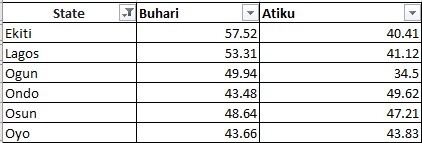
What is important to note is that in the three most recent elections, apart from Lagos and Ondo states in 2011, both PDP and APC or ACN candidates scored more than the required 25% in the SW states. Elections appear to be more competitive in the South West, compared to the other two Southern political regions.
In 2011 and 2015, when the PDP had a southern candidate, the PDP had a landslide victory in the South South and South East, apart from Edo state in 2015 where APC reached the 25% threshold. In 2019, when we had Northern candidates for the two major parties, the outcome was mixed in the South South and South East. PDP still dominated but the APC passed the 25% threshold in the two regions, apart from in Rivers state.
I have not considered the elections before 1999. That was deliberate. In those days, the South West was dominated by Chief Awolowo while the South East was dominated by Dr Nnamdi Azikwe. Nobody in Southern Nigeria has attained that level of dominance. In 1999, that a was very unique arrangement to cede that election to Southern Nigeria. In 2003, Obasanjo did very well in the South West. The outcome of the 2007 election was embarrassing to the winner, the Late Yaradua.
In 2023, there are going to be three major candidates, one from the North East, another From the South West and one from the South East. How will things play out? You can expect all these candidates to do well in their region, if you go by history. However, it gets very complicated beyond that for the following reasons:
Politics in the South West is very competitive and one would expect both APC and PDP to do well. This is a disadvantage for the APC candidate. There are divisions in both parties: The APC lost Osun state governorship elections partly due to infightingThe PDP governor of Oyo state has issues with the PDP presidential candidate. How will this be resolved? Peter Obi has some support in the South West, the only question is how big that support is and the influence it would have on the plight of the APC and PDP candidates. The South West is very diverse, especially Lagos state and there is always a level of affinity for people to be attracted to the candidate from their region, as Nigeria is a very ethnocentric nation. Therefore, a landslide for the APC in the South West is very unlikely.In the South East, the Fitch report predicts that Peter Obi will eat into the votes of the PDP candidate, Atiku.This is significant because the South East has voted massively for the PDP in every election since 1999.In the South South, the Governor of the biggest state, Rivers is at odds with Atiku, the PDP candidate. Should Atiku and PDP lose Rivers, how will they make up the votes?The APC candidate is from the South. The PDP candidate is from North East, but he is from the biggest voting block, Hausa Fulani. Where is the guarantee that the North West will vote for a Southerner when they have one of their own on the ballot? The ethnocentricity of Nigerians is something that one can never rule out.Therefore, although Fitch predicts a Tinubu win, I am personally not so sure. If the Hausa Fulani block in the North West decides to vote for their own massively, Atiku may be able to offset the political problems in his own party. Voters turn out in the North always surpass that of the South and there are more registered voters in the North.
It is a very long way to go and event risk is always a factor in life.
September 26, 2022
Classic Fiscal and Monetary Policy Misalignment, aka Schizophrenic Management of the Economy.
Rutus Odiri put the puzzle from the UK nicely.
There are two approaches to intervene in the running of the economy.
Fiscal policies focus on the control of government revenues and expenditure. If you want people to spend more, you allow them to keep more of their money. If you want to discourage spending, you raise taxes.
Monetary policy is about using interest rates or supply of money to influence the cost of funding in an economy. Changing interest rates, devaluation and quantitative easing are examples of monetary policies.
Rutus Odiri is very spot on here. What is happening in England right now is schizophrenic. The government has charged the apex bank to keep inflation at 2.5%. As inflation is much higher, the Bank of England in its efforts to bring it down, has been raising interest rates.
Suddenly, the government decided to do huge tax cuts, a fiscal policy that is at odds with the Central Bank’s monetary policy. It is returning money from to members of public and what will they do with the money? Spend it of course. That act alone conflicts with the task that the government set for the apex bank. The reaction of the financial markets was to raise the cost at which the UK can borrow and also to devalue the Pound. The outcome is more inflation probably on the way.
This misalignment is schizophrenic.
September 24, 2022
An Incident at Bere Farm in Adebayo Faleti’s Omo Olokun Esin (Son of the King’s Horseman)
In the Wikipedia entry for Kwasi Kwarteng, there is a quote about Black Lives Matter attributed to him that caught my attention:
So within that time and geography there’s a huge amount of variety, different cultures and different time periods and getting a sensitivity to that is hugely important and I think a lot of the debate around Black Lives Matter and imperialism or colonialism has a very kind of cartoon-like view of what was happening over centuries across a quarter of the world
It reminded me of something that I was thought on a degree a decade or so ago: knowledge is situated. In other words, you need to look at the context in which a particular knowledge is produced, for example, the historical/time or the cultural settings. I am currently re-reading a book called “Heart of Darkness” by Joseph Conrad. No publisher will print such a book today due to the abundance of use of words like cannibal, savage and various permutations of the n word. The book reflects the time it was produced. Michel Foucault said discourses are linked to the social context in which they are produced.
I think Kwarteng was uncomfortable with taking events that happened a century ago and rephrasing in narratives and discourses of today, stripping the knowledge from the context (historical, geography and time) in which it was produced and using it for political purposes today. When you strip context away from events, you end up with a very incomplete picture.
I have been re-reading Adebayo Faleti’s Omo Olokun Esin (The Son of The King’s Horseman) in small chunks and this coincided with the comments of Uju Anja, a professor in an American university on the day the Queen Elizabeth II died. To read more about the story, please follow this link. It was not just Uju Anya’s reaction that caught my attention. Many Nigerians, Caribbeans and other Africans had queried why those who come from nations that were exploited by the British Empire were mourning the death of the Queen, who reigned during those times. This is not the place to discuss whether late Queen who reigned but did not rule could be held responsible for this.
There is no doubt the British Empire and other like it disrupted Africa. The scramble and partition of Africa during the Berlin conference laid the foundation for some of the problems in Africa today. Sitting down a few thousand miles away and partitioning a whole continent without any regards to the culture of the people there was always going to have lasting negative legacies.
Often when we tell the story of Imperialism/Colonialism, it is an incomplete story. It is incomplete because we don’t always discuss how we lived together as Africans before Imperialism/Colonialism arrived. I am a Yoruba from Nigeria and I am fortunate in two regards. I can read in the Yoruba language and several authors wrote about the Yoruba society as it was in the days when we ruled ourselves. Omo Olokun Esin by Adebayo Faleti is one of such books. What I discovered from some of these books make very uncomfortable reading.
in this post, I will just focus on an event that happened in the first chapter of Omo Olokun Esin. The main character in the book is Ajayi, the son of the King’s Horseman (Omo Olokun Esin). The King’s Horseman is a chieftaincy title. Historically, the current holder of the title dies with the king. Wole Soyinka, the Nobel laureate wrote another well celebrated book on a particular holder of the title who refused to die. You can read more about the book here. In Omo Olokun Esin, it is the son of the King’s horseman, rather than the King’s Horseman who is the star of the show.
The setting was at a time when a Yoruba town called Oko, had hegemonic control over the other towns in Oke Ogun area of what used to be known as Ekun Osi of Oyo Kingdom. Ajayi, the King’s Horseman’s son was from another town/village called Otu. Princes of Oko can come to Otu and treat the people with impunity. When they come, they expected to be feast sumptuously at the expense of the Otu people. Not only that, every year, the people of Otu will choose men who will carry on their head tributes to the King of Oko. It seemed as if the domination had been taking place for generations and that was all they knew.
The setting of the first chapter where the incident happened was at Beere Farm. Beere was a plant that was considered better and more enduring at building thatched huts. The people of Otu and other towns had to cultivate Beere, harvest it and carry it in bales to Oko. The trip from Otu to Okoo can last days as it had to be done on foot.
On the specific day of interest, the sun was intolerable, it was so hot that despite the footwear, the heat was felt intensely on their feet. The labourers were very thirsty, but their taskmaster, Roti, who is a representative of the king of Oko was relentless as he drove them to hit their targets. Ajayi, who was labouring along with the others had been wondering why the Oko people dominated his own people. He decided to rebel and downed tools.
Either Roti did not want any confrontation with Ajayi or did not notice he stopped working. Eventually, it was brought to Roti’s attention, and he had no choice but to challenge Ajayi. In the ensuing altercation, Ajayi prevailed. Roti pronounced judgment and said, “You are in trouble, your family is in trouble, your extended family is in trouble”. On hearing that pronouncement, Ajayi’s siblings started to weep because the work that boys from all households in the town should do would now be done by Ajayi’s family.
When Ajayi’s father heard, he was angry and beat him up. When his mother got home and was told, Ajayi received extra beating. His whole family was nervous because of the consequence of this rebellion to the authority of the Oko King. Not only that, the chiefs and leaders of Otu were all nervous about the consequences. Oko’s domination of the Otu people was total and most of the citizens accepted that as normal. Only Ajayi thought this was wrong and hankered for change.
Colonialism/Imperialism cannot be justified, the legacies were damaging, and its impact are still felt today. Furthermore, Colonialism has racism embedded into it and the treatment of the slaves who were treated as property was worse than any form of domination that Otu people experienced from the Oko King.
Nevertheless, the people of Otu were dominated, their resources commandeered, and their labour appropriated for the benefit of the Oko King. This is also a form of colonialism/imperialism. The encounter between the Imperialists/Colonialists with African nations on one hand, and that between the Oko King and Otu people, reflects the mindset of “might is right” that prevailed at the time. Whether it was an encounter between communities or between nations, the stronger had its way. The experience of the weaker was oppression from the stronger. These encounters had more in common when you examine it closely.
If as a Nigerian I want to hold the Royal Family of today responsible for some of the events that happened 100 years ago, what will I do if an African Caribbean person wants to hold me responsible for what my ancestors did to them? This has actually happened to me twice in the last 25 years. In July 1997, we hailed a cab in Dallas. After some discussions with the driver, he realized we were from Nigeria. He accused us of selling his ancestors into slavery and dominating his ancestors in Africa. And as it turned out, some of the Nigerian cabbies, according to him, were colluding with White Americans to take business away from him. The second time was at a church event when somebody who was raised in England turned to me in a discussion, accusing my ancestors of selling her ancestors into slavery.
For me, let’s visit the past so we can learn from it and not make the same mistakes that were made then. We should not visit the past to divide societies of today. The past is muddled, messy and complicated.
August 29, 2022
Rev Jesse Josiah Ransome-Kuti and the Ogboni Fraternity
Recently, I wrote about Fela Anikulapo-Kuti’s musical heritage (read here). Rev Jesse Josiah Ransom-Kuti was Fela’s grand father:
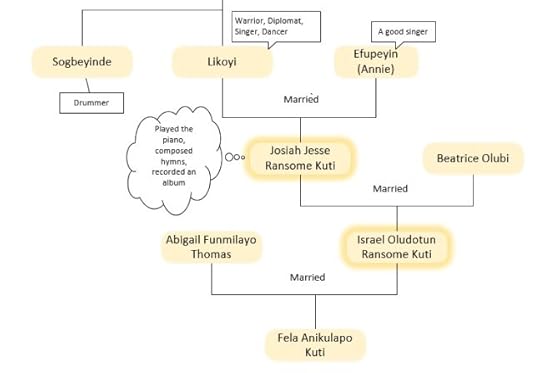
Rev Josiah Jesse Ransome-Kuti took a very radical and practical approach to his faith, and that approach brought conflict with the Anglican Church. A very good example was when he allowed the “Ogboni Fraternity” to hold a thanksgiving service in his church.
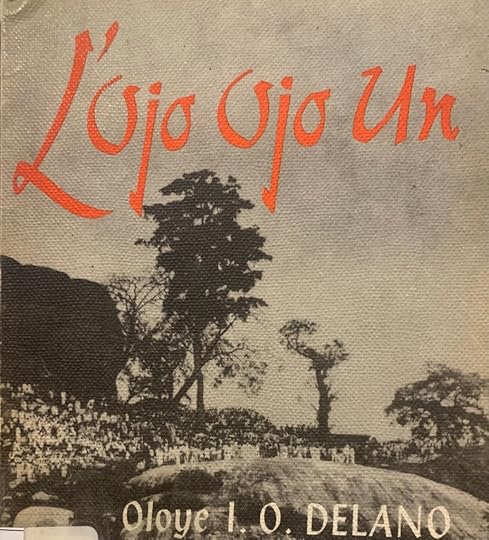
The “Ogboni Fraternity” attended a service officiated by Rev Josiah Jesse Ransome-Kuti on April 27, 1916. Here is a picture of the attendees (source “Lojo Ojoun” by Isaac Delano).
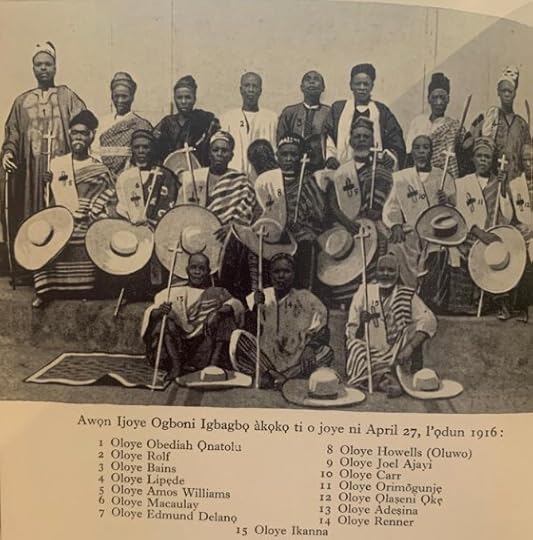
First, a brief history of the “Ogboni Fraternity”. It is a fraternity that is indigenous to Yoruba speaking part of West Africa, specifically Nigeria, Republic of Benin and Togo (read more here). Before colonialism, it was the premier political authority, especially among the Egbas. The Ogbonis Fraternity was superior to the king. Note that before colonialism, the people groups in Nigeria and the rest of West Africa saw each people group as a nation. It was the commercial interest of the colonial masters that led to the amalgamation of the different people groups into countries.
It didn’t come as a surprise that when colonialism and Christianity arrived, the Ogboni fraternity came under pressure. First one would imagine that a political association could be a rally point for political resistance. Furthermore, the Yorubas are in “all things religious” ,therefore, the practices of the Ogboni fraternity then would have been steeped in the Yoruba traditional religion. One can understand why the original form in which the Ogboni Fraternity existed, “Aborigine Ogboni Fraternity”, became a problem for the early Yoruba Christians. As a result, the “Reformed Ogboni Fraternity” was formed in 1914 by an Anglican cleric. The “Aborigine Ogboni Fraternity” was weakened by at least two factors. Firstly, its connections to traditional worship put membership at odds with the Christian faith. Secondly, it was in the interest of the colonial masters to prevent a rallying point for political resistance. After the advent of colonialism and Christianity, the “Aborigine Ogboni Fraternity” was reduced to a nominal association, stripped of real power.
Over the years, illustrious Nigerians beyond Yoruba speaking areas have been members of the Reformed Ogboni fraternity. These included Sir Adeyemo Alakija, Chief Ladoke Akintola (Premier of Western Region in the first republic), Sir Adetokunbo Ademola (one time Chief Justice of Nigeria), King Olubusi Sijuwade who was the Ooni of Ife and a successful business man in his life time, King Geroge VI of the UK, Dr Nnamdi Azikwe (President of Nigeria during the first republic), Sir Ahmadu Bello, the late Sardauna of Sokoto (the first Premier of Northern Nigeria) and Chief Olusegun Obasanjo a former Head of State and President of Nigeria (source).
I am not certain that the members of the “Ogboni fraternity” that came to offer thanksgiving and also addressed the church led by Fela Anikulapo Ransome-Kuti’s grandfather were part of the Reformed Ogboni Fraternity” but it is highly likely. The Thanksgiving service at Kuti’s church took place less than two years after the “Reformed Ogboni Fraternity” was formed.
The visit of the “Ogboni fraternity” was controversial to say the least. Please note that the account of the visit that I outlined here is probably sympathetic to the “Ogboni fraternity” because it is sourced from the book “The Singing Minister Of Nigeria” written by Chief Isaac Delano. If you look at the picture of the chiefs of the “Christian Ogboni Fraternity”, you will observe that “No 7” in the picture is one Edmund Delano, who happened to be the father of Chief Isaac Delano.
According to Isaac Delano, the Ogbonis who came to worship at a service presided by Rev Josiah Jesse Ransome-Kuti were just a prayer group that met every first Monday of the month. They decided to form themselves into a society and gave themselves Ogboni titles. Why did they do this? Due to their adherence to the Christian Faith, they were not allowed to join the “Aborigine Ogboni Fraternity”. Therefore, they were denied the title they could have attained as members. It was their hunger for position that led them to take Ogboni titles and the outward symbols, according to Delano. Delano in his book “The Singing Minister of Nigeria wrote:
These Christian Ogbonis had no political significance beyond settling petty matters between Christians so they should not go before heathen judges for justice. They had as their badge the sign of the Cross, which emblem was conspicuous on their staff of office and on the Itagbe. Their motto was ‘Faith, Hope and Charity’. They drew up laws and regulations to govern themselves. They were not more than a social fraternity like Freemasonry, for example. They went into the Church of God and asked Kuti to hold a Thanskgiving service for them after the Easter Service of that year 1916. “After having studied their rules and know the object of the Fraternity, he (Kuti) said ‘I held the Thanksgiving service for them”.
What did Rev Josiah Jesse Ransome-Kuti think about the whole incidence? We can catch a glimpse of this from his notes, from which Isaac Delano drew heavily in his book:
My actions in Ake Church in bringing those sin-laden elderly Christian Ogbonis into the House of God and before the Throne of Grace to give thanks offerings after prayer and address was my offence
What are we to make of this? What did Rev Kuti mean by “sin-laden elderly Christian Ogbonis”? Did he mean this in the context of Roman 3:23, that “all have sinned and fallen short of the glory of God”? Or did he mean this because of the specific practices of the members of these “Christian Ogbonis”? This is open to interpretation but from a letter that he wrote to one Rev E.W. George, in 1919, we gain further insight into his thinking:
Does the church of England forbid Societies like Freemasons? Do the Elders at Ake Church (the Christian Ogbonis) pray to Demons? Is having Thanksgiving to the God of our Salvation idolatry? “Mine house shall be called a house of prayer for all people” – see Isaiah 56 v 7. The God Almighty has said that. And who are you and what are you to say “No” to that or condemn?
Finally, please take a piece of advice from the poor sinner and unworthy rustic Josiah Jesse Ransome-Kuti. Do not constitute yourself a critic, a judge, a fault finder or false accuser. I am your brother in the blessed Service of the Lord Jesus
Clearly, Rev Ransome-Kuti believed his actions were consistent with the teachings of the Church and the bible.
He escaped with a warning from the Anglican Church.
August 19, 2022
The Musical Heritage of Fela Anikulapo Ransome Kuti
This post is all about Rev Canon Josiah Jesse Ransome Kuti, Fela Anikulapo Kuti’s grandfather.
Earlier this year, I read for the second time a book written in Yoruba titled “Lojo Ojoun” (in the olden days) by Isaac Delano. I am not sure the book is any longer in print anywhere but I found copies at the British Library and the library of School Of Oriental And African Studies, both located in London. When I first read the book growing up, it left some emotional trace and was the reason I wanted to read it again.
While reading the book this time, I came across a picture of the Rev. Josiah Jesse Ransome Kuti and his son, the Rev. Isaac Oladotun Ransome Kuti. It was a surprise to me that the celebrated music genius, the Late Fela Anikulapo Ransome Kuti had such a heritage. Fela was not the man you would typically connect with anything Christian.
While searching for the Delano’s books, I found a biographical book he wrote about Fela Anikulapo Kuti’s grandfather. The book is titled “The Singing Minister of Nigeria: The life of The Rev. Canon J.J. Ransome Kuti” by Isaac Delano. The book was published in 1942 and was written in English. Delano provided some insight about Fela Anikulapo Kuti’s ancestors. From the book, I gathered the information that help me to construct Fela Anikulapo Kuti’s family tree. It is not exhaustive as I left out his siblings and focus on that part of his ancestry that gave some context to his musical genius:
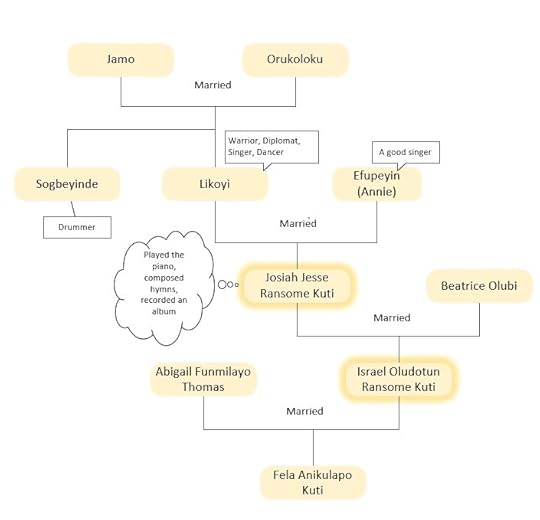
Jamo was Fela Anikulapo Kuti’s great, great grandfather. According to Delano, Fela’s ancestors were in public service, serving as soldiers and successful traders. Originally based in Orile, the ancestral home of Igbein people, they drifted to Abeokuta.
Not much was said about Jamo, apart from having two sons, Likoyi and Sogbeyinde. Likoyi was described as one of Egbas’ greatest diplomats and a weaver by trade. The Egbas are a people group in the South West of Nigeria. Likoyi’s hobbies included singing and dancing. Sogbeyinde was described as a singer and dancer. To produce two sons who were musical, it is probably likely that Fela’s great, great grandfather himself was musical.
Fela Anikulapo Kuti’s great grandmother was Efupeyin. I think it should be written “Efunpeyin” because she was a worshiper of Orisa-Oko (the farming deity?). She converted to Christianity in 1848, bringing the Christian faith into the Kuti lineage. She took the name “Annie”. She was one of the earliest Christians among the Egbas.
Josiah Jesse Ransome Kuti, Fela Anikulapo Kuti’s grandfather was born on June 1855. At one point, Annie ran away because of rumors her son would be killed because she was a Christian. Likoyi persuaded her to come back home, vowing to defend his son from any evil doer. Annie was free to worship but Likoyi did not want her to take his son to church and was against his baptism. Likoyi would take his son to fetish idols to eat meat sacrificed to idols. Later in life when Josiah Jesse Ransome Kuti was asked about his consumption of those meats, he quipped that he liked eating them.
Eventually, Josiah Jesse Ransome Kuti was baptized at a Wesleyan Church in Ogbe in 1859. Annie and Josiah became Anglicans when Annie was cast out of the Wesleyan church due to a visit to a CMS church to be with two of her friends.
Annie was also described as “a good singer”, a native of Imo and niece of Solanke, a Balogun (War Chieftain) of the Egbas. Due to the different religious persuasion of his parents, Josiah Jesse Ransome Kuti said he often ate meats at idol shrines and missionaries’ biscuits on the same day.
While at Igbein Primary School, Josiah Jesse Ransome Kuti fell ill and Annie demanded he came back home. For a whole year, Annie taught him indigenous music and tunes, and, the language of native drums. When Josiah Jesse Ransome Kuti returned to school, the musical mentoring by his mother paid off, and he excelled as a student, especially in music. by 1880, Josiah Jesse Ransome Kuti was a teacher at CMS Girls School, Lagos, where he taught and practiced music. He was described as polished musician, a great singer, who “accompanied himself on the piano or harmonium with ease and confidence”. He was so good he could have been a success on the social scene. However, based on the advice of a German missionary, Mrs. Mann, he decided to dedicate his talent to the Lord and consecrated his musical talent to Christian music.
On May 2, 1882, Josiah Jesse Ransome Kuti married Beatrice Olubi.
Rev Canon Josiah Jesse Ransome Kuti would go on to build significant work at Gbagura, Sunren-Ifo District, Ilaro, Ake Church Abeokuta, among several other places. A prolific musician, he authored indigenous music that struck a chord with his people and drew them to his open-air events. He was an educator who at one time had sixteen boys and girls under his roof as an informal boarding house. Adjudication in certain matters were delegated to him by the colonial administration. During his long career in the ministry and public service, he was a mediator in various conflicts, the most notable of when the Egbas resisted taxation by the colonial government.
On a visit to the United Kingdom in 1922, he made some gramophone record of his songs.
Not only is Rev Canon Josiah Jesse Ransome Kuti grandfather to Fela Anikulapo Kuti, he was also grandfather to the first African Nobel Prize winner, Professor Wole Soyinka.
Some of the quotes in this article comes from “The Singing Minister of Nigeria: The life of The Rev. Canon J.J. Ransome Kuti” by Isaac Delano, published in 1942.
July 2, 2022
Ejigbede Lona Isalu Orun (Ejigbede’s Journey to Heaven): First Look
Ejigbede Lona Isalu Orun was written by Joseph Ogunshina Ogundele and published in 1956 by Longmans, Green and Co LTD.
Ejigbede (translated as “a pair of young pigeons or doves”) was born in heaven to Laburukusege. My guess of the meaning Laburukesege is somebody you don’t wish to offend. Coming out of the womb with a bag on his shoulder, hiss parents were afraid and wonder aloud about what sort of child they had. To their surprise, he replied that his bag contained his destiny. He further told them that the bag contained two pigeons and his name shall be call called Ejigbede.
One day, the divinities of heaven decided that they will send Ejigbede to earth and he consented. However, he had a change of heart when one of the poets of heaven recited a riddle:
Ejigbede o kare iwo omo akin, akata nje ogede o nyun idi, ko mo wipe ohun ti o ba dun a maa pani.
Translation of the riddle:
The jackal is eating banana and licking his lips, he does not realize that sweet things can kill
To persuade Ejigbede to head to earth, his father’s poet intervened:
Eniti aigbon pa ni o po, eniti ogbon pa ko to nkan
Ile aiye, ile afe
Ile aiye, ile ayo
Bi enia ba nwa ire ti ko ba ri
Ki o fi ori le ile aiye
Bi enia ba nwa ayo nitarata
Ki o fi or le ona Akamara
Gbefe Ileke aiye po ju ti orun lo
Ejigbede, gbera nle ki o dide
Ki o ya ma lo si Ileke Aiye
Translation:
More are killed by ignorance than wisdom
The world is a place of fun
It is also a place of joy
If you are looking for a blessing and can’t find it
Go to the earth
If you are looking for instant gratification
Head to Akamara (a synonym for earth)
The pleasure of earth is more than that of heaven
Ejigbede, hasten your trip to earth.
The problem that Ejigbede did not realize was that after spending a thousand years on earth, he was expected to come back to heaven, having stuffed all the inhabitant of earth in his bag of destiny.
When Ejigbede arrived on earth, there was nobody there. It was void (this is a word borrowed from Genesis Chapter one, remember the first name of the author was Joseph). He started wandering around the earth and one day, he naturally arrived at Ile Ife, a town in South Western Nigeria, where he discovered a married couple, the Sun and the Moon. In the history and myths of the Yorubas, there is always a primacy of Ile Ife.
In the process of time, Ejigbede married Ogere Afokoyeri. After a thousand years, the divinities of heaven decided it was time for Ejigbede to fullfil his promise. They sent three emissaries Esu, Oran and Iku. Apparently, Esu was expelled from heaven, therefore, he is similar to Satan, the devil as in the bible. Oran means trouble and Iku means death. The three emissaries reminded Ejigbede of his promise. Esu told Ejigbede that he had three options. Ejigbede could walk to heaven through a very difficult route that humans are unlikely to survive, or he could commit suicide with a knife or poison. For emphasis, Esu added the following:
Ka ku ni kekere, ka pa eran nla bori sanju idagba ailedie irana
Translated
It is better to die young with a honorable burial than to die old without a decent burial
You catch a glimpse of the importance of burials among the Yorubas. The threat here is if you try to work to heaven, Ejigbede, and you don’t make it, you might die in the middle of nowhere, without anybody nearby to bury ou.
When Ejigbede heard the emissary from heaven, the difficulty ahead of him became very clear. Tears dropped. This was followed by a speech:
Igbesi aiye omo enia dabi opa itele
Omo araiye a ma fe e nigbati o ba se itele
Sugbon bi o ba di wipe o da lojiji
Omo araiye a ko ehin si i, a si di itele igi aro
Oba ti nfo bi eni wipe iku ko si mo
Iwo olori ti o nhu iwa bi eniti ko ni imo
Ibasewipe o mo wipe igba ki lo bi orere
Loni ni iwo iba bere si fun rere
…………………………………………………………………………………………………………….
Igbesi aiye omo enia da bi atupa
Atupa ti o mole ninu okunkun
Sugbon ti a fe pa lojiji, ti ahon ina na si fo lo
Okunkun a tun pada bo si ipo re
Beni eniyan ki yio si mo ipa atupa na mo
Omode ile akose ninu okunkun na, a si subu
Translation:
The life of a human is like a walking stick
When the stick is fulfilling its purpose, it is treated with care and love
If it breaks suddenly,
It becomes a log for a bonfire.
If you are king ruling with impunity
If you are a queen acting in ignorance
If you realize that nothing lasts forever
You will change immediately and start sowing good sees
…………………………………………………………………………………………………………….
The life of a human is like a lamp that is burning
The light shines in the darkness and bring illumination
if the lamp goes out suddenly,
The lamp becomes useless an ineffective
Children in the house would start to stumble due to the darkness
Ejigbede Lona Isalu Orun is a fiction with the purpose of entertaining people with stories that are rather exotic and in the realms of fantasy. Ejigbede, the main character was born in heaven. It is not clear whether he was human or not. He interacted with the divinities of heaven who eventually voted to send him to earth. How did he come to earth? He climbed a tree in his father’s garden and found himself on earth. He lived for a thousand years, he was older than Methuselah, the oldest man in the bible.
The emissary from heaven, Death, Trouble and the Devil, took a form that the inhabitants of the earth could relate to, though the disturbance and unease that humans experienced when they turned up made it clear these were no ordinary beings.
Like D.O Fagunwa’s books, Ejigbede Lona Isalu Orun was not just a book that focuses on entertainment. It also taught some moral lessons. For example, it asked those in position of power to realize that nothing last forever. It brings awareness that things can change suddenly by using the examples of a burning lamp and walking stick. He also called out those in power (the King and the Queen) that when they exercise power, they should realize that nothing lasts forever.
April 8, 2022
Lójó Ojóun (In the Olden Days) – Early Encounter Between The Yorubas and The British
It is always good to start reading a book from the preface. It provides insight into the reasons why the author started the project.
From the preface of Lojo Ojoun, we know that the author, Isaac Delano, wrote a historical account of the advent of British influence and its effects on the South West of Nigeria. British influence brought Ìlàjú, a word that could be translated “enlightenment”, “civilisation”, “refinement”. These are all possible meanings of Ìlàjú. We do know that the Yorubas had their own civilisation before the British turned up. Therefore, it will be patronising to say the British brought civilisation, enlightenment and refinement.
In the light of this, I believe Ìlàjú is synonymous with exposure to British style education and culture. Therefore I choose to interpret Òlàjú as a person who has been systematically exposed to the British education and culture.
It is sad to observe that the British convinced well educated people like Delano that the Yorubas were not civilised before the arrival of the British. I drew this inference from statements in Lójó Ojóun. For example in the preface, Delano referred to the British as “civilised”, contrasting them with the Yorubas. There are other examples in the book bu they will have to wait till another post in which I will focus on the theme of “òlàjú” and “Ìlàjú”.
Delano saw two components to “Western enlightenment”. Christianity and British style education was the first one. Both could not be separated because literacy training was delivered by the church and preists often doubled as teachers. The gospel preached and the education provided were all delivered in the framework of British culture.
The second component was the liquor business. With British influence came British merchandise, including cheaper and more intoxicating liquors.
While Christianity was considered an overall positive influence, liquor brought drunkenness. By 1909, the churches in Nigeria and England proposed to ban sale of alcohol in Nigeria.
Delano thought it was important to document how Christianity, literacy and the liquor trade came into the South West (first to Abeokuta, then to Lagos and later to the rest of South West). Another important issue he wished to record was the efforts of the clergymen of those days. Finally, Delano wanted to highlight the devastation that accompanied the British liquor trade, while highlighting the benefits of western education and Christianity.
From the preface, it was clear that Delano would be doing a critical appraisal of British influence, looking at the pros and cons; coming up with a judgment of whether overall, the influence of the British was good for South West of Nigeria.
Although, Lójó ojóun was a historical account of events in South Western Nigeria, it was written as fiction, apart from sections of the book that addressed the liquor trade.
Just as in “Ayé Dayé Òyìnbó” by the same author, It was a woman giving the account of events. Although the book was written in 1963, three years after Nigeria became independent, the narrator was considerably older, discussing historical events such as the death of Madam Tinubu in 1887, the building of a railway station at Aro in 1898 and the role that returned slaves (via Sierra Leone) played in local administration and governance in 1865. The interaction of the returned slaves with their brothers and sisters who never went into slavery deserves a separate post.