
Tade Oyebode's Blog
March 15, 2023
People of the City by Cyprian Ekwensi
“People of the City” was written by Cyprian Ekwensi in 1953. Despite studying Pharmacy, Ekwensi became a prolific author with several critically acclaimed books to his name. It’s said that his father was a storyteller, which may have inspired Ekwensi’s love for writing. After working in broadcasting, he eventually started his own business, showcasing his multifaceted talents.
Sango’s mother had high hopes for her son and warned him to be wary of city girls. She had a girl in a convent whom she was preparing for Sango. Girls flocked to Sango because he was very handsome. As much as he wanted to heed his mother’s advice, he lacked the moral fiber to resist.
“People of the City” is set in Lagos. The story revolves around a young man in his mid-twenties named Amusa Sango. It is not clear where Sango came from, but like many of the people of the city, he was neither born nor bred in Lagos. Instead, he came to Lagos from an area called Eastern Greens. The location of Eastern Greens is not specified, leaving us to guess. Although Amusa Sango sounds like a Yoruba name, Yoruba-speaking areas are located to the north of Lagos, rather than towards the east. Nigeria was divided into three regions at the time: North, West, and East, and Ekwensi hailed from the Eastern Region. Where Eastern Greens was located will remain a mystery.
Aina was one of the people of the city. Although Sango was trying to make a career in journalism, he had a side hustle leading a band that performed in the evenings. After his performance, he could always choose one of the girls, resulting in repentance the next morning. One of those picks was Aina, a shoplifter who also came into the city to escape poverty. The next morning, Sango was ready to move on, but Aina was looking for a relationship. There was something about Aina that worried Sango. He had a premonition that he would not be able to extricate himself from her.
Lajide also lived in the city. He was Sango’s landlord and referred to as the financier. He was involved in various shady deals and once attempted to double-cross some robbers who were trying to sell stolen goods to him. Lajide had eight wives and was always on the lookout for more. He disliked Sango because of his string of one-night stands.
When Lajide discovered that Aina was about to be stoned to death for shoplifting, he was eager to let Sango know that his warnings about girls with dubious characters were prescient. Sango rushed out, thinking about how to save Aina. He eventually found a corporal who called 999, and within minutes, the police arrived and rescued Aina. However, she was eventually jailed for three months.
Aina’s mother was unhappy that Sango did not fight more for her daughter. She almost got him into serious trouble when Bayo, a friend of Sango, wanted to make money on the side by colluding with a nurse to inject a woman with some illegal drugs for treatment. The woman in question happened to be Aina’s mother, and Bayo intended to use Sango’s flat for the operation. However, when Aina’s mother learned of the plan, she reported it to the police. Bayo and Sango managed to escape charges by quickly disposing of the evidence, but the nurse was not as fortunate. Additionally, Lajide became fed up with Sango and evicted him, leaving him homeless
Eventually, Aina was released from prison, and Sango found her irresistible. You can imagine what happened next.
Meanwhile, while Aina was in jail, Sango had found another love interest, Beatrice, who was the mistress of an English man named Grunnings. Grunnings was married with three children in England, but Beatrice loved Sango. However, now that he was homeless and storing his belongings in the Left Luggage office at a railway station, he was not interested in pursuing a relationship with her. Beatrice was bored and wanted to move, but she had no money. Sango directed her to Lajide, who was willing to provide accommodation in exchange for her becoming his ninth wife. Lajide faced competition from a Lebanese businessman who was willing to pay £5,000 for five years to rent one of Lajide’s properties. Ultimately, Beatrice chose the Lebanese businessman, Mohammed Zamil, but Lajide continued to pursue her.
Lajide purchased the hall where Sango and his band performed in the evenings and promptly evicted them. However, thanks to Beatrice, Sango was able to secure an Islamic school as an alternative venue
One of Sango’s band members discovered that he had no place to live, and invited him to share his tiny room, taking turns sleeping in the bed. Despite his living situation, Sango was doing well at his job.
Politics was in the air, as Lagos had just elected the first black mayor in West Africa. Everyone, including Sango, was swept up in the euphoria of the moment. On the day of the mayor’s inauguration, the crowd was massive, and a girl fainted. Sango was there to save her, and he fell in love with her instantly. However, she was already betrothed to a medical student in America who wanted her to join him as soon as possible. Her name was also Beatrice, and Sango dubbed her “Beatrice the Second.”
Meanwhile, Sango’s mother, who was unwell, had traveled to the city for treatment and was admitted to the hospital. With her was a girl that Sango’s mother wanted him to marry. She had just left a convent, but Sango found her too boring.
Suddenly, Aina showed up, claiming that she was pregnant with Sango’s child. He gave her five pounds and warned her not to return.
Bayo, one of the people from the city whom we encountered earlier, fell in love with Saud Zamil, sister to Mohammed. Beatrice the First was already bored with Mohammed and had moved on to hitch up with Kofi, a commercial driver who plied the Lagos to Abuja route. Beatrice the First eventually dropped dead, and Kofi, who had a family in Ghana, was devastated.
When Mohammed discovered the relationship between Bayo and Saud, he did not approve of it. The two lovers wanted to elope, but Mohammed discovered their plan. In the ensuing confusion, he shot both of them dead.
Sango, wanting to exact revenge, used his journalistic skills and the platform he had to expose what happened. At the time he did this, he was about to have the big break in his career that he had sought for so long. Unfortunately, his article stepped on too many toes, and he was dismissed from work.
Aina returned to the accommodation Sango shared with his friend called First Trumpet. On seeing her, Sango became livid. In the ensuing tussle, Aina had to be rushed to the hospital.
Sango was worried. If Aina died, it would be a custodial sentence. Luckily for him, Aina pulled through and Sango found out he wasn’t the father of her baby.
Somewhere along the line, Lajide, husband to eight wives, lost his first wife. The event devastated him, and he died suddenly shortly afterward, literally drinking himself to death.
Beatrice the second’s fiancé failed his medical exam abroad and tried to commit suicide. He died in a Lagos hospital, around the same period when Sango’s mother died at the same hospital.
Sango and Beatrice the second married at a low-key ceremony, with very few invited guests. Nevertheless, word got around, and Kofi, still mourning Beatrice the First, gatecrashed the party, offering the new couple to come and spend some time in Accra. The book ended with the new married couple looking forward to an exciting time in Ghana.
In the news this week was the sad story of the conviction of a Nigerian politician and his wife who appeared to have tricked a boy trapped in poverty in the city of Lagos to the UK to donate a kidney to their daughter. Very tragic story, no matter how you opt to look at it. The final part of the story played out as I was reading this book. Cities attract people who fled poverty from their towns and villages. In “People of the City”, Sango, Aina, Bayo, Lajide, Beatrice the first, the eight wives of Lajide, were all people who fled from somewhere to Lagos to escape poverty. Lajide made it financially, but the rest didn’t. It was a very exploitative environment. Sango messed around with several women who fled into the city from elsewhere. However, when it was time for him to settle down, he opted for Beatrice the second, a woman who was born and raised in a very settled family environment in the city.
People of the City also provided an insight into what Lagos was like in 1954, under the colonial masters. It was a place into which somebody like Sango’s mother could travel in from a village, be admitted for treatment and receive proper help. |T|his reminded me of a story that a Chines colleague told me about China: if you can find your way into a Chinese city, you will have high quality medical attention. Lagos of 1954 was a place where calling 999 elicited response in minutes. Train stations had proper functioning level crossing, with gates. Railway stations in those days had “Left Luggage Office”, a facility that Sango took advantage of to store his personal possessions when he became homeless. Like it is today, acommodation was in demand because of the constant influx of people.


March 11, 2023
Weep Not Child by James Nguigi (Ngũgĩ wa Thiong’o)
Weep Not Child was written in 1964 by Nguigi Wa Thiong’o (using James Nguigi as pen name). The title comes from a poem called “On the Beach at Night” written by Walt Whitman:
…Weep not, child,
Weep not, my darling,
With these kisses let me remove your tears,
The ravening clouds shall not long be victorious,
They shall not long possess the sky, they devour the stars only in apparition,
Jupiter shall emerge, be patient, watch again another night, the Pleiades shall emerge,
They are immortal, all those stars both silvery and golden shall shine out again,
The great stars and the little ones shall shine out again, they endure,
The vast immortal suns and the long-enduring pensive moons shall again shine…
It is a tragic story, a story of dispossession of a people from their own land. It is a story of unrealised hopes unfulfilled love and dreams that collapsed and shattered. It is a story of a people who welcomed strangers into their own land. They even went with these strangers to fight a war that they had no clue about. However, returning back from war, the young men discovered there were no lands to farm. The colonial master had taken everything. In exchange, there is education, which was nothing more than teaching people to speak and think in the language of the colonial master. What good will that do? Well, only if it helps to acquire land…
On the very first page of the book, you will note that going to school was a privilege in those days in Kenya. During my childhood in Southern Nigeria , going to school was a right. This was not the case for Njoroge during the colonial era. He wanted to go to school but he knew his family was poor and could not ask. Nevertheless, his mother, Nyokabi knew how strong his desire was and strained to provide the opportunity. She warned him that he would have to go without midday lunch unlike the other children and truancy would not be tolerated.
The context of Njoroge’s life was the poverty of his family. In the very first paragraph of the book, Nguigi drove this home as he described Nyokabi, Njoroge’s mother:
One could tell by her small eyes full of life and warmth that she had once been beautiful. But time and bad conditions do not favour beauty.
Poverty, in the process of time erodes those things that nature bestowed abundantly on people. The poverty that we are talking about here would not be easy to grasp in social welfare democracies of the West where the welfare state often provide basics, even if there are no frills attached.
Njoroge broke the news to his step brother, Kamau, who was training to be a carpenter. Excited, he said after he had finishing all the books in Kenya he would head over to England. His brother quipped ‘or Burma’, the country where many Kenyans died defending the British empire during the Second World War. Kamau then wondered aloud why Mr Howlands, a colonialist, left the land of learning to come down to Kenya, an interesting question to bring Njoroge back to earth.
The author moved on to discuss the Big War (second world war), querying why white people were fighting one another and reached a conclusion:
It is better to give up and be content with knowing the land you lived in and the people who live near you”
In other words, Njoroge, you don’t have to aspire to go and read all the books in England, just stay here in Kenya.
In the very first few pages, the exploitation of the people in their own land was graphically illustrated
You could tell the land of the Black People because it was red, rough and sickly while the land of the white settlers was green and was not lacerated into small strips
It is likely the white settlers took the best lands and had more per person than the black people to whom everything belongs.
And it was not only the white settlers who ill-treated the black people, the Indian traders did not treat their black employees fairly. There were black traders but their goods were more expensive, probably due to inbuilt disadvantages in terms of access to produce markets. The tragedy of colonialism in Kenya was not just the oppression of the white European. To add insult to injury, they brought people from other parts of the empire, such as India to come and exploit and oppress the people.
Next, we were introduced to Ngotho, Nyokabi and Njeri’s husband. As we already know both Njoroge and Kamau were growing up in polygamous family, where both women were friends. He bought some meat and asked them to divided equally, for his two wives. We are provided some insight into Ngotho’s thoughts about women.
But you could not quite trust women. They were fickle and very jealous. When a woman was angry, no amount of beating would pacify her. Ngotho did not beat his wives very much. On the contrary, his home was well known for peace
Weep Not Child was written in 1964. Why would you pacify an angry person by beating him or her? And the expression “Ngotho did not beat his wives much” suggested he nevertheless beats them. This reveals a very patriarchal social and cultural environment. Very shocking to read these paragraphs today.
Later we read this:
..his wives were good women. It was not easy to get women like this today
What exactly does this mean? Was it that society was changing and women were resisting the docile role into which they were cast? Were they beginning to fight for more rights and equality?
In the process of time, Njoroge started school. We learnt that Ngotho, his father, is a muhoi. A muhoi lives off another man’s land and is allowed to cultivate it. Jacobo was the owner of the land, and was father to Mwihaki, a girl who was a friend of Njoroge. He received the treatment of new starters and was taunted but Mwihaki defended him. Seeing a teacher beat other students in the class was a painful experience for him.
Nyokabi took a lot of personal pride in Njoroge’s learning, activities like doing sums and learning English. As Njoroge walked to where his brother was learning carpentry under a man called Nganga, he meditated on the importance of land in Kenya:
..If a man had plenty of money, many cars, but no land, he could never be counted as rich. A man who went with tattered clothes but had at least an acre of red earth was better off than the man with money
Nganga had land and could afford three wives. The number of wives you had was a signal of your social status in Kenya of those days. Nganga was not allowing Kamau to do anything and that frustrated him as Kamau felt that you learn by doing and not by watching. Njoroge was shocked that a black man can treat other black people like that.
Often in books written by Africans about colonial days, we catch insight from the perspective of Africans. Nguigi gave us a bit of insight into the typical colonial master of those days, Mr Howlands. Howlands fought during the first world imagining an opportunity for glory. After being brutalized by the terrible destruction, the peace that followed disillusioned him. Africa provided an escape from Europe, the scene of carnage. He went on to lose his own son during the second world war. Such a man could be very bitter. In fact his wife was worse, beating their servants mercilessly, after which she discarded them.
Mwihaki and Njoroge were close friends. Jacobo was a wealthy Kenyan. Eventually Kenyan workers decided to strike, a very tricky situation for Ngotho (Njoroge’s father). He was employed by Mr Howlands, who said he would sack anybody who joined the strike. Nyokabi did not want her husband to join the strike because of the financial implications. Ngotho understood that but again, he felt that he had let down his own children. Boro for example thought Ngotho was a coward for watching as Mr Howlands farm their ancestors land, doing nothing about it, just waiting for him to leave and for the prophecy (read more about the prophecy here) to be fulfilled. Jacobo was sent by the colonial masters. Ngotho was so infuriated that he confronted Jacobo. That started enmity between the two men. Jacobo was bent on destroying Ngotho. This is classic divide and rule technique used by the British Empire in Africa.
To Njoroge, education was the vehicle to drag his family out of poverty. To Ngotho, education only matters if it offers access to land. Njoroge was the brightest among his peers and he eventually ended up in a boarding school where he came in contact with missionaries. He was impressed by the missionaries teachers because they treated everybody nicely but the head of the school’s project was to make the boys like Europeans whom he believed can do things better.
While at the school, Njoroge met Stephen, Mr Howlands’ son. After they struck up conversations both realised that back home, they wanted to get to know each other but were kept apart by fear.
Meanwhile, Boro, Njoroge’s older brother had joined the Mau Mau movement, devoted to driving out the white colonial masters. He had extreme hatred for Jacobo, who he considered a traitor. He had every reason to think this way because Jacobo has been working with the white colonial masters in a campaign of intimidation of the black people, imposing curfews. Jacobo did not forget his humiliation in the hands of Ngotho and was determined to exact revenge. Boro was a devotee of Jomo, who was fighting for independence for Kenya from the colonial masters. When Jomo was imprisoned, it resulted in frustration and escalation of the activities of groups like the Mau Mau movement.
Nevertheless, Mwihaki and Njoroge’s friendship deepens. At one time, she requested both ran away but Njoroge believed that once he has this education, he would be in a good position to save his people. Unfortunately, he was not going to finish his education. Despite his brightness, one day at school, he was summoned and taken to an interrogation camp where he was tortured and asked to confess his membership of the Mau Mau movement. The reason for this? Jacobo, the father of the woman he loved had been killed. Ngotho confessed to the killing because Kamau was a suspect. It turned out that it was not Kamau who did it. Instead, it was Boro. That was how Njoroge’s education ended, and he had to go and work in an Indian shop as a salesman.
Meanwhile, Mr Howlands’ wife had implored him to let them all return to England until things settled down. However, Mr Howlands’ god was the land he farmed. He sent his wife and children back to England but stayed there, determined to overcome the various freedom movements. One day, Boro turned up and killed him. When Ngotho told the story about the prophecy earlier, Boro had realised that the land that Mr Howlands claimed as his own belonged to his forefathers. By killing Mr Howlands, he avenged the injustice done to his forefathers.
Njoroge was dejected. Mwhiaki whom he loved, believed he was part of the conspirators who killed her father. No communication between both for quite a while. Without education, the dream of saving his people died. He summoned up courage and invited Mwhiaki to meet him. Mwhiaki’s mother was surprised she would meet one of the conspirators who killed her husband.
Mwhiaki confessed her love for Njoroge and apologized for wrongly thinking Njoroge could be part of the plot to kill her father. However, she refused to run away with Njoroge, and told him that they had responsibilities, reminding him of Njoroge’s saying “The sun will rise tomorrow”. “Let us wait for a new day”, Mwhiaki implored.
After Mwhiaki left, he collapsed and wept bitterly, shouting her name.
Without Mwhiaki, and with hope of education dead, Njoroge decided to hang himself. He made his way to where Mwhiaki left him after declaring her love for him. He was going to end everything there. He decided to wait for the night to fall. He prepared the rope and was about to do it when he heard the voice of his mother calling. She had come looking for him. Courage failed him and he was relieved she had come and followed her back home, navigating their way using a glow piece of wood as lamp. Shortly after they met his second mother (Njeri, his father’s second wife) who had also gone looking for him.
I reckon the sun rose the next day and Njoroge was alive to witness it.
As the colonial masters fought to control Kenya and as the missionaries did their best to evangelize it, thousands, if not millions of personal stories like this play out as people’s lives and prospects were torn apart by the conflict. There aspirations, ambitions, dreams, hopes and desire became collateral damage in the ensuing tussle.
February 21, 2023
To Hell With The Prophecy (Weep Not Child by James Ngugi)
This story comes from the second chapter of Weep Not Child by James Nguigi. I think it is pertinent to attitude of some Christians in Nigeria to voting in elections. As you read, please note I am angry abouta particular mindset. This post allows me to dissipate that anger so I don’t go to sleep with it: be angry and sin not is the biblical advise.
Ngotho’s wives, Nyokabi and Njeri, were the ones who told stories to his children to “shorten the night”. One day, Ngotho accepted the responsibility and then told the story I paraphrase in the next paragraph.
One day, thunder and lightning, accompanied rain and wind. The chaos terrified the animals God had put in the forest to the point where they couldn’t move. Eventually, a tree that had life grew and defied the chaos, penetrated the darkness and reached the sun. God put a man and a woman under this tree. God gave them the land. It was prophesied that the white man would come one day and take the land. This event happened after a drought in the land. At first, the white man took part of the land, not all of it. Then it was the big war, the first world war. The white man conscripted the men of the land to serve in his army. After the war, the men returned home and discovered the land was gone, the whiteman had taken it all.
Ngotho’s sons were surprised: so the land that Mr Howlands claims to be his belonged to our grandfather? Yes, their father replied. My father, your grandfather died waiting for the prophecy that the land will be returned to be fulfilled.
One of the sons asked, would the prophecy be fulfilled? Their father replied that somebody once rose up who people thought would drive away the whiteman but he was killed by wicked people.
Another son said:
“To hell with the prophecy”
‘How can you continue working for a man who has taken your land? How can you go on serving him?’
The next day Ngotho reflected on the comments of his son: “Perhaps he and others had waited for too long and now he feared that this was being taken as an excuse for inactivity, or worse, a betrayal.”
I see parallels in my country of origin, Nigeria. As I talk to people, I realise how desperate for change they are. They are praying and many have heard prophecies about how God will change Nigeria. Some of these prophecies are old, really old. Some even go back as far as Pa Elton who was prophesying 40/50 years ago or so. Other prophecies go back just 30 years. Many of them will not vote. They are waiting for the prophecy to come to pass.
Prophecies and prayers can become excuse for inaction. Ngotho’s son’s response was “To hell with the prophecy”.
Yea: “to hell with any prophecy” that will keep you perpetually in slavery. “To hell with the prophecy” that will prevent you from taking responsibility to make the change that is within your reach.
“To hell with the prophecy” that will give you the impression that it is okay not to exercise your civic responsibility.
Weep Not Child was set in Kenya. Waiting for the prophecy to be fulfilled did not achieve anything. They took initiative and the rest is history.
February 20, 2023
Our Husband Has Gone Mad Again by Ola Rotimi
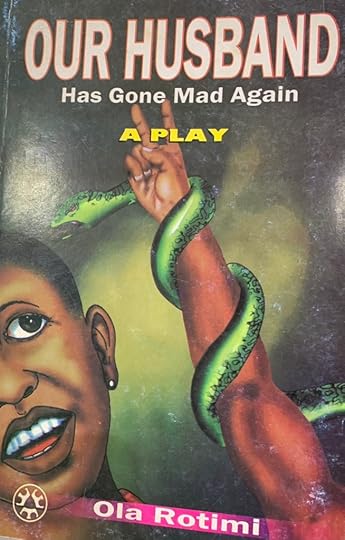
Our Husband Has Gone Mad Again by Ola Rotimi is a short play, about 85 pages. It should not take more than 2 hours to read. The book was written in 1977, just before the second republic. Nevertheless, there are quotable quotes that sounded prescient. For example, hear out the main character of the play:
Are you there? Politics is the thing in Nigeria, mate. You want to be famous? Politics. You want to chop life? – No, no you want to chop a big slice of the National cake? – Na politics.
Often people talk as if the monetisation of politics is a new thing. It is probably over four decades old. Ola Rotimi saw this in advance, even before the second republic.
He carried on:
Cakes are soft, Gentlemen. Just you wait! Once we get elected to the top, wallahi, we shall stuff ourselves with huge mouthful of the National chin-chin [munches on imaginary mouthful], something you’ll eat brother and you will know you’ve eaten something.
What about this dialogue:
Okonkwo: It sounds like war.
Lejoka-Brown: It is war! Politics is war. Oooh – I am taking no chances this time, brother mine. I took things slow and easy and what happened? Chuu! I lost a by-election to a … a small crab… a baby monkey… This time it is war.
Our Husband Has Gone Mad Again is a comedy about a soldier turned farmer turned politician.
While fighting in the Congo, Lejoka (translated chaser of snakes) Brown fell in love with a Kenyan medical student, Liza, about to head to America for a medical degree. They were married under the French law before she travelled.
However, shortly before the marriage Lejoka’s brother died and their father unilaterally married Mama Rashida, the wife of his late brown to Lejoka Brown. Lejoka Brown was informed about this but he kept this to himself and went ahead with the marriage to Lisa.
When his father died, Lejoka Brown inherited his Cocoa farm, a very prosperous business. Later he went into politics. He married Sikira, the daughter of the leader of the market women, so that he could secure her mother’s support for his political ambition.
After completing her medical degree, Liza told Lejoka Brown she was coming to Nigeria. Liza was not aware of the other women. Wanting to postpone the difficult conversation till after the election, he sent 800 pounds to Liza, encouraging her to see a bit of Europe.
A cablegram arrived informing Lejoka Brown of Liza’s arrival at 5pm. With his friend, Okonkwo, they hatched a plan for Lejoka Brown to hire a flat where he would lodge Liza and have a managed and controlled introduction of all women in his life. At one point, there was a hint of self pity as Lejoka Brown compared himself to his grandfather:
I whose grandfather had a hundred and fifteen wives, I tell you… one hundred plus ten plus five breathing wives all at once undedr his roof! But here I am, with only two little crickets, expecting one more – just one more canary, and I can’t just pick her up by the arm and say to her: “Woman, I forget to tell you: but as the whiteman says, “better late than never”, Here – meet your other ehm … sisters-in-marriage.I whose grandfather had a hundred and fifteen wives, I tell you… one hundred plus ten plus five breathing wives all at once undedr his roof! But here I am, with only two little crickets, expecting one more – just one more canary, and I can’t just pick her up by the arm and say to her: “Woman, I forget to tell you: but as the whiteman says, “better late than never”, Here – meet your other ehm … sisters-in-marriage.
This paragraph reminded me of a moan from an English chap I worked with once upon a time. He used to say that things were better in the days of his father. All a man needed to do in those days was to travel to the city to work. Once you are back home, you would not be bothered with child care. I used to remind him that in those days of his father, the wife was also a full time housewife, whereas today many women (including his own wife) held down a full time job, in addition to the remaining work he was complaining about!
Back to Lejoka Brown’s household. Unfortunately, due to bad weather, Liza arrived earlier than expected, taking a cab directly into the chaotic household of Lejoka Brown where a pet snake and chicken raised for sale dwelled with the people there.
Sikira, the youngest wife was very hostile, she was not aware of this new sophisticated rival until a couple of hours earlier. It didn’t help that Liza took her for a house help. Eventually, she worked out that the two women were her sisters in marriage. She felt betrayed and negotiated with Lejoka Brown to have some time to decide what her next steps would be as she was a complete stranger in Nigeria.
Before Liza arrived, the two women were treated like second class citizens in their matrimonial home. Lejoka Brown whose political slogan was about freedom did not allow any freedom in his own home. Neither did he allow his political associates any freedom.
In the weeks that ensued Liza transformed the household of Lejoka Brown. She taught Mama Rashida the first wife how to create demand for her egg selling business so she could increase supply. Her confidence grew to the point where she decided to move to the village where she would find land to scale the business. Lejoka Brown was welcomed to visit but he had to bring Liza with him so Mama Rashida could learn more business techniques.
Meanwhile, Liza had been busy making clothes for Sikira the third wife and indoctrinating her on equal rights for men and women. Her confidence also grew. When Lejoka Brown took exception to some of her new dresses and insisted she remove them, she refused asking that men and women need to be equal. Sikira gathered all goods and fled the house saying “Our Husband Has Gone Mad Again”. What else would you call a situation where an ex soldier wants to engage in physical combat with a woman much younger than him?
Things came to a head when a press conference that was supposed to show that Lejoka Brown’s party was united went wrong. He was expelled from the party. Lejoka Brown had been trying to use combat techniques for his campaign, having forgotten that politicians are civilians, not soldiers. Guess who his replacement was? Sikira his third wife whose mother was the influential leader of the market women.
Lejoka Brown was very shrewd with his women, especially the last two. Liza was there to enhance his image and ego as a politician, bringing her education and having been abroad to boost his political prospect. Sikira on the other hand was married purely to form an alliance with her mother, the head of the market women and secure votes that way. However, with Liza’s arrival, everything went upside down.
Finally, all he had left was Liza and she won’t be cooking for him and his political careers disappeared into thin air.
You can’t read a book like this and not reflect on how patriarchal things were 40 years ago. You would suspect the remnant of that patriarchy remains.
February 16, 2023
Alliance of Progressive Congress: 2014 Primaries and the Choice of Buhari
In 2014, many Nigerians were fed up with the governing party, Peoples Democratic Party. It is easy to forget how things were in those days. The Governor of the Central Bank was sacked because he blew the whistle that 20 billion dollars was stolen from the treasury.
Therefore, there was intense focus on the choice of the APC candidate. There was a feverish desire for Buhari because the issue of corruption loomed large. However, some of us were not convinced. I wanted to see the back of Jonathan but welcoming in Buhari was a big psychological hurdle. In one of my networks, we spent over a week debating this choice.
This evening, I decided to go through my comments. I have redacted details that can give away other participants. Most of them are no longer fans of Buhari. In fact, I have been more supportive of Buhari than most of them because I take into consideration the damaged economy he inherited and the shocks of oil prices collapsing to less than 30 dollars from highs of more than 120 dollars.
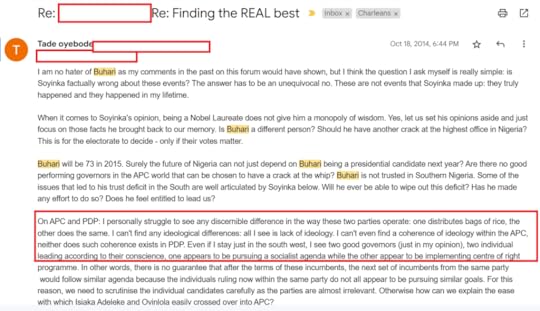
The first post I am sharing was a response to an article that Professor Soyinka wrote about Buhari that was posted to the forum. People just went for Soyinka, rather than considering the merits in his comments. Here, I highlighted the lack of ideology in the two parties and suggested we needed to scrutinise Buhari and consider whether he is the best choice within the APC. Most of those in the discussion are not partisan politicians.
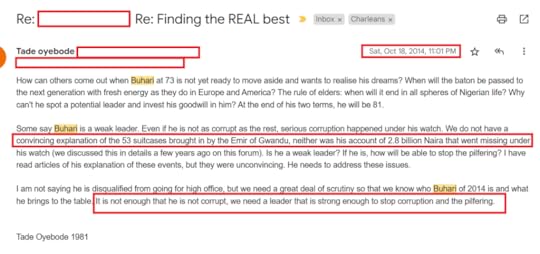
In my second post, I queried Buhari’s capacity as a leader, wondering if he has shown track records of strength needed to fight corruption. It is not enough to be incorrupt, a leader also needs to be able to challenge the corruption of others around him
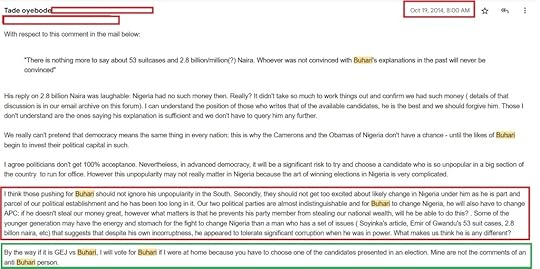
As often was the case, passions were riding high and people were insinuating I was a PDP sympathiser. I made it clear that if Buhari secured the APC ticket, he would be my preference.
Somebody posted an article where Dele Momodu waxed lyrical about the glory that Buhari would bring. The same Dele Momodu is now a strong critic of Buhari today and is working for Atiku, one of the candidates within the APC that Momodu considered inferior to Buhari then. Interesting with our people, the second choice in 2015 is now the saviour of 2023
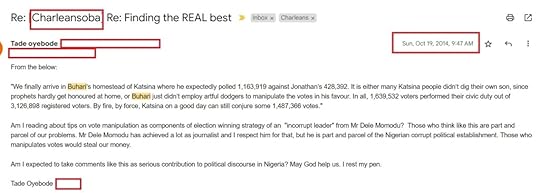
Another Buhari fan accused me of mastering the art of writing non stop. This is probably because of the whole group, only three of us were sounding a note of caution about Buhari.
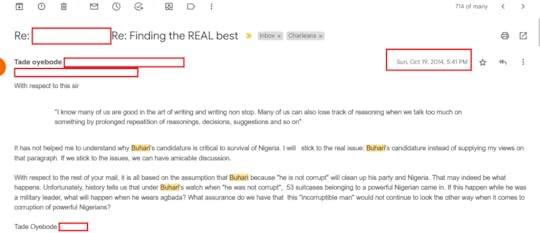
Just as people are excusing Buhari about this currency redesign, saying he was badly informed, people were excusing Buhari about the raid of Chief Awolowo’s residence that happened under this watch. I opined that if you are a leader and you don’t know what is going on, it is a problem.
Those of us challenging Buhari’s record were described as Buhari sympathiser. A younger chap summoned up courage to challenge Buhari’s record. I used the word courage because it is not easy in our culture to challenge the view of those who are much older than you. Some of these people graduated from our high school before I was born.
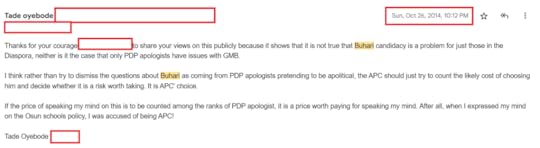
And just because we challenged Buhari’s records, somebody insinuated that it was our love for money that was driving us:
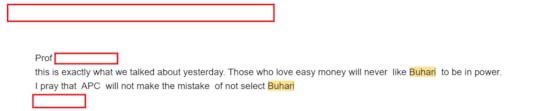
I wonder what the person who wrote the comments above think today? I am still in contact with him and I received a mail from him today. He is really disgusted with Buhari and as been so since just after Buhari won his second term.
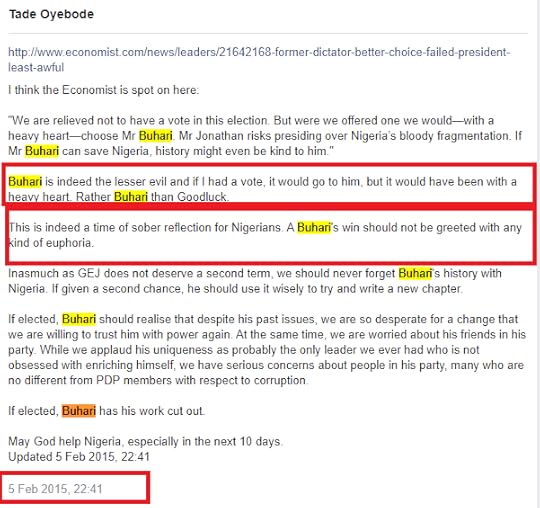
Looking back the Economist was right, describing the choice nigeria faced as a least awful choice: read here.
On Facebook, I commented:
February 11, 2023
Currency Redesign Chaos, Lack of Humanity in Nigerian Politics
While commenting on the currency redesign in Nigeria three days ago, I wrote this on my Facebook page:
“Dabbling in the political in Nigeria often strip people of their humanity. If they think there is a political advantage, they don’t care about the collateral damage. “
This morning, I was reading a post by a respected political commentator on Nigeria , Farooq Kperogi. You can read the article here. I was struck by a comment that struck a chord with mine:
Unfortunately, although the masses of people are barely surviving because of the deliberately engineered scarcity of the naira, opposition to and support for the policy have become partisan political issues. APC and Tinubu supporters resent it because they think vote buying is their only path to victory, and PDP and Labor Party supporters defend it because they think it’s the only way to stop Tinubu in his tracks.
None of them cares for the real-time, heartrending humanitarian disaster that the policy is engendering in the polity. Politics has robbed people of their very humanity.
I could not agree more.
Hundred percent agreement on this.
However, I respectfully disagree on vote buying. The main thing we learn in 2022 was that money alone is not enough to become a candidate in Nigerian politics. Had it just being the resources to bribe delegates alone, Wike would have won the PDP ticket. And had it not been for the APC Northern governors, Ahmed Lawan would be on the APC ticket. And nobody is seriously going to say that governors in Nigeria are short of cash and needed to be bought.
Money is a big factor. Amaechi, Osibajo, Okorochas all allegedly had the resources (or backers) to propel them to victory but there is a bit more to be done to win the right to spend. All would have allegedly bought votes to win if they had the political clout, network, alliances and allies to do so.
If you have tracked the key allies of Tinubu in the APC, people like Ganduje and El Rufai, there is some deeper commitment to Tinubu.
And as the writer wrote below, the APC has allegedly found a way round the funding they require for the election. If so, why are they going to court and trying to turn things around and making noise on this issue? I think there are two hypotheses that can be gleaned from the noise in the media in the last week:
(1)The APC candidate fears the impact of the chaos and pain arising from the currency redesign on their chances to do well in the election, after all, these are the policies of an APC government. This is because while some votes are for buying, not all votes are. And since Tinubu made that “famous” Abeokuta speech, the APC has tried to put clear daylight between itself and the government on these policies. Ironically, articles like the one below (which is excellent by the way), helps the APC candidate by casting this is as an attempt by Buhari and his cabal to prevent him from coming to power. Whether you like it not, BAT supporters and neutrals that are wavering and about to turn against him may be energized because of this narrative that has dominated the airwaves for the past week.
(2)The APC candidate fears that there are efforts to prevent the election from holding. Remember the chant he led on that day in Abeokuat: “A ma wole, a ma dibo”, translated “we are going to win, we are going to vote”. The easiest excuse to find to postpone an election is social chaos. The confidence with which Tinubu spoke during that speech did not portray a man who thinks his campaign had funding problems. Instead he sounded confident (to his supporters) or arrogant (to his detractors).
Separately and unconnected to the article below, isn’t that debate on Tinubu’s cognitive decline ludicrous? That man rose up and delivered a speech in June 2022, and that speech kicked off a chain reaction that played a decisive role in who won the APC ticket. The same man made a speech in January 2023 and the boomerang of that speech is still reverberating around our politics, and will continue to do so.
Whether Tinubu wins or not, he is not in cognitive decline.
February 4, 2023
A Tussle For Supremacy Within the Alliance of Progressive Congress party (APC)
In this post, I argue that while the APC Presidential candidate won the first round of his battle with the “elements in the presidency” (also known as cabal), there is no guarantee that he will this second round. This is because while it is clear his allies, the governors, control the party machinery and worked it to his advantage, nobody knows how influential the governors (not just APC’s but PDP’s and the remaining parties) and the party structure will be in the 2023 election.
I start this post with a definition of power that I think is pertinent:
the capacity or ability to direct or influence the behaviour of others or the course of events
What we have seen in the APC since end of May/early June of 2022 is a very brutal power tussle, and how it will end, nobody knows. Who is going to win this arm wresting?
Last year, Asiwaju Bola Tinubu blew everything into the open during a speech he made in Abeokuta, you can watch here. Abeokuta was significant because it was the capital of the state of one of his key competitors, the Vice President of Nigeria. In the speech, he said it was his turn and that he helped Buhari to become president. It was clear his main issue here was to challenge his party members in Ogun state not to back their own son, Prof Osibajo but to back him.
Something was lost in translation because Adamu, the Chairman of APC had a press conference soon afterwards denouncing Tinubu’s outbursts, that he was rude and disrespectful to the president and he threatened sanctions if he continues (watch here). If you watch the clip and you speak Yoruba language, it is really hard for you to come to such a conclusion.
Rumors were flying. It was very evident that there was a group within the APC political structure keen on another candidate or candidates. Or, bent on ensuring Tinubu did not win the ticket. The perception in the air was that Tinubu got himself into trouble with that speech and if you heard the proverb of Adamu which goes like this: “if you take some grass from a thatched roof, you can’t put it back”, you have to conclude that Adamu felt that Tinubu has crossed a threshold that is not reparable.
Before Tinubu’s speech, Buhari had appealed to the Governors to allow him to choose his successor, just as he allowed them to choose theirs. There is a clip of that report here. This implies that despite his executive power, choosing his preferred successor was not just up to him. Having to appeal to the governors implies that he knew he needed their support to choose a successor. Was this part of what drove Tinubu’s anger during that Emilokan speech?
It was at this point that Tinubu’s political clout within the APC became apparent. First, the news came out the Chairman of the party, Adamu, announced a candidate to the National Working Committee (watch here) and the candidate of choice was Ahmed Lawan. That kickstarted a series of events which demonstrated the political clout of Asiwaju Tinubu. The NWC did not agree with the APC chairman and the Northern governors orchestrated a series of moves that resulted in allowing all the candidates to contest the primaries. The coronation that most of the candidates had hoped for when they bought their 100,000,000 naira nomination form was not going to happen for any of them.
This was the birth of the so called “cabal” or “element within the presidency” bent on imposing a candidate of their choice. It is not very clear who that candidate of choice was for the cabal. Was it Ahmed Lawan or the Vice President?
It appeared as if Asiwaju Tinubu prevailed against the cabal, but the rumours of cabal working against him persisted. It will be Tinubu himself who would again blow open the simmering issues in the background. Not surprisingly, this happened in the South West city of Abeokuta, watch the speech here.
The clip started with a chant in Yoruba “hide the naira, hide the fuel, we will vote, we will win”. He alleged that there are people who don’t want the elections to happen and want to cause troubles. More allegations on fuel, and naira redesign and he promised a revolution, claiming he would win regardless. His drummers and musicians were busy with what the Yorubas called “orin owe”, can be interpreted “proverbial songs”. Innuendos about traitors were the themes. Who are the traitors in his mind here? The VP, Buhari? The media went to town with it.
Once again, Tinubu’s comments triggered a series of events. His comments became the talking point, with his political enemies accusing him of lack of money for vote buying and his political allies claiming that he was speaking for the people. Not surprisingly, one of his allies, Malam El Rufai came out in his defence. We learn so many things from him:
(1)Buhari did not want to choose a chairman but the Governors persuaded him to do so. It seems as if Buhari was not interested in installing a successor. Why? Was this because he is disinterested or because he is a democrat? El Rufai claimed Buhari agreed a successor must come from the South. However, “elements in the villa” (cabal?) wanted Buhari to choose a Northerner:
(2)The APC Northern Governors took a stand to ensure a Southern Candidate comes through and defeated the cabal. Furthermore, the 22 APC governors are working for Tinubu’s election.
(3)Ahmed Lawan was never the choice of Buhari, regardless of the claim of Adamu, the APC Chairman. The Governors went in to Buhari who denied it was the case. Buhari requested a list of five Southerners and the governors presented Osibajo, Tinbu, Amaechi ,Umahi and Fayemi. Buhari eventually didn’t pick any and allowed everybody to contest. According to El Rufai, it was the “elements in the villa” (the cabal?) that wanted Lawan.
(4)From what El Rufai said here, the APC is suffering, especially in the north from the fuel and currency crisis and this according to him is why the PDP candidate doesn’t want extension. He claimed that Naira is not the only currency for vote buying. Even the CFA (spent in Niger and other West African Countries) can be used for the same purpose. El Rufai strengthens his claim that the chaos is politically motivated by the Cabal to punish the APC Candidate:
There is no doubt that there is a power tussle within the APC. On one is the presidential candidate and probably the party structure controlled by the Governors. On the other side is an “element in the presidency”, often called the cabal. Who are the members of the cabal? El Rufai argued that Buhari is not part of this cabal. Regardless of who is and is not a member, one thing is clear: there is power in the office of Executive President. Power to bring forward polices, like Naira redesign and create chaos in the country if it so desires.
The APC candidate has showed his capacity to exercise power via his speech. This was very clear in June last year when his speech set up a chain reaction that caused powerful political forces within his party to rise up and fight for him. He won against the cabal eventually. Winning against a cabal within your party is possible if you are integral to that party and have worked hard for it over the years.
During the last week of January, Asiwaju Tinubu again used his speech to tell the country that he has adversary working against him. El Rufai took a leave from that and has been busy doing the media rounds. He seemed to have galvanized Tinubu’s supporters to fight for him. However, his battle this time around is very different. While his allies, the governors, control the party structure, it is not clear how decisive their influence is among the electorates.
If it is true that a cabal is responsible for the current chaos in Nigeria, it has dealt a blow to the APC’s presidential candidate. Whether he likes it or not, Asiwaju Tinubu is closely associated with the APC, after all, he is a founding father. The twin of fuel scarcity and currency shortage cannot be endearing the APC party and its candidates to Nigerians.
El Rufai is clearly alarmed about the negativity the lack of fuel and currency has created for the party and its candidate, especially in the North. What can he and the allies of their candidate do about this? How can they make this crisis go away in three weeks? What power can they exercise to influence the course of events in the next three weeks? That will determine who wins this battle of supremacy.
All the while, the focus was on the PDP with the Wike and his G-5 versus Atiku the presidential candidate whereas the real power game was always between the APC candidate and its allies on the one hand versus the cabal (or elements within the presidency) on the hand.
January 22, 2023
The Brass Drums and The Preaching of the Gospel in T.A.A Ladele’s JE NG LO GBA TEMI
T.A.A Ladele published his book, JE NG LO GBA TEMI in 1971. He was born in 1920 and therefore was 51 years old at the time of writing. The events in his books could have taken place as early as 1925.
There are many translations we can make of this title but I will simply go for “Let my enjoy my fleeting season of youth”. I went for this because it reflects the story much better than others that occurred to me.
The Yorubas of the South West love to party and have fun. Therefore, it is not surprising that musical instruments abound, the most majestic being the talking drum, in my opinion. Nevertheless, in the first few pages of JE NG LO GBA TEMI, we catch a glimpse of how novelty can capture the human imagination. Despite all these local drums, the Christians used the novelty of the brass drums to grab the attention of the people of the South West.
JE NG LO GBA TEMI was set in a fictional town called Owò (not the same as a real town called Òwò in the current Ondo state). The main event in the first few pages of JE NG LO GBA TEMI was an evangelistic team that literally danced into the town in a very comical and comedic manner. The image below from the book is a good illustration:
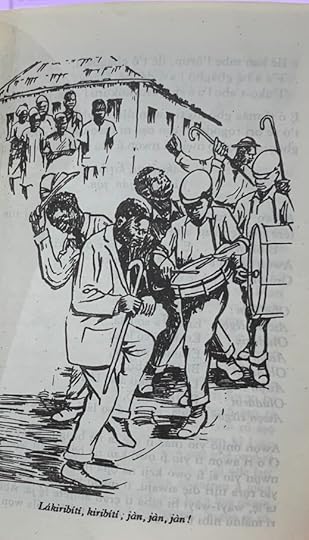
The author went on to provide a vivid description of their entrance and the impact on the people.
The fictional Owò town (really village but Yorubas don’t ever admit there place of origin is a village ) was very small, off the beaten track and without a motorable access. Nevertheless, the Christian evangelists came and arrived in style. Their entrance was signaled by “omele eebo”. The Yorubas have a drum called “omele”. “Eebo” can be translated “white”. Therefore, this combination suggested it is a new type of drum that was introduced by the foreign missionaries from the UK who brought the gospel to Nigeria. My thinking is this refers to the smallest drum in the set. The first thing the inhabitants of Owo heard was the sound of “omele eebo”:
Lakiribiti kiribiti!
Followed by:
Jan, jan, jan, jan
The Yoruba language is onomatopoeic, speakers of the language would quickly recognise these sounds. In fact whoever has heard most national anthem played and are speakers of Yoruba would quickly know which drums are in question here.
The drumming was just the tip of the iceberg. It ushered in the evangelists who danced in a rather theatrical manner. As you can see in the image, they are all exclusively dressed like the English, wearing suits and shirts. They sang and called out to “idol worshippers” to come and accept the gospel, naming the local gods like Sango, urging people to stop worshipping gods made by people.
It was their dance that caught the attention of the people. Ladele likened the dancers to a cricket scratching the ground. Some of the dancers held the helmet on their head with one hand, the walking stick raised up by the other hand (walking stick was probably just part of their dressings in those days), their heads pushed forward, behaving like cows tied down that wanted to break free. Some of them did not take off their helmet, instead, they use one hand to hold the left collar and the second hand to hold both the walking stick and the right collar, spinning around as they danced.
The impact of their dramatic entrance was people trooping out of their houses as they rushed out not wanting to miss any of the action. People appeared to just abandon whatever they were doing, children and adults alike. Some had in their hand the food they were just about to swallow. Many did not even wait to put on their shirts before they hurried out, displaying a variety of “ikun” and “idi” ( I will not bother to translate these).
December 26, 2022
Cost of Living in Nigeria in 1986 – As Seen Through the Lens of My Father’s Diary
On a visit home in 2017, I carted back some of my parent’s diaries, with permission of course.
Today, I flicked through the 1986 diary. What caught my attention was the cost of goods in 1986. If you are conversant with the history of Nigeria, you will remember that it was in those days when Forex was very scarce because the value of Naira was higher than its true value (1 Naira officially exchanged for 1 Pound Sterling). In those days, there was only one Forex Market, later in September of that year Gen Ibrahim Babangida (IBB) would introduce the Second Tier Foreign Exchange Market (SFEM). Since those days, Nigeria has somehow not been able to exorcise dual exchange rate from our economic policies.
However, I digressed. Back to the diaries. I noticed that somebody quoted a motor engine price at 300 naira to my father. I found it as a small note in his diary:

I don’t know what this Motor Engine was all about. Another entry was clearer, a new battery was bought for 148 naira:
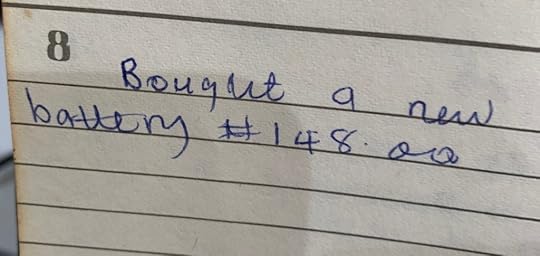
This is most likely a new battery for a car.
Photocopies cost 30 kobo per page in 1986:

My father placed a classified ad in the Daily Sketch for the price of 39 naira in 1986, I am not even sure what the events was:
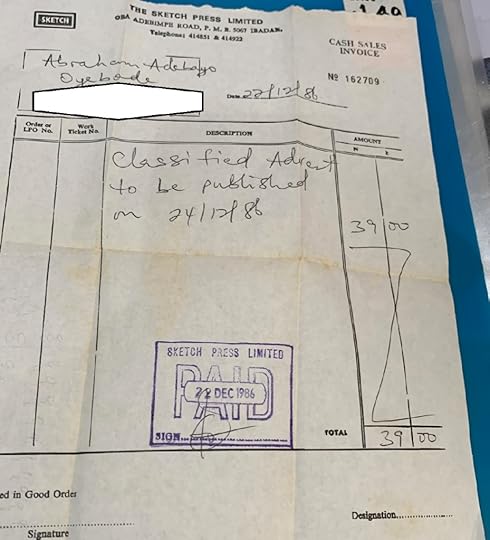
Apart from the receipt, there was an entry in his diary, also our TV probably had a fault around the same time:
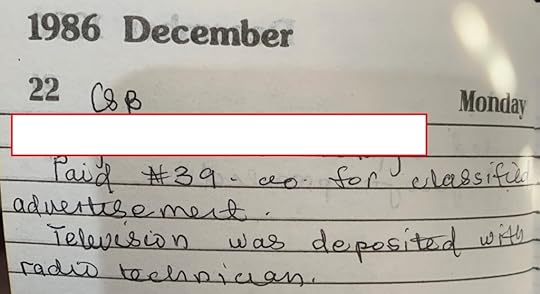
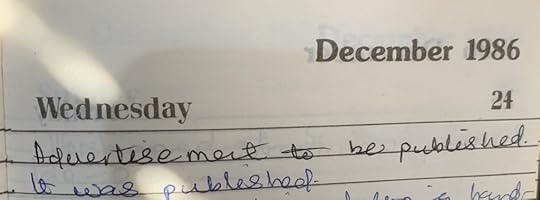
Two days later, he confirmed that the advert was published:
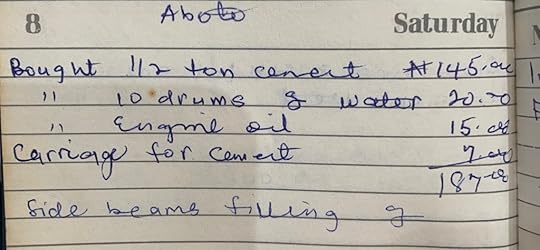
On the 8th of February, 1986, he reported buying 1/2 of a ton of cement at 145 naira, 10 drums of water at 20 naira, so, a single drum cost 2 Naira! He also bought engine oil at 15 naira:
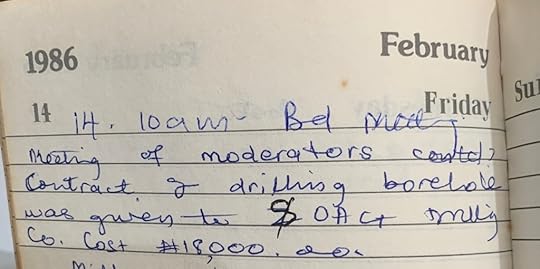
A contract for drilling borehole was awarded to the tune of 18,000 naira on 14th of February, 2008. This must be connected to the school headed:
Writing things down is a very important exercise.
December 10, 2022
The “spirit” in Camara Laye’s “The African Child”
I once blogged on the spirituality of the Yoruba people of South West of Nigeria (read here). As I read again The African Child by Camara Laye, it is very clear the same statement was true of the people of Guinea of his time. In this post I do a quick sweep of the the various “manifestations of the spirit” in the book.
Doing a task as mundane as working on the farm required the help of the “spirits”:

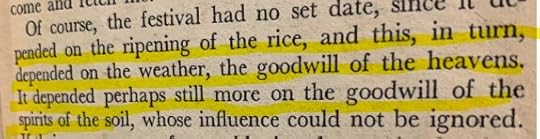
To know when to harvest, to have a good harvest, there is reliance on the “spirits of the soil”:
Camara Laye’s mother had supernatural powers, and he witnessed the display of these powers:
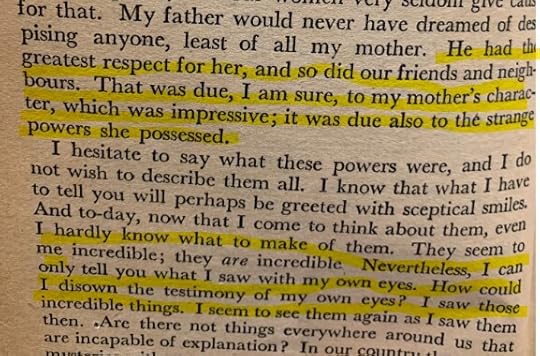
For example, she used her supernatural power to tame a horse:

His mother’s supernatural power came from different sources. She was born after a set of twin and that meant Camara Layer’s mother was endowed with magical powers:

Laye’s mother also had some power from the family occupation and ancestry. Her father was a blacksmith, therefore, she has the gift of soothsaying. Moreover, the totem of his grandfather was the crocodile and that meant his mother can draw water from the Niger with impunity, regardless of abundance of crocodiles:

Laye provided examples of her mother’s display of these powers:

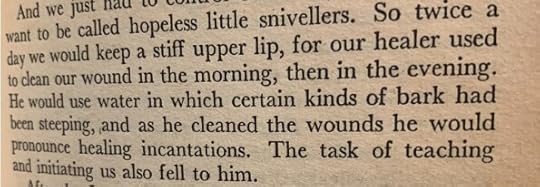
After Laye and his agemates were circumcised, they were in recuperation for a whole month. The healer came with herbs and incantations:
And when Laye was about to embark on a long journey to Conakry, it called for special sacrifices to ancestors’ spirits for protection:
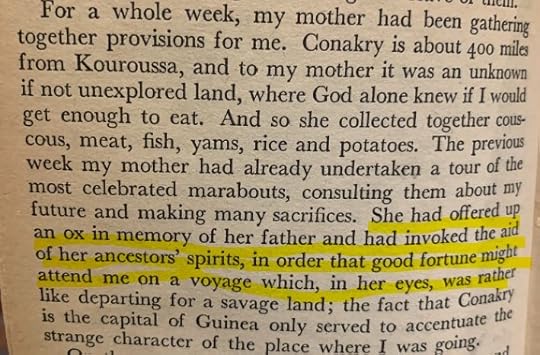
Laye’s mother was not going to just trust the safety of her son to just her ancestral spirits, she sought the help of Islamic marabouts:
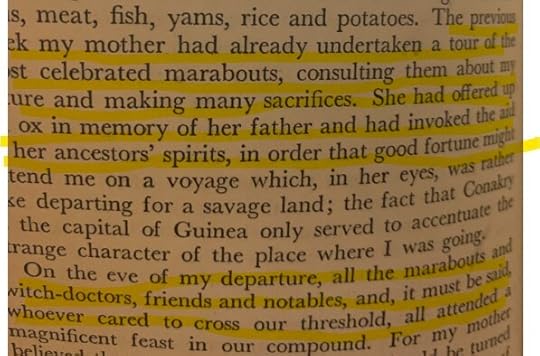
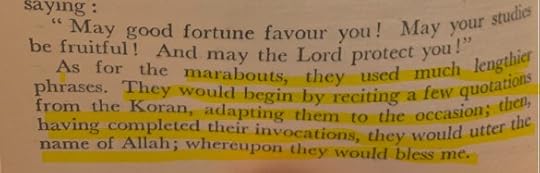
After eating and drinking both the marabouts and other visitors prayed for Laye, using different styles:
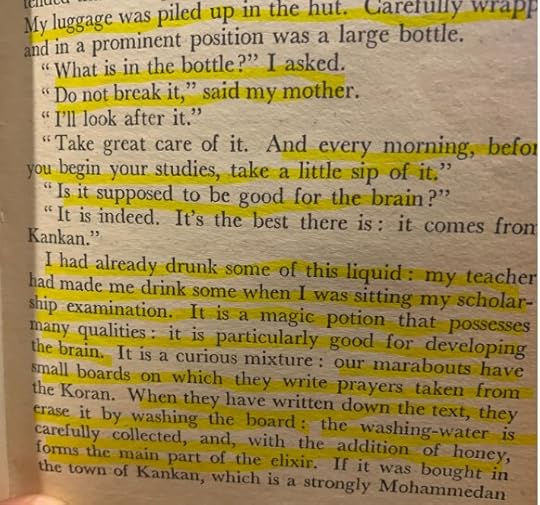
Camara Laye’s academic brilliance was taking him to Conakry but his mother had to provided some catalysts for her son’s success:
Camara Laye’s father also provided some “protection” against evil spirits for his son:

The “spirits” were everywhere. And looking at how we practice our Christianity today, they still are.


