
Clayton M. Christensen's Blog, page 9
July 19, 2018
The Four-Box Business Model
*A McKinsey-Award Winning Article*
Why is it so difficult for established companies to pull off the new growth that business model innovation can bring? Here’s why: They don’t understand their current business model well enough to know if it would suit a new opportunity or hinder it, and they don’t know how to build a new model when they need it. 
Download a complimentary copy of the article here
Drawing on their vast knowledge of disruptive innovation and experience in helping established companies capture game-changing opportunities, Innosight cofounder Mark Johnson, Harvard Business School professor Clay Christensen, and SAP co-CEO Henning Kagermann set out the tools that executives need to do both.
Successful companies already operate according to a business model that can be broken down into four elements: a customer value proposition that fulfills an important job for the customer in a better way than anything competitors offer; a profit formula that lays out how the company makes money delivering the value proposition; and the key resources and key processes needed to deliver that proposition. 
Explore our new book on business model innovation
Game-changing opportunities deliver radically new customer value propositions: They fulfill a job to be done in a dramatically better way (as P&G did with its Swiffer mops), solve a problem that’s never been solved before (as Apple did with its iPod and iTunes electronic entertainment delivery system), or serve an entirely unaddressed customer base (as Tata Motors is doing with its Nano—the $2,500 car aimed at Indian families who can’t afford any other type of car and usually use motorcycles to get around). Doing so doesn’t always require a new business model, but a new model is called for under certain conditions. It is often needed to leverage a new technology (as in Apple’s case); is generally required when the opportunity addresses an entirely new group of customers (as with the Nano); and is surely in order when an established company needs to fend off a successful disruptor (as the Nano’s competitors will now need to do).
NEW: A COMPREHENSIVE GUIDE TO BUSINESS MODEL INNOVATION
Read our new book, Reinvent Your Business Model: How to Seize the White Space for Transformative Growth (July 2018). Available on Amazon.
The post The Four-Box Business Model appeared first on Innosight.


July 12, 2018
The Risk Jeff Bezos Takes with Amazon.com Offers Stock Investors a Valuable Lesson
Mark W. Johnson, co-founder and Senior Partner at Innosight: Some years ago, famed investor Warren Buffett told an interviewer that his approach to investing “is very much profiting from lack of change rather than from change. With Wrigley chewing gum, it’s the lack of change that appeals to me. I don’t think it’s going to be hurt by the internet. That’s the kind of business I like.”
Well, who wouldn’t like Wrigley — a company that’s been around since 1891, offering pretty much the same customer value proposition the whole time, and that was doing well enough after its first 100-plus years that Mars Corp. acquired it for $23 billion?
I’m not an investment adviser, and I would never second-guess Buffett if I was, but as someone who has spent a lot of time in the C-suites of publicly traded companies, I can attest that Wrigley is an exception that proves a much-different rule.
In today’s business environment, disruption and discontinuity may be the only constants. Product cycles are getting shorter and business models more ephemeral. In 1965, the average length of time a company remained in the S&P 500 was 33 years. By 1990, it was 20 years; in 2012 it was just 18. Based on the 2017 churn rate, it is forecast that fully half of the S&P 500 will be replaced over the next decade. According to our research at Innosight, half of the 39 companies that emerged onto the Fortune 500 over the last decade were business-model innovators.
‘Every new business we’ve ever engaged in has initially been seen as a distraction by people externally, and sometimes even internally.’
Amazon.com CEO, Jeff Bezos
Wall Street may prefer safe, stick-to-your-knitting strategies, but most companies find that to remain viable, they need to move past their core and adjacencies and venture into what’s known as “white spaces.” Remaining too close to home is actually a greater risk.
Read the full article oN MARKETWATCH
The post The Risk Jeff Bezos Takes with Amazon.com Offers Stock Investors a Valuable Lesson appeared first on Innosight.
July 8, 2018
REINVENT YOUR BUSINESS MODEL
The post REINVENT YOUR BUSINESS MODEL appeared first on Innosight.
June 8, 2018
How Huron and Innosight Are Using the Dual Transformation Strategy to Innovate in Higher Education
Higher ed institutions are constantly adapting, but how can they plan to stay relevant and innovative for years to come? Many higher ed leaders are looking to other industries for the best models of how to prepare for the future, while sustaining a healthy organization in the present.
According to David S. Duncan, senior partner at Innosight, even in the business world, organizational evolution doesn’t happen overnight.
“There’s a lot of uncertainty in it, and it’s changing in such a way that the success formula that led them to become successful is being challenged by the changes around them,” says David. “And to some degree they need to create the next version of themselves.”
David says higher ed institutions need to innovate if they want to “survive and thrive.”
“So all of our work is in some way focused on helping them to address that. That kind of universal challenge,” says David.
Innosight works with large companies across a variety of industries who are struggling to successfully modify their practices in a rapidly changing world. David says Innosight has a comprehensive set of solutions to help companies evolve for the future.
“We look at it from the perspective of helping them to develop strategies that orient them towards a kind of transformational direction over the long term,” says David. “We do a lot of work around evolving their organizational capabilities to be able to execute on those strategies.”
One of the guiding principles of Innosight is a process called “dual transformation,” which David says helps companies compete in today’s market while creating long-term plans for consistent growth.
“We call it a dual transformation, because you actually have to worry about two types of transformations separately,” says David.
“There’s the transformation in your core businesses of today, which is about repositioning those businesses to adapt to the changing environment and continuing to serve the customers that you’ve served in continuing to solve the problems that you’ve solved. The other type of transformation is you have to simultaneously create new businesses, solve new types of problems for new customers. And again you have to do all of that at the same time.”
About a year ago, Innosight was acquired by Huron, a global consultancy with a large higher ed practice. The two organizations aim to combine their capabilities to focus on strategy across a wide range of industries.
“Huron has very deep experience in a number of industries including higher ed, healthcare, life sciences. And some of our IP and ways of thinking about things could be helpful to those industries,” says David.
Listen to the podcast and read the full story at EdTechTimes here.
The post How Huron and Innosight Are Using the Dual Transformation Strategy to Innovate in Higher Education appeared first on Innosight.
June 6, 2018
Leading Transformation: CEO Summit 2018
The post Leading Transformation: CEO Summit 2018 appeared first on Innosight.
April 30, 2018
March 19, 2018
Dual Transformation and Why Noah’s Arc Management Can’t Work
Scott D. Anthony, writer, speaker and Managing Partner at consulting firm Innosight, joins Innovation Ecosystem to discuss his book, Dual Transformation.
Summary
In this episode, Scott D. Anthony, writer, speaker and Managing Partner at consulting firm Innosight, joins us to discuss his new book, Dual Transformation – How to Reposition Today’s Business While Creating the Future. Scott is a globally renowned specialist in innovation, publishing several books on the domain as well as being a regular contributor to the Harvard Business Review.
What Was Covered
Scott’s concept of ‘dual transformation’ and his assertion today’s every changing global marketplace companies need to reinventing their business of today to make it ‘better, faster, cheaper’ (Transformation A) at the same time as creating their business of tomorrow (Transformation B)
Why the most successful leaders in innovation are ‘living at the periphery’ and not at the core of their industry
Why Scott believes that combining the best elements of startups and large companies is a good path to solve today’s biggest global challenges
How Scott’s experience of living in Asia has evolved his thinking on how best to organize markets, and the role that family owned businesses, private companies and government linked enterprises can play
Key Takeaways and Learnings
By doing ‘dual transformations’ together allows an organization to take the disruptive threats that are coming at them today and turn them into exciting growth opportunities of tomorrow
To avoid getting stuck in the core of today it is necessary to be able to play at the periphery of an industry. The core of today will give you no signal that it’s time to change until it’s too late
The meeting of entrepreneurial energy with assets and scale can make magic happen – so we should look for ways to combine the start up and large company communities to tackle our most intractable problems
There are different cultural norms around the world in how people and organizations think about failure. And where we see a reluctance to accept failure it holds back the innovation ecosystems both within large companies and startups
Links and Resources Mentioned in this Podcast
Dual Transformation – How to Reposition Today’s Business While Creating the Future, a book by Scott D. Anthony, Clark G. Gilbert and Mark W. Johnson
Innosight Website
Get in touch with Scott Anthony on LinkedIn, Twitter and via e-mail
The Other Side of Innovation: Solving the Execution Challenge, a book by Vijay Govindarajan
Syngenta Blossoms with its Farm-to-Fork Model, article by Louise Lucas and James Shotter, Financial Times, 13/12/2012
Innovation Ecosystem Episode 013 – Riding the S-Curve with Whitney Johnson
The post Dual Transformation and Why Noah’s Arc Management Can’t Work appeared first on Innosight.
February 16, 2018
4 Ways To Face The Challenge Of Disruptive Change
It’s one of the most common laments I hear from executives. “No sooner do I stabilize one 
Read the full article here
part of my organization when some unexpected crisis or challenge upends another.” The reality of constant, disruptive change as a way of life has many executives wringing their hands for ways to more than just cope, but thrive. Is there a way for leaders to capitalize on being established companies with the advantage of scale when smaller upstarts are perpetually nipping at their heels? How does a leader change today’s business while preparing for tomorrow?
We spoke with Scott Anthony, Managing Partner of the acclaimed firm Innosight and co-author of Dual Transformation: How to Reposition Today’s Business While Creating the Future. His research confirms that indeed, for leaders to thrive in today’s constantly disruptive way of life, they must be transforming today’s and tomorrow’s businesses. (You can also see a comprehensive video interview with Scott at our upcoming virtual summit Leading Through Turbulence.)
The post 4 Ways To Face The Challenge Of Disruptive Change appeared first on Innosight.
Three Steps to Jumpstarting Digital Transformation
It’s safe to say that the era of digital transformation will leave no industry – or even company – untouched. Some industries, media and retail in particular, have already been fundamentally reshaped by digital platforms. Industrial giants like GE are steadily investing in the Internet of Things. Despite recent concerns about profitability of the unit, GE Digital generated USD 4 billion in revenue from software in 2016, an impressive feat in its digital journey (It’s too early to tell what impact new CEO John Flannery, who has talked about refocusing, will have on its digital strategy.) 
Download a complimentary copy (PDF) of the executive briefing.
In Indonesia, the USD 10 billion company Sime Darby, which operates palm oil farms, is investing to create what it calls the “plantation of the future” with ubiquitous sensors, artificial intelligence, and drone-based monitoring.
Indeed, the relentless advance of digital means it is mission-critical for every industry, and leaders seem to recognize this. In a recent survey Innosight conducted of top executives, more than 70 percent of respondents reported making significant investments in some form of digital innovation, with a particular focus on using digital to improve interactions with customers. Moreover, almost 80 percent of respondents expect to increase their investments in digital over the next five years.
Yet, our view is that most companies have significant work to do to move from talking about digital to realizing its full transformation potential. Based on our work and research, we believe there are three steps for companies seeking to accelerate digital transformation. First, companies must cultivate the digital intuition of their leadership team. Second, they need to clarify their digital ambition with a specific focus on determining the appropriate balance between three distinct digital areas. Third, they should ensure their digital journey incorporates the lessons from today’s digital pioneers.
Step 1: Build Your Leadership’s Digital Intuition
How do you begin to shift from just thinking and talking about digital to practically and 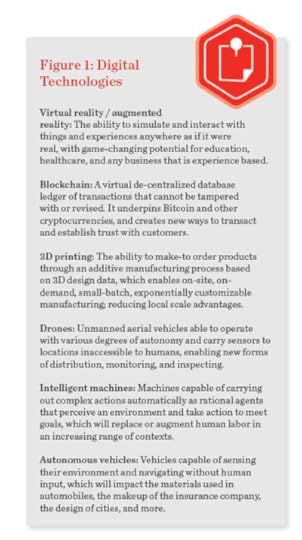 strategically moving forward? How familiar are your leaders with digital technologies like cloud computing, Internet of Things, virtual reality, and blockchain? A real challenge for many traditional companies is that leaders being tasked with driving digital transformation have spent the formative portions of their career in an analog world. They may use email and messaging, shop online, watch streaming content, and know their way around social networks used by their peers and their children, but they haven’t “grown up digital.” It is always hard to make strategic decisions in unfamiliar areas, so before lining up your digital strategy, we recommend increasing the digital fluency of your core leadership team (See Figure 1 for key digital technologies). Bringing in external talent helps, but isn’t sufficient. Consider what three organizations have done to build the digital intuition of their top leaders:
Go to the source. Singtel is Southeast Asia’s leading telecommunications company, with more than 600 million subscribers across several countries. While Singtel’s core business has been digital for decades, in 2011 it started a concerted effort to transform from a traditional telecommunications company to a digital media company. That year, Singtel gathered its top leaders in Beijing, in a country in which Singtel has no notable presence. In the first full day, the team broke into small groups to visit local startups. And over the next few years Singtel held meetings in digital and innovation hotspots around the world. Singtel Group CEO Chua Sock Koong noted that “nothing beats travelling to tech innovation hubs like Israel, Silicon Valley, or Boston to see what big tech companies and small startups are doing.” Today, not only has Singtel shifted its core business from voice to data, it has built up sizable digital businesses in categories such as mobile advertising, big data analytics, and cybersecurity.
Connect with the digital ecosystem. Digital technologies are developing in plain sight in laboratories, universities and entrepreneurial factories in places such as Silicon Valley, Berlin, Shanghai, Singapore, and Sydney. Companies can connect with this ecosystem in a range of ways, such as conducting joint research with universities, investing in startup companies, or creating their own accelerators. These programs need not be budget-busters. Several years ago, life insurance giant MetLife set up a regional innovation laboratory in Singapore. Called LumenLab, the 25-person group is chartered with working on new ideas and strengthening MetLife’s overall innovation capabilities. In 2016, LumenLab began a new initiative called collab. The small team overseeing collab ran a contest for 150 startups, where the winning company would receive a substantial contract with MetLife. The eight finalists had a chance to pitch live to a panel of MetLife executives, including Asia-Pacific President Chris Townsend, with four ultimately winning a contract. Not only did MetLife get a detailed look at dozens of interesting startups, but more than 50 executives had a chance to engage directly with the startups, building their intuition about digital developments in insurance. In 2017 MetLife announced plans to run several additional batches of collab.
Provide experiential leadership development opportunities. DBS is the largest bank in Singapore, with more than USD 300 billion of assets and a historically risk-averse and compliance focused culture. But in 2009, after Piyush Gupta became the company’s CEO, he and his team concluded they needed to jump-start their digital innovation in response to technologies like cryptocurrency, robo-advisors, and peer-to-peer finance platforms.
One piece of the solution was augmenting traditional in-class leadership training with experiential training modeled on the hackathons that have become popular in Silicon Valley. They brought together 200 leaders in groups of 30 to develop a functioning app. Over 48 hours they would meet customers, develop an initial idea, create a functioning prototype (with some, but not too much, technical assistance), get feedback from customers, and iterate. The group emerged with a deeper understanding of emerging technologies, and an appreciation for the pace of innovation in today’s digital world. Gupta says that the efforts around digital have brought greater receptivity to experimenting and an organization-wide recognition about the importance of digital transformation beyond just putting on “digital lipstick.”
Step 2: Clarify Your Digital Ambition
First-hand experience helps to build leadership intuition for the next step in the journey: defining your digital ambition. We recommend forming a small, cross-functional team, with heavy senior sponsorship, to determine how much to invest and where, and what the organizational implications will be. The team should spend no more than 90 days immersing itself in digital developments in and around your industry, probing into unmet needs of current and prospective customers, suppliers, and partners, and understanding the perspectives of internal stakeholders (See Figure 2 for a list of digital transformation milestones). 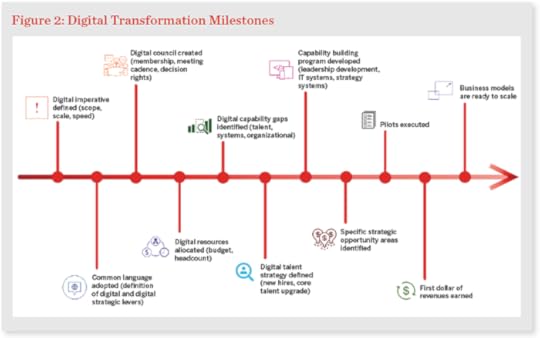
Consider, for example, the experience of one of the largest conglomerates in Southeast Asia. Founded more than 100 years ago, today the company employs more than 50,000 people and has revenues of more than USD 10 billion. The company operates in what seem to be the least digital businesses in the world: cement and building materials, chemicals, and packaging. Yet, in 2016 it made the decision to make digital transformation a strategic priority. The company saw that the rise of e-commerce, digital markets, and additive manufacturing all had implications for the value chain for their businesses.
The small team spent time with more than 100 customers, visiting startups in the country and in neighboring regions, and conducting dozens of internal working sessions. After 90 days, the team had clarity about its digital ambition. Specifically, it had determined how much it planned to invest in digital, expectations for impact, and what organizational changes would maximize its chances of success. Perhaps most critically, the effort led the leadership team to agree that the only unacceptable choice was ignoring digital. It had to act.
Generally, the most critical issue to tackle is defining the scope of your digital ambition. What should be your digital “where to play” choices? More specifically, you should consider the balance between three digital strategic areas: digitizing core operations, driving differentiation by digitizing stakeholder interfaces, and creating disruptive growth via building new digitally enabled business models (See Figure 3). Although companies can choose to focus more on a specific area, it is advisable to ensure investments in the first area are sufficient to lower the costs of running business and staying competitive in the industry. 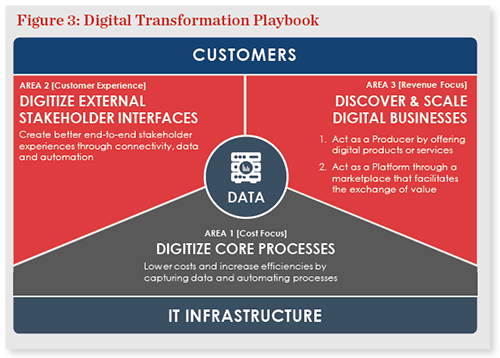
Area 1: Digitize Core Processes
Using digital technologies to optimize the core operations is increasingly a competitive necessity. Digitizing internal processes and systems can both improve efficiency and enhance performance. Companies have a range of options available when they take on core process digitization. It might be backend process automation for industries like banking and insurance or a complete re-engineering of internal processes using available digital technologies.
Consider efforts at Sime Darby to digitize their core processes. One of the company’s core businesses manages more than 600,000 hectares of palm oil plantations across Southeast Asia and would seem impervious to digitization. Yet, as Sime Darby plans to spin the palm oil arm off as a standalone venture, it is simultaneously investing to create what it calls the “plantation of the future.” Advanced genomics will help with seed selection, boosting yields by 15% or more. Ubiquitous sensors, artificial intelligence, and drone-based monitoring will help to optimize the nutrient and moisture level of each palm. Autonomous vehicles, robotics, and exoskeletons on plantation workers will further boost productivity. As data pours into a centralized control room, a manager can oversee multiple plantations remotely. The net result will be greater land utilization, higher productivity, and improved performance on key sustainability metrics.
Area 2: Digitize External Stakeholder Interfaces
Continued advancements of underlying technologies provide additional ways for companies to further digitize the interface with stakeholders. Here stakeholders might be customers, partners or any other external stakeholders of the company. One of the first examples of widespread digital adoption was the creation of mobile sites for companies to interact directly with their customers. In the early 2000s, for example, banks digitized their customer interface first through the Internet and then mobile banking. Airlines followed suit via digital check-in machines. Today, fast food companies are introducing touchscreen kiosks that facilitate order customization while streamlining kitchen operations.
Digitizing the user interface goes beyond improving efficiency and into the heart of transforming the customer experience. Aetna, the third largest insurer in the US, wanted to design a new digital interface for consumers purchasing health insurance. The team deeply thought through the customer journey in buying health insurance. They then focused on steps of the customer journey where Aetna could create unique value for customers. This enabled Aetna to differentiate from the competition through the improved experience and to generate additional revenue by offering key benefits through the interface.
Digital customer interfaces can also extend to the entire interaction that a company has with its customers. For example, Disney has invested over USD 1 billion to digitize and personalize the theme park experience for visitors with its MyMagic+ program. MyMagic+ is a combination of a website, mobile application and wristband that collectively allows visitors to customize their experience at a Disney Park. Overall, this digitization initiative has helped increase serving capacity at the Magic Kingdom in Florida.
Area 3: Disrupt with Digital Business Models
Broadly speaking, there are two different types of digital business models that enable companies to create new growth businesses: Producers and Platforms.
As the name suggests, Producers create and offer new products or services to customers using digital technologies. Much like a manufacturer of goods in factories, Producers serve their offering directly to consumers rather than facilitating an exchange between different parties. Platforms, on the other hand, facilitate the value exchange of physical or virtual goods between external producers and consumers using digital technologies. Think of companies such as Facebook, Uber, and Airbnb that have fundamentally reshaped many industries like media, transport and hotels respectively, by leveraging capacity and capabilities from outside of their own organizations (See Figure 4). 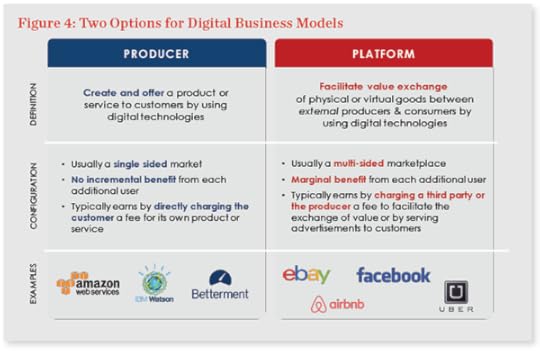
It is important to note that digital business models operate on a spectrum. They can be purely Producer, purely Platform or somewhere in between. Depending on the market circumstances and potential benefits to customers, incumbents must decide whether to create a new digital business as a Producer or Platform. Due to the complexities of orchestrating multiple players in the ecosystem, several companies start off as a Producer. Many companies then move to a Platform model after experiencing an increase in transaction volumes or pinpointing ways to capture more value externally. An example of a Producer moving towards a Platform would be GE Digital’s Predix IoT solution, which started with GE’s own applications and then moved on to accommodate partner applications.
In industries where platforms have not yet emerged, market-leading incumbents can co-opt competition and build platforms that provide new sources of value.
Step 3: Advance Your Digital Journey
With digital intuition and digital ambition defined, the next step is to advance along your digital journey, making the requisite investments to turn ambition into reality. The journey promises to be complex and challenging. Fortunately, you can draw four critical lessons from the pioneers that have come before you such as Facebook, Uber, and AirBnb:
Make it an imperative. Digital transformation needs the focus and support of the entire executive team. GE and Amazon, for example, would not be where they are without the constant involvement of CEOs Jeff Immelt (who retired from his position as CEO of GE in mid-2017) and Jeff Bezos. 
Get the future in your inbox.
At the Southeast Asian industrial conglomerate we discussed above, the leadership team set clear and ambitious revenue targets for new digital businesses for each business unit to hit by 2020. The company formed special-purpose teams to develop new digital business models. The teams report directly to the Digital Council, a newly formed group of senior leaders that reviews project progress, releases funding, opens organizational doors and helps to collectively address difficult challenges.
Your greatest enemy lies within. The main challenges related to digital transformation are not technological, but rather organizational and business model dependent. Specifically, strategy and resource-allocation systems are honed to execute today’s model with increasing precision, versus inventing new ones.
For example, Singtel set up a vehicle called Singtel Innov8 to invest in startups, established a special purpose digital group to drive its new business models, and, in 2013, publicly committed to spend SGD 2 billion (about USD 1.6 billion) pursuing strategic acquisitions in the digital space. Singtel has also rethought how it tracks and rewards performance in some of its new digital businesses, and its leaders have committed to evaluate emerging opportunities in new ways.
Business models trump technology. Don’t get too distracted by the shiny technologies that drive digital transformation, as virtual reality, the distributed ledger, and others are advancing at a head-spinning rate. Indeed, the smartphone that sits in your pocket is millions of times faster than systems that allowed NASA to land a man on the moon in 1969.
But while becoming familiar with these technologies is an absolute imperative, history shows us repeatedly that disruption isn’t a technological phenomenon. Rather, disruption comes when a company finds a way to deliver against an important, unsatisfied customer job to be done by pairing an enabling technology (often that simplifies a complex problem or economizes an expensive proposition) with a business model that allows it to create, capture, and deliver value in distinct, and difficult to mimic ways.
It is a journey. Digital transformation doesn’t happen overnight. It took four years after commercial introduction for streaming video to constitute more than half of Netflix’s revenues. GE announced its intent to become more digitally oriented in 2011. It took five years and substantial investment for software to constitute even five percent of the overall company’ revenues. Driving digital transformation isn’t a project. It is a journey, with twists and turns, false starts and failures. Like any journey, it requires patience, discipline, and constant attention.
About the Authors
Pontus Siren is a partner and leads the digital practice at Innosight.
 Utsav Bhatt is a Senior Associate at Innosight.
 Asher Devang is a Senior Associate at Innosight.
 Annabel Tio is a Senior Associate at Innosight
The post Three Steps to Jumpstarting Digital Transformation appeared first on Innosight.
January 26, 2018
What is Your Growth Gap?

Get in touch with an Innosight expert to learn more about achieving your growth goals.
A growth gap is a looming revenue shortfall that challenges the organization to transform itself and create new growth.
Does your organization face a gap between your aspirations and what could be reasonably expected?
Learn more about your growth goals and how to get there by watching this explainer video.
GRowth gap explainer video
The post What is Your Growth Gap? appeared first on Innosight.
Clayton M. Christensen's Blog

- Clayton M. Christensen's profile
- 2167 followers

