
Clayton M. Christensen's Blog, page 10
December 15, 2017


December 11, 2017
The Best of 2017
The post The Best of 2017 appeared first on Innosight.
October 3, 2016
How to Turn Ambiguity into Opportunity: A New Approach to Strategy Under Uncertainty
Asserting that the pace of change is accelerating is nothing new. That statement could arguably have started any article describing the challenges facing corporate leaders at any time over the past 150 years. Consider the broad changes the industrial and scientific revolutions unleashed. Trains, planes, and automobiles brought us closer together. Telegraphy wires and telephony enabled pervasive communication. Electricity changed the very nature of work and life. Modern medicine eradicated diseases, slashed infant mortality rates, and sharply increased life expectancy. Cities grew, crumbled, and surged again. The world of the business leader has always been uncertain, full of surprising twists and turns.
Yet, something today just feels different. Tightly intertwined markets mean ideas spread like never before. Ubiquitous smartphones, pervasive cloud computing solutions, and inventive platforms that provide on-demand access to just about everything allow companies to scale products and services faster than ever before. Unexpected competitors and fast-shifting customer tastes are upending established market leaders at an increasing rate. Business models that worked reliably for decades are struggling to deliver growth. Your customers today are
unlikely to be your customers tomorrow.
This level of change and unpredictability requires approaching strategic decisions in a new way. Traditional approaches are insufficient because they analyze the past to predict the future. They are facing in the wrong direction. This article draws on academic research and Innosight’s own field work to provide our suggestions about how to approach strategy through uncertainty. Our view is that today’s ambiguity brings tomorrow’s opportunities. Business leaders equipped to act in the face of uncertainty can build paths to growth that have not yet been imagined. They can own the future, instead of being disrupted by it.
download the full executive briefing
The post How to Turn Ambiguity into Opportunity: A New Approach to Strategy Under Uncertainty appeared first on Innosight.
CEOs face steep challenges when it comes to building cons...
CEOs face steep challenges when it comes to building consensus for change. See how five of them are taking steps to renew and and transform, with the help of Innosight.
The post appeared first on Innosight.
September 28, 2016
Competing Against Luck
– Reed Hastings, co-founder and CEO, Netflix
For many companies, innovation is still hit or miss. They spend millions compiling the data to figure out what their customers want, but they often achieve only modest incremental innovations while completely missing the mark on the breakthrough innovations critical to long-term sustainable growth.
In Competing Against Luck: The Story of Innovation and Customer Choice, Innosight’s cofounder Clay Christensen and senior partner David Duncan and their coauthors offer a game-changing look at how companies can develop and market products and services that customers actually want and need. The answer, they say, can be found in the “jobs to be done” theory of innovation. This approach provides a powerful way to understand the causal mechanism of customer behavior, and that’s the most fundamental driver of innovation success.

EVENT
See Dave at The Market Research Event, October 19, Boca Raton.
Transform your market research efforts by helping you to understand not only current customers but also nonconsumers
Build a culture that’s unified around a customer-centric mission
About the Authors
The post Competing Against Luck appeared first on Innosight.
September 19, 2016
The Little Black Book of Innovation
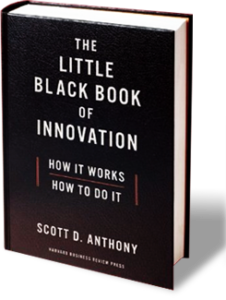 The innovation imperative—it has never been more urgent, for organizations and managers alike. In his new book, Scott Anthony, Managing Director of Innosight Asia-Pacific, combines the best of innovation theory and practice into a compact guide that will help even seasoned innovators improve their odds of success.
Drawing on decades of research and thinking, as well as Innosight fieldwork with companies like Procter & Gamble, Anthony illuminates innovation’s vital role in organizational success and professional growth and delivers tools and concepts to make you and your team more innovation savvy:
Innosight.
The First Mile
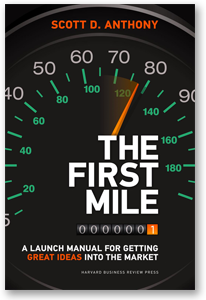 WELCOME TO THE FIRST MILE
The first mile of innovation – that critical stretch when your idea moves from concept to the real world, where it will fly or fail. This is your guide through that perilous but promising terrain. Scott D. Anthony, managing partner of Innosight, shows how to navigate the uncertainty, learn from creative experimentation, and increase the odds of your new venture’s success.
The post The First Mile appeared first on Innosight.
September 1, 2016
Know Your Customers’ “Jobs to Be Done”
Firms have never known more about their customers, but their innovation processes remain hit-or-miss.  Why? Product developers focus too much on building customer profiles and looking for correlations in data. To create offerings that people truly want to buy, firms instead need to hone in on the job the customer is trying to get done.
Some jobs are little (pass the time); some are big (find a more fulfilling career). When we buy a product, we essentially “hire” it to help us do a job. If it does the job well, we’ll hire it again. If it does a crummy job, we “fire” it and look for something else to solve the problem.
Excerpted from the forthcoming book, Jobs-to-be-done theory can transform your understanding of customer choice in a way that no amount of data ever could, because it gets at the causal driver behind a purchase. By identifying jobs that are poorly performed in customers’ lives and then designing products, experiences, and processes around those jobs, companies can improve innovation success.
Read the full article at Harvard Business Review
The post Know Your Customers’ “Jobs to Be Done” appeared first on Innosight.
August 22, 2016
4 Assumptions About Risk You Shouldn’t Be Making
“Two roads diverged in a wood, and I—I took the one less traveled by, and that has made all the difference.” The line is instantly recognizable as the conclusion of “The Road Not Taken” by Robert Frost. And, the misunderstood poem helps to highlight how innovation-seeking executives need to reframe the word risk.
Most readers assume Frost’s poem is hopeful, describing the value of the rugged individualism that has long served as an American hallmark. However, a measured reading shows a wistful tone that borders on regret (“I shall be telling this with a sigh”), with critics arguing that the poem’s key message is how we rationalize bad decisions after the fact.
Similarly, when the word risk comes out of an executive’s mouth, it’s usually accompanied by one of four mistakes:
Assuming that taking action is the biggest risk. In many cases, the riskiest action is in fact inaction. The pace of change in today’s world means that standing still leads to falling behind current and emerging competitors. The way in which many companies make investment decisions blinds them to this reality. Most executives know that the present value of an investment comes from projecting its cash flows and discounting those numbers into today’s dollars. The general rule is projects with positive net present values should get funded, and those with negative ones shouldn’t. That assumes, however, that the base case is zero. If doing nothing leads to decline, projects with marginal projections actually are better alternatives than inaction (this misuse of financial tools for innovation is discussed in depth in a 2008 Harvard Business Review article by Clayton Christensen, Willy Shih, and Stephen Kaufman).
Believing that good entrepreneurs seek out risk. They don’t. Good entrepreneurs recognize the inherent risk of creating new businesses. After all, it’s well known that most new businesses fail, and that most of the ones that succeed do so in modest enough ways that the entrepreneur gets at best a modest financial return on his or her effort.
July 18, 2016
Kodak’s Downfall Wasn’t About Technology
A generation ago, a “Kodak moment” meant something that was worth saving and savoring. Today, the term increasingly serves as a corporate bogeyman that warns executives of the need to stand up and respond when disruptive developments encroach on their market. Unfortunately, as time marches on the subtleties of what actually happened to Eastman Kodak are being forgotten, leading executives to draw the wrong conclusions from its struggles.
Given that Kodak’s core business was selling film, it is not hard to see why the last few decades proved challenging. Cameras went digital and then disappeared into cellphones. People went from printing pictures to sharing them online. Sure, people print nostalgic books and holiday cards, but that volume pales in comparison to Kodak’s heyday. The company filed for bankruptcy protection in 2012, exited legacy businesses and sold off its patents before re-emerging as a sharply smaller company in 2013. Once one of the most powerful companies in the world, today the company has a market capitalization of less than $1 billion.
Why did this happen?
An easy explanation is myopia. Kodak was so blinded by its success that it completely missed the rise of digital technologies. But that doesn’t square with reality. After all, the first prototype of a digital camera was created in 1975 by Steve Sasson, an engineer working for … Kodak. The camera was as big as a toaster, took 20 seconds to take an image, had low quality, and required complicated connections to a television to view, but it clearly had massive disruptive potential.
Spotting something and doing something about it are very different things. So, another explanation is that Kodak invented the technology but didn’t invest in it. Sasson himself told The New York Times that management’s response to his digital camera was “that’s cute – but don’t tell anyone about it.” A good line, but not completely accurate. In fact, Kodak invested billions to develop a range of digital cameras.
Clayton M. Christensen's Blog

- Clayton M. Christensen's profile
- 2168 followers

