
Thomas Frey's Blog, page 51
May 11, 2012
The Rise of the SuperProfessor

For colleges and universities, the great age of experimentation is now upon us.
Last week, Harvard and MIT announced a new nonprofit partnership, known as edX, to offer free online courses from both universities.
The Minerva Project recently announced it will become the first elite American University to be launched in over a century, at the same time, transforming every aspect of the university-student relationship. The Ronin Institute is promising to reinvent academia, but without the academy.
The University of the People (UoPeople) is the world’s first tuition-free online university dedicated to the global advancement and democratization of higher education.
In addition, iTunesU, Khan Academy, Learnable, Udemy, Codecademy, Udacity, and a number of other online courseware providers are offering their own approach to next generation learning.
But somewhere, lost in the middle of this battle of the institutions, are the lowly professors upon whom these organizations were built.
That is about to change and here’s why.
The Great Disconnect
As the student loan bubble nudges ever closer to a financial implosion, and the flow of information on the Internet disrupts every traditional delivery mechanism, a number of questions begin to surface.
Will online learning diminish the face-to-face community that is the heart of the college experience? Will it elevate functional courses in business and marginalize subjects that are harder to digest in an online format, like philosophy? Will fast online browsing replace deep thinking?
Colleges and Universities carry with them considerable inertia. They have long-standing traditions, huge alumni networks, solid brands in the minds of consumers, and are more durable than corporations. Many have lasted centuries and are still going strong. Most have integrated themselves into their respective communities with multiple funding tentacles, often benefiting from massive State-funded budgets and intense fundraising operations that extend around the world.
People attend colleges for many reasons including a desire for a better job, a sense of personal accomplishment, to improve their resume, status and prestige, build relationships, and to have fun. However, all of these reasons boil down to one overarching motivation – the quest for a better life.
Over the years colleges have evolved from a simple place of learning into a vast array of potentials. In the end, classrooms and teachers are only a tiny portion the collegiate experience.
Touch points for the college experience include dorm life, textbooks, credits, sports, friends, parties, social circles, fraternities, sororities, libraries, computers, clubs, campus events, research, writing papers, classrooms, teachers, beer, advisors, labs, job interviews, and much more.
Ironically though, most of these touch points have been relegated to “all that crap that happens outside the classroom.” College friends, parties, social events, and all the other “stuff” provides many more of the ingredients for college being a life changing experience than all those fact-cramming lectures could ever hope to achieve.
Yet credits are only given for completed courses.
Typically, young people begin the process at age of 18 and exit between the ages of 22-24. As they leave, they are not only better educated, but also more mature, with a new circle of friends, and a cadre of stories that will frame their thinking for the rest of their lives.
Any person fighting a war understands that the outcome of the battle is highly dependent upon the caliber of people standing next to them. Similarly, the outcome of the college experience is heavily dependent upon the caliber of students involved.
Over the years, the “rules of the game” have been erroneously written to exclude the value of the experience, thereby giving undue advantage to both low-cost and minimal-experience providers. With college costs spiraling out of control, students are rightfully asking, “What’s the cheapest way to get a diploma?”
Celebrity Professors, a Scarce Commodity
Much like Henry Ford’s “control everything” approach to building cars at the River Rouge Plant where raw materials were brought into one end and finished cars rolled out the other end, colleges have maintained tight control over virtually every aspect of the academic food chain happening on their campus.
Professors are carefully recruited, classroom times and schedules are thoroughly planned, courses are tightly prepared, degrees are strategically framed around in-house talent, and academic accomplishments are meticulously positioned to help brand the experience.
For this type of system, the days are numbered. The walled gardens of academia are loosing their walls.
Institutions who have professors locked under contract offer few options for extending influence beyond the traditional publishing route. That is changing with the availability of online courseware.
As an example, iTunesU, started in 2007, currently has over 1,000 Universities participating from 26 countries. Their selection of classes, now exceeding the 500,000 mark, have had over 700 million downloads. In addition, they recently announced they were expanding into the K-12 market.
However, even when colleges start playing catch-up, offering Internet-based courses, the professors tend to get left out of the decision-making process. In most cases, courses are little more than a video camera in the back of the room fraught with low production values and irrelevant lengthy diatribes.
Professors are also being left out of marketing decisions, personal branding campaigns, and how the intellectual capital of their life’s work get’s disseminated.
Universities can always add more professors, but an individual professor has a limit to how much they can produce over a lifetime. And that’s the nugget of scarcity that professors will demand greater control over in the future.

Are you super enough to be dubbed a SuperProfessor?
FacultyRow’s SuperProfessor Award
The “SuperProfessors” designation was officially launched in 2011 by the academic social network site, FacultyRow.com.
People they judge to be worthy of the SuperProfessor title come from a peer-reviewed group of academics that consistently demonstrate excellence, passion, and clarity, throughout their academic careers.
“Technology is beginning to stratify academia” according to FacultyRow expert Steven Lewis. “We are convinced that leading educators, or SuperProfessors, will become increasingly valuable going forward. Student classrooms and expert knowledge will continue to become global on a massive scale.”
Currently there are 4,000 professors who have applied for the official 2013 SuperProfessor Award.
In much the same way the Nobel Prize rose to prominence in the early 1900s, FacultyRow hopes to set the stage for uncovering the best of the best in college faculties.
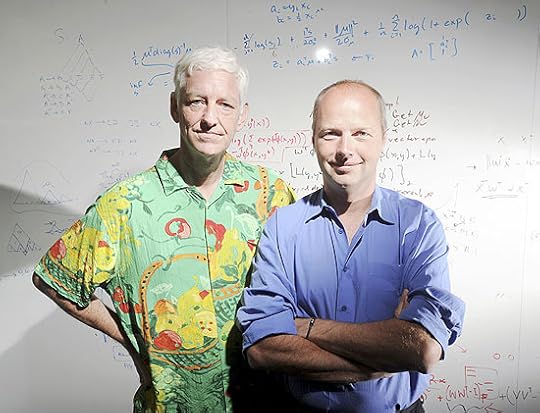
Sebastian Thrun and Peter Norvig
Unleashing the Celebrity Professor
Working as a professional speaker, I see many parallels between the teaching profession and the speaking profession. But one big difference is that professional speakers are not bound by the walls of a single institution.
Last fall when Stanford professors Sebastian Thrun and Peter Norvig offered their class, an “Introduction to Artificial Intelligence,” to anyone who had a web connection, something amazing happened. Over 160,000 students, two thirds of whom lived outside the U.S., enrolled for the class.
As a way to deal with the huge numbers, lectures and assignments, the same ones administered in the regular on-campus class, were posted and auto-graded online each week. Midterms and finals had strict deadlines.
Much of the course’s popularity can be attributed to the celebrity status of the professors. Sebastian Thrun headed up the Stanford team that won the DARPA Grand Challenge in 2005 and currently serves as the head of Google X, a lab created to incubate Google’s most ambitious and secretive projects. Peter Norvig is the Director of Research at Google.
While the Stanford brand played a significant role in the popularity of the course, it was the celebrity status of the two professors that made the course go viral.
This course served as a Woodstock-moment for academia.
Thinking Long-Term
In addition to academic prowess, future SuperProfessors will be ranked according to attributes like influence, fame, clout, and name recognition.
Future criteria for winning the FacultyRow SuperProfessor designation will likely include benchmarks for the size of social networks, industry influencer rankings, and gauges for measuring effectiveness of personal branding campaigns.
But college courses can be much more than an expert talking in the front of a room. If the same college courses were handed them off to television producers, game designers, or mobile app developers, we’d see radically different approaches to making the material fun, interesting and engaging. Look for this approach in the next generation of online programming.
People most effective at producing courseware in the future will have complete production studios staffed with video crews, interactive experts, gamification mavens, courseware experience specialists, usability teams, outcome testers, and much more. Leading the operation will be a celebrity SuperProfessor who name extends far beyond traditional classrooms to the hearts and minds of nearly everyone on the planet.
Final Thoughts
Even though the Stanford class taught by Sebastian Thrun and Peter Norvig had over 160,000 students enroll for their class, a mind-numbingly high percentage of those students, over 137,000, dropped out before completing it.
This is clear sign of our current experimentation phase where colossal mistakes are needed to test the limits of what’s possible. But at the same time that we see colossal mistakes, we will also see colossal disruption, and many traditional colleges will begin closing their doors.
Thrun predicts that in 50 years there will only be 10 universities left standing to deliver courses. Look for over half to be gone by as early as 2030.
Currently we are seeing a tremendous duplication of effort. Entry-level courses such as psychology 101, economics 101, and accounting 101 are being taught simultaneously by thousands of professors around the globe. Once a high profile SuperProfessor and brand name University produces one of these courses, what’s the value of a mid-tier school and little-known teacher also creating the same course?
As Ball Corporation executive, Drew Crouch puts it, “Education is definitely moving from a history of scarcity to a future of abundance. Just like Gutenberg freed the written word, the Internet has freed information.”
Author of “Communicating with the Future” – the book that changes everything

.
.


May 4, 2012
Eight Critical Value Points of a Futurist

As a Futurist, people often ask me how many of my predictions have come true. I find this to be a rather uncomfortable question. It’s uncomfortable, not because my track record hasn’t been up to par (actually, a high percentage have come true), but because accuracy of predictions is a poor way of measuring the value of a Futurist.
In a world filled with MBAs and number crunchers, there is a constant push to reduce our analog world to digital analytics so we can accurately measure our return on investment.
But not everything is measurable in this way.
As an example, for several years I have been tracking when my best insights occur, and they happen with far greater frequency when I’m riding bike. Therefore, it’s easy to conclude that if I spent 8-10 hours a day riding bike, I could somehow unlock the secrets of the universe.
However, the world is far more complicated than the simple surface details we can measure. What’s the value of a new idea, a new strategy, or adding awareness to a previous blindspot?
Too often, our ability to focus on one all-consuming detail blinds us to the oncoming train that is about to destroy an entire industry.
For this reason I’ve put together a list of the Eight Critical Points of Value that a Futurist brings to the table.

The Power of an Epiphany
The future is never a destination, it is always a journey. An idea that holds great value today, may be of little value two weeks from now.
Many of our best ideas appear in the form of an epiphany. An epiphany is an ‘AHA’ moment; a sudden insight or revelation into the world around us. An off-the-charts idea would be considered a Category 5 epiphany if we were measuring insights with an earthquake scale.
Creating an environment that cultivates great epiphanies can be hugely valuable. Every new business that gets launched happens as a result of an epiphany. Every new product idea happens as a result of an epiphany. It’s in our best interest to create new epiphanies and often.
Eight Critical Points of Value
Thinking about the future is like a muscle that rarely gets used. Over time, our brains will atrophy and we lose our ability to think productively about what the future may bring.
At the same time, the world is shifting faster than ever. Our “need to know” about the future is no longer a luxury; it’s a functional imperative.
With this in mind, here are some of the values a Futurist has to offer:
1.) Altered Thinking – The future is constantly being formed in the minds of people around us. Each person’s understanding of what the future holds will influence the decisions they make today. As we alter someone’s vision of the future, we alter the way they make decisions today.
2.) Unique Perspective – The future is unknowable, and this is a good thing. Our involvement in the game of life is based on our notion that we as individuals can make a difference. If we somehow remove the mystery of what results our actions will have, we also dismantle our individual drives and motivations for moving forward. That said, the future can be forecast in degrees of probability. By improving our understanding of what the future holds, we dramatically improve the probability with which we can predict the future.
3.) Evidence of Change – Empirically speaking, forecasting the future is not done by staring at tealeaves of reading tarot cards (that is the realm of psychics). Rather, futurists take an inter-disciplinary approach and employ a wide range of methods, from the study of cycles, to trend analysis, to scenario planning, to simulations, to strategic planning and visioning. Futurists use data from the past and present, as well as other concepts and methodologies to understand how the present will evolve into probable futures. We also borrow freely from other fields, such as forecasting, chaos theory, complexity science, organization development, systems analysis, and sociology.
4.) Connecting the Dots – Futurists come from a wide range of backgrounds and perspectives. What we have in common is well-researched big picture thinking, strong pattern recognition, and innate curiosity. Ideas that are routine in one industry can be revolutionary when they migrate to another industry, especially when they challenge the prevailing assumptions that have infiltrated rank and file thinking.
5.) Find Your Future Competitive Advantage – French novelist Marcel Proust once said, “The real act of discovery consists not in finding new lands but in seeing with new eyes.” The most successful companies don’t just out-compete their rivals, they redefine the terms of competition by embracing one-of-a-kind ideas in a world heavily steeped in “me-too” thinking.
6.) Take Control of Change before the Changes Take Control of You – Are you changing as fast as the world is? Change is inevitable, but how you deal with this change can vary greatly. In a world that never stops changing, great leaders can never stop learning. How do you push yourself as an individual to keep growing and evolving? Does your company do the same?
7.) The Future is Where Our Children Live - Our desire to leave a legacy is a uniquely human attribute. However, our legacy becomes meaningless if we don’t have new generations of people to pass it on to. To many this may sound like an obvious statement, but to those in the business world, there is a constant battle being waged over the needs of the present vs. the needs of the future. It’s very easy to place short-term profitability ahead of long-term problems.
8.) Every Avalanche begins with the Movement of a Single Snowflake. Our ability to tap into and leverage the power of the future is directly tied to the number of times we think about it. The more we think about the future, the more we expand our understanding of it. And the more we understand the future, the easier it becomes for us to interact with it.

How do you and your business react to change?
The Reaction Paradigm
Most companies operate within a paradigm of reaction. When bad (or good) things happen, they continue to forge ahead. They may or may not adjust their way of doing business. This unswerving reaction paradigm occurs, frankly, because it takes all they can muster to keep the doors open, make payroll and turn a profit.
It’s a tough world out there, and one widely held belief is that we’re all just trying to chip away at the world in order to make a buck. In this line of thinking, when things happen, you just do your best to hang on, and hopefully do better next time around. These are companies that are always preparing themselves for the next disaster.
Other companies plan for the future. They understand that markets shift, technology evolves and unexpected waves of mayhem occur. These companies often do better than the previous ones because they have the resources and foresight to weather this type of storm.
Their leadership has given some thought to the murky future ahead of time, and allocates resources to various strategies for adapting to the ebb and flow of these natural occurrences.
In the end it becomes easy to see that the greatest companies are those that take control of their own future. As a futurist it is my job to help these forward thinking companies weather through or simply avoid these stormy trends and achieve a more profitable, vibrant and successful future.
Final Thoughts
Famed author Jim Collins often asks the question, “If your company went out of business tomorrow, who would miss you and why?”
Can your customers live without you? If they can, they probably will. So then what?
The researchers at Gallup have identified a hierarchy of connections between companies and their customers — from confidence to integrity to pride to passion. To test for passion, Gallup asks a simple question: “Can you imagine a world without this product?” One of the make-or-break challenges for change is to become irreplaceable in the eyes of your customers.
The future cannot be our only priority otherwise we lose our ability to function in the present, and here is where it gets confusing. Near-term futures invariably take precedent over long-term futures, but our ability to prioritize importance is directly tied to the context of our own future thinking.
Our thinking about the future cannot be made against a simple black and white, right vs. wrong backdrop. Every microcosm is a part of a larger microcosm, and I tend to agree with Futurist Mary O’Hara-Devereaux when she says, “Beware of conventional wisdom because it is usually wrong.”
Author of “Communicating with the Future” – the book that changes everything
.
.
April 27, 2012
Pre-Testing Your Right to Vote
Every couple years, as the November election draws near, my wife Deb and I receive our ballots in the mail. Both of us spend considerable time studying the issues and candidates before making our final decisions. As with most couples, we don’t always agree.
Long before the ballots come, we have many discussions about these important topics and what effect they’ll have, not only on us, but also on our community as a whole. So we take our right to vote very seriously.
The section of the ballot that I find most frustrating is the section on Judges – Should these judges continue to serve in their current positions? We are given virtually no information about these people, and this severely compromises our ability to make an informed decision. Even doing online searches gives us very little to work with.
For this reason, I do not feel qualified to make this decision.
In the U.S., voting is a legal right granted to all law-abiding citizens over 18 years of age. Nowhere does it say that the voter has to be competent about the topic, or candidates, they are voting on.
This, however, could change, as voting software makes it as easy to test competency, as it does to vote.
Not All Men are Created Equal – Pre-Testing and the Electronic Voting Process
Voting is the simple process of marking a series of boxes on a page. There are no right or wrong answers, just options.
Yes, your ballot can be disqualified for checking too many boxes, mutilating the ballot, or voting twice. But for the most part, it’s a very simple system that allows almost anyone to participate.
Yet, simple does not always mean better. What if there were a few questions that had to be answered correctly before the vote were accepted? What if each voter had to demonstrate some rudimentary knowledge of the topic in question?
Personally, I don’t think I should be allowed to vote on the judges that I had mentioned above. I’m simply not competent enough to make that decision.
As a citizen of a country, I would like decisions to be made by the best and brightest among us, not just anyone.
The reason why so few are interested in a more participative form of government, where people can vote on literally hundreds of issues throughout the year, is because the learning curve is too steep and it has the potential of attracting unqualified decision-makers.
So what if a few test questions were added to every ballot as a test of competency? For people wanting to study the issue, a short video could give some background information on the topic.
Would a more informed electorate mean better decisions? More importantly, would an open voting system that qualifies people through testing, give rise to new virtual communities that could rival the influence of national governments in the future?
e-Democracy and e-Government
e-Democracy and e-Government are terms used to describe the growing movement toward increasing citizen involvement in policy decisions through online systems. As we improve our systems for virtual involvement, giving people access to information on both sides of every issue, more people will take an interest in what’s happening in their own community.
Underlying this thinking are two basic assumptions:
People want to be more involved
More involvement will translate into a fairer and better form of governance
Neither of these assumptions has been proven to be true. They indeed might be true, but so far they remain untested assumptions.
Nor has their been any serious studies of the many ways in which people can game the system for their own benefit.
That said, Internet technology is opening up many new ways in which people can participate on a local, regional, national, or even international basis. We are on the cusp of an age of experimentation for participatory governance. Invariably, these experiments will evolve into something far different than what most people think.
Consider the following two scenarios.
Two Election Software Scenarios
Many companies are currently working on online voting systems that are certifiably safe, secure, and tamper-proof. Some already claim they have achieved this goal.
Scenario 1: In 2018 the Norwegian Nobel Committee decides on using a different process for awarding the Nobel Peace Prize. After receiving roughly 250 nominations for the award, the committee narrows down the field to just eight names.
Working with a new certifiable form of election software, the Committee embarks on holding the world’s first global election to select the winner of the Nobel Peace Prize.
Allowing for a 60 day period for “campaigning” to occur, all votes are cast within a two-day period, with the winner announced the day after all of the votes are in.
During this time, a total of 750 million votes are cast with people from 84 different countries participating.
As a result of this process, the winner instantly becomes the most recognizable face on the planet…. more famous than Presidents, Kings, or any other global leader.
Also, as a consequence of this process, the Norwegian Nobel Committee is dramatically elevated in stature and influence, and the Peace Prize becomes the most coveted award on earth. The pursuit of peace becomes a global obsession.
Scenario 2: Not satisfied with the corrupting nature of present-day politics in countries around the world, a rogue group sets out to establish a new set of global standards for human rights.
The group starts out small but begins to build momentum with a series of well-targeted press articles. Over time, after holding a series of global elections to both define and refine ethical standards on basic human rights issues, the group begins to tackle more controversial topics such as abortion, infanticide, gay rights, military conduct, euthanasia, human cloning, and other end of life issues.
With each scheduled vote on controversial issues, the number of followers grows until there are several hundred million people weighing in on each issue.
Over time, the popularity of the organization, coupled with the overwhelming influence of their pronouncements, forces every level of government, in countries around the world, to rethink their existing laws and the systems they are using to enforce them.
Even though locally elected officials adamantly proclaim they are not about to be influenced by this group, thanks to the vast amount of news coverage they receive and the persuasive nature of their results, it becomes an issue that cannot be brushed aside.
Finding the Downside – Gaming the System
With the voting systems currently in place, the person who gets elected is the one who does the best job of appealing to the median intelligence of the voting public. This is probably a good thing, but tends to reduce political campaigns to simplified messaging framed around television sound bites.
With some of the very complicated issues we will be facing in the future, we will need a better system for drawing out better solutions.
Virtually every voting system can be manipulated, and I’m sure the one I described will be no exception.
The difficulty level of the questions could be manipulated to screen out backers on one side of an issue. Large organizations or companies could coach their people on how to answer the questions to vote. Answers to test questions could be sent to people in advance.
Even with these potential pitfalls, there is a potential for something far better than what we have today.
Final Thoughts
If we consider the world one hundred years in the future, what will be the most powerful entity on the planet? Will it still be a powerful nation like the U.S. or will some other organization emerge?
Perhaps it will be a religious organization, a large industrial association, a grouping of countries like the EU, or some other global governing body like ICAAN or the United Nations.
While questions like this are difficult to answer, one prediction that is easy to make is that the antiquated voting systems being used today will not last much longer. And new voting systems will create new options that few of us have previously considered.
In the future we may indeed have the right to vote on such issues as the:
Location of the Olympics
Location of the World Cup
Time Magazine “Person of the Year”
But will we be able to vote on the issues that really matter? Over the coming years we may be asked to weigh-in on a variety of major global topics.
Should plastic bags and bottles be banned worldwide?
Should research be banned on creating new forms of life, human cloning, or genetically modified organisms?
Should there be a global standard for human rights, issues of right and wrong, or other life-related matters.
Who owns the Moon or Mars?
Who has the right to mine asteroids or mineral deposits found deep within the center of the earth?
Yes, these types of elections pose a substantial threat to our current balance of power. While some people will dismiss them as unrealistic, others will view them as an undermining force. They may be both.
People who will decide are the ones who architect the systems, and there will be no voting on that issue.
Author of “Communicating with the Future” – the book that changes everything
.
.
April 20, 2012
Teacherless Education and the Competition that will Change Everything

Over the past couple months I’ve become enamored with watching my two-year-old nephew Mikaia learn the letters of the alphabet, colors, and numbers. Even though he doesn’t have them all perfect, he’s scoring in the high 90% when we quiz him verbally.
Next up, the periodic table of elements?
What’s most interesting is that his mother says she never set out to teach him this information. Rather, he picked it up on his own from watching “little guy” television shows.
Admittedly, the repeated quizzing by mom, dad, and others has helped, but this is a very young child who blasted through the most rudimentary pieces of learning without having any formal teaching, classrooms, or lesson plans involved.
If young kids can learn efficiently through television, what would happen if we moved up the food chain to college courses, and handed them off to television producers, game designers, and app developers to see how they would go about rewriting the material in fun and interesting ways?
For this reason, I’d like to take you on a journey to reimagine the way we learn through a competition, a competition that I believe will change everything.
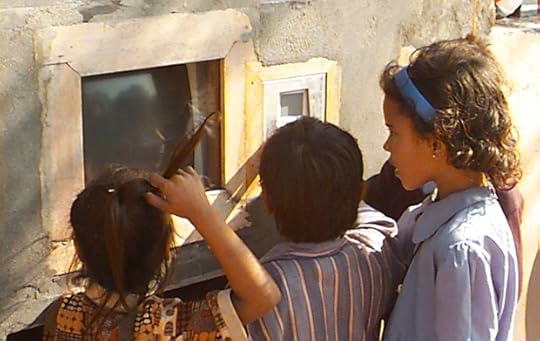
Africa will probably never have enough physical teachers.
Our Need for Teacherless Education
Throughout history, education has been formed around the concept of “place.” Build fancy buildings, attract world-renowned scholars, and you have a college or university. This model works well in a culture based on teaching. Over the coming years, with our hyper-connected world, we will quickly begin shifting to a leaning model. And while “place” will still matter, it will matter differently.
After my talk in Istanbul in February, I was approached by Cori Namer, an executive from Google who discussed the reason why teacherless education is so important.
“Our team at Google is looking for ways to educate the people of Africa, but very few teachers want to move to Africa,” he said.
The conversation was brief, but he framed the problem very succinctly. There simply aren’t enough teachers at the right time and place to satisfy our insatiable hunger and need for knowledge.
We are severely limiting our learning potential. Teachers become the problem in this equation, not the solution they were intended to be .
Teaching requires experts. Teacherless education uses experts to create the material, but doesn’t require the expert to be present each time the material is presented.
With a wide array of promising tools and techniques that can be used, the possibilities are truly inspiring. The new frontier of a teacherless education system is at our doorstep, and all we are lacking is that yet-to-be named visionary who will take the reigns.
Framing the Problem Around a Competition
Launched in 1996 by Pete Diamandis, the Ansari X Prize was a space competition in which the X-Prize Foundation offered a $10 million prize for the first non-government organization to launch a reusable manned spacecraft into space twice within two weeks. The prize was won on October 4, 2004, the 47th anniversary of the Sputnik 1 launch, by Tier One. Their entry, called SpaceShipOne, was designed by Burt Rutan and financed by Microsoft co-founder Paul Allen.
A few years ago I had a conversation with Tom Vander Ark, who was, at the time, President of the X Prize Foundation. Since his background included running the education division of the Bill & Melinda Gates Foundation, he had a vested interest in finding a way to advance education through competitions.
So far, nothing has been announced, and Tom has moved on to a new position, but Pete Diamandis and his team are still working to solve this problem. Their website lists the “Education Game X PRIZE” as something that will be announced sometime in the future.
For this reason, I’d like to weigh in with some thoughts of how to tackle this problem. As I talk through this approach, knowing my own limitations, I would invite everyone to add their thoughts in the comments about better ways of tackling this.
The Conceptual Framework for the Competition
The X Prize Foundation’s current approach to designing competitions is to first imagine a destination and then to construct a contest that focuses attention on achieving that end goal.
With education, the end goal is not easily imagined, so a different kind of competition is needed.
Starting with a definable piece of learning, such as Econ 101, a class taught in most colleges, I envision a competition to transform an entry level economics course by changing the format and style of the course into one that people can consume quickly, with maximum retention, and an effective way of certifying the results. So the process would involve three distinct steps – learning, retention, and certification.
1.) Learning – Learning is the process for acquiring new knowledge, skills or behaviors. It can be achieved in a variety of ways including the modification of existing knowledge or by synthesizing new information.
People learn through a sensory connection with the information presented to them. Human conversation with a few added visuals is the most common method used today to teach students. Even though some exciting things are happening around the fringes, little has changed in the past thousand years. At the same time, our ability to mold, fashion, and gamify information in new and interesting ways has exploded around us.
As we think through the possibilities of how information can be fashioned, shaped and presented, we begin to see thousands of new possibilities:
Learning through a movie
Learning through an app
Learning through our accomplishments
Learning through an experience
Learning through a game
Learning through music
Learning through podcasts
Learning through virtual world experiences
Learning through smells, tastes, and sensory involvement
Learning by using a combination of all of the above
However, finding new and interesting ways of presenting the information is only part of the equation. Creating a process for turning it into a long-term, usable piece of knowledge is just as important as our initial exposure to it.
2.) Retention – Once the initial learning has taken place, how long does it stick around?
We have all heard stories of college students pulling an all-nighter to cram for a final exam. As they do this, they have one goal in mind – to pass the test.
For them, the immediate hurdle is to complete the course with a passing grade, and whether or not anything penetrates the neurons long-term is strictly secondary. But having the information somehow take root in the cranial cavity is just as important as learning it in the first place.
There are many techniques for improving retention that I won’t go into, but devising a process that insures greater retention, and the ability to demonstrate its effectiveness, should be part of the overall competition.
3.) Certification – The final piece of the equation should be certifying that a quantifiable piece of learning has taken place, and assessing its level of influence. Traditionally, the certification of learning has involved some form of testing, but far better systems will likely emerge in a competition like this.
One possible solution I’ve written about in the past is confidence-based learning. Some experiments in this area have demonstrated a far greater retention and a significant reduction in learning time.
Distinguishing between a person guessing correctly, and one who answers correctly with confidence, can have a major impact. This assessment process not only validates knowledge but also the confidence with which it is presented.
Again, there are hundreds of possible solutions and any competition like this should somehow find a way to certify that the person has indeed gained new knowledge from the experience.

Judging the Results, Picking a Winner
Unlike some competitions that specify the criteria for winning, this should be a contest with enough latitude to allow for some very creative entries to be presented.
The judging process should involve actual students, taking the courses, going through the process, and rating their experience, with official judges on hand to determine the winners.
Possible judging criteria might also include:
Overall learning time - Speed of learning, start to finish
Degree of engagement - Was it an enjoyable experience? Would you do it again?
Repeatability - Can it be repeated with other subject matter such as courses in psychology, computer science, mechanical engineering, etc.
Cost-to-benefit ratio – Can this new form of learning be replicated efficiently?
Intangibles – Does it require some new piece of equipment? Does it require the learning take place at a certain time, place, or under certain conditions? Or is there any piece of the process that will slow implementation?
Rinse and Repeat
Once the first competition has been staged, thinking about the second one would need to begin.
Finding a new way of educating the masses should be an iterative process, using the results of the first competition to establish a higher bar for the second year, and so on.
Within five years, with the right sponsorships and participation, this kind of competition would radically rewrite the rules for teacherless education.
Final Thoughts
If we work within our existing system for education, the best we can hope for is a few percentage points improvement. The system itself becomes the limiting factor.
By creating a new system, we remove those limits.
Since we can’t envision the best possible way to educate people in the future, we need to unleash the creative minds of the world, and somehow incentivize them to participate.
My hope in writing this column is to inspire others to move this conversation forward. I certainly don’t have all the answers, and perhaps no one does. But with a little work, we might be able to create a process that can uncover those answers.
So let me know what you think. The conversation starts here.
Author of “Communicating with the Future” – the book that changes everything
.
.
April 13, 2012
Creating a ‘Ripple in the Force’ of the Power Industry
Working with many early stage inventors, I often have the privilege of seeing some truly remarkable inventions and innovations. A few days ago I was shown a technology that snugly fits into that remarkable category, one that has the potential to radically transform the way cars and other vehicles are powered. In fact, vehicles using this power source will never need to stop and refuel.
I’m not at liberty to explain this technology in detail, but using this power source to fuel what is otherwise an electric vehicle, these cars will have 70% fewer moving parts – no ignition, gas tank, oil filter, catalytic converter, or muffler – and in this case, a highly efficient, non-traditional battery that will outlive the life of the rest of the car.
The best part is that it emits as close to zero pollution as we may ever hope to get.
After seeing this stunning new technology I had to take a step back and assess its true potential. It provides tremendous advantages on every front. Easy to manufacture, simple to understand, while being less expensive to build and operate, it has the potential to operate virtually maintenance free for decades.
On the surface it sounds too good to be true, but rest assured, it does exist. It offers a breakthrough tantamount to nuclear fusion.
However this is not a column about this particular technology. Rather, it’s about disruption, and whether or not a startup like this can ever hope to dislodge the existing power-brokers in the oil, gas, and automotive industries.
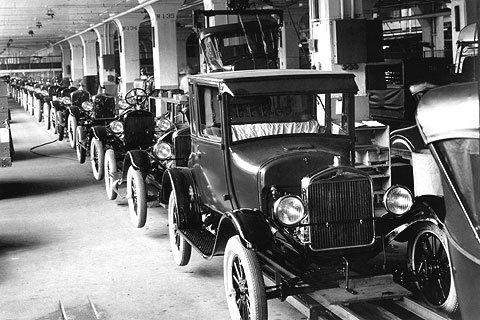
The mass produced Ford Model T automobile.
Disruptive Innovations
The term ‘disruptive technologies’ was coined by Clayton M. Christensen and introduced in his 1995 article “Disruptive Technologies: Catching the Wave”.
A disruptive technology is an innovation that helps create a new market and eventually goes on to disrupt an existing market by displacing an earlier one.
As Christensen explains, the automobile was a revolutionary technological innovation, but it was not, in itself, a disruptive innovation. Early automobiles were expensive luxury items that did not disrupt the market for horse-drawn vehicles. The market for transportation essentially remained intact until the debut of the lower priced Ford Model T in 1908. The mass-produced automobile became the disruptive innovation, because it changed the transportation market. The automobile, by itself, was not.
Nervous CEOs
We have seen many examples of industries that have had the rug pulled out from under them recently, and virtually every CEO and industry executive has their sensory radar tuned to sniff out anything that may seem even remotely disruptive.
With technology advancing on nearly every front, the nervousness that CEOs now feel is quickly turning to heightened paranoia.
Maximum Freud
In 1972, I was young engineering student at South Dakota State University in Brookings, SD. One of the first courses I was required to take was a short-course on slide rules. For those of you who don’t know what a slide rule is – first came the abacus, then came the slide rule, and then came the calculator.
This was a time when the real “cool geeks” on campus walked around proudly displaying their black carrying case for their slide rule that was attached to their belt.
Early calculators were first showing their face around 1970, but in 1972 they were still pretty expensive. I remember arguing with my teacher about whether or not the slide rule course was necessary and his dismissive response was that “all engineers need to know how to use a slide rule.”
Of course his short sighted thinking couldn’t have been further from the truth. Even though I took the course and passed it with flying colors, I’ve never used a slide rule to do engineering work (or any kind of work for that matter).
Engineers at Hewlett Packard and Texas Instruments who were working on next generation calculators at the time would have laughed at my teacher’s assertion that slide rules were always going to be the centerpiece of an engineer’s tool kit.
Clearly this period of time was the end of an era. It was the end of the slide rule era and the beginning of the calculator era.
As a society we haven’t been a part of ending too many eras, but we are on the verge of experiencing the disappearance of many societal norms in the near future.
So I sketched out the simple diagram below showing the end of one era and the beginning of another. The point where the two eras overlapped caught my attention. This time period was important to isolate because of the disruptive nature that a collision of business forces creates.
For this reason I came up with the name “Maximum Freud” to describe it. Yes, it’s a rather wacky name, but it makes sense.
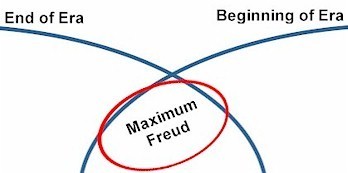
Maximum Freud is a period of extreme chaos, but also a period of extreme opportunity. When technologies approach a Maximum Freud cycle, industry players spend a lot of time on the Freudian Couch to understand what’s going on.
But here’s the most important part to remember: All technologies end.
Each and every technology that we use today will eventually go away and be replaced by something else. Every technology will approach its own period of Maximum Freud. So from the standpoint of making bold predictions, the impending demise of even our most foundational technologies will happen over time.

Creative Destruction isn’t always pretty.
Our Morale Obligation for Creative Destruction
Taking this discussion of disruptive technologies a few steps further, a growing number of people feel it is our moral obligation to disrupt, even destroy, existing businesses and industries.
This argument focuses on the growing societal debt we are incurring. With the growing debt created by our financial institutions and the rapid depletion of our natural resources, we are mortgaging the future of not only our children, but also many generations to come.
A huge undercurrent of social unrest is brewing, filled with righteous anger, and a growing awareness of corporate misdeeds, waiting for the right opportunity to take action. When this prime opportunity comes along, they intend to vote with their pocketbooks and take action with technology.
This is a generation that is not shy about their intentions. They intend to declare war on the past.
Unfortunately, the Best Technology Rarely Wins
Even with the viral nature of the Internet, rapid communications, and a brewing caldron of social unrest, it is extremely difficult to disrupt an existing industry.
Existing industries have an employee base, investors, vendors, customers, and users that may consist of millions of people. These are people who are comfortable enough with where they are today and have formed a natural resistance to change.
This change-resistant population creates a formidable inertia to maintain the status quo. For this reason, even holy-grail technologies like superconductors, cures for cancer, anti-gravity, or human teleportation will go through a somewhat lengthy adoption curve.
In addition to natural resistance, we also see aggressive tactics used to bolster a company’s current position. Welcome to the world of so called free enterprise.
Much like a messy political campaign, well-established companies resort to a number of “dark side” business practices to keep an upstart at bay:
Discredit the technology
Discredit the company
Pose counter-claims
Use credible people to “say it ain’t so”
Distract people from the truth
Discredit or dislodge the founders
Use legal maneuvers to keep them tied up in court for decades
The startup company I referred to above is currently looking for a CEO to help guide their efforts and steer clear of these “dark side” pitfalls. They are looking for someone who has guided a rapid, high-growth company from zero to a billion dollar industry. Only a handful of these wunderkind currently exist and if an added criteria is that this person has to have done this in the power industry, the number of viable candidates drops to zero.
Up till now, no one has been able to dislodge the existing power structure of the power industry. It is entrenched, ingrained and the infrastructure is in place. But how long will can they hang on to this dominance in the future when companies start thinking outside of the existing lines of power?
When will some new technology become the silver bullet that causes the industry giants to collapse?

The bigger they are the harder they fall!
Giants are Falling
Twenty years ago it seemed inconceivable that any of the major newspaper companies could fail, yet that is exactly what happened.
In a similar fashion, book publishing, big tobacco, major retailers, the auto industry, and the Yellow Pages have all been severely wounded by a new breed of visionaries.
Thinking about it though, is the big differentiator the technology or the people driving it?
If Steve Jobs had never lived, would we still have the iPhone and iPad today? Similarly, if Walt Disney, George Lucas, and Pete Diamandis had all taken jobs on Wall Street instead of living their lives as true innovators, would we still have Disneyland, Star Wars, and the X-Prize Foundation today?
To put it more succinctly, if the visionary never existed, would we still have the industry?
Certainly, if Edison hadn’t invented the light bulb, someone else would have. In many cases, inventors have lost out on a patent because of mere minutes separating the timestamp on a patent. So the invention was destined to happen regardless of whose name showed up on the patent, right?
Not so fast.
The systems we create help define the kind of people who will naturally rise to the top. And these leaders of innovation have decidedly different approaches for making things work.
So who’s next?
The most entrenched industries today are what I call “the big eight” – banking and financial services, big pharma, healthcare, higher education, insurance, telecom, oil and gas, and the power industry. The number of laws and systems used to bolster their position make them far more difficult to disrupt.
However, difficult does not equate to impossible. Over the next 20 years every one of these industries will inevitably see the rising tide of disruption reach their doorsteps.
In fact, society now feels it has a morale obligation to disrupt each of these industries.
Niche Markets to Start
Even with a massive wall of change-resistant inertia, a disruptive new technology can find a lucrative niche to begin with.
When the two-wheeled Segway came onto the scene in December 2001 with much fanfare, the upstart company was quickly confronted with a wall of resistance that would keep them in the novelty product category until they were able to find viable niche markets selling to police departments, security companies, and golf courses.
Today, even though they remain a tiny segment of the transportation industry, they are a profitable company.
Going back to the tiny startup mentioned above that is threatening to disrupt the entire auto industry, they too will initially need to search for niche markets that are accessible, profitable and open to change.
Here are a few that might fit in that category:
Electric RVs – For an industry that epitomizes the squandering of natural resources and is highly susceptible to volatile gas prices, any new innovation that would cause operational costs to plummet would be welcomed with open arms and create an industry renaissance.
Electric Mail and Delivery Trucks – Vehicles that spend their day negotiating through stop and go city traffic to deliver mail, pizza, and other supplies are also a prime target for this technology.
Electric Boats – Traveling across the water in a loud and noisy, highly polluting boat is already an unwelcome intrusion to the tranquil nature of open water. Adding a silent, pollution free alternative would be quickly embraced by the industry.
This is but a short list of possibilities, where many more are likely to exist.
Final Thoughts
Regardless of your thinking, whether disruptive technology is more about declaring war on our past, simply a golden opportunity for the moment, or part of our larger quest for creating a better future, we have a morale obligation to disrupt the status quo.
In much the same way our legacy systems create an ongoing toll on society, the inefficiencies of our past, and the excessive cost of doing business that they represent, keep us anchored to a former life we desperately need to escape.
Will the technology I talked about at the beginning of this article, with its massively disruptive potential for reforming the entire power industry, ever see the light of day? The short answer is yes.
It certainly won’t happen as quickly as it needs to from an ecological standpoint, but from an economical, industry-disrupting, old-jobs-destroying-new-jobs-creating standpoint, it may happen too quickly for the world to properly shift gears. Therein lies the dilemma.
In the mean time, I’ll be rooting for the little guys.
Author of “Communicating with the Future” – the book that changes everything
.
.
April 6, 2012
Printable Houses and the Massive Wave of Opportunity it will bring to Our Future
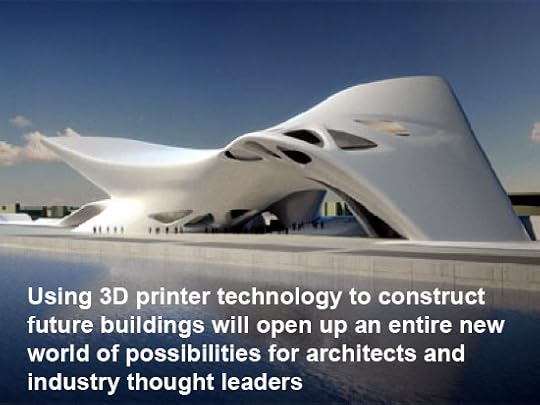
All the way back in March of 2004, working in his laboratory at the University of Southern California in San Diego, Dr. Behrokh Khoshnevis, was working with a new process he had invented called Contour Crafting to construct the world's first 3D printed wall.
His goal was to use the technology for rapid home construction as a way to rebuild after natural disasters, like the devastating earthquakes that had recently occurred in his home country of Iran.
While we have still not seen our first "printed home" just yet, they will be coming very soon. Perhaps within a year. Commercial buildings will soon follow.
For an industry firmly entrenched in working with nails and screws, the prospects of replacing saws and hammers with giant printing machines seems frightening. But getting beyond this hesitancy lies the biggest construction boom in all history.
Here's why I think this will happen.
Click here to view the embedded video.
Contour Crafting
Contour Crafting is a form of 3D printing that uses robotic arms and nozzles to squeeze out layers of concrete or other materials, moving back and forth over a set path in order to fabricate a large component. It is a construction technology that has great potential for low-cost, customized buildings that are quicker to make and can therefore reduce energy and emissions.
Using a quick-setting, concrete-like material, contour crafting forms the house's walls layer by layer until topped off by floors and ceilings that are set into place by the crane. In its current state of thinking, buildings will still require the insertion of structural components, plumbing, wiring, utilities, and even consumer devices like entertainment and audiovisual systems, as the layers are being built.
After using the technology to form simple things like walls and benches, discussions began to focus on other far-reaching opportunities like constructing rapid shelters after natural disasters, building operational structures on the moon out of moon dust, and building cheap houses for people in impoverished countries.
But those early visions were too much for an industry steeped in regulation and tradition, and the laudable ideas of helping the less fortunate will likely give way to a more mainstream approach of working with pieces before building the whole enchilada.
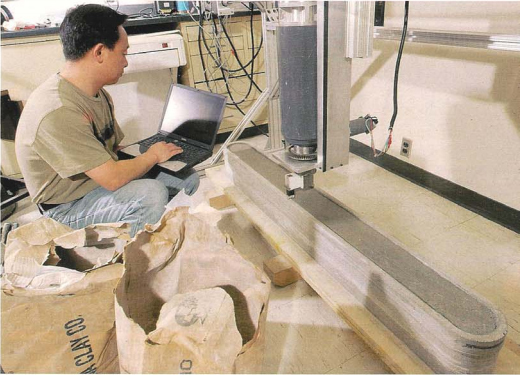
Experimenting with wall-printing technology in 2003
Breaking Through the Barriers
Starting with a mortgage industry that's becoming increasingly wary of lending on virtually any houses, let alone something that looks radically different, coupled with city planning and zoning departments that have no way of deciding what the code should be on a "non-traditional structure," and thousands of aging industry experts who can't imagine building houses in any way other than we do today, we find ourselves up against a slow-moving, massively resistant building culture that will take years to overcome.
That said, this industry will have plenty of opportunity to move forward.
Early on, a number of industries will form around printed components and construction material. Printed blocks, cabinets, wall panels, toilets, and even doors will catch on quickly.
Printed artwork will begin to show up everywhere, including three dimensional "wall printings."

Imagining what a house-printer could look like
A natural extension of printing new buildings will be devices that recycle the old ones. Ideally, the old material will be ground up and reformulated into new composites that can be re-printed into whatever is needed.
As an example, an old patio deck could be automatically "eaten" by some sort of PacMan device, ground up and mixed with other materials, and used to "print" a new patio deck – all within a couple hours.
By replacing our traditional techniques for pouring concrete, 3d printers could be used to print driveways, sidewalks, benches, fences, foundations, and much more.
When it comes to roofing, small bots will be used to create seamless coatings on the tops of houses. The small army of people needed to reroof a house today will be replaced with a single person who's job is to place the bot at its initial starting point and make sure there is a consistent supply of material to coat the entire roof.
Only after gaining traction in a myriad of these component industries will we see the public warming up to entire houses being printed from the ground up.
Here are a few examples of this type of 3D printed construction projects already taking place:

The SeatSlug
The SeatSlug is based on the shape of the recently discovered flabellina goddardi sea slug with the surface inspired by traditional Japanese designs known as karakusamon patterns.

The SeatSlug in use
Serving both as a piece of artwork and a parkbench, there will be little resistance to this type of niche application.
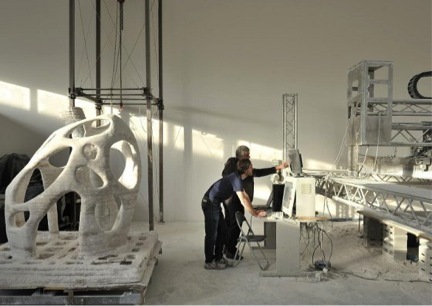
D-Shape – A printer capable of printing an entire building
An Italian inventor, Enrico Dini, chairman of the company Monolite UK Ltd, has developed a huge three-dimensional printer called D-Shape that can print entire buildings out of sand and an inorganic binder. The printer works by spraying a thin layer of sand followed by a layer of magnesium-based binder from hundreds of nozzles on its underside. The glue turns the sand to solid stone, which is built up layer-by-layer from the bottom up to form anything from a sculpture to a sandstone building.

The Radiolaria
Enrico Dini's first project was a 24' tall gazebo-like structure call the Radiolaria, built in 2010.
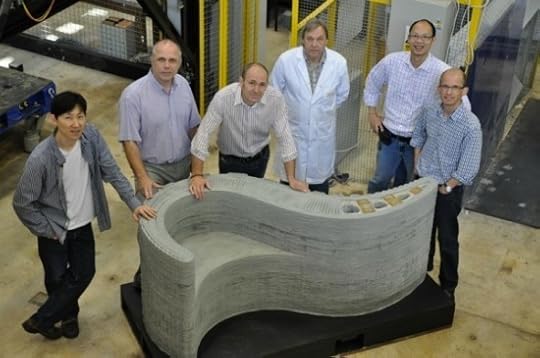
Loughborough University project
A team at Loughborough University rethinks the use of concrete with their 3D printer technology.

Another Loughborough University project
Experimenting with their ability to craft unusual shapes and forms out of concrete, the Loughborough University team created this unusual piece.

Thinking Three-Dimensionally
When we rid ourselves of the constraints of flat walls and smooth surfaces, a massive new wave of options begins to appear.
If we were able to actually create a three-dimensional holographic display above our computers, like you sometimes see in movies, we wouldn't even grasp what we could do with that because we have been entrenched into two dimensional thinking from birth, with two-dimensional tools like paper, slide rules and blackboards.
Breaking out of this 2D thinking, the questions then become things like, how do you surf the Internet three dimensionally? How do you build three-dimensional charts and graphs?
We won't really know how to use that type of display technology until we've had an entire generation of kids growing up with it and learning how to use it so that it gets integrated into our thinking and dreaming on a deeper level.

Printing Houses
Our thinking about homes today has been constrained by the materials we work with. Eight-foot sheets of drywall, wooden 2X4s, specific sizes for doors and windows, and an overwhelming desire to keep all surfaces flat, flat, flat.
However, flatness is rarely found in nature. Construction worker hate dealing with curves and unusual shapes because it complicates their lives tremendously.
Once we step away from the world of flatness, we begin to see a number of playful options that seem to come straight out of a Dr. Seuss book.

There is no doubt that a non-linear home will have its own unique challenges. Hanging pictures on a wall, installing cabinets, and even arranging furniture will all present obstacles to our present way of thinking.
But the energy and creativity that will flow from these spaces will be nothing short of breathtaking.

Walls will no longer need to be flat surfaces. Every wall can be designed with textures, protrusions, and artistic "surface rubble" to put an end to the dreadful uniformity in in our homes today.
What's Next?
When printing entire buildings, there are many details that are not well understood, and that's where the great opportunities lie. As an example:
When working with composite material, what is the expansion and contraction rate of this material?
How long will it last?
How resistant is it to wind and rain and even extreme weather like tornadoes, hail, and hurricanes?
Is it possible to instantly switch the printer ingredients from concrete to glass, and automatically "print" windows into their place?
When printing a building with a seamless skin, what are the advantages and disadvantages of this process?
Is it possible to "print" the carpeting into a room? And when it wears out, is it possible to bring in bots that "eat" the old carpeting, grind it up, and reprints it with a new formulation and new color?
Once a building is in place, can a printer be used to "print" the cabinets, furniture, toilets, shelving, and decorative details?
If part of a structure is damaged, will it be possible to use "repair printers" to produce seamless patches?
Can we use this same technology to "print" our highways?

Non-linear thinking for the buildings in our future
Final Thoughts
Will your next home be a printed home?
Along with this new technology will come a number of labor-reducing and cost-saving features. The number of people needed to build a home will drop by a factor of ten, maybe more.
Over time, we may see old houses torn down with PacMan-like recycling machines, where the material is ground up, reformulated, and an entirely new house is printed in its place – all in less than one day.
All of this sounds pretty radical by today's standards. But once we see the first homes being built this in this fashion, a new wave of change will quickly descend upon us. And even though many will lose their old jobs, the number of new jobs that get created along the way will more than replace everything we lost.
Personally, I can't wait.
Author of "Communicating with the Future" – the book that changes everything
.
.
March 30, 2012
Rewriting Our Social Norms

On March 24th, surveillance cameras at the Taylor Made Jewelry store in Akron, Ohio captured the startling image of a red SUV crashing through the front windows with two masked men jumping out, smashing display cases, and stealing over $100,000 of jewelry in less than 2 minutes.
Both men are seen grabbing what they can from the cases, jumping back into the SUV, and speeding away.
While many young people view this smash-and-grab robbery as the perfect crime with little chance of getting caught, future technology will haunt them the rest of their lives.
Future video technology, much like what is being used by TSA at airports today, will enable investigators to "see behind" masks and clothing and expose the criminals for crimes that were committed 20, maybe even 30 years earlier.
While this kind of technology seems appropriate for uncloaking heinous criminals, people are far more reluctant to shop in stores if they think some voyeuristic cameras are capturing them "naked" walking through the store.
In this brief example we can clearly see how the same technology used to protect us can also be misused in thousands of different ways.

What if every part of your life could be seen at any time?
Growing Levels of Surveillance
Most people like the idea of instant video footage magically appearing if someone mugs us, pulls a gun, and steals our money.
But most of us will also object to videos being used to aggressively enforce less serious crimes like wrongfully parking in a handicap spot or speeding on a remote stretch of highway.
Therein lies the conflicting love-hate relationship forming around our increasingly transparent society.
However, this discussion is not just about video surveillance. Humans are emitting far more than visual data, and every cellphone, tweet, and Facebook entry is leaving a digital trail that smart people all over the world are beginning to leverage.

See it, like it, share it.
A Society of Sharing
There are many benefits to living life in public. It pushes us into social acts and into connecting with other people, even in subtle ways. When Flickr began, cofounder Caterina Fake said that they made the decision to "default to public," to go against the presumption and precedent of all the earlier photo services. By making them public and by tagging them, users could find other people's photos, with similar interests, and they could even find friends. Open sharing allows us to join up and do more together than we could alone.
According to Jeff Jarvis, Professor at New York University and author of the book "Public Parts":
"We are sharing for good reason—not because we are insane, exhibitionistic, or drunk. We are sharing because, at last, we can, and we find benefit in it. Sharing is a social and generous act: it connects us, it establishes and improves relationships, it builds trust, it disarms strangers and stigmas, it fosters the wisdom of the crowd, it enables collaboration, and it empowers us to find, form and act as publics of our own making."
"For individuals, sharing is a choice; that is the essence of privacy."
"Facebook's founder, Mark Zuckerberg, told me that before the net, we had "privacy through obscurity". We had little chance to be public because we had little access to the tools of publicness: the press, the stage, the broadcast tower (those proprietors were last century's 1%). Today, we have the opportunity to create, share and connect, and 845m people choose to do so on Facebook alone. Mr Zuckerberg says he is not changing their nature; he is enabling it."

Does fear of humiliation prevent you from sharing?
Mutually Assured Humiliation
In an interview with New York Times' columnist Tom Friedman, Google's Eric Schmidt jokingly suggested we should be able to change our names and start fresh at age 21.
We have all had our moments of youthful indiscretion. For many of us, it doesn't stop in our youth.
But what exactly are we afraid of? What are our greatest fears associated with living our lives in the open?
According to Jarvis, "What's insidious about the fear of what others will say is that you rarely hear them say it. You imagine what they'd say. You imagine they care that much about you. The fragility of our own egos gets the better of us."
However, there are legitimate fears that most of us have from over exposure. So what exactly is it that we fear most?
We fear that everything we say can and will be used against you in the court of public opinion.
Fear of embarrassment.
Fear of not being hired for a job.
Fear that our employers will find embarrassing, booze-laden pictures from spring break in college and label us an outcast.
Fear of someone stealing our identity, our property, and even our kids.
Fear of government.
Fear of the IRS doing a full-blown colon-rectal inspection of our dismal records over the past five years.
Fear of losing control.
These fears are not without merit. The wealthier we become, the more likely we will become a target of some sinister plot.
There is great money to be made on both sides of this debate and major forces are lining up to take advantage of these differing opinions.
Asymmetrical Economics
The asymmetry of knowledge (where one party has more knowledge than the other) has been the cornerstone of our economy for all of recorded history.
In a 1970 paper titled, "The Market for Lemons: Quality Uncertainty and the Market Mechanism," economist George Akerlof first introduced the concept of information asymmetry.
He explained the economic advantages of when a seller knows more about a product than the buyer.
As Akerlof explains, there are good used cars ("cherries") and defective used cars ("lemons"). Because many important mechanical parts and other elements are hidden from view and not easily accessible for inspection, the buyer of a car does not know beforehand whether it is a cherry or a lemon. So the buyer's best guess for a given car is that the car is of average quality.
For this reason, the buyer is only willing to pay the price of an average quality car.
This means that the owner of a carefully maintained, never-abused, good used car will be unable to get a high enough price to make selling that car worthwhile. Therefore, owners of good cars are less likely to place their cars on the used car market. The fewer number of good cars reduces the average quality of cars on the market even further, causing buyers to revise downward their expectations for any given car.
Akerlof, Michael Spence, and Joseph Stiglitz jointly received the Nobel Memorial Prize in Economic Sciences in 2001, all for their research related to the economics of asymmetric information.
As a counterbalance to this, transparency becomes a powerful tool.
In the very near future, sellers will not be able to hide defects, make unsubstantiated claims, or overcharge for non-essential and non-time-sensitive goods and services.
You may say that the auto industry has been dealing with this since the beginning of the Internet, and that they have somehow survived the onslaught of commodity pricing. You may also think that online auto sellers and brick & mortar dealerships have reached equilibrium. However, this is not true.
The sticker price on a car has nothing to do with the price the dealer is paying, neither does the invoice price. If it did, there wouldn't be any car dealers. Do you really think you can run a car showroom making $25 per transaction?
According to a recent column by DigitalLiving editor Shelly Palmer:
"When you are looking at a Samsung 46″ HDTV Model number UN46D7000LFXZA at an electronics retailer, then take out your handheld device and search the web, you will instantly find it at a significantly lower price. You know it is exactly the same unit you are looking at in the showroom. Can the brick & mortar retailer match the online price? Will it? As this problem gets bigger, retailers are going to be highly de-incentivized to purchase inventory they cannot sell at a profit."
"If retailers don't stock items, manufacturers will have to perfect just-in-time inventory. They will (many already have). But what will become of the post-4G retail store? How will the retail environment have to adapt to be relevant in a world where everyone who walks-in has instant access to the lowest price, free shipping and no tax from an online vendor? Buyers already know more than sellers about the features and benefits of products – the web is the perfect tool for that – what does the retail store or showroom have to offer? How will manufacturers adapt production and finance to accommodate the change?"
"Now, let's expand this idea to every other business we can think of. As we move towards transparency, retail transactions certainly get tougher, but service businesses get hit just hard."
"If the job of a service professional is to transfer the value of their intellectual property into wealth, how much will transparency hurt?"
Information asymmetry in a buyer-seller relationship is where the real power lies. And now, thanks to transparency, information asymmetry is becoming harder to create. To survive, the basic structure of transactions will have to adapt.

"Transparency increases integrity."
Rewriting Social Norms
According to Mark Zuckerberg, "Transparency increases integrity." His entire business model for Facebook is oriented around society's growing embrace of transparency.
Nowhere in society are our values shifting faster than when it comes to our thinking about privacy vs. transparency. But we are still in the middle of this evolution so we have no way of fully embracing the "new norms" to live our lives.
So were do we go from here?
There are several "unfinished pieces" that will leave us in limbo for the foreseeable future.
First, the technology of transparency has not stabilized. Technology is moving quickly and may never be fully complete.
Video cameras are improving in resolution, and will soon have additional capabilities. Where once they were limited to grainy black and white images silhouetted against a fuzzy background, videos today are improving on almost every front.
Future video technology will have the capability of seeing through walls, into buildings, and even watch us while we sleep. This can be a good thing, but in the hands of the wrong person it turns into a disastrous thing.
We are also a long ways from establishing a well-structure public policy around personal privacy. Any laws created around today's thinking will need to be constantly updated to better mirror our evolving sense of right and wrong.
Final Thoughts
We can understand this better if we look at the economics of perversion. If only one person has photos of a naked celebrity, it becomes a valuable commodity. If you can find the same photos on 10,000 different websites, the value of that photo approaches zero, and our thinking about perversion suddenly shifts along with the proliferation. Nakedness becomes the new norm.
At one time, selling alcohol was illegal until we decided it was ok.
Selling marijuana is still illegal, but as a society, we are on the verge of changing those laws as well.
Many of our fears are framed around the old notions of right and wrong, legal and illegal. As those standards change, how does this cause us as a society to reframe our lives?
As I bring this discussion to a close, I am probably leaving you with far more questions than answers. But to those rare people who can find the answers, answers that everyone will embrace, a golden opportunity awaits.
Author of "Communicating with the Future" – the book that changes everything
.
.
March 23, 2012
14 Global Projects that could Make You the World’s Next Billionaire

Opportunities are often right before our eyes, but few of us can see them.
The super-connected nature of the Internet is giving us a far different “opportunity landscape” than ever before in history. Unlike the painstakingly slow 400-year period between DaVinci’s drawings of flying machines and the Wright Brother’s first flight, development cycles in the digital era can now be measured in hours and minutes rather than decades or centuries.
Killer apps of the past, like online search, email, and ecommerce, now over a decade old, are becoming mature industries. More recent innovations like social networking, smartphones, and mobile apps are also becoming old news.
Every major industry of the past provides the foundational underpinning for industries of the future. It is in this rubble of business-past, with generational lifespans shortening to less than a decade, we find our next era of global enterprises. But what will they be?
Here are 14 possible options.
So What’s Changed?
According to Business Insider, in 1999, there were 38 million broadband Internet users worldwide. Today, there are 1.2 billion people getting broadband Internet access on their phones.
The number of smartphones sold now exceeds the number of PCs sold. That transition happened last year.
Globally today there are 5.6 billion “dumbphone” users compared to 835 million “smartphone” users. In the U.S. we are already about halfway through the process of converting over to all smartphones. Still, 12% have no cellphone at all.
Globally, the dumbphone conversion cycle is just getting started. Tablet sales will pass PC sales in 2-3 years.
Mobile apps are now a $10 billion marketplace growing over 100% per year. The number of available apps through Apple and Android now exceeds 1.2 million with over 34 billion downloads so far between the two of them.
Angry Birds alone has had over 600 million downloads. “Draw Something” was launched 6 weeks ago and already has over 20 million downloads and is generating over $100,000 per day. It’s now the number one app in 79 countries.
To reach the 1 million user milestone, it took AOL – 9 year, Facebook – 9 months, “Draw Something” – 9 days.
Both the speed and pervasiveness of broadband connections continue to climb rapidly.

Crowdfunding will be huge, for better and worse.
Adding Crowdfunding to the Mix
With the U.S. Senate’s passing of the new crowdfunding legislation we are about to see another huge variable come into play.
Startups will be able to raise up to $1 million per year using online sources. While some view this as an instant money gravy train, it will be far from that. The true rules about what works and what doesn’t will take years to define.
That said, some initial thoughts are that cause-related investments, with strong emotional appeal, will be a far easier sell than something less-emotional even though it may still be a sound financial investment. Local and community-oriented projects will likely have local appeal.
On the negative side of the equation, it will be possible for someone to fund a poorly conceived startup without anyone seriously vetting the business model. This is a task normally reserved for incubators, angels, or VCs. So some of the previous checks and balances may be missing, although it may only be in a small minority of the cases.
Funding startups has always been risky and even the smartest of the smart money people aren’t all that good at picking the winners.
The best part about crowdfunding is that it will allow startups to take more control over their own destiny, and the number of jobs created along the way will be huge.

Global vision produces large-scale opportunities.
14 Global Projects
When it comes to launching web-related startups, only rarely do we see people start with a global vision first. Usually that works against them because they quickly lose their ability to focus on a starting point.
But inside these global visions are some of the true large-scale opportunities for the future that take advantage of growing levels of human connectedness.
My hope in listing these projects is to stimulate thinking about other possible projects. I’m sure this is only scratching the surface.
1.) The Billion-Cam Video Project – What would it take to get people to connect 1 billion video cameras to the Internet? Does the current infrastructure have enough capability to handle that volume of data? Even low-res, compressed signals will likely strain telecom capacity.
But if it were possible, would there be a market for it?
Consider the following scenario. If a company offered cheap wireless cameras that could be placed around a home, commercial property, on cars, or other public areas, and the cost of connecting the cameras was a low $1-$2 a month, how quickly would that catch on?
Assuming that most people would feel safer with “watchful eyes” outside their homes, how would this type of pervasive video monitoring affect society? Would the crime rate drop? Would this level of transparency create an unusual level of paranoia? How could this data be monetized in new and unusual ways?
Those with the right answers may hit the next big wave online.

Terabyters collect vast amounts of information daily.
2.) The Coming of the Terabyters - A terabyter is a term I’ve coined to describe a person who produces more than a terabyte of new information every day. Today, only a handful of these people exist, but the numbers will soon swell along with the development of new data capture equipment.
Similar to the pervasiveness of the Billion-Can Video Project, a Terabyter would begin each day by strapping on video and data capture equipment to record a constant stream of information around them, and upload it online. Once 100,000 or even 1 million people are doing this, this real-time spidering of the world by individuals will create unique business openings.
So where is the business model in capturing massive volumes of data like this? Who are the winners and losers? The people who can answer these questions will be the ones who turn this idea into one of the next online gold mines.
3.) Whole Earth Genealogy Project - The genealogical industry currently exists as a million fragmented efforts happening simultaneously. While the dominant players, Ancestry.com and MyHeritage.com, have multiple websites with hundreds of millions of genealogies, there is still a much bigger opportunity waiting to happen.
So far there is no comprehensive effort to build a database of humanity’s heritage capable of scaling to the point of including everyone on earth, posted on an all-inclusive whole-earth family tree.
As we improve our ability to capture DNA and decipher it, it may even be possible to automate this process.
The information will prove to be tremendously valuable, providing data about hereditary diseases, demographic patterns, census bureau analytics, and much more.
More importantly, this will become a new organizing system for humanity – a new taxonomy. Every person on earth will have a placeholder showing exactly where they fit. In many respects, it will be similar to the way maps helped us frame our thinking about world geography. This would be a new form of “geography” for humanity.
4.) Whole Earth Plant Genealogy Project – Same as #3 but using plant DNA to automatically map plant genealogy. Unlike working with humans, there would be no privacy concerns about mapping plants (unless you are Monsanto).
Over time this could evolve into vital data to feed into our global food supply.
5.) Whole Earth Animal Genealogy Project – Once again, the same as #3 and #4, but using animal DNA to automatically map animal genealogy.
With many of our newer diseases attributed to coming from animals, understanding animal genealogy may well provide us with the critical information to find a cure.
6.) Whole Earth Ownership Project – Records of property ownership are typically buried in some courthouse or government filing system, available only to people who take the time and energy to do the research.
Currently there is no global repository for this type of information.
Zillow.com has created a way to instantly find the value of properties in the U.S., but it doesn’t get into ownership records. Expanding on their model to include properties worldwide, with additional information, could be a very successful enterprise.
7.) The Ownership Matrix – Every person owns tons of stuff. When we buy something new, we take ownership of it. But when exactly does the ownership actually begin and end. And who’s keeping track?
Our houses are filled with books, tools, ornaments, utensils, furniture, fixtures, gifts, clothing, shoes, and accessories. When we loan something out, its hard to keep track.
Few people have any sort of inventory of what they own, and most start to lose track after a few hundred items and the passage of time obscuring even the best of memories.
Somewhere in this quandary lies a golden opportunity. Is it possible to create an ownership graph with the value of items, locations, and an aging matrix? Is this something that can be automated?

A worldwide central ‘law repository’ would usher in global transparency.
8.) Whole Earth Law Project – Very few countries have their laws posted in a central repository. In the U.S. the laws, rules, and regulations are so numerous and obscure that few people know what laws are governing them at any given moment.
If a central “law repository” were created, and all laws should be public knowledge anyway, then our global legal systems could move into a new era of transparency.
Business people would be able to make conscious decisions about whether they want to do business in a certain country based on the number of laws they may have to contend with.
9.) Whole Earth Court System – If a court system were developed using crowdsourcing to form its jury decisions, what things would have to change?
Much like every other system we’ve been raised with, the courts and justice systems are highly inefficient legacy systems that we have inherited from generations past. And like every other legacy system, it’s only one disruptive personality away from being totally revamped.
Companies can agree to settle their disputes in ways other than traditional national or regional court systems. If enough companies agree, traditional court systems may find themselves on the outside looking in.
10.) Global Elections – When will we see the first global election with over 500 million people voting from over 50 different countries? Will they be voting for a person, or voting on an issue? If it’s a person, what position will that person be running for? And, if it’s an issue, what issue will be so compelling that everyone wants to vote on it?
The idea of global elections is not new. In fact, people have dabbled with the concept for centuries. However, the Internet has opened up an entirely new toolbox of possibilities.
The trickiest part to hosting global elections will be the voting process and making sure the technology is hacker-proof.
In addition to technological problems are issues of authority, accountability, and enforceability. As an example, if world-wide referendums were used to decide on an official global currency or official global language, who will enforce the results? What penalty will there be for non-compliance?
However, for someone who can figure it out, there could be a massive up-side to this business model.
11.) Global Checks-and-Balance Project – Too many of the vital systems used to govern our world are left unchecked. Abuse of power is rampant in countries throughout the globe.
In a project that would propose to map systems against their associated checks and balance counterweight, we will begin to find a very revealing way of restructuring some of the world’s more egregious problem areas.
12.) Replacement for Wikipedia - At the DaVinci Institute, we began a series of Wikipedia research projects to uncover “what’s missing,” and the results are very telling. Two of the tests showed well over 50% of important content entries either missing or incomplete, and by another measure, over 95% missing.
Missing content is in direct correlation to the relevancy Wikipedia will hold in the minds of people in the future. It is also a clear signal to startup entrepreneurs that a new opportunity awaits.

What mysteries does the simple wheat kernel hold on an atomic level?
13.) Every-Atom Mapping of a Kernel of Wheat – We are still a long ways away from being able to do this, but over time we will begin to understand the entire data set inside a single kernel of wheat. What role does every molecule play and what role do external forces play on it’s development?
This will be a project exponentially more complicated than the human genome project, and it may be too complicated to start with wheat, but eventually we will get there. Once we can successfully map wheat, we can work on far more complicated organisms including animals and humans.
14.) Job-Mapping, Skill-Mapping Project – Our jobs throughout the world are constantly changing. At the same time, the skills people use to perform their tasks are also evolving. What’s missing is a less-interpretive way of connecting skills with the jobs that require them.
There will be huge demand for someone who can crack the code on this one.
Closing Thoughts
Once again, this exercise was intended to help stretch the thinking of those in search of the next big thing. I’d love to hear your thoughts about other projects that should also be included on this list.
Certainly I can’t promise all will lead to a billion dollar payday. Perhaps none of them will.
But I can promise that when it comes to big opportunities in the years ahead, we are only scratching the surface. The greatest industries today will pale in comparison to what comes next.
Author of “Communicating with the Future” – the book that changes everything
.
.
14 Global Projects that could Make You the World's Next Billionaire
Opportunities are often right before our eyes, but few of us can see them.
The super-connected nature of the Internet is giving us a far different "opportunity landscape" than ever before in history. Unlike the painstakingly slow 400-year period between DaVinci's drawings of flying machines and the Wright Brother's first flight, development cycles in the digital era can now be measured in hours and minutes rather than decades or centuries.
Killer apps of the past, like online search, email, and ecommerce, now over a decade old, are becoming mature industries. More recent innovations like social networking, smartphones, and mobile apps are also becoming old news.
Every major industry of the past provides the foundational underpinning for industries of the future. It is in this rubble of business-past, with generational lifespans shortening to less than a decade, we find our next era of global enterprises. But what will they be?
Here are 14 possible options.
So What's Changed?
According to Business Insider, in 1999, there were 38 million broadband Internet users worldwide. Today, there are 1.2 billion people getting broadband Internet access on their phones.
The number of smartphones sold now exceeds the number of PCs sold. That transition happened last year.
Globally today there are 5.6 billion "dumbphone" users compared to 835 million "smartphone" users. In the U.S. we are already about halfway through the process of converting over to all smartphones. Still, 12% have no cellphone at all.
Globally, the dumbphone conversion cycle is just getting started. Tablet sales will pass PC sales in 2-3 years.
Mobile apps are now a $10 billion marketplace growing over 100% per year. The number of available apps through Apple and Android now exceeds 1.2 million with over 34 billion downloads so far between the two of them.
Angry Birds alone has had over 600 million downloads. "Draw Something" was launched 6 weeks ago and already has over 20 million downloads and is generating over $100,000 per day. It's now the number one app in 79 countries.
To reach the 1 million user milestone, it took AOL – 9 year, Facebook – 9 months, "Draw Something" – 9 days.
Both the speed and pervasiveness of broadband connections continue to climb rapidly.
Crowdfunding will be huge, for better and worse.
Adding Crowdfunding to the Mix
With the U.S. Senate's passing of the new crowdfunding legislation we are about to see another huge variable come into play.
Startups will be able to raise up to $1 million per year using online sources. While some view this as an instant money gravy train, it will be far from that. The true rules about what works and what doesn't will take years to define.
That said, some initial thoughts are that cause-related investments, with strong emotional appeal, will be a far easier sell than something less-emotional even though it may still be a sound financial investment. Local and community-oriented projects will likely have local appeal.
On the negative side of the equation, it will be possible for someone to fund a poorly conceived startup without anyone seriously vetting the business model. This is a task normally reserved for incubators, angels, or VCs. So some of the previous checks and balances may be missing, although it may only be in a small minority of the cases.
Funding startups has always been risky and even the smartest of the smart money people aren't all that good at picking the winners.
The best part about crowdfunding is that it will allow startups to take more control over their own destiny, and the number of jobs created along the way will be huge.
Global vision produces large-scale opportunities.
14 Global Projects
When it comes to launching web-related startups, only rarely do we see people start with a global vision first. Usually that works against them because they quickly lose their ability to focus on a starting point.
But inside these global visions are some of the true large-scale opportunities for the future that take advantage of growing levels of human connectedness.
My hope in listing these projects is to stimulate thinking about other possible projects. I'm sure this is only scratching the surface.
1.) The Billion-Cam Video Project – What would it take to get people to connect 1 billion video cameras to the Internet? Does the current infrastructure have enough capability to handle that volume of data? Even low-res, compressed signals will likely strain telecom capacity.
But if it were possible, would there be a market for it?
Consider the following scenario. If a company offered cheap wireless cameras that could be placed around a home, commercial property, on cars, or other public areas, and the cost of connecting the cameras was a low $1-$2 a month, how quickly would that catch on?
Assuming that most people would feel safer with "watchful eyes" outside their homes, how would this type of pervasive video monitoring affect society? Would the crime rate drop? Would this level of transparency create an unusual level of paranoia? How could this data be monetized in new and unusual ways?
Those with the right answers may hit the next big wave online.
Terabyters collect vast amounts of information daily.
2.) The Coming of the Terabyters - A terabyter is a term I've coined to describe a person who produces more than a terabyte of new information every day. Today, only a handful of these people exist, but the numbers will soon swell along with the development of new data capture equipment.
Similar to the pervasiveness of the Billion-Can Video Project, a Terabyter would begin each day by strapping on video and data capture equipment to record a constant stream of information around them, and upload it online. Once 100,000 or even 1 million people are doing this, this real-time spidering of the world by individuals will create unique business openings.
So where is the business model in capturing massive volumes of data like this? Who are the winners and losers? The people who can answer these questions will be the ones who turn this idea into one of the next online gold mines.
3.) Whole Earth Genealogy Project - The genealogical industry currently exists as a million fragmented efforts happening simultaneously. While the dominant players, Ancestry.com and MyHeritage.com, have multiple websites with hundreds of millions of genealogies, there is still a much bigger opportunity waiting to happen.
So far there is no comprehensive effort to build a database of humanity's heritage capable of scaling to the point of including everyone on earth, posted on an all-inclusive whole-earth family tree.
As we improve our ability to capture DNA and decipher it, it may even be possible to automate this process.
The information will prove to be tremendously valuable, providing data about hereditary diseases, demographic patterns, census bureau analytics, and much more.
More importantly, this will become a new organizing system for humanity – a new taxonomy. Every person on earth will have a placeholder showing exactly where they fit. In many respects, it will be similar to the way maps helped us frame our thinking about world geography. This would be a new form of "geography" for humanity.
4.) Whole Earth Plant Genealogy Project – Same as #3 but using plant DNA to automatically map plant genealogy. Unlike working with humans, there would be no privacy concerns about mapping plants (unless you are Monsanto).
Over time this could evolve into vital data to feed into our global food supply.
5.) Whole Earth Animal Genealogy Project – Once again, the same as #3 and #4, but using animal DNA to automatically map animal genealogy.
With many of our newer diseases attributed to coming from animals, understanding animal genealogy may well provide us with the critical information to find a cure.
6.) Whole Earth Ownership Project – Records of property ownership are typically buried in some courthouse or government filing system, available only to people who take the time and energy to do the research.
Currently there is no global repository for this type of information.
Zillow.com has created a way to instantly find the value of properties in the U.S., but it doesn't get into ownership records. Expanding on their model to include properties worldwide, with additional information, could be a very successful enterprise.
7.) The Ownership Matrix – Every person owns tons of stuff. When we buy something new, we take ownership of it. But when exactly does the ownership actually begin and end. And who's keeping track?
Our houses are filled with books, tools, ornaments, utensils, furniture, fixtures, gifts, clothing, shoes, and accessories. When we loan something out, its hard to keep track.
Few people have any sort of inventory of what they own, and most start to lose track after a few hundred items and the passage of time obscuring even the best of memories.
Somewhere in this quandary lies a golden opportunity. Is it possible to create an ownership graph with the value of items, locations, and an aging matrix? Is this something that can be automated?
A worldwide central 'law repository' would usher in global transparency.
8.) Whole Earth Law Project – Very few countries have their laws posted in a central repository. In the U.S. the laws, rules, and regulations are so numerous and obscure that few people know what laws are governing them at any given moment.
If a central "law repository" were created, and all laws should be public knowledge anyway, then our global legal systems could move into a new era of transparency.
Business people would be able to make conscious decisions about whether they want to do business in a certain country based on the number of laws they may have to contend with.
9.) Whole Earth Court System – If a court system were developed using crowdsourcing to form its jury decisions, what things would have to change?
Much like every other system we've been raised with, the courts and justice systems are highly inefficient legacy systems that we have inherited from generations past. And like every other legacy system, it's only one disruptive personality away from being totally revamped.
Companies can agree to settle their disputes in ways other than traditional national or regional court systems. If enough companies agree, traditional court systems may find themselves on the outside looking in.
10.) Global Elections – When will we see the first global election with over 500 million people voting from over 50 different countries? Will they be voting for a person, or voting on an issue? If it's a person, what position will that person be running for? And, if it's an issue, what issue will be so compelling that everyone wants to vote on it?
The idea of global elections is not new. In fact, people have dabbled with the concept for centuries. However, the Internet has opened up an entirely new toolbox of possibilities.
The trickiest part to hosting global elections will be the voting process and making sure the technology is hacker-proof.
In addition to technological problems are issues of authority, accountability, and enforceability. As an example, if world-wide referendums were used to decide on an official global currency or official global language, who will enforce the results? What penalty will there be for non-compliance?
However, for someone who can figure it out, there could be a massive up-side to this business model.
11.) Global Checks-and-Balance Project – Too many of the vital systems used to govern our world are left unchecked. Abuse of power is rampant in countries throughout the globe.
In a project that would propose to map systems against their associated checks and balance counterweight, we will begin to find a very revealing way of restructuring some of the world's more egregious problem areas.
12.) Replacement for Wikipedia - At the DaVinci Institute, we began a series of Wikipedia research projects to uncover "what's missing," and the results are very telling. Two of the tests showed well over 50% of important content entries either missing or incomplete, and by another measure, over 95% missing.
Missing content is in direct correlation to the relevancy Wikipedia will hold in the minds of people in the future. It is also a clear signal to startup entrepreneurs that a new opportunity awaits.
What mysteries does the simple wheat kernel hold on an atomic level?
13.) Every-Atom Mapping of a Kernel of Wheat – We are still a long ways away from being able to do this, but over time we will begin to understand the entire data set inside a single kernel of wheat. What role does every molecule play and what role do external forces play on it's development?
This will be a project exponentially more complicated than the human genome project, and it may be too complicated to start with wheat, but eventually we will get there. Once we can successfully map wheat, we can work on far more complicated organisms including animals and humans.
14.) Job-Mapping, Skill-Mapping Project – Our jobs throughout the world are constantly changing. At the same time, the skills people use to perform their tasks are also evolving. What's missing is a less-interpretive way of connecting skills with the jobs that require them.
There will be huge demand for someone who can crack the code on this one.
Closing Thoughts
Once again, this exercise was intended to help stretch the thinking of those in search of the next big thing. I'd love to hear your thoughts about other projects that should also be included on this list.
Certainly I can't promise all will lead to a billion dollar payday. Perhaps none of them will.
But I can promise that when it comes to big opportunities in the years ahead, we are only scratching the surface. The greatest industries today will pale in comparison to what comes next.
Author of "Communicating with the Future" – the book that changes everything
.
.
March 16, 2012
The Coming Coder Wars
In the late 1980s, I spent some time as a mainframe programmer at IBM. Conversations around the water cooler often had to do with some of the cryptic code written 2-3 decades earlier that was incomprehensible to what anyone was writing at the time.
Now, 25 years later, the problem has grown exponentially worse. With a programming universe comprised of over 2,500 different languages, dated languages like Fortran, Jovial, and Cobol that lie buried inside corporate IT departments are coming back to haunt their host companies.
As an example, the day-to-day operations at the Mellon Bank of New York are based on 112,500 Cobol programs – 343 million lines of code – that run core-banking functions. Mellon Bank is not alone. Thousands of other companies have similar issues.
The ticking time bomb behind this problem is the people familiar with this code are nearing the retirement age. For companies that wait until that the institutional knowledge is gone, the costs for converting over may well be as much as ten times higher than it would have been beforehand.
In an industry where speed is king, few college students want to learn the equivalent of programming Egyptian sundials when atomic clocks are driving the web. Not so surprisingly, our newest venture at the DaVinci Institute will be to train next-generation programmers – DaVinci Coders.
History of Cobol
Cobol is one of the oldest programming languages, first appearing in 1959. Its name was derived from an acronym for COmmon Business-Oriented Language.
The COBOL specification was created by a committee of researchers from private industry, universities, and government during the second half of 1959. The specifications were to a great extent inspired by the FLOW-MATIC language invented by Grace Hopper, an inspirational visionary often referred to as "the mother of the COBOL language."
Largely because of Grace Hopper's influence, the percentage of female COBOL programmers is over 30%, far more than most languages in this heavily dominated male arena. By contrast, only 6% of Ruby on Rails programmers are female.
More than 50 years after Cobol came on the scene, the language is alive and well in the world's largest corporations, where it excels at executing large-scale batch and transaction processing operations on mainframes. The language is still popular because of its scalability, performance and mathematical accuracy.
Finding New Talent
A recent article in ComputerWorld does a good job of laying out the challenges ahead. New people entering the programming field couldn't be bothered by the slow, tedious nature of programming in COBOL.
"College graduates with training in Cobol are in short supply. In Michigan, for example, state schools that offer Cobol programming have cancelled classes due to a lack of interest. "They can't get anyone to enroll," says Jonathan Miller, director of Saginaw County Information Systems and Services."
"But some colleges are still providing Cobol training — with help from IBM. The mainframe vendor has developed curricula in association with more than 80 colleges and universities ranging from Brigham Young to Texas A&M. "We donate hardware and software, help with the curriculum, and they graduate hundreds of people every year," says Kevin Stoodley, IBM fellow and chief technology officer."
Having a gradating pool of "hundreds" hardly seems adequate for a language with a 50-year legacy and a massive bulge is talent ready to retire.
Salary Comparison
A recent survey by PayScale.com reveals some of the problem with recruiting new COBOL programmers. They simply don't make as much money.
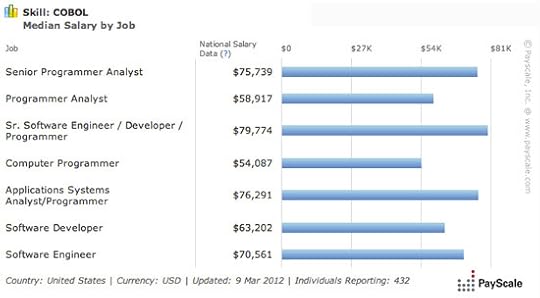
A senior software engineer in COBOL earns less than $80,000, while an experienced Ruby on Rails Developer can earn over $120,000 per year.
Currently the Ruby on Rails field is predominantly a male working environment comprised of 94% men and 6% women.
Even though there are an estimated 235,000 websites using Ruby on Rails, this is a young field. Only 3% have less than 1-year experience. 42% have 1-4 years experience, 30% have 5-9 years experience, and 25% have 10 or more years coding.
Many of the largest employers are using Ruby on Rails, including Amazon.com, Groupon, IBM, NASA, John Deere, Google, Living Social, Cisco, NASA, Oracle, JP Morgan, Twitter, Electronic Arts, New York Times, NBC, and many more.
What We Can Learn from the New York Stock Exchange
The anticipated retirement of in-house talent and the coming shortage Cobol programmers were a primary drivers behind NYSE Euronext's decision to reengineer 1 million lines of Cobol on a mainframe that ran the stock exchange's post-trade systems. While Cobol was dependable, it wasn't viewed as maintainable in the long run.
According to ComputerWorld:
"Steven Hirsch, chief architect and chief data officer at NYSE Euronext, cites the need to make changes very rapidly as another key reason the stock exchange abandoned Cobol. "Ultimately, the code was not easily changeable in terms of what the business needed to move forward. We were pushing the envelope of what it took to scale the Cobol environment," he said."
In a recent survey, nearly half (49%) of survey respondents whose organizations don't use Cobol say the reason is that the language is simply outdated.
The Coming Talent Wars
Several factors are converging that will make the decades ahead fertile territory for software engineers.
First, the Bureau of Labor Statistics is predicting a 22% increase in available tech jobs nationally by 2020. The demand for software services is already growing at a healthy clip.
Complicating these projections, many of the large corporations are beginning to contend with a retiring talent pool. Programmers well versed in the old languages, far more than just COBOL, are about to leave. In many cases, the cost of replacing the code after the resident talent leaves can be exponentially greater than when the in-house IT experts are still around.
Virtually every major industry will be conducting a code assessment over the next 2-3 years to determine whether the old code is worth saving. Every time a decision is made to "re-do everything," either the company or its IT arm, will undergo a massive hiring surge.
In addition to everything else, mobile apps and mobile startups are becoming the new gold rush. A high percentage of existing programmers are ready to jump ship and start their own business when the conditions are right.
Young people today have demonstrated time and again that they are far more interested in launching their own business than they are in buying a house. And the business of choice invariably will involve a web operation or two.
Every startup in the tech world only increases the demand for additional coders. It becomes an incessant driver without enough talent in the pipeline.
The Genesis of DaVinci Coders
In looking over the opportunity landscape, we found a dearth of beginner-based training. People wanting to enter the programming field are left with the options of either going to a traditional college or learning on their own.
Since most people don't have 4-5 years and $80-$100K to make the transition, or even 2 years and less money in the case of technical schools, traditional education is not a viable option.
On the other end of the spectrum, self-study programs that have recently become widely available and free, only appeal to the narrow spectrum of self-motivated individuals.
Neither of these options does a good job of integrating students into the working life of coders by networking them into local companies.
The best example of doing it right was the Code Academy in Chicago started by Neal Sales-Griffin and Mike McGee in 2011. Starting their first class in August of last year, Code Academy focused in on people who are passionate and driven. With three times the number of applicants as to what they could handle, they found they had drilled into a deep untapped opportunity.
Patterning our curriculum closely after what Code Academy is doing in Chicago, DaVinci Coders will be offering a full-immersion program based on an 11-week course with 10-hours per week of actual classroom instruction and homework and group projects filling virtually all of the non-classroom time.
Each class will be limited to 16 students. When they're not in class, students will have their own pass code to use the adjacent coworking facilities inside the DaVinci Institute 24/7.
Students will each be assigned an industry mentor who will meet one-on-one with the students for 30 min per week.
The cost of this full-immersion program is $6,000. The first set of classes will begin on June 4, 2012.
Final Thoughts
With over 2,500 existing computer languages competing for mind share, we will naturally see the vast majority of them go away over the coming decade, with little more than a footnote in the tech history books to note their existence. However, the code left behind will have to be dealt with in some fashion.
While the owners of this code see it as a problem, many others see it as a golden opportunity. Stale operating systems that were painful at best to make changes to, can now be rewritten in a vibrant language with interactive feature that allow them to move into the mobile spaces and social networking environments.
The number of coders and IT professionals will have to grow dramatically to meet the demand over the coming years. Already one of the highest paid professions in the country, programmer salaries are destined to climb much higher as skilled talent will be in short supply for decades to come.
Author of "Communicating with the Future" – the book that changes everything
.
.
Thomas Frey's Blog

- Thomas Frey's profile
- 2 followers

