
Thomas Frey's Blog, page 46
May 10, 2013
The Urgency of Purpose and the Forward Movement of Failure

As a futurist I spend much of my time tracking failure. Why failure? Because they are the unforgiving anchors around which society changes directions.
In the U.S. we are now witnessing a record number of failures taking place. Just look around. Failed businesses, failed systems, failed jobs, and failed marriages.
Some failures are easily predicted, where a known problem looms larger and larger until a solution is found. Most, however, are not so easy. In many respects, failures are nature’s own system for checks and balances.
Failures attract attention. Much like a car accident causing a gawker’s block along the highway, failure attracts onlookers, some with offers to help, others moving quickly to avoid being painted with the same failure brush.
So what causes failure? Turns out that failure is just one relentless driver being perpetuated by a series of other relentless drivers. As we lift up the hood on this eight cylinder engine, here is what’s really going on.
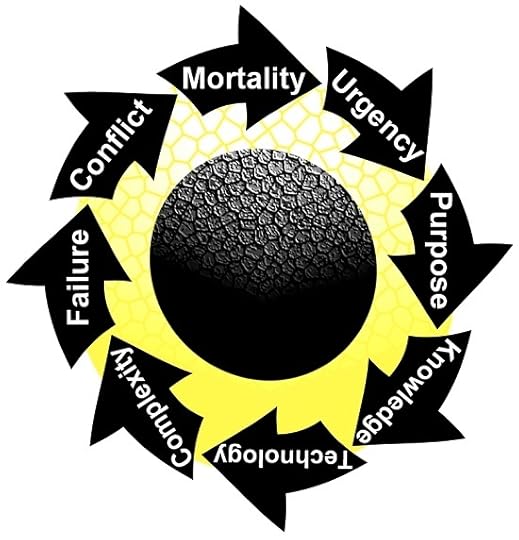
To be sure, there are many forces driving the world around us, and each one of these drivers is like a hand grenade generating a blast zone of forces pushing in multiple directions. However, these particular forces concentrate an unusual amount of energy in the directions I’ve indicated here to keep this cycle in motion.
Mortality drives urgency
Urgency drives purpose
Purpose drives our quest for knowledge
Our quest for knowledge drives technology
Technology drives complexity
Complexity drives failure
Failure drives conflict
Conflict drives mortality
As we begin to study these linkages, we are able to uncover fascinating relationships which help enormously in explaining the nature of humanity and the world we live in.
1.) Mortality Drives Urgency – The fact that we will someday die gives us only a short runway of time to get things done. The clock is ticking. We either get things done today or we lose a significant piece of the time we have left before we die. Even though people are living longer today than 100 years ago and we have a slightly longer runway, the urgency we feel is still a prevalent force in everything we do.
While it’s true that competition and our need for status also drive urgency, the constant trickle of sands falling through the hourglass leaves us feeling like our own lives are slipping through our fingers. The sound of our own mortality is a sound few can avoid listening to.
Counter to what some believe, living forever may indeed be counter-productive. People who live with no end in sight may well lose their motivation for “doing anything important today.”
2.) Urgency Drives Purpose – How many times have you heard someone ask, “Why am I doing this?”
It’s a very common concern because most of us simply despise doing anything dubbed “meaningless.”
Baby-boomers are getting older. As this massive bulge in the population moves into their retirement years, many are feeling the regrets of not having lived up to their own expectations, and in doing so, are searching for higher meaning. In what Forbes Magazine publisher Rich Karlgaard describes as the “Age of Meaning,” the former hippie generation is now searching for a higher calling, and they want it now.
3.) Purpose Drives our Quest for Knowledge – To find meaning and purpose, we need more knowledge.
In today’s world, information is infinite, but knowledge is finite. According to a 2010 report by the Global Information Industry Center, the hours we spend consuming information has grown 2.6 percent per year from 1980 to 2008 to an average of nearly 12 hours per day.
At the same time, our ability to sort through the growing storehouses of information and find those shimmering glints of needles-in-the-haystack information is a relentless quest. It is a quest we cannot do alone, and so we turn to technology.
4.) Our Quest for Knowledge Drives Technology – Human frailties and our own physical limitations drives us to find technical solutions.
How can we think faster, see things outside of the range of normal human vision, hear things on the other side of the world, or process information that baffles the normal mind?
Virtually every invention known to mankind is an extension of human senses or human capabilities.
The more information we consume, the greater our need for technology, and that’s where things start getting complicated.
5.) Technology Drives Complexity – Technology drives many things, but when it comes to complexity, technology acts as the great enabler.
Rather than managing 100 accounts on paper, we can now manage 1,000 accounts with a computer. Rather than spending 10 hours sorting through 20,000 books in a library, we spend 10 minutes sorting through 2 million books online.
Technology extends our reach, but it also extends our ability to devise complex systems for managing it, and complicated solutions to our problems.
Complexity itself is neither good nor bad, but it increases fragility and too much complexity pushes us beyond our ability to manage it. And that’s where things begin to fail.
6.) Complexity Drives Failure – The more complicated something is, the more likely it is to fail.
Yes, in abstract terms, complexity adds function. And some measure of complexity is both necessary and beneficial.
However, according to complexity management firm Ontonix, 80% of companies that fail experience at least one year of rapidly increasing complexity.
Complexity tends to function like a self-perpetuating organism. Complex systems tend to expand until they reach a breaking point, and that is where the conflict begins.
7.) Failure Drives Conflict – Yes, failure causes many things, but failure is very emotional, and emotional intensity leads to conflict.
Our first reaction is that failure is bad and conflict resulting from failure is even worse. Yet at the same time, failure is a time of renewal, a new branch growing where an old branch just died.
Conflict arises from our resistance to failure, and in many case we need to resist because failures are not inevitable. We only appreciate that which we struggle to achieve, and virtually every conflict clears our mind about the importance of what we are struggling for.
8.) Conflict Drives Mortality – Every conflict gives us another look into the frailties of being human.
Conflicts are riddled with confusion and doubt, second-guessing and regret. They are the friction from where the rubber-meets-the-road on this turning wheel.
But most conflicts come from within. As famed country singer Garth Brooks says, “The greatest conflicts are not between two people but between one person and himself.”
In the end, we ask what we were fighting for, and that, in turn, drives our own feeling of mortality.
So What Can We Conclude?
It was several weeks ago when I first sketched this out, trying to decide if it was indeed meaningful, and whether this kind of insight could be helpful.
In the back of my mind I kept asking, “Is this cycle inevitable” and “Can it be stopped?” Perhaps, more importantly, “Should it be stopped?”
We each have many wheels to contend with. Our family wheel overlaps our business wheel, and those overlap our social and side-projects wheels.
With global databases of information skyrocketing and technology improving access to it, the wheel is turning at a faster and faster pace.
Every imbalance in the wheel causes a ripple effect throughout the rest of the wheel.
Are we better off trying to eliminate conflict and failure, or trying to optimize it? With the new mantra being “fail fast and fail often,” we have begun to accept the inevitability.
Is purpose more important than knowledge, or does strengthening one driver simply create an imbalance that strengthens the other?
Is our quest for knowledge making us smarter, of just more confused?
As you can see, I have far more questions than answers, so I’d like to hear your thoughts. If possible, please take a few moments to write down some of the ideas that formed in your head as you read through this.
I look forward to hearing your insights.
Author of “Communicating with the Future” – the book that changes everything
.

.
.


April 26, 2013
How Google Glass will Disrupt the Hearing Aid Industry?

Hearing aids are for old people. At least that’s what I thought when I was young and invisible attending rock concerts far louder than they should have been.
Even though I still have most of my hearing relatively intact, I’m also part of the aging baby boom generation whose sheer size is already beginning to tax the limits of today’s healthcare systems.
People over the age of 65 typically spend 3-5 times more on healthcare than do people under 65, so unless we figure out ways to radically disrupt this trend, we may all be dealing with some rather dire affordability issues.
As a tiny pebble being dropped into the massive pond of healthcare costs, one of the first truly disruptive technologies for the hearing aid industry may be Google Glass with its conductive-bone audio transmission capabilities.
Three features that give it such disruptive potential are the elimination of an earpiece, the processing capabilities of its onboard microprocessor, and an open API that allows the geeks of the world to develop apps far more ingenious than anything in existence.
Here are a few thoughts on why this tiny sub-category of Google Glass will likely have such a massive impact.
History of the Hearing Aid

After the invention of the transistor in 1948, hearing aids began to shrink
The idea of hearing aids began to take root in the 1700s with the creation of shell-like devices that enabled a person to capture a larger sphere of sound and focus it into their ear. While they never worked very well, this early thinking led to a generation of electronic devices that began to crop up after Alexander Graham Bell’s telephone in 1876.
The first electric hearing aid, called the Akouphone, was created by Miller Reese Hutchison in 1898. It used a carbon transmitter, so that the hearing aid could be portable.
Later, Siemens began to commercialize an electronically amplified hearing aid in 1913. The product was bulky, about the size of a “tall cigar box” and not easily portable.
As an industry, hearing aids started to catch on after the development of transistors in 1948 by Bell Laboratories. Over time they’ve become tinier, more fashionable, and with far better audio capabilities.
Population Trends

Our aging baby boomer population in the U.S. (similar in other countries) will dramatically increase demand for health-related products as individuals over the age of 65 typically spend 300-500% more on healthcare than to people under 65
The number of people over 65 is increasing quickly, and so are activity levels. Gone are the days when old people were relegated to a rocker on the front porch to while away their remaining years. Seniors today are very active, and very demanding of solutions to anything that will limit their capabilities.
Pricing Trends

As you can see in the chart above, most of today’s consumer electronics products – cameras, laptops, TVs and even GPS systems – have dropped on average by more than half!
The combination of market competition and low cost manufacturing in the Far East have streamlined production processes and driven prices lower. The only exceptions in the above examples are MP3 players and hearing aids.
MP3s experienced a price jump because its capabilities have advanced exponentially over the past decade going from storing 128MB of data (roughly 12 songs) in 2000 to storing 160G of data (roughly 40,000 songs) or more today.
Hearing aids prices have risen partly because they’re covered by insurance and partly because of sheer demand. It’s an industry well positioned for a radical overhaul.

Enter Google Glass
Google Glass is an attempt to free people from their desktop computers and remove the quirky need to check their portable devices every couple minutes. Glass places all the same information into a viewing surface right in front of your eyes.
Essentially, Google Glass is a camera, display, touchpad, microprocessor, battery and microphone built into spectacle frames. The display is slightly above a person’s normal field of vision but easily viewable.
The viewing surface is the equivalent of looking at a 24-inch display from 8 inches away.
Having and ever-present online display mounted on your head gives rise to a series of obvious uses such as taking, sending, and receiving photos, videos, search, facial recognition, calendar reminders, breaking news flashes, and much more.
But one of the more intriguing thoughts is that Glass will become a close-to-the-brain interface device capable of adding any number of add-ons and attachments.
The current version of Glass features a sunglasses attachment that can easily be coupled to the main rail. In time it will allow normal corrective lenses to be added.
Glass does not have a typical earpiece but instead transmits sound through bone conduction. The use of this kind of non-obtrusive sound amplification creates the possibility for a device used as a hearing aid for those with low-level hearing loss.
Naturally a number of in-ear attachments could also be attached to compensate for whatever kind of hearing loss issues an individual is dealing with.

Creating apps for Google Glass is a far different experience than smartphones
The Hearing Aid App
Google’s approach is unique. Sound is captured by the Glass frame and converted into something “hearable” through bone conduction transfer – vibrating your skull to transmit to your ears.
Since hearing loss comes in a million different shapes and sizes, developing a perfect solution for everyone has been a rather elusive dream.
By placing a device like this in the hands of people outside of current industry thought leaders opens up an entirely new realm of possibilities.
Just adding self-adjusting EQ apps that autocorrect based on the micro-detection of normal human responses could improve our listening abilities a thousand fold.
With the addition of directional devices, we may soon have the bionic ability to zero in on a conversation a mile away, or to listen through walls, or even pick out a quiet conversation happening in a noisy room.
Very likely, a near-term app will give us the ability to see an instant translation of a conversation we’re having in a foreign country in our own native tongue on the Glass display.
Yes, sensory enhancements like this may seem scary at first, and there will be many abuses, but when have we ever been satisfied with living within the confines of our current abilities?
“Just adding self-adjusting EQ apps that autocorrect based on the micro-detection of normal human responses could improve our listening abilities a thousand fold.”
Final Thoughts
As you can see, I’ve focused in on a very tiny aspect of Glass capabilities. Yet the overall impact can be enormous.
Roughly 25% of the U.S. population suffers some level of hearing loss, yet it is a condition that will affect 100% of every population either directly or indirectly at some point in their lives.
The U.S. hearing aid market is a $6 billion industry that has been licking its lips at the prospects for an aging population that will quickly double in size.
However, they never imagined their biggest competitor might soon be Google, a rival few companies want to have enter their space.
But this is just one possibility. I’d love to hear your thoughts on the disruptions Google Glass may bring, or whether you think it could simply fizzle out altogether. Or will Apple or Samsung create a competitive product that is far superior with far better features?
Post your thoughts below.
Author of “Communicating with the Future” – the book that changes everything
.
.
.
April 19, 2013
Downloadable Personalities for Your Computer

Fifteen years ago in an article I wrote for The Futurist Magazine, I made the prediction that once we had talking computers, we would soon have downloadable personalities to create a more human-like experience. I went on to suggest that most of us would actually download multiple personalities so we could interact with the right persona at any given moment.
Machine-like voices tend to grate on us after while, and the notion that the heartless pile of equipment we currently spend our days with could somehow be magically transformed into a warm and engaging human-like organism is rather alluring. Many of us would like to see that happen.
However, an interactive voice is only a small part of the “personality” equation.
As we’ve seen from some of the early entrants in this space, most notable the smartphone duo of Siri and Robin, current technology leaves much to be desired. A few inquiries into a test run and you’ll find that most responses totally miss-the-mark.
Most GPS systems allow users to change the voice of their commands. But like Siri and Robin, these are one-dimensional voice-only manifestations of a personality, lacking the emotional queues, non-verbal expressions, and the intellectual prowess to answer anything more than a common factoid.
Human-like personalities are hard to define, and since we don’t have any good examples of them, no one has any sense as to the needs or desires of a personality marketplace.
For this reason I’d like to take you on a journey into the unchartered territory of downloadable personalities.
History of Artificial Personalities
The art and science behind replicating human personalities has evolved dramatically over time. Here are a few of the key innovators driving the “science of personality” forward.
1.) Walt Disney – Pioneer of Artificial Personalities
In 1937, the Walt Disney Studios released its first fully animated feature film, Snow White and the Seven Dwarfs, and pioneered animation as a new form of entertainment.
Yes, there were artists depicting figures in motion as early as the Paleolithic cave paintings thousands of years ago, and some of Leonardo da Vinci sketches in 1510 showed sequential motion in the human body.
Many different devices paved the way for animation in the motion picture industry, including the magic lantern in 1650, the Thaumatrope in 1824, the Phenakistoscope in 1831, the Zoetrope in 1834, and the flip book in 1868. One of the first motion picture animations was a short called “The Humpty Dumpty Circus” by Albert E. Smith and J. Stuart Blackton in 1908.
Even though there were eight animated films that came earlier, it was Disney’s Snow White in 1937 that pushed the bar for animation dramatically higher with amazing attention to detail and characters that exuded their own personality.
2.) Teddy Ruxpin – The Personality Bear from 1985
One children’s toy that was way ahead of its time was Teddy Ruxpin, an animatronic talking teddy bear produced in 1985 by Worlds of Wonder.
The bear moved his mouth and eyes while ‘reading’ stories which were played on a cassette tape player built into his back. The design team included Ken Forsse, Larry Larsen, and John Davies. Later versions used a digital cartridge in place of the cassette. At his peak, Teddy Ruxpin was the best-selling toy in both 1985 and 1986.
3.) Jim Henson – Master of Puppet Personalities
In 1955, fledgling puppeteer Jim Henson launched the Muppets, a puppet-based TV show that would soon become world famous. At the heart of his emerging puppeteering empire was his fixation on character personalities.
Believing that television puppets needed to have “life and sensitivity,” Henson began making characters from flexible, fabric-covered foam rubber, allowing them to express a wider array of emotions at a time when many puppets were made of carved wood.
4.) Robot Personalities
When it comes to imagining what king of personality would best fit a robot, we see quite an evolution over the years:
Rosie (The Jetsons, 1962)
Lost in Space robot (“DANGER, Will Robinson!” 1965)
C-3PO, R2-D2 (Star Wars, 1977)
KITT (Knight Rider 1982)
Data (StarTrek, 1987)
Optimus Prime (Transformers, 1987)
Sonny (iRobot, 2004)
WALL-E – (Disney Film WALL-E, 2008)
Even though I’ve only mentions a few of the thousands of robots in TV, movies, radio, and literature, you can sense the radically different approaches used to instill a personality into these machines.

Mr. Personality Robot
Mr. Personality Editor Software
WowWee is Hong Kong-based company launched by Richard and Peter Yanofsky that focuses on “breakthrough consumer technologies.” They are best known for their biomorphic robot RoboSapien.
In 2009, they released a homebrew editing software that allowed users to edit the personality files on their Mr. Personality Robots™.
With its programmable modules, Mr. Personality™ redefined the term “personal” robot because users could architect whatever personality they desired. Designed as a fully animated and interactive talking companion, it exudes personality in everything it says and does. Like a cartoon character morphed into 3D, he can tell jokes, read your daily fortune, and even answer questions about your future.
Thinking Through Personality Technology
One of Google’s executives recently mentioned that a full 20% of all searches, each day, have never been done before. This means that the human-to-computer interface is evolving at a staggering rate. For this reason, downloadable personalities, although still on the drawing board, will transition in a similar fashion.
Once created, artificial personalities will begin down a path of constant evolution. As a starting point, they will be constructed around a series of “personality modules” such as:
Voice module
Humor module
Famous quote module
Advice module
Encouragement module (motivation)
Physical appearance module
Frequently asked question module
With the right framework it will be quite easy to launch a new personality and many celebrities will want to get into the act.
As an example, creating a David Letterman personality will begin with downloading a few hours of his recorded voice and the computer will learn to speak like him. His “top 10” lists and jokes from his monolog will be added on a daily basis, along with famous quotes, words of wisdom, and advice.
Using a series of images it will be easy to create a David Letterman avatar to serve as the persona projected onto a facial display like the one shown above. Over time people will ask a number of questions that he can spend time answering, or have someone on his staff respond to.
Much like a living organism, each personality will be developed around a growing body of content that transforms with each additional module.
Critically important to this technology will be the revenue models and your willingness to spend money on a celebrity personality like David Letterman for your computer?

Become your own personality architect
Next Generation Opportunities for Downloadable Personalities
If you had the ability to create a new “personality,” with some new personality-builder software, what features would you want it to have? And what type of devices would you want to download it into?
Adding a personality or two to a computer or robot is only one possibilities. What if you could download personalities onto your refrigerator, your car, your bathroom mirror, or the front door of your house?
Do you want your refrigerator to criticize you every time you open the door and stare blankly at what’s inside? People on a diet may love this feature.
Would you want a car that asked you questions about your schedule for the day and helped you map out a more efficient strategy?
For women that were fixing their hair and putting on makeup, would you want to interact with a mirror that made suggestions about hair styles and eye color?
Would you like to program your front door to automatically ask all solicitors to go away, or recognize your friends and cordially invite them in?
People love to talk to their plants, so what if the plants could talk back? Every flowerpot and plant-holder could exude the personality of the plant. Add a few sensors and the plant could tell you exactly when it needs attention.
Arguing Shoes
A few years ago I created a future scenario about a product I called “Arguing Shoes”:
“Our research has shown that most children today think of their feet as an extension of their own personality, and a source of entertainment. For this reason we have created the world’s first talking shoes. But after extensive testing we found that just talking to their feet didn’t exactly excite kids. So we spent time designing shoes that not only talk, and carry on a conversation with each other, but also argue with each other. For whatever reason, kids just love watching shoes that are constantly arguing and bickering with each other.
To make it even more interesting, our shoes not only argue with each other, we’ve designed them to pick a fight with any other shoes within earshot. This will create hilarious situations in shopping malls, movie theaters and schools, entertaining children everywhere!”
Is this a realistic possibility?
Final Thoughts
Thinking through the options, I would want to download a Conan O’Brien personality to have fun with, Ben Franklin to give me advice, and Morgan Freeman to explain things to me.
Taking it a few steps further, I would want Walter Cronkite to tell me the news, Bill Cosby to help put things into perspective, and Mother Teresa to keep me humble.
If we designed robots to take care of babies, they should have the voice and personality of the mother, automated pet walkers should come with the personality of their owner, and as Sugata Mitra has suggested, students struggling in school are most encouraged by hearing the voice of a grandmother.
Automatic Teller Machines could come equipped with the personalities of highly trusted people like Warren Buffet or Suze Orman
The world of downloadable personalities is still waiting to be launched, but in my way of thinking, it won’t take long to completely explode.
Let me close with a few questions:
If there was one personality that you would most want to interact with, who would it be?
Would you be an early adopter, downloading one of the earlier offerings, or wait to see how well it was received?
Assuming a monthly fee for a downloadable personality, how much would you be willing to pay?
If the pricing of personalities was low enough, $2-$3 a month, how many would you download?
I’d love to hear your thoughts on this. As for me, I can’t wait.
Author of “Communicating with the Future” – the book that changes everything
.
.
.
April 11, 2013
Monitoring People from Space: The Good the Bad, and the Ugly

In the late 1980s, I was an engineer working as part of an IBM team to build a mobile satellite command and control center for monitoring missile launches from space. This contract was part of Regan’s “Star Wars” missile defense system.
Whenever a missile is launched, the heat plume coming out of the back of the rocket produces a distinct heat signature instantly detectable by satellites with infrared sensors.
The technology we were using over 25 years ago could instantly distinguish between types of rockets, calculate trajectory, and give information on time of impact.
Since those early years of working with infrared sensors I’ve often wondered if it would be possible to monitor people from space by tracking their personal heat signatures.
Two overarching trends that get little attention today are those of rapidly increasing precision and awareness. As both travel up the exponential growth curves of the emerging big data industry, what inevitably becomes possible is an ability to distinguish a person’s identity from a distance, even space.
On the surface this may be a frightening prospect. Having someone know where I am at any moment of the day, does indeed make the hair stand up on the back of my neck.
But at the same time, there is an undeniable convenience factor. If a person is suffering a heart attack or stroke, being kidnapped, or otherwise in a condition of extreme stress, a monitoring system that can shave minutes off emergency response times can mean the difference between life and death.
As with many of today’s emerging technologies we have to sort the good from the bad. Here are a few thoughts on what may happen in the future.
The History of Biometrics
Biometrics is a term that refers to the identification of humans by a certain physical characteristic or trait. It’s often used with computer systems to validate a person’s identity.
One of the earliest forms of biometric tracking came with fingerprints. The earliest cataloging of fingerprints dates back to 1891 when Juan Vucetich started collecting fingerprints of criminals in Argentina.
Over the decades a number of other biometric systems have been developed around everything from voice recognition, to DNA, to keystroke and hand print behavior.

Retina scanning devices are already commonplace in certain areas.
The 2002 film Minority Report brought attention to Iris/Retina scanning technologies for both personal identification and point of sale transactions. The main character changes his identity by having his eyes transplanted, and later accesses a security system using one of the removed eyes.
Recently, Renato Zenobi, a researcher at the Swiss Federal Institute of Technology in Zurich, discovered a new area of science – breathprinting. By using a mass spectrometer to analyze the breath of 11 individuals, 4 times a day over nine days, he was able to identify the unique molecules in each breath sample and determine both the health characteristics and the identity of the individual.
As the field of biometrics advances, we will see a number of personal identification systems that can be observed from a distance, both by drones and satellites.
Can an infrared signature of a human body be person-specific?
The answer to this question is still an unequivocal “maybe.”
Infrared radiation is made up of photons with wavelengths that vary from a little less than 1 micron to about 1 millimeter. Since everything from animals, to trees, to cars, and highways all emit photons, the first challenge will be to separate human heat signatures from everything else.
It will be tricky to separate direct emissions from reflections. If, as example, you were sitting on a seat for a long period and then walked away, the seat would retain a similar heat signature for a short period of time.

Current technology still doesn’t allow recognition of individual infrared heat signatures.
Even if we can account for all of those issues, we still don’t know if that infrared signature is 100% unique to that individual. Complicating things further, the clothing we wear, the food we eat, and our current level of activity all have a bearing on our ability to discriminate one person from the next.
Since photons are just light at a lower frequency, a person’s shape could only be resolved to the resolution limits of the sensor system. The higher the resolution of the sensors, the more accurately a person would come into focus.
Even with a high res system, variables like the person’s state of health, their metabolic and emotional state as well as their physiologic response to external conditions (extreme cold, for example) will cause variations in thermal signatures.
For these reasons, it’s unlikely that an infrared-only heat signature will be sufficient for identification. However, tying infrared sensors to other biometric monitors is something that will happen sooner or later.
Peeling Away the Onion Layers
As we add layers of precision and awareness to the equation, we begin to see increasingly intrusive capabilities begin to form. Here is a progressive list, going from crude observations to nano-detailed observations, of how this type of technology will evolve over time:
Distinguishing between plants, animals, and humans
Determining gender
Defining age, ethnicity, height, weight, hair color, and other physical characteristics
Doing basic health assessments, monitoring heart rates, blood pressure, skin temperature, etc.
Scanning for levels of brain activity
Remote indexing of stomach content
Monitoring a person’s sex life
Analyzing the chemical composition of a person’s sweat
Now imagine these monitoring capabilities first from 100 feet, later from a mile away, and eventually from a geosynchronous satellite orbiting the earth.
The Good
Even with a strong pushback from privacy advocates, niche uses will find their way into everyday use. Some of the first business models will form around creating early warning systems for people in peril. Here are a few use cases that will be used to advance the technology.
People suffering from heart attack, stroke, seizures, accidents, or other debilitating conditions triggering an alarm for a local emergency rescue team.
Governments will develop non-specific systems to monitor the general mood of their constituency, tracking levels of happiness and anxiety. Rather than relying on traditional polling, these results will be very fast and information rich.
Disease tracking will also be possible. Since many diseases involve human contact or are spread through being in close proximity with those infected, quarantines will happen quicker, outbreaks better contained, and public health in virtually all areas will be managed better.
In the event of natural disasters, those in danger will be quickly alerted of impending dangers.
Parents can use it to find lost kids and pets.
Farmers and ranchers can use it to monitor their crops and livestock.
Tracking rhinos, along with other frequently poached animals, and their attackers will be quite simple.
We will know immediately whenever someone dies.
The Bad
Naturally images of big brother hovering over us come to mind with any technology like this. But big brother isn’t the only one that’ll cause problems. Here are a few possible ways things will go bad.
Companies will find all new ways to spy on their competitors.
Governments will try to use it to find tax cheats, those who owe alimony, and even track down unpaid parking tickets.
Hypochondriacs, those suffering from paranoia, and other kinds of alarmists will have a whole new set of tools for clogging up the system.
Political activists will devise new ways of systematizing their efforts, building coalitions, and making a statement.
A whole new line of “satellite masking” products will be developed including everything from cloakable-clothing, to car-blockers, to building-jammers.
The Ugly
Many of our latest technologies, designed with all the best intentions, go woefully off track in the hands of the wrong people.
In the event of a war, this technology will be used pinpoint rivals even before they become enemies.
Political hacks will take what is already an ugly process and make it even uglier. People with differing opinions will be discredited and have their reputations destroyed faster than ever.
Reputation tagging will become commonplace. If you thought profiling was bad, once a person gets tagged with whatever label someone wishes to assign, it’ll become a far reaching cloud on their character.
This is a technology tailor made for stalkers.
There will be no place left on earth to hide.

Final Thoughts
Growing up as young people we are constantly testing our limits. We are testing the limits of how much we can eat or drink, how little sleep we can get away with, how fast we can run, and even how many people we can date simultaneously.
Without testing our limits, we can’t possibly know who we are.
We are all terminally human, and our learning styles and thought processes vary tremendously from one person to another. As such, we need enough runway to fall on our face a few times before we understand our limits.
Limit-testing is our way of learning how to behave in the future, and extreme transparency has a way of making “different” wrong.
Transparency has an insidious way of encroaching on our space and exposing our foibles to the rest of the world.
The technology I’ve described above will eventually happen with or without our blessing. Today’s cellphone tracking systems have already started us down this path. The overarching trend is already well underway.
Is this a technology that will eventually destroy the world as we know it today, or will it lead us down a path to something better?
I’d love to hear your thoughts on this topic.
Author of “Communicating with the Future” – the book that changes everything
.
.
.
April 5, 2013
Piercing the Field of Knowability

“If at first, the idea is not absurd, then there is no hope for it” – Albert Einstein
As a futurist, I’ve always been interested in our relationship with the future. But lately I’ve become obsessed with understanding more about the dividing line between the present and the future.
I constantly find myself asking questions like, “when does the future end and the present begin?” and “how does the future become ‘now’ and where does it go from here?”
When thinking about this topic it’s easy to slip in thoughts about premonitions, ESP, and similar unexplained phenomena. But that’s not what this is about. Instead, I’m searching for a hard-science approach to the unveiling of the present.
Over the past year I’ve been developing a theory about what I call the “Field of Knowability.” Parts of this were described in a column I wrote on the “12 Laws of the Future.”
My theory begins with the assumption that there is a small gap in time between when the future is formed, and when we know about it. The point when we become “aware of the present” is what I refer to as the field of knowability.
This means that the “present” would exist for a tiny period of time, perhaps just a fraction of a second, before we ultimately experience it. Think of it as a staging area for what occurs next.
Here’s why I think this is important.
Explaining Time – We Can’t!
The concept of time is a human construct that works well enough for us to measure duration of events and intervals between them. Time has long been a major subject of study in religion, science, and philosophy. But all theories of time are riddled with unanswerable questions and eventually break down.
Some simple, relatively uncontroversial definitions of time include “time is what clocks measure” and “time is what keeps everything from happening at once.”
Two contrasting viewpoints on time come from Isaac Newton and Immanuel Kant. Newton’s view was that time is part of the fundamental structure of the universe—a dimension independent of events, in which events occur in sequence. This explanation has become known as Newtonian time. Kant believed that time was neither an event nor a thing, and therefore not measurable nor travelable.
Putting those definitions aside, time is one of the seven fundamental physical quantities in the International System of Units used to define our world.
Separating the Present from the Future
Einstein described it this way. “The distinction between the past, present and future is only a stubbornly persistent illusion.”
The present is constantly forming around us. We are continually immersed in “presentness.” In many respect, we are swimming in the present. And like fish immersed in water, we have no way of gaining an outsider’s perspective of something we are continually submerged in.
But where does the present come from? How does it get formed? Who decides what form it takes?
The movement or progression we experience from one moment of time to the next is driven by what I call inertia.
The inertia that is in place as we leave the present is still in place as we enter the future. If we witness the act of someone throwing a baseball, using a superfast strobe light, each billionth of a second motion is tied directly to the next billionth of a second motion. Our inertias give motion to the present and direction to our future.
On a personal level, we are each dealing with the inertia of our body and the inertia of our mind. Both are constantly in motion. At the same time, our personal inertias are taking place inside the context of every other person’s inertia, as well as the inertia of every other thing around us. Nature has its own sets of inertia, with the forces of nature providing the inertia for every living and every non-living molecule in the entire universe.
Using that basis of understanding, is it possible to know something-anything about the present before it happens?
We’ve all experienced situations where we know someone is calling us before the phone rings, or that someone we’ve been thinking about is standing at the door before there is a knock on the door.
Is it possible that humans have sensory perceptions that feed us information about the “pre-present” with quiet signals directed through our subconscious? Would this be something like seeing lightning long before we hear it?
What Happens to the Present When it’s over?
After we experience the present, we are done with it. It’s over. So then what?
What is the duration of the “present?” Some of our more recent movies have been filmed at 48 frames per second. Do we experience the present at a rate of 48 “presents” per second, or is it faster than that?
What happens to the present when we have finished with it? Does it simply get discarded?
Is there some cosmic junkyard in another dimension where all of our “used” experiences go? A wasteland of former “presents?”
Every existing “present” is becoming displaced by the next “present.”
Since two “presents” cannot coexist, one volunteers to become the past? How does that work?
Does the past permanently disappear or is there still some record of it?

Requesting Help – Piercing the Field of Knowability
Reality is constantly unfolding, but is it possible that there is some sort of time-delay between when it is formed and when our human senses are able to comprehend it. If so, many of today’s mysteries of science and physics could be explained.
As an example, the nature of gravity has been one of mankind’s greatest unsolved mysteries. So what if the forces of gravity were exerted in this ultra-brief period of time, prior to knowability, with the only thing remaining, once the present arrived, being the effects of gravity, not the measurable force itself.
So how can we create an experiment to test this hypothesis?
The first test needs to prove the existence of a “present” before we know about it, even if it’s only a fraction of a second before human knowability sets in.
The second test would be one to pierce the field so we can “know before we know.” How do we time-shift the present into the pre-present?
Final Thoughts
Yes, I realize you may consider this to be the delusional thinking of a madman.
But as we amp up our microscope in viewing how every moment of the present is transacted, how we shed these fleeting occurrences of the here and now, and take our next micro-step into the future, we begin to see far more questions than answers.
I will end with one more of Einstein’s thoughts, “The most beautiful thing we can experience is the mysterious. It is the source of all true art and science.”
I think this one qualifies as beautifully mysterious.
That said, I’d love to hear your thoughts. Have I sincerely gone off the deep end this time, or is this something that deserves further study?
Thank you for listening.
Author of “Communicating with the Future” – the book that changes everything
.
.
.
March 29, 2013
Credit Banks, Testing Centers, and Micro-Credits – Missing Elements of a Future Education System

A couple years ago I was on a weekend outing in Vail, Colorado and ended up attending a kayaking tournament taking place on the Gore Creek in the heart of town.
Fascinated by this sport, which I knew very little about, I had a chance to talk with some of the participants and found out that several were attending a special kayaking high school.
As it turns out, this was a private traveling high school for students who wanted to earn their education while exploring unique rivers and cultures around the world. At the heart of their education was the sport of kayaking.
There are no doubt tons of other niche schools that I’m currently unaware of, but this one was a refreshing example of how today’s mass market education system is a colossal mismatch for the hyper-individualized social structures being developed in the online world.
Over the coming years we will be seeing a mass disassembling of traditional schools, with pieces reassembling around a new system architecture.
Some of the missing elements are testing centers, micro-credits, and credit banks. Here is a brief overview of how and why this transition is about to occur.
The Fluid Learning Movement
If you were to list your top 5-10 memories from high school, how many of them occurred in a classroom?
Similarly, if you were to list the top 5-10 most important lessons you’ve learned so far in your life, how many of them were associated with something you learned in a school?
Informal polling of people in my network would indicate both of these numbers are close to zero.
Steve Jobs famously stated that “people don’t know what they want until you show it to them.”
Educators have been working under a similar assumption that “students don’t know what they need so it needs to be planned out for them.”
The key difference in these two statements is that Steve Jobs created products that lived or died based on market demand, and consequently, many of his products failed.
Market demand in education is vastly different because the customers (students), have very few options, and future employers, the ultimate consumer of an educational system’s output, are only tangentially involved in the whole process.
So let’s consider to a more consumer-driven educational marketplace.
If a student had the ability, as in a grocery store, to walk down an aisle and pick and choose the “products” they wanted to learn, how different would that be from our educational systems today?
To ask this another way, if every course lived or died based on its ability to build an audience, an actual consumer-driven following, what courses would still exist and which ones would disappear.
More importantly, what would classes look like and would we even have classrooms, schools, and teachers?
In the fluid learning environment emerging around us, the whims of a marketplace will be as fickle as in today’s retail stores.
Driving Forces
When it comes to education, there are already a number of powerful forces currently at play:
Homeschooling – Current estimates show that over 2 million kids are being homeschooled. This amounts to over 3% of the student population, a number that has been growing rapidly over the past two decades. Studies have shown that homeschooled students perform substantially better throughout their lives than their traditional school system counterparts.
iTunesU – Apple’s rapidly growing compendium of courses has just passed 1 billion downloads. Launched in 2007, a full 60% of iTunes U downloads originate from outside the United States, coming from 154 different countries.
MOOCs – The New York Times named 2012 as the “Year of the MOOC.” MOOCs exploded onto the academic scene in the summer of 2011, when a free artificial-intelligence course offered by Stanford University in California attracted 160,000 students from around the world — with 23,000 of them actually finishing it.
Coursera – As the poster child of the MOOC movement, Coursera has already attracted over 2.9 million students to its 328 courses from 62 universities in 17 countries since it started in April 2012.
EDx – What started as a Harvard-MIT partnership has now grown to include 12 universities with over 700,000 students for it 25 courses.
Kahn Academy – Adding to the mix are a host of disruptive startups like Khan Academy with roughly 250 million downloads of its library of over 4,000 courses.
Creating Future Systems to Match Today’s Trends
Little by little, today’s educational infrastructure is being dismantled. This dismantling will continue until some triggering incident causes a wholesale collapse.
Our rapid shift to free, any-time, any-place online learning is forcing traditional colleges to rethink virtually every aspect of their operation.
It’s important to understand that the collapse will occur with or without a new system in place for it to morph into. So we can either be proactive or reactive in creating the new system.
Here are some of the elements I’m predicting will be needed for a truly fluid learning environment to flourish:
1.) Credit Banks – Much like using a traditional bank as a place to store your money, credit banks are a place to store your academic credits.
Some credit banks already at colleges like Thomas Edison State College, Charter Oak, Excelsior College, and Ohio University. In their present form they serve as an evaluation and transcript service for those who need to consolidate academic records.
They currently accept seven different kinds of deposits, including credits from:
Licenses
Certifications
College courses (including correspondence or distance courses)
Equivalency exams
Non-college learning experiences
Company courses
In-house training
None of today’s existing credit banks are state/federally sanctioned or regulated.
Although most people don’t know they exist, if credit banks were officially legislated into existence, they could serve as a key facilitator and support business for future educational services.
2.) Future Testing Centers: Many testing centers already exist, but as with credit banks, none are state/federally sanctioned or regulated. As a result, a high degree of fraud and cheating takes place.
Future testing centers will require students to pass through scanners and remove all electronic devices, as well as prove their identity.
One of the challenges most MOOCs have is legitimizing test results. Once testing centers become legislatively sanctioned, an entire new industry will materialize around the services they can offer.
3.) Micro-Credits: All of us are learning constantly, but we currently have no good way of assigning value to it. Micro-Credits are a system for doing exactly that, only in tiny little increments as small as one hundredth of a college credit at a time.
Read a book, take a test, and get 14.8 micro-credits. Go to a movie, take a test, and get 4.6 micro-credits. Watch a TED video, take a test, and get 3.8 micro-credits.
The possibilities are enormous when it comes to credentialing everyday learning, but the challenge is creating a system with the right kind of controls to make it attractive so everyone wants to participate.
Final Thoughts
If we work within our existing system for education, the best we can hope for is a few percentage points improvement. The system itself becomes the limiting factor.
By creating a new system, we remove those limits.
Much of what happens in today’s colleges and universities is based on “symbols of achievement,” not actual accomplishments. The closer we can get to credentialing actual accomplishments, the more relevant education becomes in the minds of hiring companies.
An amazing transformation happens once someone finds a company willing to pay for what they produce.
Creating new systems around the fluid learning environments described above will transition colleges from being in the “university business” to being in the learning business.
Let me end with three quick questions:
What percentage of today’s colleges do you think will still be in existence 10 years from now?
In what year will the homeschooling movement reach 10% of the student population?
What are MOOCs currently missing? Even though they’re wildly popular, how can they be improved?
I’d love to hear what you think.
Author of “Communicating with the Future” – the book that changes everything
.
.
.
March 22, 2013
10 Unanswerable Questions that Neither Science nor Religion can Answer

A few years ago I was taking a tour of a dome shaped house, and the architect explained to me that domes are an optical illusion. Whenever someone enters a room, their eyes inadvertently glance up at the corners of the room to give them the contextual dimensions of the space they’re in.
He went on to explain that since domes have no corners, that from the inside they appear larger than what they really are, and from the outside, they appear smaller than the space of another house with a comparable footprint.
This notion of context has followed me throughout my life, into virtually every topic I’ve come to wrestle with. Once I can find the “corners of the room,” I can begin to make sense out of whatever subject I’m dealing with.
However, when we dive into the “why” topics of how time and space began, and even the size of the universe, I find myself struggling to even formulate good questions.
Perhaps this is nothing more than a form of therapy for me, but I’d like to take you along on a rare inner personal journey into how I think about the biggest of all big picture issues. And it all starts with one simple question. “Why are there exceptions to every rule?”
The Feud Between Science and Religion
Even before the time of Copernicus, scientists like Philolaus and Aristarchus of Samos had proposed something other than an earth-centered universe.
While evidence of this line of thinking had been building for centuries, with Nicolaus Copernicus publishing his landmark book “On the Revolutions of the Celestial Spheres” in 1543, it wasn’t until Galileo made his mark in 1615 that the rift between science and religion would reach death-sentencing proportions.
The Galileo verdict caused a rift between science and religion that continues even today.
However, there are some seemingly unanswerable questions that neither science nor religion can offer a reasonable answer to, and I’ll do my best to keep this balanced so I don’t come across favoring one side or the other.
With this in mind, I’ll start with a rather unusual question.
1.) Why are there exceptions to every rule?
Why is it that all of our rules, theories, maxims, and models all have an exception? This is precisely the way the world works, except when it doesn’t.
In a perfect world, we wouldn’t have any exceptions, or would we?
On the surface this seems like a rather trite question, and if you ask the average person on the street, most will simply smile, shrug, and move on. But in a world where scientists have spent countless billions to research and understand such topics as the relationship between matter, energy, particles, and waves, everything has to make sense, except it doesn’t.
Even with our basic understanding of math, 2+2 does not always equal 4. It depends on what type of measurement scale you are using. There are four types of measurement scales – nominal, ordinal, interval, and ratio. Only in the last two categories does 2+2 = 4.
So why do exceptions matter? Exceptions matter because nothing comes with 100% predictability. Yes, we can count on such things as buildings existing from one day to the next, the earth traveling around the sun in the same orbit, gravity holding us down, and the speed of light remaining reasonably constant. In fact, most of the world around has been created around natural forces that can be predicted with high degrees of probability.
For this reason, there is no such thing as absolute certainty, except our certainty that nothing is certain… maybe.
2.) Why do logic and reason fail to explain that which is true?
In many scientific circles, the only truths are those that can be explained with logic and reason. Religious people use a different metric, but they too have a way of calibrating their truths with logic and reason.
So why are logic and reason such miserable tools for explaining the world around us? It’s as if the world around us was perfect, and then someone divided by zero. Everything perfect has a touch of that one secret ingredient known as chaos.
Is order more perfect than chaos? Or is chaos just a higher form of order? How will we ever know if we can’t explain it with logic and reason?
3.) Is the universe finite or infinite?
If we were able to travel to the outer edges of the universe, what would we find? Perhaps we would run smack dab into another universe, but how would we know? Would the other universe somehow come in a different color, operate with a different set of rules, or smell slightly like almonds? How would we know?
I’m imagining a large sign that says, “You have reached the end of Universe A! Welcome to Universe B where proximity is not an issue!”
How much is infinity plus one?
4.) Why does anything exist?
Before there was something, there was nothing. And out of nothing, how did we get something? What existed before the big bang, before creation, and before God?
Yes, it becomes very confusing when we throw in theories about other dimensions and non-linear time, but all of these theories fail to answer this most fundamental of all questions, “Why does anything exist?”
We know things exist, but why?
5.) Why does time exist?
Time is the sound of a metronome ticking in our heads, the beat of our heart, the blinking lids on our eyes, the mental waves in our brains, and all the circadian cycles that govern our lives.
Much like fish that can’t understand water because they’re in it all the time, we have a very poor grasp of our most immersive of all substances – time.
Each of us thinks about time differently. To some it is a tool to be leveraged, to others a setting sun, a theory of physics, a philosophy to be debated, the hands of a clock, a lengthening of a shadow, or the grains of sand dropping in an hourglass.
And yet every truth we have about the existence of time comes with a counterbalancing exception to the rule.
I love Albert Einstein’s comment that “the only reason for time is so that everything doesn’t happen at once.”
What Einstein may have been alluding to is the existence of other dimensions outside of those governed by time. But whenever he made the comment, it always ended with a smile, the universal sign for “no further explanation will be forthcoming.”
6.) Why do humans matter?
We are born as a baby, struggle our entire life with everything from finding food to eat, homes to live in, educating ourselves to gain more understanding, staying healthy, making friends and relationships, raising a family, earning a living, and then we die.
If we have more accomplishments in life, earn more money, have more friends, raise a bigger family, and somehow do everything better than anyone else, we will still eventually die. Right?
In a world teaming with 8.7 million different life forms, how do humans fit in?
Every past civilization, with their manmade structures, machines, systems, and cultures, has eventually succumbed to Mother Nature. Plants, animals, bacteria, and fungi methodically remove every trace of what we leave behind.
Why are humans important?
Does the fact that we can ask questions like these, ponder the unponderable, think the unthinkable, and accomplish things that no other species can accomplish, somehow give us a higher purpose?
Are humans destined to become the guardians, caretakers, and eventually the masters of the universe? If so, then we have to ask…
7.) Why are humans so fallible?
Humans are the bull in every china closet, the off-center bubble on every level, the mystery behind every hidden agenda, and the blunt instrument whenever a precision tool is called for.
We are both our greatest heroes and our most feared enemies. We are praised for our accomplishments and castigated for our failures.
Of all species on planet earth, humans are the least predictable, most destructive, require the longest nurturing period, and consume the most food. At the same time, we are also the most curious, most aware, most innovative, and the most likely to waste countless hours playing video games.
Yes, we may have better developed brains than all the other animals, but that doesn’t explain why we are so unbelievable fallible?
8.) Do human accomplishments have long-term meaning?
If you do a search of mankind’s greatest accomplishment you come up with lists that include the building of the great pyramids, landing on the moon, the invention of the telephone and light bulb, amazing artworks, and the composition of countless music scores. But are those things that human’s consider to be great accomplishments really significant in the bigger scheme of things?
Perhaps today’s human accomplishments are a stepping-stone to what comes next?
We live in a world driven by prerequisites. A machinist needs to understand a single-point lathe operation before he or she can advance to multi-axial milling. Engineers need to understand the concepts of mechanical stress and strain before they start bending of a cantilever beam. Metallurgists need to understand thermodynamics before they attempt phase transformations in solids. Physicists need to understand quantum mechanics before they can understand a standard model for particle physics. Mathematicians need to understand nonlinear differential equations before they can understand strange attractors.
Are all our accomplishments just stepping-stones to something else that we don’t know or understand yet?
So what is it that we don’t currently know that will make tomorrow happen?
9.) Why is the future unknowable?
While I’m well aware of the notion that a “known future” will strip us of our drive and motivation, understanding the consequences still doesn’t explain why the future isn’t knowable.
I like to think of the future as a force so massive that the entire universe is being pulled forward in time simultaneously. We have no choice in this matter. The future will happen whether or not we agree to participate.
Currently there are no known techniques for us to speed it up, slow it down, or even try to stop it. The pace with which the future is unfolding is constant, and at the same time, relentless.
Will the future always remain unknowable?
10.) What is the purpose of death?
Shortly before his death, Steve Jobs said, “No one wants to die. Even people who want to go to heaven don’t want to die to get there. And yet death is the destination we all share.”
But why death?
Couldn’t we just dissolve into a pile of ash, fly out of our skin, step into an invisible elevator preprogrammed to go to the highest of all floors, or just mentally fade to black.
People fear death. We spend millions on vitamins, health food, fitness programs, and doctors all to avoid the unavoidable. Or is it unavoidable?
Why are we so terrified of the unknown?
Final Thoughts
People who surround us today are part of the present and will also be part of the future. For people who are intellectually enlightened and “tuned in,” it’s easy to discount those who have a different perspective.
Yet the future is being created by all of us. If we believe we have a purpose, then so does every butterfly, pocket mouse, and beam of light.
We have all experienced things that we would consider extra-dimensional, such as thoughts that spring from “nowhere,” words that come from our “intuition,” and ideas that torture us relentlessly.
Regardless of your beliefs, start with the most basic of all questions – Why does anything exist?
It’s rather ironic that our first impulse is to use logic and reason to come up with answers, an approach that has historically only been able to answer questions about the tiniest of all fractions of the knowable universe.
If you were expecting me to have all the answers to life’s most unanswerable question, then this column will certainly disappoint you. It has been a lifetime journey for me just to formulate the questions.
That said, I would love to hear your thoughts. Am I asking the right questions? Do you have answers to these questions, even one of them? Here’s your chance to weigh in.
.
Author of “Communicating with the Future” – the book that changes everything
.
.
March 15, 2013
Should We Revive Extinct Species?

Like many others, I’m a fan of TED Talks and a Feb 2013 talk by Stuart Brand titled “The dawn of de-extinction. Are you ready?” has caught much of the world off guard.
For those of you who aren’t familiar with this topic, biotech is currently accelerating four times faster than digital technology, and the revival of extinct species is not only becoming possible, but is imminent. Stewart Brand plans to bring many extinct species back and restore them to the wild with his Revive and Restore Foundation.
Brand is well aware of the moral and ethical controversies surrounding this topic – the can-we-should-we debate – but the issues go far beyond the ethics of de-extinction. What he is proposing is an “unleashing” of human reengineered species that only closely approximate those who have become extinct.
So how long will it be before we see a revived version of the passenger pigeon (extinct in 1914), the Tasmanian tiger (extinct in 1936), and the woolly mammoth (extinct over 3,000 years ago) roaming the earth again?
It will probably come as a surprise to most to learn that the first revival of an extinct species has already occurred. It happened in 2003 when scientists cloned a bucardo, an Iberian wild goat, that had gone extinct three years earlier, by inserting its DNA (which they got from frozen bucardo skin) into the eggs of an existing goat. The cloned bucardo was born, but then died just ten minutes later.
To put this into perspective, the Wright Brother’s first flight only lasted 12 seconds.
Perhaps the most controversial comment made by Brand during his talk was, “the results won’t be perfect but nature isn’t perfect, either.”
So we will only be creating close proximities to existing species, effectively new forms of life. Here are a few thoughts on what comes next.
Stuart Brand – “The dawn of de-extinction. Are you ready?”
Should cloning be used for de-extinction?
In its earliest form, de-extinction will involve cloning DNA, which means it will raise a number of ethical questions, like “Should we be playing God?”
According to Brand’s Revive and Restore Foundation, there are four primary reasons for reviving extinct species:
To preserve biodiversity and genetic diversity.
To undo harm that humans have caused in the past.
To restore diminished ecosystems.
To advance the science of preventing extinctions.
To be sure, humans have played a role in the extinction of many species, but not all of them. With some, humans had very little to do with their disappearance.
So should we only focus on species where human played a role in their extinction? The unanswered questions go far beyond that.
As an example, if California condors go extinct, it’s unclear if they could ever be brought back fully, because young condors rely on their parents for training.
Will a revived species learn to adapt to its new environment? Will they be able to reproduce in sufficient number to ever be fully viable? Will the genetic differences be too great for them to survive, or will those differences make them ultra-adaptable where they will thrive to the point of becoming a pest to their surroundings.
Three Possible Techniques
Around the same time as the attempted revival of the bucardo in 2003, Robert Lanza, Chief Scientific Officer at Advanced Cell Technology, took tissue from a Javan banteng (not yet extinct), and inserted it into an egg cell of a closely related cow. The cow gave birth to the exotic banteng, which is still alive and thriving.

The cloned Javan banteng
Currently there are three semi-successful techniques being experimented with for de-extinction.
1.) Selective back-breeding of existing descendants to recreate a primordial ancestor is being used for the revival of the European Aurochs, among others.
2.) Cloning with cells from cryopreserved tissue of a recently extinct animal can generate viable eggs. If the eggs are implanted in a closely related surrogate mother, some pregnancies produce living offspring of the extinct species.
3.) Allele replacement for precision crossbreeding of a living species with an extinct species is a new genome-editing technique developed by Harvard geneticist, George Church. If the technique proves successful (such as with the passenger pigeon), it might be applied to the many other extinct species that have left their “ancient DNA” in museum specimens and fossils that are thousands of years old.
Over the coming years many new techniques will undoubtedly come to life making it one of the hottest new areas of science.
Reviving Extinct Humans
Resurrecting lost plants and animals are one thing, but when it comes to tampering with humans the stakes get much higher.
Here are a few examples of of the ethical dilemas we will be facing:
Could a young woman introduce the DNA of her own grandmother to her own eggs and essentially give birth to a baby ancestor?
If women could purchase the DNA of famous people, world leaders of the past, or top scientists, how many would be willing to pay for genetic material from the likes of Abraham Lincoln, JFK, Paul McCartney, Richard Branson, or Steve Jobs?
By combining human and animal DNA, is it possible to create super-human DNA?
Are there moral and ethical boundaries that we should not cross? How will we know when we’ve gone too far?
Driven by ROI
Very often what starts as a cause, to right the wrongs of the world, will get hijacked by businesses wanting to profit for the new technology. Moral and ethical edges of science are often vastly different than the lines businesses are willing to cross.
Genetic research like this is very expensive, and this recent awareness campaign will undoubtedly draw in millions.
However, the same people funding today’s research are often the same people wanting to recoup their investments, and the lens through which they are viewing the work is vastly different than the lens of scientists doing the research.
Certainly the moral divide, created by the chasm between knowledge-seekers and profit-seekers, varies on a case-by-case basis. It can range from non-existent to something very wide. But without good systems for governing research and outcomes, it may be wise to focus on the lack the checks and balances needed to prevent large-scale disasters.
Final thoughts
The 1993 movie Jurassic Park did a great job of sensitizing the world to the idea that de-extinction may indeed be possible. As a result, many scientists decided to make it their mission in life.
While we will see some early successes over the next ten years, we will also see many setbacks. As Brand puts it, “De-extinction is not a ‘quick fix’ science. Most species revival projects will take many decades.”
At the same time, the sum total of all human knowledge is massively dwarfed by what we don’t know, and very often our attempts to control the world around us goes very wrong.
A good example of this was given by Allan Savory, an ecosystem scientist working in Africa when he recommended the slaughter of 40,000 elephants to help prevent desertification, only later to realize that elephant grazing itself was highly beneficial to thwart the encroachment of the desert.
Brand ended his talk with, “Humans made a huge hole in nature, and we have a moral obligation to repair the damage.”
Will the world be a better place if we bring some of our extinct animals back? Are the close proximities of animals that Brand describes close enough, or is this a dangerous area to be playing in? I’d love to hear your thoughts?
Author of “Communicating with the Future” – the book that changes everything
.
.
March 8, 2013
We have Officially Entered the Drone Era

For every emergency situation, a city’s first response
will be to “get eyes on” the situation
Yes, drones have been around for a long time and the military has already committed countless billions to drone R&D, but when a U.S. Senator dedicates 13 hours to filibuster the topic of drones, it signals far more than a token political move.
Drones have taken center stage and an anxious and eager public is waiting to see what comes next.
Along with the political headlines come the opportunity-spotters who can sense a host of major business opportunities ahead.
Lawyers will begin to specialize in drone law, schools will begin offering classes in drone repair, new trade associations will be formed around specific industry niches, law enforcement experts will specialize in drone-related crimes, businesses will offer drone services, politicians will begin to wrestle with drone legislation, and drones will become a featured technology in TV shows, movies, novels, radio talk shows, and newspaper articles.
At the same time, the FAA will struggle to formulate a strategy for managing airspace when we have the potential for tens of thousands of flying drones crisscrossing the skies on a daily basis.
So where do we go from here?

Spotting an early stage forest fire
Looking for Mr. Good Drone
Living in Colorado, where people are constantly hiking, camping, skiing, or climbing mountains, it’s easy to become enamored with the beauty of our surroundings. But sometimes accidents happen and the tiny campfire we built to keep us warm gets out of control and rapidly turns into a full-scale forest fire.
During the first few minutes, between the time when a fire first starts and it reaches a point of being out of control, is a containment window where only a few gallons of water or a few pounds of fire retardant is necessary to put the evil genie back into the bottle.
Using a fleet of surveillance drones, equipped with special infrared cameras, fires could be spotted during the earliest moments of a containment window, signaling a fleet of extinguisher drones to douse the blaze before anything serious happens.
Drones specifically designed for extinguishing forest fires have the potential for eliminating over 90% of the devastating fires that blanket newspaper headlines every summer. Whether or not eliminating fires altogether is good for the long-term health of forests is certainly another topic for discussion, but this is a clear example of how drone technology can be used to alleviate one of mankind’s biggest problems.

Putting out a fire before it gets too large
But, as we know, not everything about drone technology is good. Somewhere along the lines we’ll be forced to decide if the advantages of the good drones outweigh the disadvantages of the bad drones.
As a technology, a flying drone can extend the reach of an individual by hundreds, even thousands of miles. They can skim along the surface of the earth and avoid detection by traditional radar systems.
A good drone, used to deliver pizza and packages, can also be a bad drone delivering bombs, drugs, or poison.
The same drone that can spot a forest fire can be used to spy on corporate executives, government officials, or military activity.
An evil person, coupled with the power of a drone, could bring down a commercial aircraft, start fires in buildings, sever power lines, cause car accidents, poison our water supplies, or drop a viral contagion onto a crowd of people.
As most people already know, the power to protect, placed in the wrong hands, quickly becomes the power to destroy.
In much the same way the networking effect of Internet has given rise to virus-builders intent on destroying the work of others, the white-hat drone industry will have to deal with a wide range of black-hat destructionists.

Channel 5 reporting on a car accident as it’s happening
The right to keep and and bear drones
Does the Second Amendment of the U.S. that gives us the “right to keep and bear arms,” also give us the “right to keep and and bear drones?”
Or does it only give us the right to own guns capable of shooting down drones?
A new bill recently passed by congress and signed into law by the President has taken a major first step. A recent article in the New York Times summarizes it this way:
“Under the new law, the F.A.A. must allow police and first responders to fly drones under 4.4 pounds, as long as they keep them under an altitude of 400 feet and meet other requirements. The agency must also allow for “the safe integration” of all kinds of drones into American airspace, including those for commercial uses, by Sept. 30, 2015. And it must come up with a plan for certifying operators and handling airspace safety issues, among other rules.”
This is just the first of many new pieces of legislation that will be used to create a safe but open playing field for this emerging industry.
Where do we go from here?
When Abe Karem, the aerospace engineer known as the father of the Predator created his first drone in 1973, he had no clue what he was about to unleash.
In much the way we deal with controlled substances, drones will be considered a “controlled technology.”
New systems will emerge for licensing and registering drones. Similar to the recent flurry of gun control legislation, every “major drone incident” will spawn new forms of drone-control regulations.
Privacy issues will be an ongoing concern. With technology for seeing through buildings and improved clarity at a distance, the drone industry will be constantly pushing the envelope of what’s acceptable. This has been kind of a legal gray area until now, with the F.A.A. warning, but not fining, individuals.

Avalanche early warning system
Final thoughts
Sometime over the coming months you can expect to see a version of the following help wanted ad:
“Help Wanted: Full-time aerial drone drivers needed to help manager our growing fleet of surveillance, delivery, and communication drones. We are also looking for drone repair techs, drone dispatchers, and drone salesmen.”
The drone industry in the U.S. currently stands at roughly $5.9 billion, but will grow significantly over the coming years.
We are still in the very early stages of this technology. The emerging do-it-yourself droners are still driving much of this industry.
At the same time, conditions are ripe for a major player to enter the fray. As an example, if Apple, Samsung, or Google were to start offering flying drones, under $1,000, controllable with apps through their smartphones, the industry has the potential of mushrooming into tens of millions of units in a matter of months.
So what percentage of people will own a personal flying drone 10 years from now? I predict it will be upwards of 90%. What do you think?
Author of “Communicating with the Future” – the book that changes everything
.
.
March 1, 2013
The Half-Life of a College Education

Last week I went through the process of analyzing how much of what I learned in college that I’m still using today. This ended up being a difficult thing to assess and quantify.
While most of my undergraduate coursework was focused on human factors engineering, I ended up taking several general courses like humanities, math, history, psychology, and accounting.
Looking over my classes, the three least useful courses were – how to use slide rules, Fortran programming (taught with punch card machines), and calculus, which I have never used. I certainly can’t say these courses were worth zero, but they hold very little value in my world today.
Putting aside my conclusions, it does bring up a much larger question: What skills are being taught today that will have little or no value in the future?
More importantly, as college costs escalate, and repayment plans extend for decades, does the usefulness of a college education wear out before the payments end?
Technology is blazing forward at a torrid pace making lifelong learning part and parcel to our ability to stay relevant. Education has value, but exactly how much value and for how long? And what happens to the massive debt incurred by students when the knowledge is no longer relevant?
Here are a few thoughts on how the massive changes coming to colleges are being driven by the decreasing half-life of education.
Our Current Time-Based Systems
In the past, courses were created to fit the arbitrary timeframe of a school schedule. Quarters and semesters were devised to make the learning process more manageable from a scheduling standpoint. This was done largely to benefit the operation of the school, not the students.
Adding time and space requirements (i.e. classes are from 9:00-9:50 am MWF in classroom 254F) also made life easier for school administrators. Students needed to mold their lives around the demands of the school, because knowledge was a scarce commodity. As the owners of a scarce commodity, they made the rules.
The needs of the student were nearly always subservient to the needs of the school.
Enter the Internet
Once the Internet began connecting the world, a variety of new possibilities started to surface, shifting the focus away from the institution to the needs of the student.
Today, knowledge is growing exponentially. In many fields, the useful life of knowledge is now measured in months rather than years. According to Cathy Gonzalez, in her 2004 paper on “The Role of Blended Learning in the World of Technology:
“One of the most persuasive factors is the shrinking half-life of knowledge. The “half-life of knowledge” is the time span from when knowledge is gained to when it becomes obsolete. Half of what is known today was not known 10 years ago. The amount of knowledge in the world has doubled in the past 10 years and is doubling every 18 months according to the American Society of Training and Documentation (ASTD). To combat the shrinking half-life of knowledge, organizations have been forced to develop new methods of deploying instruction.”
But not all knowledge and skills are created equal. Learning to read, do math, write proficiently, and speak eloquently are still highly valued skills in today’s world. Operating a slide rule, not so much.
Status Learning vs. Functional Learning
Spending four years in a college to earn a degree is all part of achieving status. Only a relatively small portion of what is learned will hold long-term value.
Functional learning is comprised of the knowledge and skills needed to maintain functional relevancy in the world today. As an example, a person who manages a software company will find management skills useful throughout their career even though the software itself is constantly morphing and changing.
We develop functional learning in many ways, driven primarily by a current need. Most of the time, getting “credit” for something we urgently need to learn is only a distant consideration.
Yet, in our seemingly upside down world, colleges charge far more money for “status learning” where credits are assigned than the functional knowledge and skills that are often learned elsewhere. But all that is changing.

Image from HERE
Groundswell of Change for Colleges – The Rise of MOOCs
A massive open online course (MOOC) is an online course focused on large-scale participation via the web.
Apple recently announced that iTunes U, their online compendium of free downloadable college courses, started in 2007, just surpassed the one billion downloads mark. Stanford University alone, has had over 60 million course downloads through iTunesU.
A full 60% of iTunes U downloads originate from outside the United States, coming from 154 different countries.
Coursera, a free online delivery platform for 62 colleges worldwide started in April of 2012, has already had 2.8 million students register for their classes.
Competing directly with Coursera is EdX, a nonprofit founded by Harvard University and MIT in March of 2012. They’ve recently added ten more schools to their partner roster and already have over 700,000 students who’ve sign up for their free courses.
Adding to the mix are a host of disruptive startups like Khan Academy with over 242 million course downloads, Udacity, and Canvas Networks.
The rapid shift to free any-time any-place online learning is forcing traditional colleges to rethink virtually every aspect of their operation.
Significant Trends
Along with all the changes mentioned above, we are seeing a number of substantial trends emerging:
1.) Employer acceptance of non-credit courses – In 2011 Excelsior College and the Zogby organization conducted nationwide surveys of employers and hiring officials to determine their perceptions of online certificates and degrees. Nearly two-thirds believed courses taken online to be as credible as those through traditional campus-based programs.
2.) The coming price wars – Traditional colleges charge huge amounts of money, while the large online players offer their classes for free. Since the economics of free is not a long-term viable strategy, expect to see pricing battles emerge between key players.
3.) Rise of the Super Professor – As MOOCs become more sophisticated and closely monitor their analytics; every instructor will be assigned a star-power rating tied directly to their ability to draw a crowd. Much like in Hollywood, top professors will begin to retain agents in order to market their talent effectively.
4.) The demise of for-profit colleges – Colleges have a way of instilling loyalty among their students, but less so for colleges without physical campuses and even less so those whose primary role is to make money for shareholders. The fallout has already begun.
5.) Shrinking course lengths – With time and place requirements going away and time constraints of students becoming an overriding concern, look for course lengths to shrink to their absolute minimum.
6.) Expanding number of long tails courses – In much the same way “hit” television shows attract millions of viewers while niche TV shows are proliferating, far more niche courses will be developed as traditional college gatekeepers get circumvented.
To be sure, there will never be a one-size-fits-all solution to education in the future.
Final Thoughts
Over 35 million people with student loans in the U.S. now owe over $1 trillion and much of what’s owed is for knowledge and skills no longer pertinent in today’s world.
If this debt were collateralized by factory equipment, the unusable portion of the debt would be quickly charged off as uncollectable and the loan officer in charge of lending the money would be severely chastised.
Student loans, however, fall into a different category. They are easy to get and Congress has chosen to classify these loans as “non-dischargeable” in a bankruptcy.
As MOOC courses apply downward pressure on the cost of tuition, and constant refresher courses become part of everyday life, a number of friction points will emerge surrounding this increasingly uncollectable debt mass. Students will claim they were conned, and societal pressure will mount against the “too easy to get” loan system.
Tightening the loan system alone will cause many colleges to go out of business.
When we think about what college education will look like 20 years from now, the mounting number of variables make it impossible to predict. But in general, education will become more readily available, at an overall lower price, and come in more flavors and varieties than ever-dreamed possible.
For those who love to learn, there are good reasons to be optimistic. But for those mired in debt and still struggling to compete, the better-life dream is still a few system changes away from reality.
Author of “Communicating with the Future” – the book that changes everything
.
.
Thomas Frey's Blog

- Thomas Frey's profile
- 2 followers

