
Thomas Frey's Blog, page 35
October 29, 2015
Reaching 1 Billion Drones by 2030
I was recently honored to be a guest speaker at a conference hosted by Mark Wilkins, Kevin Kelly, and the good people at Stampede on the “future of the drone industry” in Buffalo, NY.
While most businesses are taking a wait and see attitude with flying drones, Stampede has not only embraced them, but is formulating much of their future audio-visual business strategy around using drones to scale their operation exponentially.
My role was to expand the audience’s thinking and hopefully add a few new dimensions to their planning process.
Having written several columns in the past about the emerging drone industry, including “192 Future uses for Flying Drones,” I’ve become enamored with the seemingly limitless potential for innovation in this “hyper-mobile drone-robot space.”
When it comes to drones, we shouldn’t limit our thinking to their flying capabilities. Instead, the same drone that can fly may also be able to roll along the ground, jump onto a building, climb a tree, adhere to a piece of glass, float on the water or swim under it.
While most have confined their thinking to drones with photo and video capability, they can include everything from sensors, to robotic arms, video projectors, speakers, lights, x-rays, weapons, bombs, and several dozen spy technologies only the NSA knows how to use.
One of my recent grand epiphanies had to do with how Moore’s Law, the exponential doubling of capacity every 2 years, would affect drones.
With typical electro-mechanical advancements in the physical world, there is perhaps a 2X-4X improvement every decade. But once an industry transitions into the digital space, where Moore’s Law shifts industries into the exponential growth fast lane, smart technology can slingshot its way up the improvements ladder far faster:
Two Years – 2X
Four Years – 4X
Six Years – 8X
Eight Years – 16X
Ten Years – 32X
If we apply this to transportation, as the connected electric car becomes far more digital, over the next decade they have the potential of improving by a factor of 32 while traditional mechanical cars may only double or quadruple.
As our physical houses enter the digital arena of smart homes, they too have the potential of improving by a factor of 32 while conventional homes gauge their improvements on a low single digit scale.
This also applies to our cities. Normal cities change at a snails pace, while a smart city could potentially ratchet forward 32-fold over the same period.
Yes this line of thinking grossly oversimplifies the complex systems, processes, and methodologies shifting in the background, but its safe to say old rules no longer apply.
The Difference Between Swarms and Fleets
A swarm of drones, that operates like a swarm of bees, flock of birds, or school of fish, will coordinate their activities around a central purpose or mission.
As example, a single lighted drone floating in the sky can act as a pixel in space, but with a swarm drones acting in unison, the lighted sky takes on the characteristics of a giant three dimensional display, with “flying pixels” changing color and switching on and off as the nature and pattern of the scene requires.
Similarly, a security swarm oriented around a single purpose may be used to capture images over complex environments like a wooded forest, smoky burning neighborhood, or dense crowds.
Fleets, on the other hand, which may incorporate a swarm or two in their operation, will have the capacity of handling several assignments at once. A swarm will generally operate as a subset of a fleet.
While part of a fleet may be monitoring a construction project, another may be tracking livestock, and another delivering packages to customers.
This kind of distinction may come across as premature for a fledgling industry where swarms and fleets do not yet exist, but it’s helpful in understanding how exponential growth will soon make drones one of the most pervasive industries on the planet.
Thinking through the Potential for Drone Fleet Businesses
It won’t take long for people managing complex operations to realize that if one drone is effective, a dozen or two can produce far better coverage.
Managing a fleet of commercial drones will be far different than working with today’s one-off hobbyist quadcopters. Fleets will only come into play once automated systems enable less-skilled operators to manage their own equipment.
Fleet operators will find themselves needing a command center with skilled personnel such as pilots, logisticians, and data analyzers, but the drones themselves will be automated to the point on needing little supervision.
Going beyond traditional power-distance-capacity characteristics, fleets of drones will have a way of drawing attention to owners and operator. Much like the kid with a new toy, early fleets owners will be granted unusual status in society and will always have interesting stories to tell, This alone will get them invited to most A-list parties.
We should never underestimate the desire for “cool factor status” as we try to separate ourselves from the rest of the crowd.

Managing a fleet of drone will soon become a new super cool profession
18 Examples of Fleet Operations
The following are a few examples of where fleets will begin showing up in our local communities:
Police Departments – Every police cruiser will soon come equipped with rapidly deployable drones for surveillance, high-speed chases, and monitoring highly volatile situations.
EMTs - Fire Departments – Whenever high stress public safety situations occur, drones can be used to quickly assess the situation far in advance of first responders arriving.
News Organizations – TV news broadcast teams are rated on their ability respond quickly and accurately whenever an incident happens. Having super fast drones that capture the first live coverage can mean the difference between first and last place in the industry’s highly volatile ratings game.
Sports Teams – Analyzing an opposing team’s weaknesses may require unusual viewing angles to uncover biomechanical fault lines, non-obvious frailties, and strength limitations.
Stadiums – While teams are busy watching the players, stadium owners and operators are more interested in monitoring the crowds.
Forestry Departments – Forests are a very dynamic mixture of plants, animals, insects, and weather-based ecologies that change on a second by second basis.
National Parks – Similar to stadiums and sports teams, National Park services are more interested in the visitor-park interface, monitoring everything from traffic patterns, to bottlenecks, and illegal activities.
Power Plants – Today’s power industry is built around a complex infrastructure involving generators, windmills, solar panels, power lines, and much more. With operators worried about security issues and electro-mechanical system failures, drone monitoring can be used to mitigate most disasters.
Ski Resorts – As with most extreme sports, problems happen on a regular basis. A ski resort’s ability to quickly spot problems and reduce disasters will go a long ways in lessening issues of risk and liability.
College Campuses – Every College comes with tons of moving parts. With the fluid movement teachers, students, and other workers, campus security will rise in data-gathering importance, as crowd monitoring becomes an everyday activity.
Airports – Think in terms of crowd monitoring drones, traffic checking drones, security drones, parking lot scanners, lost child finders, situation analysis, and much more.
Farmers – Crop monitoring drones, chase-away bird drones, spraying-seeding-testing drones, and more. With large amounts of land and increasingly precise equipment, farmers will need a far better understanding of what’s happening to their crops on a minute-by-minute basis.
Construction Companies – Investors are always curious about monitoring construction projects, even if they’re on the other side of the world.
Shipping Docks – With tens of thousands of shipping containers making their way on and off ships, having new ways to monitor activity will become increasingly important.
Theme Parks – Any place where people gather is ripe for monitoring, traffic analysis, data gathering, and much more.
Military Installations – Since the military was instrumental in launching the flying drone era, it’s only reasonable that they find new ways to leverage the anywhere, anytime surveillance options that drones provide. Monitoring activities both inside and surrounding a military base will become a natural extension of this.
Prisons – Some drones are used to keep people out, others used to keep people in, but when it comes to prisons it will be all this and more.
Emergency Rescue Command Centers – Whether its forest rangers tracking down lost hikers, avalanche rescue teams trying to spot a buried skier, or lifeguards trying to prevent swimmers and surfers from getting into trouble, there are many rich untapped markets for accident prevention drones.

Drone factories will soon be producing thousands every day
Final Thoughts
The flying drone industry is about to explode. They will affect our lives in countless ways we cannot yet imagine.
Reaching a billion drones in the world may not seem all that significant, but it truly is.
Having tens of thousands of drones swarming over most metro areas on a daily basis may seem annoying at first, but the combination of new businesses, jobs, information, data analysis, new career paths, and revenue streams will quickly turn most naysayers into strong industry advocates.
That said, there will be many problems to overcome during the next few years. Noise, pollution, mid-air crashes, peeping drone issues, terrorist activities, smugglers and more will cause many to question their value.
But this is a highly transformative industry, solving problems nearly as quickly as they’re created, giving us capabilities we never knew we’d ever want.
Personally I can’t wait for this amazing new world to come to fruition.
Author of “Communicating with the Future” – the book that changes everything

The post Reaching 1 Billion Drones by 2030 appeared first on Futurist Thomas Frey.


October 9, 2015
Five-Part Sharing-Economy Solution to the Refugee Crisis
A few weeks ago I was asked to appear on CCTV, the Chinese-American television channel for an interview about the topic of border walls.
With the crisis in Syria deepening, affecting bordering countries and virtually all of the European Union, the show’s moderator asked me a series of tough questions about immigration trends and whether border walls, like the one proposed in Hungary, would become a growing trend.
In retrospect, the thoughts I conveyed on-air to this complex situation were not as crystallized as they could have been, forcing me to rethink my responses.
Admittedly, working with desperate people, those seeking to forge a new life in a new country, is not an easy situation to manage. But the top-down systems we’ve used to administer crisis situations like this in the past are no longer adequate for the extreme population shifts happening today, nor will they be for tomorrow’s fluid-thinking global citizens.
Governments should view refugees as a long-term investment in their economy. People are what create our economies.
Those who are willing to uproot their lives and start over in a new country are exactly the kind of ambitious, self-directed people every community should want. They exhibit the drive, flexibility, and bootstrap mentality needed in most economies.
Even for those who return home after a few years, the new relationships built during these times can be a power connection.
By investing in early stage refugees, helping them with food, shelter, and other forms of assistance, these migrant families and individuals can begin to regain control of their lives. And by incorporating rapid-integration systems, new arrivals can quickly transition their way from desperation, through the many levels of “Maslow’s Hierarchy of Need,” to productive, contributing community members in a very short period of time.

Typical relocation camp for refugees
The UN Refugee Agency
The UN Refugee Agency is the United Nations organization tasked with the protection and support of refugees. Started in 1950, the agency has been chartered to manage and coordinate displaced populations all over the earth.
Their primary purpose is to safeguard the rights and well-being of refugees. It strives to ensure that everyone can exercise the right to seek asylum and find safe refuge in another state, with the option of returning home voluntarily, integrating locally, or even resettling in a third country.
By providing tents and emergency food supplies, the agency has done a reasonably good job of solving the immediate needs of displaced people. But temporary relocation camps set up as an interim solution for these families-caught-in-the-middle often turn into political footballs, with literally millions of people’s lives put into limbo while global leaders debate their plight, often taking years to resolve.
With systems designed long before the Internet came into existence, their work is still being organized around a top-down authoritative style. However, with our most recent migration crisis, it may be time to rethink this approach.

Using a sharing economy approach to solve the refugee crisis
The Sharing Economy Solution
In much the same way AirBNB enables people with an extra room or even an extra home to rent space to short-term stay guests, a similar system could be designed to match refugees with prospective host families.
People in transition can either register themselves through any computer, smart phone, or by making a phone call to a central number and providing the necessary information. By adding maps with profiles and locations of host families, refugees can both arrange and secure their location long before they arrive.
There are five primary components to this approach:
1.) The Website: As with much of the sharing economy, the website will connect refugees with prospective host families in a brutally simple and efficient manner. Approvals need to be instantaneous, or nearly so, allaying fears, giving hope and direction to a very desperate populace.
2.) Host Families: Those with extra space in their home and a willingness to help refugees get their life back in order can register on this AirBNB-like service. A profile of each member of the family coupled with photos/videos of the available facilities, including bedroom(s), kitchen, bathrooms, living areas, etc.
3.) Refugees: Those seeking assistance would be able to register themselves, adding pertinent information about themselves, their families, languages spoken, and other details about their situation. The site itself will become the main form of communication for many refugees.
4.) Assistance: People needing assistance will apply for government support or other grants. The site will serve as the heart of this new refugee management system, informing recipients of qualification rules, limitations, acceptance policies, and expectations. By varying the amount and duration of assistance, countries can directly influence the availability of host families as well as the kind of support they can pass through to their guests.
5.) Transportation: Anyone traveling on foot can request an Uber-like service to assist in making their way to a final destination. This could include Uber-like boats, planes, and similar car services to complete the journey.
By connecting refugees with Host families in advance, and adding some semblance of normality to the relocation process, there will be far less need for police troops and dogs to quash border clashes and uprisings.
Once refugees are settled in their new cities or villages, the next steps will be to integrated them into the community – providing “arrival training” for adults, translation services, helping kids find a school, medical care when needed, jobs, and other necessary support.

Future Population Shifts
Todays shifting populations are only the tip of the proverbial iceberg.
We are becoming a much more fluid society, able to travel virtually anywhere in the world on a moment’s notice.
At the same time, the world’s population is changing in many different ways.
As healthcare and diets improve, life expectancy is increasing dramatically.
Most developed nations are experiencing declining birthrates resulting in a negative population growth.
Half of all babies born in the world today are being born in Africa.
Children growing up in India, Africa, and Indonesia today are much more aware of the world than ever before in history. Smartphone technology is permeating family life in nearly every country.
Kids growing up in impoverished areas in the future will be far more inclined to uproot their lives in search for a better life with better-quality opportunities. Youth migration such as this will be commonplace, and the numbers will be staggering.
Final Thoughts
What I have just described is a system for turning an old-school system into a self-organizing complex system.
Government officials, steeped in traditional thinking, will undoubtedly have a hard time imagining how an automated process like this can work.
Using today’s top-down governmental approach, any mass migration of people is almost guaranteed to result in extreme stress, desperation, and uncertainty. In these show-up-and-see-what-happens states of high-anxiety and panic, public confrontations are both frequent and disruptive.
Moving towards more of a “freedom-on-demand” model where people are allowed to take control of their own destiny, self-relocating as they like, we will begin to unleash a whole new era of personal innovation, creativity, and free-thinking lifestyles.
As with most new systems, once we drop the bureaucratic overhead, we cannot begin to imagine the wide-ranging impact a change like this will leave in its wake.
Author of “Communicating with the Future” – the book that changes everything

The post Five-Part Sharing-Economy Solution to the Refugee Crisis appeared first on Futurist Thomas Frey.
September 26, 2015
The Perfection Quandary
I often wake up in the middle of the night with a big idea, something I’ve dubbed the grand epiphany. But as it turns out, very few actually fit into the “grand” category.
Whenever they do, big ideas carries with them a heavy responsibility, the responsibility of either moving them forward or allowing them to die in the silent echo chambers of our own grey matter.
For this reason, I’ve often equated my eureka moments to that of being tortured by my own ideas. Yes, grand ideas are a wonderful playground where you can dream about starting a new company, solving some of the world’s biggest problems, and constructing visions of wealth and influence, all in the time it takes most people to get ready for work.
However, what I’ve told you is far from a rare condition. Millions, perhaps even billions, are being equally tortured by their own epiphanies, on a daily basis. In fact, every new product, book, movie, and mobile app has been born out of one of these lightning-strike moments.
Without epiphanies, life would be a very monochrome experience. No swashes to add color to our dreams, no voices of urgency calling out in the middle of the night, and no moments of anticipation to cause our mind’s fertile proving grounds to blossom. Instead, every silent box we open will be just that… silent.
I often weep for the great ones that have been lost. Every grand problem humanity faces today has been solved a million times over inside the minds of people unprepared to move them forward.
That’s right, every major problem plaguing the world today, ranging from human trafficking, to water shortages, major pollution issues, poverty, and even war has been solved again and again with personal epiphanies and no ability to implement them.
But that’s about to change.
Over the coming decades the achievements of machine intelligence will continue to hockey-stick its way up the exponential growth curve, creating digital mechanisms for capturing personal epiphanies, with all the right tools and incentives for idea-holders to attach their solutions to.
At this point we will begin harvesting pinnacle thought moments from our best and brightest, paving the way for more continuous idea-feeds, and a crude form of the global brain, as imagined by countless science fiction writers in the past, will begin to take shape.
However, no breakthrough technology is without its unintended consequences, and this one is no exception.
In our rush to solve all of life’s major problems, and we each have our own utopian image of the good life, our drive for solutions will leapfrog us directly onto the lily pad of perfection. And ironic as it may sound, it will be this drive for perfection that will be our undoing.
Early Days of Artificial Intelligence
In 1950 Alan Turing published a groundbreaking paper where he contemplated the possibility of inventing a thinking machine. Since he concluded that "thinking" was difficult to define, he devised his famous Turing Test as a way to know when we’ve achieved it.
According to Turing, if a machine could carry on a conversation (over a teleprinter, the most advanced technology of the day) that was indistinguishable from a conversation with a human being, then it was reasonable to assume that the machine was "thinking" and building a "thinking machine" was at least plausible.
The field of artificial intelligence officially began at Dartmouth College in 1956 with a conference organized by Marvin Minsky and John McCarthy. Many of the early artificial intelligence researchers predicted that a machine with human-like intelligence was no more than a generation away. They spoke so convincingly that investors ponied up millions to make this vision come true.
In the early 1970s, investors became disillusioned with the progress and began to back away. The period between 1974 and 1980 became known as the 1st AI winter.
In 1980, a move by the Japanese government to fund AI research caused a number of other governments to follow suit and the millions from the 50s quickly mushroomed into billions. In the 1980s a form of AI program called "expert systems" became popular was adopted by corporations around the world. Knowledge became the primary focus of mainstream AI research.
However, that wasn’t enough to sustain interest and the second AI winter happened between 1987 and 1993 when investors once again pulled away from funding any new projects.
That all changed when a number of AI success stories began to surface:
1997 - IBM’s Deep Blue victory over the reigning world chess champion Gary Kasparov.
2005 – DARPA’s Grand Challenge, which involved driving an unmanned vehicle over an unrehearsed 131-mile desert trail, was won by the Stanford Team.
2007 – DARPA’s Urban Challenge, involving autonomously navigating a 55 mile high traffic urban roadway, was won by the Carnegie Melon Team
2011 – IBM’s Watson defeated two of the top champions, Ken Jennings and Brad Rutter, in the quiz game show of Jeopardy.
We are now overdue for another AI matchup, one that I’ve speculated will involve pairing up a driverless car against a recent winner of the Indianapolis 500.
In Search of the Singularity
The person who coined the term "singularity" was mathematician John von Neumann. In a 1958 interview, von Neumann described the "ever accelerating progress of technology and changes in the mode of human life, which gives the appearance of approaching some essential singularity in the history of the race beyond which human affairs, as we know them, can not continue."
Since that first cryptic mention half a century ago, futurist thinkers like Vernor Vinge and Ray Kurzweil began focusing on the exponential growth of artificial intelligence. As a Moore’s Law type of advancement, we will develop superintelligent entities with decision-making abilities far beyond our ability to understand them.
Cloaked in this air of malleable mystery, Hollywood has begun to cast the singularity as everything from the ultimate boogeyman to the savior of humanity.
Adding to these prophecies are a number of fascinating trend lines that give credence to these predictions. In addition to our ever-growing awareness of the world around us brought on by social media and escalating rates of digital innovations, human intelligence shows a continued rise, every decade, since IQ tests were first invented in the 1930s, a phenomenon known as the Flynn Effect.

The balancing act of life. Will we ever get it right?
The Problem with Perfection
Ironic as it may sound, perfection is an imperfect concept.
Each of us has been born and raised with all of the foibles and limitations of being human. A typical day involves forgetting where we’ve put our keys, stubbing our toe, getting angry at the wrong person, and dropping a plate full of food. And those are just the little things.
We are indeed intelligent beings, but for all of our limitations, the intelligence we possess doesn’t seem hardly enough.
Even after a full night sleep we still wake up tired, we crave food that isn’t good for us, and our pets end up being a poor substitute for the kids we didn’t have.
Most importantly, we have a never-ending need for social interaction. The proliferation of social networks has given many the illusion of being surrounded by those who love them, but the reality is just the opposite. A 2012 study in the Atlantic concluded that only one in four Americans have someone with whom they can discuss important matters, compared with one in ten 30 years ago.
Similarly, a 2013 survey conducted by Lifeboat shows that the average American only has one real friend, drawing the conclusion that we are in a friendship crisis. This prompted The Guardian newspaper to declare we are entering the “age of loneliness.”
The opposite of loneliness is not togetherness, it’s intimacy. We need to be needed, and that’s where perfection comes in.
Our human needs are what creates our economy. Without needs, we have no economy.
It’s easy to imagine a perfect person as being self-fulfilled. The more flawless our lives become, the more self-sufficient, self-reliant, self-absorbed, and isolated we become. But our need for control works just the opposite, leaving us in control… of a universe of one.
Nothing exciting ever happens in a vacuum. Well, it does, but the vacuum doesn’t care. We need someone who cares.
That’s where artificial or machine intelligence comes into play. The improvements we seek with this technology are rarely going to be the improvements we need.
Our striving to make a better world is a superficial goal, much like winning the lottery, buying expensive jewelry, or eating 3 lbs. of chocolate. The instant high we experience from filling our immediate gratification only sets us up for a second stage of emptiness and the crashing realization that once we have it all, it’s never enough.
Final Thoughts
Most of us today are incredibly lethargic, sitting 9.3 hours a day. Sitting has become the smoking of the Millennial generation.
But from our personal command center, wherever it is that we may be sitting, we’re able to control most of what we want in our lives, right?
So what is it that we want to control? On-demand entertainment, on-demand answers, food, healthcare, sex, transportation, news, or something else.
Setting perfection as our goal, we need to begin with defining perfection. Does perfection mean we’ve optimized our efficiency, our purpose, our income, our accomplishments, our relationships, our happiness, or something else?
The balancing act of life was never intended for someone to win in every category, and even if that were possible, without needs we’d somehow become devoid of purpose.
This entire discussion has left me in a bit of a quandary, better put, a perfection quandary. Why is there an exception to every rule? Perhaps we need to solve the laws of unintended consequences?
Try as we may, we seem destined to struggle.
For this reason I’ve concluded that broad forms of AI will not live up to their expectations, and the singularity will not unleash the utopia many are predicting. But as with all mysteries of science, we will never really know for sure until we reach the other side.
Author of “Communicating with the Future” – the book that changes everything

The post The Perfection Quandary appeared first on Futurist Thomas Frey.
September 14, 2015
The Future of the Darknet: 9 Critically Important Predictions
Have you ever run across a situation so frustrating that you wished you could hire a “fixer?”
Maybe it has to do with gangs moving into your neighborhood, or the local slumlord not willing to repair a dangerous situation, or a local politician taking bribes, or finding out that your husband is also married to someone else in another state.
My guess is that we’ve all run into problems that are outside of our ability to deal with and we need help. But the help we need is not the normal kind. We don’t have millions to throw at lawyers and we don’t have the time, patience, or resources to go though official channels.
Well, there may be another option, but it will involve you going over to the dark side... of the Internet.
The darknet, often referred to as the dark web, is the place where less-scrupulous people offer less-scrupulous solutions.
If you think I’m talking about murder-for-hire, you’re missing the 10,000 other possible intermediary steps involving everything from public shaming, to social media faux pas, fake IRS notices, identity corruption, denial of service attacks, or worst of all, frivolous lawsuits designed to meter out your own form of justice in unusually creative ways.
While this may sound like the latest episode of the TV show “Leverage,” new toolsets available on the darknet are enabling us to operate far outside traditional recourse with total anonymity.
Whether it’s whistleblowing, dissident protests, news leaks, or simple revenge, neither the perpetrator nor the implementer of the service will wish to be identified, but somehow the results justify the extraordinary measures taken.
Welcome to the dark side of the Internet where the grey areas of justice come in far more than 50 shades.
Commonly thought of as a “mafia marketplace” where illegal drugs are bought and sold, and human trafficking, child porn, and contract killings make all the headlines, the dark net is growing in its appeal with far less offensive offerings catering to a more mainstream audience.
Even though this tends to be an experimental playground for the dregs of society who manage to skirt the law with impunity, it’s unleashing some critically important innovations in the process.
Here’s why the benefits of the darknet will soon outweigh the downside, and nine significant predictions for the future.

Typical page on Silk Road before it was shut down by the FBI in 2013
A Little Darknet History
In the 1970s, shortly after the creation of the Internet forerunner, ARPANET was developed by the Pentagon’s Defense Advanced Research Projects Agency, a number of isolated, secretive networks begin to appear, giving rise to the term “darknet.”
In the 1980s, a series of problems with storing sensitive or illegal photos, videos, and data began to surface, causing a number of "data havens" to spring up, the informational equivalent of tax havens in the Caribbean.
As part of the dot com bubble in the late 1990s, Napster spawned a series of peer-to-peer networks like Gnutella, Freenet, and Kazaa, that operated with decentralized data hubs for trade and distribution of copyrighted music and movie files.
TOR, which is an acronym for its original project name, The Onion Routing project, was developed in the mid-1990s by United States Naval Research Laboratory as a way of protecting U.S. intelligence communications online. But it also has another natural constituency, those wanting to browse the darknet.
In 2009 the mysterious Satoshi Nakamoto introduced Bitcoin, a form of untraceable cryptocurrency. Unlike previous digital currencies that failed because of security issues with hackers literally copying money, Bitcoin uses of an innovative public accounting ledger, the block chain, to prevent double spending.
In 2011 a popular blog publishes an exposé on Silk Road, a clandestine marketplace that "makes buying and selling illegal drugs as easy as buying used electronics." Silk Road was like Amazon.com, only for crystal meth and LSD, a service available to Tor users with Bitcoin accounts. As a result, traffic to Silk Road surged, and the value of a Bitcoin jumps from around $10 to more than $30 within days.
In 2013 the FBI sets up a sting operation and shuts down Silk Road with the arrest of its founder Ross William Ulbricht. In 2 years, Silk Road had done $1.2 billion in sales. Instantly a number of other sites sprung up to fill the void.
Accessing the Darknet
The darknet is not a place. It’s not like the backroom of some nightclub where you pull back the curtain to reveal a whole different party happening in the background.
In fact it’s not even close to a party. Most of the darknet is comprised of academic resources maintained by universities and contains nothing even remotely sinister.
Accessing the hidden Internet is surprisingly easy. The most popular way to do it is using a service called Tor (or TOR), which stands for 'The Onion Router'.
Since the original Silk Road was unmasked through a bug in a Captcha screen, dozens of Tor alternatives have surfaced like I2P, Tails, Subgraph OS, Cloudnymous, Freenet, Spotflux, Orbot, JonDo, Freepto, Psiphon, and Tunnelbear.
In general, it only takes two clicks from the Tor or Tor–alternative site and you’re ready to access the darknet. The Tor browser was originally built on top of the open-source code in Firefox, so the interface is familiar and easy to use.
Search engines for the darknet are different than browsers. The unindexed side of the Deep Web is estimated to be 500 times larger than what is captured by Google’s search engines. Even though specialized deep web search engines can uncover many unindexed sites, nothing is currently able to search it completely.
Deep web search engines include: Ahmia.fi, Deep Web Technologies, TorSearch and Freenet.
Tor web addresses don't look like typical URLs. They are composed of a random-character string followed by .onion. As example, here’s the kind of URL you’ll run into: http://dppmfxaacucguzpc.onion/. This link will take you to a directory of darknet websites if you have Tor installed, but if you don't, it will be completely inaccessible to you.
With Tor, you can find directories, wikis and free-for-all link dumps for anything you may be interested in on the darknet.
9 Critically Important Predictions for the Darknet
According to Jamie Bartlett, author of “The Dark Net,” 95% of darknet users give their merchants a five out of five star rating. Reputation is everything on the darknet, and even though people don’t use their real names, a reputable pseudonym name can be worth its weight in gold.
Bartlett estimated 20,000-30,000 sites exist in this censorship-free world visited by steady base of 2-3 million anonymous users, but only a small number actually cater to the illegal black market trade.
1.) The darknet will become even darker
Because of the difficult, inhospitable conditions the darknet operates in, the operators of darknet sites are always innovating, always thinking of ways of getting smarter, more decentralized, harder to censor, and yet, more customer-friendly.
With a history of cause-driven activities, extreme libertarians are continually trying to find new ways to become more anonymous and avoid detection by law enforcement agencies.
Even though the veil of secrecy is likely to become more digitally opaque, the darknet itself is destined to become far more mainstream.
2.) Every failure will spawn a dozen workarounds
What does six sigma anonymity look like?
In much the same way that hackers are constantly forcing tech companies to improve their security, every exposed darknet flaw will cause thousands of protectors to flock to the rescue and plug the leaks.
This global cat and mouse game is being played by some intensely bright cause-driven people. We are still a long ways from having companies offer darknet insurance to protect an individual’s anonymity, but it may not be that far off.
3.) Better UI/UX will dramatically lower the geek factor
User interface is often measured by click-to-access, load times, menu simplicity, and clear navigation schemes that take the guesswork out of finding your way around.
Some of the appeal of the darknet in the past has come from being the lucky one, fortunate enough to discover hidden gems inside a murky ocean of sludge. But efficient marketplaces cannot be about luck.
The next generation of the darknet will offer a far better grade of searchable sludge.
4.) Other cryptocurrencies will compete with Bitcoin as the anonymous payment system of choice
According to Jamie Bartlett, “There was a problem with bitcoin, because every bitcoin transaction is actually recorded publicly in a public ledger. So if you're clever, you can try and work out who's behind them. So they came up with a tumbling service. Hundreds of people send their bitcoin into one address, they're tumbled and jumbled up, and then the right amount is sent on to the right recipients, but they're different bitcoins, creating a micro-laundering system.”
As of this writing, there are over 3,200 cryptocurrencies of which 26 have a market cap over $1 million USD.
After Bitcoin, the top 10 cryptocurrencies include Ripple, Litecoin, Ethereum, Dash, Dogecoin, Banxshares, Stellar, BitShares, Bytecoin, and Nxt.
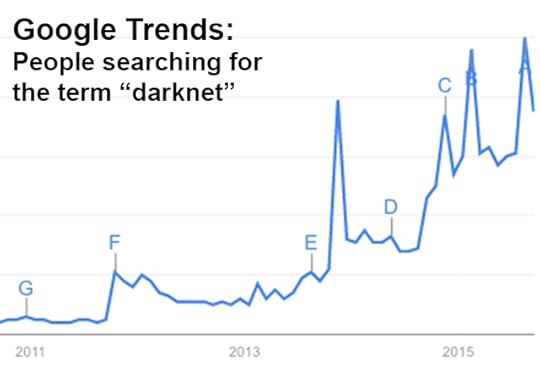
Google Trends shows society’s growing in the darknet
5.) Darknet customer base will grow exponentially
As shown above, the number of articles written, TV shows and documentaries produced, and headline-making court cases about the darknet has dramatically increased consumer interest.
People are naturally curious, but in the past have shied away because of rumors that anyone using the Tor browser would put them on some FBI watch list. Now, with plenty of Tor alternatives and reports of “normal people” exploring the darknet just for fun, far more Internet users are feeling it’s safe to dip their toes in the dark waters.
6.) The darknet marketplace will expand exponentially to meet customer demand
When U.S. government officials shut down Silk Road, the FBI seized 144,000 bitcoins, worth about $28.5 million. This one site alone was doing over $600 million per year in transactions.
It’s not easy to get reliable stats on the darknet economy, but when a $600 million site goes down, entrepreneurs see this as a ton of existing consumers looking for an alternative marketplace.
While this probably falls into the “I’m-smarter-than-the-other-guy” theory of counterintuitive entrepreneurship, every public failure of darknet markets will inspire hundreds if not thousands of freethinking opportunists.
Public court documents are nothing short of a how-to-manual for entering the darknet business arena.
Internet security firm, Trend Micro, foresees “the rise of new, completely decentralized marketplaces” that rely on Bitcoin’s blockchain technology. They predict this technology will be used “to implement full-blown marketplaces without a single point of failure”, guaranteeing trust and safe transactions.
7.) Private delivery services will crop up to insure untraceable, secure, and anonymous delivery
Think in terms of a silent and anonymous flying-driving drone that appears invisible to street-cams, radar, and infrared scanners and logs no record of its pickup and delivery points.
This is a machine that no one controls, other than to insure it’s operational, perform routine maintenance, and collect the money in the form of Bitcoin that is paid for every time it’s used.
In a few years, I can imagine a small fleet of these vehicles in every major city, never parking in the same place, with mobile maintenance units meeting vehicles in random locations to perform standard upkeep.
8.) A uniquely-crafted avatar will soon emerge as the first celebrity face and voice of the darknet
Having a celebrity avatar as the “face of the darknet” is a natural evolution of the darknet going mainstream.
While Edward Snowden, Julian Assange, and Chelsea Manning have become some of the more visible personalities for whistleblower activity, there are many more who are passionate about righting the world’s wrongs that are wishing to stay far more anonymous.
The first celebrity avatar will likely be a college team testing the limits of their darknet prowess, but will evolve quickly under the media spotlight.
9.) The darknet will invent its own justice system
When something goes wrong on the darknet, there are no police, court systems, judges, or lawyers to talk to. For this reason, a number of darknet “fixer” sites will spring up to manage the failures in a way that can only be described as darknet justice.
Second Life and many other virtual world sites lost tons of prospective users because they weren’t able to resolve consumer conflicts.
While darknet justice may not be a “systems approach” to resolving conflict, it could evolve into a more procedural system that everyone buys into.
Final Thoughts
Much like our right to bear arms, the same freedom that gives us the right to own guns and protect ourselves, puts guns into the hands of evil-doers and some of these guns can be used against us.
Yes, there’s a downside to every new technology.
The same darknet that can be used by whistleblowers, political dissidents, and freedom of speech advocates can also be used for nefarious activities by trolls, anarchists, perverts, and drug dealers.
In 1990 the National Society for the Prevention of Cruelty to Children estimated that only 7,000 images of child pornography were in circulation, making it a low priority issue. However, by 2009 with the aid of a high speed Internet, the U.S. Justice Department recorded 20 million unique computer IP addresses actively sharing child pornography files.
At the same time, political activists are mapping out ways to use the darknet and Bitcoin to topple corrupt governments.
When it comes to the darknet, does the good outweigh the bad? Is this a debate that will ever go away?
I’d love to hear about your experience on the darknet. Are you a proficient user or new at it, and what has been your experience?
Author of “Communicating with the Future” – the book that changes everything
The post The Future of the Darknet: 9 Critically Important Predictions appeared first on Futurist Thomas Frey.
August 28, 2015
The Day the Banking Industry Died
It was rather anticlimactic when it finally happened, but the front door simply failed to open.
There was no “going out of business” sale, no press conferences, no people gathered around to claim what was theirs. Instead, this once bustling institution that built the tallest building in Cleveland, Ohio, full of glass and fancy furniture, had breathed its last breath.
Make no mistake, the rich colorful legacy of the banking industry will fill countless future studies as people analyze and scrutinize past business dealings over the decades ahead, but the days of being able to walk into an actual bank building and make deposits and withdrawals just came to an end.
Far noisier endings had come a few years earlier in 2037 when Chase, Citigroup, Goldman Sachs, and Wells Fargo closed their doors. But this last bastion of teller windows and hand written deposit slips, and the handful of aging customers who still frequented it, had been hemorrhaging cash for some time, and with this silent ending the banking era had officially come to a close.
When it comes to money, it’s all about trust. Once consumer confidence and trust begins to erode, it becomes a mammoth task to regain it.
Like many businesses of the past, the money world focused on people with money, leaving countess millions either unbanked or under-banked. But in a highly connected world, where every consumer has networks, influence and value, eyeballs count.
For some, banking leaders were the notorious puppet masters who manipulated the stock market, created new legislation, and made self-serving decisions that favored the rich and powerful at the expense of everyone else. To others, they were merely hardnosed business people making the most of their position to keep investor returns high.
As an industry that had been artificially propped up with innumerable laws and a banker-friendly political system funded by banker-friendly rich people, the final days were delayed far past the time when the first foot entered the coffin. But all industries will eventually end, and this is the story of this one.
Is this a realistic scenario? If so, what are the key factors we should be paying attention to today? The answers will probably surprise you.

The J. P. Morgan & Company bank building in Manhattan in 1915
Banking, the Early Years
Lest we forget, the banking industry is a relatively young industry, coming into its own less than two centuries ago.
Junius and J.P. Morgan were the father and son duo credited with bringing banking and finance to America. In the early 1800s, Junius Morgan helped George Peabody solidify America's ties with the capital markets in England. The English were the primary buyers of the state bonds being used to build up America.
In 1895, J.P. Morgan, took over the business and leveraged the relationships his father built to launch the U.S. into the industrial era at breakneck speed.
Early Wall Street banks gave new meaning to elitism. No regular person was allowed to walk into the House of Morgan and open a bank account.
Ironically, even as recently as 70 years ago, most banks simply refused to do business with the little guy.

Suffering through the heart of the recession
The Beginning of the End
Early signs of trouble started to come to light even prior to the 2007-2008 recession, a recession many attributed to the shenanigans of key industry executives, none of which were ever charged for their role in manipulating the markets.
In 2000 with the dot com world crashing, the Federal Reserve lowered rates 11 times - from 6.5% in May 2000 to 1.75% in December 2001.
After the terrorist attack on the World Trade Center in 2001, the Fed continued slashing interest rates to avoid a recession.
In June 2003, the Fed lowered interest rates to 1%, the lowest rate in 45 years, creating a flood of available credit.
Easy credit and the upward spiral of home prices made investments in higher yielding subprime mortgages the new gold rush.
By 2004, U.S. homeownership peaked at 70%.
Consumer demand drove the housing bubble to all-time highs in the summer of 2005, a bubble that ultimately collapsed in August of 2006.
2006 saw a 40% decline in U.S. home construction.
During February and March 2007, more than 25 subprime lenders filed for bankruptcy and as home prices plummeted, the whole financial system started to unravel.
Similar to many other banks, HSBC reached peak employment in 2007 with 315,520 full-time employees, dropping to 208,000 in 2015.
The 2007 recession caused a total collapse of confidence and trust in the global financial system. But even more significant than the loss of confidence and trust, the entire financial system including every rusty bolt, nut, and overcharging scheme for consumers lay fully exposed for the world to see.
With political leaders racing to compensate for bad systems, adding layer upon layer of regulatory oversight, entrepreneurs everywhere suddenly realized how vulnerable the entire financial industry was.

Over 8,000 fintech startups have already launched and the numbers keep growing
Enter Fintech
Even before the recession a number of startups in the financial technology, or “fintech,” space began percolating.
Good entrepreneurs have a way of sniffing out where money and opportunity coexist, and the banking-finance world was not shy about flaunting their lavish lifestyles and opulent trappings, revealing many of the underhanded dealings that made them rich.
Armed with a righteous contempt for old school banking practices, a contempt that plays well in sound bites on social media, fintech companies began showing up in all aspect of the financial marketplace including exchanges, investment systems, networks, brokerages, research, and risk management.
Bitcoin, the mysterious godfather of cryptocurrencies was launched in 2009 with the promise of automating “authority” out of existence.
As we transition from national to global systems the concept of “authority” becomes a reoccurring theme. In this context, technology has changed the very definition of business, forcing regulators to reassess their own role and authority.
Is Uber a taxi company or simply a “lead generation” service for entrepreneurs?
Is AirBNB in the hospitality business or simply a “tenant finder” for the real estate industry?
Are coworking operations part of the real estate industry or in the collaboration business?
Is Lending Club a new kind of banking loan service or is it in the resource coordination business?
Emerging business models are rapidly showing how archaic and narrowly defined our regulatory systems have become.
Fintech Feeding Frenzy
In 2015, with over $12 billion of VC funding stoking the fires, the number of fintech startups swelled to over 8,000, each attacking tiny pieces of formerly protected banking turf.
Much like an underwater feeding frenzy with countless piranha-like startups eating every possible ounce of flesh from the banking industry’s bones, we are witnessing an epic transition in the banking finance world.
Many executives inside the large institutions are fully aware of the customer-stealing disruptions happening outside their walls, but internal legacy systems make it impossible for them to shift strategies.
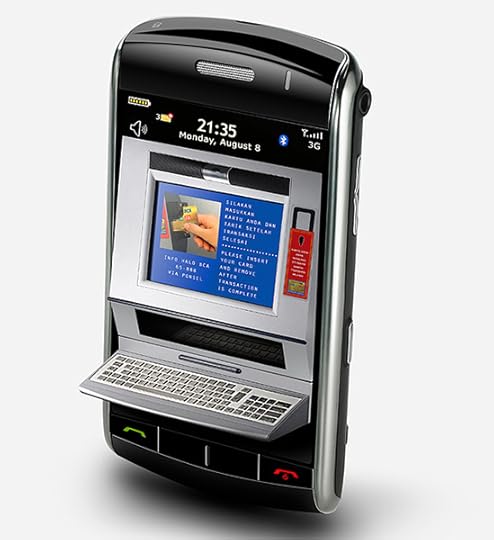
What will the bank of the future look like?
Defining the Bank of the Future
The future of banking will be mobile, happening in devices we carry in our pockets, built into jewelry, and on our wrists, not in fancy office buildings.
In less than five years, smartphones, watches, and other devices will replace credit/debit cards, wallets, lenders, stockbrokers, and insurance agents.
They will even allow us to transfer money around the world instantly, into different currencies, for virtually no transaction fee. Western Union currently dominates the $583 billion a year "remittances" business and collects transaction fees of 9%. Facebook and others are getting into this market with lucrative business models charging only a fraction of that amount.
Trusted retailers and grocery stores will allow customers to store money in private accounts, circumventing the need for traditional bank accounts. Leveraging data from shopping habits and loyalty cards, approved shoppers will be able to instantly borrow money at the point of sale, select the best payment schedule, and not have to worry about compound interest or hidden fees.
Early adopters will be Millennials and the unbanked poor people of the world. With very little to lose, and unusual incentives to participate, a banking revolution comprised of low-cost tech solutions used by industry outsiders will begin to infect nearly everyone on the planet.
By 2020, peer-to-peer lenders are projected to be handling 30% of the established loan business in the U.S. Traditional banks are already devising ways to participate with peer-to-peer lenders to better manage their portfolio.

How long before the banking system as we know it comes to an end?
Final Thoughts
Since the 2007-2008 recession, banks have done little to regain consumer confidence and trust.
A recent Viacom Media poll of 10,000 Americans found that 4 of the 10 least-loved brands in the U.S. are banks, and a full 71% said they would rather go to the dentist than listen to what a banker has to says.
Banks that survive the coming decades will look far more like tech companies than traditional banks.
With global systems beginning to coopt national systems, fintech startups reaching unicorn status ($1B+ valuations) in record time, and global currencies gaining traction in the cryptocurrency space, banks are in for some turbulent years ahead.
Since money is at the heart of nearly everything, it’s hard not to have a dog in this fight.
That said I’d love to hear your thoughts. Is the banking industry doomed as many are predicting, or will they reinvent themselves and retain control as we enter this new era?
Author of “Communicating with the Future” – the book that changes everything
The post The Day the Banking Industry Died appeared first on Futurist Thomas Frey.
August 20, 2015
Our Emerging Superhero Culture
When my oldest son Darby was 8 years old, he looked at his 3-year old sister, Shandra, and pointedly said, “She’s worthless! She couldn’t save anyone!”
I was always amazed at this line of thinking because somewhere in his mind our primary reason for living was to save people. For him, making a name for yourself was not about being a regular hero, but a superhero.
Whether it’s Iron Man, Batman, or Captain America, people have become enamored with superheroes. But it’s not just in the movies, superheroes are showing up on clothing, on billboards, on talk shows, and they are even entering our corporate culture.
Growing from 10% of our top movies in 2010 to 50% in 2014, the superhero culture is growing rapidly and in ways we may not imagine.
These fictional characters are no longer the playground of the under 20s. Rather, they’ve become big business, and with many superheroes born in the 30s and 40s, even those in their retirement years feel a kindred spirit towards them.
To many, comic books have become far more important than classical literature, the artwork more memorable than classical paintings, and the underlying philosophies more important than politics, religion, and traditional beliefs.
Superheroes transcend politics. They cross national, social, and geopolitical borders and give hope to the downtrodden, inspiration to the oppressed, and a narrow window of escape for the beleaguered and exploited.
Most importantly they make life fun again.

They may have been created by kids, but they’re big business today
Superhero History
Born out of the post-depression era, superheroes symbolized something far more important than fictional characters; they symbolized the power to overcome any adversary for a new generation.
Superman was created by Jerry Siegel and Joe Shuster in 1933 and later sold to Detective Comics (DC Comics) in 1938.
Batman was created by artist Bob Kane and writer Bill Finger, and first appeared in Detective Comics #27 (May 1939).
Moe Goodman founded Marvel Comics in 1939 and hired his wife’s cousin, Stan Lee, to work as his office assistant.
Stan Lee, in collaboration with several artists like Jack Kirby and Steve Ditko, helped create such notable characters as Spider-Man, the Hulk, the Fantastic Four, Iron Man, Thor, X-Men, and many more.
The famous first cover of Captain America showed him slugging Adolph Hitler in the face. It hit newsstands, where comic books were typically sold, about a year before the U.S. officially announced its involvement World War II.
The August 1962 edition of Amazing Fantasy, featured "The Amazing Spider-Man" and it became Marvel's best-selling issue in months. Spider-Man quickly earned his own comic and became, in Stan Lee’s words, "America's most different new teen-age idol."
Though Bob Kane created the first Batman comic just one year after Superman's debut, Batman has since evolved many times.
Michael Uslan is credited with bringing Batman into the modern era by producing Tim Burton's 1989 Batman (staring Michael Keaton), the top-grossing movie of the year.
The film's success spawned three sequels: Batman Returns (1992), Batman Forever (1995) and Batman & Robin (1997).
In 2005, Batman Begins was released to theaters as a reboot of the Warner Brothers film series, directed by Christopher Nolan and starring Christian Bale as Batman. Its sequel, The Dark Knight (2008), set the record for the highest grossing opening weekend of all time in the U.S. and was followed by The Dark Knight Rises (2012).

You may not realize it, but every business is in the superhero business
Eleven Timeless Values of Superheroes
Since superheroes are as varied and different as the people who create them, there are no one-size-fits-all formulas for inventing them.
Here are eleven unusual qualities that make superheroes super-valuable:
1.) Superheroes are Timeless – Superman is now 82 years old and Batman, a mere 76. They are not only timeless, with their ability to morph with the fashion industry, physical trends, and new forms of art to add realism, they look far better now than ever in the past.
2.) Scandal-Proof Reputations - Unlike having fallible humans like Bill Cosby, Jared Fogle, Lance Armstrong, or Charlie Sheen serving as the spokesman for Jell-O, Subway, Nike, or Fiat, a superhero endorsement means you’ll never have to worry about a personal scandal, negative headlines, or being thrown into crisis management mode.
3.) Network Effect of Brand Value – Whenever someone mentions Spiderman, Daredevil, or the Flash in any form of media, the value of the brand increases. Each superhero character is a piece of intellectual property that grows exponentially in value along with every hyperlink between heroes as well as every crosslink between online and offline channels.
4.) Defendable Form of Intellectual Property – Every superhero is a living, breathing trademark that can be managed and defended in court. Disney has made a fortune defending its characters and will continue to do so long into the future.
5.) Never Ending Storylines – Superheroes have super problems, and every problem creates another story to be told. Unlike formulaic television shows where they run out of good material, being a superhero is a never-ending journey. They can live on forever.
6.) Always Politically Correct – They may get it wrong in the beginning, but as constantly morphing characters they can change along with the times.
7.) The More Evil the Villain, the More Valuable the Superhero – Villains are important. Without a good villain, there is no one to hate and no bad person to overcome. What would Star Wars be without Darth Vader, or Superman without Lex Luther, or Daredevil without Kingpin?
8.) They Transcend Issues of Race, Ethnicity, and Gender – Superman is not Japanese, Croatian, Indian, or American. Superman is an alien, born on another planet and living on earth. Do we think less of him because he’s alien? Not at all. We admire superheroes for what they can do, not their skin color, heritage, or gender.
9.) They Symbolize Hope – Children in even the most depressed neighborhoods in India, Africa, and Brazil can be inspired and dream of better times ahead when they immerse themselves in the lives of their favorite superhero.
10.) Reliably Trustworthy – They are better than we are. Sure they make mistakes and live complex fictional lives, just like our complex real lives, but their intentions are good, and we can always trust them to do what’s right in the end.
11.) Knows the Difference Between Right and Wrong – You can always count on a superhero to make the right decision even when it appears there are no right answers available. Superheroes have made a fine art of beating the no-win “prisoners dilemma” as it plays out in its many forms.
Final Thoughts
We are entering a “superhero era.”
Each of us think about superheroes differently, but they are far more than entertainment.
For many, they add purpose, meaning, and inspiration to a world often devoid of those qualities.
Some will use superhero-logic to decide their career path, who to marry, and where to live.
For others, they prove to be the reason for getting up in the morning. They remind people there is a better “you” waiting to get out.
In some extreme cases they are a deciding factor between suicide and finding new reasons to live.
Superheroes are serious business, and until you come to grips with exactly how serious, you’ll be missing countless opportunities in the years ahead.
Author of “Communicating with the Future” – the book that changes everything

The post Our Emerging Superhero Culture appeared first on Futurist Thomas Frey.
August 13, 2015
Teaching Robots to Fight Wars
A robot does not kill someone out of fear, anger, or desperation. They kill because someone told them to do it. At least that the way it works with our current generation of robots. What comes next may be a different story.
Normally, when we think about war, it has to do with countries using their armies to fight other countries, or in the case of a civil war, countries torn apart by internal rival factions.
But that line of thinking is far too narrow for the conflicts in our future as our choice of weaponry and choice of battlefront continues to expand.
From my perspective, the traditional country vs. country war tends to be far more about political theater, a theater that plays out on the world stage in full view of the public, than the subversive battles being fought over countless levels of minutia in the background.
In fact, very few wars are being waged between countries.
Consider an example of an industry war where the use of steel is threatened by a new synthetic material, and the entire industry decides to go to war.
Since this new material threatens the very livelihood of this lucrative and well-established industry, a black-ops steel team goes to work.
Using a multi-pronged approach, the team first launches an intellectual property war, filing a series of patents along with a series of patent infringement lawsuits, to delay production.
At the same time studies are commissioned to uncover any possible danger with the core ingredient including such things as potential danger to handlers, danger to children and pregnant women, environmental dangers, and more. Once the studies are in its only a matter of manipulating the results to sway public opinion.
Generally speaking, if a mature industry decides to declare war on an emerging technology, the new kid on the block generally doesn’t have a chance. Covert resources can be used to change public perception, alter tariffs, rewrite standards, plant damaging articles in blogs and industry press, and destroy the personal reputation of key players in the fledgling business.
If you think this scenario is a unique story, you’re not paying attention. And adding robots and automation to this type of war will be like pouring gasoline on a fire.
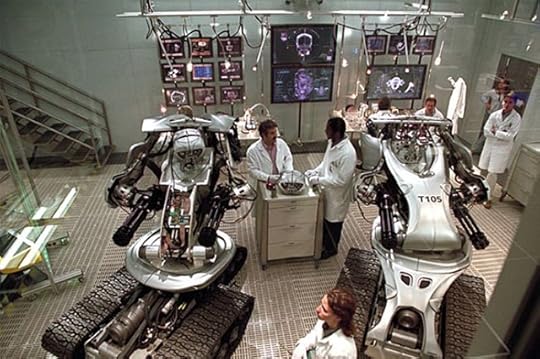
Military robot laboratory
Calling for a Ban on Autonomous Robotic Systems
A number of influential people are now calling for a ban on autonomous robotic systems in war, but this will be impossible to implement in any effective way.
It’s impossible for two reasons. First, because it will not be possible to define autonomous and robotic systems in any meaningful way, and second, because it will not be possible to define war.
In many cases, the benefits of technology far outweigh the downside. Robots don’t need to take breaks, stop and eat lunch, or get scared of loud noises. They don’t need to wear eye protection when its dusty, put breathing masks on when there’s chemicals in the air, or spend time finding clean water to drink.
Defensive robotic systems are generally programmed differently than offensive ones, but even a rescue robot can be instructed to kill anything that impedes with a rescue.
Similarly, a troop transport can easily be coded to automatically kill or destroy anything that prevents it from getting to its destination. However, it will also be easy to leave the troops out and send an automated troop transport like this directly into the heart of an enemy camp and this vehicle that was intended to be an automated “defensive” system quickly becomes the most lethal “offensive” tool in the arsenal.
Rethinking Autonomous Robotic Systems
Whatever label we place on automation used in war, there will always be an exception or workaround.
An autonomous robotic system is generally one that “thinks” or makes some limited set of decisions for itself. The thinking part comes into play with a complex set of AI algorithms capable of simulating human decision-making. Couple this with a walking, talking machine and there is plenty of room for alarm.
The popularity of recent movies like Terminator and Ex Machina are giving us a few glimpses into the potential downside when we take the human completely out of the loop.
But as frightening as the potential downside may be, we’re not there yet. Not even close. In fact, we’ve only taken the first step, in what may very well be a thousand step journey, and there are innumerable benefits that can be gained from taking the next few steps.
Autonomous robotic systems are what pilots a driverless car, boat, or tractor. They will be used to walk our dogs, fly drones, harvest apples, cook our food, pick up trash, and do all the things we don’t want to do.
When it comes to security, they will watch our homes, protect our children, guard our wealth, and keep us healthy.
For every negative scenario there are a thousand positive ones to offset it, at least for now. However, every new technology, created with all the best intentions, has the potential for getting coopted and turned into a tool for destruction.
Since all of this technology is still evolving, and evolving in ways none of us can understand, it is far too early to start placing limits on how it can be used.

Religious wars, culture wars, and language wars are only the beginning
Rethinking Battlefronts and the Concept of War
Just as our tools change so does our concept of war. The power and influence of an individual will grow exponentially as more tools and technology becomes available to everyone.
As a way of sparking your imagination, I’m listing a few of the emerging battlefronts as we go through this process of redefining war.
Data wars
NGO wars
Religious wars
Culture wars
Language wars
Reputation wars
Standards wars
Intellectual property wars
Personal property wars
Advertising wars
Political wars
Artificial intelligence wars
Drug wars
Legacy wars
Lifestyle wars
Automation wars
Time & freedom wars
Ownership wars
Enforcement wars
Nutrition wars
Game wars
Innovation wars
Biotech pandemic wars
Nanotech wars
Heritage wars
Network wars
Emerging tech wars
Wars of perception
Isolation wars
Economic wars
Industry wars
Autonomy wars
Redistricting wars
Tax wars
Yes, a war that involves guns, bombs, and killing people is vastly different than a nutrition war or a lifestyle war. But to some, destroying a person’s reputation, social network, and their legacy may be a fate far worse than dying on the battlefield.
Final Thoughts
In the past, wars have been based on intense emotions such as anger, hatred, and fear.
However, unmanned robotic systems can be designed without the same intense emotions that cloud judgment or result in anger and frustration with ongoing battlefield events.
Automated intelligent systems can integrate more information from more sources far faster before responding with lethal force than a human ever could in real-time.
We run an extreme risk of letting Hollywood influence our thinking in this area. Autonomous systems have the potential of creating a far safer world for us to live in, but that should in no way be construed as living in a world without struggle.
Whether they’re personal battles, corporate battles, or cultural and religious battles, we will all have more than enough challenges to go around, and robots are destine to play a big part in that future.
By Futurist Thomas Frey
Author of “Communicating with the Future” – the book that changes everything
The post Teaching Robots to Fight Wars appeared first on Futurist Thomas Frey.
August 4, 2015
Future of the Internet – 8 Expanding Dimensions
In March of 1989 when Tim Berners-Lee wrote the first online message that would eventually lead to the World Wide Web, it was similar to the first car leaving an inventor’s workshop.
The highway system for cars started on horse and buggy trails and the Internet was born on switching networks designed for telephones. With roads turning into sophisticated highways and phone lines morphing into fiber and wireless networks, we begin to get a sense as to where we’ve come from.
But when it comes to an Internet with a gazillion devices talking to another gazillion devices, streaming audio-video, and a global user base that is rapidly climbing, where are the opportunities that will arise from a next-gen Internet?
With the Internet being a multidimensional communications network, I like to think of it from the perspective of being inside a bag with people pushing on all of the outer walls simultaneously.
The future of the Internet is not any one thing, it’s many.
For this reason, I’ve broken the transformative nature of the Internet into eight causal dimensions, and I’ll use these dimensions to describe how each is expanding our understanding of this super complex mechanism.
Eight Expanding Dimensions
Speed
Pervasiveness
Capacity – Data Transmission, Processing, & Storage
Durability
Human Interfaces
Dimensionality
Privacy, Security, Trust, Ethics, & Standards
Intelligence
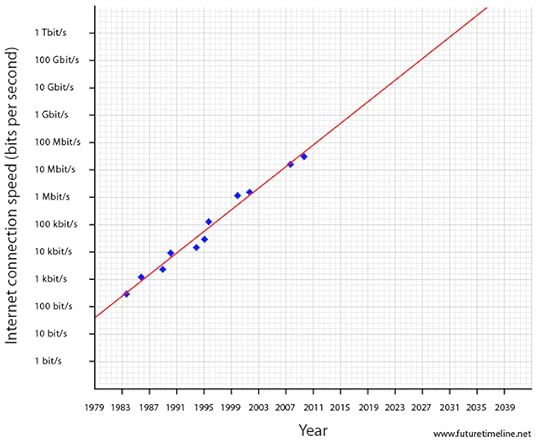
Nielsen's “Law of Internet Bandwidth”
1.) Speed
Nielsen's “Law of Internet Bandwidth” says that users' bandwidth will grow by 50% per year (10% less than Moore's Law for computer speed). The new law fits data from 1983 to 2014.
The dots in the diagram show the various speeds of the Net ranging from early acoustic 300 bps modems in 1984 to the 120 Mbps lines in 2014. The data points are impressively close to the exponential growth curve for the 50% annualized growth stated by Nielsen's Law.
NOTE: The y-axis is based on a logarithmic scale, making the straight line in the diagram an exponential growth curve.
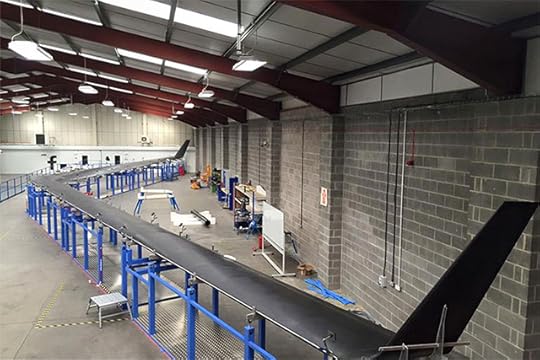
Facebook’s Aquila has the wingspan of a 737 but weighs hundreds of times less
2.) Pervasiveness
It may seem ironic, but many users are still discovering the Internet for the first time. Penetration rates continue to climb from roughly 16 million in 1995 to around 3 billion today.
Even though some are expecting the number of directly connected users to level out around 4 billion over the next decade, the number of people indirectly connected will soon be nearly 100%.
Both Larry Page and Mark Zuckerberg are driving the effort to create a more pervasive Internet filled with satellites, drones, and balloon systems that connect us to even the most remote regions of the earth.
Google Chairman Eric Schmidt predicts virtually everyone will be connected in some manner by 2020, with each of these 7 billion-plus unique nodes becoming a critical source of data collection and transmission.

3.) Capacity – Data Transmission, Processing, & Storage
An exabyte is the equivalent of 1 billion gigabytes. A zettabytes is 1 thousand exabytes.
After sifting through hundreds of conflicting reports on projected data capacity, I found it difficult to describe what’s happening in this space in ways that most people can understand.
As an example, Cisco projects “the data created by Internet of Everything will reach 403 zettabytes per year by 2018, up from 113 ZB in 2013. By 2018, these devices will create twice the amount of data end users send to data centers and be 47 times greater than total data center traffic.”
At the same time, over 90% of Internet traffic is video, and the Internet wasn’t designed for this level of video data.
“Big data” has no official definition. Rather, it refers to huge volumes of data that are created, captured, and analyzed.
Big data is becoming increasingly critical in the day-to-day operation of society, adding amazing levels of insight into social structures and fascinating details about the ever-changing human experience.
Recently President Obama signed an executive order to fund the world’s first “exascale” computer to come online in 2025.
Exascale computing refers to computing systems capable of at least one exaFLOPS, or a billion billion calculations per second. Such capacity represents a thousand fold increase over the first petascale computer that came into operation in 2008.
While this sounds impressive, it’s just one complex computer that will inevitably be outdated soon after it’s been built.
Transmission, processing, and storage are all interrelated. The Internet cannot progress unless all three are somewhat in equilibrium.
To put the exponential growth of Moore’s Law into perspective, researchers at FutureTimeLine project:
By 2030, a micro-SD card (or equivalent device) will have the storage capacity of 20,000 human brains.
By 2043, a micro-SD card (or equivalent device) will have a storage capacity of more than 500 billion gigabytes - equal to the entire contents of the Internet in 2009.
By 2050 - if trends continue - a device the size of a micro-SD card will have storage equivalent to three times the brain capacity of the entire human race.
4.) Durability
How resilient is the Internet itself to attack? Will it survive military strikes, deliberate hacker assaults, immense solar flares, or even a massive downturn in the global economy?
Perhaps the most insidious demon of all will be the relentless aging of legacy systems over time.
As of July 2015, there were 13 root servers that controlled the Internet. Originally there were 13 physical servers with 10 located in the U.S. and the other three located in Stockholm, Amsterdam, and Tokyo.
However, for durability purposes, there are no longer location-specific physical servers. Rather each server operates in multiple geographical locations using a routing technique called “anycast” addressing. This means that every root server uses redundant equipment to provide reliable service even if there is a failure of hardware or software.
Even though there are only 13 root servers per se, servers now exist in multiple locations on different continents, and the number is growing along with the demands of the Internet.
At the same time, all of the operational equipment driving the Internet has a definable life expectancy, as do the systems, people, and methodologies. This is no different than any other piece of infrastructure.
The overall management of the Internet is handled by ICANN, an international non-profit based in California. They are charged with ensuring the network's stable and secure operation.
Over the coming decades, the durability issue will come front and center. Building a World Wide Web for long-term survivability, sustainability, and economic viability will be in everyone’s best interest.

Will the future Internet be a lonely experience or an engaging one?
5.) Human Interfaces
It all started with the keyboard, pushing buttons to form words, translating letters into meaningful phrases.
For those who did poorly with brain-to-keyboard coordination, our early text-based Internet was not a friendly place.
Then along came the mouse and hyperlinks, and the typing experience suddenly turned into a surfing experience. As connection speeds improved, we added graphics, animated gifs, charticles, and videos.
After countless years of research, we now have input devices that can understand common speech and the gaming world has turned gesture controls into a performance art.
So what comes next?
We still have a long ways to go before we will have a well-functioning brain interface, but we will take many baby steps every year as we inch our way in that direction.
Optical interface devices such as augmented reality and virtual reality are picking up steam. Google Glass, Microsoft HoloLens, Facebook’s Oculus VR, and Samsung’s Game VR are all part of a growing cadre of devices aimed at rewriting how we experience the world.
As we add growing levels of intelligence to everything around us, our devices will begin making many of our decisions for us. For example, driverless cars will eliminate the need for us to make 10,000 micro decisions per hour while we drive.
Smart homes will know when to heat and cool a room, turn lights on and off automatically as we need them, and play perfect music at the perfect volume to match our ever-changing moods.
6.) Dimensionality
When the Internet first began, it was simple crude computers linking to other simple crude computers. Over time, mainframes gave way to personal computers, and wireless modems paved the way for smartphones, tablets, watches, and a myriad of other devices.
As the Internet of Things added connection to objects we never dreamed connectable, we began adding an entirely new dimension to the Web.
Sensor technology is expected to break through the “trillion sensor” threshold around 2024, creating data streams from virtually every surrounding surface.
We will soon see sensors embedded on the sides of house, bridges, cars, and even woven into the fabric of our clothing.
In addition to sensors, microchips will add computational power to whatever is being detected.
Skin sensors and body sensors combined with microchips will monitor a person’s health in real time.
3D printing will soon be embedding tiny sensors, microchips, and transmitters into commonly printed objects. Solar cells will be printed onto roofs, pavement readers will be printed onto roads, and identity transmitters will enable world travelers to avoid security and customs lines everywhere.
Future devices will tap into ambient power in a form of wireless energy, so we will no longer have a need for cords, or be limited by batteries, or have to remember to plug things in at night.
Every new sensor, microchip, transmitter, and receiver will add tiny new dimensions on the micro-scales, while satellites, drones, and balloon systems will add macro-scale dimensions.

Who are the watchers watching the watchers, and what do they know that we don’t?
7.) Privacy, Security, Trust, Ethics, & Standards
Over two years have now passed since Edward Snowden broke ranks with the NSA’s spy culture, showing the world what kind of holes we have in our so-called private lives.
At the same time, the number of bad actors intent on taking down major businesses and entire countries is climbing, and surveillance technologies are a hugely important tool for tracking down those with evil intent.
More security means less privacy, and more convenience means less security. Much like playing a constant rock-paper-scissors game, we are still a long ways from solving the privacy-security-convenience game.
So where does that leave our privacy?
Radical transparency advocates still believe that a fully transparent world will be a far safer place, exposing those with malicious intent long before any damage is done.
But a radically transparent world will mean knowing everything about every other person, including their bank accounts, credit card numbers, and passwords. In this scenario we lose our ability to own things, a foundational premise on which today’s world has been built.
Since the Internet runs on data, will it ever be possible to reach some sort of equilibrium between the constantly shifting norms involving privacy, security, trust, and ethics?
In January, President Obama proposed a “Privacy Bill of Rights,” but so far it hasn’t received much support. Privacy is a global issue and not a standard that can be imposed by a single country.
In the future, we will need something akin to a “Geneva Convention on Privacy,” to establish global standards along with practical guidelines, legal definitions, definable limits, monitoring tools to signal whenever there is a privacy breach, and enforcement provisions for handling abuse.
Even though privacy gets most of the attention, it’s the incestuous relationship between privacy, security, trust, ethics, standards, and several dozen more philosophical underpinnings that are preventing the Internet from reaching its full potential.

Will artificial intelligence be better than “swarm intelligence?”
8.) Intelligence
Whether it’s human intelligence or artificial intelligence, or a combination of both, the Internet is the tide that raises all boats.
The Internet gives us the ability to function together in a form of swarm intelligence. Think of a “swarm” as a cohesive grouping of individuals, all working together as a dynamic unified system.
Nature had demonstrated that social creatures, by functioning together in closed-loop systems, can outperform the vast majority of individual members when solving problems and making decisions.
As humans, we don’t possess the natural ability to form real-time swarms, but Internet technologies can help fill in the missing pieces, using artificial means to form the critical interstitial connections.
Most people who try swarming agree – swarms are fun. In a study performed recently at California State University with college seniors, 60% rated the experience of swarming as “very fun” on a subjective scale, with no users expressing negative feelings.
In the coming years, human swarming will transition from an intellectual curiosity to a powerful tool that unleashes group intelligence in a wide variety of fields, applications, and settings.
A future Internet will even help us expand our understanding of what intelligence is and how to apply it.
Final Thoughts
When we look at technological innovations of the past 1,000 years, the Internet is probably the one that has had the greatest impact on everyday life in developed economies.
Cisco says that the number of mobile-connected devices exceeded the world’s population in 2014, so it’s safe to say that the rest of the world is not far behind.
As the Internet expands, the impacts will be even more significant than what we’ve experienced so far.
It will diminish the meaning of borders, and new “nations” of those with common interests will emerge online and exert influence far beyond the capacity of our current nation-states to control.
An Internet-enabled revolution in education will spread more opportunities with less money spent on buildings and teachers.
Major businesses and even entire industries will form, expand, and collapse far faster than ever before.
Every business, every institution, and every individual will feel the effect of our every expanding Internet.
But contrary to the way Hollywood likes to portray it, our future Internet is not Skynet. The Internet itself is neither good nor bad. It will be up to us to define how it affects each of our lives.
By Futurist Thomas Frey
Author of “Communicating with the Future” – the book that changes everything
The post Future of the Internet – 8 Expanding Dimensions appeared first on Futurist Thomas Frey.
July 17, 2015
Will Coworking Replace Colleges?
When I first brought up the idea of coworking taking over colleges, it seemed like an absurd notion. But there is a secret reason that very few people are grasping.
At first glance, the highly structured ivory towers of academia seem to be on the opposite end of the spectrum from the unstructured anything-goes world of coworking. But the more I thought about it, it seems inevitable that the two are on a collision course.
In fact, it’s already happening, but not in the ways you may imagine.
Geekdom, a San Antonio-based coworking hub launched in 2012, has piloted an educational program called SparkEd where over 1,500 young people have enrolled in their workshops and "weekend camps."
In Baltimore, the team behind Betamore has positioned itself as a coworking campus for entrepreneurs and their technology. Its purpose is to invigorate the Baltimore ecosystem with a unique curriculum that is open to the community.
The Posner Center in Denver is a network of over 200 companies focused on the international development of agriculture, education, energy, health, infrastructure, microfinance, and various other fields. As a mission oriented coworking facility, they are very selective in who they choose to work with, and education and training courses are an every day occurrence.
Our work at DaVinci Institute is also a prime example with our 11-13 week DaVinci Coder courses for learning new programming languages in a coworking environment.
No, there are no coworking locations currently offering a four-year bachelor degree, but that’s exactly the point. The status that colleges think they’re conveying is not the same status that today’s young people care to receive.
In the emerging gig economy where 36% of all work is already being done by freelancers, Millennials no longer feel they have the luxury of blowing 4-5 years and a boatload of money learning abstract concepts when they can take a 3-4 month coding bootcamp and learn while doing actual work that they’re being paid for.
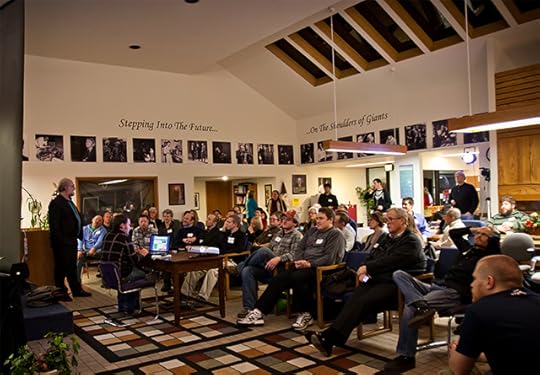
Recent DaVinci Coders workshop at the DaVinci Institute
The Recent Coworking Surge
So what is it about coworking, defined as membership-based workspaces where diverse groups of freelancers, remote workers, and other independent professionals work together in a shared, communal setting, so effective?
An estimated 20,000 coworking facilities currently dot the American landscape, and over 1,700 have signed their allegiance to the Coworking Manifesto, an online document that spells out the theory, philosophy, and working strategy of this new movement.
Here are ten stats explaining why coworking has become so insanely popular:
40% of the workers will be freelancers, temps, independent contractors and solopreneurs by 2020.
70% reported they felt healthier than they did working in a traditional office setting.
64% of coworkers are better able to complete tasks on time.
68% said they were able to focus better while co-working.
92% are satisfied with their co-working space.
91% have better interactions with others after co-working.
60% are more relaxed at home since co-working.
78% of coworkers are under 40.
90% said they felt more confident when working.
50% report higher incomes.
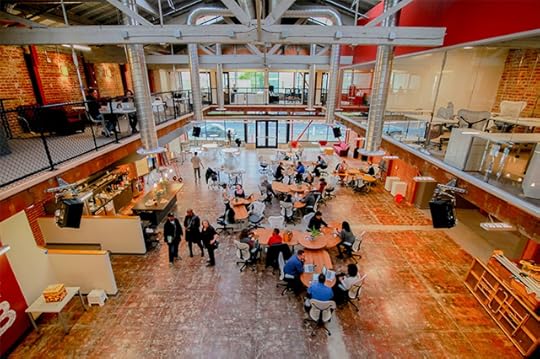
Flexible space for flexible projects, events, and traning
The Business of “You”
How many schools are currently prepping students to be “freelancer-ready?” In a word - none. It’s simply not happening.
Instead, the hard transition from student grunt to skilled worker is occurring in radically new ways - through friends, through trial and error, and through existing project workers.
Mentorship is quickly becoming the new classroom.
When LinkedIn founder Reid Hoffman says, “You need to think and act like you’re running a start-up,” he’s referring to your own career.
Every new free agent that enters the project-to-project job world quickly realizes that their growing lists of questions simply don’t have textbook answers. They have to find their own answers, and the quickest way is through peer groups and mentors.
Living in a country with the highest educated waitresses and bartenders in the world, an increasingly vocal underground feels they’ve been lied to. Academic credentials no longer live up to the promise implied with every new student loan that’s being applied for.
That’s one of the reasons coworking is becoming so trendy; they’re looking for a better network.
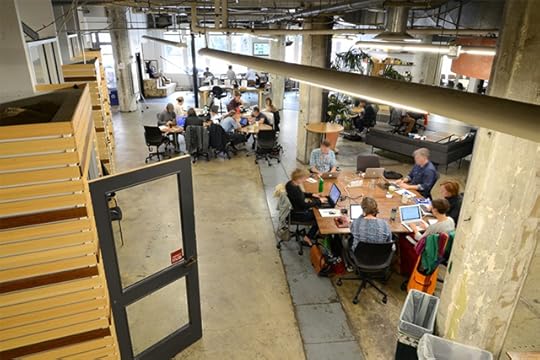
The business of "you" is being defined by your own social circles
Finding a New Path to Success
Anyone growing up has a rough idea of what they think success should look like.
For teenagers, their heroes are people who have launched their own video games, started a band, filmed a rockumentary, created a mobile app, written a graphic novel, or won a major video game tournament. To them, the accolades and notoriety that come with this kind of experience far outweighs the tedium involved in credentialing new skills.
For Millennials, nothing resonates quite like being involved in an authentic accomplishment-based learning experience where meaningful work is making a meaningful impact.
Experience trumps diplomas every day of the weeks.

Geeking out is an everyday occurrence
A Tech Industry that Doesn’t Care About Diplomas
Many of today’s tech gurus have been self-taught. Bill Gates, Tom Hanks, Madonna, Steve Jobs, Mark Zuckerberg, Michael Dell, Paul Allen, Ben Stiller, Brad Pitt, George Clooney, Matt Damon, and Sean Combs are some of the smartest and most influential people in the world, none of whom graduated from college.
When applying for a coding job, company interviewers are far more interested in a person’s capabilities than their time spent in academia. In fact a computer science degree will often work against them as it conveys far more theory and far less actual coding.
In the fast moving tech world where innovations are typically 7-10 years ahead of academia’s talent pool, those who can demonstrate jerry-rigged accomplishments and resourceful curiosity become the most sought after.
Emerging fields like augmented reality designers, virtual reality educators, user experience architects, artificial intelligence testers, search engine optimizers, and online reputation managers are all part of a growing lists of jobs that have no university pathway to get there.
Much like becoming a rock star, game designer, professional athlete, race car driver, or movie star, landing a dream job has never been about taking the safe route, especially since there’s virtually no such thing as a safe route anymore.
Game rooms are common in coworking spaces
Competing for Fun
Even though colleges get in trouble for promoting the fun side of campus life, it becomes a major part of every incoming student’s decision
Coworking facilities are also competing for the “fun” crowd, with many offering free beer, free food, ping pong, arcade games, air hockey, foosball, exercise rooms, indoor theaters, bocce ball, and more.
Will we see coworking sports teams competing against other coworking sports teams anytime soon? Yes, but it will probably be in non-traditional sports like ping pong, Arduino hackathons, and video game tournaments instead of football, baseball, and hockey.
Traditional tenant-landlord relationships simply don’t work very well in today's fluid society
The Secret Reason Why Coworking will Replace Colleges
We are moving into a very fluid society and traditional tenant-landlord relationships simply don’t work very well.
Signing a ten-year lease in a world being framed around exponential change measured in days rather than years is a quantum leap of faith most companies would rather not take.
Real estate has become a millstone around every fast-moving company’s neck.
For this reason coworking spaces have been quickly filling up with small corporate teams, telecommuters, and remote project groups, each of whom place a far greater emphasis on flexibility than cost and stability.
Colleges are being caught up in similar dynamics.
Since most colleges have large real estate holdings, they’ve also had to deal with rapidly escalating maintenance, janitorial, security, and facility overhead costs.
The inflexible cost of operations is running headlong into a world where shifting attitudes, lifestyles, and career goals are not only more common, they’re becoming the norm.
This means colleges in the future will not only have to deal with rapid ebbs and flows in student populations and staffing, but campus operations as well.
That’s why a host of hybrid coworking style experiments will begin to permeate campus life. Flexibility is key, and the rigid decision-making processes involved in most universities simply won’t work.
Final Thoughts
Colleges are in a scaling-down mode, many fighting to survive, while coworking is in a massive scaling up mode with big time investment money paving the way for rapid expansion.
In this rapidly escalating battle for talent, coworking is becoming cooler, trendier, less expensive, and far more fun than spending countless grueling hours in a classroom memorizing troves of terminology and squishy theories while watching the tuition meter in the front of the room click another notch higher with every word uttered from the professor’s mouth.
Will we see coworking universities in the future that offer college credits for doing freelance work? Yes, I believe this will happen very soon.
There are very few things in human existence that will remain untouched by today’s entrepreneurial teams scouring the world looking for new opportunities, and colleges have become a prime target.
Author of “Communicating with the Future” – the book that changes everything
The post Will Coworking Replace Colleges? appeared first on Futurist Thomas Frey.
July 9, 2015
The Coming of “Peak Car”
In what year will the number of cars in the world reach its peak and auto sales overall begin to decline?
For most, it may be surprising to realize we’re already there in the U.S. Growing data shows many wealthy economies have already hit “peak car,” a point of market saturation characterized by an unprecedented deceleration in the growth of car ownership, total miles driven, and annual sales.
Vehicle traffic grew at a staggering rate worldwide for decades. But that all changed in 2007. Some refer to it as the perfect storm with the combination of economic collapse, digital revolution, and major shifts in urban lifestyles.
Several alternative transportation startups also began in that timeframe led by the likes of Zipcar, Uber, Lyft, and SideCar. This was followed by the emergence of connected cars, growing electric vehicle markets, driverless cars, declining birthrates, and increasingly congested highways in virtually every major city in the world.
Mounting indicators are painting a clear picture of an automobile industry only a few years away from reaching the top of the bell curve in the rest of the world as well.
Even though the continent of Africa with its high birthrates and under developed infrastructure is a long ways from reaching its automotive peak, today’s wholesale shift in transportation thinking has caused alarm bells to ring throughout the entire automotive industry.
So how will this transformation play out?
In just a decade or so, owning a car may well be relegated to the hobbyist, luxury market, much like owning airplanes or horses today.
Relying on a personal vehicle, with personal responsibility for finance charges, licensing, taxes, repair costs, insurance, gas, oil changes, cleaning, and complying with 10,000 laws about parking, speeding, noise, pollution, stop signs, stop lights, and construction zones will soon be a thing of the past.
In fact, owning a car has become a painful experience. From the salespeople who sell you the car, to the finance guys in the background, to the cops watching your every move, it’s easy for car buyers to feel like tiny rodents with swarms of vultures circling overhead.
With a history of scam artists and con men leaving their indelible mark, the auto sales industry has begun a slow march towards is being regulated out of existence.
People have put up with it because they didn’t have any other good options. But new options are already here and more are on their way.

In the U.S. "peak car" happened in June 2005
Shifting from “Just-in-Case” to “Just-in-Time”
On a recent trip to Australia I was shown a house that was owned by Elton John. He owned it for 12 years but only showed up there once.
In the past, rich people were always defined by how much they owned. Real estate, expensive cars, vacation homes, and fancy jewelry have long been the symbols of greatness.
But today’s young people think about it differently. Our physical trappings weigh us down. They occupy our mind, cloud our judgment, and consume our time. Our possessions become our obsessions.
No, the world of physical ownership will not abruptly end over night. But the speed with which we begin to migrate in that direction is about to pick up.
We own a car just-in-case we need to go somewhere. But what if there were other options?
Today 144 million Americans spend an average of 52 minutes a day in their car, most of it spent commuting to and from work. In the future, we will not show up for work just-in-case we need to be there. Rather, we will figure out schemes for being there just-in-time, either virtually or physically, as the needs of business dictate.

On-demand transportation, anywhere, any time
On-Demand Transportation
If the average non-productive time spent in cars were eliminated, how else could commuters spend their extra 52 minutes a day?
Imagine stepping out of your house 10 years from now and using your smartphone to summon a driverless vehicle. Within 2-3 minutes a driverless vehicle arrives and whisks you off to work, school, shopping, or wherever you want to go.
On-demand transportation is already happening with companies like Uber and Lyft. If we eliminate the driver, costs will plummet.
According to Lux Research, by 2030, the self-driving car market will grow to over $87 billion.
Once the technology is perfected, on-demand transportation companies will crop up in most metropolitan areas with large fleets of vehicles poised to meet consumer demand.
It’s at this point where car companies will begin changing their business model, and rather than charging for each vehicle sold, they will partner with fleet managers and charge for every mile the car is driven.
The New Industry Model
Today, auto manufacturers are incentivized to sell cars, and the more cars the better. Well, it’s better for them but not better for the cities and countries that have to deal with the deluge of cars.
Car companies will continue to sell cars until cities become dysfunctional, and we are seeing this play out all over the world. Most municipalities are ill equipped to build the necessary infrastructure to accommodate the rapidly growing number of cars.
My sense is that in an on-demand transportation world, car companies will be paid for every mile they’re driven, so they will begin focusing more on durable vehicles, capable of traveling a million miles or more. Fewer vehicles, that are capable of lasting far longer, will equate to a much more profitable car company.
At the same time, fleet operators faced with purchasing 10,000 vehicles at a time will be a vastly different consumer than today’s personal-use car buyer. Operational efficiency and repair records will be the primary considerations, and with large numbers of vehicles involved in each purchase, they will push had for the lowest possible price.
Since most people will no longer own their own cars, far less attention will be paid to things like style, color, branding, and status.
The losers in this emerging world will be insurance and finance companies, and all the dealerships dependent on sales. At the same time, traffic cops and traffic courts will go away along with all the lawyers, judges, parking lots, junk yards, taxi and limo services, and thousands of other tiny businesses supporting our current human-centric driving world.

Entering the driverless car era
Final Thoughts
We will very likely reach “peak car” for the world sometime over the next ten years.
Even though the auto industry has been glacially slow at adapting to change in the past, the on-demand transportation shift will happen quickly, meaning years instead of decades.
Policy-makers will find it far easier to regulate a few large fleet companies than millions of individuals. Noise, pollution, drunken driving, car related deaths and injuries will all become a thing of the past.
City planners will begin working on an entirely new era of infrastructure as driverless highways and driverless mass transit will require far different standards.
Most consumers will welcome the change as it frees up their time and money for more important uses.
As always, there are many things that can go wrong along the way. Hackers causing cars to crash into each other, unions preventing some states from allowing driverless cars, protests by people losing their jobs, or driverless cars being used in some terrorist plots are all potential threats to this scenario.
The path of progress is never smooth, so expect many things to go wrong along the way.
However, I see “peak car” as a very positive development. But I’d love to hear what you think. Is this a good thing? Will we all be using driverless cars within the coming decade? Will “peak car” happen in the next ten years, and if not, why not?
Author of “Communicating with the Future” – the book that changes everything
The post The Coming of “Peak Car” appeared first on Futurist Thomas Frey.
Thomas Frey's Blog

- Thomas Frey's profile
- 2 followers

