
Thomas Frey's Blog, page 33
May 24, 2016
Megaprojects Set to Explode to 24% of Global GDP Within a Decade
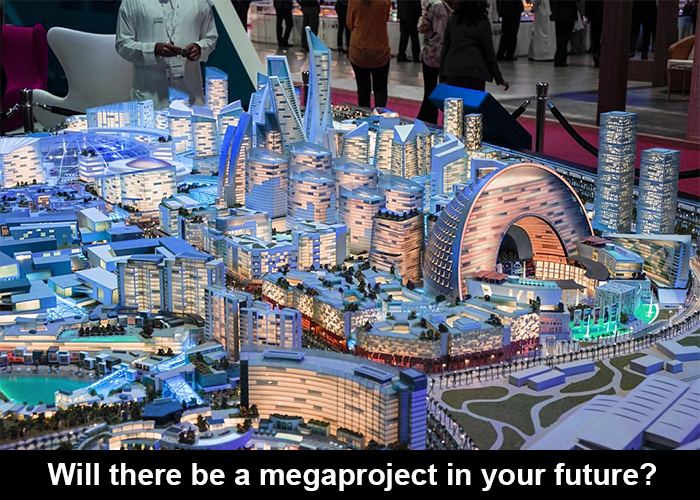
Gone are the days where people are impressed by projects costing $10-$50 million or even $100 million. We are witnessing an explosion in the number of $1 billion+ projects with some, like the artificial archipelago being built in Azerbaijan, Turkey’s massive Urban Renewal project in Istanbul, and the new construction of Masjid Al Haram in Saudi Arabia each exceeding $100 billion.
But even these are merely scratching the surface of the extreme megaproject growth that will happen over the next decade, and there are several important reasons why this is happening.
First, we’re seeing a shift in power towards megacities. As people relocate from rural to urban communities and population clusters grow, so does the demand for major infrastructure improvements to help manage the traffic, water, sewage, power, and living strains of these growing economies.
Second, the wages paid for workers building infrastructure projects will improve the local economy to a point where other megaprojects become viable.
Third, as global awareness improves, so does the desire to standout and impress the rest of the world. Megaprojects become a source of national pride and a status symbol for emerging economies.
Fourth, we are moving into an era of technological unemployment where jobs are automated out of existence at an unprecedented level. The demand for new jobs – and these will provide tons of new jobs – will trump most other arguments.
And finally, megaprojects have a way of collateralizing themselves through the sheer size and impact of the project. Even though many will be based on un-provable claims and flawed accounting, the spinoff economies alone will create an overpowering momentum to push them across the finish line.
The growing list of megaprojects include tunnels, bridges, dams, highways, airports, hospitals, skyscrapers, cruise ships, wind farms, offshore oil and gas rigs, aluminum smelters, communications systems, Olympic Games, aerospace missions, particle accelerators, entire new cities, and much more.
In spite of their problems, here’s why the megaproject list will continue to grow and will continue to define the cities and megacities of our future.
 $45B Lusail City – Qatar’s largest real estate project, will be home to 200,000 with a scheduled completion date of 2019
Understanding the Value of Megaprojects
According to Global Strategist, Parag Khanna, we are becoming a globally networked civilization because that is exactly what we’re building. All of the world’s defense budgets and military spending taken together total just under $2 trillion per year, but our global infrastructure spending is projected to rise from $3 trillion to $9 trillion per year over the coming decade.
“We have been living off an infrastructure stock meant for a world population of three billion, as our population grows towards nine billion,” says Khanna. “As a rule of thumb, we should spend about $1 trillion dollars on basic infrastructure for every 1 billion people on the planet.”
It’s no surprise that Asia has taken the lead. In 2015, China announced the creation of the Asian Infrastructure Investment Bank, which together with a network of other organizations aims to construct a network of iron, silk, and digital roads, stretching from Shanghai to London.
And as all of these megaprojects unfold, we will likely spend more on infrastructure in the next 40 years, than we have in the past 4,000 years.
Examples of this are easy to find. Ten of the world’s most impressive megaprojects currently in the queue include:
Dubai World Central Airport (United Arab Emirates)
Songdo International Business District (South Korea)
Tokyo-Osaka Maglev Train (Japan)
Masdar City (United Arab Emirates)
The Grand Canal (Nicaragua)
National Trunk Highway System (China)
International Thermonuclear Experimental Reactor [ITER] – Fusion (France)
World’s Tallest Building (Azerbaijan)
Delhi-Mumbai Industrial Corridor (India)
King Abdullah Economic City (Saudi Arabia).
According to Bent Flyvbjerg, a management professor at the University of Oxford’s Saïd Business School, megaprojects currently constitute 8% of global GDP (gross domestic product).
Even though nine out of ten megaprojects experience cost overruns, and most take far longer to build than expected, they represent a crucial piece of today’s global economy.
Flyvbjerg also noted that project leaders have an incentive to overstate income, underestimate costs, and exaggerate future social and economic benefits due to lack of accountability and risk-sharing mechanisms.
But even though things go wrong, people generally don’t care. They don’t care about the poorly calculated cost-benefit statements, squandered money along the way, or the political wrangling necessary to get the green light; they just want something significant to happen in their community.
The benefits of megaprojects can be boiled down to these six points:
Technological Inspiration. Most megaprojects are technically inspiring. Engineers and technologists develop great enthusiasm for working on large and innovative projects, pushing the boundaries for what technology can do.
Source of Jobs. With so many jobs being automated out of existence, megaprojects serve as a catalyst for both the unemployed and the under employed.
Political Accomplishment. Politicians need something they can point to with a sense of pride and accomplishment.
Economic Benefits. Business people, trade unions, and workers alike will all reap the rewards from megaprojects.
Community Pride. Everyone loves to tell stories about the big things their community accomplished.
Aesthetic Beauty. Most people appreciate good design when it comes to building, using, and looking at something very large that is also ironically beautiful.
As a rule of thumb, history books don’t spend time memorializing the critics and project-killers, only those who succeed.
Raising the Bar – 64 Next-Generation Megaprojects
It’s easy to look at the world’s top 10 bridges and try to build something bigger, taller, longer, or more artistic than any of the ones currently in existence.
The same thinking applies to creating the next tallest building, largest cruise ship, longest tunnel, most popular theme park, or grandest stadium.
At the same time we seeing a form of blue ocean thinking creeping into the megaproject arena that includes never-been-done-before projects like colonizing Mars, tube transportation networks, floating islands, and underwater cities.
Here are a few megaprojects that have the potential to inspire the world for generations to come:
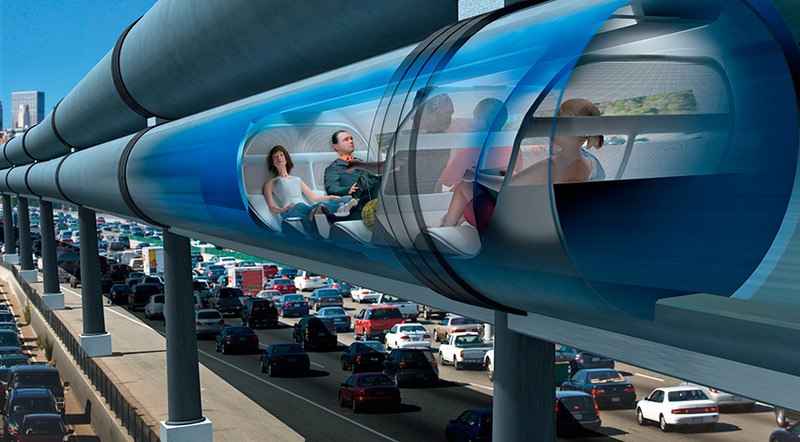 Will global tube transportation networks be coming to a megacity near you?
A. Global Infrastructure – All global systems need a point of origin, and the point of origin will typically turn into the global center of knowledge and operation for the industry it creates.
Global Tube Transportation Project – ET3, Hyperloop, or something else.
Whole Earth Automated Postal System – Delivering packages anywhere on earth without ever touching human hands.
Global Wi-Fi Network – Connected anywhere at anytime.
Global Genealogy Systems – For humans, plants, and animals including standards.
Global Ownership Authority – To govern standards and regulations, for personal ownership rights.
Global Privacy Standards – Adoptable by every nation on earth.
Global Ethics Standards – Including courts for oversight.
Electronic Borders – For countries to monitor all the inputs and outputs through their borders.
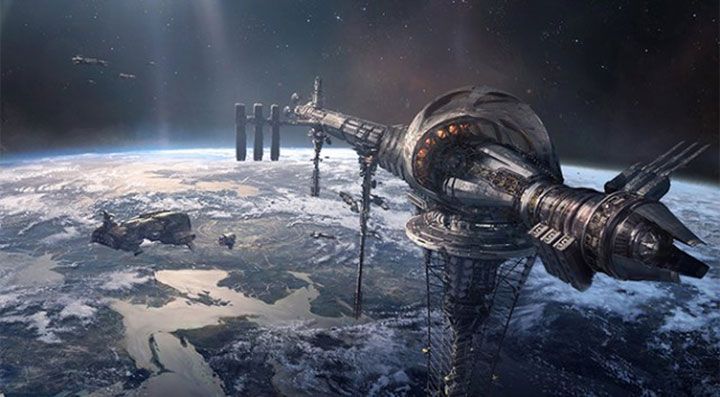 How long before a real space elevator becomes technically viable?
B. Space Industries – Every major space project has a huge ground support team all hoping to be part of that next great interplanetary mission.
Space resorts
Asteroid mining
Space-based power stations
Space elevator
Colonizing other planets
Traveling faster than the speed of light
Satellite Shooters – To shoot satellites into space
Constellations of Floating Wi-Fi antennas, solar powered planes, floating balloons, cubesats, and more to provide Wi-Fi to the entire world
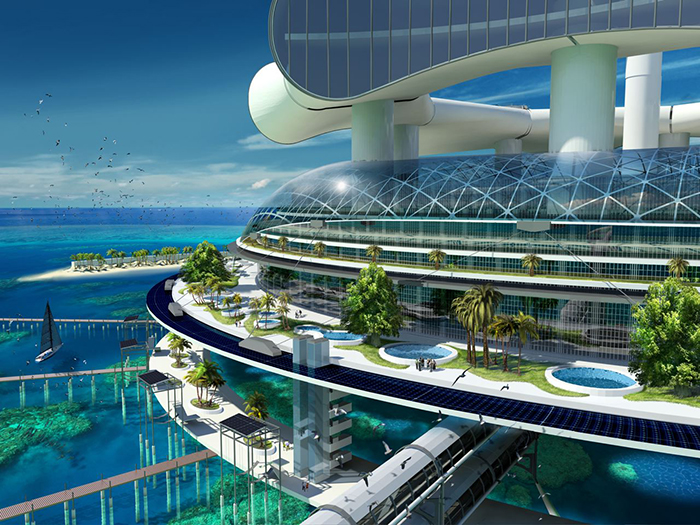 Architect Richard Moreta Castillo envisions a self-sufficient eco-resort called Grand Cancun
C. Ocean Industries
Floating island resorts
Floating farms – for grains, fruits, vegetables
Open ocean aquaculture mega farms – for raising underwater sea plants and animals
Floating countries
Underwater museums
Underwater arboretums
Ocean wave power generators
Freshwater factories – turning saltwater into freshwater
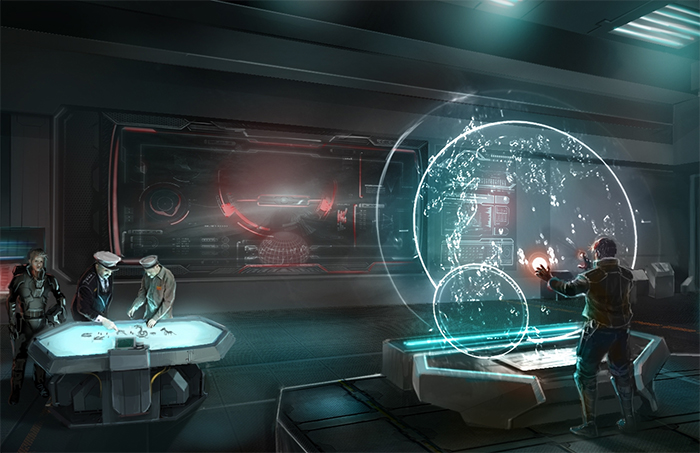 Imagining the weather command center of the future
D. Controlling Extreme Weather. We continually find ourselves the victims of forces of nature while it is entirely possible to mitigate the damage of extreme weather.
Controlling hurricanes
Controlling earthquakes
Controlling tornadoes
Controlling hailstorms
Controlling desertification
Controlling draught and famine
Controlling dust storms
Controlling extreme blizzards, rainfall, and flooding
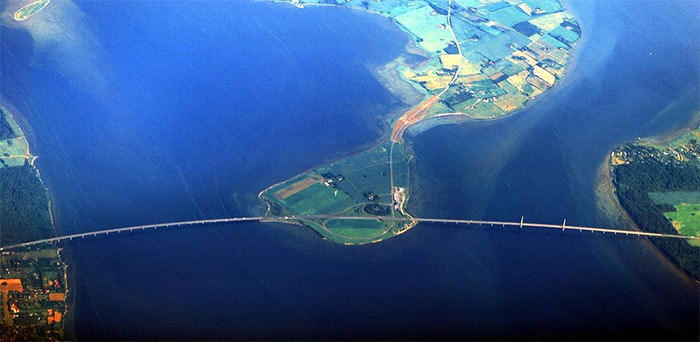 The world’s greatest bridge projects are still on the drawing board
E. Grand Bridge-Tunnel Projects. When it comes to ground transportation we have several massive disconnects in our global transportation network.
Bridge across the Bering Straight – Connecting North America with Asia
Bridge across the Darian Gap – Connecting North and South America
Gibraltar Bridge-Tunnel System – Connecting Europe and Africa
Sweden to Finland Tunnel – Connecting Sweden and Finland.
Korea Japan Friendship Tunnel System – Connecting Japan and Korea
Taiwan Strait Tunnel Project – Connecting China with Taiwan
Saudi-Egypt Causeway – Connecting Egypt and Saudi Arabia.
Sakhalin-Hokkaido Tunnel – Connecting Japan with Russia
 $15B Artificial Island – The Pearl, located in Qatar
F. Extreme Physics Challenges
Terraforming Planets – Developing the formula for recreating human-friendly earth-like environments on other planets and moons.
Mass Energy Storage – Storing power from one day to the next is still far too inefficient. Think in terms of cities having a 2-week power reserve at all times.
Controlling Gravity – The single greatest force of nature is gravity, yet we know very little about it.
Sending a Probe to the Center of the Earth – We currently know very little about the center of the earth.
Controlling Time – Many possibilities such as manipulating time in short intervals, soas to know something 5-10 minutes before it happens.
Viewing the Past – How can we create a technology capable of replaying an unrecorded event that happened decades earlier in actual-size, in holographic form?
Instant Disassembling of Matter – Think in terms of a process where large boulders can be instantly disassembled into a pile of molecules, simply by breaking all the molecular bonds.
Whole Earth Genealogy Project – Automated project that scans DNA and builds a map of today’s genealogy, adding to it the efforts of past genealogies to create a grid map of plants, animals, and humanity.
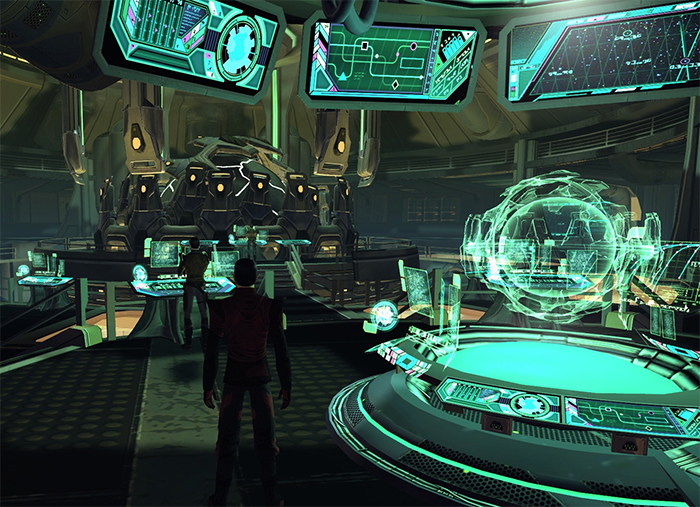 When the data of the world is at your fingertips
G. Extreme Data Megaprojects
The Billion-Cam Video Project – What would it take to get people to connect 1 billion video cameras to the Internet? How will this change the world?
Whole Earth Law Project – Very few countries have their laws posted in a central repository.
World’s First Billion Internet of Things Operating System – Architecting over 1 billion devices talking to each other is a powerful position to be in.
Global Elections – When will we see the first global election with over 500 million people voting from over 50 different countries?
World’s First Billion Sensor Network – What advantages will be created when over 1-billion sensors are tied together?
Global Language Archive – Over 500 languages have less than 10 people currently speaking the language.
World’s First Billion Drone Operating System – Much like cellphones, drones will evolve around a common operating system.
Global Intellectual Property System – Including patents, copyrights, and trademarks.
 Can we build a better human?
H. Solving the Human Equation – No person should ever die… ever! If we can fix human aging, repair accidents, cure diseases, and modify deviant behavior, people no longer need to die. As a result, no person should ever die… ever! Is that our goal? And if not, why not?
Curing Cancer
Curing Diabetes
Curing Heart Disease
Curing Suicide
Curing Human Aging
Cloning or Printing Humans
Curing Deviant Behavior
Creating Super Humans
 The 790 feet tall statue of Sardar Patel will soon be the tallest in the world
Creating the world’s largest statue
India has started to build the world’s tallest statue, the Statue of Unity. It will be a 790 feet tall tribute to Sardar Patel. By comparison, Crazy Horse Monument in Custer, South Dakota, which has been under construction for nearly 70 years, is only 564 feet tall.
 Comparing the largest statues in the world
Sardar Vallabhbhai Patel (or just Sardar, which means Chief) was the first Home Minister (the head of the Ministry of Home Affairs) and Deputy Prime Minister of post-independence India from 15 August 1947 to his death in December 15,1950.
Final Thoughts
In the past, megaprojects like the Pyramids in Egypt or the Great Wall of China became a lasting testament to human accomplishment simply because of the incredible amounts of human labor involved in the undertaking. But today it’s far more about the size, money, and significance of the project.
As I travel around the world, it’s hard to miss the sheer number of construction projects happening in every major city. If we only read newspaper headlines, it would appear megaprojects are primarily taking place in China and Dubai, but there are hundreds more that haven’t gotten nearly as much attention.
If we do increase our infrastructure spending to $9 trillion per year, as Parag Khanna suggests, megaprojects will rise in importance from roughly 8% of global GDP to close to 24% factoring in all the spinoff economies.
Over the coming decades we will begin the transition to megacity cultures, lifestyles, and economies. Megacities themselves will become more important than the countries they reside in.
With megaproject spending reaching unprecedented levels, any failures will have far reaching implications.
If your city, region, community, or country is not working on its own mega projects, it will certainly be left behind.
Author of “Communicating with the Future” – the book that changes everything



May 2, 2016
Five Tough Questions: The Warsaw School of Economics Interview

The Warsaw School of Economics is the oldest, most prestigious, and top-ranked business school in Poland. Dr. Piotr Turek received his PhD in Economics there and went on to become a fellow futurist and new media expert in Warsaw where he works as a journalist, lecturer and mobile/web services expert.
In early January, Piotr contacted me and asked if he could interview me for a series of publications in Poland. When I agreed to the interview, I had no idea how tough these questions would be.
An edited version of the interview recently appeared on Futurist of the Year, a site designed to promote the study of futurology in Poland.
Since the answers submitted were more extensive than what they had room for in the magazine, I’ve included the long-form interview here.
 Why should we study the future?
1.) Dr. Turek: In researching people to interview for this article, you instantly jumped out as one of the most respected futurists with deep insights into a variety of topics. Let’s begin with the topic of futurology and what it means to you. Why it is so important to study the future?
Frey: As a Futurist, people often ask me how many of my predictions have come true. I find this to be a rather uncomfortable question. It’s uncomfortable, not because my track record hasn’t been up to par (actually, a high percentage have come true), but because accuracy of predictions is a poor way of measuring the value of a Futurist.
In a world filled with MBAs and number crunchers, there is a constant push to reduce our analog world to digital analytics so we can accurately measure our return on investment.
But not everything is measurable in this way.
Thinking about the future is like a muscle in our brain that rarely gets used. Over time, our brains will atrophy and we lose our ability to think productively about what the future may bring.
At the same time, the world is shifting faster than ever. Our need to know about the future is no longer a luxury; it’s a functional imperative.
With this in mind, here are critical eight values that a Futurist has to offer:
Altered Thinking – The future is constantly being formed in the minds of people around us. Each person’s understanding of what the future holds will influence the decisions they make today. As we alter someone’s vision of the future, we alter the way they make decisions today. My goal is to help individuals and organizations make better, more informed decisions about the future.
Unique Perspective – The future is unknowable, and this is a good thing. Our involvement in the game of life is based on our notion that we as individuals can make a difference. If we somehow remove the mystery of what results our actions will have, we also dismantle our individual drives and motivations for moving forward. That said, the future can be forecast in degrees of probability. By improving our understanding of what the future holds, we dramatically improve the probability with which we can predict the future.
Evidence of Change – Empirically speaking, forecasting the future is not done by staring at tealeaves of reading tarot cards (that is the realm of psychics). Rather, futurists take an inter-disciplinary approach and employ a wide range of methods, from the study of cycles, to trend analysis, to scenario planning, to simulations, to back casting. Futurists use data from the past and present, as well as other concepts and methodologies to understand how the present will evolve into probable futures. We also borrow freely from other fields, such as forecasting, chaos theory, complexity science, organization development, systems analysis, and sociology.
Connecting the Dots – Futurists come from a wide range of backgrounds and perspectives. What we have in common is well-researched big-picture-thinking, strong pattern recognition, and innate curiosity. Ideas that are routine in one industry can be revolutionary when they migrate to another, especially when they challenge assumptions and rewrite common knowledge among the rank and file.
Find Your Future Competitive Advantage – French novelist Marcel Proust once said, “The real act of discovery consists not in finding new lands but in seeing with new eyes.” The most successful companies don’t just out-compete their rivals, they redefine the terms of competition by embracing one-of-a-kind ideas in a world heavily steeped in “me-too” thinking.
Take Control of Change before the Changes Take Control of You – Are you changing as fast as the world is? Change is inevitable, but how you deal with change can vary greatly. In a world that never stops changing, great leaders can never stop learning. How do you push yourself as an individual to keep growing and evolving? Does your company push you in the same manner?
The Future is Where Our Children Live – Our desire to leave a legacy is a uniquely human attribute. However, our legacy becomes meaningless if we don’t have new generations of people to pass it on to. To many this may sound like an obvious statement, but to those in the business world, there is a constant battle being waged over the needs of the present vs. the needs of the future. It’s very easy to place short-term profitability ahead of long-term problems.
Every Avalanche begins with the Movement of a Single Snowflake – Our ability to tap into and leverage the power of the future is directly tied to the number of times we think about it. The more we think about the future, the more we expand our understanding of it. And the more we understand the future, the easier it becomes for us to interact with it.
 Google’s Chief Engineer, Ray Kurzweil, believes machine intelligence will exceed human intelligence by 2029
2.) Dr. Turek: Do you agree with Ray Kurzweil’s prediction that a connection between brain and Internet will take place before 2030, and does this concern you in any way?
Frey: Over the past 30 years, artificial intelligence went through a couple major boom and bust cycles because the algorithms failed to live up to the hype.
Since 2012, a specific machine learning technique called “deep learning” has permeated the AI world, and we’ve made more progress in the past four years than in the preceding 25 years on several key AI problems including image understanding, signal processing, vocal comprehension, and understanding text.
Keep in mind that deep learning still isn’t true AI, the kind of sophisticated and adaptable intelligence humans exhibit, but it’s a giant leap forward on the path to getting there.
Futurists like Vernor Vinge and Ray Kurzweil began focusing on the exponential growth of artificial intelligence several decades ago. With ever increasing advancements in areas like nanotech, biotech, chemistry, and bioinformatics, they’ve predicted we will be able to create a race of superhumans with decision-making abilities far beyond our ability to understand them.
Through these early efforts the field of transhumanism was born, referring to a form of superhumans with capabilities far beyond what we can comprehend today.
My sense is that people are far more nuanced and complicated than researchers have ever imagined, and while we’ll create closer facsimiles to human cognition, we’ll never be able to achieve a complete AI mind with inorganic materials.
The “singularity” itself is a bit of a mystery. Some have predicted 2029, and others 2045, but the exact nature of the transformation being predicted is still rather fuzzy around the edges.
Will artificial intelligence become integrally linked to the human mind as in a symbiotic relationship? Will “boosted” humans have the same values, ethics, incentives, and levels of consciousness as people today? Can we also “boost” intelligence in plants and animals?
Some of the differences between a human mind and an artificial one can be found in the emotional value we place on things around us. For example, we may value the softness of a nice pillow because it is comfortable around our head, and while artificial intelligence can duplicate the value, it can’t understand why.
Similarly, artificial intelligence can be designed to take initiative when certain criteria is met, such as cleaning a floor once it is dirty, yet it still can’t grasp the reasoning behind it.
AI cannot intuitively feel anxiety, stress, anger, or fear. Humans can be plagued with hundreds of physical and psychological conditions like insomnia, claustrophobia, kleptomania, xenophobia, or narcolepsy, all of which are considered a flaw in the human condition. But these failures are what make us who we are.
Without failure there can be no motivation for improvement.
Our drive and motivation comes from our own insecurities, and without this wide range of physical and emotional shortcomings, the only initiatives AI will be able to muster will be the well-calculated kind.
At the same time, what’s the point in replicating flawed humans? Our current advantages over machines involve things like adaptability, resourcefulness, our ability to make ethical decisions, and our desire to leave a legacy. But for how much longer?
Over the coming decades the achievements of machine intelligence will continue to hockey-stick its way up the exponential growth curve
However, no breakthrough technology is without its unintended consequences, and this one is no exception.
In our rush to solve all of life’s major problems, and we each have our own utopian image of the good life, our drive for solutions will leapfrog us directly onto the lily pad of perfection. It will be this drive for perfection that will be our undoing.
Ironic as it may sound, perfection is an imperfect concept.
Each of us has been born and raised with all of the foibles and limitations of being human. A typical day involves forgetting where we’ve put our keys, stubbing our toe, getting angry at the wrong person, and dropping a plate full of food. And those are just the little things.
We are indeed intelligent beings, but for all of our limitations, the intelligence we possess doesn’t seem hardly enough.
That said, AI is on the verge of becoming a powerful tool in our lives. In much the same way computers and machines are being leveraged to improve our capabilities today, AI will be integrated into our lives in thousands of different ways.
I love the question that Caltech Professor Kip Thorne likes to ask. “A thousand years from now, what things will be possible, and what things will not?”
Only time will tell.
 Will we be able to protect intellectual property in the future?
3.) Dr. Turek: Over the next 15 years we will run into a number of dicey issues concerning the intellectual property rights of artists and proper payment for their work? What are your thoughts on this?
Frey: Our society places great value on creativity, originality, and discovery. History books are filled with talented people who figured out how to “zig left” when everyone else “zagged right.”
Recently, a company called Qentis unveiled a computer program capable of generating every possible combination of words on a single page, effectively preempting any future copyright claims.
Using a similar system, the company can also generate every possible combination of musical notes on a page giving them a priority claim to every “new” musical score.
Likewise, a software company called Cloem has developed a program capable of linguistically manipulating the claims on a patent filing, substituting keywords with synonyms, reordering steps, and rephrasing core concepts in order to generate tens of thousands of potentially patentable “new” inventions.
In much the same way computers are capable of generating every possible combination of lottery numbers to guarantee a win, patent and copyright trolls will soon have the ability to play their game of “fleecing the innovators” at an entirely new level.
More importantly, it confuses the concept of originality, and compromises the contribution of an individual if a version of every “new” idea already exists.
Naturally there are steps that can be taken to prevent this kind of abuse, like adding video proofs of the creation and statements from witnesses. But once artificial intelligence enters the picture, the deceptions will become even harder to sort out.
 How beneficial would a global currency be?
4.) Dr. Turek: Do you think we are headed for just one world currency, or maybe none, and we return to exchange goods for barter?
Frey: The future of banking will be mobile, happening in devices we carry in our pockets, built into jewelry, and on our wrists, not in fancy office buildings.
In less than five years, smartphones, watches, and other devices will replace credit/debit cards, wallets, lenders, stockbrokers, and insurance agents.
There is a good chance that we will have a default global currency arise from the cryptocurrency movement.
The primary purpose of a global currency will be to have a stabilizing effect on other currencies. However, it will not operate to the exclusion of others. There needs to be multiple currencies to serve as a form of checks and balance for the global economy.
Over the past few weeks I’ve become enamored with the power of financial friction. This could involve everything from adding a tenth or hundredth of a cent charge to every email sent, social media “likes,” video downloads, views of copyrighted photos, and much more.
Even though it may not seem significant, there is a huge difference between “free” and “0.1 cent.”
Tiny charges, much like the rest of life’s sandpaper, tend to give us clarity between what’s significant and what’s not.
The reason this has become such an important topic today is because transaction costs have plummeted along with the cryptocurrency invention of distributed block chain ledgers, and the possibility of creating “nano-payment” networks is opening the doors to thousands of new fractional payment models.
The traditional way of providing online services like email, news, or uploading photos has been to pass the cost of operating these services on to advertisers.
But that could change.
Over the past decade, micro payment schemes have created successful business models around charges less than $1. As an example, Google’s AdSense charges advertisers as little as a few cents for every click of their ads.
It’s only recently, with the introduction of Blockchain technology, that we’ve been able to consider much smaller charges, even less than a penny.
In the past I’ve been an ardent advocate of simplicity, but over time my thinking has changed. Automation enables complexity, and the intricacy of complexity is what opens the door for unusual new business opportunities.
As a way of expanding our thinking in this area, here are 8 short scenarios with brief explanations.
When it comes to e-books, would you rather pay $7.99 for the entire book or a tenth of a cent for every page you read? With this type of model it would be very easy to run the analytics and determine which chapters, sections, and pages most resonate with readers.
If you received a tenth of a cent for every “like” on Facebook, but also had to pay a tenth of a cent every time you “liked” someone else’s page or photo, would you be making money or losing some at the end of each month? How could this Lilliputian economy be translated in other areas?
For photos with a copyright, whenever someone clicks to expand the image, their account would be debited a tenth of a cent. In this scenario, the owners would be incentivized to having their photos show up everywhere to increase exposure.
As a blog reader, every time you click “continue here,” you would be sending a tenth of a cent, or multiple tenths for every page viewed, to the writer. Would this incentivize more blog writers?
Would you be willing to pay a tenth of a cent for every page you view on Facebook, Twitter, or LinkedIn just to avoid all the ads being directed at you? The amount you pay would be in direct proportion to how much you use these services, but still a relatively small amount.
Should every text message come with the option of paying a tenth of a cent to keep your service ad-free?
When it comes to videos, should a pay-per-play charge of a tenth of a cent be added to every YouTube, Vimeo, Vine, Twitch, or Viddy play. Should people posting videos have that option for remuneration?
Similarly, does it make sense to add a tenth of a cent charge for every episode of RadioLab, NPR, Freakonomics, or TED podcasts.
 What role do banks play in our future?
5.) Dr. Turek: What kind of banking products and services will be relevant in the future and how do you envision banking to evolve in developing countries between 2020 and 2030?
Frey: There are approximately 2.5 billion people in the world who do not have access to traditional banks, yet nearly half of them have a mobile phone. These phones have enabled some of the poorest economies to leapfrog the wealthier countries because they don’t have to worry about their legacy infrastructure.
As an example, people in Africa are three times more likely to use mobile money as their counterparts in Europe and the U.S.
In fact, nine African nations now have more mobile pay accounts than traditional bank accounts.
Kenya is an example of how mobile money can dramatically transform a country’s economy. In 2006, less than 30% of adults had access to formal financial services. Today, thanks to M-PESA, that figure stands at over 65%.
M-PESA was originally designed as a system to allow microfinance-loan repayments to be made by phone, reducing the costs associated with handling cash and thus making it possible to offer lower interest rates. But after pilot testing it was expanded to become a general money-transfer system.
Launched in 2007 by Safaricom, the country’s largest mobile-network operator, it is now used by over 17 million Kenyans.
One study found that in rural Kenyan households that adopted M-PESA, incomes increased by 5-30%. In addition, the availability of a reliable mobile-payments platform has spawned a host of start-ups in Nairobi.
In 2014, the service processed over $20 billion in transactions, a figure equal to more than 40% of Kenya’s GDP.
The M-PESA experiment has paved the way for fintech startups like Abra in other countries.
Much of the fintech revolution happening in the tech world offers tools for improving the economy of developing countries.
Today there are 2.6 billion smartphone subscribers in the world and that will grow to over 6.1 billion in 2020. Smartphones will replace the need for many of today’s banking services and will open the door to a variety of new payment technologies as well as new banking options.
As an example, where bank transfers today still take two to three days, Bitcoin technology makes it possible to transfer money instantaneously and securely from person to person. This is inspiring startups, like Abra, to offer a more convenient and affordable ways to move money.
Abra is the world’s first digital cash peer-to-peer network.
The basic premise behind Abra is that anyone should be able to send money from his or her smartphone to any other person via their phone.
If a user wants to send $5 to a friend, all they need is the recipient’s phone number. If the recipient doesn’t have Abra on their phone, they will receive a text message telling them to install the app.
The app also takes care of currency conversions so that the value is never subject to the fluctuations of the price of Bitcoin or traditional costs in currency exchange.
Abra enables users to store money digitally on their phone, send that money to any phone number in the world and then, using a network of Abra tellers or traditional banks, exchange that digital money for cash. Since all money is stored on the phone, Abra never touches the money.
The only cost for their service comes from funds transferred to traditional bank accounts or converted to cash.
The Abra app currently works with users and banks, in the US and the Philippines, with plans to expand into India and other parts of Asia over the next couple years.
With $436 billion USD in remittances flowing to families in developing countries in 2014, the market opportunity is significant.
Final Thoughts
The people of the world have an “unfinishable mandate” to continually stretch, grow, propagate, and master not only the world around us, but also the entire universe.
The human race is genetically pre-dispositioned to push the envelope, color outside the lines, and reach for things that will forever be unreachable.
As individuals, there will be some who are content to find inner peace and live a minimalist lifestyle. But as a race, we will be driven by a need to make a difference, be admired for our accomplishments, and create moments of triumph in our otherwise pale existence.
We have only taken the first step in a trillion mile journey. The next few steps, in my opinion, will be nothing short of spectacular.
Author of “Communicating with the Future” – the book that changes everything

April 21, 2016
Fourteen New Dimensions for Rethinking the Cruise Ship Experience
My wife Deb and I recently got back from a 10-day Princess Cruise through the Panama Canal, a fabulous experience, but one that could have been greatly enhanced with better technology on the part of the cruise line.
To illustrate this point, on the 2nd day of the cruise we ran into some people who thought it would be great if I could give a talk on the ship. So I sent a message to Susan the cruise director, the lady in charge of all the entertainment on the ship, that I’d be willing to give a talk.
Since there is no cellphone service on the ship (or texting), this involved me writing a note and handing it to someone at the passenger services desk. Two days later I received a phone message that I responded to with a request for a meeting.
Another two days went by and I received another message telling me a couple different times and places where we could meet. I picked the earliest meeting time and managed to catch about 3 minutes of her time. She was very pleasant and cordial and responded favorably to the idea of me giving a talk, and said she’d let me know.
I then followed up with a 3rd handwritten message clarifying that I wasn’t looking for any compensation and suggesting three different titles for my talk.
Keep in mind the main source of information on a ship is a daily bulletin that gets distributed to every cabin in the evening highlighting the next day’s activities. On this cruise line it’s called the Princess Patter.
Finally, on the second to the last day I received a phone message late in the afternoon saying I was approved for giving a talk, but I would have to respond within an hour because the Princess Patter went to press at 5:30 pm.
I didn’t get the message until an hour too late. When I called back I reached Simon, the assistant cruise director, and he apologized for the late notice but since they hadn’t heard back from me my talk was left out of the final day’s agenda.
Whether or not I was given the opportunity to speak on the ship was not important, but the process highlighted some critical fault lines in the industry’s business model. Keep in mind, this exchange involved seven full days of handwritten messages and voice mails, and it all boiled down to a one-hour time slot that crept up without warning.
Needless to say, person-to-person communications on ships like this has been atrocious, but that is on the verge of changing in a big way. And these changes are opening the door to entirely new business models.
The Great Vacation Debate
Whenever I mention something about lack of cell service or bad Internet on a ship, Deb always responds by telling me that I’m supposed to be on vacation and I shouldn’t be thinking about work.
While I understand the need for “braincations,” and no, being off the grid is not going to kill me, I also know that most of the world is not wired that way.
In fact, the entire cruise industry has been slow to capitalize on the massive market for working vacationers; a market that constitutes the vast majority of today’s leisure crowd.
It’s also an enormous adjustment for hyper-connected families to step onboard and readjust their thinking to work with such primitive communication tools. On ships carrying 2,000+ passengers it’s easy to lose a family member or friend several times a day.
Better communication systems will also shift the market away from the 70-year-old floating-assisted-living model to more active Gen-X and Gen-Y crowds looking to reimagine their lives.
To this end, many cruise lines have already begun the process of equipping their ships with high bandwidth communication systems.
Why is the Internet so Expensive on a Cruise Ship?
Generating a reliable satellite signal to a moving ship is no small task. Not only do cruise lines have to lock on to a constantly moving signal in some of the most remote corners on earth, but they also need sufficient bandwidth to accommodate several thousand passengers at once.
Many have already begun the Wi-Fi upgrade process while others will be installing new equipment later this year. Here are three examples:
Royal Caribbean provides high-speed Internet on all of its 25 ships for $20 per day. They also offer a service called VOOM, which allows guests to stream videos and music for an extra $15 a day.
Norwegian Cruise Line has also expanded Internet on all 13 of its ships for $29.99 a day, but there’s a catch. The Wi-Fi plan must be purchased for the entire trip, which means Wi-Fi will cost $300 for a 10-day cruise.
All of Viking River Cruise ships offer complimentary Wi-Fi. Access to a faster service - which is needed for video streaming - is available for $11.95 a day.

What kind of experience would you like to have on your next cruise?
Fourteen New Dimensions for Tomorrow’s Cruise Experience
Each level of bandwidth improvement comes with a vast new learning curve, one that will require several years to rethink service options.
The lack of Wi-Fi has also created a generational market gap with Gen-X and Millennials less inclined to spend a week or two without Internet.
Yes, cruise ships do offer luxury-class service, food, and entertainment. Some of the newer features like waterslides, robotic bartenders, climbing walls, Jumbotron movies under the stars, and indoor ice arenas all have their appeal, but as with all high dollar experiences, next-generation customers are eager for something new.
Diverse communities create diverse interests and younger people are less interested in old school relaxation and far more interested in being engaged, learning new skills, and adding some new dimension to their lives.
With that in mind, here are fourteen new features, made possible by better connectivity that could easily be added to cruise ships over the coming years:
1. ) Makerspaces – Equipped with laser cutters, welders, 3D printers, potters wheels, and jewelry making equipment, a well-furnished makerspace has the potential to radically transform the onboard experience. How-to classes can teach people the fundamentals of using specific pieces of equipment as well as making things they can show to their friends.
2.) Videographer Studios – With smartphones replacing the need for elaborate cameras and editing skills, virtually every passenger has the need to improve their videographer skills. Keep in mind, video posted on social media have the potential to radically amp up the marketing reach of the personal cruise experience.
3.) Video Game Tournament Centers – A 2015 study showed that 42% of Americans play video games at least 3-hours a week with the average age being 35 years old. Not only is it important to have the bandwidth to play online video games, but having a dedicated facility for onboard tournaments will also ensure maximum engagement for a large percentage of today’s young people.
4.) Hacker Spaces and Hacker Classes – Every person connected to the Internet has a different level of proficiency. The online skills needed to be proficient in even rudimentary aspects of the web like word processing, texting, and social media are constantly evolving. Hacker spaces can serve as both training centers and entry points for newbies as well as rich technical environments for more advanced users.
5.) Make Your Own Beer, Wine, and Spirits Distilleries – Micro-breweries, micro-distilleries, and winemaking are quickly becoming part of urban culture and having the facilities to both teach the skills and taste the end product can easily become an engaging feature of every new cruise ship.
6.) “Quantified Self” Center for Personal Analysis – Our ability to accurately measure the inputs and outputs of the human body are increasing exponentially with every new sensor and wearable device added to everyday living. These devices, along with data analytics machines, can be leveraged to provide a hyper-individualized health analysis offering a range of plans for improvement.
7. ) New Product Expos – Companies are always seeking new ways to introduce a new line of products. Whether its food products, household gadgets, Internet of Things devices, software, hardware, or something else, people are continually fascinated by cutting edge products. This will open the doors for sponsorship arrangements with companies who otherwise have little connection to the cruise industry.
8. ) Floating Garden Centers – Rather than just looking at plants and flowers on a ship, many are interested in learning about the species and how to grow them at home. Ships are well positioned to become working laboratories for aquaponics and hydroponic operations, and a significant percentage of passengers would love to be engaged in this type of experience.
9.) Drone Training Facilities – The emerging field of flying drones has captured the imagination of hobbyists and working professionals alike. Operating without the restrictions of defined airspace and country-to-country restrictions, ship-based drones can be used for entertainment, pilot training, photography, surveillance, remote lighting, drone rescue, and much more.
10.) Cannabis Cooking Classes – In much the same way gambling is not legal while ships are docked, the open seas can open the doors to recreational marijuana in much the same ways Colorado and Washington are exploring today. This would open the door to cannabis cooking classes, new types of lounges, alternative health courses, and much more.
11.) Escape Rooms – One of the fastest growing team-building exercises and family entertainment are escape rooms and the intricate layers of puzzle pieces and clues teams need to filter through to find a way out. Based on the notion of living through a real life video game experience, participants find themselves challenged in new and exciting ways.
12.) Treasure Hunts – The online world provides an entirely new dimension to treasure hunts with physical and virtual clues making the final destination all the more rewarding. Answers or clues can be hidden anywhere on the ship and real-time tracking can provide team members with instant feedback of their progress.
13.) Onboard Competitions – With all the new possibilities, a natural extension of these activities will be to stage competitions to uncover the best of the best. Contests can range from drone races, to building makerspace jewelry boxes, wine tasting, beer tasting, best short videos, ship-to-ship video game competitions, and more.
14.) Collaborative Work Spaces – For those who don’t have the luxury of being off-grid on their cruise, the quality of workspaces matter. Collaborative environments are natural conversation starters as well as fertile territory for discovering new friends and business contacts.

Much like cities, cruise ships struggle with managing their waste, but oceans create far more environmental complexities than land-based cities.
Sustainability as a Competitive Advantage
With mounting pressure from environmental groups, the cruise industry has been working to remedy many of the ecosystem hazards being left in the wake of international waters.
Along with a new generation of highly connected passengers comes a level of transparency and scrutiny the industry may not be prepared for.
With today’s class of cruise ships, a 3,000-passenger ship can generate as much as 210,000 gallons of waste and sewage and 1 million gallons of gray water from showers and drains in a typical week according to the EPA. In addition, there are discharges of bilge water that may contain oil, grease and other contaminants.
The wastes from these “floating cities” pose a threat to fragile ecosystems, to sea life, and even to people enjoying a day at the beach.
While Disney is making the strongest effort to correct these problems, other cruise lines are also making progress. As sensor technology makes pollution issues increasingly transparent, the entire industry will soon be held to new accountability standards as customers continue to “vote with their pocketbooks.”
Final Thoughts
Until now, cruise ships have been operating like upscale third world countries, just now entering Internet age. Their true potential has yet to be discovered in this new digital friendly environment.
From a business standpoint, being on the cutting edge of creating exciting new cruise itineraries is now being counterbalanced with the nuanced opportunities for experiencing the oceans with an increasingly Internet savvy clientele.
In addition to being a floating resort, next generation cruise ships will operate as a working laboratory as companies experiment to unlock the ultimate cruise experience for every one of their passengers.
Author of “Communicating with the Future” – the book that changes everything

The post Fourteen New Dimensions for Rethinking the Cruise Ship Experience appeared first on Futurist Thomas Frey.
April 20, 2016
Fourteen New Dimensions for Rethinking the Future Cruise Ship Experience
My wife Deb and I recently got back from a 10-day Princess Cruise through the Panama Canal, a fabulous experience, but one that could have been greatly enhanced with better technology on the part of the cruise line.
To illustrate this point, on the 2nd day of the cruise we ran into some people who thought it would be great if I could give a talk on the ship. So I sent a message to Susan the cruise director, the lady in charge of all the entertainment on the ship, that I’d be willing to give a talk.
Since there is no cellphone service on the ship (or texting), this involved me writing a note and handing it to someone at the passenger services desk. Two days later I received a phone message that I responded to with a request for a meeting.
Another two days went by and I received another message telling me a couple different times and places where we could meet. I picked the earliest meeting time and managed to catch about 3 minutes of her time. She was very pleasant and cordial and responded favorably to the idea of me giving a talk, and said she’d let me know.
I then followed up with a 3rd handwritten message clarifying that I wasn’t looking for any compensation and suggesting three different titles for my talk.
Keep in mind the main source of information on a ship is a daily bulletin that gets distributed to every cabin in the evening highlighting the next day’s activities. On this cruise line it’s called the Princess Patter.
Finally, on the second to the last day I received a phone message late in the afternoon saying I was approved for giving a talk, but I would have to respond within an hour because the Princess Patter went to press at 5:30 pm.
I didn’t get the message until an hour too late. When I called back I reached Simon, the assistant cruise director, and he apologized for the late notice but since they hadn’t heard back from me my talk was left out of the final day’s agenda.
Whether or not I was given the opportunity to speak on the ship was not important, but the process highlighted some critical fault lines in the industry’s business model. Keep in mind, this exchange involved seven full days of handwritten messages and voice mails, and it all boiled down to a one-hour timeslot that crept up without warning.
Needless to say, person-to-person communications on ships like this has been atrocious, but that is on the verge of changing in a big way. And these changes are opening the door to entirely new business models.
The Great Vacation Debate
Whenever I mention something about lack of cell service or bad Internet on a ship, Deb always responds by telling me that I’m supposed to be on vacation and I shouldn’t be thinking about work.
While I understand the need for “braincations,” and no, being off the grid is not going to kill me, I also know that most of the world is not wired that way.
In fact, the entire cruise industry has been slow to capitalize on the massive market for working vacationers; a market that constitutes the vast majority of today’s leisure crowd.
It’s also an enormous adjustment for hyper-connected families to step onboard and readjust their thinking to work with such primitive communication tools. On ships carrying 2,000+ passengers it’s easy to lose a family member or friend several times a day.
Better communication systems will also shift the market away from the 70-year-old floating-assisted-living model to more active Gen-X and Gen-Y crowds looking to reimagine their lives.
To this end, many cruise lines have already begun the process of equipping their ships with high bandwidth communication systems.
Why is the Internet so Expensive on a Cruise Ship?
Generating a reliable satellite signal to a moving ship is no small task. Not only do cruise lines have to lock on to a constantly moving signal in some of the most remote corners on earth, but they also need sufficient bandwidth to accommodate several thousand passengers at once.
Many already have begun the Wi-Fi upgrade process while others will be installing new equipment later this year. Here are three examples:
Royal Caribbean provides high-speed Internet on all of its 25 ships for $20 per day. They also offer a service called VOOM, which allows guests to stream videos and music for an extra $15 a day.
Norwegian Cruise Line has also expanded Internet on all 13 of its ships for $29.99 a day, but there’s a catch. The Wi-Fi plan must be purchased for the entire trip, which means Wi-Fi will cost $300 for a 10-day cruise.
All of Viking River Cruises’ ships offer complimentary Wi-Fi. Access to a faster service – which is needed for video streaming – is available for $11.95 a day.
 What kind of experience would you like to have on your next cruise?
Fourteen New Dimensions for Tomorrow’s Cruise Experience
Each level of bandwidth improvement comes with a vast new learning curve, one that will require several years to rethink service options.
The lack of Wi-Fi has also created a generational market gap with Gen-X and Millennials less inclined to spend a week or two without Internet.
Yes, cruise ships do offer luxury-class service, food, and entertainment. Some of the newer features like waterslides, robotic bartenders, climbing walls, Jumbotron movies under the stars, and indoor ice arenas all have their appeal, but as with all high dollar experiences, next-generation customers are eager for something new.
Diverse communities create diverse interests and younger people are less interested in old school relaxation and far more interested in being engaged, learning new skills, and adding some new dimension to their lives.
With that in mind, here are fourteen new features, made possible by better connectivity that could easily be added to cruise ships over the coming years:
1. Makerspaces – Equipped with laser cutters, welders, 3D printers, potters wheels, and jewelry making equipment, a well-furnished makerspace has the potential to radically transform the onboard experience. How-to classes can teach people the fundamentals of using specific pieces of equipment as well as making things they can show to their friends.
2. Videographer Studios – With smartphones replacing the need for elaborate cameras and editing skills, virtually every passenger has the need to improve their videographer skills. Keep in mind, video posted on social media have the potential to radically amp up the marketing reach of the personal cruise experience.
3. Video Game Tournament Centers – A 2015 study showed that 42% of Americans play video games at least 3-hours a week with the average age being 35 years old. Not only is it important to have the bandwidth to play online video games, but having a dedicated facility for onboard tournaments will also ensure maximum engagement for a large percentage of today’s young people.
4. Hacker Spaces and Hacker Classes – Every person connected to the Internet has a different level of proficiency. The online skills needed to be proficient in even rudimentary aspects of the web like word processing, texting, and social media are constantly evolving. Hacker spaces can serve as both training centers and entry points for newbies as well as rich technical environments for more advanced users.
5. Make Your Own Beer, Wine, and Spirits Distilleries – Micro-breweries, micro-distilleries, and winemaking are quickly becoming part of urban culture and having the facilities to both teach the skills and taste the end product can easily become an engaging feature of every new cruise ship.
6. “Quantified Self” Center for Personal Analysis – Our ability to accurately measure the inputs and outputs of the human body are increasing exponentially with every new sensor and wearable device added to everyday living. These devices, along with data analytics machines, can be leveraged to provide a hyper-individualized health analysis offering a range of plans for improvement.
7. New Product Expos – Companies are always seeking new ways to introduce a new line of products. Whether its food products, household gadgets, Internet of Things devices, software, hardware, or something else, people are continually fascinated by cutting edge products. This will open the doors for sponsorship arrangements with companies who otherwise have little connection to the cruise industry.
8. Floating Garden Centers – Rather than just looking at plants and flowers on a ship, many are interested in learning about the species and how to grow them at home. Ships are well positioned to become working laboratories for aquaponics and hydroponic operations, and a significant percentage of passengers would love to be engaged in this type of experience.
9. Drone Training Facilities – The emerging field of flying drones has captured the imagination of hobbyists and working professionals alike. Operating without the restrictions of defined airspace and country-to-country restrictions, ship-based drones can be used for entertainment, pilot training, photography, surveillance, remote lighting, drone rescue, and much more.
10. Cannabis Cooking Classes – In much the same way gambling is not legal while ships are docked, the open seas can open the doors to recreational marijuana in much the same ways Colorado and Washington are exploring today. This would open the door to cannabis cooking classes, new types of lounges, alternative health courses, and much more.
11. Escape Rooms – One of the fastest growing team-building exercises and family entertainment are escape rooms and the intricate layers of puzzle pieces and clues teams need to filter through to find a way out. Based on the notion of living through a real life video game experience, participants find themselves challenged in new and exciting ways.
12. Treasure Hunts – The online world provides an entirely new dimension to treasure hunts with physical and virtual clues making the final destination all the more rewarding. Answers or clues can be hidden anywhere on the ship and real-time tracking can provide team members with instant feedback of their progress.
13. Onboard Competitions – With all the new possibilities, a natural extension of these activities will be to stage competitions to uncover the best of the best. Contests can range from drone races, to building makerspace jewelry boxes, wine tasting, beer tasting, best short videos, ship-to-ship video game competitions, and more.
14. Collaborative Work Spaces – For those who don’t have the luxury of being off-grid on their cruise, the quality of workspaces matter. Collaborative environments are natural conversation starters as well as fertile territory for discovering new friends and business contacts.
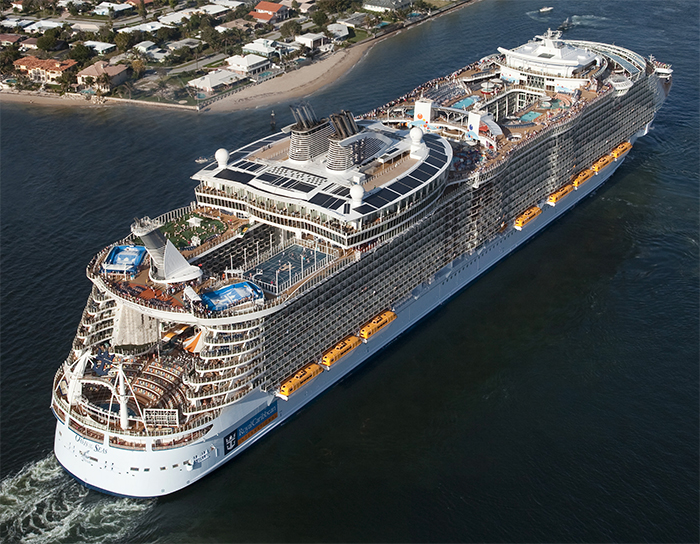 Much like other cities, cruise ships struggle with managing their waste, but oceans create far more environmental complexities than land-based cities.
Sustainability as a Competitive Advantage
With mounting pressure from environmental groups, the cruise industry has been working to remedy many of the ecosystem hazards being left in the wake of international waters.
Along with a new generation of highly connected passengers comes a level of transparency and scrutiny the industry may not be prepared for.
With today’s class of cruise ships, a 3,000-passenger ship can generate as much as 210,000 gallons of waste and sewage and 1 million gallons of gray water from showers and drains in a typical week according to the EPA. In addition, there are discharges of bilge water that may contain oil, grease and other contaminants.
The wastes from these “floating cities” pose a threat to fragile ecosystems, to sea life, and even to people enjoying a day at the beach.
While Disney is making the strongest effort to correct these problems, other cruise lines are also making progress. As sensor technology makes pollution issues increasingly transparent, the entire industry will soon be held to new accountability standards as customers continue to “vote with their pocketbooks.”
Final Thoughts
Until now, cruise ships have been operating like upscale third world countries, just now entering Internet age. Their true potential has yet to be discovered in a new digital friendly environment.
From a business standpoint, being on the cutting edge of creating exciting new cruise itineraries is now being counterbalanced with the nuanced opportunities for experiencing the oceans with an increasingly Internet savvy clientele.
In addition to being a floating resort, next generation cruise ships will operate as a working laboratory as companies experiment to unlock the ultimate cruise experience for every one of their passengers.
Author of “Communicating with the Future” – the book that changes everything
April 5, 2016
128 Things that will disappear in the driverless car era
I started writing this column while I was in Manila, Philippines for a talk with UnionBank, one of the most innovative banks I’ve ever come across.
Driving across Manila is often a painful experience with far too many cars locking up all possible arterials, and nowhere near enough money to redesign and build the needed infrastructure. But this is not unique to Manila.
As I’ve traveled around the world, I’ve run into equally bad traffic in Istanbul, Rotterdam, Los Angeles, Seoul, Mexico City, San Francisco, Rome, London, Beijing, and Mumbai. In fact there are literally thousands of cities where bad traffic is a way of life.
Car companies have become very good at selling vehicles but few countries have anticipated them being this good at it.
A recent study by Morgan Stanley showed that the average car is only used 4% of the day, making cars an astonishing waste of resources. If all cars were to be on the road simultaneously, we cannot even imagine the chaos that would ensue.
For these reasons I’ve become enamored with the coming autonomous car era where many of todays problems get solved. However, going through the transition will be anything but smooth.
Making the Transition
There’s a significant difference between a driverless car and a fully autonomous vehicle. We already have a number of vehicles on the road today with driverless features, but that’s only a small step towards the no-steering-wheel type of driverless car many are imagining.
As we move further into the fully autonomous car era, we also need to understand the distinction between “user-operated” and “completely driverless” vehicles. Because of regulatory and insurance issues, user-operated fully autonomous cars will come to market within the next five years, while complete autonomous driverless autos will remain further off.
Even though both Google and Tesla have predicted that fully-autonomous cars, the kind that Elon Musk describes as “true autonomous driving where you could literally get in the car, go to sleep, and wake up at your destination,” will be available to the public by 2020, that’s not the full story.
First generation vehicles like these will come with a variety of regulator issues and technical problems few can anticipate. But as with all early stage technologies, each of these problems will be dealt with as they arise.
In addition, being available and being commonplace are also many years apart.
While we are entering a game-changing transition period accompanied with a never-ending stream of industry hype, most of the changes listed below will happen after 2030.
Somewhere in the 2030-2035 timeframe we’ll begin to see highways designated as “driverless only,” only allowing vehicles that can be switched into driverless mode.
Fleet Ownership and On-Demand Transportation
Imagine stepping out of your house 15 years from now and using your smartphone to summon a driverless vehicle. Within 2-3 minutes a driverless vehicle arrives and whisks you off to work, school, shopping, or wherever you want to go.
A form of on-demand transportation is already happening with companies like Uber and Lyft. If we eliminate the driver, costs will plummet.
Once the technology is perfected, on-demand transportation companies will crop up in most metropolitan areas with large fleets of vehicles poised to meet consumer demand.
As car companies come to grips with a future that has fewer cars in it, they will begin changing their business model. Rather than charging for each vehicle sold, they will partner with fleet managers and charge for every mile the car is driven.
In a move to strengthen their financial position, car companies will begin to reduce the number of dealers, middlemen, and finance costs. This will put large fleet owners in an unusually influential position regarding car design.
Over time, riders will place far more emphasis on features like ingress and egress, riding comfort, and entertainment options, placing far less emphasis on things like car brand, style, color, and efficiency ratings.
Since the idea of fleet ownership and on-demand transportation tend to break down in rural communities, early use cases will spring up first in large metro areas.
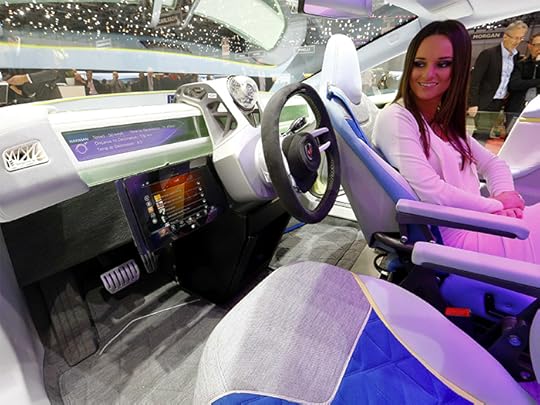
How much longer will cars have steering wheels?
Major Industry-Wide Changes Ahead
Over the coming decades, a number of industry-wide “epiphany moments” will cause business leaders to rethink the true scope of impact.
Early adopters will include Gen Z young people who will never feel the need to get a license and pay for insurance as well as Baby Boomers who don’t want to loose their freedom.
Adding to the early user list will be poor people, both legal and illegal immigrants, folks with DUIs, teenagers too young to drive, the directionally impaired, people who have lost their insurance, and many more.
Keep in mind these are changes that will take place over the next couple decades. In some cases we will see a car industry version of Blockbuster Video where all physical stores disappear. While some will disappear completely, others, like travel agencies, will be reduced to a small fraction of their former self.
Double Checkerboard
Over the years I’ve developed a brainstorming technique called the “checkerboard” as a way to generate new ideas. It’s a very simple technique where I start with eight categories and list eight items in each category, enough to fill all 64 spaces on a checkerboard.
When I’m feeling extra creative, I’ll generate enough ideas to fill two checkerboards – 128 of them.
Below are sixteen lists to help you grasp the sea change ahead in the transportation industry.
Driving Jobs that will Disappear – The job of driving a vehicle is one of the most common jobs in the world today. Most of these will evaporate over the coming decades.
1. Taxi drivers
2. Uber & Lyft drivers
3. Delivery (FedEx, UPS, USPS) jobs
4. Courier jobs
5. Bus drivers
6. Truck drivers
7. Valet jobs
8. Chauffeurs and limo drivers
Other Jobs that will Disappear – Along with driving vehicles, the transportation industry has a huge number of supporting roles that will also vanish.
9. Road construction flag people
10. Drivers-Ed teachers
11. Traffic reporters
12. Traffic analysts
13. Car licensing and registration
14. Drivers test people
15. Rental car agents
16. Crash testers
Specialty Vehicles – Virtually every vehicle that requires a human operator today will find itself competing with an autonomous version sometime in the future.
17. Forklift drivers
18. Lawnmower operators
19. Snowplow operators
20. Water truck drivers
21. Fire truck drivers
22. Water taxies
23. Ambulance drivers
24. Trash truck drivers

Autonomous ag-bots are coming to farmer’s field near you
Farm and Equipment Vehicles – Agriculture has continually been on the forefront of innovation. Entering the driverless era will be no exception.
25. Tractor drivers
26. Combine operators
27. Swather operators
28. Bailer operators
29. Sprayer operators
30. Horse trailer drivers
31. Grain truck operators
32. Automated fruit harvester operators
Construction Equipment Vehicles – Road construction and repair is a huge industry that will eventually be taken over by unmanned bots and drones.
33. Crane operators
34. Road grader operators
35. Earth movers
36. Street sweeper operators
37. Backhoe operators
38. Trencher operators
39. Cement truck operators
40. Fuel truck operators
Car Sales, Finance, & Insurance Industry Positions – As we move from owned to shared vehicles, much of the transportation economy will also disappear.
41. Auto sales – new and used
42. Account managers
43. Auto auctions
44. Credit managers
45. Loan underwriters
46. Insurance agents and sales reps
47. Insurance claims adjusters
48. Insurance call center agents
Miscellaneous Jobs to Disappear – We often forget how embedded our transportation culture is in today’s economy. Here are a few more of our soon-to-be-forgotten professions.
49. Traffic reporters on the news
50. Sobriety checkpoint people
51. Auto industry lobbyists
52. Stoplight installers
53. Pothole repair people
54. Emission testers
55. Road and parking lot stripers
56. Night repair crews

It’s hard to imagine what the inside of future vehicles will look like
Vehicle Features that will Disappear – The inside of cars will look radically different once the driver is removed from the equation.
57. Steering wheels
58. Gas pedals
59. Talking GPS
60. Dashboards for drivers
61. Spare tires
62. License plates
63. Seatbelts
64. Odometers
Vehicle Repair – Consumer-Facing Businesses – A significant portion of today’s retail and service industry is related to transportation. These too will begin to fade away.
65. Roadside assistance
66. Auto repair shops
67. Body shops
68. Tow trucks
69. Glass repair
70. Auto locksmiths
71. Transmission repair shops
72. Auto part stores
Vehicle Maintenance – There are a number of businesses that keep our cars operational and looking good. These too will dwindle over time.
73. Gas stations
74. Car washes
75. Oil change businesses
76. Detail shops
77. Tire shops
78. Brake shops
79. Emissions testing
80. Alignment shops
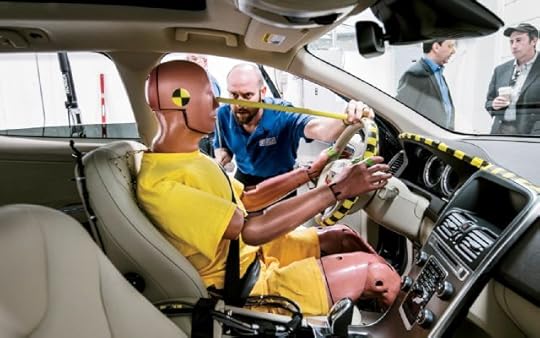
Even crash test dummies will soon lose their jobs
Driver Related Issues that will Disappear – Because of all the things that can go wrong in today’s congested traffic, many other issues will also disappear.
81. Road rage
82. Fender benders
83. Car theft
84. Getting lost
85. Lost cars in parking lots
86. Driving tests
87. Traffic stops
88. Crash test dummies
Parking Related Things – With cars today only being used 4% of the average day, we’ve had to build a massive parking infrastructure to accommodate both the long-term and short-term storage of unused vehicles. These will all lose their importance over time.
89. Parking lots
90. Parking garages
91. Parking tickets
92. Valet services
93. Parallel parking
94. Parking meters
95. Charging stations
96. Handicap parking
Courts/Justice System – In an autonomous vehicle era, most police departments will shrink to a fraction of their current size.
97. Traffic cops
98. Traffic courts – lawyers, DA, judges
99. Driver licenses
100. Patrol cars and officers
101. DUIs and drunk driving
102. Sobriety checkpoints
103. The boot
104. Road rage school
Highway Related – Future highways will not require near as many safety features.
105. Traffic jams
106. Traffic signs
107. Traffic lanes
108. Speed zones
109. Road stripes
110. Weigh stations
111. Mile markers
112. Guardrails
Highway Repair – While we will still need to repair roads in the future, repair activities will no longer be a major impediment to the flow of traffic.
113. Traffic cones
114. Road closures
115. Detours
116. Stoplights
117. Pilot cars
118. Flag people
119. Merge lanes
120. Night lights for late night road repair
Traffic Laws – Traffic law has grown to become a significant portion of the justice system penal code.
121. Speeding tickets
122. Failing to stop at a stoplight or stop sign
123. DUIs – driving under the influence
124. Reckless driving
125. Driving in the wrong direction
126. Passing in a no passing zone
127. Unsafe lane changes
128. Driver profiling - In our autonomous future, every car will be driven exactly the same way, so ageist, sexist, racist and regional driver prejudices will cease to exist.
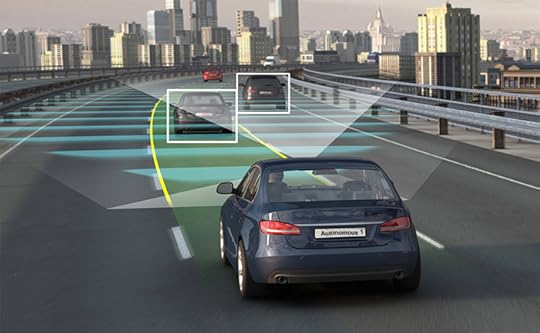
Unlocking the road ahead
Final Thoughts
The privilege of driving is about to be redefined.
Elon Musk has predicted, over time, that lawmakers will decide that driving a vehicle is far too dangerous for humans, and most people will be outlawed from doing the driving themselves.
Following close behind autonomous vehicles on the ground will be a wide array of autonomous vehicles in the air including flying passenger drones. Even though it will be many years before “droning to work” will become a common form of transportation, we will eventually get there.
Many are already thinking about the systematic loss of jobs coming when drivers are deemed unnecessary. The part that’s receiving far less attention is the huge number of new jobs that will replace the ones going away.
Here is just a quick sampling of
In-car “ride experience” designers
Operators of fast food drones that will dock with moving cars
Traffic flow analysts
Traffic system planners, designers, and monitors
Automated traffic architects and engineers
Driverless operating system engineers
Luxury vehicle designers
Traffic transitionists and impact minimizers
Car designers today spend the vast majority of their time trying to optimize the driver experience. After all, the driver is the most important part of the ownership equation.
As we enter the “driverless era,” the focus will shift to the passenger experience. Fancy dashboards displaying dazzling amounts of information for the driver will become a thing of the past as riders fuss over on-board movies, music, and massage controls.
Some fleet owners will offer car experiences that are more conversational in nature, pairing socially compatible riders in a way to maximize conversations and improve the social environment. Others will stress the benefits of alone-time, offering a peaceful zen-like experience for those wishing to escape the hustle and bustle of work-life.
As we navigate our way towards a safer, more efficient society, we still have a few bumpy roads to go down before we see the light at the end of the tunnel.
As I’ve said many times, driverless cars will change transportation more dramatically than the invention of the automobile itself. I’m hoping this will help you understand why.
Author of “Communicating with the Future” – the book that changes everything
The post 128 Things that will disappear in the driverless car era appeared first on Futurist Thomas Frey.
April 4, 2016
128 Things that will disappear in the driverless car era
I started writing this column while I was in Manila, Philippines for a talk with UnionBank, one of the most innovative banks I’ve ever come across.
Driving across Manila is often a painful experience with far too many cars locking up all possible arterials, and nowhere near enough money to redesign and build the needed infrastructure. But this is not unique to Manila.
As I’ve traveled around the world, I’ve run into equally bad traffic in Istanbul, Rotterdam, Los Angeles, Seoul, Mexico City, San Francisco, Rome, London, Beijing, and Mumbai. In fact there are literally thousands of cities where bad traffic is a way of life.
Car companies have become very good at selling vehicles but few countries have anticipated them being this good at it.
A recent study by Morgan Stanley showed that the average car is only used 4% of the day, making cars an astonishing waste of resources. If all cars were to be on the road simultaneously, we cannot even imagine the chaos that would ensue.
For these reasons I’ve become enamored with the coming autonomous car era where many of todays problems get solved. However, going through the transition will be anything but smooth.
Making the Transition
There’s a significant difference between a driverless car and a fully autonomous vehicle. We already have a number of vehicles on the road today with driverless features, but that’s only a small step towards the no-steering-wheel type of driverless car many are imagining.
As we move further into the fully autonomous car era, we also need to understand the distinction between “user-operated” and “completely driverless” vehicles. Because of regulatory and insurance issues, user-operated fully autonomous cars will come to market within the next five years, while complete autonomous driverless autos will remain further off.
Even though both Google and Tesla have predicted that fully-autonomous cars, the kind that Elon Musk describes as “true autonomous driving where you could literally get in the car, go to sleep, and wake up at your destination,” will be available to the public by 2020, that’s not the full story.
First generation vehicles like these will come with a variety of regulator issues and technical problems few can anticipate. But as with all early stage technologies, each of these problems will be dealt with as they arise.
In addition, being available and being commonplace are also many years apart.
While we are entering a game-changing transition period accompanied with a never-ending stream of industry hype, most of the changes listed below will happen after 2030.
Somewhere in the 2030-2035 timeframe we’ll begin to see highways designated as “driverless only,” allowing vehicles that can be switched into driverless mode.
Fleet Ownership and On-Demand Transportation
Imagine stepping out of your house 15 years from now and using your smartphone to summon a driverless vehicle. Within 2-3 minutes a driverless vehicle arrives and whisks you off to work, school, shopping, or wherever you want to go.
A form of on-demand transportation is already happening with companies like Uber and Lyft. If we eliminate the driver, costs will plummet.
Once the technology is perfected, on-demand transportation companies will crop up in most metropolitan areas with large fleets of vehicles poised to meet consumer demand.
As car companies come to grips with a future that has fewer cars in it, they will begin changing their business model. Rather than charging for each vehicle sold, they will partner with fleet managers and charge for every mile the car is driven.
In a move to strengthen their financial position, car companies will begin to reduce the number of dealers, middlemen, and finance costs. This will put large fleet owners in an unusually influential position regarding car design.
Over time, riders will place far more emphasis on features like ingress and egress, riding comfort, and entertainment options, placing far less emphasis on things like car brand, style, color, and efficiency ratings.
Since the idea of fleet ownership and on-demand transportation tend to break down in rural communities, early use cases will spring up first in large metro areas.
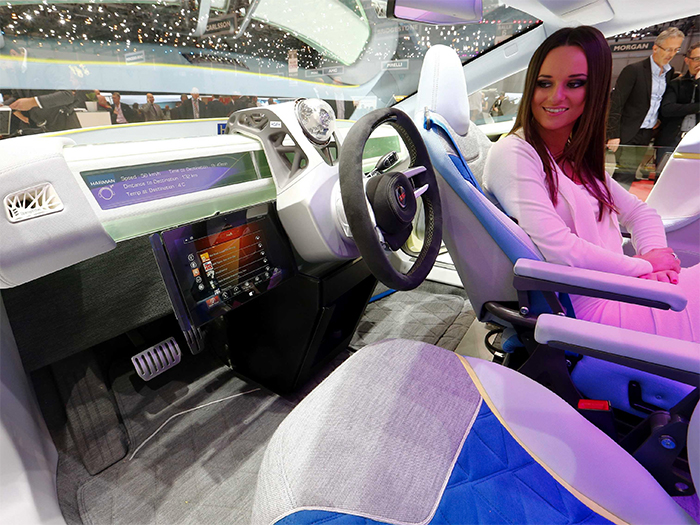 How much longer will we have steering wheels?
Major Industry-Wide Changes Ahead
Over the coming decades, a number of industry-wide “epiphany moments” will cause business leaders to rethink the true scope of impact.
Early adopters will include Gen Z young people who will never feel the need to get a license and pay for insurance as well as Baby Boomers who don’t want to loose their freedom.
Adding to the early user list will be poor people, both legal and illegal immigrants, folks with DUIs, teenagers too young to drive, the directionally impaired, people who have lost their insurance, and many more.
Keep in mind these are changes that will take place over the next couple decades. In some cases we will see a car industry version of Blockbuster Video where all physical stores disappear. While some will disappear completely, others, like travel agencies, will be reduced to a small fraction of their former self.
Double Checkerboard
Over the years I’ve developed a brainstorming technique called the “checkerboard” as a way to generate new ideas. It’s a very simple technique where I start with eight categories and list eight items in each category, enough to fill all 64 spaces on a checkerboard.
When I’m feeling extra creative, I’ll generate enough ideas to fill two checkerboards – 128 of them.
Below are a number of these lists to help you grasp the sea change ahead in the transportation industry.
Driving Jobs that will Disappear – The job of driving a vehicle is one of the most common jobs in the world today. Most of these will evaporate over the coming decades.
Taxi drivers
Uber & Lyft drivers
Delivery (FedEx, UPS, USPS) jobs
Courier jobs
Bus drivers
Truck drivers
Valet jobs
Chauffeurs and limo drivers
Other Jobs that will Disappear – Along with driving vehicles, the transportation industry has a huge number of supporting roles that will also vanish.
Road construction flag people
Drivers-Ed teachers
Traffic reporters
Traffic analysts
Car licensing and registration
Drivers test people
Rental car agents
Crash testers
Specialty Vehicles – Virtually every vehicle that requires a human operator today will find itself competing with an autonomous version sometime in the future.
Forklift drivers
Lawnmower operators
Snowplow operators
Water truck drivers
Fire truck drivers
Water taxies
Ambulance drivers
Trash truck drivers
 Autonomous ag-bots are coming to farmer’s field near you
Farm and Equipment Vehicles – Agriculture has continually been on the forefront of innovation. Entering the driverless era will be no exception.
Tractor drivers
Combine operators
Swather operators
Bailer operators
Sprayer operators
Horse trailer drivers
Grain truck operators
Automated fruit harvester operators
Construction Equipment Vehicles – Road construction and repair is a huge industry that will eventually be taken over by unmanned bots and drones.
Crane operators
Road grader operators
Earth movers
Street sweeper operators
Backhoe operators
Trencher operators
Cement truck operators
Fuel truck operators
Car Sales, Finance, & Insurance Industry Positions – As we move from owned to shared vehicles, much of the transportation economy will also disappear.
Auto sales – new and used
Account managers
Auto auctions
Credit managers
Loan underwriters
Insurance agents and sales reps
Insurance claims adjusters
Insurance call center agents
Miscellaneous Jobs to Disappear – We often forget how embedded our transportation culture is in today’s economy. Here are a few more of our soon-to-be-forgotten professions.
Traffic reporters on the news
Sobriety checkpoint people
Auto industry lobbyists
Stoplight installers
Pothole repair people
Emission testers
Road and parking lot stripers
Night repair crews
 It’s hard to imagine what the inside of future vehicles will look like
Vehicle Features that will Disappear – The inside of cars will look radically different once the driver is removed from the equation.
Steering wheels
Gas pedals
Talking GPS
Dashboards for drivers
Spare tires
License plates
Seatbelts
Odometers
Vehicle Repair – Consumer-Facing Businesses – A significant portion of today’s retail and service industry is related to transportation. These too will begin to fade away.
Roadside assistance
Auto repair shops
Body shops
Tow trucks
Glass repair
Auto locksmiths
Transmission repair shops
Auto part stores
Vehicle Maintenance – There are a number of businesses that keep our cars operational and looking good. These too will dwindle over time.
Gas stations
Car washes
Oil change businesses
Detail shops
Tire shops
Brake shops
Emissions testing
Alignment shops
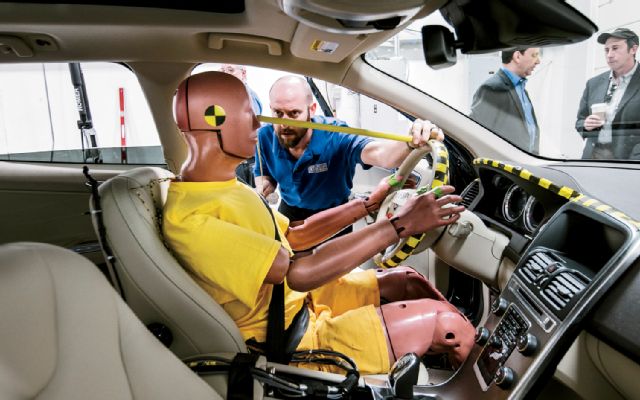 Even crash test dummies will soon lose their jobs
Driver Related Issues that will Disappear – Because of all the things that can go wrong in today’s congested traffic, many other issues will also disappear.
Road rage
Fender benders
Car theft
Getting lost
Lost cars in parking lots
Driving tests
Traffic stops
Crash test dummies
Parking Related Things – With cars today only being used 4% of the average day, we’ve had to build a massive parking infrastructure to accommodate both the long-term and short-term storage of unused vehicles. These will all lose their importance over time.
Parking lots
Parking garages
Parking tickets
Valet services
Parallel parking
Parking meters
Charging stations
Handicap parking
Courts/Justice System – In an autonomous vehicle era, most police departments will shrink to a fraction of their current size.
Traffic cops
Traffic courts – lawyers, DA, judges
Driver licenses
Patrol cars and officers
DUIs and drunk driving
Sobriety checkpoints
The boot
Road rage school
Highway Related – Future highways will not require near as many safety features.
Traffic jams
Traffic signs
Traffic lanes
Speed zones
Road stripes
Weigh stations
Mile markers
Guardrails
Highway Repair – While we will still need to repair roads in the future, repair activities will no longer be a major impediment to the flow of traffic.
Traffic cones
Road closures
Detours
Stoplights
Pilot cars
Flag people
Merge lanes
Night lights for late night road repair
Traffic Laws – Traffic law has grown to become a significant portion of the justice system penal code.
Speeding tickets
Failing to stop at a stoplight or stop sign
DUIs – driving under the influence
Reckless driving
Driving in the wrong direction
Passing in a no passing zone
Unsafe lane changes
Driver profiling – In our autonomous future, every car will be driven exactly the same way, so ageist, sexist, racist and regional driver prejudices will cease to exist.
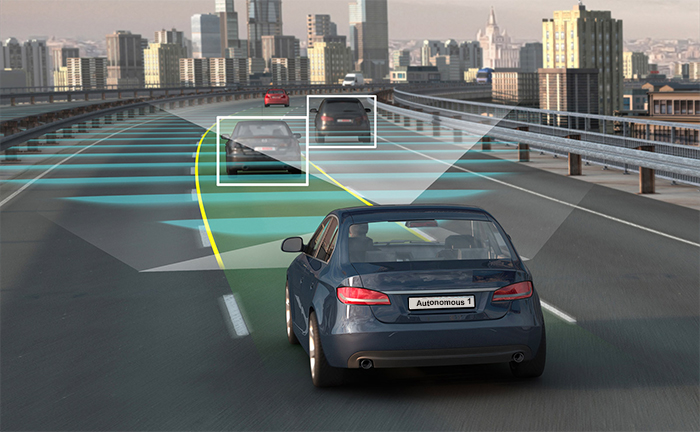 Unlocking the road ahead
Final Thoughts
The privilege of driving is about to be redefined.
Elon Musk has predicted, over time, that lawmakers will decide that driving a vehicle is far too dangerous for humans, and most people will be outlawed from doing the driving themselves.
Following close behind autonomous vehicles on the ground will be a wide array of autonomous vehicles in the air including flying passenger drones. Even though it will be many years before “droning to work” will become a common form of transportation, we will eventually get there.
Many are already thinking about the systematic loss of jobs coming when drivers are deemed unnecessary. The part that’s receiving far less attention is the huge number of new jobs that will replace the ones going away.
Here is just a quick sampling of
In-car “ride experience” designers
Operators of fast food drones that will dock with moving cars
Traffic flow analysts
Traffic system planners, designers, and monitors
Automated traffic architects and engineers
Driverless operating system engineers
Luxury vehicle designers
Traffic transitionists and impact minimizers
Car designers today spend the vast majority of their time trying to optimize the driver experience. After all, the driver is the most important part of the ownership equation.
As we enter the “driverless era,” the focus will shift to the passenger experience. Fancy dashboards displaying dazzling amounts of information for the driver will become a thing of the past as riders fuss over on-board movies, music, and massage controls.
Some fleet owners will offer car experiences that are more conversational in nature, pairing socially compatible riders in a way to maximize conversations and improve the social environment. Others will stress the benefits of alone-time, offering a peaceful zen-like experience for those wishing to escape the hustle and bustle of work-life.
As we navigate our way towards a safer, more efficient society, we still have a few bumpy roads to go down before we see the light at the end of the tunnel.
As I’ve said many times, driverless cars will change transportation more dramatically than the invention of the automobile itself. I’m hoping this will help you understand why.
Author of “Communicating with the Future” – the book that changes everything
March 26, 2016
Will Artificial Intelligence Improve Democracy or Destroy It?
There’s a big difference between what a person wants and what they need.
On one hand we need healthy food, a good night’s rest, and decent medical care. But a little voice inside our heads has us craving dinner at Gordon Ramsay’s, an overnight stay at the Ritz Carlton, and a spa weekend at the St. Regis in Aspen to fix whatever is wrong.
The same is true with countries. There’s a big difference between what a country wants and what it needs.
While we may need better roads, schools, and playgrounds, we want others to pay for them. And while we need elected officials who can make the best possible decisions, we tend to vote for candidates who are good looking and make us feel better.
Our wants and needs are vastly different creatures constantly pulling us in opposite directions.
In fact, many of us are addicted to our wants. A drug addict has an unquenchable thirst for drugs, a Facebook addict is always checking their phone, and a sex addict can never get enough.
The irrational mind may live next door to the rational mind, but together they form contradictory arguments inside a rather dysfunctional neighborhood in our own heads.
So how can we possibly make better decisions and create a better world if all we have to work with is defective humans?
Current State of AI (Artificial Intelligence)
There tends to be a lot of confusion between machine learning and artificial intelligence. But in reality, machine learning is the only kind of AI that exists.
At the same time, our understanding of AI is changing. Most of the things we thought of as AI in the past were little more than sophisticated forms of computer programming.
However, along with advances in technology, the latest strategy for AI developers has become, “Don't model the world, model the mind.”
When AI researchers “modeled the mind,” they created systems capable of learning increasingly complicated things about the world around them.
Since 2012, a specific machine learning technique called “deep learning” has permeated the AI world. Researchers have abandoned the classical programming tricks-style of AI and switched to deep learning, because it works far better than any previous methodologies.
We've made more progress in the years since 2012 than in the preceding 25 years on several key AI problems including image understanding, signal processing, vocal comprehension, and understanding text.
Keep in mind that deep learning still isn't true AI, the kind of sophisticated and adaptable intelligence humans exhibit, but it's a giant leap forward on the path to getting there.
Naturally this raises a number of philosophical questions:
How can flawed humans possibly create un-flawed AI?
Is making the so-called “perfect” AI really optimal?
Will AI become the great compensator for human deficiencies?
Does AI eventually replace our need for other people?
Should we use AI to Create Better Citizens?
One possible step towards integrating artificial intelligence with democracy will be to gamify the interface between people and government with something similar to customer loyalty programs, in this case by gamifying citizenship through a government loyalty program.
A system like this would effectively promote involvement, rewarding people for their role in creating a better functioning society. It would begin by asking questions like:
Have you gotten all your shots, finished high school, learned about American history, or served in the military or some similar community service position.
How many times have you voted since you were 18?
How many government services have you taken advantage of over the past decade?
If they sent you a survey asking you to evaluate their performance, did you answer that survey?
Have you been asked to serve on a jury? Did you?
Rewards for top citizens could range from things like low interest loans, to lower taxes, free national park passes, less TSA scrutiny at airports, higher credit ratings, and maybe even favorable treatment in the event of a tax audit.
Perhaps the highest ranked citizens could even win a free night stay in the Lincoln bedroom at the Whitehouse.
With the right status, people may receive advance notification and priority rating when applying for certain jobs.
When it comes to jobs, AI will have the ability to determine your optimal career path by analyzing past experiences, inherent skills, and individual preferences, and do it in a far more efficient manner than any system we have today.

How much longer will democracy survive?
8 Reasons Why Democracy is Today’s Best form of Government
Democracy is far from perfect, but when it comes to running a government, it has a number of built-in mechanisms for promoting fairness and participation. Here are some of the reasons why those who advocate democracy view it as today’s best form of government.
Democracy is the great equalizer. It doesn’t favor the rich over the poor, nor the successful over the unsuccessful, nor the healthy over the unhealthy, nor one race over another race, nor one region over another region.
Everyone has a stake, every person can voice their opinion.
It promotes fair and healthy competition allowing the best of the best to stand out.
Democracy promotes participation. Even poor people without formal education, living in disadvantaged neighborhoods, and little authority can play a significant role.
It’s self-adjusting. A democracy allows the most pertinent issues to rise to the top.
It diffuses tension by giving people an outlet.
It places human values on a human system. Much like the value of stocks, currency, or collectables, we assign an emotional value to the world around us. Democracy is our system for assigning value to the people we elect or the referendums we vote on.
It both improves and preserves personal pride and dignity.
8 Reasons Why Democracy Still Comes Up Short
There are no perfect systems and in many ways democracy still comes up short.
Democracy is biased towards what we want, not what we need.
Those who are elected are the ones who do the best job of appealing to the median IQ of the voting public. We like to think we’re electing the best and the brightest but we’re not.
It’s a very adversarial system. Rivalries are good to a certain point, but excessive rivalries create a polarizing environment.
Voters are not experts.
Democracy favors the “less busy.” Senior citizens carry an inordinate amount of clout because they have more time to be involved.
Democracy typically works better for those who receive the most benefits.
It favors the “fairest” decision over the “best” decision.
Democracy demands a constantly evolving system for it to function properly. In our increasingly complex society it requires constant monitoring, new kinds of checks and balances, oversights, rules, and limitations to make it function properly.
8 Ways Artificial Intelligence can Improve Democracy
It would be easy to leapfrog our thinking towards a system where AI makes all of our decisions for us, but any process that reduces individual participation will be heavily scrutinized before we learn to trust it, and trust takes time.
Any system that reduces personal involvement will require years of testing before it’s implemented on a large scale. That said, here are a few ways it could greatly improve our processes:
Since AI can understand individual preferences, it can help voters make decisions and, by extension, increase participation.
AI will have the ability to instantly spot fraud and corruption in the system.
With better ways of spotting corruption, AI will pave the way for electronic voting, create more convenience, and enable a wider cross-section of society to participate.
AI will allow voters to “drill down” and get the facts straight on any decision before they make it.
Done correctly, AI will improve the caliber of decisions but will not undermine the role of the individual.
AI has the potential to give voters expanded authority, allowing more issues to come up for community input and public decisions.
AI will have the ability to cancel out negative campaigning, biased reporting, and slanted arguments.
AI has the potential to reduce the cost of campaigning, reduce the reliance on contributors, and reduce political favors in the process.

Will the algorithms that create tomorrow’s artificial intelligence be the same algorithms that govern us in the future?
8 Ways Artificial Intelligence could Destroy Democracy
Keep in mind that improving democracy and destroying it may very well be the same thing.
With AI, we have the potential to automate democracy as well as the entire decision-making process for government. Most likely this will involve a step-by-step process where each new level of automation is tested, refined, and retested before anything is implemented system wide.
Here are eight possible steps towards an automated-AI form of democracy.
AI could easily alter the one-person-one-vote system by adding more value to the votes of those who are better informed, better educated, or more involved.
AI could be set up to instantly trigger new elections whenever public confidence drops below a certain level.
Minor decisions could be automated, and if that works, we could begin to automate more significant ones.
When it comes to justice systems, AI could eventually be used to eliminate judges altogether, and in the process, deliver far more impartial court rulings.
When problems occur, AI could be used to automatically trigger new referendums based on “situational awareness,” riots, protests, and petitions, as well as ebbing and waning levels of public sentiment.
Eventually AI could be used to eliminate scheduled election days completely and replace them with an auto-correction system that triggers election days and election issues as needed.
Taking this line of thinking a few steps further, AI could eliminate elected officials altogether and replace them automated votes by the general population.
As a final step, if every other AI process functions properly, we could eliminate voting altogether in favor of automated consensus system. Since AI already knows how we think, it could register our votes automatically.
Will AI result in an improved form of Democracy or something else?
When it comes to democracy, it’s easy for poor people to vote for more taxes on the rich, but in the U.S., it’s the rich who contribute the most to campaigns, so the two tend to counterbalance each other out.
Many view campaign contributions as a form of corruption, but so far we’ve not found any effective way of funding campaigns without tapping into rich people’s money.
At the same time, machine intelligence has quickly become a playground for creative minds, and even though we’re still a couple steps removed from what experts consider true AI, it has the potential to change our current systems and remove many of the built-in biases.
Over the coming years, enterprising people will try countless experiments to test new approaches for adding thinking systems to our governmental processes.
Final Thoughts
Democracy is destined to change, and with a host of emerging technologies already in the works for rewriting the rulebooks on parliamentary thinking, will soon seem like a very dated form of government.
Words like auto-democracy, democracy AI, and auto-governance will soon enter the public lexicon as we experiment our way towards something better.
But this will not be an easy transition. We will see the strongest resistance over concepts like “what constitutes better?” with many asking “better for whom?”
Will it be better for the working class, better for the business owners, better for families with children, or better for rich and poor alike?
More importantly, how will we know?
Author of “Communicating with the Future” – the book that changes everything
The post Will Artificial Intelligence Improve Democracy or Destroy It? appeared first on Futurist Thomas Frey.
Will Artificial Intelligence Improve Democracy or Destroy It?

There’s a big difference between what a person wants and what they need.
On one hand we need healthy food, a good night’s rest, and decent medical care. But a little voice inside our heads has us craving dinner at Gordon Ramsay’s, an overnight stay at the Ritz Carlton, and a spa weekend at the St. Regis in Aspen to fix whatever is wrong.
The same is true with countries. There’s a big difference between what a country wants and what it needs.
While we may need better roads, schools, and playgrounds, we want others to pay for them. And while we need elected officials who can make the best possible decisions, we tend to vote for candidates who are good looking and make us feel better.
Our wants and needs are vastly different creatures constantly pulling us in opposite directions.
In fact, many of us are addicted to our wants. A drug addict has an unquenchable thirst for drugs, a Facebook addict is always checking their phone, and a sex addict can never get enough.
The irrational mind may live next door to the rational mind, but together they form contradictory arguments inside a rather dysfunctional neighborhood in our own heads.
So how can we possibly make better decisions and create a better world if all we have to work with is defective humans?
Current State of AI (Artificial Intelligence)
There tends to be a lot of confusion between machine learning and artificial intelligence. But in reality, machine learning is the only kind of AI that exists.
At the same time, our understanding of AI is changing. Most of the things we thought of as AI in the past were little more than sophisticated forms of computer programming.
However, along with advances in technology, the latest strategy for AI developers has become, “Don’t model the world, model the mind.”
When AI researchers “modeled the mind,” they created systems capable of learning increasingly complicated things about the world around them.
Since 2012, a specific machine learning technique called “deep learning” has permeated the AI world. Researchers have abandoned the classical programming tricks-style of AI and switched to deep learning, because it works far better than any previous methodologies.
We’ve made more progress in the years since 2012 than in the preceding 25 years on several key AI problems including image understanding, signal processing, vocal comprehension, and understanding text.
Keep in mind that deep learning still isn’t true AI, the kind of sophisticated and adaptable intelligence humans exhibit, but it’s a giant leap forward on the path to getting there.
Naturally this raises a number of philosophical questions:
How can flawed humans possibly create un-flawed AI?
Is making the so-called “perfect” AI really optimal?
Will AI become the great compensator for human deficiencies?
Does AI eventually replace our need for other people?
Should we use AI to Create Better Citizens?
One possible step towards integrating artificial intelligence with democracy will be to gamify the interface between people and government with something similar to customer loyalty programs, in this case by gamifying citizenship through a government loyalty program.
A system like this would effectively promote involvement, rewarding people for their role in creating a better functioning society. It would begin by asking questions like:
Have you gotten all your shots, finished high school, learned about American history, or served in the military or some similar community service position.
How many times have you voted since you were 18?
How many government services have you taken advantage of over the past decade?
If they sent you a survey asking you to evaluate their performance, did you answer that survey?
Have you been asked to serve on a jury? Did you?
Rewards for top citizens could range from things like low interest loans, to lower taxes, free national park passes, less TSA scrutiny at airports, higher credit ratings, and maybe even favorable treatment in the event of a tax audit.
Perhaps the highest ranked citizens could even win a free night stay in the Lincoln bedroom at the Whitehouse.
With the right status, people may receive advance notification and priority rating when applying for certain jobs.
When it comes to jobs, AI will have the ability to determine your optimal career path by analyzing past experiences, inherent skills, and individual preferences, and do it in a far more efficient manner than any system we have today.
 How much longer will democracy survive?
8 Reasons Why Democracy is Today’s Best form of Government
Democracy is far from perfect, but when it comes to running a government, it has a number of built-in mechanisms for promoting fairness and participation. Here are some of the reasons why those who advocate democracy view it as today’s best form of government.
Democracy is the great equalizer. It doesn’t favor the rich over the poor, nor the successful over the unsuccessful, nor the healthy over the unhealthy, nor one race over another race, nor one region over another region.
Everyone has a stake, every person can voice their opinion.
It promotes fair and healthy competition allowing the best of the best to stand out.
Democracy promotes participation. Even poor people without formal education, living in disadvantaged neighborhoods, and little authority can play a significant role.
It’s self-adjusting. A democracy allows the most pertinent issues to rise to the top.
It diffuses tension by giving people an outlet.
It places human values on a human system. Much like the value of stocks, currency, or collectables, we assign an emotional value to the world around us. Democracy is our system for assigning value to the people we elect or the referendums we vote on.
It both improves and preserves personal pride and dignity.
8 Reasons Why Democracy Still Comes Up Short
There are no perfect systems and in many ways democracy still comes up short.
Democracy is biased towards what we want, not what we need.
Those who are elected are the ones who do the best job of appealing to the median IQ of the voting public. We like to think we’re electing the best and the brightest but we’re not.
It’s a very adversarial system. Rivalries are good to a certain point, but excessive rivalries create a polarizing environment.
Voters are not experts.
Democracy favors the “less busy.” Senior citizens carry an inordinate amount of clout because they have more time to be involved.
Democracy typically works better for those who receive the most benefits.
It favors the “fairest” decision over the “best” decision.
Democracy demands a constantly evolving system for it to function properly. In our increasingly complex society it requires constant monitoring, new kinds of checks and balances, oversights, rules, and limitations to make it function properly.
8 Ways Artificial Intelligence can Improve Democracy
It would be easy to leapfrog our thinking towards a system where AI makes all of our decisions for us, but any process that reduces individual participation will be heavily scrutinized before we learn to trust it, and trust takes time.
Any system that reduces personal involvement will require years of testing before it’s implemented on a large scale. That said, here are a few ways it could greatly improve our processes:
Since AI can understand individual preferences, it can help voters make decisions and, by extension, increase participation.
AI will have the ability to instantly spot fraud and corruption in the system.
With better ways of spotting corruption, AI will pave the way for electronic voting, create more convenience, and enable a wider cross-section of society to participate.
AI will allow voters to “drill down” and get the facts straight on any decision before they make it.
Done correctly, AI will improve the caliber of decisions but will not undermine the role of the individual.
AI has the potential to give voters expanded authority, allowing more issues to come up for community input and public decisions.
AI will have the ability to cancel out negative campaigning, biased reporting, and slanted arguments.
AI has the potential to reduce the cost of campaigning, reduce the reliance on contributors, and reduce political favors in the process.
 Will the algorithms that create tomorrow’s artificial intelligence be the same algorithms that govern us in the future?
8 Ways Artificial Intelligence could Destroy Democracy
Keep in mind that improving democracy and destroying it may very well be the same thing.
With AI, we have the potential to automate democracy as well as the entire decision-making process for government. Most likely this will involve a step-by-step process where each new level of automation is tested, refined, and retested before anything is implemented system wide.
Here are eight possible steps towards an automated-AI form of democracy.
AI could easily alter the one-person-one-vote system by adding more value to the votes of those who are better informed, better educated, or more involved.
AI could be set up to instantly trigger new elections whenever public confidence drops below a certain level.
Minor decisions could be automated, and if that works, we could begin to automate more significant ones.
When it comes to justice systems, AI could eventually be used to eliminate judges altogether, and in the process, deliver far more impartial court rulings.
When problems occur, AI could be used to automatically trigger new referendums based on “situational awareness,” riots, protests, and petitions, as well as ebbing and waning levels of public sentiment.
Eventually AI could be used to eliminate scheduled election days completely and replace them with an auto-correction system that triggers election days and election issues as needed.
Taking this line of thinking a few steps further, AI could eliminate elected officials altogether and replace them automated votes by the general population.
As a final step, if every other AI process functions properly, we could eliminate voting altogether in favor of automated consensus system. Since AI already knows how we think, it could register our votes automatically.
Will AI result in an improved form of Democracy or something else?
When it comes to democracy, it’s easy for poor people to vote for more taxes on the rich, but in the U.S., it’s the rich who contribute the most to campaigns, so the two tend to counterbalance each other out.
Many view campaign contributions as a form of corruption, but so far we’ve not found any effective way of funding campaigns without tapping into rich people’s money.
At the same time, machine intelligence has quickly become a playground for creative minds, and even though we’re still a couple steps removed from what experts consider true AI, it has the potential to change our current systems and remove many of the built-in biases.
Over the coming years, enterprising people will try countless experiments to test new approaches for adding thinking systems to our governmental processes.
Final Thoughts
Democracy is destined to change, and with a host of emerging technologies already in the works for rewriting the rulebooks on parliamentary thinking, will soon seem like a very dated form of government.
Words like auto-democracy, democracy AI, and auto-governance will soon enter the public lexicon as we experiment our way towards something better.
But this will not be an easy transition. We will see the strongest resistance over concepts like “what constitutes better?” with many asking “better for whom?”
Will it be better for the working class, better for the business owners, better for families with children, or better for rich and poor alike?
More importantly, how will we know?
Author of “Communicating with the Future” – the book that changes everything
March 17, 2016
How much are VR Broadcasting Rights Worth for NFL Football?
1994 was the first year that television broadcast rights for NFL football exceeded $1 billion. While currently earning over $6 billion per year, the NFL currently has its eyes set on a much larger number in the years ahead, upwards of $25 billion.
Broadcast rights include an exclusive piece of content through which a broadcast company, in this case CBS, Fox, NBC, and ESPN, have the right to air all the events leading up to the game, the game itself, and any post game events significant enough to attract a audience.
The television rights to broadcast NFL games are the most lucrative and expensive rights of any American sport.
The value of these rights is based on a broadcaster’s ability to sell ads and make a profit. In most cases the profit potential has to be several multiples of what they cost. So if the rights to an event cost $10 million and the cost of producing the broadcast with producers, hosts, commentators, reporters, camera crews, engineers, and studio analysts amounts to another $10 million, the television station may need to see potential ad sales of over $100 million to make it all worthwhile.
Over time television companies have become very sophisticated in their ability to predict audience size and generate ad sales.
As a result, professional sports have grown into a massive industry with player contracts, licensing agreements, and stadium deals all in the crosshairs, as owner groups have been quick to mine every possible revenue stream to their advantage.
That’s why the latest innovations in virtual reality are particularly interesting because they open the doors to entirely new revenue streams that currently don’t exist.
The key difference is that broadcast rights for VR will have far less to do with ad sales and far more to do with the overall value of the experience.
The Ultimate Form of Story Telling
An athletic competition is only interesting if athletes and teams are relatively evenly paired, and if either team has the potential to win or lose their next competition.
Teams that always win tend to be far less interesting over time, and those with constant losing streaks are the least interesting of all.
In this context, sporting competitions have become the ultimate form of story telling. Each contest is a test of the human spirit, with good guys and bad guys pairing off, amidst great drama, as people test their limits to overcome adversity, in their struggle to achieve victory. And all of this is unfolding in real time, veiled in the mystery of an unknown outcome.
As a result, sports have become the ultimate form of fresh content in a world where relevance is gauged by timeliness and hyper-awareness is all part of the group experience.
The value of these broadcasts degrades exponentially faster than virtually any other form of content because once it’s over, and the scores announced, few people have interest in watching it all over again.
As a result, sporting events take center stage as viewers plan their days. Most media companies view sports as an anchor event around which all other programming is scheduled.
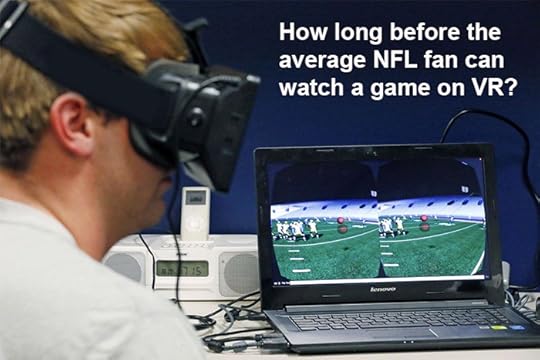
When will the experience be good enough?
As with any new technology, users have had to put up with bad prototypes and the beta-quality equipment for several years, knowing something better will be coming soon. The public is now poised for the next generation of VR gear, sensing that every iteration moving forward will be substantially better than anything in the past.
But with football broadcasts being one of thousands of potential applications, even the upgraded gear may not be ready for prime time.
As I see it, the ultimate football broadcast will involve a few key players on each team wearing tiny helmet-cams so viewers can experience the game the same way a player does.
This assumes video cameras that are tiny enough and durable enough to survive the rigors of full contact, and batteries and transmission modules unobtrusive to those wearing them.
It also assumes viewers and advertisers will be paying a premium for this kind of experience.
Once that’s proven, a even later generation VR will add haptic-sensation devices that allow wearers to feel the impact of getting hit on the field and, to some degree, the struggles each player feels as they play the game.
The sale of VR gear will have to reach hundreds of millions of users before there’s sufficient markets for teams and broadcasters to make the investment. Once that happens, the league will have to zero in on the right price point viewers are willing to pay a premium for that kind of viewing experience.
That could range from $50-$100 per game, or more, depending on the market. Since advertising on VR is still in its infancy, it’s unknown how much of it can be offset with sponsors.
Regardless of how good the broadcast is, virtually no one will want to spend 3-4 hours straight watching a game on VR. It will be an intermittent experience, with long interludes to enjoy a beer and some food and to talk with friends. Most likely it will be one VR set per party to share the experience.
Under optimal conditions with marked improvement in each new generation of gear, and sales of VR gear going through the roof, we are still at best five years away from any serious revenues being made from VR broadcasts of the NFL.
Final Thoughts
The first live sporting event to be broadcast on VR will be NASCAR. Fox Sports has teamed up with NextVR to bring the 58th running of the Daytona 500 to Samsung Gear VR users.
Done as a promotional event, NextVR will have 360-degree cameras positioned at the starting line, in the pit row, and in the garage. And Fox will livestream a directed broadcast of the race complete with graphics and commentary to guide virtual reality users around the track.
With Samsung underwriting the costs of this experiment, this will be a good test case to determine the overall value of the experience. Yet it is far from having cameras mounted on every driver’s helmet and having an immersive “feeling-the-heat-of-battle” experience.
We will see a number of these experiments play out over the coming years with tech companies hoping to drive sales and sports teams looking to set the stage for a more engaged audience and measurable broadcast rights somewhere down the road.
VR has the potential to make or break sports in the future. Both engagement and entertainment levels will change, as will the audience experience. It will also dispel some of the mystery behind the magic. That will be unfortunate for some but a boom for others.
It will also mean that physical sports will have to compete with virtual sports on the consumer attention index. Since video games are far more VR-ready than anything in the physical world, the real competition here may be for mindshare of consumers in an overly distracted marketplace.
Author of "Communicating with the Future"
The post How much are VR Broadcasting Rights Worth for NFL Football? appeared first on Futurist Thomas Frey.
March 9, 2016
Fixing our Insanely Broken Sales Tax System
At a recent visit to our local hairdresser, my wife and I were informed by the enterprising young lady that she was no longer selling her line of retail hair products. Filling out the monthly sales tax reports had simply become too onerous, and the profits too small to justify the time.
This was not the first time I’d heard of someone “throwing in the towel” on their plans for selling products. Indeed this has become a reoccurring anthem among young entrepreneurs.
At the heart of our failing retail industry is a very broken sales tax system so complicated and confusing that a huge number of would-be merchants are simply choosing to avoid it altogether.
Without national legislation to create any kind of level playing field, individual states have cobbled together a patchwork system requiring some to tax even one-time transactions like garage and bake sales, while others require nothing at all.
Lost in all the sale tax finagling is the opportunity costs imposed by relentless form-filing, accounting requirements, and the stress toll imposed on enterprising merchants willing to attempt this minefield.
However, automation is a great enabler of complexity and the rise of blockchain technology, with its ability to drive transaction cost to something approaching zero, a whole new set of prospects are beginning to emerge.
Using a big picture perspective of the emerging technology landscape, here is my approach for solving our mind-numbingly torturous sales tax system.
Sales Tax History – How we got into this mess!
Most cities in the U.S. are funded through some form of sales tax, a system designed during an entirely different era.
Sale tax is paid by the buyer and collected by the seller, but a slew of new regulations have developed around which transactions are taxable and which ones are not.
At the heart of current problems is a 1992 landmark ruling by the Supreme Court that determined retailers are not required to collect sales tax from shoppers unless they have a physical presence in the state where customers live.
Initially, this ruling applied mainly to catalog companies and home-shopping channels on TV. But it also applied to the rapidly growing online retail industry, giving them a distinct competitive advantage, and consumers an additional reason to change their buying habits.
Local retailers who have invested in their community, who send their kids to local schools and volunteered for local charities, quickly found themselves competing with faceless online companies, most of whom have never set foot in their town. The problem with these uneven sales tax laws is that they create a significant disadvantage to those who are local.
But here is where it gets complicated.
If an online business has a physical presence in a state, such as a store, office or warehouse, they must collect sales tax from the customers who purchase items in that state. Without a physical presence, no sales tax needs to be collected. That sounds simple enough, until you get into the definition of what constitutes a physical presence.
As an example, after numerous rounds of legislation, Amazon currently collects state sales taxes in 28 states, covering 84% of the U.S. population. However, they still have managed to avoid most city and regional sales tax.
A University of Tennessee study estimated that states lost $23.2 billion in revenue in 2012 because of remote sales.
Sales Tax Today
Sales tax is considered a “pass-through” tax, because the merchant is only “holding” the taxes collected before remitting it to state and local taxing authorities. But there are significant labor and overhead costs associated with tracking and accounting for this money which is sent in either monthly, quarterly or annually depending on gross sales.
Currently 5 states - Alaska, Delaware, Montana, New Hampshire and Oregon - do not levy any form of sales tax.
The other 45, however, have created over 15,000 taxing jurisdictions, which in turn have generated a mystifying and complex web of taxes that are in a constant state of flux as state and local lawmakers decide which goods and services will be subject to their taxes, and which will not.
The volatility of this system should not be underestimated. One clear example, in November 2015 alone, taxing authorities in 26 states made 257 changes to their sales tax rates and rules.
The Tax Foundation currently singles out Arizona, Louisiana, and Colorado as having the worst sales tax systems in the country. And with Arizona and Louisiana working on changes, that leaves my home state of Colorado as the worst of the worst!
Colorado currently has 294 taxing jurisdictions, including the state itself, various special districts and authorities, metropolitan districts, statutory cities and towns, home rule cities, and counties. These jurisdictions yield a total of 756 areas with different rates and bases.
Add the burgeoning new marijuana industry to the mix and it all becomes an impossible blur.
Setting the Stage
When it comes to sales tax, here’s what everyone get’s wrong. Sales tax is not a location tax, it is a transaction tax. The transaction triggers the tax. The location just determines the amount and who the recipients will be. Without a transaction, there is no tax.
The fact that every community wants to add their own extra piece to the sales tax puzzle, requiring special forms and special rules for compliance, is what has turned it into an impossibly complicated system.
Cities and communities across the country are now in dire straits. Their programs and services were framed around the income streams of more prosperous times. Bad systems, like sales tax, get remarkably worse during a bad economy. But they also create an opportunity.
Enter the Blockchain
The blockchain is the public ledger part of all Bitcoin transactions. Regardless of whether Bitcoin itself survives, the ingenious thinking that led to the technology behind blockchain will.
The financial community has taken notice of blockchain in a big way, with a number of courses now being taught or in process at prominent institutions, including two at MIT, to further its development.
By using cryptography, blockchains allow multiple parties to keep private information private while keeping it publicly auditable; this provides the foundation for multi-party trust.
One of the key advantages is that as risk plummets, the cost per transaction approaches zero.
In much the same way that telephone long distance rates dropped to zero and opened the door for countless new business opportunities, if financial transaction costs drop to zero, we will see an explosion of new retail opportunities. We will move from micropayments to nano-size payments virtually overnight.
In addition to its role in cryptocurrencies, blockchain technology is being used to solve real world problems such as enforcing contracts, providing accountability to partners, or allowing for the verification of real world products.
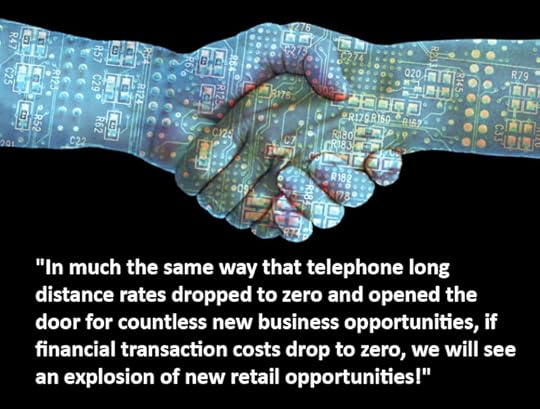
Proposing a Solution
First, let’s start with the assumption that sales tax must be applied to all retail transactions - period, no exceptions. If we eliminate this one variable, then much of the complex decision-making process currently imposed on retailers is eliminated.
Second, if we agree to split the amount of sales tax evenly between the location of the buyer and the location of the seller, there will no longer be any disagreement over collection and distribution of tax receipts.
Third, as we move into a blockchain era, as money becomes increasingly digital, the actual collection and remittance of sales tax can happen instantly. As money is paid by the seller, sales tax from every transaction can be peeled off and remitted directly to the taxing agency.
As an example, with a $12.00 purchase and 7% sales tax - 4% going to state, 1% going to county, and 2% going to a city - the total charge would be $12.84 with $.48 going directly to the state, $.12 to the county, and $.24 going to the city.
Tiny sales tax payments would be sent instantly, and in the event a refund is issued, the same tiny transactions would happen in reverse.
Even cash transactions could be run through an electronic device and taxes would be instantly remitted from a special account managed by the merchant. Most merchants would be happy to maintain a small balance in a special tax-remittance account in exchange for never having to file sales tax reports ever again.
Rather than continuing to patch our current system where millions of individual retailers bear the responsibility for collecting the sales tax, filling out tax forms, and remitting the money on a monthly basis, literally billions of tiny payments would be made in real time every second of every day. This will eliminate the stress-laden responsibility of relentless accounting, form filing, and updates that happen along the way.
Everything would happen through software, and that software would be super easy to use, free to every merchant, and managed independent of any user group.
The whole intent of this approach is to build a sales tax collection mechanism that is both seamless and nearly invisible to both retailers and customers alike.
Final Thoughts
My intent here is to stimulate a discussion, not to claim all of the answers.
Even though I love to buy things online and have products delivered to my front door like everyone else, it doesn’t mean I don’t want to support my local community. We’re currently saddled with a very bad system and it’s a system problem, not a business or community problem.
Accounting and bookkeeping as an industry tends to thrive in the face of complexity. Each new decision point added to the tax code has been very good for the accounting business, but generally bad for the rest of the economy.
Complexity places an insidious brainpower burden on people, and this translates into a significant toll on society. While it may be unrealistic to eliminate complexity by imposing simplicity, we can at least automate it.
Our future is being shaped by our systems. We now have a golden opportunity to do something amazing, and one critical first step will be to fix sales tax.
Please let me know your thoughts.
Author of "Communicating with the Future"
The post Fixing our Insanely Broken Sales Tax System appeared first on Futurist Thomas Frey.
Thomas Frey's Blog

- Thomas Frey's profile
- 2 followers

