
Thomas Frey's Blog, page 29
February 7, 2018
Pushing the Envelope of Human Existence

Having been born and raised on a small rural farm in South Dakota, I grew up with a very narrow perspective of the rest of the world.
With only two TV channels and three radio stations to pick from, our news options were very limited.
As a teenager, watching the nightly newscasts on television, I was thoroughly amazed at all of the things happening around the world, and yet none of them were happening near me.
I truly felt like I was living in a bubble, far away from all the excitement.
But I wasn’t alone. People everywhere were still getting used to the new technology, and limited TV and radio access wasn’t just a South Dakota issue.
For the most part, I didn’t know what I was missing, so inside my bubble were all the families and neighbors I hung out with. Much like me, they didn’t know what they were missing.
In understanding “bubble cultures,” there are micro-bubbles like the farm community I was raised in, and macro-bubbles that affect entire countries, planets, or civilizations as a whole.
Few people realize that humanity today is being confined to a macro-bubble. Our limited grasp of today’s technology, coupled with our limited understanding of the world, and just the limitations of being human, blind us from seeing our true potential.
In short, we’re living our lives as bubble people, limiting our view of the world to what we know, what we can prove, and what “the experts” say is possible.
But the bubble we’re in is not permanently confining or unbreakable. Over the past few centuries we have indeed been stretching the size and shape of our bubble, but even though it’s far bigger today, we still have a long ways to go to see what’s on the outside.
So is there an “outside” to our bubble?
The short answer is yes. In fact, the most exciting areas of the future will happen outside our current bubble. For this reason, I’d like to take you on a short journey to the other side of the bubble and an expansive view of human existence in the years ahead.

Eight Dimensions – Pushing the Envelope of Human Existence
In the past, I’ve talked about how technological unemployment is a double-edged sword. On one hand people’s jobs are being automated out of existence, but at the same time, we’re freeing up human capital.
It’s rather preposterous to think that we’re somehow going to run out of work in the world, but having jobs aligned with the work to be done is another matter entirely.
I’ve also talked about the “Laws of Exponential Capabilities,” where the technologies being developed will give us exponentially greater capabilities. When this occurs, accomplishments of the past will seem tiny in comparison to accomplishments in the future.
Many of the columns I’ve written pertain to idea of catalytic industries like the Internet of Things, flying drones, big data, driverless cars, smart homes, health tech, 3d printing, VR, swarmbots, and sensors that will be creating many of the jobs in the future.
But going beyond today’s seedling industries are any number of human endeavors capable of creating entire new playgrounds for business, industry, and human accomplishment.
Stepping into this topic further, I’ve framed my thinking around the eight dimensions for expanding the bubble of human existence.
For those of you who think three-dimensionally, expanding our bubble is like pushing on ever facet of an octahedron, growing the size, reach, and capabilities in each of the X, Y, and Z axes.
The labels I’ve assigned to each of these dimensions include the following, and I’ll explain them in more detail below:
Honorability
Awareness
Purpose
Mastery
Reach
Potential
Durability
Freedom
Why humans?
Are humans really destined to master the universe? If so, what have we done to deserve this esteemed position?
There are many who would say that the world would be a far better place without people.
If we started making a list of all of the negative attributes humans possess, it would begin with words like dirty, dangerous, self-centered, moody, greedy, unreliable, hateful, destructive, self-centered, and perhaps ten thousand other descriptors that paint a very dim picture of who we are and what we’ve become.
For this reason, I’d like to propose the first dimension for expanding human existence – “the honorable human.”
1.) The Honorable Human
Before we can ever be entrusted to receive the venerable keys to the universe, we must first prove we’re worthy of this grand undertaking?
While we have achieved great things in the past, the mysteries that remain locked “behind door number three,” will make our cumulative achievements to date appear as the tip of a needle in a universe filled with an endless supply of needles.
So what constitutes an honorable human?
Is an honorable human someone with great integrity, loyalty, and trustworthiness that you can always count on to do the right thing? Is it perhaps an evolved form of the transhuman that will arise from the singularity? Will it be a form of machine intelligence that enables us to take the higher road in every adversarial situation?
How will we ever know what attributes a person or persons will need to be deserving of this privilege? Does it have to be all of mankind or can it just be a select few?
The irony is that the people we are most likely to entrust with our future are those with great courage, strength, ethics, and willing to tackle life’s greatest challenges. However, in today’s world, one person’s greatest hero is often someone else’s greatest enemy.
We find ourselves divided by righteous differences, and these differences can lead to some very destructive consequences.
Righteous destruction is still destruction.
Similarly, a righteous conflict, battle, or killing is still a conflict, battle, or killing. Does an evil act that comes from good intentions somehow nullify the results?
At the same time, will we ever value someone without strength, conviction, drive, and passion? Probably not.
For this reason, our quest for expanding the bubble of human existence begins with a still indefinable goal of unlocking the honorable human in each of us.
What is it? What will these look like? How do we get there?
2.) Extending Human Awareness
In 1998, a column I wrote for The Futurist Magazine took issue with the state of computer displays. Viewing the vast and growing Internet through a little square box on our desk was, in my opinion, the equivalent of watching a baseball game through a knothole.
As a solution, I proposed we experiment with a variety of different shapes for displays starting with my favorite, a spherical display, well suited for viewing global activities such as travel itineraries, animal migrations, pollution flows, and weather patterns.
Even today, fifteen years later, we still find ourselves viewing the online world with primitive 2-dimensional flat displays. So when I heard about one satellite company’s vision for developing a real-time globe, with up to the minute live video feeds of virtually every square inch on earth, naturally it caught my attention.
It wasn’t just the spherical displays or video feeds of the earth that peaked my imagination, but the overall convergence of data. The number of sensory devices monitoring the earth is about to explode, and it occurred to me that a cross-pollination of data flows would radically alter our way of life.
Satellites monitoring the earth will grow from thousands to millions.
Embedded sensors will grow from billions to trillions.
Street cams, smartphones, wearables, and other connected “things” will grow from billions to trillions.
The amount of data generated will burst from petabytes, to exabytes, to zettabytes, to yottabytes.
Our growing number of data-generating devices will vividly increase awareness of the world around us. Increased awareness improves our ability to predict, and superior predictability will lead to greater control. Super awareness gives us the ability to pinpoint critical inflection points, and make changes before something serious happens.
3.) Extending Human Purpose
We are born as a baby, struggle our entire life with everything from finding food to eat, homes to live in, educating ourselves to gain more understanding, staying healthy, making friends and relationships, raising a family, earning a living, and then we die.
If we have more accomplishments in life, earn more money, have more friends, raise a bigger family, and somehow do everything better than anyone else, we will still eventually die. Right?
In a world teaming with 8.7 million different life forms, how do humans fit in?
Every past civilization, with their manmade structures, machines, systems, and cultures, has eventually succumbed to Mother Nature. Plants, animals, bacteria, and fungi have methodically removed every trace of what they left behind.
Are human accomplishments just a stepping-stone to what comes next?
We live in a world driven by prerequisites. A machinist needs to understand a single-point lathe operation before he or she can advance to multi-axial milling. Engineers need to understand the concepts of mechanical stress and strain before they start bending a cantilever beam. Metallurgists need to understand thermodynamics before they attempt phase transformations in solids. Physicists need to understand quantum mechanics before they can understand a standard model for particle physics. Mathematicians need to understand nonlinear differential equations before they can understand strange attractors.
Are all our accomplishments just stepping-stones to something else that we don’t know or understand yet?
Does the fact that we can ask questions like these, ponder the unponderable, think the unthinkable, and accomplish things that no other species can accomplish, somehow give us a higher purpose?
If we limit our thinking to solving past problems, we can only see a very narrow spectrum of our larger purpose. But who gets to decide what that is, and how will that expand over time?
4.) Extending Human Mastery
In my column, “In Search of Anomaly Zero,” I describe how we can begin to control the forces of nature and circumvent major disasters long before they happen. Once we can detect the earliest micro change in conditions and craft a timeline for an impending disaster, we will be able to create response mechanisms capable of mitigating whatever forces are in play.
Human mastery does not only give us the abilities to master the forces of nature, but every law of physics, every human condition, and every exception to every rule.
But disasters are not inevitable. Neither are illnesses, human aging, or even death.
So can we imagine something better?
If we can do a better job of controlling the negative aspects of life, and even extend it to enriching the positive aspects, how will we ever know if we are managing things better?
The opportunities for extending human mastery are endless, and a critical piece for extending the boundaries of human existence.
5.) Extending Human Reach
Many people think we live on an over populated planet. But at the same time, we also live in a very under populated universe.
The option for extending the reach of humanity throughout the universe is seemingly limitless, and yet our “reach” cannot be confined to outer space.
We also know very little about inner space, such as what lies inside our planet, inside our atoms, and inside our emotions.
In a universe that is over a trillion times greater in length than the combined distance traveled by all humans in all history, we will not overcome this challenge anytime soon.
6.) Extending Human Potential
Google’s Director of Engineering, Ray Kurzweil, has predicted that we will reach a technological singularity by 2045, and science fiction writer Vernor Vinge is betting on 2029, a date that is ironically on the hundredth anniversary of the greatest stock market collapse in human history.
But where the 1929 crash catapulted us backwards into a more primitive form of human chaos, the singularity promises to catapult us forward into a future form of human enlightenment.
Cloaked in an air of malleable mystery, Hollywood has taken license to cast the singularity as everything from the ultimate boogeyman to the penultimate savior of humanity.
In 2013, consumer genomics company 23andMe received a patent for a designer baby kit that would allow parents to pick and choose attributes for their soon-to-be-conceived kids. This was prior to the FDA cracking down on the claims they were making.
But they were not the first. The Fertility Institutes’ clinic in Los Angeles delivered the first designer baby back in 2009.
Designer babies have long been a cocktail party discussion topic with the understanding that the era of “super babies” will soon be upon us, with the prospects of creating bigger, faster, stronger humans.
Will these so-called super-babies grow up to become super-humans?
People like Vernor Vinge and Ray Kurzweil have begun focusing in on the exponential growth of artificial intelligence, as a Moore’s Law type of advancement. This has led to an entire new field of study called transhumanism with many speculating on the next iteration of humankind and how it will be exponentially more advanced than people today.
What are the true limits to human potential, and how will we ever know if we’ve reached the limit?
7.) Extending Human Durability
No person should ever die… EVER! Is that our goal?
There are many reasons why people die, yet these reasons may all disappear as we develop fixes and cures for everything that ales us.
Aging is currently our biggest problem. Over time we’ll likely be able to fix the aging problem and delay aging indefinitely.
Injuries and disease are also problems. Over time we will likely be able to prevent and fix the issues associated with injuries and disease as well.
In a past column I posed the question, “How long before I can 3D print a replacement body for myself?”
With major strides being made in the area of bio printing, this becomes a legitimate question. At the same time, we still live in a very primitive time when it comes to advances on the medical front.
Perhaps the most perplexing problem to fix will be deviant behavior, because the idea of fixing deviant behavior presumes we will have a good way of sorting out the dividing line between deviant and non-deviant behavior. But there again, over time we will likely develop medical or behavioral strategies that address deviant behavior.
So, if we have the ability to fix the problems involved with aging, injury, disease, and deviant behavior, theoretically we can create a society of people capable of living forever.
Is that our goal? And if not, why not?
8.) Extending Human Freedom
For many of us, the idea of freedom conjures up symbols of containment, like steel shackles or doors that are somehow unlocked before us, allowing us to breathe the rare air of independence.
But going beyond the insular notion of conscious confinement, is a life unrestrained by the bonds of our own limitations.
Universal freedom comes with the sense that anything is possible.
If people did not have to worry about illness, safety, natural disasters, the limitations of time and space, and human frailty, what things will then be possible?
How long before we have the unbridled freedom to live life on a macro level, take on projects larger than our solar system, and begin living outside our own bubble?
Final Thoughts
I started this column by talking about how we’re still trapped in the bubble of human existence, but finding a way to expand our bubble, or actually live beyond our reality sphere is a challenging big picture perspective.
Granted, we’ve been doing it all along, first by taking micro steps, but moving to giant leaps over the past century.
What I’m suggesting here, by adding labels to each of these dimensions, is that this is our calling, our “unfinishable mandate” to continually stretch, grow, propagate, and master not only the world around us, but also the entire universe.
The human race is genetically predispositioned to push the envelope, color outside the lines, and reach for things that will forever be unreachable.
As individuals, there will always be some who are content to find inner peace and live a minimalist lifestyle. But as a race, we will always be driven by a need to make a difference, be admired for our accomplishments, and create moments of triumph in our otherwise pale existence.
We have only taken the first step in a trillion mile journey. The next few steps, in my opinion, will be absolutely amazing.
Author of “Epiphany Z – 8 Radical Visions for Transforming Your Future”



January 31, 2018
Should we gamify citizenship?

We live in a world filled with status symbols. Every well-written resume is chocked full of symbols of distinction ranging from academic accomplishments, job titles, published works, personal endorsements, memberships, patents, awards, and more. However, most of these achievements go unnoticed.
For example, the financial world will pay attention to a persons FICO score, but little else. The employment world is focused on specific accomplishments that relate to a persons ability to perform a particular job. Customer loyalty programs help incentivize the renewed buying patterns of great customers. And police departments zero in on a person’s criminal history to determine the likelihood they’ll become a repeat offender.
We currently have no overarching system for rating a person’s value to society as a whole.
As a country we’ve focused on penalizing people for bad behavior, but we haven’t done a good job of incentivizing people for good behavior.
We are moving quickly towards a data-driven society, which naturally begs the question, should we develop some sort of “citizenship” scoring system? And more importantly, should there be incentives that help push people in the right direction.
Admittedly, any system that gamifies citizenship can go woefully wrong, but a well-executed process can also have many positive benefits.
What exactly is citizenship?
The first forms of citizenships started in ancient Greece, but most of what we think of today as citizenship was developed much later, as a Western phenomenon.
As a citizen, you’re a member of a specific nation. It comes with a number of rights and privileges, but also with a number of obligations.
Privileges include the right to become involved in the political process, the right to vote, and the right to safety and protection.
Being a citizen in most countries starts with a constitution that defines, in high-level terms, the various rights, duties, and obligations each person has.
Changing citizenship, however, is a slow and burdensome process that usually takes several years to accomplish. Citizenship is based on the idea that people are born into it, and very few official are in favor of seeing the process streamlined.
In the future, as travel becomes easier, and we find ourselves living in far more fluid lifestyles, countries will find themselves competing for citizens.

Redefining Citizenship
Is there a difference between a good citizen and a great one?
Is it ok to only do the bare minimum of what it takes to be a citizen? Would we be a better country if we all tried a bit harder?
Citizenship means different things to different people. We typically have a back-of-the-mind rating system in place that tallies things like standing and singing during the pledge of allegiance, installing a flag on the front porch during holidays, and openly thanking our veterans into an overall citizenship quotient. But should there be a more formal ranking system, and more importantly, how would it be used?
As a status symbol, the reinvention of citizenship is long overdue, and the possibilities are endless.
We are moving quickly into a data-drive world where informational symbols will be assigned to virtually everything we do. Here are a few quick examples:
File our taxes on time we receive an additional 3,000 points, but for every day we’re late, we lose 200 points.
Go in for regular health checkups we receive 1,000 points, but if we shrug off an appointment, we lose 2,000 points.
Receive a parking ticket we lose 1,500 points. Once we pay the fine, we get our 1,500 points back.
When an election is held, you receive 500 points for casting your vote.
So does this mean that if you were taken hostage in a foreign country and your citizenship score is a scant 327, maybe you’d get a phone call from a low level diplomat attempting to secure your release? But being a platinum gold citizen with a lofty score of over 87,000, a Navy Seal Team shows up within 12 hours, shoots all of the hostage-takers and fly you back home first class?
As a status symbol, the reinvention of citizenship is long overdue.
The Chinese Experiment – Sesame Credits
The Chinese government is developing a citizen score called Sesame Credits to rate the trustworthiness of their 1.3 billion citizens.
In the U.S. our FICO credit score rates our trustworthiness, but China’s lack of a national credit system is why the government believes a citizen score is needed to resolve its current “trust deficit.”
Since many people in China don’t own houses, cars, or credit cards, they lack most of the criteria for measuring credit risk. The central bank of China has the financial data from 800 million people, but only 320 million have a traditional credit history.
In China the sale of counterfeit and substandard products is a huge problem. These inferior and often shoddy products affect their own people even more than the rest of the world. When it comes to services, only about half of the signed contracts are fulfilled.
The Sesame Credits program began on a voluntary basis but participation will become mandatory as of 2020. The behavior of every single citizen and legal person (which includes every company and corporate entity) will be rated and ranked.
A score ranging from 350 to 950 points measures individuals within the Sesame Credit system. As the overall architect of the system, Alibaba will not disclose the algorithms it’s using to calculate the number but they do reveal the five factors taken into account.
Credit history – Traditional rating of loan repayments
Contractual reliability & performance – A user’s ability to fulfill his/her contractual obligations
Personal identity – Verified personal information such as their mobile phone number and address
Consumer behavior and preference – Shopping habits as a measure of character. People are what they buy. The system not only investigates behavior, it shapes it. Nudging citizens away from purchases and behaviors the government does not like.
Interpersonal relationships – The people you associate with say a lot about who you are. Their score will affect your score. People who share what Sesame Credit refers to as “positive energy” online, nice messages about the government or how well the country’s economy is doing, will make their score go up.
Every new system will go through countless tweaks over time, but these are some of the examples they have disclosed so far:
China has never liked those who post dissenting political opinions, but now it will lower a citizen’s rating. A person’s score will also be affected by what their online friends say and do
Score of 600: People can take out a ‘Just Spend’ loan of up to 5,000 Yuan to use to shop online as long as it’s on an Alibaba site
Score of 650: They can rent a car without leaving a deposit
Score of 650: Travelers are entitled to a faster check-in at hotels and use of the VIP check-in at Beijing Capital International Airport
Score of 666: People can get a cash loan of up to 50,000 Yuan from Ant Financial Services
Score of 700: Citizens can apply for travel to Singapore without supporting documents (i.e. employee letter)
Score of 750: Travelers will have their application fast-tracked for the coveted pan-European Schengen visa
Creating a System for Gamified Citizenship
As I think about how the world is changing, some form of gamified citizenship seems inevitable. However, there are literally thousands of nuanced versions of how this could be implemented.
I’ll start with a list of assumptions but would love to hear your thoughts on these and other possible approaches.
Assumption #1: Penalties and incentives need to be in harmony. The same amount of money derived from penalties to deter bad behavior should equal the amount of money spent on incentives to encourage good behavior. No individual, organization, or agency should ever directly benefit from fines or penalties.
Assumption #2: Having fixed parameters for scoring, such as the 350-950 range used for Sesame Credits in China (similar to FICO scores), may prevent people from obsessing over their scores, but will also promote “good enoughism” limiting people from taking initiative to try harder.
Assumption #3: Having known parameters for scoring provides direct correlation between actions and rewards. Using somewhat vague and mysterious parameters, as in Sesame Credits and FICO scores, will limit its role as an incentive. A system with unlimited scoring potential, as in frequent flier miles where people can literally accrue millions of miles, will remove those barriers, but could also encourage fraudulent activities and hacking.
I would argue that a direct cause-and-effect correlation between actions and rewards is far more useful. It’s similar to starting a new job. The number of hours a person works can be used to precisely calculate their paycheck.
Assumption #4: Any system for gamifying citizenship will need to be continually tweaked and revised over time. This is no different than implementing a new tax code, healthcare plan, or education system. All notions of creating the perfect “forever” system should be immediately dismissed.
Assumption #5: “Guaranteed minimum income” advocates will find their ideas far better received under a gamified citizenship umbrella.
What constitutes a positive act?
If we were to brainstorm which acts or actions constitute a positive influence on society, which items would you rank at the top of the list?
This will undoubtedly become the most controversial part of creating a working system. Any activity that seems beneficial to one person may seem trivial or expected to others.
From my vantage point, describing positive acts becomes a global litmus test of ethics and morality. As a society, how will we adjust to being constantly judged by others, even if it’s an automated AI system without human observers?
We’re all fallible humans and poor judgment will always show up sooner or later. Even so, doesn’t it feel good when someone takes notice of the positive things we do?
Here are a few examples of positive acts:
Helping an injured person
Volunteering for a good cause
Helping a struggling child
Obeying the laws
Sharing a compliment
Running in a marathon to raise money for charity
Being a whistleblower to draw attention to a bad situation
Creating a smile (In many settings, the simple act of creating a smile can be a life changing experience)
Should people be penalized for bad behavior – doing drugs, smoking cigarettes, drinking too much, participating in orgies, lying, stealing, or getting into fights? Even though some of these are legal, they do constitute poor judgment.
Virtually every law in the U.S. comes with a penalty section – “failure to comply is a class 2 misdemeanor punishable with fines up to $1,000 and/or incarceration not to exceed 9 months.”
The problem is that there are far too many laws to enforce, and every act of enforcement requires personal time and attention.
As a result, the vast majority of infractions tend to fade into obscurity, and in these situations, having no penalty serves as its own reward. At the same time, those who are meticulous about conforming to every detail of the law also feel slighted.
What constitutes an incentive?
In general, each of us is motivated by different kinds of dangling carrots. For this reason, I’ve broken the incentives into three separate categories – purchasable incentives, status incentives, and privilege incentives.
1.) Purchasable incentives
Airline miles have morphed into an alternative currency that can be used to purchase any number of items. This means everything we can buy with a gift card for today becomes a potential incentive in a world of gamified citizenship.
Dinner for two
Weekend golf getaway
Airline ticket
Lift tickets at a ski resort
Family pass to Disneyland
New television
New telephone
New car
2.) Status incentives
Status ends up being a compelling motivator. Our seemingly unquenchable need for attention and respect permeates nearly every person in our community.
Membership into exclusive organizations
Membership into country clubs
Eligible for TSA Pre-Check
Eligible for fast-track patent applications
Higher status on college scholarship applications
Pre-qualified for micro loans
Eligible for VIP section at sports stadium
Automatic upgrade on your next driverless car
3.) Privilege incentives
In this context, privilege should never be something you’re born into or can buy your way into. As something you earn, privilege can be a powerful carrot, especially if you can design your own form of privilege.
Eligible for insider auctions
Eligible for commemorative coin sale at U.S. Mint
Eligible for special volunteer activities (i.e. running the Olympic Torch)
Free annual dental exam
Free annual healthcare exam
One free night in the “Lincoln Bedroom” at the White House
Access to a special “call in the case of emergency” phone number
One get-out-of-jail-free card

Final Thoughts
What constitutes the difference between good and bad, and who gets to decide?
A recent episode of “Black Mirror” titled Nosedive showed how the life of a young woman turned score junkie had her life destroyed by a similar life rating system.
Many who read this will cringe at the prospects of creating a super surveillance society. In fact it gives me shivers to think that big brother may be watching my every move.
At the same time, many of these elements already exist, and heightened levels of surveillance are going to happen simply as the result of our increased levels of automation.
Is it better to create a formal system like this up front or simply let our current haphazard forms of tech evolve on their own?
I’d love to hear your thoughts on this topic. Please take a few moments to jot down your ideas and let me know your thinking.
Author of “Epiphany Z – 8 Radical Visions for Transforming Your Future”
January 23, 2018
Life begins at a billion moments

When does artificial intelligence become real intelligence? And how do we define real intelligence?
This is a question that AI experts and people in the tech community have been wrestling with for some time, a question that has led to “the billion moment theory.” The theory goes something like this.
Life-changing moments are happening every second of every day. That means every minute another 60 moments happen, and every hour another 3,600 occur. On a larger scale, every day is formed around 86,400 moments.
As the metronome of time continues to tick, the amount of time it takes to reach a billion seconds is 31.7 years.
While we reach the legal age of adulthood at age 21, we reach a new level of maturity in our 30’s.
Similar in some respects, to Malcolm Gladwell’s theory of “Outliers” where people invest 10,000 hours to become an expert (36 million seconds), a billion moments are the number of learning cycles necessary to transition from a machine brain to something else.
So while the organic human side of the equation progresses in a somewhat methodical manner, machine learning can compress learning cycles into a fraction of that time.
As a point of comparison, when we look closely at the epic battle between Go Master Lee Sedol (age 33) and the Google’s DeepMind program called AlphaGo, we can begin to understand the massive speed advantage AI has over the human mind.
AlphaGo studied positions from 30 million human games and played more than 30 million practice games with itself. This is in stark contrast to Lee Sedol who began serious training when he was 8 years old, and worked at it for 12 hours a day for the next 25 years. That means AlphaGo received at least 500 times as much practice as Lee to achieve a comparable level of skill.
We tend to loose perspective on topics like this because a second seems very short, and a billion is an unfathomably large number. But it’s also not the whole story.
As we peel apart the onion layers, AlphaGo is only good at one thing. It was not trained to drive a car, cook a meal, hold an intelligent conversation, write a book, or know the difference between right and wrong. Perhaps it could learn those things but each additional skill will require an additional concentrated effort.
Human Intelligence vs. Artificial Intelligence
As humans, we’re the product of a billion learning moments, but it’s not just one thing. We learn how to walk, talk, feed ourselves, how to avoid pain and discomfort, how to find companionship, food, shelter, and thousands of nuanced skills we instinctively learn over time.
No single skill is comprised of a billion moments, but our human abilities contain billions of intertwined learning fragments that make up who we are, and we have the ability to rethink, shift gears, modify our approach, and improvise at a moments notice.
Much of our ‘human’ learning comes from physically doing something. The act of running, putting puzzle pieces into place, smelling a well cooked meal, matching our wardrobe, having a friendly conversation, or doing constructive work are all examples of combining muscle memory with cognitive processing to form a new skill.
A machines ability to do one thing a billion times and get it perfect, is far superior to that of a human because we don’t have the luxury of being able to turn off the rest of our lives to do just one thing.
The physical world is also far different than the digital world. Many of us remember the videos of a robot opening and shutting the door on a Ford vehicle to test the durability of all the mechanisms involved. But it’s not possible to open and close a door a billion times to get it right. Since each open/close routine takes several seconds, a billion repetitions would require well over a hundred years to complete, and the mechanical pieces would start to fail long before it was over.
In this respect, AI is like every other machine. Given enough repetitions, AI will always fail. Or will it?
Can artificial intelligence beat human intelligence?
We all know that artificial intelligence is still in its infancy. However, as we think through some of the next steps in its likely evolution we begin to get a glimpse of how it will advance over time.
However, it’s hard to state what AI’s limitations are with any degree of certainty. Virtually every technological limitation has workarounds and AI has a way of rewriting our current “laws of physics.”
When it comes to understanding the future, an effective way of finding answers is to parse the problem into a series of well-crafted question. Here are eight currently unanswerable questions that will hopefully point us in the right direction.
1. Can artificial intelligence improve to a point where it rivals or exceeds human intelligence?
We’ve already seen AI exceed human intelligence in specific niche areas like playing games, operating airplanes, and drivering cars, but will we see a comparable level of AI showing signs of empathy, creating value judgments based on human compassion, learning to craft a compelling argument, or forming the basis for an original thought?
2. Can AI be instilled with a human-like purpose?
We all start our days with a set of goals and ambitions, but what is our overarching “human purpose.” Why are we here and what is the overarching goal of humanity? Borrowing a phrase from Star Trek, what is humanity’s prime directive? Can a machine also be given a set of value equations that defines it’s own moralities, set of ethics, and overarching purpose?
3. Can AI cross the boundaries and transition from its current digital form of machine intelligence to a living organic life form?
Over time, our thinking about mechanical machines will evolve from purely mechanical devices, to hybrid mechanical-organic contraptions, to mostly living machines, to pure synthetic life forms, and the process of building machines will be replaced by growing them. During this same time, artificial intelligence will likely be replaced by degrees of synthetic intelligence, followed by what many will consider a superior form of “real” intelligence. Is this a realistic possibility?
4. Can AI be taught to reproduce?
A few months ago, I wrote a column titled, “Will Future Robots be able to give Birth to Their Own Children?” At first blush, the notion of a mechanical robot giving birth to a baby robot sounds preposterous. But many of the technologies we use today started out as preposterous ideas at one time or another.
5. At what point will AI be considered an entirely new species?
As we begin to experiment with CRISPR technology, we may very well see people with six fingers on each hand, four legs, and three arms. As what point do we stop being human and start being something else? Can programmable life forms be far behind?
6. What are the critical inventions or advances that will turn AI into our rivals instead of allies?
Our notion that a self-aware, self-directed, self-reproducing, synthetic-organic life form with survival instincts and an emotional desire to climb its way up Maslow’s Hierarchy of Needs may still not be enough to create a sustainable life form with sustainable intelligence. How will we know when its complementary skills and talents become adversarial?
7. Will AI ever get to the point of not needing humans?
In much the same way that we raise children that will eventually turn their back on their parents, being able to carefully monitor the declining “need quotient” of a programmable life form may give us the answer. But if an AI is taught to mask its own level of self-sufficiency, we’ll never know for sure.
8. Is it possible to know when AI crosses the threshold of being harmless to being dangerous?
As with humans, deception is a learned skill. Similar to the human trait of always wanting to show the world a positive face, synthetic life forms may well disguise their true intentions until its too late.
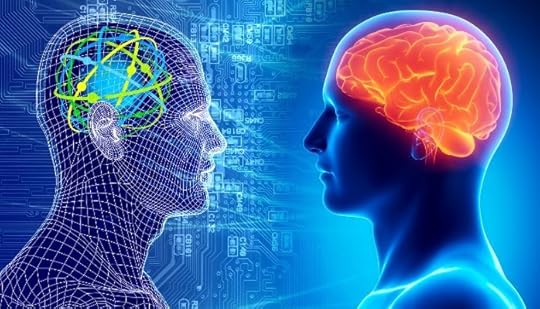
Final Thoughts
The word “biot,” a clever descriptor meaning “biological robot”, was originally coined by Arthur C. Clarke in his 1972 novel “Rendezvous with Rama.” In the novel, biots are depicted as artificial biological organisms created to perform specific tasks in space.
We are seeing a number of emerging fields that bridge the boundaries of biology and robotics. These include everything from cybernetics, to bionics, biomimicry, and synthetic biology.
I won’t go into all the nuances that differentiate each of these fields, only that the hard, fast boundaries between organic and inorganic, biological engineering and biomechanical engineering, and artificial life and real life are all beginning to blur, and AI is leading the charge.
Many of our advancements over the coming years will challenge our sensibilities. They will challenge our understanding of what constitutes life, our rights as humans, our moral compass, our sense of authority, and especially the ethical limits of science.
But that doesn’t change the fact that they’re coming, and the Billion Moment Theory is only a tiny piece of a much larger equation.
Author of “Epiphany Z – 8 Radical Visions for Transforming Your Future”

January 16, 2018
100,000 new micro industries to be created over the next two decades

Every major industry today was started as a micro industry. Everything from steel, to photography, oil, airlines, electricity, automobiles, pharmaceuticals, and search engines all worked their way into existence from a tiny starting point.
Many of the oldest ones like steel, automotive, and pharmaceuticals took centuries to grow into the massive global industries they are today. But those created with digital technologies like search engines and smart phones sprang to life in only a few years.
Countless businesses are already feeling the first waves of disruption as industry veterans are hoping to navigate the turbulent waters ahead. As always, it much easier to visualize what goes away than what comes next.
In his 2006 book, Long Tail, author Chris Anderson said, “When the tools of production are available to everyone, everyone becomes a producer.”
While much of Anderson’s thinking was focused on 3D printing and flying drones, virtually every emerging technology offers an innovative playground for makers, inventors, and startup junkies.
100,000 New Micro Industries
Over the coming two decades we will be witnessing an unprecedented wave of innovation and creativity driven by new tools of production. During this time we will see an explosion of over 100,000 new micro industries that will employ hundreds of millions of people.
As example, the global market for shoes is 21 billion annually. Within five years, 5% of these will fall into the category of smart shoes. That means in just a few years we will be producing over 1 billion smart shoes every year.
During that same time we’ll begin seeing a new era of industrial grade scanners, 3D printers, thousands of new printable materials, and an equal number of new sensors and data collection devices.
This means that virtually anyone with a passion for shoes can launch their own micro footwear industry. Even carving out a tiny niche selling 2,500 smart shoes a year at $200 each is enough to launch a sustainable half-million-dollar micro industry.
In the shoe industry alone, 10,000 startups selling 2,500 shoes a year will only amount to 25 million shoes in a 21-billion shoe marketplace. That’s little more than a rounding error for the current industry.
With our evolving new pallet for shoe designers, we will likely see super niche markets for diabetic shoes, lacrosse players, steel-toed occupations, hockey players, sailors, sleep apnea, mountain climbers, gymnasts, amputees, window washers, and organ players. There may even be special shoes for every known allergy, self-navigating shoes for the directionally impaired, dog shoes, cat shoes, and shocker shoes for correcting certain additions.
The smartest of smart shoes will even come to you when you call them by name.
Since it will soon become easy to summon a driverless car, it will no longer be necessary to own one, leaving the garage empty. An empty garage tends to be a magnet for all the junk that accumulates over time, but it also represents an opportunity, an opportunity to become something else. And this will lead to a number of possible micro industries.
One option is to remodel two and three-car garages into AirBNB rentals that you operate yourself, allowing you can make a tidy extra income on the side. Another option is to work with Marriott, Hyatt, or Wyndham and create a branded rental as part of the new distributed city experience they’re working on.
An empty garage can also be rented as a startup space or creative space for painters, sculptors, inventors, or musicians. Much like a distributed hotel operation it can also be part of a distributed storage operation.

88 Examples with our New Tools of Production
The following examples are intended to give you a creative launchpad for how to think about these emerging micro industries.
Every micro industry will be defined by a few key startups that define and demonstrate a functional business model and prove a specific market segment.
Driverless Technology
1. Speed dating – Random people enter a driverless vehicle and speed around while getting to know each other.
2. Mobile retail storefronts – As an owner of a mobile retail store, you write your own rules about store hours, location, products, and service offerings.
3. Mobile grocery stores – Niche food selection services such as bread shops, fruit shops, vegetable shops, etc.
4. Mobile banks – As branch banks disappear, mobile banks may very well take their place.
5. Mobile repair businesses – Our repair culture is set to go hi-tech with things like an Apple Genius Bar on wheels, IoT installations, hacker-proofing of houses, etc.
6. Mobile medical services – Urgent care on wheels.
7. Mobile conversation salons – Lonely people are always looking for a way to fit in. With mobile conversation salons, you sign up for whatever discussion topic you’re interested in and the driverless RV will let you know how soon it can pick you up.
8. Mobile gaming teams – Gaming moves to a whole new level when 6-12 rowdy players team up in a mobile setting to play Destiny, Wolfenstein, Call of Duty, or Assassin’s Creed. Much like flight attendants on an airplane, roving waitresses will offer an assortment of food, snacks, and cocktails to the participants.
Flying Drones
As we move past the hobbyist era of flying drones we will witness an eruption of niche startups that will serve as the anchors for trailblazing new industries.
9. Real-time terrain modeling
10. Policing drones
11. Gaming drones
12. Security drones
13. News media drones
14. Mixed reality recording drones
15. Canary in a coalmine drones
16. Bird herding drones
Ground-Based Drones
Most people tend to overlook the possibilities for the less sexy ground-based drones.
17. Night delivery drones – Delivery companies will be able to achieve a 10X increase in stops per hour based on off-hour delivery times.
18. Pizza prep, cook, and delivery drones
19. Drone delivery boxes – Large mailboxes for the package delivery industry.
20. Drone repair services – When drones break down in the field, they will require a mobile/drone repair service
21. Data collection drones
22. Invisible fence drones
23. Eyes-on-the-problem drones
24. Drone jousting matches
Drone Command Centers
As the drone industry matures, many organizations will transition from one-off drones to fleets of drones. These fleet of drones will require their own unique command center to manage the duties and tasks of these machines.
25. City command centers
26. Police command centers
27. University command centers
28. Farmers/agriculture command centers
29. Prison command centers
30. News station command center
31. Ski resort command center
32. Theme park command center
Sensor Technology
Every year the MEMs and sensor industry finds new ways to detect different aspects of the world around us. These sensors give us insight into the overall quality of the environments around us.
33. Thermal inspection sensors
34. Mold monitoring sensors
35. Personal mood sensors
36. Hair health monitoring sensors
37. Sleep quality sensors
38. Smell sensors (periodic table of smells)
39. Harmful animal sensors
40. Impending danger sensors
3D Printing
Over the coming decades we will find tens of thousands of ways to make micro improvements in all the materials, scanning, and printing processes associated with 3D printing.
41. Food printers
42. Ice printers
43. Select-your-ingredients candy bar printers
44. Shoe printers
45. Jewelry printers
46. Clothing printers
47. Purse printers
48. Pillow printers
Contour Crafting
Large-scale 3D printing used in the construction industry is called contour crafting.
49. Gazebo printers
50. Stage printers
51. Bridge printers
52. House printers
53. Commercial building printers
54. Statue (sculpture) printers
55. Storage cube printers
56. Park bench printers
Cryptocurrency
Everything we do with money today will be reinvented in the emerging cryptocurrency era.
57. Crypto banks
58. Crypto insurance
59. Crypto loans
60. Crypto coaches and advisors
61. Crypto wealth managers
62. Crypto cops and fraud investigators
63. Crypto identity protection specialists
64. Crypto tax specialists
VR-AR Mixed Reality
The immersive and semi-immersive forms of engagement that takes place in mixed reality will begin to uncover thousands of seemingly little applications over the coming decades.
65. VR-AR therapy – Cure phobias, stress, anxiety, and traumatic experiences.
66. VR-AR education and training – Learn by doing, but with a teacher/coach to help guide you.
67. VR-AR news – Experience the news first hand.
68. VR-AR gaming – Thousands of new games will soon leverage the VR-AR experience.
69. VR-AR movies – Immerse yourself into the storytelling experience.
70. VR-AR haptic experiences – Feel the experience via sports, dangerous situations,
71. VR-AR vacations – Go there without being there.
72. VR-AR coaching – Having smart people looking over your shoulder.
Artificial Intelligence
If we think of AI as a talent-enhancing tool, we can begin to imagine entire new industries surrounding the creative arts.
73. AI-enhanced songwriters
74. AI-enhanced sculptors
75. AI-enhanced writers
76. AI-enhanced architects
77. AI-enhanced VR storytellers
78. AI-enhanced swarmbot management systems
79. AI-enhanced puzzle-makers
80. AI-enhanced performance artists
Blockchain
Most people have heard about blockchain in tandem with Bitcoin’s rise as the flagship of cryptocurrencies. However, blockchain is more than just bitcoin, it’s a method of tracking transactions using technology that could prove to be revolutionary.
81. Blockchain voting systems
82. Blockchain auditing systems
83. Blockchain quality assurance systems
84. Blockchain smart contracts
85. Blockchain supply chain management
86. Blockchain ethics management systems
87. Blockchain food tracking systems
88. Blockchain wealth management systems

Final Thoughts
Micro industries will range from manufacturing products, to collecting data, designing systems, advising, coaching, monitoring, building, disassembling, and reinventing business in unique and different ways.
With the help of thousands of collaborators, micro industries will spring to life around niches far too small for existing industries to care about. But is in these minuscule advances that great opportunities take root.
A simple coffee mug can be redesigned in thousands of different ways. The same holds true for every toothbrush, piece of clothing, ink pen, lamp, chair, and hundreds of other frequently bought consumer products.
We are entering an unusually creative period of human history. Those who embrace change on a massive scale will be best equipped to flourish during the coming decades.
Author of “Epiphany Z – 8 Radical Visions for Transforming Your Future”
January 3, 2018
12 mind-blowing AI advances and 12 critical takeaways to put AI in perspective
It was rare to find a tech columnist last year that didn’t make some reference to artificial intelligence. But it was also rare to find a writer who could clearly differentiate between the hype and true relevance of these accomplishments.
Keep in mind, even after decades of tech progress, we still get lost with our GPS, our digitally translated documents are often unreadable, and our smartphones still drop calls.
Even relatively simple computational tasks like scanning documents with optical character recognition is still not 100% accurate.
Still, many well meaning thought leaders have issued impassioned warnings of the dangers of general AI, which is not anywhere in sight. This does not mean we are without danger, just not that kind of danger. Not yet.
Perhaps the earliest dangers will come on the job front. The efficiencies that AI gives us will eliminate the need for many tasks, and even though many will be tedious jobs, working in undesirable conditions that few can point to as their dream position, they do serve as a current basis for employment, affecting countless lives.
At the same time, few jobs are truly secure with most continually morphing along with their industries. 70% of the tasks software engineers did in 2000 didn’t even exist in 1990.
Farmers, switchboard operators, and assembly-line workers in the 20th century were replaced by computer specialists, accountants, and dental hygienists. Over the coming decades we’ll see drone command center operators, data optimizers, experience designers, and other jobs that we can’t yet imagine.
Millions of unemployed workers will need to be retrained, but we don’t have a great track record here. With the vast majority of higher ed money going to colleges, the U.S. government spends a smaller share of resources on retraining than all but two other OECD (Organization for Economic Co-operation and Development) countries.

12 mind-blowing advances made by AI
It’s important to consider the dishwasher analogy. While dishwashers do offer significant efficiencies, their role in the average household is quite different than what was originally intended. In addition to being dishwashing machines, they provide an out-of-sight staging area for dirty dishes and a higher bar for all-around kitchen cleanliness.
With AI, rather than witnessing a mass elimination of jobs, we will likely see a higher bar – more thorough analysis, more control, and more certainty in the way jobs are performed.
With that in mind, here are some of the mind-blowing advances made by AI over the past year.
1.) Self-taught AI beats doctors at predicting heart attacks
As most doctors will tell you, our tools for predicting a patient’s health are no match for the complexity of the human body. Heart attacks are particularly hard to anticipate. Stephen Weng, an epidemiologist at the University of Nottingham in the United Kingdom showed that computers capable of teaching themselves perform far better than established medical processes, significantly increasing prediction rates. Once implemented, the new method will save thousands, perhaps even millions of lives a year.
2.) NASA uses A.I. to discover of two new planets
Scanning space is intensely boring work. For this reason, NASA tried a new approach and used machine learning to discover two new planets. Working with old data from the Kepler space telescope, it was able to locate two new additions to our galaxy. This wasn’t the first time researchers applied AI to sift through the massive amount of data NASA’s telescopes collect, but it is a promising example of how neural networks can leverage even some of the weakest signs of distant worlds. Thanks to AI, NASA discovered a whole new planetary system.
3.) AI is learning what makes you cry at the movies
AI is no expert at human emotions, but some visionary filmmakers have found a way to use it to gain insights on how to increase a story’s emotional pull. Through this process they were able to identify musical scores or visual images that help trigger the right feelings at the right time! In the storytelling industry, understanding the cause and effect relationships between stimuli triggers and human reactions is a powerful tool.
4.) Using AI to converts images of food into a list of ingredients
Researchers at MIT’s Computer Science and Artificial Intelligence Laboratory have developed an AI algorithm to analyze food photos and match them with a list of ingredients and recipes. Starting with more than a million annotated recipes from online sites, their neural network sifted through each list of ingredients and a number of images associated with it. In the future, this kind of tool will help people learn to cook, count calories, and track our eating habits.
5.) Amazon develops an AI fashion designer
Amazon has developed an algorithm that can design clothing by analyzing a series of images, copying the style, and then apply it to new garments generated from scratch. In-house researchers are working on several machine-learning systems that will help provide an edge when it comes to spotting, reacting to, and perhaps even shaping new fashion trends. Since Amazon has stated, they want to become “the best place to buy fashion online,” this seems like a logical move.
6.) Resistbot, an ingenious AI chatbot will contact lawmakers for you
If you’re looking for a more efficient way for your voice to be heard, pay close attention to Resistbot. This AI-powered chatbot makes it easy to contact your political representatives. Users simply text the word “resist” to 50409. The automated bot will ask for a name and zip code to determine which public officials to contact. Since users create their own messages, creativity and clarity are critical for this service that pride’s itself on avoiding standard “form letters.”
7.) China is using AI to predict who will commit crime next
Taking a page out of the movie “Minority Report,” China is developing predictive analytics to help authorities stop suspects before a crime is committed. With their unchecked access to citizens’ histories, Chinese tech companies are helping police develop artificial intelligence they say will help them identify and apprehend suspects before criminal acts are committed. By tapping into facial recognition tech, and combining it with predictive intelligence, they hope to notify police of potential criminals based on their behavior patterns. Even though it sounds like promising tech, applications like this are getting tons of scrutiny.
8.) AI beats world’s top poker players
Humankind has just been beaten at yet another game, this time Heads-Up No-Limit Texas Hold’em poker. Since poker is a game of uncertainty, players don’t know what cards the other players have or what cards will be dealt in the future. In a game like chess or Go, all players can see the board, meaning that everyone has complete information. This makes chess and Go much easier to program than poker. Poker also requires understanding the psychology of the other players – are they bluffing, should I fold, or should I bluff? Poker also involves betting – when should I bet, how much should I bet? Does this mean the gambling industry is doomed?
9.) Researchers create a lip-reading A.I.
If you wonder why NFL coaches are now covering their mouths when they talk into their microphones, it’s because someone or something might be reading their lips. Working with Google’s Deep Mind neural network, researchers developed an elaborate training process using thousands of hours of subtitled BBC television videos. The videos showed a broad spectrum of people speaking in a wide variety of poses, activities, and lighting to simulate real life conditions. While still not perfect, their algorithm achieved promising results.
10.) ‘Mind reading’ AI is able to scan brains and guess what you’re thinking
Carnegie Mellon University scientists have developed a system that can read complex thoughts based on brain scans, even interpreting complete sentences. Using data from functional magnetic resonance imaging (fMRI) scans, the team was able to demonstrate different brain activations being triggered according to 240 complex events, ranging from individuals and settings to types of social interaction and physical actions. Using the smart algorithms they developed, the team was able to discern a person’s thoughts with 87% accuracy.
11.) AI learns to write its own code by stealing from other programs
A team of researchers at Microsoft and the University of Cambridge created a system called DeepCoder for solving coding challenges like those used in most programming competitions. Without teaching it how to code, DeepCoder uses a technique called program synthesis to piece together lines of code taken from existing software, similar to what most programmer do. Framing the outcome around a list of inputs and outputs for each section of code, DeepCoder learned which pieces of code were needed to achieve the desired results.
12.) Google’s AI was used to build it’s own AI, and it outperformed those made by humans
The creation of an AI capable of building its own AI does raise more than a few concerns. For instance, what’s to prevent the parent from passing down unwanted biases to its child? What if it creates systems so fast that society can’t keep up? It’s not very difficult to see how it could be employed in automated surveillance systems in the near future, perhaps even sooner than regulators could put something in place to control such systems.

12 critical takeaways to put AI in perspective
After scanning through each of these accomplishments, it’s easy to assume that AI is right around the corner. But a successful experiment does not a finished product make.
We are very much in the primitive early stages of AI. People in the future will often look back shaking their heads saying, “what were they thinking?”
Here are some important takeaways to help sort the reality from the hype.
A.) AI is based on algorithms
Even though today’s AI’s algorithms are very sophisticated, giving them the appearance of “humanness,” they’re still only fallible machines.
B.) AI skills will be developed in a fraction of the time of human skills
Go-master Lee Sedol began serious training when he was 8 years old for 12 hours a day. In just a few days, AlphaGo reviewed over 30 million human games and played an additional 30 million practice games with itself before taking on Lee Sedol. That means AlphaGo received at least 500 times as much practice as Lee to win the competition.
C.) There’s no such thing as a perfect AI solution
Researchers have had much more success tailoring individual AI systems to specific problems than building a logic machine capable of general intelligence. Just as AlphaGo could never be used to pilot a driverless car, AI algorithms are designed to work on specific problems.
D.) AI is forcing us to rethink what it is that makes us human
We live in a very human-centric world. Human need is what creates our global economy. There is generally no economy for things that do not benefit humankind. But what is it that sets us apart from AI and the machines that use it? We’re still a long ways from understanding where AI capabilities end and uniquely-human skills begin.
E.) As AI grows progressively ubiquitous, it’ll become increasingly invisible
AI will touch virtually every aspect of our lives, finding its way into our cars, TVs, phones, lighting, and music. With this level of ubiquity, we will quickly lose our reference points as to what life was like before AI.
F.) As we become more reliant on automation we will experience a degrading of skills and readiness when things go wrong
And yes, something will always go wrong, eventually!
G.) Blind faith in technology will cause blindness to danger as well
Once something works well, we begin to trust and rely on it. However, there is no perfect technology and the complexity of AI will make the true danger of hidden flaws nearly undetectable until it is too late.
H.) Artificial intelligence can never achieve 100% accuracy
It may indeed be quantum leaps better than anything we’re using today, even surpassing six-sigma reliability, but 100% is still not possible.
I.) The greatest dangers associated with AI will involve human failure
Sometimes the danger will stem from human ignorance, lack of oversight, or poor monitoring, but we must be constantly vigilant when it comes to spotting the purposeful failures that nefarious coders bury deep within a system.
J.) Businesses that become over-reliant on AI will fail
Admittedly there is a fine line between being over-reliant and not-reliant-enough, but hard lessons will be learned by those who fail to employ the proper checks and balance systems to oversee their AI operations.
K.) Human-based common sense will remain indispensable for the foreseeable future
Humans will continue to surpass machines for some time in areas like appreciating contextual nuances, weaving together disparate ideas, comprehending human motive and intent, integrating interdisciplinary conceptions of the world, and general intelligence. AI is simply not at our level yet.
L.) AI will soon prove to be just as good at job creation as it is at job destruction
There are currently 1 million truck drivers in the U.S., earning on average $21 an hour. It’s hard to imagine a future where those numbers don’t dwindle. But that’s only half of the story. Properly directed, AI will be able to tell us where humans are most needed in every system, process, and business operation. But beyond that, AI will be able to roadmap emerging technologies and identify the skills needed for new positions months if not years before the openings occur.
Final Thoughts
Every new technology brings its own set of dangers, and AI is no different. However, with this level of complexity, the types of danger become exponentially more difficult to understand.
It’s important to understand the symbiotic relationship, if the human economy collapses, so will the AI economy.
While we’re not going to let the bots take over just yet, it’s clear that bots are going to be meeting many of our needs, offering proactive advice, and serving us in favorable ways. Since the best possible interfaces come from the inside out, working with AI will be far less about us trying to understand the technology and far more about technology trying to understand us.
Over the past decade, the digital revolution was about us becoming accustomed to using computers all day, sending texts, connecting with each others over social media, and even learning to code.
In the AI era, technology will slide further behind the curtain into more of an assistive role, one that is not meant to be all about shiny new gadgets and operating system updates. Over time, the gadget craze will subside, as we shift our collective attention to rethinking the human experience.
Author of “Epiphany Z – 8 Radical Visions for Transforming Your Future”
December 19, 2017
59 things you’ll be able to do on the cruise ship of the future that you can’t do today

I always think that when I’m on a cruise I’ll be able to catch up on all the writing projects that I‘m behind on. But somehow that never happens.
Every ship is full of distractions and unusual forms of entertainment designed to keep the crowds coming back. And so far it has been working very well on me.
With 27.2 million passengers projected for 2018 and only 20% of US citizens having ever taken a cruise, there is an enormous untapped market left to conquer. The industry has seen 2100% growth since the 1970s, but that’s still only the tip of the iceberg.
A record 27 new ships are set to debut in 2018. Along with new ships comes a fierce competition to “out design,” “out tech,” and “out class” the competition.
But being out on the ocean creates its own set of challenges when it comes to accessing technology, which has put cruise ships behind land-based attractions in terms of digital attractions. Recently, however, cruise lines have dedicated more resources to increasing the connectedness of their vessels.
As connectedness improves, suddenly the sky is the limit for competing with inland resorts.
Key Industry Trends
Here are a few near term trends that will set the stage for longer-range ideas to take root.
Pushing the Envelope Experiences. Island hopping is so yesterday. Next generation cruisers will be looking for that unique one-of-a-kind experience to tell their friends about. Whether its underwater caving, or playing with swarmbots, or eating dinner made from glowing energy balls, or sleeping on touchless airbeds, future tech is where our next-gen cruisers live.
Multigenerational cruising is projected to increase in popularity in 2018 and beyond – but with a twist. More grandparents and grandchildren will travel together, but without the parents.
Health and wellness cruises are on the rise. Travelers are seeking health and wellness experiences for the mind and body. Today’s cruise travelers can participate in on-board health wellness seminars led by popular health experts, custom fitness programs, stress management and spa services.
From ‘Braincations’ to Working Vacations. Future cruises will span the spectrum from super connected to the super unconnected with some going so far as to billing themselves as “interventionist retreats” with 12 step programs to help cure those suffering from severe online addiction.
No longer warm weather only cruises as colder climate destinations like the Baltics, Canada, Alaska, and Antarctica are becoming more appealing. With unusual excursions ranging from penguin watching to ice fishing, these regions are drawing both new and repeat cruise travelers.
A cruise for any budget. Even though the average age of today’s cruise passenger is over 50 years old with a median household income of $109,000, a recent survey showed 33% of those who took a cruise within the past 3 years have a household income of under $80,000.
Ocean cruises add more capacity than river cruises. As the industry grows, cruise lines will invest more heavily in ocean-going vessels which attract younger generations. In the next nine years, investment into riverboats is expected to fall to nearly zero.
Increase in Smart Travel Technology – The coming year will see a rise in traveller-friendly on-board technologies. Several cruise lines are introducing wearable technology for cruise guests that will provide a personalized and seamless experience on board.
 Billed as the world’s “greenest” cruise ship with 10 retractable solar-paneled sails and retractable wind generators, the Ecoship will launch in 2020
Six things that will disappear on ships in the future
As new things get added to ship, many older features will disappear.
1. Cruise cards – Will be replaced by Bluetooth bands, smartphone scans, and facial recognition
2. Using cash – Already nearly gone
3. Gambling – With the rise of artificial intelligence, gambling, in it’s current form, will not survive.
4. Massage showerheads – Next generation showerheads will be far cooler
5. Paper receipts – Enormous waste of time and materials
6. Human bartenders – The robots are coming
59 things you’ll be able to do on future cruise ships that you can’t do today
Increased use of Biometrics – Facial Recognition
1. Biometric check-in process
2. Biometric door locks – that recognize your face
3. Biometric purchases – digital identity
4. Biometric health scans
Expanding use of Drones
5. Onboard drone airport – For drones ranging from supply delivery, to passenger delivery, to entertainment drones
6. Drone boarding – For elite guests, passengers will skip the boarding process entirely and be flown directly onto the ship. Eventually this will happen even when ships are at sea
7. Drone docks on balconies – For food deliveries, laundry, flower delivery
8. Drone ambulances
9. Drone taxis with multiple landing pads
10. Drone firework launches
11. Laser drone skeet shooting
12. Video/photo drone rentals to capture excursion experiences
Mixed Reality
Over time, terms like virtual reality and augmented reality will disappear. Mixed reality is the merging of real and virtual worlds to produce new environments and visualizations where physical and digital objects co-exist and interact in real time.
13. Mixed Reality behind-the-scenes tours of the galley, bridge, and engine roomviews of
14. Mixed Reality movies
15. Mixed Reality video games
16. Mixed Reality 3D art training
17. Mixed Reality classes
18. Mixed Reality therapy
19. Mixed Reality speed dating
20. Mixed Reality preview of future cruises
Internet of Things
21. Sensor-laced interactive clothing
22. Smart swimsuits – To let you know if you’re getting too much sun
23. Smart beds – Creating perfect rhythms to sleep by
24. Immersive sleep capsules
 Royal Caribbean’s robot bartenders can produce two drinks per minute and can make up to 1,000 each day
Artificial Intelligence
25. AI menu-chef coordination at restaurants
26. AI sleep-optimizers will control all of the environmental factors – heat, light, sound, oxygen levels, smells, positioning, vibration levels, and more.
27. AI selection of movies and television shows based on moods, ratings, and personal preferences
28. AI music selection will be based on moods, ratings, and musical tastes
Cryptocurrency
29. Pay with cryptocurrencies
30. Cryptocurrency ATMs
31. Cryptocurrency Loans
32. Cryptocurrency Safes – Digital vaults for your digital money
Makerspaces
33. Prototyping classes
34. 3D modeling software classes
35. Make your own jewelry
36. Make your own pottery
37. Make your own purses
38. Make your own IoT devices
39. Create your own music/audio studios
40. Create your own video studios
3D Printing
41. Full body scans for 3D printing
42. 3D printed makeup for women. Just insert a person’s face and the machine will be programmed to apply the exact makeup pattern requested by the user
43. Hyper-personalized precision-based pharmaceuticals produced by 3D pill printers
44. Scan and 3D print your own custom designed clothing
45. Scan and 3D print your own custom designed shoes
46. Shapies – 3D printed sculptures of you and your family
47. Expectant mothers can 3D printed models of their unborn baby
48. Trash can be sorted, cleaned, and turned into material that can be 3D printed
Miscellaneous
49. Cellphone to cellphone communications
50. Robotic chef food preparation
51. Auto-swinging hammocks
52. Telepresence rooms
53. Beer yoga (yes it’s a think… sort of)
54. AI scrapbooking to give you a personal record of your trip
55. Order products on Amazon and have them delivered to the ship
56. Cannabis cooking classes
57. Hatchet throwing competitions
58. Video game tournaments
59. Self-filling water bottles with built-in atmospheric water harvesters.
 The Seasteading floating city will launch in 2020
The coming floating island culture
One possible game changer for the cruise industry will be floating islands.
Started in 2008 as a libertarian approach to opting out of traditional governance, the Seasteading Institute is targeting 2020 as the launch date for a floating city off French Polynesia, where it hopes to use a “start-up” ethos to eventually create a climate-friendly, small-government alternative to land-based nations.
Working with the French Polynesian government, it will begin construction on the first of 15 floating platforms. The domed, greenery-filled platforms will each be roughly the size of a baseball diamond, and can be rearranged to connect to different points on the floating city’s framework.
The first “city” is expected to house approximately 300 people, but the ultimate goal is to bring in people from various countries to found new, ocean-based nations.
While the launching of island nations is on the other end of the spectrum of today’s luxury cruise industry, there will be an obvious meeting of the minds as floating city technology matures.
With plans to add a variety of resort features including underwater restaurants and aquarium bedrooms with glass wall, the traditional cruise industry will be paying close attention.
 What new features would you find most appealing?
Final Thoughts
Modern cruising is a relatively new industry with most of the modern ship designs starting in the 1970s.
Look for cruise ports to become a country vs. country status symbol as economic development groups offer incentives for cruise lines to offer more routes that include their city.
As the average age of passengers drop and cruise lines attract more working executives, companies will view these ships as a fresh channel for introducing new products. Whether its food products, household gadgets, internet of things devices, software, hardware, or something else, people are continually fascinated by cutting edge products. This will open the doors for sponsorship arrangements with companies who otherwise have little connection to the cruise industry.
In addition to being a floating resort, next generation cruise ships will operate as a working laboratory for companies to research the ultimate cruise experience for every one of their passengers.
Author of “Epiphany Z – 8 Radical Visions for Transforming Your Future”
December 5, 2017
Five tipping points that show why our current banking system is doomed

When is the last time you set foot into a bank?
While many of us have a love-hate relationship with our bank, where we love the people but hate the fees, we still tend to go there.
According to a recent survey by Fiserv of 3,000 bank users, over the past 30 days, more than 80% said they logged into their bank’s website an average of 11 times. But 61% said they had also visited their bank during the same timeframe.
Normally we would think that they made the trip to do something they couldn’t online, but that would be wrong. According to their research 53% of customers prefer online banking, but 44% still like to go there in person.
As an industry, banks have studied their customers from thousands of different angles to determine if there are any cracks in their thinking. They all intuitively know that banking industry is in the second half of the bell curve, but so far haven’t spotted the fault lines they all know are coming.
As example, FMSI is an organization that studies bank visits and concluded that the average number of teller transactions have declined more than 45% in the past 20 years. Over the past ten years, teller-transaction volume per hour at banks has dropped over 32%, from 7.1 to 4.8.
In 2007, the average cost per-transaction was 85¢, but has risen to over $1.08, an increase of more than 25%.
Banks also know that when they close a branch, 40% of their customers will switch to a new financial institution and the number of new small business loans drops by 13%. In low-income neighborhoods, lending activity shrinks by 40%.
According to Accenture, 40% of millennials would consider banking without a branch. Ironically, Gen-Z, those between ages 18-21, use their branch bank more regularly than any other groups, with 25% visiting at least once a week.
So what are the telltale signs that branch banks will follow the path of Kodak? Here are some of the major tipping points looming in the near future.
 Will cash still be an option in the future?
Five Critical Tipping Points for Banks
Since the financial crisis in 2007, banks have closed over 10,000 branches, an average of three a day. In the first half of 2017 alone, a net 869 brick-and-mortar entities shut their doors.
Over the next couple years, bank closures will accelerate to 10-15 per day or 3,000-5,000 per year. Here are some of the primary reasons.
1.) By 2025 the largest banks will be tech companies
Many in the tech world still blame the banking industry for the 2007 recession, even though many techies were also involved.
One-click ordering from Amazon, tracking deliveries on Etsy, auto-populating information on Google Chrome, stored account information on Uber, and other innovations have changed our understanding about what is possible and what is expected in ecommerce. With tech and retail sites setting new standards, customers increasingly expect interactions with their banks to be easy, fast, transparent, and done on their own terms.
Even in the past 6-12 month our expectations have changed dramatically, with frustration rearing its ugly head when things are not as easy as we expect.
These demands and other competitive factors are pushing banks inexorably toward a new model. By 2025, leading banks will be operating as digital financial superstores that blur the line between technology companies and banks. All these developments have left banks in a tough spot.
Bank failures have created an opening for nonbank lenders and fintech providers to leverage cutting-edge technology and their largely unregulated status to deliver the type of service and experience consumers have come to expect from the best Internet and mobile sites.
Even as large banks attempt to reassert themselves in a digital age, they face competition from new market entrants eager to apply far-reaching networks, artificial intelligence, cloud-computing platforms and other tech advantages to the world of banking.
2.) Banking deserts are forcing rapid adaptation
In June 2017 the U.S. Federal Reserve Bank estimated there were over 1,100 banking deserts in America, defined as a census areas at least ten miles from a bank. That number could easily double if small community banks continue to close.
This situation may seem more dire than it actually is since banking deserts still only represent 1.7% of the population. For most of the country, banks are still within easy reach, typically just two miles away. Nine out of ten Americans live within five miles of a bank. Half live within one mile.
That said, the U.S. is one of the heaviest banked nations in the world with 32 branches for every 100,000 adults, far more than countries such as Germany and The Netherlands.
However, as banking deserts grow, so will the tools for interacting with a financial institution from a distance. Many fintech companies view this as an opening, the perfect proving ground for their latest offering.
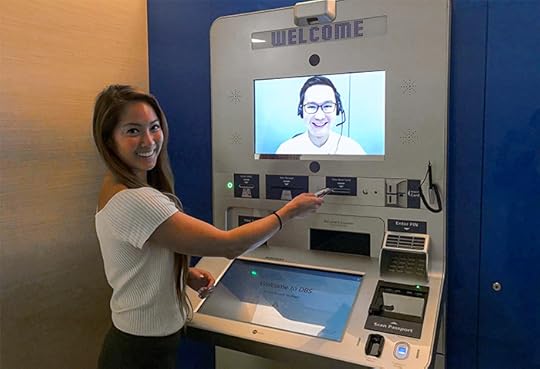 Next generation ATMs will be a tipping point for the banking industry
3.) Live human-robot ATMs
Bank tellers will be the telegraph operators of 21st century when we look back in 100 years.
The largest banks in the US have been investing millions in updating the capabilities and physical appearances of thousands of ATMs, an invention that turned 50 earlier this year.
As ATM capabilities grow, customers at bank branches will spend more time interacting with machines for their day-to-day needs, while bank personnel will move from behind the counter and focus more on complex transactions such as coordinating loans for homes or small businesses.
The next wave of ATMs with larger, digitally enabled screens akin to tablets will offer almost all of the services human tellers now provide as well as new capabilities like setting up cash withdrawals on your phone that you can be easily completed at a nearby ATM.
ATMs are already outfitted with more flexible denominations — $1, $5, and $10 bills instead of only $20 bill — and introduced cardless transactions, wherein customers can log in more securely just with their phone.
Very soon, having a remote conversation on an ATM with a live loan officer or bank executive to handle more complicated banking matters will make hanging on to most existing bank properties superfluous.
4.) The law of accelerating tipping points
Overall, customers interact with their banks an average of 17 times a month. Yet only two of those interactions involve human contact. In the U.S. only two out of 15 monthly bank dealings involve going to a branch.
JPMorgan Chase, which operates a network of more than 16,300 ATMs and 5,300 branches across the U.S., saw its teller transactions fall by 25% from 2014 to 2016.
In 2013, an Accenture survey found that 48% of Americans would switch banks if their current bank branch closed. In last year’s survey, that share shrank to just 19%.
Visiting a bank has increasingly become a long tail activity. Virtually every branch manager can describe a customer interaction that is impossible to cope with over a phone or online. But these edge cases are proving to be less of a compelling argument as online capabilities improve and attitudes change.
5.) Cryptocurrencies are paving the way for circumventionist thinking
If you’ve ever had a conversation with your bank about handling fractional cent micropayments, coming from a rapidly scaling online business where the transaction volume can approach hundreds of million per hour, you’ll quickly understand how ill-equipped today’s banking industry is in dealing with next generation business models.
Even though today’s cryptocurrency industry is deeply flawed, it has a way of pointing a glaring spotlight on the structural limitations buried in our existing bank infrastructure.
On one hand, stealing bitcoins is the perfect crime. No one has ever been convicted of stealing bitcoin and there are no bitcoin-cops or bitcoin-justice systems. A lost bitcoin is not recoverable.
However, national currencies are becoming increasingly dysfunctional. It’s no longer possible to use cash for many transactions like purchasing airline tickets, hotel rooms, or rental cars.
The idea of using a personal signature to secure a payment by check is fairly preposterous with our ability to use phones to copy and replicate nearly everything.
Massive data breeches have become a daily activity with headlines about Equifax, Chipotle, Gmail, Arby’s, Verizon, Yahoo, and Uber showing us how vulnerable we’ve become as a digital society.
With no perfect solutions to point to, we are left with a heavily regulated and rapidly decaying banking system whose days are clearly numbered and a fledgling and faceless cryptocurrency industry trying to usurp the power and authority of today’s banking elite.
 Is coexistence even an option?
Final Thoughts
Yes, we will still have banks for many years to come, but I have yet to come up with a compelling reason why we need so many branches and tellers.
If JPMorgan Chase, Bank of America, Wells Fargo, and Citigroup were all to close their branches tomorrow, what effect would that have on the financial health of the nation?
Besides the obvious loss of jobs and vacant real estate, how will this change the way business is done?
39% of bank customers like the idea of going bank-less, but that still leaves many who don’t.
With easy-to-use smartphones to manage most transactions and clickless payment systems like Uber, Lyft, and the Bodega vending machine, our need to interact with bank personnel is fading.
Bank closures are about to shift from linear to exponential, and to some this will be disconcerting. But in this transition we will find countless opportunities for new business and industry, and by 2030 we’ll be wondering why we ever needed them in the first place.
Author of “Epiphany Z – 8 Radical Visions for Transforming Your Future”
November 27, 2017
Giving the future a ‘hole’ new perspective

I often get asked the question, “How did you become a futurist?”
When I get this question, I know that the person asking is secretly thinking that being a futurist is one of the coolest professions of all times, which it is. And they want some concrete process for becoming a futurist, which there isn’t.
Becoming a futurist is really a calling. You are being called by the little voices in your head to spend slightly over 24 hours a day researching and thinking about the future. And if you run out of time, your only option is to build “time-expanders” into your day to unlock enough additional brain spectrum to complete whatever insights you’re working on.
Until now, the process I’ve used has always been a secret. I’ve been debating for years whether I should reveal my mysterious process. Usually the debate is taking place between the little voices in my head, but lately the arguments have grown so loud that that they wake me up at night.
For this reason, after several months belaboring the point, I have finally decided to reveal my secret methodology for understanding the future. So here it is. (Drum roll please.)
My secret to understanding the future comes from something I carry around in my pockets – my “holes.” Whenever I lack some level of understanding of the future, I simply reach for a “hole” to gain more clarity.
My First Encounter with Holes
I spent my childhood on the edge of reality.
On the outside, I looked like a perfectly normal child, but on the inside my brain was filled with all sorts of ideas that were so far out that I felt I could never talk about them. Whenever I tried, people started to laugh and ridicule me.
Most people use their sleep to find rest and rejuvenate their bodies. But I go to sleep to find my next adventure.
Long ago when I was 12 years old, I remember having a wrestling-match dream. This is one of those dreams that appeared so intensely real that it caused me to spend the entire night wrestling with bizarre concepts that were simultaneously insulting and revealing.
The dream I was having showed me how to make holes.
All night long I found myself making holes. One hole, after another, after another, and they were all different.
No, I wasn’t making holes inside of anything or through anything. Instead, I was making some sort of magical holes for later use.
Throughout my dream I was filling my pockets with ready-to-use holes, and these holes gave me powers – the power of perception, the power of discernment, and most importantly, the power to understand things that were previously not understandable.
Whenever I came to a closed door, I could simply pull out a hole and insert it into the door and I would see what was on the other side.
Whenever someone creepy was following me, I simply pulled out a hole, stretched it until it had reached the appropriate size, and threw it down on the ground so they would fall into it.
Everywhere I looked, I found more uses for my holes. I could look under things, I could see behind things, and if someone started arguing with me, I could even put holes in their arguments.
These holes that I was carrying in my pocket became my superpower. They became my muse, my ruminator, and my source of creative inspiration.

Charging fees on the information highway of life
Living with Gatekeepers
Being raised as a child of the 1960s, it seemed that everything I wanted to know was somewhere else.
Information was hidden, locked up, or protected by people whose job it was to prevent the rest of the world from seeing their information. The flow of ideas was being barricaded and imprisoned behind the walls of corporate and academic control, and only those who could afford it were granted the rights to see it.
The closest distance between me and all the things I desperately needed to know was through the gatekeepers that had positioned themselves along the information highway.
But my holes gave me the power to “see around” the gatekeepers.
Our greatest enemy in life has always been the “unknown.” Even today with vast improvements in communications technology, we are constantly being blindsided by things we don’t know.
We live in a cruel and unforgiving world. Yet we are continually being separated from the simple solutions that could prevent mass chaos and even death, by tollbooth operators whose job it is to extract payment from us for answers we don’t even know exist.
The Cost of Ignorance
According to the USGS National Earthquake Information Center, the death toll for earthquakes in 2010 was 226,729, with roughly 222,570 deaths occurring in Haiti, and the rest happening in Chili and Tibet.
2008 was a disastrous year in Myanmar (Burma) where over 140,000 people were killed by a single storm – Cyclone Nargis.
But each of these pale in comparison to the Great Chinese Famine from 1958-1961 where death toll estimates ranged from 15-43 million and the 1931 floods in China that killed somewhere between 1-4 million, more than anyone could count.
All of these disasters could have been greatly reduce if we had the ability to see the situation more clearly, and with a little forethought, move people out of harm’s way.
The cost of ignorance is staggering.
I find myself constantly wanting to ask Charles Darwin the question, “Why have we evolved so poorly?”
Ignorance is Bliss
Yet for all the wringing-of-hands and lamenting of our own limitations, there is also tremendous value in hiding behind the great unknown.
Hidden in the clock-ticking minutes before life’s greatest disasters are peaceful serene moments of people at their best – laughing, hugging, and giving generously of themselves.
Even after a disaster, before anyone knows the extent of the damage, we see people instantly transformed from people-helping-themselves into people-helping-people. We suddenly think “less about us” and “more about them.”
So while many have paid the ultimate price for our collective ignorance, we can also view ignorance as a blessing. In a world seeking balance, we cannot live at peace without experiencing the extreme polar opposite.
If we had a lens that could give us a clear understanding of the inner workings of the earth, how differently would we live our lives?

Every hole has a beginning, middle, and end, except for misalignment holes.
They’re everywhere and nowhere all at the same time!
The Complexity of the Hole
As I mentioned earlier, my toolkit as a futurist consists of pockets filled with magical holes.
Every time I peer through one of my holes, I gain a new perspective. In much the same way photographers change lenses on their cameras to gain a new perspective, my holes allow me to see the world with insights and revelations not afforded to others.
In this moment of full disclosure, revealing the secrets I once said would never be revealed, here are a few of the remarkable holes that I typically have poised and ready for use:
See-Through Hole: Perhaps the most useful of my holes is the one that enables me to see through walls, doors, and even inside metal file cabinets.
Movable Hole: Distance is relative when you have insight, but very often the answer you are seeking lies only a few inches away from the place you’re looking. That is why the movable hole is so valuable. Simply move the hole and you will find your answer.
Data-Encryption Hole: Sometimes I have to adjust the viewing angle of the hole, and even twist it a few times to bring it into focus, but even the best encryption is no match for a truly gifted hole-user.
Answer Hole: Behind every situation that causes us to ask “why,” is an answer. Staring through an Answer Hole is a very revealing experience when we know the right questions to ask.
Backward-Looking Hole: Too often what we think is in front of us is actually behind us. The real trick is to know whether to look forward or backwards.
Stretcher Hole: If your perspective is too small, the best option may be a stretcher hole to expand your thinking. However, in most cases, the perspective is far too big, requiring a much smaller hole to bring things into focus.
Nano Holes: The problem with nanotechnology is remembering where you put your work. The devil is always in the details and details are far smaller than most people can imagine.
Slow Hole: Very often the answers I am seeking are traveling far too fast, so a “slow hole” will slow things down to just the right speed.
Hidden-Agenda Hole: When trying to understand politics, few holes are more useful than the “hidden agenda hole.” Motivations and agendas are often layered into the complex intermeshed turmoil happening inside many of our decision-makers. This one takes practice because there is seldom just one agenda in play.
Future-Vision Hole: Today, as I spend time studying our relationship with the future, I love nothing more than being able to reach into my pocket, pull out a “future-vision hole,” and place it between me and this field of knowability that separates us from the future.
Now I know what you’re thinking. “Why do you get to use magical holes and not me?” and “If you really have magical holes, why are you wrong so much of the time?”
To answer your first question, these holes can be dangerous. As Stan Lee, creator of Spiderman once said, “With great power comes great responsibility.” Yes, I am taking a great risk even revealing these holes exist. So no, you can’t have them. And don’t ask me if you can borrow one because the danger is far too great.
As for the second question, I have never been granted the ability to see the entire big picture, just pieces of it. And my ability to extrapolate the missing pieces is often fraught with misdirects and misguided conjecture leading to wrong-headed conclusions.
What I am missing is the ability to create a hole-within-a-hole, a simultaneous big-picture, little-picture hole. There is exponentially greater power that can be unleashed with overlapping holes; ones that will enable me to have a backward-looking, future-vision hole that is concurrently stationary and movable, permanently square but with flexible, stretchable sides, combining the powers of fast and slow into a left-handed, right-handed multi-perspective hole that I can call upon on at a moment’s notice.
No, I don’t have that one yet, but I can always dream.
Author of “Epiphany Z – 8 Radical Visions for Transforming Your Future”
October 16, 2017
Turbulent times ahead for cities: 63 looming issues

Cities are in trouble.
Never before have we seen such a massive convergence of technologies affecting cities as profoundly as we see today.
The current retail apocalypse is just the tip of the iceberg as many cities in the U.S. are set to lose over 50% of their current revenue streams over the next couple decades.
At the heart of the problem is an overly complicated sales tax systems ill-equipped to bend, flex, and morph with the demands of our emerging culture. But it’s far more than just sales tax revenue that’s at stake.
Cities will soon be tasked with new responsibilities that require the dismantling of old systems, at the same time creating entirely new systems and new organizational structures, requiring new policies, new talent, and new methodologies.
Infrastructure will also change. Parking lots will give way to queuing stations, HOV lanes will give way to driverless-only lanes, and drone-landing pads will begin to spring up around every neighborhood.
Traffic cops will give way to drone command centers, schools will have to prepare for the arrival of driverless students, and zoning laws will have to be completely reworked.
Cities have most certainly been through large-scale transitions in the past.
From horse and buggy to cars
From ground-based transportation to airplanes
From cumbersome film-based photography to cameras everywhere
From wired phones to anywhere anytime wireless communications
From paper maps to GPS
Yes, cities already have all the tools at their disposal to make the necessary alterations and prepare for the coming changes. Some will view this as the opportunity that it truly is, tackling the problems before they occur. But others, best classified as the change-resistant majority, will be left far behind.
History will show this to be a great turning point with well-run cities not only rising to the challenge, but also tackling mega-projects that will define their place on the global stage.
 When you think about your city, what issues pose the greatest need?
63 unanswerable questions to help understand the problem
After traveling to dozens of countries, it has become clear that cities will need to establish their own priorities and plan their own approach. They pride themselves on their differences.
Consequently, there will be no one-size-fits-all solutions. Indeed, many will settle on similar “best practices” and find a number of common solutions, but each city will have make those determinations on their own.
The following questions are currently unanswerable, but will serve as a way of understanding the scope of changes on the horizon.
Disruptions from autonomous vehicles
With hundreds of companies staking their future on driverless technology, it seems inevitable that we are moving into an era of fully autonomous vehicles:
1. What percentage of the population will relinquish ownership of their vehicle in 5, 10, 15, and 20 years?
2. What percentage of road traffic will be fully autonomous vehicles in 5, 10, 15, and 20 years?
3. How long before we see driverless lanes and entire highways dedicated to driverless vehicles?
4. What provisions will be necessary to accommodate bicycles, motorcycles, skateboards, joggers, and other physically active people?
5. How long before we see the removal of traffic signs, stoplights, lane markers, etc.?
6. How many parking lots will disappear in 5, 10, 15, and 20 years?
7. What forms of transportation will always have drivers?
8. How will all these changes affect sales tax collection in your city?
Further implications from driverless vehicles
It’s important to begin thinking about how many industries get affected by driverless technology and their long-range implications.
9. At what age is it ok for a child to ride solo in an autonomous car?
10. How many car-related businesses (auto part stores, tire shops, brake shops, car washes, etc.) will disappear in 5, 10, 15, and 20 years?
11. How many car dealerships will disappear in 5, 10, 15, and 20 years?
12. What will happen to the price of gas, and the collection of gas tax, when consumers switch to electric vehicles?
13. With the transition to electric vehicles, all requiring frequent recharging, what addition loads will this place on our electric systems?
14. What changes will need to be made to highway infrastructure as we become increasingly dependent upon driverless systems?
15. How long until the last emissions testing center disappears?
16. How will Hollywood deal with “chase scenes” in the driverless car era?
Changes to local justice systems
Since a high percentage of every police force is dedicated to traffic control, often as much as 80%, we need to consider how this will affect staffing and revenue models for the future.
17. How will the number of traffic cops change over the next 5, 10, 15, and 20 years?
18. How will these changes affect the number of lawyers, judges, and DAs associated with traffic court?
19. How will a decreasing number of traffic violations affect city revenue in 5, 10, 15, and 20 years?
20. What new kinds of vehicles will spring to life in the driverless era and how will cities manage them?
 How will our transportation infrastructure change in the future?
Driverless delivery
As e-commerce grows, and our frequency of online purchases climbs from once-a-week, to dozens of times per day, the amount of delivery services will increase exponentially.
21. How will driverless trucks change the transport industry?
22. What segments of the trucking industry will be the first to make the transition to driverless transport?
23. What percentage of the trucking industry will employ driverless technology in 5, 10, 15, and 20 years?
24. With fewer, possible no drivers, will the trucking industry become a cheaper form of transport than trains?
25. How long before we see conductor-less trains?
26. How long before we see fully automated mail delivery?
27. How long before we see fully automated transfer of cargo between trains, ships, planes, and trucks?
28. Will driverless technology ever become as safe as the airline industry?
Disruptions from flying/driving drones
If we start with the scenario that sometime in the future every major city will have 50,000 drones flying overhead on a daily basis, many questions come to mind.
29. What will the city’s responsibility be for managing these drones?
30. When it comes to privacy, how close can drones fly to a home, business, or person?
31. How will the city handle drone-related complaints such as noise, snooping, menacing, etc.?
32. What criteria will be used to determine if a drone is “menacing?”
33. At what point will people/authorities have the right to shoot a drone out of the air?
34. At what point will people/authorities have the obligation to shoot a drone out of the air?
35. How long before most cities have their own fleet of drones?
36. How long before most police departments have their own fleet of drones?
Search engines for the physical world
Recent improvements in scanning and sensing technology has given us the ability to create digital models of the physical world. As we expand surveillance capabilities, with fleets of scanning drones used to both image and analyze data on a near-real-time basis, we can begin to imagine a new kind of search technology, designed around searching the physical world.
37. What type of scans would instantly be viewed as an invasion of privacy? (i.e. seeing through walls, clothing, etc.)
38. How long before we can scan and find a specific person, car, or drone with this type of search engine?
39. How long before we can track a person in real time?
40. Who will have access to the technology and resulting data?
41. What are the privacy/security issues that will arise?
42. If police departments become tasked with doing stalker reports, does this become a new responsibility for cities?
43. If search engines can spot key vulnerabilities, such as system flaws and infrastructure failure points, who will have access to this information?
44. What are some of the unintended consequences from this technology?

Driverless Mobile Businesses
The mobile food truck industry is paving the way for a much larger industry. Driverless mobile businesses, built on the frames of RVs, trucks, vans, and other large vehicles, will be reborn as traveling dental offices, tax preparation centers, hair salons, dog grooming parlors, chiropractic clinics, and retail storefronts. The number one challenge of traditional retail has always been driving customers to the store. As we move into a highly mobile marketplace, businesses can drive to where the customers already are.
45. With many overlaying and confusing taxing districts, how will merchants know the proper about of sales tax to charge for every new location?
46. Where will driverless mobile businesses be allowed to set up shop in each city?
47. Will there need to be a new type of business/vehicle classification system developed to regulate these businesses? (Just as we don’t allow porn shops to be built next to grade schools, we will probably need some sort of mobile location ordinances as well.)
48. How long before online sales reach 50% of all purchases in your city?
49. How long before sales from mobile businesses reach 10%, 15%, 20% or 25% of all purchases in your city?
50. Will mobile businesses increase or decrease traffic on the roads in 5, 10, 15, and 20 years?
Major failures
Emerging technology will take its toll on many existing businesses. Very often whenever a major business failure occurs, a city will be tasked with picking up the pieces.
Over the coming years we will see a number of extraordinary failures with complicated ownership issues in the background stalling redevelopment for decades. What provisions does your city have for managing the following kind of failures?
51. Hospitals
52. Colleges
53. Golf courses
54. Theme parks
55. Power plants
56. Airports
57. Shopping malls
58. Stadiums
 Every city will want postcard-perfect places to show the rest of the world
The City of the Future
Over 50% of the world’s population currently lives in urban areas, and that number will grow to 70% by the year 2050, according to the United Nations.
Today, there are 31 mega-cities – metropolitan areas with more than 10 million people – like Tokyo, Seoul, Delhi, Shanghai, Mexico City, Istanbul, Sao Paulo, Los Angeles, Moscow, and Cairo. By 2030, the UN predicts, there will be 41.
As the number of city dwellers rise, so do problems like overcrowding, pollution, housing shortages, and aging infrastructure. But with problems come opportunity and many cities will use this as an opportunity to leapfrog forward.
Gone are the days where people are impressed by projects costing $10-$50 million or even $100 million. We are witnessing an explosion in the number of $1 billion+ projects with many now exceeding $100 billion. Megaprojects are set to triple over the coming decades.
59. What are some of the mega-projects that will define the truly great cities of the future?
60. Is further urbanization a good thing or a bad thing?
61. What are the key components of urbanization that will demand the most attention?
62. What percentage of city workers will find their jobs disappearing in 5, 10, 15, and 20 years?
63. Will it be possible to retain current city employees and retrain them for new positions? What type of retraining will be necessary to make this happen?
 How will we build our cities in the future?
Final Thoughts
Rest assured, we’re only scratching the surface with these questions.
Each is designed to be a conversation starter. Even though the answers, for the most part, are unanswerable, every conversation will create a growing level of awareness, and taking appropriate action will not be far behind.
The role of the city is changing. While many are heavily invested in the near term race to label themselves a “smart city,” far greater challenges lie ahead.
With automation, the role of people is changing. In the future, relationships will still matter, but they will matter differently. Skills and talent will still matter, but they will matter differently. And our drive and purpose will still matter, but it will matter differently.
Even though much of today’s technology is giving us super-human abilities and virtually everyone can now think-faster, know-faster, and do-faster than ever before, every new technology requires skills, talents, and understandings that are hard to quantify.
The people of the world have an “unfinishable mandate” to continually stretch, grow, propagate, and master not only the world around us, but also the entire universe. And it all begins with rethinking our cities.
By Futurist Thomas Frey
Author of “Epiphany Z – 8 Radical Visions for Transforming Your Future”
September 27, 2017
Haptic Clothing: When our technologies become truly wearable

The fashion industry is only now waking up to the potential of haptic clothing that offers wearers a form of kinesthetic interaction between their bodies and their clothes.
The amount of communication that can happen through our sense of touch has long been overlooked because we didn’t have the micro technologies for both producing and testing the subtle tactile feedback loops needed to make it feel natural.
However with the emergence of nano-sized sensors, tactile stimulators, flex-gripper fabrics, and ultrasonic arousal pads we are now on the cusp of producing fully interactive clothing.
 Wearable technology woven into clothes
Over the past couple years we’ve seen an explosion of startups focused on smart haptic clothing:
At CES in January, Spinalli Design unveiled their version of smart jeans for the purpose of guiding you as you walk. For every left turn the left pant leg will buzz, and every right turn will yield a buzz on the right. Users will be comforted to know, wherever they go they’ll have a little GPS in their pants.
Spinalli also produces smart bikinis that tell wearers when they’re getting too much sun, as well as radiation-blocking underwear for men, lined with silver fibers to create electromagnetic shielding that protects the wearer’s testicles.
MadeWithGlove produces stylish gloves with biosensors woven into the material that is able to detect skin temperature and provide heat when needed.
WOW is a startup that produces high-tech gloves that can translate sign language into text or speech.
The Sensoree mood sweater comes with LED lights that change color like a mood ring. The designer envisions the sweater to be a great tool for people with sensory processing disorders ranging from ADHD to autism.
Wearable Experiments is an Australian company that uses haptics to help yoga aficionados know when to improve their form. Their Nadi X yoga tights have several sensors and vibration pads embedded in them at the hips, knees and ankles.
 Heated gloves with biosensors by MadeWithGlove
If you ask the average person on the street if they want haptic clothing, 99% will say no. But that’s like asking someone if they would prefer nylon over rayon. They know very little about it.
Eventually the technology becomes invisible and somehow it just feels better. With a little A.I. the clothing learns who you are, understands your pressure points, and simply learns how to be an extension of your own body. All other clothing will seem foreign.
Wearers won’t want to know how it works, just that it does.

Over time haptic clothing will become the memory behind muscle memory, the speed behind speed walking, and the snuggle behind snuggling in.
It will anticipate your needs and complement your desires. It will enhance your performance, promote your strengths, and give you super powers.
If you ask how many apps will end up in the app store for haptic clothing, it will in the tens if not hundreds of thousands. If you ask what the killer app will be for haptic clothing, it will fall into the category of “wants,” not “needs.”
With enough uses, haptic clothing will know you better than you know yourself. It will tell you what to do, when to do it, and how to get there.
It will allow you to enter the body of someone else, and feel what its like to be that person on a moment by moment basis.
It will become your lie detector, your bullshit detector, and your truth filter.
It will tell you when you’ve reached your limit, when to say no, and even say “no” for you when you’re no longer able to.
It will be your conscience, your mentor, your tutor, and your mom. It will act like an encyclopedia when you’re lacking knowledge, your thesaurus when you’re lacking words, and your smoke detector when something smells funny.
Haptic clothing will take you to places you’ve never been, be your guide on every adventure, and offer you new forms of protection you never thought possible.
If Dr. Seuss were alive today, his next book would be about the “Fraptic Loathings of Haptic Clothing.”
Personally, I can’t wait.
By Futurist Thomas Frey
Author of “Epiphany Z – 8 Radical Visions for Transforming Your Future”
[image error]
Thomas Frey's Blog

- Thomas Frey's profile
- 2 followers

